I fed the little Chihuahua every day, but he never looked at me—he only watched the road
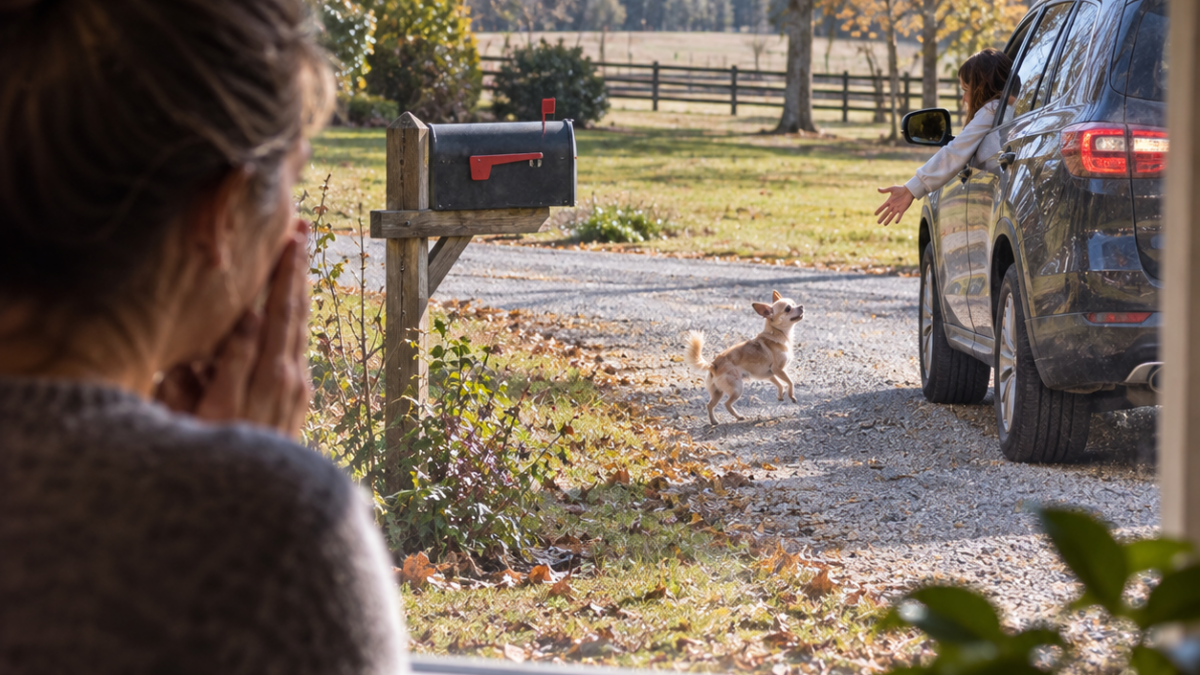
I was already moving before I realized I had left the kitchen.
By the time I opened my front door, Benny had crossed half the street.
He stopped when he saw me.
I stopped too.
Neither of us seemed to know what came next.
For twenty-six days, our relationship had consisted of bowls placed on pavement and conversations held across a distance he had chosen.
I had never touched him.
He had never crossed into my yard.
Now the little Chihuahua stood at the edge of my driveway with his ears lowered and his eyes fixed on me.
“Hi, sweetheart,” I said.
His tail did not move.
I crouched slowly.
My knees protested.
At eighty, nearly every part of my body had an opinion about crouching, but I ignored them.
“You don’t have to come.”
Benny stared at me.
Behind him, the front door of his old house remained closed.
He looked back once.
Then he stepped onto my driveway.
That was the first choice he made that did not involve waiting.
He approached in small stages.
Three steps.
Pause.
Two more.
Pause.
When he finally reached me, he stopped just outside my hands.
His coat smelled faintly of rain and dust.
A faded red collar hung loosely around his neck.
There was no tag.
Only a metal ring where a tag must once have been.
I held out my fingers.
Benny sniffed them.
Then he walked past me.
Straight through my open front door.
I stood there for a second, surprised.
“Well,” I whispered.
Then I followed him inside.
He reached the middle of my living room and stopped.
The room must have seemed strange after nearly a month outdoors.
Soft carpet.
The old clock ticking on the wall.
The smell of coffee and furniture polish.
Photographs everywhere.
My husband’s leather chair in the corner.
Benny turned slowly as though taking inventory.
Then he walked to the far side of the sofa, curled against the baseboard, and lowered his head onto his paws.
He sighed.
It was not the contented sigh dogs make before falling asleep.
It sounded like something inside him had finally collapsed.
I closed the front door.
That sound made his ears twitch.
For one terrible second, I thought I had frightened him.
So I opened it again.
Benny looked toward it.
He could leave.
I wanted him to understand that immediately.
“This isn’t a trap,” I told him.
He remained where he was.
I left the door open for almost an hour.
He never moved toward it.
Eventually, I closed it again.
That first day, Benny did not eat.
I placed a small bowl of chicken beside him.
He sniffed once, then turned away.
He drank water only after dark.
I know because I heard his nails clicking across the kitchen floor at two in the morning.
I remained in bed.
Some instinct told me that watching him would make things harder.
The next morning, his food was untouched.
I replaced it.
He ignored the new bowl too.
The same thing happened the following day.
By the third evening, I was worried enough to call my veterinarian.
Technically, Benny was not my dog.
Not yet.
Maybe not ever.
But I did not know what else to call him.
Dr. Patel had treated the spaniel Benjamin and I owned years earlier.
When I explained what had happened, he was silent for several seconds.
“Has he eaten anything at all since coming inside?”
“No.”
“Is he drinking?”
“A little.”
“Vomiting?”
“No.”
“Diarrhea?”
“No.”
“Is he alert?”
“If staring at the front door counts.”
He sighed.
“Elizabeth, bring him in tomorrow if you can.”
“I don’t know if he’ll let me put him in the car.”
“Don’t force him tonight. Try food again. Something warm and fragrant.”
“What if he still refuses?”
“Then call me in the morning.”
I warmed chicken broth.
Benny lifted his head when the smell reached him.
For one hopeful second, I thought he would stand.
He did not.
I placed the bowl nearby.
Then, instead of going back to the kitchen, I sat on the carpet.
It took some effort.
Getting down was easier than getting up.
Benny watched me.
“Benjamin hated sitting on the floor,” I told him.
His ears moved slightly.
I had not spoken my husband’s name aloud to the dog before.
Maybe that was the moment I finally admitted why I had called him Benny in my thoughts.
“My husband,” I continued.
“Benjamin.”
Benny’s eyes remained on me.
“He said floors were for children, dogs, and people trying to fix the television.”
I smiled.
“He was seventy-eight when he died, and he still refused to admit his knees hurt.”
Benny blinked.
I reached toward him, then stopped before touching him.
“I suppose you two would have gotten along.”
I sat there for nearly an hour.
Eventually, I went to bed.
In the morning, half the broth was gone.
So was a small piece of chicken.
I cried over an empty bowl.
That became our first routine.
Every morning, I made coffee.
Then I sat on the floor beside Benny.
Sometimes I talked.
Sometimes I read.
Sometimes I simply existed near him.
I began keeping a cushion beside the sofa because my hips were becoming tired of our arrangement.
Benny never seemed impressed by my sacrifice.
The fourth day, I touched his back.
Only for a second.
His body tightened beneath my hand.
I removed it immediately.
“Okay.”
The next morning, I tried again.
He allowed two seconds.
On the sixth day, I stroked his back from shoulder to tail.
He did not relax, but he did not move away.
At the end of the first week, he ate an entire meal.
It was barely half a cup, but I called Dr. Patel afterward as if Benny had won a championship.
“He ate everything.”
“Good.”
“Every bite.”
“That’s very good.”
“Should I bring him in now?”
“Yes.”
“I thought you would say that.”
Getting Benny into the car became our first disagreement.
The moment I clipped an old leash onto his collar, he froze.
I had found the leash in my garage.
It belonged to Charlie, the cocker spaniel Benjamin and I had owned nearly fifteen years before.
I had forgotten I still had it.
The hook clicked against Benny’s collar.
He looked toward the front door.
Then toward me.
His whole body changed.
“No,” I said gently.
“We’re coming back.”
He did not understand.
Of course he did not.
People imagine words can repair trust if we say them softly enough.
They cannot.
Trust comes from what happens after the words.
So I opened the front door and waited.
Benny stood in the hallway.
The mailbox across the street was visible from where he stood.
His eyes locked onto it.
I felt the leash go slack.
For a long time, neither of us moved.
Finally, Benny stepped outside.
He walked to the edge of the porch.
Stopped.
Looked at the road.
Then looked at me.
I did not pull.
After nearly a minute, he followed me toward the car.
At the clinic, Dr. Patel examined him carefully.
Benny weighed just over six pounds.
Too thin, but not dangerously so.
He had mild dehydration, irritated paw pads, and several small bald patches where the collar had rubbed against his neck.
No microchip.
No identification.
No serious disease.
“He’s lucky,” Dr. Patel said.
I looked at Benny standing on the examination table.
“He doesn’t seem to think so.”
Dr. Patel rubbed beneath his chin.
Benny allowed it.
“He’s probably grieving.”
“Dogs grieve?”
“Of course.”
“For people who left them?”
Dr. Patel looked at me.
“Love doesn’t always disappear when someone proves they didn’t deserve it.”
That sentence stayed with me.
I paid for Benny’s examination.
When the receptionist asked for an owner’s name, I hesitated.
“Put mine.”
She looked up.
“Elizabeth Warren?”
“Yes.”
It felt strange seeing my name beside his.
On the drive home, Benny stood on the passenger seat and watched the road.
Every turn made his body tense.
When I turned onto our street, he recognized it immediately.
He pressed his nose against the window.
My heart sank.
He probably thought we were returning him to his old house.
I parked in my driveway.
Benny stared across the street.
The new family had unpacked more boxes.
A bicycle lay on the lawn.
Curtains had appeared in the upstairs windows.
Different curtains from the ones Benny had watched every day.
I opened the car door.
He jumped down.
For a moment, he stood facing the mailbox.
Then he turned toward my porch.
Not the mailbox.
My porch.
He walked to the front door and waited.
I nearly dropped my keys.
“Okay,” I whispered.
“Okay, sweetheart.”
That evening, Benny ate dinner.
Afterward, he returned to his corner.
But he faced the room instead of the wall.
Progress arrived in measurements that small.
At the start of the second week, he began exploring.
First the living room.
Then the kitchen.
Then the hallway.
He moved carefully, nose low, ears rotating at every sound.
My house had been quiet for four years.
Too quiet.
After Benjamin died, I left many of his things exactly where he had last used them.
His chair remained beside the lamp.
His coat still hung in the hall closet.
His favorite coffee mug sat at the back of a cabinet because I could not bear to use it or throw it away.
Grief is strange that way.
You can believe you have moved forward while building tiny museums everywhere you live.
Benny discovered Benjamin’s chair on the tenth day.
He sniffed the leather.
Walked around it twice.
Then sat beside it.
I was standing in the kitchen doorway.
“That was his.”
Benny looked at me.
I walked closer.
“My husband’s.”
Benny sniffed the chair again.
Then he lay beneath it.
That became his new sleeping place.
For several nights, he abandoned the corner beside the sofa and slept under Benjamin’s chair.
I did not know what he smelled there.
Leather.
Dust.
Maybe traces of a man who had been gone four years.
Maybe nothing.
But the sight of Benny curled beneath that chair did something to me.
I started speaking to him more.
Not baby talk.
Not the nonsense people sometimes use with dogs.
I talked to Benny the same way I had once talked to Benjamin while cooking.
“Mrs. Harrison called again.”
Benny’s ears moved.
“She says the maple tree is leaning toward her roof.”
I stirred soup.
“It is not.”
Benny watched.
“She has been saying that tree is falling for fourteen years.”
He blinked.
“Your predecessor agreed with me.”
I began referring to Benjamin that way.
Your predecessor.
It made me laugh.
The first time I laughed while saying it, Benny raised his head sharply.
The sound startled both of us.
I had not heard myself laugh like that in a long time.
At the end of the second week, Benny approached me on his own.
I was in Benjamin’s chair reading.
He had been lying near the fireplace.
Suddenly, I heard the soft click of his nails.
He walked across the room.
Stopped beside my slipper.
Then sat.
I lowered my book.
“Hello.”
Benny leaned forward.
Slowly, carefully, he placed his chin on my knee.
I stopped breathing.
His body remained on the floor.
Only the small weight of his head rested against me.
I placed my hand behind his ears.
He did not flinch.
I stroked him once.
Then again.
His eyes closed.
That was when I started crying.
I tried to do it quietly.
Ridiculous, I know.
As if tears might embarrass a Chihuahua.
One landed on the back of my hand.
Benny lifted his head.
He looked at me.
Then he licked the tear from my fingers.
One quick swipe of his tongue.
And placed his head back on my knee.
“I miss him,” I whispered.
Benny stayed.
That afternoon, we sat together until the sun disappeared from the windows.
At the beginning of the third week, Benny wagged his tail.
It happened over toast.
I dropped a corner of mine.
Benny was beneath the kitchen table.
His tail moved once.
Barely.
A tiny flick against the floor.
I saw it.
He saw me see it.
I did not celebrate.
That would have embarrassed us both.
Instead, I broke off another piece of toast.
“For scientific confirmation.”
The tail moved again.
I smiled.
By then, the new family across the street had learned about him.
The woman, whose name was Rachel, knocked on my door one afternoon.
Benny barked once from beneath Benjamin’s chair.
Not joyfully.
Not aggressively.
Just enough to announce that someone was there.
I opened the door.
Rachel stood on the porch holding a small cardboard box.
“Mrs. Warren?”
“Elizabeth is fine.”
“I’m Rachel. We bought the house across the street.”
“I know.”
She looked uncomfortable.
“I wanted to ask about the dog.”
Benny had moved behind my legs.
“He’s here.”
“I figured.”
She crouched slightly but did not reach toward him.
“Our realtor explained what happened after we moved in.”
I said nothing.
“She said the previous owners left him.”
“Yes.”
Rachel’s face tightened.
“I don’t understand that.”
“Neither do I.”
“My son keeps asking if he’s ours because he was at the house.”
“He isn’t.”
“I know.”
She hurried to clarify.
“I mean, I told him that. I just… I feel terrible.”
“You didn’t leave him.”
Rachel looked toward the street.
“He ran toward us that morning.”
“I saw.”
“We thought he belonged to a neighbor.”
“He thought you were someone else.”
Her eyes filled.
“I know that now.”
She held out the box.
“I found these in the garage.”
My stomach tightened.
“What?”
She opened it.
Inside was a small dog bed.
Blue fabric.
Flattened in the middle.
A ceramic bowl decorated with bones.
And a green cloth harness.
Benny smelled the box before I did.
His body froze.
He stepped forward.
Then stopped.
Rachel lowered it carefully to the porch.
“He recognizes them.”
“Yes.”
“There was also this.”
She pulled out a yellow rubber ball.
Benny’s ears lifted.
He moved closer.
He sniffed the ball.
Then the harness.
Then the bed.
His breathing changed.
I felt my heart break all over again.
Objects remember for us.
That is not literally true, of course.
But sometimes it feels true.
A worn bed can contain a whole household.
A collar can carry the shape of years.
A bowl can hold the memory of someone saying dinner.
Benny placed one paw against the edge of the bed.
Then withdrew.
Rachel wiped her cheek.
“They left all of it.”
“I see that.”
“Do you want me to throw it away?”
Benny sniffed the ball again.
“No.”
I lifted the box.
“I’ll take it.”
That evening, I placed the bed beside Benjamin’s chair.
Benny circled it twice.
Then walked away.
I expected him to sleep there.
He did not.
He slept beneath my chair instead.
The next morning, the yellow ball was gone.
I found it in the kitchen.
Benny had carried it there during the night.
That ball became the first thing from his old life he chose to keep.
The bed remained unused.
The harness remained in the box.
I washed the bowl and placed it beside the new one I had bought.
He drank from it occasionally.
But the ball became his.
At the beginning of the fourth week, Benny brought it to me.
I was folding towels.
He appeared in the doorway with the yellow ball in his mouth.
I stared.
He walked closer.
Dropped it at my feet.
Then looked at me.
“You want me to…?”
Benny looked at the ball.
I picked it up.
His ears rose.
I tossed it gently down the hallway.
He ran.
Not quickly at first.
Three little hops.
Then faster.
He grabbed the ball.
Turned around.
For a second, I saw the dog he must have been before the mailbox.
Bright eyes.
Ears high.
Tail moving.
He ran back.
Dropped the ball.
I threw it again.
He chased it again.
By the fifth throw, I was laughing.
By the tenth, Benny was racing so enthusiastically that he slid on the kitchen rug.
He recovered with great dignity.
I laughed harder.
He barked.
One high, sharp Chihuahua bark.
The same voice I had first heard when he thought his family had returned.
But this time the sound held no desperation.
Only excitement.
We played until my throwing arm became tired.
That night, Benny climbed onto the ottoman beside my chair.
He turned three circles and curled into a ball.
I rested one hand on his back.
He sighed.
The sound was similar to the sigh he had made during his first night in my living room.
But now his muscles softened beneath my palm.
Peace has a different weight from surrender.
I was beginning to understand the difference.
The first real walk came several days later.
Until then, we had gone only into the yard.
Benny did his business quickly, then returned inside.
I bought him a new harness because I refused to use the green one his old family had left behind.
Maybe that was petty.
Dogs do not understand symbolism the way humans do.
Still, I wanted one thing that belonged only to this life.
The new harness was navy blue with a soft padded chest.
I left it beside his food bowl for two days.
He sniffed it.
Ignored it.
Eventually, he allowed me to put it on.
When I opened the front door, he stepped onto the porch.
The mailbox was visible.
Benny froze.
I stopped beside him.
Across the street, Rachel was pulling weeds.
She noticed us but did not wave.
I appreciated that.
Benny stared toward his old house.
The mailbox.
The driveway.
The porch.
His whole body seemed to tighten around a memory.
I wanted to tell him not to look.
I wanted to lead him away.
Instead, I waited.
One minute.
Maybe two.
Then Benny turned his head.
He looked at me.
His eyes stayed on mine for several seconds.
I took one step toward the sidewalk.
He followed.
We walked past his old driveway.
He slowed.
But he kept moving.
We reached the corner.
That was where he had stopped twenty-six days earlier while chasing the departing car.
I recognized the maple tree.
So did he.
Benny stood beneath it and looked down the empty road.
I thought we might stay there all afternoon.
Then a squirrel ran across the grass.
Benny’s head snapped around.
The squirrel climbed an oak.
Benny stared.
His tail twitched.
He took three quick steps toward it.
“Traitor,” I told the squirrel.
Benny glanced at me.
Then we continued toward the park.
He did not look back.
Our world expanded quickly after that.
First the park.
Then two blocks farther.
Then the small coffee shop where dogs were allowed on the patio.
The owner, Marcy, began keeping tiny biscuits behind the counter.
Benny learned this within one visit.
By the third week of our walks, he was pulling me gently toward the café every morning.
“You have become financially motivated,” I told him.
Marcy laughed.
“He knows what he wants.”
“He could teach me something.”
“Maybe he already has.”
I looked down at Benny.
He was sitting beside my shoe waiting for his biscuit.
Maybe she was right.
Before Benny, my days had become very small.
I had not noticed when it happened.
After Benjamin died, friends visited.
Then less often.
My daughter called from Arizona every Sunday.
My son lived forty minutes away and came twice a month.
People invited me places.
I declined.
At first because I was grieving.
Later because I had developed the habit of declining.
Grief can disguise itself as routine if you give it enough time.
I drank coffee.
I watered my plants.
I bought groceries on Thursdays.
I watched television.
I slept.
I told everyone I was fine.
Then Benny arrived and needed breakfast.
He needed walks.
He needed veterinary appointments.
He needed someone to throw the yellow ball.
Suddenly, morning was not just the part of the day before afternoon.
It was when Benny woke me by standing beside the bed.
No barking.
No whining.
Just staring.
The intensity of a Chihuahua’s stare at six-thirty in the morning should be regulated by law.
I would open my eyes.
Benny’s tail would begin moving.
“Five more minutes.”
Tail.
“Three.”
Tail.
“One?”
More tail.
“All right.”
He would race toward the kitchen.
I followed.
By the seventh week, he no longer slept beneath Benjamin’s chair.
He slept beside my bed.
Then, without asking permission, he upgraded to the bed itself.
The first night he did it, I woke at two in the morning because six pounds of Chihuahua had somehow taken up half a queen mattress.
I moved him.
He sighed dramatically.
“You have the body mass of a loaf of bread.”
He stretched sideways.
“And the spatial needs of a horse.”
He ignored me.
In the morning, I woke with his back pressed against my ribs.
I had not slept beside another warm body in four years.
I lay still for a long time.
Benny was breathing quietly.
For once, he was not waiting for anything.
Neither was I.
A month after Benny came inside, animal control called.
They had reached the previous family.
I sat at the kitchen table while Benny chewed the yellow ball near my feet.
“What did they say?”
The officer hesitated.
“They confirmed he was theirs.”
My fingers tightened around the phone.
“And?”
“They said they couldn’t take him to the new property.”
“They left him beside the road.”
“They described it as… a difficult decision.”
I laughed once.
It did not sound pleasant.
“Did their difficult decision include telling anyone?”
“No.”
“Did they surrender him?”
“No.”
“Did they arrange care?”
“No.”
“No.”
The officer sighed.
“Mrs. Warren—”
“Elizabeth.”
“Elizabeth, I understand you’re upset.”
Benny looked at me.
I lowered my voice.
“What happens now?”
“They’ve relinquished ownership.”
I looked down.
Benny had stopped chewing.
He was watching my face.
“Relinquished.”
“Yes.”
“They signed something?”
“Yes.”
“So legally…?”
“If you want to adopt him, we can transfer ownership once we complete the paperwork.”
I was quiet.
The officer must have mistaken my silence.
“You don’t have to.”
“I know.”
“We can place him through rescue if necessary.”
Benny stood.
He came to my chair.
Put one paw against my slipper.
“No.”
“Excuse me?”
“He’s staying.”
The answer came so easily that I almost laughed.
“He’s staying with me.”
Two days later, a woman from animal control arrived with forms.
I signed my name beside Benny’s.
His legal name was unknown.
They had a different name listed from the original owners.
I looked at it once.
Then covered it with my hand.
I never used it.
Perhaps somebody will think that was unfair.
Maybe a dog should keep the name he grew up with.
But that name belonged to people who left him waiting.
Benny was the name he had when he finally crossed the street.
It belonged to this part of his life.
The officer asked, “You want to keep Benny as his official name?”
“Yes.”
“Middle name?”
I stared at her.
“Dogs have middle names?”
“Some owners add one.”
Benny sat beside me.
I smiled.
“Benjamin.”
The officer looked at me.
“Benny Benjamin?”
I laughed.
“No. Just Benny is fine.”
After she left, I placed his adoption paperwork in the drawer where I kept important documents.
My marriage certificate was there.
Benjamin’s death certificate.
The deed to the house.
Insurance policies.
And now Benny’s papers.
That evening, I told him he was officially mine.
He brought me the ball.
Apparently he considered legal ownership less interesting than fetch.
Summer arrived.
Our mornings moved to the porch.
I drank coffee.
Benny lay in the sun.
Sometimes he looked toward the house across the street.
But the looks changed.
At first, he stared for minutes.
Then seconds.
Eventually, he looked the way any dog might look at movement.
A door opening.
A child running.
A car leaving.
Nothing more.
Rachel’s daughter, Sophie, became Benny’s friend.
She was nine.
The first few times she approached, Benny hid behind my chair.
Sophie never chased him.
She sat on the grass and read books aloud.
I suspect Rachel told her to do that.
Within a week, Benny began sitting five feet away.
Then three.
Then beside her.
By August, Sophie came every Saturday with a library book and read to him on the porch.
Benny understood none of Charlotte’s Web, but he listened politely.
One morning Sophie asked me, “Do you think he still misses them?”
Children ask questions adults spend too much time avoiding.
“Yes,” I said.
“Even after they left him?”
“Yes.”
“Why?”
I looked at Benny.
“Because loving someone and understanding what they did are different things.”
Sophie frowned.
“That doesn’t seem fair.”
“It isn’t.”
“Does he like us more now?”
I smiled.
“I don’t know if love works like keeping score.”
She considered this.
Then scratched Benny’s chin.
“He should.”
I laughed.
“He probably agrees.”
The seasons changed.
Autumn came.
Benny discovered leaves.
For a dog that had spent nearly a month sitting beside a mailbox, he developed an astonishing enthusiasm for chasing dry leaves.
Wind would send them skittering down the sidewalk.
Benny pounced as if each one had personally insulted him.
Sometimes he caught them.
Sometimes the wind won.
I began walking farther because he wanted to.
My doctor noticed.
At my annual checkup, she looked at my chart.
“You’ve lost seven pounds.”
“Is that bad?”
“Not at all. Your blood pressure is better too.”
I pointed at Benny, who was waiting in the lobby with my son.
“His fault.”
My doctor smiled.
“You got a dog?”
“He got me.”
That was how I began telling the story.
Not that I rescued Benny.
Not that I adopted Benny.
He got me.
Because by then I understood something uncomfortable.
I had been waiting too.
Not at a mailbox.
But in every way that mattered.
After Benjamin died, I had built my life around absence.
His chair.
His mug.
His coat.
The empty side of the bed.
I was loyal to what had been.
So loyal that I barely noticed what still was.
My children.
My neighbors.
Summer mornings.
Coffee on the porch.
A yellow ball.
A ridiculous six-pound Chihuahua who considered squirrels a national emergency.
Benny did not erase Benjamin.
That was not the point.
He taught me that continuing to live is not betrayal.
One evening in October, I opened the hall closet.
Benjamin’s coat was hanging where it had hung for four years.
Brown wool.
One button loose near the bottom.
I touched the sleeve.
Benny sat behind me.
For years, I had avoided moving it because some irrational part of me believed that leaving everything unchanged honored my husband.
That night, I took the coat down.
I held it against my chest.
I cried.
Then I folded it and placed it in a donation box.
Benny watched.
“You don’t understand any of this.”
He tilted his head.
“Lucky you.”
He followed me to the garage.
The next morning, I donated the coat.
I kept Benjamin’s mug.
I kept photographs.
I kept his watch.
Moving forward did not require emptying the past.
It required making room beside it.
Winter was harder for Benny.
Cold mornings reminded him of the mailbox.
I knew because the first snow changed his behavior.
He stepped outside.
Saw the white street.
Stopped.
His ears lowered.
I remembered the nights I had watched him shiver beside that mailbox.
I crouched.
“Home’s behind you.”
Benny looked at me.
I pointed toward the open door.
“See?”
Warm light spilled across the porch.
His bed was visible inside.
His water bowl.
The yellow ball.
Benny turned.
He walked back into the house.
Then he returned carrying the ball.
I laughed.
“Fine.”
We played fetch in the hallway instead.
Christmas arrived.
The first Christmas since Benjamin’s death that I decorated the whole house.
Not just a wreath.
A tree.
Lights.
The wooden angel my husband always complained leaned crooked.
Sophie helped.
My son brought dinner.
My daughter flew in from Arizona.
Benny received four toys, two sweaters, three bags of treats, and an unreasonable amount of attention.
At some point during dinner, my daughter found the box Rachel had brought from Benny’s old house.
“What is this?”
“His old things.”
She lifted the green harness.
Benny saw it.
He walked over.
Sniffed.
Then walked away.
My daughter looked at me.
“Do you keep this for him or for you?”
I stared at the harness.
I had not thought about that.
The old dog bed was still in the spare room.
Unused.
The ceramic bowl remained beside his newer one, though he preferred stainless steel.
The harness lay in the box.
Only the yellow ball had become part of his new life.
Maybe the rest were not memories he needed.
Maybe they were evidence I could not yet throw away.
That night, after everyone left, I sat on the floor with the box.
Benny lay beside me.
I took out the bed.
“Want this?”
Nothing.
The bowl.
Nothing.
The harness.
Benny sniffed it, then looked away.
I held the yellow ball.
His ears lifted instantly.
I laughed.
“So that’s your vote.”
The next morning, I donated the bed and bowl to a local rescue.
I threw the harness away.
Benny kept the ball.
That seemed right.
Not every object from the past needs to be preserved.
Sometimes you keep one thing.
Sometimes one is enough.
January marked six months since he crossed the street.
I realized it because Rachel mentioned the date.
“You know it’s been half a year?”
We were standing near the mailbox.
Her mailbox now.
The mailbox where Benny had once waited.
Benny was sniffing the edge of the sidewalk.
“Already?”
She nodded.
“Do you think he remembers this spot?”
I looked at him.
“Probably.”
Benny lifted one leg and urinated on the post.
Rachel burst out laughing.
“Well.”
“I believe that’s closure.”
We laughed so hard I had to hold her arm.
Benny looked pleased with himself.
In spring, the old yellow ball finally split.
I found Benny in the kitchen with half of it in his mouth.
“No.”
He ran.
At eighty-one, I was forced to chase a Chihuahua through three rooms to prevent him from swallowing rubber.
I won.
Barely.
Benny stood glaring while I held the ruined ball.
“I know.”
He whined.
“You can’t eat it.”
He whined louder.
“That argument lacks evidence.”
His ears dropped.
I looked at the ball.
It was the only thing he had carried forward from his old home.
For some ridiculous reason, throwing it in the trash felt cruel.
So I washed it.
Dried it.
Placed it in the top drawer of my desk.
Benny watched the entire process.
Then I bought six new balls.
He chose an orange one.
Within ten minutes, the old yellow ball had been forgotten.
I kept it anyway.
That one was for me.
Not him.
By the first anniversary of Benny’s arrival, he had become known throughout the neighborhood.
Children stopped to greet him.
Marcy at the café served his biscuit before making my coffee.
The mail carrier knew not to step backward when Benny barked because he would interpret retreat as victory.
Rachel’s husband kept treats in his truck.
Sophie still read to him.
The animal control officer who had first tried to catch him visited once.
Benny allowed her to scratch his ears.
She looked at me.
“He looks different.”
“He is.”
She shook her head.
“I never thought he’d leave that mailbox.”
“Neither did I.”
Benny sat beside my shoe.
The officer smiled.
“Good thing he did.”
Later that evening, I sat on the porch watching sunset.
The sky turned orange behind the maple trees.
Benny lay across my feet.
I thought about the first morning.
The moving truck.
His tiny body running after a car that did not stop.
Twenty-six days of rain, cold, traffic, hunger, and hope.
Then another car.
Another family.
Another disappointment.
For a long time, I had believed the saddest moment of Benny’s life was when those strangers walked into the house and shut the door.
Now I wondered if it had also been the moment everything changed.
Not because abandonment was good.
It was not.
Pain does not become noble simply because something better happens afterward.
But Benny had spent twenty-six days convinced that the only future worth having was the return of his past.
That closed door forced him to turn around.
And when he did, he saw me.
Or maybe he had seen me all along.
Maybe I was the one who had not understood.
I rubbed his ears.
“Benny.”
He looked up.
“You’re my home now.”
I felt silly as soon as I said it.
People make grand statements to dogs because dogs rarely interrupt.
Benny stood.
For one second, I thought he was leaving.
Instead, he climbed into my lap.
Getting six pounds of Chihuahua onto an eighty-one-year-old woman’s lap is not dramatic.
But he treated it like a mountain expedition.
Front paws.
Hind paws.
Turn twice.
Then he pressed his chest against mine and rested his head beneath my chin.
I wrapped my arms around him.
His heartbeat was fast.
Mine was slower.
Two different rhythms.
Same porch.
Same evening.
For years after Benjamin died, people told me I still had a home.
They were technically correct.
I had a roof.
Furniture.
Forty years of memories.
But a house can become a waiting room if the person inside it stops expecting anything new.
Benny changed that.
A year became two.
Benny’s muzzle grew whiter.
He remained suspicious of delivery trucks.
I could hardly blame him.
He developed arthritis in one knee.
Dr. Patel prescribed medication.
He hated taking it.
I hid pills in cheese.
Benny learned to eat the cheese and spit the pill onto the floor.
Our relationship became an arms race.
Eventually, I switched to peanut butter.
Victory.
At ten years old, Benny still chased squirrels.
Not successfully.
Never successfully.
But optimism is apparently hereditary in Chihuahuas.
At night, he slept beneath the blankets beside me.
Sometimes I woke and placed my hand against his side just to feel him breathing.
I wondered if he did something similar.
He always woke when I left the room.
If I went to the bathroom at three in the morning, he followed.
If I walked to the kitchen, he followed.
If I went onto the porch, he followed.
At first I worried it was anxiety.
Dr. Patel smiled.
“Some of it probably is.”
“That doesn’t make me feel better.”
“But some dogs also just like knowing where their person is.”
“His person.”
“Yes.”
The words warmed me every time.
One summer afternoon, I tripped in the garden.
Nothing dramatic.
My shoe caught the edge of a paving stone.
I fell onto the grass.
The breath left my lungs.
Before I could sit up, Benny was barking.
Not his squirrel bark.
A sharp, repetitive alarm.
Rachel came running from across the street.
“Elizabeth!”
“I’m fine.”
“You’re on the ground.”
“Observant.”
She helped me sit.
Benny climbed onto my leg.
He sniffed my face frantically.
“I’m okay.”
Rachel frowned.
“You’re going to the doctor.”
“I’m eighty-two. If I went to the doctor every time gravity reminded me who was in charge, I’d live there.”
“You’re going.”
She won.
I had bruising but no broken bones.
When I returned home, Benny stayed pressed against me for hours.
That night, I realized our roles had changed again.
I had once watched the street to make sure he survived.
Now he watched me.
Not because he expected me to abandon him.
Because I mattered.
There is a difference.
On the second anniversary of his adoption, Sophie gave me a framed photograph.
It showed Benny sitting on my porch.
I was behind him holding coffee.
Neither of us was looking at the camera.
Beneath the photo, she had written:
HOME IS WHO STAYS.
I cried.
Sophie panicked.
“Do you hate it?”
“No.”
“Then why are you crying?”
“Because adults are badly designed.”
She accepted that answer.
The frame went on my mantle beside my wedding photograph.
Benjamin on one side.
Benny on the other.
Past and present did not fight.
They sat together.
That was something Benny had taught me too.
Love is not a room with one chair.
A new love does not evict an old one.
It simply asks you to make space.
Years passed.
Not many.
Enough.
At twelve, Benny slowed.
His hearing became less sharp.
His eyes developed the faint cloudy haze of age.
He still recognized the sound of the treat jar from two rooms away, proving selective hearing exists across species.
His walks grew shorter.
We no longer went to the park every morning.
Sometimes we walked only to the maple tree at the corner.
The same tree beneath which he had once watched his family disappear.
Benny no longer stopped there.
He sniffed.
Peed on something.
Moved on.
I thought about how places lose their power when enough new memories are built around them.
The corner had once been the edge of his world.
Now it was simply where Mrs. Harrison’s cat sometimes hid.
The mailbox changed too.
Rachel replaced it after a snowplow damaged the old one.
When I watched the workers remove it, I felt unexpectedly emotional.
That mailbox had become part of Benny’s story.
Then I realized Benny was asleep inside my house and did not care.
Again, dogs are often wiser.
They do not worship landmarks of suffering.
We do that.
They live.
When Benny turned thirteen, my daughter asked whether I wanted to move closer to her.
“You shouldn’t be alone out there,” she said.
I looked down at Benny.
“I’m not alone.”
“You know what I mean.”
I did.
My house had stairs.
Winters were difficult.
Driving at night had become harder.
My daughter had a guest suite.
She wanted to help.
But leaving the house frightened me.
Not because of the building.
Because of the life Benny and I had created there.
Morning coffee on the porch.
Walks past the old mailbox.
The chair.
The kitchen.
The hallway where he first chased the yellow ball.
Then I remembered something.
Waiting is not living.
Home is not the place where you stay because leaving feels frightening.
I asked my daughter one question.
“Can Benny come?”
She laughed.
“Mom, I knew better than to ask otherwise.”
We did not move to Arizona.
I was not ready for that much change.
Instead, my son helped convert the downstairs study into a bedroom.
We installed rails.
I stopped climbing the stairs.
Home adapted.
So did we.
Benny had always been good at adapting once someone gave him time.
At fourteen, his heart began to weaken.
Dr. Patel heard a murmur.
Medication helped.
For several months, little changed.
Then one November evening, Benny refused dinner.
My whole body went cold.
I remembered the first week.
The untouched food.
The empty stare.
But this was different.
Benny came to me.
He climbed onto my lap.
Rested his head against my chest.
He was not withdrawing.
He was tired.
At the clinic, Dr. Patel performed tests.
The news was not catastrophic.
Not yet.
“His heart disease is progressing.”
“How long?”
“I can’t tell you.”
“Months?”
“Maybe.”
“A year?”
“Possible.”
“You’re being very careful.”
“Yes.”
I appreciated him for that.
False certainty would not help.
On the drive home, Benny sat wrapped in a blanket.
At a stoplight, I looked at him.
“You know, you’ve had terrible timing since the day we met.”
He closed his eyes.
“I’m old too.”
One ear moved.
“You’re not allowed to leave first just because you’re older in dog years.”
He slept.
When we reached our street, I drove past the house across from mine.
Benny did not wake.
I realized I could not remember the last time he had looked toward it.
That felt like victory.
Not over his former family.
Not over grief.
Over waiting.
Winter was gentle that year.
Benny spent afternoons in patches of sunlight near the living room window.
I sat beside him reading.
Sometimes his head rested on my slipper.
Sometimes his body pressed against my ankle.
He needed more sleep.
But he still barked at squirrels.
Still demanded breakfast.
Still followed me to the kitchen.
Life became quieter, not sadder.
That distinction mattered.
One evening, I opened my desk drawer searching for stamps.
There it was.
The broken yellow ball.
I had forgotten it.
I held the two pieces in my hand.
Benny was asleep nearby.
The ball had been part of his old life, then his new one.
It had survived exactly long enough to cross both worlds.
I nearly threw it away.
Instead, I placed it in a small wooden box with his adoption papers and first veterinary tag.
Maybe that sounds sentimental.
It was.
I had earned sentimentality.
Benny had too.
The following spring, Sophie came home from college for a weekend.
She was eighteen now.
She walked across the street and knocked.
Benny barked once.
Weakly.
Sophie entered.
When she said his name, his tail moved.
She sat on the floor.
“Hey, old man.”
Benny walked toward her.
Slowly.
She began crying.
“Oh no.”
I laughed.
“Adults are badly designed.”
She looked up at me.
“You remember that?”
“I remember everything important.”
She rested her forehead against Benny’s.
He licked her nose.
For fifteen minutes, he looked young again.
That night, Sophie sent me the photograph she had taken years earlier.
The one from the mantle.
HOME IS WHO STAYS.
I looked at those words differently now.
Staying did not mean never leaving.
That was the lesson Benny had spent years teaching me.
Everyone leaves eventually.
My husband did.
My children grew up.
Neighbors moved.
Bodies fail.
Dogs age.
Staying means something else.
It means you do not abandon someone in the part of the journey you promised to share.
You stay while you can.
You show up.
You return.
You make your leaving different from abandonment.
Benny taught me that goodbye and betrayal are not the same thing.
One warm morning in June, Benny woke before me.
I opened my eyes.
He was sitting at the foot of the bed.
Exactly as he had done hundreds of mornings before.
Watching.
Waiting for me to wake.
I smiled.
“Good morning.”
His tail moved.
He hopped down.
Slowly.
We walked to the kitchen.
I prepared coffee.
He ate half his breakfast.
Then we went outside.
The garden was bright.
Sunlight covered the grass.
Benny stepped into it.
He stopped.
Lifted his nose.
Closed his eyes.
For a moment, I saw every version of him at once.
The dog beside the mailbox.
The dog running toward the wrong car.
The dog crossing the street.
The dog refusing food.
The dog carrying a yellow ball.
The dog sleeping beside me.
The old dog standing in the sun.
I lowered myself onto the porch chair.
Benny walked back.
He sat beside my foot.
Across the street, Rachel’s family had changed the house again.
New paint.
New shrubs.
Sophie’s bicycle was long gone.
Life had kept moving.
Benny looked toward the road.
Only for a second.
Then he looked at me.
I bent down.
“You ready?”
He stood.
We took our morning walk.
Slowly.
Past the mailbox.
Past the maple tree.
Toward the park.
Benny stopped several times to sniff.
I stopped with him.
Neither of us was in a hurry.
When we reached the corner, I looked down.
Benny was facing forward.
Always forward now.
And suddenly I understood the lesson he had spent years trying to teach me.
Loyalty is not sitting forever where someone left you.
Love is not proving your devotion by refusing to move.
A home is not a place that holds your memories hostage.
Home is where you are safe enough to stop watching the road.
Home is the hand that reaches for you and is still there when morning comes.
Home is knowing that when someone walks through the door, they intend to return.
My name is Elizabeth.
I was eighty when Benny crossed that street.
I am older now.
So is he.
I have lived in this house for more than forty years, but I did not fully understand what home meant until a six-pound Chihuahua walked through my front door and collapsed beside my sofa.
People sometimes tell me I saved him.
I did not.
I fed him.
I opened a door.
I sat beside him until he was ready.
The rest was Benny.
And if anyone was saved, it was both of us.
He stopped waiting for a family that was not coming back.
I stopped waiting for a life that had already ended.
Together, we learned something neither of us seemed capable of learning alone.
The past can be loved without being lived in.
Grief can stay without becoming a cage.
And sometimes the most faithful thing you can do is stop waiting at the place where you were abandoned and take one small step toward the person who is still there.
That morning, when we returned from our walk, Benny reached the porch first.
He stood at the door and looked back at me.
His tail moved.
I climbed the steps.
“I’m coming.”
He waited.
Not with fear.
Not with desperation.
Just patience.
Because now he knew the difference.
I opened the door.
Benny walked inside.
And I followed him home.








