HOA Karen fined me thousands over the propane tank behind my fence, and the one question I asked her should have made her stop before she answered
The clerk behind the counter was named Naomi Brooks.
She had worked in county records for twenty years and possessed the kind of patience people develop after explaining deeds to angry strangers for two decades.
When I stopped reading, she looked over from her desk.
“You find something?”
“I think so.”
“That usually means either very good or very bad.”
“I don’t know yet.”
I read paragraph nine again.
The wording was formal.
Dry.
Written by lawyers for people who expected disputes long after they were gone.
But the meaning was simple.
If the party using the propane distribution system interfered with inspection, refused required maintenance, disputed the landowner’s ownership of the equipment, or directed the landowner to cease operating the system, the landowner could suspend service after reasonable written notice.
And the landowner would not be responsible for an interruption caused by that suspension.
I stared at the page.
Then at the fine notice in my folder.
Then back at the page.
Naomi rolled her chair closer.
“You need a certified copy?”
“Yes.”
“How many?”
“Everything attached to this.”
“That’s going to be a stack.”
“I like stacks.”
She smiled.
“You and every lawyer who comes through here.”
“I’m not a lawyer.”
“What are you?”
“Propane technician.”
That made her laugh.
“Well, today you’re doing lawyer homework.”
The story behind the document was clearer once I read the full exhibit.
Years before I bought the property, the land belonged to a widow named Adele Barlow.
Adele had goats.
A hay barn.
A vegetable garden.
And apparently the personality of a woman who had reached an age where nobody could embarrass her into selling anything.
The company developing Cedar Hollow had a problem.
The subdivision was being built faster than the regional natural-gas system could reach that part of the county.
Homes were framed.
Closings scheduled.
Families were expecting heat.
So the developer approached Adele.
They wanted part of her land.
She said no.
They wanted to buy the propane installation.
She said no.
They offered more money.
Still no.
Eventually, she agreed to a license.
The developer could install and use a bulk tank and regulator station on her property.
A buried distribution line would run downhill into the subdivision.
The developer would pay an annual land-use fee.
The developer would fund inspections and maintenance.
The equipment remained the property of Adele and whoever later owned her parcel.
Not Cedar Hollow.
Not the developer.
Not some future HOA.
Adele.
Then me.
I drove home with certified copies on the passenger seat.
At red lights, I kept touching the folder to make sure it was still there.
That sounds ridiculous.
It was paper.
But for six weeks, Celeste had been treating her documents like gravity.
Her letterhead.
Her fines.
Her sections.
Her meeting minutes.
Her architectural rules.
I finally had paper of my own.
And unlike hers, mine actually reached my property.
That evening, I spread everything across the kitchen table.
Plat map.
Utility dedication.
License.
Old equipment drawing.
My closing documents.
Service records.
The propane delivery logs I had inherited when I bought the house.
Then I traced the buried line.
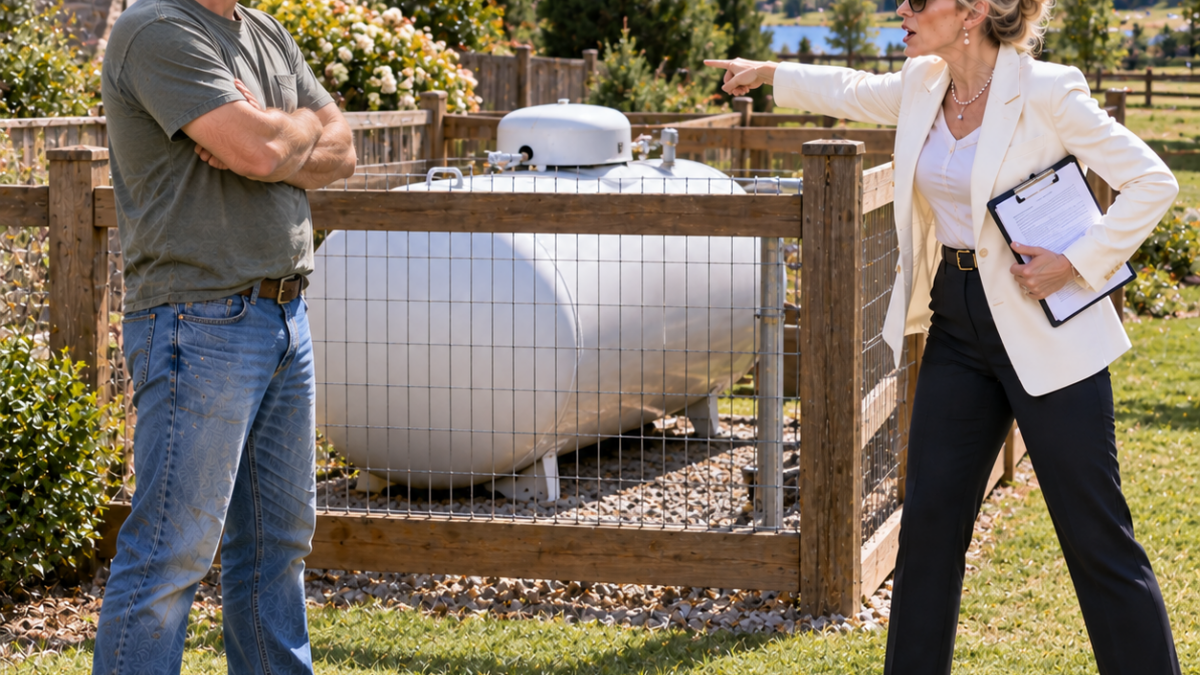
The main distribution leg left the regulator station behind my fence and ran under the southern boundary into Cedar Hollow.
My house and workshop branched upstream.
That mattered.
I followed old address lists and service notes.
Forty-seven homes.
Forty-seven.
Not all sixty.
The first two phases of Cedar Hollow were still connected to that original system.
Every house on Larch Bend.
Every house on Cedar Hollow Court.
The even-numbered side of Thistle Row.
The clubhouse too.
The thirteen newer homes at the top of the hill had a separate supply installed by a later builder.
Then I checked Celeste’s address.
Phase three.
Separate supply.
Of course.
The woman ordering me to shut down the tank did not receive fuel through it.
I leaned back in my chair.
“Son of a gun.”
Nobody answered.
I lived alone.
That sometimes made discoveries feel larger.
There was no one across the table to say what I was thinking.
Forty-seven families.
Doyle Hurst lived in one.
Doyle helped me pull a transmission during a thunderstorm the previous summer because I was stupid enough to start the job outside and optimistic enough to believe the weather app.
Mrs. Kenner, retired shop teacher, lived in another.
Every August she left tomatoes on my porch.
A young couple named Evan and Marie Lester lived on Thistle Row with a baby who had spent most of September announcing her existence through open windows.
These people had never fined me.
They had never told me what my land should look like.
Most had no idea where their fuel came from.
That stopped any feeling of satisfaction immediately.
I did not go outside.
I did not touch the valve.
Instead, I called Reed Callahan.
Reed was the attorney who handled my closing.
He had an office above a pharmacy in town and the disturbing habit of enjoying property-record problems the way normal people enjoy sports.
“I found something.”
“Bad?”
“Interesting.”
“For whom?”
“Possibly everyone.”
“Come tomorrow.”
I brought the folder.
Reed read the license without speaking.
Then read it again.
Then turned to paragraph nine.
He looked at Celeste’s cease-use directive.
Then at me.
“What do you want?”
“The fines gone.”
“Reasonable.”
“My land left alone.”
“Also reasonable.”
“And I don’t want forty-seven houses losing heat because their HOA president is trying to win an argument.”
That last part changed his expression.
“How cold is it supposed to get?”
“Twenties next week.”
He removed his glasses.
“Good.”
I frowned.
“Good?”
“Good that you understand this isn’t a toy.”
“I repair propane systems.”
“I know.”
“But you’re also angry.”
“Yes.”
“And people do foolish things while technically correct.”
He tapped the license.
“Do not turn this into revenge, Nolan.”
“I’m not.”
“You’re thinking about shutting it down.”
“I’m thinking about following the directive.”
“Those are the same action with different stories attached.”
I said nothing.
Reed leaned back.
“Here is what you do.”
I listened.
“First, verify title.”
“Already did.”
“Professionally.”
“Fine.”
“Second, verify that equipment ownership transferred with your parcel.”
“Okay.”
“Third, have a qualified technician determine what a controlled suspension and restoration actually require.”
“I can do that.”
“No.”
I looked at him.
“You are involved in the dispute.”
“So?”
“So I want an independent technician standing beside you.”
That annoyed me because it made sense.
“Fourth, give written notice.”
“To the HOA?”
“To everyone who legally needs it.”
“What about residents?”
“That part we discuss after we understand safety obligations.”
He pointed at me.
“And fifth, nothing happens quickly.”
“Celeste has been fining me for six weeks.”
“Then she can wait another week.”
I left frustrated.
Which usually meant Reed had done his job.
My independent technician was Warren Hale.
Sixty-three.
Partially deaf in one ear.
Hands thick from four decades around pipe and regulators.
Warren had actually helped install the Cedar Hollow system fifteen years earlier.
When I showed him the license, he started laughing before reaching the bottom.
“What?”
He tapped the document.
“I wondered where this went.”
“You knew?”
“Knew the tank was private.”
“Did you know the license had a shutdown clause?”
“No.”
He kept reading.
“I knew Adele would never sell them anything.”
“You knew her?”
“Everybody knew Adele.”
“What was she like?”
Warren looked at me.
“You ever argue with a fence post?”
“Can’t say I have.”
“Same experience.”
That explained a lot.
We met again at my property.
Warren inspected the tank.
Regulator station.
Line.
Shutoff.
Pressure.
He reviewed the service history.
Then we stood beside the master valve.
It was not dramatic.
Brass handle.
Riser.
Lockout point.
Nothing about it looked capable of affecting forty-seven homes.
“How fast could you shut the leg?”
“Minutes.”
“And restore it?”
Warren looked at me sharply.
“That’s the wrong question.”
“Why?”
“Because closing flow is one action.”
He pointed downhill.
“Repressurizing occupied houses after a system loses pressure is another.”
I knew that.
Still, hearing it said in context changed things.
“You restore that line, you don’t just twist this back open and go home.”
“I know.”
“Appliances need proper handling.”
“Pressure checks.”
“Relights.”
“House by house.”
“Exactly.”
He stared at me.
“You planning to do this?”
“I’m planning to make them decide whether they really want what they ordered.”
“That’s lawyer talk.”
“I’ve been infected.”
“Then let the lawyer write the notice.”
We did.
Reed’s draft was almost three pages long.
Boring.
Specific.
Safe.
It identified the recorded license.
The equipment.
The parcel.
The HOA’s directive.
It quoted Celeste’s answer from the clubhouse meeting.
Then her written demand.
It gave eight days notice of suspension.
Monday.
Nine in the morning.
A qualified technician would perform it.
Affected addresses were attached.
Forty-seven.
The notice stated that restoration would require inspection and controlled technician-supervised return to service.
It asked the HOA twice, in bold type, to notify residents immediately.
Then Reed added a final paragraph.
The owner remained willing to avoid suspension if the association withdrew the cease-operation directive, suspended the disputed fines, acknowledged that jurisdiction over Nolan’s parcel remained unresolved, and entered good-faith discussions regarding inspection and maintenance responsibilities.
That was my offramp.
Celeste’s too.
We sent the notice by certified mail.
To the registered agent.
To Celeste.
To the property-management company.
Electronic copies went to every board member.
Graham Pike.
HOA counsel.
I truly expected a call.
Not because I thought Celeste would apologize.
Because no competent board could read “forty-seven affected houses” and continue pretending this was about sightlines.
Three days passed.
Nothing.
On the fourth morning, Graham Pike called my shop.
Seven-oh-three.
“Nolan.”
“Morning.”
“Is that notice real?”
“Yes.”
“The forty-seven addresses?”
“Yes.”
“You verified them?”
“Warren Hale did.”
Silence.
“You know Warren?”
“Yes.”
Another silence.
Then:
“The main shutoff really is on your parcel.”
It wasn’t a question.
“You already knew.”
Graham breathed out.
I remembered the first day Celeste visited with him.
She asked whether the HOA could hire someone to remove my tank.
Graham said he would need to look into ownership.
He had looked toward the arborvitae instead of the cylinder.
He knew.
“How long?” I asked.
“What?”
“How long have you known?”
“I need to speak with the board.”
“That isn’t what I asked.”
“I know.”
“Graham.”
His voice dropped.
“She isn’t going to listen.”
“What does that mean?”
“I have to go.”
He hung up.
I stood there with the phone in my hand.
That conversation bothered me more than Celeste’s insults.
Confusion is one thing.
A property manager sounding afraid of his own board president is another.
Celeste finally answered the next afternoon.
Three lines.
The association would not be extorted.
My “intimidation tactic” had been documented.
The board would proceed with collection and lien remedies.
At the bottom:
Do whatever you need to do with your ugly tank.
I printed it.
Read it twice.
Then called Reed.
“She replied.”
“Send it.”
I did.
He called back five minutes later.
“Well.”
“That helpful?”
“Very.”
“Can I shut it now?”
“No.”
“What else?”
“We wait until the stated date.”
“I know.”
“And you do nothing without Warren.”
“I know.”
“And the residents?”
“That’s why I’m calling.”
We discussed it.
The HOA had received notice.
Management had received notice.
Its lawyer had received notice.
Legally, those channels mattered.
Morally, I kept seeing Doyle Hurst standing in the rain helping with my transmission.
So Saturday morning, I printed forty-seven letters.
Plain paper.
No threats.
No accusations.
I knocked on doors.
Twenty-two households answered.
Doyle was third.
He read the letter twice.
Then looked down the hill toward my property.
“That big white tank?”
“Yes.”
“That feeds my house?”
“Yes.”
“Well, hell.”
“That was roughly my reaction.”
“Does Celeste know?”
“She has known about the planned shutdown for nearly a week.”
“No.”
“I have the delivery receipt.”
Doyle sat on his porch step.
“My water heater has been acting up.”
“I remember.”
“That upstream regulator problem you mentioned…”
“Yes.”
He stared at me.
“So when I asked you about my fuel, you knew?”
“Not yet.”
“Good.”
“Why good?”
“Because I was about to accuse you of being annoyingly mysterious.”
“I can still be annoyingly mysterious.”
“That part I believe.”
At the next house, a woman told me I was lying.
At another, a man accused me of blackmail.
I gave both the association’s phone number.
No argument.
Mrs. Kenner read the letter carefully.
“My mother lives with me.”
“I know.”
“She uses an oxygen concentrator.”
“Electrical.”
“Yes.”
“Do you have electric space heat?”
“One heater.”
I gave her the number of a friend who had extras.
We checked her furnace together.
I told her to call me if indoor temperature became an issue.
I did not want anybody unsafe.
That became my rule.
Whatever fight existed between me and Celeste, nobody else paid through danger if I could prevent it.
By Sunday night, Cedar Hollow knew something was coming.
The neighborhood social-media page exploded.
Screenshots reached me through Doyle.
Some people blamed me.
Some blamed Celeste.
Several demanded board answers.
Celeste posted only:
The association is addressing an improper attempt by an adjacent commercial operator to disrupt community utilities.
Adjacent commercial operator.
Me.
I stared at those words.
Then put my phone away.
Monday arrived at twenty-six degrees.
Warren came at eight-thirty.
He checked everything twice.
Documented pressure.
Photographed the gauge.
Checked the lockout.
Verified notice period.
Then looked at me.
“You can still stop.”
“I know.”
“Want to?”
“Yes.”
He waited.
“But not like this.”
“That doesn’t answer me.”
I looked toward the hill.
Forty-seven roofs.
Thin furnace exhaust rising into cold air.
I hated the idea.
Then I remembered the alternatives.
Pay fines to an HOA that did not govern my land.
Apply for retroactive approval and concede authority it did not possess.
Allow representatives onto my property under false jurisdiction.
Or surrender equipment rights nobody had even proved they owned.
“What happens if I don’t?”
Warren understood.
“They keep pressing.”
“Yes.”
He nodded slowly.
“Then do it by the book.”
At nine, I put my hand on the valve.
Cold brass through gloves.
Turned.
There was no dramatic hiss.
No neighborhood lights went dark.
No explosion.
Just a short mechanical click.
Warren watched the gauge.
Logged the change.
Installed the lockout.
Signed.
I signed.
Four minutes.
Then we walked inside.
I made coffee.
For the first twenty minutes, nothing happened.
That felt worse.
Then my shop phone rang.
Woman on Thistle Row.
Stove would not light.
I gave her the association number and explained the suspension notice.
Four minutes later, another call.
Then Doyle.
“Water heater’s out.”
“Expected.”
“Neighbors too.”
“Yes.”
“You okay?”
That surprised me.
“I’m fine.”
“You don’t sound fine.”
“I’m not enjoying this.”
“Good.”
“What?”
“Means you’re still Nolan.”
He hung up.
By ten, the clubhouse furnace lost service.
According to Graham later, that changed the politics immediately.
A Monday exercise group had eleven residents standing in a cold clubhouse wearing winter coats over workout clothes.
They called management.
Management’s phone began ringing continuously.
Thirty-one calls in ninety minutes.
Two residents called the fire department because they assumed a neighborhood gas emergency was underway.
The fire crew confirmed there was no leak and no immediate hazard related to a broken line.
The supplier confirmed the bulk tank still contained fuel.
That confused everybody more.
At 11:11, Celeste called.
I looked at her name.
Let it ring twice.
Those two rings are the closest I came to petty satisfaction.
Then I answered.
“What have you done?”
No hello.
No neighborly tone.
“I complied.”
“You cut gas to the subdivision.”
“I suspended the distribution leg after the association ordered me to cease operating the system.”
“You cannot do this.”
“I gave eight days notice.”
“You’re endangering people.”
“I personally delivered notices Saturday after the board declined to do so.”
Silence.
Then:
“The HOA owns that system.”
“Show me the deed.”
More silence.
I heard a dog barking on her end.
Then she hung up.
Nineteen minutes later, her white crossover came down my driveway too fast.
Graham sat in the passenger seat.
Celeste got out without a coat.
“Turn it back on.”
“No.”
Her eyes widened.
“I am not asking.”
“I understand.”
“Then do it.”
“I can’t.”
“You just turned it off.”
“Closing and restoration are different procedures.”
“I don’t care.”
“You should.”
I stayed behind the gate.
“A system serving forty-seven houses cannot simply be repressurized casually after loss of service.”
“So bring your technician.”
“After inspection.”
Her face flushed.
“Inspection of what?”
“The system your developer agreement requires your side to maintain.”
She stared at me.
Then looked at Graham.
“Tell him.”
Graham did not move.
“Graham.”
He looked at Celeste.
Then at me.
“Nolan is correct about restoration.”
She turned on him.
“You knew?”
I almost laughed at the irony.
Graham looked miserable.
“I told you there were ownership issues.”
“That is not what I asked.”
Interesting.
Celeste was using my line now.
She turned back to me.
“We will get an injunction.”
“That’s your right.”
“You will be served today.”
“Reed Callahan accepts service.”
I gave her his office address from memory.
That seemed to infuriate her more than yelling would have.
Then she reached for status.
Maybe it had always worked before.
“You’re a technician, Nolan.”
Her voice lowered.
“You don’t understand association law.”
I considered that.
“Maybe not.”
She looked almost relieved.
Then I opened my folder.
“But I understand my propane line.”
I handed her the certified license.
Then the plat.
Then the as-built drawing.
Then her written cease-operation order.
Then her one-word confirmation.
Then the “ugly tank” message.
She read.
Not carefully at first.
Quickly.
Like a person trying to find where the trick is.
Then she slowed.
Her thumb went back to the first page.
Graham had gone pale.
“Celeste.”
She ignored him.
“Celeste.”
Still reading.
He finally said:
“We need to call counsel.”
She looked up.
That was the moment I believed she had finally understood.
For nine days, I thought the story ended there.
Proud HOA president did not read an old agreement.
Working guy did.
Everybody learned a lesson.
Neat.
Almost funny.
Then Graham changed everything.
He drove to Reed’s office on a Thursday afternoon.
No appointment.
Carried a flash drive.
Reed called me at six.
“Come in.”
“Tonight?”
“Yes.”
“What happened?”
“Come in.”
“Tell me.”
“No.”
“Reed.”
“I want to watch your face when you read this.”
That made me uneasy.
I arrived at six-forty.
Graham was gone.
Reed had printed an email chain.
Eleven pages.
He put his hand on it before letting me read.
“One thing.”
“What?”
“She knew.”
I stared at him.
“Knew what?”
“Start at the beginning.”
The first email was dated September.
Three months before Celeste’s first visit to my driveway.
The HOA’s insurance carrier had conducted an annual renewal review.
The underwriter flagged the propane system.
No current inspection certificate in HOA files.
No documented ownership.
No updated access agreement with the owner of my parcel.
No clear allocation of liability.
The carrier requested three things within ninety days.
Inspection.
Updated agreement.
Liability clarification.
Otherwise, the distribution system might be excluded from coverage.
Next email.
Graham Pike to Celeste Whitaker.
October 6.
He had researched the records.
Found the license.
Found the plat.
Identified the tank, regulator station, and master shutoff as private property belonging to my parcel.
He wrote that the HOA appeared to hold a conditional right of use inherited from the developer.
He wrote that maintenance obligations appeared to rest with the user side of the agreement.
He recommended contacting me immediately to negotiate an updated agreement.
The attachments included the same document I later found with Naomi.
Celeste had received it eleven weeks before she stood at my fence pretending not to understand ownership.
I kept reading.
Celeste’s reply:
Opening a discussion on those terms would place the association in a weak negotiating position.
Another paragraph:
I do not want the board formally accepting maintenance responsibility for infrastructure it does not control.
Then:
Handle the matter first as a compliance issue.
My hands went cold.
I looked at Reed.
“She knew.”
“Yes.”
I kept reading.
Celeste instructed Graham not to circulate the old license to the full board until she had what she called a “resolution pathway.”
Then she asked:
How many homes are currently served?
Graham replied:
Forty-seven residences plus clubhouse mechanical load.
Forty-seven.
She knew.
Before the fine.
Before the meeting.
Before the removal demand.
Before she ordered me to shut down.
She knew.
I read the next emails.
Her plan slowly emerged.
The clubhouse needed mechanical upgrades.
Pool heater.
Fitness annex.
Utility improvements.
The board wanted financing.
The insurance carrier wanted clean control and maintenance responsibility over infrastructure feeding those amenities.
My privately owned equipment was a problem.
Not because it was ugly.
Because I could say no.
Then I reached an email dated November 11.
Celeste writing to a former treasurer.
She wanted the association eventually to acquire the tank and a permanent easement for nominal value.
Then one sentence.
Eventually he will realize fighting us costs more than signing it over.
I read it twice.
Then a third time.
Reed watched me.
“You okay?”
“No.”
“Good.”
“What do you mean good?”
“You should be angry.”
“I am.”
“But don’t act from it.”
I stood.
Walked to the window.
Down below, the pharmacy sign flickered.
People crossed the parking lot carrying grocery bags.
Normal evening.
I had spent weeks wondering whether I should have warned Celeste earlier.
Whether I had let pride turn a misunderstanding into a crisis.
There had been no misunderstanding.
The first five-hundred-dollar fine was not correction.
It was pressure.
The one-hundred-dollar daily penalty was pressure.
The threat of a lien was pressure.
The retroactive approval form was pressure.
If I applied for approval, I might appear to recognize HOA jurisdiction.
If I let their inspector onto my property under that authority, the board could later claim a pattern of control.
If the fines climbed high enough, perhaps signing over equipment would look cheaper than litigation.
Celeste was not trying to remove an ugly tank.
She was trying to acquire leverage over an essential utility without paying market value for it.
The worst part?
Her strategy required her to repeatedly tell me to stop operating the system.
Exactly the event paragraph nine addressed.
She had triggered the clause she was trying to use against me.
Not accidentally.
Through the mechanism she chose.
“She created the shutdown.”
I said it quietly.
Reed nodded.
“She created the paper trail.”
“The valve didn’t beat her.”
“No.”
“Her letters did.”
“Yes.”
“What happens now?”
“The board needs to see this.”
“Graham gave it to you.”
“Yes.”
“Why?”
Reed sat back.
“Because he’s done.”
“With his job?”
“With covering her.”
That explained Graham’s face at my gate.
The emergency HOA meeting happened Tuesday.
Standing room only.
The clubhouse was still cold.
Portable electric heaters had been brought in, but they barely touched the room.
People wore coats.
Children sat in the back with tablets.
Coffee steamed from insulated dispensers.
This time, I did not sit in the back row.
Second row.
Reed beside me.
Tessa Monroe, the board member I had met at the mailbox, sat at the center table.
Graham sat at the far end.
Laptop closed.
Celeste opened with a prepared statement.
She called the shutdown a deliberate disruption.
She said an adjacent commercial operator had endangered residents to gain leverage.
She said the HOA had attempted every reasonable resolution.
She said essential service had been weaponized.
Some residents believed her.
That needs saying.
A man behind me muttered that his elderly mother lived with him.
A woman on the opposite side stared at me with open anger.
I understood.
Their houses were cold.
They had no reason yet to know why.
Reed whispered:
“Hands.”
I realized mine were clenched.
I opened them.
Celeste finished.
Tessa asked if I wished to respond.
I started to stand.
Reed touched my arm.
Then stood himself.
“Six minutes.”
Tessa looked confused.
“For what?”
“A timeline.”
Someone connected his laptop to the projector.
The first slide appeared.
No dramatic title.
September 14 — Insurance Carrier Renewal Notice.
Reed read it.
Ownership documentation requested.
Inspection requested.
Maintenance allocation requested.
October 6 — Graham Pike Memorandum to Celeste Whitaker.
License located.
Private equipment identified.
Forty-seven affected homes later confirmed.
Negotiation recommended.
October 7 — Celeste Whitaker Response.
Handle as compliance issue.
Do not circulate license.
The room changed.
Not loudly.
People simply stopped moving.
Reed continued.
November 11.
Email concerning acquisition.
The sentence appeared on the wall.
Eventually he will realize fighting us costs more than signing it over.
Someone whispered:
“Oh my God.”
Reed did not react.
December.
First violation notice.
Five hundred dollars.
Daily fines.
Then my response challenging jurisdiction.
Celeste’s refusal.
Demand to cease use.
Clubhouse meeting.
My question.
Three times.
Her answer.
ABSOLUTELY.
The word filled the screen.
Then the written confirmation.
CONFIRMED.
Then the eight-day suspension notice.
Forty-seven addresses.
Two requests that the HOA notify affected homeowners.
Then Celeste’s response.
DO WHATEVER YOU NEED TO DO WITH YOUR UGLY TANK.
Someone in the back made a sound halfway between a laugh and disbelief.
Reed displayed the plat.
My parcel outside the HOA.
The license.
Tank ownership.
Regulator ownership.
Maintenance clause.
Suspension clause.
Then he stopped.
No speech.
No accusation.
The documents did enough.
Tessa slowly turned toward Celeste.
“You knew.”
Celeste’s posture stayed perfect.
“Tessa, this is being presented without context.”
“You knew the tank was his.”
“We knew there was an old document with unresolved succession questions.”
“You knew forty-seven houses used it.”
“We knew there was legacy service.”
“You fined him anyway.”
“For an unregulated commercial installation adjacent to—”
“No.”
Graham’s voice came from the end of the table.
Quiet.
Everyone turned.
He had not spoken all night.
“I warned you.”
Celeste stared at him.
“Graham.”
“October sixth.”
He opened his hands.
“I told you exactly what the license said.”
“You gave a preliminary interpretation.”
“I sent you the document.”
“You are not counsel.”
“No.”
His voice shook slightly.
“But I told you we needed counsel.”
The HOA attorney was attending by speakerphone.
Tessa leaned toward the microphone.
“When did your firm first see this license?”
A pause.
“Nine days ago.”
The room erupted.
Tessa hit the table.
“Please.”
People quieted.
She turned back to the speaker.
“Was counsel consulted before the fines were issued?”
“Not concerning the recorded propane license.”
“Was counsel consulted before the cease-use directive?”
“Not regarding that issue.”
Celeste tried to speak.
Tessa stopped her.
“Not yet.”
Doyle stood from the fourth row.
“I got Nolan’s notice Saturday.”
He held up the paper.
“Nothing from the board.”
He looked at Celeste.
“You knew my house was on that line?”
She answered carefully.
“The board was evaluating the validity of Mr. Avery’s threats.”
“That’s not what I asked.”
Doyle’s voice cracked.
“My wife woke up Monday and couldn’t get hot water.”
He pointed toward me.
“He told us.”
“You didn’t.”
Mrs. Kenner spoke next.
“My mother is eighty-three.”
Celeste looked toward her.
“Mrs. Kenner, I’m very sorry for the inconvenience.”
“Inconvenience?”
Her voice stayed calm.
That made it worse.
“You knew before Christmas that my furnace came through his property.”
Celeste began talking about liability.
Insurance.
Fiduciary responsibility.
Professional management.
Words.
For months, those words had carried power.
Now every sentence sounded thinner because everyone could see the paper beneath it.
Tessa asked:
“Did you intend to pressure Nolan into transferring the system?”
“No.”
Reed changed the projected slide back to the November email.
Eventually he will realize fighting us costs more than signing it over.
Nobody had to say anything.
Celeste closed her folder.
For the first time since I met her, she looked unsure where authority lived.
The meeting lasted three hours.
No shouting victory.
No dramatic arrest.
Just questions.
Board members learned documents had been withheld.
Residents learned the propane infrastructure was privately owned.
Graham admitted he should have escalated sooner.
The HOA attorney recommended immediately suspending all fines.
Tessa moved to do exactly that.
Unanimous.
Even Celeste did not vote against it.
Then came the harder part.
Restoring service.
I stood.
People quieted.
“I can restore as soon as we have a signed inspection and a safe relight plan.”
A man shouted:
“Tonight.”
“No.”
Anger returned immediately.
I understood.
“It’s freezing.”
“I know.”
“My mother is seventy-nine.”
“I know.”
“Then turn it on.”
I looked directly at him.
“I will not put pressure back into a distribution line and leave unverified appliances downstream.”
Warren stood from the side wall.
He had come specifically for this.
“I’m Warren Hale.”
The room looked at him.
“I installed part of that system.”
That got attention.
“He’s right.”
He explained the problem in plain language.
Not technical instructions.
Not DIY advice.
Just the fact that restoring fuel service safely required trained personnel and house-by-house checks.
“We can start once the inspection is signed.”
“When?”
“Tomorrow if the association authorizes it.”
Every face turned toward the board.
Tessa said:
“Authorized.”
Celeste said nothing.
The next eleven days were paperwork, inspections, negotiation, and more humility than anyone enjoyed.
Reed handled most of it.
The settlement was smaller than the dramatic version people later told.
Better too.
Every fine against me disappeared.
$4,800.
The HOA acknowledged in writing that my parcel was outside Cedar Hollow’s architectural jurisdiction.
It reimbursed my legal expenses.
A little over six thousand dollars.
The association entered a twenty-year access and maintenance agreement.
Annual land-use fee.
Inspection obligations.
Maintenance responsibilities clearly assigned.
Insurance requirements.
No board officer or contractor could enter my land or touch the equipment without written authorization except in defined emergencies.
No claim of ownership.
No retroactive architectural approval.
No fake jurisdiction.
In return, I agreed to continue allowing the system to serve Cedar Hollow under documented terms.
That mattered.
I did not want the tank transferred to the HOA.
I also did not want forty-seven families heating their homes through a handshake nobody remembered.
That arrangement had already survived far too long.
Warren found one aging fitting during inspection that needed replacement.
The irony was obvious.
For years, the HOA had ignored the maintenance responsibility it was supposed to fund.
Celeste’s pressure campaign accidentally forced the first serious review in years.
By Friday, Warren signed the system inspection.
I stood beside him at the valve again.
Same cold brass handle.
Same regulator cabinet.
Different feeling.
“Ready?” he asked.
“Yes.”
“No speeches?”
“No.”
“Good.”
The system was restored under his supervision.
Then Warren and three technicians spent the rest of the day working through affected homes as service returned.
Doyle brought sandwiches.
Mrs. Kenner brought coffee.
Residents who had cursed me at the meeting opened their doors.
Some apologized.
Some did not.
That was fine.
By eight that evening, the final house was complete.
Eighteen days after suspension, Cedar Hollow had full propane service again.
Eighteen days is a long time in winter.
I carried guilt about that.
Still do.
The easiest version of this story makes me sound like a man who triumphantly turned a valve and taught an HOA president a lesson.
That is not how it felt.
There were children in those homes.
Elderly people.
Families who had nothing to do with Celeste’s plan.
Two households stayed in hotels temporarily.
Others used electric backup heat.
Neighbors shared heaters.
People adapted.
Nobody suffered a major injury.
I am grateful for that.
But being legally justified does not make consequences emotionally clean.
Reed understood before I did.
That is why he told me not to turn correctness into revenge.
If I had delayed restoration even one day after agreement and inspection simply to make Celeste uncomfortable, the whole story would have changed.
I would have been using forty-seven families as leverage.
I refused to become that man.
Celeste’s board position did not survive.
Tessa and two other directors called a special membership meeting.
The petition reached the required threshold in days.
Celeste resigned shortly before the removal vote.
The unofficial tally afterward was thirty-nine households favoring removal.
Four supporting her.
Others abstained or did not vote.
She was not thrown from her house.
She did not lose everything.
She was not arrested.
She did not become homeless.
She still lived in Cedar Hollow.
Still drove the clean white crossover.
Still had the same carefully landscaped yard.
That ending disappointed people who wanted punishment.
It did not disappoint me.
She lost the thing she had misused.
Authority.
That was enough.
Tessa became interim president.
Her first email to residents was six paragraphs and contained no threats.
Doyle printed it and brought it to my shop.
“Look.”
“What?”
“No bold red text.”
“Progress.”
“No Latin.”
“Miraculous.”
He folded it.
“People are mad at you still.”
“I know.”
“You okay with that?”
“No.”
He raised an eyebrow.
I smiled.
“But I’ll survive.”
“Some think you should’ve warned everyone earlier.”
“I did.”
“I mean before the suspension notice.”
“I know what they mean.”
Doyle leaned against the workbench.
“Should you have?”
That question stayed with me.
“I don’t know.”
Honest answer.
I could have told Cedar Hollow about the line the first afternoon Celeste visited.
Could have said:
The tank you hate feeds half your subdivision.
Maybe she would have stopped.
Maybe the board would have negotiated.
Maybe none of it happened.
Or maybe Celeste’s email chain proved she already knew enough to keep pressing anyway.
“What stopped you?” Doyle asked.
“Pride.”
He waited.
“And?”
“Anger.”
“Anything else?”
“She was standing on my property treating me like hired help and demanding ownership answers she already had.”
Doyle nodded.
“So pride and anger.”
“Mostly.”
He smiled.
“You’re improving.”
“Go home, Doyle.”
Spring came.
The ground thawed.
Cedar Hollow moved on.
That is what communities do.
A crisis feels permanent while you are inside it.
Then somebody’s kid graduates.
Somebody paints a house.
A storm knocks down a tree.
Pool season opens.
The thing that once consumed every conversation becomes one story people tell newcomers.
The new board hired an engineer to review the clubhouse mechanical system.
That review found years of deferred work.
The modernization plan Celeste wanted was postponed.
Not because people wanted to punish her.
Because they discovered they had more basic repairs to make first.
The pool heater was serviced instead of replaced.
The fitness annex disappeared from the agenda.
Tessa called me once.
“Would you consider serving on a utilities committee?”
I laughed.
“I’m not in the HOA.”
“We know.”
“Then no.”
“You didn’t even think.”
“I thought for six weeks.”
“Fair.”
Instead, she asked if I would attend one meeting each year when the board reviewed the propane agreement.
That I agreed to.
The first annual review lasted twenty-three minutes.
Inspection current.
Insurance current.
Land-use fee paid.
Maintenance reserve funded.
No issues.
I walked out almost disappointed.
Boring systems are beautiful.
That summer, Warren told me the part of the history I had never known.
We sat on my tailgate waiting for a delivery.
He pointed toward the tank.
“Developer wanted this whole parcel.”
“Adele wouldn’t sell.”
“Three times.”
“How much?”
“Last offer was good.”
“How good?”
“Enough that most people would’ve taken it.”
“Why didn’t she?”
Warren shrugged.
“She liked her goats.”
I laughed.
“That’s it?”
“And she didn’t like being told something was inevitable.”
That sounded familiar.
“They told her Cedar Hollow needed the land.”
“She said Cedar Hollow needed a different plan.”
“Then they asked for the license?”
“Eventually.”
Warren smiled.
“She made them pay yearly because she said anything free becomes somebody’s entitlement.”
I looked at him.
“Adele said that?”
“Close enough.”
I thought about fifteen years of history.
The developer planned the propane arrangement as temporary.
Natural gas was supposed to arrive.
Then routing changed.
Wetland approvals delayed it.
The developer collapsed financially.
Another builder took over later phases.
Management companies changed.
Board members changed.
People retired.
Adele died.
The license disappeared inside thousands of pages of recorded documents.
Meanwhile, houses stayed warm.
Everyone assumed someone else owned the system because it had always been there.
That was the real failure.
Not Celeste.
She exploited it.
But she did not create it.
The weakness existed for fifteen years.
Everybody inherited assumptions.
Nobody checked.
Until an insurance underwriter asked a boring question.
Who owns this?
That question started everything.
Not the tank.
Not the fines.
Ownership.
Responsibility.
Those are different things.
Celeste wanted control because the HOA depended on infrastructure it did not control.
That concern was not irrational.
If she had come to my gate and said:
Nolan, we discovered our community relies on equipment you own, and our insurer wants a current agreement.
I would have listened.
If she had said:
We need inspections and clear maintenance terms.
I would have agreed.
If she had said:
Would you consider selling?
I might have said no.
But we could have discussed it.
Instead, she decided negotiation made the HOA look weak.
So she created a violation.
That choice did more damage than any old fuel line.
She confused leverage with leadership.
Months later, I ran into her at a hardware store.
Paint aisle.
I was buying pipe insulation.
She was comparing exterior stain samples.
We saw each other at the same moment.
For a second, neither moved.
Then she said:
“Nolan.”
“Celeste.”
I expected her to turn away.
She did not.
“How’s the system?”
“Fine.”
“Inspection?”
“Current.”
She nodded.
“Tessa sends me the board packets.”
That surprised me.
“You still read them?”
“I still live there.”
Fair.
She looked at the insulation in my cart.
Then toward the paint samples.
“I owe you an apology.”
I said nothing.
She continued.
“I knew enough to know your land was outside the association.”
“Yes.”
“And I knew about the license.”
“Yes.”
“I convinced myself the board had a responsibility to force control of the system.”
“You did.”
“I thought if we approached you acknowledging that we depended on you, you’d have all the leverage.”
“I would have had some.”
“Yes.”
Her mouth tightened.
“That bothered me.”
“I gathered.”
She looked down.
“I spent a lot of time telling myself I was protecting Cedar Hollow.”
“Maybe part of you was.”
She looked up.
That surprised her.
“Your insurer had a legitimate concern.”
“Yes.”
“The system needed a current agreement.”
“Yes.”
“The mistake wasn’t caring about it.”
“No.”
“It was believing you had to make me smaller before you could negotiate.”
She went quiet.
A store employee pushed a cart past us.
Somewhere overhead, an announcement asked for assistance in lumber.
Ordinary world.
Finally Celeste said:
“That’s fair.”
Then she did something I did not expect.
“Were you scared?”
“When?”
“Turning it off.”
I thought about Warren beside me.
Frost on the tank.
Forty-seven houses.
“Terrified.”
She looked surprised.
“You didn’t look terrified at the meeting.”
“I repair gas equipment.”
“What does that mean?”
“It means fear is useful if it makes you slower.”
She nodded.
“I was terrified too.”
“After?”
“Before.”
That stopped me.
“Before what?”
“Before I came to your property the first time.”
I frowned.
She explained.
The insurance letter arrived while she was pushing the clubhouse plan.
She had promised residents improvements.
New mechanical systems.
Fitness space.
Pool upgrades.
Then Graham showed her the old license.
Suddenly, the HOA’s utility arrangement depended on someone outside the community.
A man the board did not know.
No current agreement.
No guaranteed access.
Insurance uncertainty.
“I thought the board would blame me for not already knowing.”
She said it quietly.
“So instead of telling them?”
“I tried to solve it first.”
“By fining me.”
“Yes.”
“That makes no sense.”
“It did then.”
I could almost understand.
Almost.
Fear plus authority makes terrible decisions look efficient.
“You could’ve called me.”
“I know.”
“Graham told you to.”
“I know.”
“You told him not to circulate the license.”
Her face tightened.
“I know.”
There was nothing left to say about that.
I shifted my cart.
She held up one of the stain cards.
“Do you think this is too dark?”
I stared.
She smiled for the first time.
Not the old smile.
No audience.
No board table.
No folder.
Just a woman in a hardware store.
“I fix furnaces.”
“So?”
“So do not let me choose your deck stain.”
She laughed.
Then we walked opposite directions.
I did not forgive everything in aisle twelve.
Life is not that tidy.
But I stopped rehearsing arguments with her after that.
That was worth something.
The tank is still behind the arborvitae.
Same white cylinder.
Concrete piers.
Regulator station.
The new board installed a proper sign on the enclosure.
PRIVATE EQUIPMENT.
AUTHORIZED ACCESS ONLY.
My shop number underneath.
Tessa walked past while the installer finished.
She read it.
Then looked at me.
“Should be bigger.”
“I think everybody remembers.”
She laughed.
The annual land-use fee goes into a separate account I keep for property maintenance.
Nothing dramatic.
It does not make me rich.
The HOA funds required maintenance.
Warren retired the following year.
His replacement is a woman named Mia Santos who is thirty-six and treats documentation like a religion.
I like her.
The system has had two inspections since.
Both boring.
Exactly how I want propane to be.
Doyle replaced his water heater.
The old one was not entirely the upstream regulator’s fault.
He blamed me anyway.
Mrs. Kenner’s mother turned eighty-five.
The young couple on Thistle Row had another baby.
Cedar Hollow remains a normal subdivision.
Mailboxes.
Snow shovels.
Children.
Arguments about lawn care.
A pool nobody uses as much as the maintenance budget suggests they should.
Celeste eventually joined a gardening club in another town.
Doyle told me that like it was scandalous.
“Good for her.”
He looked disappointed.
“That’s all?”
“What do you want?”
“I don’t know.”
“Maybe something about her controlling the roses?”
I stared.
“Go home, Doyle.”
I sometimes think about the four seconds it took to turn that valve.
People who hear the story love that part.
The click.
The phone calls.
The president suddenly realizing who owned the tank.
They imagine it felt powerful.
It didn’t.
It felt heavy.
Real leverage usually does.
If using power makes you feel nothing except pleasure, you should probably ask why.
I think about the eighteen days those families lived around the interruption.
I think about the hotel rooms.
Electric heaters.
Hot water.
Worry.
I think about how easily a dispute between two people became something forty-seven households had to carry.
That is not a victory.
The victory was what came after.
The agreement.
The inspection.
The maintenance.
The clear ownership.
A system no longer depending on forgotten paperwork and assumptions.
The fact that the next board president will not need to rediscover paragraph nine.
The fact that the next owner of my property will know exactly what that white tank means.
The fact that the next resident moving into Larch Bend can ask where the propane comes from and receive an answer that does not begin with:
“Well, fifteen years ago there was a widow with goats.”
Though honestly, that version is more entertaining.
Adele Barlow died before I ever bought the place.
I found a photograph of her once in the county historical society archive.
Standing beside the old hay barn.
Rubber boots.
Gray hair.
One goat trying to eat the bottom of her jacket.
She looked unimpressed with the photographer.
I printed the picture.
It hangs in my shop.
Warren saw it.
“That’s Adele.”
“Yep.”
“She’d have liked you.”
“You think?”
“No.”
He laughed.
“She hated everybody.”
“Good.”
Then he looked toward the tank.
“She would’ve liked what you did with the agreement.”
That meant more.
Sometimes people assume property disputes are about greed.
Often they are about memory.
Someone signed something.
Someone promised something.
Someone refused to sell.
Then time moves.
Names disappear.
Buildings arrive.
People assume permanent things came from nowhere.
My tank looked like part of Cedar Hollow’s utility system because functionally it was.
Legally, it never stopped belonging to the land beneath it.
Celeste saw dependence and wanted ownership.
I saw ownership and initially ignored dependence.
We were both incomplete.
The solution required both truths.
Their homes depended on the system.
The system sat on my land.
Neither fact erased the other.
That is what good agreements are for.
They let two inconvenient truths exist at the same time without somebody needing to dominate.
I wish I had understood that before winter.
Maybe Celeste does too.
A year after the shutdown, the board invited me to one more meeting.
Not utilities.
Insurance renewal.
Tessa was now president.
Graham Pike still worked for the management company.
He had almost resigned after the crisis.
Instead, he stayed.
I asked him why once.
“Because leaving felt easy.”
Fair.
At that meeting, the insurer accepted the updated documentation.
Inspection.
Maintenance agreement.
Property schedule.
Liability allocation.
No exclusion.
The underwriter joined by video.
She thanked everyone for resolving an item first raised eighteen months earlier.
I almost laughed.
First raised.
Those two words contained an entire winter.
Afterward, people lingered.
Coffee.
Cookies.
Ordinary HOA stuff.
A man I did not know approached.
New homeowner.
Phase one.
“Are you Nolan?”
“Depends.”
He laughed nervously.
“I bought the Hargrove place on Cedar Hollow Court.”
“Okay.”
“They told me about the propane thing.”
“I’m sure they did.”
“Is it true you shut down half the neighborhood?”
I considered the answer.
“No.”
He looked disappointed.
I pointed toward the board table.
“They ordered private equipment shut down.”
“So you shut it down.”
“With notice.”
“So yes.”
“No.”
He frowned.
“You’re making this complicated.”
“It was complicated.”
He smiled.
“Fair.”
Then he asked:
“Should I worry about my heat?”
I looked at Tessa.
Graham.
The maintenance binder.
The new agreement.
Mia’s inspection certificate.
“No.”
That answer felt better than any dramatic ending.
No.
You should not worry.
The system is boring now.
People did their jobs.
Paper matches reality.
That is success.
I left the clubhouse and walked home.
Cold evening.
My property sits downhill, so I could see the white tank through the arborvitae before I reached the gate.
For years it had just been equipment.
Then an eyesore.
Then leverage.
Then evidence.
Then a neighborhood crisis.
Now it was equipment again.
Best thing it could be.
I stopped beside the enclosure.
The new sign caught light from my shop.
PRIVATE EQUIPMENT.
AUTHORIZED ACCESS ONLY.
Underneath, my phone number.
I thought about the first afternoon Celeste came down my driveway.
“Are you the maintenance contractor?”
I had told her no.
Technically correct.
Maybe incomplete.
Because in the end, maintaining things was exactly what all of us should have been doing.
Me.
The HOA.
The board.
The developer years before.
Not just valves and regulators.
Boundaries.
Agreements.
Trust.
You ignore maintenance long enough and something eventually fails.
Sometimes it is metal.
Sometimes paperwork.
Sometimes leadership.
And sometimes the failure starts with something as small as a woman carrying a folder down a driveway, looking at equipment she already knows she needs, and deciding she would rather control the man who owns it than sit at his kitchen table and ask for help.
Celeste fined me over the propane tank.
She ordered me to stop operating it.
I asked her three times if she was certain.
She said absolutely.
Then confirmed it in writing.
It took less than four minutes to follow that order.
It took Cedar Hollow eighteen days, thousands of dollars, an emergency board meeting, a rewritten utility agreement, and one very cold clubhouse to understand what should have been settled with a conversation before winter ever started.
The subdivision was never my enemy.
The people inside it were never my enemy.
Even Celeste eventually stopped feeling like one.
The real enemy was simpler.
Assumption.
The assumption that because something serves you, you own it.
That because someone looks ordinary, he does not understand the paperwork.
That because you hold the title, your summary must be the truth.
That because a person stays quiet, pressure is working.
That because a system has functioned for fifteen years, somebody must have made sure it was built on solid ground.
Sometimes nobody did.
Sometimes the whole neighborhood is staying warm because a widow refused to sell a tank years ago and everyone forgot.
And sometimes all it takes to expose that forgotten truth is one person powerful enough to order the system turned off—and confident enough never to ask what would happen when someone finally listened.








