He was only five months old, but he had already decided the tiny kitten beside him was his to protect
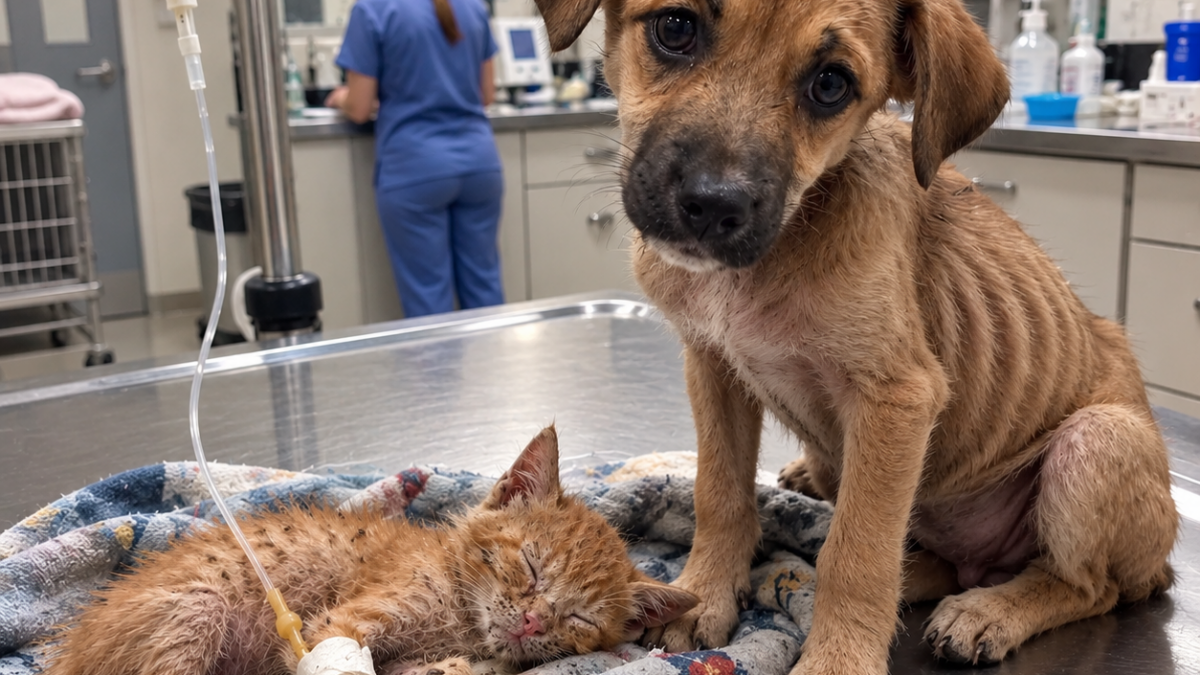
Dr. Hayes followed my gaze.
The puppy was sitting under the stainless-steel examination table with his front paws together and his head tilted upward.
He looked exhausted.
His coat was dirty.
One ear had a small scrape along the edge.
His belly was too narrow for a growing dog.
But none of that seemed to matter to him.
His attention remained fixed on the kitten.
Rosemary crouched.
“He’s young.”
“Five months, maybe?”
“Somewhere around there.”
She held out the back of her hand.
The puppy sniffed but did not move closer.
“What do we know about him?”
“Nothing.”
“Collar?”
“No.”
“Chip?”
“David is getting the scanner.”
The kitten cried softly from the warming pad.
The puppy stood.
Immediately.
Rosemary looked at me.
“You’re right.”
“About what?”
“He’s monitoring him.”
The puppy walked around the table leg until he could see the kitten again.
Then sat.
Rosemary shook her head.
“I’ve seen bonded animals.”
“So have I.”
“Usually adults.”
“Same.”
“Not babies raising babies.”
That phrase stayed with me.
Babies raising babies.
The puppy was not old enough to understand the world himself.
His feet were still oversized.
His chest had not filled out.
When he turned too quickly, he had the awkward balance of an animal whose body had not caught up with his intentions.
And yet somewhere along the way, he had apparently decided the kitten was his responsibility.
David returned with the scanner.
“No chip.”
He ran it over the puppy again.
Nothing.
“Figures.”
“What about the kitten?”
“Too young for one unless somebody was extremely organized.”
That seemed unlikely.
Dr. Hayes began setting up fluids for the kitten.
“We need a name for intake.”
David pointed at the dog.
“Him too.”
“Temporary names.”
“Obviously.”
David looked at the puppy.
“Guardian.”
I stared at him.
“That sounds like a superhero.”
“He’s literally guarding a kitten.”
“No.”
“Scout?”
“No.”
“Brownie?”
“Absolutely not.”
David crossed his arms.
“You come up with something.”
I looked down.
The puppy was standing now because the kitten had been moved onto a heated blanket.
Every time the kitten shifted, the dog’s entire expression changed.
“Finn.”
David considered it.
“Finn.”
The puppy’s ears moved.
David grinned.
“He likes it.”
“He heard a sound.”
“Finn it is.”
I looked at the kitten.
His dirty gray-looking fur had the faintest orange visible beneath one ear where Rosemary had cleaned him.
“Milo.”
David nodded.
“That works.”
Finn and Milo.
Two names for two animals who had probably spent days without anyone saying anything kind to them.
Dr. Hayes placed a small catheter in Milo’s front leg.
Finn watched.
When Milo cried, Finn whined.
Rosemary stopped.
“Can he come closer?”
“You tell me.”
“As long as he stays calm.”
I brought Finn beside the table.
He stretched upward.
Rosemary lowered Milo carefully, still wrapped in the towel.
Finn sniffed the kitten’s face.
Then licked his forehead.
Milo stopped crying.
The room went quiet.
David muttered, “You’ve got to be kidding me.”
Dr. Hayes looked at him.
“He knows that dog.”
“Or he knows comfort.”
“Either way.”
She placed Milo back on the warming pad.
Finn sat beside it.
For the next forty minutes, we worked around both of them.
Fluids.
Temperature checks.
Bloodwork.
Parasite screening.
Basic neurological response.
Milo was estimated at perhaps six or seven weeks old.
Too young to have been away from his mother safely.
Far too young to have been trying to survive in an abandoned garage.
His dehydration was severe.
He was anemic, likely from fleas and poor nutrition.
There were concerns about infection.
One side of his abdomen was tender.
He had sores on his paws.
And he was dangerously thin.
Finn, by comparison, was in better condition.
Thin.
Flea-ridden.
Minor abrasions.
One healing cut on his back leg.
No fractures.
No obvious illness.
Hungry enough to inhale half a bowl of softened puppy food before remembering Milo existed.
Then he abandoned his food and returned to the table.
David looked at the unfinished bowl.
“That may be the most convincing evidence yet.”
“What?”
“That dog is starving and left food.”
Finn stood with his nose near Milo’s blanket.
I scratched his neck.
“You can eat.”
He glanced at me.
Then Milo.
Then the food.
“He’s not leaving.”
David moved the bowl closer.
Finn ate while facing Milo.
That became the compromise.
Dr. Hayes wanted Milo admitted overnight.
Maybe several nights.
Finn technically did not require hospitalization.
He could go to the shelter.
He could be placed in a foster home.
He could wait somewhere comfortable while Milo received treatment.
The moment we tried to lead him away from the exam room, he planted his feet.
Not fearful.
Determined.
“Finn.”
He stared toward the closed treatment-room door.
I tugged gently.
Nothing.
David tried.
Still nothing.
“He’s stronger than he looks.”
“Don’t pull.”
“I’m not.”
Finn began whining.
The sound rose when he could no longer see Milo.
I opened the door slightly.
Finn stopped.
Dr. Hayes looked over from the treatment table.
“Oh.”
I gave her a look.
“Exactly.”
“You cannot keep a puppy in intensive care.”
“I know.”
“He will interfere with procedures.”
“I know.”
“He may stress the kitten.”
“He seems to do the opposite.”
Rosemary looked down.
Milo had been restless.
The moment Finn’s head appeared through the doorway, the kitten’s cries softened.
Rosemary sighed.
“I hate when animals make medical decisions.”
David smiled.
“So that’s a yes?”
“That is a temporary compromise.”
She pointed at us.
“Temporary.”
We set up a large crate in a quiet corner of the treatment room.
Finn had a blanket, water, food, and enough room to stand and turn comfortably.
Milo remained in a heated enclosure several feet away.
Not together.
Close.
Finn settled almost immediately.
He lay facing Milo.
That first night, I stayed late.
Much later than necessary.
Milo’s temperature improved slightly.
His fluids helped.
But he remained weak.
Every few hours, a technician offered a small amount of food designed for kittens his age.
Sometimes he swallowed.
Sometimes not.
Finn barely slept.
Whenever anyone opened Milo’s enclosure, the puppy stood.
Whenever Milo cried, Finn pressed his nose against the crate door.
At midnight, I sat on the floor beside him.
“You know he’s not your kitten, right?”
Finn looked at me.
“Biologically, this is complicated.”
He put his chin on his paws.
“I don’t think you care.”
His tail moved once.
I reached through the bars.
He rested his head in my hand.
I had rescued animals for nine years.
You develop boundaries if you want to survive the work.
You cannot take every case home emotionally.
You cannot make every animal your personal responsibility.
If you try, the job will hollow you out.
I knew all of that.
Then Finn closed his eyes with his head in my palm while Milo struggled to stay alive ten feet away.
Boundaries became slightly theoretical.
At two in the morning, Milo crashed.
His temperature dropped.
His breathing changed.
One moment he was curled beneath the warming pad.
The next, Rosemary was moving fast.
Oxygen.
Adjusted heat.
Glucose check.
Additional fluids.
Medication.
I stood against the wall because there was nothing useful for me to do.
Finn became frantic.
He whined.
Paced.
Scratched once at the crate door.
“Finn.”
He ignored me.
Milo made a thin cry.
Finn barked.
One sharp sound.
The first bark we had heard from him.
Rosemary looked toward the crate.
“Can you bring him closer?”
I opened the crate.
Finn ran directly to the treatment table.
I held him so he could not interfere.
He stood on his hind legs with his front paws against my arm.
His nose stretched toward Milo.
“Milo.”
I whispered the name.
Finn whined.
Rosemary continued working.
Minutes passed.
Long ones.
Milo’s breathing steadied slightly.
Not normal.
Better.
Rosemary finally stepped back.
“He’s responding.”
I released a breath I did not realize I had been holding.
Finn sagged against me.
I sat on the floor with him.
The puppy pressed his entire body into my chest.
Only then did he tremble.
Not while Milo was in crisis.
After.
I wrapped both arms around him.
“You’re five months old.”
Finn buried his face beneath my chin.
“You’re supposed to be chewing shoes.”
His body shook.
“Not doing this.”
That was when Rosemary sat beside us.
“I want to try something.”
“What?”
“If Milo stays stable.”
I looked at her.
“I want supervised contact.”
“You mean together?”
“For a few minutes.”
I did not hide my surprise.
“You were the one saying medical separation.”
“I still am.”
She looked toward Milo.
“But stress matters too.”
Finn’s head lifted.
Rosemary continued.
“I don’t know what happened in that garage.”
“Neither do I.”
“But that kitten may associate this dog with warmth.”
“Safety.”
“Food?”
“Maybe.”
“If Finn is reducing his stress, that has value.”
I nodded.
“When?”
“Tomorrow morning if Milo makes it through the night.”
If.
There was always an if.
I stayed until dawn.
Milo survived the night.
At seven, we placed him on a clean fleece blanket in a shallow padded pen.
Finn entered slowly.
The puppy did not pounce.
Did not sniff wildly.
Did not act like a five-month-old dog meeting a small moving animal.
He walked directly to Milo.
Curled around him.
Exactly the position we had found them in.
Milo moved his head.
Pressed his face beneath Finn’s chest.
Then slept.
Everyone in the treatment room stopped pretending not to watch.
Rosemary checked Milo’s heart rate.
Then looked at the monitor.
“Interesting.”
“What?”
“Lower.”
“Good lower?”
“Yes.”
Finn rested his chin beside the kitten.
Milo’s breathing became slower.
More regular.
Rosemary nodded.
“Five minutes.”
It became ten.
Then fifteen.
From that morning forward, Finn became part of Milo’s care plan.
Not constantly.
Medical hygiene mattered.
Milo needed procedures.
Finn needed exercise, vaccinations, feeding, and normal puppy development.
But several times a day, when both animals were stable, they were allowed supervised time together.
Each time, Milo seemed to settle.
Each time, Finn became calm.
The relationship worked both ways.
We had assumed Finn was keeping Milo alive.
Over the following days, I began to wonder whether Milo was also keeping Finn from falling apart.
When separated for walks, Finn was nervous.
He scanned every room.
Startled at doors.
A truck passing outside sent him crouching beneath a chair.
He did not know how to play.
I offered him a rope toy.
Nothing.
A ball.
Nothing.
David squeaked a stuffed duck.
Finn jumped so hard he hit a cabinet.
We stopped immediately.
“Sorry, buddy.”
David set the toy down.
Finn returned to Milo’s room as fast as he could.
There, he relaxed.
The dog who looked brave beside the kitten was frightened by almost everything else.
That told us something.
Whatever had happened before the garage had affected both of them.
We started asking questions.
The abandoned house belonged to a bank after foreclosure.
Nobody had legally occupied it in eight months.
Neighbors reported people occasionally using the garage.
Teenagers.
People seeking shelter.
Stray animals.
No one remembered Finn or Milo specifically.
A woman across the street had seen a small brown dog near the property about two weeks earlier.
Alone.
Another neighbor thought she had heard kitten cries several nights after that.
The timeline suggested Finn may have arrived first.
Then Milo.
But how?
We would never know for certain.
Maybe someone abandoned them separately.
Maybe Finn found the kitten nearby and carried or guided him inside.
Maybe Milo’s mother disappeared.
Maybe the puppy had been dumped and simply heard something smaller crying.
Rescue stories often have missing chapters.
People dislike that.
They want explanations.
Who did it?
Why?
How long?
Animals rarely give us those answers.
We work with what remains.
A dusty mattress.
A weak kitten.
A puppy wrapped around him.
That was enough.
By day three, Milo’s bloodwork improved slightly.
He was still critical.
But no longer declining every hour.
By day four, he began taking food more willingly.
By day five, he lifted his head when Finn entered.
Finn’s reaction was immediate.
Tail.
For the first time since we found him, a full wag.
David laughed.
“There.”
I smiled.
“Finally.”
Finn walked closer.
Milo tried to stand.
His legs shook.
He made it two steps.
Then collapsed against Finn’s paw.
The puppy froze.
Milo crawled forward.
Climbed partially onto Finn’s leg.
Finn looked at us as if asking what to do.
“Stay.”
He did.
Milo fell asleep.
That became our favorite photo.
Milo, still tiny and thin, curled over Finn’s front leg.
Finn sitting rigidly because he apparently believed moving would be irresponsible.
We did not post it publicly yet.
The animals were still receiving care.
But the shelter staff passed it around internally.
Everyone had an opinion.
“They have to be adopted together.”
“Obviously.”
“You can’t separate them.”
“I know.”
I agreed emotionally.
Professionally, I hesitated.
Bonded placement across species was possible.
But finding one home willing to adopt both a young dog and a young cat was more complicated than finding two homes.
Finn was also still a puppy.
Milo, if he survived, would need socialization with humans and cats.
We could not let one traumatic bond prevent healthy development.
Love should create security.
Not dependence so rigid that neither animal can function alone.
That became the next challenge.
We needed to help them stay connected without making the entire world consist only of each other.
Finn started foster sessions with me.
Short ones at first.
An hour away from the clinic.
Then two.
I brought him into our shelter’s quiet training room.
No Milo.
The first session went badly.
Finn paced.
Whined.
Ignored treats.
Ignored toys.
Stood at the door.
I sat on the floor.
Did nothing.
After twenty minutes, he stopped pacing.
After thirty, he took chicken from my hand.
After forty-five, he sniffed the rope toy.
At fifty minutes, he lay down.
That was progress.
When we returned to Milo, Finn nearly knocked me over trying to reach him.
Milo woke.
They touched noses.
Then both settled.
We repeated the exercise.
Every day.
Finn learned the world did not end when Milo disappeared for an hour.
Milo learned the same when Finn went outside.
A technician named Hannah began spending quiet time with Milo alone.
Hand feeding.
Gentle brushing.
Warm blankets.
At first, the kitten cried.
Then tolerated.
Then purred.
The first purr was so faint Hannah thought a machine was vibrating.
She called me over.
“Listen.”
I leaned close.
There it was.
A tiny rumble.
Milo’s eyes were closed.
Hannah had one finger beneath his chin.
“He’s purring.”
Finn was on the other side of the room.
His ears lifted.
Then he walked over and lay beside the table.
Milo kept purring.
That sound felt like another threshold crossed.
By the end of the second week, Milo’s orange fur began appearing beneath the grime and dull coat.
The change was remarkable.
When we first found him, he looked gray.
Now rusty orange spread across his back.
White under his chin.
A small white spot on one front paw.
David stared.
“We rescued the wrong cat.”
Milo blinked.
Finn wagged.
“I think he’s been undercover.”
Milo grew stronger.
He started walking.
Badly.
His legs were still weak and his balance uncertain.
Finn followed three inches behind him like an anxious parent.
Whenever Milo stumbled, Finn lowered his head.
Sometimes the kitten used Finn’s shoulder to steady himself.
Sometimes he climbed directly over the dog instead of walking around.
Finn tolerated everything.
Tail pulling.
Ear chewing.
Milo sleeping on his neck.
Milo sitting inside his food bowl.
Everything.
The only time Finn corrected him was when Milo tried to bite his sore paw.
Finn gave one soft grumble.
Milo froze.
Then slapped Finn’s nose.
Finn looked offended.
David laughed so hard he had to leave the room.
“Parenting is difficult,” I told Finn.
He sighed.
At three weeks, both animals were moved from the clinic to our shelter’s medical foster wing.
Milo no longer needed intensive monitoring.
Finn was medically cleared.
That meant they could begin living more normally.
We put them in adjoining spaces with a shared supervised play area.
Finn had a puppy bed.
Milo had a heated cat bed.
The first night, both ignored their assigned beds and slept pressed against the divider.
So the next day, we modified the setup.
During supervised hours, they could share a larger room.
At night, they slept separately but within sight.
The first night apart, Finn whined for ten minutes.
Milo cried for five.
Then both slept.
Second night, three minutes.
Third night, silence.
Progress did not mean weakening the bond.
It meant expanding trust.
That was when Finn discovered toys.
A volunteer rolled a tennis ball across the floor.
Finn stared.
The ball stopped.
He approached.
Sniffed.
Pawed it.
It rolled again.
Finn jumped backward.
Milo, now much stronger, launched himself at the ball.
He was approximately one-tenth Finn’s size and one hundred times more reckless.
The kitten pounced.
Missed.
Rolled sideways.
Finn stared.
Then something happened.
The puppy bounced.
Front legs down.
Rear end up.
Tail swinging.
A perfect play bow.
Milo charged.
Finn ran.
They chased each other around the room.
Not gracefully.
Milo slid under chairs.
Finn forgot his legs were long.
They crashed into a blanket pile.
Milo emerged first.
Finn followed.
Everyone watching began laughing.
That was the first day they looked like babies.
Not survivors.
Not medical cases.
Not symbols of loyalty.
Babies.
A puppy.
A kitten.
Playing.
That mattered more than any dramatic rescue moment.
Because rescue is not complete when an animal stops dying.
It becomes meaningful when the animal starts living.
We photographed that too.
This time, the shelter posted it.
The response was immediate.
Hundreds of messages.
Then thousands.
People fell in love with the story.
A five-month-old puppy protecting a starving kitten.
It sounded almost too perfect.
So we were careful.
We told the truth.
We did not claim Finn had “adopted” Milo in some magical human sense.
We did not invent how they met.
We did not pretend we knew how long they had been together.
We simply said what we had seen.
They were found together.
Finn was curled around Milo.
Finn became distressed when Milo cried.
Milo calmed near Finn.
Both recovered while remaining closely bonded.
That truth was enough.
Then the adoption applications arrived.
Many wanted Finn.
Many wanted Milo.
Several wanted both.
We decided early that joint adoption would be preferred if the right home existed.
Not because separation was impossible.
Because there was no good reason to separate them if a suitable family could safely raise both.
We rejected applicants who wanted them because the story was viral.
We rejected a family that said they planned to create a social media account around them.
We rejected someone who wanted Finn as an outdoor dog and Milo as a barn cat.
We rejected a well-meaning woman who had six other animals and no plan for slow introductions.
The story had made them desirable.
Our job was to make sure desirability did not become another kind of danger.
Then came the application from the Bennett family.
Rachel and Tom Bennett.
Two children, Emma, thirteen, and Noah, ten.
Quiet house.
Fenced backyard.
One elderly cat named Oliver.
No dog currently.
Previous Labrador lived to fourteen.
Veterinary history excellent.
One parent worked from home.
They had read Finn and Milo’s story but wrote something in the application that caught my attention.
We understand they may eventually become more independent from each other, and we are not adopting them to preserve a cute story. We want to give both animals the chance to become themselves while keeping the relationship that makes them feel safe.
I read that sentence twice.
Then called.
Rachel answered.
We spoke for forty minutes.
She asked about Finn’s fear responses.
Milo’s medical history.
House training.
Cat introductions.
Puppy adolescence.
Whether Finn guarded food.
Whether Milo was comfortable being handled.
She asked almost nothing about the viral story.
Good.
We scheduled a meeting.
Oliver the elderly cat obviously did not attend the shelter visit.
Finn and Milo met the family in a quiet room.
No crowd.
No expectations.
Emma sat on the floor.
Noah had been instructed not to rush.
Finn entered first.
Stopped.
Looked at everyone.
Then went directly to Rachel.
Sniffed her shoes.
Backed away.
Milo came in a carrier.
When released, he walked under a chair.
Finn followed.
Sat nearby.
Nobody tried to pull them out.
Five minutes.
Ten.
Then Milo emerged.
He approached Noah’s shoelace.
Bit it.
Noah looked at me.
“Can I move?”
“Slowly.”
He wiggled the lace.
Milo attacked.
Noah smiled but stayed quiet.
Finn watched.
Then Emma rolled a tennis ball gently.
Finn’s ears lifted.
The ball stopped halfway.
He walked toward it.
Pushed it.
Emma rolled again.
Soon Finn was bringing the ball back.
Not all the way.
Close enough.
Tom sat against the wall.
Finn eventually approached him too.
Sniffed.
Accepted chicken.
Then leaned one shoulder against Tom’s knee.
Rachel looked at me.
I saw tears in her eyes.
She did not reach for her phone.
She did not take a picture.
She simply watched.
That mattered.
The meeting lasted an hour.
At the end, Milo fell asleep in Noah’s lap.
Finn lay beside Emma’s shoes.
“We’d like to continue,” Rachel said.
Not “take them home.”
Continue.
Good answer.
The next step was a home visit.
Their house was exactly what the application described.
Not perfect.
Real.
Shoes near the door.
Homework on the table.
A fenced yard.
Cat shelves along one living-room wall for Oliver.
Baby gates already purchased.
Separate feeding areas planned.
A crate for Finn.
A safe cat-only room for Milo.
They were ready to manage two species, not merely admire a friendship.
Oliver’s introduction took time.
We started with scent.
Blankets exchanged.
Then barriers.
Oliver hated Finn for approximately two days.
Not personally.
Philosophically.
He sat on a shelf and stared at the puppy with profound disappointment.
Finn, thankfully, was deferential.
One hiss from Oliver and Finn backed away so quickly he stepped into his water bowl.
Milo thought Oliver was magnificent.
Oliver thought Milo was an insult.
That improved too.
After several supervised visits, we approved a foster-to-adopt placement.
The day Finn and Milo left the shelter, I expected Finn to hesitate.
He did.
At the front door, he stopped.
Looked back.
The shelter had become safe.
Leaving safe places was difficult for him.
I crouched.
“Different door this time.”
Finn looked at me.
Milo was already inside the carrier in Rachel’s car.
He meowed.
Finn’s head turned.
There.
His reason to move.
He walked forward.
Emma held the leash loosely.
No pulling.
Finn followed Milo to the car.
I stood in the parking lot longer than necessary after they drove away.
David joined me.
“You crying?”
“No.”
“You are.”
“Dust.”
“We are outdoors.”
“Pollen.”
“November.”
I looked at him.
“Go away.”
He stayed.
That is what good coworkers do.
They annoy you close enough that you do not grieve transitions alone.
The first night in the Bennett house was rough.
Rachel texted me at 11:40.
Finn won’t settle unless he can see Milo.
I called.
“Where is Milo?”
“In the cat room.”
“Finn?”
“Crate in the hallway.”
“Can he see the doorway?”
“No.”
“Move the crate.”
They shifted Finn’s crate so he could see through the baby gate into Milo’s room.
Milo was asleep on a blanket.
Finn looked.
Circled twice.
Lay down.
Done.
Second issue.
Milo screamed at four in the morning because he wanted out.
Oliver screamed because Milo was screaming.
Finn barked because everyone was screaming.
Rachel told me later that Tom stood in the hallway at 4:15 and said, “We chose this.”
She replied, “Yes.”
Then they both laughed.
Good family.
The first week was adjustment.
Finn had two accidents.
Chewed a slipper.
Barked at the vacuum.
Panicked when Tom dropped a metal pan.
Milo climbed curtains.
Spilled water.
Got behind a bookshelf.
Stole a piece of chicken larger than his head.
Oliver glared.
The children learned that rescue animals are not gratitude machines.
They are animals.
They make messes.
They get scared.
They test boundaries.
They need repetition.
That was exactly what I wanted.
By week two, Finn slept through the night.
By week three, Milo no longer needed the separate room except when he wanted quiet.
By week four, Oliver allowed Milo to sleep on the same couch, provided there was approximately three feet of diplomatic distance.
Finn learned the backyard.
At first, he stayed near the door.
Then near Emma.
Then explored.
The first time he ran a full circle around the yard, Rachel sent a video.
He ran badly.
Long puppy legs.
Huge grin.
Tail high.
Milo watched from the window.
Finn stopped.
Looked at him.
Milo pawed the glass.
Finn ran another lap.
I watched the video four times.
The dog who once believed his only job was guarding a dying kitten had discovered running for no reason.
That mattered.
Milo flourished too.
His orange coat became bright.
Almost copper in sunlight.
He gained weight.
His eyes cleared.
The internal issues Dr. Hayes had feared turned out to be treatable inflammation and complications from starvation rather than permanent damage.
He remained smaller than average for months.
But he was healthy.
And fearless.
Too fearless.
He climbed Finn.
Attacked Finn’s tail.
Slept on Finn’s back.
Stole Finn’s toys.
Finn rarely objected.
When he did, he gave gentle corrections.
A growl.
A head turn.
Walking away.
Milo learned.
Mostly.
One afternoon, Rachel sent a photograph.
Finn was asleep on the couch.
Milo lay curled against his stomach.
Oliver was sleeping at the opposite end.
The message said:
Diplomatic relations established.
I printed it.
Put it in our staff room.
David added a handwritten note beneath it.
Guardian successful.
I crossed out Guardian.
Wrote Finn.
Because that mattered too.
Finn deserved a life larger than the thing he had done at five months old.
He had protected Milo.
Yes.
But he was not obligated to spend the rest of his life being heroic.
He could be Finn.
A dog who stole socks.
A dog terrified of garbage trucks.
A dog who loved tennis balls.
A dog who slept upside down.
A dog who eventually realized Milo could walk into another room without catastrophe.
That last part took longer.
For months, Finn checked.
Milo disappears upstairs?
Finn watches.
Milo goes behind a closed door?
Finn waits.
Milo goes to the vet alone?
Finn paces.
So the Bennetts continued building independence.
Separate walks sometimes.
Individual training.
One-on-one attention.
Finn went on short drives with Tom.
Milo had quiet afternoons with Rachel.
Each learned that love did not vanish during separation.
That may have been the most important lesson either animal received.
Because whatever had happened before the garage, both had learned survival through constant proximity.
Now they learned security could stretch.
It did not have to break.
Six months after adoption, the Bennetts invited us over.
David came.
So did Dr. Hayes.
Rachel opened the door.
Finn appeared behind her.
For one second, he froze.
Then recognized us.
Tail explosion.
He ran to me.
Jumped.
Forgot his training.
I did not care.
“You’re huge.”
He had grown into his legs.
Still light brown.
Dark eyes.
Broader chest.
Healthy weight.
Almost adult.
Milo appeared from beneath the table.
Orange.
Bright.
Furry.
Nothing about him resembled the gray trembling creature from the mattress.
He walked directly toward Rosemary.
She crouched.
“Milo?”
He sniffed her.
Then climbed onto her knee.
Rosemary laughed.
“You were nearly dead.”
Milo bit the string of her hoodie.
“Very moving.”
David sat on the floor.
Finn immediately dropped a tennis ball in his lap.
David looked at me.
“He remembers I named him.”
“You did not.”
“I contributed.”
“Poorly.”
We spent the afternoon in the yard.
Finn chased balls.
Milo stalked insects.
Oliver supervised from the porch like an elderly landlord.
At some point, Emma brought out a photo album.
They had printed pictures from the first six months.
Finn asleep beside Noah.
Milo in a Christmas tree.
Finn and Milo sharing sunlight.
Oliver reluctantly touching Milo’s tail.
A picture of both children asleep on the couch with the animals layered over them.
Then Emma turned to the first page.
The shelter photo.
Milo curled over Finn’s leg.
Finn sitting absolutely still.
Emma looked at me.
“Was he really that sick?”
“Yes.”
“How close?”
I hesitated.
Children deserve truth without unnecessary terror.
“Very.”
She looked at Milo chasing a leaf.
“And Finn stayed?”
“Yes.”
“Why?”
There it was.
The question everyone asked.
Why?
I looked at Finn.
He was chewing a tennis ball now, blissfully free of philosophy.
“I don’t know.”
Emma frowned.
“Maybe he loved him.”
“Maybe.”
“Can dogs love cats?”
“I think animals form strong attachments.”
“That sounds like a science answer.”
“It is.”
She waited.
I smiled.
“Yes.”
“I think he loved him.”
That satisfied her.
It also satisfied me.
Years passed.
We received updates every birthday.
Finn grew into a seventy-pound adult mixed-breed dog.
Longer-legged than we expected.
Still gentle.
Still slightly anxious around loud metal noises.
Milo became a confident orange cat who behaved as though the house belonged to him and everyone else had signed a lease.
Oliver died at sixteen.
That loss affected Milo deeply.
For three days, he searched the cat shelves.
Finn followed him.
Not obsessively.
Quietly.
When Milo stopped near Oliver’s old bed, Finn lay beside him.
Rachel sent me a photograph.
No dramatic caption.
Only:
He still knows when Milo needs company.
I stared at it for a long time.
The relationship had changed.
As babies, Finn protected Milo because Milo could not survive alone.
As adults, protection became companionship.
Presence.
No panic.
No desperate monitoring.
Just knowing when to stay close.
That felt healthier.
More beautiful, even.
Finn was six when the Bennetts faced their first real test.
He developed a lump on his shoulder.
Biopsy.
Benign.
But surgery was recommended.
Milo hated the entire situation.
Finn stayed at the veterinary hospital for one night.
For the first time since adoption, Milo spent a full night without him.
Rachel expected chaos.
Instead, Milo searched briefly.
Then slept on Finn’s bed.
The next morning, he ate.
Used the litter box.
Sat by the window.
Waited.
When Finn returned, Milo approached.
Sniffed the bandage.
Slapped Finn once on the nose.
Then curled beside him.
Rachel laughed.
Years of independence training had worked.
Their bond was not fragile.
It could tolerate absence.
That is what secure love does.
It bends.
Finn recovered.
Milo resumed using him as furniture.
At eight, Finn developed arthritis early in one hip.
Nothing severe.
Medication helped.
Shorter runs.
More swimming.
Milo was still agile.
He began jumping onto the couch first and waiting for Finn to use the ramp.
Sometimes, if Finn paused, Milo sat at the top.
I do not know whether he was encouraging him.
Maybe Milo simply enjoyed being in the way.
Both interpretations fit.
Noah went to college.
Emma followed two years later.
Finn and Milo became anchors for Rachel and Tom during the transition to an emptier house.
The children visited.
The animals greeted them wildly.
Then life settled again.
I visited every year or two.
Not because shelter workers normally remain this involved.
Because the Bennetts became friends.
Some cases do that.
Finn always recognized me.
Milo pretended not to, then eventually sat on my bag.
David retired from rescue.
Dr. Hayes cut back her clinic hours.
I became intake coordinator.
Time moved.
The old abandoned garage was demolished.
A new house was built on the property.
No one living there knew what had happened on the old mattress in the back corner.
That was okay.
Places do not need monuments for every moment of survival.
The lives afterward are monument enough.
When Finn was eleven, Rachel called me.
Her voice was wrong.
I knew immediately.
“What happened?”
“He collapsed.”
My stomach dropped.
“Where are you?”
“Emergency vet.”
“Do they know?”
“Heart.”
I sat down.
Not cancer.
Not injury.
Dilated cardiomyopathy.
Advanced.
Finn had hidden the symptoms until he could not.
Dogs are frighteningly good at that.
The cardiologist stabilized him.
Medication.
Restricted activity.
Maybe months.
Maybe longer if he responded well.
He did respond.
For a while.
Finn went home.
Milo stayed close.
But not the frantic five-month-old dependence of the garage days.
Something quieter.
If Finn slept, Milo slept nearby.
If Finn got up for water, Milo watched.
If Rachel gave medication, Milo appeared.
Roles had shifted.
Now the kitten Finn once protected was the adult cat monitoring him.
The reversal was impossible to ignore.
Rachel sent me a video.
Finn sleeping on his orthopedic bed.
Milo sitting beside his head.
Every few seconds, Milo leaned forward.
Sniffed Finn’s ear.
Then sat back.
I showed David when he visited the shelter.
He stared.
“Well.”
“What?”
“Full circle.”
I nodded.
Finn lived another eleven months.
Good months, mostly.
Slow.
Managed.
Short walks.
Sun in the yard.
Chicken mixed with medication.
Milo beside him.
Then one winter morning, Finn stopped eating.
Rachel knew.
The cardiologist confirmed what everyone feared.
His heart was failing despite treatment.
He was tired.
The family chose an at-home goodbye.
Rachel called me.
“You don’t have to come.”
“I know.”
I went.
So did David.
Not Dr. Hayes.
She had moved closer to her daughter by then, but she joined by video briefly.
Finn lay in the living room.
Same house.
Same family.
Gray muzzle.
Thin but comfortable.
Milo sat beside him.
I knelt.
Finn’s tail moved.
One slow sweep.
“Hey, baby.”
He was not a baby.
He was twelve.
But I saw the five-month-old puppy anyway.
The dark eyes.
The thin legs.
The body wrapped around Milo.
“You did good.”
Finn closed his eyes.
Milo stepped over him.
Curled along his chest.
Rachel started crying.
“We tried moving Milo earlier.”
“He came back.”
“Of course.”
The veterinarian arrived.
She allowed Milo to remain.
No reason to remove him as long as he stayed calm.
The family sat around Finn.
Emma had driven home.
Noah too.
Tom sat against the couch.
Rachel held Finn’s head.
I sat a few feet away.
David stood near the doorway because he claimed his knees would not let him sit on the floor.
Liar.
He was crying already.
The first medication relaxed Finn.
His breathing slowed.
Milo lifted his head.
Sniffed Finn’s face.
Finn’s eyes opened once.
He looked toward the cat.
Tail moved.
Milo pressed his forehead against Finn’s cheek.
Nobody spoke.
The veterinarian gave the final medication.
Finn left quietly.
No fear.
No garage.
No cold mattress.
No helpless kitten requiring vigilance.
Only family.
Milo stayed beside Finn’s body for several minutes.
Sniffed.
Walked around him.
Sat.
Then eventually left the room.
He did not search much afterward.
Maybe because he had been there.
Maybe because animals understand more when absence has a scent and a moment.
He grieved.
Absolutely.
He ate less for several days.
Slept on Finn’s bed.
Stopped playing.
Rachel kept his routine.
No immediate new animal.
No attempts to force cheerfulness.
Time.
Presence.
Familiarity.
The same medicine Finn had once given him.
Two months after Finn died, Milo started sleeping in the sunny window again.
Three months, he chased a string.
Four, he slept on Rachel’s lap instead of Finn’s bed.
Grief changed shape.
Milo lived to sixteen.
A long life for a kitten we once thought might not survive his first night.
He became an old orange cat with cloudy eyes, a loud voice, and arthritis in his back legs.
The Bennetts added steps to the couch.
He hated them.
Used them only when nobody watched.
He remained healthy until the final year.
Kidney disease came gradually.
Managed with diet.
Fluids.
Medication.
Rachel became very good at subcutaneous fluids.
Milo became very good at pretending he had been mortally insulted by necessary care.
When he declined, the family recognized it earlier than they had with Finn.
Experience does that.
It does not make loss easier.
It makes love more informed.
They chose another at-home goodbye.
I went again.
This time David could not.
His own health had declined.
But he sent a message.
Tell him the old man who saw him on the mattress says he was worth every sleepless night.
I read it aloud.
Milo ignored us.
Appropriate.
The veterinarian arrived on a warm afternoon.
Milo lay in a patch of sunlight near the window.
Rachel had placed Finn’s old collar beside him.
Not because we believed Milo needed an object to understand.
Because the family did.
Emma brought the photo album.
We looked through it.
The old shelter photo.
Finn’s leg beneath tiny Milo.
The first Christmas.
Oliver.
The backyard.
College goodbyes.
Finn with his gray muzzle.
Milo alone afterward.
One life continuing after another.
When the time came, Milo was calm.
Rachel held him.
Tom touched his back.
Emma and Noah sat close.
I placed one finger beneath Milo’s chin.
He began purring.
Very faint.
Almost like that first purr in the clinic.
I laughed through tears.
“You did that the first time too.”
His eyes remained half closed.
The medication made him sleepy.
Before the final injection, I whispered something I had thought about for years.
“He found you.”
Maybe that was true.
Maybe Milo had found Finn.
Maybe fate had nothing to do with any of it.
But one way or another, two abandoned babies had ended up on the same ruined mattress.
And neither had faced what came next alone.
Milo died in sunlight.
Sixteen years after he had nearly died in dust.
The Bennetts buried no animals in the yard because they planned to move eventually.
Both Finn and Milo were cremated.
Their urns sat side by side on a shelf beneath the first photograph.
No dramatic inscription.
Only names.
FINN.
MILO.
That was enough.
A year later, Rachel and Tom moved to a smaller house.
The children were grown.
They packed carefully.
The urns went in Rachel’s car, not the moving truck.
So did the photo album.
When they settled, Rachel sent me a picture.
Two wooden boxes on a bookshelf.
Between them, the photograph of a five-month-old puppy with a starving orange kitten curled over his leg.
Her message said:
Still together.
I cried at my desk.
Then answered:
Exactly where they should be.
I have worked rescue for a long time now.
Long enough to distrust stories that turn animals into saints.
Dogs are dogs.
Cats are cats.
They do not need to behave like tiny humans for their lives to matter.
Finn was not heroic every day.
He stole sandwiches.
Chewed a remote control.
Panicked at thunderstorms.
Ignored commands when squirrels were involved.
Milo was not an angel.
He knocked glasses off counters while making direct eye contact.
Bit ankles.
Woke people at five in the morning.
Stole chicken.
Bullied an elderly cat before eventually loving him.
They were animals.
Beautifully ordinary animals.
But something extraordinary happened between them when they were young.
A frightened puppy found—or stayed with—a kitten who was weaker than he was.
He gave warmth.
Presence.
Protection.
Maybe that bond kept Milo alive long enough for us to find them.
Maybe caring for Milo gave Finn something stable to focus on when everything else frightened him.
We will never know every answer.
We do not need to.
I know what I saw when I entered that garage.
A puppy curled around a kitten.
A pair of dark eyes asking us not to hurt the small creature beneath him.
I know what I saw at the clinic.
Finn standing whenever Milo cried.
Milo relaxing when Finn lay close.
I know what I saw years later.
A healthy dog running through a backyard.
An orange cat attacking his tail.
Two animals able to separate without panic because safety had expanded beyond each other.
And I know what happened at the end.
When Finn became weak, Milo stayed.
Not because he was trapped.
Not because he could not survive without him.
Because staying close was something they had always known how to do.
There is a difference between dependence and devotion.
We watched them learn it.
The abandoned garage disappeared years ago.
The mattress is gone.
The dust.
The broken shelves.
The place where someone left them behind.
None of that survived.
Finn and Milo did.
That is what matters.
People sometimes ask me what the most beautiful rescue I ever worked was.
I never know how to answer.
There have been hundreds.
Dogs pulled from floods.
Cats found after fires.
Senior animals finally adopted after years in shelters.
Every life feels enormous to the person—or animal—living it.
But when I think about Finn and Milo, one image always returns.
Not the clinic.
Not their adoption day.
Not their old age.
That first morning.
Gray light through a broken garage door.
Dust hanging in the air.
A mattress nobody wanted.
A kitten so weak I could barely see him breathe.
And around him, a puppy who was still a baby himself.
Five months old.
Too young to know much about loyalty.
Too young to know anything about medicine.
Too young to understand that the tiny creature beneath his chest might die.
But old enough to know one thing.
He should not leave him alone.
Maybe love begins that simply.
Not with promises.
Not with understanding.
Not with knowing how the story ends.
Sometimes it is only a decision made in a dark place.
I will stay here.
You will not face this by yourself.
Finn made that decision before we ever opened the garage door.
And for the rest of their lives, in different ways, they kept choosing it again.








