Four starving dogs stood around an old mattress in the middle of the landfill, refusing to leave the fifth dog who was too sick to lift his head
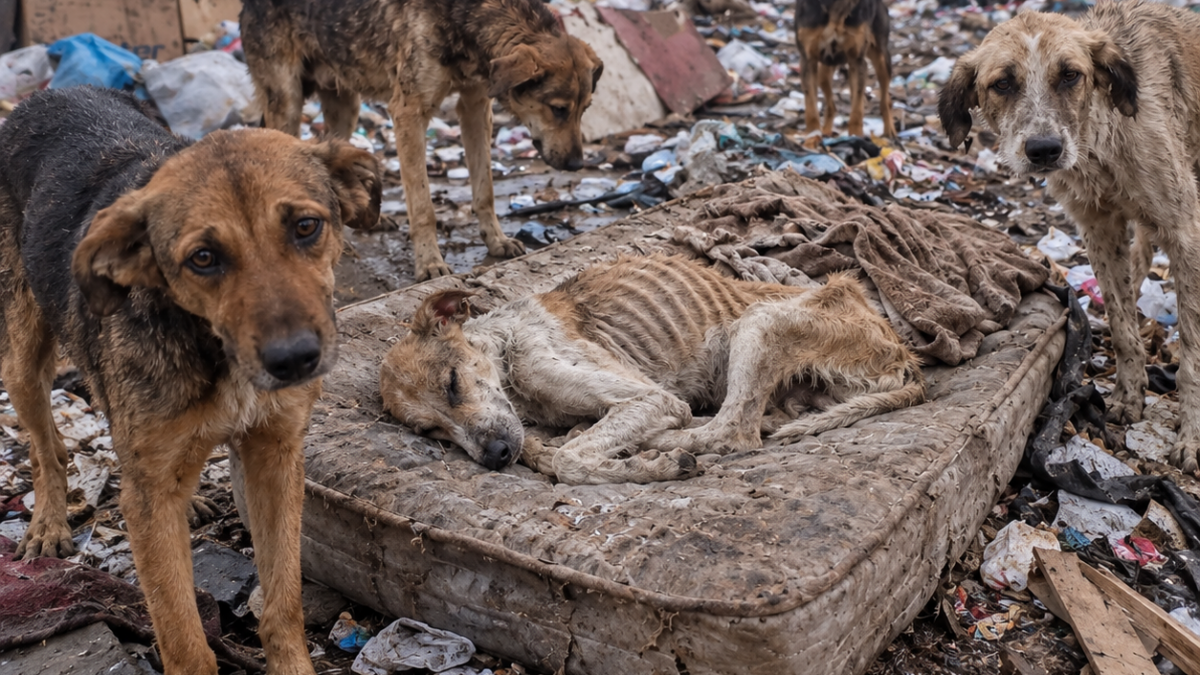
The landfill suddenly felt colder.
Not because the wind had changed.
Because now I was looking at the four standing dogs differently.
Before that moment, they had been strays.
A problem.
Four more animals surviving on whatever scraps they could find among things people had thrown away.
But once I understood what they were doing around that mattress, I could not see them that way anymore.
They were guarding somebody.
Ray ended the call and slid his phone into his jacket.
“Northside Animal Clinic is ready,” he said.
“They can stabilize him.”
I looked at the road behind us.
Calling it a road was generous.
It was a muddy service track full of ruts deep enough to swallow half a tire.
“They can’t send anyone?”
Ray shook his head.
“Their transport van won’t make it through here.”
“So we take him.”
“Yeah.”
I looked at the sick dog.
“How?”
That was the problem.
He was too weak for us simply to tuck under an arm and carry.
His body was already trembling from my hand resting lightly on his shoulder.
Any sudden movement might hurt him.
Ray scanned the trash around us.
Old plywood.
Broken lawn chairs.
Carpet.
Mattresses.
Discarded blankets soaked by months of weather.
“If we can make a stretcher…”
He started walking.
The four dogs watched him go.
One—a black female with white toes—followed him five or six steps, then stopped and turned back toward the mattress.
She seemed unable to decide whether Ray or the sick dog mattered more.
The sick dog won.
She returned immediately.
I kept my hand near his head.
“Easy, buddy.”
His eyes opened again.
Brown.
Dull from exhaustion, but aware.
“What happened to you?”
Of course he did not answer.
The black female came closer.
Not to me.
To him.
She sniffed his ear, then licked it once.
The dog’s eyelid fluttered.
That tiny gesture told me more than any medical chart could have.
They knew him.
Not merely as another animal feeding at the same dump.
He mattered to them.
Ray returned dragging a thick moving blanket.
“Found this under some boxes.”
I looked at it.
It was stained, but dry enough.
“Better than nothing.”
We spread it beside the mattress.
The moment we did, the largest of the four dogs—a brindle male with a torn left ear—stepped between us and the sick dog.
His body stiffened.
He did not growl.
But the message was clear.
Slow down.
I stopped immediately.
“Okay.”
I lowered both hands.
“We’re not taking him to hurt him.”
The brindle dog stared at me.
Behind him, the sick dog breathed shallowly.
I crouched and let the brindle smell my hand.
He would not come close.
That was fine.
Trust is not something a frightened animal owes you because your intentions happen to be good.
Ray moved around to the other side.
The brindle dog watched him too.
“Jackson,” Ray whispered.
“Yeah?”
“I don’t think we’re getting him out of here unless they let us.”
“I know.”
That was exactly what it felt like.
The four dogs had created a wall around their companion.
Not an aggressive wall.
A worried one.
So we stopped acting like men trying to solve a problem and started acting like visitors asking permission.
I sat directly on the dirty ground.
Ray did the same.
For several minutes, nobody moved.
A gull screamed overhead.
Somewhere on the other side of the landfill, a loader backed up with a rhythmic warning beep.
The dogs flinched at the sound.
The sick one did not.
He barely had the strength.
I took a granola bar from my jacket, then remembered chocolate could be dangerous and put it away.
Ray laughed quietly.
“Great rescue diet.”
“You got anything useful?”
He checked his lunch cooler.
“Turkey.”
“Plain?”
“Mostly.”
We tore pieces and tossed them toward the four dogs.
The black female approached first.
One step.
Pause.
Then another.
She grabbed a piece and backed away.
The brindle male would not eat.
Neither would a scruffy brown dog with a crooked tail.
The fourth, a pale yellow female with a scar across her nose, took food only after I turned my face away.
None of them fought over it.
That surprised me.
Dogs hungry enough to show ribs often compete.
These did not.
When a piece landed close to the mattress, the black female picked it up.
Then she walked to the sick dog and placed it near his mouth.
Ray looked at me.
I looked at him.
Neither of us spoke.
The sick dog smelled the turkey but did not eat.
The black female nudged it closer.
Nothing.
She sat beside him.
That was when Ray whispered, “They’ve been feeding him.”
I looked around.
Several old food containers lay near the mattress.
Chicken bones.
A crushed burger wrapper.
Half a paper plate.
Maybe it was coincidence.
Maybe landfill scraps simply accumulated everywhere.
But the food nearest the mattress looked different.
Collected.
Brought.
I remembered the four dogs’ condition.
All starving.
And yet they had apparently been carrying food back to the one who could no longer search for it himself.
The thought made my throat close.
I reached for my radio.
“Dispatch, Jackson.”
A burst of static.
“Go ahead.”
“We need animal services at the south entrance.”
“Five dogs.”
“Five?”
“One critical.”
“Four mobile but severely underweight.”
“Copy.”
“ETA?”
A pause.
“Forty-five minutes, minimum.”
Forty-five minutes was too long for the sick dog.
“Tell them we’re transporting one to Northside.”
“Have them meet us back here for the remaining four.”
“Copy.”
The brindle male watched me clip the radio back to my belt.
I looked at him.
“You heard that?”
His ears moved.
“We’re coming back.”
I had no idea whether he understood.
I needed to say it anyway.
Ray and I approached the mattress again.
This time, the brindle dog stepped back.
Only one pace.
But it was enough.
“Thank you,” I murmured.
We slid the moving blanket against the mattress.
The sick dog’s breathing sped up when I touched his chest.
“Easy.”
Ray placed one hand beneath his shoulders.
I supported the hips.
He was terrifyingly light.
The moment we began to lift, he made a weak sound.
All four dogs whined at once.
It was not a bark.
It sounded closer to grief.
“We’ve got him,” Ray said, as though speaking to them.
“We’ve got him.”
The black female moved forward.
I held still.
She sniffed the sick dog’s paw hanging over the blanket.
Then she stepped back.
We shifted him onto the fabric.
His eyes opened.
His head rolled toward me.
“Still with us?”
His tail tried again.
A tiny movement.
“That’s enough.”
I swallowed.
“You don’t have to impress anybody.”
We folded the sides of the blanket around him.
Ray grabbed two corners.
I took the other two.
The walk to the truck was maybe seventy yards.
It felt like a mile.
The landfill ground was uneven beneath our boots.
Every few steps, one of us had to stop and adjust.
The dog whimpered when the blanket shifted.
Each sound made the four others whine behind us.
They followed at a distance of about ten feet.
All four.
Nobody wandered toward food.
Nobody broke away.
Their eyes remained on the dog we carried.
At the truck, I opened the rear crew door.
Our garbage truck was not made for this.
There was no proper kennel.
No medical space.
Just a narrow bench behind the front seats where crew sometimes rode between collection areas.
We laid the blanket across it.
The sick dog did not move.
I climbed in beside him.
Then I looked outside.
The four dogs stood below the open door.
The black female placed her front paws on the running board.
For one second, I thought she would climb in.
There was not room.
Not safely.
“I know,” I said.
She looked at the dog.
Then at me.
“We’re coming back.”
Her ears lowered.
My chest tightened.
“You hear me?”
“We are coming back.”
Ray stood beside the driver’s door, watching.
“We can’t take them all.”
“I know.”
“Animal services will get here.”
“I know.”
“We need to go.”
I looked at the four dogs.
The brindle male sat down.
The others stayed standing.
None followed when Ray started the engine.
They simply watched.
As we pulled away, I turned in the seat.
They became smaller through the dirty rear window.
Four thin shapes beside the old mattress.
Waiting.
I had spent eleven years working around things people threw away.
That was the first time I had ever felt something at the landfill watching me leave.
The dog beside me shivered.
I placed my hand gently on his head.
“We’re not doing that to you.”
His breathing remained rapid.
“We’re coming back for them.”
He could not know what I meant.
Maybe he knew my voice.
That had to be enough.
The ride to Northside took thirty-two minutes.
Ray drove faster than usual but carefully enough that the sick dog did not slide.
I sat beside him the entire way.
Every few minutes, I checked his breathing.
At one point, he stopped shivering.
That scared me more than the shaking.
“Ray.”
“What?”
“He’s really still.”
Ray glanced into the mirror.
“We’re almost there.”
I rubbed the dog’s chest gently.
“Stay with me.”
His eye opened.
“That’s it.”
“You can hate me later.”
I kept talking because silence felt dangerous.
I told him about the clinic.
I told him there would be heat.
Food.
Water.
People who knew more than two garbage collectors with a filthy blanket.
I promised him things I had no authority to promise.
That he would live.
That the others would be safe.
That we would bring them back together.
People do that when scared.
We try to bargain with the future using words.
The dog shifted his head.
Then, slowly, rested his muzzle on my thigh.
I stopped talking.
His eyes closed.
For the remainder of the ride, I kept one hand on him and felt every shallow breath.
Northside Animal Clinic was waiting when we pulled into the rear lot.
Three people came outside with a stretcher.
A veterinarian in dark blue scrubs took one look through the open door and said, “Move carefully.”
Her name was Dr. Hannah Lowell.
I had never met her before that morning.
I would know her for years afterward.
She climbed partly into the truck.
“Hey, sweetheart.”
The dog barely reacted.
“How long has he been down?”
“Don’t know.”
“Found him on a mattress.”
“Other dogs around him.”
“Four.”
Her eyes flicked toward me.
“Four?”
“They were guarding him.”
She paused.
Then returned to work.
“Okay.”
They slid a real stretcher beneath the blanket.
The dog whimpered once.
I leaned close.
“Easy.”
His nose moved toward my sleeve.
Dr. Lowell noticed.
“You should come in.”
“Me?”
“He knows your smell now.”
I followed.
Ray said he would return to the landfill immediately.
I grabbed his arm before he turned.
“Don’t leave without the others.”
“I won’t.”
“You promise?”
Ray looked offended.
“Jackson.”
I released him.
“Right.”
He climbed back into the truck.
“I’ll call you.”
Then he drove away.
Inside, the sick dog disappeared behind treatment-room doors.
For the first time since seeing him on the mattress, I had nothing to do.
I hated it.
A receptionist handed me paperwork.
“Your dog’s name?”
“He’s not mine.”
She looked up.
“What should we call him?”
I stared at the blank line.
Somewhere between the landfill and the clinic, he had gone from “the sick dog” to something that felt wrong to leave unnamed.
I thought of the mattress.
Four dogs forming a circle around him.
Waiting.
“Chance,” I said.
The receptionist wrote it down.
“Chance?”
“Yeah.”
It sounded corny.
I did not care.
Chance.
That was what we were trying to give him.
I paced.
Twenty minutes.
Thirty.
Forty.
Finally, Dr. Lowell came out.
She pulled off her gloves.
“He’s alive.”
I exhaled so sharply I felt dizzy.
“How bad?”
“Bad.”
The relief stopped.
“Severe dehydration.”
“Extreme malnutrition.”
“High fever.”
“Anemia.”
“Skin infection.”
“Pressure sores.”
“Parasites.”
“Possibly pneumonia.”
She took a breath.
“And bloodwork suggests a serious bacterial infection.”
“Can you treat it?”
“Yes.”
“Will it work?”
She looked through the treatment-room window.
“I don’t know.”
“What are his chances?”
“Better now than they were two hours ago.”
Not an answer.
Also the only honest answer.
“He’s young,” she added.
“Maybe three or four.”
I blinked.
“He looks ten.”
“Starvation ages everything.”
That sentence stayed with me.
“What about the tail?”
“The what?”
“He keeps trying to wag it.”
For the first time, she smiled.
“That is medically irrelevant.”
“Okay.”
“And emotionally encouraging.”
“Good.”
My phone rang.
Ray.
I answered immediately.
“You got them?”
“Animal services beat me back by five minutes.”
“And?”
“All four still there.”
My knees weakened.
“Still by the mattress?”
“Exactly there.”
He sounded strange.
“Jackson…”
“What?”
“When the animal control van pulled up, they started wagging.”
I closed my eyes.
“All of them?”
“Yeah.”
“They just… knew.”
“What’s happening now?”
“They’re loading them.”
“Any trouble?”
“None.”
“The black one walked into the crate herself.”
Ray gave a shaky laugh.
“The brindle guy needed turkey.”
“Good.”
“Clinic?”
I turned toward the treatment room.
“Chance is alive.”
“Chance?”
“His name.”
“You named him?”
“Temporarily.”
“Sure.”
“Shut up.”
Ray laughed.
It was the first normal sound either of us had made all morning.
“We’ll bring the other four to Northside.”
“All of them?”
“Clinic agreed.”
“How?”
“County’s covering emergency intake.”
I leaned against the wall.
“All right.”
Ray lowered his voice.
“We got all five, Jackson.”
That sentence did something to me.
I covered my eyes.
“Yeah.”
“We got all five.”
The other dogs arrived less than an hour later.
Animal control officers brought them in separate crates.
The black female was listed as Dog One.
The brindle male Dog Two.
The pale female Dog Three.
The brown crooked-tail male Dog Four.
I hated that immediately.
They had spent who knew how long keeping one another alive.
They deserved names.
But first they needed medicine.
Dr. Lowell and her staff examined each one.
The black female had severe flea dermatitis and intestinal parasites.
The brindle male had an old leg injury and several scars.
The pale yellow female was underweight but otherwise surprisingly healthy.
The scruffy brown male had an infected ear and a healing cut along one shoulder.
None was as sick as Chance.
All were dehydrated.
All were starving.
All four had empty stomachs except for tiny amounts of scavenged food.
Dr. Lowell came into the hallway.
“They’ve probably been giving the better food to him.”
“You can tell?”
“I can tell they’re all hungry.”
“And he’s worse.”
“That doesn’t prove anything.”
No.
It did not prove it medically.
I did not need proof.
I had watched the black dog place turkey near his mouth.
I knew.
The clinic placed their kennels in the same room.
Chance was in a heated enclosure with IV lines and oxygen.
The other four were arranged close enough to smell and hear him.
The moment the black female entered, Chance opened his eyes.
His head lifted less than an inch.
She whined.
The brindle male answered.
Chance’s tail moved beneath the blanket.
Dr. Lowell stared.
“Well.”
I folded my arms.
“Medically irrelevant?”
She nodded.
“Completely.”
Then she smiled.
We had to leave eventually.
Ray and I had a shift.
A supervisor who had been unusually understanding was still expecting us back before the county discovered two employees had transformed a garbage route into an animal rescue operation.
I stood outside Chance’s enclosure.
“See you tomorrow.”
His eyes were closed.
The black female watched me from the kennel across the room.
“I’ll see all of you.”
She tilted her head.
Ray tapped my shoulder.
“Come on.”
I did not want to leave.
That surprised me.
I had spent eleven years learning to leave things at the landfill.
Finish the route.
Empty the truck.
Move on.
The entire job depended on not carrying things home.
Those five dogs had already ruined that skill.
I returned the next morning before work.
Then after work.
Then every day for the next nine days.
Ray came almost as often.
On day two, Chance’s fever dropped.
On day three, he ate three tablespoons of prescription food.
I received a photo from Dr. Lowell as if someone had sent me an ultrasound of my first child.
I showed Ray.
“He ate.”
Ray stared at me.
“You realize he’s a dog?”
“Yes.”
“Just checking.”
On day four, Chance sat up for twelve seconds.
Then collapsed back onto the blanket.
The black female went wild with excitement, whining and pawing at her kennel door.
We named her Lucy.
She had become the unofficial nurse.
Every time Chance moved, Lucy noticed first.
The brindle male became Bruno.
The pale female became Daisy.
The brown crooked-tail dog became Otis.
The names were supposed to be temporary for records.
None changed afterward.
Chance, Lucy, Bruno, Daisy, Otis.
Five dogs from a landfill mattress.
Once Chance was stable enough, Dr. Lowell allowed brief supervised contact.
Lucy entered first.
Chance was lying on a padded mat.
The door opened.
Lucy rushed toward him, then stopped inches away.
As if remembering he was fragile.
She lowered herself onto her belly.
Chance lifted his head.
Their noses touched.
He wagged.
Not attempted.
Actually wagged.
Slowly.
Three times.
I heard Ray sniff beside me.
I looked over.
“You crying?”
“No.”
“You are.”
“Clinic dust.”
“Very dusty.”
Bruno came next.
He sniffed Chance from nose to tail, then stood over him for several seconds.
Daisy licked Chance’s face.
Otis circled twice and lay down against his back.
Then Lucy curled beside his front legs.
Five minutes later, all five were touching.
The staff stood around pretending to have legitimate medical reasons for remaining in the room.
Dr. Lowell eventually said, “Everybody out.”
Nobody moved.
She looked at us.
“I mean the humans.”
We left.
Through the window, the dogs slept.
Together.
Again.
The question everyone began asking was where they had come from.
Five bonded dogs do not usually appear at a landfill by accident.
Animal control checked missing pet reports.
Nothing.
They searched microchips.
Only one dog had one.
Bruno.
The chip was registered nine years earlier to a rescue organization three counties away.
The rescue had closed.
The original adopter information was incomplete.
That lead ended.
Then a landfill worker named Pete remembered something.
“Seen them around before,” he told me.
“How long?”
“A few months.”
“All five?”
“Sometimes three.”
“Sometimes four.”
“Usually near the far fence.”
“You never reported them?”
Pete looked uncomfortable.
“They stayed away from people.”
“Thought they belonged to someone out by Miller Road.”
They did not.
We eventually pieced together the likely story from sightings.
The dogs had been living as a loose pack around abandoned industrial lots for months.
Maybe longer.
People left scraps.
Restaurant dumpsters fed them.
They slept under trailers, inside drainage pipes, behind warehouses.
No single person cared for them.
But they cared for each other.
Then Chance got sick.
At first, he could still follow.
Later, he slowed.
Eventually, he could not walk.
The pack could have moved on.
Food around the landfill was unreliable.
Cold nights were coming.
Staying beside a sick dog made survival harder for all of them.
They stayed.
Someone had dumped the mattress weeks earlier.
Maybe the dogs chose it because it was softer.
Maybe because it held warmth.
Maybe Lucy led Chance there when his legs failed.
We would never know.
What we did know was that when Ray and I found them, four starving dogs had chosen to remain beside the weakest member of their group.
That was enough.
Chance remained hospitalized for sixteen days.
On day seven, he stood.
Not gracefully.
His legs shook beneath him.
He managed six seconds.
Lucy barked once from the other side of the gate.
Chance immediately sat down.
Everyone laughed.
“Peer pressure,” Ray said.
On day nine, he walked four steps.
On day eleven, ten.
On day twelve, he ate from a full bowl without assistance.
On day fourteen, he tried to steal some of Bruno’s food.
Dr. Lowell called that “the first convincing sign of recovery.”
The other four improved faster.
Regular meals transformed them.
Lucy’s coat started growing back.
Bruno gained eight pounds.
Daisy discovered tennis balls and apparently decided landfill survival had been an unfortunate interruption to her true career.
Otis became obsessed with blankets.
Every blanket.
Clinic blankets.
Laundry baskets.
Towels.
A jacket Ray left on a chair for thirty seconds.
Otis slept on all of them.
The staff began calling him King Otis.
Ray and I visited enough that our supervisor finally confronted us.
His name was Dale Mercer.
He had run sanitation operations for twenty-three years and believed emotions were something people should handle at home after completing their routes.
He stood beside our truck one afternoon.
“You two adopting a veterinary clinic?”
“No,” Ray said.
Dale looked at me.
“Five dogs?”
“Yeah.”
“You’re going every day?”
“Mostly.”
He shook his head.
“You’re ridiculous.”
Then he handed me an envelope.
“What’s this?”
“Crew took up a collection.”
Inside was $860.
I stared at him.
“For bills?”
“For whatever they need.”
Dale turned before I could say anything.
“Don’t get sentimental, Jackson.”
I watched him walk away.
Ray grinned.
“He likes dogs.”
“He hates everything.”
“Exactly.”
The clinic bill had already become enormous.
The county covered emergency stabilization and animal services contributed some.
A local rescue named Second Road Animal Project stepped in after the story spread among volunteers.
Then the landfill crew donated.
Then Northside discounted services.
Then somebody posted a photo of the five dogs sleeping together.
Donations came from strangers.
Five dollars.
Ten.
Fifty.
One anonymous donor covered Chance’s remaining hospitalization costs.
I remember looking at the total and thinking how strange the world was.
Somebody had once looked at an old mattress and decided it had no value.
Five dogs turned it into the place where a community first saw them.
Three weeks after we found them, Chance was medically cleared to leave the clinic.
Not fully recovered.
That would take months.
But stable.
Eating.
Walking.
No fever.
Blood values improving.
The clinic scheduled his release for Saturday morning because Ray and I refused to miss it.
We arrived early.
Of course.
Lucy, Bruno, Daisy, and Otis were staying in the rescue’s foster facility next door by then.
They had not seen Chance for three days because staff wanted to monitor him without constant pack stimulation.
When Dr. Lowell walked Chance through the clinic doors, I almost did not recognize him.
He was still thin.
Still weak.
But standing.
Actually standing.
His tan coat had been bathed and brushed.
The dark mask around his face gave him a serious expression that did not match his gentle behavior.
He wore a green harness.
He looked toward the parking lot.
Then heard something.
Lucy.
She was whining from behind the foster-yard gate.
Chance’s ears lifted.
His tail started wagging.
The gate opened.
I wish I could say the reunion was calm and dignified.
It was chaos.
Lucy reached him first and nearly knocked herself over trying not to jump on him.
Daisy raced in circles.
Otis barked and pressed his entire body against Chance’s side.
Bruno approached slower, sniffed Chance’s face, and then leaned his chest into him.
Chance stood in the middle of them.
Tail moving so hard his hips swayed.
Then he tried to run.
His legs had other opinions.
He stumbled.
All four stopped.
Immediately.
Lucy stood beside him.
Bruno moved to the other side.
Chance regained balance.
Then all five walked forward together.
Ray wiped his face.
“Dust again?”
“Shut up.”
Dr. Lowell stood behind us.
“That,” she said, “is why I hate this job.”
I looked at her.
“You’re smiling.”
“I hate it emotionally.”
“Sure.”
The difficult part came next.
Adoption.
The rescue assumed at first that the dogs would need separate homes.
Five medium-sized dogs together is a huge commitment.
Food.
Veterinary care.
Space.
Training.
Housing restrictions.
Finding one person willing and equipped to take all five seemed nearly impossible.
The rescue director, Marisol Vega, sat with Ray and me at a folding table.
“They’re bonded,” she said.
“But not equally.”
“Chance and Lucy are the strongest pair.”
“Bruno can function independently.”
“Daisy likes everyone.”
“Otis attaches to blankets more than civilization.”
I laughed.
She continued.
“We may have to split them.”
My stomach tightened.
Ray looked uncomfortable too.
“Would that hurt them?”
“We would do it gradually.”
“Pair placement if possible.”
“It may actually be healthier than holding them months waiting for a five-dog adopter who never comes.”
She was right.
I hated that she was right.
Good rescue work is full of choices where love does not automatically create enough resources.
We agreed to try.
First, though, they would remain together in foster while Chance regained strength.
That gave us time.
Weeks became months.
Spring warmed into early summer.
I visited almost every Sunday.
Sometimes Ray came.
Sometimes my daughter, Katie, came with me.
Katie was twenty-three and studying physical therapy.
The first time she met Chance, he placed his head on her knee.
She looked at me.
“No.”
I had not said anything.
“Dad, no.”
“What?”
“I live in an apartment.”
“I didn’t ask.”
“You’re thinking.”
“Maybe you’re projecting.”
She stared at Chance.
“Stop being cute.”
Chance wagged.
“That is manipulation.”
Eventually, the five dogs revealed more of themselves.
Lucy was the cautious one.
She watched every door before relaxing.
New men made her nervous.
Women she trusted faster.
Once she decided a person was safe, she became affectionate to the point of climbing into laps despite weighing forty-five pounds.
Bruno was the guardian.
Quiet.
Steady.
He slept nearest the entrance.
If another dog barked outside, Bruno stood first.
He rarely demanded affection but leaned heavily into anyone he loved.
Daisy was joy with paws.
Within weeks, she behaved as though the landfill had happened to someone else.
Balls.
Sticks.
Hoses.
Butterflies.
Everything delighted her.
Otis was the comedian.
He stole blankets, shoes, empty food bowls, and once an entire bag of cotton balls from the clinic.
Chance remained gentle and observant.
He tired easily.
His immune system was still recovering.
But each week he grew stronger.
And the others continued checking on him.
Not constantly anymore.
They played.
Explored.
Slept apart sometimes.
But if Chance coughed, Lucy appeared.
If he lay down early, Bruno often lay nearby.
When he went to veterinary appointments, all four waited by the gate until he returned.
Family.
There was no other word that fit.
Marisol extended the group-placement search longer than she normally would.
“We’ll give it summer,” she said.
“If no one suitable comes, we start pairing.”
We posted their story.
Not dramatically.
No exaggerated rescue language.
Just facts.
Five strays found at a landfill.
Four surrounding the fifth.
One critically ill.
All recovered.
Bonded group seeking experienced adopter or sanctuary placement.
Dozens of messages arrived.
Most were useless.
“I want the tan one.”
“Can you ship Daisy to Florida?”
“My kids want all five but we live in a condo.”
“I have three intact male dogs; will these get along?”
One person asked whether Chance was “famous enough” to use in social-media videos.
Marisol deleted that application without finishing it.
Then, in August, an email arrived from a woman named Helen Brooks.
She was sixty-two.
Widowed.
Retired veterinary technician.
Owned a six-acre property outside Yellow Springs.
Fenced.
No other dogs.
One elderly barn cat who lived mostly in the workshop and apparently considered dogs beneath notice.
Helen wrote:
I am not applying because the story is sad.
I am applying because I understand bonded animals and because I have the space, time, finances, and experience to let them remain together if the group proves manageable.
Marisol called me.
“This may be something.”
I went to the home inspection even though technically I had no role.
Nobody stopped me.
Helen’s property was almost suspiciously perfect.
A modest white farmhouse.
Large fenced yard.
Shade trees.
A covered porch.
A heated mudroom.
Separate indoor areas in case dogs needed space.
Low fencing around a garden.
No nearby highway.
She had ramps from a previous senior dog.
Medication cabinets.
Washable beds.
Emergency crates.
A relationship with a local veterinarian.
And no romantic illusions.
“Five dogs are expensive,” she said.
“Yes.”
“Five dogs can fight even if bonded.”
“Yes.”
“Resource guarding can appear after deprivation.”
“Yes.”
“Medical problems may emerge later.”
“Yes.”
“Chance may have lifelong consequences from starvation and infection.”
“Yes.”
She looked at me.
“You’re waiting for me to say something sentimental.”
“Maybe.”
Helen smiled.
“I had four littermates for thirteen years.”
“All rescues.”
“People told me to separate them.”
“I didn’t.”
“They cost me a fortune.”
“Destroyed two couches.”
“Dug a trench through my vegetable garden.”
“And gave me the best years of my life.”
I liked her immediately.
The dogs visited the property the following week.
We brought them in two vehicles.
Helen did not stand at the gate calling excitedly.
She sat on the porch.
Smart.
Lucy emerged first.
Suspicious.
Bruno followed.
Daisy bounced down the ramp as if invited to a birthday party.
Otis located a porch cushion in less than two minutes.
Chance walked beside me.
When his paws touched grass, he stopped.
The yard stretched wide around him.
Not trash.
Not concrete.
Grass.
Trees.
Sunlight.
He sniffed.
Lucy moved ahead.
Then returned.
She touched her nose to his.
They continued together.
For an hour, Helen mostly ignored them.
She let them explore.
Bruno inspected the fence.
Daisy found a tennis ball.
Otis attempted to steal Helen’s gardening glove.
Lucy followed Helen into the shade and lay six feet away.
Chance eventually came to the porch.
Helen extended one hand.
He sniffed.
Then he lowered himself beside her chair.
Not touching.
Close.
Marisol looked at me.
I knew.
Still, we did not rush.
There were more visits.
An overnight trial.
Then three nights.
Then a week.
No serious fights.
No escape attempts.
Chance ate normally.
Lucy began sleeping near Helen’s bedroom door.
Bruno claimed the mudroom mat.
Daisy discovered a shallow kiddie pool.
Otis stole a quilt.
Helen sent us photos every day.
Day six showed all five asleep on the porch.
Chance in the middle.
Exactly as he had been on the mattress.
Except now the bodies around him were full.
Clean.
Safe.
I stared at that photograph for a long time.
Katie stood behind me.
“You okay, Dad?”
“Yeah.”
“You’re crying.”
“I’m fifty-one.”
“My eyes do things.”
“Sure.”
The adoption became official in September.
All five.
Together.
The paperwork filled half a folder.
Helen signed every page.
When Marisol reached the final signature, she said, “You understand you’re under no obligation to keep all five together if serious behavioral or medical issues make that unsafe.”
Helen looked at the dogs.
Lucy beside Chance.
Bruno at the door.
Daisy holding a tennis ball.
Otis lying on a blanket he had stolen from the office.
“I understand.”
“And?”
“I intend to keep the family intact as long as it remains good for the family.”
That was exactly the answer we wanted.
The day they left, Ray and I stood outside the rescue.
I had thought I would feel only happy.
I did feel happy.
Also empty.
For months, those dogs had become part of my week.
My phone.
My conversations.
My family.
Then suddenly they were climbing into Helen’s SUV.
Chance paused at the ramp.
He turned toward me.
I crouched.
“Go on.”
He walked back.
His nose touched my hand.
Then he leaned his head into my chest.
I wrapped both arms around him.
“You scared the hell out of me, buddy.”
His tail wagged.
“Don’t ever do that again.”
Ray cleared his throat behind me.
I stood.
Lucy came next.
Then Bruno.
Then Daisy, who tried to steal the keys from my belt.
Then Otis, carrying a small blanket Marisol had officially surrendered to him.
They loaded into the SUV.
Helen closed the rear hatch.
The five dogs looked through the glass.
Together.
Ray stood beside me.
“Remember them by that mattress?”
“Yeah.”
“Hard to believe.”
I watched the SUV pull away.
“No.”
He looked at me.
“Actually, it’s not.”
The five dogs never forgot one another.
But they changed.
That was important.
People like rescue stories where animals remain emotionally frozen in the moment they were saved.
Forever grateful.
Forever attached.
Forever defined by hardship.
Real healing looks different.
Lucy stopped checking Chance every five minutes.
Bruno stopped sleeping directly against doors.
Daisy gained too much weight and had to go on a diet, which she considered a personal betrayal.
Otis discovered Helen’s couch and abandoned his obsession with landfill-grade blankets for better textiles.
Chance grew stronger until he could run.
Not far.
Not endlessly.
But run.
Helen sent me a video one October morning.
Chance was chasing Daisy beneath a maple tree.
His legs were long and awkward.
He slipped on leaves.
Recovered.
Kept going.
Lucy joined.
Then Bruno.
Otis ran in the wrong direction because he had a sock.
I watched the video five times.
Then sent it to Ray.
His reply came immediately.
LOOK AT CHANCE.
I wrote back:
I AM.
A year after the rescue, Helen invited everyone for a reunion.
Ray.
Me.
Dr. Lowell.
Marisol.
Two animal-control officers.
Dale from sanitation, who insisted he was attending “because Jackson won’t shut up about these dogs.”
The landfill crew brought food.
For humans.
Mostly.
Helen had set tables under the trees.
The dogs moved through the yard greeting people.
Chance recognized my voice before he saw me.
I had barely stepped from the car when his head came up.
His tail began moving.
Then he ran.
Actually ran.
Straight toward me.
I dropped to one knee.
He hit my chest hard enough to make me sit down.
I laughed.
He licked my chin.
“Okay.”
“Okay.”
“You’re healthy now.”
“You can stop trying to kill me.”
Lucy arrived next and leaned against my side.
Bruno stood behind her.
Daisy brought me a ball.
Otis arrived with a dish towel.
Some things had not changed.
Dr. Lowell stood nearby with her arms folded.
“Medically irrelevant,” I said.
She smiled.
“Completely.”
The reunion became annual.
Every September.
At first, all five dogs came racing to the gate.
Then, as years passed, slower.
Life does that.
Chance developed arthritis earlier than expected.
Dr. Lowell believed the months of malnutrition had taken a permanent toll.
Helen managed it carefully.
Medication.
Weight control.
Shorter walks.
Soft beds.
Lucy remained attached to him, but by then the bond looked peaceful rather than desperate.
They slept together by choice, not fear.
Bruno’s old leg injury worsened.
Daisy remained absurdly cheerful into old age.
Otis continued stealing blankets until the day he died, according to Helen.
We lost Bruno first.
He was estimated to be eleven or twelve.
Cancer.
Fast.
Helen called me before the final appointment.
I drove out.
Bruno lay on the porch.
Chance slept beside him.
Lucy on the other side.
Daisy near his feet.
Otis had placed a blanket partly over Bruno’s back.
Helen claimed nobody had done it.
I believed her.
Bruno left at home.
Surrounded by his pack.
Afterward, the remaining four searched the yard for him.
For several days.
Then less.
They adjusted.
Not forgot.
Adjusted.
That distinction matters.
Otis went next two years later.
Heart failure.
He died asleep on one of Helen’s quilts.
Daisy aged into a white-faced old lady who still believed tennis balls were worth medical risk.
She passed at fifteen, or close to it.
Then there were two.
Chance and Lucy.
The pair that had always seemed closest.
The sick dog from the mattress and the black female who had carried food to him.
By then I had retired from landfill work.
Ray was still there, supervising crews.
I had moved into maintenance for the county, partly because my back had stopped appreciating garbage-truck suspension.
But I stayed in touch.
Chance was old.
Lucy older.
Helen sent fewer running videos.
More sleeping photographs.
Two gray faces touching on the porch.
One winter evening, she called.
“Jackson?”
I knew from her voice.
“Which one?”
“Lucy.”
I closed my eyes.
“What happened?”
“She’s not eating.”
“Vet thinks kidneys.”
“How’s Chance?”
There was a long pause.
“He won’t leave her.”
Of course.
I drove to Yellow Springs the next morning.
Ray came too.
Snow had dusted the grass.
Inside the farmhouse, Lucy lay on a bed near the fireplace.
Chance rested beside her.
His muzzle was almost white now.
His legs stiff.
His hearing poor.
But his body still curved toward Lucy.
Helen sat nearby.
“She was fine last week.”
That is the lie endings tell us.
Fine last week.
Fine yesterday.
Fine before breakfast.
Time hides its cliff edges.
Lucy lifted her head when I spoke.
“Hey, girl.”
Her tail tapped weakly.
I knelt.
Chance sniffed me.
His ears moved.
He pushed his head into my shoulder.
I put one arm around him.
Ray sat beside Lucy.
“You were the first one to trust us,” he told her.
He was right.
Lucy had taken the turkey.
Lucy had stepped aside.
Lucy had watched us carry Chance.
Lucy had waited at the landfill.
Lucy had walked into the animal-control crate as if she understood rescue had finally arrived.
The veterinarian came that afternoon.
Lucy died with Chance’s nose against her face.
Helen’s hand on her chest.
Ray holding one paw.
Me rubbing the black fur between her ears, now sprinkled with white.
Chance made one small sound after she stopped breathing.
Not a howl.
Not a bark.
A sigh.
Then he lay down.
He stayed beside her until we moved her.
For the next weeks, Chance changed.
He still ate.
Still walked.
Still greeted Helen.
But part of his attention seemed aimed somewhere else.
He searched rooms Lucy had used.
Sniffed her bed.
Waited by the porch door at sunset.
Helen called me worried.
I told her what Dr. Lowell had once taught me.
Grief is not always an emergency.
Sometimes it is work the body has to do.
So Helen stayed close.
She kept routine.
She did not force cheer.
She let him sleep on Lucy’s bed.
She let him stop during walks and smell the places Lucy had marked.
Slowly, Chance returned.
Not fully.
You do not return fully from loving someone.
You return changed.
That spring, he began lying in the sun alone.
By summer, he followed Helen into the garden.
He was the last.
The dog who once seemed least likely to survive outlived the entire pack.
There was something unbearably fitting about that.
Chance lived almost two more years.
When he became too weak to manage the porch steps, Helen used the ramp.
When he stopped enjoying long walks, they sat in the yard.
When his hearing faded, she touched the floor before approaching so the vibration would tell him she was coming.
When he stopped eating dry food, she cooked.
When he stopped caring about most food, she offered chicken.
Then one September morning, Helen called again.
“He’s ready.”
I was already putting on my shoes before she finished.
Ray met me there.
Dr. Lowell came too.
She had reduced clinic hours by then but still remembered every dog.
Chance lay on the porch.
The same porch from the first adoption photo.
Trees had grown taller.
Helen’s hair was whiter.
Ray moved slower.
So did I.
Chance was thin again.
Not starvation-thin.
Old-thin.
There is a difference.
His body had simply spent most of what it had been given.
I knelt beside him.
His nose moved.
“Jackson,” Helen said.
“I think he knows.”
I touched his head.
“Hey, Chance.”
His tail moved once.
One tiny sweep.
I laughed through tears.
“You still doing that?”
His eyes opened.
Cloudy.
Warm.
The motion took me back instantly.
The landfill.
The mattress.
My hand on his filthy head.
The dog too weak to lift himself but trying to wag anyway.
Dr. Lowell sat on the porch floor.
“You know,” she said, “that tail has been medically irrelevant for a very long time.”
Ray laughed.
I did too.
Chance breathed slowly.
I looked around the porch.
There were framed photographs on Helen’s wall.
Five dogs in grass.
Five dogs asleep.
Five dogs at Christmas.
Bruno by the door.
Daisy with a ball.
Otis wrapped in stolen fabric.
Lucy pressed against Chance.
A life.
Not survival.
A life.
I bent closer.
“You did good.”
His ear moved.
“You stayed.”
I thought of the four dogs surrounding him.
Then I corrected myself.
“They stayed.”
Another breath.
“And then you stayed for all of them.”
Helen cried quietly.
Ray looked toward the yard.
Dr. Lowell placed a hand on my shoulder.
Chance rested his muzzle across my wrist.
I whispered the words I had promised him in the garbage truck years earlier.
“You’re safe.”
Then I added something I could not have said that first morning.
“They’re waiting for you now.”
I do not know whether I believe dogs meet again after death.
I hope they do.
That day, hope was enough.
Chance left peacefully on the porch.
No mattress.
No trash.
No hunger.
No four frightened dogs standing guard because humans had not come yet.
Just Helen.
Ray.
Dr. Lowell.
Me.
And years of evidence that he had mattered.
Afterward, Helen gave me something.
A photograph.
The first one she had ever taken after all five dogs moved in.
They were asleep on the porch.
Chance in the middle.
Lucy touching his front paws.
Bruno along his back.
Daisy curled near his belly.
Otis on a blanket by his head.
The arrangement was almost identical to the way we had found them.
But everything else was different.
Their bodies were healthy.
Their coats clean.
Their ribs hidden.
The mattress replaced by thick beds.
Garbage replaced by grass and trees.
Fear replaced by sleep.
On the back, Helen had written:
They stayed when survival gave them every reason to leave.
I keep that photograph in my kitchen.
Not at work.
Not in a box.
Where I see it every morning.
The landfill is still there.
I pass it sometimes.
The old section where we found them has changed.
The mattress disappeared long ago.
Buried or crushed or hauled somewhere else.
Trash never keeps monuments.
But people can.
After Chance died, Ray convinced the sanitation department to put a small plaque inside the employee break room.
Nothing public.
Nothing dramatic.
It says:
THE FIVE FROM SOUTH FIELD.
IF SOMETHING LIVING IS IN THE TRASH, IT IS NOT TRASH.
STOP.
LOOK.
CALL.
New employees ask about it.
Ray tells them.
Sometimes I do.
The story changed procedures.
Workers received basic animal-response training.
Garbage trucks carried spare leashes, water bowls, blankets, and contact numbers.
The landfill partnered with animal services.
Employees learned what to do if they found trapped wildlife, dumped pets, litters of kittens, injured dogs.
It sounds obvious.
It was not before.
People assume somebody else will respond.
Those five dogs taught us that somebody else is often late.
So stop.
Look.
Call.
In the first two years after the policy changed, workers found fourteen animals alive at the landfill.
Three puppies in a taped cardboard box.
A senior Chihuahua inside a broken recliner.
Two cats trapped in a discarded carrier.
A rabbit in a plastic tote.
Several dogs wandering after being intentionally dumped.
Not every story ended well.
Some animals were too sick.
Some disappeared before help arrived.
Some wildlife could not be saved.
But many lived.
Because two garbage collectors had once stopped the truck.
That matters to me.
I think often about what would have happened if Ray had not noticed them.
If we had been talking.
If he had been looking at his phone.
If the dogs had hidden.
If the black female had run.
If we had told ourselves animal control would eventually handle it.
Chance probably would have died that day.
Maybe that night.
The other four might have stayed until hunger forced them away.
Maybe one would have died too.
Maybe all of them.
Instead, Ray stopped.
That was the first rescue.
Not lifting Chance.
Not calling the clinic.
Stopping.
Attention is where rescue begins.
Years later, a reporter asked me what impressed me most about the dogs.
She expected me to say loyalty.
Friendship.
Devotion.
I told her something different.
“They made room for us.”
She looked confused.
“What do you mean?”
I remembered the landfill.
The four thin bodies surrounding the mattress.
The way they watched us.
The moment they stepped aside.
“They had every reason not to trust people.”
“They were starving.”
“Living in garbage.”
“Probably chased away plenty of times.”
“But when they understood we were trying to help Chance, they moved.”
“They let strangers into their circle.”
The reporter nodded.
“That’s trust.”
“Maybe.”
I thought about it.
“Or desperation.”
“Maybe both.”
Then I said something I did not understand fully until the words were out.
“Sometimes hope is just making enough room for help to reach you.”
That line ended up in the article.
Helen framed it.
I thought that was excessive.
She did not.
I still visit her once or twice a year.
There are no dogs at the house now.
Not because she stopped loving them.
Because five aging dogs took a lot from her physically and emotionally, and she is honest enough to know her limits.
There are photographs everywhere.
Chance.
Lucy.
Bruno.
Daisy.
Otis.
On the porch, five small engraved stones sit beneath the maple tree.
One for each.
No long quotes.
Just names.
Lucy.
Bruno.
Daisy.
Otis.
Chance.
Sometimes we sit there with coffee.
Helen tells me stories I missed.
How Daisy once stole an entire birthday cake.
How Bruno barked at a plastic flamingo for six months.
How Otis took every bath towel from the laundry room and arranged them in a nest.
How Lucy would not sleep until Chance settled.
How Chance, after everyone else died, began lying in all their favorite spots, one after another, as though keeping attendance.
One afternoon, Helen said, “People always say I rescued them.”
I looked at her.
“You did.”
“No.”
She shook her head.
“You and Ray rescued them.”
“I gave them a house.”
“That counts.”
“So did they.”
“What?”
She looked toward the five stones.
“My husband died three years before they came.”
“I had this property.”
“Money.”
“Time.”
“Nothing to wake up for.”
Her eyes filled.
“Then suddenly breakfast took an hour.”
“Medication took charts.”
“Someone was throwing up at two in the morning.”
“Someone needed the vet.”
“Someone stole my laundry.”
“I couldn’t disappear into myself anymore.”
I looked down.
“They were a lot of work.”
Helen laughed.
“They were terrible.”
Then she smiled at the stones.
“And they saved my life.”
That is how rescue stories usually work if you follow them long enough.
Nobody stays only rescuer.
Nobody stays only rescued.
Need moves both directions.
Those dogs needed us because people had failed them.
Ray and I needed them because they forced us to look at our work differently.
Helen needed them because grief had emptied her days.
Northside needed their story to build support.
The landfill needed them to change its procedures.
Other abandoned animals needed the path they created.
Five starving dogs around one mattress.
That image became larger than the place where it happened.
But I try not to turn them into symbols too much.
They were dogs.
Real dogs.
Messy.
Expensive.
Sometimes difficult.
Daisy once ate part of Helen’s porch cushion.
Bruno had to be carefully introduced to strange male dogs.
Lucy never completely stopped guarding food around unfamiliar animals.
Otis had no respect for personal property.
Chance had lifelong digestive problems and required medication for years.
Love does not become more meaningful when we pretend its subjects are perfect.
They were worth saving because they were alive.
That was enough.
I am sixty now.
Ray retired last year.
At his party, the landfill crew gave him a framed picture of the five dogs.
He cried in front of thirty sanitation workers.
Nobody teased him.
Much.
He keeps it in his garage.
I asked him recently whether he remembers the exact morning.
“Every detail,” he said.
“Me too.”
“You know what I remember most?”
“What?”
“That sound.”
I knew immediately.
The whining.
Four dogs pleading around the mattress.
“Yeah.”
Ray stared at his coffee.
“I still hear it sometimes.”
“So do I.”
Then he said, “But I remember the second sound too.”
“What second sound?”
“When we came back with animal control.”
I smiled.
“The happy whining.”
“Yeah.”
He nodded.
“That one’s better.”
He was right.
Memory gives us both if we let it.
Pain.
Then what came after.
That is probably why I still tell the story.
Not because five dogs were starving at a dump.
There are too many stories like that.
I tell it because four animals who had almost nothing left still decided that one of them would not suffer alone.
They had hunger.
They stayed.
They had fear.
They stayed.
They had no guarantee help was coming.
They stayed.
And when help finally appeared, they did something just as brave.
They trusted us enough to step aside.
Chance survived because of medicine.
Food.
Fluids.
Antibiotics.
Veterinary care.
Donations.
Foster space.
Helen.
All of that is true.
But Chance survived long enough to receive those things because four dogs kept him alive before any human knew his name.
Lucy brought him food.
Bruno guarded.
Daisy stayed.
Otis stayed.
Maybe they kept him warm at night.
Maybe they warned scavengers away.
Maybe they simply gave him a reason not to give up.
We will never know everything.
We do not need to.
When I close my eyes, I still see that old mattress.
Chance stretched across it.
Four thin dogs standing around him.
Mountains of trash behind them.
The worst place in the county.
And somehow, in the middle of everything people had thrown away, there was loyalty no one could buy.
That is what stays with me.
Not the garbage.
Not the smell.
Not the mud.
The circle.
Four bodies around one.
A family with no house.
No bowls.
No collars.
No owner.
No guarantee of tomorrow.
Still a family.
Maybe that is all family has ever meant at its deepest level.
Not who shares your blood.
Not who owns you.
Not who is legally assigned to care.
Family is who notices when you fall behind.
Who brings something back when you cannot go looking yourself.
Who stays when leaving would be easier.
Who makes room when help finally comes.
And who waits for the truck to return because they refuse to believe the one taken away has disappeared forever.
The five dogs never separated by choice.
Life separated them eventually.
Age.
Illness.
Time.
But not abandonment.
Never again.
When Bruno died, the others were there.
When Otis died, he was home.
When Daisy died, she was loved.
When Lucy died, Chance was beside her.
When Chance finally went, every dog who had once stood around that mattress had already known years of warmth, food, grass, beds, toys, names, and belonging.
That is the ending I choose to remember.
Not five starving dogs in a landfill.
Five old dogs who got to become old.
There is a difference.
A huge one.
At the county landfill, trucks still arrive before sunrise.
Gulls still circle.
Furniture still breaks under compactors.
People still throw away things they no longer need.
But inside the break room hangs that plaque.
IF SOMETHING LIVING IS IN THE TRASH, IT IS NOT TRASH.
STOP.
LOOK.
CALL.
Whenever I visit Ray, he jokes that the county finally turned our worst detour into an official rule.
Maybe that is what goodness often looks like.
A detour.
You are going somewhere else.
You have work.
Schedules.
Reasons to keep moving.
Then something makes you stop.
You look.
You see a life everybody else missed.
And suddenly the place you thought you were headed is not as important as what is right in front of you.
That morning, Ray and I were supposed to collect garbage.
Instead, we found a family.
And those five dogs taught me something I still carry whenever I pass an abandoned animal, a person sitting alone, or anything living the world seems too busy to notice.
You do not always need to know the whole story.
You do not need proof that the one suffering deserves help.
Sometimes you simply stop.
You walk closer.
You kneel.
And you say the words those five dogs had been waiting to hear from someone for far too long.
We see you.
We’re here.
And this time, nobody is being left behind.








