For twelve years, Rex had worked as a K9 search-and-rescue dog, but by the time I met him, the old Chihuahua spent his days sitting silently in the back corner of a shelter kennel as if he were still waiting for an order that would never come
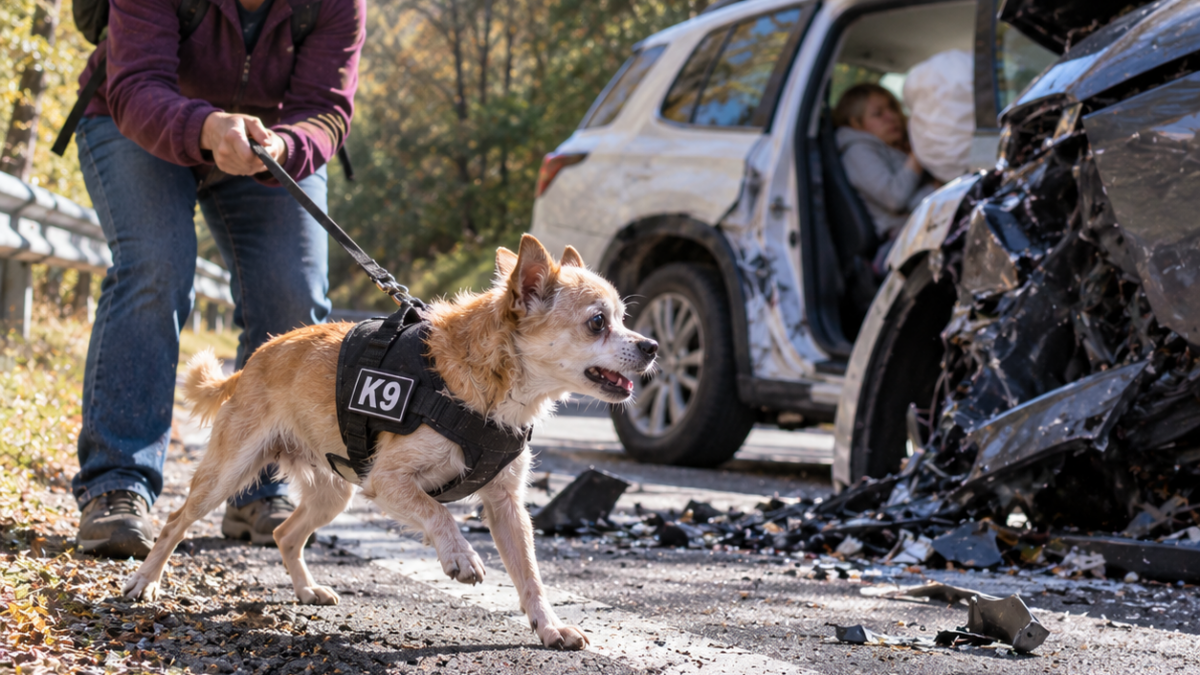
“Sir, can you hear me?”
The man inside the sedan made another low sound.
I pressed the phone harder against my ear.
The 911 dispatcher was still speaking.
“Ma’am, do not enter the vehicle if you smell fuel.”
“I know.”
My voice sounded strangely distant.
“I know, but there’s someone inside.”
“Emergency crews are on the way.”
I looked toward the engine compartment.
A thin ribbon of gray smoke was rising from beneath the bent hood.
“How long?”
“Units are responding now.”
That wasn’t an answer.
Rex barked again from inside the sedan.
Short.
Sharp.
Insistent.
The sound went through me.
I leaned toward the opening in the rear door.
“Rex, come.”
He did not come.
Instead, he turned his head toward the driver.
Then back toward me.
I had spent weeks wondering whether there was anything left inside that little old dog from his working years.
There was.
All of it.
I lowered the phone for half a second.
“Rex, show me.”
The words came without thought.
Maybe I had heard them somewhere.
Maybe they had been buried in one of the training notes in his file.
Whatever the reason, he responded immediately.
He turned toward the front seat.
I crouched and looked through the broken window.
The man was slumped sideways against the steering wheel.
His seat belt was still fastened.
Blood ran from a cut near his hairline, but his chest was moving.
Barely.
The front of the sedan had folded around a tree at an angle, crushing the driver’s side enough that the door would never open.
The passenger side had been hit by the SUV before the sedan spun.
There was no easy way in.
Except the gap Rex had found.
“Sir!”
No response.
Rex climbed partly onto the center console and pushed his nose against the man’s cheek.
The driver groaned.
His right hand moved.
“Good boy,” I whispered.
Rex barked once.
I looked around desperately.
The SUV had stopped farther down the road.
Its driver was standing beside it, stunned but upright.
A woman had stopped her pickup on the opposite shoulder.
She was already running toward us.
“What happened?”
“There’s a man trapped.”
She looked at the smoke.
“Oh, God.”
“I need help.”
Together we tried the rear passenger door.
It opened perhaps eight inches before twisted metal stopped it.
The woman grabbed the top of the frame.
I pulled the lower edge.
Nothing.
The dispatcher’s voice came from my phone on the ground.
“Do not put yourselves in danger.”
I knew she was right.
I also knew the man inside did not have the luxury of waiting calmly for us to agree.
Rex squeezed back through the gap.
For a second, I thought he was finally leaving the car.
Instead, he came to me, touched my shin with his nose, and immediately turned back.
He had found the route.
He was showing it to me.
I dropped onto my hands and knees.
The opening was too small for my shoulders.
But the rear window had shattered almost completely.
Only a few jagged pieces remained around the frame.
The woman from the pickup took off her coat.
“Use this.”
We wrapped the coat around my forearm.
I knocked the loose glass away as carefully as I could.
Then I reached inside.
The driver’s seat was several feet ahead.
Too far.
I could not get through.
Rex could.
That was what twelve years of training had been built around.
Not strength.
Access.
He could go where people could not.
He could find life where other eyes saw only wreckage.
“Can you wake him up?” I whispered.
Rex was already moving.
He crawled across the back seat, over a collapsed headrest, and onto the center console.
The smoke was thicker now.
My stomach turned.
“Rex!”
His ears flicked.
He heard me.
He did not leave.
He pushed his nose beneath the man’s right hand.
The hand moved again.
Then Rex began licking the man’s wrist.
The driver’s head shifted.
“Hey!” I shouted.
“Sir, listen to me!”
His eyelids fluttered.
“Can you hear me?”
A weak voice came back.
“What…”
“My name is Anna.”
I nearly laughed from relief.
“You’ve been in an accident.”
He tried to move and cried out.
“Don’t move your neck.”
“I can’t…”
“I know.”
I looked at the belt.
“Can you reach the seat belt release?”
He tried.
His hand fell short.
Rex followed the movement.
The Chihuahua put both front paws against the man’s thigh and barked.
The man’s eyes opened slightly.
“What…”
“That’s Rex.”
I swallowed.
“He found you.”
The man looked at the tiny dog as if none of this made sense.
Honestly, it didn’t make sense to me either.
“Can you move your right arm?”
He tried again.
“Yes.”
“Good.”
“Something’s burning.”
“I know.”
The woman beside me whispered, “Anna.”
I looked toward the hood.
The smoke was no longer thin.
It was darkening.
Somewhere beneath the car came a faint popping sound.
The dispatcher’s voice sharpened.
“Everyone needs to move away from the vehicle.”
I shouted into the car.
“You have to release the seat belt.”
“I can’t find it.”
“Rex.”
The dog turned toward me.
I pointed.
“Find.”
I had no idea if that was the correct command.
Apparently it was close enough.
Rex lowered his head.
He sniffed around the driver’s hip.
Then he pawed at one spot near the buckle.
“There!”
I shouted.
“Your right hip.”
The man’s hand moved.
Missed.
Tried again.
I could hear his breathing.
Fast now.
Panicked.
“Stay with me.”
“I can’t…”
“Yes, you can.”
“I can’t feel my left leg.”
“Don’t worry about your leg right now.”
The woman beside me said, “Fire truck!”
I heard sirens.
Distant.
Getting closer.
But not close enough.
“Right hip,” I repeated.
“Rex is showing you.”
The driver’s fingers searched.
Rex pawed the belt.
Click.
The buckle released.
The man slumped sideways.
“Got it.”
“Good.”
I looked at the rear seat.
If he could crawl backward, maybe we could pull him through.
“Can you turn?”
He tried.
His face tightened.
“My leg.”
“What’s wrong?”
“Caught.”
Rex disappeared lower.
I could barely see him.
“Rex?”
He squeezed between the console and the driver’s seat.
Then barked from near the floor.
I leaned farther through the window.
The man’s left pant leg was caught beneath bent plastic and a section of the dashboard.
Not crushed.
Pinned.
The woman beside me saw it too.
“We can’t get him out.”
I looked toward the road.
Sirens.
Maybe a minute.
Maybe less.
Then came another pop beneath the hood.
A small orange flicker appeared near the front wheel.
“No.”
The woman stepped backward.
“Anna, fire.”
The dispatcher heard her.
“Move away now.”
My heart pounded so hard I felt sick.
I looked at Rex.
The old Chihuahua was still inside.
“Rex, come!”
This time he obeyed.
He scrambled across the seat and squeezed through the opening.
I grabbed him against my chest.
He was shaking.
Not fear.
Adrenaline.
I put him on the pavement behind us.
“Stay.”
He stayed.
Years of training.
One word.
Stay.
I ran back to the broken rear window.
The driver was conscious now.
That mattered.
“Listen to me.”
He turned his head.
“Firefighters are almost here.”
His eyes moved toward the smoke.
“I’m stuck.”
“I know.”
“I’m stuck.”
“I know.”
Panic changed his face.
“No, no…”
“Look at me.”
He didn’t.
So I yelled.
“Look at me!”
His eyes found mine.
“What’s your name?”
“James.”
“James, keep looking at me.”
The sirens were very close now.
“You’re not alone.”
He coughed.
“I don’t want to burn.”
The sentence nearly broke me.
“You’re not going to.”
I had no right to promise that.
I promised it anyway.
“You hear me?”
His breathing shook.
“Yes.”
“Rex found you.”
He looked toward the road where the Chihuahua stood exactly where I had told him.
Tiny gray sweater.
Faded leather collar.
Ears forward.
Watching.
James stared at him.
“That dog?”
“Yes.”
A strange expression crossed his face.
Almost disbelief.
Then a fire engine rounded the bend.
Everything happened quickly after that.
Firefighters jumped down before the engine had fully stopped.
One pulled me backward.
Another approached the vehicle with an extinguisher.
A third carried hydraulic tools.
I tried to explain everything at once.
“Driver’s conscious, left leg trapped, seat belt off, gasoline smell, fire near the front wheel—”
“We’ve got him.”
A firefighter guided me away.
“You did good.”
“Rex—”
The Chihuahua was still waiting.
I ran to him.
The second I reached him, his legs seemed to weaken.
I scooped him up.
His heart hammered against my hand.
“It’s okay.”
I was saying it to both of us.
“It’s okay.”
The firefighters attacked the small flames near the engine compartment.
Then hydraulic cutters screamed against metal.
Rex turned his head toward the sound.
His whole body became tense.
I held him tighter.
“You’re done.”
He looked toward the wreck.
“You found him.”
His ears remained forward.
“You did your job.”
For years, I would remember exactly what happened next.
Rex exhaled.
Not a pant.
Not a whine.
A long breath.
Then he rested his head beneath my chin.
It was the first time I had ever felt him let go.
Not collapse.
Not surrender.
Release.
As if something he had been carrying since the day he left his unit had finally been placed on the ground.
The firefighters freed James eleven minutes later.
His leg was injured, but not crushed.
Paramedics loaded him onto a stretcher.
As they passed us, his eyes opened.
He saw me.
Then he saw Rex.
His lips moved.
I stepped closer.
“What?”
He lifted one hand weakly.
“The dog.”
“He’s here.”
Rex raised his head.
James stared at him.
“Good dog.”
Then the paramedics carried him away.
Minutes later, after the ambulance had left, flames broke through beneath the damaged hood again.
Firefighters extinguished them quickly.
The car never became the towering fireball of nightmares or movies.
But one firefighter later told me the fuel line had been damaged badly enough that remaining inside would have become increasingly dangerous.
The difference between James being unconscious and conscious had mattered.
The difference between firefighters knowing exactly where he was trapped and searching blindly had mattered.
And Rex had been responsible for both.
I sat on the curb afterward with the old Chihuahua in my lap.
My hands would not stop shaking.
A firefighter named Luis brought me a bottle of water.
“You his handler?”
I almost said yes.
Then I shook my head.
“No.”
Luis looked at Rex.
“Could’ve fooled me.”
“He’s retired.”
“From what?”
“Search and rescue.”
Luis laughed once.
Not mockingly.
More like suddenly understanding.
“That explains it.”
“He’s twelve.”
Luis crouched.
Rex watched him.
“He worked today.”
“Yes.”
Luis held out his hand.
Rex sniffed it.
Then looked away toward the ambulance’s disappearing lights.
Luis stood.
“Some dogs don’t know how to retire.”
I looked down at Rex.
“That might be the problem.”
When we returned to the shelter, everyone already knew.
Someone from emergency services had called.
The director, Mrs. Hale, met us at the entrance.
Her first expression was anger.
“You were near a burning vehicle?”
“Technically, yes.”
“Anna.”
“I know.”
“You could have been hurt.”
“I know.”
“Rex could have been hurt.”
“I know.”
Her eyes dropped to the Chihuahua.
Rex stood beside my shoe.
His sweater was dirty.
His collar was slightly crooked.
He looked exhausted.
Mrs. Hale’s expression softened.
“What did he do?”
I told her.
Not dramatically.
I didn’t need to.
The details were enough.
Rex heard the crash.
Detected someone inside.
Entered through a narrow opening.
Alerted me.
Found the trapped driver.
Helped wake him.
Located where his leg was pinned.
Then came out on command.
Mrs. Hale did not interrupt.
When I finished, she looked toward Rex’s kennel.
“He hasn’t done anything like that since he got here.”
“I don’t think he had anything to do.”
She looked at me.
“That’s not the same as being unhappy.”
“No.”
I hesitated.
“But I think for him it might have been close.”
Rex walked toward his kennel.
The door was open.
Normally, he would enter immediately and go to the back corner.
That day, he stopped at the threshold.
He looked inside.
Then turned toward me.
I crouched.
“You can go rest.”
He remained where he was.
“Rex.”
He took one step inside.
Then another.
But he did not go to the corner.
He lay down near the front gate.
That tiny change made my chest tighten more than the accident had.
For the first time, he chose to stay where he could see us.
The next morning, I arrived before my volunteer shift.
Rex was standing at the gate.
Waiting for me.
Not in the back.
Not with his head lowered.
Standing.
His tail moved once.
I smiled.
“Good morning.”
It moved again.
Mrs. Hale was walking behind me.
She stopped.
“Did he just wag?”
“Yes.”
“I’ve never seen him do that.”
“Neither have I.”
Rex pushed his nose through the bars.
I touched his forehead.
The scarred little brass plate on his collar clicked softly against the gate.
After that Sunday, Rex changed.
Not overnight.
Not magically.
Old dogs do not suddenly become young.
Arthritis does not disappear because someone calls you a hero.
Some mornings he was stiff.
Some afternoons he slept for hours.
His eyesight was not perfect.
He had dental disease.
His hearing seemed selective, although Mrs. Hale insisted that was probably personality.
But he stopped disappearing into the rear of the kennel.
He began watching the hallway.
When I entered, he stood.
When I spoke, his ears lifted.
On Sundays, when I brought out the leash, his tail moved.
He still walked slowly.
But there was purpose in his step.
I stopped thinking of him as sad.
He was not sad exactly.
He had simply lost the structure around which his entire life had been built.
For twelve years, someone had needed him.
Then one day, people decided the kindest thing was to ask nothing from him.
Maybe they were right medically.
But nobody had explained retirement to Rex.
Nobody could.
All he knew was that the harness disappeared.
The commands stopped.
The truck rides ended.
The people he worked beside vanished.
Then he woke up in a kennel.
I began reading his file more carefully.
There were gaps.
Several pages had been redacted or removed when he transferred from the county emergency management unit.
But enough remained.
Rex had entered training when he was just over a year old.
He had not been a patrol or apprehension dog.
No biting suspects.
No chasing criminals.
His specialty was human scent in confined environments.
An early trainer had realized he was unusually fearless in unstable spaces.
Where larger dogs hesitated at narrow pipes or crushed cavities, Rex went in.
He worked hurricane aftermath.
Collapsed buildings.
Missing-person searches.
Vehicle accidents.
Once, according to a local newspaper clipping, he located a seven-year-old boy trapped beneath part of a damaged garage after a tornado.
Another clipping described him entering a storm culvert and finding an elderly man who had fallen and become disoriented.
There were photographs.
A younger Rex standing proudly in a red working vest.
Rex beside firefighters.
Rex being held by a paramedic after a long deployment.
Rex asleep on the seat of an emergency response truck.
In almost every photograph, the same man appeared nearby.
Tall.
Broad shoulders.
Dark mustache.
Name patch: CARTER.
I asked Mrs. Hale.
“Who was Carter?”
“His handler, I think.”
“What happened to him?”
She shook her head.
“Don’t know.”
“Did he surrender Rex?”
“Not exactly.”
She pulled out the intake notes.
Rex had transferred from a regional K9 retirement program after his handler could no longer keep him.
No details.
“Can we contact him?”
“We could try.”
“Would that upset Rex?”
Mrs. Hale looked at me.
“Possibly.”
“Would it help?”
“Possibly.”
I hated answers like that.
Life seemed to contain too many of them.
I decided not to interfere yet.
Rex had enough changes.
Instead, I focused on Sundays.
We expanded our walks by a few blocks.
I bought him a better sweater.
He hated the first one because it had sleeves.
The second had no sleeves.
He tolerated it.
I brought soft treats.
Rex rejected anything shaped like a bone but loved tiny pieces of boiled chicken.
He had opinions.
It delighted me.
The more personality he revealed, the more ridiculous I felt for ever imagining service dogs were machines waiting for commands.
Rex was stubborn.
He disliked puddles.
He adored warm laundry.
He would stare suspiciously at bicycles.
He refused to step over storm grates.
He preferred women with quiet voices and men who knelt before approaching.
He loved lying in patches of sunlight.
And he carried one object everywhere inside his kennel.
An old leather ball.
It was not really a dog toy anymore.
The surface had cracked.
One seam was loose.
The leather had gone dark from years of saliva and handling.
According to his belongings sheet, it had arrived with him.
I never saw him play with it.
He simply kept it nearby.
If staff cleaned the kennel, Rex watched until they put the ball back.
Sometimes he rested one paw over it while sleeping.
“Probably from his handler,” Mrs. Hale said.
That made the ball feel different.
A relic from another life.
Three weeks after the accident, I was folding towels in the laundry room when the front desk called me.
“Anna?”
“Yeah?”
“There’s someone here asking about Rex.”
My stomach jumped.
“Who?”
“A man.”
Very useful.
“What man?”
“He says Rex saved his life.”
I dropped the towel.
James stood in the lobby.
I recognized him only because of his eyes.
At the accident, his face had been covered in blood and dust.
Now he wore a heavy winter coat and walked with a cane.
Gray touched both sides of his hair.
A healing scar crossed his forehead.
When he saw me, he smiled.
“You’re Anna.”
“Yes.”
His hand tightened around the cane.
“I hoped I remembered your name correctly.”
“How are you?”
“Alive.”
He laughed softly.
“That’s a pretty good answer these days.”
I looked toward his leg.
“Was it badly hurt?”
“Broken ankle. Torn ligaments. A lot of bruising.”
He touched the scar.
“Concussion.”
“I’m sorry.”
“For what?”
“I don’t know.”
He smiled.
“You didn’t hit me.”
That helped.
A little.
James glanced down the shelter hallway.
“Is he here?”
“Yes.”
His expression changed.
Nervous.
Almost shy.
“I’d like to see him.”
I led him through the kennel area.
Dogs barked as we passed.
James moved slowly.
His cane tapped against the floor.
When we reached Rex’s kennel, the Chihuahua was asleep near the front gate.
I stopped.
“That’s him.”
James stared.
For several seconds, he said nothing.
“That little?”
I smiled.
“Everyone says that.”
“I remember seeing him in the car.”
He shook his head.
“I thought I was hallucinating.”
Rex woke.
His ears lifted.
He looked at me first.
Then at James.
Something happened.
Not recognition exactly.
At least not immediately.
Rex stood.
His body became still.
James crouched with difficulty.
He put the cane on the floor beside him.
“Hey.”
Rex approached the gate.
James held out his hand.
The Chihuahua sniffed.
Long.
Carefully.
Then Rex stepped closer.
James’s face tightened.
“He remembers me?”
“Maybe the scent.”
Rex pressed his forehead against the bars.
The same gesture he had once given me.
James covered his mouth with one hand.
His shoulders shook.
I looked away.
Some moments deserve privacy even when you are standing three feet away.
When I looked back, James had pushed two fingers through the gate and was rubbing the fur between Rex’s ears.
“I don’t know how to thank you.”
Rex stood quietly.
“I keep waking up thinking about that car.”
James’s voice broke.
“They told me I was unconscious when he found me.”
“Yes.”
“They said you might not have known anyone was still inside.”
“I heard something eventually.”
“But Rex heard it first.”
“Yes.”
James swallowed.
“I don’t remember the crash.”
“That may be good.”
“I remember his face.”
I looked at him.
“Inside the car?”
He nodded.
“Everything was blurry.”
He wiped his eyes.
“But I remember this tiny dog standing on me and barking like he was furious I wouldn’t wake up.”
I laughed.
“That sounds like Rex.”
James smiled through tears.
“I kept thinking I dreamed it.”
He looked at the Chihuahua.
“I didn’t.”
Rex sat.
James remained crouched.
For several minutes, neither moved.
Then James asked, “Why is he here?”
The question was so simple that it hurt.
“He retired.”
“So they put him in a shelter?”
“It’s more complicated.”
I explained.
Retirement program.
Handler situation.
Health problems.
Transfer.
Limited placement options.
Age.
Medical costs.
Behavioral uncertainty.
All the reasonable words people use when something sad does not have a single villain.
James listened.
“How long has he been here?”
“Several months.”
“And nobody wants him?”
“People want puppies.”
I hated how bitter I sounded.
“Or younger dogs.”
James looked at Rex.
“What happens if nobody adopts him?”
“He stays here.”
“For how long?”
“As long as we can care for him.”
He understood what I had not said.
Shelters have limits.
Even good ones.
Space.
Money.
Medical resources.
Rex was safe, but safety was not the same as a home.
James looked at me.
“I want to adopt him.”
I blinked.
“You just met him.”
“He saved my life.”
“That’s not the same as being ready to care for a twelve-year-old dog.”
James did not get offended.
That was the first good sign.
“You’re right.”
He stood slowly.
“What would I need?”
“A home check.”
“Fine.”
“Veterinary references if you’ve owned pets.”
“I had a beagle for fourteen years.”
“What happened?”
“Cancer.”
“I’m sorry.”
“Her name was Molly.”
He looked at Rex again.
“She died three years ago.”
“You live alone?”
“Yes.”
“Rex has arthritis.”
“So do I.”
Despite myself, I laughed.
“He may need medication.”
“So might I.”
“James.”
“I’m serious.”
His expression softened.
“I know saving me doesn’t automatically make me his person.”
That sentence stopped me.
“Then why adopt him?”
James looked through the gate.
“Because I know what it feels like to wake up after your old life ends.”
I said nothing.
“My wife died four years ago.”
He continued quietly.
“My daughter lives two states away.”
“I retired last year.”
“Most days I get up, make coffee, walk around the house, find something to repair that doesn’t need repairing, then go to bed.”
His hand rested on the top of his cane.
“When I was in the hospital, I realized something.”
“What?”
“I wasn’t afraid of dying because I had unfinished work.”
He paused.
“I was afraid because I had gotten used to having nobody waiting for me.”
Rex watched him through the bars.
James smiled faintly.
“Maybe that sounds pathetic.”
“It doesn’t.”
“It feels pathetic.”
“No.”
I looked at Rex.
“It sounds familiar.”
James followed my gaze.
The two of them had more in common than I wanted to admit.
Still, I refused to romanticize it.
Trauma did not make people compatible.
Gratitude was not adoption readiness.
I brought Mrs. Hale over.
She explained the process.
James listened to every requirement.
He filled out an application that afternoon.
He did not ask for special treatment.
He did not mention the accident again unless someone asked.
He simply wrote down his address, his veterinarian’s name, his financial information, his emergency contact, and the details of his home.
Small farmhouse.
Three acres.
Fenced vegetable garden.
No other pets.
One-story layout.
Few stairs.
He returned two days later with veterinary records from Molly.
The clinic confirmed she had received regular care until the end of her life.
He returned again with photographs of the house.
Then again for a supervised meeting with Rex outside the kennel.
That meeting mattered most.
I clipped Rex’s leash.
James sat on a bench in the shelter courtyard.
I brought Rex outside.
The Chihuahua noticed him immediately.
He walked over.
No rushing.
No dramatic recognition.
He sniffed James’s shoes.
Then his cane.
Then his hands.
James did not reach down.
He waited.
Rex circled once.
Then sat beside James’s boot.
James looked at me.
“Is that good?”
“It’s not bad.”
Rex remained there.
James slowly lowered his hand.
Rex sniffed it.
Then leaned against his leg.
I felt my resistance weaken.
Over the next hour, we tested ordinary things.
James walked Rex on leash.
Slowly.
Perfectly.
He offered treats.
Rex accepted.
We brought out a chair.
James sat.
Rex lay beneath it.
A staff member dropped a metal bowl nearby.
Rex startled but recovered.
James did not fuss over him.
Good.
Too much comforting at the wrong moment can reinforce fear.
Apparently James knew that from Molly.
We introduced him to Rex’s medication schedule.
Morning anti-inflammatory.
Joint supplement.
Special food.
Dental monitoring.
He wrote everything down.
“You don’t have to memorize it today,” I said.
“I want to.”
At the end of the visit, James stood.
Rex remained near him.
James looked down.
“Can I say goodbye?”
“Of course.”
He crouched.
Rex stepped closer.
James touched his head.
“I’ll see you again, friend.”
Rex licked his thumb.
James smiled.
After he left, I sat in the courtyard with Rex.
“So.”
Rex looked at me.
“You like him.”
He sniffed my pocket.
“No chicken.”
He continued sniffing.
“Fine.”
I gave him a tiny piece.
Mrs. Hale opened the door.
“Well?”
“I hate it.”
She raised an eyebrow.
“He’s perfect.”
She smiled.
“That’s why you hate it?”
“Yes.”
Because if James was right for Rex, Rex might leave.
Volunteering at shelters teaches you a strange kind of selfishness.
You want animals adopted.
You celebrate when they leave.
You also grieve every empty kennel.
Rex had become part of my week.
Part of my life.
Sunday morning meant Rex.
Bad day meant sitting beside Rex’s kennel.
Confusing decision meant talking to Rex as if he were a therapist with enormous ears.
I wanted him to have a home.
I did not want him to disappear from mine.
Both things were true.
The home visit happened the following Saturday.
Mrs. Hale invited me to come.
James’s property sat thirty minutes outside town.
A narrow road ran past fields and patches of woods.
His house was small.
White siding.
Green shutters.
A covered porch.
The backyard was fenced near the house, with the larger property opening beyond it.
Inside, everything was neat.
Not fancy.
Comfortable.
One floor.
Wide hallways.
Rugs covering slippery sections of hardwood.
James had already placed a dog bed beside the living-room chair.
I stared at it.
“You bought that?”
He looked embarrassed.
“Too soon?”
“Maybe.”
“I kept the receipt.”
I laughed.
The bed was orthopedic.
Low edge.
Exactly the kind we recommended for older dogs.
Near it sat two stainless-steel bowls on a rubber mat.
In the kitchen was a small bag of the same senior food Rex ate at the shelter.
“You really did homework.”
“I’ve had time.”
James showed us the backyard.
There was a vegetable garden enclosed by another small fence.
Tomatoes had died back for winter.
Rosemary survived near the porch.
A wooden bench sat beneath an oak tree.
Beyond the fence, the land rolled slightly downward toward a small pond.
“Rex wouldn’t be loose out there,” James said immediately.
“Too many coyotes.”
Good.
A Chihuahua in rural country should never wander unsupervised.
“I thought we’d stay inside the fenced area or use a leash.”
Mrs. Hale nodded.
“Exactly.”
At the side of the porch sat an old leather armchair beneath a weatherproof cover.
“You keep a chair outside?”
“My wife hated it.”
James smiled.
“I refused to throw it away.”
“Why?”
“It’s comfortable.”
Mrs. Hale looked at me.
Men.
The home check passed.
Still, Rex did not leave immediately.
Senior adoptions required a transition plan.
James began visiting three times a week.
Then he took Rex for short drives.
The first car ride worried me.
Rex associated vehicles with work.
The moment he saw the open passenger door, his posture sharpened.
He climbed in without help.
Then sat upright.
Waiting.
James looked at me.
“What do I do?”
“Nothing.”
Rex’s eyes moved from the windshield to James.
“He thinks something is about to happen.”
James sat behind the wheel.
“We’re getting coffee.”
Rex remained alert.
James drove around the block.
When they returned, Rex was still sitting stiffly.
The second drive lasted fifteen minutes.
The third included a stop at a quiet park.
By the fifth trip, Rex lay down on the passenger seat.
That was progress.
The old leather ball came with him every time.
James asked about it.
“He won’t play with it,” I said.
“But don’t lose it.”
“Important?”
“I think so.”
James held the ball carefully.
“Then it rides with us.”
One afternoon, I finally decided to investigate Rex’s old handler.
I told myself it was for the adoption records.
That was partly true.
I searched the name from the photograph.
Daniel Carter.
Former county emergency response K9 specialist.
It did not take long to find him.
There were old newspaper articles.
Award ceremonies.
Disaster-response photos.
Then, five years earlier, one brief article.
Daniel Carter injured during a warehouse collapse.
He survived.
Retired from field operations afterward.
Another search led to an obituary.
Not Daniel’s.
His wife’s.
Then a community fundraiser page from three years earlier.
Daniel had suffered a severe stroke.
Long-term care facility.
I stopped.
Suddenly the intake note made sense.
His handler had not abandoned him.
His handler had become unable to care for him.
I showed Mrs. Hale.
She contacted the retirement program.
They confirmed what they could.
After Daniel’s stroke, relatives had kept Rex temporarily.
But Rex required medication and structured care.
Eventually, they transferred him to the K9 retirement program.
The program placed him with a foster family.
That placement failed after Rex became anxious and repeatedly tried to escape when emergency sirens passed.
A second placement failed because the resident dogs overwhelmed him.
Then health expenses rose.
Eventually he came to us.
Nobody had been cruel.
Life had simply dismantled his world one piece at a time.
I asked if Daniel was still alive.
He was.
Living in a skilled nursing facility two counties away.
“Can we take Rex to see him?” I asked.
Mrs. Hale hesitated.
“Before adoption?”
“Yes.”
“That could be emotionally difficult.”
“For Daniel or Rex?”
“Both.”
I thought about it.
Then I thought about the leather ball.
“Maybe difficult doesn’t mean wrong.”
James agreed.
“If his handler is alive, I think he should know Rex is safe.”
So a week before the adoption, we arranged the visit.
The nursing facility staff prepared a private courtyard.
Daniel’s sister met us there.
Her name was Elaine.
She was in her sixties.
When she saw Rex in my arms, she covered her mouth.
“Oh, my God.”
Rex stiffened.
I lowered him to the ground.
He stared at Elaine.
She crouched.
“Hey, little man.”
His ears lifted.
That voice.
Something in it.
Rex approached.
He sniffed her hands.
Elaine cried quietly.
“He remembers the family.”
James stood several feet away.
He understood this was not his moment.
A nurse wheeled Daniel into the courtyard.
He looked much older than in the photographs.
Thin.
Gray.
One side of his body remained weak from the stroke.
His speech, Elaine had warned us, was limited.
Rex saw him.
The transformation was instant.
The leash jerked through my hand.
Rex ran.
Not the slow walk of an arthritic twelve-year-old Chihuahua.
Ran.
Straight toward the wheelchair.
Daniel’s good hand lifted.
His mouth opened.
“R…Rex.”
The Chihuahua jumped against the footrest.
I rushed forward in case he fell.
Daniel bent as far as he could.
Rex scrambled into his lap.
And then the old dog made a sound.
A high, broken whine.
I had never heard it before.
Daniel pressed his hand against Rex’s back.
“Good…”
His voice struggled.
“Good… boy.”
Rex buried his face against Daniel’s chest.
Everybody cried.
I did.
Elaine did.
One of the nurses did.
James turned away and wiped his face.
Daniel kept repeating two words.
“Good boy.”
Again.
Again.
Again.
Rex shook beneath his hand.
Not fear.
Memory.
They stayed together almost an hour.
Elaine told us stories.
How Rex used to sleep in a crate beside Daniel’s bed during deployments.
How Daniel carried the leather ball in his gear bag.
How Rex would refuse breakfast if Daniel left for work without him.
How he once found Daniel’s nephew hiding inside a closet during a family game and then spent twenty minutes barking because nobody rewarded him properly.
“That ball,” Elaine said suddenly.
I looked at the toy beside Rex.
“You know it?”
“Daniel gave it to him after his first live find.”
I picked it up.
“This one?”
Elaine nodded.
“He carried it everywhere.”
James looked at me.
That explained why Rex never played with it.
It was not a toy.
It was a medal.
A memory he could hold in his mouth.
Before we left, James approached Daniel.
“My name is James.”
Daniel looked at him.
James crouched beside the wheelchair.
“Rex saved my life.”
Daniel’s eyes moved toward the Chihuahua.
A small smile appeared.
“I’m hoping…”
James paused.
“I’m hoping to take him home.”
Daniel looked at him for a long time.
Then at Rex.
Then back at James.
His good hand moved.
James offered his.
Daniel gripped it.
“Home.”
One word.
James’s face crumpled.
“Yes.”
Daniel squeezed his hand once.
“Home.”
When it was time to leave, Rex resisted.
Of course he did.
He stood with his front paws against Daniel’s leg.
Daniel touched his head.
“Go.”
Rex did not move.
Daniel tried again.
“Rex.”
The dog’s ears came forward.
That old command voice, weakened but still there.
“Go… home.”
Rex stared at him.
Then he stepped backward.
I clipped the leash.
Daniel pointed toward James.
“Go.”
Rex looked at James.
Then slowly walked to him.
I do not know how much dogs understand of language.
I know what I saw.
Daniel gave Rex his final command.
And Rex followed it.
The adoption was approved three days later.
On Rex’s last morning at the shelter, I arrived before sunrise.
I told myself I wanted to help pack.
That was only partly true.
Rex’s belongings fit inside one grocery-sized bag.
Medication.
Medical records.
Gray sweater.
Red blanket.
Two bowls.
A worn rope toy he ignored.
And the leather ball.
Twelve years of work.
Months in a shelter.
One bag.
I sat on the kennel floor.
Rex climbed into my lap.
“You know something?”
His ear twitched.
“I thought I was saving you.”
He looked up at me.
“That was arrogant.”
His tail moved against my leg.
“You were working on me the whole time.”
I scratched his chest.
“When I came here, I had no idea what I wanted.”
Rex yawned.
“Don’t be rude.”
He rested his chin on my wrist.
“I think I know now.”
I had applied to a graduate program in animal behavior and shelter management.
Not because I wanted every dog to become another Rex.
Because Rex had taught me to look more carefully at what behavior meant.
A dog sitting in the back of a kennel was not necessarily calm.
A dog ignoring toys was not necessarily uninterested.
A retired working dog did not stop having needs when work stopped.
Behavior was biography.
You had to read it.
James arrived at nine.
He brought a new harness.
Plain brown.
No K9 markings.
No patches.
No words.
Just a comfortable senior-dog harness with a handle in case Rex needed help getting into the car.
I appreciated that.
Rex did not need another uniform.
James stood outside the kennel.
“Morning.”
Rex walked toward him.
The old Chihuahua sniffed his boots.
Then leaned against his leg.
James smiled.
“Ready?”
I wanted Rex to hesitate.
Just a little.
For my sake.
He didn’t.
And that was exactly what I had hoped for.
I fastened the harness.
We walked down the shelter hallway.
Dogs barked from both sides.
Rex kept moving.
At the front door, he stopped.
Sunlight stretched across the floor.
For a second, I remembered the first rainy Sunday.
Rex standing at that same threshold.
Trembling.
Uncertain.
Waiting for permission to step into a world without instructions.
This time, he walked out on his own.
James opened the car.
Rex climbed into the passenger seat.
The leather ball was already there on a folded blanket.
He placed one paw over it.
Of course he did.
I handed James the bag.
“Medication is labeled.”
“I know.”
“Dinner at five.”
“I know.”
“Don’t let him jump off high furniture.”
“I know.”
“Watch his back left knee.”
“Anna.”
“I know.”
James smiled.
“You can visit.”
“That’s what everyone says.”
“I mean it.”
I leaned through the open door.
Rex licked my fingers.
“You’re a good dog.”
He looked at me.
“No.”
I shook my head.
“You’re an excellent dog.”
James started the engine.
Rex sat upright for a moment.
Old habit.
Then he looked toward James.
James touched the dashboard.
“No mission.”
Rex’s ears flicked.
“We’re going home.”
The Chihuahua settled onto the blanket.
I stood in the parking lot until the car disappeared.
I cried.
Of course I cried.
But it was different from the grief I had expected.
The kennel behind me was empty.
Rex’s blanket was gone.
His ball was gone.
His bowls were gone.
His little brass identification plate no longer clicked against the gate.
The emptiness hurt.
But an empty shelter kennel can mean two very different things.
Sometimes it means loss.
That morning, it meant home.
James sent the first photograph two hours later.
Rex stood inside the kitchen staring at a bowl.
Message:
HE THINKS LUNCH SHOULD BE EARLY.
The second photograph arrived that evening.
Rex was asleep beside James’s old leather chair.
The ball rested beneath one paw.
The third came the next morning.
Rex stood in the backyard wearing his gray sweater.
His nose was buried in rosemary.
I visited the following Sunday.
James had worried Rex might become confused if I appeared too soon.
Apparently Rex disagreed.
The moment I stepped through the gate, he ran toward me.
Not far.
Not fast.
But enough.
I crouched.
He pushed his face into my hands.
“Hi, old man.”
James stood on the porch holding coffee.
“He’s been waiting by the gate since eight.”
“How would he know I was coming?”
James shrugged.
“I told him.”
I looked at Rex.
“Of course you did.”
We walked around the yard.
Rex explored the fence line.
Then the garden.
Then the porch.
No leash.
No command.
James had checked every gap twice.
The yard was secure.
Rex walked where he wanted.
Eventually he found the patch of sunlight near the old leather chair.
He lay down.
Closed his eyes.
Breathed.
Just like the first rainy Sunday outside the shelter.
Except this time, he was home.
James sat beside him.
I sat on the porch step.
For a while, nobody spoke.
“You know what’s strange?” James said.
“What?”
“I thought adopting him would feel like repaying something.”
I looked at him.
“It doesn’t.”
“No?”
“No.”
Rex rolled slightly onto one side.
James smiled.
“It feels like I’m the one getting away with something.”
I understood.
James’s recovery took months.
His ankle healed slowly.
Physical therapy frustrated him.
On bad days, Rex accompanied him from room to room.
Not trained medical assistance.
Just companionship.
When James did his exercises, Rex lay on the mat.
When James walked short distances in the yard, Rex followed.
When James became angry and threw his cane onto the couch one afternoon, Rex stared at him until he apologized.
“I apologized to a dog,” James told me later.
“You should.”
“He was judging me.”
“He probably was.”
They developed routines.
Morning coffee.
Rex received breakfast while James read the news.
At ten, they walked to the mailbox.
At noon, Rex inspected the garden.
At three, he slept in sunlight.
At five, dinner.
At seven, James sat in the leather chair while Rex occupied the cushion beside him.
Not every day was perfect.
Rex had accidents in the house twice.
His arthritis flared during cold weather.
He developed an ear infection.
He barked for twenty minutes at a smoke detector with a dying battery.
One thunderstorm sent him beneath James’s desk.
And emergency sirens remained complicated.
The first time an ambulance passed the farmhouse, Rex jumped from his bed.
He ran to the door.
Body rigid.
Ready.
James did not restrain him.
He sat on the floor.
“No job today.”
Rex paced.
“No job.”
Eventually, the Chihuahua stopped.
He looked at James.
James patted the floor.
Rex came.
It took months for sirens to become just sounds.
Each time, James repeated the same words.
“No job today.”
Gradually, Rex believed him.
That phrase became something larger than either of them realized.
James told me he began using it on himself.
When he woke at three in the morning thinking about the accident.
No job today.
When guilt whispered that he should be accomplishing more in retirement.
No job today.
When he looked at the empty half of the bed where his wife had once slept and felt as though he had failed by continuing without her.
No job today.
You are allowed to be here.
You are allowed to rest.
Maybe Rex was not the only one learning retirement.
Winter softened into spring.
Rex turned thirteen.
We had no exact birth date, so James chose the anniversary of his adoption.
He bought a small piece of plain chicken.
I brought a new blanket.
Mrs. Hale visited.
Daniel’s sister Elaine sent a card.
Inside was a photocopy of an old photograph.
Young Rex in his working vest.
Daniel kneeling beside him.
Both facing the camera.
On the back, Elaine had written:
His first year in service.
James framed it.
He placed it beside a newer photograph.
Rex asleep in sunlight at the farmhouse.
Two lives.
Same dog.
That spring, we took Rex to visit Daniel again.
The change in Daniel was subtle.
Speech remained difficult.
Movement limited.
But when Rex entered the room, Daniel smiled before anyone spoke.
“Rex.”
The Chihuahua walked straight to him.
This time he did not whine.
He sat beside the wheelchair.
Daniel stroked his back.
James showed Daniel photographs from the farm.
Rex in the garden.
Rex asleep in the chair.
Rex wearing a ridiculous raincoat James had purchased despite my warning that he would hate it.
Daniel laughed at that one.
A real laugh.
Weak but unmistakable.
“Bad,” he said.
“I know,” James replied.
“Anna told me.”
“I did.”
Daniel looked at me.
“Good.”
Rex eventually rested his chin on Daniel’s shoe.
Before we left, Daniel pointed toward James.
Then Rex.
Then himself.
His speech therapist waited.
Daniel worked to form the sentence.
“Good… team.”
James’s eyes filled.
“Yes.”
He looked at Rex.
“We are.”
That summer, I started my graduate program.
My life became busy.
Classes.
Work.
Shelter shifts.
Research.
For the first time since college, I was not frightened by the question of what came next.
I still did not know exactly.
But direction is different from certainty.
Rex had given me direction.
I visited less often.
Once every two weeks.
Then sometimes once a month.
Each time, Rex greeted me as if I had been gone five minutes.
Dogs are generous that way.
They do not punish absence like people sometimes do.
They simply begin again from love.
By autumn, Rex’s health changed.
James called me one evening.
“He fell.”
My stomach dropped.
“What happened?”
“Back legs slipped.”
“Is he hurt?”
“Vet says no fracture.”
I drove out immediately.
Rex lay on his bed.
He lifted his head when I entered.
Tail moved.
Good sign.
James sat beside him.
“He’s getting weaker.”
I knew.
Thirteen for a Chihuahua is old but not extraordinary.
Yet Rex’s body had worked hard for many years.
Arthritis.
Old injuries.
Kidney values beginning to change.
Heart murmur.
The veterinarian adjusted medication.
We added rugs.
James installed a small ramp from the porch.
Rex accepted assistance reluctantly.
He hated being carried.
James compromised by supporting him beneath the harness handle.
“Still has pride,” he said.
“Always will.”
That winter, snow fell heavily.
Rex had never shown much interest in snow.
The first morning, James opened the back door.
Rex stared at the white yard.
Then at James.
Then back at the yard.
James told me later the expression clearly said:
Absolutely not.
He carried Rex to a cleared patch.
Rex completed his business as efficiently as possible and returned inside.
The photograph James sent showed Rex wrapped in two blankets beside the fireplace.
Caption:
RETIRED K9 REFUSES WINTER DEPLOYMENT.
I laughed for five minutes.
The following spring marked one year since Rex had moved home.
James invited me for lunch.
The garden was alive again.
Tomatoes.
Beans.
Herbs.
Rex lay beneath the old chair.
His face had gone whiter around the muzzle.
He slept more.
But when I sat down, he climbed slowly into my lap.
I ran my fingers along his collar.
James had replaced the old leather collar because it had become brittle.
But the brass identification plate had been transferred to the new one.
The scratches remained.
“What happened to the old collar?”
“In the house.”
“Why keep it?”
James looked surprised.
“Why wouldn’t I?”
Inside, he showed me.
A wooden box sat on a shelf.
The old collar lay inside.
Beside it, Rex’s retired working vest.
Elaine had found it among Daniel’s belongings.
The fabric was faded.
One strap had been repaired twice.
The word SEARCH had once been printed on the side, but most of the lettering was worn away.
I touched the edge.
“Does Rex react to it?”
“The first day, yes.”
“What did he do?”
“Stood beside it for a long time.”
“Then?”
“Walked away.”
That felt right.
History acknowledged.
Not erased.
Not resumed.
Just placed somewhere safe.
James had also framed the newspaper clipping about the car accident.
I groaned when I saw it.
“You kept this?”
“The headline makes you sound heroic.”
“It makes Rex sound heroic.”
“Correct.”
The clipping showed firefighters beside the wreck.
Neither Rex nor I were visible.
I preferred it that way.
The story was not about photographs.
It was about what happened before anyone had a camera out.
James poured coffee.
Rex slept between us.
“I never told you something,” James said.
“What?”
“The morning of the accident, I almost didn’t leave my house.”
“Why?”
He looked toward the garden.
“It was my wedding anniversary.”
I waited.
“I used to visit my wife’s grave every year.”
“That’s where you were going?”
“Yes.”
He rubbed his thumb across the coffee mug.
“After the crash, when I woke up in the hospital, I was angry.”
“At who?”
“Everyone.”
He laughed bitterly.
“Myself.”
“Her.”
“God.”
“The other driver.”
“The car.”
“Probably the poor hospital food.”
“That seems fair.”
He smiled.
“Then I found out about Rex.”
His voice softened.
“And something changed.”
“How?”
“I kept thinking about this old dog.”
“He had done his service.”
“He had lost his handler.”
“He had ended up in a cage.”
“And still, when somebody needed him, he moved toward the danger.”
James looked down.
“I had spent years moving away from everything.”
Friends.
Neighbors.
My daughter.
Life.
“After the accident, I thought maybe surviving meant I should stop doing that.”
I touched Rex’s back.
“Did it work?”
“Some days.”
That was an honest answer.
James joined a woodworking group.
Reconnected with his daughter.
Started attending a widowers’ support group.
He claimed he hated it.
Then continued attending every Wednesday.
His daughter began visiting twice a year.
Eventually, she brought her own little boy.
Rex tolerated the toddler from a safe distance.
When the boy became old enough to understand gentle hands, Rex allowed him to offer chicken.
That was friendship.
By Rex’s fourteenth birthday, his walks had shortened to the mailbox and back.
Some mornings, only the porch.
His world became smaller.
But it was not empty.
There is a difference.
The garden.
The kitchen.
James’s chair.
The patch of afternoon sunlight.
The old leather ball.
My visits.
Daniel’s occasional visits when transportation could be arranged.
A life does not need to be large to be full.
That year, Daniel’s health declined.
The nursing facility called Elaine.
We arranged one more visit.
Daniel was in bed.
Rex was carried into the room.
When I placed him beside Daniel, the old Chihuahua immediately rested his head against Daniel’s hand.
Daniel could barely speak.
He did not need to.
His fingers moved through Rex’s fur.
Slowly.
Rex closed his eyes.
They stayed like that nearly an hour.
Before we left, Daniel whispered something.
I leaned closer.
“Again?”
He tried.
“Best… partner.”
Rex opened his eyes.
Daniel smiled.
“Best.”
Daniel died six weeks later.
Elaine called James.
Then me.
We attended the funeral.
Rex did not.
It was cold, crowded, and too difficult physically.
But James brought the old leather ball in his coat pocket.
After the service, Elaine saw it.
She touched the leather.
“He’d like that.”
“What?”
“That Rex still has it.”
James nodded.
“He sleeps beside it.”
Elaine smiled through tears.
“Daniel always said Rex knew when somebody was still there.”
“What does that mean?”
“During searches.”
“He never liked giving up.”
She looked toward the cemetery.
“I guess he was right.”
That evening, James placed the ball beside Rex’s bed.
Rex sniffed it.
Then rested one paw across it.
I sat on the floor beside him.
I thought about the boy beneath the garage.
The man in the storm culvert.
People I would never know.
People whose families probably remembered Rex even if Rex never knew their names.
Then James.
One little dog had intersected with so many lives.
Not because he was magical.
Because he was trained.
Because he was brave.
Because people worked beside him.
Because sometimes biology and circumstance create an animal unusually suited to one task.
But there was something else too.
Rex kept responding.
Again and again.
Until his body no longer could.
The following summer, he began refusing breakfast.
That scared James more than any fall.
Rex loved breakfast.
The veterinarian ran bloodwork.
Kidney disease had progressed.
There were options.
Fluids.
Medication.
Diet changes.
Supportive care.
Not cure.
James called me from the parking lot.
“How do I know when I’m keeping him for me?”
I closed my eyes.
There is no answer anyone wants to hear.
“You watch his good days.”
“How many?”
“Enough that they’re still days he wants.”
“That’s not a number.”
“No.”
“I want a number.”
“I know.”
We made a list.
Things Rex loved.
Chicken.
Sunlight.
Walking to the garden gate.
Sleeping beside James.
Greeting me.
Sniffing rosemary.
Carrying the leather ball.
Eating breakfast.
If those things disappeared one by one, we would pay attention.
For months, Rex surprised us.
Fluids helped.
Appetite improved.
He still had bad mornings.
But he had good afternoons.
He sat in sunlight.
He ate chicken.
He barked once at a delivery driver.
James called me immediately.
“He barked.”
“At what?”
“UPS.”
“That’s excellent.”
“I thought so.”
We became people who celebrated barking.
The final decline came quietly.
No dramatic emergency.
No crash.
No sirens.
One Sunday morning, nearly three years after I first walked him from the shelter, James called.
“Anna.”
His voice told me.
“I think it’s time.”
I drove to the farm.
Rex lay on his blanket near the open back door.
Warm autumn air moved through the screen.
He looked smaller than I remembered.
Not thin.
Just tired.
James sat beside him.
The leather ball rested near his paws.
I knelt.
“Hi, Rex.”
His eyes opened.
His tail moved once.
One small tap.
Enough.
I cried immediately.
James did too.
“I hate this.”
“I know.”
“He saved me.”
“I know.”
“I’m supposed to save him.”
“You did.”
James shook his head.
“No.”
“Yes.”
I put my hand over his.
“You gave him three years outside a cage.”
Three years of mornings.
Gardens.
Coffee.
Sunlight.
A chair.
A home.
“That counts.”
The veterinarian came to the house.
James had arranged it because Rex hated the clinic.
We carried his bed to the garden.
His favorite place near the rosemary.
The sun was warm.
Rex lay between us.
James held one paw.
I stroked his ear.
Before the sedative, James leaned close.
“No job today.”
His voice broke.
Rex looked at him.
“No job tomorrow either.”
Tears fell onto Rex’s fur.
“You’re done, buddy.”
The old Chihuahua exhaled.
James touched his forehead to Rex’s.
“You did enough.”
The veterinarian gave the medication.
Rex relaxed.
His breathing slowed.
I kept my hand against his side.
James kept repeating the same words.
“Good boy.”
The words Daniel had used.
The words every handler had probably used.
The simplest reward in the world.
Rex died in the sun.
Not in a kennel.
Not beneath fluorescent lights.
Not waiting for an order.
In his garden.
Beside his person.
With rosemary in the air and an old leather ball touching one paw.
For weeks afterward, James could not move Rex’s bed.
I told him not to.
Grief has its own schedule.
The food bowl stayed in the kitchen.
The leash remained beside the door.
The gray sweater stayed folded in a drawer.
The leather ball sat on the chair.
One afternoon, James called me.
“I moved the bed.”
“How was it?”
“Terrible.”
“Okay.”
“I cried for an hour.”
“Also okay.”
“Then I vacuumed.”
I laughed.
“Very brave.”
“I found half a dog treat underneath.”
“What did you do?”
“Put it in the trash.”
I waited.
“That felt like betrayal.”
“It wasn’t.”
“I know.”
That was grief too.
Knowing and feeling rarely travel at the same speed.
A month later, James invited me over.
On the living-room wall were two photographs.
Young Rex in his working vest beside Daniel.
Old Rex in the garden beside James.
Between them hung the brass identification plate from his collar.
Below it, on a small shelf, sat the leather ball.
Not hidden.
Not worshiped.
Remembered.
James stood beside me.
“I’ve been thinking.”
“That’s dangerous.”
“Agreed.”
He smiled.
“I want to do something for the shelter.”
“You already donate.”
“Something else.”
Together, we created the Rex Fund.
Small at first.
Money for medical care and foster placement for senior working dogs.
Retired search dogs.
Detection dogs.
Service animals whose handlers died or became unable to care for them.
Dogs too old for easy adoption but too alive to be reduced to a kennel number.
James funded the first year.
Daniel’s family contributed.
Several emergency workers who had known Rex donated.
The firefighter Luis sent money after hearing about it.
So did the paramedic crew from James’s accident.
A local newspaper wrote a short story.
This time I agreed to a photograph.
Not of me.
Of Rex’s leather ball beside his old working vest.
The first dog helped by the fund was a ten-year-old detection Labrador whose handler had entered hospice.
The second was an eleven-year-old bloodhound with thyroid disease.
The third was a tiny terrier mix from a county search team.
Every time one left for a permanent home, James sent me the same message.
ANOTHER ONE OUT.
I always answered:
GOOD.
Years passed.
I finished graduate school.
I did not leave shelter work.
I became a behavior coordinator.
Then assistant director.
Eventually, Mrs. Hale retired.
On her last day, she handed me the office keys.
“You were annoying at twenty-three.”
“I’m still annoying.”
“Yes.”
She smiled.
“That’s why the dogs get walks.”
A framed photograph of Rex hangs in my office now.
Not the K9 photo.
Not the accident.
The garden photograph.
Rex sitting in sunlight.
Head lifted.
Eyes closed.
No harness.
No mission.
Just a dog.
Visitors sometimes ask who he was.
I tell them.
But I tell the story differently now than I did when I was younger.
At twenty-three, I thought Rex’s story was about heroism.
An old K9 Chihuahua who came out of retirement for one extraordinary moment and saved a man after a car crash.
That is true.
But it is not the whole story.
At twenty-four, I thought the story was about fate.
Rex saved James.
James adopted Rex.
Two lonely lives found each other at exactly the right moment.
That is also true.
Still not the whole story.
Now I think Rex’s story is about identity.
What happens when the thing you have done your entire life ends?
Who are you when nobody needs your skill anymore?
Who are you after retirement?
After illness?
After grief?
After the uniform comes off?
Rex spent twelve years being useful in the most literal way possible.
People survived because he worked.
Then suddenly, usefulness disappeared.
He did not know what remained.
A shelter cage gave him safety.
But safety alone did not answer the question.
The accident did not restore his old life.
That is important.
He did not return to active service.
Nobody put him back into dangerous searches.
Nobody decided age no longer mattered.
What the accident gave Rex was something quieter.
Proof that the part of himself built through years of work still existed.
He had not become nothing.
Then James gave him something even more important.
Permission to become something else.
Companion.
Friend.
Garden inspector.
Professional blanket occupier.
Breakfast enthusiast.
A dog who hated snow.
A dog who liked rosemary.
A dog who could hear a siren and eventually learn that it belonged to somebody else’s emergency.
No job today.
Those three words became the heart of his retirement.
Sometimes love is asking someone to keep going.
Sometimes love is telling them they have done enough.
Every September, around the anniversary of the crash, James visits the shelter.
He walks more slowly now.
Gray hair fully white.
He always brings a donation to the Rex Fund.
Then he comes into my office and looks at the photograph.
One year, he said, “I still dream about the accident.”
“Bad dreams?”
“Not always.”
He sat across from me.
“Sometimes I dream I’m inside the car.”
I waited.
“I hear barking.”
His eyes filled.
“And then I wake up before the fire.”
He smiled.
“That’s not a nightmare.”
“No.”
He looked at Rex’s photograph.
“It’s a reminder.”
James never adopted another dog.
For years I thought he might.
He visited plenty.
Liked them.
Donated.
Walked seniors.
But no one came home with him.
Then, seven years after Rex died, he walked into the shelter on a Tuesday morning.
I was reviewing intake reports.
He knocked on the office door.
“You busy?”
“Yes.”
“Good.”
He sat down.
“I need your opinion.”
“That has never stopped you before.”
He smiled.
“There’s a dog in kennel fourteen.”
I knew exactly which dog.
Lucy.
Thirteen-year-old Chihuahua.
Owner deceased.
Cloudy eyes.
Heart medication.
Terrible teeth.
Personality of an irritated landlord.
“No.”
James blinked.
“I haven’t asked the question.”
“Yes, you have.”
“She hates everyone.”
“She tolerates you.”
“She bit my shoelace.”
“She bites everybody’s shoelace.”
“That sounds difficult.”
“It is.”
James smiled.
“Rex would hate her.”
“No.”
I leaned back.
“Rex would respect her.”
James adopted Lucy three weeks later.
She lived eighteen months.
She never became Rex.
That mattered.
James did not want Rex again.
He wanted Lucy.
Cranky.
Half-blind.
Suspicious.
Obsessed with cheese.
She slept on the same old leather chair.
Not in Rex’s place.
There was no Rex’s place anymore.
There was simply a home that had learned how to make room.
When Lucy died, James cried.
Then a year later, he fostered another senior.
Then another.
The man who had once told me he was afraid of dying because nobody waited for him became the person old dogs waited for.
I do not believe Rex planned that.
Dogs are remarkable enough without turning them into prophets.
But lives influence other lives.
That part is real.
Daniel trained Rex.
Rex saved strangers.
Rex saved James.
James gave Rex a home.
Rex changed me.
The fund helped other dogs.
James became a senior foster.
One event did not end.
It spread.
A few years ago, I found Rex’s original shelter intake photograph while digitizing old records.
I had forgotten how he looked.
Tiny body in the back corner.
Head lowered.
Eyes half closed.
The old leather ball beside his front paw.
I placed that photograph next to the garden picture.
The difference was almost painful.
Same Chihuahua.
Same scar over one eyebrow.
Same oversized ears.
Same scratched brass tag.
But in the first photograph, Rex seemed to be disappearing.
In the second, he occupied the world.
That is the photograph I show new volunteers.
I do not tell them every sad dog needs a heroic rescue story.
Most do not.
I tell them to pay attention.
The dog refusing eye contact may not be unfriendly.
The dog frozen in a kennel may not be calm.
The senior who sleeps all day may still have preferences, routines, memories, fears, skills, and relationships hidden beneath exhaustion.
We rarely meet shelter animals at the beginning of their stories.
Usually we meet them in the middle.
After something has already happened.
A death.
A move.
A surrender.
A disaster.
A lost owner.
A changed family.
A working career ending.
We see the kennel.
They remember everything before it.
Rex taught me that.
He also taught me something about heroes.
When I was young, I imagined heroism as action.
Running toward a wreck.
Finding a trapped person.
Saving a life.
Rex did that.
But there was another kind of courage in what came afterward.
Allowing himself to rest.
Trusting another person.
Leaving Daniel when Daniel told him to go home.
Entering James’s car.
Sleeping without listening for commands.
Growing old.
Accepting help when his legs weakened.
Lying in the sun without earning it.
Maybe we underestimate that kind of courage because it is quiet.
There are no sirens.
No newspaper articles.
No medals.
Just an old Chihuahua discovering that love does not always ask for performance.
Sometimes love says:
Stay.
Eat.
Sleep.
Come sit beside me.
You do not have to save anyone today.
James keeps one last photograph on his mantel.
I took it.
Rex was fourteen.
The garden behind him was green.
James sat in the battered leather chair.
Rex lay beside him on a cushion.
Neither looked at the camera.
James was reading.
Rex was asleep.
The leather ball sat on the porch floor.
Nothing was happening.
That is why it is my favorite photograph.
For most of Rex’s life, important moments happened because something had gone wrong.
A person was missing.
A structure collapsed.
A vehicle crashed.
Someone needed to be found.
But in that photograph, nobody needed saving.
Nobody was hurt.
Nobody was lost.
Nobody was waiting beneath debris.
The radio was silent.
The harness was packed away.
The road was empty.
Rex was simply home.
And after everything he had done, that was not a lesser ending.
It was the life he had earned.
I am older now than James was when I first met him.
I no longer believe everything happens for a reason.
Some things happen because people make mistakes.
Some because bodies fail.
Some because roads are wet.
Some because time passes.
Some things have no satisfying explanation at all.
But I do believe we get choices inside what happens.
I chose to stop at Rex’s kennel.
I chose to keep asking for those Sunday walks.
Rex chose, or responded by instinct and training, to run toward that wreck.
James chose to come back and thank him.
Then he chose to offer him a home.
Daniel, with one working hand and a few difficult words, chose to let his partner go.
Go home.
Those choices mattered.
Sometimes I still hear Daniel’s voice in my memory.
Not clearly.
Just those two words.
Go home.
I think about Rex stepping away from the wheelchair.
Looking at James.
Following.
At the time, I thought Daniel was giving Rex an order.
Now I think it was a gift.
Rex had spent twelve years being told where to search.
Where to climb.
Where to wait.
When to work.
When to alert.
That final command was different.
It sent him toward a life with no mission at all.
And somehow, it became the most important command he ever followed.
I still volunteer on Sundays sometimes, even though it is technically my job now.
Old habit.
I take senior dogs outside when staffing allows.
Slow dogs.
Stiff dogs.
Dogs nobody notices because the puppies are louder.
We walk the path behind the shelter.
The same route Rex and I once took.
The road has changed.
New traffic lights.
A coffee shop on the corner.
Different houses.
The tree from the accident is gone.
But I remember where it stood.
Sometimes I pass that spot with another old dog beside me.
I think about the sound of tires.
Metal.
Glass.
Then one small Chihuahua pulling the leash for the first time.
I think about how quickly his posture changed.
How he entered that wreck because his entire life had taught him what to do when someone was still alive in the dark.
Then I look at whichever senior dog is walking beside me.
And I remind myself:
I do not know everything this dog has been.
I do not know who loved him.
Who failed him.
Who trained him.
Who depended on him.
What room he slept in.
What name somebody whispered when they thought they would lose him.
I only know who he is today.
And today is enough to start.
Last Sunday, I walked a fourteen-year-old Chihuahua named Benny.
He had been surrendered after his owner entered assisted living.
Benny moved slowly.
Halfway down the path, he stopped.
I waited.
He lifted his face toward the sun.
Closed his eyes.
And breathed.
For a second, I could not move.
Rex.
Not because Benny looked like him.
He didn’t.
Benny was black and white.
Rex had been tan.
Benny was round.
Rex had been lean.
But the gesture was the same.
An old dog standing outside after too much time indoors.
Feeling air.
Sunlight.
Space.
I crouched beside him.
“No rush.”
Benny opened one eye.
“We’ve got nowhere important to be.”
His tail moved once.
I laughed.
We stood there for five minutes.
Then we walked back.
When I entered my office later, Rex’s photograph caught the afternoon light.
I stopped in front of it.
Fourteen years old.
Eyes closed.
Sun on his face.
Peace.
People sometimes ask whether Rex knew he had saved James.
I cannot answer that.
They ask whether saving one more person gave him closure after retirement.
I cannot answer that either.
Human beings love putting neat meanings around animal behavior.
Real lives are messier.
What I know is simpler.
Before the accident, Rex waited in the rear of his kennel.
After it, he came forward.
Before James, Rex had shelter.
After James, he had home.
Before Daniel’s final visit, Rex still carried part of an unfinished goodbye.
After Daniel told him to go home, Rex stepped toward his next life.
And when his body finally became tired beyond repair, he did not die waiting for another command.
He died hearing the person who loved him say he had done enough.
That is the part of the story I carry with me.
Not the crash.
Not the smoke.
Not the newspaper headline.
The garden.
The old chair.
The scratched collar tag.
The leather ball.
James whispering, “No job today.”
Because Rex had spent his whole life proving his value through what he could do.
Finding.
Searching.
Alerting.
Saving.
In the end, the greatest kindness anyone gave him was teaching him that he still had value when he did nothing at all.
He could sleep.
He could grow old.
He could sit in the sun.
He could simply be loved.
And perhaps that is why, whenever I think of Rex now, I no longer picture the retired K9 Chihuahua running toward a wreck.
I picture him years later.
A little gray around the muzzle.
One paw resting near his old leather ball.
James beside him.
A garden moving softly in the wind.
No sirens.
No cage.
No one calling his name because they needed something.
Just Rex closing his eyes in the sunlight.
Home at last.








