For 8 months, we searched every shelter, every forest trail, and every town around us for our Saint Bernard, Bruno
Nobody moved.
Not me.
Not Michael.
Not Ethan.
Not the dog standing beside the creek.
The forest seemed to become silent around us.
I could hear water moving over stones.
A bird somewhere high in the trees.
My own heartbeat.
The dog stared.
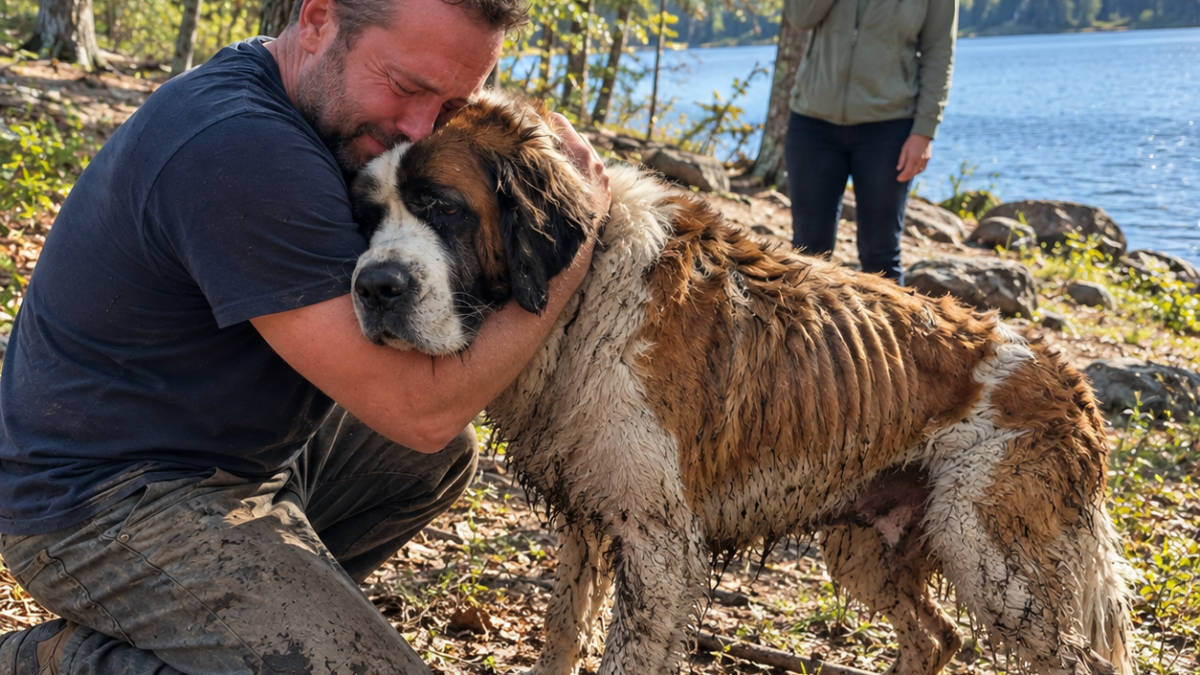
His coat was nothing like Bruno’s beautiful thick coat had been eight months earlier.
It hung from him in filthy clumps.
Burrs were tangled around his chest.
The long fur beneath his stomach was matted with mud.
His ribs showed.
His hips were sharp.
One side of his face had a healing scrape beneath the eye.
But the eyes were Bruno’s.
Dark.
Soft.
A little droopy at the corners.
Eyes that had watched my sons grow up.
“Bruno,” Michael whispered again.
One of the dog’s ears lifted.
Ethan made a sound beside me.
“Dad.”
I could not answer.
Bruno took one step toward us.
Then stopped.
His body trembled.
I thought he was afraid.
Then I realized his legs were weak.
Michael began crying.
Not quietly.
He was twelve years old and had spent eight months teaching himself not to cry every time someone mentioned Bruno.
All of that broke at once.
“Bruno!”
The dog’s tail moved.
Once.
A tiny sweep.
Then again.
And then Bruno tried to run.
He made it three steps.
His front legs carried him.
His back legs did not.
He stumbled hard onto the grass.
“Bruno!”
All three of us moved.
I threw one arm in front of the boys.
“Slow.”
They stopped because my voice scared them.
Not because Bruno was dangerous.
Because he was fragile.
This was not the one-hundred-and-twenty-pound dog who used to knock Ethan sideways with his shoulder.
This was a starving animal whose body had been running on whatever it could find for eight months.
I lowered myself to one knee.
“Hey, buddy.”
Bruno lifted his head.
His tail kept moving.
Slow.
Weak.
But moving.
Michael knelt beside me.
Ethan dropped to both knees.
Bruno looked at them.
First Michael.
Then Ethan.
Then me.
And his whole face changed.
There are moments you cannot explain without sounding like you are exaggerating.
This was one.
The fear left his eyes.
His ears softened.
His mouth opened slightly.
A sound came from him.
Not a bark.
Not a whine.
A deep, broken moan.
The same sound Bruno used to make when one of the boys came home after being gone all day.
“Oh my God,” Michael sobbed.
Bruno crawled toward us.
Not walked.
Crawled.
I met him halfway.
He pushed his head against my chest.
His body shook.
I wrapped one arm around him and immediately felt how thin he was.
Too thin.
My hand touched ribs where thick muscle and fur used to be.
Ethan buried his face against Bruno’s neck.
Michael held the other side of him.
Bruno tried to lick them both.
His tongue barely reached Ethan’s cheek.
He wagged harder.
Then his strength disappeared.
He sank against us.
“Dad, is he okay?”
“I don’t know.”
The answer terrified Ethan.
His face changed.
I corrected myself immediately.
“He’s alive.”
I put one hand against Bruno’s chest.
His heartbeat was fast.
Too fast.
“We found him.”
Michael looked at me.
“No.”
His face was wet.
“He found us.”
Bruno closed his eyes.
For half a second, panic shot through me.
“Bruno.”
His eyes opened.
“Stay with me.”
His tail moved again.
I reached for my phone.
One bar of signal.
Enough.
I called Emily first.
I do not know why.
I should have called a veterinarian.
Animal control.
Emergency services.
Anyone practical.
Instead, I called my wife.
She answered on the second ring.
“Everything okay?”
I could not speak.
“Daniel?”
My throat closed.
“Daniel, what happened?”
I looked at Bruno lying between our sons.
“We found him.”
Silence.
“What?”
“We found Bruno.”
The sound Emily made still lives inside me.
“No.”
“Yes.”
“No, don’t—”
“Emily.”
My voice broke.
“It’s him.”
She started crying.
Not speaking.
Just crying.
I held the phone near Bruno.
“Say his name.”
“Bruno?”
His eyes opened.
His head lifted.
Emily sobbed harder.
“He heard me.”
“Yes.”
“Where are you?”
“Lake Harmon trail.”
“I’m coming.”
“No.”
“What?”
“We need to get him to a vet.”
“I’m coming.”
There was no point arguing.
I called our veterinarian next.
Dr. Sarah Mitchell had known Bruno since he was a puppy.
When her receptionist said the clinic was closed on Sundays except emergencies, I said Bruno’s name.
There was a pause.
“The missing Saint Bernard?”
“Yes.”
“Hold.”
Thirty seconds later, Dr. Mitchell answered.
“Daniel?”
“We found him.”
She inhaled sharply.
“Condition?”
“Very thin. Weak. Drinking from a creek. He collapsed when he tried to come to us.”
“Do not let him drink a huge amount at once.”
I looked toward the creek.
He had stopped.
“Can he stand?”
“Maybe.”
“Do not make him walk far if you can avoid it.”
“We’re about a mile from the trailhead.”
“Do you have anything you can use as a sling?”
I looked at my backpack.
“No.”
“Call park services. I’ll meet you at the clinic.”
“Today?”
“Daniel.”
Her voice softened.
“I treated that dog for five years.”
“I’m coming.”
Park rangers reached us within twenty-five minutes.
Emily arrived at the trailhead before we did.
The rangers brought a rescue stretcher.
Bruno objected weakly when we tried to move him.
Not aggression.
Confusion.
He wanted to stand with us.
“I know.”
I held his face.
“You don’t have to walk.”
His eyes stayed on me.
The boys walked beside the stretcher all the way to the parking lot.
Michael kept one hand near Bruno’s shoulder.
Ethan talked continuously.
About school.
About the new bike he got at Christmas.
About how Mrs. Jenkins still gave too much homework.
About nothing and everything.
I realized later why.
Ethan was telling Bruno what he had missed.
At the trailhead, Emily was standing beside our car.
The moment Bruno saw her, he tried to rise.
“Bruno!”
Emily ran toward him.
Then stopped herself.
She lowered slowly beside the stretcher.
For a second, they simply looked at each other.
Emily reached out.
Bruno pushed his muzzle into her hand.
She folded over him.
Eight months of missing him came out of her in one breath.
“My baby.”
Bruno licked her wrist.
Emily laughed through tears.
“You remember me.”
Of course he did.
We loaded him carefully into our SUV.
The boys sat in the back beside him.
Emily rode with her hand against his shoulder.
I drove.
Nobody cared about speed limits more than I did that day.
I wanted to fly.
But Bruno did not need panic.
He needed us to arrive.
Dr. Mitchell was waiting outside the clinic.
The moment the doors opened, she saw him and covered her mouth.
“Bruno.”
His ear moved.
She crouched.
“Hey, big man.”
Bruno recognized her too.
His tail made one tired sweep.
“That’s enough proof for me.”
She immediately shifted into doctor mode.
Weight.
Temperature.
Heart rate.
Gums.
Hydration.
Blood.
Stool sample.
Tick check.
Joint examination.
Paw pads.
Teeth.
Abdomen.
Every answer added another piece to the story his body had been carrying alone.
He had lost almost forty pounds.
One paw had an old cut that had healed roughly.
He had ticks.
Intestinal parasites.
A mild skin infection.
A cracked tooth.
Signs of prolonged malnutrition.
But no broken bones.
No major organ failure that Dr. Mitchell could detect on the first examination.
His microchip was still present.
When the scanner beeped and displayed our registration, Emily began crying again.
As if we still needed proof.
Dr. Mitchell looked at the monitor.
“Bruno Carter.”
Michael smiled through tears.
“That’s him.”
The first good news came after initial bloodwork.
“He is dehydrated and severely undernourished,” Dr. Mitchell said, “but his kidney values are better than I feared.”
“What about his liver?”
“Stressed, but not failing.”
“Heart?”
“Strong considering everything.”
Emily gripped my hand.
“Is he going to live?”
Dr. Mitchell paused.
I hated pauses that day.
“I think he has a very good chance.”
Emily buried her face against my shoulder.
Ethan whispered, “He’s coming home?”
“Not tonight,” Dr. Mitchell said gently.
Ethan’s face fell.
“He needs controlled fluids, careful feeding, and monitoring.”
She looked at all of us.
“A dog this malnourished cannot simply eat a full bowl.”
Michael frowned.
“Why?”
“His body has adapted to starvation. We have to reintroduce food slowly.”
I looked through the glass door.
Bruno lay on a padded mat.
His eyes stayed on the hallway.
Watching us.
“Can we stay?”
Dr. Mitchell smiled.
“I assumed you would.”
We did.
For hours.
Emily sat closest.
Bruno slept with his nose pointed toward her chair.
The boys took turns reading to him.
Michael had brought nothing, so he read text messages and sports articles from his phone.
Ethan told Bruno a deeply inaccurate version of American history from memory.
Bruno did not object.
At five that evening, Dr. Mitchell gave him a small portion of recovery food.
Bruno sniffed.
Turned his head.
My stomach dropped.
Then Michael said, “Come on, buddy.”
Bruno looked at him.
Michael crouched.
“You used to eat my sandwiches.”
Bruno’s ear lifted.
“You owe us.”
He sniffed the food again.
One lick.
Then another.
Then one small bite.
We celebrated like he had won a championship.
Three bites.
That was all Dr. Mitchell allowed.
Bruno looked offended.
For the first time that day, I laughed.
“There he is.”
Emily wiped her face.
“That’s our dog.”
We went home after midnight.
Without Bruno.
That was almost unbearable.
His bed was still in the living room.
The same bed we had refused to move for eight months.
Emily stood beside it.
“I thought this would feel different.”
“What?”
“Knowing he’s alive.”
I put my arm around her.
“It does.”
She shook her head.
“It still hurts.”
Because his body had told us something our reunion had not.
He had suffered.
A lot.
And we did not know how.
The next morning, we were at the clinic before seven.
Bruno was standing.
Barely.
But standing.
When he saw us, his tail wagged.
Dr. Mitchell smiled.
“He ate breakfast.”
“How much?”
“Enough.”
Ethan looked offended.
“That’s not a measurement.”
“For today, it is.”
Bruno walked six slow steps toward us.
Michael dropped to the floor.
Bruno leaned against him.
He stayed at the clinic four days.
Each day brought improvement.
Small.
Careful.
Day two, he ate four small meals.
Day three, he walked outside to relieve himself.
Day four, he barked.
One deep Saint Bernard bark when a delivery man dropped a box near the reception desk.
Everyone froze.
Then the entire staff laughed.
Bruno looked confused by the applause.
That afternoon, Dr. Mitchell said the words we had been waiting for.
“He can go home.”
Ethan shouted.
Michael hugged him.
Emily cried.
I asked twelve medical questions in thirty seconds.
Dr. Mitchell held up one hand.
“I’m sending instructions.”
“Food?”
“Measured.”
“Water?”
“Normal access now, but monitor.”
“Stairs?”
“Limit them.”
“Exercise?”
“Short.”
“Parasites?”
“Medication.”
“Skin?”
“Medication.”
“Tooth?”
“Later, once he’s stronger.”
“Weight gain?”
“Slow.”
She smiled.
“Daniel.”
“Yes?”
“Take your dog home.”
The moment our SUV turned onto our street, Bruno lifted his head.
He had been sleeping between the boys.
Now his nose moved.
Window cracked.
Air coming in.
His ears lifted.
Emily looked back.
“He knows.”
Bruno stood.
Too quickly.
We steadied him.
“Easy.”
He stared through the window.
Our house appeared.
The fence had been rebuilt months earlier.
Stronger.
Taller.
The broken section from the storm was gone.
The front porch looked exactly the same.
Bruno started whining.
Emily covered her mouth.
I parked.
Michael opened the back door.
Bruno hesitated.
Then stepped down.
One paw.
Then another.
He stood in our driveway.
Sniffed.
His tail began moving.
Ethan ran to the front door.
“Bruno!”
I almost told him not to.
Then I saw Bruno.
His whole body leaned forward.
He walked.
Faster.
Not running.
But close.
Across the driveway.
Up the porch.
Through the door.
Then he stopped.
His bed.
Still there.
Eight months.
Same corner.
Same faded blanket.
Bruno walked toward it.
Sniffed.
Turned once.
Twice.
Three times.
Then lowered himself onto it.
His entire body relaxed.
Emily sank to the floor beside him.
“We kept it.”
Bruno closed his eyes.
“You knew we would, didn’t you?”
That first night, nobody went upstairs.
We all slept in the living room.
Emily on the couch.
Me in the recliner.
Michael and Ethan on sleeping bags.
Bruno on his bed.
At 2:13 a.m., I woke.
Bruno was awake.
Looking around the room.
Not frightened.
Checking.
One by one.
Emily.
Michael.
Ethan.
Me.
Then he lowered his head.
I understood.
He was counting too.
The next weeks were about recovery.
Food became a schedule.
Medication became routine.
Walks began at the mailbox and back.
Bruno gained weight.
Two pounds.
Then five.
Then ten.
His coat slowly improved.
The mats were trimmed.
The skin infection healed.
His paw softened.
His eyes brightened.
He slept deeply.
But he was not the same dog yet.
Some things frightened him now.
Wind.
That surprised us.
Bruno had never cared about wind before the night he disappeared.
But the first storm after he came home sent him pacing from room to room.
Not thunder.
Wind.
When branches moved against the windows, he froze.
I sat on the floor beside him.
“You’re home.”
Bruno pressed his body against mine.
“You’re not going anywhere.”
Michael sat on the other side.
Ethan brought a blanket.
Emily turned on lights throughout the house.
We stayed with him.
The storm passed.
The fence held.
Nobody disappeared.
That mattered.
The question of where Bruno had been for eight months stayed with us.
At first, I told myself it did not matter.
He was home.
That should have been enough.
But I kept seeing his damaged paw.
The matted fur.
The cracked tooth.
The starvation.
Bruno had not been lost for eight months in one continuous wilderness.
At least, that was Dr. Mitchell’s opinion.
His coat contained traces of old grease.
One section around his neck showed unusual matting as though he might have worn some kind of loose rope or improvised collar for a period.
His paws showed different stages of wear.
“He may have had contact with people,” she said.
“Good or bad?”
“I can’t tell.”
That bothered me.
So I started asking questions again.
Not posters saying LOST anymore.
FOUND.
WHERE HAS BRUNO BEEN?
I posted the creek photo—not the worst one, but one from after he had been stabilized.
The story spread locally.
A Saint Bernard missing eight months and found alive drew attention.
Messages arrived.
Most were useless.
People meant well.
Some confused him with other dogs.
Then a woman named Linda Cooper called.
“I think he stayed near us in January.”
“Where?”
“North Ridge.”
That was nearly forty miles from our home.
“Why do you think it was him?”
“Big brown-and-white dog.”
“There are others.”
“I know.”
She paused.
“He had one ear that folded lower.”
My heart changed rhythm.
“What else?”
“He wouldn’t come close.”
She described a dog appearing behind her rural property during snowstorms.
Very thin.
Scavenging near a shed.
She left food out.
He ate only after she went inside.
One night, she saw him sleeping beneath an abandoned equipment trailer.
“How long?”
“Maybe three weeks.”
“What happened?”
“He disappeared.”
“Did you call anyone?”
“Animal control.”
My frustration rose.
“And?”
“They came twice. Couldn’t find him.”
She sounded ashamed.
“I should’ve done more.”
“No.”
I had learned something during those eight months.
People punish themselves for not being omniscient.
“You fed him.”
“Yes.”
“If it was Bruno, that mattered.”
Linda sent a picture from her security camera.
Blurry.
Snow.
A large dog standing beside a shed.
But the white blaze.
The size.
The ear.
Emily looked at it for two seconds.
“That’s him.”
I agreed.
Another clue came from a mechanic fifteen miles farther south.
A huge dog had slept behind his shop for several nights in February.
Workers left food.
The dog refused to enter the building.
Then disappeared after a freight truck backfired.
Another family thought they saw him near a campground in March.
Not the campground we had driven to months earlier.
A different one.
We began mapping sightings.
Bruno had traveled.
A lot.
Not in a straight line home.
Circles.
Roads.
Wooded corridors.
Creeks.
Industrial areas.
Maybe following food.
Maybe avoiding people.
Maybe searching.
Michael stood over the map.
“He was trying to come back.”
I looked at the pins.
“I don’t know.”
“He was.”
“How can you tell?”
Michael pointed.
Several of the later sightings trended toward us.
Not perfectly.
But closer.
“He kept moving this way.”
Emily touched his shoulder.
“We’ll never know exactly what he was thinking.”
Michael looked at Bruno, sleeping across the room.
“He knew where home was.”
I wanted to believe him.
Then we found the person who knew more than anyone.
His name was Walter Greene.
Seventy-one.
Retired carpenter.
Lived alone near Pine Ridge Forest.
He called after seeing a television segment about Bruno.
“Did your dog have a notch in his left ear?”
“Yes.”
“Does he lean against you when he trusts you?”
I stopped.
“Yes.”
Walter breathed out.
“Then I had him.”
Emily was beside me.
I put the phone on speaker.
“When?”
“Late August into October.”
Immediately after the storm.
“What happened?”
Walter’s voice was slow.
“I found him near my barn.”
Bruno had appeared three days after disappearing.
Wet.
Exhausted.
Still wearing his collar.
Walter tried calling the number on the tag.
The tag was damaged.
Only parts of digits remained.
Bruno would not let Walter approach for the first two days.
So Walter left food.
Water.
A blanket in the barn.
On day three, Bruno entered.
By day five, he allowed Walter to touch him.
“Why didn’t you take him to a vet for the microchip?”
“I tried.”
His voice changed.
“I don’t drive anymore.”
That stopped me.
Medical issue.
License surrendered.
No nearby neighbors.
He called the county office.
A volunteer was supposed to come.
But storms had damaged roads that week.
Then Walter fell.
“What?”
“Broke my wrist.”
He spent four days in the hospital.
A neighbor fed his chickens but did not know about Bruno.
When Walter returned, Bruno was gone.
My chest hurt.
“You kept him safe for weeks?”
“Best I could.”
“Why didn’t you call after seeing our old posters?”
“I never saw them.”
He lived outside the radius we had originally covered physically.
Different county social-media groups.
Different shelters.
The gaps that swallow lost animals.
Emily asked quietly, “Do you want to see him?”
Walter did not answer immediately.
Then he said, “More than you know.”
We drove Bruno to Walter’s farm the following Saturday.
I was nervous.
What if Bruno did not remember?
What if the place triggered fear?
We parked outside an old white farmhouse.
A red barn stood behind it.
Walter waited on the porch.
Thin man.
Gray beard.
One hand resting on a cane.
Bruno saw him through the car window.
His head rose.
Walter did not move.
I opened the back door.
Bruno stepped out.
He stared at the porch.
Walter whispered, “Big fella.”
Bruno’s tail moved.
Once.
Then he walked toward him.
Not fast.
Not desperately.
But directly.
Walter’s face crumpled.
“I knew it.”
Bruno reached him.
Sniffed his trousers.
His hand.
Then leaned his entire body against Walter’s legs.
Exactly as Walter had described.
The old man began crying.
“So you made it.”
Bruno looked up.
“You old fool.”
Walter lowered himself carefully to the porch step.
Bruno sat beside him.
I looked at Emily.
Neither of us could speak.
Walter told us everything.
Bruno had stayed in his barn almost seven weeks.
He loved scrambled eggs.
Hated the chickens.
Slept on an old horse blanket.
Walter called him Sam because he needed something to call him.
“He never really responded.”
“That wasn’t his name.”
“I figured.”
Walter showed us the barn.
In the corner was the old blanket.
Bruno walked straight to it.
Sniffed.
Then looked at Walter.
“He remembers.”
Walter nodded.
“I hoped he would.”
A photograph sat on the barn shelf.
Bruno, healthier than when we found him but thinner than before he vanished, asleep near Walter’s boots.
Walter gave us the photo.
“No.”
“Take it.”
“You should keep it.”
Walter smiled.
“I had the dog.”
His eyes moved toward Bruno.
“You should have the proof he wasn’t alone the whole time.”
That sentence changed something in me.
For eight months, I had imagined Bruno always alone.
Cold.
Hungry.
Terrified.
The truth was still difficult.
He had suffered.
But there had been kindness too.
Mrs. Cooper leaving food in snow.
Mechanics sharing scraps.
Walter opening a barn.
Strangers who never knew the dog had boys waiting for him.
His survival was partly Bruno.
Partly weather luck.
Partly instinct.
And partly ordinary people doing small decent things without ever knowing the ending.
We visited Walter often after that.
Bruno loved him.
Different from us.
But real.
Walter became part of the story.
Eventually, part of the family.
He came to Thanksgiving.
Michael helped repair his barn fence.
Ethan taught him how to use video calls badly.
Bruno lay under the table between Walter and me as though he had decided the humans he collected should stay in one place.
A year after Bruno returned, he was nearly back to his old weight.
His coat shone.
The cracked tooth had been treated.
His stamina returned slowly.
He never became fearless about storms again.
That part stayed.
When August came, the anniversary of his disappearance, Emily became anxious days before the forecast mentioned rain.
So did I.
We had rebuilt the fence twice.
Added a second gate.
Microchip details updated.
GPS tag on Bruno’s collar.
But fear is not impressed by preparation.
That evening, thunder began.
Bruno lifted his head.
Wind moved through the trees.
He stood.
I expected pacing.
Instead, he walked toward the boys’ room.
Michael, now thirteen, sat on the floor.
Ethan joined him.
Bruno lay between them.
Emily and I sat in the doorway.
The storm came.
Loud.
Windy.
Rain pounding.
Bruno trembled once.
Michael put a hand on his shoulder.
“You’re home.”
Bruno sighed.
He slept.
That felt bigger than any celebration we could have planned.
Years passed.
Michael became taller than Emily.
Ethan stopped using Bruno as a pillow because Bruno’s arthritis made it uncomfortable, but he still sat beside him every evening.
Bruno aged.
Saint Bernards do that too quickly.
At eight, gray appeared around his muzzle.
At nine, his hips stiffened.
At ten, our walks shortened.
Walter joked that both of them were becoming equally slow.
Bruno still visited him.
Sometimes he slept on the same horse blanket in the barn.
Sometimes Walter sat beside him without speaking.
Two survivors from different parts of the same lost year.
When Bruno was eleven, Walter died.
Quietly.
In his sleep.
His niece called us.
Bruno came to the funeral home only afterward, privately, because Walter’s niece believed he should understand.
He sniffed Walter’s coat.
Stood beside the chair where Walter used to sit.
Then rested his head on the seat.
We brought the old horse blanket home.
Bruno slept on it for months.
Loss had found him again.
But this time, he was not alone.
That mattered.
At twelve, Bruno’s health declined faster.
Dr. Mitchell found a mass near his spleen.
Cancer.
Given his age and condition, surgery offered more risk than promise.
We chose comfort.
That decision hurt.
But Bruno had already fought for more life than anyone had the right to demand.
We gave him easy days.
Soft food.
Medication.
Short trips to the creek.
Visits from people who had helped him.
Linda Cooper came once.
The mechanic from the February sighting visited.
He laughed when Bruno took a biscuit from him.
“You never came close enough back then.”
Bruno accepted the biscuit as delayed payment.
Michael was twenty by then.
Home from college.
Ethan seventeen.
Both boys rearranged their lives around Bruno’s final weeks.
One evening, Ethan brought out the old missing poster.
Bruno’s young face.
Big red letters.
LOST SAINT BERNARD.
BRUNO.
PLEASE CALL.
Ethan sat beside him.
“Remember being famous?”
Bruno slept.
Michael smiled.
“He was always famous.”
“To us.”
“That counts.”
His final day came in April.
Almost exactly four years after we found him at the creek.
The morning was clear.
Like that Sunday.
Bruno refused breakfast.
Even scrambled eggs.
That was how I knew.
I called Dr. Mitchell.
She came to the house.
We carried Bruno’s bed onto the porch.
His old bed.
The one Emily never moved.
We had replaced the padding over the years.
Repaired seams.
Washed it a thousand times.
But it was still his.
The horse blanket Walter had given him rested beneath his head.
Emily sat on one side.
I sat on the other.
Michael and Ethan were at his feet.
Bruno looked old.
Not sick in the frightening way he had looked beside the creek.
Old.
Loved.
Tired.
There is a huge difference.
I held his face.
“You scared the life out of us, you know.”
His eyes moved toward me.
“Eight months.”
His tail shifted faintly.
“We looked everywhere.”
Emily laughed through tears.
“You could’ve saved us some trouble.”
Bruno breathed out.
Michael leaned closer.
“I knew it was you.”
His voice broke.
“At the creek.”
Bruno looked toward him.
“You turned around.”
Michael put his forehead against Bruno’s.
“You came back.”
Ethan was openly crying.
“I used to tell you everything.”
Bruno’s eyes moved toward him.
“So I need to tell you this too.”
Ethan took a breath.
“You were the best thing about growing up.”
Emily covered her face.
I almost lost control.
Bruno lifted his head slightly.
Ethan kissed him.
Then Bruno looked toward the yard.
Wind moved through the trees.
Not storm wind.
Soft.
Warm.
He did not tremble.
I rubbed his neck.
“You survived enough.”
His eyes returned to me.
“You don’t have to find your way anywhere anymore.”
Dr. Mitchell waited.
I looked around.
Emily.
Michael.
Ethan.
Home.
Walter’s blanket.
His bed.
Everything he had searched for, or everything we imagined he had searched for, was here.
“We found each other.”
I whispered it into his fur.
“That’s enough.”
Dr. Mitchell gave him peace.
Bruno left with all four of us touching him.
No forest.
No hunger.
No storm.
No creek.
No wondering whether someone would recognize him.
Home.
For a long time afterward, nobody moved.
Then Michael reached beneath Bruno’s blanket.
“What are you doing?”
He pulled out something small.
Bruno’s GPS tag.
The one we had added after he came home.
Michael stared at it.
Then laughed while crying.
“He never needed this.”
Emily looked at him.
“Yes, he did.”
“No.”
Michael held the tag.
“We needed it.”
He was right.
We needed the illusion that we could never lose him again.
But love does not offer that.
It offers presence.
Not guarantees.
We buried Bruno’s ashes beneath the maple tree near our back fence.
The same yard he escaped from.
Not because we wanted to remember the night he disappeared.
Because that yard had also been where he grew up.
Where the boys played with him.
Where he slept in snow.
Where Emily brushed him.
Where he finally became old.
The stone reads:
BRUNO CARTER.
LOST 8 MONTHS.
LOVED EVERY DAY.
HOME AGAIN.
Beneath it, smaller:
HE FOUND HIS WAY BACK.
I kept Walter’s photograph.
Bruno asleep near the old man’s boots.
It sits beside a photograph from the day we found him.
In the first, he was between homes without knowing it.
In the second, Michael and Ethan are kneeling beside the creek, hands on Bruno’s thin body, all three of them crying.
The photo was taken by one of the rangers.
I did not know he had taken it until weeks later.
I used to hate that image.
Bruno looked terrible.
Bones.
Dirty coat.
Exhaustion.
Now I see something else.
His tail.
Blurred.
Because it was moving.
Eight months lost.
Starving.
Barely strong enough to stand.
And when he saw his boys, he wagged.
That is Bruno’s story to me.
Not disappearance.
Recognition.
The world had changed him.
Hunger had changed him.
Weather had changed him.
Eight months of survival had changed him.
But when Michael whispered his name, something deeper than all of that remained.
Bruno.
His boys.
Home.
Years later, people still occasionally ask whether we know exactly where he went during those eight months.
No.
We pieced together maybe half.
Walter’s barn.
Linda’s shed.
The mechanic shop.
A campground.
Creeks.
Forest corridors.
Then the clearing where we found him.
There are missing weeks.
Maybe months.
We will never know.
I used to need the complete story.
Now I do not.
The missing pieces belong to Bruno.
What matters is this.
When the storm tore open our fence, Bruno disappeared into a world much larger than the one he knew.
And in that world, he survived because instinct kept him moving and because strangers sometimes chose kindness.
A bowl of food placed near a shed.
An unlocked barn.
A blanket.
A mechanic leaving scraps behind the shop.
Small things.
The kind nobody thinks will become part of a family’s miracle.
They did.
I think about that when I see a lost-dog post now.
I do not scroll past.
I look carefully.
I share.
I check the ears.
The markings.
The places.
Because somebody may be eight months into waiting.
Some child may still look at an empty dog bed every night.
And the skinny animal behind a gas station or drinking from a creek may once have been somebody’s Bruno.
Michael is married now.
Ethan is finishing college.
Emily and I still live in the same house.
The fence is still standing.
Bruno’s bed stayed in the living room for almost a year after he died.
Then one day Emily asked if we should move it.
I looked at it.
I expected the old fear.
If we remove this, we are admitting he is gone.
But that was not what I felt anymore.
Bruno had already taught us that home was not a bed waiting in a corner.
Home was recognition.
A voice saying your name.
Someone turning around.
Someone still coming toward you after the world has made the journey almost impossible.
So we folded the blanket.
Stored the bed.
Kept the photographs.
And let the room change.
Bruno did not disappear with the furniture.
He had already returned in the only way that mattered.
Every April, around the week we found him, we walk the Lake Harmon trail.
Sometimes all four of us.
Sometimes only Emily and me.
We always stop at the creek.
The clearing is greener now.
Trees have grown.
The exact patch where Bruno stood that morning is impossible to identify.
That used to bother Ethan.
Now he says it makes sense.
“What?”
“The forest moved on.”
He is right.
The forest moved on.
So did we.
Moving on never meant leaving Bruno behind.
It meant carrying the right part forward.
Not the storm.
Not eight months of fear.
Not the bones beneath his coat.
The turn.
That slow turn beside the creek after Michael whispered:
“Bruno?”
That is the moment I keep.
Because before he turned, we were a family still searching.
After he turned, we were a family being found.
And sometimes, even after eight months, that is all it takes.
One familiar voice.
One old name.
One dog turning his head.
And home exists again.








