For 7 days, a gray-muzzled Chihuahua sat beneath the glass doors of our precinct, waiting for the officer who had collapsed in front of him to come back
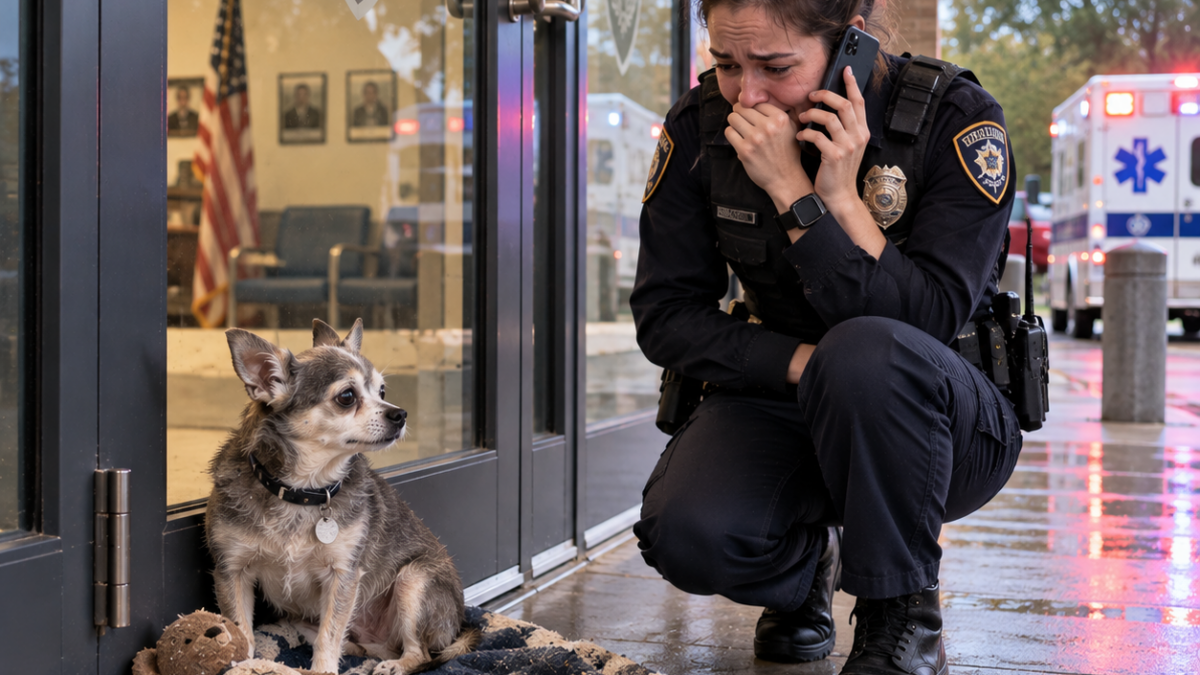
“I’m coming back.”
Rex stared at the phone.
Not at me.
Not toward the street.
At the phone.
His ears rose so sharply that for one absurd second he looked like the dog he had been three years earlier when Daniel first brought him into the precinct.
“Rex,” Daniel said again.
The voice was weak and rough.
There were hospital noises behind it.
A monitor.
Someone moving equipment.
Dr. Moran murmuring something I couldn’t make out.
But it was Daniel.
Rex knew.
His nose touched the edge of my phone.
Then he let out a tiny sound.
Not a bark.
Not a whine exactly.
More like a breath that had been trapped somewhere inside his chest for seven days.
His whole body softened.
He turned once in a circle.
Then, for the first time since Daniel’s ambulance had disappeared from the training lot, Rex lay down willingly.
He placed his head on his front paws.
His eyes closed.
I sat on the floor beside him.
Captain Marshall was standing near the front desk.
Two dispatchers had come out of their office.
Officer Price was pretending to study a bulletin board even though there was nothing on it he had not already read fifty times.
Nobody spoke.
Daniel’s voice came through the phone again.
“You be good for Sam.”
Rex’s tail moved.
Just once.
An inch.
Maybe less.
But I knew that movement.
I had seen it a thousand times.
That was his happy tail.
“Did he hear me?” Daniel whispered.
My throat closed.
“Yeah,” I said.
“He heard you.”
There was a pause.
“Good.”
Then Dr. Moran took the phone.
“That’s enough for now.”
“How is he?”
“Awake is good.”
“That doesn’t answer the question.”
“No,” she said gently.
“It doesn’t.”
I looked at Rex.
He was already asleep.
Not dozing the way he had been all week, waking every few minutes.
Really asleep.
His breathing was deep and slow.
“How bad?” I asked.
“Daniel experienced a serious cardiac event.”
My stomach tightened.
“He was without effective circulation for a short period before resuscitation.”
I closed my eyes.
“Neurological damage?”
“We’re still evaluating.”
“Is he going to recover?”
“I don’t know.”
I hated that answer.
Doctors probably hate giving it.
“When can Rex see him?”
Another silence.
“Sam—”
“He’s a working police dog.”
“I understand.”
“He’s clean, vaccinated, trained, and more disciplined than half the officers in this building.”
Captain Marshall looked at me.
I ignored him.
Dr. Moran almost laughed.
“That last argument probably isn’t going into the medical chart.”
“It should.”
“I’ll talk to administration.”
“That means no.”
“It means I’ll talk to administration.”
“When?”
“Tomorrow.”
I looked at Rex again.
“All right.”
“Sam?”
“Yes?”
“Make him eat.”
“I’ve been trying.”
“No.”
Her voice became firm.
“Daniel woke up asking whether his dog was safe.”
That landed differently.
“He needs to know Rex is being cared for.”
I nodded even though she could not see me.
“I’ll make him eat.”
After the call ended, I remained on the floor.
Captain Marshall eventually walked over.
“Well?”
“He’s awake.”
“I heard that.”
“He’s not out of danger.”
Marshall exhaled.
Then he looked down at Rex.
The captain had spent the entire week pretending he was thinking only about policy.
That was his job.
Someone had to.
But I noticed the way his face changed now.
“He slept?”
“Finally.”
Marshall squatted beside him.
“Stubborn little son of a gun.”
“You tried telling him that.”
“I outrank him.”
“Apparently he doesn’t recognize your authority.”
Marshall scratched Rex carefully between the ears.
Rex did not wake.
“Neither does half the building.”
That morning, Rex slept for almost four hours.
We moved around him.
Nobody had the courage to carry him somewhere more comfortable.
Maya from dispatch brought an old fleece blanket and slid it under him without lifting his head.
At noon, he woke.
The first thing he did was look toward the doors.
My heart sank.
Then something changed.
He looked at me.
Really looked.
I crouched.
“Daniel told you he’s coming back.”
Rex stared.
“Which means you eat.”
I brought his bowl.
Chicken.
Rice.
A little broth.
Food he normally would have inhaled.
He sniffed.
Looked toward the glass doors.
Then back at me.
“Come on.”
He took one bite.
Stopped.
I waited.
A second bite.
Then a third.
Within five minutes, half the bowl was gone.
Someone behind me whispered, “Thank God.”
I did not turn around.
Rex drank water afterward.
A lot.
Then he went outside with me.
It was the first time in a week he had willingly left the lobby for more than a bathroom break.
He walked slowly.
His legs were stiff from sitting so long.
Rain had fallen overnight.
The pavement smelled wet and cold.
Rex reached the training yard and stopped at the exact place where Daniel had collapsed.
He lowered his nose.
Sniffed once.
Then sat.
I stood beside him.
“You remember.”
Of course he did.
Dogs remember places differently than we do.
We attach stories to them.
They attach scent.
Daniel had fallen there.
Paramedics had knelt there.
A medical bag had been opened there.
Fear, sweat, rubber, disinfectant, asphalt.
Whatever Rex understood, the place still meant something.
He stayed for less than a minute.
Then he stood and walked back toward the station.
Not toward the glass doors.
Toward me.
That mattered.
On Monday afternoon, Dr. Moran called.
Hospital administration had agreed to a short visit.
There were conditions.
Rex needed to be bathed.
His nails trimmed.
Harness cleaned.
Veterinary records provided.
We had to use a service entrance.
He would be allowed into Daniel’s room for ten minutes.
Maybe fifteen if Daniel tolerated it.
I said yes before she finished.
“When?”
“Wednesday morning.”
Two days.
Rex would have to wait two more days.
But now the waiting felt different.
The whole precinct felt different.
We had a date.
A destination.
Something to prepare for.
Officer Price volunteered to clean Rex’s harness.
Maya brought a new blanket.
Captain Marshall personally called our veterinarian to make sure the records were faxed.
The same captain who had wanted Rex moved to a foster home now spent twenty minutes arguing with someone at the hospital about whether a nine-pound Chihuahua required the same elevator restrictions as a full-sized patrol dog.
“Sir,” I heard him say into the phone, “the animal weighs less than your average Thanksgiving turkey.”
I nearly choked on my coffee.
Rex resumed sleeping in the K9 room Monday night.
Not normally.
He woke twice and walked to the lobby.
I found him at the doors around 2:00 a.m.
I sat beside him.
“Two days.”
He leaned against my leg.
That was new.
Rex respected me.
He trusted me in the way working dogs trust members of a familiar team.
But Daniel was his person.
There had always been a boundary.
That week blurred it.
I think Rex understood I was the closest thing he had to Daniel’s world.
And I understood that caring for him was the closest thing I had to taking care of my partner.
Daniel and I had been paired three years earlier.
Police partnerships are strange relationships.
You can spend more waking hours with another officer than with your own family.
You learn how they take coffee.
How they breathe when they are angry.
Which jokes they repeat.
What silence means.
Daniel was not an easy man to know.
He was polite with everyone.
Friendly enough.
But private.
The first months we worked together, I knew almost nothing about him except that he had been married once, had no children, loved baseball, and hated mayonnaise with an intensity that seemed medically unnecessary.
Rex was the crack in the wall.
Ask Daniel about himself and you got a two-word answer.
Ask about Rex and you got twenty minutes.
Daniel had not originally intended to work with a Chihuahua.
Nobody had.
Our department had received a grant to expand detection work in schools, courthouse facilities, and public buildings.
The contractor who evaluated dogs for scent work brought in several candidates.
Labradors.
Spaniels.
A shepherd mix.
Then, as a joke almost, there was Rex.
He had been surrendered to a rescue after his elderly owner entered long-term care.
He was two years old, high-energy, food-motivated, fearless, and completely obsessed with searching.
During the evaluation, the trainer hid a scented training sample inside a stack of storage boxes.
The larger dogs found it.
Rex found it faster.
Then he climbed halfway into the box because he wanted to confirm.
The trainer tested him again.
Same result.
Again.
Same result.
Daniel happened to be watching.
“That dog doesn’t know he’s small,” he said.
The trainer replied, “That’s probably why he’s good.”
Daniel volunteered.
The first month was a disaster.
Rex barked during roll call.
Daniel accidentally stepped on his leash three times.
Everyone called him “Deputy Mouse.”
Daniel threatened to write people up.
Rex stole half a breakfast burrito from Officer Price.
Price filed a mock theft report.
Rex found the hidden narcotics used in a certification test in forty-three seconds.
Nobody called him Deputy Mouse after that.
At work, Daniel and Rex became precise.
Rex could search a vehicle line faster than dogs three times his size.
He could squeeze beneath seats.
Check vents.
Work through baggage.
His alert was simple.
Sit.
Look at Daniel.
Wait.
At home, according to Daniel, he was completely useless.
“He refuses to go outside if the grass is wet,” Daniel once told me.
“That’s the animal you trust to search evidence?”
“He has standards.”
“You carry him outside, don’t you?”
Daniel stared at me.
“I am not discussing operational procedures.”
That meant yes.
Wednesday morning came.
I arrived at the station before sunrise.
Rex was awake.
He watched me approach his kennel.
“You know?”
His tail moved.
“Of course you know.”
We bathed him in the utility sink.
Rex hated every second.
He gave me a look of personal betrayal while Officer Price held a towel.
“Very intimidating police animal,” Price said.
Rex sneezed water onto his uniform.
I laughed.
“Still laughing?”
Price wiped his shirt.
“He did that deliberately.”
“Write him up.”
We dried Rex.
Brushed him.
Cleaned his ears.
Polished the brass buckle on his working collar.
His department harness looked absurdly formal on his small body.
POLICE K9 was printed across the side.
By 8:00, he was ready.
So was I.
I was more nervous than I wanted to admit.
The hospital was fifteen minutes away.
Rex spent the entire drive standing on the passenger seat, looking forward.
Normally he curled up.
Not that morning.
Every red light irritated him.
I could tell by the way his front paws shifted.
“We’re going.”
He glanced at me.
“I know you’ve waited longer than this.”
When we reached the hospital, a security officer met us at the service entrance.
“You the Chihuahua?”
I looked at him.
“He doesn’t drive.”
The man laughed.
Rex did not.
We signed paperwork.
A nurse checked his vaccination documentation for the third time.
Then Dr. Moran appeared.
She looked different from how I imagined her voice.
Late fifties.
Silver streaks in dark hair.
Calm eyes.
Sneakers beneath a white coat.
She crouched.
“So this is Rex.”
Rex sniffed her hand once.
Dismissed her.
She smiled.
“I feel judged.”
“You are.”
“How’s he been?”
“Better since the phone call.”
“And Daniel?”
I asked.
Her smile faded.
“Improving.”
“That pause means something.”
“It means improvement is not the same as recovery.”
I nodded.
“He knows he had a heart attack?”
“Yes.”
“He understands how serious?”
“Yes.”
“Neurologically?”
“He’s doing well.”
Relief hit so fast I had to look away.
“He’s weak.”
She continued.
“Very weak.”
“He may need months of rehabilitation.”
“Can he return to work?”
“Sam.”
“I had to ask.”
“Not anytime soon.”
I looked down at Rex.
He was pulling gently toward the hallway.
“He knows where?”
“No.”
“He thinks he does.”
We walked.
The hospital smelled exactly like hospitals always smell.
Disinfectant.
Coffee.
Plastic.
Something faintly metallic.
Rex’s nose worked constantly.
People stopped.
A respiratory therapist smiled.
An older patient in a wheelchair whispered, “Look at that little police dog.”
Two nurses stepped aside.
Rex paid attention to none of them.
His leash stayed tight.
Not pulling wildly.
Just forward.
Always forward.
We reached the cardiac unit.
Dr. Moran stopped outside room 417.
“Before you go in.”
I looked at her.
“Daniel is emotional.”
“That’s allowed.”
“I know.”
“Rex may get excited.”
“He won’t hurt him.”
“I know.”
She looked through the door window.
“I’m not worried about Rex.”
That was when I understood.
She was worried about Daniel.
About his heart.
About what joy might do to a body that had nearly failed.
“Keep it calm.”
“I will.”
I knelt.
Rex looked at me.
My hand rested against his neck.
His pulse was fast.
“Easy.”
His eyes stayed on the door.
“Go find him.”
I opened it.
Rex walked in.
Not ran.
Not yet.
The room was bright.
Morning light came through the blinds.
There were wires.
A monitor.
An IV.
Daniel looked smaller than he had seven days earlier.
That shocked me.
I had seen him after long shifts.
After flu.
After a broken wrist.
After nights without sleep.
I had never seen him look fragile.
His skin was pale.
His cheeks seemed hollow.
His hair needed cutting.
His hands rested on top of the blanket.
Then his eyes moved toward the door.
Rex stopped.
Daniel stopped breathing.
For half a second, I thought something was wrong.
Then he whispered, “Hey.”
Rex’s entire body changed.
He ran.
The leash slid through my hand.
I let it go.
His little legs hammered across the hospital floor.
Daniel laughed.
It came out broken.
A laugh and a sob at the same time.
Rex reached the bed.
It was too high.
He tried to jump.
Failed.
Tried again.
“Help him,” Daniel said.
I lifted Rex.
The second I placed him beside Daniel’s hip, Rex scrambled upward.
He did not climb onto Daniel’s chest.
Training held.
Or instinct.
I don’t know.
He pressed himself along Daniel’s side.
Then placed his chin directly beneath Daniel’s hand.
Daniel’s fingers moved.
Slowly.
They settled on Rex’s head.
The heart monitor accelerated.
Dr. Moran took one step toward the bed.
Daniel shook his head.
“I’m okay.”
Rex’s tail moved.
Once.
Twice.
Then faster.
His whole backside began wiggling.
Daniel laughed again.
“You waited?”
Rex licked his wrist.
“You idiot.”
Another lick.
“I told you not to wait for me.”
Rex climbed closer.
Daniel’s face crumpled.
“I knew you would.”
I turned toward the window.
Not because I was embarrassed.
Because watching felt intrusive.
This was not a police officer and department property.
Not a handler and a working animal.
It was Daniel and Rex.
Whatever existed between them belonged to them.
“Sam.”
I turned.
Daniel was looking at me.
His eyes were wet.
“Thank you.”
“For what?”
“For him.”
“I didn’t do anything.”
“You kept him there.”
“Mostly he kept himself there.”
Daniel nodded.
“He always was stubborn.”
Dr. Moran approached.
“Five minutes.”
Daniel frowned.
“You promised ten.”
“I promised your body whatever it can tolerate.”
“My body is tolerating him.”
His monitor disagreed.
She pointed at the numbers.
Daniel looked offended.
“Traitor.”
I wasn’t sure whether he meant his heart or the monitor.
Rex settled.
Daniel’s heart rate began to slow.
That interested Dr. Moran.
She watched the monitor.
Then Rex.
Then Daniel.
“Leave him another few minutes.”
Daniel smiled.
“Doctor’s orders.”
“No.”
She said it firmly.
“Doctor’s experiment.”
For the next ten minutes, almost nobody spoke.
Daniel rested his hand on Rex’s back.
Rex stayed perfectly still.
Every so often Daniel’s thumb moved through his fur.
That was all.
The monitor became steady.
Not normal.
But calmer.
Dr. Moran noticed.
So did I.
When it was time to leave, Rex refused.
Naturally.
I picked him up.
He twisted.
Daniel said, “Rex.”
The Chihuahua froze.
“Go with Sam.”
Rex looked at him.
“I’ll see you tomorrow.”
Dr. Moran raised an eyebrow.
Daniel looked at her.
“Right?”
She sighed.
“Short visit.”
Daniel smiled.
“Tomorrow.”
Rex stopped fighting me.
That became our routine.
Every day at 10:30, I drove Rex to the hospital.
Every day he entered room 417.
Every day Daniel looked a little stronger.
At first, he could lift his hand for only a few minutes.
Then longer.
Within four days, he could sit upright while Rex rested beside him.
A week later, he could walk ten steps with a therapist.
Rex watched from a chair.
The first time Daniel stood, his legs shook.
The therapist held one arm.
I held the other.
Rex sat three feet away.
Daniel took one step.
Then another.
He looked exhausted.
“Come on,” I said.
He glared at me.
“Very inspirational.”
“You want inspirational?”
“No.”
“You’re doing great.”
“That’s worse.”
Rex barked.
One sharp sound.
Daniel looked down.
“You too?”
Another bark.
The therapist laughed.
“Apparently he wants you moving.”
Daniel took three more steps.
Later, Dr. Moran told me there was no medical basis for calling Rex a miracle cure.
“I know.”
“He isn’t healing damaged heart tissue.”
“I know.”
“He isn’t replacing medication.”
“I know.”
“He isn’t physical therapy.”
“Doctor.”
“Yes?”
“You’re trying very hard to tell me something I’m not arguing with.”
She smiled.
“What I will say is that motivation matters.”
“That sounds suspiciously like medicine.”
“It is.”
“Then he’s helping.”
“Yes.”
She looked through the window.
Daniel was asleep.
Rex curled beside him.
“He’s helping.”
Daniel remembered almost nothing about the collapse.
He remembered bending over.
A pressure in his chest.
Then my face above him.
After that, fragments.
Sirens.
A ceiling.
Someone saying his name.
Then nothing.
The next memory was waking in the hospital.
“What did you think about?” I asked.
We were alone one afternoon while Rex slept at his feet.
“When?”
“When you woke.”
Daniel stared at the wall.
“I didn’t know where I was.”
“Then?”
“I knew something was wrong.”
“Then?”
He looked at Rex.
“I wondered where he was.”
I laughed softly.
“I’m serious.”
“I know.”
“Before I remembered the station.”
“Before I remembered what day it was.”
“Before I knew how long I’d been unconscious.”
“I thought, where’s Rex?”
The Chihuahua’s ear twitched.
Daniel smiled.
“I told you.”
“You two need therapy.”
“Probably.”
Then his smile disappeared.
“What happened to him?”
I told him.
Not everything at once.
The glass doors.
The food.
The sleeping.
The way Rex stood whenever headlights entered the lot.
Daniel stared at me.
“Seven days?”
“Yes.”
“He barely ate?”
“Yes.”
“Why didn’t you take him home?”
“We tried.”
“You should have forced him.”
“You ever try forcing Rex to do anything?”
“That’s different.”
“How?”
Daniel had no answer.
His eyes filled.
“He thought I left him.”
“He thought you were coming back.”
“That’s worse.”
“No.”
I leaned forward.
“That’s hope.”
Daniel shook his head.
“That’s not hope.”
“What is it?”
“Trust.”
He scratched Rex’s ear.
“He trusted me to come back.”
Daniel became quiet after that.
I let him.
Later, while Rex and I were leaving, Daniel called my name.
“Sam.”
“Yeah?”
“If something happens again…”
“Don’t.”
“I mean it.”
“Dan.”
“Take him.”
I knew exactly what he meant.
“No.”
“Sam.”
“You’re not dying.”
“That’s not what I said.”
“I’m not having this conversation in a hospital room.”
“You’re exactly where people have this conversation.”
I looked at him.
He looked back.
“When I got Rex,” Daniel said, “I put my sister down as emergency contact.”
“Lisa?”
“Yes.”
“She has three kids, two cats, and lives in a condo.”
“I know.”
“She loves him.”
“I know.”
“But he knows you.”
My chest tightened.
“You’re asking me to inherit your dog.”
“I’m asking you to promise he doesn’t end up wondering where everybody went.”
That shut me up.
Rex was standing beside my shoe.
Looking between us.
I swallowed.
“Fine.”
Daniel relaxed.
“But this is hypothetical.”
“Yes.”
“Very hypothetical.”
“Yes.”
“You are going home.”
“Yes.”
“And eventually you are going to annoy me at work again.”
Daniel smiled.
“Hopefully.”
“Say definitely.”
“Sam.”
“Say it.”
He looked at Rex.
“Definitely.”
I knew it was not a promise anyone could guarantee.
But sometimes people need words stronger than reality.
Rehabilitation began in earnest during the second week.
Daniel hated it.
He hated being weak.
He hated needing assistance to shower.
He hated that walking fifty feet left him exhausted.
He hated the diet.
Especially the diet.
“What is this?”
He poked something beige on his lunch tray.
“Food.”
“It resembles insulation.”
“Eat.”
“Rex wouldn’t eat this.”
Rex was sitting beside the chair.
I held a tiny piece near him.
He sniffed.
Turned away.
Daniel pointed.
“Expert testimony.”
I laughed.
Dr. Moran entered.
“If the dog starts practicing medicine, both of you are leaving.”
“He has standards,” Daniel said.
I remembered that line from years earlier.
For a moment, things felt normal.
That was the strange part of recovery.
Normal arrived in flashes.
A joke.
A complaint.
Daniel scratching Rex’s chin.
Then a nurse entered with medication and the hospital came rushing back.
Or Daniel stood and became dizzy.
Or the monitor alarmed.
Or Dr. Moran used a careful voice.
Healing was not a straight line.
One morning Daniel walked farther than ever.
That afternoon his blood pressure dropped and he nearly fainted.
He spent the next day furious.
“I was getting better.”
“You are getting better.”
“It doesn’t feel like it.”
I looked at Rex.
He was lying beneath the chair.
“Remember when we trained him for stairwells?”
Daniel frowned.
“What?”
“Rex.”
“I remember.”
“He wouldn’t climb metal stairs.”
“He hated the sound.”
“What did you do?”
“Started with one step.”
“Then?”
“Two.”
“Then?”
Daniel sighed.
“You’re comparing me to a Chihuahua.”
“Yes.”
“I hate you.”
“One step.”
Daniel stared at the ceiling.
“Fine.”
The next morning he got out of bed.
One step.
Then two.
By the end of the week, he could walk the length of the corridor.
Rex followed.
Hospital staff learned them.
Nurse Elena kept a cup of water for Rex.
A custodian named Mike brought him a tiny tennis ball.
A pediatric patient from another floor met him one afternoon and asked if Rex was “a real police officer.”
Daniel answered from his wheelchair.
“Absolutely.”
The boy looked at Rex’s harness.
“Does he catch bad guys?”
“He catches bad smells.”
The boy laughed.
Rex licked his fingers.
Daniel looked happier for the next hour.
Two weeks after waking, Daniel was cleared to leave the hospital.
Not return to duty.
Not even close.
But go home.
The morning of discharge, I brought Rex to the station first.
That was deliberate.
I wanted him to finish something.
We entered through the side door.
Rex immediately walked toward the lobby.
The glass doors were bright with morning light.
He sat in the exact place where he had waited.
I stood beside him.
“You know what today is?”
His ears tilted.
I checked the time.
Daniel’s sister was driving him from the hospital.
They would arrive in ten minutes.
Rex looked through the glass.
This time, there was no bowl of untouched food.
No blanket.
No exhausted officers watching him.
No uncertainty.
I crouched.
“He’s coming.”
Rex’s tail moved.
A car entered the parking lot.
Not Daniel.
Rex watched.
Another car.
Not Daniel.
Then a dark blue SUV turned in.
Rex stood.
I knew before I saw the driver.
Lisa.
Passenger side.
Daniel.
Rex made a sound so loud I nearly laughed.
The doors slid open.
He ran.
No command.
No restraint.
Captain Marshall would later pretend not to have noticed the policy violation.
Daniel was moving carefully.
One hand on the car.
He barely had time to brace himself.
Rex reached him.
Daniel bent as far as he safely could.
I expected Rex to jump.
He didn’t.
He stopped at Daniel’s shoes.
For one second.
Just one.
Then Daniel knelt.
Lisa shouted, “Daniel, don’t you dare—”
Too late.
Rex launched himself into his arms.
Daniel held him.
The little Chihuahua buried his face beneath Daniel’s chin.
Daniel laughed.
Then cried.
Not quietly.
Not politely.
I had never seen him cry before.
He held Rex against his chest and kept saying the same thing.
“I’m here.”
Again.
“I’m here.”
Again.
“I’m here.”
Rex licked his jaw.
His cheeks.
His nose.
Daniel closed his eyes.
Captain Marshall turned around.
Officer Price studied the sky.
Maya cried without shame.
Lisa covered her mouth.
I stood near the door and thought about the previous two weeks.
The collapse.
The ambulance.
The glass doors.
The phone call.
The hospital room.
Daniel learning to walk again.
And there he was.
Home.
Not fully healed.
Not magically fixed.
But standing.
Breathing.
Holding his dog.
Rex spent the next six weeks at Daniel’s house.
I visited almost every day at first.
Partly because Daniel needed help.
Mostly because Captain Marshall assigned me to check on departmental equipment.
Rex was technically departmental equipment.
Neither of us ever said that out loud.
Daniel’s house was small.
Two bedrooms.
Old hardwood floors.
A fenced yard.
Rex had beds everywhere.
Living room.
Bedroom.
Kitchen.
Office.
Naturally, he slept on the couch.
Daniel’s first days home were harder than he expected.
Hospitals make recovery look organized.
Everything has a schedule.
Medication.
Meals.
Therapy.
Vitals.
At home there is silence.
That silence can become frightening.
The first night, Daniel woke at 2:00 a.m. convinced his chest felt wrong.
He called me.
“Should I go back?”
“Are you in pain?”
“I don’t know.”
“What does that mean?”
“It means I don’t know.”
I heard Rex moving.
“Where is Rex?”
“On me.”
“What?”
“He’s standing on my chest.”
“That cannot be medically recommended.”
Daniel almost laughed.
Then we called the nurse line.
His symptoms were anxiety.
Not another cardiac event.
That became another part of recovery.
Fear.
Daniel had faced armed suspects more calmly than he faced his own heartbeat.
Before the collapse, his body had been something he trusted without thinking.
Now every flutter mattered.
Every strange breath.
Every moment of fatigue.
Rex adapted.
He began sleeping against Daniel’s hip.
If Daniel got out of bed at night, Rex followed.
During home physical therapy, he sat nearby.
When Daniel practiced walking laps through the house, Rex walked beside him.
At first they both tired quickly.
Daniel joked that they were “the department’s least impressive parade.”
Week three, Daniel made it to the mailbox.
Rex trotted beside him.
A neighbor applauded.
Daniel threatened never to leave the house again.
Week four, he walked around the block.
Slowly.
Rex wore his working harness even though he was off duty.
A little girl on a bicycle stopped.
“Is he a police dog?”
Daniel looked down.
“Yes.”
“He’s tiny.”
“He’s heard that.”
Rex barked once.
The girl laughed.
“Sorry.”
Week five, Daniel returned to the precinct for a visit.
Not work.
Captain Marshall was very clear.
“You are here for thirty minutes.”
“I feel fine.”
“Thirty.”
“I can sit at my desk.”
“Twenty-nine.”
Daniel glared.
Marshall smiled.
Rex entered beside him.
The station erupted.
Nobody planned anything.
That made it better.
Maya hugged Daniel.
Price shook his hand and then hugged him anyway.
The captain pretended to be busy until Daniel reached his office.
Then he stood.
For a second they simply looked at each other.
Marshall said, “You look terrible.”
Daniel replied, “You got older.”
Then they hugged.
Rex wandered to the glass doors.
I watched him.
He stopped at his old waiting place.
Sniffed the floor.
Then looked back at Daniel.
Daniel was standing with the captain.
Laughing.
Rex walked away from the doors.
He never waited there again.
Daniel’s return to work took four months.
Even then, it was limited duty.
No patrol.
No heavy exertion.
No overnight shifts.
He hated the restrictions.
Rex returned sooner.
For several weeks, he worked with me.
That was strange for both of us.
He obeyed.
Performed searches.
Found every training sample.
But after every session, he looked toward Daniel’s empty desk.
The first time Daniel came to observe, Rex broke position.
He ran directly to him.
Daniel crouched.
“Professional.”
Rex ignored him.
Captain Marshall said, “Write him up.”
Daniel smiled.
“Conflict of interest.”
Eventually they recertified together.
The test was difficult.
Vehicle search.
Indoor scent discrimination.
Luggage.
Crowd distraction.
Rex passed.
Daniel did too, medically, but with limits.
The department adjusted their duties.
No high-intensity field assignments.
More courthouse searches.
Community events.
Evidence support.
School demonstrations.
Daniel complained for exactly two days.
Then something happened that changed his mind.
A high school invited the department for a career presentation.
Normally Daniel hated those events.
Standing in a gymnasium while teenagers stared at their phones was not his idea of meaningful police work.
Rex loved them.
That day, a boy lingered after the presentation.
Sixteen.
Quiet.
Hands in his pockets.
He asked Daniel, “Is that the dog that waited for you?”
The story had spread.
Not because we gave it to the media.
One nurse had posted a photo after receiving permission.
It traveled farther than any of us expected.
Daniel disliked the attention.
He answered carefully.
“Yes.”
The boy looked at Rex.
“My dad died last year.”
Daniel’s expression changed.
“I’m sorry.”
“Our dog waited by his bedroom door for like a month.”
Daniel crouched beside Rex.
The boy continued.
“My mom said we should move the dog’s bed.”
“Did you?”
“No.”
“Good.”
The boy looked surprised.
Daniel scratched Rex’s neck.
“Sometimes people need time.”
“Dogs too?”
“Especially dogs.”
The boy touched Rex’s head.
He smiled for the first time.
Driving back, Daniel was quiet.
“What?” I asked.
“Maybe desk duty isn’t useless.”
“Don’t let Marshall hear you.”
“I didn’t say desk duty.”
“Community work.”
Daniel looked out the window.
“Maybe.”
The experience changed something in him.
Before the heart attack, Daniel measured usefulness through action.
Calls answered.
Searches completed.
Cases built.
Evidence found.
Afterward, he began noticing quieter things.
Rex became part of hospital visits.
Not formal therapy.
Just occasional approved visits for first responders and their families.
The first time they returned to Dr. Moran’s hospital, Daniel froze in the lobby.
I noticed.
“You okay?”
“Yeah.”
He wasn’t.
The elevator doors opened.
He did not move.
Rex sat beside his shoe.
Daniel looked down.
The Chihuahua stared upward.
Then his tail moved that tiny inch.
Daniel breathed.
“Okay.”
We entered the elevator.
Dr. Moran met them upstairs.
“You look healthier.”
Daniel smiled.
“You look bossier.”
“Near-death experiences have not improved your manners.”
“Disappointing.”
She crouched to greet Rex.
“He remembers me.”
“He remembers everyone who prevents him from seeing me.”
“That sounds healthy.”
Daniel laughed.
Then he became serious.
“Thank you.”
Dr. Moran stood.
“For?”
“Letting him in.”
“You needed him.”
“I didn’t understand how much.”
She looked at Rex.
“Neither did I.”
Months became a year.
Daniel’s health stabilized.
He changed his diet.
Mostly.
He exercised.
Regularly.
He took medication.
He stopped pretending exhaustion was weakness.
That was the hardest part.
Rex aged too.
His muzzle whitened.
His jumps became lower.
We built a small ramp beside Daniel’s desk because Rex could no longer comfortably climb into his chair.
Officer Price painted it blue.
Daniel complained.
Rex used it immediately.
Two years after the heart attack, Daniel was promoted to sergeant.
Rex attended the ceremony wearing a polished harness.
When the captain pinned Daniel’s new insignia, Rex sneezed.
The room laughed.
Daniel looked down.
“You have something to say?”
Rex sat.
Daniel’s sister took a photograph.
It ended up framed in his office.
Three years after the collapse, Rex retired.
His nose was still excellent.
His joints were not.
The veterinarian said he could continue limited work.
Daniel said no.
“He waited seven days for me.”
The vet looked confused.
Daniel touched Rex’s head.
“He’s done enough.”
The department held a retirement ceremony.
Rex received a tiny badge-shaped tag.
Captain Marshall gave a speech.
It was terrible.
He used phrases like “distinguished service” and “exceptional olfactory capability.”
Officer Price whispered to me, “He definitely wrote that last night.”
Then Marshall stopped reading.
He looked at Rex.
His voice changed.
“This dog also reminded this department of something we forget.”
The room became quiet.
“We spend our careers trying to be strong for strangers.”
“We answer calls.”
“We hold scenes together.”
“We make decisions when other people can’t.”
“And sometimes we convince ourselves that needing someone makes us weaker.”
He looked at Daniel.
“Rex proved otherwise.”
Daniel looked down.
Marshall continued.
“Loyalty is not weakness.”
“Waiting is not weakness.”
“Love is not weakness.”
Then, because Marshall could tolerate sincerity for only so long, he added, “Also, I am officially relieved that he will no longer steal food from my office.”
Rex barked.
Everyone laughed.
Retirement suited him.
He slept late.
Refused rain.
Barked at delivery drivers.
Accompanied Daniel on slow evening walks.
Daniel bought him an expensive orthopedic bed.
Rex slept on Daniel’s sweatshirt.
Some things never change.
I remained part of their lives.
By then Daniel and I were less partners than brothers.
He came to my daughter’s birthday parties.
I went to his sister’s house for Thanksgiving.
Rex spent Christmas mornings under whichever table produced the highest probability of falling food.
One December, seven years after the heart attack, I visited Daniel.
Rex was old.
Very old.
His eyes were cloudy.
Hearing weaker.
Legs thin.
He still knew Daniel.
That never changed.
I watched Daniel sit on the floor beside him.
Rex rested against his thigh.
“You remember those doors?” I asked.
Daniel looked up.
“Every day.”
“You didn’t see them.”
“No.”
“But I see them.”
He stroked Rex’s back.
“Every time I leave the house.”
I understood.
Daniel had never again left Rex without saying goodbye.
Not dramatic goodbyes.
Nothing sentimental.
Just a habit.
“Back soon, buddy.”
Even if he went to the mailbox.
Even if I was waiting in the driveway.
Back soon.
One morning that winter, Daniel called me.
His voice told me before his words did.
“Can you come over?”
I drove there immediately.
Rex was on the couch.
Wrapped in an old gray police sweatshirt that had belonged to Daniel.
His breathing was shallow.
Daniel sat beside him.
The veterinarian had been there.
Kidney failure.
Heart weakness.
Age.
No single dramatic illness.
Just a body reaching the end of what it could do.
“He’s comfortable,” Daniel said.
I nodded.
“You want coffee?”
“No.”
We sat.
For hours.
Sometimes we talked.
Mostly not.
Rex slept.
Around noon, he woke.
His head lifted.
He looked at Daniel.
His tail moved.
One inch.
That old movement.
Daniel saw it.
His face broke.
“Yeah.”
He leaned down.
“I know.”
Rex placed his chin on Daniel’s wrist.
Daniel whispered, “You waited for me.”
I looked away.
“You waited when you didn’t know if I was coming back.”
His voice shook.
“So you don’t wait this time.”
Rex’s eyes stayed on him.
“I’m here.”
Daniel stroked his head.
“I’m right here.”
The veterinarian returned that afternoon.
Rex died with Daniel’s hand beneath his chin.
No glass doors.
No empty lobby.
No wondering.
Daniel stayed with him until the end.
Afterward, the house felt enormous.
That is one of the cruel things about losing a small dog.
You cannot understand how something weighing nine pounds occupied so much space until the space is empty.
The food bowl remained in the kitchen for weeks.
The little ramp stayed beside Daniel’s couch.
His harness hung by the door.
Daniel could not move it.
I did not tell him to.
Eventually, he placed Rex’s retirement tag in a shadow box.
Beside it he put a photograph.
Not the promotion photo.
Not a professional K9 portrait.
A phone picture.
Rex sitting beneath the glass doors.
Day four.
I had taken it without thinking.
Small Chihuahua.
Huge entrance.
Rain beyond the glass.
Waiting.
Under the photograph, Daniel placed a simple brass plate.
It read:
I CAME BACK.
The first time I saw it, I could not speak.
Daniel stood beside me.
“I thought about writing something about loyalty.”
“This is better.”
“Yeah.”
Years have passed since then.
Daniel no longer works patrol.
Neither do I.
Captain Marshall retired.
Maya runs communications now.
Price finally stopped losing breakfast to dogs.
Dr. Moran sends Daniel a Christmas card every year.
The precinct lobby has been renovated.
New flooring.
Different chairs.
The glass doors are still there.
Sometimes young officers hear the story.
They ask whether it is true that a Chihuahua sat there for seven days.
I tell them yes.
Then they ask if he really refused food.
Mostly.
If he really recognized Daniel’s voice over the phone.
Immediately.
If the hospital really allowed a police Chihuahua into cardiac care.
Eventually.
Then someone always asks the wrong question.
“Did Rex save Daniel?”
I tell them no.
Doctors saved Daniel.
Paramedics saved Daniel.
Medication saved Daniel.
Rehabilitation saved Daniel.
Daniel’s own damaged, stubborn heart kept beating.
Rex did something different.
He gave Daniel someone to come home to.
And maybe that matters more than we like to admit.
Because survival is not only the body continuing.
Sometimes survival requires a reason to imagine tomorrow.
A door you want to walk through.
A voice you want to hear.
A hand you want to touch.
Or, in Daniel’s case, a ridiculous nine-pound Chihuahua waiting beneath a set of glass doors because he had never learned how to stop believing in his person.
I spent most of my career believing loyalty was about standing beside someone during danger.
Rex taught me another version.
Sometimes loyalty is quieter.
It is staying when nothing is happening.
It is waiting when nobody can give you an answer.
It is trusting someone who cannot reassure you.
It is sitting beside a door while everyone else tells you to move.
And Daniel taught me something too.
Coming back matters.
Not because we can always promise it.
We can’t.
Police officers know that better than most.
Doctors know it.
Families know it.
Anyone who has loved anything long enough knows it.
But while we are here, we can return.
We can answer.
We can make the phone call.
We can open the door.
We can let the ones who waited know their trust was not wasted.
Every now and then, when I visit the old precinct, I stop near those glass doors.
New officers hurry around me.
Phones ring.
Radios crackle.
People come and go.
Nobody notices the exact spot.
I do.
I can still see him there.
Tiny body.
Working harness.
Ears pointed toward the street.
Waiting for headlights he recognized.
Waiting for a voice.
Waiting because somewhere inside that stubborn little Chihuahua was one certainty no hospital, no siren, no passing day could erase.
Daniel was his person.
And as far as Rex was concerned, people you love are worth waiting for.
Even for seven days.
Even beneath glass doors.
Even when the whole world tells you to go somewhere else.








