For 6 months, I watched a homeless man split whatever food he had and give the first half to his dog.
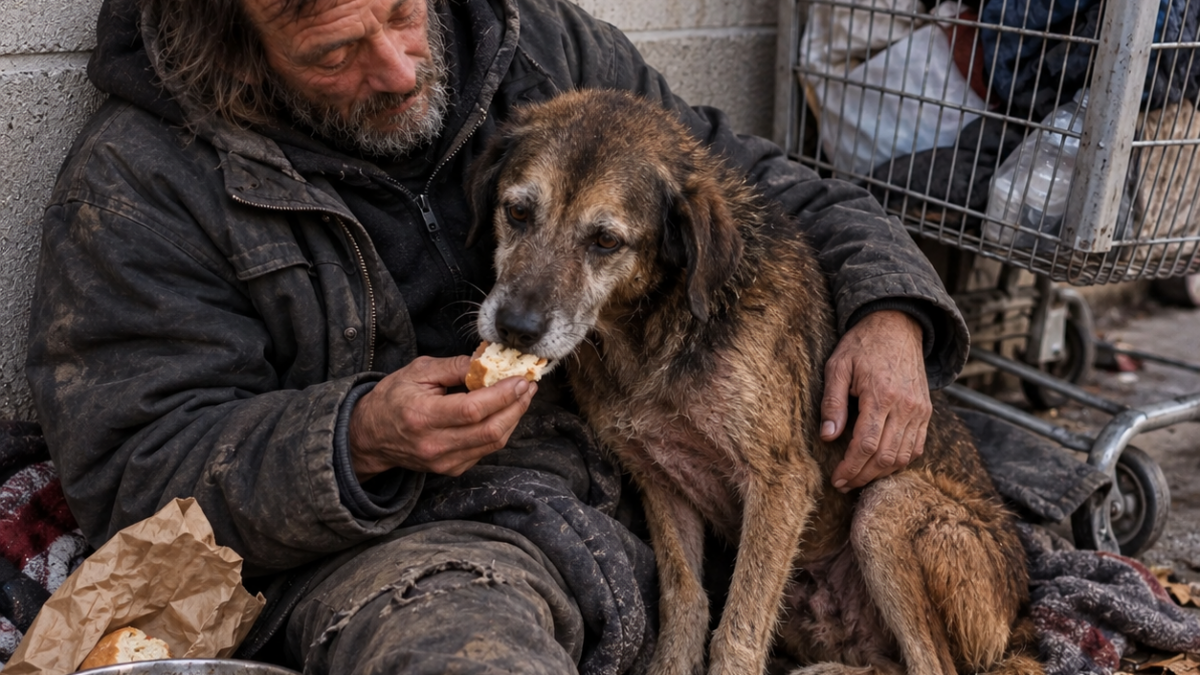
William did not move.
For several seconds, he just stood in the bitter February air staring at the open passenger door.
His beard was white with frost around the edges.
His hands trembled.
Not dramatically.
The small trembling of someone who had been cold too long.
“Daniel,” he said quietly.
It was the first time he had ever used my name.
“I don’t have any money.”
“I didn’t ask for money.”
“They’re not going to give her back.”
“We don’t know that.”
“I know how this goes.”
Something in the way he said it stopped me.
Not anger.
Experience.
William had spent enough time being poor to understand that simple problems become complicated the moment you cannot produce a document, an address, a credit card, or a person willing to say, Yes, I know him.
He looked toward the parking lot.
“I don’t even have her vaccination paperwork anymore.”
“Where was it?”
“In the truck.”
“The truck that got repossessed?”
He nodded.
“What about a vet?”
He looked at me.
“She went to one years ago.”
“Where?”
“Northside Animal Clinic.”
“That’s something.”
“That was three years ago.”
“Still something.”
He shook his head.
“They’ll say I abandoned her.”
“You didn’t.”
“They’ll say she’s better off without me.”
That sentence had been waiting underneath everything else.
I closed the car door and stepped closer.
“William, look at me.”
He did.
Barely.
“For six months, I watched you go hungry so that dog wouldn’t.”
His jaw tightened.
“I’ve seen you sleep against concrete with your coat under her because the ground was cold.”
“I watched you walk two miles in sleet because you heard the church pantry had dog food.”
“You can tell me you don’t have papers.”
“You cannot tell me you abandoned Maggie.”
His eyes filled.
He looked away quickly.
“I should’ve protected her.”
“You did.”
“Not last night.”
“You were below freezing outside.”
“The outreach team probably thought they were protecting both of you.”
“Then why does it feel like they tore my chest open?”
I had no answer.
Some decisions can be reasonable on paper and devastating in a life.
“Get in,” I said.
“Let’s find her.”
This time, William climbed into the car.
I called my supervisor from the driver’s seat.
My shift had another five hours.
“Mike, I need a few hours.”
“Emergency?”
“Yes.”
There was a pause.
Mike knew me well enough not to ask stupid questions when my voice sounded like that.
“I’ll get Rafael to cover.”
“Thanks.”
“Everything okay?”
I looked at William.
“No.”
“Not yet.”
We started with the municipal warming center.
A brick recreation building near downtown had been converted into an overnight emergency shelter whenever temperatures fell below twenty degrees.
William sat stiffly in the passenger seat while I went inside.
Then he changed his mind and followed.
At the check-in table, a woman in a county vest looked up.
“Can I help you?”
William stood half a step behind me.
“He stayed here last night,” I said.
“We’re trying to locate his dog.”
The woman’s face softened immediately.
“The large brown dog?”
William stepped forward.
“Yes.”
“Maggie.”
“Her name is Maggie.”
“I’m Karen Ellis.”
“I was here when animal control came.”
“Where did they take her?”
“Clayton County Animal Services.”
William closed his eyes.
I heard him breathe out.
Alive.
Located.
A direction.
Sometimes that is enough to put a person’s feet back under them.
Karen stood.
“I’m sorry about last night.”
William opened his eyes.
“You wouldn’t let her stay.”
Her expression tightened.
“I know.”
“We aren’t authorized to allow animals in the sleeping area.”
“She’s not an animal to me.”
“I understand.”
“No, you don’t.”
The words came harder than anything I had ever heard from William.
Karen did not argue.
She let him have them.
Then she said, “You’re right.”
That surprised him.
She continued.
“I don’t understand what she means to you.”
“But I saw enough last night to know separating you hurt both of you.”
William’s anger flickered.
Not gone.
Changed.
“She tried to follow me.”
“I know.”
“They had to carry her into the van.”
“I know.”
His face collapsed for half a second.
Karen lowered her voice.
“She did not bite anyone.”
“She did not fight.”
“She kept looking back toward the entrance after you went inside.”
William turned away.
I placed one hand lightly on his shoulder.
He did not shake it off.
Karen handed me a card.
“Ask for Officer Marcy Lane.”
“She handled the intake.”
“Tell her Karen from the warming center sent you.”
“Thank you.”
As we turned to leave, Karen called after us.
“Mr. Graves?”
William stopped.
“I put your name in for the pet-friendly transitional housing pilot.”
He stared at her.
“What?”
“It’s new.”
“Only six units.”
“Long waiting list.”
“But I submitted you last night after I saw what happened.”
William looked suspicious.
Hope does that when it has disappointed someone often enough.
It makes good news feel dangerous.
“Why?”
Karen’s eyes moved toward the empty space beside his leg.
“Because next time I don’t want to have to choose between keeping you from freezing and keeping your family together.”
William said nothing.
Then he nodded once.
“Thank you.”
Outside, he stood beside my car and stared at the county card.
“She put my name in before I yelled at her.”
“Yes.”
“I shouldn’t have yelled.”
“You were scared.”
“That doesn’t make it right.”
“No.”
He looked at me.
“You always agree with people when they insult themselves?”
“Only when necessary.”
For the first time that morning, the corner of his mouth moved.
Barely.
It vanished quickly.
But it was there.
Clayton County Animal Services sat fifteen minutes away on an industrial road behind the public works garage.
The barking started before we reached the front door.
William stopped.
Every muscle in him tightened.
I had watched Maggie follow him for six months.
Now, for the first time, I saw what William looked like without her.
He kept glancing automatically toward his left side, where she should have been.
His hand hung strangely empty.
“Ready?” I asked.
“No.”
“Good enough.”
We went inside.
The receptionist asked for Maggie’s intake number.
We did not have one.
Owner identification.
William had no current driver’s license.
Proof of address.
None.
Registration certificate.
None.
Licensing tag.
Lost with the truck.
The questions came one after another.
Each answer made William smaller.
I could see the system doing what systems do.
Not intentionally humiliating him.
Simply asking for the things most people possess without thinking.
Address.
ID.
Paperwork.
Phone number.
William had a name and a dog.
The system wanted folders.
The receptionist looked uncomfortable.
“I’m not saying she isn’t his.”
“But without proof, she’s under stray hold.”
“How long?” I asked.
“Five business days before placement review.”
William’s face drained.
“Placement?”
“Adoption eligibility if no legal owner is established.”
“No.”
He leaned over the counter.
“No, she has an owner.”
The receptionist moved back slightly.
A door opened behind her.
A woman in a navy animal-control jacket stepped out.
“Mr. Graves?”
William turned.
“I’m Officer Lane.”
“Marcy.”
She was around forty, with tired eyes and a calm voice.
“I brought Maggie in last night.”
“Where is she?”
“She’s safe.”
“Where?”
“In the back.”
“Can I see her?”
Marcy looked at him for a moment.
Then nodded.
“Yes.”
The receptionist began to say something.
Marcy lifted one hand.
“I know the procedure.”
Then she looked at us.
“Come with me.”
The kennel corridor was loud.
Dogs barked from behind stainless-steel doors.
Some jumped.
Some backed away.
Some watched silently.
William walked faster with every step.
Then, halfway down the corridor, a bark rang out unlike the others.
One bark.
Deep.
Sharp.
Then another.
William stopped.
“Maggie.”
He did not shout.
He whispered her name like prayer.
At the last kennel on the right, a large brown dog slammed her front paws against the gate.
Her amber eyes went wild.
“Maggie.”
The sound William made was worse than crying.
He dropped to his knees.
Maggie pressed her whole body against the bars.
Her tail hit the kennel wall so hard it echoed.
She whined.
Barked.
Licked his fingers through the gate.
Then began making a low, broken sound I had never heard from her.
William pushed his forehead against the metal.
“I’m here.”
Maggie licked his face through the bars.
“I’m sorry.”
Her tail kept beating.
“I’m sorry, girl.”
Marcy looked away.
So did I.
There are reunions that feel private even when they happen in a public kennel.
After a minute, Marcy unlocked the gate.
“Slowly.”
Maggie did not understand slowly.
She came out and pushed into William with all sixty pounds of herself.
He sat hard on the floor.
She climbed half into his lap.
Licked his face.
His ears.
His jacket.
His hands.
Then she buried her head against his chest.
William wrapped both arms around her and cried into her neck.
For six months, I had seen him share bread without complaint.
Sleep outdoors without complaint.
Walk in bad weather without complaint.
I had never once seen him cry.
Now he could not stop.
Maggie’s body trembled against him.
“I thought I lost you.”
She whined.
“I thought I lost you too.”
I stood in that kennel corridor feeling like an intruder and a witness at the same time.
Marcy folded her arms.
“She stopped eating after intake.”
William looked up sharply.
“She what?”
“We offered food twice.”
“She wouldn’t touch it.”
“I told them she waits for me.”
“I know.”
“She always waits until I eat.”
Marcy’s expression changed.
“You feed together?”
William wiped his face.
“She gets first.”
“Always?”
He nodded.
Maggie’s head remained pressed beneath his chin.
Marcy crouched.
“Mr. Graves, I believe she’s your dog.”
William looked at her.
“Then let me take her.”
Her face fell.
“I can’t yet.”
His arms tightened around Maggie.
“Why?”
“Because belief and legal release are different things.”
“You have no current ID.”
“No licensing record in this county.”
“No chip registered to you.”
“She isn’t chipped?”
“No.”
“She had one.”
William frowned.
“What?”
“The vet put one in years ago.”
Marcy glanced toward me.
“Do you know which clinic?”
“Northside Animal Clinic,” I said.
William looked at me as if he had forgotten I was there.
“Yes.”
“Northside.”
Marcy stood.
“Then we call them.”
Northside Animal Clinic opened at eight.
It was 8:13.
I called while William stayed on the kennel floor with Maggie.
The receptionist searched.
No Maggie Graves.
No William Graves.
Then William called from behind me.
“Try Margaret.”
“What?”
“Her name was Margaret on the paperwork.”
“I started calling her Maggie later.”
The receptionist searched again.
There she was.
Margaret.
Female mixed breed.
Microchip implanted six years earlier.
Owner: William Graves.
Old address.
Old phone number.
But his name.
His dog.
I nearly shouted.
“Can you email the record?”
“Absolutely.”
The receptionist hesitated.
“We also have a photo from her first vaccination visit.”
“Send everything.”
Within ten minutes, Marcy had veterinary records, vaccine history, the microchip number, and a photograph of a younger Maggie sitting beside a younger William with one hand on her head.
The chip scanner had failed to detect the microchip during intake because it had migrated lower toward her shoulder.
Marcy rescanned.
The machine beeped.
A number appeared.
Match.
William closed his eyes.
“Can I take her now?”
Marcy’s face should have brightened.
Instead, it became careful.
“There’s still one issue.”
I wanted to hate her.
I could tell she hated saying it too.
“What?” William asked.
“We can legally release her to you.”
“But I need a safe discharge plan.”
“I’m safe for her.”
“I’m not questioning whether you love her.”
“Then what are you questioning?”
“The temperature tonight is forecast at nine degrees.”
William went quiet.
Marcy continued gently.
“The city cannot knowingly release an older dog back into severe cold without shelter access.”
“She has me.”
“I know.”
“She sleeps under my coat.”
“I know.”
“She’s survived colder.”
“That doesn’t mean she should have to again.”
William’s face hardened.
“So because I’m poor, you get to keep my dog.”
“No.”
Marcy’s voice stayed steady.
“Because it is nine degrees tonight, I need somewhere warm for both of you.”
William looked at Maggie.
The dog had fallen quiet now that she was against him.
Her eyes were half-closed.
Safe because he was there.
Then something strange happened.
I realized everyone was waiting for someone else.
Marcy needed housing.
William needed Maggie.
The warming center needed a no-pet rule.
The shelter needed procedure.
Karen had put his name on a list.
And I had a spare room.
The thought arrived before I could argue with it.
I lived alone in a small two-bedroom house fifteen minutes from Clayton Plaza.
The second bedroom held a treadmill I used mostly to hang shirts on.
My backyard was fenced.
My divorce had been final three years.
My daughter was in college two states away.
I had space.
Immediately, the reasonable part of my brain produced objections.
I barely knew William.
He was homeless.
He was a stranger.
My employer might think I had lost perspective.
My neighbors might complain.
What if things disappeared?
The moment that last thought entered my mind, I felt ashamed.
For six months, William had sat fifteen yards from a supermarket filled with food and merchandise.
I had never once seen him steal anything.
Even when hungry.
He asked before using the restroom.
Returned coffee thermoses washed.
Picked up trash around the vent that was not his.
And here I was, standing beside the dog he had sacrificed food for, wondering whether my television was safe.
That was the ugliest part of myself I saw that morning.
I was not proud of it.
But seeing it mattered.
“I have a room,” I said.
Everyone looked at me.
William frowned.
“What?”
“My house.”
“Spare bedroom.”
“Fenced yard.”
“It’s warm.”
Silence.
Marcy stared.
“You’re offering temporary housing?”
“I think so.”
William immediately shook his head.
“No.”
“Why?”
“I’m not moving into your house.”
“Why not?”
“Because I’m not.”
“That is not an explanation.”
“You don’t know me.”
“I know enough.”
“No, you don’t.”
He stood, Maggie rising with him.
“You know the man behind the supermarket.”
“That’s not the same as knowing somebody.”
“Fine.”
I crossed my arms.
“I know you were a carpenter for almost thirty years.”
“You hurt your back on a job.”
“You don’t like sweet coffee.”
“You pretend Maggie doesn’t get cold because admitting it scares you.”
“You always give her the first bite.”
“You hate bananas.”
“They’re terrible.”
“Exactly.”
Marcy looked like she was trying not to smile.
I continued.
“I know you handed me back ten dollars I dropped near the vent before I even knew your name.”
“I know that when Mrs. Park’s shopping cart rolled across the parking lot, you chased it even though your back hurt.”
“I know you sweep the area where you sleep.”
“I know Maggie trusts you with her life.”
“Maybe I don’t know everything.”
“But I know enough to offer a room for a few nights.”
William stared at me.
Maggie looked between us.
“No charity,” he said.
“It’s not charity.”
“What is it?”
I thought about that.
“Logistics.”
Marcy laughed.
William almost did.
“You need a warm place.”
“I have one.”
“Maggie needs a fenced yard.”
“I have one.”
“You’re on a housing list.”
“We need a bridge until something opens.”
“Logistics.”
He shook his head.
“You make everything sound like a security report.”
“It’s a skill.”
He looked down at Maggie.
“What if we stay one night?”
“One night at a time.”
His eyes lifted.
“And if it doesn’t work?”
“We figure out something else.”
Marcy exhaled.
“That qualifies as a discharge plan.”
William looked betrayed.
“You two planned this.”
“We met forty minutes ago,” I said.
Maggie licked his hand.
He closed his eyes.
“Fine.”
One night.
It became six weeks.
But I am getting ahead of myself.
That first afternoon, we stopped at Clayton Plaza before going to my house.
William needed his backpack.
A duffel bag.
The rolled sleeping mat he kept hidden behind the loading dock.
Everything he owned fit inside one shopping cart.
Seeing it all together changed something in me.
A jacket.
Two shirts.
One spare pair of jeans.
Socks.
A small first-aid kit.
A battered paperback.
Dog food in a plastic grocery bag.
A carpenter’s tape measure.
One framed photograph wrapped in a T-shirt.
I did not ask about the photograph.
Not then.
Maggie walked beside him like she had always done.
Except now she kept looking up every few steps.
Checking.
Making sure he was still there.
Customers passed us.
Some stared.
One woman pulled her child closer.
William noticed.
He always noticed.
I had seen that before too.
The slight downward tilt of his head when someone looked at him too long.
The way he made himself smaller in public spaces despite being tall.
A man apologizing for existing where people could see him.
At the employee break-room door, Mike met us.
He looked at Maggie.
Then at William.
Then at me.
“This is the emergency?”
“Yes.”
Mike scratched his beard.
“Okay.”
That was it.
No judgment.
No interrogation.
Then he handed William a paper bag.
“What’s that?” William asked.
“Lunch.”
“I don’t need—”
“Then give it to the dog.”
William took it.
“Thank you.”
Maggie’s ears lifted.
Mike pointed at her.
“Dog knows turkey?”
William shook his head.
“She’ll eat it.”
“Good.”
We drove to my house.
Maggie rode in the back seat with William.
At every red light, I glanced in the mirror.
He kept one hand on her shoulder.
She kept one paw across his boot.
Neither seemed willing to risk physical separation.
My house was quiet when we arrived.
Too clean.
Too arranged.
The kind of home designed by a man who did not expect anybody.
William stood in the entryway with his backpack and looked uncomfortable.
Maggie sniffed everything.
The couch.
The rug.
The baseboards.
The hallway.
Then she found the sliding door to the backyard.
Her tail began to wag.
I opened it.
She stepped onto the frozen grass.
William followed.
For the first time since morning, his shoulders lowered.
“She likes yards.”
“I can see that.”
“We had one once.”
I did not ask.
He told me anyway.
“Little rental house.”
“North side.”
“Fence leaned like it was drunk.”
“Maggie dug underneath it twice.”
He smiled.
A real smile.
It transformed his face.
“She wasn’t trying to escape.”
“She was chasing the neighbor’s cat.”
“Did she catch it?”
“No.”
“Thank God.”
“Cat would’ve killed her.”
I laughed.
William laughed too.
Maggie ran three awkward circles around the yard, gray muzzle lifted into the cold air.
Not fast.
She was older.
But joyful.
When she came back, she pressed against William’s leg.
He scratched her neck.
I watched them from the doorway.
One night, I reminded myself.
One night.
That evening, I made pasta.
William asked to help.
I said no.
He ignored me and fixed the loose cabinet hinge above my sink with a screwdriver from his backpack.
“You travel with tools?”
“Carpenter.”
“Former carpenter.”
He looked at me.
“Still know how.”
Fair.
Maggie slept beneath the kitchen table.
I gave William a full plate.
He cut one piece of plain chicken from the side.
Placed it into Maggie’s bowl.
Then began eating.
I watched.
He noticed.
“What?”
“You still feed her first.”
His fork stopped.
“Habit.”
Maggie looked up at him.
“Good habit,” I said.
He continued eating.
We barely spoke after that.
Some silences are awkward.
That one was restful.
At bedtime, I showed him the spare room.
Fresh sheets.
Extra blanket.
Maggie’s dog bed from the shelter sat beside the bed.
William stared at it.
“I haven’t slept in a bed in almost nine months.”
The sentence came without drama.
That made it worse.
“You can leave the door open.”
He nodded.
I went to my room.
At 2:18 a.m., I woke.
Something had changed in the house.
I listened.
No voices.
No alarm.
I got up.
The spare bedroom was empty.
Bed untouched.
Panic hit immediately.
Then I saw light beneath the back door.
I opened it.
William sat on the porch steps wrapped in a blanket.
Maggie lay beside him.
“What are you doing?”
He looked guilty.
“Couldn’t sleep.”
“Why?”
“Too quiet.”
I stared.
“Too quiet?”
“Inside.”
He looked toward the dark yard.
“When you sleep outside, you hear everything.”
“Cars.”
“Pipes.”
“People.”
“Sirens.”
“Wind.”
“Sleeping inside feels like something is wrong because you can’t hear enough.”
I had never considered that.
Maggie lifted her head.
William stroked her ear.
“She couldn’t settle either.”
I sat on the step beside him.
Cold immediately came through my sweatpants.
“This is terrible.”
He gave a faint smile.
“You get used to it.”
“I don’t want to.”
That made him laugh quietly.
We sat there for several minutes.
Then I said, “You can sleep on the couch.”
“Television on.”
“Hall light.”
“Windows cracked if you want.”
He looked at me.
“You’re weirdly committed to making this happen.”
“I hate losing.”
“Security thing?”
“Personal defect.”
We moved inside.
William slept on the couch with the television playing low.
Maggie curled on the rug beside him.
In the morning, I found his hand hanging over the edge, fingers buried in her fur.
I went to work.
They came with me.
Not inside the store.
Management rules still existed.
But Mike approved William and Maggie using the employee courtyard during daytime for a week while we worked on the next step.
Karen from outreach met us there.
Then Marcy.
Then a caseworker named Sheila Brown.
Suddenly William had a team.
He hated that.
At first.
He disliked forms.
Distrusted promises.
Refused to call anything progress.
But he showed up.
That mattered.
The biggest problem was identification.
Without a valid ID, housing applications stalled.
Replacement documents required an address.
An address required documents.
Another perfect system circle.
Sheila knew how to break it.
The shelter program could receive mail.
Karen helped order William’s birth certificate.
I drove him to the Social Security office.
He had an expired state ID from two years earlier in the bottom of his backpack.
That helped.
So did the old veterinary record listing his previous address.
Maggie’s paperwork became part of William’s paperwork.
Funny how the dog who had supposedly complicated everything began helping prove he existed.
At Northside Animal Clinic, they updated Maggie’s vaccines.
The veterinarian, Dr. Patel, examined her gray muzzle and stiff hips.
“She’s in pretty good shape considering.”
William looked relieved.
“Considering what?”
“Living outside.”
His face tightened.
Dr. Patel noticed.
“I’m not judging you.”
“I know what people think.”
“I said I’m not.”
She checked Maggie’s heart.
“Her weight is slightly low.”
“Nothing severe.”
“Arthritis starting.”
“We can help with that.”
William stared.
“How much?”
Dr. Patel glanced at me.
I knew what was coming.
“William,” I said.
“No.”
“You don’t even know what I was going to say.”
“You were going to pay.”
“Maybe.”
“No.”
Dr. Patel lifted a hand.
“We have a hardship fund.”
William looked suspicious.
“Who pays for that?”
“People who can.”
“That’s charity.”
“That’s community medicine.”
He looked at me.
“Logistics,” I said.
He rolled his eyes.
That was progress too.
Maggie received medication.
A new harness.
Updated vaccines.
A microchip with William’s name and the shelter’s stable contact number until he had permanent housing.
When the scanner beeped, William’s eyes filled.
“She won’t disappear again.”
Dr. Patel looked at him.
“No.”
“Not without leaving a trail.”
That afternoon, he framed the microchip registration certificate.
I am serious.
He bought a three-dollar plastic frame at a discount store and placed the paper on the dresser in my spare room.
I said nothing.
Some paperwork deserves respect.
One week became two.
Two became four.
William started helping around the house despite my telling him not to.
The loose cabinet hinge led to a sticking door.
The sticking door led to a porch railing.
The porch railing led to an entire Saturday where he rebuilt one section so precisely that my neighbor came over and asked if he took private jobs.
William froze.
Her name was Mrs. Alvarez.
Seventy-two.
Widowed.
Fearless.
She pointed at her fence.
“Three boards are loose.”
William looked at me.
I shrugged.
“You’re the carpenter.”
“Former.”
Mrs. Alvarez waved that away.
“My fence doesn’t know the difference.”
She paid him sixty dollars.
He tried to take forty.
She threatened him with a garden hose.
He took sixty.
The next week, her son called.
Needed shelves installed.
Then a coworker of mine needed a door repaired.
Then Mike had a deck stair that wobbled.
Work began arriving in pieces.
Not enough for housing.
Enough for dignity.
William bought groceries with his own money for the first time in months.
I came home that evening and found a bag on the counter.
Bread.
Eggs.
Coffee.
Dog food.
Chicken.
He handed me twenty dollars.
“For the room.”
“No.”
His face hardened.
“Daniel.”
“No.”
“I’m not staying free.”
“You’re leaving as soon as housing opens.”
“Then take twenty dollars.”
I looked at him.
This was not about money.
So I took it.
Then put it in an envelope in my desk.
Weeks later, I used it to buy him a new carpenter’s belt when his old one split.
He knew.
He called me a thief.
Fair.
The housing call came after forty-two days.
Karen phoned me while I was monitoring the produce aisle.
“Daniel?”
“Yes?”
“We have a unit.”
I stood.
Rafael looked over from the next monitor.
“What?”
I waved him off.
Karen continued.
“Pet-friendly transitional apartment.”
“Six months guaranteed.”
“Case management.”
“Rent based on income.”
“Ground floor.”
“Fenced shared courtyard.”
“Maggie approved.”
I closed my eyes.
“When?”
“Friday.”
I should have been happy.
I was.
Mostly.
Then I realized my house was about to become quiet again.
That annoyed me.
I had spent years protecting quiet.
Now I resented it.
When I told William, he did not react the way I expected.
He sat at the kitchen table.
Maggie beside him.
“A unit?”
“Yes.”
“Your own key.”
“Dog allowed.”
“Six months.”
He stared at his hands.
“What?”
“I don’t know.”
“You don’t look happy.”
“I am.”
“What’s the problem?”
“What if I lose it?”
There it was.
Not hope.
Fear of hope.
I sat across from him.
“You might.”
His head lifted.
“Great speech.”
“I’m not going to lie.”
“Things can go wrong.”
“Work can disappear.”
“Back pain can get worse.”
“Life is very creative.”
He almost smiled.
“But if something goes wrong, you don’t go back to being the man behind Clayton Plaza on day one.”
“You know Karen.”
“Sheila.”
“Marcy.”
“Dr. Patel.”
“Mike.”
“Mrs. Alvarez, terrifying though she is.”
“Me.”
“You have numbers now.”
“People know your name.”
He looked down at Maggie.
“She knew it first.”
“Yes.”
“She did.”
Friday morning, we packed.
William owned more things now.
Not many.
But more.
Work boots Mrs. Alvarez’s son had given him.
Two new shirts.
A used phone from the reentry donation program.
Carpenter’s tools.
Maggie’s medicine.
Her bed.
A proper bag of dog food.
And the framed microchip certificate.
I carried that last.
“Careful,” William said.
“Yes, Dad.”
“It matters.”
“I know.”
The apartment was small.
One bedroom.
Plain carpet.
White walls.
A kitchenette.
But sunlight came through a wide front window.
Maggie walked in, sniffed every room, then found the courtyard door.
William opened it.
She stepped outside.
Grass.
Fence.
Two bare trees.
A bench.
Maggie ran.
Not fast.
Not far.
One circle.
Then another.
Then came back and pressed herself against William.
He knelt.
His hand buried in the fur at her neck.
“This one’s ours,” he whispered.
I looked away.
Again.
I had become very experienced at looking away during moments that were none of my business and somehow everything to me.
William stood.
He held out a key.
I stared.
“What’s that?”
“Spare.”
“For emergencies.”
“You’re giving me a key?”
“You gave me one.”
He meant my house.
I had not thought about it like that.
I took the key.
“Logistics?”
“Don’t ruin it.”
I smiled.
“Fine.”
For the first few weeks, William still came to Clayton Plaza every morning.
Not because he needed the vent.
Because routine is hard to give up when routine kept you alive.
At 6:30, he and Maggie would appear.
Only now he wore clean work clothes.
Carried coffee in a reusable cup.
Maggie wore her new red harness.
He sometimes bought breakfast inside.
Paid for it.
Then sat near the old vent anyway.
And still.
Always.
He gave Maggie the first bite.
One morning, I sat beside him.
“You know she has dog food at home.”
“I know.”
“You don’t have to split breakfast.”
“I know.”
“Then why?”
William looked at Maggie.
She waited patiently.
“Because this isn’t about hunger anymore.”
He tore off a piece of sandwich.
Held it out.
Maggie took it gently.
“It’s how we remember we made it through.”
I understood.
Ritual does not always need to disappear after survival.
Sometimes it becomes gratitude.
Months passed.
William’s carpentry work became steadier.
A local contractor named Ben Caldwell hired him for small interior jobs that did not require the heavy lifting his back could no longer manage.
Cabinet repair.
Trim.
Shelving.
Finish work.
William was good.
Very good.
Ben told me once, “He measures like wood insulted his family.”
Sounded accurate.
When the six-month housing period neared its end, William qualified for a subsidized apartment through a disability and employment program.
Pet-friendly.
Maggie approved again.
The first time I saw the lease with both his name and the line “one canine companion,” I thought about the shelter counter.
No ID.
No address.
No proof.
Now he had a lease.
A key.
A bank account.
A phone.
Tools.
A job.
And more paperwork for his dog than I had for my car.
He joked about that.
But he kept every page in a waterproof folder.
The city changed too, a little.
Karen and Marcy used what happened with William and Maggie to push for a new emergency-weather partnership.
A local rescue agreed to provide temporary crates, food, veterinary screening, and overnight foster placement when warming centers could not admit pets.
The county later funded five kennel spaces attached to the largest shelter site so people could remain near their animals during extreme-weather nights.
Not perfect.
Not enough.
Better.
I attended the city council meeting when they approved it.
I hate meetings.
I went anyway.
Karen spoke.
Marcy spoke.
Then William did.
I did not know he planned to.
He stood at the microphone wearing a clean blue shirt, hands rough from carpentry, Maggie waiting outside with me because dogs were not allowed inside the chamber.
“My dog and I were homeless,” he said.
No drama.
Just fact.
“One night it was too cold to stay outside.”
“The city did the right thing by getting me indoors.”
“They also took the only family I had because the system had no place for both of us.”
He paused.
“I’m not here to say rules don’t matter.”
“I’m here to say people don’t stop being families because they don’t have houses.”
The room went still.
“When you tell someone sleeping outside that they can come in only if they leave their dog, sometimes you are asking them to abandon the one reason they survived outside in the first place.”
I swallowed hard.
William continued.
“Maggie kept me moving.”
“She kept me sober.”
“She kept me from giving up.”
“She stood between me and nights I don’t like talking about.”
He looked down.
“When she was taken away, I did not feel rescued.”
“I felt like I’d been punished for accepting help.”
Then he lifted his head.
“Daniel found her.”
That embarrassed me immediately.
“He helped prove she was mine.”
“He gave us a room.”
“But this policy should not depend on some security guard deciding to take strangers home.”
A few people laughed softly.
I did too.
“He is right,” I muttered.
William smiled.
“We can build something better than luck.”
That line ended up in the newspaper.
The pet-safe warming program passed unanimously.
When William came outside, Maggie nearly knocked him over.
“What did you tell them?” I asked.
“The truth.”
“Dangerous habit.”
“You started it.”
Maybe I had.
Or maybe Maggie had.
Years moved.
Maggie’s gray muzzle became almost white.
Her arthritis worsened.
She slowed.
William’s life kept rebuilding around her.
He never became rich.
Never owned another house.
Never returned to full-time heavy carpentry.
But he had work.
A home.
People.
A life with edges instead of an endless sidewalk.
I remained at Clayton Plaza.
Security supervisor eventually.
Mike retired.
Rafael took mornings.
I moved to a better schedule.
But I still came in early sometimes.
At 6:30, I would look toward the old heating vent.
Habit.
William and Maggie still visited.
Less often.
Usually Saturdays.
He would bring coffee for me now.
Role reversal.
One morning, five years after the separation, William arrived alone.
My stomach dropped exactly as it had that February morning.
But this time he was not hollow.
Sad.
Yes.
Tired.
But not empty.
I stepped outside.
“Where’s Maggie?”
“Home.”
“Is she okay?”
He looked toward the parking lot.
“She’s slowing down.”
I knew.
Dr. Patel had warned him.
Kidneys.
Arthritis.
Heart murmur.
Age collecting debts.
“She had a bad night.”
“I didn’t want to leave her long.”
“Then why are you here?”
William held out a thermos.
“You left this at my place.”
I stared at him.
“You drove across town because I left a thermos?”
He shrugged.
“Could’ve waited.”
“I know.”
That was not why he came.
I knew him well enough now.
“What are you scared of?”
His face changed.
He looked toward the ground.
“I don’t know how to do this without her.”
There it was.
The original truth.
Maggie had been the one who never left.
But one day, bodies leave even when love does not.
I stepped closer.
“You don’t have to know today.”
“She saved me.”
“I know.”
“What am I supposed to do when she’s gone?”
I remembered the first sandwich.
The first coffee.
The shelter bars.
The house.
The lease.
The city council room.
“You do what she taught you.”
“What’s that?”
“Keep going.”
William looked at me.
“That’s easy for you to say.”
“No.”
“It isn’t.”
My father had died when I was twenty-nine.
My marriage ended three years before I met William.
My daughter had moved away and built a life that did not need me daily.
Loss had lived in my house too.
Just better dressed.
“You fed her first every morning,” I said.
“Now you have people who’ll make sure you eat too.”
His eyes filled.
He looked away.
“God, I hate you sometimes.”
“Healthy friendship.”
Maggie lasted another seven months.
Good months mostly.
Slow walks.
Medication.
Warm beds.
Chicken.
Sunlight.
William built a little ramp so she could reach the couch without jumping.
Naturally, it was the best-built dog ramp in Clayton County.
Dr. Patel called it structurally capable of supporting a horse.
William said horses were not invited.
On Maggie’s final morning, he called me at 5:52.
Before my shift.
I answered after one ring.
“Daniel.”
I heard his voice.
“I’m coming.”
At his apartment, Maggie lay on her bed near the window.
Sunrise had not fully arrived.
The room was dim and warm.
William sat on the floor beside her.
One hand on her ribs.
Her breathing was slow.
Her amber eyes opened when I entered.
Her tail moved once.
“Hey, girl.”
I knelt.
My knees complained.
None of us were getting younger.
Maggie sniffed my hand.
I had brought a biscuit.
Instinct.
I took it from my pocket.
William looked at it.
Then at me.
“She won’t eat.”
“I know.”
He took the biscuit anyway.
Held it near her.
Maggie sniffed.
Then rested her head again.
William’s mouth trembled.
“She always ate first.”
I sat beside him.
“So give her something else first.”
He looked at me.
“What?”
“Your words.”
For several seconds, he could not speak.
Then he leaned down.
“Okay, girl.”
Maggie’s eyes moved toward him.
“You fed me too.”
His voice broke.
“All those years I thought I was feeding you.”
“But you fed me too.”
He stroked her white muzzle.
“You kept me alive.”
“You kept me human.”
“You made me get up.”
“You made me walk.”
“You made me ask for water when I would’ve stayed thirsty.”
“You made strangers talk to me like I existed.”
His tears fell into her fur.
“And when they took you away, you made Daniel stop being an annoying security guard and become an even more annoying friend.”
I laughed through tears.
“Accurate.”
Maggie’s tail moved once.
William smiled.
“There she is.”
Dr. Patel arrived shortly after seven.
She had been Maggie’s veterinarian for five years by then.
No clinic.
No cold table.
She came to the apartment.
Examined Maggie softly.
Then sat with us.
“It’s time,” she said.
William nodded.
His face crumpled.
I put one hand on his shoulder.
He did not pull away.
Dr. Patel gave the first medication.
Maggie relaxed.
The tension left her old body.
William took a small piece of bread from a plate on the table.
I stared at it.
Of course.
He had planned this.
He broke the piece in half.
Held one half near Maggie.
She could not eat.
So he placed it beside her paw.
Then he took the other half.
For a moment, he could not swallow.
I understood.
The ritual required her to eat first.
For seven years with her and for all the months I had known them, that had been the rule.
William looked at Maggie.
Then at the bread.
Then at me.
“She’d be mad if I wasted it.”
“Yes.”
He took one bite.
Maggie’s tail moved.
Barely.
William laughed and sobbed.
“Bossy until the end.”
Dr. Patel gave the final injection.
Maggie died with William’s hand on her head, a piece of bread beside her paw, and the morning sun beginning to fill the apartment.
No animal-control van.
No cold street.
No separation.
Home.
Afterward, William sat beside her for nearly an hour.
I stayed.
I did not try to fix the silence.
Security work had taught me to intervene.
Maggie had taught me sometimes staying is the intervention.
Eventually, William looked at me.
“You remember the first time you saw us?”
“Yes.”
“What did you think?”
I considered lying.
“I thought you were homeless.”
“That’s profound.”
“You asked.”
“What else?”
“I thought Maggie looked better cared for than you.”
He smiled faintly.
“She was.”
“I thought you were probably going to become a problem eventually.”
He looked at me.
“Really?”
“Yes.”
“And?”
“I was wrong about what the problem was.”
He waited.
“The problem wasn’t you sleeping near the store.”
“It was that I could watch you for six months and convince myself watching counted as helping.”
William looked down at Maggie.
“You brought coffee.”
“Coffee is not a housing plan.”
“No.”
“But it mattered.”
That stopped me.
He continued.
“You think the big thing was the car ride to the shelter.”
“It wasn’t.”
“It was the first coffee.”
“Why?”
“Because you said my name after that.”
I swallowed.
He looked at me.
“People stop saying your name when you live outside.”
“They say sir if they’re polite.”
“Buddy if they want you to move.”
“Hey if you’re blocking something.”
“Homeless guy if they talk about you.”
“You asked my name.”
That was the smallest thing.
I had almost forgotten.
William had not.
Maggie’s ashes were kept in a wooden box William built himself.
Oak.
Simple.
Perfect joints.
On the lid, he carved only:
MAGGIE
SHE STAYED.
He kept the box near the window where she used to sleep.
The red harness hung beside it.
The framed microchip certificate remained on the wall.
Six months after Maggie died, William began volunteering twice a week with the pet-safe warming program.
He said he was only fixing kennels.
Naturally, that became more.
He repaired doors.
Built insulated dog platforms.
Helped frightened people complete forms.
Sat with men who refused shelter because their animals could not enter.
He did not lecture.
He said, “I was where you are.”
That sentence opened doors I could not.
One December night, Karen called him about an older man named Earl who had been sleeping behind a gas station with a little terrier.
Earl refused the warming center.
William drove there.
I went too.
Old habits.
Earl sat beneath an overpass wrapped in a blanket, dog tucked inside his coat.
William approached slowly.
“You don’t know me,” he said.
Earl looked suspicious.
“Correct.”
“My name’s William.”
“Used to sleep behind Clayton Plaza with my dog.”
Earl looked at him.
“Where’s the dog?”
William’s face changed.
“She made it home.”
Not alive.
Not dead.
Home.
I never forgot that phrasing.
William pointed toward the outreach van.
“They have a pet kennel attached now.”
“You can see your dog from the sleeping area.”
“Nobody takes him away.”
Earl stared.
“You sure?”
William nodded.
“I helped build the gate.”
That convinced him.
They went in together.
I stood by my car watching.
Five years earlier, William had needed someone to say, Get in, we’re finding Maggie.
Now he was saying it to somebody else.
That is how rescue should work, I think.
Not one heroic person saving another.
A chain.
Someone reaches.
Someone stands.
Then, when they can, they become the next hand.
I remained friends with William.
Still am.
He is sixty-two now.
His back is worse.
His beard almost white.
He works part-time at a custom cabinet shop and volunteers more than his doctor recommends.
My daughter says we are two stubborn old men trying to outdo each other in avoidable joint pain.
She is correct.
William never adopted another dog immediately.
People kept asking.
He said no.
For two years.
Then one afternoon, Marcy called.
She was still with animal services, now supervising field operations.
“We have a problem,” she told me.
“I retired from problems.”
“No, you didn’t.”
Fair.
An older mixed-breed dog had been surrendered after her owner entered long-term care.
Brown coat.
Amber eyes.
Gray muzzle.
Not Maggie.
That mattered.
Never Maggie.
Her name was Sadie.
She refused food.
Would not come out of the back of the kennel.
Marcy wanted William to sit with her.
Not adopt.
Just sit.
I drove him.
“Why am I going?” he complained.
“Because she asked.”
“She asked you.”
“She asked for you.”
At the shelter, Sadie lay against the back wall.
William sat outside the kennel.
Said nothing.
Twenty minutes passed.
Then thirty.
Finally, Sadie lifted her head.
William placed one hand near the bars.
She came forward.
Slowly.
Sniffed his fingers.
Then sat.
William’s face went still.
I knew before he did.
“No,” he said.
I said nothing.
“I am not adopting a dog.”
Sadie placed one paw through the bars.
I looked at the ceiling.
“Daniel.”
“I said nothing.”
“You’re thinking loudly.”
An hour later, he filled out a foster application.
Temporary, he insisted.
Of course.
Sadie still lives with him.
Three years now.
She eats after he does.
That took training.
The first morning, William automatically tore his toast in half and held her piece out before taking his own bite.
He stopped.
Looked at her.
Then at me.
I happened to be drinking coffee at his kitchen table.
“What?” I asked.
He smiled.
“Maggie would understand.”
Then he ate first.
Only one bite.
Then gave Sadie hers.
Not replacement.
Continuation.
That difference matters.
I think about the original six months sometimes.
The security monitors.
The heating vent.
William breaking bread.
Maggie’s amber eyes.
My belief that observing suffering somehow made me compassionate enough.
It did not.
Seeing is only the beginning.
There is a moment after seeing when you choose whether the person remains scenery.
That February morning was mine.
William came alone.
I could have said I was sorry.
Could have bought coffee.
Could have called animal control and wished him luck.
Instead, I opened the passenger door.
That action changed all three of us.
Four, if you count me.
Especially if you count me.
Clayton Plaza looks mostly the same now.
New signs.
Different manager.
Security cameras upgraded.
The vent still blows warm air behind the building.
But now there is a weatherproof cabinet near the employee entrance.
Inside are bottled water, socks, hand warmers, hygiene kits, sealed pet food, collapsible bowls, leashes, and cards listing local shelters that accept people with animals.
Management approved it after I became supervisor.
I called it emergency supplies.
William called it “Daniel finally learning logistics.”
The insult was fair.
There is also a small photograph inside the cabinet door.
Not visible to customers.
William sitting beside the vent.
Maggie at his feet.
A sandwich between them.
The picture was taken by Mike years ago.
I had forgotten it existed.
On the back, I wrote:
FEED THE PERSON.
FEED THE DOG.
LEARN THEIR NAMES.
Sometimes new security officers ask about it.
I tell them.
Not the polished version.
The real one.
I tell them I watched for six months.
I tell them I was kind in small ways.
Coffee.
Biscuits.
Conversation.
Those things mattered.
But I also tell them kindness can become comfortable if it never risks anything.
The morning Maggie disappeared, helping became inconvenient.
I had to leave work.
Drive around.
Argue with systems.
Offer a stranger my home.
Make phone calls.
Sit in offices.
Spend time.
Learn things about poverty I had avoided learning.
That inconvenience changed my life.
William once told me Maggie was the only one who never left.
He was wrong by the end.
Maggie stayed.
Then I stayed.
Karen stayed.
Marcy stayed.
Sheila stayed.
Dr. Patel stayed.
Mike stayed.
Mrs. Alvarez stayed, mostly because she enjoyed ordering William around.
And William learned that losing everything does not mean everyone is gone.
That may be the greatest thing Maggie ever gave him.
She kept him alive long enough for the rest of us to arrive.
Every year, on the anniversary of the day we found Maggie at the shelter, William and I meet behind Clayton Plaza at 6:30 in the morning.
Sadie comes now.
We bring coffee.
A sandwich.
William breaks it in half.
For years, he gave the first half to Maggie because she was the only family he trusted not to leave.
Now he takes the first bite himself.
Then he gives Sadie hers.
The first time he did that, I noticed.
Of course I did.
Security guards notice things.
I just understand now that noticing is supposed to lead somewhere.








