For 43 Days, a Dog Waited Outside the Courthouse for the Man Who Never Came Back
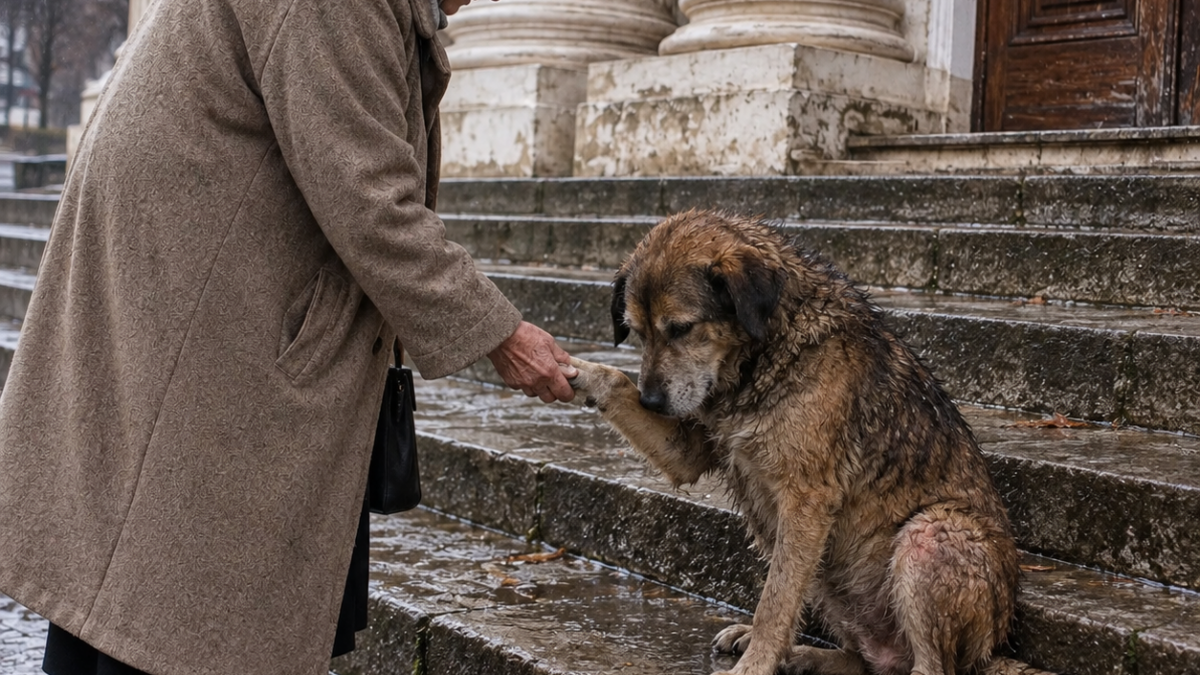
Dusty’s shoulder stayed against my leg for less than a minute.
Then footsteps sounded inside the courthouse.
His body stiffened.
He stood immediately.
The front doors opened.
A clerk stepped out carrying a cardboard box.
Dusty’s tail lifted once.
Hope moved through his whole body.
Then he saw the stranger.
His tail lowered.
The clerk glanced at us and sighed.
“Still here?”
I looked at Dusty.
“Yes.”
The clerk shook her head.
“Poor thing.”
I had begun to dislike that phrase.
Poor thing.
People said it with kindness.
But also with distance.
Poor thing meant tragic enough to notice, not necessarily close enough to become responsible for.
I had said it myself plenty of times.
About people.
Dogs.
Stories on the evening news.
Poor thing.
Then dinner.
Then sleep.
Dusty returned to his place beside the door.
I remained sitting.
Rain tapped against my umbrella.
My shoes were already wet.
At sixty-three, sitting on cold courthouse stone was not a decision my knees supported.
Still, I stayed.
A security guard named Frank emerged a few minutes later.
I knew his name because by then I had seen him every morning.
He was nearly my age, with silver hair and the posture of a former Marine, which I later learned he was.
He held a plastic bowl.
“Breakfast,” he said.
Dusty looked at it.
Then at the door.
Frank placed the bowl several feet away.
“He’ll eat when everybody stops looking.”
“I’ve noticed.”
Frank nodded toward my leg.
“He touched you.”
“Barely.”
“That’s more than most.”
“Does he let anyone take him?”
Frank laughed without humor.
“Take him where?”
“The shelter?”
“They tried.”
“Twice.”
“First time, he stopped eating.”
“Second time, he slipped his collar during a transfer and somehow made it back here before the animal control truck did.”
I looked at Dusty.
“How far is the shelter?”
“Three miles.”
“And he found this place?”
“Straight here.”
Frank folded his arms.
“That dog knows one address.”
I watched Dusty.
“What happens at night?”
“Sometimes he sleeps under the covered side entrance.”
“Sometimes across the street under the library awning.”
“Couple of businesses leave food.”
“Winters are going to be a problem.”
The word winters made my stomach tighten.
It was October.
The nights had already turned cold.
“He can’t stay here forever.”
Frank looked at me.
“No.”
We both knew Dusty disagreed.
I returned home that afternoon with muddy shoes and a wet coat.
My house was quiet.
It had been quiet for six years.
Not empty.
There is a difference.
Empty suggests nothing is there.
My house was full of Henry.
His fishing hat still hung on the mudroom hook.
His favorite coffee mug, blue with a chipped handle, remained in the back of the cabinet.
His gardening gloves sat in a drawer because I could not throw them away even though one had a hole through the thumb.
His chair still faced the window in the living room.
I no longer preserved everything the way I had during the first year.
I had painted the kitchen.
Eventually.
Cream, not the green Henry had planned to buy paint for that day.
I had donated most of his clothes.
I had learned to sleep in the center of the bed.
But some things stayed because grief does not require a total renovation to prove recovery.
I made tea.
Then I sat at the kitchen table and thought about a dog staring at a courthouse door.
At seven that evening, I called the county animal shelter.
A woman named Melissa answered.
I told her about Dusty.
“Oh,” she said.
“Courthouse Dusty.”
So he had become a title.
“Yes.”
“I’m wondering what options there are.”
There was a pause.
“Are you interested in fostering him?”
I nearly laughed.
“No.”
Another pause.
Then I said, “I don’t know.”
Melissa was smart enough not to push.
“He is technically in county protective custody, but because he repeatedly leaves placement, we’ve been using a monitored community approach while we assess him.”
“What does that mean?”
“It means courthouse security checks on him.”
“We provide food, vaccinations, parasite treatment when we can manage it.”
“He has a microchip registered to Robert Keller.”
“But Keller is incarcerated.”
“How long?”
“I can’t give you legal information beyond what’s public.”
“Can I find out myself?”
“Court records are public.”
Of course.
The courthouse.
The door.
The thing Dusty watched every day held not only Robert’s absence but the explanation for it.
“Would Robert know Dusty is still waiting?”
I asked.
Melissa grew quiet.
“I don’t know.”
“Would anyone have told him?”
“Possibly.”
“That is not really our department.”
Another version of poor thing.
Not cruel.
Institutional.
Everyone responsible for a piece.
Nobody responsible for the whole.
“What if someone wanted to visit Robert?”
“That would be a correctional facility question.”
“And what if someone wanted to bring him a message about the dog?”
“I honestly don’t know.”
I wrote down the county jail number.
After hanging up, I stared at it for twenty minutes.
Then I called.
A recorded menu answered.
Press one for visitation.
Two for inmate accounts.
Three for attorney calls.
Four for general information.
Every option sounded designed to convince ordinary people to give up.
I pressed four.
Eventually, a man answered.
I explained myself badly.
“My name is Evelyn Harper.”
“I don’t know Robert Keller.”
“But I know his dog.”
Silence.
“Ma’am?”
“His dog has been sitting at the courthouse for forty-three days.”
“Actually, forty-seven now.”
“I need to know if Robert knows.”
Another silence.
Then the man said, “I can’t discuss an inmate’s personal communications.”
“I’m not asking what he’s said.”
“I’m asking how I can tell him his dog is alive.”
The man’s voice softened slightly.
“You can write.”
“Mailing instructions are on the county website.”
“Can I visit?”
“Are you on his approved list?”
“I’ve never met him.”
“Then no.”
“How do I get approved?”
“He has to submit your name.”
“But he doesn’t know me.”
“Yes, ma’am.”
There are systems that make complete sense individually and become absurd when placed together.
Robert had to request a visit from a stranger he did not know existed so the stranger could explain what was happening to the dog he could not contact.
I almost laughed.
Instead, I asked, “Can he receive photographs?”
“With restrictions.”
I wrote down the rules.
No Polaroids.
No explicit images.
No writing on the photo itself.
Return address required.
The next morning, I brought my camera.
Not my phone.
Henry’s old digital camera.
It still worked if you hit the battery compartment twice.
Dusty sat in his usual place.
The October sky was clear after the rain.
Sunlight fell across the red bricks.
“Dusty,” I said.
He ignored me.
I took a photograph.
Not posed.
Not sentimental.
Dusty on the courthouse steps.
Door behind him.
Eyes forward.
Waiting.
At home, I printed it.
Then I wrote a letter.
Dear Mr. Keller,
My name is Evelyn Harper.
You do not know me.
I live in town and pass the courthouse often.
I am writing because I believe you should know that Dusty is alive.
He has been returning to the courthouse every day since you left.
People are feeding him.
The shelter has tried to help him, but he keeps coming back.
I have started sitting with him.
He is thin, but he is being watched and cared for as best we can.
I enclosed a photograph so you can see him.
I do not know what you told him before you left.
Whatever it was, he seems to have taken it seriously.
If there is something you want him to know, write back.
I will tell him.
Sincerely,
Evelyn Harper
I read the letter several times.
Then I added one more line.
I lost my husband six years ago.
I understand something about waiting.
That felt too personal.
I almost crossed it out.
I left it.
I mailed the letter that afternoon.
Then I waited.
Dusty waited at the courthouse.
I waited at my mailbox.
A ridiculous arrangement.
For the next eight days, nothing came.
Dusty’s routine continued.
By then, he tolerated me sitting beside him.
Not close.
Two steps down.
I began bringing a blanket.
At first, I spread it near him.
He ignored it.
On the fourth cold morning, he stood, circled once, and lowered himself onto one corner.
A victory I pretended not to notice.
You learn quickly with wary animals that excitement can feel like pressure.
So I read my book.
Dusty slept.
My library trips became mostly theoretical.
I still checked out books.
Then I read them outside the courthouse with a brown dog sitting above me like a judge.
People began talking to me.
A courthouse clerk named Marlene brought boiled chicken.
A public defender named Sam Patel stopped on his lunch break.
A coffee-shop owner across the street started leaving a bowl of water.
Children on their way to the library learned not to rush Dusty.
Frank the security guard became my unofficial source for everything Dusty did when I was not there.
“He slept by the side entrance last night.”
“He ate at six.”
“He chased a pigeon at seven-thirty.”
“Good.”
“That’s the most dog-like thing he’s done in weeks.”
Dusty became part of the courthouse.
But I did not want him to become furniture.
Something everyone noticed and nobody solved.
On the ninth day, an envelope appeared in my mailbox.
County correctional facility return address.
My hands shook.
I took it to the kitchen table.
For a moment, I simply stared.
Then I opened it.
The handwriting was cramped and uneven.
Ms. Harper,
Thank you.
I didn’t know where Dusty went after they took me away.
I have asked about him but nobody here could tell me.
I thought animal control probably had him.
I was hoping someone good took him.
I’m sorry he’s waiting at the courthouse.
That’s my fault.
The last thing I told him was, “Stay. I’ll come back.”
I didn’t know how else to get into the transport car without him following.
I thought someone would take him home.
I didn’t think he would understand stay like that.
Please tell him I’m sorry.
Please tell him he can go.
My sentence is fourteen months.
I have already served almost three counting pretrial detention.
I don’t have anybody outside.
Dusty is all I have.
I stole.
I’m not pretending I didn’t.
I lost my warehouse job after an injury and got evicted.
I was sleeping in my truck with Dusty.
Then the truck died.
I stole groceries first.
Later I stole two tablets from a store because I thought I could sell them for motel money.
I got caught.
The judge gave me a sentence that could have been worse.
I know people will have opinions about that.
I do too.
But Dusty didn’t do anything wrong.
If you can get him somewhere warm for winter, please do it.
Even if he hates me for it.
He likes chicken but not turkey.
He sleeps under blankets when it storms.
He is afraid of leaf blowers.
If you scratch behind his right ear, his back foot sometimes kicks.
His birthday is probably March 2.
That is the day I found him under a loading dock four years ago.
Thank you for telling me he is alive.
Robert Keller
At the bottom, in smaller handwriting:
Please don’t let him keep waiting for me.
I cried before I finished the last sentence.
Not delicate tears.
Not the kind you dab away with one corner of a tissue.
I put my head down on my arms and cried like somebody had opened a door I had kept bolted for six years.
Stay.
I’ll come back.
That was all Robert had told him.
A practical command.
Temporary words.
Dusty had turned them into a life.
I thought of Henry leaving for the hardware store.
“Back in twenty minutes,” he had called from the hallway.
Those were his last words to me.
Not poetic.
Not final.
Not worthy of being preserved on a plaque.
Back in twenty minutes.
For months after his death, that sentence tortured me.
The ordinary promise broken by a heart that stopped in a parking lot.
Henry had not lied.
Robert had not lied.
Sometimes people mean to come back.
Life simply does not cooperate.
I folded Robert’s letter and went to the courthouse.
Dusty was there.
Of course he was.
Frank saw my face.
“You okay?”
“No.”
He looked at the envelope in my hand.
“Robert?”
“Yes.”
Frank glanced toward Dusty.
“What’d he say?”
“He told him to stay.”
Frank’s eyes closed briefly.
“Oh.”
“Yes.”
I climbed the steps.
Dusty looked at me.
I sat beside him.
Closer than usual.
This time, he did not move away.
“I have a message,” I said.
His ears shifted.
The courthouse door remained shut.
“Robert says he’s sorry.”
Dusty looked toward the door.
“He says you can go.”
Nothing.
“He says he didn’t mean for you to stay here forever.”
Dusty’s head lowered slightly.
I knew he did not understand the words.
Not the way I wanted him to.
So I took Robert’s letter from the envelope and held it near Dusty.
There was no reason the paper should carry much scent after processing through a jail mail system.
But Dusty froze.
His nose moved.
He leaned toward it.
Sniffed.
Again.
Then he pressed his nose against the page.
A whine escaped him.
Soft.
Broken.
Frank turned away.
I held the letter steady.
Dusty sniffed every inch.
Then he sat back down facing the door.
Of course.
One letter could not undo forty-seven days of waiting.
Love does not accept administrative updates easily.
I went home and called Melissa at the shelter.
“I want to foster Dusty.”
Silence.
Then, very carefully, “Are you sure?”
“No.”
She laughed softly.
“That’s usually a healthier answer than yes.”
“I have a fenced yard.”
“I live alone.”
“I’ve had dogs before.”
“Years ago.”
“My husband did most of the walking.”
“I’m old enough to know this may be stupid.”
“You’re sixty-three, not ninety.”
“Thank you.”
“And Dusty is probably six or seven.”
“You’ll need patience.”
“I have some.”
“Not as much as I thought.”
“But enough to start.”
We made a plan.
A bad plan, probably.
But a plan.
The shelter would provide a large crate with the door kept open.
Food.
Veterinary support.
A harness.
A GPS collar because Dusty’s courthouse homing instinct had become legendary and none of us wanted to test his navigation skills again.
Frank volunteered to help load him.
I said that sounded optimistic.
He agreed.
The first attempt failed.
Dusty followed me down the courthouse steps after I showed him Robert’s letter.
That alone felt miraculous.
He walked with me across the plaza.
Then he saw the shelter van.
He stopped.
Turned.
And trotted straight back to the courthouse door.
No panic.
No chaos.
Simply: incorrect direction, Evelyn.
He sat.
Frank laughed so hard he had to turn away.
“Very supportive,” I said.
“He has a point.”
The second attempt involved my car.
Less threatening.
Dusty had watched me arrive in it for weeks.
I opened the back door and placed the blanket he used on the courthouse steps inside.
Chicken waited near the seat.
Dusty approached.
Sniffed.
Ate the chicken.
Then returned to the door.
Day three, he placed his front paws inside.
Day four, his whole body.
Then immediately out.
Day five, he climbed into the car and sat.
I did not close the door.
I sat on the curb.
We stayed like that for ten minutes.
Then he got out and returned to the steps.
Day six, I closed the door for three seconds.
Opened it.
No driving.
Day seven, we drove around the courthouse block and came back.
Dusty leaped out and ran to the door.
Frank saluted him.
“Building still secure.”
Day eight, we drove to my house.
Dusty stood in my driveway and looked at me as if I had committed fraud.
“This is temporary,” I said.
Then I caught myself.
Temporary.
Animals know that word only through behavior.
“Actually,” I corrected, “this is safe.”
He sniffed the yard.
The porch.
The flower bed Henry once tried to turn into tomatoes and mostly turned into a squirrel buffet.
I left the front door open.
Dusty walked inside.
Four steps.
Stopped.
Looked back toward the street.
Then left again.
He spent his first afternoon in my yard.
That was fine.
At five, I opened the car door.
Dusty jumped in.
I knew exactly where he wanted to go.
We drove to the courthouse.
He returned to the steps.
Melissa had warned me.
“Do not make it a battle.”
“If the courthouse is his anchor, use the anchor.”
So we did.
For the next three weeks, Dusty lived between two places.
My house at night.
The courthouse during the day.
At six each morning, he stood by the front door.
If I delayed, he paced.
At first, I drove him.
Later, he rode calmly in the back seat.
We arrived before eight.
He took his position.
I went to the library, ran errands, sometimes returned home.
Frank kept watch.
At four, I collected Dusty.
Sometimes he resisted.
Sometimes he came willingly after I showed him Robert’s letter.
At night, he slept in my living room.
Not on the dog bed I bought.
Naturally.
He chose the rug near the front door.
Always facing it.
He had not transferred his waiting.
He had expanded it.
Courthouse by day.
My door by night.
I understood more than I wanted to.
After Henry died, I had not stopped living.
I had simply reorganized life around absence.
Grocery store Tuesdays.
Library Thursdays.
Church Sundays.
Dinner at six.
Television until nine.
Bed by ten-thirty.
Everything orderly.
Everything quiet.
Everything arranged so grief would have no surprises.
Dusty disrupted that.
He needed to go outside at strange times.
He shed.
He snored.
He stared at me while I ate toast.
He once stole half a roast chicken from the counter and then appeared offended when questioned.
For a dog defined by loyalty, he had flexible ethics around poultry.
I wrote Robert about all of it.
Dear Robert,
Dusty is sleeping at my house now.
He still insists on going to the courthouse every day.
We are not fighting him.
He rides in my car.
He has discovered my refrigerator and seems to believe chicken is a constitutional right.
You were correct about turkey.
He refused it.
He sleeps by the front door.
He has not barked yet.
He lets me touch behind his right ear.
His foot does kick.
You did not exaggerate.
Robert replied.
Ms. Harper,
Thank you.
I laughed for the first time since sentencing when you wrote about the chicken.
He stole an entire rotisserie chicken from me once and hid behind the truck like I couldn’t see his tail sticking out.
Please call me Robert.
If he is sleeping near your door, that means he trusts the house.
He always sleeps closest to an exit until he knows the people.
After that he’ll pick the softest place and act like he pays rent.
I don’t know how to thank you.
Evelyn became Evelyn in the next letter.
Then Robert became Robert.
Strangers brought together by a dog refusing to understand sentencing.
I learned more about him.
His father died when he was nine.
His mother struggled with addiction and disappeared from his life when he was seventeen.
He worked warehouse jobs.
Construction.
Delivery driving.
Whatever paid.
Dusty came into his life four years earlier when Robert found him half-starved under a loading dock behind a distribution center.
At the time, Robert had almost nothing.
He still took the dog.
“He needed somebody,” Robert wrote.
“I think I needed to be somebody needed.”
I read that sentence three times.
Henry and I had no children.
Not by choice initially.
Then choice became acceptance.
We had built a good life.
But after he died, there was nobody who needed me urgently.
Friends cared.
My sister called.
Church ladies brought casseroles.
But need is different from affection.
Dusty needed breakfast.
Walks.
A ride to the courthouse.
Medication for an ear infection.
A door opened at 2:13 in the morning because apparently one leaf blowing across the porch required investigation.
I had forgotten the dignity of being necessary.
The first time Dusty slept away from the front door happened during a thunderstorm.
Robert had warned me.
Storms frightened him.
That night, thunder rolled just after midnight.
Dusty shot upright.
His body lowered.
He paced the hallway.
Another crack shook the windows.
He ran into the kitchen, then the living room, searching.
I sat on the floor near Henry’s old chair.
“Come here.”
Dusty ignored me.
Good.
Animals should not reward humans merely for intention.
Another thunderclap.
Dusty stopped.
I tapped the rug beside me.
“No doors closing.”
“You can stay there.”
He looked at me.
Rain hammered the roof.
Slowly, Dusty approached.
He sat three feet away.
Then two.
Another explosion of thunder.
He crossed the final distance and pressed himself against my side.
All eighty pounds of him.
I put one arm over his shoulders.
He trembled.
“So do I,” I whispered.
That was not technically true.
I did not fear storms.
But I feared absence.
Change.
Unexpected phone calls.
Empty chairs.
I understood trembling at things other people called ordinary.
We slept on the living room floor that night.
At four in the morning, I woke with Dusty’s head across my ankle.
The front door was fifteen feet away.
He had not chosen the exit.
He had chosen me.
The courthouse routine began changing in December.
Cold weather arrived.
The stone steps were uncomfortable.
Frank convinced facilities management to allow Dusty inside the vestibule during severe weather.
The first time the courthouse doors opened for him, everyone expected him to rush inside searching.
He did not.
He stood on the threshold.
Sniffed.
His body stiffened.
Then he backed away.
That building had swallowed Robert.
He trusted the door more when closed than open.
We respected that.
A heated mat appeared near the side entrance.
No one admitted who purchased it.
I suspected Marlene.
She blamed Frank.
Frank blamed “taxpayer resources.”
It was obviously not taxpayer resources.
Dusty used the mat after three days of pretending not to notice it.
Robert’s sentence was reviewed in January.
I learned that from him, not courthouse gossip.
His public defender had filed for participation in a work-release and reentry program after six months if he maintained good behavior and completed requirements.
Robert wrote:
Please don’t tell Dusty yet.
I smiled at the absurdity.
As if I had planned to explain criminal justice reform to him over breakfast.
The possibility frightened me.
Not because I did not want Robert released.
Because I realized something selfish.
Dusty might leave.
Of course he would.
He was Robert’s dog.
I was temporary.
Temporary.
The word I had refused to use with Dusty.
Now it applied to me.
I sat at my kitchen table with Robert’s letter in front of me and felt grief begin before anything had ended.
How ridiculous.
I had spent six years learning that love can survive loss, and here I was trying to protect myself by imagining the loss early.
Dusty wandered into the kitchen.
He put his head on my knee.
“You are trouble,” I told him.
His tail moved.
“You belong to somebody else.”
Another wag.
“I am not stealing you.”
Dusty sighed.
Henry used to sigh like that when I explained things nobody had asked me to explain.
I looked toward the empty chair across the table.
For once, the memory made me smile before it hurt.
That evening, I wrote Robert.
I’m glad there may be a path home.
Dusty will be glad too.
And I will be fine.
I stared at the last sentence.
Then deleted it.
I wrote:
And I will miss him terribly when the time comes, but that is not a reason to keep him from you.
That was true.
Hard truths are better than neat lies.
Robert answered four days later.
Evelyn,
I don’t know what home looks like for me after this.
I lost the apartment.
I lost the truck.
I won’t have a job at first.
The reentry program has transitional housing, but they don’t allow dogs.
I need you to know I am not expecting you to hand Dusty back the minute I get out if I cannot care for him properly.
I love him enough to know love is not ownership.
If he is safe with you, I will not take that away just so I feel less alone.
I cried again.
Dusty had somehow found two people determined not to abandon him by refusing to claim him selfishly.
That felt like a decent problem.
By February, Dusty no longer insisted on staying at the courthouse all day.
He still went every morning.
But at first he came home at noon.
Then eleven.
Then one Tuesday, after exactly 112 days since Robert’s sentencing, he sat on the courthouse steps for ten minutes.
The door opened.
A lawyer walked out.
Dusty watched.
Then he stood.
Turned away from the door.
Walked down the steps.
And stopped beside my car.
I stared.
Frank stared.
Marlene, visible through the glass, put both hands over her mouth.
“You ready?” I whispered.
Dusty looked at me.
I opened the car door.
He climbed in.
No letter.
No chicken.
No coaxing.
Frank walked over.
“Well.”
“Yes.”
“He’s done for today.”
I looked at the courthouse.
The door remained open behind us.
“Maybe.”
On the drive home, Dusty put his head near the open window.
Wind lifted his ears.
I cried so hard I had to pull into a parking lot.
Not because he had forgotten Robert.
That was what I finally understood.
He had not forgotten.
He had learned that leaving the courthouse did not mean betraying the person behind the door.
That distinction took me six years.
Dusty learned it in 112 days.
Show-off.
That afternoon, I took Henry’s fishing hat from the mudroom hook.
I held it for a long time.
Then I put it in a memory box with some photographs and letters.
The hook remained empty.
I did not feel guilty.
That surprised me.
For years, I had treated changing the house as if I were editing Henry out of it.
Dusty taught me otherwise.
Love is not preserved by freezing the room.
Love survives movement.
I drove to the hardware store.
The same chain where Henry died, though not the same location.
For years, I had avoided hardware stores unless absolutely necessary.
That day, I bought a new hook.
Beside the empty place where Henry’s hat had hung, I installed it lower.
Dusty’s leash went there.
Not replacing.
Adding.
That mattered.
Robert’s hearing took place in March.
He had completed every program offered.
No disciplinary problems.
The warehouse company he once worked for had agreed to interview him after release.
A church reentry organization offered temporary housing.
His public defender requested early transition into supervised community placement after eight months served including pretrial time.
I attended.
Not because Robert asked.
Because by then, I wanted to meet the man whose letters had shared my kitchen table for months.
Dusty did not come.
Dogs were not allowed inside.
Frank sat with him outside.
For once, Dusty did not stare at the door alone.
Inside, I saw Robert Keller for the first time.
He was thirty-two.
Younger than I expected.
Thin.
Brown hair cut short.
A scar along one eyebrow.
He wore county-issued clothing and looked at every person in the gallery as if wondering whether anyone was there for him.
Then he saw me.
Recognition arrived slowly.
I lifted one hand.
Robert’s face changed.
He mouthed, “Evelyn?”
I nodded.
His eyes filled instantly.
The hearing was not dramatic.
No sudden speech.
No judge pounding a gavel and declaring redemption.
Real life is paperwork wearing robes.
The judge reviewed compliance.
The prosecutor spoke.
The public defender spoke.
Robert answered questions.
He did not minimize the theft.
“I was desperate,” he said.
“But desperate doesn’t mean I didn’t make the choice.”
“I did.”
“I hurt the businesses I stole from.”
“I also made everything worse for myself.”
“I’m asking for a chance to work and pay restitution.”
The judge listened.
Then approved transfer to supervised reentry after the required processing period.
Robert would be out in eleven days.
Eleven.
After months when time had been measured in letters, mornings, courthouse steps, and one dog’s refusal to leave.
When the hearing ended, officers led Robert toward a side door.
He looked back.
I stood.
“Dusty is outside,” I said.
I do not know if I was allowed to speak.
Nobody stopped me.
Robert froze.
His eyes closed.
Then he whispered, “Thank you.”
Outside, Dusty sat beside Frank.
Not at the courthouse entrance.
Facing the parking lot.
When he saw me, he stood.
His tail wagged.
Frank noticed my face.
“Well?”
“Eleven days.”
Frank smiled.
Then he looked at Dusty.
“You hear that?”
Dusty sneezed.
Frank nodded solemnly.
“Same reaction I have to bureaucracy.”
Those eleven days felt longer than the previous hundred.
I prepared emotionally by doing absolutely nothing useful.
Dusty had no idea.
Or perhaps he did.
Dogs notice change in humans.
He followed me more.
Slept closer.
Watched me pack a small bag with Robert’s letters, copies of Dusty’s veterinary records, his old collar, and the first photograph I had sent.
The transitional housing program did not allow Dusty overnight.
That remained unchanged.
So the plan was careful.
Robert would live there.
Work.
Attend required appointments.
Visit Dusty with me every day if possible.
When Robert moved to dog-friendly housing, we would decide together what came next.
I liked the plan.
Plans make fear wear a name tag.
On release morning, I woke before five.
Dusty woke when I did.
I made coffee I did not drink.
At six-thirty, I tied Dusty’s blue bandanna around his neck.
Robert had mentioned once that blue was his favorite color on Dusty.
The dog looked offended by fashion.
“You’ll survive.”
We drove to the reentry center, not the courthouse.
That mattered.
The place where Robert returned to life should not be the door Dusty had stared at for months.
Robert’s public defender, Sam Patel, met us in the parking lot.
“You brought him.”
“Of course.”
Dusty sniffed Sam’s hand politely.
Sam smiled.
“Robert talked about this dog in every meeting.”
“He talked about you too.”
“That worries me.”
“It should.”
At 9:12, a white county van pulled in.
Dusty stood.
His ears sharpened.
I felt the leash tighten.
The van stopped.
A staff member stepped out.
Then Robert.
He wore jeans.
Work boots.
A dark jacket donated by the reentry program.
He carried a clear plastic bag containing everything he owned.
For one second, Dusty did not move.
Neither did Robert.
The parking lot seemed to disappear around them.
Then Robert said one word.
“Dust.”
Not Dusty.
Dust.
A private name.
Dusty exploded.
There is no gentler way to say it.
The dog who had spent months disciplined by grief became pure movement.
He pulled so hard I nearly lost the leash.
I let go.
Dusty ran.
Robert dropped the bag.
He dropped to his knees.
Dusty hit him with his whole body.
Not violently.
Completely.
Robert wrapped both arms around him.
Dusty whimpered, barked, licked his face, pushed his head beneath Robert’s chin, circled, came back, climbed halfway into his lap, then barked again as if scolding him for taking so long.
Robert cried openly.
No shame.
No restraint.
“I’m sorry.”
Dusty licked him.
“I’m sorry, boy.”
The dog pressed closer.
“I came back.”
There it was.
The promise.
Late.
Complicated.
But fulfilled.
I turned away because some reunions deserve privacy even in parking lots.
Sam stood beside me crying too.
“I’ve represented people for twelve years,” he said.
“I’m never going to get used to this job.”
“Good.”
He laughed through tears.
When I looked back, Robert was sitting on the pavement with Dusty sprawled across his legs.
The dog’s eyes were closed.
One of Robert’s hands rested behind the right ear.
Dusty’s back foot kicked.
Robert laughed.
That laugh was the happiest sound I had heard in years.
Then Dusty opened his eyes and looked at me.
My chest tightened.
He stood.
Walked away from Robert.
Came to me.
Pressed his head against my hip.
Robert watched.
Something passed over his face.
Not jealousy.
Understanding.
“He loves you,” he said.
“I love him.”
“I know.”
Dusty returned to Robert.
Then back to me.
Then stood between us.
A dog with two homes standing in a parking lot trying to solve human ownership.
Robert smiled sadly.
“Looks like we’re going to have to share custody.”
I laughed.
“Yes.”
“We may need lawyers.”
Sam raised both hands.
“I am off the clock.”
That first day, we took Dusty to the park.
Robert was not allowed to leave the county without permission, but the park was three blocks from the reentry center.
We sat beneath an oak tree.
Dusty lay across Robert’s feet.
Robert looked healthier than he had in court but still carried incarceration in his posture.
Always aware of exits.
Always asking before moving.
Always apologizing for small things.
I recognized it.
Grief and confinement teach the body similar habits.
“I owe you,” he said.
“No.”
“Yes.”
“You kept him alive.”
“Plenty of people helped.”
“You gave him a house.”
“He gave me one too.”
Robert looked at me.
I told him about Henry.
Not everything.
Enough.
How Henry died unexpectedly.
How I kept listening for the key.
How Dusty’s waiting had irritated something open in me.
Robert looked down at the dog.
“I thought telling him stay would keep him safe for ten minutes.”
“I thought somebody would grab him.”
“He took you literally.”
“He always does.”
Dusty sighed.
Robert stroked his ear.
“I used to joke he was too loyal.”
I shook my head.
“Maybe loyalty is only dangerous when there is nowhere for it to go.”
Robert absorbed that.
Then he said, “Thank you for giving it somewhere.”
The next months were not a sentimental straight line.
Robert struggled.
Of course he did.
Reentry is not release and then freedom.
It is forms.
Curfews.
Job applications with conviction questions.
Bus schedules.
Restitution payments.
Mandatory check-ins.
People asking for addresses you do not yet have.
He got the warehouse job.
Night shift.
Less pay than before.
He took it.
He walked forty minutes each way because he could not afford a car.
I offered rides.
He accepted two.
Then said he needed to learn to carry his own life again.
I respected that until winter came.
Then I overruled him twice during freezing rain.
Dusty visited Robert almost every day.
At first, every visit ended badly.
Not with aggression.
With panic.
When Robert stood to return to transitional housing, Dusty blocked him.
Then followed.
Then whined when I pulled the leash back.
Robert would kneel.
“Stay with Evelyn.”
The word stay made Dusty tremble.
We stopped using it.
Instead, Robert developed a new phrase.
“I’ll see you tomorrow.”
Same words every time.
Then he came back the next day.
And the next.
And the next.
Dusty learned a new promise.
Not stay.
Tomorrow.
There was something beautiful in that.
Every returned visit revised the old wound.
Robert also came to my house on Sundays.
He ate at Henry’s old seat once by accident.
Then noticed the framed photograph nearby and jumped up.
“I’m sorry.”
“Sit down.”
“I didn’t know.”
“Henry is not using the chair.”
Robert looked horrified and amused at once.
I laughed.
Then he did.
Dusty lay between us.
The chair stopped feeling like a shrine after that.
It became a chair again.
A good one.
Henry would have approved.
Maybe.
He was territorial about furniture.
By summer, Robert had saved enough for a room in a dog-friendly boarding house.
Small.
Clean.
One bedroom with a hot plate and a window facing an alley.
He was embarrassed to show me.
I walked in with Dusty.
The dog sniffed every corner.
Then jumped onto the narrow bed.
Robert laughed.
“Well.”
I folded my arms.
“Apparently inspection passed.”
Dusty circled twice and lay down.
Robert stared at him.
His face changed.
This was the moment we had both expected.
The handoff.
My stomach hurt.
Robert crouched near Dusty.
Then looked at me.
“What do you want?”
The question surprised me.
“He’s your dog.”
“I know what the law says.”
“That isn’t what I asked.”
I sat on the only chair.
Dusty looked between us.
I told the truth.
“I want him with you.”
Robert nodded slowly.
“And I want him with me too.”
I swallowed.
“But?”
“But I don’t want him to lose you.”
My eyes filled.
Robert looked down.
“He had one person.”
“Then that person disappeared.”
“He built a whole life around waiting.”
“You taught him a person can leave and another person can still stay.”
“I’m not taking that away.”
So Dusty lived with Robert.
And visited me.
Not formally.
No custody calendar.
No legal documents.
Robert brought him over when he worked long shifts.
I took him on Tuesdays because Tuesday was library day and Dusty had become known by three librarians and one pigeon population.
He slept at my house during thunderstorms because my living room floor had become his storm place.
Robert joined me for Sunday dinner.
Sometimes Dusty stayed at Robert’s.
Sometimes with me.
Eventually, the distinction mattered less.
We had become family.
A strange family.
An older widow.
A man with a record trying to rebuild his life.
A courthouse dog.
Frank.
Marlene.
Sam.
Melissa.
Even the coffee-shop owner across the street.
Dusty had waited for one person and somehow gathered a dozen.
A year after Robert’s release, we returned to the courthouse.
Not because we had to.
Because Frank was retiring.
A small gathering was held on the front steps.
The same steps.
Dusty approached slowly.
His body stiffened for one second.
Robert noticed.
“So did I,” he whispered.
Dusty sniffed the stone.
Looked at the door.
Then looked at Robert.
Robert crouched.
“I’m right here.”
Dusty’s tail moved.
He did not sit facing the entrance.
Instead, he walked to Frank.
Frank knelt as far as his knees allowed and scratched Dusty behind the ear.
“About time you learned that door has other uses.”
Dusty’s foot kicked.
Everyone laughed.
Frank cried.
He blamed allergies.
There were no flowers blooming anywhere near him.
After the retirement gathering, Robert stood at the top of the courthouse steps.
The place where he had hugged Dusty before being taken away.
I stood several steps below.
Dusty stood between us.
Robert looked at the door.
“I hated this place.”
“I imagine so.”
“For months, I thought about that last minute.”
“Leaving him.”
“Wondering where he was.”
“Thinking maybe he was dead.”
His eyes filled.
“I used to imagine if I ever came back here, I’d feel angry.”
“Do you?”
He thought.
“Sad.”
“Embarrassed.”
“Grateful.”
“Not angry.”
Dusty leaned against his leg.
Robert touched his head.
“I made the choice that put me through that door.”
“I’m not going to spend the rest of my life blaming the door.”
That sounded like something I needed too.
Henry had died outside a hardware store.
For years, I blamed ordinary things.
February.
Paint.
Parking lots.
The phrase back in twenty minutes.
But the world is not guilty because terrible things happen inside it.
If I blamed every doorway that had taken someone from me, I would eventually stop leaving the house.
That autumn, I finally entered the hardware store where Henry had died.
The exact one.
I had not planned it.
My porch rail needed paint.
Robert offered to go.
I said no.
Then he offered to come.
I said yes.
Dusty waited in the car with the windows open because dogs were not allowed.
I stood outside the entrance for nearly five minutes.
Robert said nothing.
Good man.
Then I walked inside.
No lightning.
No collapse.
No voice from the past.
Just paint cans.
Lumber.
Shopping carts.
A young employee asking whether I needed help.
I bought white porch paint.
Outside, Dusty greeted me as if I had crossed an ocean.
Maybe I had.
Two years passed.
Then three.
Robert moved into a small duplex.
Bought an old pickup.
Paid the last of his restitution.
Was promoted to shift supervisor at the warehouse.
Not because his past disappeared.
Because his work accumulated beside it.
He volunteered twice a month with the reentry program.
Mostly with men leaving jail who had pets waiting somewhere.
That became his cause.
You would be surprised how many incarcerated people worry more about their dogs, cats, and children than themselves.
Maybe you would not.
Robert helped coordinate temporary foster placements.
Melissa at the shelter joined the effort.
Sam helped with legal paperwork.
I fostered one old beagle for six weeks and complained every day while buying him three blankets.
Robert called me a hypocrite.
He was correct.
The program eventually received a small county grant.
Frank, retired and bored, volunteered.
Marlene handled paperwork because nobody else trusted county forms.
They called it Second Leash.
I thought the name was terrible.
Everyone voted against me.
The program kept it.
Dusty became its unofficial mascot.
He visited men in supervised reentry meetings.
Not as a therapy dog.
Not certified.
Simply Dusty.
He had a gift for sitting near the person who looked most ashamed.
No tricks.
No speeches.
Just presence.
One evening, a twenty-four-year-old man named Caleb sat in the corner after a meeting, elbows on knees, refusing to look at anyone.
Dusty walked over.
Sat beside him.
Caleb whispered, “I had a dog.”
Robert sat across from him.
“What happened?”
“My girlfriend took him when I got locked up.”
“Good.”
Caleb looked angry.
Robert nodded.
“I know that doesn’t feel good.”
“But if she kept him safe, that’s good.”
Caleb stared at Dusty.
“What if he doesn’t remember me?”
Robert looked at his dog.
“He might.”
“He might not the way you want.”
“But your job when you get out isn’t to make him prove he loves you.”
“It’s to become somebody safe enough for him to love.”
I stood near the coffee machine and felt tears rise.
Robert had become someone people listened to.
Not despite his mistakes.
Partly because he had stopped pretending they had not happened.
Dusty aged.
His muzzle whitened.
The powerful brown body softened around the shoulders.
He developed arthritis.
Then a heart murmur.
Then the selective hearing common to old dogs and husbands.
I told him Henry had suffered from the same condition.
Robert said that was not medically recognized.
I said marriage provides advanced diagnostics.
Dusty still loved chicken.
Still hated turkey.
Still feared leaf blowers with the passion of a constitutional scholar.
Still slept near doors during unfamiliar nights.
But he no longer stared at them.
That mattered.
At my house, he slept in Henry’s old chair eventually.
The first time I found him there, curled in the cushion like he had always owned it, I stopped.
For one second, grief pinched.
Then Dusty opened one eye.
His tail thumped.
I laughed.
“All right.”
The chair became his.
Henry had been gone nine years by then.
I no longer felt disloyal letting life touch his things.
If anything, I felt closer to him.
Love that has survived long enough does not need its furniture protected.
It needs stories.
Robert married when he was thirty-seven.
Her name was Nicole.
She was a nurse at the county clinic.
They met when Robert sliced his hand at work and Dusty, who had been waiting in the truck, barked so continuously that Nicole came outside to investigate.
She later said she married Robert because Dusty had conducted the first background check.
I liked her immediately.
Dusty adored her after exactly two chicken treats.
Traitor.
Their wedding was small.
Backyard.
Frank officiated because apparently retirement had given him too much confidence.
Dusty wore a blue bandanna.
I sat in the front row.
Robert had asked me to sit where his mother would have sat.
I told him I was not replacing anyone.
He said, “I know.”
“You’re being Evelyn.”
That was one of the kindest things anyone had ever said to me.
During the vows, Dusty fell asleep.
Appropriate.
He had already committed more loyalty than anyone could reasonably request.
A year later, Robert and Nicole had a daughter.
They named her Hope.
I objected.
“Too obvious.”
Nicole said, “We like obvious.”
Robert said, “You named a foster cat Mr. Whiskers.”
“I had three days.”
“Case closed.”
Hope grew up crawling over Dusty with supervision and absolutely no respect for personal boundaries.
Dusty tolerated her with the solemn patience of an old uncle.
When she learned to walk, she held his fur.
When she learned to say dog, she called him “Duh.”
Robert said after everything Dusty had survived, being renamed Duh was the final indignity.
Dusty loved her anyway.
By then, I was seventy.
My knees hurt.
Robert repaired things at my house without permission.
Nicole checked my blood pressure when she visited.
Hope stored crayons in my kitchen drawer.
Dusty split his time between homes depending on whose couch was warmer.
My house was no longer quiet.
Henry’s photographs remained.
His hat remained in the memory box.
His chipped blue mug sat on the shelf.
But there were also children’s drawings.
Dog hair.
Robert’s work jacket over a chair.
Nicole’s casserole dish in the sink.
Dusty’s medication beside my vitamins.
This, I learned, was not moving on.
I hated that phrase.
Moving on sounds like leaving something behind.
We had moved forward.
We brought everything with us.
Henry.
Robert’s mistakes.
Dusty’s courthouse steps.
Our grief.
Our gratitude.
Everything.
Only the arrangement changed.
Dusty’s final year came gently at first.
More sleep.
Shorter walks.
A cough at night.
Medication helped until it helped less.
Dr. Patel, who had taken over the county veterinary clinic years earlier, examined him one autumn afternoon while Robert, Nicole, Hope, and I crowded the room like an anxious committee.
“His heart is getting weaker,” she said.
Robert’s hand rested on Dusty’s back.
“How long?”
Dr. Patel gave the answer good doctors give when there is no honest number.
“We watch the days.”
“Appetite.”
“Comfort.”
“Breathing.”
“Interest.”
“You’ll know.”
We all hated that.
We all knew she was right.
Dusty had good months after that.
He turned thirteen, approximately.
We celebrated March 2, the day Robert found him.
Chicken cake.
No turkey.
Hope made him a crown.
Dusty wore it for nine seconds before eating one edge.
A reasonable response.
The courthouse invited Dusty to a small event marking five years of Second Leash.
I did not know courthouses invited dogs to things, but apparently bureaucracy evolves.
The event took place outside on the steps.
The same steps.
People spoke about reentry, foster support, animals affected by incarceration, poverty, and how often families collapse when nobody coordinates the simple things.
Robert gave a short speech.
He hated public speaking.
Dusty lay beside him.
“I went through those doors believing I had lost everything,” Robert said.
He looked toward the courthouse entrance.
“I had made bad choices.”
“I deserved consequences.”
“But consequences do not have to mean every relationship gets destroyed.”
He looked down at Dusty.
“This dog waited here forty-three days before Evelyn noticed him.”
I cleared my throat loudly.
Robert smiled.
“Before Evelyn became involved.”
Better.
“He waited much longer after that because I had told him to stay.”
Robert paused.
“For years, I felt guilty about that command.”
“But now I think Dusty taught me what stay should mean.”
He looked toward Nicole and Hope.
“Stay accountable.”
“Stay connected.”
“Stay when somebody is struggling.”
“Stay long enough to become useful.”
“Not stay frozen.”
Dusty lifted his head at Robert’s voice.
Robert crouched.
“Right, buddy?”
Dusty sneezed.
Everyone laughed.
The courthouse door opened behind them.
Dusty glanced at it.
Only glanced.
Then he lowered his head again.
That might have been my favorite moment of the entire story.
The door had become only a door.
One December morning, Dusty did not eat breakfast.
At Robert’s house, that constituted a state emergency.
Robert called me at 7:12.
“Evelyn.”
I heard it immediately.
“I’m coming.”
By the time I arrived, Dusty lay on his bed near the living room window.
Nicole sat beside him.
Hope, now four, was coloring at the kitchen table because children should not have to sit inside adult dread every second.
Robert sat on the floor.
Dusty’s head rested on his thigh.
The dog’s breathing was slow.
Too slow.
I lowered myself beside him with help from the coffee table and every ligament God had given me.
“Hello, old man.”
Dusty’s eyes opened.
His tail moved once.
Robert laughed and cried at the same time.
“He did that when he heard your car.”
“Of course.”
“I bring superior snacks.”
Dusty’s eyes remained on me.
The brown had clouded with age.
But I could still see the courthouse dog inside them.
The faith.
The waiting.
Only now there was no desperation.
He knew who was in the room.
Everyone important.
Dr. Patel arrived an hour later.
She examined him quietly.
Listened to his heart.
Checked his gums.
Watched his breathing.
Then she sat back on her heels.
Robert knew.
I knew.
Nicole knew.
Hope wandered in carrying a yellow crayon and stopped because the adults had become too still.
“Daddy?”
Robert opened one arm.
She came to him.
He pulled her close.
“Dusty is very tired.”
“Nap?”
“A very big nap.”
Hope looked at Dusty.
“Then he wakes up?”
The room broke.
Nicole turned away.
Robert closed his eyes.
I reached for Hope’s hand.
“No, sweetheart.”
“Not this time.”
She looked at me with the terrible seriousness children have when adults finally stop hiding truth.
“Is he dying?”
“Yes.”
She thought about that.
Then walked to Dusty.
She placed the yellow crayon beside his paw.
“For if he gets bored.”
Nobody survived that intact.
Dr. Patel gave us time.
Robert called Frank.
Melissa.
Sam.
Not everyone came.
Some goodbyes do not need crowds.
Frank arrived with his cane.
He had aged more than I realized.
He stood by Dusty’s bed and said, “You still owe me for approximately four hundred bowls of courthouse chicken.”
Dusty’s tail moved faintly.
Frank wiped his eyes.
“Forget it.”
“Debt forgiven.”
Melissa came and knelt.
“You were the worst foster placement we ever had.”
Dusty blinked.
“You ran away twice.”
“You made me fill out seventeen incident reports.”
Another tiny tail movement.
“You were worth every page.”
Sam arrived last.
He carried no flowers.
No treats.
Only the first photograph.
The one I had mailed Robert.
Dusty on the courthouse steps.
Door behind him.
Waiting.
Robert took it.
For a long moment, he stared.
Then he placed it on the floor beside Dusty.
“Look at you,” he whispered.
“Stubborn idiot.”
Dusty closed his eyes.
We decided to let him go at home.
In the living room.
Near Robert.
Near Nicole.
Near Hope.
Near me.
Not beside a courthouse.
Not facing a door.
Home.
Robert sat on the floor with Dusty’s head in his lap.
I sat on the other side, hand resting behind the right ear.
His foot did not kick anymore.
Too tired.
I scratched anyway.
Nicole held Hope.
Frank stood near the window.
Dr. Patel prepared quietly.
Robert leaned down.
“You remember what I told you?”
Dusty’s eyes opened.
“Stay.”
Robert’s face folded.
“I was wrong, buddy.”
He pressed his forehead against Dusty’s.
“You don’t have to stay anymore.”
My chest broke open.
Not only for Dusty.
For Henry.
For every person I had loved enough to want one more day from.
Robert’s voice shook.
“You waited.”
“You came back.”
“You gave me a family.”
“You gave Evelyn one too.”
“You did enough.”
Dusty exhaled.
Long.
Soft.
Dr. Patel gave the first injection.
His body relaxed.
The old vigilance disappeared from his shoulders.
He no longer seemed to be listening for footsteps.
No door mattered.
No command mattered.
No morning needed to be kept.
I leaned close.
“Henry,” I whispered before I could stop myself.
Everyone looked at me.
I smiled through tears.
“If you happen to be wherever he’s going, be nice.”
Robert laughed wetly.
“He likes chicken.”
“Not turkey,” I said.
Dusty’s tail moved.
Once.
The last time.
Dr. Patel gave the final injection.
Dusty died surrounded by the people he had gathered.
No courthouse steps.
No waiting.
No one disappearing through a door.
Only hands on him.
Voices he knew.
A yellow crayon beside his paw.
And Robert whispering, “I’m here,” until there was no reason to say it again.
Afterward, we sat together for a long time.
Hope asked if Dusty could still see doors.
I told her I did not know.
Then she said, “I hope there aren’t doors where he is.”
Robert looked at me.
I looked at him.
“That sounds right,” I said.
Dusty’s ashes were divided.
A small portion went with Robert and Nicole.
Another stayed with me.
And, after entirely too much paperwork, the county allowed a tiny memorial plaque near a flower bed beside the courthouse—not on the historic steps, because Frank said dead bureaucrats apparently had opinions about masonry.
The plaque did not mention crime.
Or sentencing.
Or waiting forty-three days.
It said:
DUSTY
LOYALTY BROUGHT HIM HERE.
LOVE TAUGHT HIM HE COULD LEAVE.
I visit sometimes.
Not every day.
That would miss the point.
The first time I stood there alone after the plaque was installed, the courthouse door opened behind me.
I turned automatically.
For one fraction of a second, some ancient part of me expected Henry.
Then I smiled.
That instinct had not disappeared completely.
Maybe it never would.
But I did not stand there waiting.
I walked across the street to the library.
Checked out two novels.
Bought coffee.
Then drove to Robert’s house because Hope had insisted I attend what she called an emergency tea party.
Life continued.
Not because we had forgotten anyone.
Because they had loved us well enough to leave room for continuation.
I am seventy-one now.
Robert is forty.
Nicole says I am not allowed to tell people my age without adding “and still interfering professionally.”
Hope is seven.
Second Leash has helped more than eighty animals stay safely connected to people going through incarceration, hospitalization, eviction, or reentry.
Sometimes the animal stays with family.
Sometimes foster care.
Sometimes reunification is not possible.
We have learned not to romanticize every ending.
Love does not always mean returning an animal to the original person.
Sometimes love means accepting that another home is safer.
Robert teaches that better than anyone.
“I wanted Dusty back more than anything,” he tells people.
“But wanting him wasn’t the same as being ready for him.”
“You make yourself ready.”
“Then you ask what the animal needs.”
Not what your guilt needs.
Not what your loneliness needs.
What the animal needs.
Dusty taught us that too.
I still have Henry’s blue mug.
I use it now.
That was another change.
For years, I kept it in the cabinet because I was afraid washing it too many times would erase something.
Ridiculous.
Mugs are meant to hold coffee.
Chairs are meant to be sat in.
Doors are meant to open.
Love is meant to move.
Henry remains with me.
Not because his hat stayed on a hook forever.
Because after forty-five years of loving him, the way he taught me to notice people never left.
That was probably why I noticed Dusty.
Or maybe Dusty noticed me.
Two creatures waiting at the same doorway in different parts of our lives.
One for a man in jail.
One for a husband who had died six years earlier.
Neither of us needed to be told to stop loving.
We needed to learn that leaving the step was not the same as leaving the person.
That is what I wish I could tell anyone trapped inside grief.
You are allowed to move.
You are allowed to laugh in the chair they used to sit in.
You are allowed to change the paint.
Adopt the dog.
Welcome another family.
Put a new leash on an old hook.
You are allowed to walk away from the door.
Love does not stay behind when you do.
Dusty proved that.
For forty-three days, he sat on those courthouse steps believing Robert would walk through.
Robert eventually did come back.
Just not through that door.
And by then, Dusty had learned something more important than waiting.
He had learned that home was not the place where someone disappeared.
Home was wherever the people who kept coming back were waiting for him.








