For 3 years, Henry Miller walked a mile to an empty mailbox every morning—then one cold October day something was waiting at his door
Jack Anderson had an emergency key to Henry’s house.
He had almost forgotten about it.
Henry had given it to him two winters earlier after an ice storm knocked out power for thirty-six hours.
“If I freeze to death,” Henry had said, handing him the key, “at least wait until spring before you steal my tools.”
Jack had put it on a hook in his mudroom and never used it.
Now he ran back across the road for it.
Rex followed halfway, then stopped.
The German shepherd turned toward Henry’s house.
He looked at Jack.
Then at the door.
Then back at Jack.
“I know,” Jack said breathlessly.
“I’m coming.”
Rex ran back to the porch.
By the time Jack returned, the dog was scratching at the lower corner of the door.
Jack’s hands shook so badly he missed the lock twice.
“Move, Rex.”
The shepherd stepped aside immediately.
Jack turned the key.
The moment the door opened, Rex pushed past him.
He did not search the house randomly.
He ran straight down the short hallway toward Henry’s bedroom.
Jack followed.
“Henry!”
Rex disappeared around the corner.
Then Jack heard a sharp whine.
He found Henry on the floor between the bedroom and bathroom.
The old man was lying partly on his side with one arm trapped beneath him.
His cane lay several feet away.
A glass of water had shattered near the wall.
His eyes were open.
“Henry.”
Jack dropped beside him.
Henry blinked.
His face looked gray.
Not dead.
Not unconscious.
But wrong.
“Can you hear me?”
Henry’s lips moved.
No sound came.
Rex pushed his nose beneath Henry’s hand.
Henry’s fingers moved weakly against the dog’s forehead.
Jack pulled out his phone.
“Don’t try to get up.”
Henry glared at him.
It was the most normal thing about the moment.
Jack called 911.
The dispatcher asked questions while Jack checked Henry’s breathing.
Yes, conscious.
Yes, breathing.
Unable to speak clearly.
Possible weakness.
No, Jack did not know when symptoms began.
Then he remembered the routine.
Seven every morning.
Henry had not come outside.
“He would’ve been up before seven,” Jack said.
“He walks every morning.”
“What time is it now?”
“Seven twenty-three.”
Rex remained pressed against Henry’s chest.
The dispatcher told Jack not to give him food or water.
Keep him still.
Watch his breathing.
Unlock the front door.
Help was coming.
Jack put the phone on speaker.
“Henry, ambulance is coming.”
Henry closed his eyes.
Rex began whining again.
Jack placed one hand on the shepherd’s back.
“He’s here.”
The dog looked at him.
“I know.”
“You got me.”
Rex looked down at Henry.
The first siren became audible several minutes later.
Rex’s ears lifted.
Then his entire body stiffened.
“Easy,” Jack said.
The front door opened.
Boots crossed the living room.
Two paramedics appeared.
Rex moved between them and Henry.
Not attacking.
Not barking.
Standing.
“Dog protective?” one paramedic asked.
“He’s scared.”
“Can you hold him?”
Jack reached for Rex’s collar.
The dog resisted just enough to make Jack nervous.
“Rex.”
A weak sound came from the floor.
Everyone stopped.
Henry’s mouth worked again.
“R…”
Rex’s head snapped toward him.
Henry lifted his left hand less than an inch.
The dog stepped back.
Then sat.
Jack swallowed hard.
“Good boy.”
The paramedics moved in.
They checked Henry’s blood pressure, pulse, oxygen, pupils, strength.
One asked him to smile.
Henry tried.
The right side of his face barely moved.
“Stroke alert,” the paramedic said.
Jack’s stomach dropped.
Rex stayed sitting until they transferred Henry onto a stretcher.
Then he stood.
As they rolled Henry down the hallway, Rex followed.
At the front door, one paramedic blocked him gently.
“Dog can’t come.”
Rex tried to move around him.
“Jack,” Henry managed.
The word was distorted but recognizable.
“I’ve got him,” Jack said quickly.
“Henry, I’ve got Rex.”
Henry looked at the dog.
For seven months, Henry had repeatedly told anyone who asked that he did not own Rex.
Rex was “the dog.”
“The shepherd.”
“That freeloader.”
Once, when Ruth asked whether he needed dog food picked up in town, Henry answered, “I am not reorganizing my errands around an animal I do not technically possess.”
Now, strapped to a stretcher with half his body refusing to cooperate, Henry kept looking toward Rex.
Jack understood.
“I promise.”
“I’ll keep him with us.”
“Go.”
The paramedics rolled Henry out.
Rex lunged once toward the porch.
Jack tightened his grip.
The ambulance doors closed.
The vehicle pulled away.
Rex stood at the end of Henry’s driveway watching until the siren disappeared.
Then he sat down.
Jack remained beside him.
For several minutes, neither moved.
Finally, Jack said, “You know he’s going to hate this.”
Rex looked up.
“Hospital.”
“People telling him what to do.”
“Food with no salt.”
“Physical therapy.”
The shepherd’s ears moved.
Jack sighed.
“You probably saved his life.”
Rex turned back toward the empty road.
“He’s going to be unbearable when he finds out.”
At the hospital in Bozeman, doctors confirmed that Henry had suffered a small ischemic stroke.
The phrase small stroke irritated him almost immediately.
Nothing about being unable to move his right hand felt small.
Nothing about trying to speak and hearing his own words come out broken felt small.
Nothing about being told he would need rehabilitation felt remotely small.
But the neurologist explained that the clot had affected a limited area and that Henry had arrived quickly enough to receive rapid treatment.
They were cautiously optimistic.
Henry heard only part of the explanation.
His first clear question, forced through a stubborn mouth, was:
“Dog?”
His nurse leaned closer.
“Your dog?”
Henry frowned.
“Not…”
The rest failed.
She smiled.
“Your neighbor says Rex is with him.”
Henry relaxed.
Then frowned again because he had relaxed.
The nurse noticed.
“He also said Rex is the reason he checked on you.”
Henry closed his eyes.
That information stayed with him all afternoon.
He pictured the front door.
Rex outside it.
Barking.
Rex never barked.
That was one of the first things Henry had liked about him.
Margaret had once wanted a dog when Thomas was young.
Henry had said no.
Too much work.
Too much noise.
Too much responsibility.
Margaret bought Thomas a hamster instead.
The hamster escaped three times and bit Henry twice.
For the next forty years, Margaret periodically reminded him that a dog could not possibly have caused more trouble than that hamster.
Now Henry lay in a hospital bed at eighty-seven because a dog had made enough noise to bring help.
Margaret would have enjoyed that.
The thought made him smile.
Only half his face cooperated.
It still counted.
Jack visited that afternoon.
Ruth came too.
Henry was sitting upright by then.
His speech remained slow and slurred, but he could communicate if people gave him time.
Jack carried a photograph on his phone.
Rex lay on Henry’s porch.
Not Jack’s.
Henry pointed.
“He… there?”
“Wouldn’t stay at our house.”
Henry frowned.
Jack continued.
“I got him inside long enough to eat.”
“Then he stood at our front door until I took him back across.”
Henry looked at the photo.
“I’m feeding him over there.”
Jack pulled up another picture.
A food bowl beside Henry’s steps.
Rex lying near the door.
“Ruth says I’m enabling codependency.”
Henry worked hard at a word.
“Smart.”
“Who?”
“Ruth.”
Jack looked offended.
“Stroke hasn’t improved your manners.”
Henry almost laughed.
Then his expression changed.
“Barked?”
Jack stopped joking.
“Yeah.”
Henry looked down at his blanket.
“How… long?”
“I don’t know.”
“Long enough.”
Jack sat beside the bed.
“He was throwing himself at the door when I saw him.”
“He led me straight to you.”
Henry’s eyes became wet.
He looked away.
Jack pretended not to notice.
After a moment, Henry whispered:
“Good dog.”
Jack nodded.
“Yeah.”
“Very good dog.”
Henry spent four days in the hospital and another twelve in inpatient rehabilitation.
He hated almost every minute of it.
He hated the plastic wristband.
He hated having someone stand beside him in the bathroom.
He hated the walker.
He hated exercises involving foam blocks, clothespins, rubber bands, and objects he had spent eighty-seven years picking up without applause.
Most of all, he hated being told to rest.
“Rest,” he told the physical therapist one morning, “is why people get old.”
The therapist, a thirty-four-year-old woman named Megan Walsh, did not appear intimidated.
“Mr. Miller, being eighty-seven is why you got old.”
Henry stared at her.
“That attitude why you single?”
Megan laughed.
“I’m married.”
“Poor man.”
“You’re walking another fifty feet for that.”
Henry walked sixty just to make a point.
Rex became part of rehabilitation without ever entering the building.
Jack sent photographs.
Rex at Henry’s porch.
Rex beside the empty mailbox.
Rex sitting at the bottom of the driveway at seven in the morning, looking toward the house as if waiting for the door to open.
The third photograph bothered Henry most.
He studied it for nearly five minutes.
Megan noticed.
“Your dog?”
Henry’s automatic answer came.
“Not…”
Then he stopped.
Megan waited.
Henry looked at Rex on the screen.
“He’s mine.”
It was the first time he said it.
Even Jack was not there to hear.
Henry said it again anyway.
“My dog.”
Megan smiled.
“Then you’d better work.”
That afternoon Henry walked eighty-two feet.
Jack arranged a visit during Henry’s second week of rehabilitation.
Animals were not allowed inside the unit unless certified for therapy work, but the facility had a small courtyard.
Henry sat in a wheelchair beneath a cottonwood tree.
He complained about the chair until Jack rolled through the gate with Rex.
The dog stopped.
Henry stopped complaining.
Rex stared.
Henry’s right hand rested uselessly on his thigh.
His left tightened around the chair arm.
“Rex.”
The shepherd’s ears lifted.
Jack released the leash.
Rex ran.
Not wildly.
Not with the careless speed of a puppy.
He covered the distance fast, then slowed several feet from Henry.
His nose moved.
He sniffed Henry’s shoes.
Knees.
Hands.
Hospital sweatshirt.
Then his muzzle reached Henry’s face.
Rex pressed his forehead against Henry’s chest.
Henry folded his left arm around the dog.
For a while, he could not speak.
Jack sat on a bench several yards away.
He watched Henry bury his face in the shepherd’s neck.
Rex stood perfectly still.
Finally Henry managed:
“Idiot.”
Rex’s tail moved.
“You barked.”
Another wag.
“Never bark.”
Rex pushed closer.
Henry’s voice broke.
“Good.”
He swallowed.
“Good dog.”
Jack stared very hard at the mountains.
When Henry regained control, he looked toward him.
“Jack.”
“Yeah?”
“Papers.”
“What papers?”
“Dog.”
Jack smiled slowly.
“You mean adoption papers?”
Henry scowled.
“Don’t make…”
He struggled for the word.
“Ceremony.”
“I wouldn’t dream of it.”
“You will.”
“Probably.”
Henry ran his left hand over Rex’s back.
“We do papers.”
“All right.”
“Mine.”
Jack nodded.
“Yeah, Henry.”
“He is.”
Rex spent the rest of the visit lying with one paw over Henry’s shoe.
When Jack tried to leave, Rex refused to move.
Henry pointed toward the gate.
“Go.”
Rex looked at him.
“Home.”
The shepherd remained still.
Henry tried again.
“I’m coming.”
The words came out clearer than most.
Rex’s ears moved.
“I’m coming home.”
Jack clipped the leash.
This time Rex followed him.
Henry watched until the courtyard gate closed.
Then he looked at Megan, who had been standing inside the glass doors pretending not to watch.
“Walk.”
She opened the door.
“What?”
Henry struggled out of the wheelchair.
“You heard.”
Megan grinned.
“All right, Mr. Miller.”
“Let’s walk.”
Rex had officially become Henry’s dog months earlier in every way that mattered.
The paperwork only caught up after the stroke.
Back in October, Jack had persuaded Henry to take the starving shepherd to Dr. Elena Morris, the only veterinarian within thirty miles.
Rex had no microchip.
No collar.
No registration.
No matching lost-dog report.
He was estimated to be around five or six.
His paw pads were worn badly.
There was an old groove in the fur around his neck where a collar had once been.
He flinched when men moved too quickly near him.
He was not aggressive.
Just careful.
Animal control posted the required notice.
Nobody claimed him.
Henry refused to describe himself as foster owner, adopter, rescuer, or anything else involving emotional vocabulary.
“He sleeps here,” Henry told Dr. Morris.
“That’s all.”
“Who feeds him?”
“I do.”
“Who takes him walking?”
“I do.”
“Where is he sleeping?”
“By my bed.”
Dr. Morris looked over her glasses.
“That sounds suspiciously like a dog.”
Henry paid the bill.
Rex went home.
Now, after the stroke, Henry signed the adoption form with his left hand because his right could not yet grip the pen properly.
The signature looked terrible.
He stared at it.
Jack stood beside him at the rehabilitation facility.
“You want to try again?”
“No.”
“Looks like a seismograph.”
“Still legal.”
“Probably.”
Henry tapped the line with his finger.
“Name?”
Jack looked.
The form read:
DOG: REX.
OWNER: HENRY MILLER.
Henry stared at those two lines for a long time.
Then handed the papers back.
“Done.”
Jack folded them carefully.
“Done.”
Henry returned home on May 30.
Ruth hung a small WELCOME HOME banner across the porch.
Henry complained.
Jack ignored him.
Megan had arranged home physical therapy twice a week.
Henry complained about that too.
Jack ignored him again.
Rex waited inside because everyone was afraid he would knock Henry over during the reunion.
The plan lasted exactly seven seconds.
The moment Jack opened the front door, Rex pushed through and stopped at the top of the ramp they had installed beside the porch steps.
Henry stood below with a walker.
They looked at each other.
“Don’t,” Jack warned the dog.
Rex walked down slowly.
He did not jump.
Did not race.
He reached Henry and pressed himself carefully against the old man’s left leg.
Henry leaned over the walker and placed a hand on his back.
“Home.”
Rex wagged.
Henry looked toward his house.
The place had always seemed smaller after Margaret died.
Empty after Thomas.
Now the front door was open.
Rex beside him.
Jack and Ruth behind.
Megan’s stupid exercise bands waiting in a bag.
For the first time in years, the house did not look empty.
It looked like somewhere people expected him to remain.
That frightened Henry almost as much as it comforted him.
Hope is difficult after grief.
Once you have lost enough, caring again can feel like giving the world another target.
Henry entered anyway.
At seven the next morning, Rex was waiting beside the front door.
Henry found him there while moving carefully through the hallway with the walker.
The shepherd stood the moment he appeared.
Henry checked the clock.
7:02.
“You serious?”
Rex’s tail moved.
“We’re not walking two miles.”
Rex stared.
“Doctor.”
Nothing.
“Stroke.”
Nothing.
“Eighty-seven.”
Rex sat down.
Henry sighed.
He opened the front door.
They walked to the end of the porch.
Twenty feet.
Then back inside.
The following morning, thirty feet.
Two days later, the gate.
The next week, the first telephone pole.
Home therapy became centered around an argument Henry was determined to win.
Megan set distance goals.
Henry negotiated upward.
Rex matched every pace.
If Henry stopped, Rex stopped.
If the walker caught on gravel, Rex waited.
If Henry’s right leg dragged from fatigue, Rex moved closer.
He had never been trained for mobility assistance.
Nobody mistook him for a service dog.
He was simply paying attention.
Henry understood the difference.
Partnership, he discovered, did not always require instructions.
By July, Henry used a cane instead of the walker on good mornings.
By August, he could reach the bend in the road.
The mailbox remained farther.
One mile.
Its little green shape sometimes became visible between trees before disappearing again.
Henry would stop and look.
Rex would stand beside him.
“Tomorrow,” Henry said.
Tomorrow became next week.
Next week became September.
Then, on a cool September morning almost four months after the stroke, Henry reached the mailbox.
His right leg was tired.
His hand shook around the cane.
Sweat dampened the collar of his shirt despite the cold.
Rex stood beside him.
Henry looked at the green metal box.
For three years before Rex, he had made this walk every morning even though nothing waited inside.
Then Rex came.
Then Henry’s body failed.
Now merely standing there felt like arriving somewhere much farther away than a mile.
He reached for the handle.
“Still empty,” he told Rex.
He opened it.
There was an envelope inside.
Henry froze.
He pulled it out.
His name was written across the front in uneven blue handwriting.
MR. HENRY MILLER.
The return address belonged to Jack and Ruth.
Henry frowned.
“Jack.”
Rex sniffed the envelope.
“You know something?”
Rex wagged.
“Traitor.”
Henry opened it carefully.
Inside was a piece of lined notebook paper.
Dear Mr. Miller,
Grandpa Jack told me you walked all the way to the mailbox again today.
He also told me Rex saved you when you got sick.
I think maybe you saved Rex first because he was skinny and had no house.
Grandpa says you pretend not to like sentimental things, so I will not make this sentimental.
I am writing because Mom says nobody sends real letters anymore and I think that is stupid.
Please write back if you want to.
My name is Emma Anderson.
I am twelve.
Rex looks like he would be good at secrets.
P.S. Grandpa says you complain about his coffee.
He says your coffee is worse.
Henry read the letter twice.
Then a third time.
Rex sat beside him.
Henry cleared his throat.
“Jack’s coffee is terrible.”
Rex panted.
“That’s not opinion.”
Henry folded the letter.
He looked back toward the road home.
Two miles had once been exercise performed in the service of nothing.
Now he carried something in his pocket.
That afternoon, Henry found Margaret’s old stationery in the desk drawer.
Cream-colored paper with a faded blue border.
He had not opened the box since her funeral.
His right hand still could not write well.
So he used his left.
It took thirty-two minutes to produce half a page.
Emma,
Your grandfather exaggerates many things.
His coffee is one of the few subjects on which the truth is actually worse.
Rex is terrible at secrets.
He stares at people until they confess.
I did not save him.
He appeared on my porch and refused to leave.
That is not rescue.
That is trespassing with persistence.
You may write again.
Henry Miller
P.S. School handwriting standards have apparently collapsed.
The next morning, Henry and Rex walked to the mailbox.
For the first time in years, Henry was not going to check whether something had arrived.
He was going because he had something to send.
Emma wrote back.
Then wrote again.
She lived in Helena with Jack and Ruth’s daughter, but visited her grandparents often.
She told Henry about school.
A teacher who assigned too much homework.
A boy named Colin who cheated at chess.
Her attempt to convince her mother she needed a horse despite living in a neighborhood with no horses.
Henry replied.
He corrected her spelling.
Emma intentionally misspelled words to annoy him.
Henry recognized the strategy by the third letter and pretended not to.
The mailbox changed.
At first, it held only Emma’s letters.
Then Ruth sent Henry a recipe Margaret had once given her and found in an old kitchen binder.
Jack mailed a postcard from Missoula despite living across the road because he considered this extremely funny.
Henry returned it with REDUNDANT written across the front.
The local mail carrier, Beth Carter, noticed the sudden activity.
“You’ve become popular,” she said one morning.
Henry leaned on his cane.
“Administrative error.”
Beth smiled.
“Must be.”
Then something unexpected happened.
Henry started writing to other people.
Not many.
One letter to an Army friend in Wyoming he had not contacted in eight years.
One to Margaret’s younger sister in Oregon.
One to a former coworker whose wife had recently died.
A thank-you note to Megan.
She framed it because Henry had written:
You are less irritating than initially assessed.
Megan called it the highest praise of her career.
Henry wrote because the mailbox existed.
Because walking to it now had two directions.
Receive.
Send.
The distinction became important.
Loneliness had made Henry passive.
He waited for days to happen.
Waited for evening.
Waited for sleep.
Waited for another morning he had no particular desire to see.
Rex had arrived without waiting for permission.
Emma wrote without waiting to be invited.
Slowly, Henry began doing the same.
Winter returned.
Montana did what Montana does.
Snow covered the road.
Wind pushed drifts against Henry’s porch.
Jack offered to drive him to the mailbox.
Henry declined.
Jack offered to collect Henry’s mail himself.
Henry called that “mail theft with good intentions.”
So Henry and Rex walked.
Not every day.
Henry had learned enough humility from the stroke to respect ice.
But whenever the road was safe, they went.
Rex wore a bright orange vest Jack bought so snowplows could see him.
Henry complained that the dog looked like road construction.
Rex did not care.
One January morning, Henry slipped slightly near the gate.
He caught himself with the cane.
Rex immediately pressed against his left side.
Henry stopped.
The shepherd remained there.
“I’m fine.”
Rex did not move.
Henry looked down.
“Bossy.”
Rex leaned harder.
“Fine.”
They went home.
Two years earlier, Henry would have continued simply because turning back felt like surrender.
Now he understood something else.
Coming home could also be the point.
The next May marked one year since Rex had barked for Jack.
Jack remembered.
Henry pretended not to.
Ruth baked a cake shaped vaguely like a dog.
Henry stared at it.
“What happened to its face?”
Ruth set it on the table.
“Eat it or leave.”
“Can’t identify species.”
Jack laughed.
Emma, now thirteen and visiting for the weekend, sat beside Rex on the kitchen floor.
She had finally met him in person months earlier.
The first thing she said was:
“He is good at secrets.”
Henry replied, “Give him time.”
Rex adored her.
Henry pretended that did not bother him.
After dinner, Emma brought Henry a small wooden box.
“What’s this?”
“Open it.”
Inside were copies of every letter Henry had written her.
Neatly folded.
Dated.
Saved.
Henry looked up.
“Why?”
Emma shrugged, suddenly self-conscious.
“Because letters are proof somebody was thinking about you when they weren’t in the room.”
The kitchen went quiet.
Jack stared at his plate.
Ruth looked toward the window.
Henry closed the box.
“That sounds like something your mother told you.”
“No.”
“Teacher?”
“No.”
“Book?”
Emma frowned.
“I can think by myself.”
Henry nodded slowly.
“Apparently.”
He rested one hand on the wooden lid.
Later, after everyone left, he sat on the porch with Rex.
Evening stretched pale across the mountains.
Henry scratched behind the shepherd’s ear.
“Letters are proof.”
Rex leaned against his chair.
“You knew that?”
The dog sighed.
“Of course.”
Henry looked at the empty road.
For years, he had thought nobody writing meant nobody remembered.
Maybe that had been unfair.
People become busy.
Uncomfortable.
Afraid of grief.
They assume someone wants privacy when what that person actually wants is evidence they still exist in other minds.
Henry had not reached out either.
Loneliness had been partly circumstance.
Partly construction.
He had helped build his own walls and then blamed the silence outside them.
Rex had not respected the walls.
Good.
By Rex’s third year with Henry, people in Pine Hollow no longer saw one without mentally including the other.
Henry was ninety.
Rex was perhaps eight or nine.
They still walked toward the mailbox, though rarely the full route every day.
Sometimes Jack drove them halfway.
Henry objected to this arrangement until Jack pointed out that Rex enjoyed riding in the truck.
“Dog has poor judgment.”
“Dog has functioning hips.”
Henry stopped arguing.
His stroke had left him with a slight weakness on the right side and speech that slowed when he became tired.
But he remained independent.
He cooked.
Read.
Wrote letters.
Complained.
Rex slept beside his chair.
Their routine became its own small institution.
Seven o’clock breakfast.
Seven-thirty weather assessment.
Eight, if conditions allowed, walk.
At noon, Rex moved to the sunny patch by the porch window.
Henry wrote letters or read.
Four o’clock, Jack often appeared.
Five, dinner.
At nine-thirty, Rex checked every room before settling beside Henry’s bed.
Henry noticed the inspection.
“You still working?”
Rex would look at him.
“Nothing to guard.”
The dog disagreed.
There was Henry.
That counted.
Rex began slowing the following autumn.
At first, Henry blamed the weather.
Then the dog started hesitating before jumping into Jack’s truck.
One morning, Rex stopped halfway to the mailbox and sat.
Henry looked back.
“You tired?”
Rex panted lightly.
Henry walked to him.
The shepherd stood but did not continue.
For several seconds, Henry looked toward the green mailbox in the distance.
Then down at Rex.
“All right.”
He turned toward home.
Jack later found this remarkable.
“You turned around?”
“Dog was tired.”
“You once walked through sleet with a fever because you said the mailbox had constitutional importance.”
“That was different.”
“How?”
Henry looked at Rex sleeping by the stove.
“Was alone then.”
Jack did not joke after that.
Dr. Morris examined Rex the next week.
Arthritis.
Nothing shocking.
Some spinal stiffness.
Manageable.
Weight good.
Heart good.
Bloodwork acceptable.
“Shorter walks,” she said.
Henry frowned.
“How short?”
“Let him tell you.”
“He doesn’t talk.”
Dr. Morris smiled.
“He has been telling you things for four years.”
Henry looked down at Rex.
The shepherd’s tail moved.
“Everyone smart today.”
So the mailbox route changed again.
A quarter mile.
Sometimes half.
On good days, all the way.
Henry no longer cared about completing the distance.
Rex had taught him something that age had tried unsuccessfully to teach for decades.
A journey did not become meaningless because it ended earlier than planned.
That winter, Henry wrote a letter to Thomas.
He had never done that before.
He sat at Margaret’s old desk while snow moved past the window.
Rex slept nearby.
Dear Tom,
I do not know where this is supposed to go.
Your mother would know what to say.
She usually did.
I was angry with you for dying.
That sounds foolish, but it is true.
I was angry with your mother too.
Then I was angry with everybody who remained because they were not you.
That was unfair.
A dog appeared here four years ago.
I named him Rex.
You would have liked him.
He is stubborn, quiet, and convinced I require supervision.
You would have agreed with him, which is one reason I am glad you are not both here to form an alliance.
I had a stroke last year.
The dog got Jack.
I am still here.
I have decided that being still here carries obligations.
I am trying to meet some of them.
I miss you.
Dad
Henry folded the letter.
He did not put it in the mailbox.
There was no address.
Instead, he placed it in the wooden box with Emma’s letters.
Then he wrote one to Margaret.
That one took longer.
In February, Rex stopped eating breakfast.
Henry noticed immediately.
Rex had always treated food with the seriousness of a professional obligation.
Henry added chicken.
Nothing.
He sat on the floor beside him.
That alone would have shocked anyone who had known Henry before the stroke.
His knees complained.
He stayed.
“Stomach?”
Rex looked at him.
“Teeth?”
The shepherd lowered his head.
Henry called Dr. Morris.
Tests followed.
Then more tests.
The diagnosis was not arthritis.
Cancer.
A mass near the spleen and liver.
Likely aggressive.
Treatment options existed, but Rex was older and the disease appeared advanced.
Dr. Morris sat across from Henry.
Jack had driven them.
Rex lay between the chairs.
Henry’s hand rested on his neck.
“How long?”
Dr. Morris did not pretend precision.
“Weeks.”
“Maybe a couple of months.”
Henry looked at Rex.
“Pain?”
“Manageable now.”
“And later?”
“We’ll keep reassessing.”
Henry nodded.
Jack said nothing.
On the drive home, Rex lay across the back seat.
Henry sat beside him rather than in front.
Halfway home, Jack looked in the mirror.
“You okay?”
“No.”
It was one of the most honest answers Henry had ever given.
Henry did not attempt to turn Rex’s final weeks into a celebration.
He disliked that kind of performance.
There were no bucket lists.
No staged adventures.
Rex did not care about hamburgers from famous restaurants or photographs at landmarks.
He cared about familiar things.
Henry’s porch.
Jack’s truck.
The patch of sunlight beside the living room window.
Emma’s hands scratching behind his ears.
The smell of chicken.
The mailbox road.
So they did those.
Slowly.
When Rex could walk a quarter mile, they walked a quarter mile.
When he could manage only the gate, they went to the gate.
When the gate became too far, Henry opened the front door and they sat on the porch.
One morning, Rex stood beside the cane before Henry had decided whether to go out.
Henry looked at him.
“You want the mailbox?”
Rex’s tail moved.
Henry called Jack.
Jack drove them to the halfway point.
They walked the rest.
Slowly.
Rex stopped twice.
Henry stopped with him.
No rushing.
No goal beyond being there together.
At the mailbox, Henry opened the door.
Three envelopes.
One from Emma, now sixteen.
One from Megan.
One from a man Henry had known in the Army and reconnected with by letter.
Henry laughed softly.
“Used to be empty.”
Rex sniffed the post.
Henry slid the letters into his jacket.
“Your fault.”
The dog leaned against his leg.
They sat beside the road for several minutes.
Then Jack drove them home.
That was Rex’s last mailbox walk.
Emma came the following weekend.
She sat on the floor beside Rex for nearly three hours.
At sixteen, she was taller, quieter, and less inclined to intentionally misspell words.
Henry considered this unfortunate.
She had brought a letter.
Not mailed.
Hand-delivered.
She gave it to Henry.
“Read it later.”
“Why later?”
“Because.”
“Excellent reasoning.”
“Please.”
Henry put it in his shirt pocket.
Emma looked at Rex.
“Can I write him one?”
Henry’s throat tightened.
“If you want.”
She used Margaret’s stationery.
Sat at the kitchen table.
Wrote for twenty minutes.
Then folded it and placed it beneath Rex’s bed.
Henry did not ask what it said.
Some letters belong to the person—or dog—they were written for.
Rex’s last morning came in early April.
Snow still clung to the mountains, but the valley was beginning to thaw.
Henry woke before dawn because he heard Rex trying to stand.
The shepherd’s back legs failed beneath him.
Henry switched on the lamp.
“Easy.”
Rex tried again.
Could not.
Henry sat on the floor.
He had become very good at getting down there.
Getting back up was another matter.
He slid one hand beneath Rex’s head.
The dog’s breathing was faster than usual.
His gums looked pale.
Henry knew.
Dr. Morris had explained what could happen with the tumor.
Internal bleeding.
Weakness.
Collapse.
He reached for the phone.
Jack arrived first.
Ruth came with him.
Dr. Morris twenty minutes later.
Nobody said much.
Rex lay on his bed near the porch doors.
Morning light was beginning to touch the glass.
Dr. Morris examined him.
Then looked at Henry.
“There’s likely bleeding.”
Henry nodded.
“Can you stop it?”
“Not without emergency surgery.”
“And that would?”
She hesitated.
“Probably give us very little time.”
Henry looked down at Rex.
The shepherd’s head was in his lap.
“How much hurt?”
“Enough.”
Henry closed his eyes.
Jack turned toward the window.
Ruth cried quietly.
Henry ran his fingers along Rex’s ear.
The one that had never quite stood straight.
“You came to my porch looking terrible.”
Rex breathed.
“Skinny.”
Another breath.
“Dirty.”
His voice cracked.
“No manners.”
Jack laughed once through tears.
Henry continued.
“I told everybody I didn’t have a dog.”
Rex’s tail moved faintly.
“Liar,” Jack whispered.
Henry looked at him.
“Yes.”
That surprised everyone enough to make the room soften for one second.
Henry leaned closer to Rex.
“You got me outside.”
His hand moved along the shepherd’s forehead.
“You got Jack when I fell.”
A breath.
“You got me back to the mailbox.”
Another.
“You did enough.”
Rex’s eyes rested on him.
Henry swallowed.
“You don’t have to keep checking on me.”
That was the sentence that broke him.
His shoulders shook.
At ninety-one, after losing Margaret, Thomas, friends, strength, speed, and nearly his own life, Henry Miller cried with no attempt to hide it.
“I’m all right.”
He pressed his forehead to Rex’s.
“Not today.”
“But I will be.”
Dr. Morris waited.
Henry looked up eventually.
“Here?”
She nodded.
“Here.”
Ruth brought Emma’s letter from beneath Rex’s bed.
“Should this stay with him?”
Henry stared at it.
Then nodded.
“Yeah.”
They placed the envelope beneath his front paw.
Dr. Morris gave the sedative.
Rex’s body slowly relaxed.
His breathing deepened.
Henry continued stroking his face.
“You were a good dog.”
He paused.
“No.”
His voice steadied.
“My dog.”
Jack covered his mouth.
Henry whispered:
“My dog.”
Rex’s tail touched the blanket once.
Dr. Morris administered the final medication when Henry was ready.
Rex died on the same side of the room where he had slept during his first winter.
Henry’s hand remained on him long afterward.
Nobody rushed him.
Outside, morning came.
The next day at seven, Henry woke automatically.
For a few seconds, he forgot.
He looked toward the bedroom doorway.
Rex was not there.
Memory arrived.
Henry closed his eyes.
The house was silent.
The old silence.
He had feared it.
Maybe more than Rex’s death itself.
Henry lay in bed and considered staying there.
One morning.
Nobody would care.
Jack would understand.
Ruth would understand.
The mailbox could remain unchecked.
Then Henry remembered the last thing he had promised Rex.
I will be all right.
Promises to dogs count.
Henry sat up.
Dressed.
Put on the brown wool jacket.
Picked up his cane.
When he opened the front door, Jack was standing across the road.
He did not approach.
Did not offer to drive.
He only raised one hand.
Henry raised his.
Then began walking.
Slowly.
Very slowly.
Without Rex, the road seemed wider.
Sounds felt wrong.
No paws behind him.
No breathing.
No shepherd stopping to investigate every rabbit track.
Henry made it a quarter mile.
Rested.
Continued.
At half a mile, his right leg ached.
He considered turning back.
Then he did something his younger self would not have understood.
He sat on a roadside rock and rested for ten minutes.
No shame.
Then continued.
When the green mailbox finally came into view, Henry’s throat tightened.
He reached it after nearly an hour.
Placed one hand on top.
Waited.
Then opened the door.
One envelope.
Emma’s handwriting.
Henry laughed weakly.
“Of course.”
He opened it there.
Dear Henry,
Grandpa called me.
I know Rex is gone.
I wanted to remind you of something you told me when I was twelve.
You said Rex did not save you because he knew how to save people.
He saved you because he noticed.
I think that is what he did the whole time.
He noticed you were alone.
You noticed he was alone.
Then you both kept noticing each other until neither of you was.
Please keep walking.
Not because the mailbox needs checking.
Because there are still people thinking about you when they aren’t in the room.
That is what letters are for.
Love,
Emma
P.S. Your handwriting is still worse than mine.
Henry sat beside the mailbox and cried again.
Then he laughed.
Then did both at once.
A truck approached slowly.
Beth Carter, the mail carrier, pulled beside him.
“You need a ride home?”
Henry folded Emma’s letter.
He looked back down the road.
One mile.
Long way.
He was tired.
Old Henry would have said no.
Old Henry would have considered accepting help an admission of weakness.
Rex had spent four years correcting that man.
“Yes,” Henry said.
Beth smiled.
“Get in.”
Henry climbed into the truck.
He did not feel defeated.
He felt tired.
There was a difference.
Rex’s ashes came home two weeks later.
Henry placed the small wooden box beside a photograph Emma had taken the previous summer.
Henry sat on the porch.
Rex lay beside his chair.
Neither looked at the camera.
Both were facing the road.
Jack built a small shelf.
Henry complained it was crooked.
It was not.
Emma mailed the letter she had written to Rex to Henry after his death because she decided she wanted him to read it.
Henry waited six months.
Then, one winter night, he opened it.
Dear Rex,
You never wrote me a letter, which is rude.
But Henry says you were bad at holding pencils.
Thank you for showing up at his door.
Grandpa says Henry had been disappearing before you came, even though he was still living in the same house.
I didn’t understand that when I was twelve.
I do now.
Thank you for barking that morning.
Thank you for making him walk.
Thank you for listening to all the things he probably didn’t tell people.
And thank you for letting him love something again even though loving something means you can lose it.
I think that was the bravest part.
Good dog.
Emma
Henry folded it carefully.
Placed it beside Rex’s ashes.
Then sat on the porch for a long time.
Henry continued writing letters.
More than before.
Not because he had suddenly become social.
Henry Miller was never going to become the man organizing neighborhood barbecues.
Age had hardened certain edges beyond reform.
But he wrote.
When Jack had knee surgery, Henry sent him a card despite being able to walk across the road.
When Megan had a daughter, Henry mailed a letter addressed to the baby.
It read:
Your mother is bossy.
This will probably be useful to you someday.
When Beth’s husband died, Henry wrote three pages because he knew too well how quickly a house could become quiet.
When a young veteran moved to Pine Hollow and struggled after leaving the service, Henry sent a note inviting him to coffee without using the words lonely, help, trauma, or support.
The man came.
Then came again.
Henry learned that some people accept companionship more easily when it is disguised as complaining about weather.
The mailbox stopped being a destination.
It became an exchange.
Incoming.
Outgoing.
Proof of other minds.
Proof of his own.
At ninety-two, Henry no longer walked the full two miles.
Some days Jack drove him.
Some days Beth handed mail to him on the porch.
Some days Henry walked only to the gate.
He no longer measured the worth of a morning in distance.
Rex had corrected that too.
Three years after Rex died, Emma graduated high school.
Her graduation invitation arrived in the green mailbox.
Henry was ninety-four.
Jack drove him to Helena.
Henry complained about the traffic for most of the trip.
At the ceremony, Emma found him in the crowd.
She ran over still wearing her cap and gown.
Henry stood slowly with his cane.
She hugged him.
He tolerated it for approximately three seconds before hugging her back.
“I brought something,” she said.
“You graduated.”
“Something else.”
She handed him a bundle tied with blue string.
Copies of their letters.
All of them.
More than a hundred.
Henry stared.
“You kept everything?”
“Almost.”
“Why?”
Emma smiled.
“Proof.”
He knew.
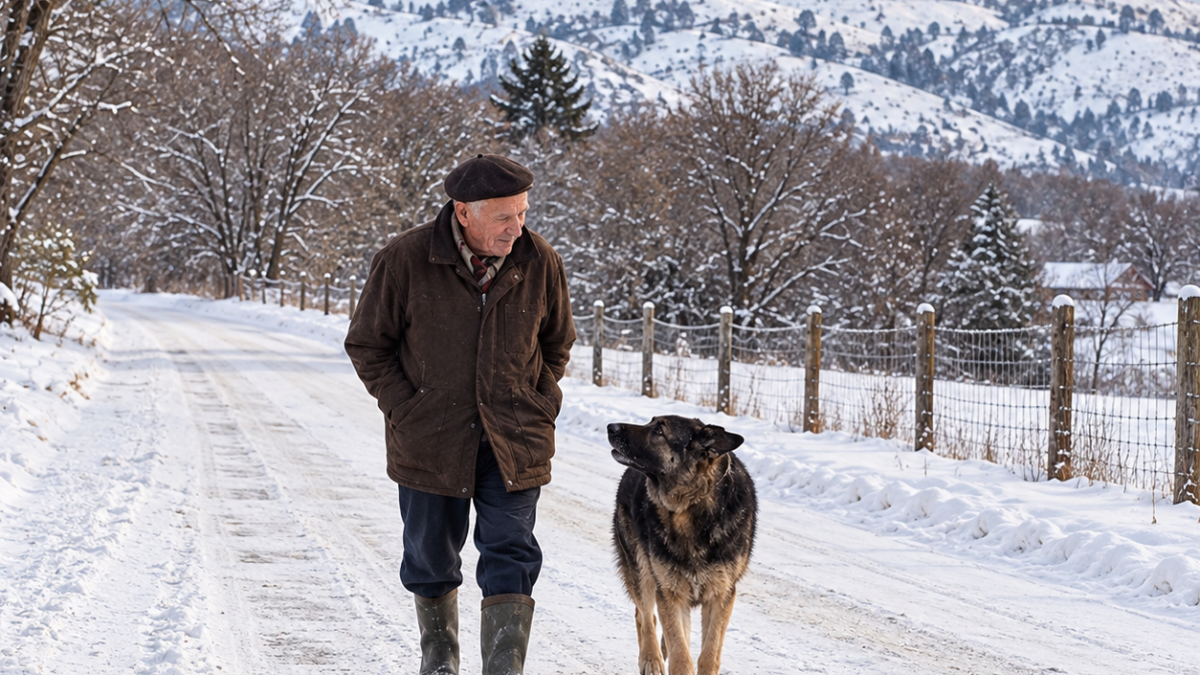
Somebody was thinking about you when they weren’t in the room.
Henry looked at Jack.
Jack looked away.
“Everybody cries too much,” Henry muttered.
Emma laughed.
“So what are you going to do now?” he asked.
“College.”
“Useful subject?”
“Veterinary medicine.”
Henry stared at her.
“Expensive.”
“Yes.”
“Long.”
“Yes.”
“Dogs bite.”
“Yes.”
He considered this.
“Good.”
Emma looked surprised.
Henry tapped the bundle of letters.
“Rex would approve.”
Henry lived to ninety-six.
He remained in the little white house longer than anyone expected.
Jack and Ruth were still across the road.
Beth still delivered mail, though eventually on a reduced route.
Emma came home from veterinary school whenever she could.
The young veteran Henry had invited for coffee began helping with repairs around the house.
People appeared.
That was the great change.
Not constant company.
Henry would have hated that.
But people knew how to enter his life now.
And Henry had learned how to let them.
On his ninety-fifth birthday, Emma gave him a framed photograph.
The image showed the green mailbox after fresh snow.
Beside it, she had mounted Rex’s old collar.
At the bottom was one sentence.
HE CAME WITH NOWHERE TO GO, AND SOMEHOW HE MADE THE ROAD LEAD HOME.
Henry read it.
Then looked at Emma.
“Too sentimental.”
“You like it.”
“Never said that.”
“You’re crying.”
“Old eyes.”
“Sure.”
He hung it in the living room himself.
Crooked.
Jack offered to fix it.
Henry refused.
On Henry’s final winter, the walks stopped completely.
His heart was weaker.
His lungs tired easily.
He slept in the chair Margaret had bought forty years earlier.
Hospice nurses visited twice a week.
Henry disliked the word hospice but liked the nurses.
Especially one named Carla who did not speak to him as if he were six.
The green mailbox remained at the end of the road.
Jack collected the mail.
Every afternoon, he brought it over and placed it on Henry’s table.
There was almost always something.
A letter from Emma.
A card from Megan.
Notes from people Henry had written over the years.
One from the veteran.
One from Beth.
One from a child Emma had treated during a veterinary outreach event whose family somehow knew the story of Rex.
Henry had walked for three years to an empty box.
Now he could no longer reach it, and the mail kept coming to him.
One evening, Jack found Henry looking at Rex’s photograph.
“Thinking about him?”
Henry nodded.
“Think he knew what he did?”
Jack sat beside him.
“Which part?”
“Dog.”
Henry’s voice had weakened with age, but not his impatience.
“All of it.”
Jack looked at the photograph.
“No.”
Henry raised an eyebrow.
“I think Rex knew you were his person.”
“That probably covered most of what mattered.”
Henry considered that.
“Yeah.”
Then he said:
“I thought I saved him.”
Jack smiled.
“You fed him.”
“Vet.”
“True.”
“House.”
“True.”
Henry pointed weakly toward the photograph.
“He did more.”
Jack did not argue.
Henry died on a quiet February morning.
No emergency.
No fall.
No desperate barking.
No sirens.
Jack was there.
Ruth too.
Emma had arrived the night before.
Henry’s bed had been moved near the living-room window so he could see the road.
Rex’s ashes sat on the shelf.
Margaret’s photograph stood beside them.
Thomas’s beside hers.
Emma held Henry’s left hand.
Jack sat on the other side.
Shortly before sunrise, Henry opened his eyes.
“Mail?”
Jack laughed softly.
“Not yet.”
Henry frowned.
“Lazy government.”
Emma laughed through tears.
Henry looked toward Rex’s photograph.
Then at Emma.
“Keep writing.”
“I will.”
“To people.”
“I will.”
“Real letters.”
“Yes.”
“No electronic garbage.”
“I promise.”
Henry relaxed.
After a while, his breathing slowed.
Then became quieter.
Emma leaned close.
“Henry?”
His eyes opened once more.
She whispered:
“You can stop walking now.”
Henry’s mouth moved.
A faint smile.
Then he was gone.
The funeral was small.
Exactly as Henry would have demanded.
No speeches longer than necessary.
No music he would have called dramatic.
Jack spoke.
Emma did too.
She did not talk about Henry’s stroke.
Or age.
Or grief.
She told the story of the mailbox.
An old man walking two miles for an empty box because the walk was the last structure remaining in his life.
A starving German shepherd appearing at the door.
A dog following without invitation.
A man denying he had adopted him.
A bark on a May morning.
Letters.
Recovery.
Loss.
More letters.
Then Emma read one sentence from Henry’s first reply to her:
I did not save him.
He appeared on my porch and refused to leave.
People laughed softly.
Emma folded the paper.
“He was wrong.”
She looked toward Henry’s casket.
“They saved each other.”
Henry had left instructions.
His ashes were to be placed beside Margaret and Thomas.
But a small amount went somewhere else.
Jack, Ruth, and Emma walked to the green mailbox one spring morning.
The snow had melted.
Grass was beginning to return.
They carried two small containers.
Rex.
Henry.
At the base of the mailbox stood a flat stone.
Jack had arranged permission because the post sat on Henry’s private property.
Emma placed both sets of ashes beneath a young pine they planted several feet away.
Not at the road itself.
Close enough.
Then she attached a small brass plate to the back of the mailbox where passing cars would not notice.
No grand memorial.
Henry would have hated one.
The plate read:
HENRY & REX
NEITHER WAS LOOKING FOR RESCUE.
BOTH KEPT WALKING.
Jack stared at it.
“Too sentimental.”
Emma smiled.
“Exactly.”
The house eventually sold.
A young couple bought it.
They had two children and a Labrador who barked at deer.
The porch was repainted.
The kitchen changed.
Margaret’s old wallpaper disappeared.
But the family kept the mailbox.
Emma asked only one thing before the sale.
Do not remove the little pine.
They did not.
Years later, when she became a veterinarian, Emma sometimes drove through Pine Hollow.
She would stop beside the old road.
Not every time.
Enough.
The pine grew taller.
The mailbox aged.
Different names eventually appeared on envelopes inside it.
That was right.
Mailboxes are supposed to belong to the living.
Once, Emma brought a frightened rescue shepherd she was fostering.
He had been abandoned after his owner entered long-term care.
Large dog.
Thin.
Nervous.
He did not trust doors.
Emma parked near the old mailbox and took him for a quiet walk.
The shepherd stopped beneath the pine.
Sniffed.
Then sat.
Emma looked toward the little white house in the distance.
She could almost see them.
Henry.
Brown wool jacket.
Cane tapping gravel.
Rex beside him.
One old man who had convinced himself nothing waited for him.
One homeless dog who had no idea where he was going.
Walking the same road.
Neither realizing yet that the road had already changed.
Emma rested her hand on the foster dog’s back.
“My friend Henry would have pretended not to like you.”
The dog looked up.
“He would’ve fed you eggs.”
The shepherd’s tail moved.
Emma smiled.
“And then he would’ve spent six months explaining that you weren’t his dog.”
She continued down the road.
The shepherd followed.
That evening, back at her clinic, Emma wrote a letter.
Not an email.
A real letter.
She addressed it to an elderly client whose husband had recently died and whose old terrier was undergoing treatment.
She did not write anything profound.
Only:
Mrs. Lawson,
I was thinking about you and Charlie today.
You do not need to answer.
I just wanted you to have proof that someone was thinking about you while they were not in the room.
Take care,
Dr. Emma Anderson
She mailed it on the way home.
Because that was what Henry had eventually understood.
A mailbox is never really about paper.
A walk is never only about distance.
A dog is never merely something you feed because it showed up at your door.
Sometimes the smallest rituals are the ropes that keep us attached to the world.
Sometimes they hold until something stronger arrives.
For Henry, it arrived thin and shivering on an October doorstep.
It followed him without being invited.
It walked beside him to a box that contained nothing.
It slept beside him through winter.
It barked when Henry could not call for help.
It waited while he learned to walk again.
And when Rex finally left, Henry discovered the dog had done something far greater than give him companionship.
Rex had reopened the road.
There were people at the other end of it now.
Letters.
Friendship.
Obligations.
Reasons to answer.
Reasons to leave the door unlocked a little wider.
For three years, Henry Miller had walked toward an empty mailbox because he needed one reason to keep moving.
Then a German shepherd with nowhere to go followed him.
And after that, neither of them ever had to walk alone again.








