Flight Attendant Tells Black Teen to Move for White Lady — Not Knowing She Owns the Airline
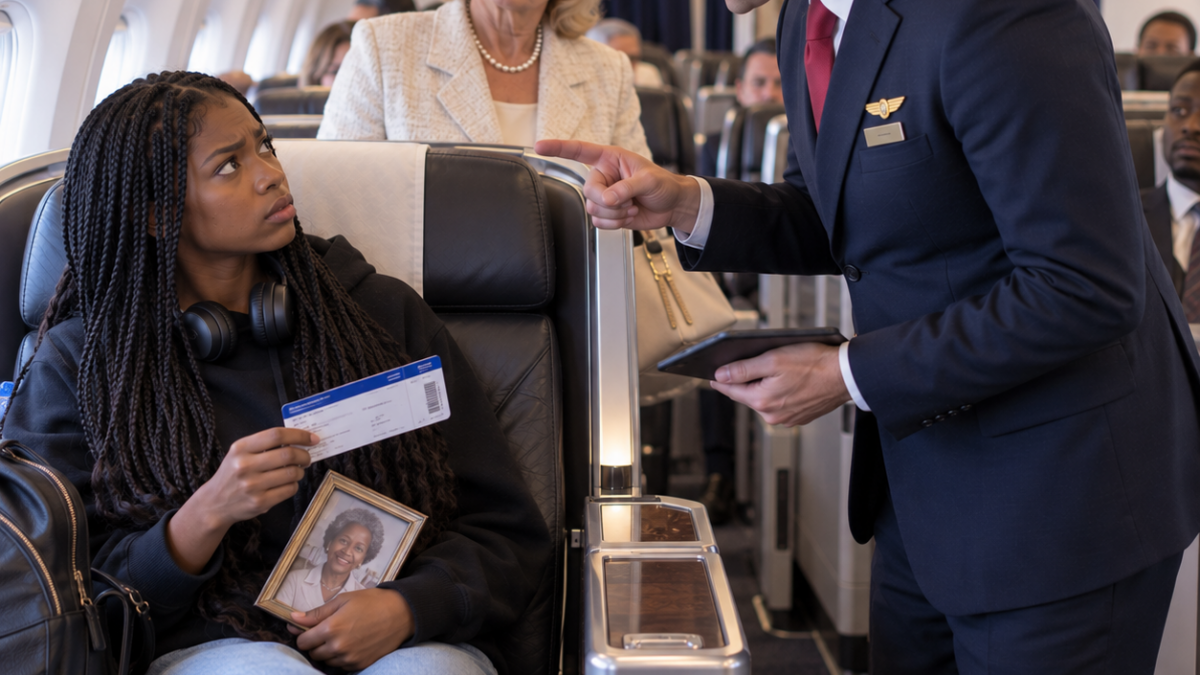
Seat 34C was a middle seat.
I sat between a college student wearing headphones and a construction supervisor who apologized every time his shoulder crossed the invisible boundary between us.
Neither knew that the woman squeezing into the center seat beside them owned fifty-eight percent of Horizon Airways.
That anonymity had always been useful.
That afternoon, it felt almost surreal.
I held Grandma Gloria’s broken photograph on my lap.
The frame had split at one corner.
A thin crack crossed the glass directly over her smile.
The picture had been taken outside the public library in Baltimore where I used to study after school because our apartment became unbearable during summer heat.
I was seventeen in the photo.
Gloria was seventy-two.
She had one arm around me.
On the back, in her handwriting, were eight words.
Fly higher than they say you can.
I traced the crack with my thumb.
“Are you okay?”
The college student beside me had removed one headphone.
“I’m fine.”
He looked toward first class.
“That guy was a jerk.”
I almost smiled.
“Which guy?”
“The flight attendant.”
“He’s doing his job.”
“No.”
The student shook his head.
“He was doing something.”
That distinction stayed with me.
A different attendant approached with the beverage cart.
“Drinks?”
“Water, please.”
She handed me one without eye contact.
The man beside me ordered coffee.
She smiled at him.
“Cream?”
“Yes, please.”
“Sugar?”
“Two.”
When she returned her attention to me, the smile vanished again.
Small.
Almost nothing.
But after what happened up front, I noticed everything.
That was the dangerous thing about discrimination.
Once you see one thread, your eyes start noticing how much fabric it holds together.
I opened my tablet.
Time of boarding.
Gate.
Aircraft number.
Crew names.
Exact words.
I wrote:
Bradley Wilson told me 2A was reserved for “preferred passengers.”
Told me “these seats are for passengers who belong here.”
Removed my carry-on without permission.
Damaged personal property.
Threatened removal when I challenged reassignment.
I stopped.
Then added:
Mrs. Elaine Whitfield reassigned into 2A despite my valid boarding pass.
I knew Elaine Whitfield’s name.
Not personally.
Her husband had once served on Horizon’s advisory council.
Her family controlled a regional real-estate group and purchased enough premium travel to qualify her for our highest loyalty tier.
But a loyalty tier was not ownership.
And it was definitely not a license to take someone else’s seat.
The aircraft hit light turbulence.
I closed my eyes.
The irony was almost ridiculous.
Seven years earlier, Horizon had consisted of one leased regional jet, forty-two employees, a rented office above an aircraft-parts distributor, and exactly four months of cash.
Now we operated sixty-three aircraft.
We flew to nineteen countries.
We employed nearly twelve thousand people.
Financial reporters called me a prodigy.
They liked the story because it sounded impossible.
Young Black aerospace engineering student.
Working-class family.
Scholarships.
Ten-thousand-dollar inheritance.
Aviation startup.
Billion-dollar valuation before thirty.
The articles usually skipped the ugly parts.
Banks that refused to meet with me until Marcus Chen, my first operations director, joined the room.
Investors who asked whether there was a “more experienced gentleman” behind the company.
One venture capitalist who told me airlines were “a brutal business for someone like you” and suggested I might have more success with beauty products.
I remembered walking out of that meeting shaking.
Grandma Gloria was still alive then.
I called her.
“You crying?” she asked.
“No.”
“Liar.”
“They said no.”
“So?”
“So they all say no.”
“Then ask somebody else.”
“What if everybody says no?”
She laughed.
“Then build something so good they have to ask you.”
That was Gloria.
No speeches about destiny.
Just stubbornness sharpened into love.
When she died, Horizon had five aircraft.
She never saw what it became.
That photograph was the last picture of us together.
And Bradley Wilson had broken it while trying to show me where I belonged.
I looked toward first class.
He was pouring champagne for Elaine.
“Our most valued passengers deserve the very best.”
His voice carried farther than he probably realized.
I typed another note.
Then a name appeared in the aisle.
Thomas Reynolds.
Chief of corporate security.
I recognized him immediately.
Thomas had joined Horizon eighteen months earlier.
Former airport police.
Military background.
Quiet.
Professional.
He was not supposed to be on that flight as crew.
He was deadheading home after a security review.
He saw me.
His eyes widened.
For half a second, recognition flashed.
I shook my head once.
Don’t.
He understood.
Thomas walked past.
Ten minutes later, he returned.
He paused near my seat.
“Everything okay, ma’am?”
Bradley was several rows away.
“Yes.”
His eyes moved to the photograph.
Then to my bag.
“Are you sure?”
“Yes.”
I held his gaze.
“Observe.”
One word.
His expression changed.
“Yes, ma’am.”
He continued walking.
The construction supervisor glanced at me.
“You know him?”
“Not really.”
That was technically false.
But I needed normal behavior.
If Thomas confronted Bradley, everyone would suddenly perform.
I wanted the truth unedited.
By the time we began descending, I had twenty-seven notes.
Three separate passengers of color had been spoken to more sharply than white passengers making similar requests.
One Black family had been told overhead-bin space was unavailable even though Bradley later rearranged luggage to fit Elaine’s shopping bag.
A Latino man requesting assistance with a tight connection was told to “check the app,” while Bradley personally called ahead for a white premium-status traveler.
Could each incident have an innocent explanation?
Absolutely.
That was why patterns mattered.
One decision is interpretation.
Twenty decisions become data.
We landed at JFK.
Passengers stood immediately.
I stayed seated.
From row 34, I watched Bradley walk Elaine off the plane carrying both her bags.
“Mrs. Whitfield, your car should be waiting.”
“Thank you, Bradley.”
“Always a pleasure.”
She laughed.
Then disappeared.
I waited until most passengers were gone.
Thomas returned.
He stood beside my row.
“Ms. Johnson.”
“Not here.”
He lowered his voice.
“I’m deeply sorry.”
“Did you see the beginning?”
“Most of it.”
“Did anyone contact you before boarding?”
His eyes shifted.
Interesting.
“Thomas.”
“Not directly.”
“What does that mean?”
“Security received a service note regarding a possible disruptive passenger in first class.”
My stomach tightened.
“Before the confrontation?”
“Timestamp says six minutes after boarding started.”
I had boarded early.
Bradley challenged me roughly fourteen minutes later.
“So someone flagged me before Bradley moved me.”
“Yes.”
“Who created it?”
“I don’t know yet.”
“Find out.”
“I will.”
“And Thomas?”
“Yes?”
“Preserve everything.”
He understood.
“Everything?”
“Passenger-service records.”
“Cabin reports.”
“Security alerts.”
“Crew communications.”
“Seat changes.”
“Boarding records.”
I paused.
“And don’t tell anyone why.”
He nodded.
“My phone?”
“Still secure.”
“Good.”
I walked through the terminal alone.
My phone had dozens of messages.
Marcus Chen.
Our COO.
My first employee.
The man who had believed in Horizon when believing in it required imagination bordering on irresponsibility.
His latest message read:
BOARD MEMBERS ASKING ABOUT JAPAN DEAL.
RICHARD MAKING MOVES.
CALL ASAP.
I called.
He answered before the first ring completed.
“Where are you?”
“Terminal Four.”
“Thank God.”
“You sound terrible.”
“I’ve had better mornings.”
“So have I.”
“What happened?”
“Later.”
“Zara.”
“What is Richard doing?”
Silence.
That told me enough.
“Marcus.”
“He scheduled an emergency board session.”
“For what?”
“Operational stability.”
I stopped walking.
“While I’m returning with three expansion agreements?”
“I know.”
“What else?”
“He’s made changes while you were away.”
“What changes?”
“Complaint handling.”
“Crew guidance.”
“Customer prioritization.”
That phrase.
Customer prioritization.
I thought of Bradley.
“These seats are for passengers who belong here.”
“Send me the documents.”
“Company network?”
“No.”
He paused.
“You think it’s compromised?”
“I think we should assume nothing.”
“Where do you want to meet?”
“Headquarters first.”
“You sure?”
“I own the building.”
“That has recently become a surprisingly complicated statement.”
I stopped.
“What did you just say?”
“Come here.”
Horizon headquarters occupied thirty-four floors of a glass tower near the river.
I entered through the executive garage.
No cameras.
No lobby.
Marcus waited in my office.
He took one look at my bag.
“What happened?”
“Sit.”
“You’re bleeding.”
I looked down.
A small cut on my hand from the broken glass.
“I’ll survive.”
“Zara.”
“Marcus.”
He recognized the tone.
“Fine.”
He handed me a tablet.
Customer complaints.
I scrolled.
Numbers.
Categories.
Station codes.
Demographics where voluntarily supplied.
The pattern appeared immediately.
Complaints involving discriminatory treatment had risen sharply over the previous five weeks.
Resolution rates had fallen.
“Who changed disposition codes?”
“Richard’s operations group.”
“Legal approved?”
“No.”
“Compliance?”
“No.”
“Board?”
“Richard says temporary operational authority gave him discretion.”
“My delegation while overseas covered schedule disruptions and vendor approvals.”
“Not policy.”
“Exactly.”
I opened a complaint.
Black passenger moved from premium cabin after another traveler claimed she felt “uncomfortable.”
Disposition:
PASSENGER COMPATIBILITY RESOLUTION.
Another.
Muslim couple separated after premium-status passenger complained about “cultural tension.”
Another.
Latino family moved farther back to “reduce boarding conflict.”
Same phrase.
Compatibility.
I looked at Marcus.
“What the hell is passenger compatibility?”
He handed me another file.
Richard Harrington.
Vice President of Operations.
Fifty-eight.
Thirty-one years in aviation.
He had joined Horizon through an acquisition four years earlier.
He knew regulators.
Airport authorities.
Legacy carriers.
Board members.
I had kept him because he understood systems I was still learning.
He had never hidden his opinion that I was too young.
He was careful about everything else.
“This policy came from him?”
“Officially, pilot program.”
“Who approved it?”
He hesitated.
“What?”
“The electronic approval chain shows your office.”
I stared.
“I never saw it.”
“I know.”
“How?”
“Delegated credentials.”
My stomach tightened.
“Who has them?”
“Your executive administration team.”
“One of whom reports operationally to Richard while I’m abroad.”
“Yes.”
I sat back.
“What else?”
Marcus opened another file.
Global Air.
The competitor.
Walter Sterling, CEO.
Messages.
Meeting summaries.
Draft term sheets.
I read slowly.
“Is Richard trying to sell Horizon?”
“I think so.”
“He doesn’t own enough shares.”
“Not yet.”
“Not ever.”
Marcus placed another document in front of me.
Temporary competency review.
Petition challenging my exercise of voting control due to “potential executive impairment following prolonged international travel and irregular financial conduct.”
I almost laughed.
“They’re calling me crazy now?”
“Not exactly.”
“That’s exactly.”
“Zara—”
“Who filed it?”
“A board committee.”
“Which board members?”
“Three.”
I knew all three.
Older.
White.
Legacy aviation.
Men who had tolerated me because the stock kept rising.
“They froze my shares?”
“Temporarily.”
“On what authority?”
“Emergency order signed this morning.”
I looked up.
“You have to be kidding.”
“Legal is challenging it.”
“Who assigned outside counsel?”
“Richard.”
Of course.
I stood.
My office window overlooked the skyline.
Horizon aircraft crossed in the distance.
Planes I had financed.
Routes I had fought regulators to approve.
Employees whose salaries I had once guaranteed personally when our cash account dropped below payroll.
“This isn’t about the flight.”
Marcus frowned.
“What flight?”
I told him.
Everything.
Bradley.
Elaine.
My seat.
The photograph.
Thomas.
The early security flag.
Marcus went completely still.
“Bradley Wilson?”
“Yes.”
“I’ve seen that name.”
“Where?”
“Richard’s personnel requests.”
My anger sharpened.
“How many?”
“Several hires.”
“Promotions?”
“Yes.”
“Outside process?”
“Some.”
I turned.
“Get Darius.”
“IT?”
“Now.”
“Carmen too.”
“Maintenance?”
“And Aisha.”
“Our deputy general counsel?”
“Yes.”
“Anyone else?”
“No.”
He stared at me.
“Why them?”
“Because I trust them.”
“Do you trust me?”
“If I didn’t, you wouldn’t be standing here.”
“Comforting.”
“Off-site meeting.”
“When?”
“Two hours.”
“Where?”
“Not somewhere Horizon owns.”
Marcus nodded.
As he reached the door, I looked at Gloria’s broken photograph.
“Marcus.”
He stopped.
“They’re not taking my company.”
He looked back.
“I know.”
“No.”
I held his gaze.
“They’re not turning it into something she would have hated either.”
That evening, five of us sat around a corner table in a coffee shop three blocks from headquarters.
Carmen Rodriguez.
Head of maintenance operations.
Fifty-three.
Blunt enough to make vice presidents nervous.
Darius Washington.
Cybersecurity architect.
Thirty-one.
Brilliant.
Sleep-deprived.
Suspicious by profession.
Aisha Okafor.
Deputy general counsel.
Thirty-eight.
The person most likely to correct my interpretation of a contract before I finished the sentence.
Marcus.
And me.
I told them what happened on Flight 816.
Nobody interrupted.
When I finished, Carmen said:
“That’s not isolated.”
I looked at her.
“What do you know?”
She opened her bag.
Pulled out a printed manual.
Horizon Passenger Comfort Initiative.
The words were harmless.
The examples were not.
Scenario:
Premium guest expresses concern regarding adjacent passenger behavior, appearance, or cultural mismatch.
Resolution options included “voluntary reseating of lower-status traveler.”
Another:
Preserve premium environment through proactive compatibility management.
Aisha read it twice.
“This is a discrimination lawsuit wearing a blazer.”
“Who wrote it?” I asked.
“No author.”
“Distribution?”
“Selected senior cabin crew.”
“Bradley?”
“Yes.”
Darius turned his laptop.
“I found the matching software logic.”
“What software logic?”
“Compatibility flags.”
I stared.
He pulled up anonymous test profiles.
White-sounding name.
Premium traveler complaint.
No flag.
Black-sounding name.
Same behavior.
Additional review score.
Latino surname.
Seat-relocation probability increased.
Muslim-associated name.
Compatibility event triggered more often.
“Tell me this isn’t deployed.”
Darius looked sick.
“Limited deployment.”
“How many flights?”
“Four hundred twelve in five weeks.”
Nobody spoke.
I thought about row 34C.
About how easily Bradley had reassigned me.
Not improvisation.
System.
Carmen slid her phone onto the table.
“I recorded something.”
Richard’s voice.
Recognizable immediately.
“Once Global Air comes in, we can stop pretending every cabin has to be a social experiment.”
Another man laughed.
Richard continued.
“Premium customers pay for atmosphere.”
“Sterling understands that.”
“Traditional aviation understood that.”
“Not everybody creates the right environment.”
The recording ended.
“Where?”
“Executive lounge.”
“When?”
“Three days ago.”
“Who was he talking to?”
“Couldn’t see.”
“Could be Walter Sterling?”
“Possibly.”
Aisha exhaled.
“Do not publish that.”
“Why?”
“Because we need authentication.”
“Chain of custody.”
“Context.”
“Consent law depending on location.”
I nodded.
“Good.”
She looked at me.
“You wanted me here to stop you from doing something emotional?”
“No.”
“Yes.”
“Maybe.”
Marcus almost smiled.
Then Carmen added:
“There’s more.”
We looked at her.
“Maintenance records.”
My body went cold.
“What about them?”
“Several managers are pressuring teams to defer inspections.”
“Why?”
“Cost.”
“That happens everywhere.”
“Not like this.”
She pulled out data.
“Routes serving our highest-revenue business corridors are getting full maintenance windows.”
“Lower-yield routes are being compressed.”
“Which routes?”
She slid the list.
Baltimore.
Memphis.
Detroit.
San Juan.
Several Caribbean services.
Cities with large Black and Latino passenger bases.
I stared.
“Aircraft type?”
“Mixed.”
“So not fleet-driven.”
“No.”
“Utilization?”
“I controlled for it.”
Darius whistled softly.
Aisha looked at me.
“That becomes a safety issue.”
“It already is.”
Carmen’s jaw tightened.
“My supervisors are being asked to sign work they didn’t perform.”
That changed everything.
Discrimination was unacceptable.
Safety manipulation could kill people.
“We need originals,” I said.
“I have copies.”
“Outside company servers?”
“Yes.”
“Good.”
Darius’s laptop chimed.
His expression changed.
“What?”
“Someone is querying my secured archive.”
“Inside?”
“Yes.”
“Can they see what you opened?”
“Not unless they’ve compromised admin credentials.”
His fingers moved quickly.
Then stopped.
“They have.”
Marcus leaned forward.
“Who?”
“Still tracing.”
My phone buzzed.
Unknown number.
SECURITY TEAM ASKING WHERE YOU ARE.
BE CAREFUL.
No signature.
I looked toward the coffee-shop entrance.
A man in a dark suit had just entered.
Scanning.
Not ordering.
“Everyone leave separately.”
Aisha did not argue.
“Evidence?”
“Copies.”
“Different destinations.”
“Darius.”
“Yes?”
“Nothing important on one device.”
“Already done.”
“Carmen.”
“Cloud and physical.”
“Marcus.”
“I’ll stay visible at headquarters.”
“Good.”
Aisha stared at me.
“And you?”
“I’ll disappear.”
“You’re CEO of a public company.”
“Temporarily inconvenient.”
We left through separate exits.
That night, I slept in an apartment I kept under a holding company’s name.
Almost nobody knew it existed.
By dawn, Darius had restored a portion of my system access through an old administrative recovery path.
I did not ask for details.
I asked one question.
“Legal?”
“Your account.”
“Authorized?”
“You created the recovery protocol.”
“Good.”
Aisha arrived at six.
She had filed emergency motions challenging the share freeze.
Marcus brought copied board materials.
Carmen brought maintenance records.
At seven-thirty, we made our first mistake.
We believed evidence would make Richard cautious.
I asked Bradley Wilson to meet me in a conference room.
He arrived looking pale.
“Ms. Johnson.”
Interesting.
Not “miss.”
Not “you need to move.”
“Sit.”
He sat.
I played aircraft footage.
Not the cabin interaction itself—our cameras were limited—but boarding records, my seat assignment, his override, the transfer of Elaine Whitfield into 2A, my removal to 34C.
Bradley watched.
“A misunderstanding.”
“Of course.”
“I was following policy.”
“Which policy?”
“Passenger compatibility.”
“Authorized by whom?”
“Operations.”
“Who?”
“Vice President Harrington.”
“My approval?”
“He said executive authorization existed.”
“Did you verify?”
“No.”
“Why not?”
“He is Vice President of Operations.”
“And if he told you to throw a passenger out because he disliked her shoes?”
Bradley’s jaw tightened.
“This isn’t fair.”
“No.”
I leaned closer.
“What happened on Flight 816 wasn’t fair.”
His eyes dropped.
“If you had known who I was, would you have moved me?”
“No.”
“Why?”
He hesitated.
“Because you’re CEO.”
“Then you understand the problem.”
“I apologized.”
“No.”
“You apologized after discovering I had power.”
I pointed toward the screen.
“The woman in this video deserved respect before you knew her title.”
Silence.
“The next Black girl you decide doesn’t look like first class may not own the airline.”
His face reddened.
“I am not R@c!st.”
“I didn’t ask for your identity.”
“I asked for your decision.”
He looked angry now.
“Mrs. Whitfield is a fifteen-year premium client.”
“So?”
“She complained.”
“So?”
“She said she felt uncomfortable.”
“Because?”
Bradley said nothing.
“Because I was sitting there.”
He looked away.
“That is what your policy encourages.”
“I didn’t write it.”
“But you used it.”
Silence.
“Who is Richard planning to replace after the Global Air acquisition?”
Bradley’s head snapped toward me.
I smiled without warmth.
“I didn’t mention Global Air.”
He realized the mistake.
“I don’t know anything.”
“Then we’re done.”
As he stood, he paused.
“Ms. Johnson.”
“Yes?”
“Richard has people on the board.”
“I know.”
“More than you think.”
Then he left.
For several hours, we seemed to regain control.
I suspended the compatibility policy.
Restored ordinary complaint review.
Locked seat-reassignment logs.
Ordered independent maintenance verification.
Richard requested a meeting.
He smiled when I entered his office.
His office was larger than mine.
I had never noticed.
“Zara.”
“Richard.”
“Welcome home.”
“Thank you.”
“How was Asia?”
“Profitable.”
“Wonderful.”
“I heard you’ve been undoing operational work.”
“I’ve been undoing discrimination.”
His smile tightened.
“Strong word.”
“Accurate word.”
“The compatibility initiative was designed to improve premium satisfaction.”
“By moving minorities.”
“That is your interpretation.”
“It’s what the data shows.”
“Data can be framed.”
“Not this easily.”
He leaned back.
“You’re tired.”
There it was.
First step toward competency narrative.
“Am I?”
“Three weeks overseas.”
“Long hours.”
“Emotional incident on the flight.”
“How do you know about the flight?”
Tiny pause.
Then:
“Bradley reported it.”
“Before or after landing?”
Richard smiled.
“You’re becoming paranoid.”
“Answer.”
“After.”
Lie.
Thomas’s timestamp contradicted him.
I filed that away.
“What are you doing with Global Air?”
“Exploratory conversations.”
“Without me?”
“You were unavailable.”
“I was negotiating expansion.”
“Exactly.”
“Meaning?”
“Meaning growth has risks.”
“Our revenues increased eighteen percent.”
“Your expansion pace concerns the board.”
“Which members?”
“Several.”
“And your answer is a sale?”
“Partnership.”
“Thirty percent below our last valuation?”
That got him.
Barely.
But enough.
“I don’t know where you’re getting your information.”
“From people who remember whom they work for.”
His face cooled.
“You built an impressive company.”
“Still building.”
“You’re twenty-seven.”
“Correct.”
“Maybe consider whether experienced people are trying to protect what you’ve created.”
I smiled.
“Experienced people protected aviation for decades.”
“And?”
“That’s why I had to build something different.”
His eyes hardened.
“There it is.”
“What?”
“Your arrogance.”
I stood.
“I learned it from people who kept telling me I didn’t belong.”
He stood too.
“You think this is about race?”
“I think your policies are.”
“I think you use race whenever somebody disagrees with you.”
“Then an independent audit will prove you right.”
He did not answer.
That told me more than anything else.
By evening, I thought we had time.
Three hours later, Darius was attacked in a parking garage.
Not shot.
Not chased through the city.
Reality did not need that much theater.
Two men shoved him against his car, took his laptop bag, and left.
He suffered a fractured wrist and concussion.
Security cameras in the garage had been disabled for twelve minutes.
Exactly twelve.
At the hospital, he looked at me through swollen eyes.
“They knew what bag.”
“Could be robbery.”
“No.”
“How do you know?”
“They left my watch.”
His Rolex sat on the bedside table.
Carmen called while I was there.
“Someone altered maintenance records.”
“From where?”
“Executive credential.”
“Whose?”
“Masked.”
Then Janet from HR called.
Her office had been entered.
Files missing.
When I returned to my apartment, the door was unlocked.
Nothing stolen.
One drawer open.
Grandma Gloria’s photograph moved from the table to the floor.
No message.
No graffiti.
No dramatic threat.
Just the frame lying face down.
That was worse.
Someone wanted me to know they had been inside.
I called the police.
Then Aisha.
Then Thomas Reynolds.
Thomas arrived last.
His face was pale.
“We need to talk.”
“Now?”
“Privately.”
I sent the officers to finish their report with Aisha.
Thomas lowered his voice.
“Richard is using a parallel security group.”
“What?”
“Contractors.”
“Authorized?”
“Under business-continuity budget.”
“By whom?”
“Board risk committee.”
“Who controls assignments?”
“Richard.”
“Did they attack Darius?”
“I don’t know.”
“That’s not good enough.”
“I said I don’t know.”
His voice cracked.
I stopped.
Fear.
Thomas Reynolds was afraid.
“Thomas.”
He looked away.
“What do they have on you?”
His eyes snapped back.
I had guessed correctly.
“My brother.”
“What about him?”
“Parole.”
He swallowed.
“Richard suggested certain violations could become visible.”
I stared.
“How long?”
“Months.”
“Why didn’t you tell me?”
“Because I thought I could manage it.”
“Can you?”
“No.”
I took a breath.
“What do you know?”
“Enough to ruin him.”
“Proof?”
“Some.”
“Where?”
“Not here.”
“Bring it to Aisha.”
He shook his head.
“Not yet.”
“Why?”
“They’re watching everyone.”
“Thomas.”
“I need time.”
We did not have time.
At five-thirty the next morning, Marcus called.
“Turn on the news.”
I did.
There was Richard.
Horizon CEO Zara Johnson Under Internal Review.
Financial irregularities.
Executive instability.
Mismanagement.
Anonymous employees concerned.
The accusations were nonsense.
That did not matter.
They were first.
Media loves first.
Truth arrives carrying documents.
Lies arrive carrying headlines.
Then Elaine Whitfield appeared.
The woman from 2A.
She looked tearful.
“I was simply sitting in the seat the airline assigned me.”
Lie.
“Ms. Johnson became aggressive.”
Lie.
“She used her position to intimidate crew.”
Lie.
“She frightened me.”
I turned off the television.
Marcus arrived thirty minutes later.
“They’re flooding social media.”
Fake accounts.
Edited images.
Old interviews cut together.
Claims I screamed at employees.
Claims I diverted company money.
Claims I was mentally unstable.
Then Bradley appeared on television.
“I was following policies approved above my level.”
He swallowed dramatically.
“Now Ms. Johnson is trying to destroy frontline workers to avoid responsibility.”
Marcus threw a pillow at the television.
“Expensive television,” I said.
“Sorry.”
“Hit Richard next time.”
By noon, Horizon stock was down fifteen percent.
Three board members demanded I step aside temporarily.
My corporate access disappeared again.
Personal accounts connected to the pending financial review were restricted.
Marcus’s wife received an anonymous call mentioning their children’s school.
He told me quietly.
“They know where my kids go.”
“Distance yourself.”
“No.”
“Yes.”
“Zara.”
“Make the statement.”
“I am not abandoning you.”
“Publicly, you are.”
He stared.
“We need someone inside.”
His expression changed.
“You want me to spy?”
“I want you to continue doing your job.”
“With espionage.”
“With selective memory.”
He smiled despite everything.
“That sounds illegal.”
“Ask Aisha.”
“She’ll ruin the fun.”
“Exactly.”
Marcus issued a statement that afternoon.
I respect the board’s process and will cooperate fully with independent review.
News channels interpreted it as abandonment.
Richard praised him privately.
Marcus became our eyes inside Horizon.
We moved operations to a community center in West Baltimore where I had studied as a child.
Mrs. Coleman still ran it.
Older.
Slower.
Same eyes.
She saw me walk in.
“What did you break?”
“I may have misplaced an airline.”
She nodded.
“Back room’s empty.”
No questions.
That was home.
Carmen arrived.
Darius joined by video from the hospital.
Aisha brought legal files.
Maya Stevens, a civil-rights attorney who had been on Flight 816, contacted us.
“I saw what they did.”
She had recorded part of the seat confrontation.
Not the beginning.
Enough to show my boarding pass.
Enough to show Bradley refusing it.
Enough to capture:
“These cabins have expectations.”
Maya joined the team.
Then others came.
Jackson Williams.
Former Horizon pilot.
Black.
Fired six months earlier after complaining about promotion patterns.
Sophia Martinez.
Current flight attendant.
Internal emails.
Bradley’s instructions.
“Identify compatibility-sensitive travelers.”
“Use discretion to preserve premium environment.”
Translation did not require a law degree.
Then Darius recovered deleted correspondence.
Richard to Bradley.
Implement through service discretion.
Avoid compliance review until transition.
Transition.
Global Air.
Walter Sterling.
The takeover became clear.
Richard needed Horizon weakened.
Stock down.
Leadership discredited.
Board frightened.
Then Global Air could buy cheaply.
Afterward, senior management contracts promised Richard and allies lucrative roles.
Discrimination was not merely tolerated.
It was part ideology, part customer strategy, part power consolidation.
But the worst discovery came from Carmen.
Maintenance deferments.
Selective.
Not enough to create imminent disaster.
Enough to erode safety margins.
Cost savings concentrated on routes Richard considered low-value.
I stared at the spreadsheet.
“You’re certain?”
“Yes.”
“If we publish this wrong, we panic passengers.”
“I know.”
“Regulator?”
“Already sent.”
“Good.”
Aisha nodded.
“That is the right move.”
Evidence went to the FAA.
Securities regulators received the acquisition materials.
Civil-rights counsel received compatibility data.
We stopped trying to win the news cycle.
We started building cases.
That was when Thomas contacted me.
Central Park.
Public.
Daylight.
No drama.
He sat beside me on a bench.
He looked ten years older.
“I’ve been copying records.”
He handed me a small encrypted drive.
“What is this?”
“Richard’s security directives.”
“Surveillance?”
“Yes.”
“Board members?”
“Yes.”
“Employees?”
“Yes.”
“My apartment?”
His silence answered.
I stood.
“You knew.”
“I found out afterward.”
“You knew they entered my home?”
“Yes.”
“And you said nothing.”
“They threatened my brother.”
“So?”
His face broke.
“So I was scared.”
I looked at him.
Anger wanted something simple.
Coward.
Traitor.
Enemy.
Life rarely cooperates.
“You recognized me on the flight.”
“Yes.”
“You could have ended it.”
“Yes.”
“Why didn’t you?”
“You told me not to.”
“That was before I knew how compromised security was.”
“I know.”
He looked down.
“I kept telling myself I was following orders.”
There it was.
The phrase that outlives every bad institution.
“I don’t need you to feel guilty.”
He looked up.
“I need you to testify.”
He swallowed.
“They’ll destroy my brother.”
“Then we protect him legally.”
“You can’t guarantee that.”
“No.”
“Then why should I?”
“Because eventually Richard will own you completely.”
He looked away.
“You know that already.”
A long silence.
Then:
“Project Phoenix.”
“What?”
“Folder on the drive.”
“What is it?”
“Takeover plan.”
“Recordings.”
“Compensation agreements.”
“Security operations.”
“Everything.”
I held the drive.
“Why now?”
His eyes filled.
“Last week they asked me to deliver a warning to Sophia’s daughter.”
I went still.
“A child.”
“Yes.”
“And?”
“I refused.”
He inhaled.
“That was my line.”
I understood.
Everyone imagines courage arrives at the first wrong thing.
Usually it arrives after the tenth.
Sometimes the hundredth.
What matters is whether it arrives before the last.
Thomas testified to federal investigators the next morning.
That changed the pace.
Regulators moved faster.
But our corporate problem remained.
Richard had scheduled the board vote.
My shares were still partially frozen.
Aisha filed for emergency relief.
The first judge denied it on narrow procedural grounds.
We appealed.
No conspiracy required.
No corrupted courtroom.
Just law moving more slowly than corporate votes.
That is often enough.
The acquisition meeting was scheduled at a Global Air conference center outside Manhattan.
Aisha obtained an emergency hearing for the morning of the signing.
We presented Thomas’s sworn declaration.
Darius’s recovered emails.
Carmen’s maintenance data.
Maya’s video.
The compatibility algorithm.
Global Air’s discounted purchase terms.
Then something unexpected happened.
The judge did not hand us victory.
He did something more useful.
He issued a temporary preservation and disclosure order.
The acquisition could not close until both sides certified that all material side agreements and board communications had been produced.
Richard’s attorneys objected.
The judge looked at them.
“If the transaction is as clean as you claim, disclosure should not concern you.”
That sentence saved Horizon.
Because the deal was not clean.
Richard had hidden compensation.
Board surveillance.
Employment guarantees.
Side letters.
One director discovered he had been personally monitored.
Another learned Richard possessed private information about his family.
The board vote began collapsing from inside.
Marcus called.
“It’s happening.”
“What?”
“Directors are freaking out.”
“How many?”
“Four want delay.”
“We need five.”
“One abstention maybe.”
“Keep working.”
“I am not supposed to be working for you.”
“You’re terrible at betrayal.”
“Thank you.”
Then Global Air’s counsel received the regulator notices.
Securities review.
Civil-rights inquiry.
FAA safety inquiry.
Suddenly Walter Sterling found caution.
Amazing what subpoenas do for ethics.
He postponed signing.
Richard called an emergency board meeting anyway.
This time at Horizon headquarters.
I walked into the building through the front entrance.
No disguise.
No back corridor.
No hiding.
Employees stopped.
Some stared.
Some applauded quietly.
Some looked afraid.
I took the elevator to the thirty-fourth floor.
The boardroom doors opened.
Richard sat at the far end.
Bradley Wilson was there too.
So was Elaine Whitfield.
That surprised me.
“What is she doing here?”
Richard smiled.
“Customer representative.”
“Convenient.”
Elaine did not meet my eyes.
Aisha sat beside me.
Marcus across the table.
Still pretending neutrality.
Eleanor Matsui, the senior independent director, called the meeting to order.
Richard spoke first.
“Ms. Johnson’s recent behavior has endangered shareholder value.”
He displayed charts.
Stock decline.
Customer cancellations.
Media volatility.
“Under stable leadership, Horizon can still complete a strategic transaction with Global Air.”
I waited.
When he finished, Eleanor looked at me.
“Zara.”
I stood.
“May I begin with the flight?”
Richard scoffed.
“This is not about a seating dispute.”
“No.”
I looked at him.
“That’s the point.”
The screen showed Flight 816.
Seat 2A.
My valid booking.
Elaine’s original reservation.
3C.
Not 2A.
Her seat had been changed after boarding.
Bradley had overridden mine.
“Mr. Wilson.”
He stiffened.
“Who instructed you?”
“I followed compatibility policy.”
“Who?”
“Operations.”
“Name.”
“Mr. Harrington’s office.”
Richard leaned forward.
“That’s misleading.”
I changed slides.
Complaint data.
Thousands of decisions.
Disparate impact.
Seat moves.
Security referrals.
Complaint dismissals.
Then algorithm results.
A board member stared.
“You were categorizing passengers by names?”
Darius answered by video.
“Not explicitly by race.”
“Proxy variables produced statistically discriminatory results.”
Richard interrupted.
“An experimental system.”
“Deployed without compliance.”
“Under emergency operational authority.”
Aisha spoke.
“Authority that did not permit discriminatory passenger classification.”
Next slide.
Maintenance.
Carmen presented.
Not dramatic claims.
Dates.
Inspection intervals.
Deferred work.
Revenue-based risk decisions.
Board members went silent.
Then Thomas entered.
No wheelchair.
No gunshot scars.
Just a tired man carrying a folder.
Richard’s face changed.
“Why is he here?”
Eleanor answered.
“Because I invited him.”
That surprised both of us.
The independent directors had begun doing their own work.
Thomas sat.
He described surveillance.
Pressure.
My apartment entry by contractors.
Threats involving his brother.
Employee intimidation.
Then Project Phoenix.
Audio played.
Richard’s voice.
“Once Sterling closes, we remove the diversity infrastructure.”
Another voice.
Walter Sterling.
“Gradually.”
“Legal will need performance files.”
Richard:
“We’re building them.”
I looked at the board.
“That is why my personnel history suddenly changed.”
Next recording.
Richard:
“Premium cabins cannot become social experiments.”
Another:
“Traditional customers are telling us they don’t recognize the airline anymore.”
Then the line that ended him.
“Zara built a diversity brand.”
“We’ll turn it back into an airline.”
Silence.
Richard stood.
“These recordings are illegal.”
Aisha responded.
“Their admissibility will be determined in the appropriate proceeding.”
“Today, the board is entitled to consider authenticated evidence of fiduciary misconduct.”
Richard pointed at me.
“This is revenge.”
“No.”
I shook my head.
“If I wanted revenge, Bradley would have been fired before Flight 816 landed.”
Bradley stared.
“I wanted to know why he thought he could do it.”
I looked around the table.
“Now I know.”
“Because policies taught him certain passengers were negotiable.”
“Because executives taught employees revenue mattered more than dignity.”
“Because complaints disappeared.”
“Because people who objected were described as difficult.”
I looked at Richard.
“And because you believed Horizon could be stolen if you first convinced enough people that the woman who built it did not belong in control.”
His face reddened.
“You did not build this alone.”
“Correct.”
That surprised him.
I looked toward Carmen.
Darius on screen.
Marcus.
Aisha.
Thomas.
Employees beyond the glass.
“I built it with thousands of people.”
I returned my gaze to Richard.
“That is why you couldn’t steal it alone either.”
Walter Sterling appeared via video.
Global Air’s counsel beside him.
“Given the regulatory issues now apparent, Global Air is withdrawing from acquisition discussions.”
Richard spun toward the screen.
“You can’t.”
Walter’s expression was cold.
“We can.”
“We have agreements.”
“Conditional agreements.”
“You promised—”
Walter interrupted.
“Richard.”
Stop.
That tone.
The boardroom shifted.
Richard realized he had lost the buyer.
Then the board.
Eleanor Matsui spoke.
“I move that Richard Harrington be removed from all executive duties pending independent investigation.”
Seconded.
Vote.
Unanimous except Richard, who had no vote on his own employment status.
He laughed.
“Cowards.”
Nobody answered.
Security approached.
Not Thomas’s compromised group.
Outside corporate officers hired through independent counsel.
Richard turned toward me.
“You think this changes what people want?”
“What?”
“Exclusivity.”
“Standards.”
He gestured toward the window.
“People pay premium prices because they don’t want every kind of person beside them.”
The room went completely still.
There it was.
No coded words.
No compatibility.
No atmosphere.
Just belief.
Elaine Whitfield covered her mouth.
Richard continued, too angry to stop.
“First class means something.”
I looked at him.
“Yes.”
“It means the passenger paid for first class.”
Silence.
“That’s all.”
His face twisted.
“You’re destroying tradition.”
“No.”
I pointed toward the door.
“I’m ending discrimination.”
Security escorted him out.
Bradley remained seated.
He looked terrified.
“Ms. Johnson.”
“Not today.”
“I want to apologize.”
“You already did.”
“No.”
He swallowed.
“I mean really.”
I looked at him.
“Why did you move me?”
He stared at the table.
“Mrs. Whitfield complained.”
“That isn’t enough.”
“The policy gave me discretion.”
“Still not enough.”
He closed his eyes.
“Because…”
We waited.
“I didn’t think you looked like first class.”
There it was.
Elaine started crying.
Bradley continued.
“And I knew nobody would question me if I said there was a service issue.”
“Had you done it before?”
His voice became almost inaudible.
“Yes.”
“How often?”
“I don’t know.”
“Guess.”
“Maybe twelve.”
My stomach turned.
“Complaints?”
“Some.”
“What happened?”
“Closed.”
“By whom?”
“Supervisors.”
“Following Richard’s policy?”
“Yes.”
I nodded slowly.
“Thank you.”
He looked up.
“Am I fired?”
“Administrative leave.”
He blinked.
“Why not fire me?”
“Because first I want every case reviewed.”
“You deserve due process.”
His face changed.
He had not expected that.
“More than you gave me.”
“Yes.”
“That’s why it matters.”
Three board members resigned that afternoon.
Two because internal emails showed they knew more than they admitted.
One because he said he no longer believed he was the right person to help rebuild trust.
I respected that one.
Federal and state investigations continued.
Some claims became criminal matters.
Others civil.
Some actions were unethical but not illegal.
That distinction mattered.
I refused to promise prosecutions from a podium.
I refused to call everyone who disagreed with me a conspirator.
Horizon needed truth, not mythology.
The hardest part began after we “won.”
Fixing the company.
Firing Richard was easy.
Deleting a discriminatory algorithm took minutes.
Changing culture took months.
We reopened five years of complaints.
Thousands.
Some were frivolous.
Some were misunderstandings.
Some showed discrimination.
Some showed patterns that made me physically sick.
Families separated unnecessarily.
Disabled passengers treated as burdens.
Black travelers questioned more aggressively over premium-cabin access.
Employees of color disciplined for behavior white colleagues were coached through informally.
Patterns.
Always patterns.
Bradley participated in the review.
Not voluntarily at first.
His employment case eventually ended in termination.
Not because he moved me.
Because investigators established repeated discriminatory treatment and falsified explanations in prior cases.
Elaine Whitfield contacted me.
I ignored the first three calls.
Accepted the fourth.
“Zara.”
“Mrs. Whitfield.”
“I owe you an apology.”
“Yes.”
She hesitated.
“I was told the seat was mine.”
“Initially?”
“No.”
“Then why did you let him remove me?”
Silence.
“Because it benefited you.”
“Yes.”
“At what point did you realize what was happening?”
“When he said you didn’t belong.”
“And?”
“I said nothing.”
“Yes.”
She cried quietly.
“I’ve thought about that every day.”
I did not rescue her from discomfort.
Some apologies need silence around them.
Finally she said:
“I liked being treated as more important.”
That honesty mattered.
“And I did not ask what that treatment cost somebody else.”
“Thank you for saying it.”
“Do you forgive me?”
I thought.
“I accept the apology.”
“That isn’t what I asked.”
“No.”
She exhaled.
“I understand.”
Months later, Elaine joined a passenger advisory panel.
Not as a diversity symbol.
As someone willing to explain how privilege can make unfairness feel normal to the person receiving the benefit.
That was more useful than punishment.
Thomas Reynolds testified fully.
His brother’s parole was not magically protected by me.
We found independent counsel.
The case was reviewed properly.
No favors.
Thomas became part of security reform, but he did not immediately return to leadership.
Trust had to be rebuilt.
Darius recovered.
Carmen became Chief Operating Officer after Marcus moved into President.
Aisha became General Counsel.
Maya joined an external civil-rights oversight board.
Jackson Williams returned as a pilot after an independent review found his termination retaliatory.
Sophia became a training captain for cabin leadership.
No one received promotions simply for loyalty to me.
Every appointment went through new independent review.
That was important.
If Horizon became a company where being close to Zara replaced being close to Richard, nothing fundamental would change.
Three months after the board meeting, I stood inside our largest hangar.
Thousands of employees gathered around our newest aircraft.
The logo had been refreshed.
Not replaced.
The horizon line remained.
Beneath it, a rising sun.
I held Grandma Gloria’s restored photograph.
The original glass was gone.
The frame had been repaired.
A faint line remained where the wood had cracked.
I liked that.
Restoration should not erase history.
I walked to the microphone.
“When I started Horizon, I believed an airline could be excellent without deciding dignity was a luxury product.”
The hangar went quiet.
“Recently, we discovered that parts of our company had forgotten that.”
I did not soften it.
“Passengers were treated differently based on race, perceived class, religion, disability, and appearance.”
“Employees who reported problems were ignored or punished.”
“Safety decisions were influenced by revenue categories in ways they never should have been.”
I looked across the crowd.
“That happened under my leadership.”
Some executives had advised me not to say that.
Legal exposure.
Brand damage.
My answer had been simple.
If I wanted the title when Horizon succeeded, I could carry it when Horizon failed.
“I did not authorize those actions.”
I continued.
“But leadership is not only responsibility for what you personally order.”
“It is responsibility for what your organization becomes while you are in charge.”
No applause.
Good.
I had not asked for applause.
Then I outlined reforms.
Independent complaint review.
Automatic analysis for demographic disparities.
Seat changes documented with objective reasons.
No premium-status customer could override another passenger’s confirmed seat absent legitimate operational need.
Cabin crew received authority—and responsibility—to challenge discriminatory requests.
Whistleblower protection.
Independent safety oversight.
Executives required to travel anonymously several times per year and file passenger-experience reports.
That policy got laughs.
I smiled.
“Yes.”
“If you run an airline, sometimes you should experience the airline.”
More laughter.
Then:
“And if your service becomes excellent only after employees recognize you, you have learned something very valuable.”
This time, applause.
I waited.
“One more thing.”
Behind me, a screen changed.
GLORIA JOHNSON AVIATION SCHOLARSHIP.
My voice almost failed.
Grandma.
Ten thousand dollars.
One woman who believed before anyone else.
“The scholarship will support students from communities historically underrepresented in aviation.”
“Pilots.”
“Engineers.”
“Mechanics.”
“Dispatchers.”
“Executives.”
I touched the photograph.
“My grandmother did not know aviation.”
“She never went to college.”
“She never sat in a boardroom.”
“But she understood one principle better than many executives I’ve met.”
I looked out.
“Someone else’s inability to imagine your future does not determine whether that future belongs to you.”
The applause this time went on too long.
I cried.
I hated crying publicly.
Grandma would have laughed.
Later that afternoon, I boarded another Horizon flight.
Incognito.
Mostly.
My face was now much more public after months of coverage, but new employees still did not always recognize me.
First class.
2A.
Same seat.
Different aircraft.
A young flight attendant greeted me.
“Good afternoon.”
“Good afternoon.”
“May I take your jacket?”
“Please.”
She hung it carefully.
“First time with Horizon?”
I smiled.
“No.”
“Frequent flyer?”
“Something like that.”
She checked my boarding pass.
“2A.”
“Yes.”
“Perfect.”
No hesitation.
No examination of my clothes.
No suspicion.
Then an older white man stopped beside me.
He looked at his boarding pass.
“I’m 2B.”
“Looks like we’re neighbors.”
He smiled.
“Looks that way.”
That was it.
No drama.
No lesson.
Ordinary.
I had spent months in hearings, audits, board meetings, regulatory sessions, employee forums, and press briefings.
But that small moment meant almost as much as any of them.
Because equality should be boring.
It should not require the Black woman in 2A to own the airline.
We pushed back.
The flight attendant began the safety demonstration.
I took Gloria’s photograph from my bag.
The repaired frame caught the cabin light.
A woman across the aisle noticed.
“Your grandmother?”
“Yes.”
“She looks kind.”
“She was terrifying.”
The woman laughed.
“In a good way?”
“The best way.”
I turned the frame over.
Fly higher than they say you can.
I had spent years interpreting that sentence as ambition.
Build bigger.
Fly farther.
Prove them wrong.
Now I understood another meaning.
Flying higher did not mean becoming important enough that nobody could mistreat you.
That is a fragile kind of victory.
There will always be someone with more power.
More money.
More status.
More connections.
Real progress is building a world where status matters less to how people are treated.
Bradley Wilson should not have respected me because I owned Horizon.
He should have respected me because I was a passenger with a valid boarding pass.
Elaine Whitfield should not have lost the right to good service because she behaved badly.
Richard Harrington did not lose his humanity because his beliefs were ugly.
Dignity cannot become another loyalty tier.
That lesson changed how I ran the company.
A year later, our customer-satisfaction scores reached the highest level in Horizon’s history.
Complaints initially increased.
Reporters called that proof reforms failed.
They were wrong.
Complaints increased because people finally trusted us enough to report problems.
Then substantiated incidents began falling.
Employee reporting rose.
Retaliation claims fell.
Maintenance reliability improved across every route.
Premium revenue increased rather than collapsed.
Apparently wealthy passengers did not flee because Black families were allowed to remain in first class.
Who knew.
One afternoon, Marcus Chen entered my office carrying quarterly results.
“You’re going to hate this.”
“What?”
“The inclusion reforms are profitable.”
“I don’t hate that.”
“You hate when morality aligns conveniently with spreadsheets.”
“I do.”
“Why?”
“Because then people pretend the spreadsheet was the reason to do the right thing.”
He sat.
“Fair.”
I looked at the figures.
“Still nice, though.”
“Very.”
We laughed.
Then he saw Gloria’s photograph.
“You ever think about Flight 816?”
“Sometimes.”
“Bradley?”
“Sometimes.”
“Richard?”
“Less.”
“Good.”
I looked out the window.
“What I think about most is that if I had shown my ID immediately, none of this would have happened.”
Marcus nodded.
“You would’ve gotten 2A.”
“Champagne too.”
“Definitely champagne.”
“Bradley would have apologized.”
“Profusely.”
“Elaine would have been charming.”
“Probably asked for a selfie.”
I smiled.
“And I would have gone home believing Horizon was fine.”
Marcus became quiet.
“That part scares me.”
“Me too.”
“How many leaders never find out what their companies are really like?”
“Most.”
“Cheerful.”
“You asked.”
He stood.
“Board meeting in ten.”
“I’m coming.”
At the door, he stopped.
“You know Gloria would be unbearable about all this.”
I laughed.
“She’d tell every stranger in Baltimore that I owned airplanes.”
“She’d ask for free tickets.”
“She hated flying.”
“Doesn’t matter.”
He left.
I looked at her photograph.
“You hear that?”
No answer.
Obviously.
But memory does strange things.
Sometimes the people you lose become the voices you borrow when you need courage.
Two years after Flight 816, I boarded an early-morning Horizon flight from Atlanta.
No cameras.
No board crisis.
No investigation.
I wore a baseball cap, sweatshirt, and jeans.
My seat was 3A.
A Black teenage girl sat in 3B.
Maybe sixteen.
Backpack covered in robotics-team patches.
She was reading an engineering textbook.
I smiled.
“Homework?”
She glanced up.
“Competition.”
“What kind?”
“Drone design.”
“Nice.”
“You an engineer?”
“Sort of.”
She laughed.
“What does sort of mean?”
“Aerospace.”
Her eyes widened.
“Seriously?”
“Seriously.”
We talked until boarding finished.
She wanted to design electric aircraft.
Her mother worked nights.
She had scholarships.
Teachers telling her aerospace programs were difficult.
People asking whether she was sure she didn’t want something “more realistic.”
That phrase.
I knew it.
The flight attendant approached.
“Good morning.”
She smiled at both of us equally.
“Can I offer either of you something before departure?”
The girl asked for orange juice.
I ordered coffee.
The attendant served her first because she had asked first.
No hierarchy.
No suspicion.
No invisible question of belonging.
When the attendant walked away, the girl looked at me.
“Have you flown Horizon before?”
I smiled.
“A few times.”
“Is it good?”
I looked around.
The clean cabin.
The crew.
Passengers settling.
Ordinary fairness humming quietly around us.
“It’s getting better.”
She nodded.
Then returned to her textbook.
I did not tell her who I was.
I did not need to.
That was the point.
A few minutes later, she struggled with an equation.
I recognized it.
“You forgot induced drag.”
She looked at me suspiciously.
“You really are aerospace.”
“I warned you.”
She passed me the pencil.
We worked through it together.
As the aircraft began taxiing, she said:
“I want to build an airline someday.”
I almost laughed.
“An airline?”
“Maybe.”
“People will tell you that’s crazy.”
“They already do.”
“Good.”
“Good?”
I looked out the window.
“Means you’re probably thinking big enough.”
She smiled.
“Did people tell you that?”
“Yes.”
“What did you do?”
The engines increased.
The runway stretched ahead.
I thought about Gloria.
Ten thousand dollars.
First aircraft.
Banks saying no.
Flight 816.
2A.
34C.
The boardroom.
The hangar.
Everything.
“I kept going.”
The girl nodded as though that were enough.
Maybe it was.
The aircraft accelerated.
The city blurred.
Then the ground fell away.
She pressed her face toward the window.
I watched her smile.
For once, I did not think about Richard Harrington.
Or Bradley Wilson.
Or everything Horizon nearly became.
I thought about what it could become next.
Not because I owned it.
Because thousands of people now understood what ownership was supposed to mean.
Not control.
Responsibility.
When Bradley told me first class was for people who belonged there, he believed belonging was something people like him could grant.
Richard believed the same thing about boardrooms.
Investors had once believed it about aviation.
They were all wrong.
Belonging was never theirs to distribute.
The only question was whether the systems we built recognized that truth.
I looked at the girl beside me.
Black.
Sixteen.
Engineering formulas covering her notebook.
Dreaming about airplanes as though nobody had informed her she was supposed to think smaller.
I hoped nobody ever did.
But if they did, I hoped she would remember something I had taken too long to learn.
You do not need permission from people who cannot imagine you.
You do not need a first-class ticket to prove your worth.
You do not need a title for your dignity to count.
And you should never have to own the airline before someone finally believes that you belong on the plane.








