Flight Attendant Slaps Black Billionaire’s Son — Seconds Later, the Flight Freezes on the Tarmac
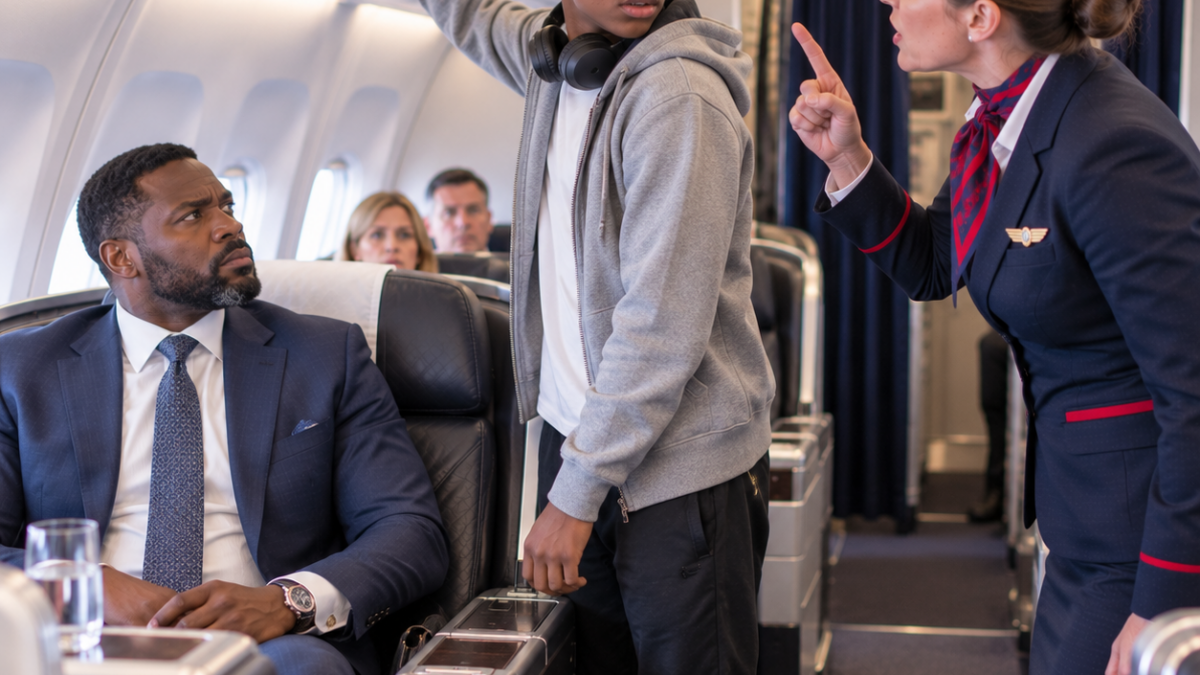
The captain stared at me for perhaps two seconds.
It felt longer.
Around us, nobody spoke.
Jamal’s breathing had deteriorated enough that each inhale carried a faint whistle.
I reached above him.
Removed his backpack.
Found the inhaler.
Put it in his hand.
Veronica did not try to stop me.
Nobody did.
“Two puffs,” I said.
Jamal shook the inhaler.
His fingers trembled.
He took one dose.
Then another.
“Slow breath.”
He tried.
The blood at the corner of his mouth had started running down his chin.
I handed him a clean napkin.
“Dad.”
“I’m here.”
“I didn’t touch her.”
“I know.”
“She hit me.”
“I know.”
The captain finally moved.
“Mr. Washington.”
I looked at him.
“We are returning to Boston.”
“Good.”
“Please have your son sit down.”
“He will sit because he needs to conserve oxygen, not because your employee ordered him to.”
The captain flinched.
Fair.
My voice was not loud.
But I no longer cared whether it sounded pleasant.
I helped Jamal back into 2B.
A woman two rows behind us stood.
“I recorded it.”
Veronica turned.
“What?”
The woman held up her phone.
She was Asian American, early thirties, wearing the casual uniform of a startup founder—black jeans, white sneakers, expensive laptop.
“My name is Sophia Chen.”
She pointed at the phone.
“I recorded the refusal to get his medication.”
Veronica’s face changed.
“And the slap?”
Sophia nodded.
“Most of it.”
Across the aisle, a Black man in his forties raised his hand.
“Andre Coleman.”
He handed me a business card.
Executive Vice President.
One of the country’s largest retail companies.
“I saw everything.”
A white man behind him scoffed.
“The kid stood up after being told not to.”
Andre turned.
“His asthma medication was above his seat.”
“Rules are rules.”
“So is not striking children.”
The man rolled his eyes.
I recognized him from earlier.
He had made a remark about our first-class seats.
Bradley Pierce.
Investment banker.
He had been watching the entire flight with the mild amusement of somebody certain that none of this could ever happen to him.
Veronica found her voice again.
“He was aggressive.”
Sophia raised her phone.
“He said, ‘I need my inhaler.’”
“He moved toward me.”
“Because you blocked him.”
“He raised his hands.”
“After you pushed him.”
Veronica looked at the captain.
“Richard.”
There was familiarity in the name.
Captain Richard Sullivan rubbed one hand over his forehead.
“Enough.”
He keyed the intercom.
“Ladies and gentlemen, due to an onboard medical and security incident, we will be returning to Boston.”
Whispers erupted.
Passengers reached for phones.
Veronica moved toward the galley.
I said:
“No.”
She stopped.
“I don’t want her near my son again.”
The captain nodded.
“Taylor.”
The younger attendant who had earlier tried to help retrieve Jamal’s bag approached.
“Yes, Captain?”
“You take first class.”
Veronica’s face reddened.
“I did nothing wrong.”
Nobody answered.
The aircraft turned east.
Only then did I realize my hands were shaking.
Not from fear for myself.
From memory.
Three years earlier, my wife had called me from a hospital emergency room.
Leila.
Brilliant neuroscientist.
Forty-five years old.
Mother of my son.
My best friend since graduate school.
“They’re not listening to me, Eli.”
Her voice had been strained.
“Chest pain.”
“Shortness of breath.”
“Something’s wrong.”
Hospital staff had repeatedly treated her symptoms as anxiety.
I was in London.
By the time somebody ordered the correct imaging, Leila had suffered a catastrophic aortic dissection.
I landed four hours after she died.
The hospital later offered an extraordinary settlement.
Private.
Confidential.
Very generous.
I refused.
I created the Leila Washington Foundation for Health Equity instead.
We funded research into racial disparities in medicine.
Training.
Patient advocacy.
Data programs.
I had told myself that was the better response.
Strategic.
Long-term.
Useful.
But there were nights when I wondered whether I had also hidden behind strategy because public grief terrified me.
Now my son sat beside me trying to breathe.
Another institution had decided his urgency could wait.
Another professional had interpreted his insistence as aggression.
I felt the past and present folding together.
“Dad.”
I looked at him.
“You okay?”
My injured son was asking if I was okay.
“I should be asking you.”
“You look weird.”
“That is inherited.”
He almost laughed.
Then coughed.
I checked the time.
“How’s your breathing?”
“Better.”
“Chest tight?”
“Little.”
“Dizzy?”
“No.”
“Any tingling?”
“No.”
Taylor approached carefully.
“I found the onboard medical kit.”
“Good.”
She looked terrified.
Not of us.
Of the situation.
“I am so sorry.”
“Did you see the slap?”
“No.”
She swallowed.
“I heard it.”
“Did you hear our earlier requests?”
“Yes.”
“How many?”
Her eyes dropped.
“Several.”
“Did you understand it was medication?”
“Yes.”
“Then why didn’t you get the bag?”
Taylor’s eyes filled.
“I tried.”
I remembered.
She had approached.
Veronica had whispered something.
Taylor retreated.
“What did she tell you?”
“That you had been flagged as potentially disruptive.”
I became very still.
“By whom?”
“I don’t know.”
“When?”
“Earlier in the flight.”
“For what behavior?”
“I don’t know.”
Jamal looked at me.
“Dad.”
“I heard.”
There it was.
A record already forming.
Not after the assault.
Before.
A description waiting for behavior to fill it.
Disruptive.
Aggressive.
Threatening.
Words with enough flexibility to swallow almost anything.
“Taylor.”
“Yes?”
“When we land, do not delete anything.”
Her face changed.
“Sir?”
“Texts.”
“Crew messages.”
“Reports.”
“Nothing.”
She nodded.
“Okay.”
“Do you understand me?”
“Yes.”
“Good.”
Captain Sullivan returned twenty minutes before landing.
“We’ll be met by airport security.”
“And paramedics?”
“I’ve requested them.”
“Requested or confirmed?”
He paused.
“Confirmed.”
“Good.”
He glanced at Jamal.
“I’m sorry this happened.”
Jamal looked at him.
“Are you?”
The captain seemed surprised.
“Of course.”
“You told my dad Veronica was probably providing normal service.”
His face tightened.
“I didn’t understand the situation.”
“You didn’t try.”
I watched my son.
No yelling.
No insult.
Just fact.
The captain accepted it.
“You’re right.”
That surprised both of us.
He continued.
“I should have investigated instead of assuming.”
Jamal nodded.
“Okay.”
No forgiveness.
No punishment.
Just acknowledgment.
It was more mature than many boardrooms I had worked in.
The wheels hit Boston.
Normally passengers applaud only after dramatic turbulence or international arrivals.
Nobody did.
The aircraft taxied.
Then stopped on a remote section of tarmac short of the gate.
Through the window, I saw airport vehicles approaching.
Blue lights.
Medical unit.
Security SUV.
Operations van.
The captain spoke.
“Please remain seated.”
Veronica stood near the forward galley.
She was talking rapidly to another attendant.
Then the door opened.
Four airport security officers boarded.
No paramedics yet.
That bothered me.
The lead officer spoke with Veronica first.
That bothered me more.
She pointed directly toward Jamal.
“He’s the one.”
Officer Daniels approached us.
Hand resting near his belt.
“Sir.”
I looked at him.
“We need the young man to come with us.”
“No.”
His eyebrows rose.
“Excuse me?”
“My son is having an asthma attack.”
“We have a report that he became physically aggressive with a crew member.”
Sophia stood.
“No, you have one crew member’s false statement.”
The officer turned.
“I have video.”
Andre rose too.
“I witnessed the entire interaction.”
Bradley Pierce said:
“He disobeyed instructions.”
Nobody asked him.
Daniels looked between everyone.
Then back at us.
“Sir, your name?”
“Elijah Washington.”
Recognition.
Immediate.
His posture changed.
I hated it.
Not him personally.
The reflex.
The moment my name changed the amount of dignity available to us.
“Elijah Washington?”
“Yes.”
“Quantum Innovations?”
“Yes.”
His tone softened.
“Mr. Washington, perhaps we can move this somewhere private.”
“No.”
Veronica’s face had gone pale.
I continued.
“You were prepared to remove my son before asking whether he needed medical help.”
“I was acting on information provided by crew.”
“Exactly.”
“And now you have additional information.”
“Yes.”
“So act on that.”
Daniels nodded.
“Fair.”
That one word mattered.
He turned.
“Get medical onboard now.”
A second officer radioed.
Veronica stepped forward.
“Officer, I was defending myself.”
Sophia lifted her phone.
“You weren’t.”
“I don’t consent to being recorded.”
Sophia almost laughed.
“That is not how witnessing works.”
Captain Sullivan emerged.
“Medical is coming.”
I looked at him.
“Good.”
A man in a National Airways management uniform climbed aboard behind the officers.
Douglas Porter.
Customer Service Director.
His smile arrived before his apology.
“Mr. Washington.”
He extended a hand.
I did not take it.
“We are deeply concerned about this unfortunate incident.”
“My son was assaulted.”
“Yes.”
He faltered.
“We’re still gathering facts.”
“Then do that.”
“If we could move you and Jamal to our premium lounge—”
“He needs a hospital.”
“Of course.”
“We have a private medical suite—”
“No.”
Porter’s smile thinned.
“We want to protect your privacy.”
“Whose?”
He blinked.
“My son’s?”
“Or your airline’s?”
Phones were recording.
He knew it.
“Mr. Washington, there is no need to make assumptions about our intentions.”
“I don’t need to.”
“I watched your employee deny medication to my son.”
“I watched her strike him.”
“I watched your security approach him as the suspect.”
“And only after hearing my name did everybody’s tone change.”
The cabin went silent again.
“That is the problem.”
EMTs boarded.
Finally.
Everything else disappeared.
“Seventeen-year-old male.”
“Asthma.”
“Delayed inhaler access.”
“Physical strike to face.”
One paramedic checked oxygen saturation.
His expression changed.
“Eighty-nine.”
My stomach dropped.
“Jamal.”
“I’m okay.”
“No.”
The paramedic fitted oxygen.
“We need transport.”
“Do it.”
Porter tried again.
“We can have someone from our VIP team accompany—”
“No airline representative goes with him.”
“But—”
“My lawyer can contact yours.”
“Mr. Washington—”
“Stop.”
My voice remained quiet.
“You keep trying to manage me.”
“Manage the facts instead.”
He stepped back.
Veronica was escorted off the aircraft.
Not arrested.
Removed from duty pending investigation.
That was appropriate for the moment.
I was not interested in performative handcuffs.
I wanted evidence preserved.
Sophia emailed her video directly to me before we left.
Andre gave me his number.
Two other passengers offered statements.
Even Taylor quietly handed me a piece of paper.
Her personal phone number.
“I’ll tell the truth.”
“Thank you.”
Bradley Pierce watched from his seat.
He shook his head.
“All this over a teenager refusing an instruction.”
Andre turned toward him.
“No.”
His voice was calm.
“All this because some people believe obedience matters more than whether a Black kid can breathe.”
Bradley looked away.
The ambulance ride blurred.
I sat beside Jamal.
Oxygen mask.
Monitor.
IV access.
His lip bandaged.
The red mark on his cheek deepening.
“Dad.”
“Don’t talk.”
“You always say that when you don’t know what to say.”
“Genetic flaw.”
He smiled weakly beneath the mask.
At Boston Memorial, Dr. James Chen was waiting.
I had called him from the aircraft.
Yes, that was privilege.
I did not pretend otherwise.
My son’s care became immediate because I could reach the right person.
That fact angered me even while I used it.
I would never apologize for protecting him.
But I would also never confuse access with fairness.
Jamal was stabilized.
Nebulizer treatment.
Steroids.
Oxygen.
Monitoring.
No permanent respiratory damage expected.
The facial injury was minor.
The emotional damage was harder to measure.
Hours later, he slept.
I sat beside him.
My phone contained 117 missed calls.
Quantum board.
Investors.
Press.
Politicians.
Friends.
People who had not called me in years.
I ignored almost all of them.
Then a notification appeared.
Sophia had posted video.
Not the slap first.
The medication denial.
That was smart.
The video showed me explaining the asthma.
Veronica refusing.
White passengers walking freely in the background.
Jamal wheezing.
Taylor attempting to help.
Veronica stopping her.
Then Jamal standing.
Then the shove.
Then the slap.
No editing trick could make it flattering.
Within an hour, millions had watched.
National Airways issued a statement.
We are aware of an incident involving a passenger and crew member aboard Flight 372 and have placed the employee on administrative leave pending investigation.
Jamal woke as I was reading.
“What does it say?”
I handed him the phone.
He read silently.
Then:
“Incident.”
“Yes.”
“Passenger.”
“Yes.”
“They don’t even say I needed my inhaler.”
“No.”
“Or that she hit me.”
“No.”
He gave the phone back.
“That’s garbage.”
“Corporate garbage.”
“You sound like me.”
“Temporary illness.”
He smiled.
Then became serious.
“Dad.”
“Yes?”
“Don’t settle.”
I studied him.
“Why do you think I would?”
“Because that is what you do.”
“What?”
“Quiet solutions.”
“That is not always bad.”
“I know.”
His voice was tired.
“But not this time.”
I did not answer immediately.
He continued.
“There are kids whose dads aren’t you.”
That did it.
Not anger.
Clarity.
“There are families nobody recognizes.”
“Yes.”
“And if this had been them…”
He looked toward the hospital door.
“Security probably would’ve taken the kid off first.”
Maybe.
I refused to claim certainty.
But the possibility was enough.
“No quiet settlement.”
I held out my hand.
He took it.
“No quiet settlement.”
The next morning, Sharon Taylor arrived.
Civil-rights attorney.
Brilliant.
Relentless.
Not impressed by billionaires.
That was why I hired her.
She reviewed everything.
“First priority.”
“Evidence preservation.”
“Yes.”
“Second?”
“Medical records.”
“Yes.”
“Third?”
“Witness statements.”
“Yes.”
She looked at me.
“Fourth?”
“Public pressure.”
“No.”
I smiled.
“Legal strategy.”
“Good.”
She pointed her pen at me.
“You are not CEO today.”
“Unfortunately still am.”
“You are father and client.”
“I dislike both limitations.”
“I know.”
“That’s why I imposed them.”
She contacted National Airways.
Preservation demand.
Cabin reports.
Crew messages.
Training records.
Complaint history.
Dispatch logs.
Security communications.
Video.
Passenger-service notes.
Then the airline called me.
Douglas Porter.
I put him on speaker.
“Mr. Washington.”
“Mr. Porter.”
“First, I want to express our deepest regret.”
“Assault.”
“Excuse me?”
“Use precise words.”
He paused.
“We regret that your son was struck.”
“After being denied medication.”
“Yes.”
“And after your employee treated us differently throughout the flight.”
“That conclusion remains under investigation.”
“Good.”
“Investigate it.”
“We’d like to offer immediate compensation.”
“No.”
“You haven’t heard it.”
“Still no.”
“A substantial payment.”
“No.”
“Lifetime first-class travel.”
Jamal, listening from bed, actually laughed.
Porter heard.
“This isn’t amusing.”
“No.”
Jamal said.
“It kind of is.”
I continued.
“What about the next family?”
Porter paused.
“We are discussing your family’s situation.”
“That’s the problem.”
“Mr. Washington.”
“Our counsel will send requirements.”
“What requirements?”
“Independent review of discrimination complaints.”
“Transparent reporting.”
“Protection for employees who report misconduct.”
“Review of crew medical-access procedures.”
“And no confidentiality clause that prevents public accountability.”
His tone changed.
“That sounds unusually broad for an individual customer complaint.”
“My son almost went to the hospital because your employee refused his inhaler.”
“He did go to the hospital.”
Jamal corrected.
Porter went silent.
I smiled despite myself.
“Good point.”
Then:
“Mr. Porter, if National Airways wants this handled privately, it should have behaved responsibly before there were cameras.”
I ended the call.
Sharon looked at me.
“You enjoyed that.”
“A little.”
“Control yourself.”
“No promises.”
By afternoon, National Airways made its first mistake.
Its flight-attendants union issued a statement framing Veronica’s actions as self-defense.
Then Bradley Pierce went on television.
He described Jamal as “agitated.”
“Defiant.”
“Intimidating.”
Sharon paused the recording.
“Notice the words.”
“I noticed.”
Andre Coleman gave an interview an hour later.
He wore a dark suit.
No outrage.
No performance.
“I sat across the aisle.”
He looked straight at the camera.
“Jamal Washington was struggling to breathe.”
“His father repeatedly requested medication access.”
“White passengers were allowed to move while the Washingtons were told movement was unsafe.”
“When Jamal stood to retrieve his inhaler, the flight attendant blocked him.”
“He did not threaten her.”
“She pushed him.”
“Then she struck him.”
The interviewer asked:
“Are you connected to the family?”
“No.”
“Did you know who Elijah Washington was?”
“I recognized him eventually.”
“Did that influence you?”
Andre smiled sadly.
“No.”
“The boy needed help whether his father owned ten companies or none.”
That line went everywhere.
Then Sophia released a longer video.
Public narrative shifted.
Former passengers contacted Sharon.
Complaints involving Veronica.
Dismissive treatment.
Racially loaded comments.
Unnecessary escalation.
Then former crew members.
Veronica had been reported.
More than once.
Her brother-in-law was a vice president in operations.
Not proof he protected her.
Enough reason to investigate.
National Airways changed Veronica’s status from paid administrative leave to unpaid suspension.
I did not celebrate.
Jamal did not either.
“She should be fired.”
“Maybe.”
“Maybe?”
“Investigation first.”
He stared.
“She hit me.”
“Yes.”
“So?”
“So if we’re demanding fair procedure, we don’t abandon it when we have power.”
He frowned.
“That sounds annoyingly reasonable.”
“Your mother used to say the same thing.”
His expression softened.
Leila.
Grief was strange.
Three years and her name could still change the temperature of a room.
“Dad?”
“Yes?”
“When Mom died…”
He hesitated.
“Did you wish you’d been louder?”
I looked at him.
“Yes.”
The answer surprised him.
“I thought you believed the foundation was better.”
“I do.”
“Then?”
“Both things can be true.”
I sat beside him.
“I spent years changing medical systems quietly because I wanted lasting results.”
“I still believe in that.”
“But I also wonder how many families might have spoken sooner if I had made what happened to your mother public.”
Jamal watched me.
“I was afraid grief would turn her into a headline.”
“So you protected her?”
“I thought I did.”
“Maybe you protected yourself.”
Children become dangerous when they start understanding you.
“Yes.”
He nodded.
No judgment.
Just understanding.
“Maybe this is for her too.”
“Partly.”
The next day, National Airways offered eight figures.
Healthcare coverage.
Travel privileges.
Private apology.
Broad release.
Confidentiality.
Sharon slid the document toward Jamal.
“What do you think?”
He looked at me.
“You’re asking me?”
“Yes.”
“Why?”
“Because you’re the person who was harmed.”
He read.
“One condition says we can’t discuss details.”
“Yes.”
“So they pay us and everybody forgets.”
“Essentially.”
He pushed the papers back.
“No.”
Sharon looked impressed.
I did not smile.
Money was easy to reject when you had money.
I told him that.
“You understand most families could not afford this decision.”
“I know.”
“So never judge people who accept settlements.”
“I won’t.”
“Sometimes rent is justice for that month.”
He nodded.
“But we don’t need it.”
“No.”
“So we can ask for more.”
“Yes.”
“Not more money.”
I smiled.
“There you are.”
Our demands were structural.
Independent audit.
Complaint transparency.
Medical-access protocol reform.
Protection for whistleblowers.
Outside oversight.
Public reporting.
The airline refused several.
We filed suit.
We filed FAA complaints.
Then something bigger happened.
Other people began telling their stories.
Not all about National Airways.
Other airlines.
Hotels.
Banks.
Hospitals.
Stores.
Black executives.
Black students.
Latino families.
Muslim travelers.
Disabled passengers.
Asian American customers.
People whose status had not protected them.
People whose lack of status had made everything worse.
Jamal read thousands.
One post stayed with him.
Black mother.
Two children.
Removed from a flight after asking why another passenger was allowed to use an overhead bin she had been told was full.
No video.
No wealthy father.
No national headline.
Complaint closed.
Jamal showed me.
“This is why.”
I nodded.
“This is why.”
Quantum Innovations’ board became nervous.
Stock moved.
Investors called.
My keynote in San Francisco was supposed to announce a quantum-computing infrastructure initiative.
Some wanted me to separate “personal controversy” from company business.
I called an emergency board meeting.
Video conference.
Twelve directors.
“Charles.”
Our chairman leaned forward.
“Elijah, nobody is asking you to ignore what happened.”
“They are asking me to minimize it.”
“We’re asking you to consider shareholder obligations.”
“I am.”
“How?”
“Quantum says ethical systems matter.”
“Yes.”
“We sell tools designed to reduce algorithmic bias.”
“Yes.”
“We advise governments on accountability.”
“Yes.”
“Then if I remain silent when discrimination nearly harms my son because speaking risks market volatility, our ethics are branding.”
Silence.
One director sighed.
“That’s unfair.”
“No.”
I looked around the screen.
“It is expensive.”
“Different word.”
The board backed me.
Not unanimously at first.
I told them if necessary I would put the matter before shareholders.
That helped.
Power mattered.
I was learning to admit that without pretending it made me morally superior.
I had leverage.
The question was what I did with it.
Jamal was discharged.
We flew to San Francisco on another airline.
That bothered him.
Not the new airline.
Flying itself.
At boarding, he froze briefly.
“Want to leave?”
“No.”
“We can.”
“No.”
He looked at me.
“If I don’t get on now, it’ll get bigger in my head.”
I understood.
We boarded.
Service was impeccable.
Too impeccable.
They recognized us.
Everyone did.
Jamal noticed.
“This doesn’t prove anything.”
“What?”
“They know who we are.”
“Yes.”
He looked toward the flight attendant smiling nervously.
“Anybody can be respectful when the whole country is watching.”
I smiled.
“Excellent.”
“What?”
“You are finally becoming cynical.”
“Dad.”
“Proud moment.”
He laughed.
In San Francisco, the technology conference became something nobody had planned.
Three thousand people.
Media everywhere.
My original keynote deck had forty-two slides on quantum infrastructure.
I deleted thirty.
I walked onstage.
Applause lasted almost two minutes.
Jamal stood backstage.
I began:
“I came here to talk about technology.”
Silence.
“I still will.”
“But first we need to talk about the systems human beings build before we ask machines to reproduce them.”
I told the audience what happened.
No dramatic video.
No photograph of Jamal’s bruised cheek.
He was not evidence for consumption.
I spoke about patterns.
About bias.
About institutions that defend themselves before investigating harm.
About status.
“Many people have asked why a billionaire would make this public.”
I paused.
“The better question is why wealth should have been necessary for anyone to be heard.”
The room went still.
“My son received medical care quickly after we landed because I had access.”
“I could call specialists.”
“Lawyers.”
“Executives.”
“Regulators.”
“That should disturb us.”
I looked around.
“Because dignity is not supposed to be a premium service.”
Applause.
I waited.
“What happened to Jamal was exceptionally visible.”
“It was not exceptional.”
On the screen behind me appeared anonymous excerpts from hundreds of stories people had shared.
No names.
No faces.
Just experiences.
Then I announced the Accountability Project.
Fifty million dollars.
Legal support.
Institutional auditing.
Research into complaint suppression.
Corporate standards.
And one additional policy.
Quantum Innovations would require major partners to maintain transparent discrimination-reporting processes and independent review mechanisms.
Contracts worth billions.
Business press went insane.
I expected that.
Then I did something I had not expected.
I invited Jamal out.
He walked slowly.
Bruise still visible.
The room stood.
He looked embarrassed.
Good.
Still seventeen.
Still my son.
He reached the microphone.
“For most of my life, I thought my dad’s way of dealing with racism was basically to become too successful to ignore.”
Laughter.
Including mine.
“I hated that.”
More laughter.
“He always told me to choose battles.”
“I thought that meant swallow things.”
He glanced at me.
“I was wrong.”
My throat tightened.
“He was also wrong.”
Bigger laugh.
I nodded.
“Fair.”
Jamal continued.
“I think he sometimes waited too long because he was afraid of what anger would cost.”
No laughter now.
“And I think sometimes I wanted to fight before I knew what winning was supposed to look like.”
He looked toward the crowd.
“What happened on that plane taught me both things matter.”
“Sometimes you speak immediately.”
“Sometimes you document.”
“Sometimes you file a case.”
“Sometimes you change a policy.”
“Sometimes somebody pulls out a phone and records.”
“And sometimes somebody with power finally decides protecting comfort is less important than protecting people.”
Then he surprised me.
“Can I get a keyboard?”
The audience laughed.
A stage manager looked at me.
I shrugged.
Apparently my keynote had ceased being mine.
A digital piano appeared.
Jamal sat.
“This piece doesn’t have a name.”
He looked at me.
“Yet.”
Then played.
I had spent years treating his music as the thing he did after homework.
A hobby.
A gift.
Not a future.
I heard how wrong I had been in less than thirty seconds.
The piece began with one repeated note.
Controlled.
Restrained.
Then another phrase entered.
Sharper.
Impatient.
The two patterns fought.
Separated.
Returned.
Eventually neither disappeared.
They changed each other.
My restraint.
His urgency.
Leila somewhere inside both.
When he finished, I was crying.
Three thousand people pretended politely not to notice until I hugged him.
That image appeared everywhere.
I did not care.
Backstage, Sharon approached.
“National Airways CEO resigned.”
I released Jamal.
“What?”
“Board announcement.”
“Why?”
“Leadership failure.”
“Veronica?”
“Terminated after internal investigation.”
Jamal looked at me.
“Finally.”
Sharon continued.
“Operations VP also resigned.”
“Brother-in-law?”
“Yes.”
“Settlement?”
“They’re ready to accept independent oversight.”
I nodded.
“And transparency?”
“Most of it.”
“Most?”
“We’ll negotiate.”
Jamal smiled.
“You sound happy.”
“I am a lawyer.”
“This is my happy face.”
It wasn’t.
Six weeks later, National Airways signed a consent agreement with our legal team and independent monitors.
Not because we could command regulators.
We could not.
But because public pressure, litigation risk, witness evidence, customer losses, board scrutiny, and regulator attention had aligned.
Companies do not transform because one billionaire makes a phone call.
That makes a better movie.
Reality is slower.
Messier.
More useful.
The agreement included independent complaint review.
Quarterly public reporting.
Protection against retaliation.
Medical-accommodation procedures.
Crew training built around real scenarios.
Clear documentation standards when passengers were labeled disruptive.
Review of prior discrimination complaints.
Board-level oversight.
No lifetime free first-class tickets.
Jamal was delighted.
“Good.”
“Why?”
“I never wanted to fly them free.”
“You enjoy paying?”
“I enjoy making you pay.”
“That tracks.”
Criminal authorities reviewed Veronica’s conduct independently.
We did not dictate charges.
Eventually she pleaded to a misdemeanor assault offense.
Her lawyer issued a statement.
Stress.
Misunderstanding.
Poor judgment.
I did not comment.
Jamal did.
Privately.
“I thought I’d feel better.”
“Do you?”
“No.”
“That’s normal.”
“She got consequences.”
“Yes.”
“So why doesn’t it fix it?”
“Because consequences are not time machines.”
He sat with that.
“Then what’s justice?”
I thought of Leila.
Hospitals.
Foundations.
Jamal’s scarred lip.
Sophia’s phone.
Andre’s testimony.
Taylor’s fear.
The airline reforms.
“Maybe justice is making tomorrow less likely to repeat yesterday.”
He nodded.
“That sounds like something Mom would say.”
“It is.”
“You stole it?”
“Marriage.”
Six months later, Jamal chose Berklee College of Music.
Not Harvard.
Not computer science.
Not venture capital.
Music composition.
When he told me, I made the mistake of pausing.
His eyes narrowed.
“Dad.”
“I’m thinking.”
“You’re calculating.”
“Also thinking.”
“Say it.”
I looked at him.
“You’re certain?”
“Yes.”
“Then I’m proud of you.”
He stared.
“That easy?”
“No.”
“But easy and right are different things.”
His shoulders dropped.
I had not realized how tense he was.
“I thought you’d fight me.”
“I almost did.”
“What stopped you?”
“Your conference piece.”
He smiled.
“I knew that got you.”
“You weaponized music.”
“I learned strategy.”
“Dangerous.”
At Berklee, Jamal wrote a composition called Tarmac.
I did not know until his first showcase.
The opening sound was almost silence.
Then one hard percussive strike.
A slap transformed into rhythm.
Breathless strings.
Interrupted phrases.
A low piano pattern that stayed controlled underneath chaos.
Then air.
Space.
A melody returning stronger.
I sat in the audience and understood exactly what he had done.
He had taken the worst sound of that day and refused to let it remain only violence.
Afterward, he found me in the lobby.
“Well?”
“I hated it.”
His face fell.
Then I smiled.
“Because it was excellent and now you’re going to become impossible.”
He shoved my shoulder.
I hugged him.
“Your mother would have loved it.”
He went still.
“Really?”
“She would’ve criticized the ending.”
“What?”
“Too optimistic.”
He laughed.
“That sounds like her.”
It did.
National Airways changed too.
Not perfectly.
I distrusted anyone who used the phrase “problem solved.”
Complaints initially increased.
Good.
Reporting was easier.
Employees trusted the system more.
Then repeat complaints involving the same individuals started dropping.
Medical-access incidents declined.
Independent monitors published data even when embarrassing.
The airline asked whether I would fly with them again.
I said yes.
Jamal asked why.
“Because accountability should include recognizing improvement.”
“You don’t want to boycott them forever?”
“No.”
“Why?”
“Then the incentive becomes hiding mistakes instead of fixing them.”
He considered that.
“Annoyingly reasonable again.”
“It’s a burden.”
My first National Airways flight after the incident was Boston to New York.
Short.
Ordinary.
I boarded alone.
Different aircraft.
Different crew.
A young Black flight attendant greeted me.
“Good morning, Mr. Washington.”
She recognized me.
Of course.
I sat in 2A.
She returned before departure.
“I know you probably hear this constantly.”
“That has never stopped anyone.”
She smiled.
“I wanted to say thank you.”
“For what?”
“I’ve been with National six years.”
She lowered her voice.
“I reported discrimination twice before.”
“Nothing happened.”
“After the reforms, both cases were reopened.”
I waited.
“One manager was disciplined.”
“Another employee got training and supervision.”
“And?”
“I got promoted.”
I smiled.
“Because of the report?”
“No.”
She smiled back.
“Because the supervisor who kept blocking me was no longer allowed to do promotions alone.”
That answer mattered more.
Systems.
Not favors.
“Congratulations.”
“Thank you.”
She started away.
Then:
“Your son okay?”
“Yes.”
“Music school.”
Her eyes brightened.
“Good for him.”
“Don’t encourage him.”
She laughed.
The passenger beside me arrived.
Older white man.
He looked at me.
Then at the seat.
Then at his boarding pass.
For one ridiculous second, my body tightened.
He smiled.
“2B.”
“Welcome.”
“Glad you’re window.”
“Why?”
“I get up too much.”
That was it.
No story.
No prejudice.
No reckoning.
I loved him for being boring.
Midflight, I ordered coffee.
The attendant set it down.
Carefully.
I stared at the cup.
Memory is physical.
Jamal’s face.
Blood.
Tarmac lights.
I did not drink immediately.
Then my phone buzzed.
Message from Jamal.
AUDIO FILE.
NEW COMPOSITION.
DON’T GIVE NOTES UNTIL END.
I put in headphones.
Pressed play.
Piano.
Strings.
No anger.
Something playful.
I texted:
THIS BETTER NOT BE ABOUT ME.
He replied:
EVERYTHING IS ABOUT YOU.
NARCISSIST.
I laughed loudly enough that 2B looked over.
“Kids?”
“Yes.”
“How old?”
“Eighteen.”
He nodded knowingly.
“That’s rough.”
“You have no idea.”
We landed.
No cameras.
No protest.
No executives.
Just passengers collecting luggage.
Ordinary.
That became the ending I preferred.
Not Veronica losing her job.
Not the CEO resigning.
Not the settlement.
Not the stock price.
A normal flight where nobody had to be powerful enough to deserve basic respect.
Months later, during a foundation meeting, a young mother asked me a question.
“What if you don’t have power?”
She had watched our case.
Her son had experienced discrimination at school.
She was a nurse.
Single mother.
No billionaire resources.
“What if nobody cares when you document?”
I hated questions with inspirational answers.
Life rarely works that way.
So I told her the truth.
“Sometimes institutions still fail.”
She nodded.
“Sometimes you speak and lose.”
She nodded again.
“Sometimes the complaint goes nowhere.”
“Yes.”
“I cannot promise courage produces victory.”
Her eyes dropped.
Then I continued.
“But isolation protects bad systems.”
She looked up.
“Find witnesses.”
“Find advocates.”
“Find records.”
“Find organizations.”
“Find people with different kinds of leverage.”
“Money is one kind.”
“Law is another.”
“Media.”
“Community.”
“Professional associations.”
“Votes.”
“Employees.”
“Customers.”
“Even one person saying ‘I saw it too’ changes the shape of a fight.”
I thought of Sophia.
Andre.
Taylor.
Captain Sullivan eventually admitting his mistake.
People I had not known that morning.
“I did not change National Airways alone.”
I said.
“My money made people answer calls.”
“But witnesses made denial impossible.”
That distinction became central to everything we did afterward.
The Accountability Project funded representation for people who lacked resources.
Not every case became public.
Most shouldn’t.
Some ended in mediation.
Some in policy changes.
Some in court.
Some failed.
We published failures too.
Jamal insisted.
“If you only publish wins, you turn justice into advertising.”
Again.
Dangerous child.
Three years after Flight 372, I attended another of his concerts.
He had grown into himself.
Hair longer.
Clothes less expensive despite my objections.
Confidence unrelated to my name.
After the show, we walked through Boston.
Cold night.
He shoved his hands into his coat.
“Dad.”
“Yes?”
“Do you still think I should’ve gone to Harvard?”
I considered lying.
“No.”
He looked shocked.
“That hurt to say?”
“Physically.”
He laughed.
We walked farther.
“Do you think your way was wrong?”
“What way?”
“Choosing battles.”
“No.”
He nodded.
“Mine?”
“Speaking immediately?”
“Yes.”
“No.”
“So everybody was right?”
“Unfortunately.”
“That is unsatisfying.”
“Most wisdom is.”
He bumped my shoulder.
Then became serious.
“I used to think being powerful meant nobody could treat you like that.”
“So did I.”
“When did you stop?”
“The plane.”
He looked at me.
“Because of Veronica?”
“No.”
“Because of you.”
His expression changed.
“I had spent my whole life accumulating enough influence that I thought I could keep the people I loved safe.”
“I couldn’t.”
“That scared me.”
We stopped at a corner.
Traffic passed.
“But then I realized I had misunderstood power.”
“How?”
“Power isn’t protection from ever being hurt.”
The light changed.
We crossed.
“Power is what you can do after the harm reaches you.”
Jamal thought.
“That sounds like a speech.”
“I’m old.”
“You’re fifty-one.”
“Ancient.”
He smiled.
“You know what I learned?”
“What?”
“Patience isn’t silence.”
I nodded.
“And anger isn’t strategy.”
He groaned.
“You couldn’t let me have one.”
“Fatherhood.”
We reached his apartment building.
Before he entered, he turned.
“Dad?”
“Yes?”
“I’m glad the plane turned around.”
“Me too.”
“Not because I got hit.”
“I understood.”
“Because I think we did too.”
“What?”
“Turned around.”
I knew what he meant.
For years, he had interpreted my caution as surrender.
I had interpreted his urgency as recklessness.
Neither of us had listened carefully enough.
Flight 372 forced us to.
I hugged him.
“Your mother would’ve made that metaphor better.”
“Definitely.”
He disappeared inside.
I stood on the sidewalk for a moment.
Then my driver opened the car door.
On the ride home, I watched airplanes cross the night sky.
For a long time, I had measured success by how high I could rise above the barriers placed in front of me.
Build the company.
Make the money.
Earn the influence.
Create enough distance between my family and vulnerability.
Flight 372 taught me the limit of that dream.
You can become wealthy enough to buy first class.
You cannot purchase a world where nobody sees your skin before your name.
You can hire lawyers.
You cannot guarantee the stranger beside your child will be fair.
You can build power.
You cannot stop every injury.
But you can decide what happens when the system expects silence.
You can preserve evidence.
You can protect witnesses.
You can refuse a private payoff when you have the privilege to refuse it.
You can use influence to open doors for people whose calls would otherwise go unanswered.
You can force institutions to look at patterns instead of isolated excuses.
And sometimes you can teach your son something while discovering he has been teaching you too.
That morning in first class, Veronica believed the most important power in the cabin belonged to her because federal law gave crew members real authority over passenger safety.
She was not wrong about the authority.
She was wrong about what it was for.
A uniform does not make dignity optional.
Wealth does not make dignity more deserved.
And a seventeen-year-old Black boy should never need a billionaire father before the people around him decide that his breathing matters.
The plane did stop that day.
For several minutes, it sat motionless on the Boston tarmac surrounded by flashing vehicles while everybody inside waited to learn whose version of events would become official.
But looking back, I no longer think that was the moment everything froze.
It was the moment something finally started moving.
And none of us were the same when it did.








