Flight Attendant Slapped Me While I Was Seven Months Pregnant—She Had No Idea Who Was About to Take Control of the Airline
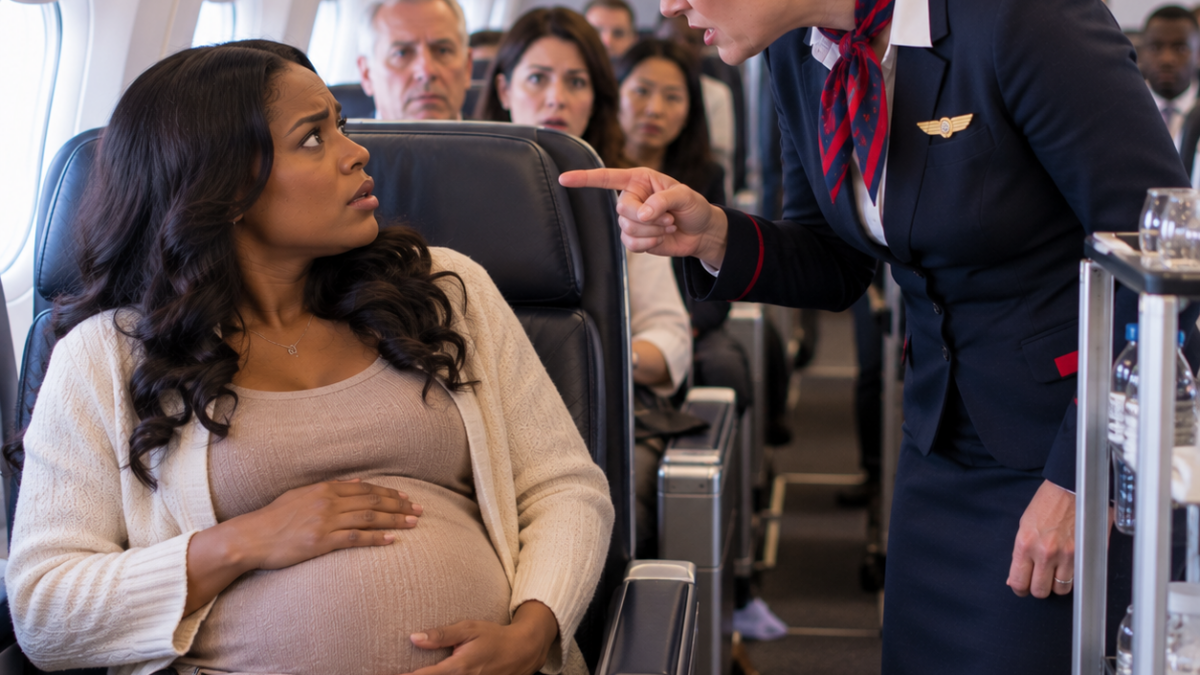
For several seconds, nobody moved.
I could hear the engines.
The soft rattle of glasses.
My own breathing.
And underneath all of it, the heartbeat pounding inside my ears.
Victoria’s hand was still halfway between us.
Her face had changed.
Not into regret.
Into calculation.
She knew immediately that she had crossed a line.
I knew it too.
Years of practicing corporate law had trained my brain to separate emotion from facts when something went wrong.
Time.
Place.
Witnesses.
Statements.
Physical evidence.
My cheek was burning.
My son was moving beneath my palm.
And all I could think was:
She just hit me.
A man three rows behind us stood halfway out of his seat.
“You slapped her.”
Victoria turned.
“Sir, sit down.”
“I photographed it.”
His camera was still in his hands.
“You slapped a pregnant woman who was asking for water.”
Later, I would learn his name was Derek Patterson.
At that moment, he was simply the first stranger willing to say out loud what everyone had just witnessed.
Victoria stepped backward.
Her voice became louder.
“She approached me aggressively.”
I stared at her.
“What?”
“You were instructed to sit down.”
“I asked for medical assistance.”
“You were threatening.”
“Do I look threatening to you?”
One hand was still on my stomach.
My other hand was pressed against my cheek.
Victoria glanced around the cabin.
I watched her realize there were witnesses.
Then she did something I would see many times afterward.
She built a narrative.
“She got out of her seat while the seat belt sign was illuminated.”
That part was true.
“She refused repeated safety instructions.”
That part distorted everything that had happened before it.
“She moved toward me in an aggressive manner.”
False.
“I feared for my safety.”
False.
Piece by piece, she was constructing a version of events where the slap became self-defense rather than assault.
Derek raised his camera.
“The photographs will show exactly what happened.”
Victoria pointed at him.
“You need to stop interfering with crew operations.”
“I am documenting an assault.”
“Sit down.”
A sharp contraction folded through my abdomen.
I gripped the top of the seat beside me.
Someone gasped.
A younger flight attendant started forward.
Victoria stopped her with a look.
“I need to sit.”
I whispered.
The younger attendant—Nicole, according to her badge—reached toward me.
Victoria stepped between us.
“I’ll handle first class.”
Nicole hesitated.
That hesitation mattered.
Not because she was cruel.
Because hierarchy can make decent people doubt what they see with their own eyes.
I lowered myself into my seat.
The baby kicked.
Hard.
I rubbed my stomach.
“It’s okay.”
I wasn’t sure whether I was talking to him or myself.
Then the captain came over the intercom.
“Ladies and gentlemen, due to an incident in the cabin, we will be diverting to Pittsburgh International Airport.”
A murmur spread around us.
My heart sank.
Chicago disappeared.
My client meeting disappeared.
More importantly, the word incident suddenly belonged to me.
People began looking toward 3A.
Some had seen what happened.
Others hadn’t.
To those farther back, all they knew was that a Black woman had stood during the seat belt sign, there had been a confrontation, and now the airplane was diverting.
I could almost feel the story changing as it traveled backward through the cabin.
“She attacked a flight attendant.”
“No, she was sick.”
“I heard she refused instructions.”
“She’s pregnant.”
“Maybe she’s intoxicated.”
“She doesn’t look intoxicated.”
Whispers.
Assumptions.
Every row creating its own version.
Across the aisle, Lawrence Graham stared at his laptop.
He had witnessed almost everything.
Victoria had poured him two glasses of champagne while refusing me water.
He had heard me say I was having contractions.
He had watched her slap me.
But when our eyes met, he looked down.
That hurt.
Perhaps more than I wanted to admit.
Not because he owed me heroism.
Because silence was so easy for him.
I spent the descent trying to control my breathing.
In for four.
Out for six.
My doctor had taught me that for anxiety.
I watched the time between contractions.
Irregular.
Seven minutes.
Then twelve.
Then nine.
That reassured me slightly.
Active premature labor usually developed a clearer pattern.
Still, stress could trigger problems.
I wanted medical attention.
I wanted Elijah.
Mostly I wanted someone to stop treating me like asking for help had created the emergency.
Pittsburgh appeared beneath gray clouds.
When we landed, the aircraft did not go directly to a normal gate.
We taxied to a remote stand.
Police vehicles waited.
My stomach tightened again.
Not a contraction this time.
Fear.
Three uniformed officers boarded.
Victoria disappeared toward the cockpit before they arrived.
When she returned, her face looked entirely different.
Professional.
Worried.
Almost fragile.
She stood behind the lead officer.
“That’s her.”
He looked at me.
“Ma’am, we need you to come with us.”
“My name is Jasmine Wilson.”
“Gather your belongings.”
“Am I under arrest?”
“We need to speak with you about what happened.”
“Then I’d like medical personnel as well.”
He frowned.
“Why?”
“I am seven months pregnant.”
I indicated my stomach.
“I’ve been having contractions for almost an hour.”
Victoria interrupted.
“She became combative after being asked to comply with the seat belt sign.”
I turned toward her.
“You denied me water.”
The officer glanced between us.
“She threatened me.”
Victoria continued.
“I was forced to protect myself.”
Derek stood.
“No, you weren’t.”
The officer raised a hand.
“Sir, please remain seated.”
“I saw the entire thing.”
“I have photographs.”
“We’ll take statements.”
“Take mine now.”
Another passenger muttered:
“She’s telling the truth.”
But when the officer looked around and asked:
“Who else witnessed the physical confrontation?”
Something awful happened.
Silence.
Not complete silence.
People shifted.
A throat cleared.
Phones lowered.
Eyes turned toward windows.
Lawrence kept staring at his laptop.
I understood it instantly.
Everyone had somewhere to be.
Everyone wanted off the plane.
Nobody knew whether speaking would delay them another hour.
Nobody wanted to become involved in a police matter.
Silence became convenience.
And convenience almost always benefits whoever already has authority.
Derek pointed across the aisle.
“That man was right there.”
Lawrence looked up.
Our eyes met again.
He opened his mouth.
Then closed it.
The officer turned to me.
“Please come with us.”
I stood slowly.
Another contraction hit.
I caught the seat.
“Ma’am?”
“I’m fine.”
I hated how automatically I said it.
I wasn’t fine.
But Black women learn early that visible distress can be used in opposite ways.
Too calm?
Cold.
Uncooperative.
Too emotional?
Aggressive.
Unstable.
Dramatic.
Sometimes you find yourself trying to perform the exact acceptable amount of pain.
I picked up my purse.
The officer reached for my arm.
“I’m cooperating.”
“I know.”
His grip remained.
I walked past Lawrence.
Past Victoria.
Past Derek.
The cabin watched.
At the door, I looked back once.
Derek held up his camera.
Not triumphantly.
Almost like a promise.
I have it.
The truth exists somewhere outside their story.
That mattered.
They did not take me through the regular terminal.
Instead, I was escorted down a service stairway onto the tarmac.
Two officers walked beside me.
One behind.
I almost laughed at the absurdity.
Seven months pregnant.
Low heels.
Carrying a laptop bag.
Apparently I required a three-person escort in case I sprinted across an active runway.
“My phone.”
I reached toward my purse.
The lead officer, Jenkins, stopped me.
“You can make calls after we talk.”
“I need to call my husband.”
“Later.”
“I’ve been diverted to another city while pregnant.”
“Ma’am, please cooperate.”
Again.
That word.
Cooperate.
I had moved seats.
Waited for water.
Obeyed instructions until pain forced me to stand.
Walked off the plane when told.
Yet cooperation was always described as something I still had not given enough of.
They took my purse.
Loaded me into a security vehicle.
The drive lasted only minutes.
It felt much longer.
My phone was somewhere outside my reach.
I didn’t know that Elijah was already calling.
I didn’t know he had seen the diverted-flight alert.
I didn’t know his acquisition of Skylight had become legally effective that morning.
I certainly didn’t know a photographer’s images were beginning to spread online.
All I knew was that I was being taken into an airport security room while my baby kept tightening my abdomen from the inside.
The room had no windows.
Beige walls.
Metal table.
Four chairs.
The door locked behind me.
That sound frightened me more than the slap.
Click.
Authority becoming physical.
I sat.
Placed both hands on my stomach.
“Hey.”
My voice shook.
“Your dad is going to be so annoyed that we missed Chicago.”
The baby moved.
I laughed once.
Then cried.
Quietly.
For perhaps thirty seconds, I let myself be scared.
I thought about our miscarriages.
The first at ten weeks.
The second at thirteen.
The sterile exam room.
The ultrasound screen with too little movement.
Elijah holding my hand while the doctor spoke words I barely heard.
This pregnancy had been different.
Every scan good.
Every test normal.
Our son strong.
Now I had allowed myself onto an airplane and someone had turned an ordinary business trip into a medical emergency.
Guilt is irrational.
That doesn’t make it weak.
“I shouldn’t have traveled.”
I whispered.
Immediately another voice answered inside me.
No.
You were allowed to travel.
You were allowed to ask for water.
You were allowed to stand when you believed your baby’s health required it.
Victoria’s choices were not mine.
I wiped my face.
Lawyer again.
Facts.
Always facts.
Twenty minutes later, Officer Jenkins returned with a man wearing a dark suit.
“Mrs. Wilson, I’m Thomas Whitfield.”
He extended a hand.
I didn’t take it.
“Vice President of Customer Relations for Skylight Airlines.”
That surprised me.
A vice president had arrived quickly.
Meaning the airline already understood this could become serious.
He sat.
“First, we take situations involving passenger safety extremely seriously.”
“Good.”
He seemed encouraged.
“Then you’ll want to hear that one of your employees physically assaulted a pregnant passenger after denying medical assistance.”
His expression changed.
“According to our preliminary information, you became verbally abusive and failed to comply with crew safety instructions.”
“Your preliminary information came from the woman who hit me.”
“Ms. Hartwell is one of our most senior flight attendants.”
“Does seniority make her version automatically true?”
“No one said that.”
“You did without using those exact words.”
His smile thinned.
“I understand emotions are high.”
“Mine are.”
I touched my cheek.
“Because your employee slapped me.”
“There was apparently physical contact.”
I stared.
“Physical contact.”
“Yes.”
“She struck my face.”
“We’re still gathering information.”
“A passenger photographed it.”
“We’ll review all relevant material.”
“Good.”
I leaned forward.
“Then retrieve Derek Patterson’s photographs.”
Thomas hesitated.
He had not expected me to know the witness’s name.
“He gave it to the officer.”
I continued.
“Review the cabin reports.”
“Preserve all onboard communication.”
“Preserve any galley or cabin camera footage if your aircraft has it.”
Thomas’s eyebrows rose.
“What do you do for a living, Mrs. Wilson?”
“Corporate litigation.”
The room shifted slightly.
Not dramatically.
But enough.
He adjusted his tie.
“I see.”
“I specialize in corporate liability.”
Another adjustment.
“Then you understand that our crew has broad authority regarding onboard safety.”
“I also understand broad authority is not unlimited authority.”
The door opened.
Victoria entered.
Her appearance had changed.
Her makeup was lighter.
Her eyes watery.
She looked frightened.
Not like the woman who had stood inches from my face.
“I don’t feel comfortable in here with her.”
She said softly.
I almost admired the performance.
Thomas nodded sympathetically.
“You’ll be safe.”
Safe.
I looked between them.
“You slapped me.”
Victoria flinched.
Then recovered.
“She came at me.”
“No.”
“I felt threatened.”
“No.”
“She was out of control.”
“No.”
Thomas raised a hand.
“Let’s keep this civil.”
I laughed.
I couldn’t help it.
“Civil?”
“Yes.”
“Your employee hit a pregnant passenger.”
“Now you’re both sitting here talking.”
“Don’t equalize those things.”
Thomas stared.
Victoria’s face hardened.
“There.”
She pointed.
“That’s what she was like on the plane.”
“What?”
“Aggressive.”
“I am speaking.”
“Hostile.”
“I disagreeing with you isn’t hostility.”
“You people always—”
She stopped.
Too late.
Thomas turned slowly toward her.
I felt my pulse change.
“What were you going to say?”
Victoria folded her arms.
“Difficult passengers.”
“No.”
I held her eyes.
“What were you going to say?”
“Nothing.”
“You already said it on the aircraft.”
Thomas looked at her.
“What did you say?”
Victoria’s jaw tightened.
“Passengers like her.”
“Like me.”
I repeated.
“What does that mean?”
Thomas interjected.
“This isn’t productive.”
“It is extremely productive.”
Another contraction hit.
Harder.
I sucked in a breath.
My hands flew to my abdomen.
Officer Jenkins stepped forward.
“You okay?”
“No.”
I waited for it to pass.
Then breathed.
“I have been requesting medical attention for over an hour.”
Victoria rolled her eyes.
“More theatrics.”
A woman’s voice came from the door.
“Excuse me?”
Officer Maria Rodriguez entered.
She looked first at Victoria.
Then me.
Then my stomach.
“How far along are you?”
“Twenty-nine weeks.”
“Contractions?”
“Yes.”
“How often?”
“Variable.”
She looked at Jenkins.
“Has EMS evaluated her?”
“No.”
“Why?”
“We were interviewing—”
Rodriguez’s face changed.
“She is twenty-nine weeks pregnant and reporting contractions.”
Thomas started:
“Officer, we’re in the middle of—”
“Medical needs come first.”
She pulled her radio.
“I’m requesting paramedics.”
That was the first moment since leaving the aircraft when someone with authority treated the medical issue like an actual fact rather than a negotiating tactic.
I wanted to hug her.
Instead I said:
“Thank you.”
She nodded.
“No problem.”
Victoria muttered:
“This is unbelievable.”
Rodriguez looked at her.
“What is?”
Victoria said nothing.
While Rodriguez called EMS, I noticed Victoria’s ring.
Silver band.
Small blue stones.
Skylight logo.
I recognized it.
Elijah and I had reviewed materials about the company during the acquisition.
Twenty-year service award.
Presented to long-tenured employees considered examples of company loyalty and performance.
I looked at it.
Then at her.
“That’s the twenty-year ring.”
Victoria instinctively covered her hand.
“What?”
“Skylight.”
I nodded toward it.
“Service award.”
Her expression sharpened.
“How would you know?”
“I read.”
Thomas looked at me differently again.
I continued.
“You’ve been there twenty years.”
“Yes.”
“Twenty years of premium routes?”
“Mostly.”
“And this is how you treat someone requesting water?”
“I don’t need to justify my entire career to you.”
“No.”
I said.
“But your company might.”
A flicker passed across Thomas’s face.
Fear.
Not fear of me exactly.
Fear of what an intelligent complainant with documentation could uncover.
Officer Rodriguez ended the radio call.
“Paramedics are coming.”
Then she looked at Jenkins.
“Give Mrs. Wilson her belongings.”
Thomas objected.
“We’re still—”
Rodriguez faced him.
“Is she under arrest?”
Thomas looked at Jenkins.
Jenkins said:
“No.”
“Charged?”
“No.”
“Then why are you holding her phone?”
Nobody answered.
Rodriguez nodded once.
“Get the purse.”
Jenkins left.
Thomas’s phone buzzed.
He looked down.
And every bit of color disappeared from his face.
That was the first sign Elijah had entered the story.
Thomas read the message twice.
Then looked at me.
Different eyes.
Different posture.
Different person.
“Mrs. Wilson.”
His voice softened.
“There appears to have been a significant misunderstanding.”
I leaned back.
“Interesting.”
He tugged his collar.
“New information has come to our attention.”
“What information?”
“Perhaps you and I could speak privately.”
“No.”
“Mrs. Wilson—”
“Whatever you have to say, say it here.”
He glanced at Victoria.
“Miss Hartwell, would you step outside?”
“No.”
I said.
Both looked at me.
“She stays.”
Victoria stared.
“You don’t get to order me around.”
“I’m not ordering.”
I smiled faintly.
“I’m preserving a witness.”
Thomas closed his eyes for one brief second.
He knew exactly what I was doing.
Lawyer recognizing lawyer behavior.
Or liability recognizing liability.
“Mrs. Wilson.”
“Yes?”
“We are reassessing the incident.”
“What changed?”
“Additional information.”
“What information?”
He wouldn’t say.
Then Victoria snapped.
“You’re blowing this completely out of proportion.”
Thomas turned.
“Victoria.”
“No.”
She pointed at me.
“If my hand made contact with her at all, it was because she was aggressive.”
I looked at Thomas.
“You heard that.”
Victoria’s face changed.
“I didn’t admit—”
“You just acknowledged physical contact.”
“That’s not what I meant.”
Thomas stood.
“Miss Hartwell, outside.”
She looked between us.
“What is happening?”
Thomas moved close to her.
His voice lowered.
Unfortunately for him, the room was small.
“Do you have any idea who she is?”
Victoria blinked.
I felt a strange chill.
Who I am.
Not what happened.
Who.
That phrase would become the center of everything that came later.
Because nothing about my face had changed.
Nothing about my pregnancy.
Nothing about the facts.
Someone had simply told Thomas that I was connected to power.
And suddenly the rules were shifting.
The paramedics arrived before I got an answer.
They checked my blood pressure.
Elevated.
Pulse.
Fast.
Fetal heart rate.
Strong.
The sound of my son’s heartbeat filled the little room.
For the first time that day, I almost broke completely.
Strong.
Fast.
Alive.
I closed my eyes.
One paramedic smiled.
“Baby sounds good.”
“Thank God.”
“The contractions are concerning, especially after stress.”
“Do you think I’m in labor?”
“Not necessarily.”
She squeezed my hand.
“But we want you monitored.”
“I’ll go.”
Thomas reentered with an older man.
Silver hair.
Tailored suit.
Corporate confidence.
“Mrs. Wilson.”
He extended his hand.
“Alexander Pierce, Chief Executive Officer of Skylight Airlines.”
I looked at his hand.
Then his face.
“Your employee hit me.”
His hand lowered.
“Yes.”
“I understand there are serious allegations.”
“Not allegations.”
I nodded toward my cheek.
“Evidence.”
He corrected himself.
“Serious circumstances.”
“That’s better.”
“On behalf of Skylight, I want to apologize for the unfortunate experience—”
“Stop.”
He stopped.
“An unfortunate experience is lost luggage.”
I said.
“A broken screen.”
“A delay.”
I touched my cheek.
“I was denied water while having contractions.”
“Your senior flight attendant called me ‘you people,’ hit me, accused me of threatening her, and your vice president came here to warn me that the airline might pursue federal charges.”
Pierce’s jaw tightened at Thomas.
I continued.
“That is not an unfortunate experience.”
“No.”
He said quietly.
“It isn’t.”
“Good.”
He offered hotel accommodation.
Medical expenses.
Priority travel the next day.
I listened.
Then asked:
“Why are you treating me differently now?”
His expression froze.
“Excuse me?”
“When I arrived, Mr. Whitfield was preparing to make me the defendant.”
“Now your CEO is here offering hotels.”
I gestured around the room.
“What changed?”
“The photographs attracted significant attention.”
“The truth attracted attention.”
“Yes.”
He corrected himself quickly.
“The documentation.”
I watched him.
Still not enough.
Then Jenkins returned with my purse.
My phone lit up the moment it was placed in my hand.
Twenty-seven missed calls.
Most from Elijah.
Texts.
JASMINE CALL ME.
ARE YOU SAFE?
I’M COMING.
PLEASE ANSWER.
I tapped his name.
He answered instantly.
“Jasmine.”
His voice almost collapsed.
“I’m okay.”
“Are you?”
“Baby’s heartbeat is good.”
He exhaled.
I heard people moving around him.
“Where are you?”
“Airport security.”
“I’m twenty minutes out.”
“Twenty minutes from Pittsburgh?”
“Yes.”
“What are you doing in Pittsburgh?”
A pause.
“There’s something I need to explain.”
“Elijah.”
“I know.”
“What did you do?”
Despite everything, I knew my husband.
That silence meant he had done something large and slightly insane.
“Jasmine.”
“What?”
“Do you remember the acquisition I’ve been working on?”
I stared at Pierce.
Pierce was staring back.
“Oh.”
“Yeah.”
“Elijah.”
“It’s done.”
“When?”
“This morning.”
I closed my eyes.
Of course.
“What exactly did you buy?”
Another pause.
“The controlling interest in Skylight.”
My eyes opened.
Across from me, Alexander Pierce had gone completely still.
I understood now.
Thomas’s message.
The sudden politeness.
The CEO appearing in a detention room.
“Oh my God.”
“I was going to tell you tonight.”
“You bought the airline I am currently threatening to sue?”
His voice cracked.
He laughed.
Only for a second.
“I recognize the timing is poor.”
Despite the pain, despite the fear, despite everything, I laughed too.
Then another contraction came.
My laughter ended in a gasp.
“Jasmine?”
“I’m okay.”
The paramedic shook her head at me.
“No, she’s going to the hospital.”
Elijah heard.
“I’ll meet you there.”
“Go to the airport first.”
“What?”
I looked at Pierce.
“Deal with your company.”
“Jasmine—”
“I’m surrounded by paramedics.”
“My baby is okay.”
I lowered my voice.
“You need to see what kind of company you just bought before everyone has time to clean it up.”
Silence.
Then:
“Are you sure?”
“No.”
I told him honestly.
“But do it anyway.”
“I love you.”
“I love you too.”
I ended the call.
Pierce looked like he had aged five years.
“Your husband…”
“Elijah Wilson.”
He swallowed.
“Yes.”
“I believe you’ve spoken.”
“Yes.”
I looked toward Thomas.
His eyes were on the floor.
Then Victoria, who stood near the doorway.
She seemed confused.
“Elijah Wilson?”
Pierce closed his eyes.
Thomas answered quietly.
“The new majority owner.”
Victoria stared at me.
For the first time that day, I saw fear.
Not remorse.
Fear.
And that hurt almost as much as the slap.
Because once again, my worth had apparently arrived after my name.
The ambulance ride to UPMC was rough.
Every pothole felt personal.
The paramedics kept me talking.
One asked about the baby.
“Boy.”
“Name?”
“Elijah Jr.”
“Family tradition?”
“No.”
I smiled weakly.
“My husband is just very persuasive.”
The fetal monitor remained reassuring.
By the time we reached the hospital, my contractions were spacing out again.
Stress induced, the obstetrician eventually concluded.
No cervical changes.
No sign of active preterm labor.
My blood pressure began dropping once I was lying still with fluids running.
The baby was fine.
Those three words changed the world.
Baby is fine.
I started crying before the doctor left.
Not elegant tears.
Not courtroom tears.
Sobbing.
Relief shaking through my entire body.
A nurse sat beside me.
“You’ve had quite a day.”
I laughed through tears.
“You have no idea.”
“Actually.”
She glanced at her phone.
“I think everyone has some idea.”
Of course.
The photographs.
Derek’s image of the slap had gone viral.
I refused to look.
Not yet.
Gabrielle Washington arrived about an hour later.
Civil-rights attorney.
Friend of a partner at my firm.
Elijah had called her.
She came with Derek.
“You hired a lawyer for the photographer?”
I asked when they entered.
Derek laughed.
“I asked the same thing.”
Gabrielle set her bag down.
“Elijah wants independent counsel preserving every copy of the photographs.”
“Smart.”
“And you?”
She looked at me.
“I assume you’re representing yourself.”
“Absolutely not.”
She smiled.
“Good answer.”
Even lawyers know the person in pain should not be their own lawyer.
Derek handed me his camera.
He had transferred images but left the originals intact.
The sequence was devastating.
Victoria ignoring my illuminated call button while talking to Lawrence.
Me standing with one hand on my belly.
Victoria pointing.
My mouth open.
Then the slap.
Her palm against my cheek.
My head turned.
My stomach protected by one arm.
Next frame.
Shock.
Then Victoria yelling.
Photographs don’t tell every truth.
But they freeze the lies people try to create afterward.
“Thank you.”
I handed it back.
“I almost didn’t start shooting.”
“Why did you?”
He thought.
“Because the difference in treatment was too obvious.”
“I document everyday discrimination.”
“I usually photograph subtler things.”
“Who gets watched in stores.”
“Who gets ignored at counters.”
“Who gets questioned.”
He looked down at the camera.
“I’ve never caught something like this.”
I felt something heavy settle inside me.
“You shouldn’t have had to.”
“No.”
He agreed.
“But I’m glad I did.”
At the airport, Elijah was learning what he had purchased.
He told me the details later.
Alexander Pierce had attempted an apology before Elijah even sat down.
Elijah stopped him.
“I don’t need a statement.”
He said.
“I need the truth.”
Thomas Whitfield was there.
His confidence had disappeared.
My husband asked him one question first.
“What did you do when you learned a flight attendant had struck a pregnant passenger?”
Thomas tried to explain he had believed Victoria’s account.
Elijah repeated:
“What did you do?”
“I informed Mrs. Wilson of potential legal exposure.”
“So you threatened her.”
“I explained procedure.”
“After she was hit.”
“We didn’t know that for certain.”
“Did you look at the photographs before making the threat?”
Thomas went quiet.
“No.”
“Did you interview the photographer?”
“No.”
“Did you ask whether medical staff had evaluated my wife?”
Silence.
“No.”
Elijah looked at Pierce.
“This is not a public-relations problem.”
Pierce nodded.
“I understand.”
“No.”
Elijah said.
“I don’t think you do.”
Then he said something I would later ask him to repeat in front of the board.
“A crisis does not create culture.”
“It reveals it.”
Victoria was next.
She entered the conference room still wearing the silver twenty-year service ring.
Elijah did not shout.
He almost never does.
People sometimes misunderstand quiet men.
They assume lack of volume means lack of anger.
Elijah’s anger becomes more precise.
“Ms. Hartwell.”
“My name is Elijah Wilson.”
She stared.
“I don’t believe we’ve met.”
“No.”
He said.
“But you met my wife.”
Her face changed.
“Oh.”
“The seven-month-pregnant woman you slapped.”
“Mr. Wilson, she was—”
“I have seen the photographs.”
Victoria stopped.
“I’ve read witness statements.”
“I’ve also read the preliminary report you submitted.”
He placed the documents on the table.
“You described her as aggressive.”
“She was.”
“You described repeated noncompliance.”
“Yes.”
“You omitted that she had asked multiple times for water.”
Victoria shifted.
“You omitted that she reported contractions.”
“I didn’t believe—”
“You omitted your physical contact.”
“It happened quickly.”
“You wrote that she ‘moved toward you in a threatening manner.’”
“She did.”
Elijah opened Derek’s images.
The sequence showed me leaning against the seat.
Victoria advancing.
The slap.
No ambiguity.
Victoria stared.
Then she said the sentence that told Elijah everything he needed to know.
“I didn’t know she was your wife.”
He sat back.
“What difference should that make?”
She blinked.
“I just mean—”
“No.”
He leaned forward.
“Explain it.”
“I would’ve handled the situation differently.”
“That is exactly the problem.”
Her eyes dropped.
“If Jasmine had been a teacher.”
He continued.
“A nurse.”
“A cashier.”
“An unemployed woman.”
“A student.”
“Would she have deserved less restraint?”
“No.”
“Less water?”
“No.”
“Less concern when she said she was having contractions?”
Victoria’s eyes filled.
“No.”
“Then why does knowing she is married to the owner change your apology?”
She didn’t answer.
Elijah asked his team to pull her complaint history.
It was not clean.
Twenty-seven formal complaints in five years.
Most closed.
Several alleged discriminatory treatment.
Others described her as unusually attentive to wealthy white frequent flyers while dismissive toward Black, Latino, younger, or less traditionally affluent passengers.
One internal review praised her “premium passenger instincts.”
Another suggested she improve “consistency across diverse customer profiles.”
Soft language.
Same truth.
Elijah stared at the records.
“How did she stay on premium routes?”
Pierce answered:
“She had exceptional satisfaction scores from our top-tier members.”
There it was.
The trade.
Some passengers loved her.
The people with the most loyalty points.
The ones whose surveys executives cared about.
If those passengers were happy enough, the complaints of everyone else became noise.
Victoria had not survived despite the culture.
Part of the culture had rewarded her.
Elijah did not fire her in a theatrical instant.
Our lawyers would have hated that.
He suspended her pending formal investigation.
Within forty-eight hours, after the photographs, witness testimony, her own statements, and prior complaint history were reviewed, Skylight terminated her employment.
Thomas Whitfield was suspended the same day.
His termination followed after investigators confirmed he had attempted to frame my assault primarily as a passenger-compliance issue without reviewing available evidence.
Alexander Pierce remained CEO for less than a week.
More on that later.
Elijah arrived at the hospital that evening.
The door opened.
He saw me.
Everything corporate disappeared.
He crossed the room in three steps.
“Jas.”
I reached for him.
He huggedged me carefully.
One hand behind my shoulders.
One over our baby.
For a long time, neither of us spoke.
Then he leaned back.
His fingers touched the fading red mark on my cheek.
His eyes changed.
“Elijah.”
“I know.”
“Don’t.”
“Don’t what?”
“Turn this into revenge.”
His jaw tightened.
“I want her prosecuted.”
“So do I.”
That surprised him.
“But not because she hit your wife.”
I continued.
“Because she hit a passenger.”
He looked at me.
“You know what I mean.”
“Yes.”
“No.”
I squeezed his hand.
“I need you to really know.”
He sat beside the bed.
“I keep thinking about what would have happened if I were someone else.”
His eyes dropped.
“They threatened federal charges.”
“I know.”
“They took my phone.”
“I know.”
“They delayed medical care.”
“I know.”
“And everything changed when they learned your name.”
His face tightened.
“I hate that.”
“Good.”
I said.
“Because that’s the problem.”
A knock came.
Officer Rodriguez entered.
Behind her stood Lawrence Graham.
I recognized him immediately.
His confidence on the aircraft was gone.
He looked smaller.
Not physically.
Morally tired.
“Mrs. Wilson.”
Rodriguez spoke first.
“We’ve completed preliminary witness interviews.”
“Ms. Hartwell will be charged with assault based on available evidence.”
I nodded.
“Thank you.”
“Mr. Graham asked to speak with you.”
Lawrence stepped forward.
“I am sorry.”
I waited.
“I saw everything.”
“Yes.”
“I heard you ask for water.”
“Yes.”
“I heard you tell her about the contractions.”
“Yes.”
“I saw her hit you.”
I said nothing.
“And when the officer asked for witnesses, I looked at my computer.”
His voice cracked slightly.
“I told myself Derek had photographs.”
“I told myself there were other people.”
“I told myself I had nothing useful to add.”
“But the truth is…”
He looked at me.
“I was afraid speaking up would create trouble for me.”
He swallowed.
“I have been a platinum member for fifteen years.”
“Victoria treated me like royalty.”
“And I liked it.”
“That day I saw what the other side of that treatment looked like.”
I studied him.
“Why did you finally give a statement?”
“My daughter.”
He almost smiled.
“She saw the story.”
“Asked whether I had been on the flight.”
“I couldn’t lie.”
“So I told her I had seen it.”
“She asked why I didn’t help.”
He looked down.
“I didn’t have an answer I could live with.”
Silence.
Then he added:
“I know coming forward late doesn’t make me brave.”
“No.”
I said.
He looked up.
“It doesn’t.”
He nodded.
“I know.”
“But it makes you useful now.”
His eyes watered.
“That is more generous than I deserve.”
“It isn’t generosity.”
I replied.
“It’s practicality.”
“Elijah is about to rebuild an airline.”
“I think people who understand what silence costs should be in the room.”
Elijah glanced at me.
That was the moment, I think, he realized I was no longer talking about suing Skylight.
I was talking about changing it.
The doctor discharged me the following morning.
Contractions stopped.
Baby healthy.
Rest required.
No business meetings.
My client had already sent flowers and a message:
CLOSE THE DEAL LATER.
KEEP THE BABY IN.
I laughed when I read it.
Elijah wanted us to go home immediately.
I refused.
“We have a board meeting.”
“You have medical orders.”
“I can attend by video.”
He stared.
“That is technically compliant.”
“I’m a lawyer.”
“I know.”
“You married me voluntarily.”
“Debatable.”
I smiled.
It was good to laugh.
Then we got to work.
Derek’s photographs had triggered something much larger than a single viral story.
Passengers began sharing old experiences with Skylight.
A Black family removed from premium seating after another customer complained they were “disruptive.”
A Latino businessman repeatedly questioned about whether his ticket had been fraudulently upgraded.
A Muslim woman who said a crew member made jokes about additional screening.
An older Black veteran who alleged that Victoria herself had once asked him whether he was sure he belonged in first class.
The company had records.
Hundreds of complaints.
No single complaint proved a companywide conspiracy.
That distinction mattered to me.
I didn’t want outrage to replace evidence.
But patterns mattered.
The audit showed certain things clearly.
Complaints involving discriminatory treatment were less likely to receive escalation than complaints from top-tier loyalty customers.
Senior crew members with strong premium-passenger scores were protected from discipline more often.
The language used in evaluations rewarded employees for “understanding premium expectations” without defining what that meant.
Certain managers treated wealthy frequent flyers as the real customers and everyone else as people lucky enough to occupy an empty seat.
My incident was extreme.
The thinking behind it wasn’t.
That was harder.
You can fire a person.
A culture has no employee badge to confiscate.
Alexander Pierce presented his reform plan the next morning.
I joined by video from our hotel because my doctor would have personally dragged me back to the hospital if she learned I went to headquarters.
Pierce had slides.
Lots of them.
New training.
Public apology.
Customer compensation.
A hotline.
A task force.
A statement about “reaffirming our commitment.”
When he finished, Elijah looked at me.
“What do you think?”
Pierce clearly did not enjoy the new owner’s pregnant wife reviewing his survival plan.
I scrolled through the deck.
“It is excellent crisis management.”
Pierce relaxed slightly.
“It is terrible reform.”
His shoulders dropped.
“Why?”
“Because almost everything happens after an incident.”
I answered.
“Your plan assumes the problem is employees forgetting policy.”
“The evidence suggests some employees were following incentives exactly as management designed them.”
Silence.
I continued.
“You reward premium satisfaction.”
“You punish visible complaints.”
“You promote managers who keep problems quiet.”
“Then you’re shocked when employees prioritize the passenger whose survey matters over the passenger they think won’t be heard.”
Pierce shifted.
“We don’t reward discrimination.”
“No.”
I said.
“You reward outcomes that can make discrimination convenient.”
That was different.
And more dangerous.
Elijah leaned toward the camera.
“What would you do?”
I had spent half the night thinking.
“Independent complaint review.”
“Outside the chain of command.”
“Body and cabin evidence preservation whenever discrimination or physical misconduct is alleged.”
“No manager can close a complaint involving their own team without secondary review.”
“Promotion metrics audited.”
“Service scores broken down by passenger demographics where legally permissible and anonymized.”
“Whistleblower protection.”
“Medical-assistance protocols where reported pregnancy distress automatically triggers escalation.”
Pierce took notes.
I kept going.
“Training built around actual scenarios.”
“Not slides telling employees racism is bad.”
“Supervisors trained to recognize differential service.”
“Executives evaluated on complaint quality, not complaint disappearance.”
Pierce looked tired.
“That’s an enormous rebuild.”
“Yes.”
Elijah answered.
“That is why I bought the company.”
Pierce presented a revised plan later that day.
Better.
Still not enough.
Over the following week, the board reviewed his handling of prior complaints.
They found warning signs he had not personally created but had tolerated because operational performance looked acceptable.
Pierce resigned.
Elijah served temporarily as executive chair while the board searched for a new CEO.
They found Christina Reynolds.
Thirty years in aviation.
Pilot background.
Operations.
Safety.
Labor relations.
Known for turning around a regional carrier without gutting its workforce.
A Black woman, yes.
But that wasn’t why she got the job.
She had the strongest record.
Which made the symbolism even better.
At her first meeting with us, Christina said:
“If you’re hiring me because you want the first Black woman CEO in your press release, I’m leaving.”
Elijah smiled.
“I’m hiring you because you told the board our first reform plan was amateur hour.”
She nodded.
“Good.”
I liked her immediately.
Victoria’s case became complicated.
The physical assault was straightforward enough.
Derek’s photographs.
Witness statements.
Her own partial admissions.
She eventually accepted a plea agreement involving probation, community service, anger-management requirements, and anti-bias education rather than a jail sentence.
Some people online were furious.
They wanted prison.
I didn’t.
Not because what she did was minor.
Because punishment should be proportionate, lawful, and useful.
Losing a twenty-year career was not criminal punishment, but it was a consequence.
The assault conviction was another.
The public humiliation was something I neither requested nor controlled.
I did not need a cage to believe accountability had happened.
Victoria also sued Skylight for wrongful termination.
Her argument was interesting.
She claimed the company had tolerated discriminatory behavior for years and was now making her a scapegoat to protect senior management.
Part of that argument was true.
That did not make her termination wrongful.
Both things could exist together.
The company had failed.
So had she.
Eventually her suit was dismissed.
But something from her filing mattered.
She produced internal emails.
Managers praising her ability to “protect premium cabin standards.”
Supervisors telling staff to “use discretion” when passengers appeared inconsistent with expected first-class profiles.
No one wrote:
Treat Black passengers worse.
Modern discrimination is rarely that stupid.
Instead, systems use words that sound neutral until you look at who pays the price.
Profile.
Fit.
Standards.
Discretion.
Presentation.
Those emails became essential to our reforms.
Victoria, accidentally, helped expose the culture that had helped create her.
Thomas Whitfield disappeared from the airline industry after his termination.
I heard he took a position in consulting for a while.
I never followed closely.
People expected me to obsess over everyone involved.
I didn’t.
I had a baby to have.
That became more important.
Our son arrived two weeks early.
Not because of the flight.
At least no physician ever said so.
He simply decided thirty-eight weeks was enough.
Seven pounds.
Strong lungs.
Furious expression.
When the nurse placed him on my chest, Elijah cried immediately.
“I am not crying.”
He said while crying.
“You absolutely are.”
“He has something in his eye.”
“He was born thirty seconds ago.”
“Hospital dust.”
Our son opened his mouth and screamed.
I laughed.
“There.”
I looked at Elijah.
“Your namesake.”
“Confident.”
“Loud.”
“Opinionated.”
“Definitely yours.”
Elijah kissed my forehead.
For months, I had imagined giving birth with the memory of the aircraft hanging over me.
Instead, in that moment, there was only him.
Baby.
Warm skin.
Tiny fingers.
The breathtaking weight of survival.
Six months after Flight 1372, Skylight no longer existed.
Not because we wanted to hide the name.
We debated that.
Would rebranding look like escaping responsibility?
Christina argued that if we changed the name, the old history had to remain visible.
I agreed.
So Horizon Airways was born.
New colors.
New leadership.
New policies.
But training centers displayed a timeline of the incident that forced the transformation.
Including Derek’s photograph.
I hated that at first.
My face.
Victoria’s hand.
My pregnant body.
Frozen forever.
“Do we really need this?”
I asked Christina.
“No.”
She said.
I was surprised.
“Then why use it?”
“Because you asked us not to sanitize the past.”
Fair.
“What would you prefer?”
I thought.
“Context.”
So beside the photograph, we put no dramatic slogan.
Only facts.
Passenger requested water and medical assistance.
Request delayed.
Passenger reported contractions.
Physical assault occurred.
Initial company response blamed passenger.
Evidence contradicted employee report.
Prior complaints later identified.
Operational reforms followed.
Facts.
No hero.
No monster.
Institutional memory.
Christina called it our origin story.
I corrected her.
“Our correction story.”
The airline existed before me.
It would exist after.
What mattered was whether it remembered why change became necessary.
Training changed dramatically.
Flight attendants practiced situations where a passenger violated one rule because of another urgent need.
Seat belt sign versus medical distress.
Passenger anxiety versus apparent noncompliance.
Language barriers.
Disability.
Autism.
Pregnancy.
Religious clothing.
Children traveling alone.
Crew authority remained absolute where genuine safety required it.
That point mattered.
I did not want employees frightened to enforce rules.
I wanted them trained to distinguish safety from ego.
A flight attendant once asked me during a workshop:
“What if a passenger lies about a medical need to ignore instructions?”
“Then follow medical escalation.”
I said.
“You don’t need to diagnose sincerity at thirty thousand feet.”
Another asked:
“What if they are abusive?”
“Document it.”
“Call for support.”
“Use procedures.”
“But do not manufacture abuse because someone questions you.”
Simple.
Difficult.
Necessary.
Lawrence Graham surprised me.
He followed through.
His company specialized in corporate culture.
At first, I did not want him involved.
It felt too neat.
White bystander fails.
Learns lesson.
Becomes consultant.
Almost offensive in its tidiness.
But Lawrence never asked to become a hero.
That helped.
At his first workshop, he opened by saying:
“I am here because I failed.”
No inspirational music.
No self-forgiveness speech.
“I watched someone receive better service because I was receiving it.”
He told employees.
“I enjoyed privilege enough that when I saw its cost to another passenger, I stayed silent.”
Then he described looking at his laptop when police asked for witnesses.
People listened.
Not because he was brave.
Because he wasn’t.
Most people don’t imagine themselves as Derek, camera raised, speaking immediately.
They imagine they would be.
Reality often makes them Lawrence.
Late.
Uncomfortable.
Trying to decide how much inconvenience morality is worth.
His story gave them somewhere honest to begin.
Derek’s photographs changed his career too.
His documentary series on everyday discrimination expanded nationally.
He received major journalism nominations.
He hated when people introduced him as “the man who saved Jasmine Wilson.”
“I didn’t save you.”
He told me once.
“Correct.”
I said.
“You took excellent photographs.”
“Exactly.”
“But without them, things might have gone differently.”
“Maybe.”
He shrugged.
“You saved yourself.”
I disagreed with that too.
We have an obsession with individual heroes.
The truth was messier.
Derek documented.
Rodriguez intervened medically.
Lawrence eventually testified.
Gabrielle handled legal strategy.
Elijah had power.
Christina rebuilt management.
I refused to disappear.
None of us alone would have created the same outcome.
Justice is often a group project nobody wanted assigned.
The Horizon Equity Foundation became my part of that work.
Elijah initially proposed funding it entirely through the airline.
I said no.
“Why?”
“Because then the company can control it.”
“You control the company.”
“Today.”
I replied.
“What about ten years from now?”
He understood.
We established independent governance.
Horizon provided funding, but the foundation could investigate Horizon too.
The board hated that.
One director said:
“We are literally financing people who might sue us.”
“Yes.”
I answered.
“That tends to encourage us not to give them reasons.”
He did not laugh.
The foundation funded legal help for travelers.
Research.
Whistleblower support.
Scholarships for underrepresented pilots, engineers, mechanics, and cabin crew.
Most cases were never dramatic.
That was good.
Lost seat.
Discriminatory questioning.
Accessibility failure.
Retaliation complaint.
Most people don’t need a viral movement.
They need a competent person to answer the phone.
Six months after our son’s birth, I boarded the first official Horizon Airways flight with him.
I was nervous.
More than I admitted.
Elijah offered to come.
I told him no.
“This one is mine.”
Seat 3A.
Yes.
On purpose.
I put Elijah Jr. against my shoulder.
The flight attendant approached.
Her name was Tiana Brooks.
“Mrs. Wilson?”
“Yes.”
“Can I bring you water before we push back?”
I laughed.
She looked confused.
“Sorry.”
I wiped my eyes.
“Yes.”
“Please.”
She brought it.
Then served the passenger across the aisle.
Same voice.
Same smile.
Same attention.
I watched obsessively for the first hour.
Tiana treated a white businessman politely.
A Black grandmother warmly.
A young Latino couple normally.
An Asian college student normally.
Not exaggerated equality.
Normal.
That was what I wanted.
My son’s first flight should not require a demonstration.
It should be boring.
He slept almost the entire way.
Before landing, Tiana stopped beside us.
“He’s an excellent passenger.”
“He takes after his father.”
“His father sleeps through flights?”
“No.”
“He’s just good at avoiding work.”
Elijah later objected strongly to this description.
At O’Hare, an elderly Black woman approached me near baggage claim.
“Mrs. Wilson?”
“Yes?”
She held my hand.
“I’ve been flying forty years.”
Her voice trembled.
“I’ve had things happen that I never reported because I knew nobody would believe me.”
I didn’t know what to say.
She continued.
“I flew Horizon last month.”
“First time in years I didn’t feel like I had to prove why I was in the seat I bought.”
My eyes filled.
“That matters.”
She squeezed my hand.
“What you did matters.”
I shook my head.
“What a lot of people did.”
She smiled.
“Still.”
Then she walked away.
I stood there holding my son.
For months, reporters had talked about stock price.
Rebranding.
Executive shakeups.
Diversity metrics.
That woman’s sentence mattered more.
She didn’t have to prove why she was in the seat she bought.
That was the standard.
Not perfection.
Not praise.
Dignity without proof.
The business results surprised people.
Customer complaints fell.
Employee satisfaction increased.
Turnover decreased.
Premium-cabin satisfaction did not collapse because flight attendants stopped treating certain wealthy passengers as royalty.
Contrary to corporate folklore, affluent people can survive being treated merely well.
Profitability improved.
Not because kindness magically prints money.
Because culture affects operations.
Employees who trust reporting systems flag problems earlier.
Teams with lower turnover retain experience.
Customers who believe complaints matter stay loyal.
Managers who aren’t spending time hiding messes can actually manage.
Ethics and economics are not always enemies.
Sometimes bad culture is simply expensive.
One evening, months after the rebrand, Elijah and I stood beside our son’s crib.
The nursery had soft blue walls.
A little wooden airplane hung above the changing table.
Elijah Jr. slept with both hands above his head.
Exactly like his father.
“Six months ago.”
I whispered.
“I thought I was going to lose him.”
Elijah’s arm tightened around me.
“I know.”
“I remember sitting in that room.”
“No phone.”
“No doctor.”
“Thinking maybe stress was hurting him.”
My voice broke.
“And Victoria was telling everyone I was dramatic.”
Elijah kissed my temple.
“I still get angry.”
“So do I.”
“Do you regret pressing charges?”
“No.”
“Do you regret firing her?”
“That wasn’t my decision.”
“You supported it.”
“Yes.”
I looked at our son.
“I don’t regret accountability.”
“But?”
“I don’t want this to become the story where a mean flight attendant attacked the wrong rich woman.”
Elijah was quiet.
“Because that makes the lesson too easy.”
I continued.
“People say she didn’t know who my husband was.”
“That wasn’t her mistake.”
“What was?”
“She thought she needed to know.”
Elijah looked at me.
I smiled sadly.
“She should’ve brought the water if you were unemployed.”
“Yes.”
“If I were unmarried.”
“Yes.”
“If I worked retail.”
“Yes.”
“If nobody had taken a photograph.”
“Yes.”
“If nobody important ever heard my name.”
He nodded.
“Yes.”
I leaned my head against him.
“That is the airline I want our son to inherit.”
His eyebrows rose.
“Inherit?”
“Figuratively.”
“Good.”
“He is six months old and already expensive.”
I laughed softly.
Our son stirred.
Neither of us moved.
People occasionally ask whether I forgave Victoria.
My answer has changed over time.
At first, absolutely not.
I wanted nothing from her.
Not an apology.
Not tears.
Not explanation.
Later, I understood that forgiveness and accountability are not opposing legal briefs.
I can believe she deserved to lose a role she repeatedly abused.
I can believe assault charges were justified.
I can believe the company failed her too by rewarding the wrong behavior.
I can also hope she becomes a better person.
None of those cancel the others.
She sent me a letter about a year after the incident.
I did not open it for weeks.
Finally, I did.
Jasmine,
I have written this several times and thrown it away.
I know apologies often become another burden placed on the person harmed, asking them to make the offender feel better.
You do not need to answer this.
I struck you.
There is no justification.
For months, I told myself the airline trained me badly.
That management rewarded certain behavior.
That passengers pressured us.
Those things may be true, but I used them to avoid the most basic truth.
I made choices.
I had spent years deciding very quickly which passengers I respected and which passengers I expected trouble from.
I called it experience.
It was prejudice.
The worst thing I said after the incident was that I did not know who you were.
I thought I was explaining why I had made a mistake.
I understand now that I was admitting something worse.
Your identity should not have mattered.
I am sorry.
Victoria Hartwell.
I read it twice.
Then placed it in a drawer.
I never replied.
Maybe someday I will.
Maybe not.
Forgiveness does not require correspondence.
But I was glad she had finally understood the sentence that mattered.
I didn’t know who you were.
Exactly.
Years later, Horizon’s training department asked me to speak to new managers.
I told them I would do it once.
No motivational montage.
No giant photograph of my face.
No “turning pain into purpose” clichés.
I stood in front of about eighty supervisors.
“Most of you know why I’m here.”
Some nodded.
“I don’t want to talk about the slap.”
That surprised them.
“I want to talk about the water.”
Silence.
“The slap was obvious.”
“Everyone understands you cannot strike a passenger.”
“The problem started earlier.”
I described Victoria serving Lawrence champagne while ignoring my request for water.
The unanswered call lights.
The dismissal of contractions.
The assumptions.
“Organizations love spectacular misconduct.”
I said.
“Because spectacular misconduct gives you someone easy to fire.”
A few people shifted.
“The harder problems are ordinary.”
“The call button ignored one extra time.”
“The complaint nobody escalates.”
“The employee everyone knows is difficult with ‘certain customers.’”
“The manager who says, ‘That’s just how she is.’”
“The performance score that hides who is receiving the good service.”
I looked around.
“If you wait until someone gets slapped, your system has already failed multiple times.”
Nobody wrote that on a poster.
Good.
Some lessons should remain uncomfortable.
After the session, a young supervisor approached.
“Mrs. Wilson?”
“Yes?”
“I used to work under Victoria.”
I stopped.
“At Skylight?”
“Yes.”
He looked nervous.
“She trained me.”
“What do you remember?”
He swallowed.
“She never said anything openly racist during training.”
“I believe that.”
“She would say things like…”
He hesitated.
“Read the cabin.”
“Protect the premium experience.”
“Know who requires extra attention.”
“What did that mean to you?”
“At first, rich customers.”
“And later?”
He looked ashamed.
“We all kind of knew.”
“Who belonged.”
The words hit me.
“Did you ever challenge it?”
“No.”
“Why?”
“She was senior.”
“Everybody loved her.”
“Management praised her.”
He looked at me.
“I wish I had.”
I thought about Lawrence.
Nicole.
All the people who had stood one layer away from the harm.
“What do you do now?”
“Train supervisors.”
“Then challenge it now.”
He nodded.
That was enough.
We cannot retroactively become brave.
We can only decide whether yesterday’s cowardice teaches tomorrow’s courage.
Our son grew.
Of course he did.
Children are rude that way.
One day you’re terrified over contractions.
Then suddenly a five-year-old is asking why airplanes don’t have playgrounds.
He loved aircraft.
Elijah blamed genetics.
I blamed the wooden mobile over his crib.
When he was six, he found Derek’s photograph in a magazine archive.
He brought the tablet to me.
“Mommy?”
My stomach dropped.
“Yes?”
“Is this you?”
The photograph.
Victoria’s hand.
My face turned.
Pregnant belly.
“Yes.”
“Why did she hit you?”
Children deserve truth at the level they can carry.
“She was angry.”
“Why?”
“I asked her for help.”
His little face frowned.
“That doesn’t make sense.”
“No.”
“It doesn’t.”
“Did Daddy fire her?”
I almost laughed.
“That is definitely the version your father would enjoy.”
“So yes?”
“She lost her job because of what she did.”
“Was she bad?”
I paused.
“She did something bad.”
“Same thing.”
“No.”
I sat beside him.
“People are bigger than the worst thing they do.”
He considered that.
“Did she say sorry?”
“Later.”
“Did you forgive her?”
Six years old.
Straight for the difficult part.
“I stopped wanting bad things to happen to her.”
“Is that forgiving?”
“Maybe part of it.”
He nodded as though filing this information for future litigation.
Then he pointed at my pregnant stomach in the image.
“That’s me?”
“Yes.”
His eyes widened.
“I was on the plane?”
“You were.”
“I got slapped too?”
“No.”
I pulled him into my arms.
“No.”
“You were protected.”
“By my tummy?”
“By me.”
He grinned.
“I was kicking?”
“Constantly.”
“That means I helped.”
I laughed.
“Yes.”
“You were excellent emotional support.”
He seemed satisfied.
Then he ran away.
I remained with the photograph.
For years, it had been evidence.
Then a symbol.
Then history.
Now my child had looked at it and simply seen his mother.
That was healing too.
I still fly often.
Sometimes Horizon.
Sometimes competitors.
I notice things differently now.
Who gets greeted.
Who gets questioned.
Whose frustration is treated as understandable.
Whose frustration is labeled aggression.
Which passengers receive the benefit of the doubt.
Which employees are expected to swallow disrespect from customers because of status.
Equity isn’t only passenger facing.
We learned that too.
Some wealthy travelers abused flight attendants and expected protection because of loyalty status.
The old Skylight culture rewarded that.
We changed it.
A Black flight attendant should not have to tolerate racism from a platinum customer any more than a Black passenger should tolerate racism from a senior attendant.
Dignity cannot be directional.
That became one of Christina’s favorite phrases.
She eventually had it printed inside manager handbooks.
I pretended not to be proud.
On the tenth anniversary of Horizon’s launch, I flew from Atlanta to Chicago.
Same route.
Not the same aircraft.
Thank God.
Seat 3A.
Again.
This time I traveled alone.
Elijah Jr. was in school.
Elijah was meeting me in Chicago.
Before boarding, I stood near the gate and watched people.
A Black grandmother traveling with two grandchildren.
A white construction worker carrying a lunchbox.
A Muslim couple.
A young woman in a wheelchair.
A businessman whose watch probably cost more than my first car.
A teenager with dyed blue hair.
Different people.
Same boarding door.
Tiana Brooks—now a senior inflight manager—happened to be on the flight.
She greeted me.
“Water?”
I narrowed my eyes.
“Are you making fun of me?”
“Ten years gives me limited permission.”
I laughed.
“Fine.”
“Water.”
She placed it down.
Then quietly said:
“Do you know what I remember about the first Horizon flight?”
“What?”
“How nervous everyone was.”
“Really?”
“We knew you were onboard.”
“That violates my request.”
“We were terrified.”
“Fair.”
“But after twenty minutes, something strange happened.”
“What?”
“We forgot.”
That was the greatest compliment she could have given us.
“You became another passenger.”
She said.
“Exactly.”
She moved on.
I sat by the window.
Across the aisle, a pregnant Black woman settled into her seat.
Maybe twenty-eight.
Maybe thirty.
She pressed the call button before takeoff.
A flight attendant approached.
“Hi, how can I help?”
“Could I get water?”
“Absolutely.”
“Thank you.”
Thirty seconds later, she had it.
Nothing happened.
No one noticed.
No camera shutter.
No argument.
No CEO.
No emergency landing.
No hashtag.
She drank the water.
The flight attendant moved on.
My eyes filled.
The woman noticed.
“You okay?”
I laughed softly.
“Yes.”
“Pregnancy hormones used to get me too.”
She smiled.
“This is my second.”
I nodded.
“Congratulations.”
“Thank you.”
She turned back toward the window.
She had no idea.
Good.
That was the point.
Real change becomes boring.
The woman shouldn’t need to know why the policy exists.
The flight attendant shouldn’t perform decency because the owner’s wife might be watching.
Water.
Need.
Response.
Done.
No story.
Perfect.
When we landed in Chicago, Elijah waited near the exit.
Older.
A little gray at his temples.
Still incapable of waiting without checking his phone.
“How was the flight?”
“Uneventful.”
“Excellent.”
“Best one yet.”
He took my bag.
We walked through the terminal.
Near a Horizon display stood the company motto we had created after the hospital conversation years earlier.
IT’S NOT JUST WHERE WE TAKE YOU.
IT’S HOW WE TREAT YOU ALONG THE WAY.
Elijah stopped beside it.
“Still like it?”
“Little corporate.”
“You wrote half of it.”
“I was medicated.”
“You were on saline.”
“Powerful saline.”
He laughed.
We kept walking.
Then I saw an elderly Black woman at a gate.
A flight attendant was kneeling beside her wheelchair, listening carefully as she explained a connection problem.
No impatience.
No performance.
Just attention.
I slowed.
Elijah noticed.
“What?”
“Nothing.”
I smiled.
“Something.”
He followed my eyes.
We stood there for a moment.
Ten years earlier, I believed justice would feel like watching Victoria lose her job.
It didn’t.
Then I believed it would feel like the assault charge.
It didn’t.
Then the rebrand.
The foundation.
The new CEO.
The better numbers.
All satisfying.
None complete.
This felt closer.
Someone I did not know receiving dignity from someone who did not know I was watching.
That was the test.
Not how a company behaved in front of its owner.
How it behaved when nobody important seemed to be in the room.
I slipped my hand into Elijah’s.
“Ready?”
He asked.
“Yes.”
We walked toward baggage claim.
I thought about the woman I had been on Flight 1372.
Seven months pregnant.
Thirsty.
Scared.
Trying not to cry.
Trying not to seem angry.
Trying to convince someone that a medical concern was real.
I wish I could go back and sit beside her.
Not to tell her that her husband had just bought the airline.
Not to tell her Victoria would be fired.
Not to tell her millions of people would see the photograph.
Not to promise the baby would be safe.
Because she needed to hear something even before any of those things were known.
I would tell her:
You are not asking for too much.
Water is not special treatment.
Medical concern is not disruption.
Speaking clearly is not aggression.
Your dignity does not depend on whether anyone recognizes your name.
And when they finally discover who your husband is and suddenly begin treating you like you matter, remember that the important question is not why they changed.
It is who they would have been if they never found out.
That question changed an airline.
It changed my marriage.
It changed how I practiced law.
It changed how I raised my son.
And it changed the meaning of that photograph forever.
People still describe the story with the same dramatic sentence.
A flight attendant slapped a Black pregnant woman without knowing her husband owned the airline.
I understand why.
It’s a good headline.
But after all these years, I think it gets the lesson backward.
Victoria’s biggest mistake was not failing to recognize the owner’s wife.
Her biggest mistake was believing a woman needed to be the owner’s wife before her pain deserved respect.
I never want another passenger to win because someone powerful steps through the door.
I want her to be safe when nobody does.
I want the water to arrive before there is a complaint.
I want the medical call to happen before fear becomes an emergency.
I want the witness to speak before a photograph goes viral.
I want managers to ask what happened before deciding whom they believe.
I want dignity to be ordinary.
Because ordinary dignity is what I had actually been asking for all along.
Not first class.
Not influence.
Not revenge.
A glass of water.
A little concern.
The right to be believed when I said something was wrong.
And a company strong enough to understand that every passenger deserves those things—
even when nobody important is watching.








