Flight Attendant Slapped Me in First Class—Then My Father Stood Up Behind Her and Said 6 Words
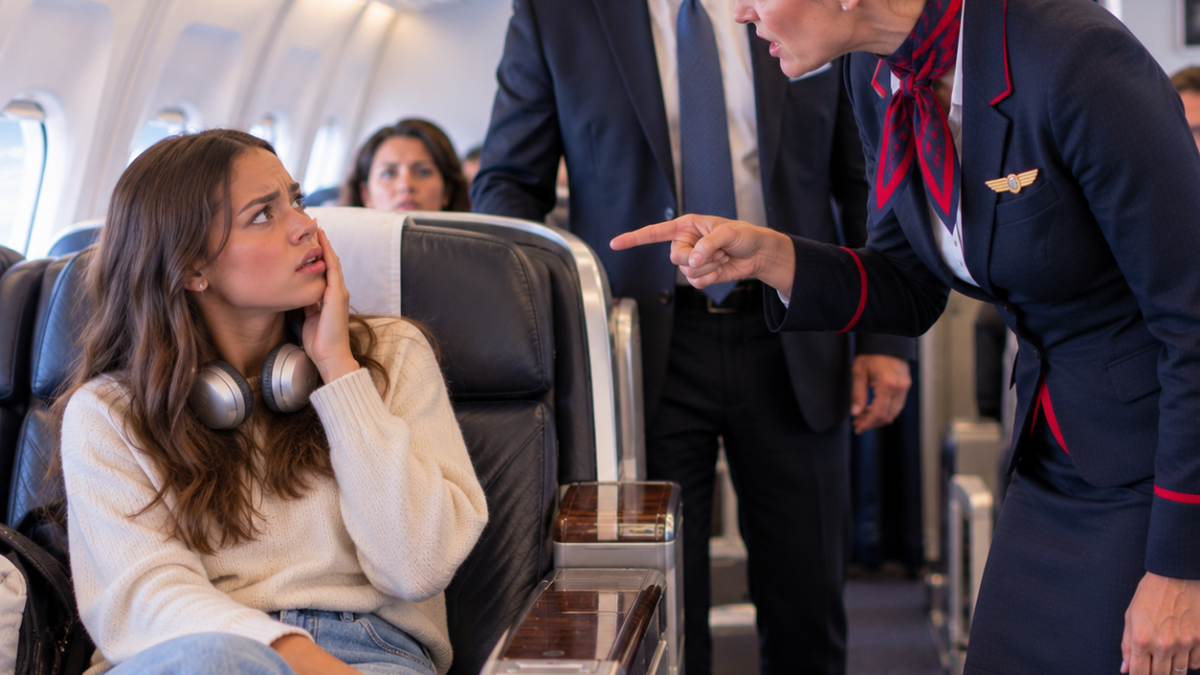
Bethany stared at my father as if the floor had disappeared beneath her.
“I didn’t realize.”
Those three words hung in the air.
Dad looked at her.
“Clearly.”
His voice was quiet.
That was Dad when he was truly angry.
He almost never shouted.
People expecting an explosion usually found something worse instead.
Precision.
Bethany looked at me.
Then at him.
Then at the phone in his hand.
“I can explain.”
“Good.”
Dad said.
“You’ll have several opportunities.”
Her mouth opened.
Dad lifted one finger.
“First, get the captain.”
“Mr. Winters—”
“And the lead flight attendant.”
“I was investigating a theft.”
“Captain.”
She left.
Fast.
The moment she disappeared behind the galley curtain, Dad sat beside me.
The anger left his face.
His hand came toward my cheek but stopped before touching it.
“Can I?”
I nodded.
His fingers barely brushed my skin.
“You dizzy?”
“No.”
“Jaw hurt?”
“A little.”
“Any ringing?”
“No.”
His eyes shined.
That surprised me.
Dad had negotiated billion-dollar acquisitions without blinking.
I had never seen him look frightened by anything involving money.
But the faint red outline of another adult’s hand on my face terrified him.
“I should’ve stayed.”
He whispered.
“No.”
“Jas—”
“You went to the bathroom.”
He closed his eyes briefly.
“I should’ve—”
“Dad.”
He looked at me.
“She did it.”
I said.
“Not you.”
He nodded.
But I knew my father.
He had already started rewriting every decision that morning, looking for the moment he could have changed the outcome.
A woman across the aisle leaned toward us.
It was Mrs. Davidson.
The woman whose headphones were supposedly missing.
Her face had gone pale.
“Mr. Winters?”
Dad turned.
She looked at me.
“I am so sorry.”
I said nothing.
“I told Bethany I couldn’t find my headphones.”
She continued.
“I never accused your daughter.”
Dad’s eyes sharpened.
“What exactly did you say?”
“I asked whether anyone had turned them in.”
She pointed toward her seat.
“I thought I left them in the lounge.”
Her husband reached between the seat and wall.
A second later he pulled out a black Bose case.
Mrs. Davidson covered her mouth.
“Oh my God.”
There they were.
The stolen headphones.
Still at her seat.
Dad stared at them.
Then toward the galley.
“Keep those exactly where they are.”
Mr. Davidson nodded immediately.
The older passenger who had spoken earlier introduced himself.
“George Jenkins.”
He said.
“I saw the whole thing.”
Dad shook his hand.
“Thank you for speaking up.”
“I should’ve stepped in sooner.”
“You spoke.”
Dad replied.
“That matters.”
Another passenger lifted his phone.
“I recorded after she started demanding the bag.”
Someone else had video too.
The cabin was no longer a collection of strangers.
It was becoming an evidence archive.
That mattered more than I knew.
The lead flight attendant arrived.
His badge read DANIEL FOSTER.
Behind him came Bethany.
No longer angry.
Now she looked wounded.
Careful.
Almost fragile.
“Mr. Winters.”
Daniel began.
“I understand there was an incident.”
Dad stood.
“No.”
Daniel blinked.
“There was an assault.”
His eyes moved toward my cheek.
“Of course.”
“Your employee accused my seventeen-year-old daughter of theft without evidence, attempted to search her belongings, struck her, and made an explicitly racial statement.”
Bethany shook her head.
“I did not—”
Dad turned the phone.
The recording was still running.
Bethany stopped.
Dad continued.
“The supposedly stolen property has been found at the passenger’s original seat.”
Daniel looked toward the Davidsons.
Mrs. Davidson nodded.
“I never accused the girl.”
Bethany’s expression collapsed slightly.
Daniel looked sick.
“I am going to contact the captain.”
“Do that.”
Dad said.
“And preserve every onboard report, crew message, and recording related to this incident.”
Bethany suddenly spoke.
“Mr. Winters, I truly didn’t know who she was.”
Dad stared at her.
Then he said something I would remember years later.
“You keep saying that like it helps you.”
Silence.
“Why should knowing who she is change whether you strike her?”
Bethany’s lips parted.
No answer.
“Would it have been acceptable if she were the daughter of a mechanic?”
Nothing.
“A teacher?”
Silence.
“A waitress?”
No answer.
“Would you have searched her bag then?”
Bethany looked down.
Dad’s voice stayed level.
“You didn’t make a mistake because you failed to recognize my daughter.”
He paused.
“You made a mistake because you thought she needed a powerful father before her dignity mattered.”
Daniel closed his eyes.
The captain called through the cabin phone moments later.
He offered to divert.
Dad declined.
I was grateful.
I didn’t want a dramatic emergency landing.
I wanted to get off the airplane.
I wanted my room.
My own shower.
My little brother Miles annoying me from the hallway.
Something ordinary.
But ordinary was already disappearing.
For the rest of the flight, service became ridiculous.
Water appeared before I asked.
Fresh food.
Dessert.
Blankets.
A handwritten apology from Daniel.
Bethany stayed in the galley.
Everyone suddenly knew my name.
“Ms. Winters.”
“Would you like anything, Ms. Winters?”
“Are you comfortable, Ms. Winters?”
I hated it.
Not because they were kind.
Because they had become kind after discovering Dad’s name.
Before that, I had been a possible thief.
Now I was important.
Same face.
Same clothes.
Same seat.
Only the context around me had changed.
I pushed the food away.
Dad noticed.
“You need to eat.”
“Not hungry.”
“Half.”
“No.”
“Quarter.”
I looked at him.
“Business negotiations with your traumatized daughter?”
“I am adaptable.”
I ate half the roll.
He accepted the victory.
After a while, I whispered:
“I want to forget this.”
Dad looked out the window.
“I know.”
“Can we?”
He thought carefully.
“If Bethany had made one terrible decision in an otherwise clean career…”
He stopped.
“If Skyline responded honestly…”
Another pause.
“Maybe.”
“But?”
“But I watched the lead attendant recognize me before he looked at the mark on your face.”
I knew exactly what he meant.
“And when Bethany said she didn’t know who you were, nobody corrected the deeper issue until I did.”
He turned toward me.
“I need to know whether this happened because one person lost control or because the company taught her she could.”
I looked down at my hands.
“What if I don’t want to be part of finding out?”
“Then you aren’t.”
He said immediately.
That surprised me.
“You mean that?”
“Yes.”
“I can investigate as a shareholder.”
“You do not owe anyone a public battle.”
“You don’t owe strangers your trauma.”
I swallowed.
“What would you do?”
He smiled sadly.
“You know better than to ask a father that while the handprint is still on your face.”
Fair.
We sat quietly.
Then I noticed Bethany in the galley.
Phone against her ear.
Whispering.
Watching us.
I nudged Dad.
He saw.
His expression changed.
“She isn’t calling home.”
I said.
“No.”
“Corporate?”
“Probably.”
“Why?”
“To tell her version first.”
That was my first lesson in crisis management.
The first story written often becomes the frame everyone else has to fight.
Bethany knew that.
Skyline knew that.
We were about to learn just how far they were willing to go to keep control of the frame.
When the aircraft door opened, three Skyline executives were waiting at the gate.
Not customer-service agents.
Executives.
Tailored suits.
Perfect smiles.
The woman in front introduced herself.
“Victoria Adams.”
“Senior Vice President, Customer Experience.”
She extended her hand.
“Mr. Winters, Jasmine, I cannot express how sorry we are for this unfortunate incident.”
Dad looked at her hand.
Then her face.
He did not shake it.
“My daughter was assaulted.”
Victoria’s smile tightened.
“Yes.”
“We understand emotions are high.”
Dad’s eyes sharpened.
“Her face isn’t emotional.”
Victoria stopped smiling.
“It was struck.”
Silence.
“We have suspended Ms. Parker pending review.”
“Good.”
“If we could move somewhere private—”
“Why?”
“There are media concerns.”
Dad glanced down the terminal.
No reporters yet.
“Media concerns?”
Victoria corrected herself.
“Privacy concerns.”
I almost laughed.
We followed them into a Skyline lounge.
Private room.
Frosted glass.
Bottled water.
Fruit nobody touched.
A man named Thomas Reeves introduced himself as deputy general counsel.
Another executive sat silently taking notes.
Victoria placed a folder on the table.
“Skyline wants to resolve this immediately.”
Dad didn’t touch the folder.
Thomas opened it instead.
Fifty thousand dollars.
Lifetime premium status.
Travel credits.
All medical costs.
Confidentiality agreement.
Non-disparagement clause.
Dad looked at me.
I looked at him.
He closed the folder.
“You have misunderstood what happened.”
Thomas leaned forward.
“No one is suggesting the incident was acceptable.”
“Then why are you buying silence before you have investigated it?”
“Settlement does not imply—”
Dad raised his hand.
“How many complaints has Bethany Parker received?”
Victoria blinked.
“I don’t have that information.”
“You came to meet me before I left the airport.”
“Yes.”
“You brought legal counsel.”
“Yes.”
“You drafted a settlement.”
Silence.
“But you don’t know whether the employee who slapped my daughter has prior complaints?”
Victoria hesitated.
I spoke for the first time.
“How long has she worked here?”
Victoria turned toward me.
“Fourteen years.”
“Has she ever been accused of treating Black passengers differently?”
Thomas interrupted.
“We can’t discuss personnel files.”
Dad leaned back.
“That’s not what she asked.”
No one answered.
I felt something cold move through me.
The silence was too careful.
Dad felt it too.
He stood.
“We won’t be signing anything.”
Thomas stood as well.
“Mr. Winters, litigation is unpredictable.”
“So is public opinion.”
Victoria added quietly.
I stared at her.
Was that a warning?
Dad heard it.
His expression hardened.
“Be careful.”
Victoria lifted both hands.
“I only mean situations become distorted.”
Dad nodded.
“Good.”
He picked up the settlement folder.
“For once, we agree.”
Then he placed it back on the table.
“Which is why I intend to preserve the facts.”
We left.
That was the moment Skyline should have stopped.
Investigated.
Apologized properly.
Held Bethany accountable.
Reviewed her history.
They could have contained a terrible incident by doing the right thing.
Instead, someone decided protecting the company required attacking us.
And that decision almost destroyed everyone involved.
By the next morning, video of the slap was online.
Not Dad’s recording.
A passenger’s.
Bethany’s hand crossing my face.
My head turning.
Then Dad appearing.
The clip had millions of views before breakfast.
Some people supported me.
Some insisted context must be missing.
Some said a billionaire’s daughter had probably provoked the employee.
Others wanted Bethany arrested immediately.
I hated all of it.
My face had become public property.
At school, students watched the video while I walked past them.
Some whispered:
“That’s her.”
As though the person in the video and the girl beside them were different people.
Dad’s investigators found twelve prior complaints involving Bethany.
Twelve.
Most from passengers of color.
None had resulted in serious discipline.
Several ended in quiet settlements.
One Black woman had complained that Bethany repeatedly questioned whether she had actually purchased her first-class ticket.
A Latino physician said Bethany demanded to see identification after he entered the premium cabin even though no other passenger was checked.
A Black executive had been described in an internal report as “agitated” after asking why her meal was served last.
I read the complaints.
My stomach hurt.
The words repeated.
Confused.
Defensive.
Aggressive.
Disruptive.
Entitled.
Different people.
Same vocabulary.
Then Dad showed me an internal email leaked by someone inside Skyline.
CEO Richard Wittmann to PR leadership.
MAKE THIS GO AWAY.
DIScredit the GIRL if necessary.
FIND SOMETHING.
NOBODY THREATENS THIS AIRLINE.
ESPECIALLY NOT THEM.
I stared at the last word.
Them.
“Us?”
Dad looked tired.
“Could mean us as investors.”
“You don’t believe that.”
“No.”
Neither did I.
The next morning, edited video appeared online.
The beginning showed me pulling my bag away from Bethany.
The audio before that was gone.
The slap remained.
But the clip was cut to make the movement look aggressive.
An anonymous “former classmate” told a gossip site I had fabricated discrimination complaints before.
Completely false.
Several social-media influencers repeated it anyway.
Then came articles about Dad.
Ruthless billionaire.
Patent bully.
Government contractor.
Corporate monopolist.
His business ethics questioned.
His charity spending dissected.
His relationship with politicians analyzed.
The original question disappeared.
Why did a flight attendant hit a seventeen-year-old passenger?
Now the public debated whether my father deserved his money.
That was deliberate.
Dad’s security chief, Ramon Santos, traced part of the online campaign to a crisis-management firm with Skyline contracts.
“Professional narrative shaping.”
He called it.
I called it lying with a budget.
Dad almost smiled.
Then Ramon gave him another report.
Thomas Griffin.
Dad’s biggest business rival.
A billionaire whose companies were developing autonomous transportation systems.
Griffin had been quietly buying Skyline stock.
Through shell entities, he had become one of its most powerful shareholders.
He also sat on its board.
And he was competing against Dad for a major government transportation-technology contract.
Dad read the report twice.
Then looked at me.
“This may be bigger than the airline.”
I stared at him.
“You keep saying things like that as if they are comforting.”
“Sorry.”
“What does Griffin want?”
“Best guess?”
“Yeah.”
“To weaken my company while my attention and reputation are tied up here.”
“So I’m collateral damage.”
“No.”
He sat beside me.
“You are the person whose experience exposed the opportunity.”
“That’s a nicer way of saying collateral damage.”
He sighed.
“Fair.”
For a moment, I wanted the settlement.
Fifty thousand dollars.
An apology.
Silence.
Normal life.
Then I remembered Bethany’s face before Dad appeared.
She had not looked afraid.
She had looked certain.
Certain nobody important would stop her.
“I don’t want to hide.”
Dad studied me.
“You’re sure?”
“No.”
I admitted.
“But I don’t want to hide anyway.”
He nodded.
That was enough.
The smear campaign intensified.
Bethany appeared on television.
She cried.
Or tried to.
She described herself as a working-class employee being destroyed by a billionaire family.
The missing headphones, she said, had created a legitimate security concern.
She claimed I “lunged” when she reached for my bag.
She barely mentioned the slap.
She never mentioned saying my kind didn’t belong in first class.
The host asked whether race played any role.
“Absolutely not.”
Bethany answered.
“I would’ve treated any passenger the same.”
Dad turned off the television.
“They found the headphones in the passenger’s seat pocket.”
I said.
“I know.”
“Why isn’t the host saying that?”
“Because the interview wasn’t built to find truth.”
He replied.
“It was built to create doubt.”
Dad’s private emails were hacked days later.
Selected lines appeared online.
One showed him telling counsel:
WE NEED TO MAKE SKYLINE BLEED.
I remembered the actual conversation.
He had been discussing discovery sanctions if the airline destroyed records.
The full line had been:
IF THEY ALTER EVIDENCE, WE NEED TO MAKE SKYLINE BLEED IN COURT UNTIL THEY UNDERSTAND PRESERVATION ORDERS ARE NOT OPTIONAL.
Context disappeared.
Rage remained.
Then Dad’s business began losing contracts.
A government project he had expected to win went to a Griffin-backed competitor.
Longtime partners delayed meetings.
His board began asking whether the lawsuit was distracting him.
At school, it became worse.
Friends stopped inviting me places.
Parents worried association with my family could affect business.
R@c!st notes appeared in my locker.
The principal told me he couldn’t investigate without knowing who had placed them there.
My debate coach suggested I temporarily step away because “the controversy” distracted from the team.
I laughed.
Not because it was funny.
Because the girl who had been struck was somehow becoming the disruption everywhere she went.
Then Zoe betrayed me.
My best friend since elementary school.
Private texts I had sent her appeared online.
Cut apart.
Rearranged.
In one, I had written:
I WANT SKYLINE TO FEEL WHAT I FELT.
The next line was missing.
POWERLESS.
Then I wrote:
BUT DAD SAYS REVENGE ISN’T THE SAME AS CHANGE AND I KNOW HE’S RIGHT.
The public only saw the first sentence.
I confronted Zoe behind school.
“How?”
She cried before I even finished.
“My dad’s company works with Skyline.”
I froze.
“They told him his department could be outsourced.”
“What?”
“They didn’t say it directly.”
“But everybody understood.”
She wiped her face.
“We have a mortgage.”
“My little sister has medical bills.”
“I was scared.”
I wanted to hate her.
It would have been easier.
Instead, I saw another person forced into an impossible choice by people who would never personally pay the price.
“That doesn’t make it okay.”
“I know.”
“I trusted you.”
“I know.”
I walked away.
I didn’t speak to her for months.
That betrayal hurt differently than Bethany’s slap.
Bethany had never loved me.
Zoe had.
Dad discovered betrayal in his own circle too.
Vincent Carter.
His CFO.
Friend of fifteen years.
Birthday guest.
Mentor.
One of the first people who believed in Dad’s company.
Security logs showed Vincent’s credentials were used to access confidential legal strategy later appearing in Griffin’s hands.
Dad refused to believe it.
Until financial records explained why.
Griffin-linked companies were acquiring a medical startup where Vincent’s son was CEO.
Millions in bonuses depended on the deal closing.
Vincent had traded information for his son’s future.
Dad fired him.
Then came into the kitchen and sat without speaking.
I made tea.
He stared at it.
“You hate tea.”
I said.
“I know.”
“Why did you ask for it?”
“I didn’t.”
“You walked in and sat down.”
“Oh.”
I pushed coffee toward him instead.
He smiled faintly.
“Thank you.”
“Was it Vincent?”
“Yes.”
“Why?”
He told me.
I sat across from him.
“You’re angry.”
“Yes.”
“But you understand.”
“I understand why.”
He rubbed his forehead.
“That doesn’t make it smaller.”
I thought about Zoe.
“No.”
“It makes it more complicated.”
Dad looked at me.
“Growing up is mostly discovering that complicated things still hurt.”
“Terrible marketing slogan.”
“I’m working on it.”
We laughed.
Then neither of us laughed anymore.
The first real breakthrough came from people Skyline had forgotten.
Black employees.
Former crew.
Mechanics.
Baggage workers.
Customer-service representatives.
Anonymous messages began arriving.
One read:
WHAT HAPPENED TO JASMINE ISN’T RARE.
WE HAVE DOCUMENTS.
Another:
MINORITY PASSENGERS ARE FLAGGED FOR EXTRA VERIFICATION IN PREMIUM CABINS.
Another:
PROMOTION SCORES ARE MANIPULATED.
COMPLAINTS DISAPPEAR.
PLEASE PROTECT US.
Dad’s technical team built a secure portal.
Whistleblowers uploaded records anonymously.
Former attendants described coded phrases.
Premium atmosphere.
Passenger fit.
Service verification.
Traditional clientele.
Nothing openly racial.
Everything racially predictable.
The most important source arrived in a hospital.
Ironically, because I ended up there.
Months of stress, depositions, school problems, and security restrictions caught up with me.
I stopped sleeping.
Forgot meals.
Pretended I was fine.
Then one afternoon during a legal meeting, I fainted.
Dehydration.
Exhaustion.
Nothing medically dramatic.
But Dad sat beside my hospital bed looking older than I had ever seen him.
“You’re thinking about ending this.”
I said.
He held my hand.
“I am thinking about my daughter.”
“Same thing.”
“Not always.”
“Dad.”
His eyes met mine.
“Maybe it isn’t worth this.”
That shocked me more than the fainting.
“You told me it mattered.”
“It does.”
“Then?”
“You matter more.”
I stared at the ceiling.
For the first time, I didn’t know what I wanted.
Then I remembered Great-Grandma Rose.
She had died when I was thirteen.
She used to tell me about segregated waiting rooms.
Colored drinking fountains.
Bus seats.
Not with bitterness.
With detail.
Like history needed witnesses.
“She told me her generation fought so mine wouldn’t have to.”
Dad nodded.
“I remember.”
“She was wrong.”
He frowned.
“Not wrong about fighting.”
I said.
“Wrong that it ever ends.”
I turned toward him.
“Every generation gets a different version.”
He closed his eyes.
Before he could answer, a nurse entered.
Young Black woman.
Scrubs.
Name badge: KENDRA BELL.
She checked my IV.
Then the door.
Then Dad.
“Mr. Winters?”
“Yes?”
“I used to work for Skyline.”
We both stared.
“Flight attendant.”
She continued.
“Three years.”
“What happened?”
Dad asked.
“I reported passenger profiling.”
“How many times?”
“Four.”
“What did they do?”
“Transferred me.”
“Then gave me overnight cargo rotations until I quit.”
She reached into her scrub pocket.
A flash drive.
“I kept copies.”
Dad didn’t take it immediately.
“Why now?”
Kendra looked at me.
“Because I saw that girl get slapped.”
She said.
“And then I watched the company do what it always does.”
“Make the person complaining regret complaining.”
She placed the drive inside my water cup.
“There are more of us.”
Then she walked out.
The files changed everything.
Emails from Skyline executives.
Complaint protocols.
Service profiling instructions.
One message from CEO Richard Wittmann:
MAKE THE PROCESS EXHAUSTING ENOUGH THAT THEY TAKE WHATEVER OFFER ENDS IT.
Dad read it silently.
Then looked at me.
“Still think this is about one slap?”
“No.”
Neither did he.
The danger also became more serious.
Our home security system was breached.
Threats arrived.
Miles was targeted online.
Strange vehicles appeared near school.
Dad moved us temporarily.
Ramon insisted on tighter protection.
At first, I hated him for it.
Security felt like prison with nicer furniture.
Then three men wearing maintenance uniforms appeared on hospital surveillance footage near the floor where I had been staying.
They weren’t hospital employees.
Background checks connected them to a private security company with contracts linked to Griffin.
No one could prove what they intended.
That was almost worse.
We moved again.
Miles went to stay with relatives overseas.
I cried when he left.
He tried to joke.
“At least I finally get the European semester.”
“You hate museums.”
“I will learn.”
He hugged me.
“Don’t get famous while I’m gone.”
“Too late.”
He rolled his eyes.
“Annoying.”
Watching my little brother disappear through airport security because adults with money had made our home unsafe was the moment my anger changed.
I stopped caring about winning.
I cared about preventing.
Whatever system had allowed this to grow needed daylight.
Dad built TruthSpeak.
A secure platform where employees and passengers could submit discrimination evidence.
Not anonymous stories posted instantly.
Verified records.
Dates.
Documents.
Witnesses.
Within forty-eight hours, thousands of submissions arrived.
Not only about Skyline.
Airlines.
Hotels.
Banks.
Retail companies.
Transportation agencies.
We had opened a door.
People had been waiting behind it.
Skyline panicked.
Legal threats.
Takedown demands.
Attempts to identify whistleblowers.
Dad’s team kept the platform alive.
Then we learned why Griffin cared so much.
A former Skyline board member named Harold Remington contacted Dad.
He had resigned months earlier supposedly for health reasons.
His health was fine.
His conscience wasn’t.
He brought board minutes.
Executive emails.
Internal presentations.
Skyline had deliberately created friction for minority passengers in premium cabins.
Nothing as crude as “keep Black passengers out.”
It was smarter than that.
Verify more.
Question upgrades.
Prioritize loyalty customers whose profiles aligned with expected premium demographics.
Create inconvenience.
Make certain people feel like first class wasn’t worth the trouble.
“The slap was never policy.”
Remington said.
“That was Bethany.”
“But the pressure beneath it?”
He tapped the documents.
“That was policy.”
Then came another fact.
Bethany was the niece of Skyline’s chief operating officer.
William Parker.
Her uncle had intervened after prior complaints.
Promotions.
Premium assignments.
Protection.
Her behavior had not merely been tolerated.
Parts of it had been rewarded.
Bethany was responsible for hitting me.
The institution was responsible for teaching her that her instincts were valuable.
Both truths mattered.
Griffin’s motive went deeper still.
While the controversy crushed Dad’s company’s stock price, Griffin-linked funds quietly purchased shares.
Hostile takeover positioning.
Then Dad’s analysts uncovered a government contract.
Passenger screening technology.
Facial recognition.
Behavioral prediction.
Automated risk scoring across airports and transportation hubs.
Griffin wanted Dad’s AI architecture because Dad’s systems were more accurate than anything his competitors had built.
But the proposed screening design relied on data sets carrying demographic bias.
If deployed badly, it could take the same assumptions Bethany used manually and apply them to millions of passengers automatically.
Dad explained it one night over a secure call.
“So he wants your company.”
“Yes.”
“To build the system.”
“Yes.”
“And our lawsuit might expose why the screening model is biased before he gets approval.”
“Yes.”
I stared at him on the screen.
“So I got slapped because she was R@c!st.”
“Yes.”
“And then Griffin saw an opportunity to destroy you.”
“Yes.”
“And now he needs us silenced because what we found could kill a multibillion-dollar program.”
“Yes.”
I leaned back.
“This is the stupidest movie I’ve ever been trapped in.”
Dad laughed.
“On that we agree.”
The laughter lasted about five seconds.
Then he said:
“There is one more issue.”
“What?”
“Our internal security plans have leaked.”
My stomach tightened.
“How?”
“We don’t know.”
We found out three days later.
A note appeared inside my bedroom at a supposedly secure residence.
NOT EVEN YOUR SECURITY CHIEF CAN PROTECT YOU.
Dad’s security team pulled footage.
Ramon.
The man who had protected us from the beginning.
Former FBI.
Dad’s trusted head of security.
Disabling one camera.
Allowing unauthorized access.
I refused to believe it.
Until Dad showed me.
Ramon had been compromised.
Not for money.
His son had serious gambling debts connected to criminal activity.
Griffin’s people had threatened prosecution and offered protection.
In exchange:
Schedules.
Safe houses.
Security routes.
Ramon chose his son.
And betrayed us.
When Dad confronted him remotely, Ramon’s voice broke.
“I thought I could control what I gave them.”
Dad stared at the screen.
“You gave them my daughter.”
“No.”
“I never told them how to hurt her.”
“You gave them access.”
Silence.
Ramon cried.
I had never seen a man like him cry.
Dad ended the call.
We abandoned every location Ramon knew.
For weeks, I stopped knowing where home was.
Hotel.
Apartment.
Rental house.
Cabin.
Cars with tinted windows.
Burner phones.
Security codes.
No school hallway.
No sleepover.
No normal seventeen-year-old life.
One night I asked Dad:
“Are we losing?”
He sat across from me in a small cabin kitchen.
His billionaire life had been reduced to instant coffee and a folding table.
“Define losing.”
“I want my house.”
“I want Miles home.”
“I want school.”
“I want you to stop looking ten years older.”
His eyes softened.
“So do I.”
“Can we get those things back?”
“I don’t know.”
That answer frightened me more than false confidence would have.
“But?”
He looked at the stack of evidence beside him.
“If winning means proving the truth?”
He nodded.
“We still have a path.”
I hated that path.
But I chose it anyway.
Dad created a dead-man release.
Evidence distributed to journalists in multiple countries.
If anything happened to us, publication proceeded automatically.
I recorded my own video.
No makeup.
No professional lighting.
Hoodie.
Hair tied back.
Seventeen and exhausted.
“My name is Jasmine Winters.”
I looked into the camera.
“A month ago, a flight attendant hit me on an airplane and told me people like me did not belong in first class.”
I told the story.
Not every conspiracy.
Not every theory.
Only what we could prove.
Skyline’s profiling records.
Retaliation procedures.
Griffin’s market activity.
Threats.
Security breaches.
Whistleblowers.
Ramon.
I ended with:
“I don’t know what happens next.”
“But I know this stopped being about me a long time ago.”
“If an airline can turn discrimination complaints into targets…”
“If wealthy executives can use security firms and political connections to frighten witnesses…”
“If biased systems can be automated and scaled…”
“Then silence is not safety.”
I swallowed.
“It is permission.”
The video went public.
Millions watched.
Then other victims came forward.
Together.
Not one at a time.
A Black executive removed from a Skyline flight.
A Latino family repeatedly questioned about premium tickets.
Employees denied promotion.
Whistleblowers transferred.
Passengers pressured into NDAs.
Class actions followed.
Current employees released documents.
Skyline’s board split.
Corporate travel accounts were suspended.
Banks tightened terms.
Aircraft lessors became nervous.
Institutional investors demanded answers.
Griffin’s communications leaked.
One message destroyed the last plausible deniability.
MAKE WINTERS RADIOACTIVE.
BUSINESS.
POLITICAL.
PERSONAL.
HE NEEDS TO LEARN THE PRICE OF INTERFERENCE.
It wasn’t a racial slur.
It didn’t need to be.
It was evidence of intention.
Then another intercepted message:
FIND THEM.
SECURE THE EVIDENCE.
END THIS TONIGHT.
Federal investigators could no longer pretend the matter was simply private litigation.
Search warrants followed.
The Attorney General announced the raids forty-two days after Bethany slapped me.
Skyline headquarters.
Related corporate entities.
Griffin businesses in multiple cities.
Servers seized.
Financial records preserved.
Senior Skyline leadership placed on leave.
Griffin was overseas when the operation began.
His return became complicated by international law-enforcement cooperation.
Weeks later, he was arrested during travel.
Ramon surrendered.
Then cooperated.
Vincent testified.
Several Skyline directors gave evidence.
Political allies suddenly developed deep commitments to transparency.
Dad found that part darkly funny.
“Nothing converts politicians faster than subpoenas.”
He said.
Mom would have told him not to generalize.
My mother had died years earlier.
It was one reason Dad and I were so close.
One reason his fear during the entire ordeal had always felt doubled.
He had already lost one person he loved.
He could not tolerate imagining another.
Federal charges were complicated.
Not every dramatic thing we suspected could be proven.
Some allegations disappeared.
Others became civil cases.
Some people we thought were deeply involved turned out to be peripheral.
That mattered.
Truth had to include uncertainty too.
But enough remained.
Civil-rights violations.
Market manipulation.
Witness intimidation.
Corrupt influence.
Data misuse.
Obstruction.
Griffin’s transportation empire began breaking apart.
Skyline nearly followed it.
The company’s stock had collapsed.
Customers left.
Senior leadership was gone.
Public trust was destroyed.
Fourteen thousand employees faced uncertainty.
Mechanics.
Pilots.
Gate agents.
Cleaners.
Dispatchers.
People who had never met Bethany.
People who had secretly helped us.
Then Skyline’s board chairman called Dad.
I was in the room.
Dad listened.
Then stared at the phone.
“No.”
Pause.
“No, I heard you.”
Another pause.
“You want me to do what?”
I looked up.
He put the call on speaker.
The chairman repeated it.
“We want you to consider becoming chief executive officer of Skyline Airways.”
I laughed.
Not politely.
The chairman continued.
“We need leadership capable of rebuilding credibility.”
Dad stared at me.
I shook my head violently.
Absolutely not.
“You tried to destroy my family.”
Dad said.
“The executives responsible are gone or under investigation.”
“The company isn’t only the executives.”
“No.”
The chairman agreed.
“It is also fourteen thousand employees.”
Dad went quiet.
“Many of whom provided evidence.”
The chairman continued.
“If Skyline collapses, they pay the price for leadership’s misconduct.”
“You are asking the man your company targeted to rescue it.”
“Yes.”
“At least you’re honest.”
Dad ended the call without agreeing.
I exploded immediately.
“No.”
“I haven’t said yes.”
“Good.”
“Jasmine.”
“Dad, no.”
He sat down.
“We spent months hiding because of them.”
“I know.”
“Ramon betrayed us because of people connected to them.”
“I know.”
“They attacked your company.”
“I know.”
“They attacked me.”
“I know.”
“Then why are you thinking?”
He looked toward the window.
“Because mechanics didn’t attack you.”
I stopped.
“Pilots didn’t.”
“Most flight attendants didn’t.”
“Gate agents didn’t.”
“Some of those people risked careers to help us.”
“That doesn’t mean you owe Skyline your life.”
“No.”
He agreed.
“But maybe I owe the people who stood up a serious conversation.”
I hated that he was right enough to complicate my anger.
So we met employees.
Not executives.
Employees.
Darren Williams.
Black mechanic.
Twenty years at Skyline.
He had supplied maintenance records and internal messages to investigators.
“If you leave.”
He told Dad.
“Someone else takes control.”
“Maybe another private-equity group.”
“Maybe someone who renames the company, cuts jobs, makes a diversity commercial, and keeps the same incentives.”
Dad listened.
Darren continued.
“We helped expose this because we wanted something better.”
“Not unemployment.”
That stayed with me.
I still hated the idea.
But I began to understand.
Destroying Skyline would punish thousands who never created its culture.
Transforming it would be harder.
Which was probably why it mattered more.
Dad accepted.
With conditions.
Complete authority over culture redesign.
Independent compliance.
Whistleblower protections.
Public complaint metrics.
Leadership diversity tied to actual qualification and promotion systems.
External civil-rights auditing.
Victim settlement funds.
No NDAs used to bury discrimination claims.
Board restructuring.
Transparency around government contracting.
And one condition nobody expected.
I had veto power over using my image in Skyline marketing.
Absolutely no redemption campaign built around “the billionaire’s brave daughter.”
The board agreed.
I was especially proud of that one.
Bethany’s family requested a meeting months later.
I refused twice.
The third time, I agreed.
Not because I wanted reconciliation.
I wanted information.
Bethany herself wasn’t there.
Her sister came.
She looked exhausted.
“I’m not here to excuse her.”
She said immediately.
“Good.”
I replied.
“She was always difficult.”
“That sounds like an excuse.”
“No.”
Her sister shook her head.
“I mean we all knew.”
“She liked rules when rules gave her control.”
“She liked important customers.”
“She liked being praised for knowing who mattered.”
I waited.
“Her uncle promoted her.”
She continued.
“Protected her.”
“Every time somebody complained, he told her the passenger was trying to get free travel.”
“The company rewarded her for maintaining cabin standards.”
She made quotation marks with her fingers.
“What did that mean?”
I asked.
“You know.”
“I want you to say it.”
Her eyes filled.
“Keeping certain people comfortable.”
“Which people?”
“Wealthy white regulars.”
“And who made them uncomfortable?”
She looked at me.
“People they didn’t expect to see.”
There it was.
Not one woman’s hatred.
A system of preference.
Bethany chose to slap me.
But she had been trained by years of praise to believe her judgment about who belonged had value.
That did not make her less responsible.
It made firing her insufficient.
When Dad took over, that became the starting point.
Skyline changed slowly.
Not magically.
The first six months were ugly.
Senior executives resigned.
Some accused Dad of reverse discrimination.
Others sued.
Union leaders worried new monitoring tools would become surveillance.
Passengers complained that employees seemed nervous.
Stock remained weak.
Media waited for Dad to fail.
He probably aged five years.
One evening I found him asleep at our kitchen table with a policy draft under his head.
“You’re supposed to be a billionaire.”
I said.
He opened one eye.
“I am.”
“Billionaires don’t sleep on printed PDFs.”
“We are versatile.”
I made coffee.
Then sat beside him.
The new system he was designing bothered me.
AI review of service patterns.
Wait times.
Complaint handling.
Seat disputes.
Upgrade scrutiny.
Promotion decisions.
“My concern.”
I said.
“Is that you use technology to fight bias and create another system that watches everyone.”
Dad nodded.
“Good concern.”
“You could punish employees because an algorithm decides something looks discriminatory.”
“Bad design.”
“So?”
“AI flags patterns.”
“Humans investigate.”
“No automatic discipline.”
“Privacy controls.”
“Aggregate demographic analysis.”
“Independent review.”
“Appeal rights.”
I looked at him.
“And if your algorithm itself is biased?”
“Continuous external auditing.”
He smiled faintly.
“Technology does not become ethical because I built it.”
That mattered.
Griffin had wanted technology to automate suspicion.
Dad wanted technology to identify inconsistent treatment.
Same category of tool.
Opposite purpose.
The difference wasn’t magic.
It was design, governance, and accountability.
I began joining some policy meetings.
Not because Dad asked.
Because I became interested.
Law.
Systems.
Incentives.
The strange point where human prejudice becomes corporate procedure.
By the end of senior year, I had changed my college plans.
Medicine had once been my dream.
Now I wanted law.
“Your mother is going to haunt me.”
Dad said when I told him.
“She was a lawyer?”
“No.”
“She hated lawyers.”
I laughed.
“What did she want me to do?”
“Anything that made you happy and financially independent.”
“Practical.”
“She married an engineer.”
“Trauma response.”
Dad threw a napkin at me.
Normal.
Slowly returning.
Ramon asked to see us before sentencing.
Dad wasn’t sure.
I said yes.
We met in a monitored federal facility.
He looked smaller without the suit.
Without the earpiece.
Without responsibility.
“I am sorry.”
He said.
Dad didn’t respond.
“My son was facing prison.”
“We know.”
“They offered to make it disappear.”
“We know.”
“I thought if I gave schedules and nothing else…”
Dad finally spoke.
“You knew schedules were security.”
“Yes.”
“You knew what could happen.”
“Yes.”
“Then why are you explaining?”
Ramon looked down.
“Because I need you to understand I didn’t do it because I hated you.”
Dad’s face changed.
“That is not the comfort you think it is.”
Ramon nodded.
“I know.”
I watched him.
He had protected me for years.
Birthday events.
School pickups.
Threat assessments after Dad became famous.
Then fear for his son broke him.
Corruption rarely asks people to betray what they hate.
It targets what they love.
Dad later used that lesson in Skyline’s compliance system.
Conflict disclosures.
Employee assistance.
Legal support.
Anonymous reporting.
Not because support prevents all wrongdoing.
Because desperation is an exploitable vulnerability.
Punishment mattered.
So did reducing the conditions powerful people weaponize.
One year after the flight, Skyline held a recommitment event.
I hated the name.
Sounded like a wedding vow after infidelity.
Dad found that hilarious.
“What would you call it?”
“Tuesday.”
“Marketing will love you.”
The event included a commemorative flight.
Somebody suggested I serve briefly as an honorary flight attendant.
My first answer was:
Absolutely not.
Then I thought about it.
First class had become a place I avoided.
I hadn’t flown Skyline since the incident.
Every time I pictured that cabin, I felt Bethany’s hand.
Maybe reclaiming it wasn’t the worst idea.
So I agreed.
No dramatic recreation.
No seat 3A stunt.
No Bethany references.
Just boarding.
Passengers.
Service.
A speech at the end.
I stood at the aircraft door in a simple version of the new crew uniform.
“Welcome aboard.”
A Black grandmother smiled at me.
A white businessman thanked me.
A Latino couple argued lovingly about overhead-bin space.
Two teenagers ignored everyone while wearing giant headphones.
Normal people.
Normal flight.
Dad boarded last.
He stopped in front of me.
“Boarding pass.”
I said.
He narrowed his eyes.
“You know who I am?”
“Security.”
I called.
He laughed.
So did I.
For one moment, the memory belonged to us instead of to Bethany.
Halfway through the flight, Dad found me in the galley.
“How does it feel?”
I thought about it.
“Like turning poison into medicine.”
His expression softened.
“That sounds rehearsed.”
“It absolutely is not.”
“Too good.”
“Jealous.”
“Probably.”
I looked out toward the cabin.
“Still hurts.”
“I know.”
“But not the same way.”
He nodded.
Before landing, they handed me the microphone.
I almost gave it back.
Then spoke.
“A year ago, I sat in a first-class cabin and learned how quickly a person can be reduced to an assumption.”
Passengers listened.
“What happened afterward became bigger than I wanted.”
“Bigger than my family wanted.”
“I do not celebrate the fear, threats, betrayals, or damage that followed.”
“I would never choose them again.”
I paused.
“But I am proud of the people who refused to let one incident be buried as an unfortunate misunderstanding.”
“Passengers.”
“Employees.”
“Whistleblowers.”
“Investigators.”
“Journalists.”
“People who spoke even when speaking cost them something.”
I looked toward Dad.
“The goal was never to prove that I belonged in first class because my father was wealthy.”
“That would teach exactly the wrong lesson.”
I turned back.
“I belonged because my ticket said I belonged.”
Nothing more.
“Today isn’t about pretending Skyline never failed.”
“It is about building a company capable of seeing failure before someone has to become famous for surviving it.”
Then I sat.
Dad didn’t say anything for a while.
Later he claimed dust got in his eyes.
At thirty thousand feet.
Classic billionaire problem.
Griffin’s prosecution took years.
The case included market manipulation, corruption, witness intimidation, and other offenses tied to his network.
Not every accusation survived.
Enough did.
His empire was dismantled.
Some assets sold.
Some placed under new oversight.
Dad’s company eventually won the government technology contract Griffin had coveted.
But only after independent reviewers rebuilt the procurement process and required stronger bias safeguards.
Dad almost declined.
I told him that would be ridiculous.
“You spent a year arguing ethical technology matters.”
“It does.”
“So build it.”
“I dislike when you use my arguments.”
“Genetic.”
“Not genetic.”
“Emotional inheritance.”
“Worse.”
His company created screening tools with strict limits.
No race-based proxies.
Bias testing.
Independent audits.
Appeal pathways.
Human review.
No system perfect.
No claims of perfection.
That lesson mattered most.
Technology does not remove prejudice merely because code looks mathematical.
Bad assumptions written in software simply become faster assumptions.
My final conversation with Bethany happened years later.
Not because I sought her out.
She wrote after completing probation and mandatory counseling.
Her first letters went unanswered.
Eventually I agreed to a mediated meeting.
She looked older.
So did I.
She kept her hands folded.
“I’ve rehearsed this.”
She said.
“Don’t.”
She looked up.
“Okay.”
“Say what you actually came to say.”
She breathed.
“I was R@c!st.”
Simple.
No qualification.
That surprised me.
“I spent years refusing that word because I thought R@c!sm meant hatred.”
She continued.
“I didn’t wake up hating Black people.”
“I didn’t use slurs at home.”
“I had Black coworkers I liked.”
“So I told myself I couldn’t be R@c!st.”
She looked down.
“But I judged Black passengers differently.”
“I questioned whether they belonged.”
“I expected conflict.”
“I interpreted normal disagreement as aggression.”
“And management praised me for ‘reading the cabin.’”
I stayed quiet.
“I slapped you because you pulled your bag away.”
She continued.
“And somewhere in my head, your refusal felt more threatening than it would’ve felt coming from someone else.”
Tears filled her eyes.
“That was mine.”
“Not Richard’s.”
“Not my uncle’s.”
“Mine.”
I felt something loosen inside me.
Not disappear.
Loosen.
“Why did you say you didn’t know who I was?”
She closed her eyes.
“Because when your father stood up, I suddenly understood consequences.”
She looked at me.
“And for years I thought that was the lesson.”
“Don’t mistreat someone because she might be powerful.”
I nodded.
“Then I realized how ugly that is.”
“Yes.”
“If your father had been a bus driver, I would’ve still been wrong.”
“Yes.”
“If nobody recorded it.”
“Yes.”
“If the airline had successfully buried it.”
“Yes.”
She wiped her face.
“I am sorry.”
I believed her.
Believing an apology is not the same as erasing history.
“I accept that you’re sorry.”
I said.
Her shoulders moved.
Almost relief.
“Does that mean you forgive me?”
“I don’t know.”
She nodded.
Fair.
“I don’t hate you.”
I continued.
“That is what I can give you honestly.”
She cried harder.
“Thank you.”
“Don’t thank me.”
I stood.
“Do something useful with whatever you learned.”
Then I left.
That was enough.
At twenty-six, I graduated from law school.
Dad sat in the audience beside Miles.
Miles had grown taller than both of us and considered that his greatest accomplishment.
Afterward, reporters asked whether Flight 1619 had inspired my career.
I knew what they meant.
The slap.
The scandal.
The investigations.
“No.”
I said.
They looked surprised.
“It influenced it.”
“But my career isn’t a monument to the worst thing that happened to me.”
That became another headline.
At least it was accurate.
I joined a civil-rights and technology-policy practice.
Part of my work involved algorithmic discrimination.
Hiring systems.
Credit models.
Insurance.
Transportation screening.
The same human problem wearing newer clothes.
Dad joked that I had become professionally expensive to argue with.
He was correct.
Years later, exactly one decade after Bethany slapped me, I boarded another Skyline flight.
Not ceremonial.
No cameras.
No special alert.
I booked under a shortened version of my name.
J. Winters.
Seat 3A.
Dad didn’t come.
He had meetings.
And because I was thirty now, he finally admitted I could survive air travel unsupervised.
At the gate, a young Black girl boarded with her mother.
The girl looked about sixteen.
Expensive headphones around her neck.
They sat across from me.
The flight attendant greeted them.
“Good morning.”
“Can I bring you anything before takeoff?”
“Water?”
The girl asked.
“Absolutely.”
A white man behind them had trouble finding his seat.
The attendant helped him.
Same voice.
Same patience.
No exaggerated friendliness.
No suspicion.
Nobody asked why the girl was in first class.
Nobody checked her boarding pass twice.
Nobody accused her of taking anything.
She existed.
That was all.
And I realized ordinary dignity was the ending I had wanted from the beginning.
Not Griffin in handcuffs.
Not Dad becoming CEO.
Not Skyline’s stock recovering.
Not laws bearing my name.
A teenager in a seat.
Left alone.
Allowed to belong.
The flight attendant returned with water.
The girl smiled.
“Thanks.”
“No problem.”
That was it.
I looked out the window because my eyes had filled unexpectedly.
Ten years earlier, Dad had stood behind Bethany and said:
That is my daughter you just assaulted.
People still loved that part.
The reveal.
The power reversal.
The billionaire she didn’t recognize.
But if I could rewrite those seconds, I would remove Dad’s money from the story entirely.
I would make him a teacher.
Mechanic.
Nurse.
Unemployed.
Anything.
Because the truth would remain exactly the same.
Bethany should not have hit me.
She should not have accused me without evidence.
She should not have decided first class had a racial appearance.
My right to dignity did not begin when she recognized Maxwell Winters.
That was the lesson we spent years learning.
Power can force attention.
Money can buy lawyers.
Technology can preserve evidence.
Connections can open doors.
Those things helped us enormously.
I will never pretend otherwise.
Many people suffer the same wrong and never receive the platform I received.
That fact creates responsibility.
But privilege cannot be the requirement for justice.
If the system only corrects itself when the victim can hurt it back, the system isn’t fair.
It is afraid.
The best thing Dad ever did wasn’t destroying Skyline.
He didn’t.
It wasn’t using billions to crush everyone who hurt us.
He could have tried.
Instead, he accepted responsibility for rebuilding something he had every emotional reason to abandon.
He learned that punishment without structural change creates new villains and old incentives.
I learned that surviving injustice does not obligate you to become consumed by it.
Bethany learned that prejudice doesn’t need hatred to cause harm.
Ramon learned that love can be weaponized when fear overcomes judgment.
Skyline learned that hiding complaints does not protect a company.
It weakens it until one visible incident reveals everything underneath.
And I learned something Great-Grandma Rose probably already knew.
Every generation thinks the battle should be finished.
It never is.
The shape changes.
The language changes.
The technology changes.
The excuses improve.
So must our courage.
Not dramatic courage every day.
Most courage is small.
A passenger speaking up.
An employee preserving an email.
A mechanic forwarding a document.
A board member asking an uncomfortable question.
A friend refusing to repeat a lie.
A manager investigating instead of defending.
A company publishing numbers it would rather hide.
A teenager saying:
Don’t touch my bag.
Those moments rarely look historic when they happen.
Mine certainly didn’t.
I was seventeen.
I wanted to go home.
My cheek hurt.
My father was standing behind a flight attendant whose entire expression had changed because she suddenly understood who he was.
Back then, I thought that was power.
Now I understand something else.
The most important thing Dad said that day wasn’t:
“That is my daughter you just assaulted.”
It came later.
When Bethany kept apologizing because she hadn’t known who I was.
Dad asked:
“Why should that matter?”
That question outlived the lawsuit.
Outlived Griffin.
Outlived the headlines.
Outlived Skyline’s old leadership.
It became the standard I carried into every courtroom and every policy meeting afterward.
Why should status matter before dignity begins?
Why should money matter before someone is believed?
Why should the presence of a camera determine whether an institution tells the truth?
Why should a person need connections before a complaint becomes real?
The answers are obvious.
They shouldn’t.
The aircraft lifted above the clouds.
Across the aisle, the teenage girl put on her headphones.
Her mother opened a book.
The flight attendant continued service.
Nobody knew I was watching.
Nobody needed to.
I smiled.
Because that was how I finally knew change had become real.
Not when the company behaved properly for Maxwell Winters’s daughter.
When it behaved properly for someone it thought was nobody special.
And after everything we had endured, that quiet, ordinary moment felt bigger than revenge ever could.








