Flight Attendant Said I Didn’t Belong in First Class—She Had No Idea Who She Was Humiliating
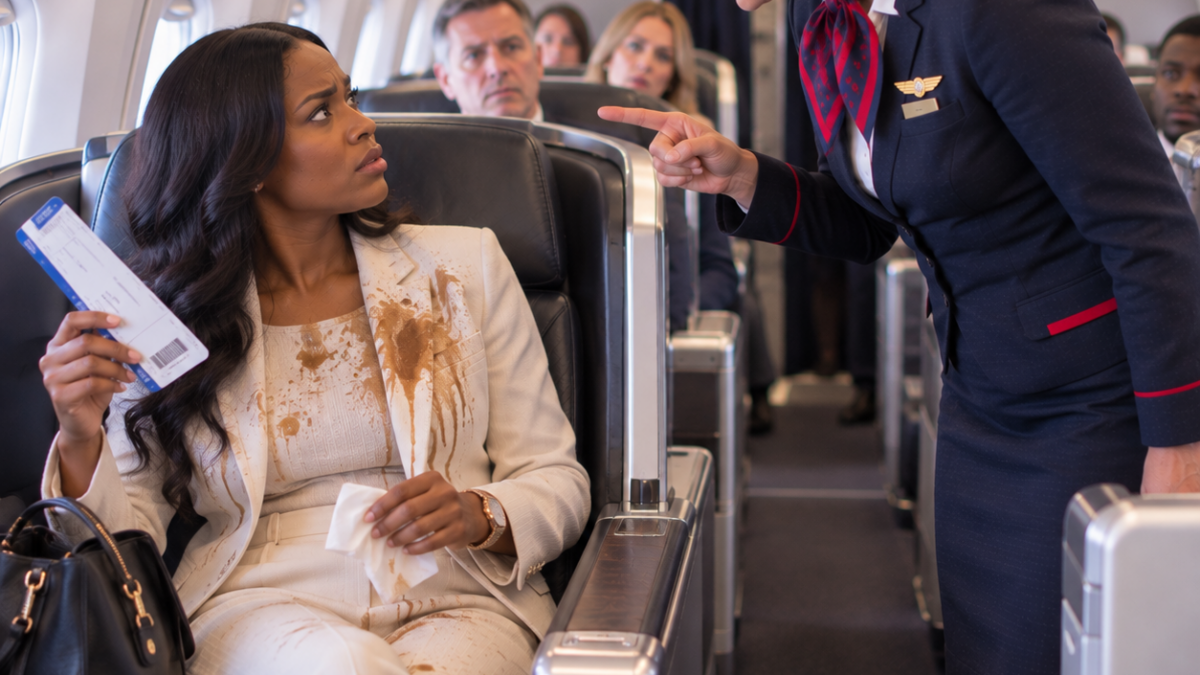
I had spent most of my adult life learning how power behaves when it believes no one important is watching.
Vanessa’s mistake was believing I needed to display mine.
I didn’t.
At least not yet.
The man to my left was already asleep again before the aircraft finished taxiing.
The woman to my right tightened her grip on a small dog that looked equally unhappy about our seating arrangement.
My knees pressed against the seat in front of me.
The leather briefcase that had fit comfortably beside me in 1B now sat awkwardly between my shoes.
Inside were contracts, financial models, regulatory summaries, and notes connected to the merger I was supposed to finalize in New York.
I looked toward first class.
Vanessa was pouring champagne.
She laughed at something Mr. Grayson said.
Then she glanced back toward me.
Our eyes met.
Her smile became smaller.
Sharper.
I opened my phone.
One message waited from my assistant.
MERGER DOCUMENTS READY.
CALL WHEN YOU LAND.
I typed back.
REVIEWING NOW.
Then the aircraft accelerated down the runway.
Los Angeles disappeared beneath us.
For twenty minutes, nothing happened.
I almost convinced myself Vanessa had gotten whatever satisfaction she wanted from moving me.
Then the seatbelt sign switched off.
Her heels clicked down the aisle.
She stopped beside 9C.
“Mr. Langston.”
“Yes?”
“We need to discuss your attitude.”
I looked up.
“My attitude?”
“You challenged me repeatedly during boarding.”
“I asked why you were moving me from a seat I purchased.”
“You made the situation confrontational.”
“I never raised my voice.”
“You don’t have to raise your voice to be aggressive.”
There it was.
A familiar word.
Aggressive.
I had heard it in boardrooms.
Performance reviews.
Negotiations.
Sometimes it meant genuinely aggressive.
Sometimes it meant a Black man had said no without apologizing enough.
I kept my voice level.
“What exactly are you asking me to do now?”
“Cooperate.”
“With what?”
She stared at me for several seconds.
Then smiled.
“Just remember who’s responsible for this cabin.”
She walked away.
The woman beside me shifted uncomfortably.
“That was weird.”
I looked at her.
She immediately looked down at her dog.
“I mean…”
She hesitated.
“You seemed pretty calm.”
“Thank you.”
That was apparently the end of her courage.
About an hour into the flight, the beverage cart reached us.
Vanessa was pushing it herself.
She served the woman beside me.
Then the sleeping man woke long enough to ask for whiskey.
Finally, she looked at me.
“Coffee?”
“Water would be fine.”
She picked up a coffee cup anyway.
“I thought you said coffee.”
“I said water.”
She reached over me.
Her elbow moved.
The cup tipped.
Hot coffee spilled across my lap.
I jerked backward.
Pain flashed through my thighs.
“Damn.”
Several passengers gasped.
Vanessa stepped away.
“Oh.”
Her voice contained no surprise.
“I am so sorry.”
The woman with the dog stared.
“That looked—”
Vanessa turned toward her.
“Accidents happen.”
Then she tossed napkins toward me.
Not handed.
Tossed.
“Clean yourself up.”
I looked down at my suit.
Coffee soaked the fabric.
Some had splashed across the side of my briefcase.
My skin burned.
I breathed slowly.
“You need to document this.”
Vanessa laughed.
“Document an accident?”
“Yes.”
“I’ll note it.”
“Medical kit.”
Her smile disappeared.
“What?”
“My leg is burned.”
“It isn’t that hot.”
I looked directly at her.
“Bring me the medical kit.”
She stood there for two seconds.
Then walked away.
A junior attendant arrived instead.
His name was Daniel.
He looked embarrassed.
“I brought burn gel.”
“Thank you.”
He lowered his voice.
“I’m sorry.”
“You didn’t spill it.”
He glanced toward the front.
“I know.”
That answer interested me.
“Daniel.”
“Yes, sir?”
“Did you see what happened?”
His face tightened.
“I was behind the cart.”
“Did you see it?”
He hesitated.
“Yes.”
I nodded.
“Thank you.”
He looked frightened.
I understood why.
“I’m not asking you to do anything.”
He relaxed slightly.
“But if someone asks later, tell them what you actually saw.”
His eyes met mine.
“I will.”
I treated the burn as discreetly as possible.
The skin was red but not blistered.
Painful.
Manageable.
My suit was another matter.
The merger documents in my briefcase had escaped serious damage, but the leather was wet.
I removed my laptop.
Thankfully dry.
I opened the financial model.
Work had always been my easiest way to control anger.
Numbers did not care about race.
Spreadsheets did not develop suspicions because of a suit or skin color.
Either the assumptions worked or they didn’t.
The merger involved acquiring a regional aviation technology and maintenance company that Horizon badly needed.
People described me publicly as an investor.
That was true.
Incomplete, but true.
I had first invested in Horizon fifteen years earlier when it was a struggling mid-size carrier with aging aircraft and terrible debt.
Over time, my investment group provided capital during two major restructurings.
We financed fleet modernization.
Backed refinancing during the pandemic.
Supported a route expansion that later became one of Horizon’s most profitable decisions.
Through various holding companies and direct ownership, I now controlled fifty-one percent of Horizon’s voting shares.
Most employees did not know my face.
They knew Ethan Carver as CEO.
They knew the board chairman.
They knew corporate branding.
I preferred it that way.
I had no interest in becoming a celebrity owner.
My role was capital allocation, governance, and long-term strategy.
Ethan ran the airline.
At least that was how the structure was supposed to work.
I returned to my laptop.
Thirty minutes later, Vanessa came back.
She stopped beside me.
“Tray table problem.”
I looked at the tray.
“What problem?”
“It’s been reported as damaged.”
“By whom?”
“Crew.”
“It was working until your coffee landed on it.”
She ignored that.
“Tampering with aircraft equipment is a serious issue.”
I stared at her.
“Are you accusing me of damaging the tray table?”
“I am recording an irregularity.”
“You spilled coffee on it.”
Her expression hardened.
“Sir, I suggest you stop arguing.”
The woman beside me looked at the tray.
“He didn’t do anything.”
Vanessa turned.
“Ma’am, please let crew handle safety matters.”
The woman shrank immediately.
Vanessa walked away.
Ten minutes later, a security contractor approached.
Airlines sometimes carried security personnel on certain routes or positioned them among traveling staff.
This man was large.
Professional.
Not hostile.
“Mr. Langston?”
“Yes.”
“We’ve received a concern about possible interference with cabin equipment.”
“Look at the tray.”
He did.
Sticky coffee.
Nothing else.
“May I inspect your bag?”
“Why?”
“Crew reported unusual behavior.”
I glanced toward Vanessa.
She stood near the galley.
Watching.
I looked back at the officer.
“I’ll consent to a visual inspection.”
“Thank you.”
I opened the briefcase myself.
Laptop.
Contracts.
Tablet.
Chargers.
No tools.
Nothing unusual.
He nodded.
“Everything looks fine.”
“It is.”
He returned my bag.
“Sorry for the inconvenience.”
“You have nothing to apologize for.”
Then I added:
“Please document who initiated the complaint.”
He glanced toward Vanessa.
“I will.”
The moment he left, whispers started.
I heard one man from first class say:
“Told you he didn’t belong up there.”
My hands became still.
That sentence affected me more than Vanessa’s coffee.
Not because one stranger mattered.
Because he had watched everything.
The valid ticket.
The seat change.
The security search finding nothing.
And somehow the conclusion remained that I was the suspicious one.
Vanessa began moving among passengers.
I watched her bend toward one seat.
Then another.
Quiet conversations.
Glances toward me.
A woman in first class turned around and stared.
Then whispered to her husband.
A few minutes later, the woman beside me pulled her dog closer.
I looked at her.
She flushed.
“Sorry.”
“For what?”
“I don’t know.”
That was the problem.
Fear had been created without an event.
Vanessa did not need evidence anymore.
She had supplied a narrative.
I was troublesome.
Everything afterward could be interpreted through it.
I had seen that in corporations too.
Label someone difficult.
Then every question becomes insubordination.
Every disagreement becomes proof.
Every neutral action becomes suspicious.
Vanessa understood that technique instinctively.
I reopened my laptop.
The merger model appeared.
I focused.
Twenty minutes later, a soda can tipped across my keyboard.
The sound was small.
The damage wasn’t.
Liquid spread between the keys.
The screen flickered.
Then went black.
I stood so quickly the sleeping man jerked awake.
“What the hell?”
Vanessa held both hands up.
“The cart caught.”
I looked at the wheels.
The cart had not moved.
“You poured soda onto my computer.”
Her mouth opened.
“I absolutely did not.”
“You’ve now spilled two drinks on me.”
“Accidents happen.”
“Not like this.”
Passengers were watching again.
She leaned closer.
“Careful.”
“Careful?”
“You’re getting angry.”
I almost laughed.
Of course.
She could pour a drink onto a laptop.
My reaction would become the issue.
I sat down.
“Bring me an incident report form.”
Her eyes narrowed.
“We don’t provide those in flight.”
“Then note the damage officially.”
“I’m not responsible for your electronics.”
“You caused the damage.”
“That is your opinion.”
She walked away.
I stared at the dead computer.
Months of work were backed up.
I was not worried about losing the merger.
I was worried about the precision of what she was doing.
Every incident gave her plausible deniability.
Seat confusion.
Coffee accident.
Equipment concern.
Soda accident.
Nothing by itself sounded impossible.
Together, the pattern was unmistakable.
I pulled out my phone.
Cloud backups gave me access to the documents.
Slowly.
I activated the hotspot and began working.
Twenty minutes later, the intercom chimed.
Vanessa’s voice filled the cabin.
“Ladies and gentlemen, we’ve been asked to shut down personal wireless hotspots due to reported signal interference.”
I froze.
There was no general prohibition on phone hotspots in cruise under these conditions.
At least none I knew of.
Then the captain spoke.
“We’ve identified a device in row nine creating a concern.”
Heads turned.
Every head seemed to turn toward me.
I looked at my phone.
Hotspot active.
I switched it off.
Then pressed the call button.
Daniel arrived.
“Can you ask the captain to clarify whether my phone actually interfered with navigation?”
His eyes widened.
“I…”
“Just ask.”
A few minutes later he returned.
“The captain says operations asked that all hotspots be disabled.”
“All?”
“Yes.”
“Not mine specifically?”
He looked uncomfortable.
“Yes.”
I nodded.
“Thank you.”
Vanessa had transformed a cabin-wide request into an accusation directed toward me.
Again.
By then, several passengers had decided I was dangerous.
One man from first class eventually came back.
Tall.
White.
Mid-fifties.
Bourbon on his breath.
“Man, just chill.”
I stared at him.
“I haven’t spoken to you.”
“Everybody’s trying to have a normal flight.”
“So am I.”
“Then stop causing problems.”
“What problem did I cause?”
He pointed toward the front.
“Signal thing.”
“That wasn’t me.”
“Tray.”
“I didn’t damage it.”
He laughed.
“Of course.”
I stood slowly.
Not to threaten him.
Because being spoken down to while seated felt intolerable.
“I paid for seat 1B.”
“I was moved without cause.”
“I have been searched.”
“I have had two drinks spilled on me.”
“I have been accused of damaging equipment I didn’t touch.”
“And now a stranger who has been drinking is standing over me telling me I am the problem.”
His face reddened.
“You calling me drunk?”
“I am describing the obvious.”
He moved closer.
“Maybe there’s a reason they moved you.”
There it was again.
The cabin became quieter.
I looked at him.
“What reason?”
He said nothing.
“Say it.”
His jaw tightened.
“Maybe you don’t belong up there.”
The words hung between us.
I nodded once.
“Thank you.”
He looked confused.
“For what?”
“For finally saying the quiet part out loud.”
He backed away.
“Whatever.”
He returned to first class.
I sat again.
My pulse was elevated.
But my mind was clear.
The flight no longer mattered only as a personal humiliation.
I needed evidence.
I began making notes on my phone.
Time.
Seat issue.
Overhead bin.
Coffee spill.
Security complaint.
Soda damage.
Wireless announcement.
Passenger confrontation.
Then Vanessa made her most dangerous move.
She announced that I had threatened her.
Loudly.
Publicly.
“I need everyone to remain calm.”
Her voice came over the cabin.
“We’re dealing with a passenger who has made threatening remarks toward crew.”
Passengers began looking around.
Then Vanessa pointed.
At me.
Chaos does not need much invitation inside an airplane.
A cabin is a sealed space.
People already surrender control to strangers.
Pilots.
Crew.
Security.
The idea that someone among them is dangerous spreads quickly.
The man with the bourbon stood again.
“What did he say?”
Vanessa put on a frightened expression.
“I don’t want to repeat it.”
That was enough.
Another passenger shouted:
“Get him off.”
I stood.
“I have never threatened her.”
The bourbon man walked toward me.
“Sit down.”
I stared.
“You should take your own advice.”
He shoved my shoulder.
The cabin erupted.
I stumbled sideways against a seat.
Another man grabbed the first man’s arm.
Someone shouted.
Phones appeared.
The woman with the dog screamed.
I did not strike anyone.
That decision may have saved me.
Two security officers moved through the aisle.
They separated the men.
Then Vanessa said:
“He started it.”
I looked at her.
“No.”
“He threatened me.”
“No.”
“He became aggressive.”
“No.”
The larger officer turned toward me.
“Sir, put your hands where I can see them.”
I did.
“Do you have any weapons?”
“No.”
“Turn around.”
I stared at him.
“Why?”
“We need to stabilize the cabin.”
“I was shoved.”
“I understand.”
“Then why are you restraining me?”
“Temporary.”
I looked around.
Passengers recording.
Whispering.
Judging.
Vanessa stood several feet away.
Calm again.
I turned around.
The cuffs closed.
Cold metal.
Tight enough to hurt.
The bourbon man smiled.
Someone said:
“Knew it.”
I closed my eyes.
That sound stayed with me.
Knew it.
They knew nothing.
Yet the handcuffs seemed to prove everything Vanessa had told them.
She walked closer.
“You should have just followed instructions.”
Only I could hear her.
I turned my head.
“Everything on this aircraft is recorded.”
For the first time, her expression flickered.
Then she recovered.
“Good.”
I smiled faintly.
“Yes.”
“Good.”
Twenty minutes later, she claimed I had tampered with her drink.
That was when another passenger finally spoke.
His name was Walter Price.
Retired electrician.
Sixty-seven years old.
Denim jacket.
Gray beard.
He had been sitting across the aisle two rows behind me.
“He never touched her drink.”
The security officer looked at him.
“You saw that?”
“I’ve been watching this mess for hours.”
Vanessa turned.
“Sir, please stay out of this.”
“No.”
Walter stood.
“You moved that man.”
“You spilled coffee.”
“You spilled soda.”
“You sent security after him.”
“And now you’re saying he touched your drink when he hasn’t been within ten feet of it.”
The entire cabin changed.
Not completely.
But enough.
Truth had acquired a witness.
I looked toward the ceiling camera.
“Check video.”
The officer radioed the cockpit.
Several minutes passed.
Then the captain responded.
No evidence showed me approaching Vanessa’s beverage.
The poisoning allegation collapsed immediately.
The cuffs came off.
I rubbed my wrists.
Vanessa looked furious.
Then the captain announced a diversion to Denver.
Not because of poisoning.
Because the conflict in the cabin had become a safety issue.
That decision was reasonable.
We landed shortly afterward.
Paramedics boarded.
Airport police boarded too.
Vanessa changed her accusation.
She now claimed I had grabbed her arm during the earlier confrontation.
She displayed a red mark.
The bourbon-drinking passenger claimed he saw me lunge.
I stared at him.
He would not look at me.
Police asked me to step off the aircraft.
Then they cuffed me again.
Vanessa watched from the doorway.
Her eyes met mine.
That time, I finally understood the scale of the problem.
She was not protecting a cabin.
She was protecting herself from consequences.
Every lie required a larger lie afterward.
Seat confusion became safety concern.
Safety concern became aggression.
Aggression became threat.
Threat became assault.
If I did not stop the chain with evidence, the story would become whatever she wrote first.
At the airport police facility, I called Carla Reyes.
My attorney.
She arrived before midnight.
Carla was five-foot-three and had the temperament of an annoyed federal prosecutor.
“What evidence?”
She asked.
“Cabin cameras.”
“Passengers.”
“Daniel.”
“Walter Price.”
“The woman in 9D.”
“Security search.”
“Everything.”
She nodded.
“Good.”
“Do not talk to anyone else.”
“I haven’t.”
“Excellent.”
The galley footage arrived first.
No contact.
Then passenger video.
No lunge.
Then Walter gave a statement.
The assault allegation fell apart.
I was released.
Carla looked at my ruined suit.
“What the hell happened to you?”
“Customer service.”
She almost laughed.
Then saw I was serious.
“Marcus.”
“Yes?”
“Call Ethan.”
“Not yet.”
Her eyebrows rose.
“You own half the damn airline.”
“Fifty-one percent.”
“Even better.”
“I want evidence preserved before anyone at Horizon knows how high this goes.”
“Why?”
“Because Vanessa was too comfortable.”
Carla considered that.
“You think she’s protected.”
“I think people do not behave that confidently unless experience tells them consequences are unlikely.”
She nodded slowly.
“Now you’re thinking like a plaintiff.”
“I prefer thinking like an owner.”
The next morning, I tried to book a Horizon flight to New York.
The kiosk rejected me.
RESTRICTED PASSENGER.
A gate agent approached.
“Mr. Langston?”
“Yes.”
“You’ve been placed on an internal no-fly list pending investigation.”
I stared at her.
“Based on what?”
“Crew safety report.”
“From Vanessa Creed?”
She looked uncomfortable.
“I can’t discuss personnel matters.”
“Of course.”
I stepped away and called Carla.
“They banned me.”
Silence.
Then:
“Send me everything.”
Within an hour, Horizon legal received a preservation notice and formal challenge.
The internal ban was lifted before noon.
That should have ended it.
Instead, a tabloid story appeared.
VIOLENT BUSINESSMAN REMOVED FROM HORIZON FLIGHT.
My photograph showed me in cuffs.
Coffee-stained suit.
Bruised jaw.
Perfect visual evidence for a false story.
Anonymous “crew sources” claimed I had threatened employees.
Another source called me a fraud pretending to have influence inside Horizon.
That part almost made me laugh.
Then clients began calling.
The merger team paused negotiations.
My assistant sounded panicked.
“Marcus, they want reassurance.”
“They’ll have it.”
“Do we issue a statement?”
“Not yet.”
“Boss.”
“Not yet.”
Then I called Ethan Carver.
CEO of Horizon.
We had known each other since college.
He had run the airline operationally for nearly eight years.
I had backed him for the job.
He answered immediately.
“Marcus.”
“You’ve seen it?”
“Yes.”
“It’s garbage.”
“Yes.”
“Then why am I still seeing statements from Horizon saying you’re investigating passenger misconduct?”
Silence.
“PR moved fast.”
“Without speaking to me.”
“I know.”
“I own fifty-one percent of this company, Ethan.”
“I know.”
“Apparently Vanessa doesn’t.”
“No.”
“Do you?”
Another silence.
“Marcus.”
“Preserve everything.”
“Crew records.”
“Prior complaints.”
“Passenger reports.”
“Internal emails.”
“Every camera file.”
“I already started.”
“Good.”
“Come to New York.”
“I am.”
“We’ll fix it.”
I wanted to believe him.
For several hours, I did.
Then Horizon’s board froze my voting shares pending a conduct review.
I read the email twice.
Then a third time.
The board did not have the legal authority to confiscate my ownership.
But under certain governance agreements tied to ongoing merger activity, they could temporarily suspend specific voting rights if they believed my conduct created a material reputational threat.
The clause had been written for criminal misconduct by controlling shareholders.
Not false accusations from a flight attendant.
Someone had weaponized it.
I called Ethan.
“What happened?”
“Gerald Klein.”
Board treasurer.
Old money.
Old airline family.
Old resentments.
“He pushed an emergency vote.”
“Why?”
“Vanessa talked to him.”
“How does a flight attendant get direct access to Gerald?”
Silence.
“Ethan.”
“They’re related.”
I stopped.
“What?”
“Her mother is Gerald’s half-sister.”
Everything clicked.
The confidence.
The complaints disappearing.
The lack of fear.
“Why didn’t I know this?”
“It never seemed relevant.”
“It is relevant now.”
“Marcus, I fought the vote.”
“You lost.”
“Yes.”
I closed my eyes.
“Do not touch anything else.”
“What are you going to do?”
“Find out how many people she did this to before me.”
That investigation changed everything.
Carla obtained records through formal legal demands.
My team reviewed internal complaints.
Three cases appeared almost immediately.
Then six.
Then nine.
Black passengers questioned about premium tickets.
Latino travelers accused of moving seats.
An older Black physician removed from business class after a manifest dispute later proven to be an airline error.
A young Black entrepreneur accused of vaping after a device was found near his seat.
He denied ownership.
The complaint had been closed quietly.
Vanessa’s name appeared repeatedly.
So did Gerald’s.
Not directly in the incidents.
In the aftermath.
HR notes.
Executive referrals.
Instructions to “resolve discreetly.”
One email was devastating.
GERALD REQUESTS NO FORMAL DISCIPLINE.
FAMILY SITUATION.
I sat in Carla’s conference room staring at it.
“Family situation.”
Carla shook her head.
“She had an uncle on the board cleaning up behind her.”
“Apparently.”
“What do you want to do?”
“Publicly?”
“Yes.”
“Nothing yet.”
She stared.
“Marcus.”
“We need proof before outrage.”
“We have proof.”
“We have pattern.”
“I want the mechanism.”
That mechanism came from Daniel.
The junior attendant from Flight 119.
He called Carla privately.
“I want to talk.”
We met with counsel present.
Daniel looked terrified.
“Vanessa told us nobody could touch her.”
“When?”
“All the time.”
“Why?”
“Mr. Klein.”
“She said if managers complained, she would call her uncle.”
“Did she?”
“I saw it happen once.”
“What happened?”
“A supervisor wrote her up for insulting a passenger.”
“The write-up disappeared.”
Daniel swallowed.
“She bragged about it.”
I felt something settle inside me.
Not rage.
Clarity.
“Did anyone report the pattern?”
“Yes.”
“What happened?”
“People learned not to.”
Then Walter Price contacted us.
Then the woman from 9D.
Then one of the security officers.
Then a former Horizon HR manager.
The system opened slowly.
Once one person realized another person was speaking, fear lost some of its power.
We released verified evidence.
Not anonymous accusations.
Video.
Records.
Timeline.
The public story changed almost overnight.
Footage showed Vanessa repeatedly targeting me.
Witnesses described the pattern.
The assault allegation had already been disproven.
The tabloid retracted key claims.
Horizon suspended Vanessa.
Gerald Klein resigned from the board.
Official reason:
Personal circumstances.
I issued one statement.
Not about r@c!sm.
Not yet.
About governance.
“Horizon cannot demand trust from passengers while protecting employees from accountability because of family relationships or internal influence.”
The stock fell.
Then recovered.
The merger partner returned to negotiations.
The board restored my voting rights.
Ethan called.
“We need you back publicly.”
“I never left.”
“You know what I mean.”
“Yes.”
“Come to headquarters.”
I did.
The emergency board meeting lasted four hours.
Some directors apologized.
Some defended themselves.
One said:
“We acted based on available information.”
I looked at him.
“You acted before obtaining available information.”
He shifted.
“We faced a reputational crisis.”
“You created one.”
Another director said:
“Marcus, nobody knew how serious the employee problem was.”
“That is not a defense.”
“Why not?”
“Because we paid people to know.”
The room went silent.
I looked toward Ethan.
“Who was responsible for employee conduct escalation?”
“HR.”
“Who supervised HR?”
“Chief people officer.”
“Who reviewed repeated high-risk complaints?”
“Legal and operations.”
“Who received board referrals?”
Silence.
Finally Ethan said:
“My office.”
I nodded.
“Then this is not Vanessa’s failure.”
“It is ours.”
Ethan looked down.
“Yes.”
That answer saved him with me.
Not because it erased anything.
Because leadership begins when excuses end.
We appointed an independent investigation.
No board control.
No executive filtering.
Outside counsel.
Civil-rights experts.
Aviation operations specialists.
Employee interviews protected from retaliation.
The findings took months.
Vanessa had engaged in repeated discriminatory and abusive conduct.
Gerald had intervened improperly.
But the larger failure was structural.
Complaint data lived in separate systems.
Passenger issues did not automatically connect with employee conduct files.
Managers could downgrade allegations.
VIP and board referrals bypassed ordinary review.
People learned who was protected.
The report did not describe Horizon as an airline built on r@c!sm.
Reality was more complicated.
Most employees were decent.
Most crews were professional.
Many managers had never heard Vanessa’s name.
But one protected person had exploited gaps.
And those gaps harmed the same kinds of passengers disproportionately.
That distinction mattered.
Systems do not need every person to be prejudiced.
They only need enough people to ignore patterns.
Vanessa was fired.
Not “on the spot.”
I refused that.
People expected me to call Ethan the moment I was moved from 1B and order her removed before landing.
That would have made a satisfying story.
It would have taught the wrong lesson.
I wanted evidence.
Process.
A record no one could later call revenge.
Her termination followed investigation.
So did discipline for managers who buried complaints.
Gerald’s resignation became permanent.
He also lost a lucrative advisory relationship connected to Horizon.
Then came the part I did not expect.
Threats.
Not movie-villain threats.
Real ones.
Anonymous emails.
Doxxing.
Messages calling me a race hustler.
Investors accusing me of destroying value for politics.
Vanessa gave interviews claiming I had used wealth to crush a working-class woman.
Some people believed her.
They said:
“Why didn’t he just tell her he owned the airline?”
That question followed me everywhere.
My answer never changed.
“Because I shouldn’t have needed to.”
If your behavior changes only when you learn someone’s status, then your behavior was never based on principle.
One interviewer pushed me.
“But surely you could have stopped the entire incident.”
“Yes.”
“Why didn’t you?”
“Because the man in 9C without fifty-one percent should not need me to explain why what happened was wrong.”
That clip spread widely.
So did another question.
“Did you enjoy firing her?”
“No.”
The host looked surprised.
“Really?”
“No.”
“Why not?”
“Because firing one person does not repair the conditions that protected her.”
That became our work.
Horizon changed complaint tracking.
Repeated allegations against employees triggered independent pattern review.
Premium cabin verification rules became uniform and auditable.
Seat disputes required system documentation.
Crew allegations involving safety remained protected, but deliberately false claims carried serious consequences.
Security intervention required contemporaneous documentation where possible.
Cabin camera retention expanded for major incidents.
Employees received clearer authority to challenge discriminatory instructions from colleagues or supervisors.
We also changed something less visible.
Board relatives.
No informal protection.
Any board or executive intervention in employee discipline had to be logged and reviewed by independent counsel.
Gerald’s “family situation” would never happen quietly again.
Daniel remained with Horizon.
Three years later, he became a cabin manager.
Walter Price received free travel for a year.
He complained.
“I spoke the truth, not saved the airline.”
I told him:
“Then consider it compensation for being the only passenger on that flight who remembered truth before popularity.”
He laughed.
The woman from 9D wrote me a letter.
She apologized for pulling away from me during the flight.
One sentence stayed with me.
“I believed you were dangerous because everyone else suddenly seemed to believe it, and I am ashamed of how easily fear borrowed my judgment.”
I framed that sentence.
Not the apology.
The insight.
Group fear had been one of Vanessa’s strongest weapons.
People think mobs begin with screaming.
Usually they begin with permission.
One person says he is dangerous.
Another repeats it.
Someone moves away.
Someone else decides the movement itself is evidence.
Soon everybody believes everyone else knows something they don’t.
That mechanism frightened me more than Vanessa herself.
The merger eventually closed.
Six months late.
Different terms.
Still successful.
Horizon expanded.
Profits improved.
But my relationship with the airline had changed.
Before Flight 119, I saw Horizon primarily as an investment.
Aircraft.
Routes.
Margins.
Debt.
Labor.
Fuel.
Capital.
Afterward, I saw every spreadsheet differently.
Customer complaints were not abstract service metrics anymore.
Employee turnover was not merely a cost line.
Governance was not legal architecture.
Every system eventually touches a person.
Sometimes in seat 1B.
Sometimes in 9C.
The question is whether leadership notices before the damage becomes a headline.
Two years after Flight 119, Ethan came into my office.
“You’re selling.”
It was not a question.
“Yes.”
“How much?”
“Most of it.”
He sat down.
“Why?”
“I have other things I want to build.”
“Horizon?”
“Will survive.”
“You built half this company.”
“No.”
I looked at him.
“Thousands of employees built this company.”
“I supplied capital.”
“You supplied more than that.”
“Maybe.”
He leaned back.
“Are you leaving because of what happened?”
“Partly.”
“So Vanessa wins?”
I laughed.
“No.”
“Then explain it.”
I looked out across Manhattan.
“I spent years believing ownership meant being able to protect the institution.”
“And?”
“Sometimes ownership becomes a reason to stay inside a structure longer than you should.”
Ethan frowned.
“You think Horizon is broken?”
“No.”
“I think Horizon is changing.”
“Good people are leading that.”
“Then why leave?”
“Because I no longer need fifty-one percent of an airline to prove I can influence aviation.”
He smiled.
“You’re building another company.”
“Maybe.”
“Marcus.”
“Yes.”
“You are terrible at secrets.”
The sale took almost a year.
Institutional investors purchased much of my stake.
Employees received an expanded equity plan as part of the transaction.
I retained a smaller position.
Enough to care.
Not enough to control.
Financial press estimated the deal at a little over two billion dollars across multiple transactions and related holdings.
The headline wrote itself.
HORIZON’S MAJORITY OWNER CASHES OUT AFTER CIVIL-RIGHTS SCANDAL.
That was not how I saw it.
I was not cashing out of injustice.
I was reallocating capital.
The economist in me enjoyed that phrase.
The man who had sat in 9C enjoyed something else.
Freedom.
My new aviation company did not begin as an airline.
That surprised everyone.
It began with airport technology.
Passenger identity systems.
Complaint analytics.
Crew safety reporting.
Data tools designed to detect patterns institutions usually miss.
Who gets questioned repeatedly?
Whose seat assignments are challenged?
Which employees generate disproportionate complaints?
Which complaints vanish after executive intervention?
Where are service rules applied inconsistently?
Data cannot eliminate prejudice.
But it can make patterns harder to hide.
Eventually, we expanded.
Training.
Maintenance systems.
Regional aviation.
And yes, years later, aircraft.
A reporter asked whether I wanted to compete with Horizon.
“No.”
“Then why aviation?”
I smiled.
“Because I still love airplanes.”
That had never changed.
Vanessa eventually disappeared from public attention.
I did not follow her life closely.
Carla occasionally sent legal updates during the civil cases.
Vanessa settled several claims.
She lost her airline career.
She completed court-ordered programs related to later misconduct tied to harassment and false reporting.
There was no dramatic attempted murder.
No supervillain finale.
Real life did not need one.
What she had already done was enough.
She had used ordinary authority recklessly.
That is far more common.
And therefore more important.
Several years after Flight 119, I received an envelope with no return address.
Inside was a handwritten letter.
Vanessa.
I almost threw it away.
Instead, I read it.
She did not ask for forgiveness.
Good.
She did not claim she had been misunderstood.
Better.
She wrote:
I spent a long time believing what happened to me began when you fought back.
It did not.
It began long before you boarded.
I had been getting away with treating people differently for years.
Every time nothing happened, I convinced myself nothing was wrong.
Then I confused protection with proof that I was right.
I stopped reading for a moment.
That sentence hit me.
Protection with proof.
That was exactly what Gerald had given her.
She continued.
When I learned who you were, my first thought was that I had chosen the wrong passenger.
It took me a long time to understand there should never have been a right passenger to treat that way.
I folded the letter.
Sat quietly.
Then placed it in the same drawer as the letter from the woman in 9D.
I never responded.
Forgiveness does not always require correspondence.
But I was glad she understood.
Years later, I boarded a Horizon flight again.
Los Angeles to New York.
Same route.
Different aircraft.
I purchased first class.
Seat 1B happened to be available.
I took it.
At the aircraft door, a young flight attendant greeted me.
“Welcome aboard, Mr. Langston.”
“Thank you.”
He scanned the pass.
“1B, right up front.”
No recognition in his eyes.
Perfect.
I lifted my briefcase toward the overhead bin.
He said:
“Let me know if you’d like help.”
“I’ve got it.”
A white man boarded behind me with a roller bag.
The attendant greeted him with exactly the same warmth.
I noticed.
Of course I noticed.
Old habits.
During boarding, an elderly Black couple entered.
Both dressed casually.
Matching university sweatshirts.
The woman carried a first-class boarding pass.
The attendant scanned it.
“Welcome, Dr. Harris.”
No surprise.
No second scan.
No question.
The couple sat across from me.
The husband smiled.
“Nice jacket.”
“Thank you.”
His wife looked at me.
“You look familiar.”
“My mother says that too.”
She laughed.
The attendant began champagne service.
Row one.
Everyone.
Same question.
Same glass.
Same courtesy.
The woman across from me lifted hers.
“To flying without drama.”
I raised mine.
“I’ll drink to that.”
We took off over Los Angeles.
The coastline disappeared.
I opened my laptop.
A newer one.
Water-resistant keyboard.
I had learned something practical from the experience.
Halfway across the country, the captain came on the intercom.
Weather ahead.
Possible deviation.
Normal flight.
Normal communication.
Normal cabin.
I realized how extraordinary normal had become to me.
No one cared that I was there.
No one knew my old ownership stake.
No one whispered.
No one watched.
I was simply another passenger in 1B.
That was the victory people misunderstood.
They thought power meant being able to fire Vanessa.
They thought the satisfying part was learning I controlled Horizon.
They thought the twist was that she had humiliated the man financing the airline.
But wealth was never the point.
In some ways, it made the story easier.
I had lawyers.
Resources.
Connections.
Evidence teams.
A platform.
Most people Vanessa treated badly had none of those things.
So the lesson could never be:
Be careful who you humiliate because he might own the airline.
That lesson is just another form of status worship.
The real lesson is simpler.
Do not humiliate people.
Do not invent suspicion where evidence gives you none.
Do not confuse a uniform with permission.
Do not let someone’s race, clothes, age, accent, or apparent income tell you whether they belong somewhere their ticket clearly says they belong.
And if you make a mistake, correct it before pride turns one bad decision into ten worse ones.
Vanessa had many chances to stop.
After the first scan.
After the second.
After the seat dispute.
After the coffee.
After the search.
After the video disproved her.
Every time evidence offered her an exit.
Pride blocked the door.
That, more than r@c!sm alone, destroyed her career.
Prejudice gave her the first assumption.
Power protected it.
Pride kept it alive.
The combination was devastating.
When we landed at JFK, I waited until most passengers had left.
The young attendant stood near the door.
“Have a good evening, Mr. Langston.”
“You too.”
I paused.
“What is your name?”
“Isaiah.”
“How long with Horizon?”
“Seven months.”
“Like it?”
He smiled.
“Honestly?”
“Preferably.”
“Yeah.”
“Training is intense.”
“Managers are strict.”
“But they take complaints seriously.”
“Sometimes too seriously.”
I smiled.
“That sounds familiar.”
He tilted his head.
Then recognition flashed.
“Wait.”
I raised a hand.
“Don’t.”
His eyes widened.
“You’re Marcus Langston.”
“Today I’m the guy from 1B.”
He laughed nervously.
“Yes, sir.”
I nodded toward the elderly couple ahead of us.
“You treated them well.”
His expression became confused.
“Of course.”
“Good.”
I shook his hand.
“That matters more than recognizing me.”
I stepped onto the jet bridge.
New York air met me at the terminal.
No cameras.
No headlines.
No handcuffs.
Just another arrival.
I had once believed the most important kind of power was ownership.
Fifty-one percent.
Board votes.
Capital.
The ability to move billions.
Flight 119 taught me something different.
The most consequential power is often much smaller.
The power to decide whether you believe the person standing in front of you.
The power to challenge a colleague when something feels wrong.
The power to document instead of look away.
The power to admit a mistake.
The power to refuse a crowd’s version of events until you’ve checked the facts.
Walter Price had that power.
Daniel had it.
The security officer who finally requested video had it.
The woman in 9D eventually found hers.
Even Vanessa eventually discovered the power to tell herself the truth, though far too late to avoid the consequences.
I did not build my next company because I wanted revenge on Horizon.
I built it because systems can be redesigned.
That became more interesting to me than punishment.
Years after selling most of my stake, I visited one of our aviation technology centers.
A group of interns was testing a complaint-pattern dashboard.
One young engineer showed me the screen.
“We built an alert for repeated premium-seat disputes.”
I stopped.
“What triggers it?”
“Same employee plus demographic disparities plus unusually high manual verification.”
He clicked.
“If patterns emerge, compliance sees it before ten separate complaints disappear into different departments.”
I stared at the dashboard.
The young engineer became nervous.
“Is something wrong?”
“No.”
I smiled.
“This is exactly right.”
He relaxed.
“Cool.”
To him, it was software.
To me, it was seat 1B.
It was 9C.
It was coffee burning through a suit.
It was cuffs.
It was a woman with a dog moving away because fear had borrowed her judgment.
And it was the possibility that the next person would never need to own an airline before someone noticed the pattern.
That was enough.
More than enough.
People still occasionally introduce me using the story.
“This is Marcus Langston.”
“The guy whose own flight attendant didn’t know he owned the airline.”
Everyone laughs.
I usually smile.
Then I correct one word.
“I didn’t own the airline.”
Someone inevitably says:
“You owned fifty-one percent.”
“Exactly.”
They look confused.
So I explain.
“No person owns an airline by himself.”
“Pilots fly it.”
“Mechanics keep it safe.”
“Dispatchers route it.”
“Flight attendants protect cabins.”
“Gate agents manage chaos.”
“Baggage crews move lives beneath the floor.”
“Customers fund every paycheck.”
“Investors provide capital.”
“Leadership provides direction.”
I pause.
“When any one of those groups starts believing the airline belongs to them more than everyone else, trouble begins.”
That was Vanessa’s mistake too.
She thought the cabin belonged to her.
I once thought Horizon belonged to me.
We were both wrong.
The difference was that I had enough people around me willing to prove it.
And if there is one thing Flight 119 taught me that I never forgot, it is this:
Real power is not making people discover who you are.
Real power is building a system where who you are does not determine whether you are treated with dignity.








