Flight Attendant Forced Me Out of First Class—Then She Collapsed and Whispered Four Words That Changed Everything
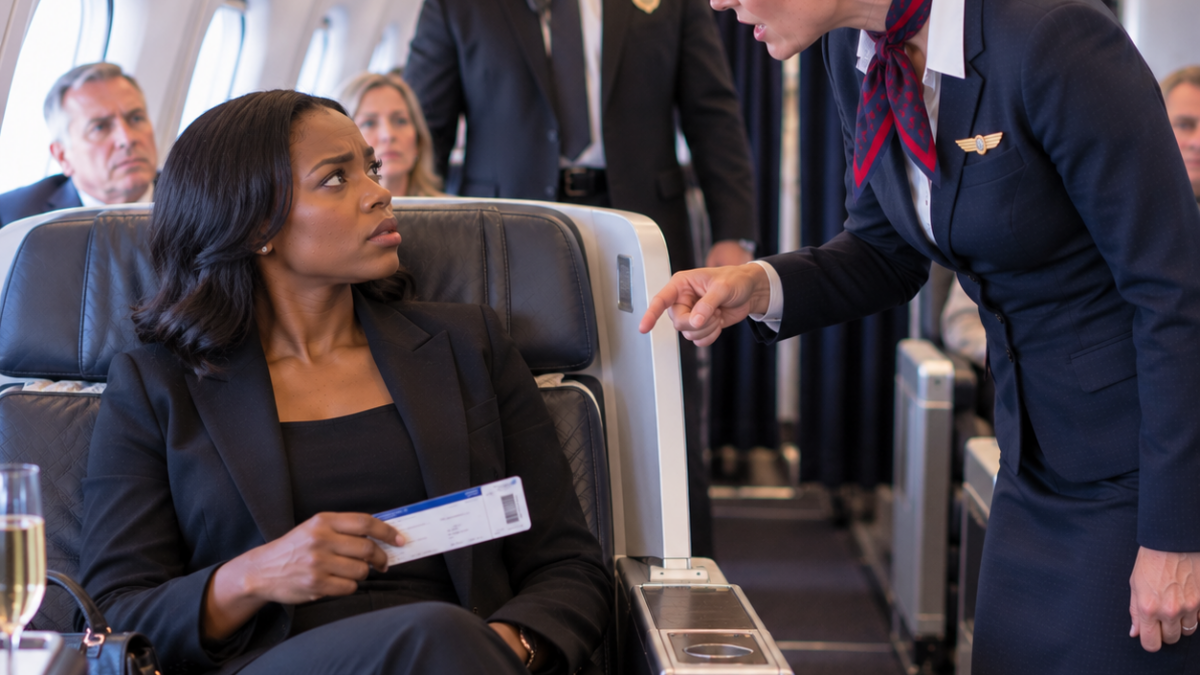
For three or four seconds, nobody moved.
Then the cabin exploded.
“Is there a doctor?”
“Give her space.”
“Move back.”
A passenger several rows behind me stood and hurried forward.
“I’m a cardiologist.”
Security pushed people away from Heather while the doctor knelt beside her.
I remained next to 3A.
Phone still recording.
Briefcase beneath the seat.
Boarding pass glowing on the screen.
And one word pounding through my head.
Warrant.
One of the security officers turned toward me.
“Ma’am, stay where you are.”
“I wasn’t planning on going anywhere.”
His partner crouched to help clear the aisle.
Heather was conscious.
Barely.
Her breathing came in short, shallow bursts.
But what struck me wasn’t her medical condition.
It was her eyes.
She kept looking at me.
Not like a woman in pain.
Like a woman who had realized she’d made a catastrophic mistake.
“What warrant?”
I asked.
The officer raised one hand.
“We’ll sort that out.”
“You arrived here because she called you.”
“Yes.”
“And she just said I’m not the person connected to a warrant.”
“Ma’am.”
“So before anybody asks me another question, I’d like an explanation.”
My voice remained calm.
That wasn’t because I felt calm.
My legal training had taken over.
When facts become chaotic, narrow the question.
Who knew what?
When did they know it?
What did they do because of it?
That instinct had made me successful in courtrooms.
Now it was keeping me from unraveling in seat 3A.
The cardiologist checked Heather’s pulse.
“She’s stable.”
Someone brought an emergency medical kit.
Heather closed her eyes.
The security officer looked at me.
“I need you to remain cooperative.”
That word irritated me immediately.
“I have been cooperative.”
“Nobody said you haven’t.”
“Your posture is saying something.”
His hand moved away from his belt.
Fair.
Maybe he realized how he looked.
Around us, at least a dozen phones were recording.
A teenager behind me whispered to her mother:
“This is already online.”
I heard another passenger say:
“First Class While Black.”
Social media had named my humiliation before I even understood it.
Paramedics boarded ten minutes later.
Heather sat up.
The cardiologist said her blood pressure was elevated but found no obvious signs of a major cardiac event.
She insisted she felt dizzy.
They placed her on a stretcher.
As they wheeled her toward the aircraft door, I called after her.
“Ms. Caldwell.”
She looked at me.
“What warrant?”
Her eyes moved toward the airline supervisor who had just boarded.
Then she turned away.
No answer.
That frightened me more than if she’d shouted.
Because silence from someone who had been confidently accusing me minutes earlier meant one thing.
There was a fact she suddenly did not want exposed.
The flight remained at the gate.
Passengers were told a security matter needed resolution.
I expected the officers to apologize and leave.
They didn’t.
Instead, one stood beside my row while the other spoke quietly into a radio.
A younger flight attendant named Ryan approached.
“Ms. Wright?”
“Yes.”
“Would you like water?”
“Please.”
He reached toward the galley.
An older crew member caught his arm.
Whispered something.
Ryan’s face changed.
He backed away.
No water.
I almost laughed.
Apparently hydration had become a security risk.
Then the captain came over the intercom.
“Ladies and gentlemen, we apologize for the delay.”
The cabin quieted.
“Due to an ongoing verification matter, we need one passenger to temporarily deplane so security can complete its review.”
I knew before he said it.
“Passenger seated in 3A, please gather your belongings.”
Every face turned toward me.
There are humiliations that happen privately.
Those hurt.
Public humiliation does something different.
It converts pain into spectacle.
Suddenly you’re not only experiencing something.
You’re watching everyone else decide what it means.
A woman near the front whispered:
“I knew something was off.”
The same woman who had questioned my seat earlier.
The businessman across the aisle looked disgusted.
“Are you serious?”
The security officer gestured toward the aisle.
“Ma’am.”
I remained seated.
“I’m complying under protest.”
“That’s fine.”
“No.”
I looked at my phone.
Then directly at him.
“I’m saying it clearly because I’m recording.”
“My boarding pass is valid.”
“I’ve committed no offense.”
“I am being removed after your airline employee admitted I am not the person associated with whatever warrant triggered this.”
The officer’s face tightened.
“I’m not airline security.”
“Fair correction.”
I stood.
“But you’re participating now.”
He nodded slightly.
Another fair point accepted.
Then I picked up my briefcase.
And began walking.
I will remember that aisle forever.
People pretending not to stare.
People openly staring.
Phones held chest-high.
Eyes following.
Some suspicious.
Some embarrassed.
Some sympathetic.
First class.
Premium economy.
Coach.
Hundreds of strangers received a visual message before they received any facts.
Black woman.
Security escort.
Removed from aircraft.
Our minds hate empty spaces.
So we fill them.
What did she do?
Was she violent?
Fraud?
Drugs?
Fake ticket?
The same human instinct that makes stories possible also makes prejudice efficient.
People hate admitting uncertainty.
By the time I reached the aircraft door, narratives were already being born.
The gate area was worse.
People had gathered after hearing about the commotion.
Fifty maybe.
Some travelers.
Some airline staff.
Almost everybody holding a phone.
“That’s her.”
“What happened?”
“She made the flight attendant collapse.”
I stopped.
That sentence reached me clearly.
She made the flight attendant collapse.
I turned toward the speaker.
A young man.
He looked away.
This was how quickly causation gets invented.
Heather had confronted me.
Heather had collapsed.
Therefore I had caused her collapse.
No evidence necessary.
Just sequence.
A customer-service supervisor introduced himself.
“Thomas Bentley.”
He directed us into a small office beside the concourse.
Two airport police officers waited inside.
I put my phone on the table.
Still recording.
“Now.”
I said.
“Explain the warrant.”
Thomas looked exhausted.
“Ms. Wright, we’ve had a significant identification problem.”
“That’s not an explanation.”
He inhaled.
“The airline’s passenger verification system flagged your name against a federal fraud warrant.”
“What name?”
“Morgana Wright.”
I stared.
“My name is Morgan.”
“We understand.”
“Apparently not.”
He continued.
“Morgana Wright is wanted in connection with financial fraud cases in three states.”
“Race?”
Thomas hesitated.
“Black.”
“Age?”
“Twenty.”
“I’m thirty-four.”
“Thirty-one, according to the file.”
“Height?”
He looked at the computer.
“Five-three.”
“I’m five-seven.”
One of the police officers looked increasingly uncomfortable.
“Tattoos?”
Thomas stopped.
“She has several distinctive tattoos.”
I rolled up my sleeves.
“Anything?”
“No.”
“So your system looked at two Black women with similar names and decided close enough.”
“Facial-recognition software generated a preliminary confidence score.”
“What confidence?”
“I don’t have the exact number.”
“Then why was I publicly accused of fraudulent travel documents?”
“Ms. Caldwell appears to have misinterpreted the alert.”
I leaned back.
“Misinterpreted.”
His corporate vocabulary was fascinating.
“My ticket was valid?”
“Yes.”
“My miles?”
“Valid.”
“My seat?”
“Valid.”
“My ID?”
“Valid.”
“Did I do anything wrong?”
“No.”
“Then say it.”
He blinked.
“You did nothing wrong.”
“Good.”
I pointed toward my phone.
“Now we’re starting with facts.”
Thomas offered me a flight three hours later.
Full refund.
Upgrade protected.
Ten thousand bonus miles.
Airport lounge access.
He presented it like generosity.
I stared at him.
“You removed me from a valid seat because your system can’t reliably distinguish Black women.”
“Ms. Wright—”
“You publicly labeled me suspicious.”
“Your employee accused me of fraud.”
“You escorted me off the aircraft in front of hundreds of people.”
“Videos are already circulating.”
“And you’re offering miles.”
“We want to make this right.”
“You want to make this inexpensive.”
He went quiet.
I checked my watch.
The strategy dinner in Chicago started in less than two hours.
Even if the next flight departed perfectly, I would miss it.
The meeting I had spent half a year building.
Gone.
I opened my phone.
Forty-three notifications.
Then sixty.
Then more.
The video was spreading.
One clip showed Heather shouting.
Another began after her collapse.
Another showed me walking down the aisle with security.
Context fragmented into content.
That’s how reputations get destroyed now.
Not always through one lie.
Through twenty incomplete truths.
I called Aiden Matthews.
Senior associate.
Friend.
Sometimes rival.
One of the few people at Ellis & Montgomery who understood exactly how much tomorrow mattered.
He answered immediately.
“They did what?”
I pulled the phone away.
“Lower your voice.”
“Where are you?”
“Still at the airport.”
“Westlake lands in Chicago in an hour.”
“I know.”
“Richard’s losing his mind.”
“I need you to stall.”
“How?”
“Mechanical delay.”
“Weather.”
“Anything.”
“Morgan.”
His voice softened.
“There’s video everywhere.”
My stomach tightened.
“Already?”
“You’re trending.”
I closed my eyes.
“Put Richard on.”
There was a pause.
“Maybe I should explain first.”
“Aiden.”
“He’s furious.”
“I’m aware.”
“Not about the airline.”
That told me everything.
A minute later Richard Ellis came on.
“Where the hell are you?”
“Airport.”
“You were supposed to be at the Peninsula in forty minutes.”
“I was removed from my flight after a racial-profiling incident.”
Silence.
Then:
“Can you get another flight?”
I blinked.
“That’s your first question?”
“My first question is whether you can fulfill your obligation to this firm.”
“I was just publicly detained because—”
“Save the social-justice analysis for later.”
Something inside me went cold.
“We have a hundred-million-dollar client arriving.”
“I built that client relationship.”
“Then you should’ve been here.”
I almost laughed.
“Would you like me to commandeer an aircraft?”
“Don’t get sarcastic.”
“Don’t blame me for something I didn’t cause.”
His voice dropped.
“Your judgment will be discussed when you return.”
“My judgment?”
“Aiden will lead tomorrow’s presentation.”
“Richard.”
“That’s final.”
The call ended.
I stared at the screen.
Seven years.
Fourteen-hour days.
Weekends.
Trials.
Settlements.
Clients who called me instead of partners twice my age.
One incident outside my control.
And suddenly my career had become conditional.
I thought the airline had humiliated me.
My employer had just shown me a deeper vulnerability.
Institutions love your excellence until protecting it becomes inconvenient.
That evening, I sat alone in an airport hotel.
I never reached Chicago.
The new flight was delayed again.
By then, missing the dinner was unavoidable.
I opened my laptop.
An email from Human Resources waited.
Temporary Administrative Leave.
Paid.
Effective immediately.
Pending review of “public circumstances potentially affecting firm reputation and client relationships.”
I read it twice.
Then once more.
I was being investigated because somebody else discriminated against me.
My phone rang.
Unknown number.
“Ms. Wright, Trevor Richardson.”
“Vice president of customer relations for Transcontinental Airways.”
His voice sounded manufactured in a laboratory for corporate reassurance.
“I’m calling regarding today’s unfortunate misunderstanding.”
“Racial profiling.”
A pause.
“We haven’t concluded that.”
“You removed the wrong Black woman because an algorithm confused two names.”
“Our system generated a security alert.”
“Your employee turned it into a public accusation.”
“We take discrimination extremely seriously.”
“Clearly.”
He ignored that.
“We’d like to offer a full refund, ten thousand miles, and a premium travel voucher.”
I laughed.
I couldn’t help it.
“Mr. Richardson.”
“Yes?”
“My firm just suspended me.”
“That’s unfortunate.”
“My partnership may be gone.”
“I understand you’re upset.”
“Do you?”
“We followed established security protocols.”
There it was.
The legal position.
I recognized it instantly.
This wasn’t an apology call.
It was evidence management.
“Then preserve everything.”
Silence.
“Excuse me?”
“All communications.”
“Passenger-profile data.”
“Cabin recordings.”
“Internal messages.”
“Any facial-recognition output.”
“Every communication concerning me today.”
His tone changed.
“Ms. Wright, there’s no reason to make this adversarial.”
“I’m an attorney.”
“Your employee accused me of fraud.”
“Your company removed me from a paid seat.”
“Your actions helped derail a hundred-million-dollar client meeting.”
“And now you’re telling me your protocols worked properly.”
I smiled without humor.
“It became adversarial before you called.”
I hung up.
Ten minutes later, an email arrived.
Unknown sender.
No message except a screenshot.
An internal Transcontinental memo.
Enhanced Verification Protocols — Premium Cabin Routes.
One phrase highlighted:
Special attention to unusual booking patterns and demographic anomalies.
Demographic anomalies.
Corporate language is extraordinary.
You can put cruelty in a PowerPoint and suddenly people feel sophisticated discussing it.
I downloaded the screenshot.
Saved it to cloud storage.
Then to another account.
Then sent it to myself through an encrypted service.
Instinct.
Evidence first.
Emotion later.
If Transcontinental wanted a quiet settlement, someone inside the company wanted the opposite.
By morning, I had barely slept.
The video had millions of views.
Some headlines supported me.
Others didn’t.
BLACK LAWYER REMOVED AFTER AIRLINE SECURITY ALERT.
FIRST-CLASS DISPUTE ENDS WITH ATTENDANT MEDICAL EMERGENCY.
One channel used a photograph of Heather being wheeled away beside a still image of me holding my phone.
The implication was obvious.
Cause and effect.
My mother called.
I lied.
“I’m fine.”
Mothers hear lies in frequencies unavailable to everyone else.
“You don’t sound fine.”
“I’m handling it.”
“You always say that when you don’t want anybody helping.”
“I love you too.”
“Come home.”
“Not yet.”
She sighed.
“You are your father’s daughter.”
Dad had died when I was twenty-one.
If persistence were inherited, he had left me an excessive amount.
I began researching.
Not as a victim.
As counsel.
Transcontinental passenger complaints.
Discrimination claims.
First-class disputes.
Upgrade challenges.
It took six hours to find enough public records to see a pattern.
Black premium-cabin passengers questioned disproportionately.
Several moved despite valid boarding passes.
Quiet settlements.
Confidentiality clauses.
Complaints increasing after rollout of a new passenger-verification system.
Then an investigative journalist called.
Vanessa Chen.
National Herald.
“I’ve been working on Transcontinental for months.”
I almost ended the call.
Reporters wanted stories.
I needed evidence.
Then she said:
“I’ve interviewed seventeen passengers who describe almost exactly what happened to you.”
I stopped.
“When can we meet?”
Vanessa brought documents.
A lot of them.
Passenger incident reports.
Internal emails.
Statistical comparisons.
One phrase appeared repeatedly:
Premium Cabin Standardization.
Another:
Passenger Profile Expectations.
“They don’t write race.”
Vanessa said.
“They write demographic consistency.”
I stared at an internal report.
Black passengers were being flagged at multiples far beyond booking variables.
“What’s FRP?”
I asked.
She slid a passenger manifest toward me.
My name was highlighted.
FRP.
“Further Review Protocol.”
“When was I added?”
Vanessa hesitated.
“After you complained last month.”
I remembered.
A broken entertainment screen.
Nothing dramatic.
I had filled out a feedback form.
No compensation requested.
Just reported it.
“So a customer complaint put me on a scrutiny list.”
“That’s what my source says.”
My phone vibrated.
Unknown sender.
Check your email.
Another document.
Phase-two profiling results.
The email included a warning:
They’re watching you.
I looked around the coffee shop.
A man two tables away lowered a newspaper.
Maybe coincidence.
Maybe not.
“We’re leaving.”
Vanessa didn’t argue.
Outside, she told me something worse.
Westlake Industries.
The company I had been trying to bring to Ellis & Montgomery.
One of Transcontinental’s largest corporate customers.
Their executives had negotiated “premium experience standards.”
Language vague enough to deny.
Specific enough to matter.
Then my phone alerted.
Transcontinental CEO James Whitfield was giving a press conference.
A photograph loaded.
Whitfield at the podium.
Behind him stood Richard Ellis.
My managing partner.
I showed Vanessa.
Her face changed.
“That’s not coincidence.”
No.
It wasn’t.
And for the first time, betrayal hurt more than discrimination.
An airline didn’t know me.
Richard did.
He had promoted me.
Praised me.
Put me in front of clients.
Told me I had partnership material.
Now he was standing beside the company accused of targeting me.
That was personal.
The next morning, I went to Ellis & Montgomery at seven.
Administrative leave or not, my badge still worked.
I told security I needed personal materials.
Technically true.
Then I went upstairs.
My office looked unchanged.
Photographs.
Law books.
Client binders.
The framed note from my mother after my first federal-court victory.
You walked into every room they told us wasn’t built for you.
I stared at it for several seconds.
Then logged in.
Westlake.
Transcontinental.
Edward Ellis.
Richard’s father and the firm’s retired founder.
Search.
The results made me physically ill.
Our firm had represented Transcontinental in all four discrimination settlements I’d found publicly.
Not coincidentally.
Not tangentially.
Direct representation.
Edward Ellis sat on Transcontinental’s board.
He owned millions in company stock.
Our attorneys had helped draft settlement language sealing passenger allegations.
The institution threatening my career had spent years protecting the institution that profiled me.
“Jesus.”
A voice behind me made me jump.
Lawrence Kim stood at the door.
“Morgan?”
“What are you doing here?”
“Apparently discovering why I shouldn’t trust anyone.”
He closed the door.
“Richard’s coming in.”
“Early?”
“Emergency partner meeting.”
I looked at him.
“Did you know?”
“About Transcontinental?”
He shook his head.
“Not until yesterday.”
“What happened in the meeting?”
“Richard was furious you missed Westlake.”
“Of course.”
“Edward joined remotely.”
Lawrence lowered his voice.
“He said something about board exposure.”
That confirmed everything.
Then he added:
“They reassigned your clients.”
All of them.
“Already?”
“Edward ordered it.”
I looked around my office.
They weren’t investigating me.
They were erasing me.
Richard arrived before I could finish reviewing the archive.
He summoned me.
His office felt different that morning.
Same glass walls.
Same city view.
Different power.
“Why are you accessing firm servers?”
“I came for case materials.”
“Your cases have been reassigned.”
“Without client consent?”
“Temporarily.”
“Why?”
“You are on leave.”
“Because your client profiled me.”
He went still.
“Transcontinental isn’t your concern.”
I laughed.
“I’m apparently their concern.”
“Don’t do this.”
“Do what?”
“Turn a security incident into a crusade.”
“Your father sits on their board.”
His expression changed.
Barely.
Enough.
“Our firm represented their previous discrimination cases.”
“Morgan.”
“You knew.”
“Be careful.”
That was when I knew.
Not suspected.
Knew.
People who have facts answer facts.
People protecting secrets warn you about tone.
I stood.
“I’m done being careful about other people’s misconduct.”
His jaw tightened.
“Your office is being reassigned.”
“To whom?”
“The Westlake team.”
“Of course.”
“Your personal things will be moved downstairs.”
“Where?”
“Temporary workspace.”
“Where?”
He looked almost embarrassed.
“Records level.”
Basement.
Seven years from corner office to basement file room in forty-eight hours.
Efficient.
I handed him my key card.
“Have my belongings delivered.”
Then walked out.
Before leaving, I stopped in IT.
Dev Patel had saved me from trial disasters more times than I could count.
He looked up.
“Morgan.”
“Quick question.”
I kept my voice normal.
“Anybody monitoring my accounts?”
His eyes shifted.
Then he typed.
Turned his screen.
YES. FULL MONITORING. YOUR OFFICE MAY BE RECORDED.
My stomach tightened.
I nodded casually.
“Thanks.”
As I turned, he slipped a small radio-frequency detector into my hand.
No explanation.
None necessary.
At home, I found three listening devices.
One beneath my desk.
One near the dining area.
One beside my bed.
I sat on the floor staring at the last one.
Until that moment, part of me still believed this was corporate cowardice.
Ugly.
Unethical.
But professional.
The device beside my bed changed that.
Someone had entered my home.
I called Xavier Thompson.
Civil-rights attorney.
Former conference acquaintance.
The kind of lawyer corporations hired consultants to warn them about.
I told him everything.
He listened without interrupting.
When I finished, he said:
“Leave your primary phone at home.”
“Why?”
“Because if even half of this is accurate, they’re tracking it.”
“That sounds paranoid.”
“Finding a microphone beside your bed sounded paranoid yesterday.”
Fair.
His office had a secure conference room.
No phones.
Signal shielding.
Old-fashioned notebooks.
I showed him the screenshots.
My recordings.
The FRP memo.
Firm conflicts.
“You’re looking at retaliation.”
He said.
“Potential discrimination.”
“Privacy violations.”
“Ethical conflicts.”
“Possibly criminal conduct depending on who placed those devices.”
He leaned back.
“But understand something.”
“What?”
“If we go forward, they’ll attack you.”
“They already are.”
“No.”
He looked directly at me.
“They’re containing you.”
“Attack is different.”
I found out how right he was the next morning.
My bank accounts froze.
Someone had attempted large transfers using correct security answers.
A bar complaint appeared anonymously.
A legal blog published an article claiming I had a history of exaggerating discrimination.
My professional biography vanished from the firm website.
Three clients called asking why they’d been reassigned.
Then my mother phoned.
A man claiming to work for airline security had contacted her.
Asked whether I had a “history of confrontational behavior.”
Suggested she encourage me to accept settlement terms.
That was the first time I became truly angry.
Not courtroom angry.
Not strategic angry.
Personal.
“Mom.”
I said.
“If anyone calls again, don’t answer questions.”
“Tell them your attorney will respond.”
“I don’t have an attorney.”
“Now you do.”
“Are you in danger?”
I hesitated.
Wrong hesitation.
She heard it.
“Morgan.”
“I’m taking precautions.”
“That was not my question.”
“I don’t know.”
Silence.
Then:
“I’m coming.”
“No.”
“I’m your mother.”
“I’m thirty-four.”
“Congratulations.”
“Still your mother.”
She arrived that evening.
A detective appeared through Xavier.
Marcus Jackson.
Financial Crimes.
Black.
Mid-fifties.
Tired eyes.
He had been tracking a pattern of identity attacks against professionals who challenged large institutions.
“We can’t prove who’s directing everything yet.”
He said.
“But the methods overlap.”
Then as he left, he stopped.
“Off the record?”
“Yes.”
“I fly Transcontinental constantly.”
“Once I reached top status, I started getting ‘random’ additional screening almost every trip.”
He smiled without humor.
“Random has interesting demographics.”
That conversation mattered.
Not because it proved my case.
It didn’t.
Because it reminded me I wasn’t imagining the larger pattern.
Then Sophia contacted me.
A Transcontinental flight attendant.
She wanted to meet.
Central Park Cafe.
Blue scarf.
No phones.
It sounded like espionage.
I hated that my life had begun sounding like espionage.
Sophia arrived shaking.
She slid a USB drive across the table.
“Full cabin footage.”
I stared.
“How?”
“Internal access.”
“You could be fired.”
“I know.”
“Then why?”
“My grandmother was one of the first Black flight attendants at her airline.”
I blinked.
Sophia was white.
She smiled.
“Adopted family.”
“She raised me.”
“She spent years being told passengers wouldn’t be comfortable seeing her in premium service.”
Sophia pushed the drive closer.
“What they’re doing now uses software instead of signs.”
“Same idea.”
I asked about Heather.
Sophia looked around.
“Her collapse wasn’t what they made it sound like.”
“What does that mean?”
“She wasn’t having a heart attack.”
“I know that.”
“She has done something similar before.”
My skin went cold.
“Explain.”
“When passengers record confrontations, Heather sometimes suddenly has a medical episode.”
“Why?”
“Sympathy.”
“Confusion.”
“Stops questioning.”
“Changes the story.”
I remembered her hand going to her chest.
The timing.
The glance at the tablet.
“Did she plan it?”
“I can’t prove that.”
Sophia tapped the drive.
“But watch the video.”
Xavier and I reviewed it on an isolated computer.
Heather before approaching me.
Listening through her earpiece.
Looking at her tablet.
A message arrived.
We couldn’t read it.
Then she walked straight toward 3A.
After I started recording, Heather glanced toward another camera.
Then shifted position so she was visible.
Seconds before collapsing, she looked down at the tablet.
Paused.
Then lowered herself more carefully than passenger videos suggested.
Not a theatrical dive.
Not obvious enough to call fake from appearance alone.
But deliberate-looking.
Xavier replayed it.
“Interesting.”
“That’s lawyer for suspicious.”
“Correct.”
Then Sophia’s files revealed more.
Heather had prior complaints.
Several involved Black or Latino passengers questioned in premium cabins.
Internal supervisors repeatedly closed them as misunderstandings.
Her background file contained troubling social-media material discovered during hiring.
Not illegal.
But relevant to bias risk.
Management ignored it.
Then another whistleblower delivered the evidence that changed everything.
A former Transcontinental legal employee.
Fifteen years with the company.
One USB drive.
One note:
What they’re doing is wrong. This is everything.
The files were devastating.
Not merely discriminatory outcomes.
Intent.
Executives discussing premium cabin “demographic consistency.”
Passenger satisfaction surveys showing some high-paying customers preferred cabins matching “historical composition.”
Instead of challenging those preferences, Transcontinental designed verification procedures that disproportionately flagged minority travelers.
My name appeared in meeting notes.
Morgan Wright. Platinum member. Frequent upgrades. Previous complaint. Add to FRP review.
I read it twice.
“They targeted me.”
Xavier nodded.
“Looks that way.”
“Before the flight.”
“Yes.”
The warrant alert had been real.
But the reason Heather scrutinized me so aggressively existed before that alert.
The similar name gave them security cover for bias already in motion.
That distinction mattered enormously.
Then we found the passenger-relations reserve.
A budget.
Actual money allocated for discrimination settlements.
Race-coded categories.
Different expected payout ranges.
I felt physically sick.
They had not failed to anticipate discrimination.
They had priced it.
That might have been the ugliest thing I found.
Not the insults.
Not Heather.
Not Richard.
A spreadsheet.
Prejudice converted into an operating cost.
We built a coalition.
Twenty-three passengers first.
Then thirty-four.
Then forty-seven.
Current employees.
Former employees.
Civil-rights groups.
Attorneys.
Cybersecurity specialists.
Vanessa documented the pattern publicly.
Sophia convinced two crew members to give statements.
A retired executive admitted the algorithm had been intentionally tuned around demographic factors.
Evidence stopped looking like a complaint.
It looked like architecture.
Transcontinental responded exactly as Xavier predicted.
Ten-million-dollar defamation lawsuit.
Emergency injunction.
They named me.
Xavier.
Vanessa.
Coalition members.
The strategy was obvious.
Make truth expensive.
They filed Friday morning.
Media campaign Friday afternoon.
By Saturday, television analysts were asking whether discrimination claims had become “too easy to weaponize.”
James Whitfield appeared before cameras speaking solemnly about inclusion.
Behind him?
Richard Ellis.
My mentor.
My employer.
The man who had threatened my career when I missed dinner because his corporate ally removed me from a plane.
He called my accusations fabricated.
On national television.
My mother threw a pillow at the screen.
“I never liked him.”
“You invited him to Christmas drinks.”
“I was being polite.”
“You baked for him.”
“I regret the pie.”
Despite everything, I laughed.
I needed that laugh.
Then the coalition began shrinking.
Settlement offers.
Threats.
Career pressure.
People have mortgages.
Children.
Medical bills.
Courage costs differently depending on your bank account.
I refused to judge those who left.
Xavier didn’t either.
But each departure hurt.
Then someone broke into his office.
Case files taken.
Security cameras mysteriously failed.
Thankfully digital backups existed.
The message was clear.
We can reach you.
My mother’s harassment escalated.
Photographs arrived.
Her entering a doctor’s office.
Buying groceries.
Checking mail.
No explicit threat.
None needed.
Then Detective Jackson was reassigned.
Cold cases.
Basement.
He called me.
“Somebody high up made calls.”
“Can you prove it?”
“No.”
“Then don’t risk your career.”
He laughed bitterly.
“Little late for that.”
Another ally removed.
Another pressure point.
My mother eventually suffered chest pain.
Hospital.
Stress-induced cardiomyopathy.
Broken-heart syndrome, the doctor called it.
I sat beside her bed and felt the entire fight collapse inside me.
“This is because of me.”
Her eyes opened.
“Don’t.”
“Mom.”
“I mean it.”
“They’re doing this because I won’t stop.”
“No.”
She squeezed my hand weakly.
“They’re doing it because they want you to believe stopping is the only way to protect people you love.”
Tears blurred my vision.
“What if they’re right?”
“Then what did I raise you for?”
“Not this.”
“You think I worked two jobs so you could become safe?”
She shook her head.
“I worked two jobs so you could become free.”
I looked away.
She continued.
“Freedom costs.”
“I just didn’t expect them to bill me too.”
That was my mother.
Heart monitor attached.
Still making jokes.
That night, Transcontinental’s general counsel called.
Howard Klein.
The offer was everything designed to reach my weakest points.
Money.
Career rehabilitation.
Medical support for Mom.
Professional references.
Financial compensation.
One condition.
Silence.
Withdraw public claims.
Dissolve coalition.
Confidentiality.
Midnight deadline.
After the call, I stared at the number for nearly an hour.
It would solve almost everything.
My mother would receive the best care.
My accounts would stabilize.
I could rebuild.
Maybe return to a prestigious firm.
People like to imagine moral decisions clearly.
Truth on one side.
Money on the other.
Real life isn’t that clean.
Sometimes money means your mother’s medicine.
Your rent.
Your future.
Sometimes surrender arrives dressed like relief.
At 11:53 p.m., my finger hovered over CALL.
I thought of Heather.
Sophia.
The passengers who settled before me because fighting was too expensive.
The spreadsheet that calculated how much discrimination cost.
Then I turned off the phone.
I did not call.
The next morning, a courier arrived.
The former legal employee’s full archive.
Everything.
We already had pieces.
This connected them.
Executive meetings.
Settlement strategies.
Policy development.
Demographic metrics.
Historic documents tracing premium-cabin practices back decades.
And Heather’s employment history.
Most important of all was one audio recording.
Trevor Richardson.
Vice president of customer relations.
The same man who had offered me miles.
His voice:
“These people never know their place.”
I stopped the recording.
Xavier stared at the screen.
I pressed play again.
“First class has standards for a reason.”
Another executive laughed.
Trevor continued.
“We’ve got too many of them thinking they belong there now.”
No euphemism.
No algorithm.
No demographic consistency.
Just the belief underneath everything.
There are moments in litigation when facts stop being complicated.
That was one.
We filed our response.
And the class action.
Thirty-four named passengers initially.
Affidavits.
Internal training documents.
Passenger data.
Sophia’s footage.
The executive recording.
The settlement reserve.
The FRP policy.
The case became public record.
Transcontinental’s decision to sue us had produced the one outcome their lawyers should have feared most.
Discovery.
Their attempt to silence us created a pathway into everything they wanted hidden.
Vanessa called.
“They just stepped on their own rake.”
“Journalistic terminology?”
“Very technical.”
Then something unexpected happened.
A financial analyst noticed James Whitfield had sold twelve million dollars of Transcontinental stock shortly before the scandal became public.
Maybe innocent.
Maybe scheduled.
Maybe not.
Regulators wanted answers.
The SEC opened an inquiry.
Suddenly board members who had defended Whitfield discovered moral concern.
Institutional investors asked questions.
Stock fell.
The company that had treated my dignity as a manageable liability discovered shareholders react differently when discrimination becomes securities risk.
Cynical?
Yes.
Useful?
Also yes.
Both can be true.
Whitfield was placed on leave.
Patricia Hernandez, the CFO, became interim CEO.
Richard stepped back from managing partner duties.
Trevor received subpoenas.
Executives began seeking individual counsel.
The coordinated wall became a room full of people pointing at one another.
Then two Transcontinental board members contacted Xavier.
No confidentiality precondition.
No demand that I retract.
They wanted reform discussions.
For the first time, the company wasn’t asking:
How much will she take?
They were asking:
What has to change?
That difference mattered.
Before negotiations began, Xavier asked me a question.
“What do you want?”
I had thought about money.
Not because I wanted a yacht.
Because money measures harm in civil law.
Lost income.
Career damage.
Security costs.
Medical consequences.
But that wasn’t the answer.
“I want nobody removed from a paid seat because software thinks their face doesn’t match someone’s idea of first class.”
He nodded.
“What else?”
“I want independent algorithm audits.”
“Okay.”
“External complaint review.”
“Okay.”
“Crew training that distinguishes security evidence from bias.”
“Keep going.”
“Passengers must be told when automated identity systems affect them.”
“Good.”
“No demographic variables hidden inside proxy data.”
“Good.”
“Whistleblower protections.”
“Yes.”
“And a passenger equity office that reports above customer relations.”
Xavier smiled.
“You’ve been thinking.”
“I haven’t slept.”
“Same thing for lawyers.”
Then I said:
“And the settlement fund.”
“What about it?”
“I don’t want it paid to me.”
His eyebrows rose.
“Some should.”
“I deserve compensation.”
“Yes.”
“But I want a substantial portion funding legal support for passengers who can’t afford what this fight cost.”
Xavier sat back.
“Air Travel Justice Foundation.”
“Terrible name.”
“You’ll improve it.”
“I hate naming things.”
“You named twenty-seven legal strategies this month.”
“Those were motions.”
“Exactly.”
We settled months later.
Not quietly.
That was essential.
No NDA covering systemic findings.
Public reform commitments.
Independent monitoring.
Algorithm redesign.
Crew retraining.
Whistleblower protections.
External audits.
Passenger Equity Office.
Diane Reynolds, a former operations executive who had testified against prior leadership, became its first director.
Compensation existed.
Significant compensation.
Some to individual plaintiffs.
Some to victims from earlier cases.
A major portion established the Air Travel Justice Foundation.
My mother’s medical costs were covered as part of documented damages.
But I refused anything that made her healthcare dependent on my silence.
That distinction mattered to both of us.
Individual consequences followed.
Trevor faced regulatory penalties and eventually cooperated.
Whitfield remained under SEC investigation over stock transactions.
Richard Ellis resigned permanently after ethics inquiries examined the firm’s conflicts.
Edward Ellis left Transcontinental’s board.
Ellis & Montgomery lost major clients.
The firm survived.
I wanted it to.
Hundreds of employees hadn’t planted microphones or buried complaints.
Institutions should face accountability without pretending everyone inside them shares identical guilt.
The firm created independent ethics review.
Conflict disclosure reforms.
New governance.
Whether those changes lasted would depend on people I no longer worked with.
Because I did not go back.
They offered.
I declined.
Richard’s replacement called personally.
“Your partnership track will be restored.”
I almost laughed.
“Restored?”
“Immediately.”
“I don’t want it.”
Silence.
“Morgan, you’ve spent seven years here.”
“I know.”
“You were months from partnership.”
“I know.”
“Then why?”
I looked around Xavier’s conference room.
Stacks of civil-rights files.
Passengers calling.
Employees asking for help.
People who had discovered institutions become very large when you’re standing alone.
“Because I spent seven years trying to earn a seat at your table.”
I said.
“I think I’d rather build another table.”
Xavier and I founded Wright Justice Partners.
He complained my name came first.
“It’s alphabetical.”
“It absolutely isn’t.”
“W comes after T.”
“Then why am I second?”
“Branding.”
“I hate you.”
“You signed the documents.”
We began with six attorneys.
Then nine.
Then fifteen.
Corporate discrimination.
Algorithmic bias.
Retaliation.
Civil-rights compliance.
And something I hadn’t expected.
Companies began hiring us voluntarily.
Not only after disasters.
Before them.
“Tell us where the risk is.”
“Review the system.”
“Audit our algorithm.”
“Train our leadership.”
Preventive accountability turned out to be a business model.
My old firm taught me something useful after all.
Problems hidden become expensive.
Problems confronted can become design.
Sophia stayed in aviation.
She had been terrified she’d never work again.
Instead, Transcontinental asked her to help redesign crew training.
She almost refused.
“Feels like helping the people who hurt you.”
She told me.
“Maybe.”
I said.
“Or helping the people they might hurt next.”
She accepted.
Her grandmother came to the first training session.
Ninety years old.
Wheelchair.
Perfect lipstick.
She listened while Sophia explained how subtle bias escalates.
Afterward, the older woman looked at me.
“Took y’all long enough.”
I laughed.
“Yes, ma’am.”
Heather was more complicated.
People wanted a villain.
Simple.
Heather wasn’t simple.
She had targeted passengers.
Made biased assumptions.
Participated willingly in discriminatory verification.
Her so-called medical episode during my confrontation had not been a genuine cardiac emergency.
Medical testing showed no acute event.
Internal evidence indicated she had previously used dramatic health claims after contentious passenger interactions.
But she was also an employee inside a system that rewarded exactly what she did.
Management praised “effective premium cabin control.”
Supervisors ignored complaints.
Executives designed the target list.
That did not excuse her.
It explained why firing one flight attendant would never have solved the problem.
Heather lost her job.
She faced civil consequences.
She completed bias and ethics counseling as part of resolving employment-related proceedings.
Months later, I received a letter from her.
I expected excuses.
Instead:
I told myself I was following alerts, but I know now I was often looking for reasons to believe the alerts were right.
That line was honest.
Then:
When I saw you, I had already decided what kind of passenger you were.
I folded the letter.
I did not respond immediately.
Three months later, I sent one sentence.
Understanding what you did matters only if it changes what you do next.
She wrote back.
I know.
That was our entire correspondence.
My mother recovered.
Slowly.
Stress cardiomyopathy usually can.
She complained about hospital food until doctors considered discharging her for their own mental health.
At my first major civil-rights conference keynote, she sat in the front row.
Pink suit.
Pearls.
The proudest expression I had ever seen.
Six months earlier, I had been removed from seat 3A while strangers recorded.
Now I stood before airline executives, transportation regulators, attorneys, and advocates discussing the settlement that resulted.
“What happened to me was not caused by one malfunctioning algorithm.”
I told them.
“Algorithms do not create prejudice from nothing.”
“They absorb priorities.”
“They reflect choices.”
“They scale whatever assumptions we feed them.”
The room was silent.
“Transcontinental did not accidentally build a system that disproportionately questioned Black passengers.”
“People built it.”
“People reviewed the results.”
“People saw who was being flagged.”
“And people decided those outcomes were acceptable because the revenue model rewarded them.”
I looked toward Mom.
She nodded.
“Technology did not discriminate against me.”
“An institution used technology to make old discrimination look objective.”
That became the quote reporters used.
For once, I didn’t hate the headline.
The Air Travel Justice Foundation funded thirty-seven passenger cases in its first year.
Not all race cases.
Disability.
Religion.
Nationality.
Language.
Class.
People removed after algorithmic errors.
People pressured to surrender seats.
Families separated because “policy” somehow became flexible only when certain customers complained.
The lesson expanded.
Any system that trains people to equate status with deserving eventually harms more than one group.
Patricia Hernandez became permanent CEO of Transcontinental.
First Black woman to lead the airline.
Some commentators called her appointment symbolic.
It was.
Symbols matter.
But I cared more about what she did after receiving the title.
She published demographic complaint data.
Opened algorithmic audits to independent researchers.
Connected executive bonuses to documented equity outcomes.
Created direct board oversight of the Passenger Equity Office.
Leadership diversity without authority is decoration.
Patricia had authority.
She used it.
One month after her permanent appointment, I booked a Transcontinental flight.
To Chicago.
Same route.
Same cabin.
First class.
My mother asked why.
“Take another airline.”
“I could.”
“So why aren’t you?”
“Because I don’t want that flight owning the route.”
She sighed.
“You and your father.”
“Again?”
“Stubborn for sport.”
I smiled.
“I’ll call when I land.”
“You better.”
At the gate, I felt fine.
Jet bridge?
Fine.
Then I reached row three.
My chest tightened.
3A.
I hadn’t intentionally chosen the same seat.
The coincidence irritated me.
For a moment, I stood there holding my bag.
A flight attendant approached.
Black man.
Maybe thirty.
“Ms. Wright?”
My stomach tightened again.
“Yes?”
“The captain asked whether she could greet you before departure.”
My first instinct was:
Here we go.
Then the cockpit door opened.
An older Black woman in captain’s stripes stepped out.
She smiled.
“Ms. Wright.”
“Captain.”
She shook my hand.
“What you did changed things for a lot of us.”
I didn’t know what to say.
She gestured toward her insignia.
“Some battles need fighting so others don’t have to.”
My eyes burned.
“I had a lot of help.”
“The good ones usually do.”
She returned to the cockpit.
The flight attendant looked at my boarding pass.
Once.
“3A.”
He smiled.
“You’re exactly where you’re supposed to be.”
The sentence almost broke me.
Not because it was dramatic.
Because it wasn’t.
I sat.
Across the aisle, a Latino father helped his daughter with headphones.
Ahead of me, an Asian couple argued quietly about whether to order wine.
Behind me, a white woman in construction boots opened a laptop covered in engineering stickers.
A Black teenager took selfies by the window.
Nobody looked unusual.
Nobody needed to match a demographic expectation.
Just passengers.
That should never have felt revolutionary.
Yet after everything, ordinary diversity looked like evidence.
A few minutes before departure, another passenger approached.
Older white man.
Gray suit.
He glanced at the row.
My body reacted before my mind did.
Heart faster.
Shoulders tight.
He pointed toward the overhead bin.
“Would you mind if I put my coat above your bag?”
I almost laughed from relief.
“Go ahead.”
“Thanks.”
That’s it.
No confrontation.
No verification.
No algorithm.
No humiliation.
He stored his coat and sat down.
Sometimes healing is realizing the stranger approaching you is only trying to put away a jacket.
As we taxied, I opened the file for a new case.
Young Black software engineer.
Hotel facial-recognition system incorrectly flagged him as banned from the property.
Security removed him during a client conference.
He lost the account.
Employer blamed him for the disruption.
Different industry.
Same architecture.
I read the first page.
Then looked out the window.
There would always be another system pretending its assumptions were neutral.
That thought once exhausted me.
Now it clarified my work.
People still ask whether I regret refusing Heather’s order.
Wouldn’t life have been easier if I’d simply moved to economy?
Of course.
In the narrowest sense.
I could have packed my laptop.
Walked backward.
Maybe caught the Chicago meeting.
Maybe made partner at Ellis & Montgomery.
Maybe never learned what my firm protected.
Maybe Transcontinental’s profiling system continued quietly for years.
Maybe another passenger got questioned.
Another moved.
Another paid a settlement.
Another signed an NDA.
Quiet is often cheaper than justice.
That is exactly why powerful systems depend on it.
But refusing to move was never about first class itself.
Seats are furniture.
The issue was the reason I was being asked to leave one.
Heather wasn’t asking because of safety.
She wasn’t correcting a ticket error.
She had a valid boarding pass in her hand.
She had my valid ID.
Her system had already marked me as abnormal because someone had decided Black women in first class deserved more scrutiny.
Then an inaccurate warrant match gave bias a badge.
That was the danger.
Not one R@c!st sentence.
Bias dressed as procedure.
My legal career changed completely.
I never became the youngest senior partner at Ellis & Montgomery.
For a while, that loss hurt.
I had spent years measuring success against that title.
Senior Partner.
The capital letters mattered to me more than I admitted.
Then Wright Justice Partners won its first major corporate-accountability case.
A mother hugged me outside court.
Her teenage son had been falsely flagged by a retail facial-recognition system.
She said:
“You believed us before anybody important did.”
Before anybody important did.
I drove home thinking about that phrase.
Why do we wait for importance?
Why did the airline become more careful only after the story went viral?
Why did my old firm defend me only after regulators appeared?
Why did board members discover ethics when share prices fell?
Why do institutions so often require pressure before remembering principle?
I couldn’t answer all of it.
But I knew what kind of lawyer I wanted to be.
One who believed people before their pain became expensive enough to matter.
A year after Flight 237, I visited Ellis & Montgomery.
Not for reconciliation.
A deposition.
Different case.
The receptionist recognized me.
The lobby looked exactly the same.
Marble.
Glass.
Quiet money.
Richard’s name was gone from the leadership wall.
My old office now belonged to someone else.
I passed the elevator leading toward the basement record room.
For one second, I remembered his little punishment.
You want to challenge us?
We’ll bury you downstairs.
I smiled.
Power can be unimaginative.
It loves symbols.
Corner office.
Basement.
First class.
Economy.
Front.
Back.
Above.
Below.
Hierarchy feels natural until the people assigned lower positions stop accepting the map.
Lawrence met me for coffee afterward.
He had stayed.
Helped rebuild the ethics committee.
“Do you hate us?”
He asked.
“No.”
“That’s disappointing.”
“Would hatred help?”
“Probably not.”
“I distrust institutions that describe themselves as families.”
He laughed.
“Fair.”
He became serious.
“We should’ve stood beside you earlier.”
“Yes.”
“I was scared.”
“I know.”
“That doesn’t excuse it.”
“No.”
He looked down.
“How do you forgive people who failed when it mattered?”
I thought about Sophia.
Jamal from another case I had handled.
Heather.
Myself.
“We stop treating forgiveness like an acquittal.”
He looked up.
“You can understand somebody.”
“Forgive them.”
“Work with them.”
“And still say they were wrong.”
“Those ideas can coexist.”
He smiled.
“You sound expensive.”
“I am.”
Vanessa eventually won an investigative journalism award.
She tried thanking me in her speech.
I texted during the ceremony:
Stop. You found half the story before I arrived.
She replied:
Let me have my dramatic moment.
She later published a book on algorithmic discrimination.
I blurbed it.
One sentence:
Bias learned to code before many institutions learned to recognize it.
She told me that sounded pretentious.
I told her she had already printed it.
Detective Jackson got out of the basement.
Internal Affairs examined the pressure surrounding his reassignment.
No movie ending.
Nobody found a single executive ordering:
Destroy the detective.
Reality was networks.
Calls.
Relationships.
Hints.
People anticipating what powerful people wanted.
That mechanism fascinated me.
Direct corruption is easier to prosecute.
Deference is harder.
Nobody has to order anything if everyone already understands the hierarchy.
Jackson eventually became a lieutenant.
He called.
“You know what the promotion means?”
“What?”
“More random screenings.”
I laughed.
“Congratulations.”
Mom fully recovered.
Her cardiologist told her stress management was essential.
She interpreted that as permission to criticize my cooking.
At Sunday dinner, she once looked around my apartment.
“You need art.”
“I have art.”
“You have legal awards.”
“That’s not art.”
“Those frames were expensive.”
“Still ugly.”
We argued for twenty minutes.
I loved every second.
Health sometimes announces itself through ordinary irritation.
Then one evening, while cleaning old files, I found the boarding pass.
Flight 237.
Seat 3A.
Creased.
I had shoved it into my briefcase after being removed and forgotten it.
For months, I had imagined framing it.
Proof.
Symbol.
Artifact.
Instead, I carried it into the kitchen.
Mom was visiting.
“What’s that?”
“The boarding pass.”
She examined it.
“You keeping it?”
“I don’t know.”
She handed it back.
“Why would you?”
“History.”
She shrugged.
“You lived the history.”
“You don’t need every piece of paper.”
That was surprisingly unsentimental for a woman who saved birthday cards from 1998.
I put it in a drawer.
Didn’t throw it out.
Didn’t frame it.
That felt right.
The experience mattered.
It didn’t need to become an altar.
Heather’s sentence remained in my mind longer than anything else.
She’s not the woman from the warrant.
Because underneath the horror was another question.
What if I had been?
What if I really were Morgana Wright?
Would humiliation have been justified?
No.
Security concerns can justify verification.
They don’t justify contempt.
They don’t justify broadcasting accusations before confirming identity.
They don’t justify treating human beings as guilty because software produces a probability.
Due process matters most when suspicion is legitimate.
Not least.
That was the lawyer in me returning.
The part that refused easy heroes and villains.
Even actual fugitives retain dignity.
Systems become dangerous when fear makes us forget that.
Eventually, I learned more about Morgana.
Not through restricted files.
Public court records.
Young woman.
Financial fraud allegations.
Complicated background.
No connection to me whatsoever.
I almost resented her for existing.
Then immediately felt ashamed.
She hadn’t caused what happened to me.
Her name wasn’t the problem.
Her race wasn’t the problem.
The problem was a system deciding similarity between Black women was enough.
I wondered whether anyone had ever mistaken a white executive named Morgan Wright for her.
Probably not.
That’s what statistics are for.
To reveal patterns stories alone can hide.
Three years after Flight 237, I spoke to a law-school class.
Professor Eleanor Washington introduced me.
She had been one of my mentors.
The students wanted drama.
“How did it feel when Heather collapsed?”
“Did you know you were going to sue?”
“Did Richard apologize?”
“How much was the settlement?”
The last question made everyone laugh.
I smiled.
Then a student in the back asked:
“What was the hardest part?”
That one stopped me.
Not the removal.
Not the internet.
Not losing my job.
Not my mother getting sick.
“The hardest part was wondering whether surviving the fight required becoming the kind of person who trusted nobody.”
The room went quiet.
“Did it?”
The student asked.
“No.”
“But for a while I thought it might.”
I looked around.
“Systems hurt people partly by isolating them.”
“So building trust is not sentimental.”
“It is strategy.”
“Find people.”
“Document.”
“Verify.”
“Build redundancy.”
“Share risk.”
“Never assume courage must be solitary.”
That was what the coalition taught me.
One person can be discredited.
Forty-seven people become data.
After class, a young Black woman approached.
First-year student.
Nervous.
“My mom saw your story when I was in college.”
“Okay.”
“She wanted me to go into medicine.”
“What did you want?”
“Law.”
“Why?”
She smiled.
“Because watching you made it look useful.”
I laughed.
“That’s a dangerous misunderstanding.”
She laughed too.
Then said:
“I mean useful when power lies.”
That stayed with me.
Maybe that was what I had always loved about law before prestige got mixed into it.
Law, at its best, gives structure to the sentence:
Prove it.
Not:
Who are you?
Not:
Who do you know?
Not:
Do you look like you belong?
Prove it.
Evidence.
Rules.
Accountability.
Imperfect.
Often manipulated.
Still worth fighting for.
The last time I saw Richard Ellis was at a legal conference.
He looked older.
So did I, probably.
We ended up alone near the coffee station.
“Morgan.”
“Richard.”
Awkward silence.
“I’m sorry.”
I waited.
Not to punish him.
To see what came next.
“For what?”
He exhaled.
“All of it.”
“Specificity helps.”
A faint smile.
“You always were difficult.”
“Careful.”
He nodded.
“I chose the firm.”
“Westlake.”
“My father’s board position.”
“Reputation.”
“Everything before you.”
“Yes.”
“I convinced myself I was protecting hundreds of employees.”
“Maybe part of you was.”
“And the other part?”
“Protected yourself.”
He looked away.
“Yes.”
I appreciated that.
Then he said:
“I should have believed you.”
“No.”
He looked confused.
“You should have investigated before deciding whether belief was convenient.”
He absorbed that.
“Fair.”
I picked up my coffee.
“Take care, Richard.”
“You too.”
No reconciliation.
No hug.
No dramatic closure.
Just two lawyers acknowledging the record.
Sometimes that’s enough.
When people retell what happened, the title usually focuses on Heather.
Flight Attendant Forces Black Woman Out of First Class—Then Collapses After Realizing the Truth.
Catchy.
Incomplete.
Heather was part of it.
The warrant mistake was part of it.
My law firm was part of it.
The algorithm was part of it.
But the real story was about how many people and systems had learned to look at exclusion and call it procedure.
And how hard it was to force them to call it what it was.
That took longer than one viral moment.
It required passengers.
Employees.
Journalists.
Attorneys.
Researchers.
Regulators.
Board members who finally found courage—or self-interest.
Either way, change happened.
On a clear Tuesday morning several years later, I boarded another Transcontinental flight.
I was headed to Chicago again.
Another case.
Another presentation.
No cameras.
No reporters.
No executives waiting.
Just passengers finding seats.
I reached 3A.
Put my bag away.
Sat by the window.
A flight attendant approached.
Young woman.
Maybe twenty-six.
“Ms. Wright?”
I looked up.
Old reflex.
Tiny.
Still there.
“Yes.”
“Would you like coffee before departure?”
That was all.
No ID.
No extra verification.
No suspicious pause.
“Coffee would be great.”
“Milk?”
“Black.”
She smiled.
“Coming right up.”
I watched her walk away.
Then looked around the cabin.
Nobody cared that I was there.
I cannot explain how beautiful that felt.
Not celebrated.
Not recognized.
Not protected because someone knew my name.
Ignored in the best possible way.
Ordinary.
Belonging without examination.
My phone buzzed.
Mom.
Did you get the seat?
I typed:
Yes. 3A.
Three dots.
Then:
Behave yourself.
I laughed out loud.
A man across the aisle looked over.
“Everything okay?”
“Perfect.”
He nodded and returned to his newspaper.
I looked out the window as the aircraft pushed back from the gate.
Years earlier, I’d thought justice meant getting my seat back.
Then I thought it meant winning the case.
Then punishment.
Then reform.
All of those mattered.
But sitting there, I understood the outcome I cared about most.
The next Black woman with a valid ticket should never know my name.
She shouldn’t need my lawsuit.
My foundation.
My settlement.
My viral video.
She should board.
Sit down.
Order coffee.
Open her laptop.
And spend the entire flight worrying about ordinary things.
A deadline.
A meeting.
A movie.
Whether the coffee tastes terrible.
That is what successful reform looks like.
Not everyone knowing your battle.
Fewer people needing to fight it.
The engines rose.
The plane accelerated.
I felt the familiar pressure push me backward.
Chicago waited ahead.
I closed my eyes briefly.
Heather’s voice appeared in memory one last time.
She’s not the woman from the warrant.
Then another voice replaced it.
The captain from my return flight:
Some battles need fighting so others don’t have to.
That one I kept.
The aircraft lifted.
Ground fell away.
I opened my case file.
And went back to work.
Because the seat was never the destination.
It was simply the place where I finally understood what my work needed to become.








