Every night, the starving Chihuahua took the food I left behind my butcher shop and disappeared without eating a single bite
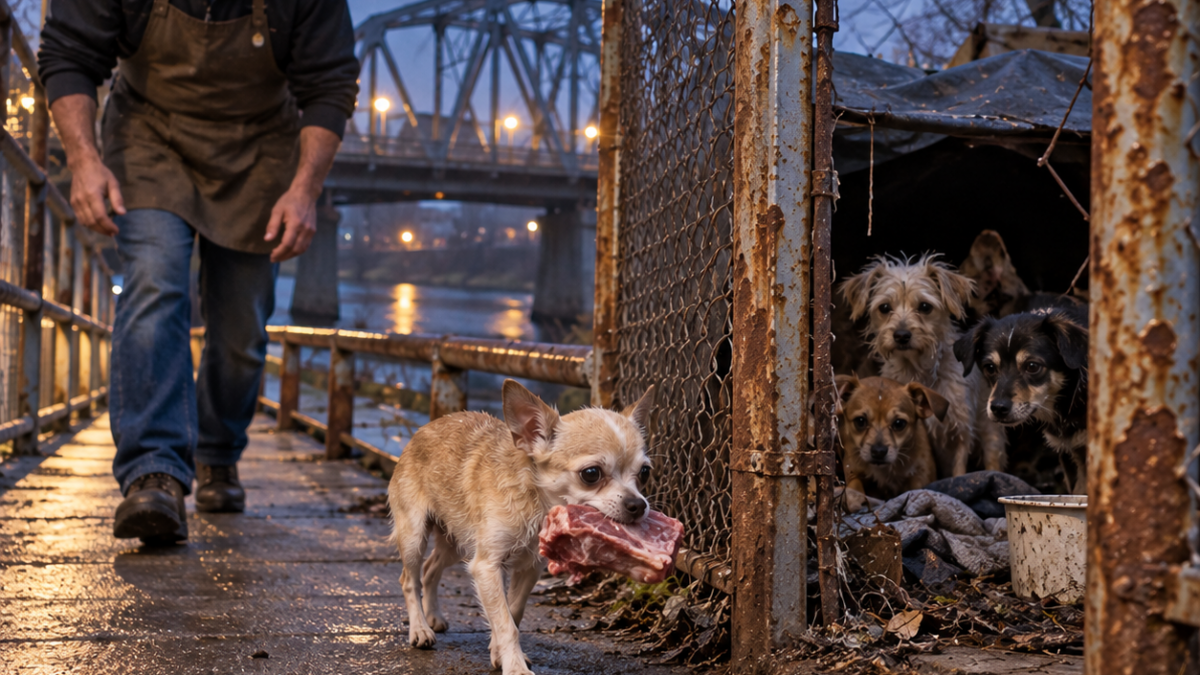
For several seconds, I did nothing.
I simply stood there with one hand gripping the fence, listening to the distant traffic from the bridge.
The gray-brown Chihuahua was still searching the concrete for crumbs.
The black-and-white dog had eaten the chicken too quickly and was licking the ground where it had been.
The tan Chihuahua had managed to lift her head.
Her eyes were open, but there was very little strength behind them.
I had seen hungry dogs before.
My father had taken in strays when I was a kid.
People sometimes abandoned animals near the industrial district because they assumed someone would find them.
But I had never seen three dogs connected by hunger like this.
The one who was free was nearly as thin as the two who were trapped.
Yet every night she left my shop carrying food.
Every night she came back for more.
And apparently every night she made sure they ate first.
I looked at the gate.
A heavy chain had been looped through it several times and secured with an old padlock.
The warehouse behind the yard had been abandoned for years.
Broken glass covered several windows.
Weeds had grown through cracks in the loading dock.
There were no vehicles.
No lights.
No reason anyone should have been keeping dogs there.
I called the non-emergency police line first.
The dispatcher listened and told me animal control would be notified.
Then I called a local rescue group whose number I found online.
A woman answered even though it was nearly ten at night.
Her name was Laura.
I explained what I had found.
“How weak are the dogs inside?” she asked.
“Very.”
“Are they standing?”
“One tried.”
“Any water?”
I looked through the fence.
There was a metal bowl overturned near the wall.
“No.”
“Can you safely get water to them without climbing the fence?”
“I think so.”
“Do that if you can, but don’t give them a large amount of food all at once.”
“Why?”
“If they’ve been severely underfed, suddenly eating too much can be dangerous.”
I had spent my life around food.
It had never occurred to me that feeding a starving animal could itself require caution.
Laura continued.
“Small amounts only.”
“I understand.”
“And please don’t leave until someone gets there if you can avoid it.”
“I’m not going anywhere.”
I returned to the shop.
The gray-brown Chihuahua followed me halfway across the bridge before stopping.
When I looked back, she was standing under a streetlight.
“You coming?”
She hesitated.
Then she turned around and ran back toward the warehouses.
That answered the question.
She was not leaving them.
At the shop, I filled two plastic containers with water.
I also packed a small amount of plain cooked chicken into butcher paper.
Then I grabbed a pair of work gloves and a flashlight.
My father used to keep bolt cutters in the storage room.
They were still there.
I took those too.
When I returned, the little Chihuahua was waiting beside the fence.
Not inside.
Beside it.
As though she had been watching for me.
“I came back,” I told her.
Her ears moved.
I slid one container of water beneath the gap.
The black-and-white dog tried to stand.
His front legs pushed against the ground.
His back legs trembled.
Then he collapsed.
The sound of his body hitting the concrete was soft.
It still made my stomach twist.
“Easy,” I whispered.
The gray-brown Chihuahua squeezed beneath the fence.
She went straight to him and touched her nose to his ear.
He opened his eyes.
Then she walked to the water.
She drank only once.
One quick lap.
Then she stepped away and nudged the bowl toward him.
I stared.
“No.”
I whispered it without meaning to.
“You drink too.”
She ignored me.
The black-and-white Chihuahua dragged himself forward and began drinking.
Not much.
Just a few laps.
Then he stopped.
The tan dog did not move.
I slid the second bowl closer to her.
The gray-brown Chihuahua walked over.
She lowered her nose to the water.
Again, one lap.
Then she moved aside.
The tan dog lifted her head.
Slowly.
She drank.
That was the moment I stopped thinking of the gray-brown dog as simply a stray.
She had a purpose.
She had been keeping those two alive.
Maybe not perfectly.
Maybe not enough.
But consistently.
She knew where food could be found.
She knew they could not leave.
So she had built her entire existence around moving between them and whatever scraps she could locate.
I crouched outside the fence.
“You’ve been doing this alone, haven’t you?”
She looked at me.
Her face was narrow from hunger.
Her eyes were dark and exhausted.
Still, there was no panic in them.
Only attention.
As if she were waiting to see whether I was useful.
“I’m trying.”
A vehicle turned off the bridge.
Headlights moved across the warehouse wall.
The little Chihuahua stiffened.
“Easy.”
A white rescue van pulled beside the fence.
Three people got out.
Laura was the first.
She was perhaps forty, wearing jeans, work boots, and a heavy jacket with the rescue organization’s emblem on one sleeve.
Two men followed her carrying equipment.
“Daniel?”
“Yes.”
“I’m Laura.”
She looked through the fence.
Her expression changed immediately.
“Oh.”
That single sound told me she had understood the situation.
The gray-brown Chihuahua backed several feet away.
Laura noticed.
“Is that the one you’ve been feeding?”
“Yes.”
“She’s free?”
“She can get under the fence.”
Laura crouched.
“And she comes back?”
“Every night.”
Laura looked at me.
“You’re sure the dogs inside can’t get through the same opening?”
“They’ve tried.”
“How do you know?”
I pointed at the dirt near the gap.
There were scratch marks.
The hole was large enough for the gray-brown dog because she was smaller.
The black-and-white Chihuahua had broader shoulders.
The tan one appeared too weak to crawl anyway.
Laura nodded.
“Okay.”
She introduced the other rescuers as Mark and Tom.
Animal control arrived a few minutes later.
An officer checked the property address and contacted the police department to document entry.
No registered owner could be reached.
No active business was listed at the warehouse.
The officer photographed the chained gate.
“Once we cut this,” he told Laura, “we’re documenting everything.”
“Understood.”
Mark used the bolt cutters.
The old lock resisted twice.
On the third attempt, it snapped.
The sound echoed across the yard.
All three Chihuahuas flinched.
The gray-brown one ran ten feet away.
Then stopped.
She did not disappear.
Tom opened the gate.
Laura entered slowly.
She did not walk straight toward the dogs.
Instead, she sat on the concrete several feet away.
“Hi, babies.”
Her voice was quiet.
“You don’t know us.”
The black-and-white dog watched her.
The tan Chihuahua barely reacted.
Laura placed a shallow dish of water down.
Then she backed away.
The black-and-white dog lifted his head.
His tongue touched his nose.
He looked toward the gray-brown Chihuahua.
She had returned to the gate.
Laura noticed that too.
“It’s okay,” she said to her.
The little dog remained outside.
Laura looked at me.
“What do you call her?”
“I don’t.”
“You’ve been feeding her a month and never named her?”
“I thought she belonged to somebody.”
Laura smiled slightly.
“She may have.”
Something in the way she said it bothered me.
I had spent so much time thinking about where the Chihuahua went every night that I had not spent much time thinking about where she came from.
Did all three once live together?
Had someone abandoned them here?
Had the smaller dog escaped?
Had she squeezed beneath that fence while the others could not?
If so, why had she returned?
The answer was standing in front of me.
Because they were still there.
Laura moved closer to the black-and-white dog.
He did not growl.
She slipped a towel beneath his chest and lifted him carefully.
He weighed almost nothing.
His legs hung loosely.
“That bad?” I asked.
“Yes.”
My voice dropped.
“Is he going to make it?”
“I don’t know.”
The answer hurt more because she did not soften it.
Tom brought a padded carrier.
Laura lowered the Chihuahua inside.
He immediately looked toward the tan dog.
The gray-brown Chihuahua began pacing outside the gate.
Laura pointed.
“She’s worried.”
“I know.”
Tom approached the tan dog next.
The moment he touched her shoulder, she whimpered.
He froze.
“Easy, sweetheart.”
He checked her legs.
“No obvious fracture.”
Laura came over.
Together they placed her on a soft blanket and lifted her.
The gray-brown Chihuahua rushed through the fence.
For the first time since I had known her, she made a sound.
A sharp, frantic cry.
She ran alongside them.
“She thinks you’re taking them,” I said.
Laura stopped.
She lowered the carrier.
The gray-brown dog pressed her nose against the door.
The black-and-white Chihuahua moved weakly inside.
His nose touched hers through the plastic openings.
The frantic sound stopped.
Laura looked at me.
“That bond may be the reason they’re alive.”
“What happens to her?”
“If we can catch her safely, she comes too.”
I expected catching her to be difficult.
It was not.
Laura sat on the ground.
She held out one hand.
The gray-brown Chihuahua watched.
Laura waited.
Five seconds.
Ten.
Twenty.
The dog approached.
She sniffed Laura’s fingers.
Then she looked back at the two carriers.
Laura stroked one finger along the side of her face.
The dog closed her eyes.
That small surrender was harder to watch than anything else that night.
For a month she had kept herself alive.
She had crossed streets.
Searched alleys.
Approached dumpsters.
Carried food farther than I realized.
Returned to two dogs who could not help her.
She had been responsible for everything.
And now, for the first time, someone else was taking over.
Laura slid one arm beneath her chest.
The Chihuahua did not resist.
She simply folded into Laura’s jacket.
I looked away.
Not quickly enough.
Laura saw.
“You okay?”
“Fine.”
“You’re crying.”
“I have dust in my eye.”
“At midnight beside a warehouse?”
“Industrial dust.”
She smiled.
Then she handed the Chihuahua to me.
I had not expected that.
She weighed less than the packages of meat I carried around the shop every day.
Her body was warm but frighteningly light.
For a second she remained stiff.
Then she rested her head against my chest.
I looked down at her.
“You could have eaten some of it yourself.”
Her eyes closed.
“You know that, right?”
Her body trembled once.
I held her more securely.
Laura said quietly, “She probably did sometimes.”
“Not enough.”
“No.”
I carried her to the van.
The three dogs were taken to an emergency veterinary clinic that worked with the rescue organization.
I followed in my truck.
It was after midnight when we arrived.
The clinic smelled like disinfectant and wet fur.
A veterinarian named Dr. Ellis examined them.
The black-and-white Chihuahua went first.
Male.
Approximately six years old.
Severely dehydrated.
Underweight.
Anemic.
Covered in fleas.
He had sores on his hips from lying on hard ground.
His paws were irritated from urine and dirt.
But his heart sounded stable.
His temperature was low but not dangerously low.
The tan Chihuahua was female.
Older.
Maybe eight or nine.
She was even thinner.
She had an infected wound near one shoulder and severe dental disease.
Her blood sugar was low.
She needed fluids immediately.
The gray-brown Chihuahua sat in my lap while we waited.
When Dr. Ellis finally examined her, the dog kept turning her head toward the treatment room where the other two had gone.
“Interesting,” Dr. Ellis said.
“What?”
“She’s dehydrated too.”
“I knew that.”
“But not as badly.”
“Meaning?”
“She’s been drinking enough to survive.”
I thought of the water bowl.
One lap.
Then stepping aside.
“What about food?”
“She’s very underweight, but she’s stronger than the others.”
Dr. Ellis palpated her abdomen.
“She may have eaten just enough to keep moving.”
“So she really was giving most of it away.”
Dr. Ellis looked at me.
“Dogs can absolutely prioritize bonded companions.”
I stared at the little Chihuahua.
“Why?”
The veterinarian smiled faintly.
“You’re asking a medical question or a philosophical one?”
“Either.”
“I can give you the medical answer.”
“Go ahead.”
“Social animals form attachments.”
“That doesn’t explain this.”
“No.”
She scratched beneath the dog’s chin.
“The rest may be harder to measure.”
We admitted all three.
I did not leave until nearly three in the morning.
Before going home, I asked whether I could see them once more.
Dr. Ellis led me to the recovery area.
The black-and-white Chihuahua lay inside a heated kennel with an IV line taped to one leg.
The tan female rested in another.
The gray-brown dog was supposed to be in a third kennel.
Instead, she was standing at the door, staring across the room at them.
“Can they be closer?” I asked.
“We’re trying to monitor them separately tonight.”
“She’s going to stand there all night.”
Dr. Ellis looked at her.
Then at me.
Finally she moved the kennel so the gray-brown Chihuahua could see the others more clearly.
The dog immediately lay down.
That was when I understood.
She did not need to touch them.
She needed to know where they were.
I went home.
I slept for two hours.
At six, habit woke me.
I nearly opened the shop.
Then I realized I could not concentrate.
I called my employee, Luis.
“You sick?” he asked.
“No.”
“Then what happened?”
“I found three Chihuahuas.”
There was silence.
“Three what?”
“Long story.”
“Are they alive?”
“Yes.”
“Then go do what you need to do.”
Luis had worked for me eight years.
He knew I had never missed a morning for anything except my father’s funeral.
“You sure?”
“I can cut meat without you watching me.”
“I know.”
“Go.”
So I went back to the clinic.
Laura was already there.
She was sitting with a paper cup of coffee outside the treatment area.
“You came back.”
“I said I would.”
“You never said that.”
“I thought it.”
She handed me the coffee.
“You look terrible.”
“Thank you.”
“The dogs made it through the night.”
That woke me faster than caffeine.
“All three?”
“All three.”
I exhaled.
Laura continued.
“The tan female is still the biggest concern.”
“Why?”
“She’s older, weaker, and that shoulder infection is significant.”
I looked through the window.
“Can I see them?”
“In a minute.”
Laura opened a folder.
“We need names for the intake records.”
I frowned.
“I thought shelters did that.”
“We can.”
She handed me a pen.
“But you found them.”
“I found one of them.”
“She found the other two for you.”
That was true.
I stared at the form.
The black-and-white male was easy.
Not because I wanted to call him Blackie.
It felt too obvious.
There was something careful about him.
Watchful.
Even weak, he kept looking toward the others.
My father had owned an old black-and-white dog when I was a child named Milo.
“Milo,” I said.
Laura wrote it down.
The tan female took longer.
She had a thin white stripe between her eyes.
It reminded me of flour on my mother’s hand when she used to bake.
“June.”
“Why June?”
“My mother’s name.”
Laura nodded.
Then she pointed to the last line.
The gray-brown Chihuahua.
I looked through the treatment-room glass.
She had finally fallen asleep.
One ear upright.
The other folded.
My father used to say certain people carried their strength quietly.
His sister had been like that.
Hannah Mercer.
My aunt.
She had raised four children, cared for her husband through cancer, and never once described herself as strong.
“Hannah.”
Laura wrote it.
“Hannah, Milo, and June.”
I read the names.
They fit.
At least to me.
When I went inside, Hannah stood immediately.
She pressed her paws against the kennel door.
“Hey.”
Her tail moved for the first time since I had met her.
Not much.
One small sweep.
But I saw it.
Dr. Ellis opened the kennel.
Hannah climbed into my arms.
“Look at that,” Laura said.
“What?”
“She knows you.”
“She knows I have meat.”
“Whatever helps you emotionally.”
I sat in a chair near the three kennels.
Milo was awake.
June was sleeping.
Hannah kept twisting in my lap to check them.
Finally Dr. Ellis allowed me to place her on a towel between their kennels.
She curled there.
For nearly an hour, none of us spoke much.
Then June woke.
She lifted her head.
Hannah stood instantly.
June tried to stand.
Her front legs shook.
Hannah approached the kennel door.
June took one step.
Then another.
The two touched noses through the bars.
Laura wiped her face.
I pretended not to notice.
By afternoon, the police had learned more about the warehouse.
A property-management company owned it.
The previous tenant had operated a storage business there and had moved out months earlier.
No one admitted knowing about the dogs.
A worker from a neighboring business told animal control he had seen “a few small dogs” around the property during summer.
Another said an older man sometimes slept in a vehicle nearby.
No one knew his name.
It was impossible to determine whether the dogs had belonged to him, to the former tenant, or to someone else.
There were no microchips.
No collars.
No identification.
The rescue organization posted their photographs online.
No owner came forward.
For a while, that bothered me.
I wanted an explanation.
I wanted somebody to be responsible.
I wanted to know why Milo and June had been locked behind that gate.
I wanted to know whether Hannah had escaped or had simply been outside when the chain was placed there.
But answers did not arrive.
What arrived instead were mornings.
Then afternoons.
Then another night.
And the three Chihuahuas needed things more immediate than a story about the past.
Food.
Water.
Medication.
Warmth.
Time.
Their recovery was deliberately slow.
Dr. Ellis explained refeeding syndrome to me.
Animals starved for long periods cannot simply be given a large meal.
Their bodies need careful nutritional support.
Electrolytes can shift dangerously.
Organs that have adapted to starvation need time.
So the portions looked painfully small.
The first time I watched Milo receive a measured spoonful of food, I nearly protested.
“That’s it?”
“For now.”
“He’s starving.”
“That is exactly why.”
I looked at Milo.
He had eaten every trace and was licking the bowl.
Dr. Ellis touched my shoulder.
“We’re not denying him food.”
“I know.”
“We’re helping his body remember what to do with it.”
I nodded.
Hannah ate her portion differently.
She took three bites.
Then turned toward Milo.
“No,” I told her.
She looked at me.
“That one is yours.”
She took another bite.
Then looked at June.
“You cannot keep doing this.”
Hannah sat down.
Laura laughed from across the room.
“You realize she does not speak English.”
“She understands tone.”
“She understands that you’re trying to interfere with her system.”
“She almost died because of her system.”
Hannah stared at me.
I pushed the bowl slightly closer.
“Eat.”
After a long pause, she did.
But she kept looking at the others between bites.
For the first week, I visited every day.
At first I told myself it was because I felt responsible.
Then I stopped lying to myself.
I wanted to see them.
I adjusted my shop schedule.
Luis opened twice.
I closed early once.
Customers asked where I had been.
I told a few.
Within days, everyone knew.
That is how small neighborhoods work.
Mrs. Donnelly, who had bought pork chops from my father for twenty-five years, came in carrying a bag of dog toys.
“You don’t own a dog,” I reminded her.
“They’re not for you.”
She placed the bag on the counter.
Inside were three small fleece toys.
One red.
One yellow.
One blue.
Mr. Rivera from the hardware store brought blankets.
A schoolteacher named Amy brought puppy pads.
Someone left an envelope with fifty dollars and no name.
I called Laura.
“People keep bringing things.”
“Good.”
“What do I do with all of it?”
“Bring it here.”
So I did.
The rescue named the donation box “Hannah’s Pantry.”
I hated the name.
Then I secretly liked it.
Milo was the first to stand for more than a few seconds.
It happened on day eight.
I was sitting beside his kennel when he pushed himself upright.
His legs trembled.
He looked surprised by his own body.
“Easy.”
He took one step.
Then another.
Then sat hard.
I smiled.
“That counts.”
His tail tapped once against the towel.
June’s recovery was slower.
The infection in her shoulder improved, but she remained weak.
She also seemed afraid of sudden movement.
Whenever someone raised an arm too quickly, she flattened herself.
No one knew why.
We did not need to know in order to move gently.
Hannah stayed between them emotionally even when she could not be physically between them.
If Milo coughed, she woke.
If June refused food, Hannah watched.
When either dog left the room for treatment, Hannah paced until they returned.
One afternoon, June was taken for dental X-rays.
Hannah waited by the treatment-room door for forty-three minutes.
I know because I timed it.
“Remind you of anyone?” Laura asked.
I looked at her.
“What?”
“You.”
I frowned.
She smiled.
“You’ve been standing beside that dog for twenty minutes watching the same door.”
I looked down.
Hannah looked up at me.
We were both waiting for June.
“Fair point.”
When June returned, Hannah inspected her thoroughly.
Nose.
Ears.
Feet.
Then she lay down.
Only then did I realize how much stress she carried.
She had spent who knew how long believing that the survival of two other dogs depended on her.
Now help had arrived.
But habits built under fear do not vanish because circumstances change.
That applied to people too.
My father died six years before I met Hannah.
Cancer.
He had worked until three months before he died.
After the funeral, I reopened the shop five days later.
Everyone told me to take more time.
I did not know what I would have done with more time.
The shop gave me structure.
Open at six.
Prepare the case.
Take deliveries.
Serve customers.
Clean.
Close.
Repeat.
I thought I had handled grief well because I had kept moving.
Watching Hannah, I began wondering whether moving and recovering were the same thing.
She survived because she kept moving.
That did not mean she was okay.
On the twelfth day, Dr. Ellis cleared Hannah for a short walk outside.
I volunteered.
Of course I did.
We used a soft harness because her neck was too thin for pressure from a collar.
The moment the clinic door opened, Hannah froze.
Traffic moved along the street.
A bus hissed at the curb.
People passed.
Her whole body tightened.
I crouched.
“You don’t have to go far.”
She looked behind her toward the clinic.
Toward Milo and June.
“They’re still there.”
She took one step outside.
Then another.
We walked only half a block.
Hannah sniffed a tree.
That was all.
But it felt significant.
For months, maybe, every trip outside had been about survival.
Find food.
Carry food.
Return.
That day she smelled a tree simply because it was there.
When we went back inside, she ran straight to Milo and June.
Both were sleeping.
She checked them.
Then she returned to me.
Something shifted after that.
Not dramatically.
Hannah remained cautious.
But she began showing small pieces of personality that hunger had hidden.
She disliked stainless-steel bowls and preferred ceramic ones.
She hated the squeak of rubber toys.
She loved towels fresh from the dryer.
She would not eat carrots.
She stole green beans.
She liked having the base of her ears scratched.
And she was stubborn enough to make a stone wall seem flexible.
The first time I tried to leave after a visit before she was ready, she sat on my shoe.
“Move.”
She did not.
“Hannah.”
Nothing.
Laura walked past.
“She’s got you trained.”
“I am not trained.”
Hannah shifted more weight onto my shoe.
Laura laughed.
“Sure.”
Three weeks after the rescue, Milo gained nearly a pound.
On a Chihuahua, it was a remarkable difference.
His eyes looked brighter.
His coat began to lie flatter.
He discovered toys.
Specifically, the blue fleece toy Mrs. Donnelly had donated.
He carried it everywhere.
June improved more slowly but steadily.
Her dental infection was treated.
The wound on her shoulder closed.
Her appetite grew.
Then one morning, Dr. Ellis called me.
“You need to come by when you can.”
My stomach dropped.
“What happened?”
“Nothing bad.”
“You cannot start a sentence that way.”
She laughed.
“June walked into the hallway this morning.”
“By herself?”
“By herself.”
I closed the shop at lunch.
Luis shook his head.
“You’re worse than a new father.”
“I’m paying you.”
“That doesn’t make me wrong.”
When I reached the clinic, June was resting.
I crouched beside her.
“I missed it.”
Her tail moved.
“Couldn’t wait for me?”
She stood.
Slowly.
Her back legs trembled.
Then she walked toward me.
Four steps.
Maybe five.
She placed her tiny head against my knee.
I sat down on the floor.
June climbed partly into my lap.
Hannah immediately joined us.
Then Milo came over carrying the blue toy.
For several minutes, all three were pressed around me.
Laura took a photograph.
I did not know she had until weeks later.
That picture eventually became one of my favorites.
Not because I looked good.
I looked exhausted.
My apron was still on.
There was dried flour from butcher paper on one sleeve.
But the dogs looked alive.
Not merely breathing.
Alive.
That distinction mattered.
At the end of the first month, the rescue started discussing foster placement.
Milo and June still needed monitoring, but the clinic could not keep them indefinitely.
Hannah was medically ready sooner.
Laura asked whether I would foster her.
I responded too quickly.
“Yes.”
She raised an eyebrow.
“You want to think about it?”
“No.”
“Daniel.”
“What?”
“Fostering means she may eventually be adopted by someone else.”
That stopped me.
I looked at Hannah.
She was asleep on a towel beside my chair.
“I understand.”
“Do you?”
“Yes.”
“Because I’ve seen people accidentally foster dogs and then act shocked when someone applies.”
“I know what fostering means.”
Laura smiled.
“You sound defensive.”
“I own a butcher shop.”
“That explains nothing.”
“I don’t have time for a permanent dog.”
“Fine.”
“I work long hours.”
“Fine.”
“My house isn’t set up.”
“Fine.”
Laura crossed her arms.
I frowned.
“You’re not supposed to agree.”
“You’re arguing with yourself.”
I looked at Hannah again.
“Temporary.”
“Of course.”
Two days later, Hannah came home with me.
I had not owned a dog since childhood.
My house reflected that.
No dog bed.
No bowls.
No fenced yard.
No toys.
By the time Hannah arrived, I had three beds, four bowls, a baby gate, two harnesses because I could not decide which size fit, seven toys she ignored, and enough dog treats to survive a natural disaster.
Luis helped me carry everything inside.
“You said temporary.”
“It is.”
“Three beds?”
“She might prefer different rooms.”
Luis stared at me.
“You need help.”
Hannah entered cautiously.
She sniffed the kitchen.
Living room.
Hallway.
Bedroom.
Then she returned to the front door and sat.
I knew what she wanted.
Milo and June.
“They’re safe.”
Hannah looked at the door.
“You’ll see them tomorrow.”
She stayed there.
Ten minutes.
Twenty.
I placed a blanket beside her.
She ignored it.
Finally I sat on the floor.
“You cannot walk back to the clinic.”
Her ears moved.
“I know you think you can.”
She looked at me.
“You are seven pounds.”
One ear folded.
“That is not an argument.”
I remained there.
Eventually Hannah lay down.
Not beside me.
At the door.
That was where she slept the first night.
The second night too.
On the third night, I placed one of Milo’s old clinic towels near her bed.
Laura had given it to me deliberately because it carried his scent.
Hannah sniffed it.
Then June’s towel.
She circled twice.
And slept in the bed.
I learned quickly that Hannah’s attachment to the others could not be erased.
Nor did I want to erase it.
So every morning before opening the shop, I took her to the clinic.
The first time she saw Milo after spending the night at my house, she nearly pulled out of her harness.
He ran toward her.
June followed more slowly.
The reunion lasted perhaps thirty seconds.
Sniffing.
Licking.
Circling.
Then all three settled.
As though they had merely needed confirmation.
Still here.
Still safe.
That became our routine.
Hannah came to the shop with me.
At first she stayed in the office behind a baby gate.
Health regulations meant she could not enter food-preparation areas.
I gave her a small bed in the corner.
She could see me through the doorway.
Every fifteen minutes, she checked that I was still there.
Customers heard about her.
Some asked to meet her.
I brought her to the front after closing.
She remained shy with most people.
But she liked children.
That surprised me.
Children move unpredictably.
They make noise.
Yet Hannah seemed to relax around them.
Maybe whoever she lived with before had children.
Or maybe children simply sat close enough to the ground to seem less threatening.
A girl named Sophie became her first regular visitor.
She was eight.
Her mother bought meat from me every Saturday.
Sophie would wait by the office gate.
“Hannah.”
The Chihuahua would approach slowly.
Sophie never reached for her.
She waited.
That was why Hannah trusted her.
By the fourth Saturday, Hannah sat beside the gate before Sophie arrived.
Temporary, I reminded myself.
I visited Milo and June every day.
Their bond with Hannah remained obvious.
But something else was happening.
Milo and June were beginning to rely on each other more.
When June slept, Milo curled beside her.
When Milo became nervous during examinations, June pressed against him.
Hannah still checked both.
But she was no longer carrying responsibility for them alone.
One evening, Laura and I sat outside the clinic while Hannah slept between my boots.
“Milo and June may be ready for adoption in another few weeks,” she said.
“Together?”
“If possible.”
“They should stay together.”
“I agree.”
“What about Hannah?”
Laura looked down.
“What about her?”
“Will she be listed too?”
“She can be.”
The thought produced an immediate reaction in my chest.
I disliked it.
Laura noticed.
“You still fostering?”
“Yes.”
“Very temporary?”
“Yes.”
She smiled.
“Good.”
“Why are you smiling?”
“No reason.”
Applications came for Milo and June.
Some wanted Milo only.
The rescue declined.
One family wanted June because she was calm but said they already had another male dog and did not want Milo.
Declined.
Then Catherine and James Whitmore applied.
They were in their early sixties.
Their last dog had died the previous year.
They lived in a quiet house with a fenced yard.
They specifically wanted a bonded pair.
When they met Milo and June, they sat on the floor and let the dogs decide when to approach.
Milo went first.
June followed.
Within twenty minutes, Milo had placed the blue toy in James’s lap.
Laura looked at me.
“That’s promising.”
I nodded.
Hannah watched from beside my chair.
Catherine noticed her.
“That’s the little one who brought them food?”
“Yes.”
Catherine crouched.
Hannah moved closer.
“You’re a good friend,” Catherine whispered.
I almost corrected her.
Friend seemed too small a word.
But I let it stand.
The adoption was approved.
Milo and June would go home together the following Saturday.
I should have been happy.
I was.
I was also worried about Hannah.
The night before the adoption, all three dogs spent several hours together in a quiet room at the rescue.
Milo slept.
June rested beside him.
Hannah moved between them.
She licked June’s ears.
She stole Milo’s blue toy.
For the first time, Milo chased her.
Not fast.
Not far.
But he chased her.
Hannah ran in a small circle.
I had never seen her run for fun.
She stopped.
Looked back.
Milo bowed awkwardly.
Hannah ran again.
Laura and I watched from the doorway.
“Remember the warehouse?” she asked.
I did.
Too clearly.
Three bodies shaped by hunger.
Concrete.
Rust.
A water bowl tipped on its side.
Now Hannah and Milo were playing.
June was watching with her tail moving.
“I didn’t know if June would survive that first night,” Laura said.
I looked at her.
“You never told me that.”
“You didn’t need to know then.”
“How close?”
“Close.”
I looked at Hannah.
Laura continued.
“The food she brought mattered.”
“Would June have died without it?”
“No one can prove that.”
“But?”
“But I think Hannah bought them time.”
I crouched.
Hannah ran to me.
I lifted her.
She was heavier now.
Healthy.
Her coat was soft.
Her white chin was actually white.
“You hear that?”
She licked my nose.
“You bought them time.”
Saturday arrived too quickly.
Catherine and James brought two new harnesses.
Milo’s was green.
June’s was purple.
They also brought a blanket large enough for both dogs.
I liked that.
Laura went over medical records.
Medication.
Feeding.
Follow-up appointments.
I stood outside with Hannah.
I told myself I was giving the adopters space.
Really, I was avoiding the goodbye.
Eventually James came out carrying Milo.
Catherine had June.
Hannah stiffened.
I set her down.
Milo saw her.
His tail moved.
Catherine knelt.
June and Hannah touched noses.
Then Milo joined them.
For a minute, the three Chihuahuas stood together in a tight little circle.
No drama.
No mysterious knowledge of what was happening.
Just familiar smells.
Familiar bodies.
Hannah licked Milo’s face.
Then June’s.
I swallowed.
Catherine looked at me.
“You can visit.”
I nodded.
“We mean it.”
“Thank you.”
James opened the car door.
Milo climbed into a secured seat beside June.
Hannah moved forward.
I expected her to cry.
She did not.
She watched.
The car pulled away.
Hannah remained still.
I knelt beside her.
She looked down the road.
“They’re okay.”
Her ears shifted.
“They’re together.”
The car disappeared.
Hannah continued looking for several seconds.
Then she turned toward me.
That was all.
She did not collapse.
She did not howl.
She did not chase the car.
Those were human ideas of goodbye.
Hannah simply turned toward the person who remained.
Me.
I rested my hand against her back.
“Ready to go home?”
The word came out before I thought about it.
Home.
Not my house.
Not the foster house.
Home.
Hannah looked up.
Her tail moved.
I drove back to the shop.
It was closed for the afternoon.
I unlocked the front door.
Hannah went straight to the office.
She climbed into the bed in the corner.
I stood in the doorway.
Temporary.
The word had become ridiculous.
Two days later, Laura called.
“We received an adoption application for Hannah.”
Everything inside me tightened.
“Oh.”
“Nice couple.”
“Oh.”
“No children.”
“Okay.”
“Someone home most of the day.”
“Good.”
“Fenced yard.”
“Fine.”
There was silence.
Laura said, “Daniel?”
“Yes?”
“Would you like me to process it?”
I looked through the office doorway.
Hannah was sleeping.
One paw rested over her nose.
“No.”
Laura waited.
I said it again.
“No.”
“Meaning?”
I sighed.
“You know what it means.”
“I would like to hear you say it.”
“You’re enjoying this.”
“Enormously.”
I rubbed my forehead.
“I want to adopt Hannah.”
Laura laughed.
Not loudly.
Warmly.
“I’ll bring the paperwork.”
“I already filled out foster paperwork.”
“Different paperwork.”
“Of course.”
“And there’s an adoption fee.”
“I have money.”
“And a home check.”
“You have already been inside my house.”
“Procedure.”
I looked at Hannah.
“Fine.”
Laura’s voice softened.
“You sure?”
That was the only question that mattered.
“Yes.”
This time I did not hesitate.
“I’m sure.”
The adoption became official three days later.
Sophie drew Hannah a picture.
It showed three small dogs standing beside a butcher shop.
One was gray.
One black and white.
One tan.
Above them, Sophie had drawn an enormous red heart.
There were spelling mistakes in every other word.
I framed it anyway.
Hannah’s first months with me were not magically easy.
Recovery is not a straight line.
She became healthier physically before she became secure emotionally.
If I left through the back door of the shop, she panicked.
If food dropped on the floor, she grabbed it and ran.
For weeks she hid pieces beneath her bed.
Chicken.
Biscuits.
Once, half a dinner roll.
The first time I found a pile of dried food beneath her blanket, I understood immediately.
She was storing it.
Maybe for herself.
Maybe for Milo and June.
Maybe because a dog who has known hunger does not trust a full bowl.
I did not scold her.
I cleaned it up.
Then I started leaving a small sealed treat container near her bed.
Every evening, I put one biscuit inside.
Hannah watched.
“This stays here.”
She sniffed it.
“You don’t have to hide anything.”
The first week, she carried the biscuit beneath the bed.
The second week, she ate it.
By the third month, sometimes she left it until morning.
That felt like progress.
Her relationship with food slowly changed.
At first she ate fast.
Then paused and looked around.
Sometimes she carried pieces away from the bowl.
One evening she took a piece of chicken from her dish, walked across the room, and dropped it beside me.
I stared.
“No.”
Hannah looked up.
“That is yours.”
She nudged it toward my shoe.
I laughed.
“You are feeding me now?”
She sat down.
I picked up the chicken and returned it to her bowl.
“You’ve done enough.”
Eventually she ate it.
But the habit remained.
Once or twice a week, Hannah brought me something from her bowl.
A piece of kibble.
A small treat.
The offering itself mattered more than the food.
I began thinking about how easily I had misunderstood generosity.
I used to imagine generosity required abundance.
Someone has extra.
They share.
Hannah had taught me another version.
Sometimes generosity comes from scarcity.
Sometimes the thing being shared is needed desperately by the one giving it.
That does not automatically make sacrifice good.
I did not romanticize what she had done.
I wished she had never needed to do it.
I wished all three dogs had been safe from the beginning.
But I could not deny what I had witnessed.
Hannah had made choices every day that benefited two weaker companions.
Whatever word humans wanted to use for that behavior, it had kept them alive.
Catherine sent photographs.
Milo gained another pound.
June discovered the couch.
They slept together in the same bed even though Catherine had purchased two.
Hannah recognized their names when I spoke them.
The first time we visited, she knew the house before we reached the front door.
Milo barked from inside.
Hannah went wild.
She ran in circles on the porch.
The door opened.
Milo shot outside.
June followed.
The reunion was loud, fast, and completely undignified.
Three Chihuahuas raced around Catherine’s living room.
Milo brought Hannah the blue toy.
June pressed against her side.
James laughed.
“I guess they remember.”
Hannah stayed close to them for the first hour.
Then something unexpected happened.
She walked away.
She came to me.
She climbed onto the chair beside my leg.
Milo and June were safe.
Hannah knew it.
She no longer needed to monitor them every second.
That realization hit me quietly.
Her life had once been duty.
Now she was learning choice.
She could love them without being responsible for keeping them alive.
I wondered how many people needed to learn the same thing.
I did.
For years after my father died, I had treated the shop like something fragile that only I could protect.
I opened every morning.
Closed every night.
Approved every order.
Checked every invoice.
Refused vacations.
Luis once asked me why I thought the business would collapse if I disappeared for three days.
I had been offended.
Now I understood why.
My father had built the shop.
After he died, keeping it exactly as he left it became my version of guarding something.
Perhaps I thought changing anything meant losing him again.
Hannah had spent her days running between food and a fenced yard.
I had spent mine running between a cutting table and a register.
Different stakes.
Same instinct.
Keep moving.
Keep watch.
Do not trust anyone else to carry the responsibility.
One morning, six months after Hannah’s adoption, I gave Luis the shop keys.
He stared at them.
“What are these?”
“Keys.”
“I recognize keys.”
“I’m taking Saturday off.”
Luis looked toward the ceiling.
“Should I call an ambulance?”
“Don’t be dramatic.”
“In eight years, you have taken exactly two Saturdays off.”
“Three.”
“Your father’s funeral does not count as leisure.”
I frowned.
“Hannah and I are going to the lake.”
Luis looked down at her.
Hannah sat beside my boot.
“Good.”
“That’s all?”
“What do you want, applause?”
“Maybe.”
He clapped slowly.
I threw a dish towel at him.
That Saturday, Hannah and I drove an hour outside the city.
The lake was quiet.
I brought food.
Water.
A folding chair.
And an absurdly small life jacket Laura insisted I buy.
Hannah hated it.
She looked at me with betrayal.
“You are seven pounds.”
Her expression did not change.
“You are not a strong swimmer.”
Nothing.
“I am responsible now.”
She sneezed.
We walked along the shore.
Hannah chased leaves.
She barked at a goose and immediately regretted it when the goose turned toward her.
I laughed harder than I had in years.
We sat near the water.
Hannah curled beneath the chair.
For several hours, nothing needed to be saved.
Nothing needed to be repaired.
Nothing depended on us.
It was one of the best days I could remember.
A year after the rescue, Hannah had become part of the neighborhood.
She came to the shop every morning.
Health rules kept her away from the work area, but customers could see her through the office gate.
People asked for her before they asked for me.
“Where’s Hannah?”
“In the office.”
“How’s Hannah?”
“Fine.”
“Did Hannah like the treats?”
“Yes.”
I started wondering whether I still owned the business.
One afternoon, a little boy dropped a wrapped sandwich outside the shop.
Hannah noticed.
She ran toward it.
I expected her to eat it.
Instead, she picked it up and carried it toward the alley.
My stomach tightened.
“Hannah.”
She stopped.
For one second, the old pattern returned.
Food in mouth.
Body pointed toward the route she used to take.
The bridge.
The warehouses.
Milo.
June.
Then she turned.
She walked back to me.
I took the sandwich.
“You don’t have to do that anymore.”
Hannah looked at my hand.
“I know you remember.”
She leaned against my leg.
I understood then that memory does not disappear simply because life improves.
The body remembers hunger.
The mind remembers fear.
The heart remembers responsibility.
Healing is not forgetting.
It is learning that the old emergency is no longer happening.
That evening, I drove Hannah to visit Milo and June.
I did not plan it.
I simply thought she deserved confirmation.
Milo met us at the door.
June followed.
Hannah relaxed almost immediately.
They played.
They slept.
Catherine made coffee.
“You worry about her,” she said.
“Yes.”
“She’s fine.”
“I know.”
“Do you?”
I smiled.
“Usually.”
Catherine looked at the three dogs.
“James thinks Milo still checks on June before he eats.”
“Probably learned it from Hannah.”
“Maybe.”
She was quiet for a moment.
“I don’t think they forget what happened.”
“No.”
“But maybe they don’t have to.”
I looked at Hannah.
She was lying upside down on Catherine’s rug while Milo tried to steal the blue toy from beneath her paw.
“No,” I said.
“Maybe they don’t.”
The abandoned warehouse was eventually demolished.
The city cited the property owner for several violations unrelated to the dogs.
No one was ever charged for abandoning them because there was not enough evidence to prove who had done it.
At first I was angry.
I wanted a name.
A consequence.
Then time passed.
My anger became less useful.
The rusted gate was removed.
The chain went into an evidence bin and disappeared.
Grass eventually grew over the place where Milo and June had lain.
One morning, nearly two years later, I drove past.
Hannah was in the passenger seat secured in her harness.
I slowed.
The warehouse was gone.
A construction fence surrounded the property.
Hannah looked out the window.
I wondered whether she recognized anything.
Maybe scent.
Maybe shape.
Maybe nothing.
She did not react.
At the next traffic light, she turned toward me.
I scratched her chest.
“Good.”
The light changed.
We kept going.
That became important to me.
Not pretending the warehouse never existed.
Not turning it into the center of her entire life either.
It was a place she survived.
Not the definition of who she was.
Years went by.
Hannah grew confident.
Not fearless.
She still disliked dumpsters.
If metal lids slammed, she flinched.
She hated being behind closed gates.
At dog parks, she became anxious if she could not see the exit.
So we did not go to dog parks.
We found other places.
Quiet trails.
Catherine and James’s yard.
The lake.
My backyard.
Sophie grew older.
At twelve, she started volunteering at the rescue with her mother.
At fourteen, she told me she wanted to become a veterinarian.
“Because of Hannah?” I asked.
“Partly.”
Hannah sat beside us.
Sophie scratched beneath her chin.
“I want to help animals that people don’t notice.”
I looked at the girl who had once drawn three crooked Chihuahuas under a giant heart.
“That sounds like a good reason.”
She became one of Hannah’s favorite people.
Every time Sophie entered the shop, Hannah ran from the office.
The little dog who had once avoided human hands would roll onto her back demanding attention.
Watching that never became ordinary.
When Hannah was around ten, her muzzle began turning white.
She moved more slowly in winter.
The veterinarian said her knees showed early arthritis.
We started supplements.
Later medication.
I placed a small ramp beside the couch.
Hannah ignored it and attempted to jump anyway.
She missed.
I caught her.
“You have a ramp.”
She looked offended.
“You are not young.”
More offense.
“I am not young either.”
She licked my chin.
“Exactly.”
Milo and June aged too.
June developed heart disease.
Milo became partially deaf.
They still lived with Catherine and James.
We visited less often because long trips tired them.
But when the three dogs met, the bond remained.
Older bodies.
Slower greetings.
Same recognition.
One autumn afternoon, we sat in Catherine’s yard.
June slept in the sun.
Milo lay beside her.
Hannah rested against my shoe.
James looked at them.
“You know, we thought we rescued two dogs.”
I smiled.
“So did I.”
He shook his head.
“No.”
He looked at Catherine.
“They changed the house.”
She nodded.
“It was too quiet before.”
I understood that.
My house had been quiet too.
So had the shop after my father died.
Hannah did not fill the silence with noise.
She filled it with presence.
There is a difference.
At twelve, Hannah began having trouble with her teeth.
Several needed extraction.
The night before surgery, I barely slept.
Laura called me ridiculous.
“You watched Dr. Ellis treat her when she was half-starved.”
“That was different.”
“How?”
“She wasn’t mine yet.”
Laura laughed.
“That may be the least convincing thing you’ve ever said.”
The surgery went well.
Hannah came home angry, groggy, and convinced I had betrayed her.
I fed her soft food.
She forgave me by dinner.
A few months later, June died peacefully at home.
Catherine called me that morning.
Her voice broke when she said it.
I drove over with Hannah.
Milo was lying on June’s bed.
He would not leave it.
Hannah approached him slowly.
She sniffed the blanket.
Then she lay beside him.
For nearly an hour, the two Chihuahuas remained there.
No dramatic behavior.
No visible understanding that I could prove.
Just closeness.
Catherine sat on the floor and cried.
James stood by the window.
I rested my hand on Hannah’s back.
The old three had become two.
For the first time since the warehouse, someone was missing.
Milo changed after June’s death.
He slept more.
Ate less for several days.
Then slowly adjusted.
Hannah visited twice that month.
Each time she stayed close to him.
It reminded me of the warehouse in a painful way.
But now there were full bowls.
Warm blankets.
Veterinary care.
Hands nearby.
Grief was still grief.
But it was not abandonment.
That distinction mattered.
Milo lived another year.
When he died, James buried the blue fleece toy with him.
I thought that was right.
Hannah became the last of the three.
I did not say that aloud around her.
It felt too heavy.
She simply continued being Hannah.
She woke me early.
Inspected the kitchen.
Went to the shop.
Slept in the office.
Accepted attention from customers.
Refused carrots.
Loved chicken.
Shared food she no longer needed to share.
At thirteen, she began carrying one biscuit from her bowl to the corner of her bed again.
I worried.
The veterinarian found no cognitive decline.
No illness.
Maybe it was habit.
Maybe memory.
I started putting the sealed treat container beside her bed again, just as I had years before.
Hannah sniffed it.
Then looked at me.
“You remember this?”
Her tail moved.
That night, she ate the biscuit instead of hiding it.
I smiled.
“Good girl.”
One winter morning, Sophie came into the shop wearing a college sweatshirt.
She had been accepted into a pre-veterinary program.
She knelt beside Hannah.
“You started this.”
Hannah licked her hand.
Sophie looked at me.
“She’s getting old.”
“Yes.”
Her eyes filled.
“So are you.”
I frowned.
“That was unnecessary.”
She laughed.
Hannah sneezed.
“See?” Sophie said.
“She agrees.”
I had turned fifty by then.
The shop still opened at six.
But not every day by me.
Luis had become manager.
I took Sundays off.
Then Wednesdays too.
I traveled occasionally.
Nothing extravagant.
A fishing trip.
A weekend with my sister.
Once I visited my mother’s hometown.
Hannah stayed with Sophie’s family when I traveled.
The first time I left her for three days, I nearly canceled the trip.
Sophie pushed me toward the car.
“She will survive.”
“I know.”
“She’ll sleep in my room.”
“I know.”
“I have her medication.”
“I know.”
“You wrote the instructions on four pages.”
“I like clarity.”
“You labeled her food by day.”
“Consistency matters.”
Sophie stared at me.
“You realize Hannah was once surviving behind dumpsters.”
“Exactly.”
“She can survive Thursday without you.”
She did.
More importantly, I survived Thursday without her.
When I returned, Hannah greeted me like I had crossed an ocean.
I knelt.
“You see?”
She climbed onto my lap.
“I came back.”
Those words mattered more to me than I expected.
Maybe because for the first part of Hannah’s life, people may not have come back.
Maybe because I had lost my father and learned what it meant when someone truly could not.
Maybe because loving an animal eventually becomes a long series of departures and returns.
Work.
Errands.
Sleep.
Trips.
Hospital visits.
A closed door.
An opening door.
Again.
Again.
Again.
Until trust becomes routine.
At fourteen, Hannah’s heart murmur worsened.
Medication helped.
Her walks became shorter.
She no longer came to the shop every day.
Some mornings she preferred staying home in the sun.
I hired a neighbor to check on her at midday.
On good days, she still visited.
Customers noticed the difference.
Mrs. Donnelly was gone by then.
Mr. Rivera had retired.
But their children shopped with me.
Then their grandchildren.
People who had known Hannah as children brought their own kids to meet her.
Her story became part of the neighborhood.
Not the dramatic version.
Not “hero dog saves friends.”
I disliked that phrase.
Hannah had never tried to become a hero.
She had simply refused to abandon Milo and June.
That was enough.
One spring afternoon, a reporter from a local paper contacted me.
Someone at the rescue had mentioned the old story.
They wanted an interview.
I almost refused.
Laura convinced me.
“People should hear what happened.”
“They’ll make it sentimental.”
“Then don’t let them.”
So I agreed.
The reporter asked what made Hannah special.
I thought about it.
Then answered.
“She kept going back.”
“That’s all?”
“That’s everything.”
He waited.
I explained.
“She could leave the fence.”
“They couldn’t.”
“She could find food.”
“They couldn’t.”
“She could have stayed near the butcher shop after I started feeding her.”
“She didn’t.”
“She kept going back.”
The reporter looked at Hannah.
She was asleep beneath my chair.
“So you think she understood responsibility?”
“I think she understood those two dogs were hers.”
“Hers?”
“Her family.”
The article ran the following Sunday.
Customers brought copies.
Sophie framed one for the shop.
I placed it in the office.
Not because Hannah needed recognition.
Because people did.
We needed reminders that loyalty often looks ordinary.
A repeated route.
A piece of food carried somewhere else.
A return.
At fifteen, Hannah began having more bad days.
Nothing dramatic at first.
She slept longer.
Ate slower.
Sometimes she stood in the kitchen and seemed uncertain why she had entered.
The veterinarian adjusted medication.
We monitored her heart.
Her kidneys.
Her weight.
I knew where the road was going.
I had known from the day I adopted her.
That is the contract we make with animals.
We receive years.
Never enough.
One night, Hannah woke me around two.
She stood beside the bed.
I lifted her.
Instead of settling near my feet, she crawled onto my chest.
Her body was lighter again.
Not warehouse-light.
Not starving.
Age-light.
Fragile.
I stroked her back.
“Can’t sleep?”
She sighed.
For a while, we lay there.
Then I thought about the first piece of meat I ever left beside the dumpster.
I had assumed I was feeding one hungry dog.
I had no idea where that simple act would lead.
Across a bridge.
Behind a fence.
Into a clinic.
Into my house.
Into years of my life.
I whispered, “You know, I thought I was helping you.”
Hannah opened one eye.
“I was very arrogant.”
Her eye closed.
“You handled it.”
A month later, she stopped wanting to walk far.
I carried her more.
The woman who had once crossed half the neighborhood every night with food in her mouth now traveled mostly in my arms.
I did not find that tragic.
There was something fitting about it.
She had carried enough.
Sophie visited often.
Laura too.
Catherine and James came one Sunday with a small box.
Inside were photographs of Milo and June.
One showed all three Chihuahuas in their yard years earlier.
Hannah was in the middle.
Milo had his blue toy.
June was leaning against her.
Catherine handed it to me.
“You should have this.”
I placed it beside Sophie’s childhood drawing.
Three dogs.
One old photograph.
One child’s crooked version.
Two ends of the same story.
Hannah slept beneath them.
Her final summer was warm.
She still enjoyed the garden.
I placed a bed beneath the shade tree.
She lay there in the mornings.
Birds moved through the hedge.
Children rode bicycles past the fence.
Occasionally Hannah lifted her head.
Mostly she slept.
One afternoon, Sophie sat beside her.
“Do you think she remembers the warehouse?”
I considered the question.
“Yes.”
Sophie looked sad.
“But I think she remembers this too.”
I pointed toward the house.
“The shop.”
“The lake.”
“Milo and June’s house.”
“You.”
Sophie touched Hannah’s paw.
“Good.”
Hannah’s breathing became difficult in October.
The medication helped for a while.
Then less.
The veterinarian was gentle.
We discussed quality of life.
I hated the conversation.
I also respected it.
Hannah deserved more than my fear of losing her.
She deserved comfort.
One morning, she refused breakfast.
Then chicken.
Then water.
That frightened me.
She still wanted to be near me.
But she did not want to move.
I carried her outside.
She rested in the autumn sun.
Her nose lifted.
For a moment, I wondered what she could smell.
Leaves.
Earth.
The bakery two doors down.
Maybe the faint scent of my shop on my clothes.
I sat beside her.
“You hungry?”
She did not respond.
Those words had once defined her entire life.
Hungry.
Find food.
Carry it.
Return.
Now there was food everywhere.
And she no longer wanted it.
I cried then.
Quietly.
Hannah opened her eyes.
I laughed through it.
“Sorry.”
She placed one paw on my hand.
That afternoon, the veterinarian came to the house.
Sophie arrived.
Laura came.
I had not called many people.
Hannah never liked crowds.
Catherine and James spoke to her by phone.
Catherine said Milo and June’s names.
Hannah’s ears moved.
I closed my eyes.
Laura sat on the floor.
“Remember the first night?” she asked.
“Yes.”
“She wouldn’t let me take those carriers out of her sight.”
“I remember.”
Laura smiled through tears.
“She trusted you before she trusted me.”
“No.”
“She did.”
“She trusted the food.”
“Daniel.”
“Fine.”
I touched Hannah’s head.
“She tolerated me.”
Hannah licked my thumb.
Laura laughed softly.
The veterinarian gave her a sedative first.
Hannah relaxed against the blanket.
Not the first blanket from the clinic.
That one had worn out years earlier.
This was a brown fleece blanket Sophie gave her for Christmas.
I held Hannah in my lap.
Her breathing slowed.
I whispered the names.
“Milo.”
Her ear moved.
“June.”
Another tiny movement.
Then I said, “Hannah.”
Her eyes opened.
I smiled.
“Yeah.”
I pressed my forehead gently to hers.
“That’s you.”
My voice broke.
“You did enough.”
She breathed out.
“You don’t have to carry anything anymore.”
That sentence finished me.
I had spent years telling her versions of it.
You don’t have to hide food.
You don’t have to wait by the door.
You don’t have to watch every bowl.
You don’t have to make sure everyone eats first.
You don’t have to go back.
Now there was one final thing she did not have to do.
She did not have to keep fighting for us.
I held her when she died.
The house became quiet.
The shop became quiet too.
For weeks, I still looked toward the office every time I walked past the gate.
Sometimes customers entered and stopped before asking the question.
They already knew.
Sophie took Hannah’s bed home for a few days because I could not decide what to do with it.
Then she brought it back.
“You don’t have to get rid of everything.”
“I know.”
“You also don’t have to keep everything.”
“I know.”
She placed the bed in the office.
Hannah’s ceramic bowl remained beside it.
Empty.
Eventually, I filled it with wrapped dog treats for customers to take home.
That felt right.
The rescue still used the name Hannah’s Pantry for its emergency pet-food program.
I had forgotten that until Laura invited me to an anniversary event.
A wall near the entrance had photographs of animals helped by donations.
At the center was a picture I had never seen.
Hannah outside the clinic during her first week.
Still thin.
Still tired.
But standing.
Beneath it was a small card.
No dramatic slogan.
Just:
HANNAH’S PANTRY
Food assistance for animals and families in crisis.
I read it twice.
Laura stood beside me.
“You hate it?”
“No.”
“You look angry.”
“I’m trying not to cry.”
“Ah.”
The program helped people who were temporarily struggling to afford pet food.
That mattered to me.
Not because Hannah’s story needed a legacy.
Animals do not care about legacies.
But because hunger had shaped her.
If her name could help another dog stay with a family instead of being abandoned, that felt useful.
I began donating regularly.
Meat was not always practical for shelters.
Money was.
Food was.
Veterinary assistance was.
I learned to ask what organizations actually needed instead of assuming.
Another lesson Hannah had taught me.
Helping is not about giving what makes the giver feel generous.
It is about giving what the recipient can use.
Years later, Sophie returned to town wearing veterinary scrubs.
She had finished school.
Her first job was with Dr. Ellis’s old clinic.
Dr. Ellis had retired.
I stood behind the shop counter when Sophie told me.
“You did it.”
She smiled.
“Hannah did some of it.”
“Give yourself credit.”
“I will.”
She looked toward the framed childhood drawing.
“Do you still have the original?”
“Of course.”
“I was terrible at spelling.”
“You were eight.”
“The dogs look like rats.”
“They’re Chihuahuas.”
“That does not help.”
We laughed.
Then Sophie became serious.
“You know what I remember most?”
“What?”
“The first time she let me touch her.”
I remembered too.
Sophie had sat outside the office gate and waited.
No reaching.
No forcing.
Hannah had approached.
“She taught you patience.”
“She taught me consent.”
That surprised me.
Sophie explained.
“You always told everyone not to grab her.”
“Because she was scared.”
“Exactly.”
“She got to decide.”
I nodded.
“That matters with animals.”
“It matters everywhere.”
I smiled.
“Hannah would be unbearable if she knew how educational she became.”
Sophie laughed.
“She already was.”
The butcher shop is still open.
I am older now.
Luis owns half of it.
That was another thing I eventually learned to let go of.
The old sign remains outside.
The tile still does not match.
My father’s ledger is still in the drawer beneath the register.
But the office has changed.
Hannah’s bed is gone now.
The ceramic bowl remains.
So does Sophie’s drawing.
And the photograph of Hannah, Milo, and June.
Sometimes a customer asks about the three small dogs.
If business is slow, I tell the story.
I tell them about the tiny gray-brown Chihuahua who appeared near my dumpster after sunset.
I tell them she never begged.
I tell them how she carried away everything I gave her.
I tell them how foolish I was not to wonder sooner.
I tell them about the bridge.
The warehouses.
The rusted fence.
Milo trying to lift his head.
June too weak to stand.
And Hannah dropping food in front of them before searching the ground for whatever remained.
People usually say the same thing.
“What a good dog.”
They are right.
But that sentence never feels large enough.
Hannah was not good because she suffered.
Suffering does not make anyone good.
She was not special because she was hungry.
Hunger is only hunger.
She was remarkable because hardship did not erase her attachment to the two lives beside her.
She still noticed them.
Still returned.
Still shared.
Then, when safety finally arrived, she slowly learned something equally important.
She learned to receive.
Food.
Rest.
Help.
Affection.
A home.
That may have been the harder lesson.
One evening, many years after the warehouse was gone, I sat outside the shop after closing.
A little girl was waiting while her father finished talking to Luis.
She looked at the photographs in the office window.
“Who’s that dog?”
“Hannah.”
“Was she yours?”
“Yes.”
“Was she nice?”
I smiled.
“Very.”
The girl pointed at Milo and June.
“Who are those?”
“Her friends.”
“Did they live here too?”
“No.”
I pulled a chair beside me.
“They lived somewhere else.”
The girl thought about this.
“Then why are they in her picture?”
“Because they were part of her family.”
She accepted that immediately.
Children often understand certain things faster than adults.
Then she asked, “Why does your bowl have dog treats in it?”
I looked at Hannah’s old ceramic dish near the office door.
“So dogs who come here can have one.”
“Can I give one to my grandma’s dog?”
“Absolutely.”
She chose a biscuit.
Then paused.
“Can I take two?”
I raised an eyebrow.
“Does your grandma have two dogs?”
“No.”
“One.”
She looked embarrassed.
“Why two?”
“One for today.”
She held up the second biscuit.
“And one for tomorrow.”
I laughed.
“Take two.”
She put them carefully in her pocket.
As she walked away, I thought about Hannah carrying meat across the bridge.
Of course the situations were nothing alike.
That little girl would go home to dinner.
The dog waiting for her had never known a locked yard.
Still, the small impulse was familiar.
I have something.
Someone else might need it.
Maybe that is where kindness begins.
Not with sacrifice.
Not with suffering.
Simply with noticing.
Hannah noticed.
Every night.
Even when she was hungry.
Even when she was tired.
Even when nobody was watching.
I am fifty-nine now.
I have spent most of my life behind a butcher counter.
People assume working with meat makes a person less sentimental about animals.
Maybe it does for some.
For me, it did the opposite.
My father taught me that hunger deserves respect.
Hannah taught me that so does trust.
She also taught me something I wish I had understood earlier.
You do not always need to solve an entire life.
Sometimes you notice one thing.
A thin dog behind a shop.
A full bowl that somehow never makes her gain weight.
A route she walks every evening.
A fence that should not be locked.
You pay attention.
Then you take the next useful step.
That may be all rescue ever is.
Not heroism.
Attention followed by action.
I did not save Hannah alone.
Laura helped.
Mark and Tom helped.
Animal control helped.
Dr. Ellis helped.
The clinic staff helped.
People from the neighborhood donated.
Catherine and James gave Milo and June a home.
Sophie gave Hannah patience before she knew that patience would become part of her career.
Luis kept my business running when I disappeared to sit beside three tiny dogs.
And Hannah?
Hannah did what she had been doing before any of us arrived.
She went back.
Again.
And again.
And again.
If she had stayed beside my shop after finding food, I never would have known Milo and June existed.
If she had chosen only herself, no one could have blamed her.
She was starving too.
But she returned to the fence.
That is the part I still think about.
Not because I believe animals should sacrifice themselves.
I do not.
I wish Hannah had never needed to.
I think about it because her choice forced me to make one of my own.
Once I understood where she was going, I could no longer tell myself it was none of my business.
I had seen them.
After that, indifference required a decision.
So did helping.
I chose to help.
Then many other people did too.
That was enough to change three lives.
And, though I did not know it then, mine.
Sometimes, just before closing, I still place a small bowl of clean water outside the back door.
Not because I expect Hannah.
I know better.
I leave it because animals still pass through the alley.
Cats.
Lost dogs.
Wildlife.
Occasionally another frightened little stray.
Most nights, no one touches it.
Some mornings, the bowl is half empty.
I never know who drank.
That is fine.
Not every act of care needs a witness.
Hannah taught me that too.
Every night she carried food across a bridge when she had no idea anyone would ever follow her.
She did not need applause.
She needed Milo and June to survive.
They did.
Then Hannah survived too.
More than survived.
She learned what it felt like to finish her own dinner.
To sleep without guarding a fence.
To leave food in a bowl because breakfast would come again.
To watch friends drive away and trust they were safe.
To lie in the sun.
To grow old.
To be carried when her legs became tired.
To be loved without needing to earn it by saving anyone first.
That is the part of her story I treasure most.
Not that Hannah gave everything away.
That eventually she learned she was allowed to keep something for herself.
A warm bed.
A full stomach.
A quiet life.
And a place where, every evening, she knew exactly where she belonged.








