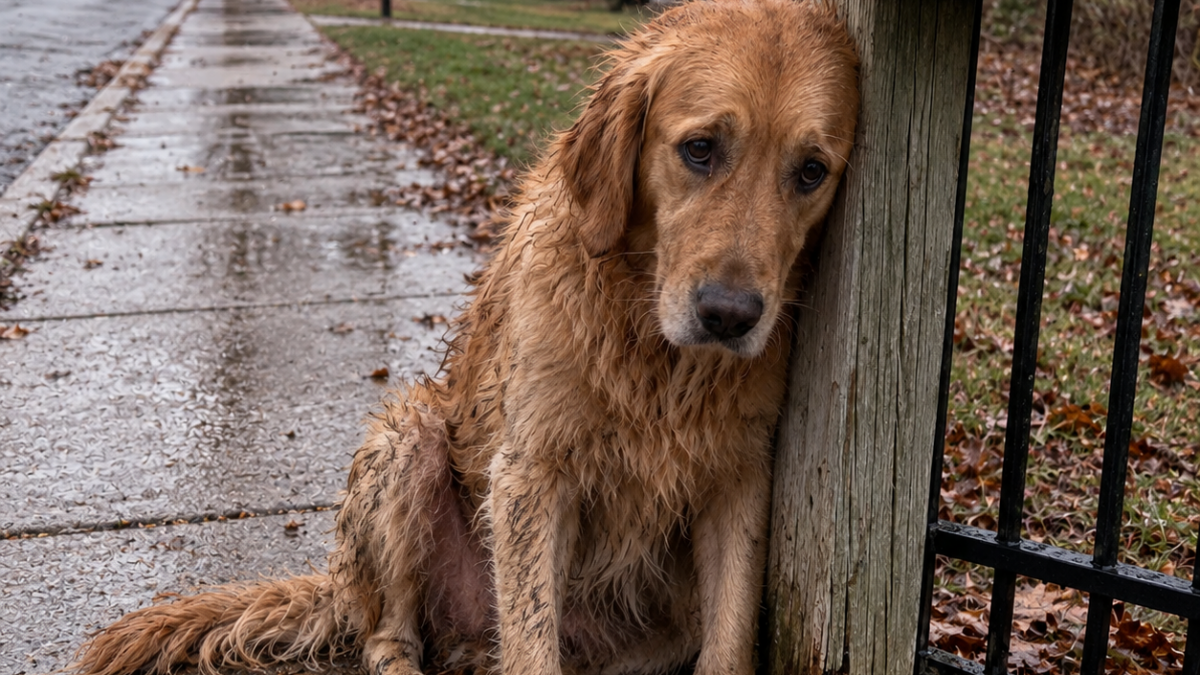
Every morning at exactly 7:15, my Golden Retriever sat beside our front gate and waited for a dog who was never supposed to come back
For a moment, I could not understand the words.
Not because they were complicated.
Because my mind refused to put them together.
Bruno.
Found.
Two months.
Stopped eating.
Lucas was asleep—or trying to sleep—near the front door.
Even in sleep, he had begun positioning himself closer to the gate.
Closer to the street.
Closer to the place where his morning still made sense.
I gripped the phone.
“How bad?”
The woman hesitated.
That was when fear became real.
“My name is Claire Bennett,” she said.
“I’m the night supervisor.”
“Claire, how bad?”
“He’s alive.”
“That’s not what I asked.”
“I know.”
She exhaled slowly.
“He was surrendered nearly eight weeks ago under a different intake name.”
“What name?”
“Bear.”
I closed my eyes.
Of course.
Someone had dropped Bruno at a shelter and changed his name as if changing a word could sever a life.
“How did you know it was him?”
“One of our volunteers found your missing-dog posts tonight.”
I had made dozens.
Photos of Bruno from the Hendersons’ old social media page.
Descriptions.
Approximate age.
Weight.
Markings.
The little white patch near his left rear paw.
His habit of leaning his whole body into people he trusted.
Claire continued.
“She showed me the photo.”
“And?”
“And I knew.”
My throat tightened.
“Is he sick?”
“Medically, yes and no.”
I hated every careful answer.
“He has lost a lot of weight.”
“Why?”
“We have tested for infection, parasites, gastrointestinal problems, organ issues.”
“And?”
“Nothing that explains the decline.”
I looked at Lucas.
His chest rose and fell slowly.
“What does explain it?”
Claire was quiet.
Then she said, “We think he shut down.”
That phrase entered the room like cold air.
I sat down.
“What do you mean?”
“When he first arrived, he was anxious but responsive.”
She spoke gently.
“He watched the front door constantly.”
I swallowed.
“He refused to enter the play yard unless someone stood near the entrance.”
My eyes filled.
“He would perk up when large golden-colored dogs passed.”
I covered my mouth.
“And then?”
“After about three weeks, he stopped reacting to visitors.”
Claire’s voice tightened.
“He stopped playing.”
“Then what?”
“He began eating less.”
I knew the rest before she said it.
“Now he barely eats at all.”
My eyes moved to Lucas.
One dog waiting at a gate.
Another waiting behind shelter bars.
Both disappearing.
Miles apart.
Keeping the same grief.
“When can I come?”
“We’re open at seven.”
“No.”
“Sir?”
“I’m coming now.”
“The public area is closed.”
“Claire.”
My voice broke.
“I’ve spent two months watching one dog lose himself because he thought Bruno disappeared.”
There was silence.
“Please.”
Claire lowered her voice.
“Give me forty minutes.”
“I can be there in thirty.”
“Drive safely.”
I hung up.
Then I looked at Lucas.
“Buddy.”
His eyes opened immediately.
At five years old, Lucas had always responded to my voice.
Lately, he responded more slowly.
As if waking required negotiation.
But when I said one word, everything changed.
“Bruno.”
Lucas lifted his head.
I froze.
His ears rose.
Not much.
But more than they had in days.
“Bruno,” I said again.
He stood.
Slowly.
His tail did not wag yet.
But he was looking directly at me.
That was the most alive I had seen him in weeks.
“We found him.”
Lucas took one step.
I did not know whether he understood the sentence.
But he understood the name.
That was enough.
I grabbed his leash.
For the first time in almost two months, Lucas walked toward the car before I did.
Riverside Shelter was forty-three minutes away.
I made it in forty-seven because Claire’s warning stayed in my head.
Drive safely.
Lucas sat upright in the passenger side of the back seat.
He did not lie down once.
Every time I said Bruno’s name, his ears lifted.
The city thinned behind us.
Streetlights became farther apart.
Rain had begun, soft against the windshield.
At one point, I looked in the mirror.
Lucas was staring out the window.
Not with the empty look he had carried for weeks.
With focus.
Hope is dangerous when you have been disappointed long enough.
I almost stopped saying Bruno’s name.
What if we were wrong?
What if it was another Bernese?
What if Bruno did not recognize him?
What if the dog had changed beyond recognition?
What if we arrived too late?
I gripped the steering wheel harder.
“No.”
Lucas looked at me.
“We’re not doing that.”
I was talking to myself.
“You waited.”
His ears moved.
“He waited.”
I swallowed.
“We’re going to find out.”
The shelter sat behind a municipal services building near the river.
At night, the parking lot was nearly empty.
One light burned above the entrance.
Claire was waiting inside.
She unlocked the door before I reached it.
“You’re Daniel?”
“Yes.”
Her eyes dropped to Lucas.
And then her expression changed.
“Oh.”
“What?”
She stared.
“He looks like him.”
“Like Bruno?”
“No.”
Her eyes filled.
“Like the dog Bruno has been waiting for.”
That sentence almost dropped me.
Lucas stepped through the door.
His nose lifted immediately.
The shelter smelled like disinfectant, wet fur, laundry detergent, food, metal, and dozens of animals.
Normally, Lucas would have been overwhelmed.
That night, he ignored everything.
Barking erupted from a kennel corridor.
Lucas did not look.
A small terrier yapped behind a glass door.
Lucas did not look.
His nose stayed high.
His body became alert.
Then he pulled forward.
Not hard.
Lucas had never been a strong leash puller.
But there was urgency in him now.
Claire looked at me.
“He smells him.”
I could not speak.
She led us down a quieter hall.
“We moved Bruno to medical three days ago.”
“Why?”
“He was too weak for the main kennel.”
My chest tightened.
“Is he on fluids?”
“Intermittently.”
“Has he eaten today?”
“Two bites.”
Lucas pulled harder.
Claire stopped before a closed door.
“Daniel.”
I looked at her.
“I want to prepare you.”
“No.”
“You need to know—”
“No.”
My voice cracked.
“I don’t want preparation.”
She studied me for a second.
Then nodded.
“All right.”
She opened the door.
The room was dim.
A blanket covered most of the floor inside a large recovery pen.
At first, I only saw black fur.
Then white.
Then the broad head.
Bruno.
He was lying on his side.
Or what was left of him.
The enormous Bernese Mountain Dog I remembered had been thick, powerful, almost bear-like.
This dog looked smaller.
Not because he was small.
Because his body had emptied.
His ribs showed beneath his coat.
The fur around his shoulders had lost its shine.
His head rested flat against the blanket.
His eyes were open.
But tired.
So tired.
Lucas froze.
Everything in him went still.
I stopped breathing.
Claire whispered, “That’s Bruno.”
Lucas made a sound.
I had never heard it before.
Not a bark.
Not a whine.
A low, broken sound from somewhere deep in his chest.
Bruno’s ear moved.
That was all.
Lucas stepped forward.
Bruno’s eyes shifted.
He saw Lucas.
For one second, nothing happened.
My heart began to fall.
Then Bruno lifted his head.
Barely.
But he lifted it.
Lucas pulled so suddenly the leash slipped through my fingers.
He crossed the room.
Claire gasped.
I nearly reached for him.
Then stopped.
Lucas went straight to the gate of the recovery pen.
Bruno tried to stand.
His front legs moved.
His body failed.
He collapsed back onto the blanket.
Lucas pressed his face against the bars.
Bruno crawled.
Not walked.
Crawled.
He dragged himself forward until his nose reached Lucas’s.
They touched.
And everything that had happened for two months seemed to break open in that room.
Lucas began whining.
Not loudly.
Not frantically.
A high, trembling sound that made my knees weak.
His tail moved.
Once.
Then again.
Then faster.
Bruno pressed his muzzle through the bars.
Lucas pushed his head against him.
Claire covered her mouth.
I was already crying.
“Can you open it?”
Claire hesitated.
“Bruno is medically fragile.”
“Please.”
She looked at them.
Lucas had lowered himself onto the floor outside the pen.
His entire body was pressed against the gate.
Bruno had placed his head against the bars opposite him.
Two dogs separated by six inches of metal after surviving two months of separation.
Claire made the decision.
“Stay calm.”
She opened the pen.
Lucas did not rush.
That was what destroyed me.
He entered slowly.
Carefully.
As if he understood Bruno was fragile.
He approached.
Bruno tried once more to lift himself.
Lucas went down instead.
He lay beside him.
Shoulder to shoulder.
Exactly the way they had lain beneath my maple tree a hundred mornings.
Bruno put his head across Lucas’s neck.
Lucas closed his eyes.
And for the first time in two months, both dogs stopped waiting.
The room went silent.
Claire cried openly now.
I sat on the floor.
I could not stand.
For nearly ten minutes, neither dog moved.
Then something extraordinary happened.
Bruno lifted his head.
He sniffed Lucas’s face.
Then the room.
Then me.
His eyes sharpened slightly.
Claire whispered, “Bruno?”
The dog looked at her.
She froze.
“He hasn’t looked at me like that in days.”
Lucas stood.
Bruno watched him.
Lucas moved toward the water bowl.
Drank.
Then returned.
Bruno looked at the bowl.
Claire’s eyes widened.
“No way.”
She moved slowly, picked up a small dish of soft food from the counter, and placed it near Bruno.
“He refused this an hour ago.”
Lucas sniffed it.
I laughed through tears.
“Lucas, no.”
For the first time in weeks, Lucas’s tail wagged at my voice.
Bruno looked at him.
Lucas sat.
Bruno lowered his nose toward the dish.
One sniff.
Then another.
He licked the food.
Claire made a sound like she had forgotten how to breathe.
Bruno took a bite.
Tiny.
Slow.
But a bite.
Then another.
I put both hands over my face.
Claire whispered, “Oh my God.”
Bruno ate four bites.
Then stopped.
That was enough.
More than enough.
Lucas lay beside him again.
Bruno rested his head across his back.
Claire stepped into the hallway.
“I need to call Dr. Patel.”
“Now?”
“Yes.”
“Is something wrong?”
She looked at me.
“No.”
She smiled through tears.
“For the first time, something may finally be right.”
Dr. Anika Patel arrived twenty-five minutes later.
She was the shelter veterinarian and had apparently been sleeping when Claire called.
She entered wearing jeans, boots, and a sweater under her clinic coat.
Her hair was tied back badly.
She did not care.
She stopped in the doorway when she saw the dogs.
“That’s Lucas?”
“Yes.”
She looked at Bruno.
Then at the empty food dish.
“He ate?”
“Four bites,” Claire said.
Dr. Patel’s eyes filled.
“Bruno.”
He looked at her.
She laughed softly.
“There you are.”
She crouched.
Lucas stayed beside him.
Dr. Patel checked Bruno’s gums, heart, breathing, hydration, abdomen.
He tolerated it more easily than Claire had ever seen.
Every time he became tense, Lucas leaned against him.
Dr. Patel noticed.
“He’s regulating him.”
“What does that mean?” I asked.
“Lucas is making him feel safe.”
She sat back on her heels.
“How long were they together?”
“Two years.”
“Daily?”
“Every morning.”
“Close?”
I almost laughed.
“They were ridiculous.”
“Good.”
“Good?”
She looked at Bruno.
“Attachment can affect appetite, sleep, cortisol, behavior.”
She ran one hand gently over his shoulder.
“This isn’t magic.”
“I know.”
“But stress can absolutely make illness harder and recovery slower.”
I looked at Lucas.
“So seeing him could help?”
“It already has.”
That gave me hope.
Then Dr. Patel’s expression changed.
“What?”
“He’s still very sick, Daniel.”
The hope did not disappear.
It became careful.
“How sick?”
“His body has been underfed for too long.”
“Because he refused food?”
“Mostly.”
“Can he recover?”
“I think so.”
I closed my eyes.
Think.
Not know.
“But?”
“No but.”
She touched my arm.
“We go one day at a time.”
I nodded.
Then a question I had avoided forced itself forward.
“What happens to Bruno?”
Claire looked at Dr. Patel.
Dr. Patel looked at me.
“He belongs to Riverside Shelter legally now.”
“The Hendersons surrendered him.”
“Yes.”
“Can I take him?”
The words were out before I planned them.
Claire blinked.
“Daniel.”
“I’m serious.”
Dr. Patel remained calm.
“You already have Lucas.”
“Yes.”
“Bernese Mountain Dogs are expensive.”
“I know.”
“Large dog.”
“I know.”
“Medical needs.”
“I know.”
“Bruno may have long-term issues after this.”
“I know.”
“Do you?”
“No.”
That made her smile.
“Probably not fully.”
I looked at the dogs.
Lucas had fallen asleep.
Actually asleep.
Not the light, restless dozing he had done beside the gate for weeks.
His body was loose.
His face rested near Bruno’s paws.
Bruno’s eyes were closed too.
Their breathing had begun to match.
“I know one thing.”
“What?”
“I’m not separating them again.”
Claire looked away.
Dr. Patel sat beside me.
“The shelter can’t release Bruno tonight.”
“I understand.”
“He needs medical stabilization.”
“Fine.”
“There’s a legal adoption process.”
“I’ll fill out everything.”
“Home assessment.”
“Come tomorrow.”
“Daniel.”
“Yes?”
She smiled gently.
“You have clearly rehearsed none of this.”
“No.”
“Good.”
We all laughed.
Quietly.
Enough not to wake them.
I stayed until dawn.
Around five-thirty, Claire brought me coffee from a machine that produced something technically brown and hot.
I drank it anyway.
Lucas slept beside Bruno.
At six-fifteen, Bruno woke.
He looked around.
Then immediately checked for Lucas.
Lucas lifted his head.
Their noses touched.
Bruno relaxed.
At 6:45, Dr. Patel offered him food.
This time he ate half the dish.
Lucas ate breakfast too.
His first full breakfast in weeks.
I cried again.
By then, I had given up pretending I was going to handle any part of this with dignity.
At seven-thirty, I took Lucas home.
That was harder than I expected.
The moment we approached the door, Bruno became alert.
Lucas stopped.
Neither wanted the separation.
My stomach turned.
“We’re coming back.”
Lucas looked at me.
“I promise.”
Claire crouched beside Bruno.
“Lucas will come back.”
Bruno watched the door after we left.
In the car, Lucas whined.
“Me too.”
We were home for four hours.
Lucas ate.
Drank.
Slept deeply for an hour.
Then at 11:30, he went to the gate.
My heart stopped.
7:15 had passed while we were at the shelter.
For the first time in two months, Lucas had not waited there at 7:15.
But now he sat.
I walked outside.
“Buddy.”
He looked at me.
This time, he was not looking down the street.
He looked at my car.
I understood.
“You want to go back.”
His tail moved.
“All right.”
We went back.
That became our life for the next two weeks.
Morning at Riverside.
Afternoon at home.
Evening at Riverside.
Sometimes Lucas stayed for hours.
Sometimes just one.
Bruno improved slowly.
The first day, four bites.
Second day, two small meals.
Third day, he stood for nearly thirty seconds.
Fourth day, he walked three steps.
On the fifth, he followed Lucas across the treatment room.
Seven steps.
Claire applauded.
Bruno looked embarrassed.
Lucas looked proud.
By day eight, Bruno could walk to the small private courtyard.
Lucas went first.
Bruno followed.
They stood outside beneath weak winter sunlight.
Bruno lifted his face.
The breeze moved through his fur.
Lucas sniffed the grass.
Then, as if two months had vanished, he nudged Bruno’s shoulder.
Bruno nudged back.
I laughed.
“Don’t start.”
Lucas moved sideways.
Bruno took one playful step.
Only one.
Then he tired.
But it was play.
Claire saw it from the door.
“He hasn’t done that since he came.”
I looked at her.
“How long had he been here before he stopped playing?”
“About ten days.”
Ten days.
It had taken him only ten days to understand the Hendersons were not coming back.
Lucas had taken three.
Different dogs.
Same loss.
I began asking questions about Bruno’s surrender.
I told myself it was necessary for his medical record.
That was partly true.
Mostly, I was angry.
Claire pulled the intake paperwork.
Bruno had been surrendered by Mark Henderson.
Reason:
Housing restrictions.
Owner relocation.
Behavior:
Friendly.
Bonding:
None listed.
That line made my stomach turn.
None listed.
Two years of morning meetings.
Walks.
Sleeping side by side.
Waiting.
Grieving.
None listed.
“Did Mark tell you about Lucas?”
“No.”
“Nothing?”
“No.”
“Did anyone ask?”
Claire’s face tightened.
“Probably not specifically.”
I wanted someone to blame.
The Hendersons were easiest.
They had known.
Hadn’t they?
Surely they had seen Bruno cross the street every morning.
Surely they had watched those dogs together.
Why had they never called?
Why did they not tell me they could not keep him?
Why not ask whether I could help?
Why surrender him and leave?
I called Mark Henderson.
He answered after three rings.
“Daniel?”
“You remember Bruno?”
Silence.
“Of course.”
“I found him.”
Another silence.
Then Mark said quietly, “Where?”
“Riverside.”
His breath left him.
“Oh.”
“Two months.”
“I know.”
“You knew?”
“I knew he was surrendered two months ago.”
“You knew he was at Riverside?”
“No.”
I stood in my kitchen, anger rising.
“He nearly died.”
Mark did not answer.
“He stopped eating.”
“I’m sorry.”
“Don’t.”
“Daniel—”
“You saw Lucas and Bruno together every day.”
“Yes.”
“And you said nothing.”
“We were overwhelmed.”
“That’s your answer?”
“No.”
His voice changed.
He sounded older.
Tired.
“Our move fell apart at the last minute.”
“That does not explain—”
“Our landlord changed the pet agreement.”
“So you called a shelter.”
“We called everyone.”
I stopped.
“What?”
“Friends.”
“Family.”
“Breed rescues.”
“Boarding places.”
“No one could take him quickly.”
My anger faltered, but did not disappear.
“Why didn’t you call me?”
Mark was quiet.
That answer mattered.
“Why?”
“Because we were embarrassed.”
I closed my eyes.
“There it is.”
“I know.”
“No, you don’t.”
“We thought you’d judge us.”
“I am judging you.”
“I know.”
He sounded like he was crying.
That surprised me.
“We kept telling ourselves the shelter would place him quickly.”
“He’s a Bernese.”
“I know.”
“He’s gentle.”
“I know.”
“He loves everyone.”
“You knew he loved Lucas.”
“Yes.”
The word broke.
I sat down.
Mark continued.
“My wife couldn’t even come inside when I surrendered him.”
“Then why not tell me afterward?”
“I wanted to.”
“But?”
“Every day made it harder.”
Shame.
That useless human instinct to hide from damage because admitting it means feeling it fully.
I had spent weeks angry at them.
I was still angry.
But now anger had company.
Sadness.
Cowardice rarely looks evil from inside the coward.
It looks like tomorrow.
I’ll call tomorrow.
I’ll explain tomorrow.
I’ll fix it tomorrow.
Then tomorrow becomes two months.
“Bruno almost died because everyone assumed someone else would understand him.”
Mark began crying.
“I know.”
“No.”
I looked out the window.
Lucas was sleeping in the sun.
“You know now.”
I ended the call without forgiving him.
Not yet.
Maybe not fully ever.
But I stopped imagining him as a villain.
That mattered.
Bruno’s adoption became official seventeen days after the phone call.
Home inspection passed.
Veterinary plan approved.
I bought a second enormous bed.
Then a third because Lucas immediately decided Bruno’s bed was better.
I bought raised bowls.
Joint supplements.
A ridiculous amount of food.
A ramp I hoped Bruno would never need.
A new collar.
I did not buy matching collars.
I had limits.
Claire disagreed.
The shelter staff held a small goodbye for Bruno.
No balloons.
He hated sudden noises.
No crowd.
Just Claire, Dr. Patel, three technicians, and a volunteer named Sophie who had sat outside his kennel during his worst days.
Sophie knelt beside him.
“I told you someone was coming.”
Bruno leaned into her.
Her face crumpled.
“You just took your time.”
Lucas stood beside him.
Sophie laughed through tears.
“Oh.”
She looked at Lucas.
“You were the someone.”
I signed the final paper.
Adopter:
Daniel Mercer.
Dog:
Bruno.
The shelter had written Bear in parentheses.
I crossed it out gently.
“He knows who he is.”
Claire nodded.
“Bruno it is.”
The drive home took forty-five minutes.
Lucas and Bruno rode in the back.
For the first ten minutes, both remained upright.
Then Lucas lay down.
Bruno looked at him.
Slowly, he lowered himself beside Lucas.
By the time we reached our neighborhood, Bruno’s head was resting across Lucas’s back.
I parked in my driveway but did not get out immediately.
Across the street stood the Hendersons’ empty house.
New owners had moved in.
A child’s bicycle lay near the porch.
Different curtains.
Different car.
Different life.
I looked at Bruno in the mirror.
Would he remember?
Of course he would.
I opened the door.
Lucas jumped down first.
Bruno followed slowly.
The moment his paws touched our driveway, his nose lifted.
His body went still.
Then he looked across the street.
My chest tightened.
He walked toward the edge of the driveway.
Stopped.
Stared at his old gate.
Lucas stood beside him.
Neither moved.
I did not call them.
Some moments belong to animals.
Bruno sniffed the air for a long time.
Then he turned his head toward Lucas.
Lucas touched his nose to Bruno’s.
That old morning greeting.
I am here.
You are here.
The world is okay.
Then Lucas turned toward my house.
Bruno followed.
Not the old house.
Mine.
I cried all over again.
At the front door, Bruno hesitated.
Lucas walked inside.
Stopped.
Looked back.
Bruno stepped over the threshold.
Home.
The first weeks were careful.
Bruno gained weight slowly.
Dr. Patel had warned me not to overfeed him.
His body needed time.
Lucas seemed personally offended by this medical restriction and began leaving pieces of kibble near Bruno’s bowl.
The first time I caught him, I stared.
“Are you feeding him?”
Lucas looked away.
Bruno ate the kibble.
“Unbelievable.”
It became a problem.
I had to feed them separately for a while.
Lucas hated it.
Bruno found loopholes.
Friendship apparently included conspiracy.
At exactly 7:15 the first morning after Bruno came home, I woke to movement downstairs.
I checked the clock.
7:13.
I followed quietly.
Lucas stood at the front door.
Bruno beside him.
I opened it.
Both walked outside.
Lucas went to the gate.
Bruno followed.
My throat tightened.
They sat side by side.
Not one waiting for the other.
Both present.
At 7:15, Lucas touched Bruno’s nose.
Bruno touched back.
Then they walked into the yard.
The ritual survived.
It changed.
But it survived.
Every morning after that, 7:15 belonged to them.
Sometimes they sat at the gate.
Sometimes the porch.
Sometimes beneath the maple tree.
But they always found each other at that time.
I stopped setting an alarm.
Their footsteps woke me.
The strangest part was how quickly Lucas returned.
Not overnight.
But visibly.
He started eating normally.
Then playing.
Then greeting the mail carrier as if the man had personally survived a war.
His coat regained shine.
His eyes brightened.
The tennis ball came out from under the porch.
Three weeks after Bruno came home, Lucas brought it to him.
Dropped it at his paws.
Bruno looked at the ball.
Then Lucas.
Then me.
“He wants you to play.”
Bruno sniffed it.
Lucas picked it up.
Dropped it again.
Bruno sighed like an exhausted parent.
Then picked up the ball.
Lucas exploded with joy.
He bounced around him, tail spinning.
Bruno lumbered after him.
Slow.
Awkward.
Still rebuilding.
But playing.
I stood in the yard laughing like a fool.
The dogs did not care.
That spring, Bruno became healthy again.
Not exactly the same dog.
His body carried the memory.
He disliked enclosed kennel-like spaces.
He became anxious if a car was packed with boxes.
The first time I brought suitcases downstairs before a weekend trip, Bruno stopped eating.
I understood immediately.
“No.”
I sat on the floor with him.
“We’re all going.”
Lucas lay beside him.
“All of us.”
We had rented a cabin where dogs were welcome.
I loaded Bruno last.
He resisted the car.
Lucas jumped in.
Turned around.
Waited.
Bruno climbed inside.
At the cabin, both slept near my bed.
Bruno learned something important that weekend.
People can pack.
Cars can leave.
And dogs can come too.
Healing is often a new ending attached to an old trigger.
We kept doing that.
New endings.
When strangers came over, they stayed.
Then left without taking him.
When I closed a door, I opened it again.
When the vet took him to the back, Lucas waited in the lobby and Bruno came back.
When food bowls emptied, they filled again.
When morning came, nobody disappeared.
Small proof.
Repeated.
That was how Bruno healed.
That was how I did too.
Because I had changed.
Watching those dogs had stripped away something arrogant in me.
I no longer laughed when people said animals grieved.
I no longer said things like, “Dogs live in the moment,” as if the moment contained no memory.
They live in the moment, yes.
But moments can be full of someone missing.
I began volunteering at Riverside.
Not every week.
Twice a month.
Mostly transport and photography for adoption profiles.
I was a decent amateur photographer.
Claire said the shelter needed better photos of older and larger dogs.
“They look miserable in kennel pictures.”
“They are miserable in kennel pictures.”
“Exactly.”
So I photographed them outside.
Grass.
Sunlight.
Human hands.
Personality.
A dog named Walter who looked terrifying in his intake photo turned out to love carrying stuffed ducks.
A senior shepherd named Daisy leaned against everyone she met.
A hound called Cooper was afraid of cameras until Bruno sat beside him.
Yes.
Bruno became involved too.
So did Lucas.
They began helping with calm-dog introductions.
Never forced.
Never used with dangerous situations.
Just frightened dogs who needed stable company.
Lucas brought joy.
Bruno brought stillness.
Together, they were strangely effective.
One young dog named Pepper had refused to leave her kennel for nearly a week.
Claire sat outside for hours.
Nothing.
One afternoon, I brought Bruno down the hall.
Pepper saw him.
Bruno lay several feet from her kennel.
Did nothing.
No staring.
No pressure.
Lucas lay beside him.
Ten minutes later, Pepper stood.
Twenty minutes later, she came to the door.
Thirty minutes later, she stepped into the hallway.
Claire cried.
“So now they have jobs.”
“Absolutely not.”
“They’re volunteers.”
“They expect snacks.”
“Then they understand nonprofit work perfectly.”
The shelter created a small program around bonded animals and social relationships.
Nothing dramatic.
Just better questions.
Does this dog rely heavily on another?
Who do they seek when frightened?
Do they eat better beside another dog?
Do they sleep touching?
Do they panic when separated?
Could this be a bonded pair?
Bruno’s intake had said:
Bonding: None listed.
Claire printed that old page once and taped it inside her office cabinet.
Next to it, she placed a photo of Bruno and Lucas asleep against each other.
Underneath, she wrote:
ASK BETTER QUESTIONS.
I loved that.
A year after Bruno came home, Mark Henderson called.
I almost did not answer.
Then I did.
“Daniel.”
“Mark.”
“How is he?”
I looked toward the yard.
Bruno and Lucas were sleeping under the maple tree.
“Good.”
“Really?”
“Yes.”
Silence.
Then a breath.
“Can I see him?”
I stiffened.
Mark rushed on.
“Not take him.”
“I know.”
“I just…”
He stopped.
“I want to apologize.”
“To me?”
“To him.”
I said nothing.
“You don’t have to say yes.”
I looked at Bruno.
Forgiveness is complicated when the harmed creature cannot explain whether he wants it.
I did not want to use Bruno to make Mark feel better.
But I also did not want my anger deciding every future moment.
“Come Saturday.”
Mark arrived alone.
He looked thinner.
Older.
He stood at the gate instead of walking in.
Bruno saw him from the yard.
His head lifted.
Everything in me tightened.
Lucas stood too.
Mark did not call Bruno.
Good.
He waited.
Bruno stared at him.
Then slowly approached.
Halfway across the yard, he stopped.
Mark crouched.
His face was already wet.
“Hey, big guy.”
Bruno’s ears moved.
Mark whispered, “I’m sorry.”
The dog remained still.
“I’m so sorry.”
He put one hand flat on the ground.
Bruno took one step.
Then another.
He sniffed Mark’s fingers.
Mark broke.
His shoulders shook.
“I failed you.”
Bruno looked at him.
Then, after a long moment, placed his nose against Mark’s hand.
Not absolution.
Not human forgiveness.
Just recognition.
You existed.
You were mine once.
Now you are here.
Mark touched Bruno’s cheek.
Bruno allowed it.
Then Bruno stepped back.
Turned.
Walked to Lucas.
Lay beside him.
Mark watched.
“I guess he chose.”
I looked at the dogs.
“He chose a long time ago.”
Mark nodded.
He stayed twenty minutes.
Never asked for more.
Before leaving, he gave me an envelope.
Inside was a check for Riverside Shelter.
A large one.
“I can’t undo it.”
“No.”
“But maybe another dog doesn’t end up like him.”
I accepted it.
Not because money erased anything.
Because regret is most useful when it becomes repair.
The donation funded several months of medical care for surrendered senior dogs.
Claire called it the Bruno Fund.
I objected.
Bruno did not.
He was uninterested in accounting.
Years passed.
Lucas and Bruno aged together.
Lucas remained more energetic.
Bruno remained larger, slower, and convinced couches existed specifically for Bernese Mountain Dogs who had suffered enough.
At seven, Lucas began showing silver near his muzzle.
Bruno’s rust-colored eyebrows faded.
At 7:15 every morning, they still met.
Even when both had slept in the same room.
That was the funniest part.
They could spend the entire night three feet apart.
Then at 7:15, they would stand, walk to the porch or gate, and touch noses.
Official confirmation.
I am here.
You are here.
World intact.
When Bruno turned nine, his hips began bothering him.
Big dogs pay for their size eventually.
We added rugs.
Ramps.
Joint medicine.
Shorter walks.
Lucas adjusted without complaint.
If Bruno slowed, Lucas slowed.
If Bruno stopped, Lucas stopped.
Once, on a neighborhood walk, a squirrel appeared.
Lucas looked at it.
Then at Bruno.
Then made the astonishing decision not to chase.
I said, “That is love.”
Lucas looked offended.
The squirrel escaped.
Bruno aged faster after ten.
Bernese Mountain Dogs are not given enough time.
No dog is.
But some breeds feel especially unfair.
His muzzle whitened.
His eyes grew cloudy.
He slept more.
Still, 7:15 remained.
Then one winter morning, Bruno did not stand.
Lucas did.
I heard his nails on the floor.
7:14.
Lucas walked to Bruno’s bed.
Waited.
Bruno’s eyes opened.
Lucas touched his nose.
Bruno tried to rise.
His back legs failed.
I knew.
Not everything.
But enough.
“Easy.”
I knelt beside him.
Lucas stayed close.
Bruno’s breathing was heavier than usual.
He had been diagnosed with an aggressive cancer two months earlier.
Dr. Patel had explained options.
We had chosen comfort.
Good days.
Food.
Warmth.
No unnecessary hospital stays.
No heroic treatment for my benefit.
I had promised Bruno I would not make him suffer because I was afraid to lose him.
Promises become hard when they are due.
I called Dr. Patel.
She came to the house.
Claire came too.
Mark asked if he should come.
I said no.
Not because I hated him.
Because Bruno’s final circle was already complete.
Me.
Lucas.
The people who helped him become himself again.
Bruno lay beneath the maple tree that afternoon.
We carried his bed outside.
The winter sun was pale.
Lucas lay beside him.
Shoulder to shoulder.
Dr. Patel examined Bruno gently.
Then looked at me.
I knew.
“Is it time?”
She nodded.
“Yes.”
I thought I would collapse.
Instead, I became strangely calm.
Maybe because Bruno was calm.
Lucas pressed closer.
Bruno turned his head toward him.
With effort, he lifted his muzzle.
Lucas met him.
Nose to nose.
I am here.
You are here.
The world—
My chest broke.
The world was not going to be okay in the same way.
But maybe that was not what the ritual had ever meant.
Maybe it meant:
This moment is okay because you are in it.
I sat behind Bruno and rested his head in my lap.
“You came back.”
His eyes moved toward me.
“I need you to know that.”
My voice broke.
“You came back.”
Lucas rested one paw against Bruno’s leg.
Dr. Patel waited.
“You were loved.”
Bruno’s breathing slowed.
“You were wanted.”
I pressed my forehead to his.
“You were home.”
Dr. Patel gave him peace.
Bruno left beneath the maple tree at 3:42 in the afternoon.
Lucas did not move.
Not for nearly an hour.
We let him stay.
People sometimes try to protect animals from death by removing the body quickly.
Dr. Patel told me not to.
“Let him understand.”
So Lucas sniffed Bruno.
Touched his face.
Lay beside him.
Eventually, he stood.
Walked to me.
Pressed his body against my legs.
That night, Lucas did not eat.
I expected that.
What I feared was morning.
At 7:14, I was awake.
Sitting on the stairs.
Waiting.
Lucas rose.
Walked toward the front door.
My heart sank.
I opened it.
He stepped outside.
Went to the gate.
Sat.
7:15.
Empty street.
I sat beside him.
“Buddy.”
He looked down the road.
“Bruno isn’t coming.”
I hated the words.
Lucas lay down.
Head on paws.
For one terrible moment, I thought we were beginning the old story again.
Two months of waiting.
Loss.
Weight loss.
Silence.
I placed my hand on his back.
“He didn’t leave you this time.”
Lucas’s ear moved.
“You were there.”
I swallowed.
“You know.”
Of course he did not understand my sentences.
But he knew the truth differently.
He had smelled it.
Seen it.
Stayed beside it.
This grief had an ending.
Not a disappearance.
That mattered.
Lucas waited at the gate for twelve mornings.
Not two months.
Twelve.
Each morning, a little shorter.
First an hour.
Then forty minutes.
Then twenty.
On the thirteenth morning, he walked to the gate at 7:15.
I followed.
He sat.
I sat.
After five minutes, Lucas stood.
Turned toward the maple tree.
Walked there.
Bruno’s ashes had been buried beneath it.
Lucas sniffed the ground.
Then lay in the grass.
I sat beside him.
That became the new ritual.
7:15.
Not waiting.
Remembering.
There is a difference.
A huge one.
The Bruno Fund at Riverside grew.
People heard the story.
Not because I tried to make it famous.
Claire shared it once in the shelter newsletter, with my permission.
A few local papers picked it up.
Donations came.
Small ones.
Ten dollars.
Twenty.
A child sent five dollars in an envelope with a drawing of a golden dog beside a big black dog.
A retired couple donated enough to cover senior-dog bloodwork for a year.
Mark continued contributing quietly.
The fund helped dogs surrendered after deaths, moves, divorces, evictions, illness.
Dogs whose worlds disappeared because human life changed too fast.
Riverside began documenting known animal relationships more carefully.
Best friend.
Bonded sibling.
Neighbor dog.
Housemate.
Preferred companion.
Not because every friendship meant dogs had to be adopted together.
But because relationships mattered.
Because nobody wanted to write None listed again when the truth was waiting at a gate.
Lucas lived to be thirteen.
He slowed.
Gray spread across his face.
His hearing faded.
His love did not.
Every morning, almost until the end, he went outside at 7:15.
Sometimes to the maple.
Sometimes only to the porch.
I went with him whenever I could.
We sat together.
No words needed.
When his final day came, it was spring.
The maple tree had new leaves.
Riverside’s Dr. Patel came again.
Older now.
More silver in her hair.
Claire came too.
Lucas lay beneath Bruno’s tree.
That had been his choice.
I had put his bed on the porch.
He walked past it.
Slowly.
Painfully.
Straight to the maple.
He lowered himself above the place where Bruno’s ashes rested.
I sat beside him.
“You stubborn old dog.”
His tail moved once.
I held his face.
Thirteen years.
He had been with me through divorce, job changes, my father’s death, Bruno’s disappearance, Bruno’s return, Bruno’s loss.
Through everything.
But when I looked at Lucas, one truth stood above all the rest.
He taught me grief before he taught me goodbye.
I once thought animals did not grieve.
I thought we put ourselves inside them because we needed their emotions to resemble ours.
I was wrong.
Not because dogs grieve exactly like people.
They do not need to.
Their grief is their own.
Lucas’s grief sat at a gate at 7:15.
Bruno’s grief lay behind shelter bars and refused food.
Their love touched noses every morning.
Their reunion ate four bites from a bowl.
Their goodbye rested beneath a maple tree.
None of that needed to look human to be real.
I leaned close to Lucas.
“He’s there.”
My voice shook.
“Wherever good dogs go.”
Lucas’s eyes were cloudy.
Tired.
But peaceful.
“You don’t have to wait anymore.”
His head settled onto my hand.
Dr. Patel gave him peace.
Lucas died beneath the same tree where Bruno was buried.
We placed his ashes beside Bruno’s.
One marker.
Two names.
LUCAS & BRUNO.
7:15.
ALWAYS THERE.
That is all it says.
It is enough.
I still live in the same house.
The Henderson place across the street belongs to another family now.
They have a young black Lab named Charlie.
Every morning around seven, Charlie’s owner walks him past my gate.
Sometimes Charlie stops.
Sniffs.
Looks into my yard.
Once, he sat there for nearly a minute.
I laughed.
“Not starting this again.”
Charlie wagged.
His owner looked confused.
I told her the short version.
She cried.
People often do.
Riverside still has the Bruno Fund.
Claire became shelter director.
Dr. Patel retired.
The program they started around bonded dogs is now part of every intake evaluation.
Ask about relationships.
Ask about routines.
Ask who this animal looks for.
Ask what disappeared before assuming the animal is simply difficult.
Sometimes the answer is medical.
Sometimes behavioral.
Sometimes fear.
And sometimes a dog is waiting for someone whose name never made it onto the form.
I volunteer there every Thursday.
Mostly with older dogs now.
The ones who sit quietly while puppies perform for visitors.
The ones people describe as “less exciting.”
I understand quiet dogs better than I used to.
One afternoon, a Bernese mix arrived.
Huge.
Black.
White chest.
Terrified.
I stood outside his kennel and almost had to leave.
Too familiar.
Claire found me there.
“You okay?”
“No.”
She nodded.
We stood together.
The dog watched us.
After a while, I sat down.
No touching.
No calling.
Just sat.
Twenty minutes later, the dog moved closer to the gate.
Claire smiled.
“Lucas taught you patience.”
“Bruno too.”
The dog put his nose near my fingers.
“Yes,” I whispered.
“They both did.”
I am seventy-one now.
My mornings are quieter.
No nails across the floor at 7:14.
No golden head pushing against my hand.
No giant Bernese breathing like a bear beside the porch.
But I still wake early.
Some habits become memory.
At 7:15, I make coffee and sit beneath the maple tree when the weather is good.
Two names are engraved on the stone.
Lucas.
Bruno.
Sometimes people ask why I kept the exact time.
Why not write Best Friends or Together Forever?
Because 7:15 was not only when they met.
It was the time they chose each other.
Day after day.
Without command.
Without reward.
Without needing us to understand.
At 7:15, Bruno crossed the street because Lucas would be there.
At 7:15, Lucas waited because Bruno had always come.
When Bruno disappeared, that time became grief.
When he returned, it became joy.
When he died, it became memory.
And now, for me, it has become gratitude.
I used to think love needed language to become complicated.
I was wrong about that too.
Sometimes love is simpler than language.
It is a gate.
A street.
A familiar set of paws approaching from the other side.
It is one dog lifting his head because he heard the friend he thought he had lost forever.
It is another refusing to stop waiting because somewhere inside him, the world does not make sense without that friend in it.
And sometimes love is knowing when waiting is no longer necessary.
That was the final thing Lucas taught me.
Grief is not proof that someone is still coming.
It is proof that someone came.
Someone mattered.
Someone changed the shape of every morning afterward.
Every day at 7:15, Lucas once sat at my gate and waited for Bruno.
For two months, I thought I was watching his heart break.
I understand it differently now.
I was watching how deeply a dog can love.
And when Bruno finally came back, even weak, starving, and barely able to stand, Lucas did not need an explanation.
He only touched his nose to Bruno’s.
I am here.
You are here.
For this moment, the world is right again.








