Dad Ordered Me Out of My Business-Class Seat for His Son—Then the Flight Attendant’s Reply Silenced the Plane
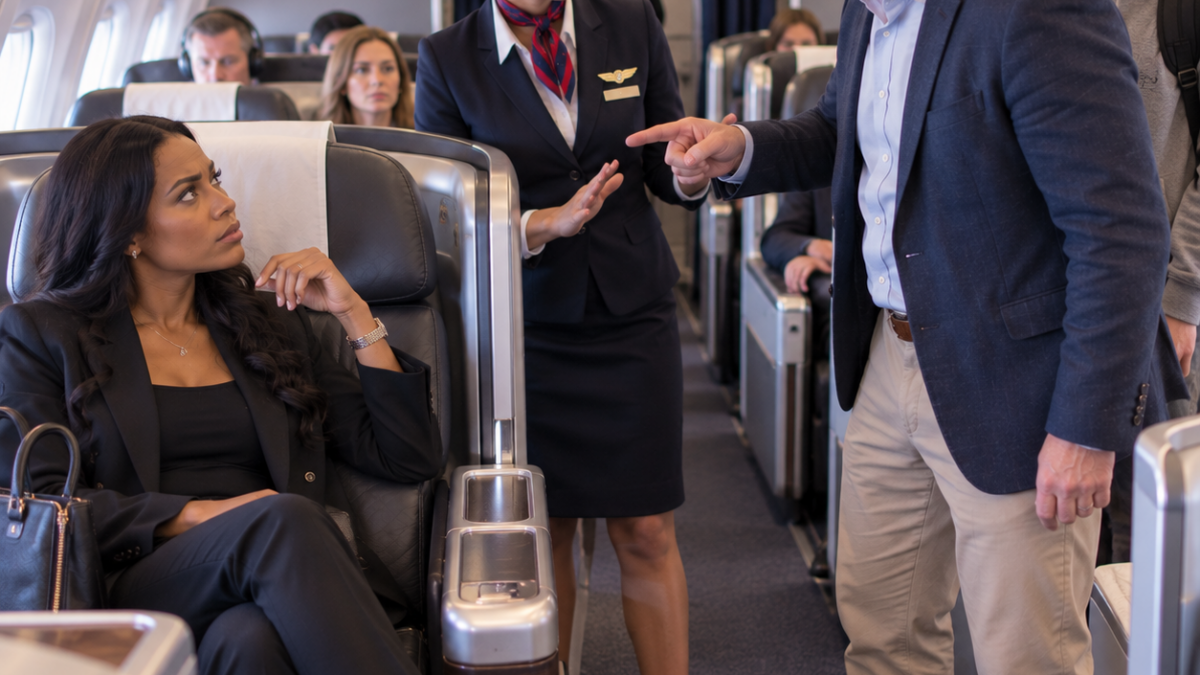
Maya held his gaze.
She did not raise her voice.
That was what made her response land so hard.
“Ms. Williams’ place,” she repeated, “is in seat 3A, which is the seat assigned to her.”
Curtis stared at her.
Maya continued.
“Your place, however, is becoming a safety issue because you’re blocking the aisle while we’re preparing to descend into Denver.”
A low murmur moved through the business-class cabin.
Curtis looked around.
Several passengers were openly recording now.
The attention did not embarrass him.
It seemed to make him angrier.
“Do you know how many business deals I’ve closed that keep this airline profitable?”
Maya remained expressionless.
“No, sir.”
“Millions.”
“Then I’m sure you understand contractual agreements.”
For the first time, I almost smiled.
Curtis didn’t.
Maya pointed toward my boarding pass.
“Dr. Williams has a contract of carriage that includes that seat.”
“You do not have the authority to remove her because you’d prefer her seat.”
Curtis’s eyes widened.
“Dr. Williams?”
He turned toward me.
I saw his mind revising its first assumptions.
Not abandoning them.
Just rearranging them.
“You didn’t say you were a doctor.”
“You didn’t ask.”
“What kind?”
“Engineering.”
He laughed under his breath.
Not because anything was funny.
Because apparently even that answer offended the story he had constructed about me.
“What kind of engineer?”
“Aerospace materials.”
His son Trevor looked at me for the first time with genuine interest.
Curtis looked irritated.
“That’s irrelevant.”
“You’re the one who asked.”
His face reddened further.
Then he said the sentence that turned an ugly passenger disagreement into something else entirely.
“I don’t know how you got up here, but people like you need to understand when an accommodation is reasonable.”
I looked at him.
“People like me?”
Maya’s posture changed.
Curtis realized too late that he’d said the quiet part aloud.
“I mean people who make everything difficult.”
“That’s not what you meant.”
His eyes hardened.
“You want to make this racial?”
“I haven’t mentioned race once.”
The cabin became silent again.
A teenage boy in an aisle seat several rows back whispered something to his mother.
The woman across from me kept her phone pointed at Curtis.
He noticed.
“Stop recording me.”
She shook her head.
“No.”
“You don’t have permission.”
“This is a public interaction on a commercial flight.”
“I’m asking you to stop.”
“And I’m declining.”
The refusal seemed to hit him almost as hard as mine had.
He turned back toward me.
“You’ve caused enough trouble.”
“I was sitting here working before you approached me.”
“Because you refuse to show basic courtesy.”
“Courtesy would have been asking.”
“I did ask.”
“No.”
I shook my head.
“You ordered.”
Trevor spoke again.
“Dad, seriously.”
Curtis spun toward him.
“Stay out of this.”
“I told you I don’t care about sitting back there.”
“You’re sixteen.”
“I’m not six.”
“Enough.”
Trevor stepped backward.
His embarrassment had turned to something closer to shame.
Maya glanced toward him.
Then at Curtis.
“Sir, I’m directing you to return to your assigned seat.”
“I’m not leaving until she moves.”
“Then I will notify the captain that you’re refusing a crew instruction.”
Curtis stared at her.
“You wouldn’t dare.”
Maya’s expression didn’t move.
“Try me.”
Several passengers laughed.
Curtis’s face went crimson.
“Give me your name.”
“Maya Chen.”
“Employee number.”
She pointed toward her badge.
“It’s right here.”
“I’m going to have you fired.”
“That’s your right to pursue through customer relations.”
“My company spends millions with your airline.”
“That still doesn’t make seat 3A yours.”
Then she motioned toward two male cabin crew members approaching from the rear.
“We have an open premium seat farther back in 18A.”
“Your son can join you there if the passenger next to him agrees to relocate.”
“Otherwise, you need to return to your original seat.”
Curtis leaned down until his face was inches from mine.
I smelled coffee and expensive cologne.
Then he said quietly:
“You need to learn your place.”
His finger pointed toward the economy cabin.
“And it isn’t here.”
A tiny drop of saliva landed on my cheek.
For a second, I couldn’t move.
Not because I was afraid of him physically.
Because that sentence reached backward through decades.
A guidance counselor telling me nursing might be more “realistic” than engineering.
A professor asking whether I was certain I belonged in his advanced materials course.
A supervisor praising a white colleague for the same assertiveness he’d called abrasive in me.
A conference attendee assuming I was hotel staff.
Know your place.
Different mouths.
Same message.
I reached for the napkin beside my glass and wiped my cheek.
Maya stepped between us.
Her voice became steel.
“Sir.”
Curtis turned.
“On this aircraft, Dr. Williams’s place is exactly where she’s sitting.”
She pointed toward the rear.
“Your place is now in question.”
The cabin froze.
Maya continued.
“You’re interfering with crew instructions and harassing another passenger.”
“You have two options.”
“Return to the seat I’ve offered you, or airport security will meet this aircraft in Denver.”
“The decision is yours.”
Curtis looked at her.
Then me.
Then the cameras.
“This isn’t over.”
“No,” Maya said.
“I don’t imagine it is.”
Two flight attendants escorted him away without touching him.
Trevor followed several steps behind.
As they passed my row, he stopped.
“I’m sorry.”
His father called sharply from farther down the aisle.
“Trevor.”
The boy flinched.
Then continued walking.
Someone started clapping.
Others joined.
I hated it.
Not because I wasn’t grateful for Maya.
Because applause turned me into a performance.
I didn’t want to be brave.
I wanted to prepare for my interview.
Maya crouched beside me.
“Dr. Williams?”
“I’m fine.”
My voice sounded normal.
My hands did not.
They were shaking.
“Jasmine.”
I looked at her.
She had deliberately stopped using the formal title.
“Are you sure?”
“I’m—”
My chest tightened.
I stopped.
The familiar sensation arrived.
Too little air.
Too much heartbeat.
Blackness pressing inward at the edges of my vision.
I had not had a panic attack since graduate school.
Apparently my nervous system had kept the skill.
Maya noticed immediately.
“Don’t fight the breath.”
“I know.”
“In through your nose.”
A woman across the aisle leaned toward me.
“I’m Eliza.”
She spoke gently.
“I’m a meditation instructor.”
“Would grounding help?”
I nodded.
“Feet on the floor.”
She said.
“Feel the pressure beneath your shoes.”
I obeyed.
“Five things you can see.”
“Maya’s blue scarf.”
“Good.”
“The exit sign.”
“Good.”
“My laptop.”
“The clouds.”
“Your phone.”
“Four things you can feel.”
“The seat.”
“My jacket.”
“My grandfather’s pin in my pocket.”
“My feet.”
By the time the landing gear came down, my breathing had slowed.
I closed my eyes.
“Thank you.”
Eliza squeezed my hand.
“I recorded the whole thing.”
My eyes opened.
“In case you need it.”
She gave me her business card.
That small piece of paper would later matter more than either of us knew.
Denver International Airport should have been a forty-minute inconvenience.
Instead, it became the place where my private humiliation turned into public property.
The moment I reconnected my phone to Wi-Fi, it vibrated so violently I thought something was wrong with the device.
Messages.
Emails.
News alerts.
LinkedIn notifications.
Social media.
I opened one app.
And there I was.
My face.
Curtis leaning over me.
Maya standing between us.
The title:
Business Executive Tells Black Woman to “Know Her Place” on Flight—Crew Member Shuts Him Down.
Two million views.
Then three.
Comments multiplied faster than I could read.
She handled that with unbelievable grace.
That guy should be banned from flying.
Typical race baiting. We aren’t seeing the whole video.
Who is she?
That last question frightened me.
My phone rang.
Mom.
I answered.
“Baby?”
“I’m okay.”
“Your father is already looking at flights to Denver.”
In the background:
“I am not looking. I booked it.”
“Dad!”
My father’s voice came through.
“Tell me where you are.”
“I’m safe.”
“That man spit on you.”
“It wasn’t exactly—”
“He leaned into your face and told you where you belong.”
My father rarely yelled.
He was yelling now.
“I want an address.”
“Dad, I am thirty-eight.”
“You were thirty-eight yesterday too.”
“That has never stopped me being your father.”
Despite everything, I almost smiled.
“Please don’t fly here.”
My mother interrupted.
“Jasmine, your face is everywhere.”
“I know.”
“Somebody posted your company information.”
“What?”
“You need to be careful.”
A notification appeared while she spoke.
Unknown number.
Uppity bitch. Hope your plane goes down before Seattle.
My hands went cold.
“Mom.”
“What?”
“Nothing.”
I deleted the message.
That was a mistake.
Later Sarah would teach me never to delete threats.
At that moment, instinct won.
“I have to go.”
“Promise you’ll call when you reach Seattle.”
“I promise.”
“And your father—”
“I’m going anyway,” Dad shouted.
“No, you’re not.”
“Your daughter is being threatened.”
“She said she’s fine.”
“She’s always fine when she isn’t fine.”
I closed my eyes.
They knew me too well.
“I love you both.”
“We love you.”
“Call us.”
“I will.”
I hung up.
Then three airport security officers approached.
“Dr. Williams?”
My stomach dropped.
“Yes?”
“I’m Officer Ramirez.”
He showed identification.
“We need to speak with you regarding an allegation connected to the incident.”
“What allegation?”
He hesitated.
“Mr. Whitfield says you threatened his son.”
I almost laughed.
Not because it was funny.
Because I suddenly understood.
Curtis wasn’t embarrassed.
He was mobilizing.
The security room was small.
Curtis sat at the opposite end of a conference table.
Trevor stood behind him.
Curtis looked remarkably calm.
Satisfied, almost.
“Dr. Williams,” Officer Ramirez said, “Mr. Whitfield alleges that before the confrontation captured in the video, you told his son to quote, ‘get his privileged white ass back where he belongs.'”
I stared at him.
“That never happened.”
Curtis sighed.
“This is exactly the problem.”
I turned toward him.
“What?”
“The public has already decided I’m the villain because of a selectively edited clip.”
“You told me to know my place.”
“After you threatened my child.”
“I never spoke to him.”
Curtis looked toward Trevor.
“Tell them.”
The boy stared at the floor.
“Trevor.”
His father repeated.
“Tell them what she said.”
Trevor’s face went red.
“Nothing.”
Curtis froze.
“What?”
“She never talked to me.”
“You’re confused.”
“I’m not.”
The room became very quiet.
Trevor lifted his head.
“We never spoke.”
“I was in economy until after you walked up there.”
Curtis’s face transformed.
Not embarrassment.
Betrayal.
As if honesty from his own son were disloyalty.
“Trevor.”
“I’m tired of lying for you.”
Officer Ramirez looked from father to son.
Curtis’s jaw tightened.
Before he could answer, the door opened.
Maya stood beside Captain Rodriguez.
The captain carried a tablet.
“We reviewed the aircraft’s security feed.”
Curtis turned.
“Security feed?”
“Video and cabin audio.”
Captain Rodriguez placed the tablet on the table.
“It confirms Dr. Williams never interacted with your son prior to your approach.”
Officer Ramirez folded his arms.
“Mr. Whitfield.”
Curtis stood.
“This is ridiculous.”
“Your allegation isn’t supported.”
“Do you know who I am?”
Ramirez looked unimpressed.
“I know who everyone in this room is.”
“I can have people fired over this.”
“That would be your business.”
“Right now, your complaint is dismissed.”
Curtis pointed at me.
“This woman has destroyed my reputation.”
I finally spoke.
“You did that yourself.”
He stared at me.
Then grabbed Trevor’s arm.
“Let’s go.”
Trevor pulled away.
“Don’t.”
The gesture was tiny.
But I noticed.
So did Officer Ramirez.
Curtis released him.
As they left, Trevor looked back at me.
His eyes said more than another apology could.
Outside the security office, Maya waited.
“You okay?”
“I no longer know what that word means.”
She smiled sympathetically.
“We have forty minutes.”
“Coffee?”
“Please.”
We found a corner away from cameras.
Maya stirred tea.
“My brother works in aerospace.”
I looked up.
“Really?”
“Materials engineering.”
“Where?”
“Horizon.”
I nearly dropped my cup.
“What’s his name?”
“David Chen.”
I stared.
“Dr. David Chen?”
“Unfortunately, yes.”
“You know him?”
“I cited his nanotube interface paper in my dissertation.”
Maya laughed.
“He’ll be unbearable when I tell him that.”
For the first time all day, something felt normal.
Then my email chimed.
Horizon Aerospace Human Resources.
I opened it.
My stomach sank.
Dear Dr. Williams,
In light of recent events, we believe it would be appropriate to postpone tomorrow’s interview.
I read the message twice.
Maya saw my face.
“What?”
I handed her the phone.
She read it.
“Because of the video?”
“They didn’t say that.”
“They didn’t have to.”
I stared at my untouched coffee.
Fifteen years.
Graduate school.
Publications.
Research awards.
Patent work.
Years of being told to be twice as prepared and half as emotional.
And suddenly one wealthy man deciding I didn’t belong in a seat might cost me the opportunity I’d worked toward for half my adult life.
Maya reached across the table.
“Let me call David.”
“No.”
“Jasmine.”
“I don’t want favors.”
“It isn’t a favor to make sure the CEO knows what’s actually happening.”
“She already emailed me personally.”
Maya stopped.
“The CEO?”
I showed her Elizabeth Carter’s earlier message.
Her eyebrows rose.
“Okay.”
“You’re definitely not going home.”
I managed a small smile.
“No.”
“But I may be flying across the country for a job that disappeared while I was in the air.”
Maya pulled out her phone.
“Then let’s find out who made it disappear.”
When we returned to the gate, Curtis was speaking to reporters.
Of course he was.
He stood beneath bright lights wearing the expression of a wounded statesman.
“What happened today was deeply unfortunate.”
His voice was smooth.
“I made a simple request so I could sit beside my son.”
“Unfortunately, that request was interpreted through a racial lens.”
A reporter asked:
“Did you tell Dr. Williams to know her place?”
Curtis sighed.
“Words said during stressful moments can sound different without context.”
Maya muttered beside me.
“He should run for office.”
“Don’t give him ideas.”
My phone buzzed again.
Maya looked at hers.
Her face changed.
“What?”
She turned the screen toward me.
ADMINISTRATIVE REVIEW NOTICE.
She had been placed under investigation for her handling of the onboard confrontation.
“Because you defended me.”
She shrugged, but her eyes betrayed her.
“Because Curtis probably threatened the corporate contract.”
“I’m sorry.”
“No.”
She looked directly at me.
“You are not apologizing for him.”
Her sentence lodged somewhere deep.
I nodded.
“Okay.”
We boarded again.
Curtis was moved far from me.
Trevor remained with him.
The second leg to Seattle should have been quiet.
Instead, Curtis spent much of it on the phone.
I heard pieces.
“I want this contained.”
“Call Henderson.”
“I don’t care what Carter wants.”
“Tell them what happens to the investment if she gets through the door.”
I turned toward Maya.
She had heard too.
We exchanged a look.
Horizon.
Curtis knew exactly where I was going.
Seattle greeted me with cameras.
Captain Rodriguez arranged a private exit.
I thought the nightmare might finally pause once I reached my hotel.
Then the hotel told me Horizon Aerospace had canceled my reservation.
Six others were full.
A major technology conference had taken every room I called.
I sat outside Sea-Tac with my suitcase beside me and felt something inside me break.
Not dramatically.
No scream.
No tears.
Just exhaustion.
For one dangerous minute, I considered flying home.
Then Maya called.
“My cousin Lee has a spare room.”
“I cannot keep accepting help from strangers.”
“She’s already mad at you for saying that.”
“She doesn’t know me.”
“She’s Asian, works in tech, and watched the video.”
Maya laughed softly.
“She says she knows enough.”
Lee Chen opened her apartment door forty minutes later.
She was barefoot, wearing sweatpants and an old University of Washington shirt.
“Guest room is down there.”
She pointed.
“Towels are clean.”
“Wi-Fi password is on the fridge.”
“Tea?”
I stared.
“You’re just letting me stay?”
“Yes.”
“Why?”
Lee looked confused.
“Because you need somewhere to sleep.”
The simplicity almost made me cry.
“Thank you.”
She shrugged.
“Also, my cousin says you’re brilliant.”
“Your cousin is biased.”
“Definitely.”
Then Lee added:
“And anyone Curtis Whitfield hates this much is probably worth meeting.”
I laughed for the first time since Denver.
The next morning, Horizon sent another email.
The position had been filled.
No interview.
No rescheduling.
Done.
I stared at the screen.
Then I put on my navy interview suit anyway.
Lee watched from the kitchen.
“Where are you going?”
“Horizon.”
“They rejected you.”
“Correct.”
“So…”
“I’m making them reject me to my face.”
Lee smiled.
“I like you.”
Horizon Aerospace headquarters stood forty stories over downtown Seattle.
Glass.
Steel.
The kind of building designed to make visitors feel small before they reached reception.
I walked inside holding my portfolio.
The security guard recognized me.
Everyone did now.
“I have an appointment with Elizabeth Carter’s team.”
He checked his screen.
Made a call.
Eventually, an anxious HR representative escorted me upstairs.
The room was not the interview I had been promised.
COO James Henderson.
General counsel Patricia Huang.
VP of HR Richard Blackwell.
Three careful corporate faces.
“Dr. Williams.”
Henderson began.
“We appreciate you coming.”
“But as our email indicated—”
“Where is Elizabeth Carter?”
They exchanged glances.
Patricia answered.
“Ms. Carter is unavailable.”
“She personally asked to attend my interview.”
“The situation has changed.”
“What situation?”
Richard folded his hands.
“Your involvement in an ongoing public controversy.”
I looked at him.
“My involvement?”
He shifted.
“We have to consider disruption to company culture.”
I almost laughed.
“Is that the phrase Curtis gave you?”
Silence.
Henderson’s expression hardened.
“Mr. Whitfield is a significant investor and advisory-board member.”
“Thank you.”
“For what?”
“For answering the question.”
Patricia leaned forward.
“Dr. Williams, this isn’t about your qualifications.”
“Then let’s discuss them.”
I opened my portfolio.
Henderson blinked.
“I’m sorry?”
“You invited an aerospace engineer here.”
“So let’s talk aerospace.”
I walked to the whiteboard.
“My current work focuses on carbon-nanotube reinforced composites.”
No one stopped me.
So I continued.
“Tensile-strength improvement of approximately twenty-three percent in our latest laboratory series.”
“Weight reduction up to eighteen percent depending on application.”
“Projected manufacturing-cost reduction approaching thirty percent after scale.”
Henderson began asking questions despite himself.
Then Patricia.
Then Richard.
Twelve minutes later, all three were taking notes.
The door opened.
Elizabeth Carter walked in.
Steel-gray hair.
No apology in her expression despite saying:
“Sorry I’m late.”
She shook my hand.
“Dr. Williams.”
“I’ve wanted to meet you.”
Henderson stood.
“Elizabeth, we were explaining—”
“I know what you were explaining.”
Her eyes sharpened.
“And I disagree.”
She looked at my whiteboard.
“Continue.”
For the next half hour, I spoke about materials science.
Not race.
Not Curtis.
Not videos.
The work.
My work.
When we finished, Carter took me into her private office.
She closed the door.
“I’ll be direct.”
“Please.”
“Curtis Whitfield wants you nowhere near this company.”
“I assumed.”
“He controls substantial investment capital.”
“And sits on the advisory board.”
“Yes.”
“He is also part of a group trying to remove me.”
“Why?”
“Because I invest in long-term R&D.”
“And because I recruit differently than they do.”
I understood.
“My candidacy became leverage.”
“Yes.”
“So can you hire me?”
She looked frustrated.
“I want to.”
“That wasn’t my question.”
“No.”
She respected that.
“I cannot offer you the position today.”
My chest tightened.
“But I’m fighting the board.”
“How long?”
“I don’t know.”
I stood.
“Then I appreciate your honesty.”
As I reached the door, Carter said:
“Jasmine.”
I turned.
“Don’t confuse a delayed outcome with a final one.”
I wished I believed her.
My phone rang outside the building.
“Ms. Williams?”
A teenage voice.
“Yes?”
“It’s Trevor.”
I stopped walking.
“Trevor Whitfield?”
“Yeah.”
“How did you get my number?”
“LinkedIn.”
Of course.
“I wanted to apologize.”
“You already did.”
“Not enough.”
He sounded nervous.
“My dad has been calling people.”
“I know.”
“Horizon.”
“Hotels.”
“Some aerospace firms.”
I stopped.
“How do you know about the hotel?”
“I heard him tell his assistant to make sure Seattle became inconvenient.”
A chill went through me.
“Trevor.”
“I took screenshots.”
“Of what?”
“Emails.”
“Messages.”
“His PR team.”
“People he’s telling not to hire you.”
My heart began pounding.
“Why?”
“Because I’m done.”
“Done with what?”
“Watching him do this.”
His voice cracked.
“My mom left three years ago.”
“He treated her the same way when she pushed back.”
“Different insults.”
“Same punishment.”
“I’ve watched him ruin people because they embarrassed him.”
“Trevor, helping me may cost you.”
“I know.”
“He’s your father.”
“I know that too.”
Silence.
Then:
“But I don’t have to become him.”
That sentence changed how I saw the boy.
Not Curtis’s embarrassed son.
A young man choosing which inheritance to keep.
“Send nothing directly to me.”
I said.
“I want a lawyer to handle it.”
“Okay.”
“I don’t want you accused of tampering with evidence.”
“Okay.”
“And Trevor?”
“Yeah?”
“Be safe.”
He was silent.
“Nobody says that to me about him.”
My throat tightened.
“Someone should.”
The civil-rights attorney’s name was Sarah Johnson.
She contacted me after seeing the video.
I verified everything before speaking with her.
By then, caution had become reflex.
She listened to the entire story.
Then said:
“This is bigger than the airplane.”
“I know.”
“Whitfield used racial language in public.”
“Then allegedly interfered with employment.”
“Then filed false claims with security.”
“And now you’ve got evidence of coordinated professional retaliation.”
“Potentially.”
“Trevor has documents.”
“If authentic.”
I appreciated that word.
Sarah did not build cases from outrage.
She built them from evidence.
“What do you want?”
She asked.
“I want him to stop.”
“That isn’t a legal remedy.”
“Then I want accountability.”
“Money?”
“No.”
“You may be entitled to damages.”
“Fine.”
“But I don’t want to sell silence.”
Sarah watched me through the video call.
“Good.”
“Because I suspect that’s exactly what he’ll try to buy.”
She was right.
First Curtis sued me.
Five million dollars for defamation.
Then National Airways apologized publicly to him.
They offered free first-class travel.
And they suspended Maya without pay.
When she called me, she sounded exhausted.
“They want me to sign a statement.”
“What statement?”
“That I escalated a routine service dispute unnecessarily.”
“You didn’t.”
“I know.”
“What happens if you refuse?”
“They fire me.”
I closed my eyes.
“Maya.”
“No.”
She knew what I was going to say.
“Do not apologize.”
“I was going to say I’m sorry.”
“Still no.”
Her laugh was tired.
“I meant what I told you.”
“Stop taking responsibility for his choices.”
“What are you going to do?”
“Refuse.”
“Maya—”
“I’ve spent eight years telling passengers that safety matters.”
“If I lie because a rich man threatened a corporate account, then none of that means anything.”
“Your job matters too.”
“So does looking at myself afterward.”
She refused.
They fired her.
That nearly broke me.
Not losing Horizon.
Not threats.
Not my hotel.
Maya.
She had done exactly what an employee should do.
Protected a passenger.
Followed cabin rules.
De-escalated.
Refused harassment.
And she lost an eight-year career because the man she challenged spent millions with the airline.
That evening, I called my parents.
Dad listened silently.
Then said:
“Come home.”
“I can’t.”
“You can.”
“I don’t want to.”
“Why?”
I looked around Lee’s apartment.
“Because if I leave now, I spend the rest of my life wondering whether I abandoned everyone who stood beside me.”
“That isn’t your burden.”
“Maybe not.”
“But it’s still here.”
Dad sighed.
Then Mom took the phone.
“You sound like your grandfather.”
“I’ll take that as a compliment.”
“It wasn’t always one.”
I smiled.
“He could be impossible.”
“So can you.”
“Thanks.”
Then her voice softened.
“Just remember courage does not require you to destroy yourself.”
I held onto that.
Trevor’s documents were real.
Emails.
Texts.
Instructions from Curtis to associates.
One message:
Make sure she doesn’t get through Horizon’s door.
Another:
Anybody hiring her after this is choosing politics over business.
Then a message to an old colleague:
That uppity diversity hire needs to learn consequences.
Sarah went silent after reading it.
“Well.”
“Is that useful?”
“It’s terrible.”
She looked at me.
“So yes.”
We prepared a countersuit for racial discrimination-related claims and intentional interference with prospective economic opportunity.
Then Trevor did something none of us expected.
He went public.
His statement spread faster than the airplane video.
My father has asked me to lie.
He has used his money and influence to punish Dr. Jasmine Williams because she refused to give him her seat.
I love my father, but I will not become him.
Curtis cut him off financially.
Threatened to remove him from school.
Trevor posted those messages too.
That was the first serious crack in Curtis’s public image.
Not because people suddenly trusted me.
Because his own son had stopped protecting him.
Then my parents’ garage was vandalized.
A racial slur.
Go back to Africa.
My father called shaking.
“Enough.”
“Dad—”
“No.”
“This isn’t some business fight anymore.”
“Your mother’s afraid to go outside.”
I sat on the edge of the bed.
Guilt is dangerous because it can disguise itself as responsibility.
“I caused this.”
“No.”
Dad’s voice sharpened.
“Don’t you dare.”
“But—”
“The person who wrote that caused it.”
“The people threatening you caused it.”
“You refusing a seat didn’t paint my garage.”
Tears filled my eyes.
“I don’t want you hurt.”
“And we don’t want you living on your knees so strangers leave us alone.”
That sounded exactly like Harold Williams.
Maybe courage really was hereditary.
Sarah received another piece of evidence.
Curtis had contacted Horizon before my arrival.
Explicitly threatened to pull investments if they hired me.
He referred to me again as a “diversity hire who needs to be put in her place.”
We now had the sentence from the aircraft repeated in corporate communication.
Not a misunderstanding.
A pattern.
Sarah said the SEC might care because Curtis sat on the advisory board of a publicly traded company and appeared to be using his economic influence for a personal vendetta.
Then Elizabeth Carter contacted me privately.
She wanted to meet.
Not about employment.
About Curtis.
For the first time, people inside his own network were beginning to treat him as a liability.
The courthouse hearing came quickly.
Too quickly for my nerves.
Judge William Peterson presided.
Sarah had warned me.
Same country club as Curtis.
Social relationship.
A history that made recusal concerns plausible but difficult.
The warning proved correct before the hearing even began.
Peterson greeted Curtis’s lead attorney warmly.
“Maggie.”
“How’s David’s boat?”
Then he turned toward Sarah.
“Counsel.”
Cold.
Efficient.
The difference was almost comic.
Almost.
Curtis’s lawyers argued the viral video had been edited to defame him.
Sarah stood.
“We have the complete aircraft recording.”
Curtis’s expression changed.
A court officer set up the monitor.
The unedited footage played.
His approach.
His demand.
My refusal.
Trevor saying he was fine.
Curtis dismissing him.
His remarks.
Maya’s intervention.
Then:
You need to know your place.
No cut.
No missing context.
No ambiguity.
The courtroom became still.
Sarah called Trevor.
His hands trembled as he swore the oath.
“What did your father say after the flight?”
Trevor looked toward Curtis.
His father stared back.
“He said he’d make sure Dr. Williams never worked in aerospace.”
“Did he ask you to make false statements?”
“Yes.”
“What statements?”
“That she’d threatened me.”
“Did she?”
“No.”
Curtis closed his eyes.
His attorney stood.
“Trevor, you are estranged from your father.”
“Yes.”
“You blame him for your parents’ divorce.”
“I blame his behavior.”
“So you have reasons to hurt him.”
Trevor straightened.
“I’m here because telling the truth is the right thing to do.”
Nothing dramatic.
No speech.
But the room felt different after he said it.
Then Maya testified.
She described National Airways’ response.
The pressure.
The investigation that cleared Curtis.
Her termination.
Curtis’s attorney attacked her motives.
“You’re bitter because you lost your job.”
“I’m angry because I lost my job.”
Maya corrected.
“Those aren’t the same thing as lying.”
I nearly smiled.
Then Sarah called Elizabeth Carter.
Curtis’s attorneys had not expected her.
Neither had Judge Peterson.
Carter walked to the stand like she was entering her own boardroom.
“Did Mr. Whitfield contact Horizon Aerospace regarding Dr. Williams?”
“Yes.”
“What did he say?”
“That hiring her would be a mistake we couldn’t afford.”
“Did he connect that to his investment?”
“Explicitly.”
“Did it influence the board?”
“Yes.”
My stomach turned even though I knew.
Carter continued.
“And that was wrong.”
Curtis stared at her.
“Our board has reversed that decision.”
My head lifted.
“Effective yesterday, we withdrew the offer from the replacement candidate.”
A murmur moved through the gallery.
“And?”
Sarah asked.
Elizabeth looked at me.
“Horizon Aerospace has formally offered Dr. Jasmine Williams the senior materials-engineering position.”
I couldn’t breathe.
Not from panic this time.
“Additionally, our board voted unanimously to remove Mr. Whitfield from our advisory committee.”
Curtis surged forward.
“This is insane.”
Judge Peterson struck the gavel.
“Mr. Whitfield.”
“Control yourself.”
Curtis sat.
Red-faced.
Staring at me as if I had stolen something from him.
That was the strange thing about entitled people.
Equality often feels like theft.
Judge Peterson dismissed Curtis’s defamation claim.
He refused to dismiss my counterclaims.
Sarah warned me not to celebrate.
“This is round one.”
“Peterson can still hurt us later.”
She was right.
Within hours Curtis offered one million dollars.
NDA.
Withdrawal of claims.
Silence.
I refused.
Two million.
Broader NDA.
Public statement expressing regret for “misunderstandings.”
I refused again.
Then the attacks returned.
A profile questioning my credentials.
Anonymous former colleagues.
PR photographs of Curtis mentoring Black students.
A legal foundation supporting him publicly.
News programs turning the story into “both sides.”
My outrage stopped being new.
And America loves novelty more than resolution.
Public attention drifted.
Curtis understood that.
Delay until people become bored.
Then bury everything quietly.
For weeks, it worked.
Even Horizon’s board became nervous.
Elizabeth called.
“Your job is safe.”
“But?”
“Our legal department is pulling back from further involvement.”
“Curtis is pressuring investors.”
“Yes.”
I closed my eyes.
Some battles do not become easier after the first victory.
They become more expensive.
Maya couldn’t find work.
Three airlines rejected her.
One recruiter privately told her she had become “too controversial.”
We spoke every week.
“I’m sorry.”
I said once.
She groaned.
“You’re doing it again.”
“I know.”
“Stop.”
“Working on it.”
She laughed.
Then grew serious.
“I’ve been thinking.”
“Dangerous.”
“Shut up.”
I smiled.
“What?”
“This can’t just be about getting our jobs.”
“You have one.”
“I don’t.”
“Technicality.”
She ignored me.
“What happened on that flight worked because Curtis had enough economic power that institutions feared disappointing him.”
“So?”
“So attack the structure.”
“Not just the man.”
That night, I began researching Meridian Capital.
Government contracts.
One jumped out.
Three hundred fifty million dollars.
Defense aerospace components.
Federal contractors operate under compliance requirements.
Equal employment obligations.
Nondiscrimination standards.
I emailed Sarah.
She replied at 6:13 the next morning.
You may have just found his pressure point.
We filed a formal complaint with the appropriate federal contracting compliance authorities.
Curtis panicked.
His lawyers sought a gag order to stop me from contacting federal agencies.
Even Judge Peterson hesitated at that.
Restricting someone’s right to petition regulators is not an easy favor to disguise as neutral procedure.
The motion failed.
Then Meridian’s defense contract went under review.
Curtis announced he was temporarily stepping aside as CEO.
His board installed Vanessa Rodriguez as interim chief executive.
I watched the press conference from my apartment.
The man who had once stood over me demanding I move now stood behind a podium explaining why he was voluntarily relinquishing power.
Sarah called.
“PR move.”
“Mostly.”
“But?”
“The board forced it.”
I stared at the screen.
“So consequences.”
“Finally.”
“Some.”
Then documents leaked.
Meridian emails.
Years of hiring conversations.
Curtis telling HR to preserve a “traditional culture.”
Instructions to find alternative reasons for rejecting minority candidates at senior levels.
Not every allegation was criminal.
But together they painted a devastating picture.
The Washington Post ran the investigation.
Meridian’s stock dropped.
Board members resigned from Curtis’s charitable foundation.
Other executives began speaking.
Then Horizon discovered someone had fabricated internal documents to undermine my case.
An HR staffer admitted Curtis had offered to pay off student debt in exchange.
The dam broke.
Everything Curtis had used for years—fear, reputation, connections—depended on people believing everyone else would stay silent.
Once enough people spoke at once, the structure weakened.
He still wasn’t finished.
One evening, I received a private video from him.
“Dr. Williams.”
He looked tired.
Older.
“I think this has gone too far.”
I almost laughed.
“I am prepared to offer you ten million dollars.”
“No NDA.”
“No public apology required from you.”
“Walk away.”
He leaned toward the camera.
“Ask yourself whether you want justice or vengeance.”
I stopped the video.
That word bothered me.
Vengeance.
People with power often describe accountability as vengeance once the consequences reach them.
I forwarded the video to Sarah.
Her response was immediate.
Do not answer.
I didn’t.
The next day Curtis announced a fifty-million-dollar diversity initiative.
He invited me publicly to serve on its advisory board.
Maya called.
“He is unbelievable.”
“Actually, he’s becoming predictable.”
“If you accept, he says he’s changed.”
“If you refuse, he says you don’t care about solutions.”
“Exactly.”
“So?”
“I refuse.”
“Publicly?”
“No.”
I issued one statement.
Communities facing discrimination do not need rehabilitation campaigns designed by the people accused of harming them. They need independent systems with accountability.
That was all.
Trevor severed ties with his father publicly.
Not impulsively.
After months.
His post was simple.
He would rather build a life without inherited wealth than inherit power that required silence.
Curtis’s image as a misunderstood father collapsed.
Former Meridian employees challenged their NDAs.
Other women came forward.
Journalists dug deeper.
Sarah renewed her effort to force Judge Peterson’s recusal.
For the first time, the motion appeared likely to succeed.
Curtis became more desperate.
And desperate powerful men are dangerous because they are unused to consequences.
Three months after the airplane, Curtis confronted Sarah outside the courthouse.
Two court officers saw it.
He grabbed her arm.
Demanded she make me drop the case.
When she refused, he said:
“You don’t understand who you’re dealing with.”
The officers arrested him.
Security footage captured everything.
Sarah called me after she was examined.
“Are you hurt?”
“Bruised.”
“I’m coming.”
“No.”
“Sarah.”
“Jasmine, I’m fine.”
“He touched you because of my case.”
“No.”
Her voice hardened.
“He touched me because he chose to.”
I closed my eyes.
Apparently everyone in my life had joined the stop-Jasmine-from-assuming-responsibility campaign.
“You’re all annoying.”
“We learned from the best.”
Curtis was released on bail.
Ordered to surrender his passport.
His lawyers called.
This time, the offer was twenty million dollars.
Public apology.
Permanent resignation from Meridian.
No NDA.
Complete civil resolution.
I looked at Sarah.
“That’s everything.”
“Practically.”
“And the criminal case?”
“Separate.”
“His settlement can’t erase what he did to you?”
“No.”
I was silent.
“What do you think?”
Sarah asked.
“I don’t want twenty million dollars.”
“Nobody says you have to spend it on yourself.”
That was when the idea came.
“What if five million funds legal support?”
“For what?”
“People facing workplace discrimination who can’t afford years of litigation.”
Sarah smiled slowly.
“Flight 2267 Foundation?”
I groaned.
“Terrible name.”
“Memorable.”
“I hate you.”
“Noted.”
I accepted.
With conditions.
Curtis publicly acknowledged his conduct.
He resigned permanently.
Five million dollars funded the new legal-defense organization.
The rest compensated professional harm, security costs, emotional injury, and legal expenses.
People online called it victory.
It didn’t feel like victory.
It felt like putting down something unbearably heavy.
Curtis’s apology aired on television.
No grand performance.
No tears.
He admitted his statements on the aircraft were inappropriate and discriminatory.
He acknowledged contacting professional associates in an effort to affect my employment.
He apologized to me.
To Maya.
To Trevor.
I watched only once.
Then I turned it off.
Lee asked:
“Do you believe him?”
“I don’t know.”
“Does it matter?”
“Less than I thought it would.”
That surprised me.
For months, I had imagined accountability required him to understand.
Maybe it didn’t.
Understanding would be good.
Change would be better.
But the system could not require private enlightenment before imposing public boundaries.
He no longer controlled Meridian.
He could no longer intimidate me through Horizon.
His behavior was documented.
Others had protection.
That was enough for now.
I began working at Horizon.
For the first month, I waited for someone to suggest I had only gotten the job because of publicity.
Eventually, someone did.
Not to my face.
Someone always tells you when your name is in a room without you.
I went to Elizabeth.
“Do people think I only work here because of Curtis?”
“Some.”
“Does that bother you?”
“No.”
“It bothers me.”
She leaned back.
“Then make them regret underestimating you.”
I stared.
“That’s your leadership advice?”
“Would you prefer a seminar?”
I laughed.
“No.”
“Good.”
“Your research got you here.”
She pointed toward the lab.
“Now go prove what it can do at scale.”
So I did.
Our team produced a composite manufacturing method that exceeded even my original projections.
Lower energy demand.
Improved structural performance.
Reduced cost.
We filed patents.
Industry journals noticed.
Suddenly people who had questioned whether I belonged wanted me at conferences.
I remembered Curtis looking at seat 3A.
Someone like you.
I stopped needing him to see how wrong he had been.
The work answered better.
Maya filed a wrongful-termination claim against National Airways.
Sarah represented her.
The airline settled.
Back pay.
Reinstatement.
Formal policy changes.
And a promotion to senior cabin crew trainer.
Maya called me screaming.
Not crying.
Actually screaming.
“I’m back.”
I held the phone away.
“My hearing may not be.”
“They gave me training.”
“Of course they did.”
“Do you know what I’m teaching?”
“How not to anger rich people?”
“Shut up.”
She laughed.
“Bystander intervention.”
“Passenger discrimination.”
“De-escalation without punishing the targeted passenger.”
I smiled.
“Perfect.”
Then her voice softened.
“Remember when I told Curtis your place was your seat?”
“Hard to forget.”
“I didn’t plan that.”
“I know.”
“I was terrified.”
“You didn’t look terrified.”
“I almost threw up.”
I laughed.
“Why didn’t you?”
“Professionalism.”
We both laughed.
Then I said:
“Thank you.”
She became quiet.
“For what?”
“Not making me stand there alone.”
“Anytime.”
That became our friendship.
Not built from similarity.
Built from one moment where she decided another person’s dignity was worth professional risk.
Curtis eventually pleaded guilty to witness intimidation charges connected to the courthouse incident.
He avoided jail.
Community service.
Counseling.
Supervision.
Maya was furious.
“He still gets special treatment.”
“Probably.”
“That doesn’t bother you?”
“Of course.”
“Then why aren’t you angry?”
“I am.”
I looked across Elliott Bay.
We were sitting outside after an aerospace conference.
“But accountability doesn’t always arrive in the exact shape we want.”
“That’s annoyingly mature.”
“I’ve been practicing.”
Curtis had lost Meridian.
His advisory positions.
Much of his social influence.
His name had become associated with conduct he once assumed could be hidden.
Money remained.
Privilege remained.
Life is not a fairy tale where the villain becomes poor so the moral feels complete.
But his fear-based power had diminished.
That mattered.
Trevor disappeared from public life for a while.
Then he emailed.
He had established the Horizon Futures Scholarship.
Five minority aerospace-engineering students each year.
Full tuition.
Mentorship.
He funded it with part of a trust inherited from his grandmother rather than money controlled by Curtis.
His email ended:
You showed me I could choose what kind of man I become, even if my father already chose for himself.
I cried.
That embarrassed me more than any courtroom.
I wrote back:
Your father gave you a name. He doesn’t get to give you a character.
Trevor responded:
I’m stealing that.
Engineers call it technology transfer.
I laughed out loud.
Six months after Flight 2267, I stood before hundreds of aerospace engineers at the industry’s largest materials conference.
My keynote was not about discrimination.
It was about composite curing.
Molecular alignment.
Fiber interfaces.
Manufacturing.
Science.
That mattered to me more than I could explain.
For months, strangers knew my face because a white businessman told me I didn’t belong in business class.
That morning, they knew my name because of my work.
At the end, the audience stood.
I looked into the third row.
Maya was there.
She lifted both thumbs.
I rolled my eyes.
Afterward, Elizabeth found me backstage.
“Check your email.”
“Why?”
“Because I enjoy watching people react.”
I opened it.
HORIZON AEROSPACE BOARD DECISION
My heart jumped.
Then I read.
Director of Advanced Materials Research.
Promotion approved unanimously.
I stared at Elizabeth.
“Director?”
“You built the team.”
“You delivered the technology.”
“And you’re good at telling powerful men no.”
“That wasn’t in the job description.”
“I added it.”
I laughed.
Then I cried.
Again.
Apparently success had made me emotionally inefficient.
My first flight after Flight 2267 happened that evening.
I nearly canceled.
I didn’t tell anyone.
I checked my boarding pass three times.
Business class.
Window.
My stomach tightened as I walked down the jet bridge.
The old panic wasn’t dramatic.
Just present.
Memory sitting beneath the ribs.
I reached my seat.
3A.
Of course.
I almost asked to change it.
Then I heard:
“Welcome aboard, Dr. Williams.”
I looked up.
Maya.
Senior cabin crew uniform.
New insignia.
Same smile.
“What are you doing here?”
“I saw your name on the manifest.”
“You stalk passenger records now?”
“Only dramatic engineers.”
I laughed.
She leaned closer.
“I thought you might appreciate a familiar face.”
My eyes burned.
“Thank you.”
I sat.
A father and young daughter boarded several minutes later.
Their seats were separated.
The father approached a man across the aisle.
“Excuse me.”
He spoke gently.
“Would you be willing to switch so my daughter and I can sit together?”
“If not, totally fine.”
The man checked the seat number.
“Sure.”
“Thank you.”
“No problem.”
Simple.
Ordinary.
Respectful.
I watched the exchange.
Maya noticed me watching.
She raised an eyebrow.
I smiled.
That’s all the original confrontation ever needed to be.
A request.
An answer.
Respect either way.
The plane took off.
Seattle shrank beneath us.
I touched my grandfather’s silver wings pin inside my purse.
The sky doesn’t care about your color, Jazzy.
Only whether you understand its language.
For most of my life, I thought he had been talking about airplanes.
Maybe he was talking about freedom.
People still ask me about Curtis.
Usually they ask the wrong question.
“Do you regret not just moving?”
No.
I understand why people ask.
One seat.
Look what followed.
Death threats.
My parents’ home vandalized.
Maya fired.
Trevor estranged from his father.
Months in court.
Millions in legal consequences.
Fear.
Panic.
Security systems.
News cameras.
Wouldn’t surrendering one seat have been easier?
Absolutely.
Easier and right are not synonyms.
The seat itself was never sacred.
If an exhausted mother had asked politely so she could sit beside a frightened five-year-old, maybe I’d have moved.
If an elderly couple had been accidentally separated on an anniversary trip, perhaps I’d have traded.
Courtesy can be beautiful.
But courtesy ceases to be courtesy when someone believes your compliance is owed.
Curtis did not ask me because he thought I might be kind.
He ordered me because he believed his status ranked above mine.
And when I said no, what offended him was not inconvenience.
It was equality.
A Black woman had told him his desire did not outrank her right.
Everything afterward came from his inability to accept that.
My grandfather understood that kind of fight.
The Tuskegee Airmen flew for a country that still told them where they could eat, live, study, and sit.
They defended a freedom they were not fully allowed to possess at home.
When I was a child, Grandpa rarely talked about war.
He talked about preparation.
“Be so ready they can’t use your mistakes as excuses.”
At seventeen, I loved that advice.
At thirty-eight, I saw its limitation.
Sometimes you can be flawless and people will still invent a reason.
I had a legitimate boarding pass.
Elite status.
A doctorate.
A career.
Perfectly calm behavior.
Curtis still decided I didn’t belong.
My credentials didn’t cure his prejudice.
And they shouldn’t have been necessary.
A woman with a high-school diploma would have deserved seat 3A if it were assigned to her.
A waitress.
A teacher.
An unemployed mother.
Someone taking her first flight.
Someone who had saved for five years.
Dignity cannot depend on résumé length.
That became one of the principles behind the Flight 2267 Foundation.
We represented people whose cases would never trend.
People without viral video.
People without famous attorneys.
People facing quiet retaliation.
A schedule cut.
A promotion withdrawn.
A supervisor suddenly documenting imaginary performance problems.
A landlord reacting after a complaint.
Abuse often survives not because it’s invisible.
Because fighting it costs more than most people can afford.
I had money after the settlement.
I wanted some of it to change that calculation.
One year later, Maya invited me to speak to a new cabin-crew class.
I refused initially.
“I’m an engineer.”
“Correct.”
“This is flight-attendant training.”
“Also correct.”
“So why me?”
“Because today’s lesson is entitled passengers.”
“You have expertise.”
I hung up on her.
She called back.
“That was rude.”
“I’m practicing boundaries.”
“Very inspiring.”
I eventually agreed.
Forty new crew members sat in the training room.
Maya stood at the front.
On the screen behind her was a still image from Flight 2267.
Me seated.
Curtis standing.
Her between us.
My chest tightened.
She noticed.
“Want me to turn it off?”
I shook my head.
“No.”
She faced the class.
“What do you see?”
Hands rose.
“Passenger conflict.”
“Potential racial harassment.”
“Blocked aisle.”
“Power imbalance.”
Maya nodded.
“What almost caused me to handle this incorrectly?”
The students looked confused.
She answered.
“I knew Curtis’s corporate account mattered.”
Several people shifted.
“I knew complaints from high-value travelers get executive attention.”
“I knew challenging someone like him could affect my career.”
She looked at me.
“And I was right.”
“I got fired.”
The room became silent.
“But here’s the important part.”
She clicked to another slide.
National Airways’ revised policy.
Employees will not be disciplined for good-faith intervention to protect passengers from discriminatory harassment.
“I got my job back.”
“More importantly, we changed the rule.”
A trainee raised her hand.
“Was it worth getting fired?”
Maya thought about it.
“Ask me on the day I couldn’t pay my mortgage and I’d give you a complicated answer.”
Everyone laughed softly.
“Ask me now?”
She looked toward me.
“Yes.”
“Because courage isn’t feeling no fear.”
“It’s deciding fear does not get the only vote.”
I wrote that down.
Engineers steal good material too.
Later, I asked Maya something I’d never asked.
“What would’ve happened if Curtis had just returned to his seat?”
She smiled.
“Nothing.”
“No video?”
“No scandal.”
“No lawsuit.”
“No.”
“No foundation.”
“No.”
“No policy reforms.”
“Probably not.”
I looked out the training-room window at aircraft moving across the runway.
“Strange.”
“What?”
“All of that because he couldn’t accept one no.”
Maya shrugged.
“Some people spend their whole lives building enough power to avoid hearing it.”
“Maybe that’s why no sounds like violence when it finally arrives.”
I turned.
“That’s annoyingly profound.”
“I spend too much time with you.”
“Clearly.”
My parents eventually replaced their garage door.
Dad refused to repaint over the slur.
“I don’t want the ugliness buried under a coat of paint.”
He removed the entire door.
Then donated it to a university archive documenting contemporary civil-rights incidents.
Mom hated the idea.
“Who wants our racist garage door?”
“Historians.”
“Your father is becoming dramatic in retirement.”
Dad heard her.
“I learned from my daughter.”
At Thanksgiving, we laughed about it.
That laughter mattered.
It meant fear had stopped owning the memory.
Elizabeth Carter became my mentor.
She never pretended Horizon had behaved nobly from the start.
That was one reason I trusted her.
“We failed you.”
She told me once.
“You fought.”
“After failing.”
“Both can be true.”
Corporate leaders love redemption stories that erase the failure.
Elizabeth refused that.
At an executive meeting, she presented my hiring case as a lesson.
Not:
Look how we overcame outside pressure.
Instead:
Look how quickly our systems became cowardly when a powerful investor threatened us.
Several directors looked uncomfortable.
Good.
Discomfort is not injury.
Sometimes it is information.
Horizon created new safeguards limiting individual investors’ influence over hiring.
Conflicts involving board members required independent review.
Not because my case would repeat exactly.
Systems improve when they learn the shape of their own weakness.
Three years later, I became vice president of advanced engineering.
I still carried Grandpa’s wings pin.
By then, young Black engineers sometimes approached me after conferences.
One woman named Nia waited nearly forty minutes outside a panel.
“Dr. Williams?”
“Yes?”
“I almost quit aerospace.”
“Why?”
“Graduate adviser.”
I already knew what was coming.
“Did he tell you that you weren’t a fit?”
“Worse.”
She laughed nervously.
“He told me I’d be happier somewhere less competitive.”
“What did you do?”
“Nothing.”
“For two years.”
“Then I saw your story.”
I braced.
“I hate when people tell me that.”
She looked surprised.
“Why?”
“Because I don’t want the worst day of my life to become my résumé.”
She nodded.
“That’s fair.”
“But?”
“But it made me realize maybe feeling unwanted doesn’t mean I’m in the wrong place.”
That stopped me.
“Did you stay?”
“Yes.”
“I’m finishing my PhD.”
“What field?”
“Thermal protection composites.”
I smiled.
“Then send me your paper when you’re done.”
Her eyes widened.
“Seriously?”
“Seriously.”
She walked away almost floating.
I touched Grandpa’s pin.
Maybe stories belonged partly to whoever needed them afterward.
Even the ones we wished we never had to live.
Curtis remained wealthy.
People sometimes found that unsatisfying.
He had lost the CEO position.
Advisory roles.
Friends.
Public prestige.
But he wasn’t penniless.
No prison sentence erased his life.
Justice is not a movie ending.
Money can cushion consequences even when it cannot eliminate them.
What changed most was simpler.
People stopped being afraid of him.
Former employees spoke.
Board members challenged him.
Trevor built his own life.
The business world discovered it could continue without Curtis Whitfield.
That may have been the punishment he understood best.
A man who once introduced himself as if his name should move people out of seats became a man whose name no longer opened every door.
Trevor eventually reconciled with his mother.
Not his father.
At least not then.
He enrolled in college without Curtis’s money.
Business ethics, strangely enough.
I teased him.
“Trying to understand your childhood academically?”
“Therapy was expensive.”
“College is more expensive.”
“Scholarship.”
“Smart.”
His Horizon Futures Scholarship expanded from five students to twelve.
He refused to put his own name on it.
“Why?”
I asked.
“Names get weird.”
That was wisdom beyond his age.
He visited our foundation once.
A young client recognized him.
“You’re Curtis Whitfield’s son.”
Trevor paused.
“Yes.”
The man looked uncertain.
Trevor smiled.
“But that’s not my whole sentence.”
I loved that.
None of us should be reduced to the worst inheritance handed to us.
On the fifth anniversary of Flight 2267, National Airways invited Maya and me to a companywide event.
I declined three times.
She accepted for me on the fourth.
“You cannot do that.”
“Apparently I can.”
The event was not a celebration.
That mattered.
The airline presented data.
Passenger discrimination complaints.
Resolution times.
Employee intervention rates.
Independent appeals.
What had improved.
What had not.
No giant photograph of me.
No inspirational music.
Actual accountability.
The current CEO said:
“Five years ago, our organization punished an employee for correctly protecting a passenger.”
“Maya Chen should never have had to lose her livelihood for enforcing our own stated values.”
Maya sat beside me.
Her eyes filled.
I nudged her.
“Professionalism.”
She laughed quietly.
Afterward, we boarded a flight home.
Business class.
I had 3A again.
Maya was off duty beside me.
A father approached.
For one second, both of us tensed.
He smiled.
“Sorry to bother you.”
He pointed toward two seats.
“My daughter and I got separated.”
“Would either of you be willing to switch?”
“No pressure.”
Maya looked at me.
I looked at the little girl.
Maybe six.
Holding a stuffed rabbit.
“Where’s your seat?”
“4C.”
One row back.
Same cabin.
I laughed.
“Sure.”
The father blinked.
“Really?”
“Really.”
“Thank you.”
I moved.
Maya followed me.
As we sat, she whispered:
“Five years of litigation and you gave up the seat.”
I whispered back:
“He asked.”
That was all.
He asked.
I chose.
No hierarchy.
No entitlement.
No demand.
That’s the difference people missed when they reduced the story to a seat.
The issue was never whether people should ever move for children.
Of course we can be generous.
The issue was who gets to decide.
Generosity without choice is submission.
Courtesy demanded is not courtesy.
As the aircraft lifted into the evening sky, I opened my laptop.
A draft research proposal waited.
Maya ordered sparkling water.
I looked out the window.
Grandpa’s words returned.
The sky doesn’t care about your color.
Only how well you understand its language.
I used to think belonging was something other people could grant.
A seat assignment.
A job offer.
A title.
An invitation.
A board vote.
Then one man spent months trying to prove he could revoke mine.
He couldn’t.
Not because I was unusually brave.
There were nights I wanted to quit.
Times I cried on Lee’s couch.
Moments when ten million dollars sounded like peace.
Days when Maya’s courage shamed me because she had lost more than I had.
I kept going because people kept appearing beside me.
Maya.
Lee.
Sarah.
Trevor.
Elizabeth.
My parents.
Meredith.
Passengers holding phones.
Former employees willing to speak after years of silence.
That was the real source of Curtis’s downfall.
Not me alone.
Power like his survives by isolating people.
Convincing each target that resistance is too expensive.
That nobody will believe them.
That everyone else has already surrendered.
Once people stop being isolated, the mathematics changes.
One voice becomes evidence.
Two become corroboration.
Ten become a pattern.
A hundred become a system forced to answer.
That is what happened.
If I could return to Flight 2267, I would change almost everything after that first confrontation.
I would remove the threats.
The vandalism.
Maya losing her job.
Trevor being punished by his father.
My parents’ fear.
Sarah being grabbed.
Months of anxiety.
But I would not change my answer.
“No.”
Not because the word was heroic.
Because it was mine to say.
Seat 3A had been assigned to me.
I had done nothing wrong.
I did not owe Curtis Whitfield an explanation for occupying it.
And Maya understood something in that moment that took me months to fully understand.
My place was not wherever the most powerful man in the room decided it should be.
My place was where I had earned, chosen, and lawfully stood.
That included an airplane seat.
A laboratory.
An executive meeting.
A conference stage.
A courtroom.
Anywhere.
Years later, the viral clip still appears sometimes.
I don’t watch the whole thing.
But there is one part I no longer avoid.
Curtis is standing over me.
His face tense.
His finger pointing toward the back.
“You need to know your place.”
Then Maya steps forward.
“Sir, on this aircraft, Ms. Williams’ place is exactly where she’s sitting.”
She probably didn’t know then that millions of people would hear it.
She certainly didn’t know she would lose her job because of it.
She didn’t know there would be lawsuits.
Foundations.
Policy changes.
Scholarships.
New careers.
She simply saw something wrong and used the authority she had in that moment to stop it.
Maybe that is what courage usually looks like before history decorates it.
Ordinary.
Immediate.
Uncertain.
One person deciding:
Not while I’m here.
That is the part I remember.
Not Curtis’s anger.
Maya’s answer.
Because long after Curtis stopped having power over my life, that sentence kept growing.
My place is exactly where I’m sitting.
Exactly where I’m working.
Exactly where I’m speaking.
Not because someone powerful approved me.
Because I belong there.
And the next time someone tries to convince me otherwise, I won’t need a viral video, a courtroom, a CEO, or a multimillion-dollar settlement to know the answer.
I already learned it thirty thousand feet above the ground.
I belong.
And I will decide when I move.








