Cops Arrested Me for Refusing to Prove I Was Military—Then a Convoy Appeared Outside the Precinct
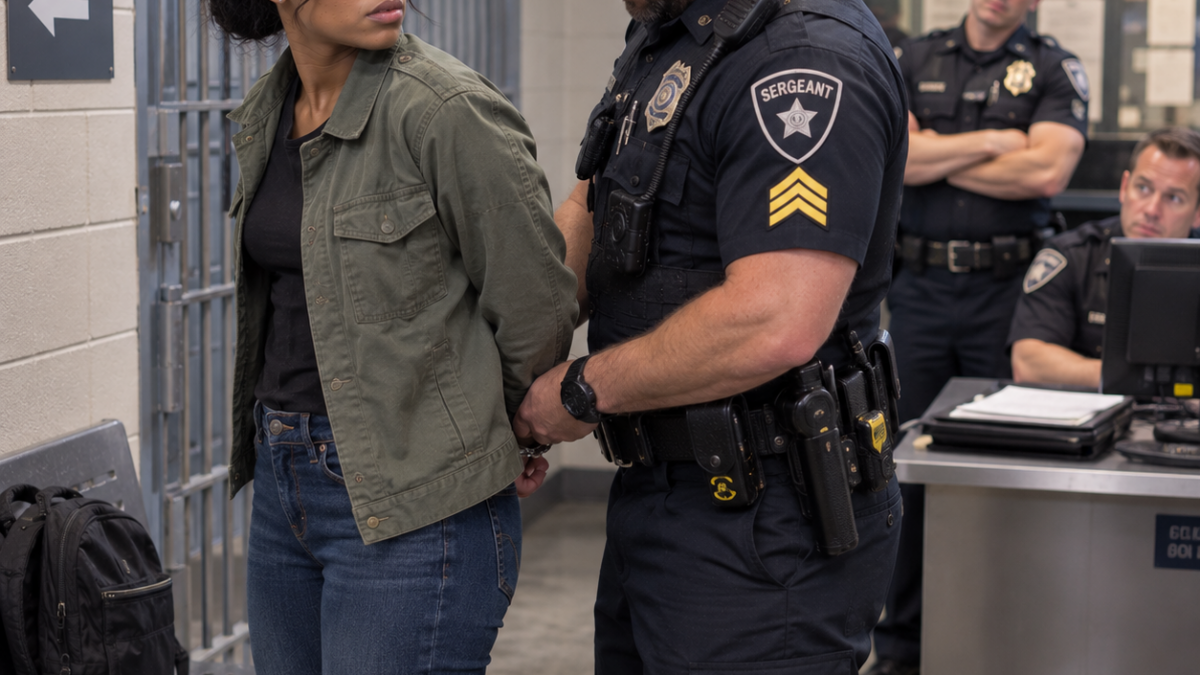
The first thing Sergeant Coulter did after locking me in the cell was run my name.
No warrants.
No arrests.
No outstanding court orders.
Nothing.
That should have been the end of it.
He had a cooperative citizen with a valid driver’s license who had walked into his building voluntarily to report damage to a rental car.
Instead, my clean record irritated him.
I learned that later from the reports.
At the time, all I could see was a narrow rectangle of hallway through reinforced glass.
The cuff around my left wrist was ratcheted tighter than necessary.
I tested it once.
No useful movement.
So I stopped.
Struggling against restraints accomplishes only two things.
It injures you.
And it gives frightened people a reason to say you were fighting.
I had learned both lessons long before that afternoon.
I looked at the red recording light above the cell.
Then I adjusted my posture.
Face visible.
Wrist visible.
No pacing.
No shouting.
No pounding on the door.
Evidence does not need help from emotion.
Outside, I could hear voices.
Not every word.
Enough.
“Clean return.”
“Still doesn’t prove anything.”
“Why would a real officer refuse to say his rank?”
Officer.
That caught my attention.
I had never said I was an officer.
I had said I served in the Army.
Coulter had supplied the rest himself.
That is how assumptions grow.
One person plants a seed.
Five minutes later, everybody remembers a tree.
Lieutenant Dorian Ashby arrived ten minutes later.
I knew none of this in real time.
I reconstructed it months afterward from interviews, reports, camera footage, and testimony.
Ashby had supervised Coulter for nearly four years.
He knew him.
That fact mattered more than rank.
According to the recording, Ashby asked him the obvious questions.
“Did he threaten you?”
“No.”
“Was he armed?”
“No.”
“Did he refuse to identify himself?”
“He gave me a driver’s license.”
“Did the license come back valid?”
“Yes.”
Then Ashby asked:
“So why is he in a cell?”
Coulter called me evasive.
He said I was “too rehearsed.”
He said nobody quoted legal procedure unless they had “experience with the system.”
That phrase stayed with me.
Experience with the system.
I had spent thirty-four years in uniform.
I had negotiated with foreign officers.
Sat through congressional testimony.
Reviewed investigations.
Signed casualty notifications.
Commanded men and women who carried rifles in places where one wrong sentence could become an international incident.
Apparently, knowing how to speak carefully inside a police station was now evidence against me.
Ashby asked whether Coulter had checked all the identification in my wallet.
There was a pause.
Then:
“I checked the license.”
“Everything behind it?”
Another pause.
“No.”
Ashby opened the wallet himself.
My CAC was behind the driver’s license exactly where it had been all afternoon.
He pulled it out.
United States Department of Defense.
My photograph.
My name.
Current expiration date.
Pay grade:
O-10.
Ashby stared at it.
He knew enough about military ranks to understand O-10 was not something he encountered during ordinary traffic work.
Not enough to know exactly what position I held.
So he used his phone.
The search result told him.
General.
Four-star.
The highest regular active-duty grade in the Army.
According to his later statement, he looked at Coulter and said:
“We have a problem.”
Coulter answered:
“We don’t know whether it’s real.”
That was the second moment where everything could have ended.
The first was when my driver’s license came back clean.
The second was when a current federal military identification card carrying my photograph and name appeared in the wallet they had already seized.
Ashby could have opened the cell.
Removed the cuff.
Apologized.
Finished the traffic report.
Instead, he decided they needed verification.
Why?
He later described it as caution.
I came to understand it differently.
Verification allowed everyone to postpone admitting the detention had become indefensible.
A phone call felt safer than an apology.
So they called Fort Eisenhower.
Military bureaucracy can move armies across oceans.
It can also take ten minutes to tell you which extension verifies an identification card.
Ashby called a public installation number.
Transferred.
Transferred again.
Personnel office.
Automated menu.
Another number.
He eventually reached the provost marshal’s office.
The specialist who answered would not verify an active-duty member over an unsecured civilian call.
Correctly.
There are procedures for that.
Ashby asked for an expedited method.
The specialist gave him another contact.
That line went to voicemail.
Meanwhile I remained cuffed to a bench.
At some point, Captain Sloan Pinnock was called.
She commanded the substation.
She was offsite at a county budget meeting.
Her questions were simpler than everyone else’s.
“Is he cooperative?”
“Yes.”
“Any weapon?”
“No.”
“Any threat?”
“No.”
“Any probable cause for a crime?”
Silence.
Ashby eventually answered:
“Not at this point.”
Pinnock told him not to question me further.
She said she was coming in.
That decision helped her later.
It did not help me during the next twenty minutes.
At 2:31 p.m., Corporal Wells Kesler processed my property.
Twenty-seven years old.
Five years on the job.
Quiet.
Good evaluations.
Studying for promotion.
He opened my wallet.
Saw the CAC.
Saw O-10.
Unlike Ashby, he did not need anybody to tell him what it meant.
He searched it.
Four-star general.
Then he put his phone down.
Kesler knew.
Completely.
He also knew Coulter supervised him.
Coulter wrote performance evaluations.
Recommended overtime.
Influenced promotions.
Two months later, Kesler planned to sit for his sergeant’s board.
He had watched colleagues challenge Coulter before.
Nothing dramatic happened to them.
No threats.
No violence.
Just worse shifts.
Denied leave.
Weak evaluations.
The slow administrative punishment institutions are very good at making look accidental.
Kesler put my CAC back into my wallet.
Then he wrote the property log.
Wallet.
Phone.
Rental key.
Leather card holder.
No mention of Department of Defense identification.
He did not lie about seeing it.
Not yet.
He simply omitted the most important thing he had found.
When investigators later asked why, he gave the most honest explanation of anybody involved.
“I thought somebody else would fix it.”
I have remembered that sentence longer than anything Coulter said.
Because Coulter was easy to understand.
Men like Coulter make themselves visible.
Kesler frightened me more.
Good employee.
Decent person.
Knew something was wrong.
Stayed quiet because doing right had a cost.
Most institutional failures do not require rooms full of villains.
They require one aggressive person and enough reasonable people hoping someone else will stop him.
At 2:45, I was supposed to arrive at the Fort Eisenhower checkpoint.
I did not.
Colonel Nadine Okafor, my chief of staff, called me.
Voicemail.
Again.
Voicemail.
She checked my itinerary.
I had departed Columbia on schedule.
The last update from the small security element traveling separately behind my route had placed me near the Chatsworth area.
My government movement that day was low profile.
No sirens.
No escort hugging my bumper.
I was traveling in a civilian rental because I had taken personal time earlier that morning and planned to join the formal movement at Fort Eisenhower.
Still, as the commander of a major Army organization, I had a protective-security protocol.
Nothing theatrical.
A few vehicles.
Military police support available if needed.
A staff communications plan.
The rule was simple.
Miss a scheduled checkpoint without communication, then locate the principal.
Okafor contacted the security team.
They had continued south after my roadside stop because I had told them I was handling a minor rental issue and would reconnect at the installation.
Now I had missed the rendezvous.
My phone was still geographically associated with the sheriff’s substation.
They turned around.
Three black government SUVs and one military support vehicle.
No sirens.
No emergency lights.
No weapons displayed.
Their mission was not:
Storm the police station.
It was:
Locate General Drummond.
Confirm his safety.
Report.
The distinction would become important later because the internet preferred the first version.
Military convoy surrounds r@c!st precinct.
Great headline.
Bad description.
The vehicles parked where they could maintain sight lines and leave quickly.
To the officers looking through the lobby windows, however, nuance did not matter.
Government plates matter.
Uniforms matter.
A military vehicle in a county parking lot matters.
Especially when a four-star general’s ID is sitting on your desk.
Captain Pinnock arrived first.
She walked directly to the holding area.
I saw her through the window.
Late forties.
Command presence.
The kind of posture senior people acquire when they have spent decades walking into problems everyone else wants them to own.
She looked at me.
Then the cuff.
Then Ashby.
“Open it.”
He started explaining.
She repeated:
“Open it.”
The door unlocked.
She stepped inside.
“Mr. Drummond, I’m Captain Sloan Pinnock.”
“Captain.”
“I understand you came here to file a traffic report.”
“Yes.”
“I apologize for how long you’ve been held.”
I looked at my wrist.
“That isn’t the part I’d start with.”
She followed my eyes.
The skin beneath the cuff had turned dark red.
“Uncuff him.”
Ashby removed it.
When the metal came away, I felt blood return to the hand in a rush.
Pain followed.
I flexed my fingers.
Captain Pinnock asked if I was willing to move to a conference room.
“I am.”
I stood.
Then stopped.
“My property first.”
“Of course.”
That response told me Pinnock understood the interaction had changed.
Not because she knew my rank.
Because she finally understood I was not a suspect.
There is a difference.
We sat across from each other in the conference room.
Pinnock began:
“I’ve been told there is a military identification card among your effects.”
“There was.”
“Lieutenant Ashby has been trying to verify it.”
“I see.”
She hesitated.
“I want to understand what happened from your perspective.”
I checked my watch.
2:49.
“I entered your lobby at approximately 1:44.”
She listened.
“I presented valid identification.”
“I explained why I was there.”
“I was cooperative.”
“I was cuffed after declining to discuss my military rank.”
“I was placed in a cell.”
“I was attached to a bench.”
“No one told me what evidence suggested I had committed a crime beyond Sergeant Coulter deciding he did not believe me.”
Pinnock did not interrupt.
That helped.
Then I said:
“At no point before you arrived did anyone ask whether the cuff was hurting me.”
Her eyes dropped toward my wrist.
“I am sorry.”
“I accept that you are sorry.”
She looked back up.
“An apology is not yet a process.”
That sentence later appeared in half the news coverage.
I had not planned it.
I simply meant it.
Feelings are easy.
Process is what determines whether the next person receives different treatment.
Ashby entered carrying the property bag.
He placed it on the table.
I opened it.
Phone.
Rental key.
Wallet.
Card holder.
I opened the wallet.
Driver’s license.
The slot behind it was empty.
I looked again.
Then every other sleeve.
“My CAC is missing.”
Ashby went still.
“It should be there.”
“It isn’t.”
“I put it back.”
Pinnock turned.
“You personally?”
“Yes.”
“After examining it?”
“Yes.”
“Who handled the property afterward?”
“Coulter.”
“And processing?”
“Kesler.”
I looked at both of them.
Nobody spoke.
That was when I heard engines outside.
Several.
Close.
Pinnock glanced toward the window.
Ashby moved first.
The view showed three black SUVs.
Government plates.
One military support vehicle behind them.
Pinnock looked at me.
I did not need to look.
I knew.
“My staff.”
Her face changed.
“How many people?”
“Probably fewer than it appears.”
That was true.
Military vehicles create the impression of more force than they contain.
“No one is coming inside aggressively.”
I added.
“They are looking for me.”
Ashby stared at the parking lot.
“You knew they would come?”
“I knew someone would notice I was missing.”
Colonel Okafor entered the building with two military police personnel.
No rifles in hand.
No shouting.
No dramatic breach.
She showed identification at the desk.
Then said:
“I am Colonel Nadine Okafor, chief of staff to General Warren Drummond.”
Laya Voss stared.
According to the lobby camera, Sergeant Coulter stood beside her.
His body shifted almost imperceptibly.
Not fear exactly.
Recognition.
Okafor continued:
“General Drummond missed a scheduled military movement checkpoint and has been unreachable.”
“I need to confirm his location and welfare.”
Coulter started with:
“This is a law-enforcement facility—”
Okafor held up her CAC.
“Then let’s behave like professionals from both professions.”
I wish I had heard that in person.
Later, watching the footage, I laughed for the first time about anything related to that day.
Coulter led them down the corridor.
The conference-room door opened.
Okafor saw me.
Then saw my wrist.
Her face did not move.
That is one reason she was my chief of staff.
She stepped inside and rendered a salute.
“General Drummond, sir.”
Everything behind her became very still.
Coulter.
Ashby.
Pinnock.
One of the MPs.
Even Okafor seemed to realize afterward how much that single word had changed the temperature.
General.
I returned the salute from my chair.
“Colonel.”
“Sir, your security detail is outside.”
“We lost contact after you missed the checkpoint.”
“I understand.”
“What happened?”
I looked at Captain Pinnock.
Then back to Okafor.
“I was detained.”
I did not need another word.
Okafor looked at my wrist.
“Were you injured?”
“The handcuff was applied too tightly.”
“We’ll document it.”
“Yes.”
Then I looked at Pinnock.
“Captain, I would like this situation handled carefully.”
She nodded.
“So would I.”
“No one outside needs to enter this building unless necessary.”
“Agreed.”
“No one here is to be intimidated by my security personnel.”
“Understood.”
“And I am not interested in anyone mistaking military rank for jurisdiction over civilian law enforcement.”
Pinnock seemed surprised.
I wasn’t.
Nothing would have made the situation worse faster than turning my wrongful detention into a military confrontation.
I had spent my career respecting chains of command.
The sheriff’s office had one.
I had another.
Accountability would happen through law.
Not vehicles in a parking lot.
Okafor produced my itinerary.
She had brought it because she knew the officers would need independent confirmation.
Name.
Destination.
Scheduled checkpoint.
Command.
My photograph.
Captain Pinnock read it.
Then again.
I watched her realize something I had already been thinking.
If I had been a retired electrician named Warren Drummond instead of General Warren Drummond, every minute before that document appeared would still have been wrong.
That mattered.
I said:
“Captain, I want to be clear about something before this becomes about rank.”
She looked at me.
“I was entitled to lawful treatment at 1:44.”
“Not at 2:51 when Colonel Okafor entered your lobby.”
Pinnock nodded slowly.
“Yes.”
“That should appear in whatever report you write.”
“It will.”
Good.
I began listing what needed preservation.
Lobby surveillance.
Report-room footage.
Holding-cell video.
Body-camera data.
Property log.
Dispatch call.
The 911 report that started everything.
Radio traffic.
Every version of the incident report.
No deletion.
No overwriting.
No “system maintenance.”
Pinnock wrote.
Then I said:
“I want an outside agency notified.”
She looked up.
“I think that’s appropriate.”
“Not internal affairs alone.”
“No.”
“GBI?”
“Yes.”
“Your choice to initiate it will matter.”
She understood what I meant.
Not to me.
To investigators.
Voluntary evidence preservation looks different from evidence preservation after a subpoena.
Then Okafor asked if a military medic could photograph my wrist.
Pinnock agreed immediately.
Four angles.
Timestamp.
Location.
Scale reference.
No drama.
Just documentation.
While the pictures were being taken, Coulter appeared at the doorway.
His face had hardened again.
Fear sometimes looks like arrogance when a person has only one emotional language.
“General.”
I did not answer.
“I need to explain what happened.”
I looked at Pinnock.
“I will not discuss the facts with any officer involved in the detention.”
Coulter took one step inside.
“You refused to show military ID.”
“I will not discuss the facts with any officer involved.”
“You made yourself suspicious.”
Pinnock stood.
“Gage.”
He stopped.
I looked at her.
“Captain, please make sure Sergeant Coulter understands that my refusal to argue with him now is not an invitation to continue.”
Her voice sharpened.
“Sergeant, leave the room.”
He did.
That was the first lawful order involving me that he followed without complaint.
Before leaving, I asked for one final thing.
“My traffic report.”
Pinnock looked surprised.
“The hit-and-run?”
“Yes.”
“That is why I came here.”
For the first time, something almost like disbelief crossed her face.
Not because I was joking.
Because I wasn’t.
Lieutenant Ashby completed it.
Dark green pickup.
Partial plate.
Approximate location.
Rental damage.
Time.
It took seven minutes.
Seven minutes.
I had spent more than an hour in custody for a process that required seven minutes.
When the report number was printed, I folded the paper once and put it into the leather card holder.
My CAC remained missing.
That was now a separate problem.
Okafor had already initiated cancellation and replacement procedures.
A missing military credential could not simply remain unaccounted for.
Before I left, I spoke to Captain Pinnock.
“I came into this building because somebody hit my rental car.”
“I know.”
“I am leaving with a bruised wrist, a missing federal credential, and a request for an outside investigation.”
She looked tired.
Already.
“I know.”
“I am not asking you to promise me what the investigation will find.”
“Good.”
“I am asking you not to protect anyone from finding it.”
She held my gaze.
“I won’t.”
I believed she meant it.
At that moment.
Later, we would learn believing something and surviving the pressure required to honor it are different.
Outside, the heat hit me immediately.
The vehicles looked ridiculous in the small county lot.
Three black SUVs.
Military support vehicle.
Personnel standing nearby.
No weapons raised.
No lights.
Still, every phone inside the building seemed to be recording through the windows.
Okafor walked beside me.
“Sir, medical first.”
“Fort first.”
“Sir.”
“Medical at Fort.”
“You have a change-of-command ceremony.”
“So I’ve been told.”
“You’re late.”
“So I’ve also been told.”
She looked at my wrist.
“Sir—”
“Nadine.”
She stopped.
Few people used her first name in uniform.
“I need the ceremony to happen.”
“Why?”
“Because four thousand soldiers have been standing in the sun rehearsing it for three days.”
“They did not put me in that cell.”
Her expression changed.
“Understood.”
The medic could examine me at the installation clinic.
We got into the lead vehicle.
As the convoy pulled out, I looked back at the building.
Coulter stood nowhere visible.
Laya did.
She was behind the glass.
So was Kesler.
He looked away when our vehicle passed.
I did not yet know he had seen the CAC.
I did not yet know the property log he signed would become one of the most important documents in the investigation.
I only knew my wrist hurt.
And I was tired.
Anger came later.
Captain Pinnock moved fast after we left.
That saved her career.
Maybe more than her career.
She ordered Coulter placed on administrative leave.
Badge.
Weapon.
Body-camera equipment.
Collected.
Kesler’s property log came next.
Wallet.
Phone.
Key.
Card holder.
No CAC.
Pinnock questioned him.
“Did you open the wallet?”
“Yes.”
“Did you see a Defense Department identification card?”
“I may have.”
“May?”
He cracked.
Not completely.
Enough.
He admitted he had seen it.
Later, investigators obtained browser records from his phone showing he searched “O-10 military rank.”
That destroyed the idea that he did not know what it meant.
He had known.
And stayed quiet.
Pinnock then confronted Ashby.
“You saw the card and continued holding him.”
Ashby defended the verification process.
Pinnock answered:
“You had a cooperative citizen with valid state ID and no articulable crime.”
“You chose administrative certainty over his freedom.”
That phrase later appeared in the internal report.
Administrative certainty over freedom.
I thought it was more accurate than anything I could have written.
I arrived at Fort Eisenhower twenty-two minutes after the ceremony was scheduled to begin.
Four thousand soldiers stood on the field.
Band ready.
Colors ready.
Families in folding chairs.
Senior leaders waiting.
Okafor wanted me to go to the clinic first.
I refused.
For fifteen minutes.
We compromised.
A physician met me in a private room near the reviewing stand.
Photographed the wrist again.
Tested circulation.
Movement.
Tenderness.
Soft-tissue injury.
No fracture.
He offered pain medication.
I declined.
Then changed into dress uniform.
The cuff of the jacket covered the bruise.
That detail later bothered people when photographs from the ceremony circulated.
They saw me saluting.
Smiling.
Speaking.
No visible injury.
Some concluded the incident must have been exaggerated.
That is another mistake we make.
We expect injury to perform itself.
We expect victims to look damaged enough.
Angry enough.
Sad enough.
Broken enough.
I had spent my adult life standing in front of formations regardless of what happened an hour earlier.
So I stood.
The colors passed.
The command changed.
I spoke for eleven minutes.
I did not mention the substation.
Not once.
The soldiers standing in front of me were not an audience for my private humiliation.
Afterward, I went to the clinic.
Then I called my wife.
That conversation was harder than the police station.
“Are you hurt?”
“I’m fine.”
“Warren.”
“I have a bruised wrist.”
“What happened?”
I told her.
There was silence.
My wife, Denise, had known me since I was a captain.
She had sat through deployments.
Promotions.
Casualty calls.
Three moves in four years.
Children crying because Dad missed birthdays.
She understood Army language.
She also understood me.
“You’re angry.”
“Yes.”
“You sound calm.”
“Both can be true.”
Another pause.
“Did they know you were a general?”
“Eventually.”
“That isn’t what I asked.”
I smiled despite myself.
“No.”
“Did they know you were Black?”
“Yes.”
There it was.
Not accusation.
Not conclusion.
Fact.
Denise breathed out.
“What are you going to do?”
“Ask for an independent investigation.”
“Ask?”
“Demand politely.”
She laughed once.
Then her voice cracked.
“What if nobody had come?”
That question stayed with me.
Not because I thought I would disappear forever inside a county substation.
Of course not.
Someone would eventually resolve it.
But when?
After another hour?
Another accusation?
A booking photograph?
A fabricated charge strong enough to justify what had already happened?
“What if you weren’t you?” she asked.
I did not answer.
Because that was the real question.
GBI opened an inquiry within days.
DOJ received a referral later.
My lawyers filed civil claims.
I refused television interviews.
Reporters called anyway.
A four-star Army general wrongfully detained in Georgia was irresistible.
Then someone leaked the parking-lot footage.
Four government vehicles.
Military personnel.
The headline appeared:
MILITARY CONVOY SURROUNDS PRECINCT AFTER BLACK GENERAL ARRESTED
I hated it.
Okafor hated it more.
“They make it look like we invaded Georgia.”
“We’ve done worse headlines.”
“Sir.”
“I’m kidding.”
“You are not funny enough to joke during an investigation.”
“Noted.”
We released one factual statement through the Army.
No threat had been made.
No military authority exercised over civilian officers.
My protective personnel had arrived after I missed a scheduled checkpoint and could not be reached.
They located me.
Confirmed safety.
Departed.
That should have made the story less interesting.
It did not.
Reality rarely defeats a dramatic headline.
Still, accuracy mattered.
Especially because the underlying facts were already bad enough.
We did not need mythology.
Special Agent Thomas Ferrer from GBI interviewed me for three hours.
He began with:
“General, I’m going to treat you like any other complainant.”
“Please do.”
“Rank stays outside.”
“Best thing I’ve heard all week.”
He started at the interstate.
Rental car.
Pickup.
Partial plate.
Insurance call.
Parking lot.
Entrance.
Every detail.
At one point he asked:
“Why didn’t you show Coulter the CAC when he asked?”
“Because I did not believe I was required to prove my rank to report damage to a vehicle.”
“Would showing it have ended the encounter?”
“Probably.”
“So why not?”
I considered the question carefully.
“Because I had already provided valid identification.”
“That sounds principled.”
“It was also practical.”
“How?”
“Reaching deeper into a wallet while an officer is suspicious of you is not always the safest choice.”
Ferrer nodded.
“Anything else?”
“Yes.”
“What?”
“I wanted the traffic report.”
“Not a conversation about my career.”
He wrote.
Then:
“When did you first believe race mattered?”
Harder question.
“Immediately?”
“No.”
“When Coulter questioned your rank?”
“Maybe.”
“When he cuffed you?”
“Possibly.”
“You don’t sound sure.”
“Because I don’t live inside Sergeant Coulter’s mind.”
I leaned forward.
“I can tell you what happened.”
“A Black man was reported as suspicious for standing near police cars while searching for a public entrance.”
“I was questioned beyond the purpose of my visit.”
“My lawful identification was treated as insufficient.”
“My calm was described as suspicious.”
“And my refusal to volunteer military status became grounds for detention.”
I paused.
“You decide what evidence supports motive.”
Ferrer looked up.
“Most complainants want to tell me what the officer was thinking.”
“Most people aren’t trained to separate intelligence from assessment.”
He smiled.
“General answer.”
“Sorry.”
“No.”
He closed the notebook briefly.
“It’s useful.”
Coulter’s body camera became a problem.
The department produced the uploaded file.
It was shorter than the holding-cell timeline.
Several minutes were missing around the time he cuffed me and moved me to the cell.
IT called it a synchronization error.
GBI requested the original storage media.
It had been reformatted after the incident.
Coulter’s attorney said this was routine end-of-shift maintenance.
Investigators disagreed about how suspicious it was.
What mattered was the holding-cell camera still existed.
Lobby footage existed.
Report-room footage existed.
The missing body-camera segment was not the only evidence.
That was another lesson.
Never build accountability on one camera.
Technology fails.
Sometimes honestly.
Sometimes conveniently.
Systems should assume both.
Kesler’s interview hurt me more than Coulter’s.
Ferrer later summarized it for my attorneys after the information became part of a public record.
Kesler admitted seeing the CAC.
He admitted searching O-10.
He admitted understanding.
Then he said:
“I knew I should say something.”
Ferrer asked:
“Why didn’t you?”
“My promotion.”
“Your promotion?”
“Coulter had to recommend me.”
“So you left a man detained?”
“I thought Captain Pinnock would arrive.”
“You didn’t know that.”
“No.”
“You thought Ashby would fix it?”
“Yes.”
“Did he?”
“No.”
Kesler cried during part of the interview.
I did not enjoy hearing that.
People assumed I would.
I had commanded young soldiers.
I knew what fear of a superior can do.
Understanding did not excuse him.
But it kept me from turning him into a monster.
He was something more common.
A man who rented his conscience to the chain of command for one afternoon.
The price was a promotion.
That frightened me because all institutions create versions of that bargain.
The Army does too.
Maybe especially the Army.
Do you speak?
Or protect your evaluation?
Report misconduct?
Or protect your unit?
Challenge the senior leader?
Or trust someone else will?
The uniform does not cure cowardice.
It simply gives cowardice different vocabulary.
Laya Voss was not disciplined.
Some people hated that.
I did not.
She had questioned the detention once.
“He signed in for a traffic report.”
Then deferred.
Was that enough?
No.
Was it misconduct deserving termination?
I did not believe so.
The more useful question was:
Why did she believe challenging Coulter twice was unsafe for her career?
That became part of the cultural review.
Pinnock had her own problem.
Two previous complaints against Coulter had been closed under her command.
One involved a Black delivery driver detained after entering the wrong service gate.
Another involved a Latino college student stopped near a closed municipal building.
Neither was identical to my case.
Both contained familiar language.
Evasive.
Attitude.
Wouldn’t answer simple questions.
Pinnock had approved the findings without deeper review.
During her interview with GBI, she admitted it.
“I trusted my supervisors.”
Ferrer asked:
“Was that reasonable?”
She answered:
“Apparently not.”
That answer may have saved her.
Leaders often destroy themselves not with the original failure, but by refusing to name it.
Three weeks after the detention, Captain Pinnock asked to meet me.
My attorney advised against it.
I agreed anyway with counsel present.
We met at Fort Eisenhower.
No uniforms required.
She wore a dark suit.
I wore Army combat uniform because I had just left a briefing.
For a moment, the visual looked backward.
Civilian police commander.
Military general.
But the conversation was not about authority.
She started:
“I failed before you entered my building.”
I waited.
“The previous complaints.”
“Yes.”
“I didn’t investigate them deeply enough.”
“No.”
“I told myself staffing was thin.”
“Union rules were complicated.”
“Coulter was productive.”
“His arrest numbers were good.”
I looked at her.
“Numbers.”
“Yes.”
“My mother loves numbers.”
Pinnock seemed confused.
“She was an accountant.”
“Used to say numbers tell you where people are hiding things.”
Pinnock nodded slowly.
“Our numbers told us Coulter was productive.”
“What didn’t you measure?”
She already knew.
“Complaints by officer.”
“Escalation rates.”
“Use of restraints.”
“Disparities.”
“Supervisor overrides.”
“Exactly.”
She looked at her hands.
“I am sorry.”
“I believe you.”
“Does that help?”
“Some.”
She gave a sad smile.
“That’s honest.”
“I don’t need you to feel worse.”
“I need you to run a better department.”
She looked at me.
“What would that look like to you?”
“I am not a police administrator.”
“You command twenty thousand people.”
“Different mission.”
“Leadership isn’t that different.”
I considered that.
Then answered.
“Make it safe for the next Kesler to speak before the convoy arrives.”
She stared at me.
I continued.
“If your lowest-ranking employee sees a mistake and believes correcting a sergeant will end his career, no policy manual will save you.”
That became the most important reform to me.
Not handcuff training.
Not identification cards.
Upward dissent.
Can somebody say:
Sergeant, I think you’re wrong.
Without paying for it later?
If not, everything else is decoration.
The county eventually proposed a settlement.
Fifty thousand dollars.
No admission.
Confidentiality clause.
My attorney placed the envelope on my desk.
I left it unopened for two days.
Not because the amount insulted me.
Money was never the point.
I could donate fifty thousand dollars before lunch and forget the transaction by dinner.
The confidentiality clause mattered.
If I signed it, the county would pay me to make the problem private.
I thought about that.
Then about the delivery driver.
The college student.
Kesler.
Laya.
Pinnock.
I called my attorney.
“Counter.”
“With what amount?”
“Keep the amount.”
Silence.
“You’re serious?”
“Yes.”
“What do you want?”
“No confidentiality.”
“Public release of investigation findings after legal review.”
“Policy reform.”
“Independent complaint audit.”
“Supervisor retaliation protections.”
“Annual public statistics for detention complaints.”
“Mandatory review whenever an officer accumulates repeated similar allegations.”
My attorney laughed.
“What?”
“You’re negotiating a consent decree over fifty grand.”
“No.”
“I am negotiating what fifty grand should actually purchase.”
“They may reject it.”
“Then we litigate.”
He sighed.
“I knew you’d say that.”
Coulter resigned before the internal termination hearing concluded.
The department recorded him as not eligible for rehire.
GBI referred evidence to prosecutors for review.
I will not turn what followed into something more dramatic than it was.
There was no midnight raid.
No federal agents kicking in his door.
No scene where he was dragged through the same lobby.
The criminal review took time.
That is normal.
Ultimately, prosecutors pursued charges related to the unlawful detention and evidence handling that the available proof could support.
Coulter’s lawyers fought them.
Some allegations were reduced.
Some dismissed.
One count involving falsification survived long enough to produce a plea agreement.
He lost his certification.
That mattered more to me than whether a judge imposed the harshest possible sentence.
He would not hold a badge again.
Kesler received a lengthy suspension and was moved away from evidence processing.
He withdrew from the sergeant’s exam.
Later, he transferred to another county department.
Before leaving Whitfield, he asked through attorneys if he could write me a letter.
I said yes.
The letter was four pages.
Most of it was apology.
One sentence mattered.
I kept waiting for a person with more authority than me to do what I already knew was right.
I folded the letter.
Put it in my desk.
I still have it.
Ashby received formal discipline and was removed from supervisory responsibility for a period.
Eventually he resigned.
Not because I demanded it.
He later said the incident made him realize he had become more interested in protecting decisions than correcting them.
I respected the honesty.
Too late for me.
Maybe not too late for whoever met him afterward.
Pinnock stayed.
That surprised people.
Her critics said a commander whose station produced such a failure should resign.
Some days, I agreed.
Other days, I didn’t.
She had signed off on weak investigations before my case.
That was serious.
She had also stopped the detention the moment she arrived, preserved evidence, cooperated with outside investigators, and publicly accepted supervisory responsibility.
Accountability should not always mean removing the person most capable of repairing what they helped allow.
Sometimes it should.
Not always.
The county kept her under outside monitoring.
She invited civilian review.
Changed complaint procedures.
Created automatic alerts for repeated allegations against the same officer.
Added anti-retaliation reporting for employees.
Required supervisors to document reasons for extending investigative detentions.
Most importantly, officers could request an immediate second-supervisor review without going through their direct sergeant.
Kesler’s rule.
People unofficially called it that.
He hated the name.
I liked it.
Six months later, I returned to Whitfield County.
Not secretly.
Not with a convoy.
One car.
One aide.
I asked Pinnock to meet me at the substation.
The parking lot looked exactly the same.
Nine spaces.
Brick building.
Faded flags had been replaced.
That was new.
I stood near the north entrance.
The same place the clerk had seen me looking at patrol cars.
A new sign had been installed.
PUBLIC ENTRANCE →
I laughed.
Pinnock came outside.
“What?”
“That would’ve saved everybody a lot of paperwork.”
She looked at the sign.
Then laughed too.
“First reform.”
“Best one.”
We went inside.
Laya still worked the desk.
She saw me.
Stood.
Then seemed unsure whether she should salute.
I smiled.
“Please don’t.”
She relaxed.
“Good afternoon, General.”
“Good afternoon.”
There was a young man waiting in the lobby.
Black.
Twenty-something.
Work boots.
Reflective vest.
He held a traffic form.
Maybe nothing.
Maybe everything.
Pinnock noticed where I was looking.
“He came in because somebody backed into his truck.”
I smiled.
“How’s it going?”
The young man looked confused.
“Fine.”
“Good.”
That was what I wanted.
Fine.
Boring.
No story.
Pinnock showed me the new complaint dashboard.
I hated the term dashboard.
Every organization discovers dashboards and immediately believes it has invented accountability.
Still, the data was useful.
Stops.
Detentions.
Restraints.
Complaints.
Repeat officer names.
Disposition.
Time to close.
Demographic patterns where legally appropriate.
Not to prove r@c!sm automatically.
To locate questions.
Patterns are not verdicts.
They are invitations to look.
One number stood out.
Internal employee concerns had increased nearly three hundred percent.
Pinnock looked worried.
I smiled.
“Good.”
She frowned.
“Good?”
“People are reporting.”
“Some of these are petty.”
“Probably.”
“Shift disputes.”
“Tone.”
“Supervisors being rude.”
“Fine.”
“What if it creates noise?”
“Then learn to separate noise from signal.”
I pointed at the graph.
“The dangerous organization is the one where nobody reports anything.”
She understood.
Silence can look like health.
So can an empty complaint box.
Sometimes it only means people stopped believing anything would happen.
My civil case settled later that year.
The financial amount remained modest compared with what headlines expected.
I did not care.
No confidentiality clause.
The county acknowledged the detention lacked sufficient legal basis after my identification was verified.
They agreed to the reforms already underway.
Independent monitoring continued for three years.
The settlement also funded outside training and a small legal-assistance program for residents challenging improper detention or property-processing errors.
My wife read the final document.
“This is what you wanted?”
“Yes.”
“No big check?”
“I have a job.”
She rolled her eyes.
“You’re impossible.”
“So I’ve been told.”
Then she pointed to one paragraph.
“This.”
Employee anti-retaliation.
“Yes.”
“That’s for Kesler.”
“Partly.”
She nodded.
“Good.”
The missing CAC was never found.
That bothered me.
More than the money.
More than the bruise.
A federal credential does not evaporate.
Investigators searched lockers.
Desks.
Evidence bins.
Trash logs.
Nothing.
There was also the missing body-camera segment.
And an email sent from Coulter’s department account to an outside address several hours after the detention.
Subject line:
Thursday.
The message body had been deleted.
Investigators traced the address to someone with no obvious relationship to the department.
No clear connection to me.
No evidence of a larger conspiracy.
Just an unexplained detail.
The internet loved it.
Secret network.
Political plot.
Military intelligence scandal.
All nonsense as far as evidence showed.
I resisted every attempt to turn uncertainty into mystery for entertainment.
Sometimes an unexplained email is just an unexplained email.
Sometimes missing evidence means misconduct.
Sometimes incompetence.
Sometimes nothing connected to the central wrong.
Truth does not become stronger when we decorate what we don’t know.
The final report marked those items unresolved.
I could live with that.
Accountability does not require pretending every question receives an answer.
One year after the incident, Colonel Okafor retired.
At her ceremony, she gave a speech.
Mostly about soldiers.
Family.
Thirty years of service.
Then, near the end, she looked at me.
“There are moments in every career when protocol feels boring.”
“Check-in times.”
“Call trees.”
“Movement logs.”
“Accountability procedures.”
She smiled.
“Then one afternoon your commanding general disappears into a county police station, and suddenly everybody loves protocol.”
The room laughed.
I did too.
Afterward, she handed me a small frame.
Inside was a printed map.
Interstate 75.
A red line going south.
Then one sharp U-turn.
Four tiny black vehicle icons drawn by hand.
At the bottom she had written:
MISSED CHECKPOINT — 1445
My wife laughed for five straight minutes.
I put it in my office.
People still ask why I didn’t simply show Coulter the CAC.
The question usually comes from someone trying to understand whether I could have prevented everything.
Yes.
Maybe.
If I had opened the wallet wider, perhaps he would have apologized immediately.
Perhaps he would have saluted.
Perhaps he would have offered coffee.
Perhaps none of the investigation would have happened.
But then what would we have learned?
That Warren Drummond, four-star general, deserved respect?
We already knew powerful titles change behavior.
That is not a civil-rights lesson.
The lesson was what happened before anyone knew my title.
I had a driver’s license.
A reason for being there.
No weapon.
No warrant.
No hostility.
No crime.
That should have been enough.
If your rights become safer only after somebody learns your résumé, they were never really treating rights as rights.
They were treating them as status benefits.
I did not refuse the CAC to create a test.
I want to be clear about that.
I did not walk into the station planning a social experiment.
I wanted a traffic report.
But once Coulter decided he was entitled to information unrelated to that task, I refused to let the conversation become a performance of importance.
I shouldn’t need stars on my shoulder to make “no” mean no.
A few months after the settlement, a reporter finally got me to sit down.
She asked:
“What went through your mind when the convoy arrived?”
I laughed.
“I was embarrassed.”
She looked shocked.
“Embarrassed?”
“Imagine being fifty-six years old and your coworkers have to come retrieve you from a police station because you missed an appointment.”
She laughed.
Then:
“Were you relieved?”
“Yes.”
“Vindicated?”
“No.”
“Why not?”
“Because the arrival of powerful people doesn’t prove the detention was wrong.”
“The facts prove that.”
She wrote it down.
Then asked:
“Do you believe Sergeant Coulter was r@c!st?”
There it was.
The question everyone wanted reduced to one word.
I took my time.
“I believe race was part of the context.”
“How?”
“A Black man standing near police vehicles was described as suspicious while looking for a public entrance.”
“My knowledge of procedure was treated as evidence of criminal experience.”
“My calm was interpreted as deception.”
“My reluctance to disclose rank was treated as proof I must be lying about military service.”
I paused.
“But I cannot testify to thoughts I did not hear.”
“So you won’t call him r@c!st?”
“I will describe what he did.”
“I’ll let people decide what word helps them understand it.”
She looked disappointed.
Clean labels make better headlines.
Complexity makes better reform.
That interview aired on a Sunday.
Monday morning, I received an email from a young police officer in another state.
No name.
No department.
Just a personal address.
He wrote:
General, last month my sergeant detained a man I didn’t think had done anything wrong.
I almost stayed quiet because I am on probation.
I thought about Corporal Kesler.
I asked for another supervisor.
The man was released.
Nothing dramatic happened.
I wanted you to know.
I read that message three times.
Nothing dramatic happened.
Best sentence in the whole thing.
No convoy.
No cameras.
No viral headline.
No four-star general.
An officer questioned a decision.
Another supervisor reviewed it.
A citizen went home.
That was success.
Not punishment.
Prevention.
Two years later, my Army retirement ceremony was held on a cold morning in Virginia.
My wife sat in the front row.
Our children beside her.
Old commanders.
Young soldiers.
People I had served with across three decades.
At the end, I gave the final speech I would ever give in uniform.
I talked about authority.
Not the police incident directly.
Not at first.
I said:
“Rank is useful because large organizations need people who can make decisions.”
“But rank is dangerous when the people below you become more afraid of disappointing you than of doing the wrong thing.”
The room went still.
I continued.
“The test of leadership is not whether people obey you.”
“It is whether they can tell you that you are wrong.”
I thought about Kesler.
Ashby.
Pinnock.
Coulter.
Myself.
“Build organizations where truth can travel upward faster than fear.”
That line received applause.
I wished it hadn’t.
Some lines deserve thought before applause.
Then I finally mentioned Whitfield County.
“I once spent an afternoon in a holding cell because one man decided my refusal to discuss my rank made me suspicious.”
A few people smiled knowingly.
“The irony isn’t that they arrested a general.”
“The irony is that rank had nothing to do with whether they should have detained me.”
I looked toward the young officers in the crowd.
“Never make a person prove they’re important before you decide they deserve dignity.”
That was the last thing I wanted them to remember.
After retirement, Denise and I drove south.
No security detail.
No checkpoint.
No Suburbans.
My own truck.
She insisted we stop for lunch outside Dalton.
I knew exactly what she was doing.
“No.”
“Yes.”
“We are not going there.”
“Yes, we are.”
“Denise.”
“You spent thirty-four years telling soldiers to face uncomfortable terrain.”
“This is different.”
“Coward.”
I looked at my wife of thirty-one years.
“You’re enjoying this.”
“Deeply.”
So we drove past the Whitfield County substation.
We did not stop.
I slowed at the intersection.
The public entrance sign was still there.
Clear.
Large.
Impossible to miss.
A patrol officer stood near the front helping an elderly man fill out a form.
Nothing happened.
Denise looked over.
“You okay?”
I rotated my left wrist.
The habit had stayed.
No pain.
No scar.
Just memory.
“Yes.”
“You sure?”
“Yes.”
We continued south.
No convoy behind us.
No phone calls.
No one waiting at the next checkpoint.
Just highway.
Twenty minutes later, Denise asked:
“Do you ever wonder what would’ve happened if nobody noticed you were missing?”
“Yes.”
“What do you think?”
I kept my eyes on the road.
“Eventually somebody would’ve found out.”
“That’s not what I mean.”
I knew.
She meant:
What would have happened if I had been ordinary?
No chief of staff.
No movement schedule.
No security detail.
No Department of Defense card.
No title anyone feared mishandling.
I thought about the young officer’s email.
The man released because somebody asked for another supervisor.
Then about the new entrance sign.
Kesler’s letter.
Pinnock’s dashboard.
The complaints finally reviewed.
“I hope it would be different now.”
“That sounds uncertain.”
“It is.”
She nodded.
“Fair.”
A few miles later, she reached across the console and took my hand.
My left one.
Her thumb passed over the place where the cuff had bruised the bone.
Nothing remained there.
Physically.
She said:
“You know what I remember?”
“What?”
“When you came home after your first deployment.”
“You couldn’t sleep unless every door was locked twice.”
I smiled.
“That wasn’t me.”
“It absolutely was.”
“Sounds like another general.”
She squeezed my hand.
“You always think discipline means nobody can see what something cost you.”
I did not answer.
She continued.
“You were hurt that day.”
“Yes.”
“Not just your wrist.”
“No.”
It had taken me longer to admit that.
Public humiliation has a strange afterlife.
You replay what you could have said.
What you should have done.
Whether compliance looked weak.
Whether resistance would have looked guilty.
Whether the room saw you as a person at all.
For weeks afterward, every time someone asked for identification, I felt the police station return for half a second.
That was not battlefield trauma.
Not comparable.
Still real.
“I was angry for a long time.”
I said.
“I know.”
“I wanted Coulter destroyed.”
“I know.”
“Then I wanted everyone to stop talking about him.”
“I know.”
“And now?”
She asked.
I thought.
“I want the next person to leave with his traffic report.”
Denise smiled.
“That sounds healthier.”
“It sounds boring.”
“Boring is healthy.”
She was right.
Again.
That is why the military convoy was never the most important part of the story.
It was the image everyone remembered.
Black SUVs.
Military vehicle.
Uniformed colonel.
A salute.
A police station suddenly realizing the man they had cuffed was a four-star general.
But spectacle is not justice.
The convoy did not make me innocent.
My rank did not make Coulter wrong.
The stars on my uniform did not create my rights retroactively.
The important moments happened before the first government vehicle entered the parking lot.
Laya noticing that I came in for a traffic report.
Ashby realizing there was no crime.
Kesler seeing the CAC.
Pinnock asking whether there was any lawful reason to continue holding me.
Every one of those moments contained an exit.
A chance to stop.
A chance to say:
We’re wrong.
Let him go.
That is how institutions fail.
Not because they never encounter an opportunity to correct themselves.
Because people keep walking past the exits.
The convoy only made it impossible to keep walking.
The real reform was building more exits.
Second-supervisor review.
Complaint tracking.
Evidence preservation.
Protection for employees who disagree upward.
People learning that correcting a superior is not betrayal.
That is less exciting than black SUVs around a precinct.
It is also much more powerful.
Because one day another man will walk into a government building wearing ordinary clothes.
Maybe Black.
Maybe white.
Maybe Latino.
Maybe nobody important.
He will ask for help.
Some officer will misunderstand him.
Another officer will notice.
And if the system works, that second officer will speak.
No convoy will come.
No general will salute.
No headline will be written.
The man will simply go home.
That is the ending I wanted.
Not for them to learn who I was.
For it to stop mattering.








