Cop Sl@pped a Black Woman He Mistook for a Defendant—Then the Bailiff Called Her “Your Honor”
They were not hurried footsteps.
That was the first thing I remember.
Measured.
Heavy.
Steady.
The sound of someone who had walked those courthouse halls long enough that nobody expected him to move out of the way.
Dutton turned toward the corridor.
Meeks still had my arm twisted behind me.
The open handcuffs hung from his other hand.
Then Gerald Thompson came around the corner.
Sixty-three years old.
Thirty years as a bailiff.
Silver hair cut close.
Dark suit.
Court insignia on his lapel.
He had escorted murder defendants and nervous jurors.
He had stood beside judges during death threats.
He had broken up arguments between attorneys without raising his voice.
During my orientation the previous week, Gerald had shown me courtroom three.
He had opened my chambers.
He had helped me carry a box of books.
He had pointed toward the old wooden bench and said:
“First day feels strange.”
I had asked:
“Does it ever stop?”
He’d smiled.
“No, Your Honor.”
Now he stopped in the lobby.
His eyes moved over everything.
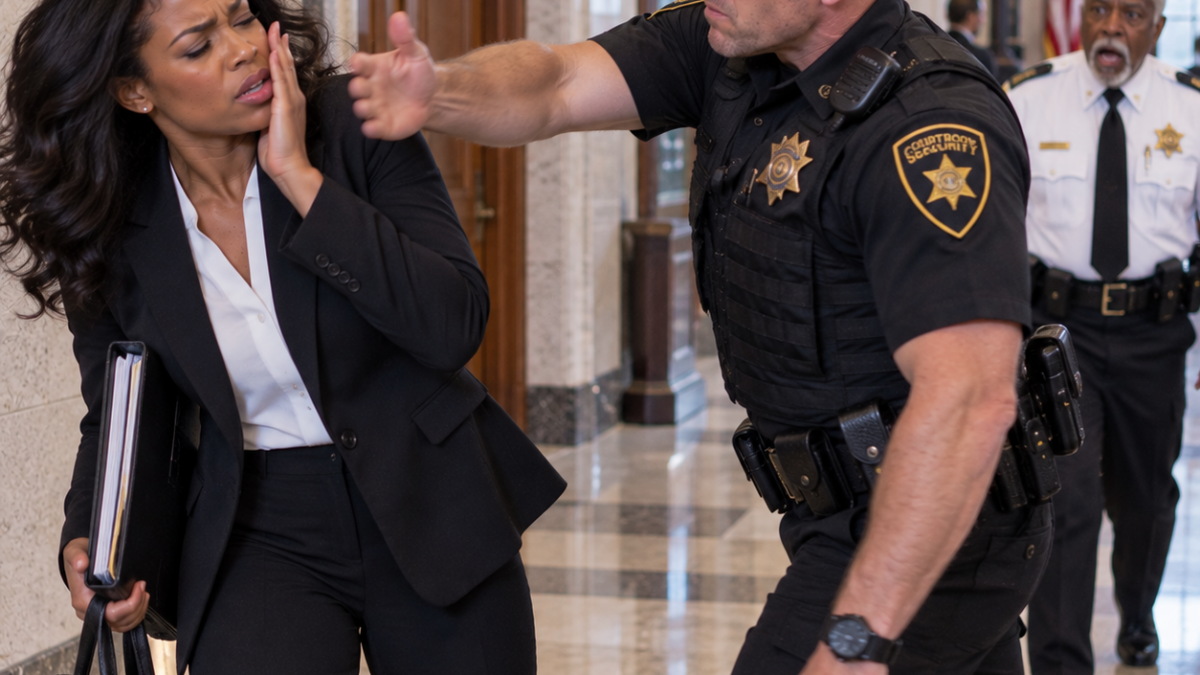
Me against the wall.
The swelling on my cheek.
The blood above my eyebrow from where my head had caught the marble.
Dutton’s fist tangled in my jacket.
Meeks holding my arm.
My belongings scattered on the floor.
The open handcuffs.
Gerald did not shout.
He did not reach for Dutton.
He simply walked toward us.
Two feet away, he stopped.
Straightened his shoulders.
And said:
“Good morning, Your Honor.”
The lobby became silent.
Not quiet.
Silent.
I felt Meeks’s grip disappear.
The handcuffs fell from his fingers and struck the marble.
Dutton released my jacket.
For several seconds, his face did not change.
It was as if his mind had heard the words but refused to translate them.
Gerald looked at me.
“Your courtroom is ready.”
“Thank you, Gerald.”
Dutton stepped backward.
“No.”
Nobody answered.
He looked at Gerald.
“No.”
Gerald turned toward him.
“You just assaulted Judge Ashford.”
Dutton’s mouth opened.
“She didn’t identify—”
“She did.”
Gerald’s voice remained calm.
“I heard enough from the corridor.”
Dutton pointed toward me.
“She came toward a restricted hallway without visible credentials.”
I almost laughed.
Even now.
Even after everything.
He was still building the report.
Gerald looked at my belongings.
A young attorney near the information desk suddenly said:
“Is that her badge?”
Every head turned.
My judicial identification lay beside the base of a marble column.
Gold seal.
Photograph.
Name.
JUDGE NAEN ASHFORD.
Meeks stared at it.
Then at me.
His face changed first.
Not remorse.
Fear.
Dutton looked next.
The arrogance drained from him so quickly that for one irrational second I thought he might actually collapse.
Gerald walked over.
Picked up the identification.
Brought it to me.
I slipped it into my jacket pocket where it remained visible.
Dutton whispered:
“I didn’t know.”
Gerald looked at him.
“That doesn’t help you.”
“What?”
“If you didn’t know she was a judge, then you assaulted a woman because you decided she looked like a defendant.”
Dutton said nothing.
Gerald took one step closer.
“If you did know, you assaulted a judge.”
“Which explanation were you hoping would make this better?”
What none of us knew yet was that someone else had been watching before Gerald arrived.
David Ross worked in courthouse IT.
Six years.
Quiet man.
Late thirties.
The kind of employee nobody noticed until a network stopped working.
That morning he had been eating a granola bar while watching surveillance monitors.
At 6:53 a.m., the main lobby camera went black.
That interested him.
Not because cameras never failed.
They did.
Because the system log showed a manual override.
Security desk.
Operator code assigned to Rick Dutton.
David had seen it before.
Three previous incidents in fourteen months.
Each time the main lobby camera stopped recording for several minutes.
Each time Dutton later filed a report stating he’d removed a disruptive visitor.
David had reported the pattern.
His supervisor had told him security sometimes disabled cameras during “sensitive encounters.”
David hadn’t liked the answer.
Six months earlier, he had created an independent backup.
Two secondary cameras.
Cloud storage.
Offsite server.
Security staff didn’t know the system existed.
So when the primary camera went dark that morning, David activated the backups.
They recorded everything.
Dutton stepping away from me.
Dutton pressing the override button.
Dutton returning.
The shove.
The strike.
Meeks grabbing my arm.
My handbag hitting the floor.
My judicial identification sliding across the marble.
Every second Dutton believed he had erased was preserved twice.
And David was not the only witness.
Denise Warfield was a civil-rights attorney on her way to courtroom three.
Fourteen years litigating excessive-force cases.
She heard the slap from near the elevator.
Turned.
Saw me against the wall.
Saw Dutton’s hand gripping my jacket.
Saw Meeks reaching for handcuffs.
Then she noticed something on the floor.
My badge.
Denise pulled out her phone.
She started recording.
More importantly, she called Sarah Lynn.
Sarah was an investigative reporter preparing to cover a completely unrelated police-misconduct hearing that morning.
She happened to be inside the courthouse press room.
Denise streamed video directly to her.
Within minutes, Sarah’s newsroom was recording a live feed.
Dutton had turned off one camera.
He had no idea he’d created three others.
Gerald looked toward Meeks.
“Deputy.”
Meeks straightened.
“Sir.”
“Release her.”
“I already—”
“Completely.”
Meeks stepped away.
My shoulder throbbed.
My cheek burned.
I adjusted the front of my jacket.
Dutton seemed to regain some of his voice.
“This got out of hand.”
That phrase struck me harder than I expected.
Out of hand.
As if the incident had escaped by accident.
As if someone else had steered his arm.
I looked at him.
“No.”
He met my eyes.
“You put your hand exactly where you intended.”
He started to answer.
Gerald cut him off.
“Sergeant Dutton, step away from Judge Ashford.”
Dutton looked toward the security desk.
I followed his eyes.
His duty weapon.
Radio.
Access panel.
For the first time, I wondered whether fear might make him unpredictable.
Gerald noticed too.
“Do not touch your weapon.”
The voice came from behind us.
Chief Judge Harrison Caldwell.
He was moving through the crowd.
I’d known Harrison for nearly six years.
He had recruited me.
Called me twice after I initially declined the appointment.
Told me Ridgemont needed someone who understood both prosecution and civil rights.
Now he stopped ten feet from Dutton.
His gaze went first to my face.
Then the blood.
Then Dutton.
“Sergeant.”
“Sir.”
“Remove your firearm.”
Dutton blinked.
“Judge Caldwell, I can explain.”
“Your firearm.”
“But—”
“Now.”
Dutton hesitated.
Gerald moved half a step forward.
Dutton saw it.
Slowly, he removed the pistol from his holster and placed it on the security desk.
“Radio.”
He removed it.
“Badge.”
That took longer.
His fingers shook.
He unclipped the badge.
Set it beside the radio.
Harrison looked toward Meeks.
“Same.”
Meeks obeyed immediately.
Gun.
Radio.
Badge.
Three pieces of authority on a counter.
Nothing more.
Harrison’s voice stayed low.
“Neither of you leaves.”
Dutton swallowed.
“Until when?”
“Until the officers coming to arrest you arrive.”
The crowd reacted then.
Not loudly.
A collective movement.
People turning toward one another.
Whispers.
Phones.
A clerk started crying.
Two attorneys near the elevators stepped closer to hear.
Dutton looked at me.
“You can’t be serious.”
I said nothing.
Harrison did.
“I am completely serious.”
“It was a security issue.”
“You disabled the camera.”
Dutton froze.
Harrison’s eyes narrowed.
“You thought nobody knew.”
From the back of the lobby:
“I know.”
David Ross emerged carrying a tablet.
He walked toward Harrison.
“Chief Judge Caldwell.”
“Who are you?”
“David Ross.”
“IT systems administrator.”
He held out the tablet.
“I need you to see this.”
Two video feeds played side by side.
The lobby.
Dutton.
Me.
The angle was high but clear.
David swiped.
Another screen.
System log.
CAMERA 6 MANUAL OVERRIDE.
OPERATOR: R. DUTTON.
06:53:11.
Harrison stared.
“How long before the first physical contact?”
“Sixty-one seconds.”
Nobody spoke.
David continued.
“This isn’t the first override using his credentials.”
“How many?”
“Four in fourteen months.”
Dutton stared at him.
“That’s confidential security data.”
David looked at him.
“Not anymore.”
Harrison’s face changed.
Until then, he had looked furious about one incident.
Now he looked afraid of what one incident might reveal.
“Previous overrides.”
He said.
“Do they correspond with complaints?”
“I don’t know all of them.”
David answered.
“But I reported every occurrence to my supervisor.”
“In writing?”
“Yes.”
“What happened?”
“Nothing.”
Harrison closed his eyes.
Only briefly.
Then:
“Preserve everything.”
“Already done.”
“External backup?”
“Yes.”
“Nobody from security can modify it?”
“No.”
“Good.”
A woman stepped out of the crowd.
Court clerk Monica Voss.
I knew her only from orientation.
She spoke carefully.
“I witnessed the incident.”
Harrison turned.
“All of it?”
“From before Sergeant Dutton touched Judge Ashford.”
“What did you hear?”
Monica looked at me.
Then at Dutton.
“I heard Judge Ashford identify herself.”
Dutton started:
“She—”
Harrison raised one finger.
“Do not speak.”
Monica continued.
“I heard Sergeant Dutton tell her defendants belonged at window four.”
“I watched a white attorney enter the same corridor without being questioned.”
“I saw Judge Ashford reach for her bag.”
“I saw Sergeant Dutton step toward the security console.”
“I didn’t know what he did then.”
She looked toward David’s tablet.
“I do now.”
“I saw him shove her.”
“I saw him strike her.”
“I saw Deputy Meeks restrain her.”
“I heard Sergeant Dutton describe her over the radio as combative.”
“Was she combative?”
“No.”
“Did you see her strike either officer?”
“No.”
“Push them?”
“No.”
“Threaten them?”
“No.”
Monica paused.
“He told her people like her were always pretending to belong where they didn’t.”
Dutton’s face went gray.
Denise Warfield stepped forward next.
“I’m recording.”
Harrison glanced at the phone.
“How long?”
“From immediately after the first shove.”
“Do you have the strike?”
“Yes.”
“Audio?”
“Clear.”
“Back it up.”
“Already sent to an outside journalist.”
Harrison inhaled slowly.
“How outside?”
Denise almost smiled.
“National television outside.”
Dutton’s eyes widened.
“What?”
Sarah Lynn’s station had gone live three minutes earlier.
The clip was spreading.
By the time Dutton understood the scale of his problem, millions of people had already seen Gerald Thompson approach me and say:
“Good morning, Your Honor.”
That became the moment everyone replayed.
But it was not the most important moment.
The most important moment happened sixty-one seconds before the slap.
Dutton pressing the camera button.
Because that showed intent.
Not merely anger.
Preparation.
He had expected whatever he was about to do to disappear.
Two county marshals arrived.
No theatrical speech.
No patch ripping.
No crowd cheering.
Real arrests are usually quieter than television.
One marshal approached Dutton.
“Rick Dutton?”
“Yes.”
“Turn around and place your hands behind your back.”
“On what charge?”
“At this point, felony assault and evidence tampering.”
“Additional charges may follow.”
Dutton stared at Harrison.
“You’re letting them do this?”
Harrison’s expression didn’t change.
“No.”
“I’m requiring it.”
Dutton looked at me.
“This is because she’s a judge.”
That sentence mattered.
I stepped forward.
“No.”
He frowned.
“This is because you assaulted someone.”
“I didn’t know—”
“Stop saying that.”
My voice remained level.
“If I had been a defendant, would striking me have been acceptable?”
No answer.
“If I had been a janitor?”
“Would you be allowed to shove me into a wall?”
“If I were someone’s mother coming to watch a hearing?”
“Could you call me a trespasser and turn off the camera?”
He looked away.
“The fact that I’m a judge explains why consequences arrived quickly.”
“It does not explain why consequences are justified.”
The marshal took his wrist.
Cuffed him.
Dutton flinched at the metallic click.
Meeks was next.
Unlike Dutton, he didn’t argue.
He put his hands behind his back.
Before the marshal led him away, he looked at me.
“I’m sorry.”
I believed he meant it.
That did not erase what he had done.
“I told myself I had to follow his orders.”
I looked at the cuffs.
“You didn’t.”
He nodded.
Tears filled his eyes.
Then he left.
Harrison approached me.
“Hospital.”
“No.”
“Naen.”
“No.”
“You were struck in the head.”
“I’ll be examined.”
“Before court.”
“My docket begins at eight-thirty.”
He stared.
“You cannot possibly intend to take the bench.”
“I absolutely do.”
“Nobody expects that.”
“I’m aware.”
“Then why?”
I looked toward the third-floor elevators.
“My first case is a police-misconduct hearing.”
His expression changed.
The irony did not need explanation.
“Naen.”
“I need ten minutes.”
“Doctor first.”
I compromised.
“On-site medical.”
He nodded.
Gerald handed me my glasses.
One lens was scratched.
Then my phone.
Cracked.
Then the scattered papers.
Last, my pearl earring.
He had picked it up without me noticing.
I looked at the small white pearl in his palm.
“Keep it.”
He frowned.
“For what?”
“I don’t know.”
I walked toward the elevators.
Then stopped.
“Actually.”
I turned.
“Put it on the security desk.”
Gerald’s eyebrows rose.
“Why?”
I looked back at the place where Dutton had stood.
“Because I want whoever works that checkpoint next to remember what happened here.”
Gerald nodded.
He set the pearl beside the empty spot where Dutton’s badge had been.
In chambers, the doctor cleaned the cut above my eyebrow.
No concussion symptoms.
No fracture.
Bruising.
Sprained shoulder.
He wanted imaging.
I promised to go after court.
Harrison stood near the window.
Angry at himself.
I could see it.
“You didn’t do this.”
I said.
“No.”
He answered.
“But I supervised the institution that allowed it.”
“There’s a difference.”
“Not enough of one.”
I didn’t argue.
Gerald had told him about prior complaints.
Fourteen reports over eleven years.
Most filed by Gerald himself.
Dutton using unnecessary force.
Dutton questioning Black attorneys.
Dutton sending Latino families through repeated screening.
Dutton removing people from corridors after assuming they were defendants.
Dutton becoming aggressive whenever anyone challenged him.
Reports traveled upward.
Nothing happened.
Not because people approved explicitly.
Because bureaucracies have a powerful way of converting warning signs into paperwork.
No single person said:
Let him keep hurting people.
They simply said:
We’ll review.
Not enough evidence.
Conflicting accounts.
No video.
Closed.
The result was the same.
Harrison looked at the bruise forming on my cheek.
“I recruited you here.”
“Yes.”
“I told you this courthouse needed you.”
“It probably does.”
He almost laughed.
“That’s your answer?”
“It especially does now.”
He looked down.
“Fourteen complaints.”
“Gerald filed fourteen complaints.”
“And we did nothing meaningful.”
“Then do something meaningful now.”
“I will.”
“Not just to Dutton.”
His eyes lifted.
“No.”
“Good.”
I reached for my robe.
The fabric felt heavier than it had during orientation.
Not because of tradition.
Because uniforms and robes mean nothing unless people wearing them understand what authority is for.
Dutton had worn a badge for nineteen years.
That badge had not taught him restraint.
The robe couldn’t make me just either.
Symbols only magnify whoever stands inside them.
I put it on.
At 8:28, Gerald entered courtroom three.
Standing room only.
Attorneys.
Court staff.
Members of the public.
Reporters limited to designated seats.
No live cameras.
That was my decision.
The hearing would not become another piece of spectacle.
Gerald reached his position.
“All rise.”
Two hundred people stood.
“The Honorable Judge Naen Ashford presiding.”
I entered.
The room changed when they saw my face.
Bruised cheek.
Cut over my eyebrow.
No makeup covering either.
I sat.
Everyone remained standing.
“Please be seated.”
Chairs moved.
Then silence.
My prepared remarks were still in my folder.
I ignored them.
“Before we begin today’s docket, I need to address what occurred downstairs.”
Nobody moved.
“At approximately 6:53 this morning, I entered this courthouse.”
“I was stopped by a security officer.”
“I identified myself.”
“I was told I was lying.”
“I was directed toward the defendant waiting area.”
“I was physically pushed.”
“Struck.”
“Restrained.”
“And threatened with arrest.”
I paused.
“Two officers are now in custody.”
“This matter will be investigated independently.”
“No person appearing before me should interpret their arrest as an indication of guilt.”
“That determination belongs to another court.”
I saw Harrison in the back row.
He nodded slightly.
Important.
Even now.
Especially now.
Due process could not become optional simply because I was the victim.
Then I continued.
“The first case on today’s docket involves an allegation of excessive force by a police officer.”
The room became even quieter.
“I considered recusal.”
That surprised several attorneys.
“I also considered postponing.”
“I have decided that neither is presently necessary.”
“But I want the parties to understand something.”
“What happened to me this morning will not cause this court to presume misconduct by every officer.”
“Nor will my former career as a prosecutor cause this court to presume law enforcement is correct.”
“My obligation is evidence.”
“The same obligation I wanted afforded to me downstairs.”
I looked toward counsel.
“If either party believes today’s incident creates a legally supportable basis for recusal, file the motion.”
“I will consider it on the record.”
“Otherwise, we will proceed.”
I lifted the wooden gavel my mentor had given me.
“This court is in session.”
One strike.
That was the first sound of my judicial career.
Not applause.
Not outrage.
A gavel.
Work beginning.
The case before me involved a traffic stop.
A Black motorist named Terrence Cole.
Officer claimed Terrence had become aggressive.
Terrence claimed he had been pulled from his vehicle without justification.
Police report said one thing.
Body-camera footage said another.
I watched every second.
Twice.
I questioned both attorneys.
Hard.
The plaintiff’s attorney wanted the morning to become symbolic.
It couldn’t.
Terrence deserved adjudication of his case, not my story placed over his.
The defense attorney looked terrified to defend a police officer before me.
That wasn’t fair either.
So I did what judges are supposed to do.
I separated facts from emotions.
Evidence from inference.
I ruled on objections.
Asked for supplemental briefing.
Scheduled further proceedings.
Nothing dramatic.
Which was exactly the point.
Justice cannot only be trustworthy when you like who benefits.
After court, I went to the hospital.
My shoulder needed a sling for several days.
No serious head injury.
The bruise took six weeks to fully fade.
The cut healed into a small pale line above my eyebrow.
Mom would have hated it.
She had died three years earlier.
Cancer.
During the weeks after the assault, I often looked at her photograph in chambers.
She had been a public-school teacher.
Thirty-one years.
When I was twelve, she had taken me to a county courthouse to watch a civil trial.
We sat in the back.
I whispered too loudly.
A bailiff turned around.
Mom expected us to be removed.
Instead, he smiled and quietly explained what was happening.
On the way home, she said:
“Authority tells you what kind of person somebody is.”
I didn’t understand.
“How?”
“Watch what people do when they are allowed to say no.”
Years later, I finally understood.
The federal investigation expanded quickly.
David’s backup footage made denial impossible.
The slap.
The shove.
The restraint.
The camera override.
The badge on the floor.
Every fact had independent support.
Denise’s phone video.
Monica’s testimony.
Gerald’s testimony.
David’s system logs.
Multiple bystanders.
Meeks eventually cooperating.
But the investigators didn’t stop at that morning.
They reviewed Dutton’s history.
Fourteen complaints.
Eleven years.
Several alleged racial profiling.
Three aligned almost perfectly with the previous camera shutdowns.
One belonged to a Black public defender named Charles Benton.
Three months before my arrival, Charles had entered the courthouse carrying case files.
Dutton stopped him.
Charles showed bar identification.
Dutton accused him of using someone else’s credentials.
Argument escalated.
Camera went dark.
Dutton physically removed him.
His complaint was rejected.
Dutton’s report described him as hostile.
There had been no footage.
Now Meeks admitted he’d watched the encounter.
Charles had never threatened anyone.
Dutton had simply decided he was lying.
Another complaint came from Maria Alvarez.
She had accompanied her father to a hearing.
They accidentally approached a staff corridor while looking for an accessible restroom.
Dutton grabbed her father by the shoulder.
Maria objected.
Dutton threatened both with arrest.
Camera outage.
No evidence.
Complaint closed.
Another involved a Black woman named Tanya Brooks.
Employment attorney.
Dutton asked whether she was there to “see her boyfriend in lockup.”
Tanya produced legal credentials.
He said she was being disrespectful.
Camera failed minutes later.
She left.
Never returned.
Her complaint went nowhere.
The pattern was not subtle once people bothered looking.
That’s the strange thing about institutional failure.
Often the truth isn’t hidden.
It’s scattered.
One complaint on one desk.
One video gap in one IT log.
One uneasy witness saying nothing.
One supervisor deciding today is too busy.
One manager assuming next time will be handled better.
The pattern only becomes visible when someone finally places the pages beside each other.
Gerald had tried.
Fourteen reports.
Year after year.
I asked him why he’d kept filing them.
We were standing in the courthouse cafeteria one afternoon.
“Because they kept happening.”
“Didn’t you get discouraged?”
“Of course.”
“Then why continue?”
He shrugged.
“Paper lives longer than excuses.”
I wrote that sentence down.
He hated when I told him.
“Don’t quote me.”
“Too late.”
He sighed.
“Judges.”
David Ross became reluctant news.
He wanted none of it.
Reporters called him heroic.
He hated that even more.
I visited the IT room two weeks after the incident.
Granola bars stacked near his keyboard.
“Gerald tells me you don’t like interviews.”
“I fix computers.”
“Apparently you also build unauthorized backup surveillance systems.”
He looked embarrassed.
“Technically, there wasn’t a policy prohibiting redundant offsite architecture.”
I smiled.
“Spoken like IT.”
“I had reasons.”
“You’d seen the camera go dark.”
“Yes.”
“And nobody acted.”
“No.”
“So you created a system they couldn’t switch off.”
He looked at the monitors.
“I didn’t know what Dutton was doing.”
“Not exactly.”
“But it felt wrong.”
“That’s enough to preserve evidence.”
He nodded.
“Apparently.”
I extended my hand.
“Thank you.”
He shook it.
“I just pressed a button.”
“So did Dutton.”
That silenced both of us.
Same action.
Different purpose.
One button tried to erase truth.
One protected it.
The grand jury returned indictments.
Dutton faced charges relating to the assault, deprivation of civil rights under color of law, obstruction and evidence tampering, plus additional allegations connected to earlier incidents.
Meeks entered a cooperation agreement.
That decision angered people.
They wanted him punished as harshly as Dutton.
I understood.
He had held me against a wall.
Twisted my arm.
Repeated “stop resisting” when I wasn’t resisting.
He was not innocent.
But cooperation exposed more victims.
More evidence.
More supervisors who had ignored complaints.
Criminal systems sometimes trade punishment for truth.
Whether that is fair is a harder question than slogans allow.
Meeks testified.
His voice shook throughout.
He said Dutton trained new officers to identify who “belonged.”
Told them suits did not always mean lawyers.
Told them certain people lied about credentials.
Taught them which cameras could be disabled.
Told them the checkpoint worked best when staff projected fear.
Prosecutor asked:
“Did Sergeant Dutton ever explicitly tell you to target Black visitors?”
Meeks paused.
“No.”
“Then why did you believe Black visitors required greater suspicion?”
Another pause.
“Because I watched who he stopped.”
That answer mattered.
Bias is often taught without curriculum.
The defense attacked Meeks as a liar seeking leniency.
Fair strategy.
They attacked David’s backup system.
Questioned whether hidden cameras complied with policy.
Fair questions.
They challenged Denise’s perspective.
The limits of eyewitness testimony.
Also fair.
They argued Dutton had initially believed he faced a security risk.
Not irrational to verify someone entering a restricted area.
Also true.
What they could not explain was everything after verification became available.
My repeated identification.
My attempt to retrieve credentials.
His camera override.
His physical escalation.
His own words.
His previous conduct.
The law did not punish him for asking who I was.
It punished what he chose to do after deciding my answer could not possibly be true.
I did not preside over any proceeding involving Dutton or Meeks.
Obviously.
Another judge handled the criminal case.
I testified as a witness.
That experience humbled me.
For years, I had prepared witnesses.
Now I was one.
The prosecutor asked me to describe the strike.
I did.
The defense asked whether I had been frustrated.
“Yes.”
“Did you raise your voice?”
“At points.”
“So the interaction was confrontational?”
“Yes.”
“You told Sergeant Dutton he was making a mistake he would not recover from.”
“I did.”
“That could sound threatening.”
“It could.”
“Was it intended as a threat?”
“No.”
“What was it?”
“A prediction that evidence would clarify what had happened.”
The defense attorney paused.
“Because you knew you were a judge.”
“No.”
I looked toward the jury.
“Because I knew I had done nothing requiring him to hit me.”
That was the truth.
My title accelerated accountability.
It did not create innocence.
The trial uncovered another failure.
Dutton’s supervisor had received Gerald’s reports.
He testified that most were “personality conflicts.”
Another administrator admitted they distrusted complainants who appeared emotionally angry.
One report had used the phrase “unsubstantiated due to lack of video.”
The video was missing because Dutton turned it off.
The system had allowed the absence of evidence he created to become evidence in his favor.
That bothered me almost more than the assault.
One employee controls recording.
Same employee uses force.
Footage disappears.
Complaint rejected because footage does not exist.
That isn’t accountability.
It’s architecture designed for impunity.
Dutton was convicted on several counts.
Not every charge.
Juries rarely deliver stories as cleanly as storytellers do.
He was acquitted of one allegation tied to an older incident where evidence was weaker.
Good.
That’s how it should work.
Accountability is not maximizing punishment.
It’s proving specific conduct beyond the required standard.
At sentencing, former victims spoke.
Charles Benton.
Maria Alvarez.
Tanya Brooks.
People who had once been dismissed because Dutton’s report carried more institutional weight than their words.
Charles said:
“The worst thing wasn’t what Sergeant Dutton did.”
“It was realizing the courthouse believed I was disposable.”
Maria said:
“My father stopped attending his own hearings because he was afraid of entering the building.”
Tanya said:
“I am an attorney.”
“But I should not have needed a law degree for my complaint to matter.”
Then it was my turn.
I stood.
Dutton looked older.
The first morning, his uniform had made him seem enormous.
Now he wore a suit.
No badge.
No belt.
No authority.
Just a defendant.
I did not enjoy that.
People expected me to.
I didn’t.
“I don’t want the court to punish Mr. Dutton because he happened to choose a judge.”
I said.
“I want the sentence to reflect conduct that would have been wrong regardless of whom he chose.”
I looked at him.
“He told me nobody cared about the people he had removed before.”
“He was partly right.”
“That is the institutional shame at the center of this case.”
“People complained.”
“They were ignored.”
“Cameras disappeared.”
“Nobody asked enough questions.”
“Reports repeated the same language.”
“Nobody compared them.”
“Mr. Dutton did what he did.”
“But institutions taught him what he could get away with.”
The judge listened.
Then imposed sentence.
Substantial.
Not the maximum.
More than the defense requested.
Less than some commentators demanded.
I won’t reduce the meaning of what happened to a number.
Prison was one consequence.
The changes afterward mattered more.
The courthouse removed manual surveillance overrides from individual security desks.
All public areas received redundant recording.
Automatic logs.
Offsite backups.
No single officer could erase footage during an encounter.
Every complaint involving physical contact required outside review.
Repeated complaints against the same employee automatically triggered pattern analysis.
Security staff received new training.
Not the useless kind where people click through slides while checking phones.
Scenario-based.
Real video.
Contradictory witness accounts.
Bias indicators.
Escalation decisions.
Most importantly, officers were taught something embarrassingly simple:
A person’s confidence does not prove they belong.
A person’s confusion does not prove they do not.
Verify.
Don’t invent.
Gerald became director of judicial security.
He hated the title.
“I was doing fine as bailiff.”
“Too late.”
“Harrison never asked me.”
“You would’ve said no.”
“Correct.”
“That’s why he didn’t.”
He glared.
I smiled.
His first major project was reopening old complaints.
Forty-seven cases had been closed without meaningful investigation.
Not all were valid.
Some review found officers acted appropriately.
Several lacked enough evidence to determine what happened.
Others revealed serious misconduct.
That’s what real reform looked like.
Not assuming every complaint proved guilt.
Taking every complaint seriously enough to investigate.
There is a difference.
Harrison apologized publicly.
Open court.
No “if anyone was offended.”
No passive voice.
“We failed.”
He said.
“We received warnings.”
“We did not respond adequately.”
“Our failure allowed misconduct to continue.”
That statement made national news.
Some courthouse employees were angry.
They felt he had embarrassed the institution.
Harrison answered:
“The institution embarrassed itself.”
I respected him more after that.
The lawsuit resolved separately.
Settlement.
Compensation.
Independent monitoring.
Reforms already underway became binding obligations.
I directed much of my portion toward a legal-aid fund for people challenging misconduct in government buildings.
That decision generated flattering headlines.
I hated them.
It wasn’t charity.
It was practical.
Litigation requires time and money.
Dutton had counted on the people he targeted lacking both.
Accountability shouldn’t depend on whether the victim happens to have a judge’s salary and a network of attorneys.
The pearl earring remained at the security desk.
For months.
Inside a small acrylic box Gerald eventually placed near the staff entrance.
No dramatic sign.
No plaque.
I insisted.
Symbols become propaganda too easily.
Staff knew what it was.
New hires asked.
Someone explained.
One afternoon, a janitor accidentally moved the box.
Gerald nearly caused a courthouse-wide emergency.
I teased him.
“You said it was just an earring.”
“It has a location.”
“Very legal.”
“Very judicial.”
My scar faded.
People stopped staring.
I stopped automatically touching my cheek when I entered the lobby.
That took longer.
Trauma is strange.
I could sentence defendants.
Question attorneys.
Handle threats.
But sometimes the sound of a hand striking a table made my body react before my mind.
I saw a therapist.
Publicly.
That also became news.
Ridiculous.
A judge goes to therapy.
Apparently worth commentary.
I spoke about it once.
“Judges have nervous systems.”
That ended most questions.
The hardest moment came almost a year later.
A Black woman entered the courthouse carrying a large folder.
She looked nervous.
New security officer stopped her.
“Ma’am, can I see where you’re headed?”
I was twenty feet away.
My body tightened.
Then she showed a document.
Officer checked it.
“Family court is second floor.”
He pointed.
“Elevators are on your right.”
“Thank you.”
“Have a good morning.”
Nothing happened.
She walked away.
He went back to work.
I stood there feeling absurdly emotional.
Gerald noticed.
“You okay?”
“Yeah.”
“What?”
“Nothing happened.”
He smiled.
“That’s usually the goal.”
Exactly.
People still tell the story as if the dramatic part was my title.
Officer hits Black woman.
Bailiff says “Your Honor.”
Instant regret.
It’s satisfying.
I understand why.
But it’s the wrong lesson.
Dutton’s mistake was not failing to realize I was a judge.
His mistake was deciding that someone he believed was powerless could be treated without restraint.
If I’d been a defendant, the strike would still have been wrong.
If I’d been lost, wrong.
If I’d been rude, still wrong.
If I’d misunderstood the hallway, still wrong.
Lawful security can redirect someone.
Request identification.
Verify access.
Call a supervisor.
It does not need humiliation.
It does not need rage.
It does not need a disabled camera.
The words Gerald spoke lasted six seconds.
“Good morning, Your Honor.”
“Your courtroom is ready.”
Those words did not give me dignity.
I had it before he arrived.
They gave everyone else information they suddenly considered important.
That difference changed me.
For years, I had assumed professional achievement could protect people like me.
Degrees.
Titles.
Credentials.
Reputation.
Become undeniable.
Become too accomplished to dismiss.
Then Dutton looked at me without a robe and erased all of it in seconds.
I learned something I should have understood earlier.
Respect that depends on discovering a person’s status is not respect.
It is hierarchy.
Three years later, I gave a lecture to new federal judges.
Someone asked:
“What’s the most important lesson from your first day?”
I could have said courage.
Bias.
Accountability.
Evidence.
Instead:
“Watch how your institution treats people who cannot help your career.”
They looked surprised.
I continued.
“Everyone behaves well around judges.”
“Mostly.”
“They behave well around chief counsel.”
“Major donors.”
“Powerful attorneys.”
“Watch the janitors.”
“Defendants.”
“Families who are lost.”
“People who are angry.”
“People who don’t understand the process.”
“That’s where institutional character is visible.”
A judge in the front row wrote it down.
Good.
My first ruling that morning was not historic.
No landmark precedent.
No national impact.
The police-misconduct case eventually settled.
Terrence Cole received compensation.
Department revised training.
Officer involved was disciplined after independent review.
Years later, Terrence sent me a letter.
He thanked me.
I wrote back.
“You were entitled to fairness regardless of what happened to me.”
He responded:
“That’s why I’m thanking you.”
I kept that one.
Monica Voss became a close friend.
She once apologized for freezing.
“I watched.”
She said.
“I didn’t help.”
“You testified.”
“Later.”
“You remembered everything.”
“Still feels cowardly.”
I understood.
People romanticize courage after an event.
During events, nervous systems do what they do.
Fight.
Flight.
Freeze.
“What would you do now?”
I asked.
“Speak.”
“Then you learned.”
She nodded.
Sometimes accountability includes giving witnesses a path to become braver next time.
Denise Warfield kept litigating civil-rights cases.
Sarah Lynn won journalism awards.
David Ross eventually left government IT for a cybersecurity firm that paid him three times as much.
Gerald claimed he was “abandoned for money.”
David bought him lunch every month to reduce the alleged betrayal.
Meeks served a reduced sentence and lost his law-enforcement career.
Years later, I received a letter from him.
He had become an electrician.
He wrote:
I spent eleven months learning from the wrong man and years learning why I let that happen.
He did not ask forgiveness.
I appreciated that.
Dutton wrote once too.
His letter was shorter.
He said prison forced him to think about how often he had confused obedience with respect.
He wrote:
I spent my career believing people respected me because they moved when I told them to move.
Now I understand many were afraid.
I read the sentence several times.
Did he change?
I don’t know.
Human beings are not court findings.
We rarely get certainty about what exists inside another person’s conscience.
I hope he changed.
Hope is not acquittal.
On the fifth anniversary of my appointment, Gerald stood in courtroom three again.
“All rise.”
I entered.
No bruise.
No cut.
Same robe.
Gerald’s voice had aged slightly.
Still steady.
“The Honorable Judge Naen Ashford presiding.”
I sat.
A young lawyer argued her first motion.
She was Black.
Nervous.
Brilliant.
Opposing counsel interrupted her repeatedly.
After the third time:
“Counsel.”
He stopped.
“Let her finish.”
“Yes, Your Honor.”
The young attorney continued.
No grand moment.
No applause.
Just space being protected for someone to speak.
I thought of my mother.
Authority tells you what kind of person somebody is.
She had been right.
After court, I walked downstairs.
The lobby had changed.
New cameras.
Different security desk.
Gerald’s acrylic box still sat near the staff entrance.
Inside:
My pearl earring.
Slightly scratched.
Beside it, nothing else.
No explanation.
A new deputy pointed at it while speaking to a trainee.
I slowed.
“What is that?”
The trainee asked.
The deputy replied:
“A reminder.”
“Of what?”
The deputy thought.
Then:
“That the person in front of you may not be who you assume.”
I almost continued walking.
Then I stopped.
“That’s not quite it.”
Both officers turned.
“Your Honor.”
I approached the box.
“The lesson isn’t that someone might secretly be important.”
They listened.
“The lesson is that it shouldn’t matter.”
I pointed toward the public entrance.
“Judge.”
“Defendant.”
“Witness.”
“Visitor.”
“Lost teenager.”
“Angry parent.”
“Whoever walks through those doors.”
“Your job is to keep them safe while enforcing the rules.”
“Not to decide who deserves dignity.”
The trainee nodded.
“Yes, Your Honor.”
I smiled.
“Good.”
Then I walked toward the judges’ corridor.
Nobody stopped me.
But that wasn’t the victory.
The victory was the woman behind me asking security where family court was.
The deputy pointed toward the elevators.
“Second floor.”
“Thank you.”
“You’re welcome.”
No suspicion.
No spectacle.
No hands.
Just a question.
An answer.
And a person allowed to continue with her day.
That is what justice should feel like most of the time.
Ordinary.
Predictable.
Almost boring.
Because when a system works properly, people do not need to become judges before someone cares what happens to them.
They simply need to be human.








