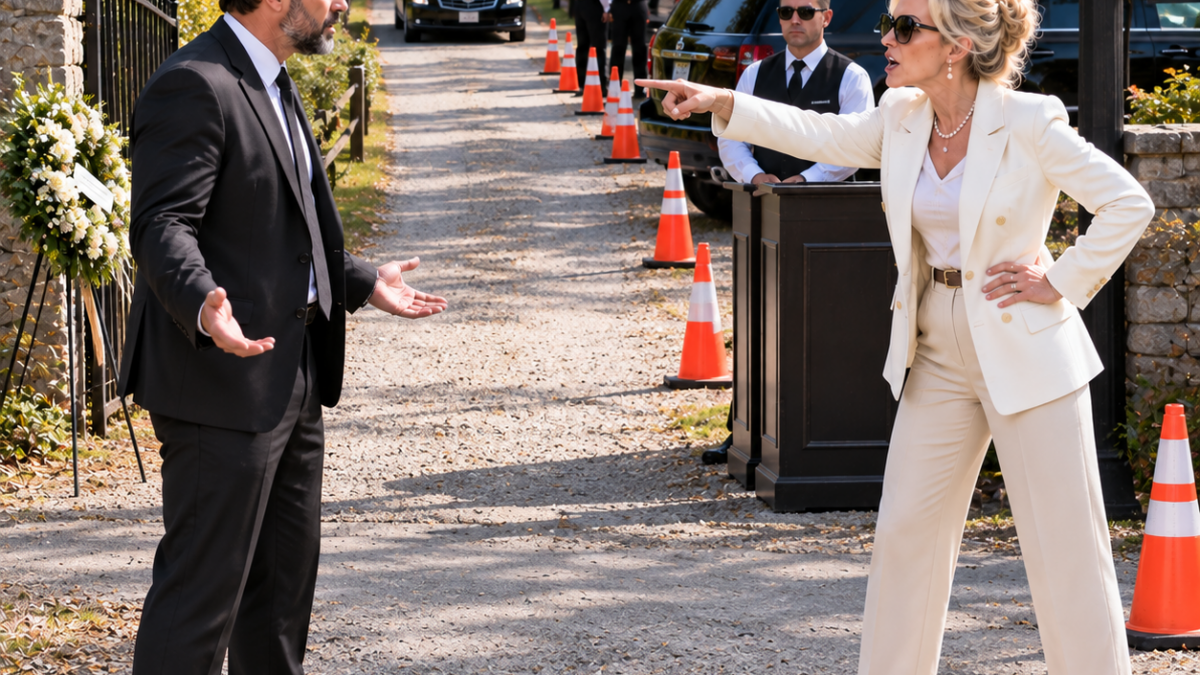
At 8:12 that morning, I found a valet podium, orange cones, black SUVs, and catering trucks gathering beside the one gravel lane the hearse would need to reach my parents’ graves
Laura Bennett called me back at 9:47.
I was standing in the hallway outside the chapel.
Through the partly open doors, I could see Dad’s casket at the front of the room.
Molly, my daughter, sat in the first row beside my sister Beth.
The minister was speaking quietly with one of Dad’s former coworkers.
“Emmett,” Laura said, “I found both versions.”
“You said the plan changed.”
“It did.”
“When?”
“The original traffic plan was approved Monday.”
“And the funeral home confirmation?”
“Tuesday morning.”
“The revision?”
She paused.
“Tuesday afternoon.”
I closed my eyes.
After they knew.
“Who approved the revision?”
“I’m checking.”
“That wasn’t my question.”
“I know.”
“Who approved it?”
“Dean signed the event operations packet.”
There it was.
No conspiracy.
No mystery.
No faceless committee.
Dean.
The same man who stood beside a valet podium that morning and told me everything would be fine because he had thirty minutes of buffer.
“What changed?”
Laura exhaled.
“The main arrival loop around Westhaven House couldn’t hold projected gala traffic.”
“So he moved some of it to the cemetery lane.”
“The shared section.”
“That’s the cemetery lane.”
“Legally, it’s a shared access segment.”
There was no edge in her voice.
She was correcting terminology because terminology mattered.
I respected that.
It also made me angrier.
“Fine.”
I lowered my voice.
“He moved gala holding into a shared access segment that you had already promised would remain available for my father’s funeral.”
“Yes.”
“Did anyone notify Sarah?”
“No.”
“Did anyone notify me?”
“No.”
“Did the revised plan include continuous cemetery access?”
Laura was quiet.
Then:
“It says cemetery access is to be cleared upon procession arrival.”
I leaned against the wall.
“Upon arrival.”
“Yes.”
“Not before.”
“No.”
“So Dean’s operation assumes my father’s hearse arrives first, then people move.”
“That appears to be the operational instruction.”
For a moment, neither of us spoke.
Then Laura said:
“I’m sorry.”
The sentence hit me strangely.
Maybe because she meant it.
Not the polished administrative apology people use when they want a conversation to end.
She sounded embarrassed.
“I approved the funeral access confirmation,” she continued.
“I believed the route would stay protected.”
“What are you going to do?”
“I’m calling Dean.”
“Good.”
“And the valet supervisor.”
“Good.”
“And I’ll monitor the entrance camera.”
“Good.”
She hesitated.
“Emmett, I can’t promise there won’t be vehicles near the area before one-fifteen.”
“I’m not asking that.”
“What are you asking?”
“For the promise already made.”
I looked toward Dad’s casket.
“One-fifteen means clear.”
“Yes.”
“No service vehicle in the turnout.”
“Yes.”
“No valet holding in the entrance.”
“Yes.”
“No incoming gala traffic crossing the procession route.”
“Yes.”
“And it stays open until the last funeral car goes through.”
“Yes.”
“Put that in writing too.”
A short pause.
Then:
“I will.”
She did.
At 9:54, the email arrived.
I photographed it.
Saved it.
Forwarded it to Sarah.
Then put my phone on silent.
Not because the problem was solved.
Because my father’s funeral was happening while I was spending his last morning negotiating traffic.
That realization embarrassed me more than Dean’s schedule did.
I went back inside.
Dad had always been good at being where he was.
That sounds simple.
It isn’t.
If he was repairing a carburetor, he repaired the carburetor.
If he was watching a baseball game, he watched it.
If somebody sat at his kitchen table, he put the paper down.
I had spent most of my life doing three things at once.
Phone in one hand.
Schedule in the other.
Mind already on the next problem.
Dad used to call it “living fifteen minutes ahead of yourself.”
I called it being responsible.
We were both right.
The family remembrance began.
Dad’s old friend Charlie Weller spoke first.
Charlie and Dad had worked together at Bellwether Freight for twenty-six years.
They hated each other for the first six.
Then became inseparable.
Charlie stood behind the lectern and stared at Dad’s photograph.
“Walter Renfrew was the only man I knew who could insult you while changing your tire and somehow make you grateful for both.”
People laughed.
I did too.
Charlie told a story about a winter breakdown in 1988.
Minus six degrees.
Truck dead on Route 11.
Dad drove forty miles with jumper cables, coffee, and a thermos of soup my mother had packed.
He spent three hours lying in snow under Charlie’s engine.
When the truck finally started, Charlie tried to thank him.
Dad said:
“You’d do the same.”
Charlie had replied:
“No, I wouldn’t.”
Dad apparently said:
“Then work on that.”
The room laughed again.
Molly leaned her head against my shoulder.
Her grandfather’s humor had survived him.
For a while, I forgot Westhaven.
Then my cousin Janet spoke about Dad teaching her to change a tire when she was sixteen.
He refused to touch the lug wrench.
She cried.
He sat on the curb.
She swore at him.
He told her swearing did not increase leverage.
She changed the tire.
Twenty years later, when she had a flat on an interstate with her infant daughter in the car, she remembered every step.
“That was Uncle Walter,” Janet said.
“He made helping you feel suspiciously like making you help yourself.”
That was Dad too.
Not sentimental.
Practical.
Sometimes annoying.
Always there.
That phrase hurt.
Always there.
Because I had not always been.
Nobody accused me of that.
Grief does not need help building indictments.
It knows where the records are stored.
A year before Dad died, he asked if I wanted breakfast.
Saturday.
Eight o’clock.
Waffle House.
I told him I had two drivers out.
Next weekend.
The next weekend I had inventory reconciliation.
Then Molly came home from college.
Then Dad had a doctor appointment.
Then it snowed.
The breakfast disappeared without anybody deciding to cancel it.
That was the danger.
Most regrets are not dramatic decisions.
They are small postponements that survive long enough to become permanent.
During a music break, my phone vibrated.
I ignored it.
Then again.
Molly noticed.
“Road?”
“Probably.”
“You checking?”
“No.”
She studied me.
“You’re improving.”
“Don’t tell anyone.”
She almost smiled.
The minister began Dad’s formal service at noon.
Lowman Funeral Home had handled Mom six years earlier.
Dad remembered Sarah Lowman because she did not call him “sir” after he asked her not to.
That was apparently enough to secure lifetime loyalty.
A month before his heart failed, Dad had called me from his kitchen.
“When it happens, use Sarah.”
“What happens?”
“When I die, Emmett.”
“Jesus, Dad.”
“I’m seventy-nine.”
“You’re seventy-eight.”
“See?”
He took a sip of coffee.
“I’m already forgetting things.”
I laughed despite myself.
“Use Sarah.”
“Fine.”
“And don’t let anybody turn it into a production.”
“What does that mean?”
“No slideshow with that damn song.”
“What song?”
“You know the song.”
I had no idea.
“Molly knows.”
Later I asked Molly.
She did.
Dad hated “Wind Beneath My Wings.”
No one knows why.
We did not play it.
The minister spoke about Mom.
That was when Dad’s death became hardest.
People had spent the morning talking about Walter Renfrew as a person.
Funny.
Stubborn.
Reliable.
But Mom’s name turned him into half of something.
Louise and Walter.
Forty-nine years.
Six years apart at the end.
Dad changed after she died.
Not dramatically.
He still worked in the garden.
Still met Charlie for breakfast.
Still complained about county taxes.
But silence accumulated around him.
He left Mom’s coffee mug in the cabinet.
Kept her side of the closet mostly untouched for a year.
Drove to Renfrew Cemetery every Sunday after church.
Not because he thought she could hear him.
At least that is what he told me.
“Then why go?”
I once asked.
“Same reason people visit anybody.”
“But she’s dead.”
He looked at me.
“You think I forgot?”
I felt ashamed immediately.
Dad softened.
“I go because I promised I wouldn’t stop showing up just because she couldn’t.”
That sentence came back to me while his casket sat six feet away.
Put me next to your mother.
That was the last promise he asked from me.
At 12:58, my phone vibrated.
I kept my hands folded.
At 1:03, again.
At 1:09, Sarah moved quietly down the aisle.
She leaned toward me.
“We’re on schedule.”
I nodded.
“Sheriff escort is waiting.”
“Good.”
Then she whispered:
“You stay here.”
I looked at her.
“Laura’s sending me road updates too.”
That surprised me.
“You asked her?”
“No.”
“She called.”
Sarah’s eyes held mine.
“You have enough to do.”
I could have argued.
Didn’t.
At 1:14, my phone buzzed again.
I knew the time without looking.
The wall clock above the chapel door moved to 1:15.
Dad’s service was ending.
The minister asked everyone to bow their heads.
I did.
Then the phone buzzed once more.
I slipped it from my jacket beside my leg.
Laura.
1:08 PM:
Moving service vehicles now. Entrance improving.
1:15 PM:
Not fully clear yet. Two valet holding vehicles remain near shared throat. Catering box truck partially occupies turnout. Dean estimates 5–10 minutes.
There was a photograph.
Timestamped.
Camera angle from Westhaven House.
Two dark SUVs.
Catering truck.
A valet cone line.
The lane was technically passable for an ordinary car.
Maybe even a pickup.
That was the problem.
People love “technically.”
Technically open.
Technically accessible.
Technically enough room.
Funeral processions do not run on technically.
A hearse is long.
The driver cannot make abrupt maneuvers.
Cars behind it need to remain together.
Nobody wants to back a hearse because somebody’s hors d’oeuvres truck needs six more minutes.
Molly glanced down.
“Not clear?”
“No.”
“What now?”
I stared at the picture.
Every instinct I had from three decades in freight told me to stand up.
Go.
Be there.
Supervise.
Control.
Make the bottleneck disappear.
That was how I had solved a thousand problems.
When a route was failing, you went to the dock.
When a trailer was late, you called the driver.
When a shift was short, you moved people.
When a funeral road was not clear, apparently you drove to it yourself.
Then I looked at Dad.
No.
For once, the urgent thing could wait outside.
“Laura has it documented.”
Molly touched my arm.
“Stay.”
“I am.”
The final prayer ended.
Music began.
Sarah’s staff moved toward the casket.
The room stood.
The moment Dad started leaving the chapel, every argument I had made all morning suddenly seemed very small.
Not wrong.
Small.
The funeral directors moved him carefully.
His casket passed the first row.
I put one hand on the polished wood as it went by.
Warm from the room.
That surprised me.
Outside, the hearse waited beneath the awning.
Bright afternoon sun reflected on black paint.
Family cars lined the curb.
At the far edge of the lot sat a Bellwether County Sheriff’s SUV.
Blue lights off.
Engine idling.
Dad would have hated the escort.
He complained about anything that made him look important.
When he received a retirement plaque, he used it as a coaster.
Molly stood beside me.
“Grandpa would say this is too much.”
“Yep.”
“He’d ask why the deputy isn’t out catching criminals.”
“Exactly.”
“And complain that flowers are a waste of money.”
“Your grandmother loved flowers.”
“He’d still complain.”
I smiled.
For ten seconds, Dad was not dead.
He was just predictable.
Then my phone rang.
Dean.
Sarah saw the name.
“If it’s the road, answer before we move.”
I stepped aside.
“Dean.”
“Emmett.”
His voice sounded compressed.
“We’re almost clear.”
I looked at my watch.
1:26.
“You promised one-fifteen.”
“I know.”
“Then you’re eleven minutes late.”
“We had a vendor unload go long.”
“That’s not my problem.”
“No.”
The quick answer surprised me.
“No, it isn’t.”
He continued.
“We’ve got Marcus breaking down valet holding now.”
“The catering truck?”
“Moving.”
“The SUVs?”
“One is clear.”
“One?”
“The second will be out in a minute.”
I looked at the hearse.
Staff were closing the rear door.
Dean said:
“I need ten more minutes.”
There it was.
Ten minutes.
Such a harmless number.
I had used it my entire adult life.
Give me ten.
I’ll call in ten.
I’ll be there in ten.
We’ll push ten.
Ten became twenty.
Saturday became next weekend.
Next weekend became never.
“The procession leaves now.”
Silence.
“Emmett, if you give me—”
“No.”
I did not raise my voice.
“The funeral home notified Westhaven.”
“I know.”
“Westhaven confirmed access.”
“I know.”
“You changed the traffic plan afterward.”
Another silence.
“Yes.”
“You told me one-fifteen.”
“Yes.”
“It’s one-twenty-six.”
“I know.”
“Then we’re done discussing time.”
Dean inhaled.
“If your procession reaches us before the truck clears, we’ll have vehicles backing onto the county road.”
“That’s why it was supposed to clear before we arrived.”
“I understand.”
I almost laughed.
“No.”
Then stopped myself.
Maybe he did understand now.
Maybe eleven minutes late was all it took.
“Finish clearing it.”
“We are.”
“The next time we speak, my father will be on that road.”
I ended the call.
Molly watched me.
“What’d he say?”
“Ten more minutes.”
She looked toward the hearse.
“We don’t have ten.”
“No.”
Sarah gave the signal.
The sheriff SUV pulled forward.
The hearse followed.
Molly and I entered the first family car.
Beth and her husband were behind us.
Then cousins.
Friends.
Dad’s old coworkers.
Almost thirty vehicles.
The sheriff escorted us from the funeral home.
Traffic stopped at the first intersection.
A white delivery van pulled to the curb.
At the second, an elderly man removed his cap.
At the third, two teenagers stopped walking and stood quietly beside their bicycles.
I had seen funeral processions a thousand times.
I had never understood how strange they looked from inside one.
The world keeps functioning around you.
People buy coffee.
Trucks unload.
Traffic lights change.
Somebody mows a lawn.
And in the middle of ordinary Wednesday life, thirty cars move slowly because one family’s world has stopped.
Dad had driven funeral processions for friends.
Probably stopped for strangers.
Now he was the reason people pulled aside.
Molly looked out her window.
“You okay?”
“No.”
“Me neither.”
That was enough.
My phone stayed face down.
When we turned onto County Road 14, the landscape opened.
Low fields.
Bare winter trees.
Small businesses.
A church.
Then the old oaks around Renfrew Cemetery Lane appeared in the distance.
A white event sign stood beside the road.
WESTHAVEN 25TH ANNIVERSARY GALA.
Arrow right.
Same right turn Dad needed.
The sheriff SUV slowed.
So did the hearse.
Then stopped.
Every vehicle behind it stopped.
My stomach dropped.
Through the windshield, I could see the entrance.
Valets.
Cones.
Two dark SUVs near the throat.
A catering box truck angled inside the turnout.
One gala vehicle approaching from the opposite side.
The white event tent beyond.
Guests gathering on the lawn.
Everything Dean had promised would be gone was still there in reduced form.
Reduced was not clear.
Molly whispered:
“Oh my God.”
I said nothing.
The driver door on the sheriff SUV opened.
Deputy Carl Hensley stepped out.
I knew him only by sight.
Mid-fifties.
Broad shoulders.
No hurry in the way he moved.
A second deputy exited the passenger side.
Hensley looked first at the hearse.
Then the lane.
Then incoming gala traffic.
He raised one hand.
A silver SUV approaching the entrance stopped.
Another car behind it stopped.
A valet hurried toward him.
Sarah stepped from the hearse.
She turned and motioned to me.
I got out.
The air was colder than it had felt at the funeral home.
Dean was already crossing the Westhaven lawn.
Radio to his mouth.
“Clear that black SUV now.”
He saw us.
Increased pace.
Deputy Hensley spoke to the valet first.
“This procession is using the cemetery road?”
“Yes, sir.”
“Then nobody else enters until they’re through.”
“We’re clearing.”
“I can see.”
He did not sound angry.
He sounded final.
That distinction matters.
Dean arrived.
“Deputy, we have active event traffic and a shared access agreement.”
Hensley looked at the hearse.
Then at Dean.
“I’m not deciding your property agreement.”
“Of course.”
“I’m controlling traffic on the county road so this funeral can make the turn safely.”
“Yes.”
Dean started to explain the event routing.
The deputy cut him off without aggression.
“You can explain after the hearse is in.”
He pointed toward the box truck.
“Move that.”
Dean spoke into his radio.
“Service truck out.”
The driver began pulling forward.
Then had to stop because one of the valet SUVs was still angled near the curve.
Marcus, the valet supervisor I had spoken to earlier, sprinted toward it.
He knocked on the window.
The SUV moved.
A gala guest tried to enter from the clubhouse branch.
Marcus waved both arms.
“Back up.”
The driver looked confused.
Marcus pointed.
The car reversed.
Another valet removed cones.
The second deputy walked fifty yards down the county road and stopped arriving gala vehicles before they reached the entrance.
Within two minutes, Dean’s carefully planned traffic operation became manual improvisation.
The truck cleared.
One SUV moved.
Then the second.
Marcus dragged the valet podium backward.
Hensley walked the throat.
Looked at the inside turn.
Checked clearance.
Returned to his unit.
“Funeral goes first.”
Four words.
No speech.
No legal ruling.
No dramatic confrontation.
Just traffic control.
Sarah touched my sleeve.
“Go.”
I returned to the car.
The sheriff SUV moved.
The hearse followed.
Its front wheels crossed onto Renfrew Cemetery Lane.
Nothing stood in Dad’s way now.
We followed.
As we passed the Westhaven lawn, gala guests had stopped talking.
Some stared.
Most did not know what had happened.
To them, we were simply a funeral interrupting arrivals.
Maybe that was healthier.
Not every stranger needed a villain.
Valet staff held traffic.
The gala waited.
The white tent stayed exactly where it was.
The caterer would survive.
The speeches would start late.
Dad would not.
Past the turnout, the lane narrowed.
Old oak branches reached overhead.
Gravel replaced radio chatter.
The cemetery gate appeared.
Rusted iron.
RENFREW.
Letters my grandfather welded before I was born.
The hearse entered.
Then our car.
Then Beth.
Then the rest.
The sheriff remained near the road until the procession cleared the shared section.
After that, Westhaven could have its entrance back.
Dad had reached Mom.
That was all I cared about.
Renfrew Family Cemetery was small.
Twenty-three graves.
Mostly relatives.
Some from the nineteenth century.
A few stones worn almost unreadable.
My parents’ plots sat beneath two white oaks near the west edge.
Mom’s headstone was simple.
LOUISE ANN RENFREW.
1947–2019.
BELOVED WIFE, MOTHER, GRANDMOTHER.
Beside it, fresh earth waited.
Sarah’s staff carried Dad from the hearse.
I followed.
The minister spoke for maybe eight minutes.
I remember almost none of it.
Wind in leaves.
Molly’s hand inside mine.
Beth crying quietly.
The sound of the lowering device.
Then Dad descending.
That image stays.
Not frightening.
Final.
The casket lowered until I could no longer see the lid.
For thirty years, I had solved delays.
Moved schedules.
Rerouted trucks.
Added labor.
Extended shifts.
Called maintenance.
Called drivers.
Called supervisors.
There was always an action.
At Dad’s grave, there was nothing to do.
Maybe that was why it hurt so much.
No solution.
No reschedule.
No next load.
Just absence.
After the minister finished, people began leaving flowers.
Charlie put one hand on my shoulder.
“Your dad loved you.”
I nodded.
It felt easier than answering.
He squeezed once.
Then walked away.
Molly stayed.
Beth stayed for a while, then followed her husband back toward the cars.
Eventually, only Molly and I remained.
She looked at Mom’s stone.
“They’re together.”
“Yeah.”
“Grandpa got what he wanted.”
“Yeah.”
She wiped her face.
“Then why do you look angry?”
“I don’t know.”
“Yes, you do.”
Kids become adults and suddenly start using your own voice against you.
I looked toward the road.
“You thinking about Westhaven?”
“A little.”
“Don’t.”
“I know.”
“Today?”
“I know.”
She put her arm through mine.
“Grandpa would hate that you spent his graveside thinking about a traffic plan.”
“He would.”
“He’d call Dean an idiot.”
“Probably.”
“Then tell you you were an idiot for still thinking about Dean.”
Definitely.
That made me laugh.
We stayed another ten minutes.
Then walked back.
My phone had three messages.
One from Laura.
One from Dean.
One from Sarah, sent while we were inside the cemetery.
I opened Laura’s first.
2:08 PM:
Procession fully entered cemetery. Shared entrance remains held. All Westhaven vehicle arrivals rerouted to overflow until funeral vehicles exit.
Then:
Please preserve the emails and traffic-plan copies in your possession. Westhaven board counsel is reviewing today’s incident.
Dean’s message was shorter.
I owe you an apology. Not today. When you are ready.
I did not answer either one.
Paperwork could wait.
We drove home.
People brought food.
Funerals produce casseroles with military efficiency.
By six, my refrigerator contained three lasagnas, two trays of baked ziti, ham, fried chicken, potato salad, pies, cookies, and something in a covered dish nobody could identify.
Dad would have enjoyed that part.
At seven-thirty, only immediate family remained.
Beth sat at the kitchen table.
Molly had kicked off her shoes.
My younger brother Paul was washing plates despite everybody telling him to stop.
We talked about Dad.
Not Westhaven.
That mattered.
Paul remembered the time Dad tried to repair the clothes dryer and knocked out power to half the house.
Beth remembered Mom banning him from electrical work afterward.
Molly remembered Grandpa teaching her to drive in the cemetery lane.
I did not know that.
“He did?”
“Yeah.”
“When?”
“I was fifteen.”
“Your mother knew?”
“No.”
“Of course not.”
“He said if I could keep the truck between the ditches on that road, I could drive anywhere.”
“What truck?”
“His F-150.”
“At fifteen?”
“Grandpa had flexible views on licensing.”
That was Dad.
We laughed.
At some point, Paul raised his glass.
“To Dad.”
Everyone followed.
No elaborate toast.
Dad would have approved.
The next morning, I woke before six.
For a second, I forgot.
Then remembered.
Grief is cruelest before you fully wake.
I made coffee.
Sat at the kitchen table.
Opened my phone.
Thirty-seven emails.
Most work.
Some condolences.
Three Westhaven.
Laura had sent both traffic plans, revision histories, camera stills, and an incident timeline.
She did not have to send that much.
I respected her for it.
The original plan was exactly as I remembered.
The shared cemetery route remained open.
Vendor staging stayed inside Westhaven property.
Valet holding stayed near overflow.
A note in bold:
DO NOT OCCUPY RENFREW CEMETERY ACCESS DURING SCHEDULED INTERMENT.
The revised plan moved two valet holding points and catering staging toward the shared throat.
A change log included:
Operational adjustment due to projected arrival congestion at main gala loop.
Approved: D. Prescott.
There was another line.
Cemetery route to be cleared/repositioned at procession arrival.
That was the whole failure in one sentence.
At procession arrival.
Not before.
Dean believed he could use the road until the moment we needed it.
Then move.
Efficient.
Reasonable if every person and vehicle behaved exactly as planned.
They did not.
Systems fail at margins.
Dad used to say that about people.
I had spent thirty years learning it about freight.
Someone arrived late.
Someone parked wrong.
A catering truck took longer.
A valet misunderstood.
Eleven minutes disappeared.
Then a hearse stopped on a county road.
I read Laura’s incident summary.
1:08 PM — vehicle clearing initiated.
1:15 PM — incomplete.
1:26 PM — Dean requests additional ten minutes from family representative.
1:38 PM — funeral procession reaches approach.
1:39 PM — sheriff suspends incoming gala traffic.
1:42 PM — shared entrance cleared.
1:44 PM — procession enters cemetery lane.
Six minutes.
That was how long the sheriff needed.
Not because deputies possessed magical logistics skills.
Because they changed priority.
Before the sheriff arrived, gala traffic and cemetery access were being balanced.
Once Hensley stepped out, there was no balance.
Funeral first.
Everything else waits.
The road cleared.
I poured another coffee.
Then opened Dean’s email.
Emmett,
I am not writing to defend yesterday.
The revised plan was my decision.
I believed I could preserve the funeral access requirement while using the shared lane for staged event traffic outside the procession window.
That assumption was wrong.
More importantly, I should not have interpreted “access will remain available” to mean “we can clear access when needed.”
I understood the difference intellectually yesterday morning and ignored it operationally.
Your father’s procession should never have stopped.
I’m sorry.
I have asked the board to review the event and access procedures without waiting for your complaint.
When you are ready, I would like to apologize to you in person.
Dean
I read it twice.
Then forwarded it to Sarah.
She replied fifteen minutes later.
That is more accountability than I expected.
So did I.
At nine, Laura called.
“Bad time?”
“No.”
“I wanted to tell you what happens next.”
“Okay.”
“The board chair called an emergency session for Monday.”
“About Dean?”
“About procedures.”
That answer was careful.
“Is he staying vice president?”
“At least until the board meets.”
“I’m not asking for him removed.”
“I know.”
“And I’m not asking for money.”
“I know.”
“I’m not even sure what I’m asking.”
Laura was quiet.
Then:
“Maybe you don’t need to ask for anything.”
That landed.
“We failed to keep a documented access commitment.”
She continued.
“We should fix why.”
Simple.
I liked her more every time we spoke.
“What did your title review show?”
“That Renfrew cemetery access predates Westhaven’s development rights.”
“Meaning?”
“Your family cemetery has recorded vehicle access over the full cemetery route.”
“And Westhaven?”
“Non-exclusive access over the shared lower segment to reach Westhaven House.”
“Subject to earlier rights.”
“Yes.”
“So neither side owns exclusive use of the shared segment.”
“Correct.”
“But Westhaven can’t practically use it in a way that defeats cemetery access.”
“That’s counsel’s view.”
I nodded to myself.
“Good.”
“What do you want us to preserve?”
“All traffic plans.”
“We have them.”
“Revision history.”
“Preserved.”
“Valet instructions.”
“Preserved.”
“Camera footage.”
“Preserved.”
“Emails with the funeral home.”
“Preserved.”
“Dean’s text to me.”
“Send it.”
I did.
Then Laura said:
“Emmett?”
“Yeah?”
“Yesterday wasn’t malicious.”
I waited.
“I know that doesn’t make it acceptable.”
“No.”
“But Dean wasn’t trying to block your father.”
“I know.”
That mattered.
Because anger likes to simplify.
Gala versus funeral.
Rich HOA versus grieving family.
Heartless board.
Sheriff hero.
Real life was messier.
Dean did not wake up planning to disrespect Dad.
He had a congestion problem.
He had too many gala vehicles.
He saw a shared lane.
He knew the funeral had a fixed arrival window.
He built a plan around moving cars just in time.
Then just in time failed.
That did not make him evil.
It made him wrong.
And wrong can cause plenty of damage without hatred helping.
“I know he wasn’t trying to,” I said.
Laura exhaled.
“Thank you.”
“That doesn’t mean I’m okay with it.”
“I didn’t think it did.”
Monday’s Westhaven board meeting was closed for the operational review.
Tuesday, Laura sent me the written corrective action.
Future events would require a cemetery conflict check before final traffic plans.
Any scheduled interment automatically created a protected access window beginning sixty minutes before expected arrival and ending thirty minutes after expected departure.
During that window:
No valet holding in the shared throat.
No service staging in the turnout.
No event queue entering from the county road if doing so reduced continuous cemetery access.
A traffic marshal assigned solely to cemetery priority.
All revisions after an interment confirmation required community-manager approval and written notice to the funeral home.
If conflicting event needs could not be resolved, Westhaven traffic—not cemetery traffic—would be rerouted.
That last line mattered.
Priority written plainly.
No balancing.
No interpretation.
Cemetery first.
Wednesday, Dean came to my house.
He called before.
That alone told me he understood the tone required.
I met him on the porch.
No blazer.
Khaki pants.
Blue sweater.
He looked older than he had on gala morning.
“Thank you for seeing me.”
I nodded toward a chair.
We sat.
For a moment, neither spoke.
Then Dean said:
“I am sorry.”
No explanation.
No “if.”
No “but.”
I let him continue.
“I promised you one-fifteen.”
“Yes.”
“I missed it.”
“Yes.”
“I changed a plan after the funeral access had already been confirmed.”
“Yes.”
“I thought a movable obstruction was the same as no obstruction.”
I looked at him.
“That’s exactly what I thought you believed.”
He nodded.
“I’ve run events for thirty-four years.”
“I know.”
“I’ve moved presidents.”
“Of companies?”
“And one actual president.”
That surprised me.
“Really?”
“Hotel conference.”
“Did you make him wait for valet?”
Dean almost smiled.
“No.”
“Then you knew priority systems.”
“Yes.”
That was the important part.
“Why did you treat the funeral differently?”
He stared at his hands.
“Because I knew the time.”
I waited.
“The gala arrivals were fluid.”
He continued.
“Catering was fluid.”
“Donor group arrival was fluid.”
“Accessible drop-off was fluid.”
“Your procession was fixed.”
“So I used the fixed thing as an anchor.”
I understood.
“You scheduled everything else around the assumption that Dad would not arrive early.”
“Yes.”
“And that you could clear before he did.”
“Yes.”
“What if we had?”
“Arrived early?”
“Yes.”
Dean looked uncomfortable.
“We would have had a problem.”
“You already did.”
“I know.”
We sat quietly.
Then he said:
“My father’s funeral was twelve years ago.”
I had not expected that.
“He died in Richmond.”
“Buried where?”
“Arlington Memorial Park.”
“Big procession?”
“No.”
He smiled faintly.
“Dad would’ve hated one.”
“Mine too.”
“We were thirty minutes late leaving the church.”
“Why?”
“Flowers.”
I raised an eyebrow.
“The wrong arrangement got delivered.”
“You delayed a funeral over flowers?”
“My mother did.”
“Fair.”
Dean nodded.
“Cemetery waited.”
He looked toward my yard.
“I think that experience taught me the wrong lesson.”
“What lesson?”
“That funerals run late.”
I sat back.
There it was.
A personal assumption hidden inside an operational plan.
“How many funerals have you planned?”
“None professionally.”
“How many galas?”
“Hundreds.”
“So you built the thing you knew around the thing you assumed.”
“Yes.”
I appreciated that sentence.
Dean turned toward me.
“I’m resigning as event committee chair.”
“You don’t have to do that for me.”
“I’m not.”
“What about vice president?”
“Staying until the term ends.”
I nodded.
“That’s probably fair.”
He smiled tiredly.
“I expected you to want me gone.”
“Why?”
“Most people would.”
“Maybe.”
I thought about Dad.
“He didn’t like punishment for its own sake.”
Dean nodded.
“What did he like?”
“Things fixed.”
The HOA fixed the process.
That was enough for me.
A week later, Sarah asked whether I would meet with Westhaven counsel and the cemetery association representative.
There was no formal association, really.
Renfrew Cemetery was family property held through a small trust Dad had maintained.
Beth and I were cotrustees now.
We met in a conference room at Westhaven House.
First time I had been inside.
Polished hardwood.
Stone fireplace.
Photographs of anniversary galas.
Awards.
Architectural renderings.
The room where Dad’s funeral had become a traffic variable.
Westhaven’s attorney, Cynthia Graves, opened a folder.
“I want to clarify what this meeting is not.”
Always comforting when a lawyer starts that way.
“It is not an attempt to weaken cemetery rights.”
“Good.”
“It is not a request for exclusive access.”
“Good.”
“And it is not a proposal to relocate Renfrew Cemetery Lane.”
“Very good.”
She smiled.
“We want the access documentation modernized.”
That made sense.
The oldest cemetery reservation dated back decades.
Westhaven’s development agreement came later.
Both were valid.
Neither was written for modern event traffic.
“What do you propose?”
“A recorded access memorandum.”
She slid a draft across.
Not replacing old rights.
Clarifying them.
The cemetery route remained continuously available for ordinary access.
Scheduled funerals received priority.
Westhaven events could use the shared lower segment so long as that use did not materially obstruct cemetery access.
For confirmed interments, a protected window applied.
Emergency cemetery access at all times.
No fixed gates or barriers without dual approval.
Any traffic controls had to be removable immediately.
I read it twice.
“What does materially obstruct mean?”
Cynthia nodded.
“Good question.”
Dean, sitting beside Laura, almost smiled.
I pointed.
“Don’t laugh.”
“I’m not.”
“You are.”
Cynthia suggested measurable widths.
Clear zones.
Vehicle turning area.
No reliance on staff moving parked vehicles to create access after a procession arrived.
That last clause was mine.
She inserted it.
We reviewed for nearly two hours.
At the end, I said:
“Dad would hate how long this is.”
Laura laughed.
“How long was the original?”
“Two pages.”
“This is nine.”
“He’d call that progress in the wrong direction.”
Cynthia closed the folder.
“But would he sign it?”
I thought.
“Yes.”
Then we did.
Not that day.
After my lawyer reviewed it.
Dad raised me better than that.
The new memorandum was recorded the following month.
For the first time, everyone knew exactly what the shared road meant.
No handshake.
No assumptions.
No hidden revision.
Paper.
Dad liked paper.
Spring came.
The temporary marker at his grave was replaced.
Simple gray stone.
WALTER JAMES RENFREW.
1945–2024.
BELOVED HUSBAND, FATHER, GRANDFATHER.
Beside Mom.
Exactly where he asked.
I drove out alone the day the marker went in.
No gala.
No cones.
No sheriff.
Just gravel.
The lane looked absurdly ordinary.
That was perhaps the strangest part.
A road can become the center of your entire emotional world for one afternoon.
Then go back to being gravel.
I parked beneath the oaks.
Walked to their graves.
Mom’s stone had darkened slightly with age.
Dad’s looked too new.
The difference bothered me.
Time would fix it.
I sat on the grass.
Talked to them.
Not because I believed they were listening.
I finally understood Dad.
Sometimes talking is how the living stay connected.
“I got you here,” I said.
Wind moved through leaves.
“Almost made a mess of it.”
Nothing.
“Dean turned out not to be a complete idiot.”
Still nothing.
“You would hate that I spent a month working on a road agreement.”
I could practically hear Dad.
Should’ve done it before the problem.
Probably.
I stayed until my knees complained.
On the drive home, Molly called.
“Breakfast Sunday?”
The same bad diner Dad loved.
The call came at exactly the wrong time.
I had a maintenance issue scheduled at the distribution yard Monday.
One trailer needed brake work.
Two drivers wanted route changes.
The lawn at home looked neglected.
Laundry.
Groceries.
Ordinary life.
I almost said:
Next weekend.
The words formed automatically.
Then I looked in the rearview mirror.
Renfrew Cemetery Lane disappearing behind me.
“Sunday works.”
Molly went quiet.
“Really?”
“Don’t sound so shocked.”
“You’ve canceled three times this year.”
“That’s inaccurate.”
“It is literally three.”
“Two and a reschedule.”
“That’s canceling with management vocabulary.”
I laughed.
“Eight-thirty?”
“You hate mornings.”
“I’m awake.”
“You’re not pleasant.”
“I’ll bring money.”
“That helps.”
We went.
Coffee was terrible.
Dad had been wrong.
Pancakes excellent.
Molly told me about work.
Her apartment.
A man she might be dating but refused to describe as dating.
I did not look at my phone for an hour.
That took effort.
Worth it.
After breakfast, she said:
“Grandpa would be proud.”
“Of what?”
“You didn’t check your email once.”
“He’d say that’s the minimum standard.”
“Exactly.”
Dad’s death changed my relationship with time.
Not in the dramatic way people describe after tragedy.
I did not quit my job.
Sell everything.
Travel the world.
Become a man who watches sunsets for spiritual meaning.
I still ran freight.
Still liked schedules.
Still got irritated when drivers missed appointment windows.
But I stopped pretending every urgent thing was equally important.
I started asking a question.
Will this still matter if I move it?
Sometimes yes.
Sometimes no.
A delayed truck can create real costs.
A safety issue cannot wait.
A driver calling about a breakdown needs an answer.
But some meetings can move.
Some emails can wait.
Some grass can grow another day.
Some people cannot be postponed forever.
That lesson showed up unexpectedly at work.
One of my dispatch supervisors, Carlos, came into my office around five-thirty one evening.
His phone kept lighting up.
“You need that?”
“No.”
It buzzed again.
“Who is it?”
“My daughter.”
“Answer.”
“She wants help with algebra.”
“Answer.”
“I’m on shift.”
“You’ve been here since six.”
He hesitated.
I pointed toward the door.
“Go home.”
“We’ve got the Atlanta outbound.”
“I know.”
“Two late pallets.”
“I know.”
“You sure?”
I almost said:
We have time.
Then smiled.
“Yes.”
He left.
Atlanta survived.
That became a private joke with Molly.
Whenever I caught myself treating some minor task like national infrastructure, she said:
“Will Atlanta survive?”
Usually, yes.
Westhaven’s gala returned the next year.
Laura called me two months beforehand.
“You’re going to enjoy this.”
“I doubt it.”
“We moved the event.”
“Where?”
“Hotel ballroom.”
I laughed.
“Why?”
“Parking.”
“Imagine.”
“Dean suggested it.”
That surprised me.
“He did?”
“Yes.”
“Good.”
Then Laura added:
“He specifically said, and I quote, ‘I have no desire to appear in Emmett Renfrew’s memoir.’”
“Smart man.”
Westhaven held smaller events at the clubhouse after that.
Each operations packet included cemetery access review.
Laura once sent me a screenshot.
Top of page:
RENFREW CEMETERY ACCESS — DO NOT STAGE.
I sent back a thumbs-up.
Dad would have hated emojis too.
Dean and I developed a strange relationship.
Not friendship exactly.
Mutual respect earned late.
Once, a storm dropped an oak limb across the lower lane.
Westhaven’s maintenance crew reached it before I did.
Dean called.
“Tree is down.”
“Cemetery side?”
“Shared throat.”
“Can people get through?”
“No.”
“I’m ten minutes away.”
“We’re already cutting.”
I arrived to find Dean in work gloves dragging branches.
No blazer.
No schedule.
No valet.
He saw me.
“Before you ask, yes, I got permission from Laura.”
I laughed.
“Learning.”
“Painfully.”
We cleared the road in forty minutes.
Afterward, we sat on the back of my truck.
Dean drank water.
“Your father ever get mad about Westhaven using this?”
“Sometimes traffic.”
“Not the right itself?”
“No.”
“Why?”
“Because access was part of the development deal.”
“He didn’t mind sharing?”
“Dad minded plenty.”
I smiled.
“He just understood ownership and use aren’t always the same thing.”
Dean nodded.
“That’s probably what I failed to understand.”
“How?”
“I thought because Westhaven had a use right, I had scheduling control.”
“Yeah.”
He stared toward the road.
“Same road.”
“Different purposes.”
“Exactly.”
He looked at me.
“You really spent thirty years in freight?”
“Thirty-two now.”
“No wonder you drove me insane that day.”
“You deserved it.”
“I did.”
That was all.
The sheriff’s role in the story also grew larger every time neighbors retold it.
People eventually claimed Sheriff Tom Bell himself arrived and ordered the gala shut down.
He did not.
Deputy Hensley was escorting the funeral.
He stopped incoming traffic because a hearse and thirty cars needed to make a safe turn.
The gala was not shut down.
Nobody was arrested.
No tow trucks hauled away luxury cars.
No deputy threatened Dean.
Reality was quieter.
And better.
Because real authority did not need theater.
Hensley saw a problem.
Set a priority.
Cleared a road.
Then left.
Months later, I saw him at a gas station.
“Deputy.”
“Mr. Renfrew.”
“You remember my dad’s funeral?”
He laughed.
“Hard to forget.”
“I never thanked you.”
“For what?”
“Getting us through.”
He waved it away.
“Funeral had right of passage in the moment.”
“Legally?”
“I’m not giving you a legal opinion.”
I smiled.
“Smart.”
He pumped gas.
Then added:
“My grandmother’s funeral got stuck behind a parade when I was a kid.”
“No kidding.”
“Band blocked the intersection.”
“What happened?”
“State trooper stopped the parade.”
“You became a deputy because of that?”
“No.”
He laughed.
“But Grandma would appreciate the symmetry.”
We shook hands.
That was it.
No hero speech.
People doing their jobs rarely know when somebody remembers them forever.
I remember him.
I remember Laura.
I remember Sarah.
I even remember Dean differently now.
But most of all, I remember Dad.
His hand around a coffee mug.
His work jacket hanging from a kitchen chair.
The way he read newspapers from back to front.
The little grunt he made when standing because his knees hurt but he refused to admit it.
His habit of keeping screws in old prescription bottles.
His hatred of decorative pillows.
His obsession with checking tire pressure.
How he pronounced “coupon” like “queue-pon.”
The things grief saves are rarely the things you expect.
One Sunday, Molly and I brought breakfast to the cemetery.
Her idea.
Two Styrofoam boxes from Dad’s diner.
We sat on folding chairs beside Mom and Dad.
“This is weird,” I said.
“You’re eating pancakes in a graveyard.”
“It was your idea.”
“You agreed.”
“Under emotional pressure.”
She opened syrup.
“Grandpa would approve.”
“He’d say these need butter.”
“I brought butter.”
Of course she had.
We ate.
Cars occasionally passed down the lane.
Nobody bothered us.
At one point, a Westhaven resident slowed.
Older woman.
She rolled down her window.
“Everything okay?”
“Fine.”
She looked at our food.
“Breakfast?”
“Family tradition.”
She smiled.
“Have a nice morning.”
Then drove on.
Ordinary use.
That was what Dad wanted.
Not a private fortress.
Not conflict.
Access.
A road that did its job.
At the cemetery trust meeting that year—which sounds more formal than two siblings at my kitchen table—Beth asked if we should replace the rusted iron gate.
“It looks rough.”
I stared at her.
“You sound like Westhaven.”
She threw a napkin at me.
“I said replace the gate, not block the funeral.”
“It has character.”
“It has tetanus.”
She was right.
We restored it instead.
New hinges.
Rust treatment.
Fresh black paint.
Kept Grandpa’s welded RENFREW letters.
When Dean drove past later, he stopped.
“Looks good.”
“Careful.”
“What?”
“You’re commenting on cemetery aesthetics.”
He raised both hands.
“Never again.”
The joke worked because enough time had passed.
That is another strange thing about pain.
Some details become stories.
Some become jokes.
Some never soften.
Dad’s missed call stayed hard.
For months, I kept returning to that Tuesday evening.
My phone lighting up.
WALTER.
Trailer at wrong dock.
Three people waiting.
I silenced the call.
Not rejected.
Silenced.
I told myself I would call later.
Dad called again two days after.
Nothing important happened.
We talked.
That should have reduced my guilt.
It didn’t.
Because I kept thinking:
What if that first call mattered?
Molly finally got tired of hearing me mention it.
“Dad.”
“What?”
“Grandpa called you thousands of times.”
“I know.”
“You answered thousands.”
“I know.”
“He missed your calls too.”
“That’s different.”
“Why?”
“Because I’m the one alive to regret it.”
She stared at me.
“That doesn’t make it different.”
I had no answer.
She continued.
“You think Grandpa spent his last year keeping score?”
“No.”
“Then stop doing it for him.”
Kids.
Again.
Dangerous.
I tried.
Not perfectly.
Grief is not corrected by logic.
But it helped.
The cemetery-road dispute eventually became a paragraph in Westhaven’s board handbook.
I know because Laura sent it to me.
“Case Example: Competing Use of Shared Access.”
No names.
No blame.
Facts.
A later event plan had been changed after a funeral access confirmation.
Revised staging interfered with the protected route.
Operational assumptions failed.
The procession experienced delay.
Corrective controls were established.
That was Dad’s funeral transformed into institutional memory.
Strangely, I liked that.
Not because I wanted him remembered as a case example.
Because somebody else might avoid the same mistake.
Systems improve when embarrassment becomes procedure.
At work, we did the same thing.
Every serious freight failure produced a postmortem.
What happened?
Why?
What assumption failed?
What changes?
Not:
Who can we humiliate?
That distinction became clearer after Dad.
People love punishment because it feels like closure.
Procedure is less satisfying.
Procedure prevents repetition.
I began seeing Dean’s mistake that way.
He should not have changed the plan.
He should have respected the earlier access.
He should have cleared sooner.
But once he admitted that, what mattered?
Fire him?
Shame him?
Make his name synonymous with Dad’s funeral?
Or write a process that stopped the next Dean from making the same choice?
Dad spent his career fixing freight systems.
He would have chosen the procedure.
Probably while calling Dean a knucklehead.
Both could be true.
The second anniversary of Dad’s death fell on a Saturday.
Molly drove in Friday night.
Beth came Sunday.
Saturday morning, Molly woke me at seven-thirty.
“Get dressed.”
“Why?”
“Breakfast.”
“It’s Saturday.”
“Yes.”
“We usually do Sunday.”
“I know.”
“Then why?”
“Because two years ago today Grandpa died.”
I looked at her.
She shrugged.
“I thought we should go.”
We went to the diner.
Same booth.
Same terrible coffee.
Then to the cemetery.
Rain had fallen overnight.
Renfrew Cemetery Lane was dark and damp.
Gravel shining.
Oaks dripping.
When we reached the shared turnout, a small Westhaven maintenance truck was parked entirely off the lane.
Two workers were trimming branches.
Cones stayed inside their work zone.
Continuous access clear.
I noticed.
Of course I noticed.
One worker waved.
We passed.
Molly smiled.
“What?”
“You’re checking.”
“I’m observing.”
“You’re checking road width.”
“I can’t turn it off.”
“Grandpa would laugh at you.”
“He would.”
We reached the cemetery.
Dad’s stone had weathered enough now to match Mom’s better.
We placed flowers.
Molly talked about a promotion.
I told Dad about Atlanta surviving.
We stayed maybe forty minutes.
On the way out, I looked in the mirror.
Nothing blocked the lane.
No drama.
No story.
Perfect.
That is the ending I prefer.
Not deputies.
Not gala guests waiting.
Not Dean’s missed deadline.
An ordinary road doing what it is supposed to do because people finally learned that shared use only works when everybody respects what the road is for.
The gala taught me something else too.
Important things do not become less important because they are quiet.
A cemetery lane looks like gravel.
Nothing glamorous.
Westhaven House had tents.
Lights.
Valets.
Sponsors.
Printed schedules.
Guests.
A quarter-century celebration.
Dad’s burial had a hearse and grieving people moving slowly toward an old iron gate.
On paper, the gala looked bigger.
More complicated.
More economically valuable.
More people working.
More moving parts.
But priority is not determined by spectacle.
That is where Dean went wrong.
He saw two scheduled uses and treated them like logistics.
Which could flex?
Which had timing?
Which could share?
He forgot purpose.
A gala can start late.
A vendor can wait.
A valet queue can move.
A dead man’s final journey to the grave should not depend on somebody clearing SUVs after the hearse arrives.
That is not sentimentality.
It is recognizing that some moments cannot be repeated.
Dad taught me that too late.
Or maybe just in time.
I stopped saying next weekend as often.
Not never.
I am still human.
Still busy.
Still capable of convincing myself a spreadsheet matters more than breakfast.
But now I hear his voice.
There’s always another truck, Emmett.
He never actually said that.
I imagine he would have.
There is always another shipment.
Another meeting.
Another lawn to cut.
Another email.
Another gala.
There is not always another breakfast with your father.
Another call from your daughter.
Another afternoon your sister asks you to come over.
Another chance to say yes before life turns it into no.
That became Dad’s last lesson.
Not the road.
Not the sheriff.
Not the HOA.
Time.
The one thing I spent my career believing could be rescheduled.
Three years after his funeral, I retired.
Not because of grief alone.
I had thirty-three years in.
My knees hurt.
Freight had become more software than people.
And Molly was expecting her first child.
When she told me, she held up an ultrasound picture over breakfast.
I stared.
“You okay?”
“No.”
She laughed.
“You say that a lot.”
“It’s accurate.”
“You’re going to be Grandpa Emmett.”
“God help the child.”
“She’ll be fine.”
“She?”
Molly smiled.
“It’s a girl.”
That afternoon, I drove to Renfrew Cemetery.
Told Mom and Dad.
Felt ridiculous.
Did it anyway.
“Your great-granddaughter is coming.”
Wind moved through the oaks.
“You two better behave.”
I stood there smiling like an idiot.
Then a car rolled slowly up the lane.
Dean.
Older.
More gray.
He parked near the Westhaven branch and got out.
“Emmett.”
“Dean.”
“What brings you out?”
“News.”
He nodded toward the graves.
“Good news?”
“Granddaughter.”
His face brightened.
“Congratulations.”
“Thanks.”
He hesitated.
“Mind if I say hello to Walter?”
That surprised me.
“You never met him.”
“No.”
“Then what are you saying hello to?”
Dean smiled.
“Fair.”
He stayed near the gate.
Then said:
“I think about that day sometimes.”
“So do I.”
“I still hate that the hearse stopped.”
“I know.”
“I can’t fix it.”
“No.”
“I used to think apologies were supposed to fix things.”
“They’re not.”
“What are they for?”
I looked at Dad’s stone.
“Maybe they tell the truth about what happened.”
Dean nodded.
“That sounds like Walter.”
I laughed.
“You still never met him.”
“I’ve heard enough.”
He left.
I stayed.
The road was empty again.
Always ordinary after the important moments pass.
I thought about the sheriff clearing it.
For years, people who heard the story focused on that.
“The sheriff made the HOA move.”
Technically, yes.
But that was not the part that stayed with me.
The deputy solved six minutes.
Dad had spent seventy-nine years teaching the rest.
Keep your word.
Show up.
Do not borrow time from people you love forever.
Do not assume something can wait just because it usually does.
And when you promise somebody a clear road, clear the damn road before they arrive.
Simple lessons.
Hard lives.
I bent down.
Brushed leaves from Dad’s marker.
“Breakfast Sunday?”
I said.
Then laughed at myself.
“Yeah, yeah.”
“I know.”
I stood.
Walked back toward the truck.
My phone rang before I reached it.
Molly.
I answered on the first ring.
“Hey.”
“Busy?”
I looked at the lane.
“No.”
Not this time.
“What do you need?”
“Nothing.”
She paused.
“I just wanted to call.”
I leaned against the truck.
“All right.”
Then I stayed on the phone.
And let everything else wait.








