A tiny gray Chihuahua waited all night on an old man’s coat outside my emergency-room door, never knowing the man he loved would never walk back through it
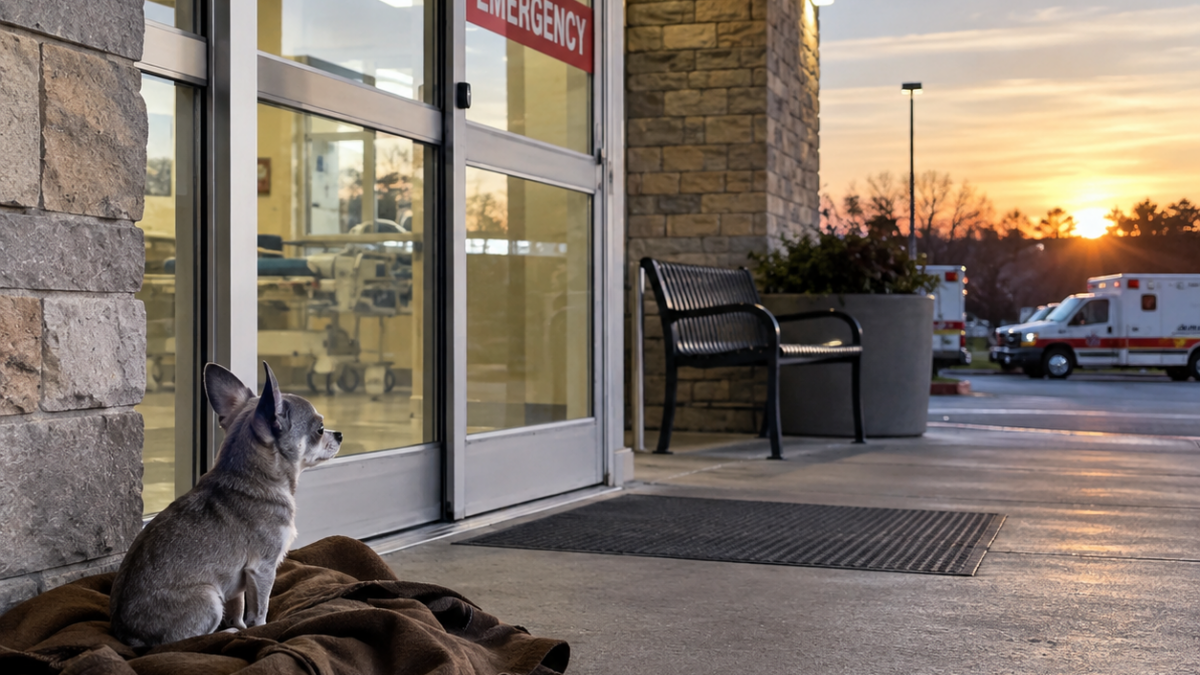
His ears moved first.
Then his head lifted higher.
For one long second, Charlie simply stared at me through the kennel gate.
I wondered whether I had imagined the recognition.
Then he stood.
He was thinner than I remembered from the hospital, though only two days had passed.
On a dog as small as Charlie, even a little lost weight showed quickly.
His ribs were not prominent, but his waist had tightened, and his shoulders seemed narrower beneath his short gray coat.
He took one uncertain step toward me.
Then another.
Leah unlocked the gate.
“You can go in,” she said.
I stepped inside and crouched.
Charlie stopped three feet away.
His nose moved.
I held out my hand.
“You remember me?”
His tail made one small movement.
Not a wag.
More like a question.
Then he walked toward me.
The instant his nose touched my fingers, something changed.
His whole body softened.
Charlie climbed onto my bent knee, put both front paws against my chest, and pressed his face beneath my chin exactly as he had in the hospital waiting room.
I closed my eyes.
For reasons I still cannot completely explain, I started crying.
I had cried after losing patients before.
Not often.
Medicine teaches you how to keep moving when your emotions want you to stop.
There is always another room.
Another chart.
Another family waiting for answers.
You learn to put grief somewhere safe inside yourself and return to it later.
But sitting on the concrete floor of that shelter with a six-pound Chihuahua trembling against my chest, I could not put anything away.
I thought about Walter Bennett lying beneath a hospital sheet.
I thought about Charlie sitting on that navy coat, watching a door that would never open for the person he wanted.
And I thought about how unfair it was that a creature capable of such loyalty could have absolutely no understanding of why his entire life had disappeared overnight.
Charlie licked my jaw once.
I laughed through my tears.
“Okay,” I whispered.
“Okay, buddy.”
Leah had stepped back several feet to give us privacy.
When I finally looked toward her, she was pretending to straighten towels on a shelf.
“How has he really been?” I asked.
She hesitated.
“He’s medically fine.”
“That wasn’t what I asked.”
“No.”
She came closer and leaned against the wall.
“He eats if someone sits with him.”
I looked down at Charlie.
“He won’t eat alone?”
“Not much.”
“What about walks?”
“He’ll go outside.”
She paused.
“But he keeps checking the parking lot.”
My chest tightened.
Leah continued.
“And when someone older comes through the lobby, especially an older man, he gets excited.”
Charlie had settled into my lap.
His nose was pressed against the fabric of my scrub pants.
“Does he know?” I asked.
Leah was quiet for a moment.
“Know what?”
“That Walter isn’t coming.”
Her expression softened.
“I don’t think dogs understand death the way we do.”
“No.”
“But they understand absence.”
That sentence stayed with me.
Dogs understand absence.
Maybe that was worse.
If Charlie understood death, perhaps there would have been an ending he could somehow accept.
Instead, Walter had simply vanished.
One moment there had been an apartment, a familiar chair, the smell of breakfast, the sound of an old man moving from room to room.
Then there had been strangers, flashing lights, an ambulance, a hospital, and a door.
And after the door, nothing.
“Did anyone find family?” I asked.
“Animal control tried.”
Leah picked up a clipboard hanging outside the kennel.
“There’s a niece in Oregon, apparently, but she hasn’t seen Mr. Bennett in years and can’t take a dog.”
“Anyone else?”
“No one they could locate.”
“What happens to Charlie?”
“He’ll stay here until he’s cleared for adoption.”
“When will that be?”
“Probably within a few days.”
I nodded.
Charlie shifted against me.
His collar was loose.
I could fit nearly three fingers beneath it.
Up close I could see scratches on the little brass name tag.
CHARLIE was stamped across the front in uneven letters, as though Walter might have ordered it from one of those machines at a pet store.
On the back was the phone number that now rang inside an empty apartment.
I ran my thumb over it.
“Can I take him outside?”
Leah smiled.
“That’s exactly what I was hoping you’d ask.”
She brought me a leash.
The moment she clipped it to Charlie’s collar, he stood and looked toward the kennel exit.
For the first time since I had arrived, he seemed alert.
We walked through the hallway together.
Charlie moved slowly.
Not because he was old.
The shelter veterinarian estimated he was about seven.
He moved slowly because he examined every person we passed.
A man carrying a bag of dog food.
A woman filling water bowls.
An older volunteer pushing a laundry cart.
Charlie looked at each face.
At the front lobby, a gray-haired man stood at the counter filling out paperwork.
Charlie froze.
His whole body became rigid.
Then he pulled toward him.
The man turned.
Charlie’s tail began wagging.
My heart sank.
The man smiled politely.
“Cute little guy.”
Charlie moved closer.
The man reached down and let him sniff his hand.
Within two seconds, Charlie knew.
The tail stopped.
He turned away.
Outside, I sat on a wooden bench behind the shelter.
Charlie climbed beside me.
For several minutes we watched cars move along the road beyond the chain-link fence.
Every time one slowed near the driveway, Charlie stood.
Every time it passed, he sat again.
I thought about what Leah had said.
Dogs understand absence.
“Were you two together a long time?” I asked him.
Charlie glanced at me.
I knew how ridiculous the question was.
Still, I kept talking.
“Did he get you as a puppy?”
Charlie sniffed the air.
“Or did you find him?”
A breeze moved through the trees.
“You probably had a routine, didn’t you?”
Charlie’s ears flicked at the sound of my voice.
“Breakfast at the same time.”
I smiled faintly.
“Maybe you sat under the table and convinced him you were starving even after he fed you.”
Charlie leaned against my thigh.
“I bet he talked to you.”
That thought hit me harder than I expected.
Walter had lived alone.
Maybe Charlie had been the only creature who heard his ordinary thoughts.
The complaints about the weather.
The television.
The price of groceries.
The ache in his knees.
The neighbor who parked badly.
The memories that no one else remained to hear.
I pictured Walter sitting in a worn recliner with Charlie curled beside him.
Perhaps that little dog had not merely belonged to Walter.
Perhaps he had been Walter’s witness.
The one living thing that knew how the old man spent his mornings.
What time he went to bed.
Which cabinet held the treats.
Which side of the couch he preferred.
What his footsteps sounded like before the fall.
The shelter door opened behind us.
Leah stepped outside.
“We close in twenty minutes.”
I checked my watch.
I had been there nearly two hours.
“I didn’t realize.”
“It happens.”
I stood.
Charlie looked at me.
The leash tightened slightly as I moved toward the door.
He followed me inside without resistance.
But when we reached his kennel, he stopped.
I opened the gate.
Charlie remained outside.
“Come on.”
He looked up at me.
I stepped into the kennel.
He stepped in too.
I unclipped the leash.
For a moment he stood beside my shoes.
Then I moved toward the gate.
Charlie moved with me.
I stopped.
He stopped.
“Charlie.”
His ears went back.
I crouched.
“I have to go.”
He climbed onto my knee.
That simple movement nearly broke me again.
“I’ll come back.”
Charlie stared at my face.
“I promise.”
The word left my mouth before I considered whether I should make promises to dogs.
Leah waited quietly.
I placed Charlie on his blanket.
The navy coat was folded beside it.
He stepped onto the coat and turned around twice.
Then he sat.
When I closed the kennel gate, he did not bark.
He did not scratch.
He simply watched me walk away.
I made it halfway down the hallway before I turned around.
Charlie was still sitting there.
Watching.
That night, I slept badly.
Every time I closed my eyes, I saw two doors.
The emergency-room doors.
The kennel gate.
Charlie waiting behind both.
At six the next morning, my alarm went off.
I had a twelve-hour shift.
By seven thirty, I was at the hospital.
At eight fifteen, I was seeing a patient with abdominal pain.
At nine, I was explaining imaging results to a worried family.
At ten thirty, an ambulance brought in a construction worker who had fallen from a ladder.
The work should have consumed me.
Usually it did.
That was one reason I had survived emergency medicine for seventeen years.
The moment I entered the hospital, everything outside it disappeared.
But that day, during every brief silence, Charlie returned.
At lunch, I found myself staring at a piece of chicken on my plate and wondering whether he had eaten.
At three, I wondered whether anyone had taken him outside.
At five, I checked the shelter’s closing time.
At seven twelve, I changed out of my white coat, drove directly across town, and arrived fifteen minutes before they closed.
Leah looked up when I entered.
“You came back.”
“I said I would.”
She smiled.
“He knows your car.”
“What?”
“He heard it pull in.”
I looked through the glass doors toward the parking lot.
“You’re kidding.”
“Go see for yourself.”
I walked down the kennel hallway.
Before I reached Charlie’s enclosure, I heard nails tapping rapidly against concrete.
Then a bark.
One sharp, high Chihuahua bark.
I turned the corner.
Charlie was standing against the kennel gate on his hind legs.
His entire body was moving.
Not just his tail.
His hips.
His shoulders.
Even his ears seemed unable to stay still.
“Hey.”
He barked again.
I laughed.
Leah opened the gate.
Charlie launched himself into my arms.
That was the first time I felt something other than grief around him.
Joy.
Small, uncomplicated joy.
I buried my face against the top of his head.
“You really did remember.”
We went for another walk.
The next evening I returned again.
Then the next.
Soon a pattern formed.
I worked.
I drove to the shelter.
Charlie and I walked.
Some days we went around the block.
Some days we crossed the street to a small municipal park.
I brought a paperback book once and sat under a maple tree while Charlie slept against my leg.
I rarely read more than two pages.
Mostly I watched him.
The sadness did not disappear quickly.
He still searched faces.
He still reacted to older men.
He still stopped when he heard certain footsteps.
But other things began to return.
He sniffed bushes.
He barked at squirrels.
He discovered that Leah carried cheese in her pocket and began following her whenever she appeared.
His appetite improved.
After five days, Leah told me he had eaten an entire breakfast without anyone sitting beside him.
“You’re making progress,” I told him that evening.
Charlie sneezed.
“I’ll take that as agreement.”
A week after Walter died, a brown paper bag arrived at the shelter.
It had been brought by the manager of Walter’s apartment building.
The city had cleared the apartment after failing to locate family willing to handle the belongings.
The manager knew Charlie was at the shelter and had saved a few things he thought might matter.
Leah carried the bag into the visitation room while Charlie sat beside me.
“There’s something here for him.”
The bag smelled faintly of old paper and laundry detergent.
Inside was a red fleece blanket.
A ceramic food bowl with a chip on the rim.
A rubber ball.
A faded photograph.
And a small green canvas pouch.
The moment Charlie saw the blanket, he froze.
Leah and I looked at each other.
I placed it on the floor.
Charlie walked toward it slowly.
He sniffed once.
Then again.
Suddenly he climbed onto it, circled twice, and collapsed.
His face disappeared into the fleece.
His whole body shuddered.
I had never heard a dog make the sound that came from him then.
It was not a howl.
Not a whine.
It was softer.
Almost a breath breaking.
I sat beside him.
Leah quietly left the room.
I picked up the photograph.
Walter was sitting in a folding chair on what looked like an apartment balcony.
He wore a plaid shirt and a baseball cap.
Charlie sat in his lap.
The dog looked younger.
His muzzle had less gray around it.
Walter’s hand rested over Charlie’s chest.
Both of them faced the camera.
On the back, written in shaky blue ink, were four words.
Charlie, my good boy.
I stared at them for a long time.
Then I examined the canvas pouch.
Inside were vaccination records, a receipt from a veterinary clinic, and several folded pieces of paper.
One was Charlie’s adoption record.
Walter had adopted him six years earlier from another rescue.
Charlie had been estimated to be one year old.
Under “reason surrendered,” someone had written:
Owner relocation — pets not allowed.
Walter had signed the form at the bottom.
I did the math.
Charlie had already lost one home before Walter.
Now he had lost another.
I looked at the tiny dog curled on the red blanket.
“No wonder you wait.”
Charlie opened his eyes.
I touched his back.
“You learned people disappear.”
He pushed his nose deeper into the fleece.
I stayed until closing.
Before leaving, I asked Leah whether the blanket could remain with him.
“Absolutely.”
“What about the other things?”
“We’ll keep them together.”
I picked up the photograph again.
“Can I make a copy of this?”
Leah smiled.
“I think Walter would have liked that.”
The next afternoon, I stopped at a photo shop on my way to work and made two copies.
One went back into Charlie’s canvas pouch.
The other went into my wallet.
I told myself it was because Walter deserved to be remembered.
That was only partly true.
The photograph reminded me that Charlie had belonged to a life before I knew him.
A complete life.
A meaningful one.
I did not want whatever happened next to erase what came before.
That evening, Charlie and I walked farther than usual.
We reached the far side of the park where a paved trail curved around a pond.
Charlie trotted beside me.
The setting sun reflected in the water.
For several minutes, he seemed completely absorbed in smells.
Then an older man appeared ahead of us.
He walked slowly with a cane.
Charlie stopped.
His ears rose.
The leash tightened.
The man came closer.
Charlie leaned forward.
I felt the familiar ache.
“Charlie.”
He barely heard me.
The man passed.
Charlie turned his head and watched him go.
For a moment I expected him to follow.
Instead, he looked back at me.
Then he walked to my side.
It was a small thing.
So small most people would not have noticed.
But I did.
That was the first time Charlie chose to come back to me after searching for Walter.
I did not tell Leah.
I did not tell anyone.
I simply carried that moment home.
Over the next several days, Charlie became more animated.
He began recognizing the time I usually arrived.
If I was late, Leah said he waited near the kennel door.
When I came through the hallway, he barked.
When I left, he still watched.
But the look was changing.
At the hospital, my colleagues noticed something had changed in me too.
One afternoon, Dr. Patel leaned against the counter beside me while I finished a chart.
“You’re leaving on time a lot lately.”
“I try.”
“You never try.”
I glanced at him.
He smiled.
“Someone waiting for you?”
I looked back at the chart.
“Sort of.”
His eyebrows rose.
“Oh?”
“It’s a dog.”
Dr. Patel laughed.
I did not.
He stopped.
“You’re serious.”
“A Chihuahua.”
“That somehow makes this funnier.”
“His owner died here last week.”
The smile disappeared.
I told him the story.
Not all of it.
Just enough.
When I finished, Dr. Patel nodded slowly.
“So adopt him.”
I shook my head.
“It’s not that simple.”
“Why?”
“I work twelve-hour shifts.”
“Dog walkers exist.”
“I live alone.”
“So does the dog.”
I frowned.
“I’ve never owned a dog.”
“That is generally how people are before they own their first dog.”
“Very insightful.”
“I went to medical school.”
I almost smiled.
Then he became serious.
“Daniel.”
I looked at him.
“You’ve been visiting this dog every day for almost two weeks.”
“So?”
“So I think you already own a dog.”
I dismissed the comment.
But that night, I stood outside Charlie’s kennel longer than usual.
He was lying on Walter’s red blanket.
His blue collar had been replaced with a clean one by the shelter because the old collar was fraying.
I hated the new collar.
It was practical.
Safer.
Better.
But the old collar had been Walter’s.
“Where is his original collar?” I asked Leah.
“In his belongings.”
“Can I see it?”
She brought me the canvas pouch.
The faded blue collar was folded inside.
I ran it between my fingers.
There were tiny bite marks near the buckle.
The brass tag was still attached.
“Could whoever adopts him keep this?”
“Of course.”
I nodded.
Whoever adopts him.
The words bothered me.
I tried to imagine someone else walking into the shelter.
A kind family.
Maybe a retired couple.
Someone with more time.
Someone with a yard.
Someone who would be home more than I was.
They would fill out the paperwork.
Charlie would leave with them.
That should have made me happy.
It did not.
I looked through the kennel gate.
Charlie was watching me.
“Don’t look at me like that.”
His tail moved.
“I’m thinking.”
Another wag.
“You have no idea what I’m saying.”
Charlie stood.
“I work too much.”
He walked to the gate.
“My apartment is small.”
He pressed his nose between the bars.
“I don’t even know what Chihuahuas eat.”
Leah spoke behind me.
“Dog food is a strong start.”
I turned.
She was smiling.
“You were listening?”
“You’re having an argument with a six-pound dog in the middle of my kennel room.”
“I’m listing practical concerns.”
“You’re losing.”
Charlie barked once.
Leah pointed at him.
“See?”
I laughed despite myself.
She leaned against the wall.
“He became available for adoption this morning.”
The laughter vanished.
“Oh.”
“We’ve already had two inquiries.”
Something cold moved through my stomach.
“About him?”
“He’s small, house-trained, affectionate, medically healthy.”
She shrugged.
“He won’t be here long.”
I looked at Charlie.
He was still standing against the gate.
“How long do I have?”
Leah’s expression changed.
“This isn’t a deadline.”
“It feels like one.”
“Daniel, you shouldn’t adopt a dog because you feel guilty.”
“I know.”
“Or because his owner died in your hospital.”
“I know.”
“Or because you want to fix something you couldn’t fix that night.”
That one landed harder.
I looked away.
Leah continued gently.
“You can’t adopt Walter.”
“I know that too.”
“Charlie needs someone who wants Charlie.”
I looked back at the kennel.
Charlie had sat down.
His head was tilted.
“Not a symbol.”
“No.”
“Not a second chance at saving someone.”
“No.”
“Just him.”
Leah nodded.
“Just him.”
I went home without making a decision.
For the first time in nearly two weeks, I did not sleep badly because I was thinking about Charlie’s grief.
I slept badly because I was thinking about mine.
Leah was right.
Emergency medicine leaves behind ghosts.
We do not call them that.
We call them cases.
A sixty-three-year-old with a ruptured aneurysm.
A twenty-four-year-old after a crash.
A child with a fever that became meningitis before anyone understood what was happening.
A seventy-eight-year-old named Walter Bennett.
We remember rooms.
Faces.
Last sentences.
The sound families make when they understand.
Then we return to work.
Charlie had forced me to stop.
Maybe that was why I had attached myself to him.
Maybe caring for Charlie was easier than admitting I had been tired for years.
Not physically.
Something deeper.
A kind of exhaustion that comes from watching endings and pretending each one leaves no mark.
At four in the morning, I got out of bed.
I walked into my kitchen.
My apartment was silent.
It had always been silent.
I had chosen it that way.
After residency, after years of noise and emergencies and people needing something from me, silence felt like luxury.
I had never married.
There had been relationships.
Some serious.
None had survived my schedule.
My parents lived three states away.
My younger sister had a family in Denver.
We spoke often, but not enough.
I stood in the kitchen and imagined a small water bowl near the refrigerator.
A dog bed beside the couch.
Tiny nails clicking across the floor.
Someone waiting when I came home.
The image frightened me.
Not because I disliked it.
Because I wanted it.
The next afternoon, before going to the shelter, I called my sister.
“Do you think I should get a dog?”
There was a long silence.
Then she said, “Who are you and what have you done with Daniel?”
“I’m serious.”
“So am I.”
I told her about Charlie.
She listened without interrupting.
When I finished, she asked one question.
“Do you love him?”
“That seems dramatic.”
“You called me about a Chihuahua from a hospital waiting room.”
I sighed.
“I don’t know.”
“Yes, you do.”
“I’ve known him two weeks.”
“You’ve known some people for ten years and cared less whether they ate breakfast.”
“That’s unfair.”
“It’s accurate.”
I sat on the edge of my bed.
“What if my schedule is bad for him?”
“Then change what you can.”
“What if he never stops waiting for Walter?”
My sister was silent for a moment.
“Maybe he doesn’t have to stop loving Walter to love you.”
I looked at the wall.
That thought had not occurred to me.
For some reason, I had imagined Charlie’s grief and my place in his life as competing things.
As though moving forward required him to forget.
My sister continued.
“People don’t work that way either.”
“No.”
“So maybe dogs don’t.”
I drove to the shelter after work.
Charlie heard me before he saw me.
By the time I reached his kennel, he was dancing in place.
I opened the gate.
He climbed into my arms.
I buried my face against his neck.
He smelled like shelter shampoo and the red fleece blanket.
“Would you like to get out of here?”
Charlie licked my nose.
“That is not legally binding consent.”
He licked me again.
I carried him to the front desk.
Leah was filling out forms.
She looked up.
I said, “I want to apply.”
Her smile appeared slowly.
“For Charlie?”
“No, I’ve become deeply attached to the beagle in kennel twelve.”
She laughed.
“Sit down.”
The adoption process took longer than I expected.
There was an application.
Questions about housing.
Work schedule.
Veterinary plans.
Emergency contacts.
I appreciated every one.
A shelter should care where an animal goes.
When Leah asked how long Charlie would regularly be alone, I answered honestly.
“Some shifts, ten hours.”
“That’s too long without arrangements.”
“I know.”
“What’s your plan?”
“I spoke with a dog walker this afternoon.”
Her eyebrows rose.
“You did your homework.”
“I also found a veterinary clinic two blocks from my apartment.”
“Anything else?”
“My building allows pets under twenty-five pounds.”
“Charlie has achieved that.”
“He also fits inside my winter boot.”
Leah smiled.
“Keep going.”
“My colleague lives four blocks away and has agreed to be an emergency contact.”
“You asked Dr. Patel?”
“How do you know Dr. Patel?”
“You mentioned him.”
“I talk too much here.”
“Yes.”
I finished the application.
Leah looked through it.
Then she set down her pen.
“There’s one thing.”
My stomach tightened.
“What?”
“The shelter manager wants to do a home visit for certain placements.”
“Fine.”
“Mostly because Charlie has had two major disruptions.”
“When?”
“Tomorrow?”
“I’m off at noon.”
“Two?”
“I’ll be there.”
She nodded.
Then she looked toward the kennel hallway.
“You understand he may have separation anxiety.”
“I do.”
“He may cry when you leave.”
“I know.”
“He may sit by the door.”
I swallowed.
“I know.”
“And there may be nights when he hears footsteps in the hall and thinks they belong to someone else.”
I looked down at the brass tag I had been turning between my fingers.
“I know.”
Leah’s voice softened.
“You still want him?”
I did not hesitate.
“Yes.”
The home visit lasted twenty-five minutes.
I had spent three hours preparing.
I bought bowls.
A bed.
A soft harness.
A leash.
Food recommended by the shelter.
Tiny training treats.
A crate I hoped never to need.
A blanket for the couch.
Two toys.
Then five more because I had no idea how many toys a Chihuahua required.
Dr. Patel came over while I was arranging everything.
He stared at the living room.
“You understand the dog weighs six pounds.”
“Yes.”
“You have prepared for the arrival of a royal infant.”
“He has preferences.”
“You don’t know his preferences.”
“He might.”
Dr. Patel picked up a miniature rope toy.
“What exactly is he supposed to do with this?”
“I assume dog things.”
“Excellent preparation, Doctor.”
“Go away.”
He put the toy down.
Then his expression softened.
“You’re happy.”
I looked at him.
“What?”
“I haven’t seen you this nervous in years.”
“That means happy?”
“For you, apparently.”
The shelter approved the adoption that evening.
I was scheduled to pick Charlie up the next day.
I barely slept.
At nine the following morning, I drove to the shelter.
Leah had already gathered his belongings.
The red fleece blanket.
The chipped bowl.
The rubber ball.
Walter’s photograph.
The green canvas pouch.
And the old blue collar.
Charlie wore his newer collar for safety, but I placed the old one carefully inside the pouch.
“We usually send a small bag of food,” Leah said.
“I have the same brand at home.”
“Of course you do.”
“I was told consistency matters.”
“You have turned into every anxious first-time adopter we’ve ever had.”
“I’m a physician.”
“That has not helped.”
Charlie stood between us, looking from one face to the other.
I signed the final form.
Leah crouched and scratched behind his ears.
“You got lucky, little man.”
I looked at her.
“I think that goes both ways.”
She stood.
Her eyes were wet.
“You know, when he first came in, we were worried about him.”
“I know.”
“He’d sit at the kennel door for hours.”
I looked down.
Charlie had one paw on my shoe.
“Yesterday he stopped.”
I looked up again.
“What?”
“He still watches the hallway.”
Leah smiled.
“But yesterday afternoon he heard your usual arrival time come and go.”
“I had the home visit.”
“I know.”
“He waited at the door for maybe ten minutes.”
My chest tightened.
“Then what?”
“He took his red blanket, dragged it to the back of the kennel, and went to sleep.”
I did not understand why that mattered until Leah explained.
“He wasn’t waiting forever anymore.”
Charlie looked up at me.
“He knew you’d come back.”
I knelt beside him.
“Did you?”
He licked my chin.
I clipped on his leash.
Leah handed me the canvas bag.
“Ready?”
No.
“Yes.”
We walked through the shelter lobby.
Several volunteers said goodbye.
Charlie stopped at the glass front doors.
For months afterward, I would remember that moment.
He stood on one side of a doorway with the shelter behind him and the outside world ahead.
The first time I had seen Charlie, a door represented the person who had disappeared.
Now another door was opening.
I pushed it outward.
Charlie hesitated.
Then he walked through.
Outside, the morning was cool and clear.
I opened the passenger door of my car.
I had purchased a small secured dog seat that attached to the seat belt.
Charlie sniffed it.
Then he looked at me.
“You’re not sitting loose in the car.”
He blinked.
“I have treated too many car accidents to negotiate this.”
He sighed.
At least I chose to interpret it as a sigh.
I lifted him into the seat and clipped his harness securely.
The canvas bag went on the floor.
Walter’s red blanket went beside Charlie.
The moment he smelled it, he settled.
I drove slowly.
Charlie looked out the window.
At traffic lights, I checked him.
Sometimes he watched pedestrians.
Sometimes cars.
Once we passed an elderly man standing at a bus stop.
Charlie followed him with his eyes.
But he did not cry.
Twenty-five minutes later, we reached my apartment.
I parked.
For several seconds I remained behind the wheel.
Charlie looked at me.
“Well.”
His ears tilted.
“It’s not much.”
He continued staring.
“But it’s quiet.”
I unfastened him.
“There’s a park three blocks away.”
His tail moved.
“And I apparently purchased the entire small-dog aisle at the pet store.”
Another wag.
I picked him up.
“Come on, Charlie.”
We walked upstairs.
At my apartment door, I set him down.
The key turned in the lock.
I opened the door.
Charlie stayed in the hallway.
He looked inside.
Then he looked back toward the stairs.
For an instant, I wondered whether every unfamiliar door now frightened him.
I crouched.
“No rush.”
Charlie sniffed the threshold.
I stepped inside but kept the leash loose.
He placed one paw across.
Then another.
Finally, his entire body entered.
I closed the door softly behind us.
Charlie froze at the sound.
His head snapped around.
I immediately reopened it.
The hallway was still there.
Charlie stared outside.
“See?”
I waited.
After several seconds, he walked back into the apartment on his own.
I left the door open another minute.
Then I closed it again.
This time, Charlie watched but did not flinch.
He explored slowly.
Kitchen first.
Then living room.
Then bedroom.
Then bathroom.
He examined every corner.
He ignored all seven toys.
He walked past the expensive dog bed.
He returned to the canvas bag.
I placed Walter’s red blanket on the floor beside the couch.
Charlie climbed onto it immediately.
Within five minutes, he was asleep.
I sat on the floor nearby.
For nearly an hour, I did nothing except listen to him breathe.
That first week was harder than the shelter and I expected.
Charlie followed me everywhere.
If I stood, he stood.
If I went to the bathroom, he waited outside.
If I stepped into the hallway to retrieve mail, he cried.
The sound was sharp and panicked.
Not the ordinary protest of a spoiled dog.
Fear.
The first time it happened, I came back inside immediately.
Charlie threw himself against my ankles.
I crouched.
“I came back.”
His body shook.
“I told you I would.”
Of course, words were not enough.
Trust is not built by explanation.
It is built by repetition.
So we practiced.
I stepped outside for ten seconds.
I returned.
Thirty seconds.
I returned.
One minute.
I returned.
Five minutes.
I returned.
Each time, I tried not to make my arrival dramatic.
The dog behaviorist I consulted told me that leaving and returning should become ordinary.
Safe.
Predictable.
Still, every time I opened the door and saw Charlie waiting, something inside me softened.
We developed routines.
Morning walks before work.
Breakfast in the kitchen.
A dog walker named Rosa came at noon on long shifts.
Dr. Patel checked on Charlie if I was delayed.
At night, Charlie slept in the dog bed beside my bed.
At least that was the arrangement.
By the fourth night, he was sleeping on my bed.
I blamed him.
He blamed no one.
The first time I worked a full twelve-hour shift after adopting him, I was more anxious than he seemed.
Rosa texted me after her midday visit.
Charlie ate lunch. Walked 20 min. Barked at a leaf. Very brave.
I read the message twice.
When my shift ended, I drove home faster than usual while remaining precisely within the speed limit, because apparently adopting a dog had turned me into my own nervous parent.
I climbed the stairs.
Before I reached my apartment, I heard Charlie bark.
I opened the door.
He stood six feet away.
His ears high.
Tail moving.
For half a second, he simply looked at me.
Then he ran.
I dropped to one knee.
Charlie hit my chest like a tiny missile.
I laughed so loudly my neighbor opened her door.
“Everything okay?”
“Yes.”
Charlie licked my face.
My neighbor smiled.
“New dog?”
“Apparently.”
She looked at Charlie.
“He seems certain.”
That night, Charlie did something he had never done before.
After dinner, he walked to the apartment door.
He sat.
I expected him to ask for a walk.
Instead, he stared at it.
The old posture.
The hospital posture.
Rigid.
Waiting.
I sat beside him.
A few minutes passed.
Footsteps sounded in the hallway.
Charlie’s ears lifted.
An older man from the apartment across the hall walked past.
Charlie stood.
Then the footsteps faded.
Charlie remained at the door.
I felt helpless.
“Walter isn’t coming, buddy.”
His ear moved.
I had never said Walter’s name to him before.
Charlie turned his head.
The reaction was immediate.
I stopped breathing.
“Walter?”
Charlie stood completely still.
His eyes widened.
Then he began looking around the room.
Behind me.
Toward the kitchen.
Toward the door.
He whined.
I felt sick.
“I’m sorry.”
Charlie went to the door and scratched once.
I closed my eyes.
Of course he knew the name.
He had heard it every day for six years.
Friends.
Neighbors.
Doctors.
Mail carriers.
Walter himself answering the phone.
Walter had not been “your owner” to Charlie.
He had been Walter.
I opened the green canvas pouch.
I took out the photograph.
Walter in the folding chair.
Charlie in his lap.
I placed it on the floor.
Charlie sniffed the photograph.
Then he licked Walter’s image.
Once.
Twice.
He sat beside it.
I sat beside him.
For the next twenty minutes, neither of us moved.
Finally Charlie lay down with one paw touching the picture.
I realized then that I had made a mistake.
I had been trying to protect Charlie from grief by avoiding Walter.
But Walter was not only grief.
Walter was six years of Charlie’s life.
Food bowls.
Morning sunlight.
Walks.
A lap.
A voice.
A home.
I picked up the photograph.
The next day, I bought a small wooden frame.
I placed the picture on a low bookshelf in the living room.
Not hidden.
Not worshiped.
Just present.
The red blanket remained beside the couch.
The chipped bowl went on the shelf too.
Charlie used a new stainless-steel bowl for food, but Walter’s old bowl stayed.
The blue collar went into a small box with the brass tag facing upward.
I wanted Charlie’s new life to have room for his old one.
Strangely, after that, something began changing.
Charlie still looked at Walter’s photograph.
But he stopped searching the apartment afterward.
Sometimes he sniffed the red blanket, turned in a circle, and fell asleep.
He began carrying the rubber ball from Walter’s apartment around the house.
The first time he dropped it at my feet, I stared.
“You play fetch?”
Charlie looked at the ball.
Then at me.
I threw it six feet.
He chased it.
I laughed.
He brought it back.
That ridiculous little rubber ball became one of our rituals.
Three throws before breakfast.
Five after dinner.
Sometimes twenty.
Charlie decided.
Weeks passed.
His body filled out.
The veterinarian said his weight was perfect.
His coat became shinier.
He stopped trembling whenever I left.
He still waited near the door when I was due home.
But waiting had changed.
It was no longer the desperate stillness I remembered from the hospital.
It was expectation.
Confidence.
He waited because experience had taught him that the door opened again.
One rainy evening, I came home almost two hours late.
A multi-car accident had overwhelmed the emergency department.
My phone battery died before I could contact Rosa.
By the time I climbed the stairs, guilt had settled heavily in my chest.
Charlie was sitting at the door.
The sight stopped me.
For one terrifying moment, I saw the hospital bench again.
The same posture.
The same eyes.
“Charlie.”
His tail began wagging.
I knelt.
“I’m sorry.”
He ran to me.
No hesitation.
No fear.
Just joy.
That was when I understood the difference.
At the hospital, Charlie had waited without knowing whether Walter would return.
Now he waited because he believed I would.
Faith and uncertainty can look almost identical from across a room.
Up close, they are entirely different things.
Winter arrived.
Charlie hated snow.
The first morning it covered the sidewalk, he walked outside, placed one paw into it, and looked at me as though I had personally betrayed him.
“You’re a dog.”
He lifted the paw.
“Dogs go outside.”
Charlie turned toward the building.
“We have been outside for twelve seconds.”
He pulled toward the door.
I bought him a small coat.
I had once mocked people who dressed dogs.
I apologized internally to all of them.
The coat was dark blue.
The first time I put it on Charlie, he stood frozen with humiliation.
Dr. Patel happened to be visiting.
He laughed until he had to sit down.
“He looks furious.”
“He’s warm.”
“He looks like a disgruntled accountant.”
Charlie glared at him.
“See?”
I picked Charlie up.
“You look distinguished.”
Dr. Patel wiped his eyes.
“He looks like he is about to audit my taxes.”
Charlie eventually accepted the coat.
He never accepted snow.
Christmas came.
I was scheduled at the hospital until six.
When I returned home, I found a small package outside my door.
It was from Leah.
Inside was a new photograph.
A shelter volunteer had taken it the day I adopted Charlie.
I had never seen it.
The photograph showed me kneeling outside the shelter, attaching Charlie’s leash before walking toward the car.
Charlie was not looking at the camera.
He was looking at me.
On the back, Leah had written:
The day he stopped waiting alone.
I stood in my hallway holding that photograph for a long time.
Then I placed it in a frame beside Walter’s.
Two photographs.
Two chapters.
No competition between them.
That evening, Charlie slept across my lap while snow fell outside.
I thought about Walter.
I had never known him conscious.
My entire relationship with him consisted of medical records, a few hours of desperate treatment, a photograph, and the dog he left behind.
Yet somehow Walter had become part of my home.
I wondered whether he would have approved of me.
Whether he would think I fed Charlie too many treats.
Whether he would laugh at the winter coat.
Whether he would recognize the rubber ball still rolling beneath my couch.
Mostly, I hoped he would know one thing.
Charlie was okay.
More than okay.
He was loved.
In January, I received a letter from Walter’s niece.
I had forgotten the shelter had my contact information available if family ever reached out regarding Charlie.
Her name was Susan.
She lived in Portland.
The letter was handwritten.
Dear Dr. Reed,
Leah at the shelter gave me your mailing address after asking your permission.
I hope this is all right.
I was Walter Bennett’s niece.
We were not close in recent years, and that is something I regret more than I can explain.
When I learned about his death, I also learned about Charlie.
I want you to know how much that dog meant to him.
Uncle Walter adopted Charlie after my aunt died.
He had become very isolated.
My aunt, Helen, was the person who kept their friendships alive, planned holidays, called family, and got Walter out of the apartment.
After she died, he stopped doing much of anything.
Then he adopted Charlie.
Suddenly he had someone who needed breakfast.
Someone who needed walks.
Someone who waited at home.
He started going outside again.
He sent me photos.
He called Charlie “the little boss.”
I am sorry I could not take him.
My husband has advanced Parkinson’s disease, and I am his full-time caregiver.
But I have worried about that dog every day since I heard what happened.
Leah told me Charlie went home with you.
Thank you.
There is one more thing you should know.
My uncle used to say that Charlie saved his life after Helen died.
I think he would find it very fitting that Charlie ended up with a doctor.
Sincerely,
Susan Bennett
I read the letter three times.
Then I sat on the floor beside Charlie.
He was chewing one of his toys.
“Little boss?”
His ears lifted.
“Was that you?”
Charlie resumed chewing.
I laughed.
Then I read the letter aloud to him.
When I said Walter’s name, Charlie looked at the photograph.
But he did not go to the door.
That mattered.
I wrote Susan back.
I told her about the red blanket.
The rubber ball.
The winter coat.
The park.
The way Charlie barked at delivery drivers but became terrified of the vacuum cleaner.
I told her he was eating well.
Sleeping well.
Living well.
I enclosed two photographs.
One of Charlie curled on my couch.
Another of him wearing his blue winter coat with an expression of profound resentment.
Three weeks later, Susan wrote again.
She said she had laughed when she saw the coat.
Then she told me Walter would have laughed too.
For the first time, Charlie’s past did not feel like a shadow in my home.
It felt like family history.
Spring came slowly.
Charlie discovered sunlight patches on the living-room floor and moved between them throughout the afternoon.
He learned the sound of my car.
He learned that the word “park” meant something excellent.
He learned Dr. Patel always pretended not to bring treats and always had treats.
I learned Charlie hated thunderstorms.
I learned he preferred chicken to beef.
I learned he slept deeply only when at least one part of his body touched something belonging to me.
A foot.
An ankle.
My leg.
The edge of my shirt.
On weekends, I began spending less time at the hospital.
That was new.
For years, extra shifts had filled empty hours.
Now empty hours were not empty.
Charlie and I walked.
I called my sister more.
Sometimes she video-called with her children, who demanded to see Charlie rather than me.
I started cooking instead of eating takeout over the sink.
I noticed the seasons.
This sounds absurd.
But emergency medicine can make life feel like one long fluorescent hallway.
Charlie pulled me outside.
Rain.
Cold.
Heat.
Wind.
Morning.
Evening.
He cared nothing about my charts or credentials.
A successful day, according to Charlie, required only a meal, a walk, several interesting smells, and someone you trusted nearby.
There was wisdom in that.
Nearly a year after Walter died, I was working the overnight shift when an ambulance arrived with another elderly man.
He lived alone.
He had collapsed in his kitchen.
The circumstances were so similar that for a moment I felt physically pulled backward in time.
We stabilized him.
Unlike Walter, he survived the night.
At dawn, his daughter arrived.
She stood beside his bed holding his hand.
I stepped out of the room.
Across the hall, the emergency-room doors opened.
And for one second, I saw Charlie.
Not literally.
Memory.
A tiny gray body on a navy coat.
Eyes fixed on the door.
Waiting.
I went into the staff room and sat down.
Dr. Patel found me there.
“You okay?”
“Yes.”
He waited.
I shook my head.
“No.”
He sat across from me.
“It was almost the same case.”
“Walter?”
I nodded.
For a while, neither of us spoke.
Then I said something I had never said aloud.
“I think I’ve been carrying too many of them.”
Dr. Patel understood immediately.
“Patients?”
“The ones we lose.”
He leaned back.
“We all do.”
“I know.”
“That doesn’t mean you have to do it alone.”
That conversation changed something.
Not dramatically.
No revelation.
No collapse.
I simply began talking more honestly about the emotional cost of the work.
I joined a physician support group organized through the hospital.
At first I hated it.
Then I stopped hating it.
Eventually, I found it useful.
Charlie had not cured anything.
He had done something more realistic.
He had made it impossible for me to continue pretending I felt nothing.
The anniversary of Walter’s death arrived on a rainy Tuesday.
I had the day off.
I took Charlie to the park.
We walked the trail around the pond.
His muzzle had become slightly grayer over the year.
Mine probably had too.
We sat on our usual bench.
I had brought Walter’s photograph.
I placed it beside me.
Charlie sniffed it.
Then he looked across the pond.
“It’s been a year.”
His ears moved.
“I don’t know if dogs understand years.”
A duck crossed the water.
“You probably understand breakfast.”
Charlie looked at me.
“And dinner.”
His tail moved.
“And cheese.”
Definitely understood.
I rested my hand against his back.
“I wish I could tell him you’re okay.”
Charlie leaned against me.
“Maybe he knew someone would take care of you.”
The thought comforted me.
Then I corrected myself.
“No.”
I looked at Walter’s photograph.
“Maybe he was terrified about what would happen to you.”
That felt more honest.
Death is not made beautiful simply because something beautiful follows it.
Walter did not choose to leave Charlie.
Charlie did not need loss in order to find me.
I did not need Walter to die for my life to change.
Those things were not a plan.
They were consequences.
What mattered was what we did afterward.
I picked up the photograph.
“I couldn’t save him.”
Charlie looked at me.
“But I could stay with you.”
My throat tightened.
“And maybe that was enough for that day.”
Charlie climbed into my lap.
I held him.
We sat until the rain began.
When we returned home, Charlie shook water across my entire entryway.
“Excellent.”
He wagged his tail.
“You are very lucky you’re small.”
He ran toward the living room.
I hung my coat.
Then I noticed something.
Charlie had gone to the bookshelf.
He stood beneath the two photographs.
Walter and Charlie.
Me and Charlie.
He looked up.
I walked over.
“What?”
Charlie sat.
I took Walter’s photograph down.
He sniffed it.
Then, after a moment, he walked away and picked up the rubber ball.
I laughed.
“Okay.”
I threw it.
Charlie chased it across the room.
That evening, I wrote Susan.
I told her it had been one year.
I told her Charlie was doing well.
Then I asked a question I had wondered about for months.
Where did Walter get the red blanket?
Susan replied two days later.
Helen made it.
Walter’s wife.
She had sewn it from an old fleece throw after Charlie came home from the shelter because Walter complained that every dog bed he bought was too large.
Susan wrote:
That blanket belonged to all three of them in a way.
A few weeks later, a package arrived.
Inside was a small photo album.
Susan had gone through Walter’s old digital photographs.
There was Charlie standing beside a Christmas tree.
Charlie asleep on Walter’s chest.
Charlie sitting on Helen’s old chair.
Charlie at a lake.
Charlie wearing a ridiculous Halloween bandana.
And one photograph that made me sit down.
Walter was asleep in his recliner.
Charlie was curled against his stomach.
The red blanket covered them both.
On the back Susan had written:
Home, before you.
I placed that photograph in the album.
I did not frame it.
Some memories deserve privacy.
Over the following years, Charlie became known throughout the emergency department.
Not because he came to work with me.
Hospital policy prevented that except for approved therapy animals.
But everyone knew him from photographs.
Nurses asked about him.
Residents heard the story.
Dr. Patel called him “Chief of Staff.”
Leah still received occasional pictures.
Every year on the anniversary of his adoption, I brought supplies to the shelter.
Charlie came with me and waited outside with a volunteer while I visited.
The first time we returned, I worried the place might frighten him.
Instead, Charlie sniffed the lobby, greeted Leah, accepted three treats, and tried to steal food from a donation box.
“He’s traumatized,” I said.
“Clearly,” Leah replied.
Before we left, I walked him past his old kennel.
It was occupied by another dog.
A small terrier.
Charlie glanced inside.
Then kept walking.
No hesitation.
No fear.
Outside, he pulled me toward the car.
Toward home.
Years passed.
Charlie aged.
So did I.
His jumps onto the couch became less graceful.
Then impossible.
I bought steps.
His walks grew shorter.
His eyes became cloudy.
He developed arthritis in his back legs.
The veterinarian prescribed medication.
He still carried Walter’s rubber ball, though eventually he stopped chasing it.
Sometimes he simply slept with it near his paws.
The red blanket became thin.
I repaired one corner myself badly.
Then another.
Eventually I asked Susan whether she minded if I had the blanket professionally restored.
She wrote back:
Please keep it usable.
It was made to comfort him, not to sit in a box.
So I did.
When Charlie turned thirteen, he began waking at night.
Sometimes he wandered toward the apartment door.
The first few times, fear rose in me.
Was he confused?
Was he searching for Walter again?
Then I realized he simply needed to go outside more often.
Age, not grief.
We adjusted.
That is what love becomes over time.
Adjustments.
Ramps.
Medication.
Earlier dinners.
Slower walks.
More patience.
One evening, Charlie stopped halfway through our usual block.
He looked up at me.
“Done?”
He sat.
I picked him up.
His body fit against my chest exactly as it had the first night in the hospital.
Smaller, somehow.
Or maybe I had simply learned how fragile he had always been.
I carried him home.
At the apartment door, Charlie rested his chin on my shoulder.
For one impossible second, I remembered the first time he had done that.
The waiting room.
Walter behind the emergency-room doors.
The trembling.
I kissed the top of Charlie’s head.
“I’ve got you.”
His eyes closed.
By then, I had learned that promises to dogs are not foolish.
They simply have to be promises you can keep.
I could not promise Charlie he would never hurt.
I could not promise he would never be afraid.
I could not promise we would have unlimited time.
But I could promise he would not face those things alone.
When Charlie was fourteen, Susan visited.
Her husband had died the previous winter.
She was traveling east to see family and asked whether she could meet Charlie.
I said yes immediately.
When she arrived, I worried Charlie would not react.
He had never met Susan as far as she knew.
But she carried something with her.
Walter’s old cardigan.
The moment she removed it from her bag, Charlie lifted his head.
He stared.
Then he walked toward her.
Slowly.
Susan knelt.
Charlie sniffed the sleeve.
His body became completely still.
Susan began crying.
“Oh, Charlie.”
He sniffed again.
Then he pressed his face into the cardigan.
I turned away for a moment to give her privacy.
When I looked back, Susan was sitting on the floor.
Charlie was in her lap.
She stroked his ears.
“My uncle loved you so much.”
Charlie closed his eyes.
Later, over coffee, Susan told me stories about Walter.
He had been a high-school history teacher for thirty-four years.
He hated flying.
Loved baseball.
Burned almost everything he cooked.
Collected old maps.
After Helen died, he stopped attending family events.
Then Charlie arrived.
“He changed after that dog,” Susan said.
“In a good way?”
“In every way.”
She looked toward the living room.
Charlie was asleep on the red blanket.
“Walter had someone to get up for.”
I understood that.
More than I expected.
Before leaving, Susan handed me the cardigan.
“You should keep it.”
“I can’t.”
“Please.”
“It was Walter’s.”
“That’s why.”
I looked at her.
She smiled through tears.
“I think it belongs with Charlie.”
I placed the cardigan beside the red blanket.
Charlie slept with his nose against it for three days.
Then, gradually, it became another familiar object in the apartment.
Not a wound.
A memory.
At fifteen, Charlie’s heart began to fail.
The diagnosis was not unexpected.
Small dogs often live long lives, but long does not mean forever.
The cardiologist explained medications.
Symptoms.
Changes to watch.
I listened as a physician.
Then I went home and became simply a man whose dog was getting old.
There is a cruelty in medical knowledge when someone you love is sick.
You recognize signs earlier.
You understand what numbers mean.
You know where the road may lead.
Charlie still had good months.
Then good weeks.
He ate.
Slept.
Walked short distances.
Demanded chicken.
Barked at delivery drivers with unnecessary confidence.
He was still Charlie.
One night, during a thunderstorm, I woke to find him standing beside the apartment door.
Lightning flashed.
Charlie trembled.
I sat beside him.
“It’s okay.”
He leaned against my leg.
I thought of Walter.
Of all the storms Charlie must have lived through before me.
I wondered whether Walter had sat on the floor beside him too.
Probably.
I imagined two men separated by time, comforting the same small dog.
The thought no longer made me jealous or sad.
It made me grateful.
Charlie had been loved before me.
That was not something I had lost.
It was something I inherited.
Six months later, Charlie stopped eating breakfast.
That frightened me more than almost anything else could have.
Charlie had never voluntarily rejected chicken.
I took him to the clinic.
The veterinarian examined him.
Blood tests.
X-rays.
An ultrasound.
His heart disease had progressed.
There were other age-related problems too.
Nothing catastrophic that day.
But the direction was clear.
“How long?” I asked.
The veterinarian looked at me with the expression I had given families hundreds of times.
“I don’t know.”
I almost laughed.
Not because anything was funny.
Because suddenly I was on the other side of a sentence I had said my entire career.
We can’t know exactly.
Take it day by day.
Watch his quality of life.
You’ll know when the bad days outnumber the good ones.
I hated every word.
They were true.
I still hated them.
I took Charlie home.
I placed the red blanket on the couch.
He curled into it.
Walter’s photograph stood nearby.
I sat beside him.
“I am not good at this side of medicine.”
Charlie opened one eye.
“I prefer giving the speech.”
He sighed.
“So rude.”
For the next three months, we measured life differently.
Not in years.
Not even weeks.
Days.
Was today good?
Did he eat?
Did he enjoy his walk?
Did he sleep comfortably?
Did his tail wag?
Did he choose to engage with the world?
Most days, the answer was yes.
So we continued.
One Saturday morning, Charlie woke before sunrise.
He stood beside my bed.
I lifted him up.
Instead of curling near my feet, he walked across the mattress and pressed himself against my chest.
Exactly where he had rested in the hospital waiting room all those years earlier.
I held him.
His breathing was shallow.
Not distressed.
Just tired.
“Morning, buddy.”
His tail tapped once.
I knew.
Not because I was a doctor.
Because I was his person.
We spent the day quietly.
I carried him to the park.
We sat on the same bench beside the pond.
Charlie did not walk.
He rested in my lap wrapped in the red blanket.
I brought Walter’s photograph.
And the rubber ball.
And the old blue collar.
It probably looked ridiculous to anyone passing.
I did not care.
The sun was warm.
Charlie watched ducks on the water.
For a few minutes, his ears lifted the way they had when he was younger.
I called Susan.
She spoke to him through the phone.
“Hi, Charlie.”
His ear moved.
“You were such a good boy for Uncle Walter.”
I closed my eyes.
“And you were such a good boy for Daniel.”
My throat tightened.
Susan cried.
So did I.
That evening, Dr. Patel came over.
He sat on the floor beside Charlie.
“Chief.”
Charlie opened his eyes.
Dr. Patel gave him a tiny piece of chicken.
Charlie ate it.
We both laughed.
“Still taking bribes,” Patel said.
“Professional integrity was never his strength.”
Charlie went back to sleep.
Dr. Patel stayed for an hour.
Before leaving, he hugged me.
We had known each other nearly twenty years.
He had never hugged me before.
The next morning, Charlie would not eat.
He would not drink.
He tried to stand and could not.
I sat beside him.
He looked at me.
There was no panic in his eyes.
Only exhaustion.
I knew what he needed from me.
And I hated it.
I called the veterinarian who provided home euthanasia.
She arrived that afternoon.
I had spent my career believing there were moments when medicine’s job was no longer to prolong life but to prevent suffering.
Believing that professionally was one thing.
Living it was another.
Charlie lay on Walter’s red blanket.
The old cardigan was folded beneath his head.
The rubber ball rested near his paw.
Walter’s photograph stood on the coffee table.
The photograph from Charlie’s adoption day stood beside it.
Two homes.
One life.
I held Charlie against my chest.
The veterinarian explained every step.
I knew every step already.
Still, I let her explain.
For once, I did not want to be the doctor.
I wanted to be the person holding the dog.
Charlie looked at me.
I kissed his forehead.
“You waited for him.”
His eyes stayed on mine.
“And then somehow you found me.”
My voice broke.
“Or maybe I found you.”
Charlie breathed slowly.
“I came back every time, didn’t I?”
His tail moved once against the blanket.
I laughed through my tears.
“Yeah.”
I pressed my forehead to his.
“I came back.”
The veterinarian gave the first medication.
Charlie relaxed.
His head became heavy in my hand.
For a few minutes, we simply sat together.
No alarms.
No fluorescent lights.
No emergency-room doors.
No kennel gate.
Only home.
I whispered Walter’s name.
Charlie’s ears barely moved.
Then I said mine.
His eyes opened a fraction.
I smiled.
“You know both.”
His breathing slowed.
I thought about the little dog I had first seen on a hospital bench.
A dog waiting for one man.
Then a shelter dog learning another person might return.
Then my dog.
My family.
My teacher in a way I would have found embarrassing to admit years earlier.
I held him when his heart stopped.
Afterward, the apartment became impossibly quiet.
The veterinarian left.
I remained on the floor.
For the first time in many years, Charlie was not somewhere in the room.
No nails on the floor.
No small body breathing.
No collar tag touching a bowl.
No bark when someone walked through the hallway.
I looked at the apartment door.
And suddenly I understood Charlie’s first night better than I ever had.
Absence is not silence.
Absence has weight.
It occupies space.
It sits beside you.
It waits.
For weeks, I kept expecting Charlie.
When I opened the refrigerator, I looked down automatically.
When I returned from work, my hand reached toward the floor before I remembered.
The first snowfall came.
I saw a small dog wearing a coat outside the hospital and had to walk into an empty room for several minutes.
Grief was not dramatic.
Most of the time it was ordinary.
A bowl that no longer needed filling.
A leash hanging beside the door.
A red blanket folded on the couch.
I did not put Charlie’s things away immediately.
Eventually, I washed the newer blankets.
I donated unopened food.
I gave his steps and harness to the shelter.
But I kept the red blanket.
The rubber ball.
The blue collar.
The brass tag.
Walter’s photograph.
Our photograph.
And the green canvas pouch.
Several months later, I returned to the shelter alone.
Leah still worked there.
She had more gray in her hair.
So did I.
When she saw me, her face changed.
“Oh, Daniel.”
She hugged me.
“I heard.”
I nodded.
We stood quietly for a moment.
Then she said, “Fifteen?”
“Almost sixteen.”
“That’s a good long life.”
“It wasn’t long enough.”
“No.”
She understood.
I donated Charlie’s remaining medication to the clinic program and brought several boxes of small-dog supplies.
Before leaving, I walked down the kennel hallway.
Different paint.
Different staff.
Different dogs.
But the concrete smell was the same.
I stopped near the enclosure where Charlie had once waited for me.
A small Chihuahua sat inside.
Tan.
Large ears.
White muzzle.
She looked old.
She did not come to the gate.
I stared for longer than I intended.
Leah appeared beside me.
“Her name is Rose.”
“I’m not adopting a dog.”
“I didn’t say you were.”
“I know that look.”
“What look?”
“The shelter-worker look.”
Leah smiled.
“You’re imagining things.”
Rose remained in the back of the kennel.
“What happened to her?”
“Owner moved into assisted living.”
I swallowed.
“Family?”
“Couldn’t take her.”
Of course.
I stepped closer.
Rose watched me.
I thought about Charlie.
Not as a replacement.
Never that.
Charlie could not be replaced because love does not work like an empty position waiting to be filled.
Still, I remembered something my sister had told me many years before.
You don’t have to stop loving one person to love another.
Maybe that applied here too.
I crouched outside Rose’s kennel.
She did not move.
“Hi.”
Her ears shifted.
Leah said nothing.
I sat on the floor.
After several minutes, Rose stood.
She took one step.
Then another.
I smiled.
“Take your time.”
I knew something about waiting now.
Good waiting.
Patient waiting.
The kind that does not demand an outcome.
Rose eventually reached the gate.
She sniffed my fingers.
Then walked away.
That was all.
I did not adopt Rose that day.
I went home.
I looked at Charlie’s photographs.
I cried.
Then, the following afternoon, I returned to the shelter.
And the afternoon after that.
Three weeks later, Rose came home with me.
She did not sleep on Charlie’s red blanket.
That belonged to Charlie.
I bought Rose one of her own.
Yellow.
She preferred the couch anyway.
Life continued.
That might be the most difficult lesson Charlie ever taught me.
Life continues.
Not because loss becomes unimportant.
Not because memory fades.
Not because one love replaces another.
It continues because love changes what comes after it.
Walter loved Charlie.
That love carried Charlie through six years of life.
Then Walter was gone.
Charlie loved Walter enough to wait behind a hospital door.
I happened to see him.
I happened to kneel.
I happened to remember.
Then I loved Charlie.
And Charlie, somehow, taught me how to return to my own life.
Years later, I still keep the photograph of Walter and Charlie on my bookshelf.
Beside it is the photograph Leah gave me.
Charlie looking up at me outside the shelter.
Sometimes visitors ask who the older man is.
I tell them.
I tell them Walter was Charlie’s first real home.
Then they ask about the doctor in the other photograph.
I usually smile.
“That was Charlie’s second home.”
The truth is more complicated.
Charlie was mine.
But I was his too.
And maybe home was never the apartment.
Maybe it was not Walter’s old place.
Not my place.
Not even the red blanket.
Home was the certainty that someone would return.
That someone would notice when you were missing.
That someone would sit beside you when waiting became difficult.
That someone would remember the things you loved before them.
I used to think the saddest part of Charlie’s story was the night he waited outside the emergency room.
I no longer do.
The sad part was that Walter could not come back.
But Charlie’s waiting itself was not sad.
It was evidence of something extraordinary.
He waited because Walter had always returned before.
That little dog believed in a pattern built by years of love.
Later, when Charlie waited for me beside my apartment door, he did so for the same reason.
Because I had returned before.
Again.
And again.
And again.
Until returning became something he could trust.
Medicine taught me many things about keeping people alive.
Charlie taught me something medicine rarely discusses.
What makes a life feel safe.
It is not certainty.
None of us have that.
It is not permanence.
Nothing living can promise permanence.
It is presence.
Today.
This morning.
This walk.
This meal.
This hand resting against your back.
This door opening again.
Sometimes, late in the evening, Rose sleeps near my feet while I sit beside the window.
The city is quiet.
On the bookshelf, two photographs remain beneath the lamp.
Walter holding Charlie.
Me kneeling beside Charlie.
Between them sits the little brass tag.
CHARLIE.
The phone number on the back belongs to no one now.
But I have never replaced the tag.
I never will.
It is scratched.
Old.
Almost unreadable.
It belonged to the life Charlie had before mine.
And that life matters.
I sometimes wonder whether Walter knew, during those final confused minutes before the ambulance came, that Charlie followed him out of the apartment.
I wonder whether he worried about him.
I wonder whether part of him wanted to say one final thing.
Stay.
Be good.
Someone will come.
I will never know.
I only know what happened afterward.
A little gray Chihuahua sat on a navy coat outside a hospital door.
He waited for a man who could not return.
A tired doctor noticed him.
The dog looked at the doctor.
The doctor could not forget.
And that was enough to begin another chapter.
Not a replacement.
Not a rescue in the simple way people like to describe rescue stories.
Charlie needed a home.
But I needed something too.
I needed to remember that being unable to prevent an ending does not mean there is nothing meaningful left to do.
Sometimes you cannot reopen the door someone is waiting beside.
Sometimes you cannot bring back the person on the other side.
But you can sit down.
You can stay.
You can carry the coat.
You can remember the name.
You can become the person who comes back.
For Charlie, for many years, that person was Walter.
Then it was me.
And I will always consider that one of the greatest privileges of my life.








