𝗙𝗨𝗟𝗟 𝗦𝗧𝗢𝗥𝗬 With My Sister’s Heart Failing and Only Thirty-Eight Dollars Left, I Saw a Stranger Collapse Outside Walmart and Had Three Seconds to Decide Who I Was
𝗙𝗨𝗟𝗟 𝗦𝗧𝗢𝗥𝗬
She looked at me across our kitchen table.
“I have.”
“What do you want to do instead?”
“Work.”
“Doing what?”
“I don’t know. Something.”
“Naomi.”
“What?”
“You’ve wanted college since you were twelve.”
She stared at the table.
That’s when I understood.
She’d seen the bills.
She knew what I owed on the truck.
She knew what rent cost.
She knew exactly how little money sat in my checking account.
“You don’t make your life smaller because you’re worried about me,” I said.
“I’m not.”
“You are.”
She lifted her head.
“Maybe I don’t want to spend four years watching you work yourself into the ground so I can study something I might not even use.”
“That’s my decision.”
“No. It isn’t.”
Her voice cracked.
“It’s my life too, Eli.”
That ended the argument.
Not because she was right.
Because she was crying.
Naomi started working at a laundromat on Jefferson Avenue.
She folded clothes, cleaned machines and remembered every regular customer’s name.
That was Naomi.
Give her six plastic chairs, fifteen dryers and a vending machine that stole quarters and somehow she’d make it feel like home.
Every evening we ate together.
Usually noodles.
Beans.
Rice.
Sometimes bread.
I always put more food on her plate.
She always noticed.
“You already eat?”
“At work.”
“What?”
“Something.”
“What something?”
“Food.”
She would narrow her eyes.
“Very convincing.”
Then she would slide part of her dinner onto my plate when she thought I wasn’t looking.
We had almost nothing.
But we laughed.
And for a long time, that had been enough.
Then the coughing started.
Then the pauses in conversation.
Then the way she’d press a hand against the center of her chest when she thought I was looking somewhere else.
She became tired walking up the stairs.
Her face looked paler.
I asked her to see a doctor.
She refused.
“We can’t afford it.”
“We’ll figure it out.”
“With what?”
“I said we’ll figure it out.”
She smiled sadly.
“That’s your answer to everything.”
“It usually works.”
Until it didn’t.
The call came at 10:14 on a Wednesday morning.
I was in a stranger’s backyard pulling weeds for fifteen dollars because I hadn’t booked a plumbing job that week.
My phone rang.
The woman on the other end said Naomi had collapsed at work.
I don’t remember dropping the rake.
I remember running.
Six blocks to the bus stop.
One bus downtown.
Another toward the hospital.
Then running again from the stop to the emergency entrance of St. Mary’s General.
I arrived covered in sweat and dirt.
A nurse led me into a small consultation room.
Dr. Paul Whitfield was waiting.
He had a tired face and a calm voice.
People who give bad news for a living learn how to speak slowly.
“Mr. Owens?”
“Yeah.”
“I’m Dr. Whitfield. Your sister is stable.”
Those words should have helped.
They didn’t.
“Why did she collapse?”
He sat across from me.
“Your sister has severe mitral valve regurgitation.”
I stared at him.
“I don’t know what that means.”
“The mitral valve is one of the valves controlling blood flow through the heart. Hers isn’t closing properly. Blood is leaking backward each time the heart contracts.”
“Can you fix it?”
He paused.
I hated that pause.
“Yes.”
I leaned forward.
“Then fix it.”
“She’ll need open-heart surgery.”
My mouth went dry.
“When?”
“Within the next three months. Preferably sooner.”
“And if she doesn’t?”
His expression changed.
That was answer enough.
I still made him say it.
“If she doesn’t get the surgery?”
“Her heart will continue to weaken. Eventually, she could go into heart failure.”
I looked through the small window in the door.
People moved past outside.
Nurses.
Families.
Orderlies.
The whole building continued functioning as if someone hadn’t just told me the only family I had left might die.
“How much?”
Dr. Whitfield lowered his eyes toward the chart.
“Without insurance, the procedure and hospitalization could cost approximately two hundred eighty-five thousand dollars.”
I thought I’d misheard him.
“How much?”
“Approximately two hundred eighty-five thousand.”
I laughed once.
Not because anything was funny.
Sometimes your body makes the wrong sound when your mind can’t understand what just happened.
“I’ve got about four thousand dollars.”
He said nothing.
“I’ve got a truck.”
Still nothing.
“Tools.”
He shifted in his chair.
“There may be assistance programs.”
“Will they pay for it?”
“Some programs can help.”
“Will they pay for it?”
“I can’t promise that.”
I stared at the floor.
“Does she have insurance?”
“No.”
“Are you currently employed full-time?”
“Not anymore.”
He wrote something.
I hated the sound of his pen.
“I’m sorry.”
Sorry.
It’s a strange word.
It can mean grief.
It can mean sympathy.
It can also mean there is nothing I’m willing or able to do for you.
After he left, I sat alone for eleven minutes.
Then I went into Naomi’s room.
She was awake.
There was a bruise forming near her temple from where she had hit the folding table.
She smiled.
“Hey.”
That smile nearly destroyed me.
“Hey.”
“They say I’m dramatic.”
“I’ve been saying that for years.”
She laughed softly.
Then she saw my face.
“How bad?”
I pulled a chair toward her bed.
“They can fix it.”
She watched me carefully.
“That’s not what I asked.”
“They can fix it.”
“How much?”
I looked away.
“Eli.”
“Don’t worry about that.”
“How much?”
I should have lied.
I never could lie well to Naomi.
“Two hundred eighty-five thousand.”
She closed her eyes.
For a few seconds neither of us spoke.
Then she whispered, “No.”
“What do you mean, no?”
“We don’t have that.”
“I know.”
“You don’t have to—”
“Stop.”
“Eli.”
“I said stop.”
She opened her eyes.
There were tears in them.
“You can’t destroy your life trying to save mine.”
I leaned toward her.
“Watch me.”
I sold my truck the next morning.
A 2004 Ford F-150.
Dented tailgate.
Nearly two hundred thousand miles.
It had carried pipe, lumber, toilets, water heaters, groceries and one very nervous sixteen-year-old girl to her first driving lesson.
The dealer gave me forty-two hundred dollars.
I handed him the keys.
Then I stood in the parking lot watching another employee drive it around the building.
I told myself it was just metal.
The tools hurt more.
Arthur had helped me build that set piece by piece.
Pipe cutters.
Wrenches.
Torch.
Meters.
Hand tools.
The equipment that had turned me from a twenty-year-old hardware clerk into somebody who could make a living.
Eight hundred dollars.
The television brought one hundred fifty.
Then I took my mother’s ring to a pawn shop on Union Avenue.
That one nearly stopped me.
Mom’s ring wasn’t expensive.
Silver.
Thin band.
Small oval stone.
She wore it every day.
After the accident, when the hospital returned her belongings, that ring was the only thing I asked for.
For eight years it sat inside a wooden box on our shelf.
Sometimes when things were bad, I’d open the box just to see it.
I don’t know why.
Maybe because objects survive people.
Maybe because holding something they touched makes loss feel temporarily negotiable.
The pawn broker looked at it through a magnifying glass.
“One twenty.”
I swallowed.
“That’s it?”
“Stone isn’t worth much.”
“It was my mother’s.”
He looked at me.
Not cruelly.
Just practically.
“Doesn’t change what the stone’s worth.”
I wanted to tell him he was wrong.
I wanted to tell him that ring had sat on my mother’s hand when she held me as a baby.
That she’d worn it while packing my lunches.
That she’d probably been wearing it when her car was hit.
Instead, I said, “Okay.”
I walked home without the ring.
Two days later, Naomi noticed.
She found me sitting on the living room floor.
Most of the furniture was gone.
“Eli.”
I knew from her voice.
“Where’s Mom’s ring?”
I stared straight ahead.
“Tell me you didn’t sell it.”
“She would have wanted me to.”
“Don’t.”
“You know she would have.”
“Don’t use Mom to justify this.”
I looked at her then.
Her eyes filled.
“I can buy another truck,” I said. “I can buy more tools. I can buy another television.”
“The ring?”
I had no answer.
She sat down beside me.
For a while we said nothing.
Then she rested her head against my shoulder.
“I don’t want you to lose everything because of me.”
I wrapped my arm around her.
“You’re not everything I lose, Naomi.”
She lifted her head.
“You’re the reason any of it matters.”
She cried quietly.
So did I.
By Saturday morning, I had thirty-eight dollars left outside the money I’d gathered toward surgery.
Thirty-eight dollars for food.
That was it.
I walked forty minutes to Walmart.
I knew exactly what I could buy.
Rice.
Beans.
Pasta.
Bread.
Milk.
Eggs if I found the right carton.
Oats if there was enough left.
I moved through the aisles doing arithmetic in my head.
Two fourteen.
Eighty-nine cents.
One twenty-seven.
Two forty-three.
Every price mattered.
I was holding a box of store-brand oats when I heard a thud from near the entrance.
Then someone gasped.
I put the box down.
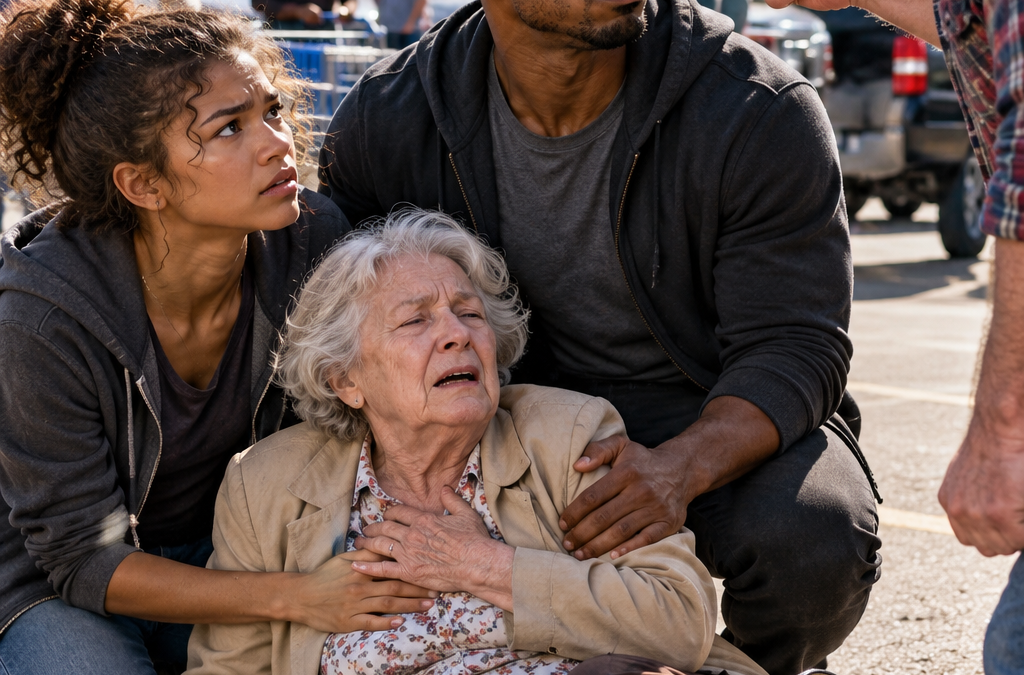
Outside the sliding doors, an older woman had collapsed sideways on a bench.
Her grocery bag lay open on the concrete.
Oranges had rolled across the walkway.
Her hand was pressed against her chest.
The fingers were turning purple.
People were walking around her.
Not everyone.
But enough.
A man in a polo shirt looked down and kept going.
A woman pushing a stroller crossed farther away.
An employee near the entrance stood watching.
I ran to the bench.
“Ma’am?”
Her eyes opened.
“Can you hear me?”
She nodded.
Barely.
“Are you having chest pain?”
Another weak nod.
“Do you have medication?”
Her lips moved.
I leaned closer.
“Nitro.”
“Nitroglycerin?”
“Forgot.”
“Where?”
“Home.”
I looked up.
Across the parking lot, beyond the intersection, I could see the CVS sign.
Then I looked at the woman again.
Her breathing was getting shallower.
I pulled the money from my pocket.
Thirty-eight dollars.
Food.
Naomi’s food.
Mine too, but I wasn’t thinking about mine.
I thought about the nearly empty cabinet at home.
About Naomi’s heart.
About how far thirty-eight dollars could stretch if I bought carefully.
Then the woman made a small choking sound.
That ended the calculation.
I stood.
I pointed at the employee.
“Stay with her.”
He looked startled.
“What?”
“Stay with her. Call 911. Don’t let her get up.”
Then I ran.
Across the parking lot.
Across the intersection.
Into CVS.
By the time I reached the pharmacy counter, I was breathing nearly as hard as the woman outside.
I explained what was happening.
The pharmacist helped me get the medication.
Thirty-one dollars and forty cents.
I stared at the amount for half a second.
Then I handed over the money.
I ran back with six dollars and sixty cents in my pocket.
The woman was still conscious.
I knelt beside her.
“Here.”
I helped place the tablet under her tongue.
Then I held her hand.
“You’re okay.”
I had no idea whether she was okay.
But somebody needed to say it.
“Ambulance is coming.”
Her fingers tightened around mine.
A minute passed.
Then another.
Her breathing began to slow.
Color gradually returned to her lips.
The ambulance arrived seven minutes later.
Two paramedics lifted her onto a stretcher.
One looked at me.
“You family?”
“No.”
“You know her?”
“No.”
He paused.
Then nodded.
As they prepared to close the doors, the woman reached toward me.
I stepped closer.
“What’s your name?”
Her voice was stronger now.
“Elijah.”
She frowned slightly.
“Elijah what?”
“Owens.”
“Elijah Owens.”
She repeated it.
Then again.
Like she was making sure she wouldn’t forget.
The ambulance doors closed.
I stood in the parking lot with six dollars and sixty cents.
My grocery cart was still inside.
I left it there.
Then I walked home.
Naomi was sitting at the kitchen table when I came in.
She looked at my empty hands.
“I thought you were getting groceries.”
“I was.”
“What happened?”
I took the remaining money from my pocket and set it down.
She looked at it.
Then at me.
I told her.
When I finished, I waited for anger.
Instead, Naomi shook her head.
“You spent almost everything?”
“Yeah.”
“On someone you didn’t know?”
“Yeah.”
She stared at me for several seconds.
Then she smiled.
Of all the reactions she could have had, she smiled.
“What?”
“Nothing.”
“Naomi.”
“You really are incapable of minding your own business.”
“Apparently.”
Her smile faded.
“I’m glad you did it.”
“We’ve got six dollars.”
“We’ll figure it out.”
I stared at her.
She raised an eyebrow.
“That’s your answer to everything, remember?”
I laughed.
For one night, six dollars felt survivable.
What I didn’t know was that the woman from the parking lot was named Eleanor Blake.
Seventy-two years old.
She lived in Germantown.
And her son, Harrison Blake, ran Pinnacle Health Group.
The company that owned St. Mary’s General Hospital.
I didn’t learn any of that until later.
At the time, all I knew was that I had saved one stranger and was still losing the person I loved most.
A few days later, I walked into St. Mary’s carrying eleven thousand eight hundred seventy dollars in a white envelope.
It was everything I’d managed to gather.
Truck.
Tools.
Television.
Mom’s ring.
Savings.
Everything.
Naomi came with me.
She sat near the window while I approached the administrative desk.
A woman named Patricia Greer sat behind it.
She looked at me over reading glasses.
“Can I help you?”
“My sister needs heart surgery. Dr. Whitfield referred us.”
“Insurance?”
“No.”
Her eyes moved over my clothes.
My boots.
The envelope.
“Are you the guarantor?”
“Yes.”
“And how do you intend to pay?”
I placed the envelope down.
“I have almost twelve thousand here. I was told we could make a deposit and arrange payments for the rest.”
She opened the envelope.
Counted.
Then pushed it back.
“Minimum deposit is fifty thousand dollars.”
I thought I’d heard wrong.
“Fifty?”
“Correct.”
“I was told ten.”
“I don’t know who told you that.”
“My sister’s doctor said—”
“I’m telling you the hospital policy.”
I looked toward Naomi.
She was watching me.
“Please.”
Patricia’s expression didn’t change.
“My sister is getting worse. I can work. I’ll sign anything. I’ll make payments. I just need to get her scheduled.”
“You don’t meet the financial requirement.”
“I have more than ten thousand.”
“The requirement is fifty.”
“Can I talk to someone else?”
“No.”
Something in me tightened.
Not anger exactly.
Fear wearing anger’s clothes.
“Please.”
She picked up the phone.
“If you continue holding up the counter, I’ll have security escort you out.”
Then a voice behind her said, “He’s not holding up the counter.”
A nurse stepped around the partition.
Young.
Maybe mid-twenties.
Her badge said SOPHIE WELLS.
She looked at Patricia.
“Standard cardiac deposit is ten thousand.”
Patricia slowly turned.
“Sophie.”
“I’ve processed those forms.”
“Return to your station.”
“He has more than the required deposit.”
Patricia removed her glasses.
“You need to return to your station now.”
Sophie didn’t move.
“You’re turning him away when he qualifies.”
Patricia lowered her voice.
“If you want to have a station tomorrow, I suggest you stop talking.”
The lobby went quiet.
Sophie looked at me.
Her jaw tightened.
Then she stepped back.
Patricia faced me again.
“We’re done.”
I wanted to yell.
I wanted to slam the envelope onto the counter.
I wanted to make somebody acknowledge what was happening.
But Naomi was watching.
So I picked up the money.
I walked over to her.
She stood slowly and took my arm.
Outside, we sat on a bench near the bus stop.
A bus came.
Then another.
We didn’t move.
Naomi put her head against my shoulder.
“It’s okay.”
“No, it isn’t.”
“We’ll find another way.”
“How?”
She didn’t answer.
Neither did I.
The next day I found work at a warehouse.
Seven at night until seven in the morning.
Nine dollars and fifty cents an hour.
No benefits.
Cash weekly.
I took it.
Every afternoon I made food for Naomi, checked her face without letting her see me checking, counted her breaths when she rested, then walked forty minutes to work.
I stacked boxes until my arms shook.
Then I walked home.
I stopped eating regularly.
I told Naomi the warehouse gave us meals.
She knew I was lying.
She stopped challenging me because arguing took too much energy.
In two weeks I lost nine pounds.
Naomi got worse faster.
The stairs became an ordeal.
Her lips sometimes looked blue in the morning.
I called charity programs.
Hospital assistance offices.
Churches.
National organizations.
I filled out forms at the library.
I started an online fundraiser.
After six days it had forty-seven dollars.
Most of it came from Brenda at the laundromat.
One night I came home and found Naomi sleeping on the couch.
The apartment looked enormous because almost everything was gone.
No television.
No real furniture.
Bare shelves.
I sat on the floor and took out the one thing I hadn’t sold.
A photograph.
Mom.
Dad.
Naomi.
Me.
All four of us standing in a park.
My father had one arm around me.
My mother was laughing at something outside the frame.
Naomi was fourteen years younger than she was now and missing one front tooth.
I looked at their faces.
Then at my sister sleeping on the couch.
“I’m not losing you too.”
I whispered it.
No one heard.
Three weeks after my first visit to St. Mary’s, Naomi collapsed again.
This time in the shower.
I heard her hit the tub.
I broke the bathroom lock.
She was lying beneath the running water, eyes half-open.
“Naomi!”
I shut off the water.
She blinked.
“I slipped.”
“No, you didn’t.”
“I’m okay.”
“Stop saying that.”
She stared at me.
For the first time, anger came into my voice.
“Stop telling me you’re okay when you’re not.”
Her face crumpled.
“I’m scared, Eli.”
I pulled her against me.
“I know.”
“I don’t want to die.”
That sentence broke something inside me.
She hadn’t said it before.
Neither had I.
We had talked about money.
Doctors.
Schedules.
Hospitals.
We had never said death.
I held her harder.
“You’re not going to.”
“You can’t promise that.”
“I’m promising it anyway.”
Two days later I went back to St. Mary’s.
I had eighteen thousand five hundred dollars.
Three weeks of warehouse pay.
Six hundred Arthur had given me.
Three hundred Brenda had put inside Naomi’s locker.
Every dollar I could find.
Patricia was at the same desk.
She recognized me immediately.
“You again?”
“Yes.”
“I already explained the policy.”
“I have more money.”
She sighed.
“How much?”
“Eighteen five.”
“Then you still don’t have enough.”
She didn’t even look at it.
“My sister collapsed again.”
“Mr. Owens—”
“She doesn’t have months.”
“The hospital has financial standards.”
“Can I speak to someone above you?”
“I’m the person you speak to.”
A woman in a white linen jacket entered behind me.
Patricia’s expression changed instantly.
Her voice became warm.
“Good morning. Welcome to St. Mary’s.”
The woman said she was there about her husband’s knee replacement.
“Of course,” Patricia said. “Would you like coffee while you wait?”
Coffee.
I stood there holding eighteen thousand five hundred dollars while the woman who wouldn’t even touch my money offered somebody else coffee.
Maybe there are moments when you know something is wrong before you can prove it.
That was one of them.
I picked up the pouch.
I turned toward the doors.
A hand touched my arm.
Sophie.
“Come with me.”
She led me into a hallway.
Her voice was low.
“The deposit is ten thousand.”
I looked at her.
“I know you said that before.”
“I’m telling you again because she’s lying to you. The hospital policy is ten. It has always been ten.”
“Why?”
Sophie hesitated.
“I’ve seen her do this before.”
“Do what?”
“Change requirements.”
“For who?”
She looked toward the lobby.
“For certain people.”
I understood.
I didn’t want to.
But I did.
She pulled a folded paper from her pocket.
“Patient advocacy. Call them. Report both visits.”
I took the paper.
Then I handed it back.
“Why?”
“I don’t have time.”
“They can investigate.”
“Exactly.”
I gestured toward the lobby.
“You know what an investigation means? Forms. Meetings. Phone calls. Weeks.”
I swallowed.
“My sister is passing out in the shower.”
Sophie’s eyes filled.
“I just need somebody to operate on her before her heart quits.”
She looked down at the paper.
“I’m sorry.”
“Don’t be.”
I forced myself to smile.
“You’re the only person here who treated me like I belonged in the building.”
I left.
When I got home, the apartment was silent.
Too silent.
“Naomi?”
Nothing.
I walked faster.
“Naomi?”
Then I saw the broken glass.
She was on the kitchen floor.
Face down.
One hand stretched toward the counter.
I dropped the pouch.
“Naomi!”
I rolled her over.
For one terrible second, I couldn’t tell if she was breathing.
Then I felt a pulse.
Weak.
Uneven.
But there.
Her eyelids fluttered.
“I was getting water.”
“Don’t talk.”
“I’m sorry.”
“Don’t apologize.”
“I broke the glass.”
“I don’t care about the glass.”
I carried her to bed.
She felt too light.
That frightened me almost as much as her heartbeat.
I sat beside her until she fell asleep.
Then I went outside.
There was one plastic chair left on our porch.
I sat down.
And I cried.
I hadn’t cried like that when Dad died.
I hadn’t cried like that when Mom died.
Back then, Naomi had needed me.
There had been paperwork.
Court.
School.
Rent.
No room to collapse.
That night there was nothing left holding me upright.
I cried for my sister.
For my mother.
For the ring.
For the truck.
For the tools.
For every hour I’d worked.
For the envelope pushed back across the hospital counter.
For eighteen thousand five hundred dollars that somehow couldn’t buy the right to be treated like everyone else.
Mostly, I cried because I had spent eight years believing that if I worked hard enough, sacrificed enough and refused to quit, I could protect Naomi.
Now I was beginning to understand that love didn’t make me powerful.
It only gave me more to lose.
When I finally went inside, I lay on the bare living-room floor.
I didn’t sleep.
At 8:12 the next morning, a black Lincoln Navigator pulled up outside.
I heard the tires on the gravel.
A man stepped out.
Dark gray suit.
Polished shoes.
Silver watch.
He walked toward the porch.
I stood.
“Elijah Owens?”
“Who’s asking?”
“My name is Harrison Blake.”
Nothing.
Then he said, “My mother is Eleanor Blake.”
Still nothing.
“You helped her outside Walmart.”
The bench flashed into my mind.
Purple fingers.
Oranges on concrete.
Nitroglycerin.
“Is she okay?”
His face softened.
“She’s alive because of you.”
I let out a breath.
“I’m glad.”
“She told me your name eleven times.”
I almost smiled.
“She wanted to make sure I remembered.”
“She succeeded.”
He looked toward the apartment.
“Can I come inside?”
I hesitated.
There was nothing inside I wanted a stranger in a suit to see.
Bare walls.
Empty rooms.
Poverty has a strange shame attached to it even when you did nothing shameful to become poor.
But I opened the door.
Harrison walked inside.
He looked around.
Not rudely.
Not with pity.
Just quietly.
Naomi’s bedroom door opened.
She stepped into the hallway.
“Eli?”
“This is Harrison Blake.”
I looked at her.
“His mother was the woman outside Walmart.”
Her eyes widened.
Harrison looked at Naomi.
Then at me.
“I know about the surgery.”
My body stiffened.
“What?”
“I know she needs a mitral valve repair. I know the estimated cost. I know you sold your truck and your tools.”
His eyes moved toward the shelf.
“I know about your mother’s ring.”
“How?”
“When somebody spends his last grocery money saving my mother’s life and disappears without asking for anything, I find out who he is.”
My voice hardened.
“You investigated me?”
“Yes.”
I didn’t like it.
He could see that.
Then he said, “I also know St. Mary’s turned you away.”
I said nothing.
Harrison took a breath.
“Pinnacle Health Group owns St. Mary’s.”
I stared at him.
“My company owns thirty-one hospitals, including that one.”
Behind me, Naomi gripped the door frame.
Harrison continued.
“Your sister’s surgery will be covered.”
I heard the words.
I didn’t understand them.
“What?”
“All of it. Surgery. Hospitalization. Recovery. Follow-up care.”
Naomi put a hand over her mouth.
“No cost to either of you.”
I looked at him for so long my eyes began to hurt.
“Why?”
“Because it’s the right thing to do.”
“You don’t owe me.”
“I know.”
“I didn’t help your mother because I expected something.”
“I know that too.”
“Then why?”
He stepped closer.
“Because my mother told me something after she got home.”
He paused.
“She said dozens of people saw her in trouble. You were the one person who stopped.”
I looked away.
“You had thirty-eight dollars.”
He knew that too.
“You spent almost all of it on her.”
“She needed medicine.”
“Exactly.”
He reached into his jacket and placed a business card beside our family photograph.
“You did the right thing when doing it cost you something.”
He looked at me.
“That’s character, Mr. Owens.”
My throat closed.
For weeks I had begged.
Explained.
Worked.
Sold.
Borrowed.
Pleaded.
Now a stranger was standing in my empty apartment telling me Naomi was going to get the surgery.
I wanted to thank him.
Nothing came out.
Naomi did it for both of us.
“Thank you.”
Her voice trembled.
Then again.
“Thank you.”
The next morning, Harrison drove us to St. Mary’s himself.
Naomi sat in the back seat.
I rode beside Harrison.
Another car followed us.
Inside were Victoria Chase, his attorney, and Dr. Leonard Graves, the chief medical officer for Pinnacle Health Group.
I didn’t know why they were coming.
Harrison didn’t explain.
When we pulled into the hospital lot, I stared through the windshield.
Same building.
Same doors.
Same place where I’d walked out twice carrying money they refused to accept.
“You ready?” Harrison asked.
“I’ve been ready.”
We entered together.
The security guard recognized me.
Then he recognized Harrison.
His eyes widened.
He stepped aside.
Patricia Greer was behind the desk.
She saw me first.
Her mouth tightened.
Then she saw Harrison.
Everything changed.
Color left her face.
Her shoulders dropped.
She knew exactly who he was.
Harrison didn’t speak to her.
He asked for the hospital director.
Three minutes later, Dr. Thomas Reed came downstairs.
He looked nervous before anyone had accused him of anything.
“Mr. Blake. We weren’t expecting—”
“Conference room.”
That was all Harrison said.
We went upstairs.
Long table.
Glass walls.
A screen at one end.
Harrison sat at the head.
Victoria opened her laptop.
Dr. Graves placed folders beside him.
Naomi and I sat near the door.
Harrison looked at Dr. Reed.
“I want eighteen months of cardiac intake records.”
Dr. Reed shifted.
“For what purpose?”
“Deposit requirements.”
“Our hospital follows established—”
“Pull the records.”
Dr. Reed did.
Within ten minutes, the standard policy was on the screen.
Ten thousand dollars.
I stared at the number.
Ten.
Not fifty.
Ten.
Victoria began comparing cases processed through Patricia’s desk.
Twenty thousand.
Thirty-five.
Fifty.
Not everyone.
Certain patients.
Again and again.
Then my name appeared.
ELIJAH OWENS.
Deposit required: $50,000.
Beside it was the hospital standard.
$10,000.
For a second I couldn’t breathe.
Not because I was surprised.
Because proof hurts differently than suspicion.
Dr. Reed looked sick.
Harrison turned toward him.
“Did you authorize this?”
“No.”
“Did anyone?”
“No.”
“Then why did it happen?”
Dr. Reed didn’t answer.
Harrison asked for Sophie.
She entered several minutes later.
When she saw me, she stopped.
Then she noticed the records.
She understood.
Harrison gestured toward a chair.
“Ms. Wells, please sit.”
She did.
“Tell us what happened during Mr. Owens’s visits.”
Sophie described everything.
The first envelope.
The twelve thousand dollars.
Patricia’s fifty-thousand-dollar demand.
The threat when Sophie challenged her.
Then my second visit.
The eighteen thousand five hundred.
The same refusal.
The hallway.
The patient advocacy number.
“Why didn’t Mr. Owens report it?” Harrison asked.
Sophie looked at me.
“He said he didn’t have time to fight the hospital.”
Her voice became quieter.
“He said his sister didn’t have months.”
The room went silent.
I looked down at my hands.
Harrison let the silence sit.
Then he said, “Bring Ms. Greer in.”
Patricia entered without her glasses.
She sat across from Harrison.
He didn’t shout.
I think shouting would have made it easier for her.
Instead, he spoke calmly.
“Ms. Greer, the standard deposit for cardiac surgery at this hospital is ten thousand dollars.”
She said nothing.
“You required Mr. Owens to produce fifty thousand.”
“I was exercising financial discretion.”
“Under which policy?”
Silence.
Victoria turned her laptop toward Patricia.
“This spreadsheet shows multiple altered deposit requirements associated with your intake decisions.”
Patricia looked at the screen.
Harrison continued.
“The increases disproportionately affected Black and Hispanic patients.”
Patricia straightened.
“I reject that characterization.”
“Then explain the pattern.”
“I was protecting the hospital from financial risk.”
“By inventing requirements?”
“I made judgment calls.”
“You denied a medically necessary procedure to a patient whose family had already exceeded the actual deposit requirement.”
“Sir—”
“You did it twice.”
Patricia looked toward Dr. Reed.
He wouldn’t meet her eyes.
Harrison’s voice hardened.
“And when a nurse told the truth, you threatened her job.”
Patricia turned toward Sophie.
For the first time since I’d met her, she looked afraid.
Harrison folded his hands.
“Your employment is terminated effective immediately.”
She blinked.
“You can’t—”
“I can.”
“I’ve worked here for seventeen years.”
“Then you had seventeen years to understand what this institution was supposed to be.”
Her face tightened.
“I was doing my job.”
“No.”
Harrison looked directly at her.
“You were using your job to decide who deserved access to care based on standards that existed only when you wanted them to.”
Patricia stood.
The chair scraped loudly against the floor.
She looked at me.
There was anger in her eyes.
Maybe humiliation.
I expected to feel victorious.
I didn’t.
I just felt tired.
Security escorted her out.
The door closed.
Harrison turned toward Dr. Reed.
“Naomi Owens will be scheduled for surgery this week.”
“Absolutely.”
“Dr. Graves will supervise the case.”
“Of course.”
Then Harrison looked at Sophie.
“Ms. Wells.”
She sat straighter.
“Yes, sir?”
“Beginning Monday, I want you supervising patient admissions.”
Her mouth opened.
“What?”
“You knew the policy. You challenged misconduct. You risked your position rather than participate in it.”
He glanced toward Victoria.
“HR will discuss the title and salary with you.”
Sophie looked at me.
I smiled.
Just a little.
She had been the only person behind that counter who saw me as a brother trying to save his sister instead of a problem to remove.
Now she would sit on the other side of that desk.
Naomi’s surgery was scheduled four days later.
The night before, I sat beside her hospital bed.
She couldn’t sleep.
Neither could I.
“You scared?” I asked.
She looked at me.
“Are you?”
“Terrified.”
She smiled.
“Me too.”
I reached for her hand.
After a while she said, “Eli?”
“Yeah?”
“If something happens—”
“No.”
“Listen.”
“No.”
“Elijah.”
I looked at her.
She had tears in her eyes.
“If something happens, you have to live.”
My throat tightened.
“Nothing’s happening.”
“You can’t stop every bad thing.”
“I can try.”
“You’ve been trying since you were twenty.”
She squeezed my hand.
“You raised me.”
I looked away.
“You gave me everything.”
“Don’t talk like this.”
“I need you to hear it.”
I shook my head.
She continued anyway.
“You were my brother when Mom and Dad were alive.”
Her voice trembled.
“After they died, you became everything else.”
I closed my eyes.
“I don’t know what I would have done without you.”
“You never needed to know.”
She smiled through tears.
“Exactly.”
The next morning they took her away at 10:03.
The doors closed.
I sat down.
Four hours and eleven minutes.
That’s how long the surgery took.
I counted every minute.
Sophie brought me coffee.
I held it.
Never drank it.
Harrison called once.
Eleanor called twice.
Arthur came by and sat beside me for forty minutes without saying much.
Brenda arrived still wearing her laundromat uniform.
No one told me I was alone.
At 2:34, Dr. Graves walked through the doors.
I stood so fast my chair almost fell.
He removed his surgical cap.
Then he smiled.
“The valve is repaired.”
My knees weakened.
“She’s okay?”
“She’s going to be okay.”
I covered my face.
For several seconds I couldn’t speak.
I’d imagined that moment so many times.
I thought I’d shout.
Cry.
Thank God.
Thank the doctor.
Do something dramatic enough to match the size of the relief.
Instead, I breathed.
One breath.
Then another.
Then another.
Naomi woke several hours later.
I was beside her.
Her eyes opened slowly.
She looked at me.
“You look terrible.”
I laughed.
“You just had open-heart surgery.”
“And somehow you’re still the ugly one.”
That was my sister.
I bent over and pressed my forehead against her hand.
“You scared me.”
“I know.”
“Don’t ever do that again.”
“I’ll schedule my future medical emergencies around your preferences.”
She tried to laugh.
Pain stopped her.
I laughed enough for both of us.
Harrison came the next afternoon.
He carried a folder.
“What’s that?” I asked.
“Something I’d like you to consider.”
He handed it over.
Pinnacle Health Group.
Facilities maintenance.
Full-time.
Benefits.
Health insurance.
I closed the folder.
“No.”
His eyebrows lifted.
“No?”
“I don’t want a charity job.”
“It isn’t.”
“You barely know me.”
“I know enough.”
“Harrison—”
“I manage thousands of employees.”
He sat across from me.
“Skills can be taught. Procedures can be taught. Technical systems can be taught.”
He pointed toward the folder.
“Integrity is harder.”
I said nothing.
“You know plumbing. You know maintenance. You know what it means to work.”
He looked toward Naomi.
“And I know exactly what you do when someone needs help and nobody is watching.”
I stared at the folder.
“It’s a real job?”
He almost looked offended.
“Very real.”
“Then why me?”
“Because I want you working for me.”
Naomi spoke from the bed.
“Take the job.”
I looked at her.
She lifted an eyebrow.
“You sold your truck, genius.”
I laughed.
“Apparently I need employment.”
“Apparently.”
I signed.
Eleanor Blake visited the following day.
The moment I saw her, I recognized the woman from the bench.
She carried homemade soup and yellow daisies.
When I entered Naomi’s room, Eleanor stood and wrapped both arms around me.
I froze.
Then hugged her back.
“You ran very fast,” she said.
I laughed.
“I was scared.”
“So was I.”
She held my shoulders.
“You saved my life.”
“The medication did most of the work.”
“No.”
She shook her head.
“Medicine doesn’t run across parking lots by itself.”
Then she sat beside Naomi.
Within twenty minutes they were talking like relatives.
Recipes.
Television.
Memphis heat.
Naomi showed Eleanor how to use a streaming app on her phone.
Eleanor complained that technology was designed by people who hated old women.
Naomi laughed so hard a nurse told her to stop.
I stood near the window listening.
For months, every sound Naomi made had frightened me.
A cough.
A gasp.
A pause.
That afternoon, she laughed.
And for the first time, I didn’t hear danger.
I heard a future.
Naomi came home on a Wednesday.
Harrison drove us.
When I opened our apartment door, I stopped.
There was a couch inside.
A table.
Two chairs.
A lamp.
Nothing expensive.
Nothing excessive.
Just a home again.
I turned.
“Harrison.”
He raised both hands.
“Not me.”
“Who?”
He glanced at Eleanor.
She looked innocent.
Very badly.
I shook my head.
Naomi walked in slowly, smiling.
Then I saw the shelf.
The family photograph was still there.
Beside it sat a small wooden box.
My chest tightened.
I knew that box before I touched it.
“No.”
I crossed the room.
Opened it.
Inside was my mother’s silver ring.
Thin band.
Small oval stone.
Exactly as I remembered it.
I stared at it.
I couldn’t move.
Harrison spoke behind me.
“We found the pawn shop.”
I lifted the ring.
“You bought it back.”
“Eleanor insisted.”
His mother shrugged.
“I can be very difficult.”
I laughed through tears.
I held that ring in my palm and looked at the photograph beside it.
Dad.
Mom.
Naomi.
Me.
For eight years, I’d thought surviving meant holding on to whatever remained.
Then everything started disappearing.
My parents.
My truck.
My tools.
My mother’s ring.
Almost my sister.
But standing there, I understood something I hadn’t understood before.
Not everything lost stays lost.
Some things return differently.
Naomi recovered slowly.
There were medications.
Follow-up appointments.
Physical therapy.
Bad days.
Good days.
The first time she climbed the apartment stairs without stopping, she reached the top and turned around with tears in her eyes.
I pretended not to notice mine.
Three months after surgery, she told me she had reapplied to college.
I looked at her across the kitchen table.
“What changed?”
She smiled.
“I decided I’m tired of letting money make every decision for me.”
“What do you want to study?”
“Nursing.”
That surprised me.
“Seriously?”
“I met a good one.”
I knew immediately.
“Sophie.”
Naomi nodded.
“People remember who helps them when they’re scared.”
I looked down at my dinner.
“Yeah.”
“They do.”
Sophie transformed admissions at St. Mary’s.
Not overnight.
Real institutions don’t change because one bad employee leaves.
Harrison ordered a broader review.
Policies were standardized.
Deposit decisions required documentation.
Appeals could no longer disappear behind a single person’s desk.
Several families whose cases had been mishandled were contacted.
Some situations couldn’t be repaired.
That was the hardest truth.
Stopping an injustice doesn’t erase everyone who suffered before someone finally stopped it.
But it mattered.
It had to.
I started at Pinnacle two weeks after Naomi came home.
The first morning, I wore new work boots.
No duct tape.
I almost missed the old ones.
Almost.
The job wasn’t glamorous.
Broken fixtures.
Pressure problems.
Cooling systems.
Maintenance inspections.
Emergency leaks.
Things I understood.
Eventually they let me supervise a small team.
Harrison never treated me like I owed him.
That mattered more than he probably understood.
Eleanor started calling on Sundays.
At first she asked about Naomi.
Then she started calling to complain about Harrison.
Apparently running thirty-one hospitals didn’t prevent a grown man from forgetting to call his mother.
“Tell him I’m eighty.”
“You’re seventy-two.”
“That’s irrelevant.”
Sometimes she brought groceries.
Sometimes soup.
Once she brought six bags of food and claimed she had “accidentally bought too much.”
Naomi looked inside.
“Eleanor, there are three cartons of milk.”
“I was distracted.”
“Four loaves of bread?”
“Very distracted.”
We stopped arguing with her.
One Sunday, months after the surgery, I was putting Mom’s ring back into the wooden box when Naomi came into the room.
She leaned against the doorway.
“You know what I think Mom would say?”
I closed the lid.
“What?”
“She’d be mad you sold it.”
I smiled.
“Definitely.”
“Then she’d be mad you didn’t sell it sooner.”
I laughed.
“Also definitely.”
Naomi came over and sat beside me.
For a moment we looked at the photograph.
“I thought I was going to die,” she said.
The words were quiet.
I looked at her.
“When?”
“All the time.”
She traced one finger along the edge of the frame.
“I just didn’t want to tell you.”
“Why?”
“Because you already looked scared.”
I swallowed.
“I was.”
“I know.”
She leaned her head on my shoulder the same way she had the night she discovered Mom’s ring was gone.
“You know what the weirdest thing is?”
“What?”
“None of this happens if you keep walking.”
I knew exactly what she meant.
The Walmart parking lot.
Eleanor.
Thirty-eight dollars.
I thought about that morning often.
Not because I believed helping Eleanor had somehow earned Naomi’s surgery.
Life isn’t a vending machine.
You don’t insert kindness and receive miracles.
Good people suffer every day.
Cruel people sometimes prosper.
I knew that before.
I knew it even better afterward.
What stayed with me was simpler.
That morning, I had believed I possessed thirty-eight dollars.
In reality, I possessed a choice.
Everyone around that bench had one.
The man with the phone.
The woman with the stroller.
The employee by the door.
Me.
I wasn’t better than them.
I was scared.
I was broke.
My sister was sick.
I had every reason to protect what little I had.
Thirty-eight dollars was food.
Thirty-eight dollars was survival.
Thirty-eight dollars mattered.
But there was a woman in front of me who couldn’t breathe.
For three seconds, two realities existed at once.
My sister needed me.
And a stranger needed me.
I couldn’t solve both problems.
So I solved the one happening directly in front of me.
I ran.
That’s all.
I ran.
Years later, people would sometimes tell the story differently.
They’d make it sound heroic.
A poor man sacrifices his final dollars.
A wealthy stranger repays him.
A corrupt employee is exposed.
A sister survives.
Neat.
Balanced.
Almost like everything happened because the universe keeps accounts.
I never saw it that way.
I remembered the ugly parts.
I remembered Naomi unconscious beneath running shower water.
I remembered Mom’s ring leaving my hand.
I remembered Patricia sliding my envelope back across the counter.
I remembered crying on a cracked concrete porch because I thought love had finally demanded more from me than I could give.
Those things mattered too.
Maybe more.
Because courage doesn’t usually feel like courage when you’re living through it.
It feels like fear.
It feels like exhaustion.
It feels like standing in front of a pharmacy counter knowing the money in your hand was supposed to feed the person you love.
It feels like walking back into a hospital that humiliated you because your sister has no time left.
It feels like begging when pride tells you not to.
It feels like getting out of bed after another door closes.
Naomi eventually started nursing school.
On her first day, I drove her.
Yes, drove.
I’d bought another truck by then.
Used.
Nothing special.
She climbed out wearing blue scrubs and carrying a backpack.
Before closing the door, she looked back at me.
“You crying?”
“No.”
“You are.”
“Sun’s in my eyes.”
“It’s cloudy.”
“Get to class.”
She grinned.
Then she closed the door.
I watched her walk toward the building.
Strong.
Alive.
Her heart working the way it should.
That was enough.
More than enough.
When I got home that evening, I placed my keys on the shelf.
Mom’s ring sat beside the old family photograph.
I picked it up.
For a second, I remembered the pawn shop.
The man telling me the stone wasn’t worth much.
He had been right in one sense.
You could measure silver.
You could price a stone.
You could put numbers beside a truck, a tool kit, a television, a hospital procedure.
But some values exist outside numbers.
My mother’s ring had been worth one hundred twenty dollars to a pawn shop.
To me, it was twenty years of her life.
Thirty-eight dollars had been one week of groceries.
To Eleanor, it became breath.
Eighteen thousand five hundred dollars had been everything I could gather.
To Patricia Greer, it wasn’t enough to let me through a door.
A ten-thousand-dollar hospital policy had been written clearly on paper.
One person’s prejudice had turned it into fifty.
For months, money seemed to decide everything.
Who got treated.
Who waited.
Who ate.
Who worked.
Who lived with fear.
But in the end, the moments that changed us weren’t really about money.
Sophie risked her job without being paid to.
Arthur gave me six hundred dollars and refused repayment.
Brenda quietly left money in Naomi’s locker.
Eleanor remembered the name of a stranger.
Harrison used power he already had to correct something that should never have happened.
And Naomi, after everything, chose a profession where frightened people would someday look toward her for help.
I closed my hand around Mom’s ring.
From the kitchen, Naomi called my name.
“Eli?”
“Yeah?”
“You cooking?”
“I was considering it.”
“Please reconsider.”
I laughed.
“You’re very disrespectful for somebody whose life I’ve spent saving.”
She appeared around the corner.
“Your noodles have nearly killed me more times than my heart.”
“That’s medically inaccurate.”
“I’m studying nursing now. I outrank you.”
“You’ve been in school one day.”
“Still counts.”
I looked at her.
Healthy color in her face.
Energy in her voice.
No hand pressed against her chest.
No pause to catch her breath.
Just Naomi.
My little sister.
Alive.
I put Mom’s ring back beside the photograph and walked into the kitchen.
For years, I had believed my responsibility was to keep Naomi from losing anything else.
After our parents died, I tried to build walls around what remained.
Work harder.
Spend less.
Sacrifice more.
Control every disaster before it arrived.
I couldn’t.
No one can.
What I learned instead was that sometimes survival comes through people you never expected.
An old plumber.
A laundromat coworker.
A young nurse who refuses to stay quiet.
A frightened woman on a supermarket bench.
Her son.
A stranger.
Sometimes the person you save cannot save you.
Sometimes they can.
But that isn’t why you stop.
You stop because they’re there.
Because they’re hurting.
Because you can do something.
Even if it costs you.
Especially when it costs you.
I had thirty-eight dollars in my pocket that morning outside Walmart.
For three seconds, I thought those thirty-eight dollars were the last thing standing between my sister and hunger.
I was wrong.
The last thing standing between all of us and something worse was whether somebody would decide another person’s life mattered enough to inconvenience their own.
I made that decision once for Eleanor.
Sophie made it for me.
Harrison made it for Naomi.
And months later, standing in our kitchen while my sister insulted my cooking and laughed like she had all the time in the world, I finally understood why the memory of that parking lot never left me.
It wasn’t because kindness had rewarded me.
It wasn’t because thirty-eight dollars had somehow come back multiplied.
It was because when everything in my life had been reduced to numbers—two hundred eighty-five thousand dollars, ten thousand dollars, fifty thousand dollars, thirty-eight dollars, six dollars and sixty cents—one human being needing another had still meant more than any of them.
Naomi opened a cabinet.
“Do we have pasta?”
“Yeah.”
“Beans?”
“Yeah.”
“Actual vegetables?”
I looked at her.
“Let’s not get reckless.”
She laughed.
I smiled.
Outside, evening settled over Bellwood Lane.
Inside, our apartment was no longer empty.
There was a couch.
A table.
Food in the cabinets.
My mother’s ring on the shelf.
And my sister standing in the kitchen with a repaired heart and plans for tomorrow.
For a long time, tomorrow had terrified me.
That night, I couldn’t wait to see it.








