PART 2: HOA Karen Tried to Steal My Boat—She Had No Idea I’d Been Waiting for Her to Try
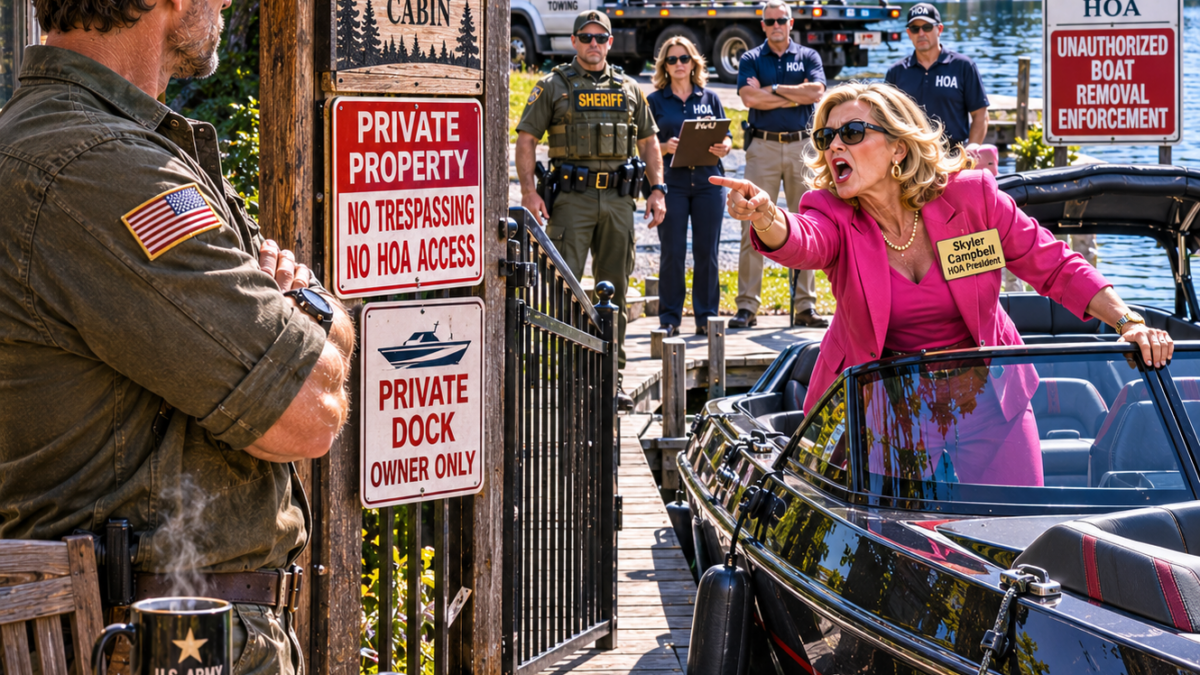
The first time Skyler Campbell tried to take my boat, I was standing inside my late uncle’s lakeside cabin with a cup of coffee going cold in my hand, watching the HOA president slip through a locked private gate, ignore two NO TRESPASSING signs, and climb aboard a matte-black electric boat she had already been told—on camera, in writing, and to her face—did not belong to her community.
What made it worse was that this wasn’t some drunken mistake or confused neighbor borrowing the wrong kayak; Skyler had spent weeks trying to turn my dock into an “honorary HOA zone,” scheduling weddings and baptisms on land outside Lakeview Serenity, photographing my locks, sending committees to pressure me, and finally deciding that if I would not hand over access voluntarily, she would simply create the access herself.
I could have called the sheriff the moment she touched the console, but after twenty-two years in uniform I had learned that some people only stop testing a boundary when the boundary answers back, so I watched her reach for the ignition and waited to see whether she would make the one choice I had quietly prepared for.
My name is Benjamin Reed, and I moved to the lake because I was tired of people telling me where I was allowed to stand.
For twenty-two years, I wore a uniform. I slept in deserts, jungles, barracks, temporary tents, and once in the back of a transport truck during a storm that turned the road into soup. I learned how to follow orders, give orders, and survive organizations where a clipboard could sometimes cause more damage than a rifle if the wrong person held it.
When my uncle died, he left me a small cabin on the edge of Serenity Cove.
The place was old but solid—cedar siding, stone fireplace, narrow dock, and enough pine trees to make the rest of the world disappear.
More important, it sat outside the Lakeview Serenity HOA.
I checked.
Twice.
The deed was clean. The parcel map was clear. No covenants. No shared-access easement. No “community shoreline” language hidden in tiny print.
For three days, I had exactly what I wanted.
Coffee before sunrise.
Repair work during the day.
Fishing at dusk.
Then I heard sandals scraping up my gravel path.
Skyler Campbell introduced herself with a laminated PRESIDENT badge, oversized sunglasses, and a clipboard thick enough to require its own zip code.
“Welcome to Lakeview Serenity,” she said brightly.
“I’m not in Lakeview Serenity.”
Her smile tightened.
“Oh, technically your parcel sits outside the association, but this cove has always functioned as a shared shoreline.”
“Technically is doing a lot of work in that sentence.”
She ignored that.
Skyler explained that residents had historically used my dock for barbecues, sunset socials, baptisms, and occasional weddings.
I pointed toward twelve beer cans I had collected from beneath the deck the previous morning.
“Your traditions leave trash.”
“That could have been teenagers.”
“Then your teenagers trespassed.”
She clicked her pen.
“We prefer not to use words like that among neighbors.”
“I’m comfortable with it.”
That was the beginning.
Within a week, she asked me to leave my gate open on weekends.
Then she tried to assign me “personal boating days” on Tuesdays and Thursdays while reserving Saturdays for community access.
Then a flyer appeared showing an actual photograph of my dock beneath the words TRADITIONALLY OPEN TO ALL.
I installed gates.
Skyler photographed them.
I installed cameras.
She complained they created a “hostile aesthetic.”
I posted another sign.
PRIVATE PROPERTY — INCLUDING CLIPBOARD CARRIERS.
That one she really hated.
But what interested me wasn’t the anger.
It was the pattern.
She wasn’t arguing anymore.
She was studying.
The locks.
The camera angles.
The dock.
And especially the boat tied beneath the boathouse.
Ghost was a quiet electric craft I had built during long stretches between deployments, part hobby, part therapy, and probably the only machine I had ever trusted more than most people.
One afternoon Skyler leaned over my railing and stared at it.
“Beautiful boat,” she said.
“Thanks.”
“Would be perfect for community sunset cruises.”
“No.”
Her jaw tightened.
“You really don’t understand how things work here.”
I looked at her reflected in the black hull.
“No, Skyler. I think I finally do.”
That night, I stopped thinking about how to keep her away from Ghost.
I started thinking about what would happen if she convinced herself she had the right to take it.
PART 2
Ghost hadn’t been designed as a trap.
That part mattered to me.
She had been designed because, during the last years of my military career, I needed something that made sense when everything else felt temporary.
Orders changed.
Bases changed.
People came and went.
You learned not to get attached to rooms, vehicles, schedules, or even the coffee mug you liked, because sooner or later somebody packed it, reassigned it, broke it, or transferred you somewhere you hadn’t planned to be.
Machines were different.
A machine did exactly what its engineering allowed.
If something failed, you traced the failure.
If something worked, there was a reason.
Ghost had started as sketches during quiet nights overseas.
Low-noise electric drive.
Redundant navigation.
Geofenced return function.
A safety mode that could take control if the operator lost consciousness or wandered beyond a programmed area.
By the time I retired, I had turned those sketches into a real boat.
Matte-black fiberglass.
Low profile.
Silent motor.
Nothing flashy.
My uncle saw her once before he died.
He walked around the hull twice, rubbed his chin, and said, “Looks like something Batman would use to catch trout.”
Coming from him, that was high praise.
The safety system was the feature Skyler didn’t know about.
If Ghost detected an unauthorized startup, she would refuse normal manual control and enter a slow geofenced holding pattern until the owner authenticated or activated the return sequence.
It wasn’t violent.
It wasn’t fast.
It wasn’t designed to strand anyone in danger.
There was a clearly marked emergency return control on the console.
There were life jackets under both seats.
There was a radio beacon.
And the automated speed was slower than most fishing boats idling through a marina.
I’d built it because boats get stolen.
Not because HOA presidents do.
At least, I hadn’t expected that part.
***
The next morning, I walked the entire property.
Road gate.
Lakeside gate.
Dock.
Boathouse.
Cameras.
Everything was exactly where it should be.
The lake sat flat and gray under early fog.
For a while, I wondered whether I had started thinking like I was still deployed—looking for an attack simply because somebody had irritated me.
Skyler was obnoxious.
Entitled.
Pushy.
But would she actually steal a boat?
That sounded ridiculous.
Then I checked the camera from the previous afternoon.
After leaving my dock, Skyler had walked twenty yards up the trail.
Stopped.
Turned around.
Taken three photographs of Ghost.
Then two photographs of the boathouse door.
Then one of the gate latch.
Not scenery.
Details.
I watched twice.
After twenty-two years in uniform, you learn to separate paranoia from pattern.
One strange thing is paranoia.
Three repeated things start becoming intelligence.
I opened my notebook.
**June 14 — 1638. Campbell photographs boat, boathouse entrance, gate latch after being explicitly denied use.**
Then I underlined the last four words.
**Explicitly denied use.**
If anything happened, that would matter.
***
Skyler returned two days later.
Not alone.
She arrived with Debbie Miller and Carol Simmons, the two women who seemed to materialize whenever Lakeview Serenity required a committee.
Debbie had the visor.
Carol had the Chihuahuas.
Both dogs wore tiny life jackets.
That was new.
The bell on my gate rang.
I walked down carrying coffee.
Skyler smiled.
“Benjamin.”
“Skyler.”
Debbie pointed toward the dogs.
“We’re doing a shoreline-safety assessment.”
“Your dogs?”
“They participate.”
“Of course they do.”
Carol looked offended.
“They’re certified emotional-support animals.”
One Chihuahua growled at a pinecone.
I kept my opinion to myself.
Skyler held up a clipboard.
“We’re planning the community sunset cruise for next Sunday.”
“Not from here.”
“We haven’t determined the launch point.”
“I have.”
She ignored me.
“We’d like to inspect your dock for accessibility.”
“No.”
“Benjamin.”
“No.”
“Would you at least allow us to examine the boat?”
“No.”
Debbie looked toward Ghost.
“Is it insured?”
“Yes.”
“Registered?”
“Yes.”
“Does it meet noise regulations?”
“It’s electric.”
Carol smiled nervously.
“Could probably fit six people.”
“Four.”
Skyler glanced at her.
I shouldn’t have answered.
That tiny piece of information pleased her too much.
“Four,” she repeated.
Then she looked toward Ghost again.
“Perfect for board tours.”
“No board tours.”
Skyler lowered the clipboard.
“You always say no before hearing the proposal.”
“Because every proposal ends with you using something I own.”
“That’s not fair.”
“It’s extremely fair.”
Her smile disappeared.
“We’re trying to include you.”
“I don’t want inclusion.”
“That’s unhealthy.”
“I spent twenty-two years in organizations. I’m enjoying unhealthy.”
Debbie sighed.
“Mr. Reed, surely you understand community property—”
I held up one finger.
“Stop.”
She stopped.
“My dock isn’t community property.”
Then another finger.
“My land isn’t community property.”
A third.
“My boat definitely isn’t community property.”
Skyler’s cheeks colored.
“No one said it was.”
“You just asked to use it.”
“As part of a cooperative arrangement.”
“Which I declined.”
She looked over my shoulder.
The camera above the boathouse blinked red.
Her eyes moved to it.
Then back to me.
“You record everything?”
“On my property.”
“That seems paranoid.”
“So does bringing life jackets for dogs to inspect a dock you don’t own.”
Carol looked at the dogs.
For half a second, even she seemed to reconsider her morning.
Skyler turned.
“Come on.”
Before leaving, she said quietly:
“You can’t live beside a community and pretend you’re separate forever.”
I answered just as quietly.
“Watch me.”
***
That night, I had trouble sleeping.
Not because I feared Skyler.
Because she reminded me of something I had tried to leave behind.
People who viewed resistance as malfunction.
In the military, good leaders understood authority had boundaries.
Bad ones treated every disagreement as disrespect.
Skyler didn’t have military authority.
She barely had HOA authority.
But psychologically, she operated the same way.
The rule wasn’t:
**This is within my jurisdiction.**
The rule was:
**I want this, therefore resistance is inappropriate.**
That kind of person rarely stopped because someone explained the line politely.
They stopped when crossing it became expensive.
Legally.
Socially.
Professionally.
Sometimes embarrassingly.
I looked toward Ghost’s status display on my phone.
Battery 94%.
GPS active.
Safety-return system tested.
Everything normal.
I didn’t change anything that night.
That mattered too.
I wasn’t going to create something dangerous.
I wasn’t wiring a trap.
I wasn’t disabling controls.
Ghost already had the unauthorized-start safety behavior she had always possessed.
All I did was make sure it worked.
***
The following Thursday, a man named Logan Pierce showed up.
I was replacing a hinge on the boathouse when I noticed him filming from the lakeside gate.
Early forties.
Polo shirt.
Navy cap.
Phone held horizontally.
He zoomed in on the lock.
Then the dock.
Then Ghost.
“Can I help you?”
He jumped.
“Oh. Morning.”
“Who are you?”
“Logan Pierce.”
He waited.
I didn’t respond.
“Water-use subcommittee.”
“Congratulations.”
He looked confused.
“For what?”
“Getting a subcommittee.”
He lowered the phone.
“We’re conducting an inventory of shoreline assets.”
“Then inventory your assets.”
“Community shoreline assets.”
“You’re standing outside private property.”
He smiled.
“I’m aware.”
“Good.”
“Could I ask about your vessel?”
“No.”
“Registration?”
“No.”
“Storage?”
“No.”
“Safety features?”
“No.”
The smile strained.
“Mr. Reed, we’re trying to reduce friction.”
“You’re photographing my locks.”
“For documentation.”
“So am I.”
I lifted my phone and photographed him.
His smile disappeared.
“That’s unnecessary.”
“Interesting perspective.”
He turned.
Before he reached the trail, I asked:
“Did Skyler send you?”
He paused.
That was answer enough.
Then:
“President Campbell is aware of the assessment.”
“Tell President Campbell I said good morning.”
He walked away.
I saved the photograph.
Added another notebook entry.
This was getting less funny.
***
Friday evening, Deputy Mark Howard pulled into my driveway.
He had called first.
That was one of the reasons I liked him.
He met me at the gate.
“Ben.”
“Mark.”
“I’ve got a strange one.”
“I seem to collect them.”
He removed his hat.
“Lakeview Serenity contacted the sheriff’s office.”
“Of course.”
“They’re alleging you’ve obstructed customary shoreline access.”
“Customary.”
“That’s their word.”
“I have the deed.”
“I know.”
“They’re not on it.”
“I know.”
“No easement.”
“I checked.”
I looked at him.
“You checked?”
Mark smiled faintly.
“When HOA presidents use phrases like historical access, I like knowing whether history agrees.”
I relaxed slightly.
“What did you tell her?”
“That civil property rights aren’t created by complaints to deputies.”
“Did she enjoy that?”
“She asked for my supervisor.”
“Of course.”
Mark looked toward the dock.
“Any threats?”
“Indirect.”
“Damage?”
“Not yet.”
“Anyone crossing the gate?”
“Not since the last warning.”
He nodded.
“Keep the cameras.”
“Already planned.”
“And Ben?”
“Yeah?”
“If somebody tries taking the boat, call us.”
I looked at him.
“What makes you say that?”
“Because she asked whether law enforcement could stop you from reclaiming ‘community watercraft’ if a dispute occurred.”
For several seconds, neither of us spoke.
Then:
“She called Ghost community watercraft?”
Mark nodded.
“She didn’t use the name.”
I felt something cold move through me.
Not fear.
Confirmation.
“Thanks.”
“I figured you’d want to know.”
“I do.”
“Don’t manufacture a confrontation.”
“I won’t.”
“Don’t bait anybody into danger.”
“I won’t.”
He studied me.
“You have that expression.”
“What expression?”
“The one retired military guys get when they’ve decided something is now a mission.”
“That’s offensive.”
“Accurate?”
“Unfortunately.”
He put on his hat.
“Call us.”
“I will.”
***
After Mark left, I sat on the dock.
The sunset turned the lake orange.
Ghost floated quietly beside me.
I ran a hand over the hull.
My uncle used to sit at the end of that dock with a folding chair and a battered metal tackle box.
He wasn’t a dramatic man.
Didn’t care about HOAs.
Didn’t care about committees.
Didn’t care about neighborhood politics.
He cared about whether the fish were biting and whether someone returned a borrowed wrench.
When his health failed, he called me from the cabin.
“Ben.”
“What’s wrong?”
“Nothing.”
He always said nothing when something was wrong.
“You sound tired.”
“I am.”
We talked for twenty minutes.
Near the end he said:
“You still thinking about retiring?”
“Eventually.”
“Come here when you do.”
“To visit?”
“To stay.”
I laughed.
“You’re giving me the cabin?”
“Someone should enjoy it.”
Six months later, he was gone.
The cabin became mine.
That was why Skyler’s behavior bothered me in a way even she probably didn’t understand.
She wasn’t demanding access to an asset.
She was trying to turn the last thing my uncle gave me into community inventory.
I looked toward Ghost.
“No.”
The word sounded different when nobody else was there.
Not sarcastic.
Not combative.
A promise.
***
Saturday morning, another flyer appeared.
**COMMUNITY SUNSET CRUISE**
Sunday.
5:00 p.m.
**SERENITY COVE DOCK**
I stared at it.
Serenity Cove Dock was the old unofficial name for my uncle’s dock.
Some residents apparently still used it.
Under location, someone had added:
**Launch access coordinated through Lakeview Serenity leadership.**
No.
I photographed the flyer.
Sent it to Mark.
Then emailed the HOA’s general address.
**For the avoidance of doubt: my property, dock, and vessel are not available for this event. No permission has been granted to the association or any member to enter, launch, operate, board, or use any private watercraft located on my property.**
I attached the deed map.
Then copied Skyler directly.
Her reply came seven minutes later.
**Your hostile position has been noted. We will address shoreline access through appropriate channels.**
I wrote:
**Excellent. Use those channels. Do not use my gate.**
No reply.
***
Sunday arrived.
At four-thirty, I expected people.
Nobody came.
At five, nothing.
Five-fifteen.
Still nothing.
Then a community pontoon appeared from the marina two coves over.
Music.
Coolers.
About fifteen people.
They cruised past my dock.
A few waved.
One man shouted:
“Sorry about the mix-up, Ben!”
I waved back.
Apparently someone with functioning judgment had relocated the event.
Skyler wasn’t aboard.
That worried me more than seeing her would have.
***
For three days, silence.
No flyers.
No committee.
No messages.
No sandals.
I almost believed the fight had ended.
Then Thursday morning, my camera caught Logan at the road gate before sunrise.
He didn’t enter.
Just stood outside.
Looked toward the cabin.
Checked his phone.
Then left.
That afternoon, Skyler drove slowly past twice.
Friday morning, Debbie photographed the lakeside trail from public land.
Reconnaissance.
The word returned.
Maybe I was wrong.
Maybe they were simply trying to document a legal complaint.
But Mark’s warning sat in my mind.
**Community watercraft.**
That evening, I checked Ghost.
All systems normal.
Emergency dock return clearly labeled.
Safety beacon operational.
Life jackets in place.
Autonomous mode tested.
Then I did something deliberate.
I moved Ghost from inside the covered boathouse to the outer berth where she could be seen from the trail.
Not because I invited anyone to take her.
Because I was done hiding my property to prevent someone else’s crime.
That distinction mattered.
Then I locked the gate.
Normal lock.
Normal sign.
Normal camera.
I went to bed.
***
The next morning, I drove into town.
Groceries.
Hardware.
Coffee beans.
Ordinary errands.
Twenty minutes after leaving, my phone buzzed.
**LAKESIDE GATE — MOTION DETECTED.**
I pulled into a gas-station parking lot.
Opened the feed.
Skyler.
Hoodie.
Jeans.
Hair tied back.
No clipboard.
That alone told me she understood what she was doing wasn’t HOA business.
She looked left.
Right.
Then manipulated the gate latch.
The camera angle showed exactly how.
I won’t describe it.
The important part is that she entered without permission.
I called Mark before doing anything else.
“She’s there.”
“On your property?”
“Yes.”
“Live footage?”
“Yes.”
“Stay where you are.”
“She’s heading toward Ghost.”
“Do not return until we tell you.”
“Understood.”
Then Skyler reached the dock.
She stopped beside the boat.
For nearly thirty seconds, she simply looked at it.
Maybe some part of her was still deciding.
I wanted her to walk away.
That’s something I didn’t expect.
After all the anger, all the signs, all the committee nonsense, I found myself silently saying:
**Don’t do it.**
Not because I wanted to lose the confrontation.
Because I wanted to be wrong about her.
She stepped aboard.
My stomach dropped.
Skyler opened the console.
Pressed the wake control.
Ghost’s display illuminated.
She tried the ignition.
The system requested authorization.
She tried again.
Then again.
Skyler looked toward the cabin.
She smiled.
And pressed the start sequence one more time.
Ghost activated.
The safety system recognized an unauthorized operator.
Manual throttle remained unavailable.
The display showed:
**ACCESS NOT VERIFIED**
**SAFE HOLD MODE ACTIVE**
Skyler frowned.
Ghost eased away from the dock at low speed.
She grabbed the wheel.
Nothing.
Pressed buttons.
Nothing.
Then the boat began its broad programmed holding pattern inside the geofenced section of the cove.
Not sharp turns.
Not wild circles.
Slow sweeping loops.
Skyler’s face changed.
She looked toward shore.
Then at the console.
Then shouted something I couldn’t hear.
I switched to the boat camera.
Audio came through.
“What is this?”
The system voice answered:
**Unauthorized operation detected. Safe navigation mode active.**
Skyler jabbed at the screen.
“Return.”
The screen displayed the large emergency control.
**EMERGENCY DOCK RETURN — HOLD THREE SECONDS.**
She didn’t press it.
Instead, she tried the wheel again.
“Stop!”
Ghost continued the slow pattern.
I stared.
She had the solution in front of her.
Big red control.
Clear words.
She refused to use it.
That told me more about Skyler than anything else.
She didn’t want safety.
She wanted control.
***
I sent Mark the live link.
His response:
**Units en route. Do not remotely alter vessel behavior unless necessary for safety.**
Fine by me.
Ghost was doing exactly what she was designed to do.
Around minute five, Skyler called someone.
Apparently her phone had signal after all.
“I’m trapped!”
Pause.
“No, I did not steal it!”
Another pause.
“I was conducting a shoreline inspection!”
I laughed once.
Could not help it.
Then she shouted:
“Get someone here!”
Ghost made another gentle loop.
A fisherman in a small aluminum boat passed twenty yards away.
“Need help?”
Skyler screamed:
“Yes!”
The fisherman looked at Ghost.
Then at the bright console.
“Press the return button.”
“I can’t!”
“Looks pretty big from here.”
“I said I can’t!”
He shrugged and continued fishing.
I liked him immediately.
***
Mark called me.
“We’re at your property.”
“Okay.”
“You can return.”
I drove back.
By the time I reached the cabin, two sheriff’s vehicles sat outside the road gate.
Mark stood on the dock with a younger deputy named Torres.
Ghost was making another broad turn roughly two hundred yards offshore.
Skyler stood now, pointing toward us.
Mark used a loudspeaker.
“Ms. Campbell, please sit down and use the marked emergency return control.”
Her response carried across the water.
“Arrest him!”
Torres looked at me.
I shrugged.
Mark repeated:
“Press and hold the red control labeled EMERGENCY DOCK RETURN.”
Skyler sat.
Didn’t press it.
“I demand you disable this!”
Mark looked at me.
“Can you?”
“Yes.”
“Would that bring her in?”
“Yes.”
“Do it.”
I opened the owner app and activated dock return.
Ghost abandoned the holding pattern.
Turned smoothly.
Approached at idle speed.
Skyler spent the entire trip shouting about kidnapping.
When Ghost reached the dock, Mark caught the line.
Torres secured it.
Skyler tried to stand too quickly.
Her knees buckled.
Mark grabbed her arm.
“Careful.”
She jerked away.
“He trapped me.”
Mark looked at the console.
Then at her.
“Were you invited aboard?”
“I was protecting community interests.”
“That wasn’t my question.”
She looked at me.
I stayed quiet.
Mark asked again.
“Did Mr. Reed give you permission to enter his property or operate his boat?”
“No, but—”
“Thank you.”
She pointed at Ghost.
“This thing kidnapped me.”
Torres coughed.
Mark glanced toward him.
The younger deputy straightened immediately.
Mark opened the console.
“Where’s the emergency return?”
I pointed.
Large red control.
Visible.
Mark read the label.
“Did you see this?”
Skyler crossed her arms.
“I was under distress.”
“Did you see it?”
“I didn’t trust his system.”
“So you chose not to use the safety return.”
“It shouldn’t have been necessary.”
Mark nodded.
“Agreed.”
For a moment, Skyler looked victorious.
Then he continued.
“Because you shouldn’t have been operating his boat.”
***
A medic checked her.
No injuries.
Pulse elevated.
Mild nausea.
Nothing serious.
That relieved me more than I wanted anyone to know.
Watching her spin slowly around the cove had been satisfying for about thirty seconds.
After that, I had mainly wanted the situation to end without somebody getting hurt.
Skyler sat on the ambulance bumper wrapped in a blanket despite the warm evening.
She glared at me.
“You engineered this.”
“I engineered the boat years before I met you.”
“You knew what would happen.”
“I knew what happens if an unauthorized person starts it.”
“You left it visible.”
I stared.
“So?”
“You wanted me to take it.”
Mark turned toward her.
“Ms. Campbell.”
She ignored him.
“You baited me.”
“I parked my boat at my dock.”
“You knew I was interested.”
“That is not permission.”
Her face twisted.
“I was going to return it.”
“I never gave it to you.”
“I was only moving it.”
“From my dock.”
“For community safety.”
“Without permission.”
Her voice rose.
“You think this is funny?”
I thought about my uncle.
The cabin.
The weeks of pressure.
The signs.
The committees.
The photographs.
“No.”
That surprised her.
“I think it’s exhausting.”
Something in my voice made her stop.
“For three weeks, I’ve told you the same thing.”
I pointed at the cabin.
“My home.”
The dock.
“My dock.”
Ghost.
“My boat.”
Then at her.
“Why wasn’t no enough?”
For the first time, Skyler had no prepared answer.
She looked away.
Mark stepped forward.
“We’re taking statements.”
***
I pressed charges.
That surprised even me.
In the source of the anger I’d imagined I’d be satisfied by the embarrassment.
But standing there after everything, I realized letting the incident slide would simply become another story Skyler rewrote later.
So I documented.
Trespass.
Unauthorized use of the vessel.
Damage assessment.
Nothing dramatic.
Nothing inflated.
The sheriff handled the rest.
Skyler left in Debbie’s SUV after refusing further medical care.
Before the vehicle pulled away, she lowered the window.
“You’ll regret humiliating me.”
I answered:
“You humiliated yourself.”
The window went up.
That was the last thing we said that evening.
***
By breakfast the next morning, the entire lake knew.
Someone had filmed part of Ghost’s looping route from across the cove.
Lakeview Serenity’s private Facebook group erupted.
I didn’t have access.
Cheryl Bennett did.
She was a board member I’d met only once.
Quiet.
Friendly.
The only person who had apologized when the sunset-cruise flyer used my dock.
She emailed screenshots.
**HOA PRESIDENT TRAPPED BY DANGEROUS PRIVATE BOAT**
Skyler’s post.
Then comments.
**Why was she on his boat?**
**Did Ben give permission?**
**This looks insane.**
**I heard the sheriff was there.**
**Maybe stop entering private property?**
That last one belonged to Cheryl.
It disappeared an hour later.
Skyler had moderator privileges.
Cheryl sent another message.
**She deleted my comment.**
I replied:
**Save everything.**
Her answer:
**Already did.**
I liked Cheryl too.
***
At 8:43 that evening, I received an email from Mitchell Green & Associates.
**NOTICE OF PENDING CIVIL ACTION**
Skyler alleged:
False imprisonment.
Intentional infliction of emotional distress.
Reckless operation of an autonomous vessel.
Harassment.
And somehow, interference with HOA functions.
I read the last one twice.
Then called Donna Carter.
Donna and I had served together years earlier, though not in the same unit. She’d left military legal work and built a civilian practice handling property, veterans’ issues, and small-government disputes.
She answered:
“Ben?”
“I need a lawyer.”
“That sentence from you scares me.”
“An HOA president stole my boat.”
Pause.
“Say that again.”
“She took my boat.”
“Did you shoot anyone?”
“No.”
“Good start.”
“The boat wouldn’t let her control it.”
Longer pause.
“What did you do?”
“Nothing dangerous.”
“That is not an answer.”
I explained.
When I finished, Donna was silent.
Then:
“Send me everything.”
“I have logs.”
“Of course you do.”
“Video.”
“Of course.”
“Property records.”
“Ben.”
“Yes?”
“Did you build a timeline?”
“Already done.”
She sighed.
“I hate how easy you make discovery.”
“Thank you?”
“That wasn’t praise.”
***
Three days later, we sat in a county mediation room.
Skyler wore sunglasses indoors.
Mitchell Green wore enough cologne to qualify as an environmental event.
Donna wore a navy suit and the expression she used when somebody’s argument had already disappointed her.
The mediator, Helen Walsh, opened:
“Let’s keep this productive.”
Mitchell began.
“My client entered the vessel under a reasonable belief that it was part of a disputed community-access area.”
Donna interrupted.
“No.”
Mitchell blinked.
“Counsel—”
“There is no disputed community-access area.”
She slid the deed map forward.
“Mr. Reed’s parcel is outside Lakeview Serenity.”
Mitchell continued.
“Historic community usage—”
“No recorded easement.”
“Custom—”
“No prescriptive claim has been adjudicated, and your client had explicit written notice.”
Donna slid forward my email.
Then the HOA reply.
Then footage of Skyler acknowledging:
**Technically, you’re not part of the HOA.**
Mitchell looked at Skyler.
That was the first moment I realized she had not told her own lawyer everything.
He whispered:
“You said jurisdiction was disputed.”
“It is.”
Donna heard.
“No.”
The mediator rubbed her temple.
Mitchell changed direction.
“Even if entry was unauthorized, Mr. Reed intentionally created a mechanism designed to confine my client.”
Donna placed Ghost’s safety documentation on the table.
“Pre-existing unauthorized-operation safety system.”
“Which trapped her.”
“Which limited an unverified operator to low-speed automated navigation.”
“She could not steer.”
“She could initiate emergency dock return.”
Mitchell glanced at Skyler again.
Donna turned her laptop.
Video.
Console.
Large red control.
Audio from Mark instructing Skyler to use it.
Skyler refusing.
The mediator watched.
Then:
“Ms. Campbell, why didn’t you press the return control?”
Skyler crossed her arms.
“I was panicking.”
Helen nodded.
“Understandable.”
Skyler relaxed.
Then Helen added:
“But why were you operating the boat?”
Skyler’s shoulders tightened again.
“I believed it was available for community use.”
Donna slid another page forward.
**No permission has been granted to enter, launch, operate, board, or use any private watercraft located on my property.**
Read receipt.
Timestamp.
Skyler’s response.
**Your hostile position has been noted.**
Donna looked at Mitchell.
“Your client didn’t misunderstand.”
Silence.
“She disagreed.”
***
Mitchell tried emotional distress.
Donna produced medical records showing no physical injury beyond transient nausea, subject to the confidentiality permissions relevant to the claim.
Mitchell tried dangerous speed.
Donna produced GPS logs.
Six knots maximum.
Mitchell tried entrapment.
Donna produced photographs of locked gates and warning signs.
Then she leaned back.
“My client did not invite Ms. Campbell onto his property.”
Skyler snapped:
“He left the boat outside.”
Donna looked at her.
“Boats are often kept near water.”
Even Helen almost smiled.
Skyler’s face reddened.
Donna continued.
“If your client maintains the claim, Mr. Reed will pursue counterclaims arising from trespass, unauthorized use of the vessel, and documented defamatory statements.”
Mitchell looked irritated.
“What defamatory statements?”
Donna opened a second folder.
Screenshots.
**Typical ex-military aggression.**
**Dangerous recluse.**
**Weaponized technology.**
Then metadata linking the original post to Skyler’s account and personal connection.
Skyler sat very still.
“You can’t prove I wrote those comments.”
“I don’t need the comments.”
Donna tapped the original post.
“This one is yours.”
Mitchell looked at Skyler.
Again.
That look lawyers give clients when every new fact arrives from the opposing side.
He requested a break.
Outside the room, Donna handed me coffee.
“You okay?”
“Wonderful.”
“You’re lying.”
“Yes.”
She leaned against the wall.
“What’s wrong?”
I looked through the courthouse window.
“I’m tired.”
“Good.”
“Good?”
“It means you’re not enjoying this too much.”
I looked at her.
“That was a concern?”
“You spent twenty-two years learning to solve conflict.”
She took a sip.
“Retirement means learning not every conflict deserves your identity.”
I didn’t answer.
Donna smiled faintly.
“Annoying, isn’t it?”
“What?”
“When lawyers say useful things.”
***
Mediation failed.
Skyler refused to withdraw.
Mitchell eventually sent notice that his firm would no longer represent her in the broader dispute.
A week later, the court dismissed the first civil complaint with prejudice after procedural and evidentiary failures made the claim unsustainable.
I assumed that was the end.
Donna didn’t.
“Keep the cameras on.”
“She lost.”
“That’s why.”
***
The HOA board started fracturing.
Cheryl sent me documents.
Not confidential legal material.
Public notices.
Meeting agendas.
A petition.
**REMOVE SKYLER CAMPBELL AS PRESIDENT**
The reasons stretched three pages.
Unauthorized representations concerning private property.
Harassment.
Improper moderation of member communications.
Attempted use of association authority outside recorded boundaries.
The boat incident was only the spark.
Residents brought older stories.
A disabled parking space Skyler tried to reassign for a yoga instructor.
A lawn mower she’d labeled “community equipment” after borrowing it without permission.
Decorative clipboard holders reimbursed as administrative supplies.
A family fined over a child’s wheelchair ramp color before another board member intervened.
That one stopped being funny.
I called Cheryl.
“Was the ramp issue real?”
“Yes.”
“Why didn’t anyone remove her then?”
Silence.
Then:
“Because everyone thought they were the only person having a problem.”
That sentence explained more than every bylaw I’d read.
Bullies survive by isolating complaints.
One homeowner thinks:
Maybe it’s me.
Another thinks:
I don’t want trouble.
Another thinks:
The board must know what it’s doing.
Meanwhile the person causing the damage keeps collecting silence and calling it consent.
“How many signatures?” I asked.
“Enough to force a recall meeting.”
“Good.”
“Ben?”
“Yeah?”
“Thank you.”
“For what?”
“For being difficult.”
I laughed.
“My uncle would’ve appreciated that.”
***
Skyler filed another complaint before the recall vote.
This one reached district court.
New attorney.
Patricia Horn.
The allegations were dressed better.
Same core.
Technological ambush.
Emotional harm.
Surveillance harassment.
Donna read the filing.
“She found better counsel.”
“Bad?”
“More competent.”
“That’s inconvenient.”
“Very.”
The hearing occurred three weeks later.
Judge Halbrook presided.
Gray hair.
Small glasses.
Patient face.
Skyler testified first.
She described fear.
Dizziness.
Feeling trapped.
She said Ghost had “carried her helplessly around the lake.”
Patricia asked:
“Did you believe you could safely exit?”
“No.”
“Did Mr. Reed warn you the boat would enter automated mode?”
“No.”
“Were you afraid?”
“Yes.”
That part was probably true.
I didn’t enjoy hearing it.
Then Patricia asked:
“What were you doing on the vessel?”
Skyler paused.
“Inspecting it.”
“For what purpose?”
“Community safety.”
Donna wrote something.
I leaned toward her.
“What?”
She whispered:
“She just admitted the entry.”
Good point.
***
On cross-examination, Donna didn’t raise her voice.
“Ms. Campbell, are you the owner of the vessel Ghost?”
“No.”
“Did Mr. Reed authorize you to operate it?”
“I believed—”
“Yes or no.”
“No.”
“Did you receive this email?”
“Yes.”
She displayed my notice.
“Did it specifically state you had no permission to board or operate private watercraft?”
“Yes, but—”
“Thank you.”
Another document.
“Did you previously acknowledge Mr. Reed’s parcel was technically outside Lakeview Serenity?”
“I said there were historical issues.”
“Did you say the words, ‘Technically, you’re not’?”
Skyler looked down.
“Yes.”
Donna played the recording.
**Technically, you’re not.**
Then the boat video.
Skyler boarding.
Attempting ignition.
The display:
**ACCESS NOT VERIFIED**
**SAFE HOLD MODE ACTIVE**
Then audio:
**EMERGENCY DOCK RETURN — HOLD THREE SECONDS.**
Donna paused.
“Did you read that?”
“I don’t remember.”
“Deputy Howard later instructed you to press it.”
“I was distressed.”
“Did you press it?”
“No.”
“Why?”
“I didn’t trust the system.”
“Yet you trusted the same system enough to start the boat without permission?”
Patricia stood.
“Argumentative.”
“Withdrawn.”
Donna moved on.
GPS logs.
Speed.
Geofence.
Automatic dock return.
No collision.
No injury.
No operation outside the safe cove.
Then she played the clip everyone eventually remembered.
Skyler shouting at the console:
“I’M THE PRESIDENT!”
The courtroom laughed.
Judge Halbrook raised his gavel.
“Enough.”
Even he looked like he was struggling.
Donna stopped the video.
“Your Honor, my client did not grant HOA authority over his land, dock, or vessel. The plaintiff entered private property after explicit notice, attempted to operate private equipment, encountered an existing safety protocol, ignored the marked return function, and then represented the event publicly as an unprovoked attack.”
Patricia stood.
“My client experienced genuine fear.”
Judge Halbrook nodded.
“I don’t doubt that.”
Skyler looked relieved.
Then he continued.
“But fear experienced during unauthorized conduct does not automatically create liability in the owner whose property was entered.”
He reviewed the records.
Then looked at me.
“Mr. Reed.”
I stood.
“I will also say this: engineering situations intended to embarrass trespassers can escalate unpredictably.”
“Yes, Your Honor.”
“You understand?”
“I do.”
“No more games.”
“No, Your Honor.”
Skyler turned slightly as though that had vindicated her.
Then Halbrook looked at her.
“And Ms. Campbell?”
“Yes?”
“Stay off his property.”
Her face fell.
“Case dismissed.”
One gavel tap.
Done.
***
Outside, Cheryl waited with three board members.
She didn’t celebrate.
Neither did I.
“You okay?” she asked.
“Yes.”
“The recall vote is tonight.”
“Good luck.”
“You’re not coming?”
“No.”
She looked surprised.
“Why?”
“I’m not in your HOA.”
That made her smile.
“Right.”
“And that’s sort of the point.”
***
At 9:18 that evening, an email arrived.
From Cheryl.
Subject:
**IT’S OVER**
The recall passed unanimously among the eligible votes cast.
Skyler Campbell was no longer president.
I sat at the kitchen table.
Read it twice.
Then looked toward the lake.
Nothing changed.
No thunder.
No dramatic music.
Ghost remained on her charger.
The refrigerator hummed.
The wood stove clicked as it cooled.
I expected satisfaction.
What I felt was exhaustion.
Then relief.
Mostly relief.
I made coffee even though it was too late.
My uncle used to do that.
Bad habit.
Good memory.
***
Two days later, a FOR SALE sign appeared outside Skyler’s house.
Across the water, her beige SUV moved in and out of the driveway.
Boxes.
Furniture.
Plants.
At one point, someone carried out the famous clipboard.
I watched through binoculars for approximately three seconds.
Then felt ridiculous and put them down.
Saturday morning, Skyler drove away.
No confrontation.
No final threat.
She didn’t look toward my cabin.
Her taillights disappeared through the trees.
The lake stayed quiet.
***
Cheryl mailed me a handwritten note.
**Dear Benjamin,**
**The HOA cannot officially endorse what happened with the boat, and our attorney has made us promise never to use the phrase “educational figure-eight” in any formal document.**
I laughed.
Then continued.
**But you forced us to look at behavior we had normalized for years. We have amended our charter to reaffirm that association authority ends at recorded property boundaries. No committee member may enter private land without permission, and all claims involving historical access must be supported by recorded documentation rather than tradition.**
Then:
**You reminded us that rules without respect are just noise.**
**Enjoy your peace.**
**Cheryl Bennett**
I pinned the letter to my fridge.
Beside it, I taped the first flyer Skyler had left under my mailbox rock.
**COMMUNITY GUIDELINES YOU’LL LOVE**
The contrast amused me.
***
Autumn arrived.
The trees around Serenity Cove turned yellow and copper.
The lake cooled.
Tourists disappeared.
Morning fog lingered longer.
For the first time since moving in, I finished repairing the dock without somebody interrupting me.
One afternoon, I found an old folding chair tangled in reeds near the shoreline.
Rusty.
Green fabric.
One leg bent.
I remembered it from the pictures of my uncle’s cabin years earlier.
Skyler had once claimed residents had always used furniture there.
Maybe this was evidence of that.
Or maybe it had blown in.
I pulled it out.
Washed it.
Set it near the boathouse.
Not because I surrendered anything.
Because history didn’t frighten me anymore.
People had visited my uncle.
He had allowed some of them.
Permission was not the enemy.
Entitlement was.
That distinction had taken an entire HOA crisis to teach everyone.
Including me.
***
Then Dennis arrived.
Dennis was a raccoon.
I did not name him immediately.
Naming a raccoon encourages confidence.
The first night, he knocked over my trash.
The second night, he stole half a sandwich.
The third night, I caught him sitting on the porch railing staring through the window like he had an appointment.
I opened the door.
“You’re trespassing.”
Dennis blinked.
“Private property.”
He washed something in the birdbath.
“I’m serious.”
Dennis continued.
Eventually I named him.
He never joined a committee.
So we got along.
***
Deputy Howard visited one Saturday.
Off duty.
No cruiser.
He brought beer.
We sat on the dock.
Ghost floated beside us.
Mark looked at her.
“Still spinning trespassers?”
“Retired from entertainment.”
“Shame.”
“You’re law enforcement.”
“Off duty.”
We clinked bottles.
After a minute he said:
“You know, Skyler filed another complaint before she moved.”
I looked at him.
“About what?”
“Your cameras.”
“Of course.”
“Said they psychologically intimidated her car.”
I stared.
“You’re joking.”
“I wish.”
“What did you do?”
“Closed it.”
“Reason?”
“Cameras pointed at private property and normal access route.”
I shook my head.
Mark smiled.
“She was flailing.”
Then he became serious.
“You handled the last part better.”
“What last part?”
“Court.”
“I had Donna.”
“No.”
He looked toward the water.
“You stopped trying to teach her.”
That landed.
I took a sip.
“At first, I wanted the boat to teach her.”
“Yeah.”
“It didn’t.”
“No.”
“What did?”
Mark shrugged.
“Consequences.”
He was right.
Ghost had embarrassed Skyler.
The law stopped her.
The board removed her.
Her own actions did the rest.
That was different from revenge.
And better.
***
Winter came hard.
Snow covered the dock.
The lake froze along the edges.
Ghost moved into the boathouse.
I spent nights repairing old furniture and reading.
The cabin finally felt like my uncle’s again.
Not a defensive position.
Home.
I found one of his notebooks while cleaning a drawer.
Fishing records.
Nothing important.
Dates.
Weather.
Water temperature.
Fish caught.
Some pages had notes.
**Ben called from overseas. Sounds tired.**
I sat down.
Another:
**Ben says he’s retiring in two years. Hope he takes the cabin. Place needs someone stubborn.**
I laughed.
Then my eyes burned.
I hadn’t cried when he left me the property.
Hadn’t cried at the funeral.
Too much paperwork.
Too many people.
Too much habit from a life where grief often had to wait until tasks were complete.
But sitting alone in that cabin with his handwriting in front of me, it came.
Quietly.
I put my hand over the page.
“Got your cabin.”
The room was silent.
“Almost lost the neighborhood over it.”
Still silent.
“You would’ve hated Skyler.”
That made me smile through it.
Then:
“I think you’d like Cheryl.”
I closed the notebook.
For the first time, I understood why I’d reacted so strongly to every attempt to call the dock communal.
The cabin wasn’t just property.
It was one of the last conversations I’d ever had with someone I loved.
Skyler didn’t know that.
She didn’t need to.
No meant no even if there were no sentimental reason behind it.
But understanding my own anger helped me finally put it down.
***
Spring returned.
The first warm weekend brought neighbors onto the lake.
Kayaks.
Fishing boats.
Children on paddleboards.
Nobody came through my gate.
Nobody used my dock.
But people waved.
I waved back.
One afternoon, Cheryl arrived at the road gate.
She rang the bell.
I walked down.
“President Bennett.”
“Don’t call me that.”
“You’re president.”
“Temporary.”
“That’s what they all say.”
She laughed.
Then held up a picnic basket.
“Peace offering.”
“What’s in it?”
“Sandwiches.”
“Any bylaws?”
“No.”
“Come in.”
She stopped.
“You sure?”
“Yes.”
That hesitation mattered.
She entered after permission.
We ate on the dock.
Cheryl told me the new board had rewritten access policies.
Common property clearly mapped.
Private property excluded.
No “honorary zones.”
No assumed traditions.
Any historical-use claim required actual legal review.
Volunteer committees prohibited from property inspections without owner consent.
“Basically,” she said, “we wrote down things adults should already understand.”
“Most bylaws.”
She laughed.
Then looked toward Ghost.
“I have to ask.”
“No.”
“I haven’t asked yet.”
“Still no.”
She smiled.
“Can I ride in the famous boat?”
I looked at her.
“You asked.”
“Yes.”
“That’s different.”
So we took Ghost out.
No loop mode.
No trap.
Just a slow ride around the lake.
Cheryl sat beside me while the electric motor hummed.
Halfway across, she said:
“This is nice.”
“That’s what it was built for.”
“Not warfare?”
“Despite recent advertising.”
She laughed.
Then became quiet.
“We should’ve stopped her earlier.”
“Probably.”
“I keep thinking about all those meetings.”
“Don’t.”
“I voted with her sometimes.”
“Then learn from it.”
She looked at me.
“You make that sound easy.”
“It isn’t.”
The lake spread around us.
“You think I don’t replay things?”
“The boat?”
“Everything.”
I told her about leaving Ghost visible.
About wanting Skyler to cross the line because I was tired of waiting for the next attempt.
“I tell myself I didn’t invite her.”
“You didn’t.”
“I also knew what she might do.”
Cheryl waited.
“I wanted proof.”
“That’s not the same as forcing her.”
“I know.”
“But?”
I looked at the water.
“I don’t want to become somebody who needs people to misbehave so I can feel right.”
Cheryl nodded slowly.
“That sounds healthy.”
“Don’t spread it around.”
***
A few months later, I removed the handwritten sign:
**PRIVATE PROPERTY — INCLUDING CLIPBOARD CARRIERS.**
Not because it was wrong.
Because I didn’t need Skyler living on the gate forever.
I replaced it with:
**PRIVATE PROPERTY**
**PLEASE RING BELL**
Simple.
Clear.
Less angry.
The first person to use it was a twelve-year-old boy named Noah whose fishing lure had snagged near my dock.
He rang.
I walked down.
“Sir, can I get my lure?”
“Where?”
He pointed.
Ten feet from shore.
“Come on.”
He retrieved it.
Then stared at Ghost.
“Is that the boat?”
I sighed.
“What boat?”
“The one that trapped the HOA lady.”
“It didn’t trap her.”
“My dad says she went around in circles for an hour.”
“Your dad exaggerates.”
“How long?”
“Long enough.”
Noah grinned.
“Cool.”
“No.”
“Kind of.”
“No.”
He looked at Ghost again.
“Can I touch it?”
I almost said no automatically.
Then stopped.
He had asked.
“Sure.”
He ran one hand across the hull.
“Whoa.”
That tiny moment taught me something.
Boundaries weren’t walls.
They were doors with handles on the correct side.
Ask.
Wait.
Respect the answer.
Then sometimes the answer is yes.
***
Donna visited that summer.
She brought court closure papers and absolutely no food.
“Lawyers don’t cook?”
“Successful ones delegate.”
She handed me the final folder.
“No remaining claims.”
“Good.”
“Counterclaim resolved.”
“Good.”
“Public retraction completed.”
“Mostly.”
Skyler’s court-required statement had been a masterpiece of reluctant compliance.
**I acknowledge that Mr. Benjamin Reed’s property and vessel are privately owned and not assets of Lakeview Serenity HOA. Prior statements suggesting otherwise are withdrawn.**
No apology.
No admission of bad intent.
Enough.
Donna sat on the porch.
“You keeping the cameras?”
“Yes.”
“Reasonable.”
“Keeping Ghost?”
“Obviously.”
“Loop mode?”
I looked at her.
She raised an eyebrow.
“It remains a safety function.”
“Good answer.”
We sat quietly.
Then she said:
“Ben.”
“Yeah?”
“You can stop now.”
“Stop what?”
“Waiting for the next person.”
I wanted to argue.
Didn’t.
She looked toward the tree line.
“You spent most of your adult life preparing for things to go wrong.”
“Kept me alive.”
“Yes.”
“Now?”
“Now it can keep you from living.”
Annoying lawyer.
I hated her.
Mostly because she was right.
***
That fall, I turned off several phone alerts.
Not the cameras.
Just the constant notifications.
A squirrel no longer triggered a tactical response.
Dennis remained exempt because he had somehow learned to open the cooler.
I upgraded the latch.
He upgraded his strategy.
We reached détente.
I fished more.
Worked less.
Sometimes sat on the dock doing absolutely nothing.
At first that felt irresponsible.
Then peaceful.
***
One evening, an envelope arrived.
Handwritten.
No return address.
My first thought was Skyler.
My stomach tightened.
That annoyed me.
Months had passed and she could still change my pulse with paper.
I opened it.
It was from her.
**Benjamin,**
No “Mr. Reed.”
Interesting.
**You probably believe I owe you an apology.**
I laughed.
Strong start.
**I still believe what you did with the boat was cruel and humiliating.**
Not promising.
Then:
**But I also know I had no permission to be on it.**
I stopped.
Read again.
**I had no permission.**
The sentence looked almost unnatural coming from her.
She continued.
**I spent years believing that because I was responsible for the community, anything affecting the community became my responsibility. Eventually I stopped recognizing the difference between responsibility and authority.**
I sat down.
**Your property became a symbol to me. Every time you said no, I heard disrespect instead of a boundary. I wanted to prove I could make you cooperate.**
There it was.
The truth I had suspected.
**I was wrong.**
Three words.
Simple.
No legal language.
No committee wording.
**I am not asking you to forgive the lawsuit or the things I said online. I am only acknowledging that I entered your property and operated your boat when you had clearly told me not to.**
Then one final line:
**I still hate that boat.**
I laughed so hard Dennis fled the porch.
Signed:
**Skyler Campbell**
I read the letter twice.
Then a third time.
I didn’t need it.
That’s what surprised me.
Months earlier, I would have wanted to frame an apology.
Display it.
Prove I had won.
Now it just felt like the final loose thread finally tied.
I wrote back.
**Skyler,**
**Thank you for saying it plainly.**
**For what it’s worth, I understand why the boat scared you, and I wouldn’t choose humiliation as my first solution again.**
I paused.
Then added:
**Ghost remains unapologetic.**
I almost removed that.
Didn’t.
She deserved one joke.
I mailed it.
Never heard from her again.
That was enough.
***
Years passed.
Cheryl eventually stopped being temporary president.
Not because she became permanent.
Because Lakeview Serenity changed how leadership worked.
Term limits.
Published minutes.
Clear property maps.
Independent financial review.
No president allowed to unilaterally create “access traditions.”
People complained about the reforms.
People always do.
But nobody stole boats.
A strong metric.
Noah, the twelve-year-old fisherman, grew into a teenager.
Then a young man.
He started helping me with the dock during summers.
Paid work.
Not community service.
I made that distinction clear.
One afternoon, while replacing the same board I’d been working on the day Skyler first appeared, Noah asked:
“Were you really in the military twenty-two years?”
“Yes.”
“Did you ever get scared?”
“Constantly.”
He stopped hammering.
“Seriously?”
“People who tell you they never get scared are usually selling something.”
He looked toward the lake.
“Were you scared when Skyler took Ghost?”
I thought.
“Not the way you’d think.”
“What way?”
“I was scared something would go wrong.”
“With the boat?”
“With me.”
He frowned.
“I was angry enough to enjoy it.”
He waited.
“That can become dangerous if you stop checking yourself.”
Noah nodded slowly.
“You regret it?”
“Parts.”
“But it worked.”
“Lots of bad ideas work once.”
He laughed.
Then I said:
“The cameras worked better.”
“The court?”
“Better.”
“The deed?”
“Best.”
He smiled.
“So paperwork wins?”
“Don’t tell anyone. Ruins the legend.”
***
Ghost aged too.
Batteries replaced.
Navigation updated.
Hull refinished twice.
I eventually changed the unauthorized-start behavior.
Not because the old system was inherently unsafe.
Because I no longer needed the joke.
Unauthorized startup now triggered immediate stationary lockout and owner notification.
No loops.
Donna approved.
Mark said I had become boring.
I told him that was the goal.
***
My biggest surprise came on the tenth anniversary of my retirement.
Lakeview Serenity held a shoreline cleanup.
Cheryl invited me.
“On HOA property?”
“Yes.”
“No conscription?”
“No.”
“No honorary zones?”
“I will hang up.”
I joined.
About forty people.
Trash bags.
Kayaks.
Gloves.
Kids pulled plastic from reeds.
Adults hauled broken branches.
Nobody ordered anybody onto my land.
At lunch, Cheryl handed me a small plaque.
I groaned.
“No.”
“Read it.”
It said:
**BENJAMIN REED**
**FOR TEACHING LAKEVIEW SERENITY THAT PRIVATE PROPERTY IS NOT A COMMITTEE DECISION**
I stared.
Below that, in smaller letters:
**AND FOR RETIRING LOOP MODE**
I laughed.
“Mark wrote that.”
“He contributed.”
“I’m burning this.”
“You’ll frame it.”
I did.
Garage.
Not living room.
I have standards.
***
As I got older, the cabin changed.
Or I did.
The steps felt steeper.
Dock boards heavier.
Winters colder.
My uncle’s old chair finally broke.
I repaired it once.
Twice.
Third time, Noah said:
“Ben, that thing is held together by screws and emotional attachment.”
“Exactly.”
“Buy a new chair.”
“You’re fired.”
He laughed.
Bought me one for Christmas.
I kept both.
***
One spring morning, I took Ghost out before sunrise.
Fog covered half the lake.
The motor barely made a sound.
Halfway across, I shut it down.
No music.
No phone.
No alerts.
Just water.
I thought about the years overseas.
Then my uncle.
Skyler.
Donna.
Mark.
Cheryl.
Dennis, who had eventually disappeared into the forest and presumably established his own HOA.
All the noise that had once seemed enormous now felt distant.
The strangest part was realizing I no longer hated Skyler.
I hated what she did.
Different thing.
She had crossed boundaries.
Used power badly.
Tried to turn control into community.
Then lost nearly everything because she couldn’t hear no.
But she had also eventually written:
**I was wrong.**
Not everyone gets there.
Maybe she became better.
Maybe she didn’t.
I wasn’t responsible for finding out.
That was freedom too.
***
I restarted Ghost.
The navigation screen illuminated.
For a second, I remembered the old red message.
**SAFE HOLD MODE ACTIVE.**
Then Skyler’s furious voice:
**I’M THE PRESIDENT!**
I smiled.
Not because she suffered.
Because the sentence now sounded absurd instead of threatening.
Titles had once filled the entire conflict.
President.
Committee chair.
Water-use subcommittee.
Volunteer coordinator.
But none of those titles changed the deed.
None changed the gate.
None changed ownership.
Authority wasn’t something you declared loudly enough until reality gave up.
It had a boundary.
Just like land.
Just like people.
***
When I returned, Noah was waiting on the dock.
Now twenty-three.
Engineering student.
He pointed at Ghost.
“Still going?”
“Better than you.”
“I’m faster.”
“You’re young. That’s cheating.”
He took the line and tied us off.
Then looked toward the cabin.
“You ever think about selling?”
I didn’t answer immediately.
Sometimes.
Age makes you think about what happens after you.
“I think about it.”
“You should leave it to me.”
I stared.
He laughed.
“Kidding.”
“Good.”
Then:
“But if you ever need help keeping the place up…”
I looked at him.
There was no entitlement in the offer.
No assumption.
Just care.
My uncle’s cabin had somehow created another relationship.
Maybe that’s what homes do when you stop treating them like fortresses.
“I’ll remember.”
Noah nodded.
Then:
“Can I take Ghost out?”
I narrowed my eyes.
“With permission?”
“Yes.”
“Did you say please?”
“Please.”
I handed him the authorization key.
His face lit up.
“Seriously?”
“Bring her back before lunch.”
“Absolutely.”
“And no figure eights.”
He laughed.
“No promises.”
I pointed.
“One more word and authorization revoked.”
He climbed aboard.
A minute later Ghost slid across the lake.
I stood watching.
Years earlier, I would have followed every movement on my phone.
Checked speed.
Route.
Location.
Now I watched until the boat became small against the morning water.
Then went inside and made coffee.
That might have been the clearest sign of all that peace had finally returned.
***
The original Karen Surveillance Log survived.
Volume One.
No Volume Two ever became necessary.
I found it in a drawer while cleaning the cabin one winter.
Entries.
Times.
Sarcastic comments.
Gate incidents.
Photographs.
The day Ghost left the dock.
I read the first page.
**HOA president attempted to schedule my dock for weddings. Outcome: denial, elevated eyebrow.**
I laughed.
Then I almost threw it away.
Instead, I placed it beside my uncle’s fishing notebook.
Two records of the same place.
His documented fish.
Mine documented people.
Someday someone would open both and wonder what kind of strange family lived there.
Good.
Let them wonder.
***
Mark retired from the sheriff’s office before I did anything interesting enough to require him again.
At his retirement barbecue, someone gave him a toy boat mounted on a plaque.
Inscription:
**IN CASE OF HOA EMERGENCY, PRESS RETURN TO DOCK**
He blamed me.
It wasn’t me.
Probably Cheryl.
We never admitted anything.
***
Donna became a judge years later.
When she told me, I said:
“Terrible mistake.”
“Why?”
“You enjoy arguing too much.”
“Judges don’t argue.”
“They win automatically.”
“Exactly.”
Before hanging up, she said:
“Ben?”
“Yeah?”
“Still peaceful?”
I looked out the window.
Lake.
Pines.
Ghost.
No sandals.
“Mostly.”
“Good.”
Then:
“That’s enough.”
She was right.
Peace isn’t perfect silence.
Trees fall.
Engines break.
Neighbors disagree.
Raccoons invade.
People occasionally become ridiculous.
Peace is knowing which problems deserve battle and which deserve a shrug.
Skyler taught me that accidentally.
My uncle had understood it all along.
***
On the fifteenth anniversary of inheriting the cabin, I replaced the gate.
The original steel gate had rusted.
I could have installed something bigger.
Taller.
Electronic.
Instead, I built a simple cedar gate.
Strong.
Visible.
Unlocked during the day when I was home.
Locked at night.
The sign remained.
**PRIVATE PROPERTY**
**PLEASE RING BELL**
Below it, I added:
**FRIENDS WELCOME BY INVITATION**
No jokes about prosecution.
No clipboards.
No hostility.
Just the rule.
One afternoon, a family walking the public shoreline trail stopped.
Their little girl pointed toward Ghost.
“Is that Batman’s boat?”
I laughed.
Her father looked embarrassed.
“Sorry.”
“Your daughter has good taste.”
The girl asked:
“Can I see it?”
Her father immediately said:
“Only if he says yes.”
I looked at him.
Then at her.
“Come on.”
They walked through the gate after I opened it.
The girl stared at Ghost like she’d discovered buried treasure.
I showed her the console.
Didn’t explain every feature.
Didn’t need to.
She touched the hull.
“Cool.”
Then asked:
“Does it really drive in circles?”
Her father closed his eyes.
I laughed.
“Used to.”
“Why?”
“Long story.”
She nodded solemnly.
“Adults do weird stuff.”
No argument there.
***
That evening, I sat on the dock with a cold beer.
Noah had brought Ghost back hours earlier.
Perfectly clean.
Fully charged.
He had left a note:
**Thanks for trusting me.**
I folded it and put it in my pocket.
Trust.
That’s what the whole story had become about.
Skyler believed community meant access without asking.
I had reacted by believing safety meant control without trusting.
Both instincts had taken us too far in different ways.
The answer turned out to be simpler.
Ask.
Listen.
Respect no.
Mean yes when you give it.
The lake reflected the sunset in long orange bands.
I thought about Skyler sitting in Ghost all those years ago, furious because a machine refused to obey her.
At the time, I thought that was the perfect revenge.
Now I knew better.
The best part wasn’t that Ghost had denied her control.
The best part was everything that came afterward.
The HOA learning its limits.
Cheryl learning to lead without owning.
Neighbors learning to speak.
Me learning that defending peace and living peacefully are not the same skill.
And eventually, me becoming comfortable enough to hand Ghost’s authorization key to a kid who once stood outside my gate asking permission to retrieve a fishing lure.
That’s what winning looked like years later.
Not Skyler losing.
Me no longer needing her to.
***
The sun slipped below the pines.
A loon called from the far shore.
Somewhere near the trash bins, something rustled.
I looked over.
A raccoon.
Not Dennis.
Too young.
But possibly family.
“You have permission to pass through,” I called.
The raccoon ignored me.
Typical.
I raised the bottle toward the lake.
My uncle used to say peace wasn’t something you found.
It was something you noticed.
For years, I hadn’t understood.
Then the Army taught me how loud the world could become.
Skyler taught me how even a quiet lake could turn noisy when somebody mistook kindness for surrender.
And age taught me the last part.
You can defend a boundary without spending the rest of your life staring at it.
I looked toward the cedar gate.
Closed.
Not locked.
Then toward Ghost.
Quiet against the dock.
No loop mode.
No intruder.
No mission.
Just a boat.
Exactly what she had always been meant to become again.
I finished my beer.
Carried the empty bottle inside.
And before shutting the cabin door, I looked once more across Serenity Cove.
For the first time in a long time, nothing out there needed me to win.
So I didn’t.
I simply let the lake be quiet.
And finally, so was I.
[END OF STORY]








