PART 2: HOA Karen Ordered Me to Trade My Inherited Farmhouse for Her Trailer—Then Called 911 and Claimed I Stole Her Home
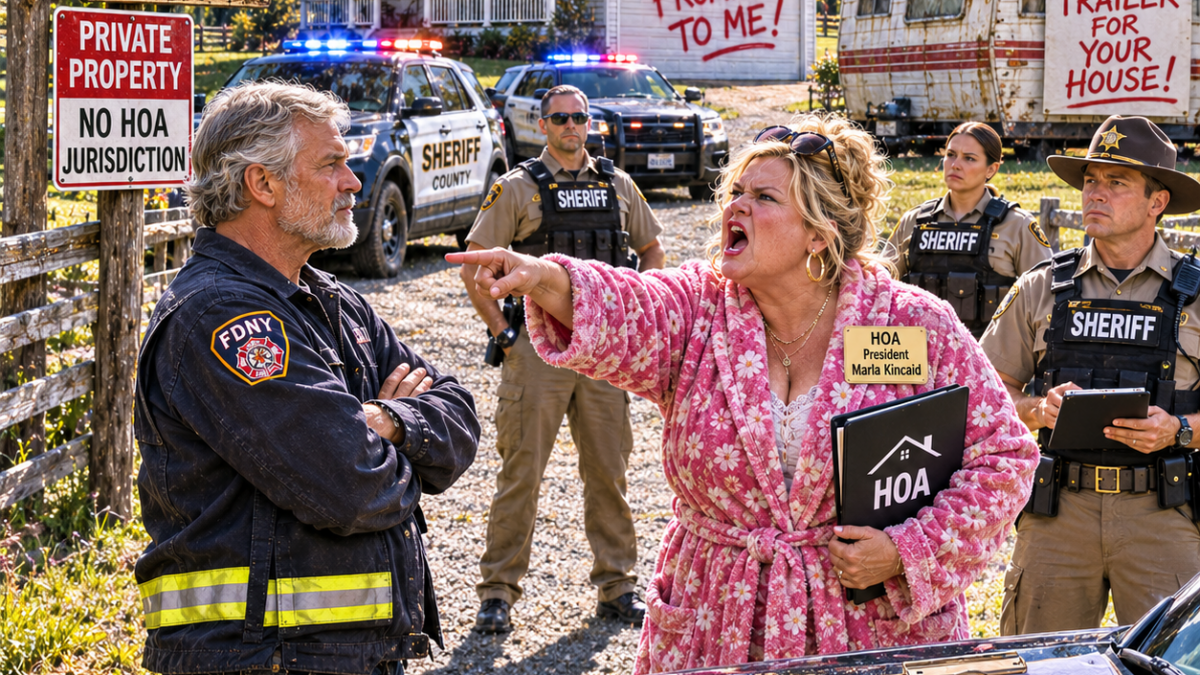
The morning three sheriff’s cruisers rolled up my gravel driveway, Marla Kincaid stood behind them in a bathrobe screaming that I was an armed squatter who had stolen her house—the same farmhouse my late Aunt Ruth had owned for decades, the same house I had personally restored after thirty-five years of running into burning buildings for the New York City Fire Department.
What the deputies didn’t know yet was that Marla had already demanded I trade that four-bedroom farmhouse for her battered trailer because, according to her, “a single old man didn’t need that much space,” then spray-painted PROMISED TO ME across my garage and began telling neighbors I had secretly agreed to hand her my property as a charitable gift.
But when Deputy Rick Lawson finally asked her to produce one legal document proving the house belonged to her, Marla reached for a folded piece of paper she clearly believed would end the argument—and I had no idea that the lie written on that page was about to expose something far bigger than one delusional HOA president trying to steal my home.
My name is Gary Phillips.
I was sixty when I retired from the FDNY.
After thirty-five years of alarms, smoke, stairwells, wrecked cars, collapses, screaming radios, and too many funerals for men I had once eaten dinner beside in firehouses, I wanted silence.
Real silence.
My late Aunt Ruth gave me that.
She left me her farmhouse in Pine Elk Valley, Colorado, an old 1940s place with redwood beams, a wraparound porch, an orchard, and enough land that I could stand behind the barn and not see another human being.
The first year felt like medicine.
I repaired fences.
Painted the porch.
Rebuilt an old shed.
Pruned Ruth’s apple trees.
At night, instead of sirens, I heard wind moving through the valley.
Then Marla Kincaid arrived next door.
She pulled in with a wheezing trailer, two children, two plastic lawn chairs, a kiddie pool, and a stereo loud enough to make me miss Manhattan traffic.
I tried to be friendly.
I even brought her a basket of apples.
She accepted them, looked past me at my house, and asked, “How many bedrooms?”
“Four.”
Her eyebrows rose.
“For just you?”
“It’s a family house.”
“That seems wasteful.”
I laughed because I assumed she was joking.
She wasn’t.
A few days later she informed me she was president of Pine Elk Estates HOA, a subdivision across the dirt road.
“Technically,” she said, “our association covers this whole valley.”
“My deed says otherwise.”
She gave me a thin smile.
“Boundaries change.”
That should have warned me.
Within weeks she was criticizing my fence height, grass length, compost bin, truck, porch color, even the number of fruit trees in the orchard.
Then fake violation notices started arriving.
I ignored them.
That only made her bolder.
One Saturday morning I was sanding the porch railing when she walked across my yard carrying a folder.
“Gary,” she said sweetly, “I’ve been thinking about your housing situation.”
“My housing situation?”
“You have four bedrooms.”
“I know.”
“I have children.”
“I know that too.”
She smiled.
“So it makes sense for us to switch.”
I stopped sanding.
“Switch what?”
“Houses.”
For several seconds, I honestly thought retirement had damaged my hearing.
She pointed toward her trailer.
“You can take mine. It’s cozy. Perfect for one person.”
Then she pointed toward Aunt Ruth’s farmhouse.
“My children need this.”
I laughed.
I couldn’t help it.
Marla’s face turned red.
“I’m serious.”
“So am I.”
“This house is not for sale.”
“I’m not asking you to sell it.”
“You’re asking me to give it to you.”
“I’m offering a fair exchange.”
“Your trailer for my family farmhouse?”
She crossed her arms.
“You don’t need all that space.”
That sentence ended the conversation.
“No.”
Her eyes narrowed.
“You’re being selfish.”
“No, Marla. I’m being the owner.”
She stormed away.
Three weeks later, I came home from fishing and found red spray paint across my garage.
**PROMISED TO ME.**
And that was the moment I stopped treating Marla like an annoying neighbor.
Because annoying neighbors complain about trees.
Marla had started building a story in which my home was already hers.
PART 2
I stood in front of the garage for a long time.
The red letters were crooked.
Angry.
The paint still looked fresh enough to shine.
**PROMISED TO ME.**
I remember thinking that the phrase bothered me more than ordinary vandalism would have.
If she’d painted an insult, I would have understood.
If she’d written OLD JERK or GET OUT or even something worse, it would’ve been simple hatred.
But **PROMISED TO ME** was different.
It was a claim.
A story.
A version of reality Marla seemed determined to manufacture until enough people repeated it.
I took photographs before touching anything.
Old firefighter habit.
After a major fire, before anyone moved debris, somebody documented the scene.
You learn quickly that memory changes.
People forget.
People exaggerate.
People lie.
Photographs don’t get tired.
I photographed the garage.
The ground.
Footprints.
The fence line.
Then I called the sheriff’s office.
Deputy Rick Lawson came out that afternoon.
He was in his late fifties with a gray mustache and the kind of patient eyes you see on people who have spent decades listening to stories they know are about to become ridiculous.
He studied the garage.
“You have problems with anybody?”
“One.”
I pointed toward Marla’s trailer.
He looked.
“HOA?”
“How’d you know?”
He sighed.
“Experience.”
I explained the house-swap demand.
The fake violation notices.
Her children crossing into my orchard.
The constant photographs.
The supposed HOA jurisdiction.
Lawson listened without interrupting.
Then he asked:
“Any camera footage of the spray paint?”
“No.”
“Witness?”
“Not directly.”
“So right now, suspicion.”
“I know.”
“You want a report?”
“Yes.”
He nodded.
“Good.”
That surprised me.
He said:
“People think a police report is only useful when somebody gets arrested.”
He looked at the red letters.
“Sometimes the important part is establishing a pattern.”
I liked him immediately.
Before leaving, he looked toward the trailer again.
“Put cameras up.”
“I was already thinking about it.”
“Think faster.”
—
The next day, three different neighbors told me Marla had been claiming I had promised her the farmhouse.
Not considered it.
Not discussed it.
Promised it.
One woman, Susan Bell, stopped her pickup beside my mailbox.
“Gary, I hate getting involved in other people’s business.”
Whenever someone says that, they’re about to get involved.
“But Marla says you’re backing out of a deal.”
“What deal?”
“She says you agreed to gift her the house because she has kids.”
I stared.
“Gift?”
“She said something about neighborly charity.”
“Did she show you anything?”
Susan hesitated.
“A letter.”
“What kind of letter?”
“I didn’t read it.”
“Did it have my signature?”
“I couldn’t see.”
I thanked her.
That evening, I found Marla’s version in my mailbox.
One sheet.
Official-looking language.
Terrible spelling.
It claimed that I, Gary Phillips, had voluntarily agreed to transfer the farmhouse to Marla Kincaid “in the spirit of neighborly charity and community equity.”
There was no notarization.
No proper deed.
No valid legal description.
No real signature from me.
But there was one line that made my stomach tighten.
**Agreement filed with the State of Colorado.**
I didn’t know whether that was another lie.
That uncertainty was enough.
—
I took the document to Jana Whitfield.
I’d met Jana at the county fair when she’d helped resolve a land-access problem for one of Thomas Avery’s ranch hands.
She was in her fifties.
Short dark hair.
Direct voice.
Not easily impressed.
Her office contained three things in abundance:
law books,
coffee,
and impatience.
She read Marla’s letter.
Then read it again.
Then laughed.
Not a polite laugh.
A full laugh.
“This is garbage.”
“Good.”
“It isn’t notarized.”
“Good.”
“It isn’t a deed.”
“Better.”
“It doesn’t include a valid transfer instrument.”
“Excellent.”
“And this sentence about filing it with the state?”
She looked at me.
“Probably nonsense.”
“Probably?”
“Gary.”
“I hate when lawyers say probably.”
“I hate when clients want certainty before we verify.”
Fair.
She turned serious.
“Keep this.”
“I was planning to.”
“Keep every notice.”
“Every photograph.”
“Every text.”
“Every video.”
“And if she enters the property again?”
“Call Lawson?”
“Exactly.”
I leaned back.
“You think she’ll escalate?”
Jana folded Marla’s fake agreement.
“People who accept no usually leave.”
“People who believe your no is illegitimate escalate.”
That sentence stayed with me.
—
I installed cameras the next day.
Porch.
Garage.
Orchard.
Driveway.
Trail camera near the far fence.
Motion lights.
I hated doing it.
I had moved to Pine Elk because I wanted to stop living like every shadow might contain a problem.
Now my retirement property looked like a low-budget security compound.
But I slept better.
For three days.
—
Then the HOA notices started arriving daily.
Violation one:
**NON-STANDARD EXTERIOR COLOR.**
My farmhouse was cream and forest green.
It had been cream and forest green before Pine Elk Estates existed.
Violation two:
**UNAUTHORIZED LANDSCAPING.**
Apparently Aunt Ruth’s apple orchard was now unauthorized.
Violation three:
**VISIBLE COMPOST STORAGE.**
Violation four:
**UNREGISTERED VEHICLE.**
My twenty-year-old pickup.
Violation five:
**NONCOMPLIANT FENCE HEIGHT.**
Violation six:
**UNPAID ASSOCIATION DUES — $1,200.**
I wasn’t a member.
I put every notice in a binder.
The binder became thick quickly.
I labeled it:
**MARLA.**
No subtitle required.
—
One afternoon, I found her inside the orchard.
Measuring tape.
Clipboard.
Phone.
She was standing beside a peach tree.
“Marla.”
She turned calmly.
“Gary.”
“You’re trespassing.”
“I’m verifying community compliance.”
“You’re standing fifty feet inside my property.”
“Your orchard affects the HOA’s visual environment.”
“My apples?”
She wrote something down.
“Tree density.”
I stared.
“You’re measuring tree density?”
“Standards exist for a reason.”
“Not here.”
Her smile tightened.
“That’s your interpretation.”
“No.”
I pointed toward the fence.
“That’s my deed.”
“Leave.”
She slowly rolled the measuring tape back into its case.
“You’re becoming hostile.”
“I’m becoming clear.”
She walked toward the fence.
Then turned.
“This would be easier if you’d cooperate.”
“With what?”
“Community integration.”
“My answer is still no.”
She looked at the farmhouse.
“That house is wasted on you.”
I waited until she crossed the property line.
Then saved the camera clip.
—
The next morning, she livestreamed me.
I was repairing the lower fence when I heard her voice.
“Everyone can see this.”
I turned.
Marla stood near the property line holding her phone vertically.
“This individual has repeatedly refused HOA safety inspections.”
I almost laughed.
“Individual?”
She pointed the camera toward my tools.
“He keeps dangerous equipment unsecured.”
It was a shovel.
A post driver.
A toolbox.
I walked closer but stayed well inside my property.
“Marla.”
She turned the phone toward my face.
“Here he comes.”
“Get off my property.”
“Oh, you’re threatening me?”
“No.”
“You’re all hearing this, right?”
I suddenly understood.
This wasn’t spontaneous.
She wanted anger.
She wanted me yelling.
She wanted an old retired firefighter looming over a single mother on camera.
So I stopped.
Turned around.
Walked back to the barn.
She followed several steps.
“Gary!”
I didn’t answer.
“Gary, are you refusing an official HOA inspection?”
Silence.
“You’re making yourself look guilty.”
I kept walking.
Inside, I called Lawson.
“She’s livestreaming from my yard.”
“You have video?”
“Multiple angles.”
“Good.”
“Want me to go tell her what I think?”
“No.”
“Thought you’d say that.”
“I’ll come out.”
By the time Lawson arrived, Marla was gone.
But the footage remained.
Another report.
Another entry in the pattern.
—
A few days later, the trail camera caught exactly what Jana had predicted.
Marla.
Broad daylight.
One friend beside her.
Clipboard.
Both inside my orchard.
Pictures of the deck.
Pictures of windows.
Pictures of the side entrance.
I printed stills.
Took them to Lawson.
He looked at the first photograph.
Then the second.
Then at me.
“Well.”
“Enough?”
“Enough for a formal warning.”
He drove to Marla’s trailer.
I didn’t stand outside to watch.
I wanted to.
Instead, I watched from my kitchen window like a responsible adult.
Mostly.
Lawson talked.
Marla gestured.
Lawson pointed toward my land.
Marla waved both arms.
Then jabbed a finger toward the subdivision.
Finally she slammed her trailer door.
Lawson returned to my property.
“How’d that go?”
“She believes HOA office gives her investigative authority.”
“It doesn’t.”
“I mentioned that.”
“She believe you?”
“No.”
“Shocking.”
He handed me the report number.
“She enters again, call immediately.”
—
The next morning two men in orange vests arrived.
They began hammering a large notice into my front lawn.
I walked outside wearing a robe.
“What are you doing?”
One man looked embarrassed.
“HOA lien notice.”
“What lien?”
“Back dues.”
“This property isn’t in the HOA.”
He checked his paper.
“Pine Elk Estates?”
“Across the road.”
He looked toward the subdivision.
Then back at my farmhouse.
“You’re not in it?”
“No.”
The second man stopped hammering.
“Sir, we’re contractors.”
“I understand.”
“Do you want us to take it back?”
“Yes.”
“Okay.”
They pulled the post out.
I photographed the paperwork before they left.
Then called Jana.
She stopped laughing at Marla after that.
“Send me everything.”
I did.
“Gary.”
“Yes?”
“If they actually filed a lien or false instrument with the county, that becomes much more serious.”
“What are we doing?”
“Cease and desist.”
“Real one?”
“Very.”
—
Jana’s letter was four pages.
Recorded deed.
Recorded boundaries.
No Pine Elk Estates covenant.
No HOA membership.
No authority to levy dues.
No right to enter.
No right to inspect.
No right to file property claims.
Any further trespass, false filing, harassment, or interference would be referred to appropriate authorities.
Certified mail.
Signature required.
Marla signed.
Then, according to my driveway camera, tore the envelope apart beside her mailbox.
Two nights later, my motion light came on at 1:07 a.m.
A figure near the porch.
By the time I reached the window, the person was leaving.
The next morning a note was taped to my garage.
**THIS PROPERTY WILL SOON BELONG TO ITS RIGHTFUL OWNER.**
**FINAL WARNING.**
That one didn’t make me angry.
It made me cold.
I’d spent thirty-five years walking into dangerous situations.
One thing firefighters learn is the difference between noise and danger.
A screaming person may be frightened.
A quiet wall that starts bowing outward can kill you.
Marla had moved from noise to something else.
I called Lawson.
Two deputies came.
Collected the note.
Photographed the garage.
Reviewed the camera footage.
It wasn’t a perfect facial image, but the clothing and movement were consistent with someone coming from Marla’s direction.
Lawson crossed the road.
Marla stood on her porch.
I heard part of the conversation.
“Continued contact can become criminal.”
She said:
“I’m HOA president.”
Lawson replied:
“Your job ends where his property begins.”
She yelled something else.
Then slammed the door.
On the way out, Lawson lowered his cruiser window.
“Keep those cameras running.”
“I plan to.”
“She’ll either stop.”
“Or?”
“Give us better evidence.”
—
She gave us better evidence.
But first, she called 911.
Tuesday.
8:30 in the morning.
I was sitting on the porch drinking coffee when the first cruiser arrived.
Then another.
Then a third.
No sirens.
Lights flashing.
I put down my mug.
Lawson stepped from the lead cruiser.
Two deputies spread out.
One asked:
“Sir, are you Gary Phillips?”
“Yes.”
“We received a report of a possible unlawful occupant refusing to leave a residence.”
I actually thought I’d misunderstood.
“A what?”
“A squatter.”
Behind the deputies, Marla shouted from her side of the property:
“That’s him!”
I closed my eyes.
Of course.
“He’s been living in my house for weeks!”
One deputy looked toward her.
“Ma’am, stay back.”
Marla continued.
“He changed everything.”
“He won’t let me inside.”
“He’s armed.”
That changed the atmosphere immediately.
I held both hands where they could see them.
“Officers, I own this property.”
Lawson sighed.
“I know you have records, Gary.”
“Inside.”
“Go slowly.”
I did.
Deed.
Tax receipts.
Utility records.
A certified copy of Aunt Ruth’s estate transfer.
I carried the folder outside.
Lawson read the deed.
Then handed it to the second deputy.
He compared the address.
Parcel number.
My identification.
Everything matched.
Lawson looked toward Marla.
“Do you have documentation showing you own this property?”
“I have an agreement.”
“What kind?”
“Gary promised it to me.”
“Recorded deed?”
“No.”
“He promised.”
“That’s not what I asked.”
She hurried back toward her trailer.
Returned with the fake letter.
Lawson read it.
His face barely changed.
That was almost funnier than laughter.
“Ma’am.”
“Yes?”
“This isn’t a deed.”
“It proves intent.”
“No.”
“It proves he gave me the house.”
“No.”
“He’s backing out.”
Lawson rubbed the bridge of his nose.
“Did Mr. Phillips sign this?”
“He verbally agreed.”
“That’s not an answer.”
Her face reddened.
“I’m HOA president.”
One of the younger deputies whispered:
“Oh, man.”
Lawson looked at Marla.
“His land is outside your association.”
“Our community recognizes—”
“County property records don’t care what your community recognizes.”
She stared.
Then she pointed at me.
“He’s dangerous.”
I almost spoke.
Lawson raised a hand toward me.
I stayed quiet.
He asked Marla:
“Did he threaten you this morning?”
“He’s threatening me by refusing to leave.”
“That’s not a threat.”
“He yelled at my children.”
“When?”
“Before.”
“Today?”
“No.”
“Does he have a weapon right now?”
“I assume.”
Lawson’s expression changed.
“Ma’am, you reported an armed hostile squatter.”
“You have been previously warned about this property.”
“You understand emergency resources were sent here based on information you’ve now failed to substantiate?”
Marla’s confidence finally cracked.
“You’re taking his side.”
“No.”
Lawson pointed toward my deed.
“I’m taking the county recorder’s side.”
Then:
“Misusing 911 can have consequences.”
Marla turned away.
“You’re all corrupt.”
She stormed back to the trailer.
I watched the cruisers leave.
Only after the last one disappeared did I realize my hands were shaking.
Not fear exactly.
Anger.
What if Lawson hadn’t known the history?
What if a deputy had believed the armed-squatter story before I could reach the deed?
What if I had stepped out holding one of my tools?
False reports are not funny when police arrive expecting danger.
I called Jana before I even picked up my coffee.
—
“We file.”
That was her first sentence.
“For what?”
“Protective order.”
“I want the 911 recording too.”
“Good.”
I requested the dispatch record.
Marla’s voice was there.
Claiming I had stolen her residence.
Claiming she feared for her safety.
Claiming I refused to vacate.
Jana included it with:
photographs,
trespass reports,
fake notices,
the garage vandalism report,
the threatening note,
camera footage,
the false ownership letter.
The court issued a temporary no-contact order pending further proceedings.
Lawson served it.
Marla tore her copy in half.
Lawson looked at the pieces.
“That’s still valid.”
“You can’t silence an HOA president!”
“I don’t care what your title is.”
“Then arrest me!”
He paused.
“Ma’am, I strongly recommend you not treat that as a challenge.”
She slammed the door.
—
For one week, silence.
No letters.
No photographs.
No children in my orchard.
No screaming.
I started sleeping through the night.
Saturday morning, at 5:46, my phone vibrated.
Motion alert.
Porch camera.
Marla.
I sat up.
A second woman stood beside her.
Younger.
Tina Mallory.
I knew her vaguely as Marla’s closest friend on the HOA board.
They whispered.
Then walked up my porch steps.
I called 911.
“This is Gary Phillips.”
The dispatcher recognized the address.
“Mr. Phillips, what’s happening?”
“Marla Kincaid is on my porch.”
“I have a court order against her.”
“She has another woman with her.”
“Are you inside?”
“Yes.”
“Door locked?”
“Yes.”
“Stay there.”
Outside, Marla started pounding.
“Gary!”
I didn’t answer.
“Open the door!”
I stood twenty feet away.
Phone in hand.
“Gary, you can’t keep what’s mine forever!”
Tina said something I couldn’t hear.
Then Marla screamed:
“He stole my home!”
Ten minutes felt like an hour.
Then red and blue lights swept across the windows.
Deputies came in fast.
Commands.
“Step away from the door.”
“Hands where we can see them.”
Tina backed away immediately.
Marla didn’t.
“This is my property!”
A deputy grabbed her arm when she tried to move toward the door again.
“Ma’am, you’re under a court order.”
“He tricked the judge!”
“Turn around.”
“You can’t do this!”
“Turn around.”
They cuffed her.
Even while walking toward the cruiser, she twisted toward my house.
“You can’t stop the truth!”
I remained inside.
I didn’t wave.
Didn’t smile.
Didn’t say anything.
When the cruiser left, I sat in the kitchen until sunrise.
The house was silent.
I wasn’t.
Inside my head, every alarm I’d heard in thirty-five years seemed to be ringing again.
Retirement peace suddenly felt far away.
—
Lawson called the next morning.
“She’s facing trespass and violation charges.”
“What about Tina?”
“Warning for now.”
“She was on the porch too.”
“We’re documenting it.”
“Marla going to jail?”
“Don’t expect a movie.”
He sounded tired.
“Could be fines.”
“Probation.”
“Community service.”
“Counseling.”
“Depends on the court.”
“Counseling seems useful.”
“Gary.”
“What?”
“Don’t become invested in her punishment.”
That surprised me.
“Why?”
“Because you can’t control it.”
He paused.
“Focus on keeping yourself safe.”
That was good advice.
Hard advice.
—
Marla disappeared for a while.
But Tina didn’t.
Two weeks later, she parked at the end of my driveway.
Sat there.
Hours.
I eventually walked halfway down my drive but did not approach her car.
She rolled down the window.
“Can I help you?”
“Just observing.”
“My property?”
“Justice.”
“What does that mean?”
She smiled.
“You’ll find out.”
I turned around.
Emailed Jana.
**She’s using Tina now.**
Jana replied:
**Document. Do not engage. We may need to broaden the injunction if this becomes coordinated harassment.**
So I documented.
Firefighters don’t put out major fires by arguing with flames.
You establish boundaries.
You understand where fire is moving.
You control what you can.
Wait for the opening.
Marla had spent months trying to make me react.
I decided she would never get that gift.
—
Then the county surveyors arrived.
That morning became the funniest moment of the entire nightmare.
Not because anyone was hurt.
Because reality finally developed a sense of humor.
Two men in survey vests worked beside Marla’s trailer.
Flags.
Measurements.
Tripod.
I walked over to my fence.
“Everything okay?”
One looked up.
“You Gary Phillips?”
“Yes.”
He pointed toward Marla’s trailer.
“This parcel belong to her?”
“She says everything belongs to her.”
He laughed.
“Well, according to the county, none of this part does.”
I stared.
“What?”
“Trailer is over the property line.”
“How far?”
“Approximately thirty feet onto the neighboring ranch parcel.”
“Whose?”
He checked the clipboard.
“Thomas Avery.”
I actually sat down on the fence rail.
“You’re telling me the woman who called 911 claiming I was squatting in her house…”
“Yes?”
“…is living on somebody else’s land?”
The surveyor smiled.
“Looks that way.”
I laughed until my ribs hurt.
Then I called Jana.
She stayed silent for three seconds.
Then started laughing too.
“Gary.”
“Yes?”
“Do not gloat.”
“Too late.”
“Not publicly.”
“I can promise that.”
—
Thomas Avery arrived that afternoon.
Older rancher.
Tall.
Weathered.
Hat.
Boots.
No interest in drama.
He walked to Marla’s trailer and knocked.
She came outside.
I watched from my property.
“Can I help you?”
Thomas removed his hat.
“Ms. Kincaid?”
“Yes.”
“You’re occupying part of my parcel.”
She laughed.
“Excuse me?”
“My family owns this field.”
“This is Pine Elk Estates.”
“No.”
“It falls under HOA management.”
“No.”
“I am president.”
Thomas looked at the trailer.
Then at her.
“My deed is older than your association by decades.”
Marla crossed her arms.
“You’re mistaken.”
“I’ve got the survey.”
“Your survey is wrong.”
“I’ve got county records.”
“The county has been conspiring against me.”
Thomas put his hat back on.
“You’ve got thirty days under the notice process to remove your trailer from my land.”
Her face changed.
“This is harassment.”
“No.”
He pointed toward the dirt beneath her porch steps.
“This is trespass.”
Then he turned.
Before leaving, he tipped his hat toward me.
I almost lost it.
Marla saw me.
“You!”
I stayed behind my fence.
“You did this!”
“No.”
“You contacted him!”
“No.”
“You’re working together!”
“Marla.”
She stopped.
I pointed toward the survey stakes.
“I can’t move your trailer thirty feet with my mind.”
She screamed.
Thomas drove away.
I went inside before I laughed again.
—
Marla began filing complaints against everyone.
Thomas.
Me.
Surveyors.
County zoning.
Environmental health.
Sheriff’s office.
She wrote that Pine Elk Estates was under attack from “noncompliant outsiders.”
She claimed Thomas’s ranch deed was fraudulent.
Claimed the county boundary map had been altered.
Claimed I was coordinating an anti-HOA land grab.
The more reality cornered her, the larger the conspiracy became.
Jana said:
“This is what happens when somebody has built identity around being right.”
“What?”
“They stop asking whether they made a mistake.”
“Every contradiction becomes evidence that everyone else is corrupt.”
“Can a court fix that?”
“No.”
“Great.”
—
Thomas filed formally.
Marla contested.
I was subpoenaed because of her claims connecting me to the supposed conspiracy.
Judge Rowland handled the property hearing.
Gray-haired woman.
No patience for speeches.
Marla arrived late in a bright pink blazer carrying a binder thick enough to stop a bullet.
She represented herself for part of the argument.
Bad idea.
When asked to explain her legal interest in Thomas’s land, she began:
“Your Honor, communities are living organisms.”
Judge Rowland looked up.
“What does that have to do with title?”
Marla continued.
“Pine Elk Estates has maintained the visual and spiritual character of this valley—”
“Ms. Kincaid.”
“Yes?”
“Deed.”
Marla stopped.
“What?”
“Show me the deed.”
“I have our charter.”
“Not what I asked.”
Marla opened her binder.
“HOA boundaries naturally evolve—”
“Recorded boundaries do not naturally evolve.”
Someone laughed.
Rowland looked toward the gallery.
“Quiet.”
Then back to Marla.
“Do you have a recorded instrument giving you ownership or lawful occupancy of the Avery parcel?”
Marla shuffled papers.
“Our community recognizes—”
“County doesn’t.”
Silence.
“Thirty days to vacate pursuant to the applicable process.”
Marla’s face went pale.
“But I’m HOA president.”
Judge Rowland said:
“That is not a property interest.”
Those six words might have been engraved in stone.
—
Outside, Marla cornered me near my truck.
“You think this is over?”
I kept walking.
“You humiliated me.”
I stopped.
“No.”
She came closer.
“You and Avery planned this.”
“No.”
“You’ve been trying to destroy my authority.”
I looked at her.
“What authority?”
Her eyes widened.
“That is exactly the problem.”
“No.”
I shook my head.
“Your problem is that you keep mistaking a title for ownership.”
“You had a trailer partly on somebody else’s ranch.”
“You tried to claim my farmhouse.”
“You issued fines to property outside your HOA.”
“You called 911 because I wouldn’t give you my house.”
Her jaw trembled.
“You stole everything from me.”
I said quietly:
“I didn’t take anything from you.”
A deputy approached.
“Ms. Kincaid.”
She turned.
“You’re still subject to the no-contact restrictions.”
Marla stepped backward.
Then kicked the side of my truck.
The deputy stared.
Marla stared at the dent.
Then at him.
For the first time, she seemed to realize actions happened in chronological order and consequences came afterward.
“Ma’am.”
He pointed away.
“Leave.”
She did.
Jana had watched from the courthouse entrance.
“She is going to self-destruct.”
“You’ve said that before.”
“Yes.”
“I underestimated how long self-destruction can take.”
—
The county assessor called the next week.
“Mr. Phillips, we need to verify a filing.”
My stomach sank.
“What filing?”
“A transfer document.”
“What transfer?”
“One purporting to transfer your property to Pine Elk Estates HOA.”
I stood.
“I never signed anything like that.”
“We suspected that.”
The office sent me a copy.
My name.
Fake signature.
Fake notary stamp.
Language claiming I transferred Aunt Ruth’s farmhouse to the HOA “in perpetuity.”
For several seconds, I couldn’t breathe properly.
Until then, Marla’s behavior had been insane but almost amateur.
Fake letters.
Fake fines.
False claims.
This was different.
Somebody had tried to place a false ownership instrument into a government record.
I called Jana.
She met me at the assessor’s office.
We compared signatures.
Not even close.
The notary information didn’t match a valid commission.
Filing metadata and related information pointed investigators toward Marla.
Lawson took the report.
This time, he didn’t sigh.
Didn’t joke.
Didn’t tell me to wait.
He said:
“Now we’re in felony territory.”
I looked at the fake document.
“My aunt’s name isn’t even spelled correctly.”
Lawson shook his head.
“People who think paperwork is magic usually don’t understand paperwork.”
—
Marla was arrested two days later in connection with the false filing investigation.
I didn’t watch from the porch.
I didn’t want to.
Thomas did.
Later he stopped by.
“You missed the show.”
“Good.”
He studied me.
“Thought you’d enjoy it.”
“Months ago maybe.”
“What changed?”
I looked at Aunt Ruth’s house.
“I just want my home back.”
Thomas nodded.
“I understand.”
—
The case resolved later through a plea arrangement.
Not the dramatic twenty-year prison sentence some neighbors predicted.
Probation.
Community service.
Mandatory counseling or evaluation requirements.
Conditions prohibiting further harassment and false filings.
Other consequences associated with the property mess.
When Jana told me, she watched my face.
“You disappointed?”
“No.”
“You sure?”
“I wanted it over.”
“Good answer.”
It was true.
Revenge sounds exciting until you’ve spent a year organizing evidence folders.
Peace starts sounding much better.
—
I repaired the garage.
Repainted the door.
Replaced damaged railing.
Fixed the truck dent.
Then planted a line of pines along the property boundary.
At the gate, I installed a wooden sign.
**PRIVATE LAND**
**NO HOA BEYOND THIS POINT**
Thomas laughed when he saw it.
“Can I get one?”
“Twenty dollars.”
“Highway robbery.”
“HOA pricing.”
He laughed.
For three weeks, life felt normal.
Then county paperwork arrived.
The listed interim president of Pine Elk Estates:
**Tina Mallory.**
I sat on the porch holding the paper.
Of course.
—
Tina’s first letter was more polished than Marla’s.
Better grammar.
Embossed seal.
Professional font.
Same nonsense.
**PINE ELK ESTATES INTERIM MANAGEMENT BOARD**
It declared a new policy:
**VISUAL IMPACT JURISDICTION.**
According to Tina, any non-HOA property visible from Pine Elk Estates could be regulated if its appearance affected “community aesthetic integrity.”
I read it three times.
Then drove directly to Jana.
She read it.
No laughter.
Just a long stare.
“Visual impact jurisdiction.”
“Yes.”
“Not a thing.”
“Thought so.”
“They can’t bind property merely because residents can see it.”
“Can I legally build a fifty-foot statue of you facing the HOA?”
“No.”
“Why not?”
“Because other laws exist, Gary.”
“Shame.”
She put the letter down.
“This isn’t about law.”
“I know.”
“It’s about keeping Marla’s power structure alive.”
—
Tina appeared at my fence two days later.
Blazer.
Sunglasses.
Clipboard.
It was almost comforting how predictable these people were.
“Mr. Phillips.”
“Tina.”
“I wanted to reset relations.”
“Excellent.”
“Start by leaving me alone.”
Her smile tightened.
“We’re moving away from Marla’s unfortunate style.”
“Good.”
“Our new approach is cooperative.”
“Better.”
“But your property falls within our visual boundary.”
“There it is.”
She continued.
“Exterior changes require consultation.”
“No.”
“Fencing.”
“No.”
“Paint.”
“No.”
“Tree density.”
I laughed.
“Tina.”
“Yes?”
“Aunt Ruth planted some of those apple trees before you were born.”
“They still affect sightlines.”
“I don’t care.”
She lowered the clipboard.
“You’re making cooperation difficult.”
“No.”
“I’m making authority difficult.”
“Because you don’t have any.”
Her smile disappeared.
“People don’t like neighbors who make enemies of a community.”
I stared at her.
Then said:
“Ask Marla how threats worked out.”
She stiffened.
I regretted the wording immediately.
Not because it was illegal.
Because Jana had taught me something.
Don’t give these people emotional material.
So I added:
“My attorney’s number is on every prior notice.”
“Use it.”
Then went inside.
—
Soon the letters returned.
**EXCESSIVE OUTDOOR EQUIPMENT VISIBILITY.**
My tractor.
**UNSANCTIONED FRUIT TREE DENSITY.**
My orchard.
**NON-HARMONIOUS FENCE MATERIAL.**
Wood.
Then Saturday morning came.
Six Pine Elk residents walked past my property wearing matching vests.
**COMMUNITY REVIEW COMMITTEE.**
Clipboards.
Cameras.
I came to the gate.
“Can I help you?”
A tall man lifted his camera.
“We’re documenting properties affecting visual harmony.”
“Stay on the public road.”
“We have board authorization.”
“Stay on the public road.”
He looked uncomfortable.
“Sir, we’re volunteers.”
“Then volunteer somewhere else.”
To their credit, they did not cross the fence.
Tina wasn’t satisfied.
Two nights later, my camera caught her and two people beyond the property line with flashlights.
This time, they crossed.
I called Lawson.
He arrived before they left.
Tina tried showing him a printed map.
“This is community inspection.”
Lawson looked at the map.
Then my fence.
Then Tina.
“Lady.”
She stiffened.
“I’ve already had this conversation with your predecessor.”
“This is not your subdivision.”
“We’re operating under visual—”
“No.”
He pointed toward the public road.
“Out.”
Tina flushed.
“We have authority.”
Lawson said:
“You have a clipboard.”
“Those are different.”
Derek would’ve loved that line.
I wished Derek existed in this story.
—
The next day Tina emailed me.
**THE HOA WILL NOT BE INTIMIDATED BY LEGAL MANIPULATION.**
**FURTHER NONCOMPLIANCE WILL RESULT IN COLLECTIVE ACTION.**
I forwarded it to Jana.
She called immediately.
“Enough.”
“What now?”
“We add the HOA itself.”
“To what?”
“Injunction request.”
“We establish coordinated harassment.”
“We ask for broader restrictions.”
“We force them to show the legal basis for this invented jurisdiction.”
I smiled.
“You sound happy.”
“I bill hourly.”
—
Once Pine Elk Estates became formally involved in the litigation rather than hiding behind individual officers, documents opened up.
Financial records.
Registration issues.
County filings.
Governance records.
Claims about partnerships with local authorities.
The picture was messy.
Some HOA documents hadn’t been properly updated.
Certain claims of county cooperation were unsupported.
Money had been spent pursuing Marla’s and Tina’s property campaigns.
Residents began asking where dues had gone.
That’s when Tina lost control.
Not because I defeated her.
Because homeowners realized their own money was financing a private vendetta against land they didn’t own.
One resident stood at a board meeting and asked:
“How much have we spent on lawyers over Gary Phillips’s apple trees?”
Nobody had a good answer.
Another asked:
“Why are we regulating somebody who isn’t a member?”
Another:
“Why were we told his property belonged to us?”
Another:
“Did Marla file false deeds using HOA resources?”
Within two weeks, county and legal scrutiny intensified.
The HOA’s financial activity became restricted pending review of the disputed governance and filings.
Tina received subpoenas for records.
Then resigned.
Official reason:
**Medical stress.**
She moved away not long after.
I stood at my gate the morning her moving truck passed.
She did not look at me.
I didn’t wave.
Thomas Avery stopped by later.
“Heard you ran off the second queen.”
“I didn’t run off anybody.”
“County did.”
“Residents did.”
“Reality helped.”
Thomas grinned.
“The kingdom fell anyway.”
For the first time in over a year, my mailbox contained nothing from Pine Elk.
I thought that meant the end.
It didn’t.
—
The lawsuit arrived in a thick manila envelope.
**PINE ELK ESTATES HOMEOWNERS ASSOCIATION AND MARLA KINCAID**
Plaintiffs.
**GARY PHILLIPS**
Defendant.
Claims:
Defamation.
Interference with community governance.
Emotional distress.
Financial harm.
And my favorite:
**UNLAWFUL OBSTRUCTION OF HOA JURISDICTION.**
I laughed in the driveway.
Then I read the rest.
Stopped laughing.
Jana explained:
“They’re not necessarily trying to win.”
“What are they trying to do?”
“Make you spend.”
“Time.”
“Money.”
“Energy.”
“Punish you for not surrendering.”
I looked toward the farmhouse.
“Well.”
“What?”
“They picked a retired firefighter.”
She smiled.
“Meaning?”
“I’ve worked twenty-four-hour shifts inside worse buildings.”
“Good.”
“Because this will be unpleasant.”
—
Court was packed.
Not because the case mattered nationally.
Because rural counties love free theater.
Marla arrived in navy.
Tina beside her.
A nervous young lawyer represented the HOA.
Judge Morales presided.
Older man.
Silver hair.
He read the caption.
Then looked at Marla’s side.
“Plaintiffs?”
Marla’s attorney stood.
He described a campaign of harassment carried out by me against community leadership.
He said my complaints damaged HOA reputation.
Caused member resignations.
Triggered investigation.
Reduced revenues.
Created emotional distress.
Judge Morales asked:
“What specific unlawful conduct did Mr. Phillips commit?”
The lawyer hesitated.
“Repeated interference.”
“With?”
“HOA governance.”
“On his property?”
Silence.
Marla leaned toward the microphone.
“He refused our authority.”
The judge looked at her.
“Ma’am, refusal is not ordinarily a tort.”
“But he publicly claimed we had no jurisdiction.”
“Did you?”
“Yes.”
The lawyer tried to interrupt.
Too late.
Judge Morales leaned forward.
“You had jurisdiction over his parcel?”
Marla nodded.
“Under extended community concepts.”
“What recorded covenant?”
She shuffled.
“Community precedent.”
“What deed restriction?”
She looked toward Tina.
Tina whispered.
Marla said:
“Visual impact standards.”
The judge sat back.
“I’ve practiced law thirty years.”
“I have never encountered ‘visual impact jurisdiction’ as a power allowing an HOA to regulate a nonmember’s unrelated property.”
Someone laughed.
The judge looked toward the gallery.
“Quiet.”
Then:
“Counsel, do you have an actual legal basis?”
The lawyer’s face became painful to watch.
“Not in the terminology used by my client.”
I almost felt sorry for him.
Almost.
—
Jana stood.
She carried one binder.
Thick.
Organized.
She placed it on counsel table.
“Your Honor.”
“My client’s deed.”
“County plat.”
“Tax records.”
“Estate transfer.”
“Police reports.”
“911 transcript.”
“Protective orders.”
“Photographs.”
“Video evidence of repeated trespass.”
“Documentation of false HOA notices.”
“County records concerning the forged transfer instrument.”
“Prior criminal disposition.”
“Court orders concerning Marla Kincaid’s conduct.”
“Evidence of continued harassment by Tina Mallory and HOA volunteers.”
Marla stared.
Jana continued.
“The plaintiffs’ theory is apparently that Mr. Phillips defamed them by accurately reporting conduct to law enforcement and government offices.”
The judge looked at their attorney.
“Response?”
He began talking.
Nothing improved.
Jana then said:
“We are seeking dismissal.”
“And pursuing counterclaims where supported by the record.”
That changed the room.
Marla whispered sharply to her lawyer.
He whispered back.
She shook her head.
He looked exhausted.
—
Judge Morales dismissed the HOA’s primary claims.
He said the pleadings failed to establish a valid jurisdictional interest in my property.
He noted that many of the statements Marla called defamatory were matters reflected in public records or protected reports.
He criticized the case as appearing driven by personal hostility rather than a legitimate property right.
Then he set the remaining counterclaims for later proceedings.
Outside, Marla shouted:
“This isn’t over.”
I kept walking.
Tina said:
“We’ll appeal.”
Jana whispered:
“They need a final appealable issue first.”
I smiled.
“Don’t tell them.”
“I won’t.”
—
The damages hearing came later.
Jana presented the history chronologically.
That was devastating.
One ridiculous event at a time can look like neighbor drama.
All of them stacked together look like a campaign.
House-swap demand.
Fake HOA fines.
Trespass.
Garage vandalism report.
Fake gift letter.
Threatening note.
False 911 report.
Protective-order violation.
County findings.
False property transfer.
Tina’s coordinated inspection campaign.
The HOA lawsuit.
When Jana finished, the timeline covered more than a year.
Judge Morales removed his glasses.
He looked tired just hearing it.
The court awarded me $25,000 in damages against the responsible parties under the claims the court sustained, along with the additional restrictions barring further coordinated contact or litigation concerning my property except through legitimate legal channels.
Marla went pale.
Tina whispered something.
The judge stopped her.
“Ms. Mallory.”
She looked up.
“This is not an invitation to reframe the same dispute under another invented theory.”
Silence.
I almost applauded.
Didn’t.
Retired firefighter.
Some discipline remains.
—
Local news covered the case.
Headline:
**RETIRED FIREFIGHTER DEFEATS HOA CLAIM OVER NON-HOA FARMHOUSE**
Another:
**PROPERTY FIGHT ENDS AFTER FALSE 911 CALL AND FORGED FILINGS**
People began stopping by.
Pies.
Cookies.
Handshakes.
One retired couple said:
“You did what we wanted to do for years.”
I appreciated the sentiment.
But it also bothered me.
“Then do it.”
The man blinked.
“What?”
“If somebody’s exceeding their authority, document it.”
“Challenge it.”
“Don’t wait for another person to fight for you.”
He nodded.
Fair enough.
Lawson stopped by one evening.
“There’s talk of people calling this road No HOA Drive.”
I groaned.
“Please don’t.”
He smiled.
“Too late.”
—
For a while, everything settled.
Marla moved to another county.
Tina stayed quiet.
Pine Elk Estates lost much of its old structure.
Some shared obligations remained among actual members, but the fantasy of controlling the whole valley was gone.
My farmhouse belonged to me.
Always had.
I returned to morning coffee.
Orchard work.
Small repairs.
The quiet life I’d wanted.
Then six months later, Lawson called.
“Gary.”
I knew the tone.
“No.”
He laughed.
“You don’t even know.”
“Marla.”
Silence.
“It’s Marla.”
I closed my eyes.
“What now?”
“She filed another action.”
“Against me?”
“County.”
“And you.”
“Of course.”
“She claims wrongful prosecution.”
“Harassment by law enforcement.”
“Conspiracy.”
“She also claims she’s reinstated Pine Elk Estates under her own authority.”
I sat down.
“You’re joking.”
“I wish.”
—
The courthouse felt like a place I had accidentally joined as a loyalty program.
Judge Deborah Keen handled Marla’s new filing.
Marla represented herself.
No lawyer.
Stack of papers.
Spiral notebook.
She looked different.
Older.
Hair less carefully styled.
Clothing mismatched.
But her eyes were the same.
Angry.
Certain.
Judge Keen asked:
“Ms. Kincaid, what new evidence do you have?”
Marla began:
“The prior proceedings were corrupted by Mr. Phillips and law enforcement.”
“What evidence?”
“I have witness statements.”
“From whom?”
“HOA members.”
“The dissolved organization?”
“It was unlawfully dissolved.”
“By whom?”
“The conspiracy.”
Judge Keen waited.
“Evidence?”
Marla flipped pages.
“Your Honor, the entire valley was manipulated.”
“How?”
“Gary used cameras.”
“On his property?”
“Yes.”
“That is not conspiracy.”
“He contacted police.”
“After you entered his property?”
“I had authority.”
“According to what?”
Marla lifted an old HOA charter.
Judge Keen read the cover.
“This charter concerns Pine Elk Estates.”
“Yes.”
“Mr. Phillips’s land is not within Pine Elk Estates.”
“But visually—”
“No.”
One word.
Perfect.
—
Marla pointed at me.
“He destroyed my life.”
Judge Keen’s expression changed.
“Ms. Kincaid.”
“He did.”
“He embarrassed me.”
“He got me arrested.”
“He got my home taken.”
“He got the HOA investigated.”
The judge said:
“Stop.”
Marla stopped.
“Mr. Phillips did not place your trailer on Mr. Avery’s land.”
Silence.
“He did not create the false property transfer submitted under his name.”
Silence.
“He did not force you to violate a no-contact order.”
Marla’s face twisted.
“They manipulated me.”
Judge Keen leaned forward.
“Adults remain responsible for their choices even when they feel provoked.”
That broke something in Marla.
“You’re all against me.”
“No.”
“You’re silencing me.”
“No.”
“You’re protecting him.”
Judge Keen looked at her for several seconds.
Then said:
“I am protecting this court from repetitive litigation unsupported by new facts.”
The case was dismissed with prejudice.
The judge also imposed restrictions requiring future related filings by Marla to undergo judicial screening before proceeding.
Marla screamed.
The bailiff approached.
As he escorted her out, she turned toward me.
“You destroyed my life.”
I had imagined that moment.
For more than a year.
In some versions I gave a brilliant speech.
In others I laughed.
In reality, I felt exhausted.
I said:
“No, Marla.”
“You did.”
She disappeared through the door.
That was the last time I saw her in person.
—
Afterward, Jana and I stood outside the courthouse.
Ferris-wheel weather.
Blue sky.
Cold wind.
She asked:
“How do you feel?”
“Old.”
“You were already old.”
“Thank you.”
“Free?”
I thought.
“Maybe.”
“Don’t sound convinced.”
“I’ve said it’s over before.”
“Fair.”
Then she smiled.
“This one is closer.”
—
The county eventually cleaned up the remaining false filings.
Pine Elk Estates’ broader claims over outside parcels disappeared.
The large association sign at the valley entrance came down.
It was replaced with a plain green road sign:
**PINE ELK VALLEY — UNINCORPORATED**
I stood beside Thomas when the crew installed it.
He said:
“Ugly.”
“Perfect.”
He laughed.
“No gold letters?”
“No.”
“No community vision?”
“No.”
“No visual harmony?”
“Thomas.”
“What?”
“I still know where you live.”
—
Lawson invited me to the county fair.
I assumed he wanted barbecue.
Instead, he pushed me toward a small stage.
“What are you doing?”
“Community recognition.”
“No.”
“Yes.”
“No.”
“You’ve survived worse.”
“Fire is easier.”
Too late.
A small crowd gathered.
Lawson held a wooden plaque.
“This goes to someone who reminded this valley that community doesn’t come from control.”
I looked at him.
He continued.
“It comes from respect.”
“Boundaries.”
“Integrity.”
“And the patience to let evidence speak.”
People applauded.
My throat tightened.
I hated that.
Firefighters are allowed to get emotional at retirement dinners.
County fairs should be safe.
Lawson handed me the plaque.
I whispered:
“You’re going to pay for this.”
He grinned.
“File a complaint.”
—
That night I sat on my porch.
Plaque beside me.
Orchard dark beyond the fence.
I thought about Aunt Ruth.
She would have found the entire fight ridiculous.
She had raised chickens.
Argued with tractors.
Survived Colorado winters.
She would have taken one look at Marla and said:
“Don’t feed the crazy.”
Good advice.
A little late.
—
The final official notice arrived that November.
A deputy clerk named Sanders brought it personally.
I saw the county vehicle and almost went back inside.
She laughed.
“Mr. Phillips?”
“What now?”
“Good news.”
“Government doesn’t drive out here for good news.”
“Today it does.”
She handed me an envelope.
The court had formalized restrictions on Marla’s repetitive filings related to me, the property, and the former HOA dispute.
Judicial screening required.
No more automatic barrage of nonsense papers reaching my mailbox simply because she typed them.
I read the order.
Then again.
“So that’s it?”
Sanders smiled.
“That’s about as final as courts get.”
I stood in the driveway after she left.
Cold wind.
Bare trees.
Paper in my hand.
For the first time, I believed the fight might actually be done.
—
Winter came.
Snow over the orchard.
No HOA notices.
No motion alarms.
No strangers photographing my fence.
No police cruisers based on fabricated ownership claims.
I started sleeping deeply again.
That matters more than people realize.
Harassment steals ordinary things.
Sleep.
Coffee.
The pleasure of hearing a car approach without wondering whether it’s trouble.
The ability to stand in your own yard without feeling watched.
You don’t notice how valuable those things are until somebody makes them expensive.
—
Thomas started Sunday cookouts in the spring.
Neighbors came.
Some had supported Marla early on.
A few apologized.
One woman said:
“We thought you were just being stubborn.”
“I was.”
She looked confused.
I smiled.
“Being stubborn isn’t always wrong.”
She laughed.
Then:
“We should have checked the records ourselves.”
“Yes.”
That was the part I cared about.
Not:
Gary was always right.
Better:
We should have checked.
Communities become dangerous when everyone lets the most confident person do their thinking.
—
One afternoon, a teenage boy knocked on my door.
I recognized him.
Marla’s son.
Older now.
Nervous.
“Mr. Phillips?”
“Yes?”
He looked at the ground.
“I used to come into your orchard.”
“I remember.”
“I messed with the trees.”
“Yes.”
“I’m sorry.”
I waited.
He said:
“My mom told us you were stealing stuff from us.”
“That doesn’t make the tree thing okay.”
“I know.”
Good.
He continued:
“I didn’t know.”
“I know that too.”
He looked toward the woodpile.
“You need help with anything?”
That surprised me.
“You offering?”
“Yes.”
I handed him gloves.
“Firewood.”
For two hours, we worked.
No speeches.
No discussion of Marla.
At the end, I gave him a bag of apples.
He looked at it.
“You used to offer Mom these.”
“I remember.”
“She said you were showing off.”
I laughed.
“Apples?”
He shrugged.
“She thought a lot of things.”
He walked away carrying the bag.
That moment stayed with me more than Marla’s arrest.
Because punishment closes one door.
Change opens another.
—
That was when I started the community garden.
The sign was handwritten.
**COMMUNITY GARDEN**
**ALL WELCOME**
**NO HOA**
Half joke.
Mostly serious.
Thomas donated compost.
Susan brought seeds.
Kids planted pumpkins.
Families put in tomatoes, beans, peppers, wildflowers.
No board.
No fines.
No clipboard committee measuring pumpkin density.
One person suggested formal bylaws.
Everyone booed.
Perfect.
The rule became simple:
If you use something, replace it when you can.
If something needs doing, help.
Don’t be a jerk.
Legally sophisticated?
No.
Effective?
Mostly.
—
By summer, the garden was full.
Children ran between rows.
Old people argued about tomatoes.
People shared tools.
Someone built a little bench under an apple tree.
No one named it after themselves.
That mattered.
One evening Thomas stood beside me.
“You know what this is?”
“Vegetables.”
“Revenge.”
I looked at him.
“How?”
“Marla spent all that time trying to build community by controlling everybody.”
He pointed toward the garden.
“You built one by leaving people alone.”
I considered.
“That’s annoyingly profound for a rancher.”
“I’m full of surprises.”
“Mostly manure.”
“That too.”
—
The county newspaper wrote about Pine Elk.
Headline:
**PINE ELK VALLEY REBUILDS COMMUNITY AFTER HOA DISPUTE**
Somebody later changed the informal nickname to:
**THE VALLEY THAT BANNED THE HOA.**
That wasn’t technically accurate.
Actual HOA members could still organize lawful shared services if they wanted.
But accuracy rarely beats a good headline.
The reporter interviewed me.
“Did you defeat the HOA?”
“No.”
“Who did?”
“Their own paperwork.”
She laughed.
“Seriously.”
“So am I.”
“The law established boundaries.”
“Residents stopped supporting overreach.”
“County officials corrected false filings.”
“I just kept evidence.”
She wrote that down.
Then asked:
“Do you feel vindicated?”
I looked toward Aunt Ruth’s farmhouse.
“No.”
“Why?”
“Because vindication would mean I wanted any of this.”
“I wanted retirement.”
She smiled.
“Did you at least get that?”
“Working on it.”
—
One evening I found something carved into the porch post.
**FIREPROOF**
I stared at it.
I vaguely remembered scratching the word there during one of the worst months.
Probably after the 911 call.
I ran my thumb over the letters.
Fireproof.
Not literally.
Nothing is.
Every firefighter knows that.
The term only means resistance.
Time.
Temperature.
Conditions.
Enough strength to hold before failure.
People are like that too.
Conflict doesn’t make you invincible.
It tests what remains after heat.
—
For a long time, I thought Marla had made me harder.
Maybe she did.
I checked documents more carefully.
Trusted titles less.
Installed cameras faster.
But she softened something too.
Before Pine Elk, I thought most bullies were just mean.
Afterward, I saw something else.
Fear.
Marla needed to be HOA president because the title made her feel important.
She needed her trailer to count as a kingdom.
Needed my house because mine made hers look smaller.
Needed authority over trees because trees didn’t listen to her.
Every time reality said:
You do not control this,
she heard:
You are nothing.
That doesn’t excuse her.
Understanding is not absolution.
But it made the ending less satisfying to imagine as simple revenge.
She didn’t lose because I crushed her.
She lost because she kept trying to force reality to validate a role it never gave her.
Eventually reality stopped negotiating.
—
I never traded houses with Marla.
Obviously.
Her trailer left Thomas Avery’s land.
The farmhouse remained mine.
Aunt Ruth’s porch remained mine.
Her orchard remained mine.
Not because I fought hard enough to earn them.
Because they were already legally mine.
That’s another thing people misunderstand about these stories.
You shouldn’t have to “win” your own property.
The system should protect it before somebody drags you through a year of nonsense.
Sometimes it does.
Sometimes only after paperwork.
Cameras.
Lawyers.
Deputies.
Judges.
And far too much coffee.
—
Jana eventually gave me one final file box.
“All closed matters.”
I stared.
“How many pages?”
“Do not ask.”
“Can I burn them?”
She stared at the retired firefighter.
“You would burn legal records?”
“Symbolically.”
“No.”
“Shred?”
“Retention schedule.”
“Lawyers ruin closure.”
“We preserve it.”
I loaded the box into my truck.
She walked me out.
“Gary.”
“Yes?”
“You handled it well.”
“I complained constantly.”
“You didn’t retaliate illegally.”
“Low standard.”
“Lower than you think.”
I looked back at her office.
“What would have happened if I had lost my temper on camera?”
“Different case.”
“If I’d physically thrown Marla off the property?”
“Different case.”
“If I’d destroyed her trailer?”
“Very different case.”
I nodded.
“So patience mattered.”
“Evidence mattered.”
“Restraint mattered.”
She smiled.
“Turns out the boring advice was good.”
“Hate that.”
—
Years passed.
The wooden sign at my gate faded.
**PRIVATE LAND**
**NO HOA BEYOND THIS POINT**
People asked why I kept it.
At first, it was defiance.
Later, history.
Eventually, humor.
A new family moved into a property near the old subdivision.
The father stopped one day.
“What’s the story with the sign?”
I looked at it.
“How much time do you have?”
He laughed.
“Not that much.”
“Neighbor tried to trade me her trailer for my farmhouse.”
He stopped laughing.
“What?”
“Then called 911 and said I stole the farmhouse.”
He stared.
“Seriously?”
“Yes.”
“That’s insane.”
“Correct.”
“What happened?”
“I kept the farmhouse.”
He waited.
“That’s the ending?”
“Best part.”
—
On summer evenings, I sat on Aunt Ruth’s porch.
The orchard rustled.
People laughed at the garden down the road.
No sirens.
No HOA patrols.
No one measuring grass.
Sometimes kids from the garden ran across the field carrying vegetables.
One shouted:
“Mr. Gary!”
“What?”
“Tomatoes!”
He held up three ugly tomatoes.
“Those look terrible.”
“They taste good!”
“Then they’re perfect.”
That became Pine Elk.
Ugly tomatoes.
Crooked fences.
Different house colors.
Actual neighbors.
Not “visual harmony.”
Not power.
Not control.
People.
—
I sometimes wondered what happened to Marla.
News reached me occasionally.
A small apartment.
Another county.
Counseling.
No HOA leadership.
I stopped asking.
The day I realized I no longer cared where she lived felt like the final victory.
Not her sentence.
Not the $25,000 judgment.
Not the dismissed lawsuit.
Not the forged documents being removed.
Indifference.
She had occupied my thoughts for more than a year.
Now she didn’t.
Peace isn’t silence alone.
It’s the absence of waiting for somebody else to ruin the silence.
—
One autumn morning, I sat on the porch with coffee.
Sunrise through apple trees.
The same view Aunt Ruth loved.
A blue jay landed on the railing.
I thought about the day Marla had stood there holding her folder.
“Your house is too big for one person.”
Maybe it was.
Four bedrooms.
One retired man.
Too much space.
But she had misunderstood what space is for.
One bedroom became a guest room for old FDNY friends.
Another held photographs and gear from my career.
One became an office.
The last remained Aunt Ruth’s room for years before I finally renovated it.
The house wasn’t wasted.
A home doesn’t justify itself by maximum occupancy.
It carries history.
Memory.
Recovery.
Choice.
That’s what Marla wanted to take when she reduced it to square footage.
—
At one community cookout, Thomas asked:
“If you had it to do over, would you move here again?”
I looked around.
Garden.
Orchard.
Children.
Mountains.
“Knowing Marla comes with it?”
“Yes.”
I thought.
“Yeah.”
He looked surprised.
“Why?”
“Because she left.”
Thomas laughed.
Then I got serious.
“Because the bad year doesn’t erase the good years after.”
He nodded.
“That’s true.”
“And Aunt Ruth wanted me here.”
That settled it.
—
On the tenth anniversary of my retirement, several old FDNY friends visited.
They sat on the porch.
Drank beer.
Mocked Colorado.
One looked at the NO HOA sign.
“What happened?”
I told the short version.
He stared.
“You spent thirty-five years fighting fires in New York and almost got taken out by a woman with a clipboard?”
I pointed at him.
“Exactly.”
Everybody laughed.
Then another said:
“Honestly, clipboard people scare me more.”
Fair.
—
Late that night, after they went to bed, I sat alone.
The valley was dark.
Stars brighter than anything in New York.
I could hear the creek.
A dog far away.
Wind through the pines I’d planted along the boundary.
I realized the trees were tall now.
When I planted them, they were thin.
Barely chest high.
Now they made a real windbreak.
Time had done what anger never could.
It changed the landscape.
—
The sign moved slightly in the wind.
**NO HOA BEYOND THIS POINT.**
I smiled.
At first the sign had meant:
Stay away.
Now it meant:
I remember.
There’s a difference.
I didn’t need Marla punished anymore.
Didn’t need Tina humiliated.
Didn’t need the old HOA erased from history.
I needed the lesson.
Power has boundaries.
Community requires consent.
Titles don’t create ownership.
Confidence isn’t evidence.
And if somebody tells you your home belongs to them because they have a clipboard, ask to see the deed.
Preferably before they call 911.
—
People sometimes asked whether the $25,000 judgment made the fight worthwhile.
No.
Money doesn’t restore a year.
It doesn’t buy back nights spent checking cameras.
It doesn’t erase the moment three cruisers arrive because somebody told dispatch you’re armed inside a house you supposedly stole.
It doesn’t remove red spray paint from memory.
But the judgment mattered.
Not because of the number.
Because a public record finally said:
This happened.
This conduct was wrong.
Gary was not imagining it.
Marla did not own the house.
The HOA did not have authority.
Sometimes official truth matters after months of being told your reality is the lie.
—
Aunt Ruth used to say houses remember who takes care of them.
I don’t know if she meant it literally.
Probably not.
But after everything, the farmhouse felt different.
I’d rebuilt porch boards.
Repainted the garage.
Repaired fence posts.
Replaced the damaged railing.
Each repair removed one physical trace of the fight.
Eventually there was nothing left to fix.
Except me.
That took longer.
—
The community garden helped.
Kids don’t care about court orders.
Tomatoes don’t care about HOA jurisdiction.
Beans climb whatever you give them.
Pumpkins ignore property drama entirely.
Working there with neighbors reminded me that community was never the enemy.
False community was.
Marla used the word community whenever she wanted obedience.
Real community showed up with shovels because the garden needed work.
No one had to be fined.
No one was threatened.
No one issued a notice because somebody’s beans were too tall.
People helped because they wanted to.
That was the difference.
—
One spring afternoon, I replaced the old gate sign.
Not because it had broken.
The wood had faded.
The letters barely visible.
I considered recreating the same message.
Then changed it.
The new sign read:
**PHILLIPS FARM**
**PRIVATE PROPERTY**
Below it, smaller:
**GOOD NEIGHBORS WELCOME**
I stood back.
Thomas drove up.
“Where’s the HOA line?”
“Retired.”
“You’re getting soft.”
“Old.”
“Same thing.”
He read the new sign.
“Good neighbors welcome.”
“What about bad neighbors?”
“They can read the first line.”
Thomas laughed.
Perfect.
—
That evening, I took the old NO HOA sign into the barn.
I didn’t throw it away.
Hung it on the wall.
History.
Then walked back to the house.
Sunset hit the farmhouse windows.
Gold.
The place looked exactly like it had when I first arrived after retirement.
Except the trees were taller.
The fence newer.
And I understood peace better.
I had once thought peace meant nothing happened.
No alarms.
No conflict.
No noise.
After Marla, I learned peace is something else.
Peace is knowing what belongs to you without needing anyone else’s permission.
It’s being able to sit on your porch without defending the chair.
It’s a neighbor asking before crossing your fence.
It’s a community that can exist without inventing authority over every person inside sight of it.
It’s sleeping through the night.
It’s a quiet mailbox.
It’s an ordinary Tuesday.
—
Marla once told me my farmhouse was too large for one man.
Maybe she was right about the size.
She was wrong about everything that mattered.
A home isn’t measured by how many people could fit inside.
It’s measured by what you’ve carried there.
Aunt Ruth’s memory.
My thirty-five years of firehouse photographs.
Friends who didn’t make retirement.
Friends who did.
The first morning I woke without a city siren outside my window.
The night I realized Marla could no longer file another automatic lawsuit against me.
The teenagers apologizing.
The neighbors laughing in the garden.
All of it lived there.
You cannot trade that for a trailer.
You cannot vote it away.
You cannot claim it through HOA letterhead.
You cannot manufacture ownership by telling the same lie loudly enough.
And you definitely cannot create a deed by calling 911.
—
The last time I thought seriously about Marla was during a thunderstorm.
Hard rain across the porch roof.
For years, storms had meant work.
Then danger.
Then retirement.
I sat there watching lightning over the ridge.
No emergency radio.
No boots waiting beside the door.
Just rain.
I thought about what Jana once told me:
People who believe your no is illegitimate escalate.
She had been right.
But there was another half.
People who respect your no become neighbors.
That’s what Pine Elk finally learned.
Boundaries weren’t what destroyed community.
Boundaries were what made a healthy community possible.
My land.
Thomas’s land.
The subdivision’s land.
Shared roads where legally shared.
Private roads where private.
People visiting because invited.
Leaving when asked.
Simple.
Not always easy.
But simple.
—
The storm moved east.
Rain softened.
I stepped off the porch.
Wet grass beneath my boots.
The farmhouse behind me.
The garden lights in the distance.
I walked down to the gate.
The new sign reflected my flashlight.
**PHILLIPS FARM**
**PRIVATE PROPERTY**
**GOOD NEIGHBORS WELCOME**
I touched the post.
Then looked across the valley where Marla’s trailer had once stood.
Empty now.
Grass.
Nothing else.
For a long time, I had imagined victory as seeing her lose.
Her position.
Her court cases.
Her false claims.
Her trailer.
Her power.
But standing there years later, I understood the better ending.
Her absence wasn’t the victory.
What grew afterward was.
A community garden.
Sunday cookouts.
Apologies.
Kids helping chop firewood.
Neighbors who checked county records before believing a confident liar.
A farmhouse where I could finally sleep.
That was revenge without becoming cruel.
Justice without letting anger own the rest of my life.
—
I turned off the flashlight.
Walked back toward the porch.
The rainwater ran cleanly from the roof.
Apple trees moved gently in the wind.
For once, there was no one standing on the property line with a clipboard.
No deputy lights.
No fake lien notice.
No one shouting that my home belonged to them.
Just Pine Elk Valley.
Just Aunt Ruth’s farmhouse.
Just me.
I sat down.
Picked up my coffee.
Cold.
Didn’t matter.
After thirty-five years of fighting fires, I had learned that the worst flames aren’t always the ones you can see.
Some burn through peace.
Some through reputation.
Some through the idea that you’re safe in your own home.
Marla tried all three.
But she made one mistake from the beginning.
She thought refusing to give her my house meant I had started the fight.
I hadn’t.
I had simply said no.
Everything that happened afterward came from her refusal to accept that one word.
And in the end, that same word was still standing.
No.
No house swap.
No fake ownership.
No HOA authority over my farm.
No rewritten history.
No more fear.
The farmhouse stayed.
The orchard stayed.
I stayed.
And after all the sirens, courtrooms, forged papers, false reports, and screaming, the quiet that finally returned to Pine Elk Valley sounded better than any revenge ever could.
It sounded like home.
[END OF STORY]








