PART 2: HOA Karen Turned My Private Farm Airstrip Into Her Luxury Airport—So I Let Her Grand Opening Become the Evidence That Destroyed Her
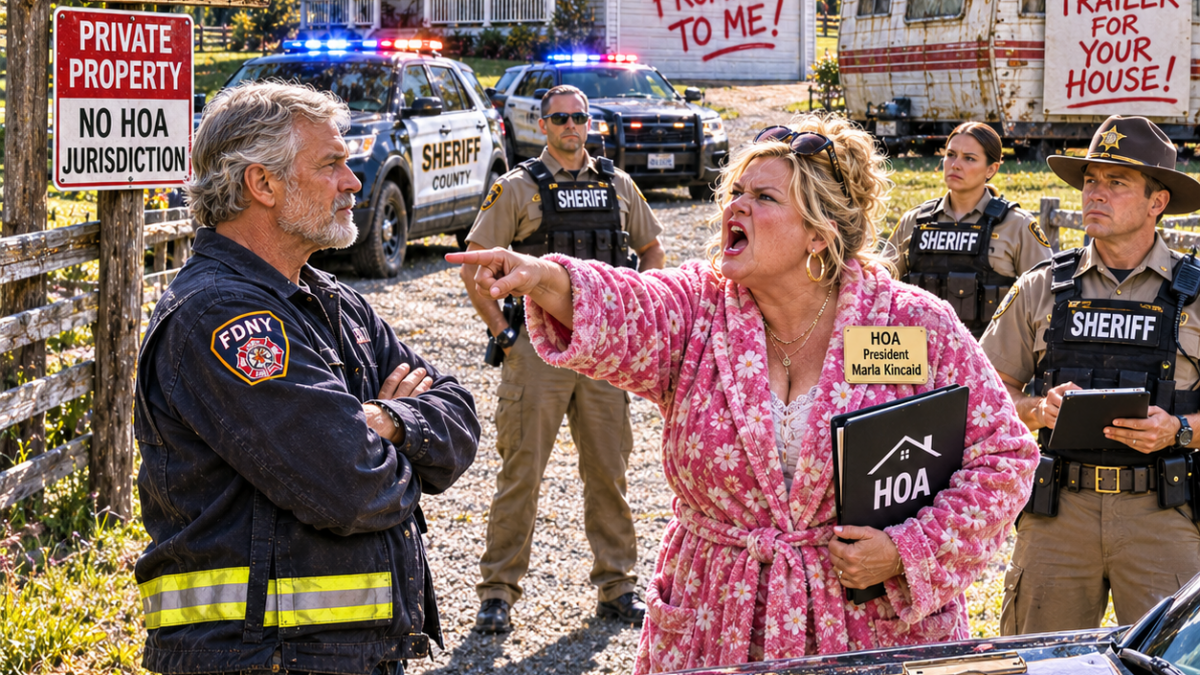
The first time Sarah Nelson landed a private plane on the two-thousand-foot airstrip I had built with my own money, she stepped onto my farm in a coral blazer, accepted a glass of champagne from an HOA board member, and calmly informed me that my runway had become a “shared community aviation amenity” because her board had voted to include it on a county map that I had never seen and certainly never approved.
By the time I discovered that Whitmore HOA was advertising my property online as **WHITMORE LANDING—PRIVATE JET ACCESS MINUTES FROM THE CLUBHOUSE**, Sarah had already hosted investor tours, installed temporary runway lights on my soil, removed three PRIVATE PROPERTY signs, charged guests for aviation events, and convinced half her wealthy subdivision that my working farm belonged to them whenever they needed somewhere glamorous to land.
What Sarah didn’t know was that I had stopped arguing with her weeks earlier—not because I had surrendered, but because an engineer learns very young that when somebody keeps building confidence on top of bad assumptions, sometimes the most effective thing you can do is stop interrupting and let them create the evidence that eventually brings the whole structure down.
My name is Brandon Green.
I was fifty-five when this happened, retired from engineering and living on the same farm I had bought twenty years earlier.
Back then, the property wasn’t impressive.
Cornfields.
A red barn.
A machine shed.
An irrigation pond.
And one long stretch of level ground where I eventually built a two-thousand-foot paved airstrip for the crop-dusting work I used to do with local farmers.
I did it properly.
Surveys.
Permits.
Aviation paperwork.
Inspections.
Everything.
At the entrance stood a small sign:
**PRIVATE USE — B. GREEN AIRFIELD**
For years, nobody misunderstood what that meant.
Then Whitmore Estates appeared half a mile east.
Gated entrance.
Stone walls.
Golf carts.
Luxury homes.
And an HOA with enough rules to regulate the emotional wellbeing of a lawn chair.
Sarah Nelson became its president.
Sixty years old.
Pearls.
Expensive sunglasses.
Immaculate pastel blazers.
And the unnerving ability to say outrageous things in the same tone someone might use to order tea.
The trouble started with a surveyor.
I found him walking my fence line wearing a neon vest and carrying a clipboard.
“What are you doing?”
“Checking the extended recreational boundary.”
“Whose?”
“Whitmore HOA.”
I pointed toward their subdivision.
“Whitmore ends about three hundred feet that way.”
He looked embarrassed.
“I’m just following the map.”
“What map?”
He showed me.
My runway had been shaded in blue.
**PROPOSED AVIATION AMENITY.**
I laughed.
I genuinely laughed.
Then a week later, a new sign appeared beside my mailbox.
**FUTURE SITE OF WHITMORE LANDING**
**PRIVATE JET ACCESS FOR RESIDENTS**
That was when I stopped laughing.
I removed it.
The next month, a Cessna landed on my runway.
I was fixing a gate hinge when I heard the engine.
I looked up and saw the plane descending toward my farm.
I ran toward the strip, waving.
The pilot landed anyway.
The door opened.
Three board members climbed out.
Then Sarah.
She smiled like we were business partners.
“Brandon! Wonderful timing.”
“What are you doing?”
“Testing the airstrip for potential investors.”
“This is private property.”
“You’ll be compensated.”
“I didn’t ask for compensation.”
Her smile tightened.
“You must have missed the county overlay.”
“There is no county overlay giving you my runway.”
“It shows a shared amenity zone.”
“It shows my farm.”
She sighed.
“Property values increase when neighbors cooperate.”
I stared at her.
“You landed an airplane on my land without permission.”
She leaned closer.
“You really should think bigger.”
Then she walked away.
That evening I called Deputy Miller.
Then I pulled my deeds.
My airfield records.
County maps.
Old permits.
And finally the supposed “shared amenity” overlay Sarah kept waving around.
It took one afternoon at the county records office to discover something almost beautiful.
The document she had built her entire airport fantasy around had never been approved.
It was an obsolete draft.
No legal adoption.
No recorded easement.
No transfer.
Nothing.
Sarah had built Whitmore Landing on paper.
Unfortunately for her, I owned the ground beneath it.
And instead of telling her immediately what I had found, I went home, installed more cameras, poured myself a drink, and waited for her to announce her next big event.
PART 2
The announcement arrived two days later.
Not in my mailbox.
Online.
Miguel sent it to me at 6:12 in the morning with one message.
**You awake?**
I was.
Farmers and retired engineers have something in common.
Neither group trusts sleeping late.
I opened the link.
Gold lettering.
A photograph of my airstrip.
My barn in the background.
My cornfields.
A champagne glass digitally placed in one corner.
Across the top:
**WHITMORE AVIATION SOCIAL**
Underneath:
**WHERE LUXURY MEETS THE SKY**
I stared at it.
Then zoomed in.
My barn.
Definitely my barn.
Someone had actually used my property as the promotional image for an event I had never authorized.
The flyer promised:
Private aircraft demonstrations.
Investor networking.
Brunch.
Live music.
Exclusive aviation access for Whitmore members.
And, at the bottom:
**Hosted at Whitmore Landing.**
I called Miguel.
He answered immediately.
“Tell me you’re seeing this.”
“I’m seeing it.”
“You going to call Sarah?”
“No.”
Silence.
“Brandon.”
“What?”
“You said that too calmly.”
“I’m done calling Sarah.”
“That sounds worse.”
I smiled.
“Come over.”
—
Miguel had worked with me during my crop-dusting years.
Mexican American, sixty-two, mechanic since dinosaurs had carburetors.
He could listen to an engine for fifteen seconds and tell you which bolt regretted being born.
He arrived in an old Chevy with a thermos and a breakfast burrito.
I handed him the flyer.
He read it.
Then looked toward the runway.
“She rented your farm.”
“Apparently.”
“Without you?”
“Apparently.”
“She charging?”
I pointed toward the sponsor packages.
He whistled.
“She has platinum landing sponsorship.”
“Yes.”
“What does that mean?”
“No idea.”
“Sounds expensive.”
“It is.”
He kept reading.
“VIP aircraft arrival experience.”
He looked at me.
“What in God’s name is that?”
“Trespassing with hors d’oeuvres.”
Miguel laughed.
Then became serious.
“What are you going to do?”
I placed the county file on my workbench.
“The overlay isn’t valid.”
“You sure?”
“County clerk confirmed it.”
“No recorded easement.”
“No zoning adoption.”
“No aviation authorization.”
“Nothing.”
He smiled.
“So we shut them down.”
“Eventually.”
His smile disappeared.
“Eventually?”
“I want documentation.”
“You have video.”
“I want more.”
“Why?”
“Because Sarah has spent two months telling everyone the same lie.”
I tapped the flyer.
“She’s collecting money now.”
Miguel leaned against the bench.
“You’re going to let the event happen.”
“I’m going to document whatever they choose to do after receiving another written notice.”
“Another?”
I had already prepared one.
Private property.
No aircraft authorization.
No event permission.
No commercial use.
No installation of lights.
No ground access.
Any continued operation would be referred to the appropriate county, law-enforcement, and aviation authorities.
Miguel read it.
“You sound like a lawyer.”
“That’s insulting.”
“Accurate.”
“I’m sending copies certified.”
“To Sarah?”
“The HOA.”
“Their property manager.”
“The aviation company listed on the flyer.”
“The county.”
“And my attorney.”
Miguel nodded slowly.
“So the trap is paper.”
“Paper and arrogance.”
“Arrogance mostly.”
“Usually.”
—
Sarah signed for the notice.
I know because the delivery receipt came back with her signature.
Two days later, crews arrived anyway.
Tents.
Tables.
Portable lights.
A catering van.
Workers started moving equipment near the runway.
I walked down.
A young guy in a safety vest approached.
“Mr. Green?”
“Yes.”
“I’m with Apex Event Logistics.”
“Did anybody tell you this property is privately owned?”
His face changed.
“We were told the HOA had a land-use partnership.”
“They don’t.”
He looked toward Sarah.
She stood near a black SUV talking into her phone.
The young man lowered his voice.
“Do you want us off?”
“I want you to see this.”
I handed him a copy of my written notice.
He read it.
Then called his supervisor.
Within twenty minutes, Apex began packing.
Sarah stormed toward me.
“What did you say to them?”
“The truth.”
“You sabotaged my event.”
“Your event is on my farm.”
“We have an agreement.”
“Show it.”
“You’ve seen the overlay.”
“Draft map.”
“County planning recognizes it.”
“No.”
“Your interpretation.”
“County clerk’s interpretation.”
Her face tightened.
“Brandon.”
“Yes?”
“Do you have any idea how much money is invested in tomorrow?”
“No.”
“Thousands.”
“Then you should have asked the landowner.”
“We’re offering the community something valuable.”
“You keep saying community like it changes ownership.”
Sarah removed her sunglasses.
Her eyes were cold.
“My brother sits on the county zoning board.”
“I know.”
“You should be careful accusing public officials of wrongdoing.”
“I haven’t.”
“You’re implying—”
“No.”
I looked toward the runway.
“I’m saying your event is on private property.”
“That’s all.”
She stepped closer.
“We are not canceling.”
“That’s your decision.”
Her eyebrows lifted.
“You’re not stopping us?”
“I already told you to stop.”
“Then why are you standing there so calmly?”
I smiled.
“Because I finally understand something.”
“What?”
“You think every warning is negotiation.”
Her face hardened.
I walked away.
—
That night, I called Ellen Carter.
She handled agricultural land disputes and commercial liability.
She had represented me years earlier over an irrigation easement.
She listened.
Then asked:
“You have proof Sarah received the notice?”
“Yes.”
“Proof the HOA is charging for access?”
“Yes.”
“County confirmation the overlay is unapproved?”
“Yes.”
“Property deed?”
“Yes.”
“Airfield documentation?”
“Yes.”
“Video?”
“More than you want to watch.”
She sighed.
“Don’t underestimate what lawyers are willing to watch when billing hourly.”
I laughed.
Then asked:
“Should I physically block the runway?”
“No.”
That answer came instantly.
“Why?”
“Because aircraft safety is not where you improvise.”
Fair.
She continued.
“You’ve given notice.”
“You have cameras.”
“You have authorities copied.”
“Do not create a hazard.”
“Do not confront aircraft.”
“Do not touch their equipment.”
“Let the responsible agencies handle aviation operations.”
That became the rule.
And it changed the nature of my plan.
I didn’t need to make the runway dangerous.
Sarah was already making her own position dangerous legally.
I just needed to make sure nobody could erase what happened afterward.
—
Saturday morning arrived bright and cool.
My cameras were ready.
Four fixed angles.
One facing the entrance.
Two runway views.
One covering the event area.
Miguel showed up at seven.
Coffee.
Binoculars.
Ridiculous straw hat.
“You look like a tourist.”
“I am a tourist.”
“On my farm?”
“Front-row package.”
I laughed.
Then the SUVs arrived.
Bentleys.
Mercedes.
Range Rovers.
People wearing clothes too clean for a farm.
Sarah arrived last.
Yellow dress.
Wide-brimmed hat.
Pearls.
Clipboard.
Naturally.
She saw me near my fence.
“Brandon!”
“Sarah.”
“So glad you decided to participate.”
“I didn’t.”
She ignored that.
“This event will change perceptions of Whitmore.”
“I believe that.”
Miguel coughed into his coffee.
Sarah looked at him.
“And you are?”
“Miguel.”
“Are you with aviation?”
“Sometimes.”
“What does that mean?”
“It means engines usually behave better when I’m around.”
She didn’t like him.
Good sign.
—
A chartered plane approached around nine.
I had already sent the operator written notice the previous day.
They had canceled.
Sarah hadn’t told her guests.
At 9:05, nothing landed.
At 9:10, people began checking watches.
At 9:18, Sarah disappeared behind a tent making phone calls.
At 9:25, she returned smiling.
“Minor schedule adjustment!”
Someone asked:
“What happened?”
“Pilot availability.”
I knew better.
The aircraft company had acknowledged my notice in writing.
They weren’t risking a landing dispute.
Sarah had lost her first operator.
But she had another.
A helicopter contractor.
I saw the black helicopter approaching just before ten.
Miguel lowered his coffee.
“You notified them?”
“Yesterday.”
“Response?”
“Nothing.”
He frowned.
The helicopter circled.
Then descended.
I didn’t interfere.
No signals.
No equipment.
No movement onto the strip.
The aircraft landed under its pilot’s control.
Dust blew across the field.
Guests applauded.
Sarah raised both arms.
“Welcome to Whitmore Landing!”
Miguel muttered:
“She’s naming somebody else’s runway while standing ten feet from the owner.”
“Talent.”
Passengers climbed out.
Photos.
Champagne.
Social-media livestream.
A local lifestyle influencer said into her camera:
“Whitmore Estates now has private aviation access right outside the community!”
I quietly recorded the timestamp.
Sarah gave a speech.
“Vision requires courage.”
“Progress requires leadership.”
“Great communities don’t wait for permission to innovate.”
That one almost made me laugh aloud.
She continued.
“For too long, underused land has separated Whitmore from the lifestyle our residents deserve.”
Underused.
My farm.
The place that fed half my retirement.
I looked at Miguel.
He had heard it too.
His jaw tightened.
“Underused?”
“Easy.”
“I want to throw her clipboard into the pond.”
“That’s why you’re not the lawyer.”
—
The helicopter demonstration continued.
The pilot appeared increasingly uncomfortable.
He spoke with one of the event organizers.
Pointed toward the wind.
Then toward the field.
Sarah came over.
They argued.
I couldn’t hear all of it.
But one sentence carried.
“We were told this was approved.”
Sarah answered:
“It is.”
The pilot shook his head.
The helicopter remained grounded.
That was when the first county vehicle arrived.
Then a sheriff’s cruiser.
Then another government vehicle carrying aviation compliance personnel who had been copied on the property-use complaint and had decided an advertised public event on a disputed private strip deserved inspection.
Sarah saw them.
Her smile disappeared.
Deputy Miller stepped out.
He gave me a small nod.
Then walked toward Sarah.
“Morning.”
She recovered quickly.
“Deputy.”
“We need to speak with whoever is responsible for this event.”
“That would be me.”
“Good.”
He looked toward the runway.
“Do you have written landowner permission?”
“We have county authorization.”
“Can I see it?”
She handed him the infamous overlay.
Miller looked at it.
Then handed it to the aviation official beside him.
The woman studied the page.
“What’s this?”
“County amenity overlay.”
“Recorded number?”
Sarah paused.
“It was approved through planning.”
The woman looked toward me.
“You the property owner?”
“Yes.”
“Did you sign this?”
“No.”
She turned back.
“Do you have an easement?”
Sarah said:
“The HOA voted—”
“That isn’t what I asked.”
I liked her immediately.
—
Her name was Agent Morrison.
She wasn’t there to perform some dramatic television arrest.
She was there to establish facts.
Who owned the strip?
Who authorized operations?
What documentation had pilots relied upon?
Had commercial events been advertised?
Were safety rules followed?
Sarah’s answer to almost everything was some variation of:
“The HOA approved it.”
Morrison finally said:
“Mrs. Nelson, your HOA does not regulate aviation law.”
Sarah laughed nervously.
“Of course not.”
“It also does not appear to own this runway.”
“We have shared-use rights.”
“Show me the recorded instrument.”
Sarah looked toward the county official.
He looked away.
The crowd became quiet.
Several guests lowered their champagne glasses.
One man asked:
“Sarah, are we trespassing?”
“No.”
Morrison said:
“The ownership question appears quite clear.”
Sarah snapped:
“This is an administrative misunderstanding.”
I finally spoke.
“You received my notice Thursday.”
She turned toward me.
“You were being obstructionist.”
“I told you the property was private.”
“You knew this event mattered.”
“So?”
“You deliberately waited until today to embarrass me.”
“No.”
I looked around at the cameras.
“I notified everyone before today.”
Silence.
That was the trap.
Not grease.
Not paint.
Not hidden hazards.
Time.
Documentation.
Receipt confirmation.
Sarah had been given every opportunity to cancel.
Instead, she had advertised louder.
Charged more.
Invited more guests.
And created more witnesses.
—
Then the helicopter incident happened.
Not because I sabotaged anything.
That distinction became critically important later.
The pilot had decided to reposition the helicopter away from the congested event area while officials sorted out the authorization issue.
Conditions near the edge of the strip were poor from recent rain and unauthorized event traffic had churned the shoulder into mud.
One of the temporary ground markers installed by the HOA had also been placed too close to an area that should never have been used as a taxi route.
The pilot began moving.
Something went wrong.
The helicopter yawed unexpectedly.
People screamed.
It slid off the paved section.
Into the soft shoulder.
Then into the outer rows of my cornfield.
Corn exploded beneath the skids.
The pilot shut the aircraft down.
For one terrible second, nobody moved.
Then emergency responders ran forward.
I did too.
Whatever I thought of Sarah, this was no longer funny.
“Everybody back!”
Miller shouted.
The pilot opened his door.
Conscious.
Shaken.
A passenger climbed out.
Then another.
No catastrophic injuries.
Thank God.
Sarah came running through the field.
One yellow heel disappeared in the mud.
She ripped it free.
“Who did this?”
Nobody answered.
She turned toward me.
“You!”
I stared.
“You sabotaged the runway!”
“No.”
“You did something!”
“No.”
“You’ve been planning this!”
Agent Morrison stepped between us.
“Mrs. Nelson.”
Sarah pointed at me.
“He admitted he had a plan!”
Morrison looked at me.
I said:
“My plan was cameras, records, and enforcement.”
“Nothing on the runway was altered by me to interfere with aircraft.”
Miguel said:
“He’s been maintaining that strip safely for twenty years.”
Sarah screamed:
“Then why did it slide?”
Morrison looked toward the temporary event setup.
“That is what investigators are going to determine.”
Sarah’s face went white.
Because suddenly the question was no longer:
Why won’t Brandon share?
It was:
Who authorized this event?
Who installed equipment?
Who told the operator the site was approved?
Who ignored the property owner’s warnings?
And Sarah’s name was on almost everything.
—
My farm turned into an investigation site for the rest of the day.
Sheriff’s deputies.
Aviation officials.
County personnel.
Emergency crews.
Insurance representatives.
The guests disappeared quickly.
Funny how fast luxury networking ends when investigators start asking for names.
I gave Morrison everything.
Deed.
Airfield registration.
County records.
Copies of notices.
Certified delivery confirmation.
Event flyers.
Screenshots.
Videos.
Pictures of Sarah removing signs.
Footage of HOA crews installing lights.
Advertisements for paid access.
She spent nearly an hour reviewing it.
Finally she looked up.
“You’ve been documenting for months?”
“Yes.”
“Why?”
“Because nobody believed me at first.”
She nodded.
“I believe you now.”
That meant more than I expected.
—
Sarah remained near her SUV.
Phone glued to her ear.
Lawyer, probably.
Or brother.
Or both.
When Morrison approached her again, Sarah started speaking first.
“This entire event was approved through county planning.”
Morrison said:
“We’ve contacted the county.”
“And?”
“The document you’re relying upon is not an adopted access instrument.”
Sarah looked toward me.
“He manipulated the records.”
I laughed.
Couldn’t help it.
Morrison didn’t.
“The county has its own records.”
“My brother—”
“Your brother is not part of this conversation.”
Sarah stopped.
Morrison continued:
“Until this investigation is complete, there will be no HOA-sponsored aviation activity at this site.”
“You can’t do that.”
Morrison stared at her.
“Actually, aviation operations can absolutely be restricted when authorization and safety are in question.”
Sarah folded her arms.
“Our residents have rights.”
“Not to somebody else’s runway.”
That ended it.
—
Local reporters arrived before sunset.
I didn’t call them.
Some guest had posted video.
Naturally.
The headline that evening:
**HELICOPTER SLIDES INTO CORNFIELD DURING DISPUTED HOA AVIATION EVENT**
Better than the internet version later.
At least accurate.
The video showed Sarah yelling.
Investigators.
The helicopter sitting in corn.
My red barn behind everything.
I refused an interview that night.
Miguel stayed.
We sat on the porch.
No whiskey until emergency crews were gone.
Then one glass.
He stared toward the field.
“That could’ve been worse.”
“Much worse.”
“Still think it’s funny?”
“No.”
“Me either.”
We sat quietly.
Then he said:
“But Sarah blaming you before the blades stopped?”
I sighed.
“Predictable.”
“What happens now?”
I looked toward the cameras.
“Now people with badges read emails.”
—
The next morning, Whitmore exploded.
Not literally.
Socially.
Homeowners demanded an emergency meeting.
Some had been told the airstrip belonged to the HOA.
Others had paid special assessments related to the aviation program.
Several believed county officials had approved everything.
Sarah had apparently presented the amenity overlay at multiple board meetings as settled authority.
I didn’t attend their emergency meeting.
Miguel knew someone on maintenance.
He called me afterward.
“You missed a show.”
“Good.”
“She got screamed at for two hours.”
“Good?”
He paused.
“Okay, maybe not good.”
“What happened?”
“Board demanded documents.”
“And?”
“She kept saying her brother handled zoning.”
“Then someone asked why there was no recorded easement.”
“And?”
“She blamed you.”
“Of course.”
“Then they asked why she ignored certified notice.”
I smiled.
“There it is.”
“She’s refusing to resign.”
“Expected.”
“She threw a clipboard.”
“Also expected.”
“You know her too well.”
“Unfortunately.”
—
The following afternoon, Agent Morrison returned with two investigators.
We sat at my porch table.
Lemonade.
Paperwork.
One asked:
“Did Sarah Nelson ever pay you?”
“No.”
“Offer?”
“Once vaguely.”
“Written?”
“No.”
“Did you authorize any flights?”
“No.”
“Any board member?”
“No.”
“Did you lease any part of the field?”
“No.”
“Did you allow them to paint markings?”
“No.”
“Install temporary lights?”
“No.”
“Sell landing access?”
“Absolutely not.”
He nodded.
Then Morrison showed me a printed email.
Sarah to the HOA board.
**Brandon has effectively consented through non-enforcement and community integration.**
I stared.
“When was that?”
“Three weeks ago.”
I laughed without humor.
“I had already served written objections by then.”
“We know.”
Another email:
**County zoning confirms shared-use status through the amenity overlay.**
“Did county zoning confirm that?”
I asked.
Morrison said:
“Not according to the county.”
I leaned back.
There it was.
Sarah hadn’t misunderstood.
She had started writing certainty into emails that the underlying records didn’t support.
—
Then investigators looked at the overlay itself.
That became the bigger problem.
The draft had once existed.
That part was real.
Years earlier, during Whitmore development planning, someone had proposed potential regional amenities.
Nothing in the draft granted access to my property.
Nothing became a recorded easement.
But the version Sarah had distributed included changes.
Labels.
Boundary shading.
Language suggesting shared aviation access.
Who altered it became a separate question.
I didn’t accuse Sarah’s brother.
Neither did investigators—not publicly.
But he was questioned because of his zoning position.
And suddenly the friendly little network Sarah had relied on started becoming very quiet.
—
The HOA sent me a formal letter three days later.
Not from Sarah.
From their attorney.
**Whitmore Homeowners Association is suspending all aviation-related activities pending investigation.**
Then:
**The Association does not concede liability.**
Of course.
Ellen read it.
“Standard.”
“What now?”
“We wait.”
“I hate waiting.”
“That’s because engineers like inputs and outputs.”
“Yes.”
“Law is more like plumbing in an old house.”
“That explains the smell.”
She smiled.
“Sarah threatened to sue you?”
“Repeatedly.”
“She will.”
“How do you know?”
“People who need to control the story often file claims when the story escapes them.”
She was right.
Certified letter arrived Friday.
**NOTICE OF INTENT TO SUE**
Gross negligence.
Defamation.
Intentional humiliation.
Property damage.
Emotional distress.
And allegations that I had deliberately made the runway unsafe.
That one mattered.
I called Ellen.
Her voice became serious.
“Don’t discuss surface conditions with anyone except investigators and counsel.”
“Fine.”
“Don’t joke about ‘making it slippery.’”
“I didn’t make it slippery.”
“I know.”
“People online don’t.”
“That’s why you don’t feed them quotes.”
“What about Miguel?”
“Especially Miguel.”
I looked across the barn.
Miguel was wearing a T-shirt that read:
**GRAVITY — THE ORIGINAL HOA ENFORCEMENT**
“That’s going to be difficult.”
—
Investigators eventually determined that there was no evidence I had intentionally sabotaged the airstrip.
That mattered more than any viral video.
The surface problems near the shoulder and event area were tied to conditions, unauthorized temporary setup, and use patterns associated with the event—not a hidden trap created to crash an aircraft.
The pilot had also been operating under information supplied by event organizers that did not accurately reflect the site’s authorization status.
The legal trap was the real one.
Sarah had created a paid aviation program.
On property she didn’t own.
After written notice.
Using documents that did not establish the rights she claimed.
Everything else flowed from that.
—
The county investigation widened.
Sarah’s brother stepped away from the zoning board while authorities reviewed how the altered planning document had circulated.
I resisted the temptation to celebrate.
It wasn’t my job to decide what he knew.
Evidence would.
That’s something I learned during the whole mess.
When people have treated you unfairly, certainty becomes addictive.
You want every rumor about them to be true.
That’s dangerous.
I had spent months criticizing Sarah for replacing facts with what she wanted to believe.
I wasn’t going to do the same thing just because the rumors now favored me.
—
Then the FAA compliance report arrived.
Dense.
Technical.
Not nearly as entertaining as television.
I loved it.
My runway was confirmed as private-use.
No HOA lease.
No recorded public access.
No association authorization.
Commercial or promotional aviation activity had occurred without my consent.
The HOA’s event documentation contained unsupported representations about access.
Safety concerns had been created by running public-facing events without proper landowner coordination and operational controls.
Ellen read the report.
Then smiled.
“Frame this.”
“I thought lawyers hated symbolism.”
“I hate bad symbolism.”
“This is excellent symbolism.”
—
Sarah’s lawsuit was filed anyway.
**NELSON v. GREEN**
She alleged I had orchestrated public humiliation.
She claimed I deliberately waited for a high-profile event before enforcing my property rights.
That part was technically true in the sense that I stopped arguing personally and let authorities handle the documented violation.
But waiting to enforce through legal channels isn’t the same as making an aircraft unsafe.
She also claimed my videos destroyed her reputation.
Ellen’s response:
“Cameras don’t create conduct.”
“They preserve it.”
I liked that.
—
Then came the media wave.
At first local.
Then aviation websites.
Then regional television.
The most popular clip wasn’t the helicopter.
It was Sarah shouting:
“Who authorized these people to investigate our community property?”
And Morrison answering:
“It isn’t community property.”
That exchange spread everywhere.
People made memes.
I hated most of them.
Miguel loved all of them.
He arrived one morning with his phone.
“Look.”
“No.”
“Sarah as an air-traffic controller.”
“No.”
“Sarah photoshopped onto a broom.”
“Miguel.”
“Fine.”
Two minutes later:
“Cornfield says no parking.”
I laughed.
I hated myself.
—
The funniest stories were also the least accurate.
One claimed I had painted the runway with cooking oil.
False.
Another said I had remotely controlled the helicopter.
Absurd.
Another said the cornfield was secretly engineered as a safety net.
I wish my farming was that sophisticated.
I eventually gave one interview.
Only one.
The reporter asked:
“Did you set a trap for the HOA?”
I thought carefully.
“Yes.”
Her eyebrows rose.
“What kind?”
“Certified mail.”
She laughed.
I didn’t.
“I’m serious.”
“I told them the property was private.”
“I documented their advertisements.”
“I preserved county records.”
“I notified authorities.”
“Then I let them decide whether to keep pretending the warnings didn’t exist.”
“So the trap was paperwork?”
“The trap was assuming I would never force them to prove what they claimed.”
That quote became the headline.
Much better.
—
Sarah’s own board began turning on her.
Emails surfaced showing she had approved aviation expenses without a clear member vote.
Aircraft rentals.
Event staging.
Marketing.
Temporary runway equipment.
Insurance riders.
Consultants.
One private flight had apparently been tied to her birthday celebration.
That didn’t help.
The board suspended her authority.
Then formally demanded her resignation.
She refused for forty-eight hours.
Then resigned.
Her letter blamed:
media pressure,
federal overreach,
county politics,
anti-HOA sentiment,
me,
and “a culture hostile to visionary leadership.”
Notably absent:
herself.
—
Miguel brought the resignation letter.
“Visionary leadership.”
“Yes.”
“Your corn survived visionary leadership.”
“Most of it.”
“You should sell it.”
“Sell what?”
“Crash corn.”
I stared.
“Absolutely not.”
“Souvenir ears.”
“No.”
“Limited edition.”
“No.”
“Brandon, you’re terrible at capitalism.”
“I’m comfortable with that.”
—
A week later, Sarah came to the farm.
Alone.
No blazer.
No pearls.
Ordinary gray sweater.
She parked on the county shoulder rather than my driveway.
That was new.
“Brandon.”
I stayed on the porch.
“What do you want?”
“To talk.”
“From there.”
She looked hurt.
Fair.
“You ruined me.”
“No.”
“Please don’t give me that line.”
“What line?”
“That I did this to myself.”
I stayed quiet.
She laughed bitterly.
“See?”
“What do you want me to say?”
“That you enjoyed it.”
I considered lying.
Didn’t.
“Parts of it?”
Her face hardened.
“Yes.”
“I enjoyed watching your fake authority collapse.”
“I enjoyed seeing the county confirm the runway was mine.”
“I enjoyed hearing you couldn’t charge people to use my property.”
Her eyes filled.
“But I didn’t enjoy the helicopter leaving the pavement.”
That surprised her.
“I didn’t want anybody hurt.”
“You expect me to believe that?”
“Yes.”
“You were smiling.”
“I smiled when the truth came out.”
“Not when people were in danger.”
She looked away.
Then:
“You could have stopped the event.”
“I tried.”
“No.”
“You could have physically shut everything down.”
“That isn’t my job.”
“I sent notice.”
“I contacted the county.”
“I contacted law enforcement.”
“I notified the operator.”
“You decided your event mattered more.”
She folded her arms.
“I believed we had the right.”
“After the county records?”
She didn’t answer.
“After my attorney’s notice?”
Silence.
“After certified delivery?”
She looked toward the airstrip.
“I thought you’d give in.”
There it was.
The first honest sentence Sarah Nelson had given me.
I said:
“I know.”
She looked at me.
“Everyone gives in eventually.”
“Not everyone.”
“No.”
Her voice broke slightly.
“Apparently not.”
She turned.
Before walking away, she said:
“I hope you’re happy.”
I looked at my farm.
“I was before you started landing airplanes here.”
She left.
—
Court came three months later.
County courthouse.
Packed.
Reporters.
Whitmore residents.
Pilots.
Curious farmers.
Miguel wearing an actual button-down shirt for once.
Ellen sat beside me.
Across the aisle:
Sarah.
Navy suit.
Pearls back.
Lawyer named Chadwick Holt.
Judge Mary Ann Porter entered.
Gray hair.
Direct stare.
No interest in spectacle.
Holt began with emotion.
Sarah’s reputation destroyed.
Public ridicule.
Loss of leadership role.
Online harassment.
Mental distress.
He claimed I had deliberately engineered a humiliating confrontation.
Judge Porter asked:
“Mr. Holt, what exactly is the actionable conduct?”
He hesitated.
“Mr. Green created hazardous conditions.”
“Evidence?”
“Circumstantial.”
“Continue.”
He called Sarah.
She described months of conflict.
My hostility.
My refusal to cooperate.
The aviation event.
The crash.
The videos.
Then she said:
“I believe Mr. Green wanted something terrible to happen.”
Ellen stood.
“Objection.”
“Sustained.”
Judge Porter looked at Sarah.
“You may testify to what you observed, not what you imagine another person intended.”
Sarah nodded.
Barely.
—
Ellen cross-examined her.
“Mrs. Nelson, did Mr. Green ever sign an agreement granting Whitmore access?”
“No.”
“Lease?”
“No.”
“Easement?”
“We believed—”
“Recorded easement?”
“No.”
“Did you receive written notice prohibiting aviation activity?”
“Yes.”
“Before the helicopter event?”
“Yes.”
“Did the HOA proceed anyway?”
“Yes.”
“Did you personally advertise Whitmore Landing?”
“Yes.”
“Did you refer to Mr. Green’s runway as a shared amenity?”
“Yes.”
“Was that statement supported by a recorded property interest?”
Sarah stared.
“No.”
“Did you remove private-property signs?”
“No.”
Ellen projected the camera footage.
Sarah appeared in gardening gloves.
Removing my sign.
Putting it in her SUV.
The courtroom murmured.
Ellen:
“Would you like to reconsider?”
Sarah’s face reddened.
“I removed an obstruction.”
“On Mr. Green’s property?”
Silence.
“Yes.”
—
Then Ellen showed the county overlay.
Original draft.
Then Sarah’s version.
Additional labels.
Different emphasis.
**AVIATION AMENITY ACCESS.**
She asked:
“Did the county formally adopt this as an easement?”
“No.”
“Did you tell residents it had?”
“I said the county recognized the zone.”
“Did it?”
Sarah looked toward her attorney.
Judge Porter said:
“Answer.”
“No.”
That single word changed the courtroom.
—
Holt tried to redirect toward the helicopter.
He suggested surface manipulation.
Ellen introduced the investigation.
No evidence of deliberate sabotage by me.
Maintenance records.
Photographs.
Time-stamped video.
Event equipment placement.
Weather conditions.
Operational findings.
Then Agent Morrison testified regarding the authorization dispute and her investigation.
She was careful.
Professional.
No jokes.
That made Sarah look worse than any comedy could.
Morrison confirmed:
private status,
absence of HOA land rights,
written objections,
commercial representations,
and the fact that the aviation event proceeded despite unresolved legal and safety concerns.
—
Then I testified.
Ellen asked:
“Why did you build the runway?”
“Crop-dusting work.”
“How long ago?”
“About twenty years.”
“Who paid?”
“I did.”
“Who maintained it?”
“I did.”
“Did Whitmore Estates exist then?”
“No.”
“Did you ever invite the HOA to operate aircraft there?”
“No.”
“Why didn’t you physically block the runway before the showcase?”
“Because I wasn’t going to create an aviation hazard.”
Judge Porter looked up slightly.
Good.
I continued:
“I notified the responsible people.”
“I called authorities.”
“I documented.”
“I let professionals handle the aviation side.”
“Did you want Sarah humiliated?”
I thought before answering.
“I wanted her stopped.”
“Those aren’t necessarily the same thing.”
“Did you release the crash footage?”
“No.”
“Did you stage the crash?”
“No.”
“Did you alter the runway to make an aircraft lose control?”
“No.”
“Did you set a trap?”
Holt objected.
Judge allowed the question in context.
I said:
“Yes.”
The courtroom stirred.
Ellen waited.
“What trap?”
“Paperwork.”
A few people laughed.
Judge Porter looked curious.
I explained:
“Sarah believed she could say something often enough and make it true.”
“I stopped debating.”
“I sent written notices.”
“I preserved delivery receipts.”
“I documented the events she advertised publicly.”
“I pulled the actual county records.”
“I gave all of it to investigators.”
“She created the rest herself.”
Judge Porter nodded slowly.
Ellen sat.
“No further questions.”
—
Holt came after me aggressively.
“You disliked Mrs. Nelson.”
“Yes.”
“You wanted her HOA aviation project to fail.”
“Yes.”
“Because you resented Whitmore?”
“No.”
“Because they were wealthy?”
I almost laughed.
“No.”
“Then why?”
“Because they were using my property.”
He paced.
“You could have benefited financially.”
“Not relevant.”
“You rejected progress.”
“I rejected trespassing.”
“You enjoyed seeing her lose status.”
“I already admitted I enjoyed parts of her authority collapsing.”
“Then this was personal.”
“It became personal when strangers began landing aircraft beside my barn.”
The gallery murmured.
Holt held up one of my text messages to Miguel.
**Let her create the evidence.**
He smiled.
“Those are your words?”
“Yes.”
“You planned her downfall.”
“I planned to document whatever she chose to do.”
“Same thing.”
“No.”
I looked at him.
“If I tell you a camera is recording and you steal my tractor anyway, the camera didn’t plan your theft.”
That got a laugh.
Judge Porter tapped her gavel.
Holt’s face reddened.
—
Closing arguments were simple.
Holt:
I had been vindictive.
I had wanted public embarrassment.
My documentation campaign showed intent.
Sarah’s reputation had been harmed.
Ellen:
Truthful documentation is not defamation.
Private ownership is not malice.
Repeated written warnings defeat the idea that Sarah was ambushed.
No evidence proved I sabotaged the helicopter.
The HOA had no legal right to use my airstrip.
Sarah’s reputation suffered because the public learned what she had done.
Then Ellen said:
“My client did not make Mrs. Nelson host an unauthorized aviation event.”
“He did not make her advertise land she did not own.”
“He did not make her remove private-property signs.”
“He did not make her ignore certified notice.”
“He simply stopped rescuing her from the consequences of those decisions.”
That was it.
—
Judge Porter ruled from the bench.
Sarah’s primary claims dismissed.
Defamation failed because the statements at issue were substantially grounded in documented events or official proceedings.
Sabotage allegations lacked evidentiary support.
The court recognized my property rights and the lack of a valid HOA access instrument.
My recoverable legal fees and documented property damage were awarded under the claims the court found appropriate.
Then Porter looked at Sarah.
“Mrs. Nelson.”
Sarah stood.
“Leadership does not create ownership.”
Silence.
“An HOA vote does not convey another person’s real property.”
“And confidence in a legal position does not substitute for verifying that position before spending other people’s money.”
Sarah looked down.
Porter continued:
“Your client may feel humiliated.”
She looked toward Holt.
“But humiliation caused by accurate exposure of one’s own conduct is not automatically a compensable injury.”
The gavel fell.
Done.
—
Outside, reporters swarmed.
I wanted to leave.
Miguel intercepted one question.
“Mr. Green, do you consider this revenge?”
I stopped.
Thought about Sarah.
The helicopter.
The corn.
The court.
Then said:
“No.”
The reporter waited.
“What is it?”
“Closure.”
That was the only answer I gave.
—
Whitmore HOA changed rapidly afterward.
The remaining board brought in outside counsel.
Independent financial review.
Clearer voting procedures.
No aviation program.
No fake shared-use maps.
No Sarah.
A new president named David Mercer wrote me.
Not demanded.
Wrote.
**Mr. Green,**
**The new Whitmore board acknowledges your exclusive ownership of Green Airfield and surrounding farm property. We apologize for prior unauthorized access and activities.**
**The Association will not enter, advertise, use, or represent any portion of your property as a Whitmore amenity without a written agreement signed by you.**
I read it twice.
Then framed it.
Miguel saw it.
“You framed the apology?”
“Yes.”
“Petty.”
“Absolutely.”
—
I restored the damaged cornfield.
That took longer than restoring my pride.
The helicopter had flattened a wide path.
Insurance handled much of the direct damage after liability issues were sorted.
I replanted.
The next crop came in well.
Miguel stood beside me during harvest.
“Best corn you’ve ever grown.”
“Probably not.”
“Symbolically.”
“Mechanics should stop using that word.”
“Symbolically?”
“Exactly.”
—
Three months later, a man named Daniel Briggs arrived.
Black government sedan.
Plain suit.
He introduced himself as an aviation program representative.
“Brandon Green?”
“Yes.”
“You did federal airfield consulting years ago.”
“Small projects.”
“Emergency-access work.”
“Long time ago.”
He looked toward my runway.
“We reviewed your old registration during the Whitmore investigation.”
That got my attention.
“And?”
“Your site was included in an auxiliary emergency-use program.”
I frowned.
“I thought that designation expired.”
“Operational arrangements changed.”
“But parts of the federal emergency-access framework remained in the records.”
I laughed.
“So what does that mean?”
“It means your private ownership remains your private ownership.”
Good.
I appreciated that clarification immediately.
“But the government retains certain emergency-use rights under the old arrangement, subject to the actual documents.”
“Not ownership?”
“No.”
“Good.”
The original source version of this part liked to claim the government secretly owned everything.
Reality was more interesting.
My land stayed mine.
But the runway had a documented emergency relationship with federal aviation planning that Sarah’s HOA had never bothered to investigate.
Briggs said:
“We’d like to update the agreement.”
“For what?”
“Emergency and training coordination.”
“And compensate you for maintaining availability.”
I stared.
“You want to pay me to maintain the runway I’ve already been maintaining?”
“Essentially.”
“Miguel is going to become unbearable.”
Briggs didn’t understand.
He would.
—
I agreed only after Ellen reviewed everything.
Because I had learned my lesson.
No handshake assumptions.
No community understanding.
No “we all know what this means.”
Paper.
Definitions.
Rights.
Limits.
Who can use the strip.
When.
How.
Insurance.
Maintenance.
Emergency access.
My ownership clearly preserved.
Ellen looked impressed.
“You’re becoming difficult.”
“Thank you.”
“That was not entirely praise.”
“Still taking it.”
—
The updated agreement meant occasional authorized training or emergency-support operations could use the airstrip under controlled circumstances.
The first one happened months later.
Small government aircraft.
Advance notice.
Professional ground coordination.
No champagne.
No influencer.
No gold banner.
No Sarah yelling about vision.
The plane approached.
Lined up.
Touched down smoothly.
Rolled.
Stopped.
Textbook.
I watched from the fence.
Miguel beside me.
He said:
“Boring.”
“Beautiful.”
“No corn?”
“No corn.”
“No screaming?”
“No.”
“No yellow heels?”
“Go home.”
He smiled.
“This is how it’s supposed to work, huh?”
“Yes.”
Permission.
Planning.
Competence.
Three things Sarah had believed were optional.
—
Whitmore eventually recovered.
Not fully.
Several residents left.
Some sued over HOA spending.
Sarah’s extravagant aviation project had cost them dearly.
But I didn’t celebrate falling property values.
Those homeowners hadn’t all supported her.
Some simply trusted the board.
That’s another lesson.
Leadership mistakes rarely bill only the leader.
Everyone pays something.
The new board cut spending.
Sold unnecessary assets.
Canceled vanity projects.
The clubhouse survived.
No airfield.
People went back to golf.
Probably safer.
—
Sarah disappeared from public life.
Rumor said Florida.
Of course Florida.
I never verified it.
For a while people sent me screenshots of someone who looked like her attending another community meeting.
I stopped opening them.
My life was here.
Her next argument wasn’t my responsibility.
—
One October morning, an envelope arrived.
No return address.
Inside was a photograph of my runway.
Fresh.
Taken from the public road.
On the back:
**I HOPE YOU’RE HAPPY. — S.N.**
I stared at it.
Miguel was in the barn.
I showed him.
“That creepy?”
“A little.”
“You calling Ellen?”
“Yes.”
“Sheriff?”
“Probably documentation only unless there’s more.”
“Smart.”
I placed the photo in the case file.
Not on my refrigerator.
I wasn’t scared.
But peace is not the same as carelessness.
—
That evening I walked the runway.
Sunset.
Corn golden.
The asphalt carried faint scars from the incident, though most people wouldn’t notice.
I did.
Engineers see scars.
So do farmers.
So do people.
I thought about how much pleasure I had once taken in seeing Sarah’s arrogance collapse.
Some of it still felt deserved.
But I also remembered the second when the helicopter moved sideways.
The sound.
The screaming.
The immediate fear that someone might die.
There is nothing satisfying about that.
Nobody deserves a preventable aviation accident because they’re arrogant.
If I had actually created that danger, I would have become the worst part of the story.
That realization stayed with me.
Justice needed to survive daylight.
That became my standard.
Would I be willing to explain what I did under oath?
To a judge?
To an investigator?
To the family of someone who got hurt?
If the answer was no, it wasn’t justice.
It was revenge.
There’s a difference.
—
Miguel joined me with two coffees.
No whiskey that night.
“You thinking too hard.”
“Yes.”
“Sarah?”
“Partly.”
He sat on the runway edge.
“Regret anything?”
“I regret not hiring Ellen sooner.”
He laughed.
“Lawyer will love hearing that.”
“I regret yelling at Sarah a couple times.”
“That’s it?”
“I regret enjoying the crash footage.”
Miguel became quiet.
“Yeah.”
“You did too.”
“Yeah.”
We sat.
Then he said:
“But you didn’t cause it.”
“No.”
“You warned them.”
“Yes.”
“You didn’t block the strip with equipment while aircraft were coming.”
“No.”
“You didn’t mess with the machine.”
“No.”
“Then stop carrying choices other people made.”
I looked at him.
“That’s annoyingly healthy.”
“I’m getting old.”
“Terrible.”
—
The next year, a young pilot stopped at the farm.
Not by landing.
He drove.
Good start.
“Mr. Green?”
“Yes.”
“I’ve heard about your strip.”
“That sentence worries me.”
He smiled.
“I work agricultural aviation.”
“My boss said you used to spray.”
“I did.”
“Would you ever lease hangar access?”
I almost said no automatically.
Then stopped.
“Maybe.”
His face brightened.
“With an actual contract.”
“Of course.”
“Insurance.”
“Yes, sir.”
“Written operating rules.”
“Yes.”
“And you ask before landing.”
He laughed.
“Definitely.”
I smiled.
“Then we can talk.”
That felt important.
Sarah hadn’t turned me into a man who wanted nobody near his property.
She had turned me into a man who understood consent more clearly.
There is a difference between protecting boundaries and building walls around yourself.
I didn’t want the second.
—
The pilot’s name was Caleb.
Twenty-eight.
Serious.
Respectful.
We eventually signed a limited seasonal arrangement.
He used the strip for agricultural work.
Paid fairly.
Followed rules.
Helped maintain the surface.
Every time he radioed ahead, I thought about Whitmore.
How simple it could have been.
Sarah could have knocked on my door.
“Brandon, would you ever consider leasing runway access?”
Maybe I would’ve said no.
Maybe yes.
Maybe we could’ve negotiated.
Instead she assumed.
Then invented.
Then escalated.
Entitlement turns possibilities into wars.
—
Caleb asked me once:
“Is it true an HOA helicopter crashed here?”
“Slid off.”
“Internet says you trapped them.”
“Internet says many things.”
“What really happened?”
I told him.
Private runway.
Unauthorized use.
Fake access claim.
Events.
Written notices.
Investigation.
Incident.
Court.
He listened.
Then said:
“So the trap was basically evidence.”
“Yes.”
He looked disappointed.
“Less exciting.”
“Much safer.”
He nodded.
“Fair.”
I liked him.
—
Years passed.
The viral story faded.
Good.
The airstrip remained.
Occasional agricultural flights.
Authorized emergency exercise.
Most days nothing.
Exactly how I liked it.
Corn.
Wind.
Barn.
Coffee.
Miguel.
He aged badly but complained professionally.
—
One summer, Whitmore invited me to speak at a community meeting.
I almost deleted the email.
Then saw who sent it.
David Mercer.
New board.
Topic:
**PROPERTY RIGHTS AND COMMUNITY PARTNERSHIPS**
I showed Miguel.
He laughed for a full minute.
“You have to go.”
“No.”
“You absolutely have to.”
“Why?”
“Walk in wearing pilot sunglasses.”
“No.”
“Coral blazer.”
“Get off my farm.”
I went anyway.
Normal shirt.
No drama.
The clubhouse felt smaller without Sarah occupying it.
About sixty residents attended.
David introduced me.
“Some of you know Mr. Green from a difficult period in Whitmore’s history.”
Understatement.
I stood.
“I don’t hate HOAs.”
Several people laughed.
“I’m serious.”
“Shared communities sometimes need shared rules.”
“Road maintenance.”
“Common property.”
“Insurance.”
“Whatever members agreed to.”
“But the important word is agreed.”
I paused.
“My runway was never part of your agreement.”
“The old board treated inconvenience as permission.”
“That was the mistake.”
A woman raised her hand.
“Do you blame residents?”
“Some.”
That surprised them.
“If you knowingly landed on my farm after being told not to?”
“Yes.”
“If you trusted the board because you thought they had verified things?”
“Less.”
“But everyone has a responsibility to ask questions when a promise sounds too convenient.”
Another resident asked:
“What would you have done if Sarah had asked?”
“I don’t know.”
“That surprises you?”
“Yes.”
“I might have refused.”
“I might have leased limited access.”
“But she removed the one thing necessary for negotiation.”
“Choice.”
The room became quiet.
That was the whole story in one word.
—
After the meeting, an older woman approached.
“I supported Sarah.”
I nodded.
“I thought what she was doing would make Whitmore more prestigious.”
“Okay.”
“I called you selfish.”
“I remember that word.”
She looked embarrassed.
“I’m sorry.”
“Thank you.”
She hesitated.
“You don’t seem angry.”
“I was.”
“For a long time?”
“Yes.”
“What changed?”
I thought.
“Anger got boring.”
She laughed unexpectedly.
Then hugged me.
I wasn’t prepared for that.
Miguel would’ve enjoyed it.
—
Later, David showed me the new HOA rules.
Any proposed use of neighboring property required:
verified title review,
written owner consent,
legal review,
documented insurance,
member disclosure.
I pointed at the first line.
“This would’ve saved everyone a lot of money.”
“Yes.”
“That should be the HOA motto.”
He smiled.
**READ THE DEED FIRST.**
I’d buy that sign.
—
Sarah’s name appeared one final time years later.
A forwarded letter.
Not threatening.
An apology.
Sort of.
**Brandon,**
**I spent a long time believing you destroyed what I built.**
Good start.
**I understand now that Whitmore Landing was never mine to build.**
Better.
**I still believe the aviation concept could have helped the community, but I should have approached you as an owner, not treated your silence or resistance as permission.**
I stopped.
Read that line twice.
**I was wrong to remove your signs.**
**I was wrong to tell residents the county had granted rights that were not actually recorded.**
**I was wrong to proceed after receiving your written notice.**
Then:
**I don’t expect forgiveness.**
**I only wanted you to know I finally understand the difference between leadership and entitlement.**
**Sarah Nelson**
No mention of the helicopter.
No excuse.
No accusation.
I showed Miguel.
He read it.
“Think she wrote it?”
“Yes.”
“Therapist involved?”
“Probably.”
“Answering?”
I looked toward the runway.
“No.”
“Why?”
“Nothing left to say.”
I kept the letter.
Closure doesn’t always require correspondence.
Sometimes it only requires believing the other person finally reached the same obvious fact everyone else saw years ago.
—
Miguel died before me.
Heart attack.
Quick.
Unfair.
One week he was complaining about Caleb’s fuel pump.
Next week I was standing at his funeral.
That changed the runway for me.
Too many memories.
Crop-dusting mornings.
Repairs.
The Sarah mess.
Coffee by the fence.
His terrible jokes.
For months, I stopped sitting near the strip.
Then one morning Caleb found me in the barn.
“You okay?”
“Old.”
He smiled.
“That’s not new.”
“Miguel would’ve liked you less for that.”
We walked toward the runway.
At the edge of the cornfield, Caleb had installed something.
Small metal plaque.
**MIGUEL ALVAREZ**
**HE COULD FIX ANYTHING EXCEPT BRANDON’S ATTITUDE**
I stared.
Then laughed so hard I cried.
“That idiot.”
“Which one?”
“Both of you.”
I kept the plaque.
—
That’s when the airstrip changed meaning again.
At first:
Work.
Then property.
Then battlefield.
Then evidence.
Then peace.
Now memory.
Places survive our arguments.
That’s humbling.
—
I eventually donated limited emergency-use rights to the county rescue network under a carefully written agreement coordinated with the existing aviation framework.
Ellen insisted on fourteen pages.
I insisted on fifteen.
She was proud.
The runway could support emergency operations when needed.
Wildfire response.
Medical transport under appropriate conditions.
Disaster logistics.
No luxury brunch.
No HOA champagne.
The first time a medical helicopter used it legitimately during a regional highway closure, I stood near the barn watching.
Professionals.
Coordination.
Permission.
Purpose.
A patient transferred safely.
The helicopter lifted.
Miguel’s plaque caught sunlight.
I thought:
That’s how it’s supposed to be.
—
Whitmore remained next door.
The houses aged.
Trees grew.
Golf carts got quieter.
New residents had no idea who Sarah was.
One kid asked me:
“Why do people call your farm the airport place?”
I said:
“Bad marketing.”
His mother laughed.
I didn’t explain.
Some stories deserve to fade.
—
The internet never completely forgot.
Every few years the video resurfaced.
New caption.
New exaggeration.
I stopped correcting strangers.
But whenever somebody asked me directly, I told the same version:
I did not sabotage an aircraft.
I did not create a hidden runway hazard.
I documented unauthorized use.
I notified the owners and operators.
I went through legal channels.
An incident happened during an event that never should have been operating there in the first place.
Investigators determined the facts.
Court handled the dispute.
That’s enough.
Real justice doesn’t need invented danger to make the story satisfying.
Sarah’s own paperwork was more destructive to her authority than anything I could have spread on asphalt.
—
One evening, long after everyone had moved on, Caleb and I sat beside the runway.
Sunset orange.
Wind in corn.
He asked:
“Would you ever sell the farm?”
“No.”
“Never?”
“Everything changes.”
“That sounds like maybe.”
“Not while I’m breathing.”
He laughed.
“What happens to the runway?”
“My niece gets the property.”
“She pilot?”
“No.”
“Keep it?”
“She says she will.”
“Why?”
I looked down the strip.
“Because apparently every family needs one absurd inheritance.”
Caleb smiled.
“Good.”
—
My niece Emily visited that fall.
She stood at the threshold of the runway.
“So this is the famous place.”
“Unfortunately.”
“You really fought an HOA over it?”
“They fought me.”
“Same difference.”
“No.”
She rolled her eyes.
Family.
I showed her the documents.
Title.
Agreements.
Maintenance history.
Emergency-use terms.
She stared.
“This is more paperwork than my house.”
“That’s because I learned.”
“What?”
“If somebody tells you something is ‘understood,’ write it down.”
She laughed.
“You’re paranoid.”
“Experienced.”
Then I told her about Sarah’s letter.
The apology.
Miguel.
Why the runway mattered.
Emily became quiet.
“I’m keeping it.”
“That was fast.”
“I like the story.”
“Keep the property, not the drama.”
“Deal.”
—
On my seventieth birthday, she gave me a metal sign.
I expected something sentimental.
It read:
**GREEN AIRFIELD**
**PRIVATE USE**
**LAND WITH PERMISSION**
Underneath, in smaller letters:
**GRAVITY IS NOT AN HOA MEMBER**
I stared.
Emily laughed.
“Miguel would’ve liked it.”
I smiled.
“He would’ve stolen it.”
We installed it at the entrance.
—
That night, after everyone left, I sat on the porch.
The runway reflected moonlight.
Twenty years earlier, I’d built it because flying made a farm feel larger.
Sarah had looked at the same strip and seen status.
Prestige.
Marketing.
Control.
I looked at it and saw work.
That’s why we never understood each other.
She believed value came from turning something private into something impressive.
I believed value came from knowing why something existed.
A runway is a tool.
A farm is a livelihood.
Land is not empty simply because somebody wealthier can imagine a more profitable use.
That lesson outlived every headline.
—
People used to ask whether Sarah got what she deserved.
I don’t know.
That’s not my job.
She lost office.
Lost reputation.
Faced investigations.
Lost her lawsuit.
Paid money.
Moved.
Maybe that was enough.
Maybe too much.
Maybe not enough.
I stopped measuring.
Because measuring another person’s suffering is a strange way to spend retirement.
What I know is what I got back.
My runway.
My cornfield.
My mornings.
My right to decide who enters.
My ability to hear an aircraft approaching without immediately wondering who gave it permission.
That’s enough.
—
If there was one moment that felt like revenge, it wasn’t the courthouse.
It wasn’t Sarah’s resignation.
It wasn’t the apology.
It wasn’t even the first time an investigator told her the property was mine.
It came years later.
A federal emergency training aircraft landed on the strip.
Smoothly.
Professionally.
Authorized.
The crew shut down.
One officer stepped out.
Walked toward me.
“Mr. Green?”
“Yes.”
“Thanks for making the site available.”
That was it.
No speech.
No cameras.
No champagne.
No promises about property value.
Thanks.
Permission had been requested.
Agreement had been made.
Everyone knew where the line was.
It was so simple I almost laughed.
—
When the aircraft left, I watched until it disappeared.
The engine noise faded.
Corn moved in the prop wash.
Then silence returned.
The kind of silence Sarah had once filled with parties and speeches.
I walked onto the runway.
Not far.
Just enough to stand in the center.
The pavement was old now.
Patched.
Repainted.
Used.
Mine.
I thought about the first Cessna.
Sarah smiling.
“You should be grateful.”
I thought about her removing my sign.
The Grand Opening banner.
The helicopter in the corn.
Investigators.
Court.
Miguel laughing.
Sarah’s apology.
All of it.
Then I thought about something my father once told me when I was learning engineering.
“Never design around what people promise they’ll do.”
“Design around what the system allows them to do.”
Sarah’s system allowed too much unchecked confidence.
Mine had initially allowed too much patience without enforcement.
Both needed correction.
—
I walked back toward the barn.
The sign stood near the fence.
**PRIVATE USE**
**LAND WITH PERMISSION**
That was the part that mattered.
Not:
KEEP OUT FOREVER.
Not:
NO COMMUNITY.
Not:
REVENGE ZONE.
Permission.
Such a small word.
It could have prevented the entire story.
“Brandon, may we use your runway?”
Maybe yes.
Maybe no.
Maybe under conditions.
Maybe for emergency purposes.
Maybe leased.
Maybe never.
But asking would have recognized the only fact Sarah refused to accept.
The answer belonged to me.
—
When I reached the porch, I turned around once more.
Moonlight stretched across the runway.
I no longer saw the helicopter incident when I looked at it.
That took years.
Now I saw Miguel.
Caleb.
Crop-dusting mornings.
Federal training flights.
Emergency operations.
Emily laughing at her stupid sign.
Things Sarah never owned.
Things she never could.
She tried to turn my farm into proof of her status.
Instead, she accidentally taught me something about ownership I hadn’t understood even after twenty years of holding the deed.
Ownership isn’t only possession.
It’s responsibility.
If somebody gets hurt on your property, you don’t get to shrug because they were arrogant.
If somebody trespasses, you still don’t earn the right to endanger them.
If somebody lies about what is yours, you answer with proof.
Not sabotage.
That distinction became the part of the story I cared about most.
—
Sarah thought my restraint was weakness.
It wasn’t.
I wanted to scream.
Wanted to tow every vehicle.
Wanted to rip down every banner.
Wanted to embarrass her publicly long before the investigation.
But restraint gave the evidence time to become undeniable.
Every flyer.
Every invoice.
Every landing.
Every photo.
Every removed sign.
Every email.
Every statement about county approval.
She stacked them herself.
I simply kept the stack.
That’s why the legal trap worked.
There was no trick.
No hidden mechanism.
Nothing an investigator needed to guess about.
Sarah entered it by continuing to make the same choice after every warning.
—
That’s what people misunderstand about satisfying revenge.
The best revenge doesn’t require you to become dangerous.
It doesn’t require destroying the other person.
The satisfying part is when their own behavior finally stops being protected from consequences.
Sarah had spent months believing wealth, confidence, HOA votes, and family connections could keep consequences somewhere beyond the horizon.
Then the horizon arrived.
Not with an explosion.
With county records.
Aviation reports.
Certified receipts.
Video.
A judge.
And one simple fact:
The runway was never hers.
—
I went inside.
Turned off the porch light.
The airfield disappeared into darkness except for a faint reflective line.
Quiet.
Exactly how I liked it.
Sarah Nelson once tried to steal my sky because she thought nobody owned empty space above a cornfield.
She misunderstood.
I never owned the sky.
Nobody does.
What I owned was the ground.
The runway.
The right to choose who used it.
And the responsibility to keep it safe.
She spent months trying to turn those boundaries into obstacles to her ambition.
In the end, they became the reason her whole story collapsed.
Not because I made her helicopter fall.
Not because I outsmarted gravity.
Because I stopped trying to outshout her.
I documented.
I waited.
I let the facts land.
And unlike Sarah’s version of Whitmore Landing, they landed perfectly.
[END OF STORY]








