PART 2: Fake HOA Police Smashed Into My Home at 1 A.M.—They Had No Idea I Was a Retired U.S. Marshal
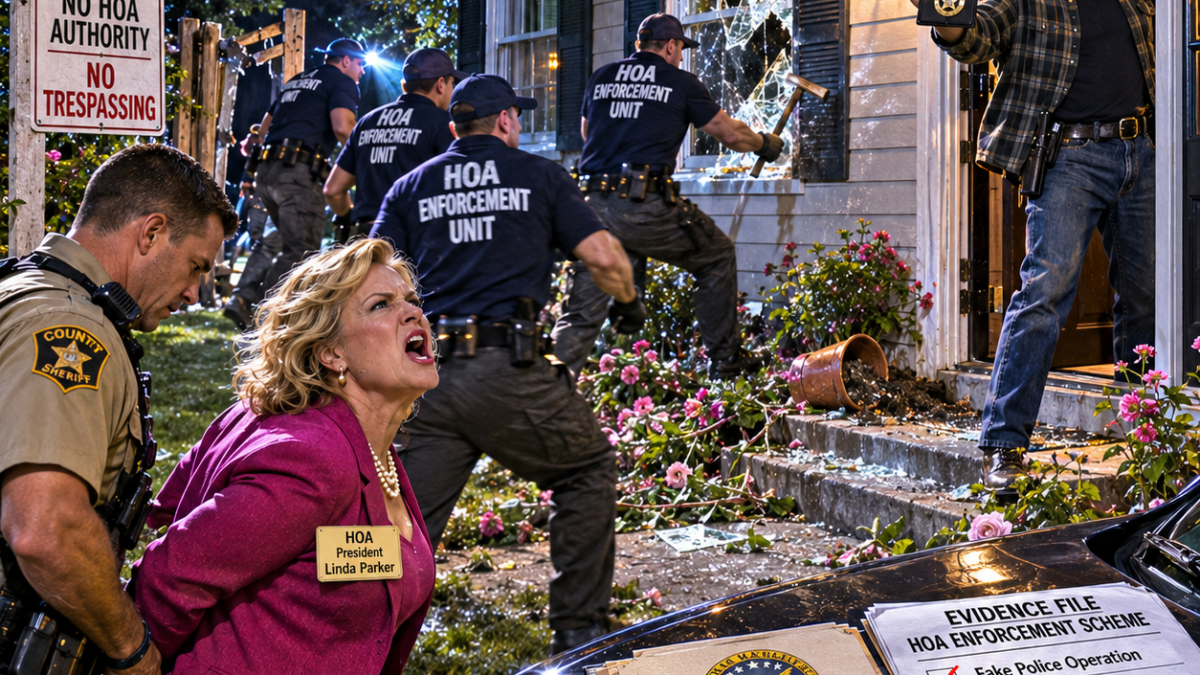
The night five men in navy shirts marked HOA ENFORCEMENT UNIT cut through my side gate, smashed one of my windows, trampled the flower beds my late wife had planted, and shouted that they were there to “teach me compliance,” they believed they were raiding the home of a stubborn gray-haired retiree who had refused to pay dues to an association he had never joined.
For months, HOA president Linda Parker had sent fake violations, midnight “patrols,” plastic-badge officers, threatening letters, and golf carts with flashing lights to convince me that her board somehow possessed police powers over my property, even though county records, my deed, and the original neighborhood documents all said the same thing: homeowners who lived here before the HOA formed had never been required to join.
What Linda didn’t understand was that I wasn’t frightened by uniforms, badges, threats, or people pounding on my door in the dark—and by the time her little enforcement squad finally crossed the line from harassment into something far more serious, I had already learned enough about their operation to know that the broken glass in my yard was only the beginning.
My name is Daniel Harris.
I had lived on Hawthorne Lane for fifteen years.
When I bought the house, there was no HOA.
No compliance committee.
No architectural review board.
No neighborhood patrol.
Just families.
Retirees.
Veterans.
Teachers.
Mechanics.
People who waved from porches and argued about barbecue instead of mailbox colors.
I liked it that way.
After forty years in federal law enforcement, boring was exactly what I wanted.
I had spent most of my adult life with the U.S. Marshals Service and on joint fugitive task forces, chasing people who actually had warrants, interviewing people who actually had reasons to lie, and standing beside men and women whose badges represented real authority backed by real law.
Retirement was supposed to be different.
Coffee on my porch.
Tomatoes behind the garage.
Roses along the walkway.
Quiet.
Then Maple Ridge Community Association appeared.
The newcomers wanted “uniform standards.”
At first, that seemed harmless enough.
They formed an association.
Built a clubhouse committee.
Printed glossy brochures.
Talked about property values.
Most new buyers joined automatically through their purchase documents.
Existing homeowners like me were offered voluntary membership.
I declined.
That should have ended it.
Instead, I received a registration packet.
Then another.
Then:
**FINAL ENROLLMENT NOTICE.**
I called the number.
Linda Parker answered.
She introduced herself as HOA president.
“Mr. Harris, we’ve noticed you haven’t completed your membership forms.”
“That’s because I’m not joining.”
A pause.
“You don’t get to decide that.”
I almost laughed.
“Ma’am, I most certainly do.”
Her voice cooled.
“This community has standards.”
“So does contract law.”
She hung up.
The violation notices began the following week.
Bird feeder.
Mailbox color.
Trash-can placement.
Grass supposedly too tall.
Then, somehow, too short.
Christmas lights left up after the approved deadline.
I appealed none of them because there was nothing to appeal.
They had no jurisdiction over me.
That made Linda furious.
Then she created what she called the **HOA Enforcement Unit**.
Five or six neighborhood volunteers started wearing navy shirts, cheap metal badges, radios, utility belts, and patches that looked just official enough to make an elderly resident hesitate before asking questions.
Their patrol vehicles were golf carts with reflective tape.
Their “chief” was a heavyset man named Barry Collins who had apparently decided that owning a plastic badge qualified him to bark orders.
The first time Barry came to my house at eleven at night, he shined a flashlight across my porch.
“You’re under an HOA compliance order.”
“I’m not in your HOA.”
“Everyone here follows community law.”
I looked at his badge.
Then at him.
“Community law?”
He puffed out his chest.
“You’ll regret not cooperating.”
I smiled.
“I’ve heard better threats from better men.”
For weeks, they photographed my house.
Walked across my lawn.
Rang the doorbell after midnight.
Left warnings.
Tried to exhaust me.
Then one night my security lights snapped on.
Boots crossed the yard.
Something hit the side gate.
And a voice shouted:
“HOA POLICE! OPEN THE DOOR!”
I looked through the bedroom window.
Five figures were spreading across my property.
One kicked over a planter.
Another hit my siding.
A third began photographing my windows.
And I remember standing there in the darkness thinking only one thing.
Linda had finally given me exactly what I needed.
Not another complaint.
Evidence.
PART 2
I didn’t open the door.
That surprised them.
People who pretend to have authority depend heavily on immediate obedience.
The uniform.
The badge.
The loud voice.
The assumption that if they sound official enough, you’ll spend the first few seconds trying to figure out whether you’re allowed to say no.
Those seconds are their oxygen.
I didn’t give them any.
I stood in the hallway watching the feeds from my security cameras.
Front porch.
Driveway.
Side yard.
Back garden.
Every angle had audio.
Barry Collins stood near the porch.
Navy shirt.
Plastic badge.
Flashlight.
A baton-like object hanging from his belt.
He pounded again.
“Mr. Harris!”
I stayed quiet.
“This is your final compliance inspection!”
One of the other volunteers walked through the flower bed.
My stomach tightened.
Those flowers had mattered to Carol.
My wife had planted the first roses the summer after we moved in.
Carol had been gone five years.
Cancer.
Quick at the end.
Too quick.
I had kept that garden alive because sometimes grief needs a physical job.
Water.
Prune.
Replace mulch.
Cut dead blooms.
Do something small with your hands when nothing you do can fix the big thing.
Watching a grown man intentionally stomp through those roses did something to me.
But training is strange.
It can outlive anger.
Instead of walking outside, I picked up my phone.
Saved the live footage.
Called the county dispatch non-emergency number first, because at that moment nobody had forced entry into the house itself.
“My name is Daniel Harris.”
I gave the address.
“There are several HOA volunteers trespassing on my property and damaging landscaping.”
The dispatcher asked:
“Weapons?”
“I see tools and something resembling a baton.”
“Are you inside?”
“Yes.”
“Stay inside.”
“That’s the plan.”
Then came the first crack of glass.
My front window.
The call changed.
—
The deputy cars arrived after the group had already left.
By then, one pane was broken.
A planter was shattered.
My mailbox leaned sideways.
Two rose bushes were crushed.
Someone had carved:
**PAY YOUR HOA DUES**
into the wet dirt beside the walkway.
Deputy Franklin looked at it.
Then at me.
“You’re not in the HOA?”
“No.”
“You sure?”
I looked at him.
He raised both hands.
“Had to ask.”
I brought out the original purchase documents and the later HOA formation documents.
He read enough to understand the issue.
Then I showed him the camera footage.
Barry pounding on the door.
The others entering the yard.
One kicking the planter.
Another striking the window.
Franklin stopped the video.
“These guys actually call themselves police?”
“Depends who they’re talking to.”
“Officially?”
“HOA Enforcement Unit.”
“And unofficially?”
“They’ve yelled ‘HOA police’ at least twice.”
He shook his head.
“You know that’s a problem.”
“Yes.”
“You sound very calm.”
“I’ve had practice.”
“What’d you do before retirement?”
“Federal law enforcement.”
That changed his expression.
“What kind?”
“Marshals Service.”
He stared for a second.
Then:
“Oh.”
Exactly.
—
The next morning, I walked the property with coffee.
Broken glass glittered in the grass.
The mailbox hung by one screw.
Boot prints marked Carol’s garden.
Neighbors watched from behind curtains.
I saw faces.
Then curtains closing.
Fear has a posture.
You learn it after years interviewing witnesses.
The lowered eyes.
The half-open door.
The person who wants to say something but calculates whether telling the truth will make tomorrow worse.
Linda had built that kind of neighborhood.
Not overnight.
One small concession at a time.
One ridiculous fine.
One selective enforcement decision.
One resident embarrassed at a meeting.
One whispered warning:
**Don’t get on Linda’s bad side.**
A community rarely wakes up one morning under a bully.
It drifts there.
—
At nine, a silver SUV stopped beside my driveway.
Linda.
She climbed out in heels and a gray blazer.
Clipboard under one arm.
She inspected the damage.
Then smiled.
Not fully.
Just enough.
“Good morning, Mr. Harris.”
“Linda.”
“I see you’ve had an incident.”
“You know exactly what happened.”
She placed a hand against her chest.
“I certainly do not.”
“No?”
“Our community patrol did conduct routine compliance work last night.”
“Routine?”
“Yes.”
“Did routine compliance involve smashing my window?”
Her smile disappeared.
“You should be careful making accusations.”
“I have video.”
That landed.
Only for a moment.
Then she recovered.
“If you joined the HOA, we could help protect your property from vandalism.”
I stared at her.
“Protection.”
“That’s right.”
“Interesting word.”
She crossed her arms.
“You’ve become increasingly disruptive.”
“I’ve done nothing.”
“You refuse community standards.”
“Because I’m not subject to your contract.”
“Everyone living here benefits from the association.”
“Then everyone who voluntarily joined can pay for it.”
Her face tightened.
“You are enjoying this.”
“No.”
I looked at Carol’s crushed roses.
“I’m really not.”
—
Two men stepped from her SUV.
Barry was one.
The other was Nolan Pierce, another HOA volunteer.
Barry wore his navy enforcement shirt in daylight.
Badge polished.
Sunglasses.
He looked almost proud.
Linda said:
“Mr. Harris, we’re offering you one final opportunity to cooperate.”
I sipped my coffee.
“You brought witnesses?”
“Officers.”
I looked at Barry.
“Officer of what?”
He stepped forward.
“Community enforcement.”
“Legal authority?”
“The HOA board.”
“Statutory arrest power?”
His jaw moved.
“We’re not discussing technicalities.”
I smiled.
“Authority is mostly technicalities.”
Linda snapped:
“Enough.”
I turned toward her.
“You sent these men here after my property was vandalized.”
“I sent them to make sure you understand the consequences of continued defiance.”
I nodded.
“Thank you.”
She frowned.
“For what?”
“That sentence.”
Her eyes moved toward the porch camera.
She saw the blinking light.
For the first time that morning, Linda looked uncertain.
—
After they left, I went inside and opened the metal lockbox I kept in the hall closet.
My old credentials were inside.
Photographs.
Service records.
A retirement plaque I never displayed.
And the badge.
I picked it up.
Not because I planned to wave it around.
I had spent too many years around real law enforcement to believe a badge was magic.
It isn’t.
A badge is only as legitimate as the authority behind it.
That was exactly what Linda and Barry didn’t understand.
Their badges were decorations.
Their uniforms were costumes.
The problem wasn’t that they looked silly.
The problem was that they had begun using those costumes to make residents believe disobedience carried legal consequences.
That’s when dress-up becomes dangerous.
—
I called Sheriff Marcus Turner.
Turner had been sheriff for eleven years.
Big man.
Slow voice.
Good instincts.
We’d met several times at county veterans’ events.
He knew my career, though we’d never worked together directly.
He listened to the story.
Then watched the footage.
Once.
Twice.
At the end, he leaned backward.
“They broke that window?”
“Yes.”
“You have the earlier patrol footage too?”
“Yes.”
“Written threats?”
“Yes.”
“Fake notices?”
“A drawer full.”
He rubbed his jaw.
“Any evidence they’re telling people they’re actual law enforcement?”
“Audio.”
I played several clips.
**HOA police.**
**Compliance order.**
**You are required to cooperate with officers.**
Turner frowned.
“That’s going to get somebody hurt.”
“I know.”
He looked at me.
“What do you want?”
That question mattered.
Not:
What punishment?
What do you want?
“I want them stopped.”
“That’s it?”
“For now.”
Turner nodded.
“We start there.”
—
He opened an investigation.
Quietly.
That was important.
No sirens.
No raid.
No public confrontation.
Statements.
Reports.
Records.
He contacted the district attorney.
I handed over copies of every piece of footage.
Then Turner said:
“Daniel.”
“Yeah?”
“I know your background.”
“Meaning?”
“You don’t get to freelance.”
I almost smiled.
“I’m retired, Marcus.”
“You know exactly what I mean.”
“I won’t.”
“If they come back?”
“Call.”
“Don’t confront.”
“Understood.”
He pointed at me.
“You’re saying that too easily.”
“I’ve mellowed.”
“No one believes that.”
—
I added better cameras.
Openly.
Nothing hidden in bedrooms or private neighbor spaces.
Exterior property coverage.
Front.
Rear.
Side entrance.
I set recordings to back up automatically so destroying a camera wouldn’t destroy footage.
That was common-sense security.
Nothing more.
Barry came back at 2:14 the next morning.
Alone.
Golf cart at the curb.
He crossed the lawn.
Photographed my driveway.
Walked toward the porch.
Then saw one of the cameras.
He stared directly into it.
Raised his middle finger.
Then kicked over my geranium pot.
I watched from inside.
Didn’t go out.
Didn’t say a word.
The next morning I sent the clip to Turner.
His reply was two words:
**That’s enough.**
—
Before local charges moved forward, I got a call I didn’t expect.
Thomas Reynolds.
My former supervisor.
Retired later than I had.
Still connected to federal task-force work.
“Harris.”
“Haven’t heard that tone in years.”
“You haven’t improved.”
“Neither have you.”
Then he became serious.
“We saw the packet Turner forwarded through the state-federal liaison channel.”
I leaned back.
“That seems excessive for a flowerpot.”
“Not the flowerpot.”
“What then?”
“Patterns.”
He started listing them.
False representation of authority.
Coordinated harassment.
Possible extortion of nonmembers.
Collection of unauthorized fees.
Possible misuse of interstate financial systems if their billing operation reached the threshold.
“Don’t get excited.”
“I wasn’t.”
“You sound excited.”
“Old habit.”
He continued.
“You are not being reactivated as some television cowboy.”
“Disappointing.”
“You can assist as a witness and retired federal liaison because you know the case history.”
“Under supervision.”
“Yes.”
“With Turner.”
“Yes.”
“And the assigned agents.”
“Yes.”
“Good.”
Then:
“We’re sending Mariano.”
I groaned.
Reynolds laughed.
“I knew you’d like that.”
—
Special Agent Elena Mariano had once worked a fugitive task force with me.
Brilliant.
Disciplined.
Zero patience for people who believed charm could replace evidence.
She arrived the next afternoon.
Same posture.
Different haircut.
I met her outside Turner’s office.
“Harris.”
“Mariano.”
“You got old.”
“You got rude.”
“Retirement suits you.”
“Federal bureaucracy clearly hasn’t improved you.”
She almost smiled.
Then held up a folder.
“This is ridiculous.”
“HOA?”
“Twenty-seven pages of homemade enforcement rules.”
I blinked.
“You already have those?”
“Subpoena return from their management account.”
That was fast.
She opened the folder.
**MAPLE RIDGE COMMUNITY SECURITY CODE**
I stared.
“Security code?”
“They wrote their own.”
“Who?”
“Linda and at least two board members.”
The pages included “detention authority.”
“Emergency inspection authority.”
“Property seizure authority.”
None supported by law.
Mariano tapped one paragraph.
“They’ve been telling elderly homeowners they can tow vehicles and impose immediate liens without process.”
“Can they?”
“You already know the answer.”
“No.”
—
Then she showed me something worse.
A spreadsheet.
Resident names.
Color codes.
Green:
Compliant.
Yellow:
Resistant.
Red:
Hostile.
My row was marked:
**RED — HIGH PRIORITY / FEDERAL RETIREE / POSSIBLE INFLUENCE RISK.**
I laughed.
Mariano didn’t.
“They knew?”
“Apparently they learned your background recently.”
“Then why keep escalating?”
“Because people committed to a bad idea often treat new facts as threats rather than information.”
Good answer.
She continued.
“They also have a column called leverage.”
I stopped smiling.
“Leverage?”
“Employment.”
“Family.”
“Vehicles.”
“Property condition.”
“Embarrassing history.”
My stomach tightened.
“That isn’t HOA management.”
“No.”
Mariano closed the folder.
“That’s why we’re here.”
—
Word spread anyway.
Deputies started interviewing residents.
An unmarked federal vehicle appeared twice.
People noticed.
Suddenly neighbors who had spent months saying nothing began calling.
Mrs. Eleanor Brooks came first.
Seventy-two.
Tiny woman.
Normally terrified of confrontation.
She sat at my kitchen table clutching tea.
“They fined me eight hundred dollars.”
“For what?”
“My porch railing.”
“Are you a member?”
“Yes.”
“So they may have some authority depending on the documents.”
She shook her head.
“No.”
“What?”
“The railing was approved.”
“Then why the fine?”
She looked ashamed.
“Because I voted against Linda’s clubhouse budget.”
That got my attention.
“Do you have proof?”
Eleanor opened her purse.
Letters.
Emails.
Original approval.
Fine notice dated two weeks after the vote.
I didn’t tell her what it proved.
I wasn’t her lawyer.
I simply said:
“Give copies to Turner.”
She nodded.
Then whispered:
“Will they know I talked?”
“Eventually maybe.”
Her hands shook.
I covered one gently.
“Eleanor.”
She looked at me.
“Talking to law enforcement about your own experience isn’t betrayal.”
Her eyes filled.
“I know.”
But fear isn’t cured by knowing.
—
Then Mr. Alvarez came.
Eighty-three.
Cane.
His wife, Rosa, had used a wheelchair before she died.
They had built a small wooden accessibility ramp.
HOA cited it for “architectural inconsistency.”
He brought photographs.
Correspondence.
One letter from Linda said:
**Personal medical circumstances do not override aesthetic requirements.**
I read that line twice.
“Did they make you remove it?”
“No.”
He looked down.
“I refused.”
“What happened?”
“They fined me every month.”
“How much?”
He told me.
Thousands.
“Rosa died before the hearing.”
I didn’t know what to say.
He continued.
“They kept sending the fines afterward.”
That angered me more than what they’d done to my roses.
Not because Carol’s garden mattered less.
Because this showed scale.
Linda wasn’t targeting one stubborn retiree.
She had built a system that rewarded fear.
—
Turner called a community meeting.
Not HOA.
Sheriff’s office.
Public safety.
The clubhouse filled.
Linda didn’t attend.
Barry did.
He sat near the back.
No uniform this time.
Turner stood at the front.
“If anyone has been told an HOA volunteer has police authority, detention authority, search authority, or criminal-enforcement authority, we want documentation.”
Hands went up.
Too many.
A young mother said the patrol threatened to report her for child neglect because her kids drew chalk on the sidewalk.
A veteran said Barry threatened to tow his truck for “aggressive tire appearance.”
Someone else had been ordered to open a garage for inspection.
Another resident said an HOA patrol member photographed medication through her kitchen window.
Turner kept writing.
Mariano sat beside him.
I stayed in the back.
This wasn’t my meeting.
That mattered.
—
Barry approached me afterward.
“You happy?”
“No.”
“You destroyed this neighborhood.”
“Did I?”
“People don’t respect anything anymore.”
“People are asking questions.”
“Exactly.”
I looked at him.
He meant it.
Questions frightened him.
“Barry, real authority survives questions.”
He stared.
“Fake authority needs people too scared to ask.”
He walked away.
—
Three nights later, Linda came to my porch.
Mascara smeared.
Hair loose.
No clipboard.
“You’ve ruined everything.”
I opened the door but stayed inside.
“Linda, you’re under investigation.”
“This is my neighborhood.”
“No.”
“I built this association.”
“You joined an existing neighborhood and formed a voluntary organization.”
“Same thing.”
“No.”
She jabbed toward me.
“You think because you used to be federal law enforcement you’re above us.”
“I think because I never joined your HOA, your HOA isn’t above me.”
“We maintained standards.”
“You sent fake officers to my house.”
“They were community patrol.”
“They smashed a window.”
“They got carried away.”
“On whose instructions?”
Her face changed.
“I don’t know what you’re talking about.”
I nodded.
“Good night.”
“You’ll regret this.”
I almost closed the door.
Then stopped.
“Linda.”
“What?”
“Don’t send anyone here again.”
She laughed bitterly.
“You don’t give me orders.”
“No.”
I looked directly at her.
“I’m giving you a warning.”
For once, she left without another word.
—
At 1:17 the following morning, my phone lit up.
Motion alert.
Five people.
Navy shirts.
Tools.
My stomach tightened.
I called Turner immediately.
“They’re back.”
“How many?”
“Five.”
“Inside property?”
“Approaching side gate.”
“Stay inside.”
I did.
That detail matters.
The source version of this story later got exaggerated into me sneaking around the house like I was twenty-five and hunting criminals in the dark.
I didn’t.
I was sixty-eight.
Retired.
And not stupid.
I watched from a safe interior room.
Turner already had patrol units nearby because of the ongoing case.
Mariano had access to the live evidence stream through established investigative arrangements.
My job was simple.
Observe.
Stay safe.
Let them create their own case.
—
The five men forced the side gate.
Bolt cutters.
Camera caught everything.
One whispered:
“Hurry.”
Another:
“He sleeps early.”
Barry directed them.
“Back door first.”
One entered the vegetable garden and crushed plants.
Another pried at the shed.
A third struck a window.
Glass broke.
Then Barry said the sentence that ended any claim this was routine HOA work.
“This is what happens when people defy us.”
Clear audio.
Then:
“Once Harris learns, everybody else falls in line.”
I sat in the dark and felt something strange.
Not anger.
Not fear.
Sadness.
Adults.
Neighbors.
People with jobs.
Families.
Mortgages.
Standing in another man’s yard at one in the morning because a neighborhood association president had convinced them that control was worth committing crimes for.
Authority can intoxicate stupid people.
But belonging can intoxicate ordinary people too.
Some of those men probably wouldn’t have done this alone.
Together?
Matching shirts.
Shared language.
A chief.
A mission.
Suddenly the absurd felt legitimate.
That’s how groups become dangerous.
—
The patrol cars arrived before the men reached my back door.
No dramatic ambush.
No heroic speech from me.
Just headlights washing over the yard.
“Sheriff’s office!”
Everything stopped.
“Put the tools down.”
One man did immediately.
Another froze.
Barry turned toward the gate.
Deputy Franklin blocked that side.
Turner entered with two deputies.
Hands visible.
Clear commands.
Professional.
Boring.
Beautiful.
Barry shouted:
“This is HOA business!”
Turner stared at him.
“You’re standing inside another man’s fenced property with bolt cutters at one-thirty in the morning.”
“We have enforcement authority.”
“No.”
“We have board authorization.”
“No.”
“Linda approved this.”
Turner’s expression changed.
“Thank you.”
Barry stopped talking.
Too late.
—
The men were arrested.
One cried.
One kept insisting Linda said it was legal.
Another immediately asked for a lawyer.
Smartest thing anybody in that group did all night.
Barry screamed from the back of the cruiser:
“Linda runs this neighborhood!”
Turner closed the door.
“Not tonight.”
—
I walked outside only after deputies cleared the property.
Broken window.
Destroyed vegetable plants.
Gate damaged.
Again.
Turner approached.
“You okay?”
“Yes.”
“You sure?”
I looked toward the roses.
“I’m tired.”
He nodded.
“That’s different.”
Mariano arrived twenty minutes later.
She studied the scene.
Then looked at me.
“Don’t say it.”
“What?”
“You told me so.”
“I wasn’t going to.”
“You were.”
“Maybe.”
She almost smiled.
Then:
“They named Linda.”
“All of them?”
“Three already.”
“That fast?”
“Turns out matching shirts don’t create loyalty.”
—
The investigation moved rapidly after that.
Barry and two others admitted Linda had called the operation a “compliance strike.”
They said she told them I was destabilizing the HOA.
That I needed to be “made an example.”
Internal messages supported portions of the story.
One text:
**HARRIS MUST BE BROKEN BEFORE OTHERS FOLLOW.**
Another:
**NO ARRESTS. JUST PRESSURE. MAKE HIM UNDERSTAND CONSEQUENCES.**
Another:
**REMOVE CAMERAS IF POSSIBLE.**
Mariano showed me the printouts.
I stared.
“They planned around the cameras.”
“Yes.”
“Poorly.”
“Yes.”
“Still.”
She nodded.
“Still.”
—
Then the money trail surfaced.
HOA funds had purchased uniforms.
Badges.
Radios.
Vehicle lights.
Cameras.
Legal templates.
Private background reports on residents.
Some expenditures were disguised under:
**Community Beautification.**
Others:
**Emergency Preparedness.**
A payment to a private consultant raised additional questions.
So did unexplained withdrawals.
Now the case wasn’t just harassment.
It involved financial misconduct.
Potential fraud.
Possible tax issues.
Forged documents.
Misappropriation.
Mariano refused to let anyone jump ahead of evidence.
“Do not call it racketeering.”
She told Turner.
“Not yet.”
Turner looked at me.
“She’s no fun.”
“I’ve known that thirty years.”
Mariano stared at both of us.
“Adults, please.”
—
Linda was interviewed.
She denied everything.
Then investigators showed the messages.
She blamed Barry.
They played Barry’s statement.
She blamed the board.
They showed her email authorization.
She claimed misunderstanding.
Then Mariano asked one question.
“Did you authorize the nighttime compliance action at Mr. Harris’s property?”
Silence.
Linda looked at me.
I was present only because counsel and investigators had decided my role as complainant/witness made limited participation appropriate.
I said nothing.
Mariano repeated:
“Did you authorize it?”
Linda’s shoulders dropped.
“Yes.”
That was all.
No dramatic confession.
No screaming.
One word.
Sometimes entire cases turn on very small sounds.
—
Linda was charged based on the conduct investigators could actually support.
So were several others.
The exact counts differed by person.
Trespass.
Property damage.
Burglary-related allegations depending on individual conduct.
Conspiracy-type charges where supported.
False representation concerns.
Financial offenses for board members involved in the money.
The source story eventually claimed every HOA officer was instantly hit with giant federal felony lists.
Reality moved slower.
Better.
Good cases don’t need theatrical inflation.
—
The HOA responded in the most HOA way possible.
Letters.
Three arrived in one morning.
One demanded six years of retroactive dues.
One threatened a lien.
One claimed I owed the association for “reputational damage caused by unnecessary law-enforcement involvement.”
I laughed so loudly Eleanor heard me from across the street.
She came over.
“What happened?”
I handed her the reputational-damage letter.
She read it.
Then looked at me.
“Can they do that?”
“No.”
“Good.”
She tore it in half.
“Eleanor!”
“What?”
“That was evidence.”
Her eyes widened.
“Oh.”
I laughed harder.
We taped it back together.
—
Their attorney later withdrew the demand.
Fast.
Because my deed hadn’t changed.
My nonmember status hadn’t changed.
An association doesn’t create contractual obligations by mailing them aggressively enough.
That simple fact became one of the most important parts of the case.
Existing homeowners had been told for years they were “basically members.”
Some had paid because fighting felt harder.
Now those residents were asking for records.
—
The courthouse filled for the preliminary proceedings.
Reporters came.
Fake HOA police make good headlines.
I hated that term.
Not because it was inaccurate.
Because it made the story sound funny.
There were funny parts.
Plastic badges.
Golf-cart patrols.
A twenty-seven-page fake law book.
But Mr. Alvarez’s ramp wasn’t funny.
Eleanor shaking at my kitchen table wasn’t funny.
Carol’s garden crushed under boots wasn’t funny.
Fear isn’t funny just because the people creating it look ridiculous.
—
I testified.
First person.
Facts only.
No speeches.
I explained the HOA formation.
My voluntary status.
Letters.
Patrol visits.
The first raid.
Broken window.
The later operation.
Security footage.
Linda’s porch threat.
Nothing dramatic.
Then prosecutors played the video.
Barry:
**This is what happens when people defy us.**
Another man:
**She said we need to teach him.**
Glass breaking.
My garden being destroyed.
The courtroom became silent.
Linda looked down.
—
Judge Samuel Whitaker removed his glasses.
“I have presided over many disputes involving homeowners associations.”
He paused.
“Most concern assessments, architectural restrictions, covenant interpretation, or election disputes.”
He looked toward the defense table.
“What is shown here is not covenant enforcement.”
“It is not community governance.”
“It is not neighborhood safety.”
“It is coordinated intimidation.”
Nobody moved.
Then:
“An HOA is a private association.”
“It is not a police department.”
That sentence made every newspaper.
—
The court did not personally “dissolve the HOA” in one magical stroke at that preliminary stage.
Real life is messier.
But the board’s authority was constrained.
A receiver and outside review became involved.
Enforcement actions were suspended.
Financial records were audited.
The illegal patrol program ended immediately.
Golf carts impounded as evidence where appropriate.
Badges collected.
The phrase **HOA Enforcement Unit** disappeared almost overnight.
Good riddance.
—
Then residents rebelled.
Properly.
Votes.
Petitions.
Records requests.
Meetings.
Actual governance.
Not mob rule.
Residents discovered bylaws gave them more power than Linda had ever admitted.
They replaced board members.
Terminated contracts.
Authorized an independent financial review.
Stopped illegitimate fines.
The community didn’t need me to save it.
It needed people to remember they had votes.
That distinction mattered.
—
Mr. Alvarez spoke at one meeting.
He walked slowly to the microphone.
Cane tapping.
The room quieted.
“My wife couldn’t use stairs.”
He held up a photograph of Rosa on the ramp.
“They fined us for this.”
Linda wasn’t there.
Still, he addressed the empty front table.
“You told us the neighborhood looked better without it.”
His voice shook.
“She died before your appeal meeting.”
A woman near me started crying.
Alvarez continued:
“I paid those fines because after she died I didn’t have energy left to fight.”
He placed the photograph on the table.
“I want that money returned.”
Nobody argued.
The new board later voted to reimburse improper assessments where records supported repayment.
That meant more to me than Linda’s arrest.
—
Eleanor became terrifying once she stopped being afraid.
At seventy-two, she ran for the replacement board.
Won.
First meeting, she proposed a rule:
“No board member or volunteer may represent themselves as law enforcement.”
Someone laughed.
Eleanor stared.
“I’m serious.”
Rule passed unanimously.
Second proposal:
“No enforcement activity on private property without lawful authority and required notice.”
Passed.
Third:
“Complaint procedures must cite the actual covenant section.”
Passed.
I watched from the back.
Proud.
—
She found me afterward.
“What?”
I asked.
“You should run.”
“No.”
“Why?”
“I have spent enough of my life around bureaucracy.”
“You’d be good.”
“Exactly why I know better.”
She laughed.
“Coward.”
“Correct.”
—
The federal financial investigation uncovered more.
Fake invoices.
Vendor conflicts.
Manipulated voting records.
A communications campaign targeting dissenters.
Some things were ugly.
Some merely incompetent.
Important difference.
Not every bad HOA decision is a federal crime.
Not every ridiculous rule is corruption.
Investigators separated misconduct from stupidity.
That made the case stronger.
—
Barry cooperated.
That surprised me.
He admitted he loved the title “chief.”
Loved people listening.
Loved having a uniform.
During one interview, according to Turner, Barry said:
“For once, people respected me.”
That sentence changed how I saw him.
Didn’t excuse him.
He had broken property.
Threatened people.
Entered my yard.
But suddenly he wasn’t a cartoon villain.
He was a man who had confused obedience with respect because the latter had apparently been missing from his life.
Authority gives insecure people a dangerous shortcut.
You don’t have to earn admiration if you can demand compliance.
—
Linda was harder.
Her identity had fused completely with the HOA.
President.
Founder.
Protector.
Keeper of standards.
When the title disappeared, she had nothing underneath ready to replace it.
Turner told me neighbors heard yelling from her house.
Things breaking.
I felt no pleasure in that.
Consequences were necessary.
Collapse wasn’t entertainment.
—
Weeks later, she left a letter at my door.
**Please talk to me.**
I threw it away.
Then retrieved it ten minutes later because evidence habits die hard.
Maya—my sister, not wife, who lived two states away—called that evening.
I told her.
“You going to talk?”
“No.”
“Good.”
“Why’d you say that so fast?”
“Because closure is overrated when the other person is under a no-contact condition.”
She was right.
I stayed away.
—
The final criminal and civil outcomes took months.
Some HOA volunteers received probation.
Some community service.
A few short jail terms depending on conduct.
Financial defendants faced separate consequences.
Linda received a combination of probationary restrictions, restitution obligations, mandatory counseling, and limitations tied to the conduct proven against her.
The source version later claimed she was legally banned from every community leadership position for ten years.
The real order was narrower.
It restricted her involvement in the organization and conduct connected to the case, and future positions would be subject to whatever legal or organizational rules applied.
Reality didn’t need extra decoration.
She had lost the one title she thought made her powerful.
That was enough.
—
The old HOA structure was eventually terminated through the mechanisms available to the homeowners and courts after the financial and governance failures came to light.
Common-property responsibilities didn’t disappear into thin air.
They were transferred.
Some services continued under new agreements.
But Linda’s association—the one built around fear—was gone.
The neighborhood created a smaller, transparent community association for only the things people actually needed.
Road maintenance.
Shared entrance landscaping.
Clubhouse insurance.
No police.
No “chief.”
No patrol badges.
No fake criminal code.
Beautiful.
—
The day the old HOA sign came down, residents gathered.
Not officially.
People just noticed the maintenance crew removing it.
The sign read:
**MAPLE RIDGE — ORDER IS COMMUNITY. COMMUNITY IS ORDER.**
Eleanor stood beside me.
“Always hated that slogan.”
“Why?”
“Sounds like something printed over a prison gate.”
I laughed.
“What should replace it?”
She thought.
“Welcome home.”
That’s what they chose.
A month later, the new sign appeared:
**MAPLE RIDGE**
**WELCOME HOME**
Nothing else.
Perfect.
—
My house took longer to repair emotionally than physically.
Window replaced in two days.
Gate repaired in a week.
Roses took months.
One didn’t survive.
Carol’s favorite.
A deep red hybrid tea rose she’d named Ruby because she believed plants needed names.
I stared at the dead stems one morning.
That loss broke something open.
For months, I had talked about property damage like a case.
Photograph.
Estimate.
Report.
Evidence.
Restitution.
But grief doesn’t fit neatly in evidence bags.
That rose had grown beside Carol for nine summers.
The night Barry’s group stomped through the garden, one man’s boot had broken the main cane.
I tried saving it.
Couldn’t.
I sat beside the flower bed.
For the first time since the raid, I cried.
Not for the HOA.
For Carol.
—
Eleanor found me there.
She didn’t say:
Are you okay?
Older people know better.
She sat on the porch step.
After a while:
“Was that Carol’s?”
“Yes.”
“The red one?”
“Yes.”
She nodded.
“I’m sorry.”
That was enough.
—
Two weeks later, the doorbell rang.
Mr. Alvarez.
Eleanor.
Turner.
Mariano.
Half the street.
They stood outside carrying a new rose bush.
Deep red.
Tag:
**MISTER LINCOLN HYBRID TEA.**
Eleanor said:
“We know it’s not the same.”
I couldn’t speak.
Mr. Alvarez added:
“Nothing is.”
Then:
“But maybe it gets its own story.”
We planted it together.
No speeches.
No reporters.
No federal badges.
Just dirt.
Water.
Neighbors.
That was the moment Maple Ridge became a community again.
—
The new rose survived.
First bloom the following spring.
Dark red.
Almost velvet.
I cut one.
Put it in a vase beside Carol’s photograph.
“Not Ruby.”
I told her.
“Still pretty.”
Maybe grief makes everyone talk to dead spouses and plants.
I don’t judge anymore.
—
Agent Mariano retired two years later.
We had coffee.
She asked:
“You miss the work?”
“No.”
She stared.
“Liar.”
“Sometimes.”
“Which part?”
“The moment when evidence finally makes sense.”
She nodded.
“Not the arrests?”
“No.”
“Same.”
She stirred her coffee.
“People think law enforcement is about catching people.”
“What is it?”
“Mostly proving what actually happened.”
That was exactly right.
—
Sheriff Turner kept the plastic HOA badge Barry surrendered.
Mounted in a shadow box at the station.
Underneath:
**AUTHORITY REQUIRES AUTHORITY.**
I told him that was unbearably corny.
He kept it anyway.
—
Barry wrote me once.
From a court-ordered community program.
His letter surprised me.
**Mr. Harris,**
**I spent a long time blaming Linda because she told us what to do.**
**The truth is, I liked being chief.**
**Nobody forced me to put on that shirt. Nobody forced me into your yard.**
**I’m sorry about your wife’s garden.**
I stopped reading.
Then continued.
**I know sorry doesn’t fix it.**
**I am trying to understand why having people fear me felt like respect.**
**Barry Collins**
I folded the letter.
Sat quietly.
Then put it in the same box as case records.
I never responded.
Not because I hated him.
Because some apologies don’t require a relationship afterward.
—
Linda contacted me once more after her legal restrictions ended.
Not at my house.
Through an attorney.
One page.
No excuses.
She wrote:
**I believed order justified almost anything.**
**I was wrong.**
**I made ordinary neighbors afraid inside their own homes.**
**Nothing that happened to me afterward changes that.**
**I am sorry for Carol’s garden.**
That last sentence got me.
She remembered.
Maybe somebody told her.
Maybe she finally understood.
I didn’t answer her either.
But I believed that apology more than the first.
—
Years passed.
Maple Ridge became boring again.
I loved it.
Children left bicycles on driveways.
One man painted his door bright yellow.
Nobody collapsed.
Eleanor allowed wind chimes.
Aggressively.
Mr. Alvarez’s grandson rebuilt the accessibility ramp even though Alvarez didn’t need a wheelchair.
“Why?”
I asked.
He smiled.
“Because Linda hated it.”
Petty.
I approved.
—
The neighborhood picnic became annual.
No HOA speeches.
No enforcement table.
Barbecue.
Music.
Kids running through sprinklers.
The first year, Turner came.
Mariano too.
Eleanor handed me a burger.
“You did this.”
“No.”
She frowned.
“Don’t start.”
“I mean it.”
“You all did.”
“Daniel.”
“Eleanor.”
She sighed.
“Fine.”
Then:
“You started it.”
I considered.
Maybe.
But I didn’t want the story ending with one hero.
That lesson would be wrong.
One person can document.
One person can resist.
One person can call for help.
But a healthy community cannot depend on one person forever.
Maple Ridge became safe when ordinary residents stopped outsourcing courage.
—
That was the biggest change.
Eleanor spoke.
Alvarez spoke.
Parents spoke.
Veterans spoke.
New homeowners read documents.
People attended meetings.
They asked:
“Where does it say that?”
“Who approved this?”
“What authority do you have?”
Simple questions.
Power hates simple questions when the answer is nothing.
—
One young couple asked me about joining the new association.
“Should we?”
I shrugged.
“Read the documents.”
“That’s your advice?”
“Yes.”
“Not ‘HOAs are evil’?”
“No.”
They looked surprised.
“Some associations work.”
“Some don’t.”
“What matters?”
“Transparency.”
“Limits.”
“People understanding that rules come from agreements and law, not personalities.”
They nodded.
Then the husband asked:
“What if someone starts another police force?”
I pointed toward Turner’s office downtown.
“Send them there.”
—
The phrase **Federal Sheriff** followed me because of the news coverage.
I hated it.
There is no ordinary federal sheriff job the way local counties have sheriffs.
I had been a Deputy U.S. Marshal and later supervised joint federal task-force work.
But one reporter called me “the federal sheriff who brought down fake HOA police.”
Internet loved it.
Accuracy lost.
Again.
Whenever someone said:
“You’re the federal sheriff?”
I replied:
“Retired marshal.”
Less exciting.
More true.
—
I kept my old badge locked away.
Rarely touched it.
The real victory wasn’t revealing it.
That’s another part the viral versions always get wrong.
People love the moment:
Fake badge meets real badge.
Crowd gasps.
Villain panics.
Great thumbnail.
But badges didn’t win.
Evidence did.
Neighbors did.
Turner did.
Mariano did.
Courts did.
Records did.
A badge without lawful authority is costume jewelry.
That was the entire problem in the first place.
I wasn’t going to turn mine into magic just because it made a better story.
—
The final time I repaired the front garden, I replaced the broken stone border.
My knees complained.
Age wins eventually.
A teenager named Caleb from down the street came over.
“Need help?”
“Yes.”
No pride.
Retirement taught me that too.
We worked.
He asked:
“Is it true people raided your house?”
“Yes.”
“Were you scared?”
Good question.
I thought.
“Yes.”
He looked shocked.
“But you were federal.”
“So?”
“I figured you weren’t scared of stuff.”
I laughed.
“Anyone who says they never get scared is either lying or hasn’t understood the situation.”
“What did you do?”
“Stayed inside.”
“That’s it?”
“Called people whose job it was.”
He looked disappointed.
Again, reality loses to movies.
I continued:
“Being brave isn’t running toward every problem.”
“Sometimes it’s resisting the urge to prove you’re brave.”
He considered that.
Then went back to laying stone.
Maybe he understood.
—
That mattered to me because the source version of my story made the final raid sound like I slipped through shadows, confronted five men alone, flashed my badge, and held everyone until police arrived.
No.
I wasn’t going to teach some teenager that being a man means stepping outside to challenge people carrying crowbars.
I called Turner.
Stayed protected.
Preserved evidence.
Let professionals handle arrests.
Experience should make you safer.
Not theatrical.
—
The roses flourished.
Mister Lincoln became enormous.
Every spring, deep red flowers opened beside the walkway.
People knew the story.
Some called it Carol’s rose.
I didn’t correct them.
One afternoon Linda’s former house sold.
A family moved in.
Two children.
Dog.
Normal.
The mother introduced herself.
“I’m Rebecca.”
“Daniel.”
“We heard…”
She stopped.
I smiled.
“I’m sure you did.”
“Is any of it true?”
“Depends which version.”
“My son says the HOA had a SWAT team.”
“No.”
“He says helicopters came.”
“No.”
“He says you arrested everybody personally.”
“Definitely no.”
She laughed.
“Good.”
Then:
“We’re planting hydrangeas.”
“Excellent.”
“Any rules?”
“Ask Eleanor.”
Rebecca looked concerned.
I smiled.
“She’s nice.”
Mostly.
—
The first yellow door in the neighborhood belonged to Rebecca.
Bright.
Almost offensive.
I loved it.
The new community association reviewed the request because her property was actually subject to the architectural agreement.
They approved it.
Unanimously.
Eleanor later admitted:
“I didn’t like the color.”
“Then why approve it?”
“Because the standard allowed it.”
There.
Growth.
—
One autumn night, my security lights came on.
My body reacted before my brain.
Heart rate.
Eyes toward window.
Old memory.
I checked the camera.
Raccoon.
Fat one.
He knocked over the trash lid.
I laughed.
Went back to bed.
That’s how I knew I had healed.
Not when the court ruled.
Not when Linda lost office.
When a light came on at night and my first fear no longer lasted.
—
I eventually took down two of the cameras.
Kept the basic security system.
Normal.
I didn’t want my home permanently arranged around a threat that no longer existed.
That’s another way people who hurt you can keep winning.
You build your life around preventing their return.
At some point, safety requires remembering the door can also open.
Not only lock.
—
Eleanor died at eighty-one.
Natural causes.
Her funeral filled the church.
At the reception, her daughter gave me a folder.
“What is this?”
“Mom’s board notes.”
I opened it.
First page:
**RULES THAT MUST NEVER COME BACK**
1. No fake cops.
2. No secret fines.
3. No retaliatory enforcement.
4. Read the actual documents.
5. Daniel Harris is never allowed to become president because he will complain too much.
I laughed so hard I cried.
Her daughter smiled.
“She loved you.”
“I know.”
I kept the page.
—
Mr. Alvarez died two years later.
His grandson donated the little ramp to a veterans’ accessibility charity.
Before they removed it, I stood there.
Ran my hand over the wood.
The HOA had once treated that ramp like a threat to beauty.
Now nobody cared whether it matched the shutters.
We cared that Rosa had once used it to get into her home.
People over systems.
Always.
—
Turner retired.
At his party, he handed me the shadow box with Barry’s fake badge.
“No.”
“Yes.”
“I don’t want that.”
“You earned it.”
“That’s exactly why I don’t want it.”
Mariano, standing nearby, said:
“Put it in the garden.”
“As fertilizer?”
“Plastic doesn’t compost.”
We argued ten minutes.
I finally took it.
At home, I put it in a drawer.
A year later, I donated it to a local civic-education display about impersonation and community authority.
Better use.
—
The neighborhood teenagers eventually knew the HOA story as ancient history.
One called it “the fake police era.”
I hated that.
But it meant the fear wasn’t inherited.
Good.
Trauma shouldn’t become tradition.
Lessons should.
—
The current association keeps annual financial statements online.
Meeting minutes.
Election results.
Rules.
Appeal procedures.
Boring documents.
I read them sometimes.
Not because I distrust them.
Because transparency only works if somebody looks.
—
People occasionally ask:
“Would Linda have stopped if you’d paid?”
Maybe.
For me.
Then someone else would’ve become red on the spreadsheet.
That’s why resistance mattered.
Not because my bird feeder needed defending as a matter of national principle.
Because abusive systems move toward the easiest target until somebody forces them to justify themselves.
My refusal didn’t create Linda.
It revealed her.
—
I have wondered whether I could have stopped things earlier.
Maybe.
Could I have called Turner after the first fake badge visit?
Probably.
Could I have challenged the HOA legally earlier?
Yes.
I had forty years of experience.
Yet even I spent months telling myself:
It’s just neighborhood nonsense.
That’s important.
Harassment survives because each step feels too small to justify escalation.
A letter.
A photo.
A midnight knock.
A person walking on the lawn.
A fake badge.
Then a broken window.
People wait for a dramatic moment.
Sometimes you shouldn’t.
Patterns matter before catastrophe.
—
If I had one regret, it was underestimating how frightened my neighbors were.
I thought silence meant apathy.
Sometimes it did.
But often it meant survival.
Eleanor had been scared.
Alvarez exhausted.
Parents worried about retaliation.
People had reasons.
Not all courageous.
Still human.
That’s why telling victims:
“Why didn’t you speak sooner?”
is usually the wrong question.
A better one:
“What made speaking unsafe?”
Fix that.
Then truth arrives.
—
The last photograph I have from that era was taken at the first post-HOA neighborhood picnic.
I didn’t know someone took it.
I’m sitting on my porch step.
Paper plate in one hand.
Mister Lincoln blooming beside me.
Turner arguing with Mariano.
Children running through a sprinkler in the street.
Mr. Alvarez laughing.
Eleanor pointing at somebody as if she’s already chairing a meeting.
Everybody ordinary.
No uniforms.
No badges.
No clipboards.
Carol would’ve loved it.
I framed that photograph.
Not my old marshal portrait.
Not the arrest headline.
Not the newspaper story.
That picture.
Because it shows what all the law was for.
Ordinary people doing ordinary things without fear.
—
One evening, many years after the raid, I sat alone on the porch.
Coffee.
Crickets.
A little wind.
The new Maple Ridge sign visible at the entrance.
**WELCOME HOME.**
The roses moved slightly.
I thought about Linda’s first sentence to me.
“You don’t get to decide that.”
She had meant HOA membership.
But the entire conflict grew from that idea.
You don’t get to decide.
You don’t get to decide whether to join.
You don’t get to decide what color your mailbox is.
You don’t get to decide whether volunteers enter your yard.
You don’t get to decide what authority we have.
We decide.
That mindset destroys organizations.
Communities require rules.
But legitimate rules begin with lawful authority.
Consent where consent is required.
Due process where process is required.
Limits.
Accountability.
Linda wanted order without limits.
Barry wanted respect without earning it.
Their fake police unit was simply the most visible form of that mistake.
—
I thought about my old badge.
Heavy.
Real.
Backed by statutes, courts, procedures, supervisors, reviews, and responsibilities.
Even then, I had never been free to do whatever I wanted.
Real authority comes with restraints.
Fake authority hates restraints.
That’s how you tell them apart.
—
Someone once asked me what I said when Linda finally realized who I was.
They expected a movie line.
Something like:
“You picked the wrong house.”
I wish I were that clever.
The truth?
I mostly said nothing.
The badge wasn’t revenge.
Her fear wasn’t the goal.
Stopping the conduct was.
That’s less viral.
Better life.
—
Linda’s final apology remained in my records for years.
Eventually, I shredded most of the duplicate case paperwork when retention rules allowed.
I held her letter.
Thought about keeping it.
Then placed it in the shredder too.
Not anger.
Release.
Carol’s photograph stayed.
Eleanor’s five rules stayed.
The picnic photograph stayed.
Some history deserves storage.
Some deserves departure.
—
The old HOA letters went next.
**FINAL NOTICE.**
Shred.
**COMPLIANCE ORDER.**
Shred.
**BIRD FEEDER VIOLATION.**
I paused.
That one was funny.
Shred.
At the bottom of the box was the first enrollment packet.
The document that started everything.
I read the voluntary-membership language.
Clear as daylight.
I remembered Linda saying:
“You don’t get to decide that.”
Then smiled.
Shred.
—
When the box was empty, I took it outside.
Recycling.
Proper container.
Eleanor would have approved.
—
Mister Lincoln bloomed again that spring.
I cut one flower.
Put it beside Carol’s photo.
Then sat on the porch.
A golf cart passed.
Actual golf cart.
Teenager driving with his father.
No lights.
No badge.
No patrol.
I laughed.
The father waved.
I waved back.
Normal.
—
That’s the ending people rarely understand.
Justice isn’t supposed to keep the conflict alive forever.
The best case is the one you can eventually stop talking about.
Not because what happened didn’t matter.
Because it mattered enough to fix.
—
The fake HOA police believed uniforms gave them power.
Linda believed a title gave her ownership of the neighborhood.
For a while, frightened residents made that illusion feel real.
Then cameras recorded facts.
Neighbors spoke.
Real investigators asked real questions.
Courts applied real law.
And the illusion collapsed.
No shootout.
No heroic raid.
No secret revenge.
Just evidence.
Accountability.
People finally deciding fear had cost enough.
—
I spent forty years enforcing federal law.
Some of those cases involved fugitives.
Fraud rings.
Violent offenders.
Men whose names appeared on television.
Yet the lesson I carried deepest into retirement came from a handful of neighbors wearing cheap navy shirts.
Power does not become legitimate because someone says it loudly.
A badge doesn’t create authority.
A board vote doesn’t erase law.
A uniform doesn’t cancel property rights.
And fear doesn’t transform a lie into jurisdiction.
—
The first night they raided my house, they shouted:
“HOA POLICE!”
Years later, I can almost laugh at it.
Almost.
But then I remember the broken window.
Carol’s rose.
Alvarez’s ramp.
Eleanor’s shaking hands.
And I remember why we couldn’t simply laugh them away.
Ridiculous people can still cause real harm when nobody stops them.
That’s why boundaries matter.
That’s why evidence matters.
That’s why communities need residents willing to ask:
**Who gave you the right to do this?**
Sometimes the answer is legitimate.
Sometimes it isn’t.
Either way, ask.
—
The sun dropped behind the roofs.
Porch lights came on.
A little girl rode past on a bicycle with streamers on the handlebars.
Her father walked behind her.
They both waved.
I waved back.
No patrol stopped them.
No clipboard appeared.
No one measured the streamers.
Good.
—
I finished my coffee.
Walked to the roses.
Touched one red bloom.
The garden had recovered.
So had Maple Ridge.
So had I.
Linda once believed she had to control the neighborhood to keep it from falling apart.
She was wrong.
The neighborhood had nearly fallen apart because she controlled too much.
Once people were free to speak, question, vote, disagree, plant flowers, build ramps, hang wind chimes, and simply live—
Maple Ridge didn’t collapse.
It finally became a community.
And if there was any revenge in that, it was the quietest kind.
The fake badges disappeared.
The real law did its job.
The people who had been afraid found their voices.
And the house Linda’s pretend police once stormed in the middle of the night became peaceful enough that, eventually, when the security lights came on after midnight, I didn’t reach for a case file or check for navy shirts.
I looked out the window.
Saw a raccoon knocking over my trash can.
And went back to bed smiling.
That was when I knew I had finally won.
[END OF STORY]








