PART 2: HOA Karen Pulled a Gun on Me Over Her Crushed $100,000 BMW—She Had No Idea I Once Ran the FBI
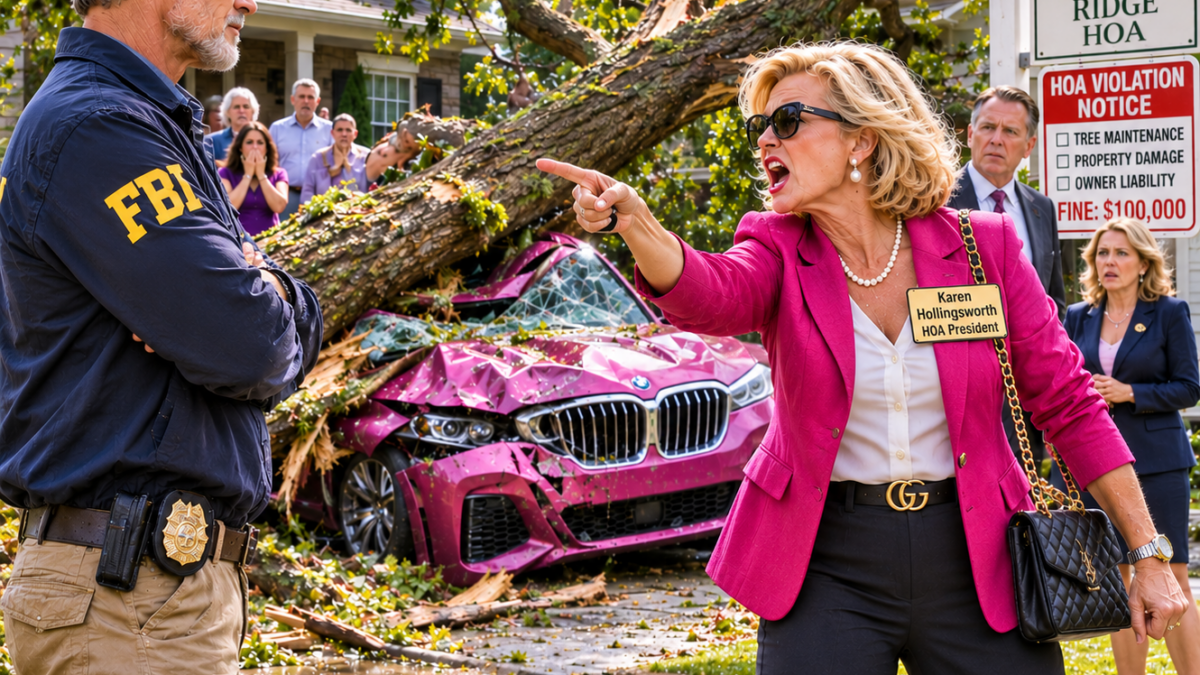
The morning Karen Hollingsworth marched into my front yard and aimed a silver handgun at my chest, the remains of her six-figure pink BMW were still sitting beneath the oak tree a violent overnight storm had ripped from my property and dropped across her driveway, yet she wasn’t yelling at the wind, the insurance company, or the weather service—she was yelling at me as though I had personally ordered forty feet of timber to crush the most expensive thing she owned.
By then she had already tried HOA fines, public humiliation, contractors, fabricated negligence claims, threatening notes, and a campaign to convince Hawthorn Ridge that I was some reckless old man who had endangered the neighborhood, but when all of that failed to make me accept blame for something the storm had done, the woman who had spent years policing mailbox colors and hedge heights finally reached into her handbag and turned a ridiculous suburban dispute into something no bylaw could explain away.
What Karen still didn’t understand, even with her finger trembling against the trigger and half the street watching from behind curtains, was that I had spent most of my adult life learning exactly what happens when frightened people mistake authority for immunity—and I had already begun preserving the one thing that would matter once her anger finally outran her judgment.
My name is James Hale.
Most people called me Jim.
When I retired, I wanted that to be the only introduction I needed.
Not Director Hale.
Not sir.
Not the title printed on plaques collecting dust in my study.
Just Jim from Maple Drive, a sixty-something widower who drank coffee too strong, kept his lawn reasonably short, and wanted to hear grandchildren laughing in his backyard without wondering which crisis would interrupt dinner.
For thirty-five years, my life had run on alarms.
Flights.
Briefings.
Threat assessments.
Phone calls at hours when decent people should be asleep.
By the time I stepped away from the Federal Bureau of Investigation, I wanted something almost embarrassingly ordinary.
A quiet house.
A porch.
A garden.
A neighborhood where the most serious disagreement involved whose dog had dug beneath which fence.
Hawthorn Ridge looked perfect.
Tree-lined streets.
Fresh paint.
Children riding bicycles between cul-de-sacs.
People waving from driveways.
The houses were expensive without being ridiculous, and the HOA brochure used words like stability, harmony, and community.
Forty-eight hours after I moved in, I learned what those words meant to Karen Hollingsworth.
A notice appeared on my front door.
**TRASH CONTAINER COLOR NONCOMPLIANCE.**
My dark-gray bins apparently leaned too blue beneath direct sunlight.
Signed:
**Karen Hollingsworth, HOA President.**
The next morning she introduced herself.
No handshake.
No welcome basket.
She stood at the edge of my driveway in a pastel tracksuit, pearl earrings, oversized sunglasses, and the expression of a woman inspecting troops.
“That hedge will need attention,” she said.
I looked behind me.
The hedge was healthy.
“What’s wrong with it?”
“Two inches above recommended height.”
“Dangerous.”
She missed the sarcasm.
“We maintain standards here.”
Over the next several months, I learned Karen had a standard for almost everything.
Mailbox paint.
Porch-light brightness.
Driveway drainage.
Holiday decorations.
Basketball hoops.
She once left a written noise warning after my daughter brought her children over and the kids laughed on the patio after eight.
I kept every letter.
Not because I planned revenge.
Because documentation becomes a habit when you’ve spent a career watching facts disappear beneath louder stories.
Then came Karen’s BMW.
Custom pink paint.
Imported wheels.
Vanity plate:
**KAREN1.**
She polished it herself every Saturday morning.
One afternoon, she caught me looking across the street.
“Beautiful, isn’t she?”
“Hard to miss.”
“Nearly a hundred thousand dollars.”
I raised my coffee.
“Congratulations.”
That answer somehow offended her.
Then the storm came.
Wind slammed rain sideways against the windows.
Lightning lit the entire street white.
At 11:43 p.m., I heard a crack so deep I felt it through the floor.
I ran outside in a raincoat.
My forty-foot oak was down.
Roots torn from saturated earth.
Trunk across the property line.
And beneath it, flattened almost beyond recognition, sat Karen’s pink BMW.
By sunrise, she was standing beside the wreck in a robe, pointing at me.
“You’re paying for this.”
“Call your insurance company.”
“You neglected that tree.”
“It was inspected last year.”
“I’m the HOA president.”
I looked at the crushed car.
Then back at her.
“Karen, storms don’t report to the HOA.”
Her face changed.
And that was when I realized the fallen oak had damaged more than her BMW.
It had damaged the one thing Karen valued even more.
Her sense of control.
PART 2
By nine that morning, the first HOA vehicle arrived.
Black SUV.
Three board members.
Matching windbreakers.
Clipboards.
Nothing says calm neighborhood governance like coordinated outerwear.
Phil Mercer led them.
He was a decent man trapped inside a weak spine, the sort who apologized with his eyes while following bad instructions with his feet.
He stepped over branches and examined the exposed roots.
“We’re conducting a damage assessment.”
“Of the storm?”
“Of the incident.”
I looked at him.
“What incident?”
“The tree failure.”
“That’s a creative name for weather.”
Phil shifted.
Behind him, Karen’s front door opened.
She came out wearing sunglasses despite the cloud cover.
The pink BMW remained under the oak.
Tow companies apparently needed time to stop laughing.
“There he is,” she said.
Neighbors began appearing.
Mrs. Ellison from two houses down stood on her porch holding coffee.
The Parkers opened their garage but didn’t back out.
A teenager across the street lifted his phone.
Karen pointed at me.
“That tree was a hazard.”
“No.”
“You were warned.”
“No.”
Phil looked uncomfortable.
I noticed that.
“Show me the warning.”
Karen froze for half a second.
Then:
“You received verbal notice.”
“When?”
“Repeatedly.”
“Specific dates?”
Her jaw tightened.
“Don’t interrogate me.”
“I’m asking a simple question.”
“You knew that tree could fall.”
I looked at the root ball.
The oak hadn’t snapped from disease.
It had uprooted.
Saturated ground.
Storm-force wind.
Healthy roots exposed like thick ropes.
I pointed.
“That tree was inspected eleven months ago when the HOA required its canopy review.”
Phil glanced at Karen.
He remembered.
I had the report.
Of course I did.
Karen crossed her arms.
“An inspection doesn’t excuse negligence.”
“Neither does an expensive car create it.”
Her face reddened.
“You will replace my vehicle.”
“Your insurance adjuster will determine liability.”
“No.”
She stepped closer.
“You will.”
That was our first real confrontation.
Not the gun.
Not yet.
Just two adults standing beneath a fallen tree, one believing facts would matter and the other believing certainty could replace them.
I had met that personality before.
Different countries.
Different offices.
Different stakes.
The pattern remained remarkably consistent.
People who depend on control react badly when reality refuses orders.
I lowered my voice.
“Karen, file whatever claim your insurer recommends. I’ll cooperate.”
“I don’t need your cooperation.”
“Good.”
“I need payment.”
“You’re not getting a check from me because you shouted first.”
She stared.
Then turned to Phil.
“Document his refusal.”
Phil raised his pen.
I looked at him.
“Document that the homeowner advised the association to use the insurance process.”
His pen stopped.
Karen snapped:
“Phil.”
He wrote something.
I smiled.
“Good meeting.”
Then went inside.
***
At 11:17, I received an email titled:
**URGENT COMMUNITY SAFETY NOTICE**
Every homeowner got it.
My address appeared in bold.
**172 MAPLE DRIVE — HAZARDOUS PROPERTY CONDITION**
Karen alleged I had failed to maintain a dangerous tree despite “multiple concerns.”
There had been no multiple concerns.
Then:
**The association is considering remedies including fines, emergency assessments, restriction of privileges, and recovery of damages.**
I saved the message.
Printed it.
Added it to a blue folder.
My daughter, Rachel, had once teased me about my filing habits.
“Dad, normal people delete HOA emails.”
“Normal people later wish they hadn’t.”
I labeled the tab:
**TREE / INITIAL CLAIMS.**
There was no satisfaction in it.
Just routine.
Facts first.
Emotion later.
***
The arborist arrived at one.
His name was Martin Cole.
He had inspected the oak the previous spring.
He walked around the root ball, took photographs, checked the broken soil, and ran a hand along the trunk.
“Healthy tree.”
“Cause?”
“Wind plus saturated soil.”
“Any decay?”
“Minor surface damage. Nothing I’d call structural.”
“Could this have been predicted?”
Martin laughed.
“You can predict every tree may fall someday.”
“Useful.”
“You want the professional answer?”
“Please.”
“Nothing in my last inspection indicated removal. Based on what I’m seeing now, uprooting occurred during extreme weather.”
He gave me a written preliminary statement.
Then looked at the BMW.
“That’s unfortunate.”
“Don’t sound amused.”
“I’m an arborist, not a saint.”
Fair.
***
Karen’s insurer called that afternoon.
Polite.
Professional.
They asked for the arborist report.
Storm records.
Property photographs.
I provided everything.
My own homeowner’s insurer opened a file.
Again, normal.
Boring.
Exactly how grown adults handle a fallen tree.
Karen apparently hated boring.
By sunset, another notice appeared under my door.
**NOTICE OF NEGLIGENCE — $25,000 HOA FINE**
I read it twice.
Then called the HOA management line.
A receptionist answered.
“I need the provision authorizing a twenty-five-thousand-dollar fine.”
Pause.
“Excuse me?”
“Citation number 24-881. I need the specific declaration section.”
More silence.
“I’ll have someone call you.”
Nobody did.
That went into the folder too.
***
The emergency HOA meeting happened the next evening.
I almost stayed home.
Then I remembered a principle from my old life.
When someone is building a story about you, absence leaves them room to build without interruption.
The clubhouse was packed.
Karen sat at the front.
Gavel.
Projector.
Phil and two other directors beside her.
Behind Karen was a photograph of her crushed BMW.
Title:
**COMMUNITY SAFETY FAILURE**
I sat in the back.
Karen opened:
“We are here because one homeowner’s negligence created a foreseeable threat.”
I raised my hand.
She ignored me.
She explained tree maintenance standards.
Property values.
Resident responsibilities.
Then claimed the storm merely “exposed” a hazard I had refused to address.
I stood.
“Karen.”
“You’ll have time during public comment.”
“You’re discussing my property.”
“Sit down.”
I looked around.
Half the room avoided my eyes.
The other half looked entertained.
I sat.
Let her continue.
Ten minutes later:
“Public comment.”
I stood again.
“Martin Cole, certified arborist, inspected the oak eleven months ago under an HOA-requested tree review.”
Karen interrupted.
“That isn’t relevant.”
“It is literally about the tree.”
A few people laughed.
Phil covered his mouth.
I continued.
“The inspection found no removal recommendation.”
I held up the report.
“The storm uprooted the tree. My insurance carrier and Karen’s insurer are handling the claim.”
Karen leaned toward the microphone.
“You’re hiding behind insurance.”
“No.”
“I’m using insurance for the purpose insurance exists.”
“The HOA has authority to impose penalties.”
“Show me the provision authorizing twenty-five thousand dollars.”
She blinked.
Then:
“The board has broad emergency powers.”
“Show me.”
“This isn’t a courtroom.”
“Then stop inventing punishments like you’re a judge.”
Murmurs.
Karen’s fingers tightened around the gavel.
“I move that the fine be increased to fifty thousand dollars for failure to cooperate.”
Phil turned toward her.
“Karen—”
“I said I move.”
“You need a second.”
Silence.
She looked at the board.
No one moved.
A smile almost reached my face.
“You can’t second your own motion.”
Someone in the back laughed.
Karen slammed the gavel.
“Order.”
Nobody had been speaking.
She pointed at me.
“You think this is funny because you had some government job.”
The room quieted.
I had never advertised my career.
A few neighbors knew I had worked in federal service.
Not details.
“I think the fine is unsupported.”
“You think you’re untouchable.”
“No.”
I paused.
“I think rules apply to everyone in the room.”
That line bothered her more than any insult could have.
Because people like Karen love rules.
They simply prefer rules pointed outward.
***
After the meeting, Evelyn Hart caught me in the parking lot.
Retired operating-room nurse.
Late sixties.
Sharp eyes.
“You should watch her.”
“I am.”
“No.”
She looked toward Karen’s car.
Temporary rental now.
“I mean really watch her.”
“What do you know?”
Evelyn hesitated.
“Nothing I can prove.”
“Then tell me what you can.”
“She controls too much.”
“Define too much.”
“Vendor approvals. Emergency spending. Compliance contracts.”
“Board oversight?”
She gave me a look.
“That answer enough?”
It was.
“Thank you.”
She touched my arm.
“Jim.”
“Yes?”
“She doesn’t lose gracefully.”
Neither did a lot of people I’d met.
That didn’t make Evelyn’s warning less important.
***
Two days later, contractors arrived with chainsaws.
They drove directly onto the edge of my property.
I walked outside.
“Morning.”
Foreman killed the engine.
“Mr. Hale?”
“Yes.”
“We’re here for storm cleanup.”
“Who hired you?”
“HOA.”
“Did they show you written authorization from me?”
He looked at his clipboard.
“HOA authorization.”
“That isn’t what I asked.”
Karen came across the street.
“Start cutting.”
The foreman looked between us.
“Ma’am, he says this is his property.”
“It is within Hawthorn Ridge.”
“That’s different.”
She pointed at the fallen oak.
“The HOA is responsible for hazardous debris.”
I raised my phone.
“Karen, are you authorizing contractors to enter my property and remove privately owned timber without my consent?”
Her eyes flicked toward the phone.
“Put that away.”
“Answer.”
“Everything within this neighborhood is subject to HOA jurisdiction.”
The foreman physically stepped backward.
Good instinct.
I said:
“Thank you.”
“For what?”
“Clarity.”
I turned to the contractor.
“Please leave the property. My insurer has already arranged approved removal.”
The man nodded immediately.
“Not our fight.”
Karen snapped:
“You’re under contract.”
“Not with him.”
He packed his crew.
That humiliation cost Karen nothing financially.
But socially, it hurt.
The entire street had watched her authority stop at my property line.
She never forgot it.
***
That night, an envelope slid beneath my door.
Handwritten.
**YOU HAVE MADE A VERY DANGEROUS MISTAKE.**
**I AM NOT AFRAID OF YOU.**
No signature.
Didn’t need one.
I photographed it.
Bagged it.
Then checked the porch camera.
Karen.
11:06 p.m.
Pink cardigan.
Looking over both shoulders.
Sliding the note beneath my door.
I sat at the kitchen table for a long time.
This was no longer just bureaucratic harassment.
Threat language matters.
Context matters more.
I called the non-emergency police line.
Reported it.
Provided footage.
The responding officer, Daniel Price, watched the clip.
“You want us to contact her?”
“Document first.”
He studied me.
“Most people want confrontation.”
“I’ve had enough.”
He wrote the report.
“Call if it escalates.”
“I will.”
***
That should have been the point where any rational person stopped.
Karen escalated.
My mailbox disappeared.
Not damaged.
Gone.
Post cut near the ground.
I found it behind the clubhouse dumpster after a teenager messaged me anonymously.
Security cameras caught a dark SUV near my driveway at 2:11 a.m., but the angle didn’t identify the driver.
Then garbage bags appeared across my driveway.
Then HOA inspectors parked outside for hours.
Then another warning:
**PENDING REVIEW OF RESIDENT ELIGIBILITY.**
Residency eligibility.
I owned the house.
The absurdity would have been funny if the pattern weren’t becoming menacing.
I began checking door locks twice.
Not because I was afraid of Karen physically.
Because predictability had disappeared.
Unpredictability is what experienced people fear.
Not loud threats.
The unknown decision someone may make after loud threats fail.
***
The dead crow appeared on a Tuesday.
Placed directly on my front step.
Wings spread.
A note pinned beneath one claw.
**YOU SHOULD LEAVE WHILE YOU STILL CAN.**
I didn’t touch it.
Called police.
They collected the note and bird.
The handwriting appeared similar to Karen’s earlier message, but similarity is not proof.
Officer Price asked:
“You have enemies?”
“I used to run the FBI.”
He stared.
I hadn’t planned to say it that way.
“Sir?”
“Long story.”
He looked at me differently.
I hated that.
One reason I’d moved to Hawthorn Ridge was to stop rooms changing when people learned my old title.
“I’ve been retired for years.”
Price nodded slowly.
“Still.”
“Karen’s the relevant problem.”
“Understood.”
The report became criminal harassment documentation.
I called Elliot Briggs later.
Not to run a secret background check.
Not to abuse federal databases.
I knew better than that.
I told an old colleague that a local dispute had escalated into threats and asked whom I should properly contact if I uncovered evidence involving interstate fraud.
Briggs listened.
“Jim, don’t investigate this as the Bureau.”
“I’m not.”
“You sound like you are.”
“I sound like me.”
“That is the problem.”
He sighed.
“Use public records. Give anything criminal to local or federal authorities through official channels. Don’t touch protected systems.”
“Understood.”
“And Jim?”
“Yeah?”
“You’re retired.”
“So everyone keeps telling me.”
“Try acting like it.”
I looked at the dead-crow evidence number written on my pad.
“I’m working on it.”
***
Public records were enough.
The HOA’s own financial reports were downloadable.
Meeting minutes too.
I started reading.
Not hunting Karen personally.
Reviewing an organization that had begun threatening me with enormous fines.
The numbers bothered me.
Landscaping costs increased thirty-seven percent despite no visible expansion.
Two contractors shared the same mailing address.
Emergency security consulting appeared three times without corresponding board approval in the published minutes.
A vendor named Silver Sycamore Property Services received regular payments described only as “compliance liaison.”
I wrote down questions.
Nothing more.
At the next board meeting, I asked them.
Karen shut me down.
“Financial inquiries must be submitted in writing.”
“I did.”
“We’ll respond.”
“When?”
“When appropriate.”
Phil stared at the table.
Evelyn sat behind me.
I could feel her anger.
Karen moved to the next agenda item.
That was another mistake.
If she’d answered clearly, maybe nothing more happened.
Instead, she taught everyone in the room that she feared the questions.
***
The next morning, a small cardboard box sat on my porch.
No label.
No return address.
I didn’t open it.
Called police.
Bomb squad wasn’t necessary after exterior inspection, but Officer Price opened it under evidence procedure.
Inside:
A single handgun cartridge.
No message.
No fingerprints suitable for immediate identification.
The cartridge itself was legal, ordinary, and terrifying because of placement.
Price looked at me.
“This changes things.”
“Yes.”
“You have somewhere else to stay?”
“Yes.”
“Use it tonight.”
I did.
Rachel lived forty minutes away.
When I arrived with an overnight bag, she knew something was wrong.
My daughter inherited her mother’s ability to read me.
“What happened?”
“Nothing you need to worry about.”
“Dad.”
I hated that tone because it worked.
I told her.
Not everything.
Enough.
She stared.
“Someone left a bullet on your porch?”
“Yes.”
“And you’re saying this like you found a coupon?”
“I’m handling it.”
“You’re retired.”
“Briggs said the same thing.”
“So Elliot knows?”
“Yes.”
Rachel closed her eyes.
“Dad, promise me you’re not turning this into one of your old cases.”
I didn’t answer quickly enough.
She pointed.
“That.”
“What?”
“That pause.”
“I’m preserving evidence.”
“Let the police handle evidence.”
“They are.”
“And you?”
“I’m trying to understand what’s happening.”
She sat across from me.
“Maybe understanding isn’t your job anymore.”
That hurt because Briggs had said nearly the same thing.
I looked at her.
“Your mother used to tell me retirement would be harder than the job.”
“She was right.”
“She usually was.”
Rachel smiled sadly.
“Please don’t make me lose you to a HOA lady because your ego won’t let you walk away.”
That sentence stayed with me.
This wasn’t ego.
I told myself that.
But sometimes duty and ego wear similar uniforms.
I promised not to confront Karen alone.
I kept that promise.
Until Karen came to me.
***
At 9:17 two mornings later, tires screamed outside.
I was home again.
Police had increased patrols.
The evidence was documented.
My cameras were running.
I was drinking coffee at the kitchen table.
A white Range Rover stopped crooked across my curb.
Karen climbed out.
Manila folder under one arm.
Her movements were sharp.
Uncontrolled.
I stood.
Didn’t go outside immediately.
She threw papers onto my lawn.
“Hale!”
I opened the front door but remained on the porch.
“Morning.”
“You’ve been spreading lies about me.”
“What lies?”
“The documents.”
“What documents?”
“Don’t play stupid.”
“I’m asking.”
“You gave the board information from my old associations.”
I had not.
That surprised me.
Someone else had.
Probably a board member investigating the records I’d questioned.
I said:
“I didn’t distribute anything about your prior HOAs.”
“Liar.”
“Then prove it.”
“You think because you were some federal big shot you can destroy people.”
I looked at the street.
Curtains moving.
Phones appearing.
Good.
Witnesses.
“Karen, leave.”
“No.”
“This conversation is over.”
“You don’t get to end it.”
“My porch. My choice.”
Her hand shook.
The folder slipped.
Pages scattered across wet grass.
Photos.
Bank statements.
Old HOA letters.
She looked at them, then at me.
“You’ve ruined me.”
“I haven’t done anything to you.”
“You destroyed my car.”
“The storm did.”
“You poisoned the board against me.”
“Your records did.”
“You embarrassed me.”
“Your behavior did.”
Each answer made her angrier because none gave her the fight she wanted.
Then she reached into her handbag.
I saw silver.
Everything slowed.
People think training makes you fearless.
It doesn’t.
Training gives fear instructions.
Hands visible.
Distance.
Cover.
Voice low.
Observe trigger finger.
Observe muzzle.
Don’t make sudden movements.
Don’t challenge unstable pride.
Her handgun came up.
Not steady.
Compact pistol.
One hand.
Finger inside the trigger guard.
Bad.
Very bad.
“Karen.”
Her breathing was fast.
“Don’t.”
“Put the gun down.”
“Stop telling me what to do.”
“All right.”
I softened my voice.
“Look at your hand.”
She glanced.
Tiny movement.
“It’s shaking.”
“Shut up.”
“If that goes off accidentally, you can’t take it back.”
“You’re afraid now, aren’t you?”
There it was.
She needed fear from me.
Proof of power.
I wasn’t going to humiliate her.
Wasn’t going to say I had faced worse.
That would be reckless.
“I don’t want anyone hurt.”
“You should have thought about that.”
“I am thinking about it now.”
She stepped closer.
Less than ten feet.
A neighbor screamed from across the street.
Karen’s head twitched toward the sound.
“Eyes here,” I said.
She looked back.
Good.
I didn’t want that muzzle sweeping across homes.
“Karen, put it on the grass.”
“Apologize.”
“For what?”
“For everything.”
“I can talk to you after the gun is down.”
“No.”
“Then we aren’t talking.”
Her eyes flicked toward my porch camera.
Red indicator.
“You’re recording me.”
“Yes.”
“Turn it off.”
“I can’t from here.”
“Turn it off!”
“It uploads remotely.”
That was true.
She looked panicked.
Not because of the gun.
Because there would be a record.
“Delete it.”
“I can’t.”
“You can.”
“Karen.”
Her voice cracked.
“You’ve taken everything.”
“I didn’t take anything.”
She raised the gun higher.
Then the shot exploded.
Upward.
Into the air.
The sound ripped across Hawthorn Ridge.
Car alarms began screaming.
Birds launched from trees.
My ears rang.
I smelled powder.
My coffee cup was still in my left hand.
I set it slowly on the porch railing.
“Karen.”
She looked shocked too.
Like she hadn’t believed the weapon would actually fire.
Then pride rushed back to cover fear.
“Apologize.”
“No.”
“Say you’re sorry.”
“I’m not going to lie to keep your story alive.”
Her finger moved.
I felt the first real surge of fear.
Not for myself alone.
For Mrs. Ellison behind her front window.
For the teenager filming.
For whoever might be inside the house if Karen fired again and missed.
Then sirens.
Close.
Fast.
Someone had called 911 before the shot.
Thank God.
A cruiser turned into the street.
Then another.
Officers exited behind doors.
Weapons drawn.
“DROP THE GUN!”
Karen froze.
“This is private property!” she screamed.
Wrong sentence.
Wrong moment.
“DROP THE WEAPON NOW!”
She looked at me.
I kept my hands visible.
“Karen. Put it down.”
For half a second, I thought she might turn toward the officers with it.
My stomach dropped.
Then something inside her broke.
Her knees bent.
The gun fell.
An officer kicked it away.
Another moved in.
Hands behind back.
Cuffs.
Commands.
Karen screamed.
“You can’t arrest me!”
They did.
“I’m the HOA president!”
No one answered.
That title had finally reached a boundary it could not cross.
***
Officer Price came directly to me.
“You hit?”
“No.”
“Any injuries?”
“No.”
“Stay here.”
I nodded.
My legs felt weaker now.
That’s another thing people misunderstand about calm under threat.
It often ends the moment the threat does.
My hands began shaking.
Not dramatically.
Enough.
I sat on the porch steps.
Mrs. Ellison crossed the street until an officer stopped her.
“Is Jim okay?”
“I’m okay.”
Karen was placed in the cruiser.
She turned toward me through the open rear door.
“You did this!”
I didn’t answer.
The door closed.
As the cruiser drove away, Phil approached from the sidewalk.
Pale.
“Jim.”
I looked at him.
“We didn’t know.”
That sentence made me angrier than the gun.
“You knew enough.”
His face fell.
“We knew she was difficult.”
“You watched her fabricate fines.”
Silence.
“You watched her threaten contractors.”
Nothing.
“You watched her use HOA authority to punish anyone who disagreed.”
Phil looked down.
“We thought she’d stop.”
“Why?”
No answer.
“You just thought she’d stop before it affected you.”
He swallowed.
Then nodded.
That was the first honest thing he had done.
***
Police photographed the spent casing.
I did not pick it up.
The original source of the story in Karen’s version would later claim I held it like some kind of trophy.
I didn’t.
It was evidence.
And at that moment I wanted nothing from the scene except distance.
I gave my statement.
So did neighbors.
Camera footage was copied under warrant and consent procedures.
The gun was seized.
Officers documented the earlier threat reports.
The bullet box.
The notes.
The dead crow.
For the first time, all the little pieces sat in one official file.
Karen’s behavior no longer looked like isolated HOA drama.
It looked like escalation.
Because that’s what it was.
***
Rachel arrived before noon.
She parked badly.
Ran toward me.
Wrapped both arms around my shoulders.
I hadn’t expected that.
Neither had she.
“Are you okay?”
“Yes.”
She pulled back.
“Don’t say yes automatically.”
I looked at her.
“My ears still ring.”
She started crying.
That was worse than the gun.
I hugged her.
“I’m okay.”
“You promised.”
“I didn’t confront her.”
“She came here.”
“Yes.”
“You could have been killed.”
“I know.”
There it was.
Not bravado.
Not training.
The truth.
I knew.
And suddenly the entire morning felt heavier.
For thirty-five years, I had accepted danger because danger came with the work.
This wasn’t work.
This was home.
Rachel’s children had played on that lawn.
My wife, before she died, had once told me retirement should mean learning that not every threat belonged to me.
Yet there I was.
Again.
Police tape.
Evidence markers.
My daughter crying.
I felt tired in a way sleep couldn’t fix.
***
The HOA sent an email at 6:02 the next morning.
**The board is aware of an unfortunate altercation involving President Karen Hollingsworth. We are cooperating with authorities.**
Unfortunate altercation.
I read that twice.
Then called Phil.
He answered reluctantly.
“Jim.”
“Altercation?”
“We’re trying not to prejudice the investigation.”
“She brought a firearm onto my property and discharged it.”
“I know.”
“Then don’t call it an altercation.”
“Legal counsel drafted the language.”
“Get better counsel.”
I hung up.
Thirty minutes later, the email vanished from the community portal.
A corrected version appeared.
**The board acknowledges a serious firearm incident involving Mrs. Hollingsworth and a resident. Mrs. Hollingsworth is suspended from all HOA authority effective immediately.**
Better.
Still late.
***
Local news arrived.
I declined interviews.
That lasted until someone revealed my old title.
Then the story changed overnight.
**FORMER FBI DIRECTOR CONFRONTED BY ARMED HOA PRESIDENT**
I hated the headline.
Not because it was false.
Because suddenly Karen’s behavior became interesting only because of who I had been.
If she’d pointed a gun at Phil, would it matter less?
If she’d threatened Evelyn?
Mrs. Ellison?
The danger was the same.
I gave one short statement through counsel.
**The incident is being handled by local authorities. My prior public service is not relevant to whether any resident deserves to be threatened in their own home.**
That was all.
***
Elliot Briggs called.
“I saw the news.”
“Unfortunately.”
“You okay?”
“Yes.”
“Rachel?”
“Angry.”
“Good.”
“Why good?”
“Someone should be.”
I sat in my study.
The old FBI plaque hung on the wall.
I had never taken it down.
Hadn’t looked at it this much in years.
Briggs continued.
“Local PD sent a request for coordination.”
“Why?”
“The financial side.”
I straightened.
“What financial side?”
“Your HOA audit questions triggered some review. State investigators found possible interstate vendor relationships.”
Silver Sycamore.
Duplicate invoices.
I felt the old part of my brain wake up.
Briggs heard it.
“No.”
“I didn’t say anything.”
“You made the sound.”
“What sound?”
“The case sound.”
“I don’t have a case sound.”
“You absolutely do.”
I smiled despite myself.
“What can you tell me?”
“Only what is appropriate. There is now an official financial investigation. You’re a witness and source of records, not an investigator.”
“Understood.”
“Say it again.”
“I am not the investigator.”
“Beautiful.”
“Happy?”
“Temporary.”
***
Two agents arrived later that afternoon.
Not because I had summoned the FBI as personal cavalry.
Because state investigators had referred potential interstate fraud to federal authorities, and local police had already identified relevant HOA records.
Agent Maya Chen led the interview.
Late thirties.
Calm.
Precise.
She reminded me unpleasantly of myself twenty years earlier.
“Director Hale.”
“Jim.”
She nodded.
“Jim.”
She opened a folder.
“We’d like copies of the publicly available records you collected and the original HOA notices sent to you.”
I gave them.
Then she asked about Silver Sycamore Property Services.
I explained where I first saw the payments.
She wrote.
No drama.
No admiration.
Exactly what I wanted.
Then:
“Do you know Franklin Coyle?”
“No.”
“Gavin North?”
“No.”
“Did Mrs. Hollingsworth ever mention outside compliance consultants?”
“Not to me.”
Maya closed the folder.
“Thank you.”
“That’s it?”
“For you.”
I laughed softly.
“Briggs warned you?”
“He said you’d ask.”
“I dislike him.”
“He knows.”
***
The financial case widened without me.
That was harder than it sounds.
I had spent decades needing to know.
Now updates came only when legally appropriate.
Still, public filings eventually showed enough.
Karen had approved payments to shell vendors.
Silver Sycamore appeared across multiple HOAs.
A consultant named Franklin Coyle marketed “community compliance modernization” to boards with poor financial controls.
He offered turnkey enforcement.
Templates.
Contractors.
Appeal processing.
Security reviews.
In reality, prosecutors alleged several companies under his influence funneled inflated fees and kickbacks.
Karen wasn’t the mastermind.
She was a willing participant.
That somehow made more sense.
She loved authority.
Coyle sold authority as a service.
Perfect match.
Investigators tied hundreds of thousands in suspicious transfers across several communities, with more than three hundred thousand dollars eventually alleged in the broader scheme connected to multiple states. The exact total shifted as audits progressed.
Karen’s BMW stopped looking like merely a ridiculous car.
It became a symbol residents couldn’t ignore.
Expensive vehicle.
Questionable finances.
Vendor kickbacks.
The HOA’s accounts were frozen where legally necessary for review.
Board members began resigning.
One by one.
Each resignation included some version of:
**I was unaware.**
That phrase should be printed above every collapse caused by passive governance.
***
Karen’s bail hearing happened eight days after the firearm incident.
I was subpoenaed.
The courthouse smelled like disinfectant and stale coffee.
Karen entered in county jail clothes.
No pink blazer.
No pearls.
No sunglasses.
She looked smaller.
Not because she actually was.
Because titles create visual weight.
Strip them away and people become ordinary again.
Her attorney argued stress.
Emotional distress after property loss.
Fear of harassment.
Provocation.
The prosecutor played footage.
Karen entering my yard.
Gun raised.
Shot fired.
Muzzle returning toward me.
No interpretation needed.
The judge asked:
“Was Mr. Hale armed?”
“No.”
“Did he advance toward Mrs. Hollingsworth?”
“No.”
“Did he threaten her?”
“No evidence of that, Your Honor.”
Karen whispered to her lawyer.
The judge looked down.
“Mrs. Hollingsworth, this court is particularly concerned by the escalation documented before the firearm event.”
Threat notes.
Cartridge.
Property interference.
Potential witness intimidation.
Bail was denied under the conditions before the court.
Karen erupted.
“You don’t understand what he did!”
The judge stared.
“What did he do?”
Silence.
“He destroyed me.”
The judge replied:
“The evidence indicates a storm destroyed your vehicle.”
That sentence became famous in local news.
I wish it hadn’t.
Outside, reporters surrounded me.
“Were you afraid?”
I stopped.
Considered lying.
Old James Hale would have said no.
Former FBI Director.
Calm.
Unshaken.
Good headline.
Instead:
“Yes.”
The reporters quieted.
“I was afraid she’d shoot someone.”
“Were you afraid she’d shoot you?”
“Yes.”
Another pause.
I continued.
“Training doesn’t eliminate fear. It helps you function while you’re afraid.”
Then I walked away.
Rachel later told me that was the first interview I’d ever given that sounded like a human being instead of a briefing memo.
I chose to take it as affection.
***
Hawthorn Ridge had no functioning board within two weeks.
Phil resigned.
The treasurer resigned.
Secretary resigned.
The management company suspended nonessential enforcement while the financial audit continued.
For the first time since moving in, nobody measured anything.
Children left bicycles on lawns.
One mailbox remained slightly crooked for ten days.
Civilization survived.
Then Evelyn knocked on my door.
Yellow legal pad in hand.
“No.”
She frowned.
“I haven’t asked.”
“Whatever it is, no.”
“We need an interim committee.”
“No.”
“You don’t have to serve.”
“Excellent meeting.”
She held up a folder.
“You do need to look at this.”
I sighed.
“That’s how Donna traps me too.”
“Who’s Donna?”
“Never mind.”
I let Evelyn inside.
The folder contained operating expenses.
Electricity.
Insurance.
Pool maintenance.
Trash contract.
Things that didn’t disappear just because Karen had.
“We need custodians,” Evelyn said.
“No new rules. No enforcement. Just keep essential services operating until an election.”
“Who?”
“Me. Mrs. Parker. Luis Ramirez. Maybe Tom Dunn.”
“Good.”
“And you.”
“No.”
“Financial review.”
I stared.
“You said no serving.”
“You won’t serve.”
“Then?”
“You’ll sit in the back with a folder.”
That was how I got recruited.
***
The first interim meeting felt completely different.
No gavel.
No projector.
No Karen.
Evelyn sat at a folding table.
“Rule one,” she said. “Nobody here is royalty.”
Luis the plumber raised his hand.
“What about duke?”
“No nobility.”
Mrs. Parker had twin toddlers in a stroller.
One threw crackers onto the floor.
Evelyn pointed.
“That is the only person allowed to create chaos.”
The room laughed.
Then we worked.
Essential payments first.
No disputed vendors.
Reserve accounts preserved.
All financial records copied and secured.
No deletion.
No shredding.
Every expense above a small threshold required two signatures.
Meeting minutes posted within forty-eight hours.
Residents could inspect nonprivileged records by appointment.
Boring.
Beautiful.
I loved it.
***
The audit was uglier.
Silver Sycamore.
Duplicate landscaping invoices.
“Threat posture consulting.”
Equipment rentals that didn’t match anything on the property.
One five-thousand-dollar monthly security contract produced reports that sounded like astrology.
**Potential resident friction elevated due to seasonal decorative variance.**
I read it twice.
“Someone got five grand for this?”
Luis looked.
“My daughter wrote better nonsense in fifth grade.”
The teenager helping us organize files, Noah Dunn, labeled one box:
**MISC.**
Then crossed it out and wrote:
**THINGS THAT MAKE NO SENSE YET.**
I approved.
Evelyn did not.
We compromised:
**UNRECONCILED EXPENSES.**
Noah wrote the fun title beneath it in pencil.
***
Silver Sycamore led outward.
Tax registration at a commercial mailbox.
Shared contact data with another firm.
Then another HOA.
I did not investigate beyond public records.
Instead, I sent the links to Agent Chen.
She replied:
**Received. Please don’t conduct interviews.**
I wrote:
**Wouldn’t dream of it.**
Her reply:
**Assistant Director Briggs says that’s false.**
Traitor.
***
Then Gavin North appeared.
Charcoal suit.
Perfect teeth.
Glossy brochures.
He introduced himself at an open-records meeting.
“Regional advocate for community associations.”
Evelyn asked:
“What does that mean?”
He smiled.
“We help associations stabilize after leadership disruptions.”
“Meaning?”
“Professional management. Compliance continuity. Vendor transition.”
I sat in the back.
His brochure listed partner organizations.
One had appeared in public filings connected to Coyle.
Not proof of wrongdoing.
Enough for a question.
Gavin saw me.
Recognition.
“Mr. Hale.”
“Mr. North.”
“I know your background.”
“I’m sorry.”
A few people laughed.
He smiled.
“Hawthorn Ridge needs experienced guidance.”
“Probably.”
“We can provide it.”
Evelyn said:
“We’re not hiring anyone tonight.”
He continued anyway.
“Without professional enforcement, standards degrade. Property values suffer.”
I raised my hand.
Evelyn nodded.
“What relationship does your organization have with Silver Sycamore Property Services?”
Gavin’s smile paused.
Barely.
“I’m not familiar with that name.”
I slid a printed state disclosure across the table.
His organization had represented an affiliate during a contract dispute.
Not criminal evidence.
Public record.
He looked at it.
“That’s unrelated.”
“Good.”
I leaned back.
“Then disclosure shouldn’t bother you.”
The room quieted.
Gavin collected his brochures.
“I think emotions are still high.”
Evelyn smiled pleasantly.
“That’s why we’re not signing anything.”
He left.
No confrontation.
No threat.
Just a door closing behind a salesman who had expected frightened residents and found people reading instead.
That moment meant more to me than Karen’s arrest.
Because nobody needed rescuing.
They handled it.
***
Three weeks later, the election happened.
Coffee.
Folding tables.
Ballots.
No speeches longer than five minutes.
Evelyn won.
Luis won.
Mrs. Parker won.
A math teacher named Daniel Cho won.
Tom Dunn lost by two votes and looked relieved.
“I hate meetings.”
“Why run?”
“My wife made me.”
Honest man.
Noah became unofficial technology volunteer and refused any title containing chairman.
The new board’s first proposed reforms were simple.
Term limits.
Mandatory conflict disclosures.
Competitive bids.
Published monthly financial statements.
Independent annual audit.
Written appeal process for violations.
No board member could issue a unilateral fine above a defined threshold.
No outside enforcement contractor without homeowner approval.
No personal entry onto private property except emergency conditions authorized by law or owner consent.
Every rule had to cite the governing authority supporting it.
That last one came from me.
Evelyn called it the Hale Rule.
I objected.
They passed it anyway.
***
Agent Chen called a month later.
“Coyle has been arrested.”
I sat down.
“Charges?”
“Public filings will answer what I can say.”
“Understood.”
“You were right about the vendor structure.”
“I was right to send it.”
“Better sentence.”
Briggs had trained her well.
Franklin Coyle ultimately entered a guilty plea in the broader fraud case. Prosecutors tied his network to deceptive vendor arrangements, tax violations, and schemes targeting community associations, while cooperating witnesses helped expose how boards with poor controls became easy targets.
Gavin North disappeared from our meetings.
I never learned whether he personally committed a crime.
I refused to invent one.
Sometimes suspicious people are only salesmen standing too close to suspicious systems.
Facts matter most when you’re angry.
Especially then.
***
Karen’s criminal case resolved months later.
The firearm charges remained serious.
The financial case complicated everything.
She cooperated.
Prosecutors credited that cooperation in the final agreement.
She received a custodial sentence for the firearm conduct and related offenses, along with financial restitution tied to the misconduct she admitted. The source version ultimately places her sentence at two years while Coyle received a longer term in the connected fraud scheme.
When Briggs called, I expected satisfaction.
Instead, I felt empty.
“That’s it?” I asked.
“That’s it.”
“Two years.”
“Jim.”
“I know.”
“Sentencing isn’t revenge.”
“I know.”
“Then why do you sound disappointed?”
I looked toward the front yard.
The oak stump remained.
Because I had delayed removing it.
Because part of me still wasn’t ready.
“I don’t know.”
Briggs was silent.
Then:
“Maybe you wanted the punishment to equal the fear.”
That was uncomfortably precise.
“Maybe.”
“It won’t.”
“No.”
“You alive?”
“Yes.”
“Rachel?”
“Yes.”
“Neighborhood?”
“Annoyingly functional.”
“Then go plant something.”
I smiled.
“You’ve become sentimental.”
“Never repeat that.”
***
I bought a young oak.
Not the largest available.
Not the fastest-growing.
An arborist helped me choose one with strong structure and healthy roots.
Rachel brought the grandchildren.
My grandson asked:
“Is this the tree that smashed the pink car?”
“No.”
“Will this one smash a car?”
“Hopefully not.”
“Can trees choose?”
“Also no.”
He seemed disappointed.
We dug together.
The hole wider than the root ball.
Soil damp.
Good.
When we lowered the sapling in, Rachel held it straight.
I packed earth around the roots.
My granddaughter brought water in a tiny plastic bucket, approximately half of which went onto her shoes.
“Grandpa.”
“Yes?”
“Why are we planting it in the same place?”
I sat back on my heels.
“Because something bad happening here doesn’t mean the place stays bad.”
She considered that.
Then poured more water.
This time mostly on the tree.
***
A week later, a receipt appeared in my mailbox.
County nursery.
Paid.
Same species of oak.
No explanation.
A note.
**FOR THE TREE.**
**I WAS WRONG ABOUT EVERYTHING BUT THE WEATHER.**
**K.**
I stared at it.
Karen had somehow arranged it through counsel.
I called my attorney.
“Any legal issue?”
“No.”
“Threat?”
“No.”
“Then what?”
“Looks like guilt.”
I folded the note.
Placed it in the same folder as:
**YOU SHOULD LEAVE WHILE YOU STILL CAN.**
Threat.
Then apology.
I kept both.
Not as trophies.
As evidence that people are rarely one thing forever.
***
Six months after Karen’s arrest, the neighborhood hosted a garden day.
That sentence would have made old me laugh.
Now I showed up carrying a shovel.
Families planted trees around the clubhouse.
Flowers.
Native shrubs.
No uniform color requirement.
No hedge measuring.
Evelyn walked over with dirt on her cheek.
“Your oak?”
“Growing.”
“Good.”
“She paid for it.”
Evelyn stopped.
“Karen?”
“Apparently.”
“What did you do?”
“Kept the receipt.”
“You write her?”
“No.”
“You going to?”
“I don’t know.”
Evelyn nodded.
“You don’t owe her forgiveness.”
“I know.”
“You also don’t owe yourself anger.”
I looked at her.
“Did everyone become a philosopher while I was at the FBI?”
“Only after retirement.”
***
The HOA’s first full financial report under the new board went online that month.
Every dollar.
Income.
Reserve transfers.
Vendor payments.
No vague “liaison services.”
No decorative clipboard holders.
Residents complained the spreadsheets were boring.
Daniel Cho, the math teacher, took that as a compliment.
“We have achieved fiscal boredom.”
Everyone applauded.
That may have been the healthiest HOA meeting in American history.
***
Karen’s old house sold.
A young couple moved in.
Aaron and Melissa.
Two children.
Golden retriever.
Silver SUV.
No vanity plate.
On their second day, Melissa knocked on my door.
“Hi. We’re the new neighbors.”
I looked at the welcome basket she held.
Actual basket.
Cookies.
Not violation notices.
“That’s unusual.”
She laughed.
“We heard the previous owner was… intense.”
“That is a polite word.”
Their daughter pointed toward the oak sapling.
“Is that the famous tree?”
“The replacement.”
“Where’s the old one?”
“Gone.”
“Where’s the pink car?”
Her mother closed her eyes.
“Emma.”
“What?”
I laughed.
“Also gone.”
The child nodded.
“Good.”
We became friends.
Not best friends.
Normal neighbors.
The kind Karen always claimed to be protecting.
***
One afternoon, Aaron borrowed my ladder.
Asked first.
Returned it.
That simple act made me think about Karen more than I expected.
Power begins in tiny assumptions.
Can I use this?
Can I enter there?
Can I decide for you?
Healthy communities ask.
Unhealthy ones assume.
The difference sounds small until someone brings a gun onto your lawn.
***
My final letter from Karen arrived almost a year after the storm.
Prison stationery.
No perfume.
No pink ink.
Her handwriting looked different.
Less aggressive somehow.
Or maybe I was reading differently.
**Mr. Hale,**
**You probably won’t believe this, but I am grateful now.**
I sat down.
**The first months here I blamed you every day. I blamed the storm, the board, the police, the judge, my lawyer, the insurance company, even the tree.**
I kept reading.
**Then my cellmate told me something I hated. She said if everyone in your life becomes the enemy at the same time, you might be the common factor.**
I smiled despite myself.
**I thought being president meant protecting the neighborhood. Somewhere along the way, I decided protecting it meant controlling it. Then I decided anyone who resisted me was attacking me.**
My throat tightened.
**When the tree destroyed the BMW, I couldn’t accept that something could happen without someone being to blame. If nobody was responsible, then I had no one to control. So I chose you.**
That sentence explained everything.
Not excused.
Explained.
She continued.
**The gun was mine. The decision was mine. Nothing you said made me pull it. I know that now.**
I stopped.
Read that line twice.
Then:
**I heard the new oak is growing. Please water it once for me. I want something connected to the worst thing I did to end differently than I did.**
**Karen**
I folded the letter.
Walked outside.
The sapling stood almost a foot taller than when we’d planted it.
Leaves moving in a light wind.
I carried the hose over.
Not because Karen asked.
Because the tree needed water.
Still, while the soil darkened around its roots, I said quietly:
“All right.”
No one heard.
Good.
***
Hawthorn Ridge changed slowly.
That was important.
No miracle.
No instant paradise.
Residents still argued about parking.
Dog waste.
Fence repairs.
One man became convinced the pool temperature was part of a conspiracy.
Humans remained humans.
But power had limits now.
Term limits.
Financial controls.
Appeals.
Transparency.
Board meetings streamed online.
Minutes posted.
Contracts visible.
No single president could quietly build a private kingdom from bylaws and people’s desire to avoid confrontation.
That was our real revenge.
Not Karen in jail.
Not the BMW crushed.
Not the news coverage.
A system that would survive the next Karen.
Because there is always a next one.
Maybe not evil.
Maybe not criminal.
Just human.
That’s enough reason to build safeguards.
***
Evelyn asked me to write a memo for incoming board members.
One page.
I wrote:
**Never outsource enforcement to anyone who sells fear.**
**Write rules you would accept if your worst enemy became president tomorrow.**
**Publish what can legally be published.**
**Document decisions.**
**Require conflicts to be disclosed.**
**Never confuse disagreement with disloyalty.**
**Never let convenience replace consent.**
Then the final line:
**Community is what remains when control is unnecessary.**
I left it on her porch.
She framed it in the clubhouse.
I complained.
Nobody cared.
***
The next storm arrived the following spring.
Not as violent.
Still loud enough to wake me.
Lightning.
Rain.
Branches scraping windows.
I stood in the living room watching the new oak bend.
For one irrational moment, I wanted to go outside and hold it upright.
Old instincts.
Control the threat.
Prevent the unknown.
Then I remembered what arborist Martin had said.
Healthy trees move.
Roots strengthen through resistance.
You don’t protect them by preventing every gust.
You give them space.
Good soil.
Then trust them.
I went back to bed.
In the morning, the sapling stood.
Bent slightly.
Fine.
I made coffee.
Sat on the porch.
No BMW.
No shouting.
No emergency notice.
Just wet pavement and birds.
Rachel called.
“Tree survive?”
“Yes.”
“You?”
“Barely.”
“You’re dramatic.”
“Retirement changes a man.”
She laughed.
Then:
“Dad?”
“Yeah?”
“You sound happy.”
I looked around.
“I think I am.”
***
Briggs retired two years later.
I attended his party in Washington.
Old colleagues.
Old stories.
Too many people pretending their knees didn’t hurt.
Briggs raised a glass.
“To Jim Hale.”
I groaned.
“He ran the Bureau and somehow his hardest case was a homeowners association.”
The room laughed.
I raised a finger.
“No case.”
Briggs smiled.
“See? Still defensive.”
Afterward, we stood outside.
He asked:
“You miss it?”
“The Bureau?”
“Yeah.”
I thought.
“Parts.”
“The action?”
“No.”
“The people?”
“Some.”
“The authority?”
That surprised me.
I looked at him.
“No.”
He nodded.
“Good.”
“Why?”
“Means you actually retired.”
We shook hands.
For the first time, the statement felt true.
***
Back home, the oak grew.
Three feet.
Five.
Seven.
My grandchildren began using it as a landmark.
“Grandpa’s tree.”
Eventually nobody called it Karen’s tree.
That mattered.
The BMW became neighborhood folklore.
The gun incident became something people mentioned less often.
New families moved in who barely knew the story.
Good.
Communities shouldn’t preserve trauma as entertainment forever.
One evening, Emma—the little girl who had asked about the pink BMW—rode her bicycle past my house.
She stopped beneath the oak.
“Mr. Hale?”
“Yeah?”
“Was this really planted because somebody shot a gun here?”
Children are efficient historians.
“Sort of.”
She frowned.
“How can a tree be because of a gun?”
I smiled.
“It’s not.”
“Then why?”
“Because the old tree fell.”
“Oh.”
She looked up through the leaves.
“That makes more sense.”
It did.
***
Five years after the storm, the neighborhood held another garden day.
The oak was tall enough to cast real shade.
Evelyn had stepped down as president after two terms.
Voluntarily.
Everyone applauded louder for that than for her election.
Luis became president.
His first act was to announce:
“I promise to do as little as necessary.”
People cheered.
Accountability had become culture instead of emergency response.
That was how I knew we’d succeeded.
***
Karen was released eventually.
I heard through counsel.
No announcement.
No return to Hawthorn Ridge.
No dramatic confrontation.
She moved near a relative.
Stayed away from HOA boards as required by the terms and consequences of her case.
I did not look her up.
Didn’t need to.
Her story was hers.
Mine had continued without her.
That was another kind of freedom.
***
One morning, years after everything, I found myself standing beneath the oak.
Its trunk was thick enough that both my hands no longer circled it.
The bark had begun developing deep ridges.
Strong roots pushed beneath the grass.
I remembered the original oak.
The storm.
The pink metal crushed beneath it.
Karen in her robe.
The gun.
Rachel crying.
Police lights.
Federal investigators.
Courtrooms.
Audit boxes.
Garden day.
Letters.
All of it connected by one fallen tree.
But standing there, I realized something.
The tree hadn’t caused any of it.
The storm hadn’t either.
Events expose structure.
Wind exposed the oak’s roots.
The BMW exposed Karen’s inability to tolerate loss of control.
Her arrest exposed the HOA’s fear.
The audit exposed the money.
The collapse exposed the weakness of a system that relied on people staying quiet.
And rebuilding exposed something else.
People can learn.
Organizations can change.
Even the person who caused the worst harm can sometimes understand what they did.
Not undo it.
Understand it.
Sometimes that’s all closure gives you.
***
That evening, Hawthorn Ridge held a block dinner.
Long tables.
Barbecue.
Children running between yards.
No speeches planned.
Naturally, Evelyn made one.
She tapped her glass.
“Thirty seconds.”
Everyone groaned.
“You promised no speeches.”
“I lied.”
Laughter.
She looked around.
“Years ago, we thought a strong neighborhood meant strict control.”
Then toward the oak.
“We were wrong.”
Silence.
“A strong neighborhood is one where no person is too important to question and no neighbor is too unimportant to hear.”
Applause.
Then she looked at me.
“Jim taught us—”
I raised a hand.
“No.”
More laughter.
She smiled.
“Jim repeatedly complained until we learned.”
“Accurate.”
People laughed harder.
No hero worship.
No fear.
Exactly right.
***
After dinner, I walked home alone.
Porch lights glowed.
Sprinklers hissed.
A bicycle lay abandoned on someone’s lawn.
No citation attached.
Progress.
The oak leaves moved overhead.
I stopped beside the trunk.
Ran a hand across the bark.
Karen had asked me once to water it.
I had.
Many times.
Not for her.
Not for myself.
Because that’s what living things require.
Attention without domination.
Care without ownership of the outcome.
Maybe communities are the same.
I sat on the porch.
Poured a small bourbon.
The old FBI plaque was still inside.
I hadn’t looked at it in months.
The Karen files remained in a drawer.
Threat note.
Bullet evidence copy.
Court papers.
Financial reports.
Her apology.
I kept them because old habits truly do run deep.
But I no longer needed to open them.
Outside, the oak moved in the evening breeze.
Cars passed slowly.
Someone laughed down the street.
My phone remained silent.
No emergency.
No crisis.
No one needed saving.
For most of my career, silence meant waiting.
The pause before the next call.
The next briefing.
The next problem.
At Hawthorn Ridge, I finally learned another kind.
Silence could simply mean nothing was wrong.
I raised the glass toward the tree.
Not to Karen.
Not to the Bureau.
Not to victory.
To ordinary life.
The thing I had wanted from the beginning.
The thing that survived the storm.
The thing all our rules should have protected instead of controlled.
Peace.
And this time, when it arrived, I was finally retired enough to let it stay.
[END OF STORY]








