PART 2: HOA Karen Offered Me $1 for My $300,000 Lamborghini—Then Called 911 When I Refused
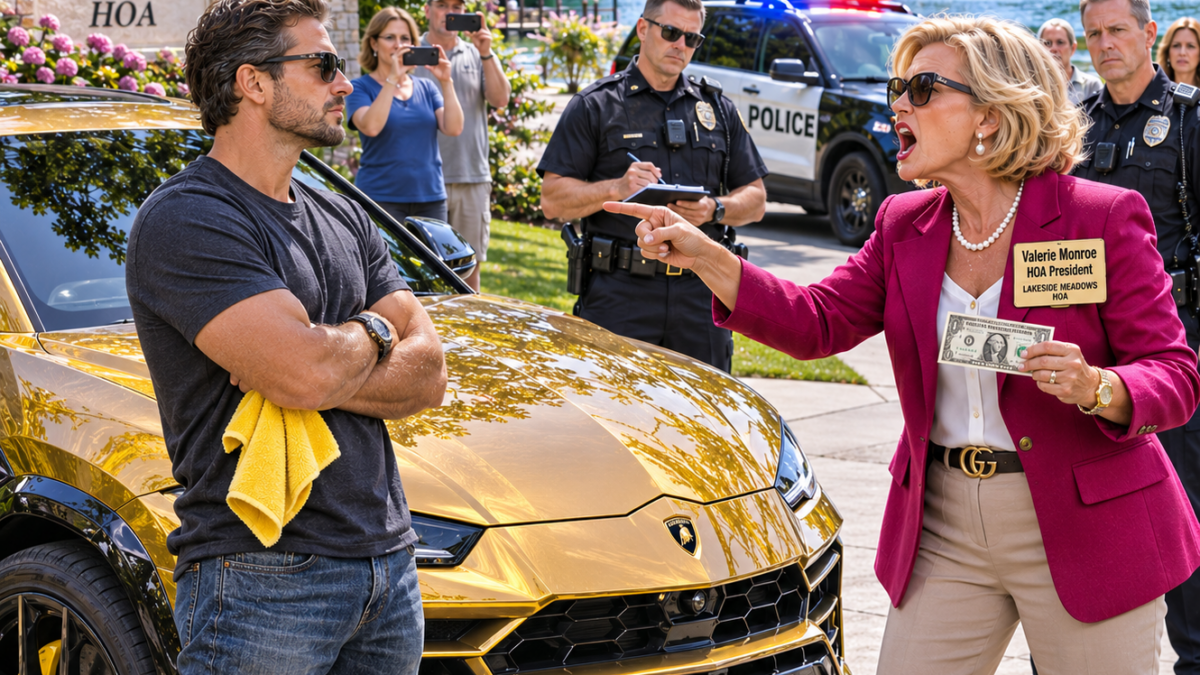
The morning Valerie Monroe called 911 and told the dispatcher I was threatening her, I was standing in my own driveway with a microfiber towel in one hand and my phone recording in the other, while she pointed at my metallic-gold Lamborghini Urus and screamed for police to arrest me because thirty minutes earlier I had refused to sell her a nearly three-hundred-thousand-dollar SUV for one crisp dollar bill.
What made the situation worse was that Valerie wasn’t some random stranger having a bad day—she was the president of Lakeside Meadows HOA, the woman who had spent years turning lawn heights, trash cans, mailbox colors, and parking rules into instruments of control, and now she was using the emergency line the same way she used the bylaws: as a weapon against anyone who had the nerve to tell her no.
By the time the first cruiser came around the corner with lights flashing and half the neighborhood watching from windows, Valerie still believed the louder story would become the official one, but she hadn’t noticed that my phone was recording, my neighbor across the street had started filming too, and the strangest part of that morning was still waiting inside a paper trail none of us had looked at yet.
My name is Ethan Cole.
Fifteen years earlier, I started a cybersecurity company out of a rented office with two folding desks, one aging server, and more confidence than money.
I spent years working weekends, losing clients, winning them back, hiring people smarter than me, and learning the expensive difference between looking successful and actually building something that could survive.
The Lamborghini came much later.
I bought it because I had once promised myself that if the company ever became stable enough to run without me watching every minute, I would buy one ridiculous thing purely because I had earned the freedom to do it.
So when I finally ordered the Urus, I chose the least subtle finish imaginable.
Metallic gold.
My neighbor Dr. Lucas Park called it “a sunrise with license plates.”
I loved it.
That Saturday morning, I was outside detailing the wheels when Valerie appeared at the end of my driveway.
Bright pink blazer.
Oversized sunglasses pushed into her hair.
Clipboard tucked beneath one arm.
Her nineteen-year-old son, Brandon, trailed beside her staring at his phone.
“Good morning, Mr. Cole,” Valerie called.
I already knew trouble was coming because Valerie never used that voice unless she wanted something.
“Morning.”
She stopped beside the driveway and looked slowly over the Urus.
“Brandon has been talking about this car constantly.”
Brandon looked up.
“Twin-turbo V8,” he said.
I nodded.
Valerie smiled.
“His birthday is next month.”
“Happy early birthday.”
“He deserves something special.”
Then she pulled a checkbook from her purse.
“So what do you want for it?”
I laughed because I thought she was joking.
“It’s not for sale.”
“Everything is for sale.”
“Not this.”
“Twenty thousand.”
My smile disappeared.
“Valerie, this car cost close to three hundred thousand dollars after options and customization.”
“Used cars depreciate.”
“I’ve had it six months.”
“Fine. Twenty-five.”
“No.”
“Thirty. Final offer.”
“No.”
Her expression hardened.
Brandon shifted.
“Mom, come on.”
“Quiet.”
Then Valerie reached into her purse again and pulled out a single dollar bill.
She held it between two fingers.
“One dollar.”
I stared at her.
“Excuse me?”
“Symbolic sale. You transfer the title to Brandon for a dollar. Think of it as supporting a young person in the community.”
“You cannot be serious.”
“Karma rewards generosity.”
“I’ll take my chances.”
I pointed toward the sidewalk.
“Please leave.”
Her smile vanished.
“You should reconsider.”
“No.”
“That vehicle may violate HOA aesthetic standards.”
“There is no rule against car color.”
“Excessive reflection.”
“Not a rule.”
“Noise.”
“The exhaust is factory compliant.”
“If the current rules don’t address it, the board can consider amendments.”
That was when I set down the towel and started recording.
“Valerie, I’m asking you clearly to leave my property.”
Her eyes moved to my phone.
“You want to play that game?”
“This isn’t a game.”
Then she stepped onto my driveway, grabbed the Lamborghini’s door handle, and pulled.
Locked.
The click carried across the quiet street.
“Step away from my car.”
She turned toward me, face flushed.
“You don’t tell me what to do in my community.”
“This is my driveway.”
She pulled out her phone.
And before I fully understood what she was doing, she dialed 911.
Her voice transformed the instant the dispatcher answered.
Soft.
Shaking.
Afraid.
“Yes, I’m at 214 Maple Crest Drive. There’s a man threatening me. He won’t let me leave.”
I stared at her.
She looked directly into my camera and whispered:
“You should have taken the dollar.”
PART 2
For a second, I genuinely wondered whether I had misunderstood what I was hearing.
Maybe she was calling someone else.
Maybe she had lost her mind.
Maybe there was some detail so ridiculous my brain had refused to process it.
Then the dispatcher asked whether I had a weapon.
Valerie looked straight at me.
“I don’t know,” she said, her voice trembling beautifully. “He’s acting very aggressive.”
I almost laughed.
Almost.
Then I remembered how quickly a false sentence becomes a dangerous situation when someone on the other end has to assume the worst.
I stopped moving.
Kept my phone pointed toward her.
Hands visible.
Voice calm.
“Valerie, you’re being recorded.”
Her eyes narrowed.
“You’re intimidating me.”
“I’m standing on my own driveway.”
“You won’t let me leave.”
I looked behind her.
The sidewalk was completely open.
“Walk away.”
She didn’t.
Instead, she stepped farther onto my property.
That told me everything.
She didn’t want escape.
She wanted escalation.
Brandon stood near the curb looking like he wished the asphalt would open and swallow him.
“Mom,” he said quietly. “Seriously, let’s just go.”
“Stay out of this.”
“I’m already in it.”
“You wanted the car.”
“I said I liked it.”
Valerie snapped her head toward him.
“You said you wanted one.”
“One. Not his.”
That distinction seemed incomprehensible to her.
She turned back to me.
“See what you’re doing? You’re humiliating my son.”
Brandon closed his eyes.
I felt sorry for him.
He hadn’t started any of this.
He was a nineteen-year-old kid who thought a Lamborghini was cool.
There was a large difference between wanting something and believing somebody owed it to you.
Apparently Valerie had never learned it.
The sirens arrived five minutes later.
It felt longer.
Two cruisers came around the corner hard enough that the first one bounced slightly over the drainage dip.
Lights flashing.
Four officers.
Doors opening.
Hands near holsters.
The entire street came alive.
Curtains shifted.
Garage doors rose.
People stepped onto porches with phones in their hands.
Valerie moved immediately.
“There!” she shouted. “That’s him!”
I lowered my recording hand slightly but didn’t put the phone away.
One officer approached.
“Sir, keep your hands where I can see them.”
I did.
“Absolutely.”
“You live here?”
“Yes. Ethan Cole. This is my house.”
Valerie shouted from behind him.
“He threatened me!”
The officer held up one hand toward her.
“Ma’am, stay there.”
Another officer separated Valerie and Brandon.
A third approached me.
“I’m Sergeant Whitaker. Tell me what happened.”
“I was washing my vehicle. Ms. Monroe came onto my property with her son. She tried to purchase it. I refused. She attempted to open the driver’s door. I told her to leave. She called 911 and reported that I threatened her and prevented her from leaving.”
Whitaker looked toward the Urus.
Then toward Valerie.
“She tried to buy the car?”
“For one dollar.”
His face remained professional.
Barely.
“One dollar?”
I nodded.
“I recorded most of it.”
That changed everything.
“May I see?”
“Yes.”
Before I unlocked my phone, Lucas came jogging across the street.
“Officer.”
Whitaker turned.
Lucas held his own phone in the air.
“I saw the whole thing. I recorded from my porch after she started yelling.”
Valerie spun.
“Lucas, stay out of this!”
He stopped.
“Valerie, you called 911 on the guy for not giving you his car.”
“It wasn’t like that.”
“It was exactly like that.”
Whitaker looked at him.
“Sir, please remain available. Another officer will take your statement.”
Lucas nodded.
“Absolutely.”
I pulled up my video.
The officer watched.
Valerie offering twenty thousand.
Twenty-five.
Thirty.
The one-dollar bill.
My refusal.
Her threat about HOA rules.
My request that she leave.
Her hand on the Lamborghini’s door handle.
Then the call.
Clear audio.
**There’s a man threatening me. He won’t let me leave.**
Whitaker looked up.
Then watched the next few seconds.
Valerie whispering:
**You should have taken the dollar.**
He slowly exhaled.
“Okay.”
He walked toward Valerie.
I stayed where I was.
Couldn’t hear every word.
I didn’t need to.
Her voice rose almost immediately.
“Do you know who I am?”
Never a good sentence.
Whitaker answered calmly.
“Yes, ma’am. I have your identification.”
“I’m the president of this HOA.”
“That doesn’t change what we’re discussing.”
“You’re taking his side.”
“We’re reviewing evidence.”
“He manipulated that video.”
Lucas called from across the driveway:
“I have another one.”
She turned.
“You shut up!”
Officer Ruiz stepped between them.
“Ma’am, lower your voice.”
Valerie’s face turned scarlet.
“This is unbelievable.”
Whitaker said something else.
Then Valerie looked at me.
Pure fury.
For one second, she seemed to understand that the police weren’t going to convert her story into reality.
That’s when she made the worst decision of the morning.
She reached down.
There was a decorative landscaping rock beside my driveway.
Not huge.
Maybe the size of a grapefruit.
She grabbed it.
Ruiz saw the movement.
“Ma’am, put that down.”
Valerie stared at the Lamborghini.
“If I can’t—”
She never finished.
Ruiz intercepted her before she could raise her arm.
The rock dropped.
Another officer took her wrist.
Everything happened fast after that.
Commands.
Cuffs.
Valerie screaming.
Brandon backing toward the curb.
Neighbors recording.
And me standing beside the car wondering how a Saturday morning had somehow turned into a police incident over a one-dollar bill.
Whitaker returned several minutes later.
“Mr. Cole, we’re going to need your full statement.”
“Of course.”
“We’ll also need copies of the recording.”
“You’ll have them.”
He glanced at the Urus.
“Any damage?”
I walked around it.
Nothing.
The door handle was fine.
The rock hadn’t touched the paint.
“No.”
“Good.”
He looked toward Valerie sitting in the back of the cruiser.
“We’ll document the attempted property damage, the trespass allegation, and the false emergency report. Charging decisions will follow the evidence and local statute.”
That sounded more like how the system actually worked.
No dramatic instant conviction.
No movie speech.
Evidence first.
Then process.
I appreciated that.
Whitaker shook his head.
“Fifteen years on the job.”
“What?”
“I’ve never responded to a Lamborghini dispute involving one dollar.”
“Neither have I.”
He almost smiled.
Then:
“Try to keep it that way.”
***
After the cruisers left, the street didn’t immediately return to normal.
It couldn’t.
People stood in little groups.
Talking.
Looking at me.
Looking at the driveway.
Looking toward Valerie’s house.
The gold Urus sat in the sunlight like the world’s most expensive piece of evidence.
Lucas walked over.
“You okay?”
“Define okay.”
“You didn’t get arrested.”
“Strong start.”
He laughed.
Then became serious.
“I’ve got the whole thing from when she pulled out the dollar.”
“Keep the original.”
“I already backed it up.”
That’s why Lucas and I got along.
He was a physician, but he thought like a security engineer.
Redundancy mattered.
“Thanks.”
He looked down the street.
“She’s finished.”
I wasn’t convinced.
“You’ve met Valerie.”
“Fair point.”
“People like her don’t interpret consequences as information.”
“What do they interpret them as?”
“Opposition.”
Lucas frowned.
“That sounds exhausting.”
“It usually is.”
***
My phone became unusable by noon.
HOA group chat.
Neighborhood texts.
Unknown numbers.
Somebody had photographed Valerie being placed in the cruiser.
Someone else claimed I’d attacked her.
Another person said I had tried to force her to buy my Lamborghini.
That one was impressive.
By two o’clock, the event had somehow become:
**Lamborghini owner attacks HOA president over parking dispute.**
Human beings can turn five minutes of video into mythology with astonishing efficiency.
I shut off notifications.
Then I did what I always did when facts mattered.
I created a folder.
**VALERIE / 911 INCIDENT**
Original video.
Backup.
Lucas’s file once he sent it.
Case number.
Officer names.
Timeline.
Photographs of the driveway.
Copy of HOA bylaws.
The one-dollar bill?
Valerie had dropped it during the argument.
It lay near my wheel.
I picked it up with two fingers.
Considered throwing it away.
Then put it in an envelope.
Not because it was evidence of a crime.
Because someday I suspected I would need proof that the most ridiculous detail in the story had actually happened.
***
Sergeant Whitaker stopped by that evening.
No emergency lights this time.
He looked tired.
“Just wanted to update you.”
“She’s out?”
“Released pending the next steps, yes. There are conditions regarding contact. The report is being reviewed.”
I nodded.
“Anything I need to do?”
“Don’t engage.”
“Happy to.”
“Keep cameras on.”
“Already running.”
“And if she comes over?”
“Call.”
“Yes.”
He glanced toward my garage.
The Urus was inside now.
Door closed.
“You know, Mr. Cole…”
“Ethan.”
“Ethan. People sometimes get embarrassed after an arrest and become more reasonable.”
“You don’t sound convinced.”
“I’m a police officer.”
Fair.
He left.
***
Monday morning proved him right to be cautious.
At 7:12, I opened my front door and found an HOA envelope taped at eye level.
Official seal.
Violation number.
Signature.
I read it while standing barefoot on the porch.
**VEHICLE AESTHETIC / COMMUNITY HARMONY VIOLATION**
Vehicle:
**Lamborghini Urus — Gold Finish**
Alleged issues:
**Excessive reflected glare.**
**Non-neutral visual presentation.**
**Repeated exhaust disturbance.**
**Public nuisance resulting from police activity.**
I stared at the last one.
They had cited me because Valerie had called the police on me.
Then I saw the signature date.
Two days before the incident.
Valerie had prepared it in advance.
That stopped being funny.
She had arrived Saturday already planning leverage.
The one-dollar offer wasn’t spontaneous generosity.
The violation threat wasn’t anger after I refused.
She had created the paperwork before she came.
Which meant she expected resistance.
I scanned everything.
Then pulled out the CC&Rs.
Cybersecurity taught me never to argue with a system before reading its rules.
The HOA could regulate certain parking conditions.
Commercial vehicles.
Long-term street storage.
Disabled vehicles.
There were nuisance provisions.
Noise after designated hours.
Nothing about metallic paint.
Nothing about reflected sunlight.
Nothing about legal factory exhaust driven normally.
And certainly nothing authorizing a nuisance violation because police responded to a false complaint made by the same board president.
I drafted an appeal.
Short.
No emotion.
**Please identify the governing provision supporting each cited violation. Pending citation of applicable authority, I dispute the notice in full.**
Certified mail.
Copy to management company.
Copy to HOA counsel.
Copy to my attorney, Rachel Donovan.
Rachel called twenty minutes after receiving it.
“Tell me the Lamborghini citation is a joke.”
“Unfortunately no.”
“Excessive reflection?”
“Yes.”
She laughed.
Then:
“Don’t laugh with me. Keep everything.”
“I am.”
“Don’t post angry commentary.”
“I wasn’t planning to.”
“Don’t antagonize her.”
“I didn’t offer her the car for one dollar.”
“Ethan.”
“Fine.”
“I’m serious.”
“So am I.”
She paused.
“People who lose control publicly often try to recover it privately.”
That sentence stayed with me.
***
The first neighbors began contacting me quietly.
Not to talk about the Lamborghini.
About Valerie.
A retired teacher named Helen sent screenshots of fines for flowerpots she claimed were never in the bylaws.
A young father named Marcus showed me three different warnings for leaving a basketball hoop near his driveway even though the board had previously approved it.
An elderly man had been threatened with towing after his daughter parked overnight while caring for him after surgery.
A woman named Cheryl said Valerie had once entered her fenced backyard without permission to photograph a shed.
Different stories.
Same pattern.
Valerie treated HOA authority not as a defined legal relationship but as a personality trait.
If she believed something affected the neighborhood, she believed she had a right to control it.
And because most people didn’t want conflict, they paid small fines.
Moved things.
Apologized.
Complied.
I had been the wrong target because my instinct under pressure was the opposite.
Verify.
Document.
Challenge.
Not because I was courageous.
Because I built my career in cybersecurity.
If a system tells me something is mandatory, my first question is:
**According to what authority?**
Valerie hated that question.
***
I created a private online group.
Not a mob.
Not a campaign against Valerie personally.
I called it:
**Lakeside Transparency**
The first post was simple.
**This group is for residents who want to compare HOA notices, bylaws, budgets, and appeal procedures. Please post documentation, not rumors. Personal attacks will be removed.**
Lucas joined first.
Then twelve people.
Then thirty.
By evening, more than half the neighborhood was watching.
I uploaded my violation notice.
Then the applicable vehicle provisions.
No dramatic caption.
Just:
**If anyone can identify the provision supporting “excessive reflected glare,” please post the section number.**
Nobody found one.
Residents started uploading their own notices.
Patterns emerged.
Some fines were legitimate.
Trash left out for weeks.
Unapproved structural changes.
Parking on fire lanes.
Those stayed separate.
Others appeared invented.
That’s important.
If you call everything corruption, nobody trusts you when you find the real thing.
So we sorted.
Supported.
Unsupported.
Questionable.
Needs legal review.
The group became less exciting and more useful.
Valerie probably hated that most.
***
Then Greg Monroe called.
Her husband.
I’d seen him at HOA events.
Quiet man.
Corporate-sales manner.
Always looked slightly uncomfortable when Valerie made speeches.
“Mr. Cole.”
“Ethan is fine.”
“I’d rather keep this formal.”
“Then Mr. Cole works.”
He exhaled.
“I want to discuss the video.”
“What about it?”
“You’re circulating material that has caused significant emotional harm to my wife.”
“I posted my own recording in a private resident group after she accused me publicly.”
“You need to remove it.”
“No.”
“This can be resolved quietly.”
“What does that mean?”
“Take down the video. Stop encouraging this rebellion. We withdraw the car violation.”
I leaned back.
There it was.
“Greg, are you offering to cancel an unsupported HOA citation in exchange for me removing evidence of Valerie’s conduct?”
Silence.
“You’re twisting my words.”
“I’m asking.”
His voice cooled.
“If you don’t cooperate, the HOA can review every aspect of your property.”
I pressed record on my phone after giving the legally appropriate notice required in my jurisdiction and told him I was documenting the call.
His tone changed instantly.
“That isn’t necessary.”
“I disagree.”
“Ethan, don’t make this uglier.”
“Then stop.”
He hung up.
Rachel listened to the recording later.
“Good.”
“That’s all?”
“What do you want? A medal?”
“A cookie would be nice.”
“Don’t answer him again without me.”
There went the cookie.
***
By Thursday, the police video had spread outside the neighborhood.
Someone else uploaded a copy.
Then another.
The clip of Valerie holding out one dollar while demanding the Lamborghini became the part people couldn’t believe.
The false 911 call was worse.
The attempt with the landscaping rock ended any sympathy.
Local news requested comment.
I declined.
The internet did not require my participation to become ridiculous.
Memes appeared.
One showed a Lamborghini dealership sign:
**HOA PRESIDENT SPECIAL — $1**
Another replaced the Lamborghini bull logo with a clipboard.
I didn’t share any of them.
Humiliation has a point where accountability becomes cruelty.
I had no interest in crossing it.
Valerie’s actions belonged in public discussion because she had used public HOA authority and emergency services.
Her face becoming a joke forever was something else.
That distinction would matter later.
***
Friday’s emergency HOA meeting was packed.
Valerie was absent.
Her attorney had advised it.
Greg sat at the head table despite being treasurer, not president.
Phil Rogers, the vice president, looked as though he had aged ten years since Saturday.
I took a seat near Lucas.
Greg opened.
“We are here to address recent events and protect the integrity of Lakeside Meadows.”
Someone behind me muttered:
“Little late.”
Greg pretended not to hear.
“The board regrets the conflict between a homeowner and President Monroe.”
I raised my hand.
Greg ignored it.
He continued.
“We also condemn unauthorized distribution of sensitive personal recordings designed to inflame residents.”
Now I stood.
“Point of order.”
Greg glared.
“This isn’t a courtroom.”
“No. It’s an HOA meeting governed by your bylaws.”
I held them up.
“Section 4.7 permits homeowner comments on board conduct at special meetings.”
Murmurs.
Greg’s face tightened.
“Five minutes.”
“Won’t need them.”
I walked to the microphone.
“My issue is simple. Valerie Monroe called 911 and reported that I threatened her and prevented her from leaving my property.”
I held up the police incident number.
“Video from two independent cameras contradicts that statement.”
Someone applauded.
I lifted a hand.
“Please don’t.”
The room quieted.
“This isn’t entertainment.”
That mattered to me.
Then I held up the Lamborghini violation notice.
“Two days before the incident, Valerie prepared this citation claiming my vehicle violated rules that do not exist in the governing documents.”
Greg leaned toward his microphone.
“That’s your interpretation.”
“No.”
I opened the bylaws.
“That’s the text.”
I read the relevant sections.
No metallic-color restriction.
No glare rule.
No factory exhaust ban.
Then I said:
“If anyone on this board can show me authority for that citation, I’ll sit down.”
Nobody spoke.
Phil looked at the table.
I continued.
“Residents also have the right under Section 4.7 to initiate a recall vote with signatures from twenty-five percent of voting households.”
That changed the air.
Greg leaned forward.
“Are you threatening the board?”
“No.”
“Sounds like it.”
“I’m reading your bylaws.”
A woman in the second row stood.
“I’ll sign.”
Then Marcus.
“Me too.”
Helen raised her hand.
“So will I.”
Greg’s face lost color.
I looked around.
“This isn’t about replacing one dictator with another. Read before you sign. Ask questions. Decide for yourselves.”
Then I sat.
Lucas whispered:
“You enjoy this.”
“No.”
“You definitely enjoy the paperwork.”
“Maybe the paperwork.”
***
The recall petition passed the required threshold in forty-eight hours.
Then doubled it.
Before the recall meeting could occur, Valerie resigned through counsel.
Her letter cited emotional strain and personal safety.
No admission.
No apology.
Just resignation.
When I read it, I expected triumph.
What I felt was relief.
The neighborhood didn’t look different.
Same sidewalks.
Same lawns.
Same houses.
Yet people walked differently.
A strange thing happens when someone who has dominated a small system leaves.
You realize how much energy everyone spent anticipating them.
Who might receive a violation?
Who might be photographed?
Who might be singled out at the meeting?
That constant low-level tension vanished.
And people noticed.
***
Brandon came to my house three days after the resignation.
Alone.
No Valerie.
No Greg.
He stood at the edge of the driveway.
Didn’t step onto it.
That detail mattered.
“Mr. Cole?”
“Yeah?”
“Can I talk to you?”
“Sure.”
He approached only after I nodded.
Hands in his pockets.
Embarrassed.
“I wanted to apologize.”
“You don’t owe me one.”
“I was there.”
“You didn’t call 911.”
“I told her I liked the car.”
I waited.
He looked at the Urus through the garage window.
“She does that.”
“What?”
“If I say I like something, she decides I need to have it.”
“That’s not your fault.”
He shook his head.
“I should’ve stopped her.”
“You tried.”
“Not hard enough.”
“Brandon.”
He looked up.
“You’re nineteen. Your mother’s choices are not yours.”
He swallowed.
Then laughed weakly.
“She was actually going to give it to me for my birthday.”
“For a dollar.”
“Yeah.”
“You couldn’t afford the insurance.”
That surprised a real laugh out of him.
“No chance.”
The tension broke.
He looked toward the car again.
“It’s still an amazing Urus.”
“It is.”
“Can I…”
He stopped.
“What?”
“Can I just see the interior?”
I smiled.
Because there it was.
A question.
Permission.
The entire conflict reduced to one simple distinction.
“Yeah.”
I opened the garage.
Brandon stood beside the driver’s door.
Waited.
I unlocked it.
“Go ahead.”
He sat behind the wheel like a kid.
Didn’t touch the start button.
Didn’t grab anything.
Just looked.
“This is insane.”
“That’s why I bought it.”
He got out after a minute.
“Thanks.”
“Anytime you ask.”
He understood the sentence.
His expression changed.
Then he nodded.
“Yeah.”
That was the first part of this story that actually felt like a win.
***
Valerie’s attorney sent a cease-and-desist letter two weeks later.
Defamation.
Harassment.
Improper publication of private information.
Rachel responded with a much longer version of:
**Truth is a defense, and protected factual discussion of HOA governance remains protected subject to applicable law.**
The threat faded.
Then something unexpected happened.
Valerie asked to resolve several civil issues.
Her attorney proposed that she reimburse some of my legal costs, withdraw the disputed violation permanently, agree to no-contact conditions concerning my property, and issue a written apology to the HOA.
Rachel asked:
“What do you want?”
“Peace.”
“Anything else?”
I thought.
“An apology that doesn’t pretend the 911 call was a misunderstanding.”
Rachel nodded.
“That I can work with.”
At the next HOA gathering, Valerie did not appear in person because of the pending criminal case.
Her attorney read the statement.
**I made false accusations regarding Mr. Cole’s conduct, acted outside my authority as HOA president, and escalated a private disagreement in a manner that harmed the community. I regret those actions.**
Not perfect.
Enough.
Nobody applauded.
That was better.
Closure doesn’t always need applause.
***
Then somebody nominated me for HOA president.
I assumed it was a joke.
Lucas insisted it wasn’t.
“No.”
“You haven’t heard the pitch.”
“No.”
“People trust you.”
“Then they’re confused.”
“You know the bylaws.”
“That is not a qualification. That’s a warning sign.”
“You understand systems.”
“I understand why I don’t want to run one.”
Lucas walked beside me around the cul-de-sac.
“You’re the only person who challenged Valerie without trying to become Valerie.”
“Yet.”
He laughed.
“Exactly.”
Messages started arriving.
Residents asking.
Not demanding.
That mattered.
I finally agreed under conditions.
One term.
Transparent finances.
Term-limit proposal.
Open meetings.
Independent review of contested violations.
And I would not become the neighborhood’s full-time enforcement cop.
Election night was packed.
I gave the shortest speech possible.
“I bought my house because I wanted a home, not a government job. If you elect me, the goal is to make this board boring, predictable, documented, and easy to question.”
Someone shouted:
“Can we put that on the sign?”
I continued.
“The HOA should protect shared obligations. It should not control private life because one officer dislikes something.”
Then I pointed toward the bylaws.
“If the rule isn’t written, we don’t invent it. If the board spends money, residents should be able to see where it went. If we make a mistake, there needs to be an appeal that doesn’t require begging the same person who issued the violation.”
No dramatic applause until the end.
I preferred that.
I won with eighty-six percent.
My first thought:
**What have I done?**
***
The first motion I proposed wasn’t about the Lamborghini.
It was about transparency.
Monthly financial reports.
Contract disclosures.
Recorded votes.
Conflict-of-interest statements.
A resident ethics committee.
An appeals panel that could include homeowners who weren’t board members.
Then term limits.
Two consecutive terms maximum.
Someone asked:
“What if we get a great president?”
“Then elect another great person.”
“What if the next one is terrible?”
“That’s why the rules matter more than the president.”
Passed.
The second motion removed Valerie’s invented Lamborghini violation from my account.
I recused myself.
The rest of the board voted.
Unanimous.
That was important.
I wasn’t going to use office to erase my own citation.
Even a stupid citation.
Process had to work when I benefited from it too.
***
Greg remained treasurer temporarily.
That worried me.
Two weeks into my term, another complaint appeared against the Urus.
**EXCESSIVE REFLECTION CREATING DRIVER DISTRACTION**
Filed anonymously.
Except the internal submission metadata identified Greg’s account.
He came to the meeting carrying a thick folder.
I placed the complaint on the public agenda.
“Mr. Monroe, would you like to explain the concern?”
“Several residents have reported dangerous glare.”
“Which residents?”
“They requested anonymity.”
“Did you personally observe the glare?”
“Yes.”
“When?”
“Multiple afternoons.”
I displayed the complaint timestamps.
Then gate-camera logs indicating Greg’s vehicle wasn’t in the neighborhood during two of the reported periods.
That didn’t prove he had never seen glare.
It proved the complaint was unreliable.
I didn’t mock him.
Didn’t make the obvious joke about nighttime sunlight.
Instead:
“This allegation lacks specific supporting evidence and cites no standard defining prohibited vehicle reflection. I’m recusing myself from the vote.”
The vice president, Mark Ellison, took over.
Board voted to dismiss.
Then Mark said:
“Greg, repeated unsupported filings against one homeowner may itself become a harassment issue under the governing policy.”
Greg looked at me.
I said nothing.
That silence mattered more than a victory speech.
He resigned as treasurer the following week.
***
The months that followed were remarkably ordinary.
Which was the whole point.
We digitized records.
Created a resident portal.
Published vendor bids.
Reduced nuisance fines.
Added written cure periods before most penalties.
Made emergency exceptions clear.
Kids left basketball hoops out.
Civilization survived.
Trash cans sometimes remained visible until noon.
Property values did not collapse.
People started attending meetings because meetings no longer felt like trials.
Then Valerie sued me.
***
The complaint arrived on a Tuesday.
Defamation.
Intentional infliction of emotional distress.
Loss of reputation.
Economic damages.
One hundred fifty thousand dollars.
Greg joined portions of the claim.
I sat at my dining table reading it.
At first I laughed.
Then I stopped.
Lawsuits don’t need merit to cost time.
Money.
Sleep.
Rachel came over that evening.
Read the complaint.
“She’s arguing your recordings and community posts destroyed her reputation.”
“She destroyed her reputation.”
“Don’t say that to reporters.”
“Wasn’t planning to.”
“We’ll challenge it early.”
“Anti-SLAPP?”
“Potentially, depending on which claims and applicable law. More importantly, truth and documented public-interest discussion are strong defenses here.”
I opened the evidence archive.
Police report.
Videos.
Board notices.
Public meeting minutes.
Valerie’s apology.
Rachel stared.
“You kept all of this?”
“Cybersecurity.”
“You people need hobbies.”
“I have a Lamborghini.”
“Apparently that’s how we got here.”
Fair.
***
The preliminary hearing drew more attention than I wanted.
Valerie looked different.
Gray blazer.
No pink.
No giant sunglasses.
Greg sat beside her.
Her attorney, Stanford Pierce, argued that I had turned a private misunderstanding into a public campaign.
Rachel stood.
“No.”
One word.
Calm.
Then she walked the judge through the timeline.
The one-dollar offer.
The threat to create HOA rules.
The trespass.
Door handle.
911 report.
Video.
Police findings.
Attempted damage.
Predated violation.
Public governance dispute.
Valerie’s own written apology.
The judge watched the footage.
Especially the moment she whispered:
**You should have taken the dollar.**
When the lights came back on, the courtroom was quiet.
Pierce said:
“Your Honor, the clip lacks context.”
The judge looked at him.
“We have approximately eleven minutes of context.”
That ended that line.
The court ultimately dismissed the actionable defamation theory and awarded the relief available under the applicable procedure, including legal costs associated with the unsuccessful claim.
I walked outside.
Reporters waited.
One asked:
“Do you feel vindicated?”
“No.”
“Why not?”
“Because this could’ve ended the morning she accepted the word no.”
Then I left.
That was the only quote I gave.
***
The video went viral again.
Millions of views.
Memes.
Commentary.
People treating Valerie’s collapse like entertainment.
Greg came to my house one evening.
He looked twenty years older.
“Please make it stop.”
“I can’t.”
“You posted the original video.”
“Other people copied it.”
“She’s barely eating.”
I folded my arms.
“What do you want from me?”
“Delete your posts.”
I thought.
Then I did something he didn’t expect.
“I’ll remove anything that isn’t necessary for the HOA record or my legal defense.”
His face softened.
“But I can’t erase the internet.”
“I know.”
“And I won’t say the footage was false.”
“I know.”
He nodded.
For once, no threat.
No anger.
Just a tired husband facing consequences he couldn’t control.
As he turned away, I said:
“Greg.”
He stopped.
“Brandon’s doing okay.”
His shoulders lowered.
“Yeah.”
“He’s not responsible for this.”
Greg looked back.
“I know.”
I hoped he meant it.
***
Six months later, the state notified Lakeside Meadows of a financial and governance review.
Not because our new board was suspected of theft.
Because the public scandal and abrupt leadership transition had created enough questions about old records to justify scrutiny.
Two auditors arrived.
Mr. Blake and Ms. Wynn.
Professional.
Unimpressed by drama.
Exactly what auditors should be.
They spent days going through vendor files.
On the third afternoon, Blake asked me to sit down.
“Do you recognize Greencrest Maintenance LLC?”
“Yes. Valerie’s landscaping vendor.”
“Did you continue using them?”
“No. We competitively rebid landscaping after I took office.”
“Good.”
He turned his screen.
“Greencrest doesn’t appear to operate as a normal landscaping company.”
Ms. Wynn slid a registration record toward me.
Mailing address.
Post-office box.
Contact:
**G. Monroe.**
My stomach tightened.
“Greg?”
“We’re still verifying.”
Then the payments.
Twenty thousand.
Nine thousand.
Twelve.
Various amounts over several years.
Invoices for work residents couldn’t identify.
Landscape restoration projects that didn’t match photographs.
Emergency tree service with no corresponding weather event.
Preliminary total:
Nearly eighty-seven thousand dollars requiring explanation.
I sat there.
For the first time since the one-dollar incident, I felt genuinely betrayed.
Not by Valerie.
By the system.
Neighbors had trusted those people with money because HOA financial reports looked official.
Boxes.
Columns.
Signatures.
Same reason scammers imitate bank portals.
Appearance creates trust.
“What’s next?”
Blake said:
“We refer suspected misconduct to the appropriate authorities. We do not determine criminal guilt.”
Good answer.
I called Rachel.
“There’s more.”
She wasn’t surprised.
“Of course there is.”
***
Greg came to the HOA office two days later.
No tie.
No folder.
No confidence.
“Ethan.”
I closed the door but kept the blinds open.
“Greg.”
“We need to talk.”
“About Greencrest?”
His face changed.
That answered enough.
“I didn’t set it up the way you’re thinking.”
“How am I thinking?”
“Valerie created it.”
“And you?”
“I signed some things.”
“Some?”
“She said it was temporary.”
I stayed quiet.
“She said we could reimburse ourselves for time spent managing vendors.”
“Through a shell company?”
He looked away.
“Greg.”
“She told me everybody did it.”
“Did you?”
Silence.
“Did you know services were being billed that weren’t performed?”
“I didn’t ask.”
“That isn’t the same as no.”
His eyes filled with anger.
Then shame.
“If this becomes criminal, she could lose everything.”
I looked at him.
“You already asked me once to hide the truth because your wife was suffering.”
“This is different.”
“No.”
“She has been through enough.”
“The residents paid those dues.”
“I know.”
“Some are retired.”
“I know.”
“Some complained about fines while board money went to a company tied to you.”
He slammed his palm on the desk.
“I said I know!”
The auditors looked through the glass.
Greg saw them.
His anger disappeared.
I lowered my voice.
“Then cooperate.”
He sat.
For a moment, neither of us spoke.
Finally:
“I trusted her.”
I shook my head.
“No.”
He looked up.
“You chose not to verify because verification might have made you responsible.”
That hurt him.
It was supposed to.
Not cruelly.
Truthfully.
He left without another word.
***
The final audit confirmed extensive governance violations and roughly eighty-seven thousand dollars in improper or unsupported payments tied to the former leadership period, including transactions involving Greencrest. The matter was referred for official investigation.
Residents were furious.
I understood.
But I refused to turn the clubhouse into a public hanging.
At the next meeting, I opened with:
“We are going to separate three things: what the audit proves, what investigators allege, and what people are guessing.”
Someone shouted:
“They stole from us!”
“The audit found improper payments. Investigators determine criminal liability.”
“Why protect them?”
“I’m protecting us.”
That quieted the room.
“If we become comfortable replacing evidence with anger because this time we dislike the accused, then we learned nothing from Valerie.”
That was the hardest speech I gave as president.
Because people wanted revenge.
So did part of me.
But governance built on revenge is just another form of Valerie.
***
Brandon sent me a message that night.
**Mr. Cole, I saw the audit. I’m sorry.**
I wrote:
**You still don’t owe me an apology for your parents.**
A minute later:
**I know. I just hate seeing what they did.**
I replied:
**Then do something different with your own life. That’s enough.**
He sent:
**Working on it.**
I smiled.
***
The criminal and civil financial case resolved more quietly than the internet wanted.
No dramatic prison convoy.
No hundred-year sentence.
Valerie accepted responsibility for financial misconduct established in the case and received probation, community service, and restitution obligations in addition to the earlier consequences from the 911 incident.
Greg received probationary consequences and financial penalties tied to his role.
Every dollar recoverable through the restitution process was directed back toward the association.
Some money returned quickly.
Some took time.
Some probably never would.
Real justice often comes in installments.
When the ruling was announced, I stood outside the courthouse.
Lucas texted:
**Closure?**
I looked at the word.
Then wrote:
**Closer.**
***
We framed the final audit report in the clubhouse lobby.
Not the page with Valerie’s name.
The recommendations.
Dual approvals.
Vendor verification.
Conflict disclosures.
Annual independent review.
Document retention.
Resident access.
Above it, a small plaque:
**TRANSPARENCY IS CHEAPER THAN CORRUPTION.**
Lucas claimed the phrase was mine.
It wasn’t.
I let him believe it.
***
For almost four months, life became boring.
Gloriously boring.
Then the drone appeared.
Saturday morning.
Naturally.
I was washing the Urus.
Again.
The buzzing started over the garage.
At first I assumed it belonged to a neighbor.
Then it dropped lower.
Fifteen feet.
Camera pointed toward me.
I stepped back.
“Who’s operating that?”
No response.
It followed when I walked along the driveway.
Then drifted toward the side yard.
I recorded it.
Did not throw anything.
Did not attempt to knock it down.
Eventually it flew toward the park.
I filed a note with the HOA because our common areas had drone restrictions near the pool.
Then forgot about it.
Until the next morning.
My phone exploded.
A video had appeared online.
Aerial footage of me washing the Lamborghini.
Dramatic music.
Fake complaint screenshots.
Title implying the new HOA president had purchased a luxury SUV with resident dues while issuing fines to ordinary homeowners.
That accusation hit differently.
Valerie calling me arrogant was annoying.
This questioned the one thing I cared about most.
Integrity.
My company existed long before Lakeside Meadows.
The Urus had been purchased before I joined the board.
HOA financials were public.
My president position was unpaid.
Yet online, context didn’t matter.
The video crossed hundreds of thousands of views.
Comments:
**Same corruption, new face.**
**Guy exposed Karen then became Karen.**
**Check the books.**
That last one I liked.
Check them.
Please.
Lucas came over.
“You’re getting killed online.”
“Apparently.”
“Who posted it?”
“Neighborhood Watchdog.”
“Sounds subtle.”
“Very.”
He looked at me.
“You know who?”
“I have suspicions.”
“Greg?”
“Suspicion isn’t evidence.”
Cybersecurity again.
Never fall in love with your theory.
***
A digital purchase receipt arrived anonymously in the HOA email inbox.
Drone registration information linked back to Greg Monroe.
I did not publish it.
I gave it to law enforcement and Rachel.
Investigators later confirmed the relevant ownership and recovered evidence supporting his involvement in the smear campaign.
Rachel sat across from me.
“We could sue.”
“Should we?”
“You’ve got a decent defamation theory if the facts line up.”
“What happens?”
“More headlines.”
“Exactly.”
She leaned back.
“What do you want?”
“Truth.”
“Then give people verifiable truth.”
I recorded one video.
No music.
No edits beyond document close-ups.
I sat in the garage.
Urus behind me.
“My name is Ethan Cole. I’m the unpaid president of Lakeside Meadows HOA. A video circulating online claims association money purchased this vehicle.”
I held up the purchase documentation.
“False.”
Company records.
Purchase date.
Then HOA compensation records.
Zero.
Public budget portal.
Audit.
Every number visible.
“You don’t have to trust me.”
I looked into the camera.
“Check the records.”
That was the message.
Not:
Believe me.
Verify me.
The video spread.
Faster than the smear.
Not because I was charismatic.
Because receipts are powerful when someone accuses you of stealing.
Greg’s story collapsed.
Law enforcement dealt with the drone-related violations and harassment issues supported by the evidence. Valerie, still under court supervision, issued an additional written apology connected to the continuing conflict.
I refused interviews again.
The internet found something else to be angry about by Wednesday.
Thank God.
***
Then came the part I least expected.
People began contacting our HOA asking for copies of the reforms.
Not because we were famous.
Because other homeowners were dealing with similar problems.
Invented fines.
Closed financial records.
One-person boards.
Unclear appeals.
We published our policies openly.
No consulting fee.
No branding.
No “Ethan Cole Method.”
Just sample documents.
Some associations used them.
Others didn’t.
Fine.
That was freedom too.
A statewide homeowners conference invited me to speak.
I declined.
Lucas asked why.
“Because I’ve become the guy I hated.”
“What guy?”
“The guy with opinions about HOAs.”
He laughed.
Then convinced me anyway.
I agreed on one condition:
No Lamborghini on the slides.
They put the Lamborghini on the introduction slide.
I nearly left.
***
My talk lasted twenty minutes.
“I used to think bad HOA outcomes were caused by bad rules.”
I looked around the room.
“Sometimes they are.”
Then:
“But a good rule in the hands of a person who cannot tolerate being questioned becomes dangerous. So design systems assuming the next president will be less reasonable than the current one.”
That got attention.
“Require documentation.”
“Separate accusation from appeal.”
“Publish finances.”
“Limit conflicts.”
“Make power expire.”
Then the line people quoted afterward:
“If accountability feels like an attack, the problem probably isn’t accountability.”
I wished they’d quoted the boring part about independent audits instead.
People prefer slogans.
***
Six months later, Mark Ellison challenged me for president.
That surprised me more than Valerie.
Mark had been my vice president.
Helped write reforms.
Helped manage the audit.
Trusted.
Smart.
He posted a message:
**TIME FOR FRESH LEADERSHIP**
His argument wasn’t crazy.
Lakeside Meadows had become too associated with me.
The Lamborghini.
The viral videos.
The reforms.
Reporters calling.
He wanted normal.
I wanted normal too.
Still, it hurt.
I knocked on his door.
“You could’ve told me.”
He nodded.
“I should have.”
“Why didn’t you?”
“Because I knew you’d talk me out of it.”
“That gives me too much credit.”
He smiled.
Then became serious.
“Ethan, this board cannot become your identity.”
“I know.”
“Do you?”
That bothered me.
He continued.
“Every reform has your fingerprint.”
“Because I was president.”
“Exactly.”
“What are you saying?”
“That if the system only works because you’re here, then we didn’t actually fix it.”
I stared at him.
There it was.
The most important criticism anyone had given me.
And he was right.
“Then run.”
He blinked.
“What?”
“Run.”
“You’re not angry?”
“I’m extremely annoyed.”
He laughed.
“But run.”
***
The election was competitive.
Civil.
Mostly.
Anonymous accounts tried to stir rumors.
I refused to chase them unless evidence supported action.
Mark campaigned on stability.
I campaigned on completing the remaining reforms and transitioning power.
At the candidate forum, he said:
“Ethan saved this association from becoming abusive. But the next phase should be about proving we don’t need a savior.”
That line landed.
Then my turn.
“When I moved here, I wanted to wash my car in peace.”
Laughter.
“I still want that.”
More laughter.
“Mark is right about one thing. Lakeside Meadows cannot revolve around one president.”
I looked at him.
“So whether you elect me or him, hold us to the same rules.”
That was my entire campaign.
I won narrowly.
Not eighty-six percent.
Fifty-six.
Mark congratulated me.
I offered him my hand.
“No hard feelings?”
“Some.”
He laughed.
“Fair.”
Then I said:
“You’re staying vice president.”
“Only if you promise not to become a brand.”
“Deal.”
We worked better after that.
Conflict had clarified the relationship.
He wasn’t my lieutenant.
He was a check.
Every president needs one.
***
The last serious fight came from outside Lakeside Meadows.
A regional HOA trade council disliked some of our reforms.
Not because it had legal authority over us.
It didn’t.
But it represented management companies, board consultants, and neighboring associations.
They invited me to a “review discussion.”
The chair, Diane Holt, sat across from me in a conference room.
“Your policies are creating expectations.”
“Good expectations?”
“Unrealistic expectations.”
“Such as?”
“Full financial access. Resident appeal rights. Restrictions on outside enforcement vendors.”
“Those aren’t radical.”
“Not every association has your resources.”
“Transparency is a PDF.”
She didn’t smile.
“We’re concerned you’re encouraging homeowners to view boards as adversaries.”
“I’m encouraging boards to make that interpretation difficult.”
Several people shifted.
Diane folded her hands.
“We’d prefer Lakeside Meadows stop circulating its model policy package under the association name.”
“Why?”
“Consistency.”
“With what?”
“Regional governance practice.”
I leaned back.
“Is there any law preventing us from publishing our own bylaws and sample policies?”
“No.”
“Any contractual restriction?”
“No.”
“Then we’re done.”
Her expression cooled.
“You’ve become disruptive.”
“I’ve been called worse.”
***
Three days later, Lakeside Meadows received a compliance review from the appropriate regulatory and administrative channels triggered in part by the broader scrutiny surrounding our reforms.
I suspected politics.
Suspicion didn’t matter.
We opened every file.
Financials.
Votes.
Contracts.
Garden budget.
Even mulch.
One inspector spent nearly an hour questioning a fifty-dollar variance in landscape pricing.
I answered.
Documentation.
Receipt.
Board vote.
Done.
Final report:
No major violation.
Minor administrative corrections.
We published the entire report.
Diane’s organization issued a statement about “ongoing concerns.”
Residents from other associations asked for our transparency packet anyway.
The harder critics tried to make the reforms look dangerous, the more people actually read them.
That was the irony.
Eventually state lawmakers discussing HOA transparency reforms cited multiple communities, advocacy groups, complaints, and public cases, including Lakeside Meadows, while considering stronger disclosure and homeowner-protection standards.
Not my bill.
Not my revolution.
Good.
Change shouldn’t depend on one guy with a gold Lamborghini.
***
On the one-year anniversary of Valerie’s 911 call, Lakeside Meadows held a barbecue.
Nobody officially called it an anniversary party.
Lucas absolutely did.
There were burgers.
Kids running through sprinklers.
A small car display because several neighbors were enthusiasts.
The Urus sat at one end.
A restored Mustang beside it.
A battered old Jeep that received more attention than both.
Brandon arrived.
I hadn’t seen him in months.
He was twenty now.
Working part-time at an automotive shop while taking classes.
He stood beside the Lamborghini.
“Still got it.”
“Still not for sale.”
He laughed.
“I brought money.”
He pulled out his wallet.
Then held up a one-dollar bill.
I stared at him.
He immediately started laughing.
So did I.
For the first time, that dollar didn’t feel like a threat.
“Your mother know you did that?”
“No chance.”
“Smart.”
He tucked it away.
Then became serious.
“She’s paying restitution.”
“I know.”
“She asked about you.”
I didn’t respond.
“She said she hopes the neighborhood’s okay.”
“It is.”
Brandon nodded.
“She wasn’t always like that.”
I looked at him.
“I believe you.”
That seemed to matter.
“After my grandfather died, she got… controlling. Everything had to be perfect. Then the HOA made her feel important.”
He swallowed.
“I’m not excusing it.”
“I know.”
“I just don’t want people thinking she was born evil.”
“They don’t need to.”
He looked relieved.
People are more complicated than villains.
Even when they behave terribly.
***
Later that evening, Mark joined me near the cul-de-sac.
“You stepping down after this term?”
“Yes.”
He stared.
“Seriously?”
“You were right.”
“Could you repeat that louder?”
“No.”
“What was I right about?”
“The system has to work without me.”
He smiled.
“I should record this.”
“Lucas probably is.”
Across the street, Lucas lifted his phone.
Of course.
I raised my lemonade toward him.
He saluted.
***
My final year as president was boring.
I consider that my greatest achievement.
No viral fights.
No dramatic recalls.
No invented violations.
Budget passed.
Pool repaired.
Landscaping contract rebid.
One dispute over fence stain resolved through appeal.
A parking argument ended with two adults talking.
Beautiful.
At the final election, I didn’t run.
Mark did.
So did two others.
Residents actually debated reserve funding and stormwater maintenance.
Nobody mentioned my Lamborghini until Lucas stood up during public comment.
“I’d like the record to reflect that the vehicle remains excessively shiny.”
Laughter.
Mark banged the gavel.
“Complaint dismissed.”
Perfect.
***
After the meeting, I walked home.
No title.
No president email.
No board keycard.
Just Ethan.
The garage light came on automatically when I entered.
The Urus sat where it always had.
Gold paint.
Same car.
Different meaning.
When I bought it, it represented success.
Then Valerie turned it into a battleground.
The internet turned it into a symbol.
The HOA turned it into a joke.
For a while, I treated it like armor.
Proof nobody could take what I had earned.
Standing there that night, I realized I didn’t need it to represent anything.
It was a car.
A ridiculous, beautiful car I enjoyed driving.
That was enough.
I ran my hand across the hood.
Then noticed an envelope beneath the windshield wiper.
My heart jumped.
Old reflex.
I opened it.
Inside:
One dollar.
And a note.
**Relax. It’s from me. — Lucas**
I walked across the street and pounded on his door.
He laughed for five straight minutes.
I threatened to fine his lawn.
He reminded me I wasn’t president anymore.
Best argument I’d ever lost.
***
Several months later, Valerie sent one final letter.
Not through an attorney.
Not through Greg.
Direct.
I considered leaving it unopened.
Then read.
**Ethan,**
**I spent a long time believing you humiliated me.**
I sat down.
**The truth is that you said no, and I decided no was something only other people had to accept.**
That sentence stopped me.
**I turned my son’s interest in your car into an excuse to prove I could make you cooperate. When you refused, I used the HOA. When that failed, I used 911. When that failed, I used court. I kept telling myself every consequence was something you did to me.**
Then:
**It took losing the position, the case, money, friendships, and finally Brandon’s respect for me to understand that I was the person making each decision.**
I read that twice.
**I am sorry for lying to the dispatcher. I am sorry for touching your car. I am sorry for threatening you through the HOA. And I am especially sorry I made Brandon feel responsible for any of it.**
No excuses.
No request for forgiveness.
At the bottom:
**For the record, I still think gold is an obnoxious color for a Lamborghini.**
I laughed.
Then the final line:
**But it was never mine to regulate.**
I folded the letter.
Put it in the same envelope as the original dollar.
Not as evidence anymore.
As history.
***
The strangest part of everything came the following spring.
Brandon stopped by.
“Can I ask you something?”
“Depends.”
“I’ve got an interview at a cybersecurity firm.”
That surprised me.
“You switched from automotive?”
“Still love cars. But I took a network-security class and liked it.”
“Which firm?”
He told me.
Not mine.
Good.
“What do you need?”
“Advice.”
So we sat on the porch.
No Lamborghini talk for almost an hour.
Resumes.
Interview questions.
Certifications.
How to admit what you don’t know.
How to avoid pretending confidence is competence.
That last one felt important.
Before leaving, Brandon looked toward the garage.
“Can I get a picture with the Urus?”
“Sure.”
He stood beside it.
Then:
“Could I sit in it?”
“You asked.”
He smiled.
“Learning.”
I unlocked the door.
He sat behind the wheel.
Same place he’d sat years earlier after apologizing.
This time he looked less like a kid.
More like someone becoming his own person.
I stood beside the open door.
“You know what the difference is between you and your mom that first morning?”
He looked worried.
“I said please?”
“That too.”
“What else?”
“You’d survive me saying no.”
He considered it.
Then nodded.
“Yeah.”
That was the lesson.
Not generosity.
Not revenge.
Respect.
***
Lakeside Meadows never became perfect.
No neighborhood does.
Mark annoyed people.
Residents fought about pool hours.
Someone accused the board of secretly favoring maple trees over aspens.
Lucas repeatedly proposed declaring my driveway a historic landmark.
Democracy survived.
The budget stayed public.
Appeals stayed independent.
Term limits stayed.
Vendor audits stayed.
No one person controlled everything.
That was enough.
***
Two years after I stepped down, I considered selling the Urus.
Not because of the memories.
Mileage.
New model coming.
I mentioned it to Lucas.
He nearly dropped his coffee.
“You cannot sell that car.”
“Why?”
“It’s part of local history.”
“It’s a depreciating SUV.”
“You once refused to sell it for one dollar.”
“I’m hoping for slightly more now.”
He shook his head.
“Put it in the clubhouse.”
“No.”
“Museum.”
“No.”
“Community mascot.”
“Absolutely not.”
I kept it.
Not because Lucas won.
Because when I drove it through the mountain roads outside Cedar Grove, I still loved the way it felt.
Some decisions don’t need symbolism.
***
One Saturday morning, years after the original incident, I was back in the driveway.
Bucket.
Soap.
Microfiber towel.
Same ritual.
The neighborhood was waking slowly.
Sprinklers.
Dogs.
Garage doors.
A kid riding a bicycle too fast.
Lucas walked past with coffee.
He stopped.
“Careful.”
“About what?”
“Woman with clipboard approaching.”
I looked up sharply.
He started laughing.
Nobody was there.
“You’re an idiot.”
“You should’ve seen your face.”
“I’m going to report you.”
“To whom?”
I pointed toward Mark’s house.
Lucas grinned.
“You retired from HOA politics.”
“Never too retired for revenge.”
“That’s what Valerie said.”
“Low blow.”
He laughed.
Then walked away.
I went back to washing the car.
Water ran across the gold paint.
Sunlight reflected from the hood onto my garage door.
Excessive glare.
I smiled.
Years earlier, Valerie had looked at that reflection and seen something she needed to control.
I looked at it now and saw nothing more complicated than sunlight.
That was peace.
Not winning every fight.
Not forcing everyone to admit you were right.
Not keeping power because you once used it well.
Peace was being able to return to an ordinary Saturday morning without waiting for sirens.
***
The one-dollar bill still sits in my desk.
Every now and then somebody asks why I kept it.
The answer changed over time.
At first, anger.
Then evidence.
Then humor.
Now?
Perspective.
A dollar is almost worthless.
Yet that one cost our neighborhood more than anyone could have imagined.
Legal fees.
Police hours.
An election.
An audit.
A fraud investigation.
Friendships.
Reputations.
Months of stress.
It also forced something open.
Residents who had been afraid started talking.
Rules got rewritten.
Finances became visible.
Leaders became replaceable.
The HOA stopped acting like a private kingdom and started behaving like a limited service organization.
None of that made Valerie’s behavior good.
But consequences can produce useful things if people learn from them.
That became the part I cared about.
***
One evening, I attended a barbecue at the clubhouse as an ordinary homeowner.
No title.
No reserved seat.
Mark was arguing with someone about irrigation repairs.
Lucas was telling the one-dollar story inaccurately to new residents.
Brandon arrived late.
He had gotten the cybersecurity job.
Entry-level.
Proud.
He brought his girlfriend.
Introduced me.
“This is Ethan.”
Not:
The Lamborghini guy.
Not:
The man who got my mother arrested.
Just Ethan.
I appreciated that.
Later, as the sun dropped behind the mountains, Brandon walked with me toward the parking lot.
The Urus glowed under the streetlights.
He stopped.
“You know what’s funny?”
“What?”
“If she had just asked whether I could take a picture with it, I would’ve been happy.”
I looked at him.
“Probably would’ve saved everyone a lot of money.”
He laughed.
Then became quiet.
“Thanks for not hating me.”
“I never did.”
“I know.”
He looked back toward the clubhouse.
“My mom’s doing better.”
“Good.”
“She volunteers now.”
“Doing what?”
“Financial-literacy classes.”
I stared.
He laughed.
“I know.”
“That’s either growth or the universe has a sense of humor.”
“Probably both.”
We shook hands.
He left.
I stood there beside the car.
For a moment, I thought about Valerie.
Not the mugshot.
Not the 911 call.
Not the lawsuit.
Just a woman who once believed authority meant never hearing no.
Maybe she had changed.
Maybe only partly.
That wasn’t mine to manage.
Another lesson.
***
I drove home slowly even though home was only two blocks away.
Pulled into the same driveway where police lights had flashed years earlier.
Turned off the engine.
Silence.
No crowds.
No cameras.
No shouting.
I sat there a moment.
The Lamborghini’s dashboard faded dark.
Then I looked through the windshield at Lakeside Meadows.
Porch lights.
Bikes.
A basketball hoop left exactly where a kid had finished using it.
Someone’s trash can still at the curb.
Nobody measuring.
Nobody taking pictures.
Nobody calling an emergency meeting.
The neighborhood wasn’t perfect.
It was alive.
That was better.
I stepped out.
Closed the door.
And before going inside, I looked back at the Urus one last time.
Valerie had once believed owning authority gave her a right to my property.
I had spent years afterward learning the opposite lesson from the same conflict.
Power is only healthy when you are willing to give it back.
The Lamborghini remained mine because ownership was clear.
The neighborhood belonged to all of us because no president could own it.
That difference was worth far more than the car.
I smiled, locked the garage, and went inside.
The one-dollar bill stayed in the desk.
The keys stayed in my pocket.
And for the first Saturday night in a very long time, nobody in Lakeside Meadows wanted anything from me except to be a neighbor.
That was the only deal I had ever wanted.
[END OF STORY]








