PART 2: HOA Karen Kept Sending an SUV Through My Hedge—Then Her Husband Totaled It on the Barrier She Forced Me to Build
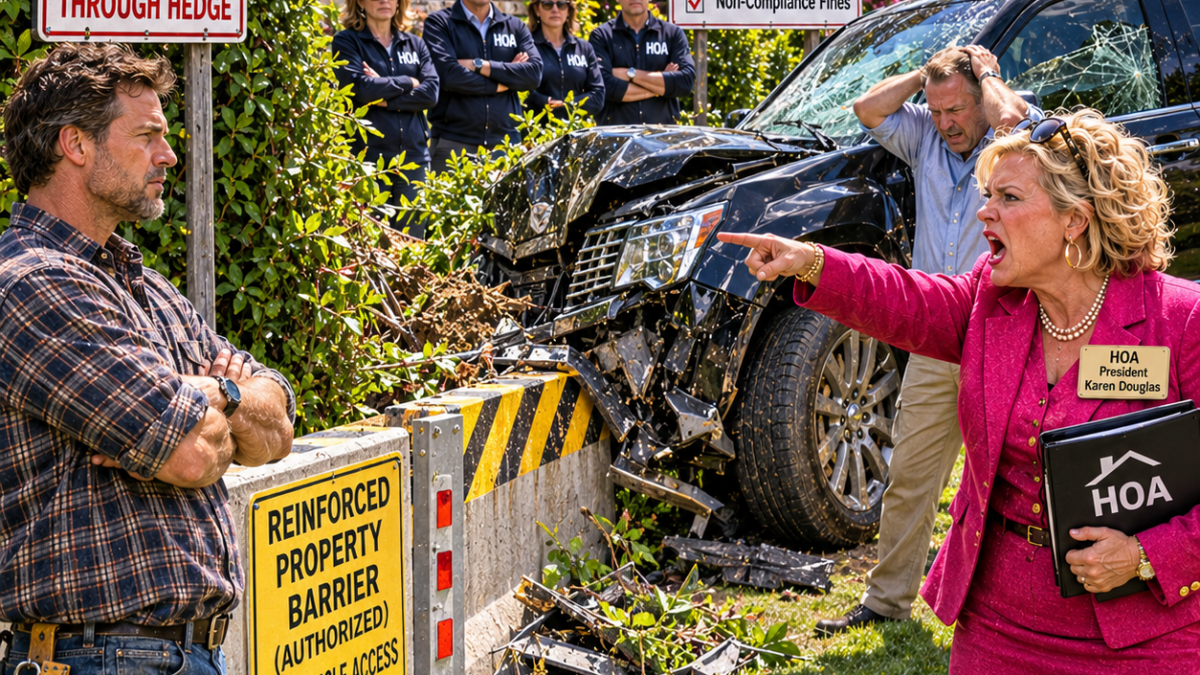
The fourth time somebody deliberately drove an SUV through the hedge I had spent fifteen years growing along the edge of my yard, I was standing less than thirty feet away with a wrench in my hand, and for the first time I saw enough through the darkness to know those crashes were not accidents.
For months, HOA president Karen Douglas had demanded that I remove that hedge because it supposedly violated “visual harmony,” and every time I refused, another violation notice appeared on my door while another section of those shrubs somehow ended up flattened beneath tire tracks.
What Karen didn’t know was that the broken piece of headlight I picked out of the dirt that night would lead me somewhere much bigger than an HOA landscaping feud—and before this was over, the people trying to push me out of my own home were going to discover that I had finally stopped treating their threats like neighborhood drama.
My name is Josh McKenzie.
I’m middle-aged, stubborn enough to repair things instead of replacing them, and stupidly sentimental about plants.
Especially that hedge.
I planted it shortly after buying my house.
Back then it was nothing more than a line of tiny shrubs struggling to survive their first summer.
Fifteen years later, it had become a thick green wall along the corner of my front property.
It blocked headlights.
Cut road noise.
Gave the yard privacy.
And, for reasons I still didn’t fully understand, made Karen Douglas furious.
Karen was president of our HOA and the sort of woman who could turn six inches of grass into a constitutional crisis.
She photographed garbage cans.
Measured lawn height.
Issued warnings about holiday decorations.
Once, according to my neighbor Miss Henderson, she complained that a Halloween pumpkin had an “aggressive facial expression.”
So when Karen first told me the hedge disrupted the neighborhood’s visual harmony, I laughed.
She didn’t.
“You should remove it, Josh.”
“Why?”
“It looks dated.”
“It’s a hedge.”
“It blocks sightlines.”
“For my living room.”
She narrowed her eyes.
“You could modernize.”
“I could also leave it alone.”
That should have ended the conversation.
Instead, the notices began.
**HEDGE HEIGHT NONCOMPLIANCE.**
Then:
**INCONSISTENT LANDSCAPE SHAPE.**
Then:
**POSSIBLE SAFETY OBSTRUCTION.**
I challenged every one.
The hedge was within the actual written rules.
Karen simply didn’t like losing.
Then, two weeks ago, I woke to a sound like somebody snapping a tree in half.
I ran outside.
One entire section of hedge had been flattened.
Tire tracks cut through the soil.
At first I assumed accident.
Delivery driver.
Teenager.
Somebody backing badly.
I repaired it.
Three nights later, another section went down.
Then again.
By the fourth strike, optimism was dead.
I asked neighbors.
Everyone suddenly became useless.
Mr. Dawson claimed he hadn’t noticed anything.
Mrs. Morales told me she didn’t want to become involved in “political matters.”
Miss Henderson, who normally knew every package delivered within five houses, lowered her voice.
“They come at strange hours, dear.”
“They?”
She immediately regretted saying it.
“Who?”
“I don’t know.”
Then she disappeared into her house.
So I started watching.
Porch chair.
Coffee.
Living-room window.
Garage.
I became a one-man neighborhood surveillance operation with no clue what I was doing.
Whoever was driving that SUV seemed to know when I looked away.
One evening I spent hours outside repairing my truck.
I stepped inside for less than two minutes to grab another wrench.
As I returned, I heard an engine accelerate.
Headlights swung toward my property.
A large black SUV left the street deliberately, crossed the edge of my lawn, and slammed straight through the hedge.
Branches exploded.
The vehicle backed out immediately.
For half a second, it stopped.
And through the side window I saw the driver’s silhouette.
Broad shoulders.
A man.
Not Karen.
Then the SUV disappeared.
I ran toward the damage.
My hedge was destroyed again.
But lying in the torn soil was a large broken piece of headlight housing.
I picked it up.
And something inside me went strangely calm.
Because Karen had spent months telling me the hedge was the problem.
Someone else had spent weeks trying to destroy it.
Now, finally, they had left me something I could trace.
I walked inside, placed the headlight fragment on my kitchen table, opened every HOA notice Karen had sent me, and began laying the papers side by side.
For the first time, I stopped asking why Karen hated my hedge.
I started asking what she needed to happen after it was gone.
PART 2
I didn’t sleep much.
Every time I closed my eyes, I heard that crunch again.
Not because losing a hedge was some great tragedy.
Plants grow back.
What bothered me was intent.
Someone had waited.
Watched.
Accelerated.
Then reversed and left.
That wasn’t careless driving.
That was a decision.
At 2:00 in the morning, I sat at my kitchen table with the broken headlight casing under the pendant light.
Black plastic.
A partial manufacturer stamp.
One mounting tab still attached.
I turned it over.
Then looked at the HOA notices.
Karen’s handwriting wasn’t on them.
Of course not.
Everything came through association letterhead.
But every complaint began shortly after one of our conversations.
The pattern was obvious.
First she asked nicely.
Then she warned.
Then she fined.
Then somebody started driving through the thing she wanted gone.
Coincidence had run out of oxygen.
—
The next morning, I called Dave.
Dave owned an auto shop twenty minutes outside town and knew vehicles the way doctors know bones.
I walked in holding the headlight fragment inside a grocery bag.
He looked up from behind the counter.
“What’d you break?”
“Not mine.”
“That sounded ominous.”
I handed it over.
He examined the plastic.
Turned it.
Read the markings.
“Large SUV.”
“What kind?”
He named the manufacturer and narrowed it to a handful of models and production years.
“Anything unusual?”
“Reinforced front trim.”
He rubbed the broken edge.
“Whoever hit something wasn’t doing parking-lot speed.”
“No.”
“Why?”
“Hedge.”
Dave stared.
“You brought me forensic shrubbery evidence?”
“Basically.”
He laughed.
Then his expression shifted.
“Funny thing.”
“What?”
“One of these came in this morning.”
My pulse jumped.
“Same model?”
“Same generation.”
“Front-end damage?”
“Lots of it.”
I stared.
“Who brought it?”
Dave hesitated.
That was answer enough.
“Karen?”
“Her husband.”
Richard Douglas.
Of course.
—
Richard was exactly the silhouette I’d seen.
Big shoulders.
Always drove the HOA’s black SUV.
The kind of man who spent barbecues talking about horsepower whether anyone had asked or not.
I kept my voice calm.
“Did he say what happened?”
“Hit some landscaping.”
Dave’s eyebrows rose.
“His words.”
“Anything else?”
Dave glanced toward the shop bays.
“He was angry.”
“About me?”
“Not directly.”
He lowered his voice.
“Karen called while he was here.”
“What’d she say?”
“Didn’t hear everything.”
“Something about Langford.”
That name meant nothing for about three seconds.
Then it clicked.
Paul Langford.
Developer.
His company had bought several older properties near our neighborhood over the past few years.
Demolished them.
Built expensive townhomes.
I had read about him because one of his projects had triggered a fight over traffic and zoning.
Dave continued.
“Karen said something like, ‘The lot needs to be cleared before the deadline.’”
My stomach tightened.
“My lot?”
“Couldn’t swear to it.”
“Then she said, ‘Josh won’t budge.’”
That part he remembered clearly.
I took the headlight piece back.
Suddenly my hedge felt very small.
—
I drove home slowly.
At every stoplight, one thought repeated.
**The lot needs to be cleared.**
Not:
The hedge needs trimming.
Not:
Josh needs to follow HOA guidelines.
The lot.
My lot.
I parked.
Walked straight past the damaged shrubs.
Went inside.
Opened my computer.
Then searched everything I could legally access about Langford Development.
Public zoning applications.
Property purchases.
Planning-board agendas.
Corporate filings.
News articles.
Nothing immediately connected him to my house.
But something connected him to Karen.
An HOA newsletter from six months earlier thanked Langford Development for sponsoring neighborhood beautification.
Then another document showed Karen serving on a redevelopment advisory committee.
That did not prove conspiracy.
It proved a relationship.
Enough to make me cautious.
Not enough to accuse anyone publicly.
I called an attorney.
That was the first smart decision I made.
—
Her name was Ellen Carter.
She handled real-estate disputes.
I told her everything.
Karen’s demands.
Violation notices.
Repeated hedge collisions.
The headlight fragment.
Richard’s SUV.
Langford.
She listened without interrupting.
Then asked:
“What are you planning?”
“Protecting the hedge.”
“How?”
I told her what my angrier brain had been imagining.
She stopped me immediately.
“No hidden hazards.”
“I wasn’t—”
“Josh.”
“Fine.”
“If somebody is deliberately driving through your landscaping, you still don’t conceal something designed to injure the driver.”
I leaned back.
“So I just let them keep destroying it?”
“No.”
“Then what?”
“Use ordinary property protection.”
She started counting.
“Cameras.”
“Lighting.”
“Police reports.”
“Insurance claims.”
“Visible landscape barriers.”
“Code-compliant bollards if local rules allow.”
“Large decorative stones properly placed.”
“Reinforced fencing where permitted.”
“But nothing hidden.”
“Nothing sharp.”
“Nothing designed as a booby trap.”
I sighed.
“That is much less cinematic.”
“It is much more defensible in court.”
That was the sentence that convinced me.
—
I filed a property-damage report.
Then hired a landscape contractor.
Not because I wanted someone to build a weapon.
Because I wanted that corner of my property protected.
We checked the setback.
Utility locations.
Visibility requirements.
Association rules.
Municipal requirements.
Everything.
Behind the hedge line—but clearly visible from my property and marked with small reflective indicators—we installed a short, legal reinforced landscape barrier using heavy decorative stone and approved protective posts.
It wasn’t unusual.
People use similar barriers to protect mailboxes, utility equipment, gardens, and corners where vehicles leave the roadway.
The hedge itself went back in front after repair.
But anyone approaching normally from the street could see there was now something substantial behind the greenery.
Someone driving where cars belonged would never touch it.
Someone deliberately crossing my lawn?
Different story.
I installed two new cameras.
Then waited.
—
Karen noticed the work.
Of course.
She appeared that afternoon.
Clipboard.
Sunglasses.
Displeasure.
“What are those?”
“Landscaping.”
“They look like barriers.”
“Excellent observation.”
“Are they HOA approved?”
“They comply with the actual rules.”
“I didn’t approve them.”
“You don’t personally approve my yard.”
She lowered her sunglasses.
“Josh.”
“Yes?”
“You are creating unnecessary conflict.”
I almost laughed.
Instead:
“Karen, someone has driven through my hedge four times.”
“Perhaps that tells you something.”
“It tells me I need to protect my property.”
“It tells you the hedge doesn’t belong there.”
There.
She said it again.
Like the hedge had caused the collision.
I stared at her.
“Do you hear yourself?”
She stiffened.
“The board has concerns.”
“Then have the board contact me formally.”
“This is formal.”
“No.”
I pointed at her clipboard.
“This is you standing in my yard again.”
She looked down.
Her shoes were several feet past my property line.
She stepped backward.
I smiled.
“Progress.”
She left.
—
For four nights, nothing happened.
Five.
Six.
I almost convinced myself the visible barrier had ended it.
Then, at 2:11 a.m. on the seventh night, a camera alert woke me.
Vehicle detected.
I sat up.
Grabbed my phone.
Black SUV.
Moving slowly.
It stopped near my property.
Lights went off for several seconds.
Then on again.
I was fully awake now.
The SUV backed up.
Paused.
Then accelerated.
Exactly like before.
Across the curb.
Across my lawn.
Straight toward the hedge.
I remember whispering:
“Don’t.”
Not because I wanted to protect Richard’s SUV.
Because suddenly the whole situation felt insane.
He could see the reflective markers.
He had to know something had changed.
He hit the hedge anyway.
Branches folded.
Then came a violent metallic impact.
The front of the SUV stopped almost instantly against the legal landscape barrier.
The rear lifted slightly.
Dropped.
Airbags deployed.
Horn blared.
For two seconds, I couldn’t move.
Then I called emergency services.
Not laughed.
Not celebrated.
Called.
—
Richard climbed out on his own.
Shaken.
Holding one wrist.
Conscious.
No serious visible injury.
Thank God.
I stepped onto the porch but stayed back.
“What the hell did you do?”
He screamed.
“I called for help.”
“To my car!”
“You drove it into my yard.”
“There’s something in there!”
“Yes.”
“A legal landscape barrier.”
“You trapped me!”
“No.”
“The markers are visible.”
“The barrier was installed by a contractor.”
“You left the road.”
“You crossed the lawn.”
“You drove through the hedge.”
He stared at me.
Then realized the cameras were pointed directly at us.
His anger changed.
Fear.
That was interesting.
—
Karen arrived before the tow truck.
Slippers.
Pink robe under a coat.
Hair unfinished.
She ran toward Richard.
“Are you okay?”
“I’m fine.”
Then she looked at the SUV.
Crushed front end.
Broken suspension.
Airbags.
The car wasn’t literally folded in half like the exaggerated source version would later claim.
But it was badly damaged.
Probably totaled.
Karen turned toward me.
“You did this.”
“No.”
“You built that thing because you knew.”
“Yes.”
Her eyes widened.
“Yes?”
“I built a barrier because someone kept driving through my property.”
“You knew Richard would hit it.”
“I knew whoever kept hitting my hedge might try again.”
“That is a trap.”
“No.”
Ellen’s words stayed in my head.
I kept my voice calm.
“It is visible.”
“It is legal.”
“It is entirely on my property.”
“And your husband left the road intentionally.”
Richard shouted:
“You can’t prove that.”
I looked toward the camera.
“Yes.”
“I can.”
Silence.
—
Police arrived.
Paramedics checked Richard.
He refused transport after evaluation.
The responding officer reviewed the scene.
Tire marks.
Curb crossing.
Damaged hedge.
Barrier.
Reflective markers.
Camera placement.
Then the video.
Black SUV.
Pause.
Reverse.
Acceleration.
Straight across the lawn.
The officer watched twice.
Then looked at Richard.
“Why’d you drive off the road?”
Richard said nothing.
Karen answered:
“He lost control.”
The officer looked at the footage again.
“After stopping and backing up?”
Karen’s jaw tightened.
Richard muttered:
“Road was slick.”
“It isn’t raining.”
Silence.
The officer asked me:
“Prior incidents?”
I handed him report numbers.
Four.
Photographs.
Headlight fragments.
Repair estimates.
HOA notices.
He looked from the folder to Richard.
“This has been ongoing?”
“Yes.”
Karen said:
“This is an HOA matter.”
The officer replied:
“No.”
He looked around my destroyed landscaping.
“This is a property-damage matter.”
That was the beginning of everything falling apart.
—
The insurance company called the next morning.
Then Richard’s insurer.
Then mine.
I gave them video.
Contractor paperwork.
Permits.
Invoices.
Photographs showing the barrier before impact.
Reflective markers.
Everything.
Ellen handled the rest.
Meanwhile, Dave confirmed the SUV from his shop history.
The earlier damage matched the broken headlight piece I’d recovered.
Not courtroom-level final proof by itself.
But combined with the video from the latest incident and the pattern?
It mattered.
Richard stopped pretending he had never driven into the hedge.
His explanation changed to:
“Trying to demonstrate a safety concern.”
That may have been worse.
—
Then I went back to Langford.
Not physically.
Records.
I called my friend Joel.
Joel worked in cybersecurity.
The legal kind.
Which meant the first thing he said was:
“No hacking.”
“I wasn’t going to ask.”
“You sounded like you were going to ask.”
“I need public-record research.”
“Good.”
“On Paul Langford.”
“How deep?”
“Everything we can lawfully access.”
“Corporate records?”
“Yes.”
“Property filings?”
“Yes.”
“Campaign and public disclosures?”
“Yes.”
“Planning applications?”
“Yes.”
“No stolen passwords.”
“No.”
“No breaking into email.”
“No.”
“I’m disappointed.”
“You’re a professional.”
“Unfortunately.”
—
What we found changed the story.
Six months before Karen’s first hedge complaint, a Langford-affiliated development company had submitted preliminary plans involving redevelopment near the edge of our street.
My parcel sat in the path of the preferred design.
Not the only possible design.
But the cleanest.
Several neighboring parcels had already received offers.
Mine had too.
I remembered tossing the letter.
Generic.
“Interested buyer.”
No company name I recognized.
I had said no.
Then the HOA complaints began.
Joel found public financial ties between Langford-sponsored community projects and several HOAs.
Nothing inherently illegal there.
Developers sponsor things.
But certain planning records raised questions.
There were inconsistencies.
Permits referenced before approval.
Boundary assumptions that didn’t match recorded property maps.
And one redevelopment presentation described several privately owned lots as:
**EXPECTED ACQUISITIONS.**
Mine was one.
Expected.
As if my decision had already been made.
—
I confronted Karen carefully.
Not with accusations I couldn’t prove.
With questions.
She stood near the mailbox cluster.
“Karen.”
She jumped.
“Josh.”
“Do you know Paul Langford?”
Her face answered before her mouth did.
“Yes.”
“How well?”
“He works with the community.”
“Why is my parcel listed in preliminary development plans?”
Silence.
“Karen.”
She looked around.
“It’s complicated.”
“No.”
“It’s really not.”
I held up a copy.
“My property.”
“His project.”
“Your campaign against my hedge.”
“Richard repeatedly driving onto my yard.”
“You tell me how those fit together.”
Her shoulders dropped.
For the first time, Karen Douglas stopped performing.
“Langford wants this end of the street.”
“How long?”
“Months.”
“And you’re helping him.”
“He promised investment.”
“In the neighborhood?”
“Yes.”
“What else?”
She didn’t answer.
“Karen.”
“Board funding.”
“Upgrades.”
“Clubhouse improvements.”
I stared.
“Anything for you?”
She looked away.
That was enough.
—
“Why the hedge?”
“He thought if your frontage looked damaged…”
She stopped.
I felt cold.
“What?”
“He thought pressure would make you sell.”
“Pressure.”
“Yes.”
“Violation notices?”
She nodded.
“Property complaints?”
Another nod.
“Richard?”
Her eyes filled.
“He said it would just be minor damage.”
I laughed once.
There was nothing funny in it.
“Minor?”
“He wasn’t supposed to keep—”
“You let your husband repeatedly drive a two-ton vehicle across my yard?”
“Langford kept pushing.”
“And you kept saying yes.”
She looked frightened now.
“Josh, you don’t understand him.”
“I’m starting to.”
“He has investors.”
“Connections.”
“Attorneys.”
“People at city hall.”
I stepped closer.
“Does he have my deed?”
She shook her head.
“Then he doesn’t have my house.”
Karen whispered:
“He’s coming to talk to you.”
“When?”
“Tonight.”
I nodded.
“Good.”
Her head snapped up.
“Good?”
“Yes.”
“I’ve been waiting to hear what he thinks gives him the right to plan around property he doesn’t own.”
—
Paul Langford arrived at 9:47.
Suit.
No tie.
No car visible.
He walked up my driveway carrying an envelope.
“Mr. McKenzie.”
“Mr. Langford.”
He offered a hand.
I didn’t take it.
He looked at the hedge.
New shrubs.
Damage repairs.
Barrier behind it.
Then at me.
“I understand you’ve had an unfortunate series of incidents.”
“You mean the SUV?”
“Yes.”
“Richard’s SUV.”
He barely reacted.
Interesting.
“I came to discuss a solution.”
“Replacing my hedge?”
“Something more comprehensive.”
He offered the envelope.
“Three times estimated market value.”
I read the number.
Generous.
Very generous.
Still no.
“Not interested.”
He seemed genuinely surprised.
“Mr. McKenzie.”
“Josh is fine.”
“Josh.”
He spoke as though explaining economics to a child.
“Your home is one structure on a parcel that could become part of a larger redevelopment.”
“Your resistance delays hundreds of millions of dollars in investment.”
“Sounds expensive.”
“It is.”
“Not my problem.”
He stared.
“You would be compensated extremely well.”
“I like my house.”
“Houses can be replaced.”
“Not memories.”
His patience thinned.
“You are being sentimental.”
“You are being entitled.”
That hit.
His eyes changed.
—
“Projects like this move forward.”
He said it quietly.
“People who cooperate benefit.”
“And people who don’t?”
“Sometimes circumstances become uncomfortable.”
There.
Not quite a direct threat.
Close.
I kept my face neutral.
“Like repeated HOA fines?”
“I don’t manage your HOA.”
“Like property damage?”
“I would be careful making accusations.”
“Good advice.”
He stepped nearer.
“This offer will not remain open forever.”
“Then I suggest you don’t waste paper printing another one.”
For the first time, anger showed.
“You should think about your future.”
I looked at my porch camera.
Then at him.
“I am.”
He followed my eyes.
Saw the camera.
His expression froze for half a second.
Good.
“Good night, Mr. Langford.”
He left.
—
I saved the video in three places.
Then called Ellen.
She watched it.
“Not enough by itself to establish criminal conduct.”
“I know.”
“But useful context.”
“I know.”
“Do not confront him again.”
“Fine.”
“Josh.”
“What?”
“If your garage gets broken into, call police.”
“Why did you say that specifically?”
“Because escalation patterns are predictable.”
I wish she hadn’t been right.
—
Two days later, a city-looking notice appeared on my door.
It demanded immediate hedge removal.
Ellen checked it.
Something was wrong.
No valid citation number.
No proper inspection record.
Wrong department language.
We sent it to the city.
They confirmed they had not issued it.
Then another HOA notice.
Then another.
My truck tire was cut overnight.
Camera angle missed whoever did it.
I filed another report.
Then I came home to find the side garage door forced.
Tools on the floor.
Drawers opened.
Papers scattered.
A brick sat on my workbench.
Note attached.
**LAST CHANCE.**
All the humor left me.
I called police.
Then Ellen.
Then Joel.
Not for revenge.
For organization.
—
We collected only lawful material.
Public records.
My own recordings.
Police reports.
HOA letters.
Property-damage history.
Langford’s buyout offer.
Planning documents.
City confirmation the fake notice had not come from them.
The redevelopment maps.
Evidence of financial relationships.
And Karen’s eventual statement through counsel.
The more legitimate authorities looked, the less this resembled a hedge feud.
I stopped thinking about exposing Langford on social media.
That would have been satisfying.
It also could have compromised something larger.
Instead, Ellen helped route records to investigators and appropriate public agencies.
A local investigative reporter eventually learned about the development dispute through public proceedings and began asking questions.
When she contacted me, I gave her documents already safe to share.
Nothing stolen.
Nothing hacked.
Nothing speculative.
The story broke anyway.
It didn’t need embellishment.
—
Headline:
**DEVELOPER’S LAND ACQUISITION TACTICS UNDER SCRUTINY AFTER HOA PROPERTY-DAMAGE DISPUTE**
Then:
**CITY REVIEWS REDEVELOPMENT APPLICATIONS FOLLOWING PRIVATE-PROPERTY COMPLAINTS**
Then:
**QUESTIONS RAISED OVER HOA-DEVELOPER RELATIONSHIPS**
News vans appeared.
Neighbors suddenly remembered how to speak.
Mr. Dawson:
“I always thought the SUV was suspicious.”
Really?
Mrs. Morales:
“I didn’t want to get involved.”
Understandable.
Miss Henderson?
She walked directly to a reporter.
“I told Josh there were people coming at odd hours.”
Legend.
—
Karen arrived at my house around six.
She stopped at the sidewalk.
That was new.
“Josh.”
I walked outside.
She looked exhausted.
No clipboard.
No HOA blazer.
“You gave them everything.”
“I gave investigators what I had.”
“Langford is furious.”
“That sounds like a Langford problem.”
“He’s blaming me.”
“You helped him.”
She flinched.
“I know.”
Then:
“I didn’t think it would become this.”
“What did you think repeated property damage would become?”
She sat on the edge of my low retaining wall.
“I thought you’d sell.”
I stared.
“I thought you’d get tired.”
“Decide it wasn’t worth fighting.”
“And then?”
“Langford gets the lot.”
“The HOA gets funding.”
“And you?”
She looked down.
“There were promises.”
“What kind?”
“Consulting.”
“Board influence.”
“Money?”
She didn’t answer.
I didn’t need the answer.
She began crying.
Not theatrically.
Quietly.
For months, I had imagined Karen finally breaking.
I thought it would feel great.
It didn’t.
—
“I’m sorry.”
She said it so softly I nearly missed it.
“For what part?”
“All of it.”
“That’s a lot.”
“I know.”
“Richard?”
“He thought he was helping me.”
“By repeatedly driving through my hedge?”
Her face tightened.
“Langford told us you were obstructing something that would benefit everyone.”
“So that made it okay?”
“No.”
She shook her head.
“No.”
“It didn’t.”
Then she looked up.
“He scared me too.”
I believed that.
But fear doesn’t erase responsibility.
I said:
“You could have told me.”
“I know.”
“You could have gone to police.”
“I know.”
“You could have said no.”
She closed her eyes.
“I know.”
That was enough.
—
The official investigation expanded.
Financial records.
Development approvals.
Public officials.
Business relationships.
I wasn’t involved in every part.
And I didn’t pretend to know facts investigators hadn’t established.
What became public was serious enough.
Fraud-related allegations.
Bribery-related allegations.
Harassment concerns.
Questions about false or manipulated permit materials.
Eventually Langford was arrested on multiple charges arising from the broader investigation.
That headline appeared on my phone one afternoon.
I read it twice.
Then placed the phone on the table.
No victory dance.
No beer.
No triumphant call to Dave.
Just relief.
—
The HOA fell apart quickly after that.
Board members resigned.
Emergency meetings.
Fines related to Karen’s personal campaign were voided.
Residents demanded financial records.
Some wanted the HOA dissolved entirely.
Others wanted replacement governance.
What happened legally to the organization became more complicated than one dramatic vote, but the old structure—Karen’s structure—was finished.
Karen resigned.
Then came to my house one morning.
She stopped at the property line.
Didn’t cross.
That alone told me she’d changed something.
“Josh.”
“Morning.”
“I came to apologize properly.”
I waited.
“What I did was wrong.”
She looked at the hedge.
“I used the HOA to pressure you.”
“I let Langford convince me your property was an obstacle instead of your home.”
“I allowed Richard to do things I should have stopped.”
“I sent notices I knew weren’t really about the hedge.”
She swallowed.
“And I made you feel unsafe in your own house.”
That line mattered most.
I nodded.
“Yes.”
“I’m sorry.”
For once, I didn’t have a joke.
—
She continued.
“I don’t expect forgiveness.”
“Good.”
A tiny smile appeared.
“That was honest.”
“I’m trying.”
I looked toward the repaired hedge.
“Why did you hate it so much?”
She laughed weakly.
“I didn’t.”
I already knew.
“But hearing her say it still hit me.
“Langford wanted the frontage open.”
“For survey visibility.”
“Access.”
“He said it made the property look less integrated into the redevelopment plan.”
“So the entire aesthetic argument…”
“Was mostly manufactured.”
I shook my head.
Fifteen years of hedge.
Months of notices.
Four collisions.
All because somebody looked at my home on a site plan and saw a missing puzzle piece.
Karen said:
“I’m starting over.”
“Good.”
She turned.
Then stopped.
“For what it’s worth?”
“What?”
“Your hedge always looked fine.”
I laughed.
“Get off my property.”
She actually smiled.
Then left.
—
I replanted the damaged sections.
Carefully.
No hidden hazards.
The legal protective barrier remained behind them.
Visible.
Marked.
Boring.
Exactly what Ellen wanted.
I watered each new shrub.
Miss Henderson wandered over.
“Looks good.”
“Thank you.”
“Think it’ll survive?”
“If another SUV drives through this one, I’m moving into a lighthouse.”
She considered.
“HOAs there?”
“Probably.”
“Then you’re doomed.”
I laughed.
—
For the first time in months, I slept through the night.
No revving engines.
No camera alerts.
No violation notices.
No black SUV.
The quiet felt strange.
Then wonderful.
—
People began treating me differently.
That bothered me.
Neighbors who had avoided eye contact now wanted to shake my hand.
A man down the block said:
“You took down Langford.”
“No.”
He looked confused.
“Investigators did.”
“But you exposed him.”
“I documented what happened to me.”
There was a difference.
I didn’t want to become some folk hero whose lesson was:
Fight everybody.
The lesson was much less exciting.
Keep records.
Use legitimate channels.
Don’t let confidence intimidate you into surrendering facts.
And don’t secretly build something intended to injure a driver no matter how angry you are.
That last one would never make the viral versions.
Still true.
—
Dave called.
“How’s the hedge?”
“Alive.”
“How’s Richard?”
“Insurance nightmare.”
“I figured.”
“He admitted the earlier impacts.”
Dave whistled.
“All of them?”
“Enough.”
“What about his SUV?”
“Total loss.”
“Good.”
“Dave.”
“What?”
“I’m supposed to be emotionally evolved now.”
“Sorry.”
He waited.
“Still good, though.”
I laughed.
“Little bit.”
—
Richard eventually sent me a written apology through attorneys.
It wasn’t warm.
It didn’t need to be.
He acknowledged responsibility for repeated damage.
Insurance and restitution handled the documented property losses.
I didn’t ask for his life destroyed.
I wanted repairs.
Legal fees where appropriate.
An end.
That was enough.
—
Joel visited one weekend.
He stared at the rebuilt hedge.
“So this caused everything?”
“No.”
“This revealed everything.”
“Different.”
He touched one leaf.
“Looks innocent.”
“That’s what they want you to think.”
He laughed.
Then:
“You know what’s funny?”
“What?”
“Langford probably could have redesigned around your property.”
I knew.
Public planning documents eventually showed alternatives.
More expensive.
Less convenient.
Still possible.
That made the whole campaign more absurd.
He didn’t need my house.
He wanted the cheapest version of his plan.
And people around him had started treating my refusal as wrongdoing because my rights increased their costs.
That’s entitlement at scale.
Not:
I want your hedge gone.
But:
Your no is expensive, so your no must be illegitimate.
—
The neighborhood changed after the scandal.
People challenged HOA notices.
Not rebelliously.
Intelligently.
“Show me the covenant.”
“What’s the appeal process?”
“Was this actually approved?”
Meetings became uncomfortable for a while.
Then healthier.
Karen’s replacement, Michael Torres, was painfully boring.
Excellent quality in an HOA president.
He opened his first meeting with:
“We will enforce rules that actually exist.”
People applauded.
I nearly cried.
—
One afternoon Michael knocked on my door.
Properly.
Didn’t enter the yard beyond the walkway.
“Josh.”
“Michael.”
“Can I ask about the barrier?”
I laughed.
“Here we go.”
“No violation.”
“Then why?”
“We’re updating the safety guidance.”
“After what happened, the board wants to encourage protective landscaping on the curve.”
I stared.
“You’re recommending barriers?”
“Visible, code-compliant ones.”
“Yes.”
“Not hidden traps.”
“No.”
“Professionally installed.”
“Yes.”
He smiled.
“You accidentally started a safety policy.”
“That may be the least glamorous legacy imaginable.”
“Perfect for an HOA.”
I liked Michael.
—
The new hedge grew.
Slowly.
The first year it looked patchy.
The second year, better.
Five years later, most people couldn’t tell where the destroyed sections had been.
I could.
That’s how scars work.
—
Karen stayed in the neighborhood longer than I expected.
Quietly.
No board.
No clipboard.
She eventually sold her house and moved.
Before leaving, she taped a card to my mailbox.
I braced myself.
Old habits.
It said:
**Josh,**
**I’m starting over somewhere else. Thank you for standing your ground when I didn’t. I’m sorry for what I helped do to your home.**
**—Karen**
Short.
No excuses.
I kept it.
Not because we became friends.
We didn’t.
Because apologies matter most when they stop trying to negotiate the past.
—
Years later, someone told the hedge story at a barbecue.
Wrong, of course.
“Josh buried steel spikes and destroyed an SUV.”
I corrected him.
“No.”
He frowned.
“That’s what everybody says.”
“Everybody’s wrong.”
“What happened?”
“I installed a legal visible barrier after repeated vehicle damage.”
He looked disappointed.
“That’s less cool.”
“It’s also the reason I wasn’t the one arrested.”
People laughed.
Then I added:
“The real trap was the documentation.”
“What do you mean?”
“Karen and Langford thought nobody would connect the HOA notices, the property damage, the development plans, and the pressure campaign.”
“They assumed each thing would look small by itself.”
“But patterns become obvious when you put them in one folder.”
That was the part I wanted people to remember.
—
A broken headlight piece still sits in my garage.
Not as a trophy.
Evidence is useless once the case is over, but I couldn’t throw it away.
It reminds me of that night.
The moment I realized someone was willing to damage my property just to make my home easier to acquire.
Sometimes people don’t attack what they really want.
They attack the thing standing in front of it.
My hedge was never the point.
My right to say no was.
—
The developer wanted my land.
Karen wanted money and influence.
Richard wanted to help his wife.
The HOA wanted promised improvements.
Everyone had a reason.
None had permission.
That distinction carried me through the whole fight.
Reasons explain behavior.
They don’t automatically justify it.
—
One autumn evening, I sat outside with coffee.
The hedge had turned dark green in the fading light.
No tire marks.
No headlights.
No damage.
Miss Henderson’s porch light came on across the street.
She called:
“Josh!”
“What?”
“Hedge still there?”
I looked.
“Still there.”
“Miracle.”
I laughed.
She went inside.
—
I thought about the night Richard hit the barrier.
For a long time, that had been my favorite part.
The damaged SUV.
Karen speechless.
The tow truck driver trying not to laugh.
But with years behind me, it wasn’t anymore.
The best moment came much later.
A real-estate company sent a letter asking whether I would consider selling.
Normal offer.
Polite.
No pressure.
No threats.
I wrote:
**No, thank you.**
They replied:
**Understood. Please contact us if that changes.**
That was it.
No SUV.
No HOA campaign.
No fake notices.
No developer appearing at night.
Just no.
Respected.
I almost framed the letter.
—
That’s what the whole story had been missing.
Respect for no.
Karen heard no and created a violation.
Langford heard no and created pressure.
Richard heard no and kept driving.
Every escalation started with people believing my refusal was a problem to solve rather than a decision to respect.
—
The hedge stands today.
Tall.
Thick.
Probably too sentimental for a normal person.
I don’t care.
Sometimes I trim it myself.
Sometimes I hire somebody because my back has become less interested in justice and more interested in lumbar support.
The barrier behind it is still there.
Ordinary.
Visible.
Legal.
Not a trap.
Just protection.
No vehicle has touched it since.
Funny how accidents stop when the people causing them stop coming.
—
Michael once asked whether I wanted to join the HOA board.
I laughed so hard I had to sit down.
He waited.
“You done?”
“No.”
Another minute.
“Josh.”
“What?”
“You know the rules better than half the board.”
“That’s exactly why I know better than to join.”
He sighed.
“Can’t blame me for trying.”
“I can.”
—
Joel suggested turning the whole experience into a cybersecurity presentation.
“Social engineering.”
“How?”
“Pressure systems.”
“People exploiting authority.”
“Manipulated records.”
“Information asymmetry.”
I stared.
“You’re turning my hedge into corporate training?”
“Yes.”
“Do I get royalties?”
“No.”
“Then absolutely not.”
He did it anyway.
I got lunch.
Fair trade.
—
Dave kept the photograph of Richard’s totaled SUV on the shop wall for a while.
I made him remove it.
“Why?”
“Because he’s still a person.”
Dave looked at me.
“You’ve gotten soft.”
“Maybe.”
“He drove through your hedge four times.”
“I know.”
“You sure?”
“Yes.”
He took it down.
Then put up a photograph of a hedge.
“Better?”
“Much.”
The caption read:
**RESPECT LANDSCAPING.**
I allowed it.
—
The bigger Langford investigation lasted longer than the neighborhood gossip.
Courts and agencies move slowly.
Some allegations were proven.
Some changed.
Some disappeared.
That’s how real cases work.
I stopped following every headline.
Once my property was safe and my role was finished, obsession would have become another kind of prison.
The people responsible faced the systems designed to handle them.
I went back to living.
—
Karen’s apology changed something in me too.
Not enough to erase what she did.
But enough to complicate the villain version.
She had made choices.
Bad ones.
She also had been manipulated.
Both things could be true.
Fear doesn’t excuse becoming someone else’s weapon.
But understanding that helped me stop hating her.
Forgiveness?
Maybe partially.
Trust?
No.
Those aren’t the same.
—
One summer, a young couple moved into Karen’s old house.
Nice people.
They planted flowers Karen would have hated.
Orange.
Bright orange.
I complimented them.
The husband said:
“HOA okay with these?”
I looked toward Michael’s house.
“Ask the actual rules.”
He laughed.
“No Karen stories?”
“You’ve heard?”
“Every neighbor has a different version.”
“Believe the least exciting one.”
“What happened?”
“Property rights.”
He stared.
“That can’t be the least exciting version.”
“Trust me.”
—
The most emotional part happened on the fifteenth anniversary of my mother’s death.
She had helped me plant the original hedge.
I’d almost forgotten.
I found an old photograph.
Me younger.
Her holding a watering can.
Tiny shrubs behind us.
She had written on the back:
**Give them time. They’ll make the place feel like yours.**
I sat at my kitchen table for a long time.
Suddenly the hedge wasn’t funny.
It wasn’t HOA drama.
It was one of the last living things on the property we had built together.
Karen couldn’t have known that.
Langford certainly didn’t.
Richard didn’t.
But I did.
That’s why every impact felt personal in a way I hadn’t understood at first.
They weren’t just breaking landscaping.
They were damaging something attached to memory.
—
That evening I carried the photograph outside.
Stood beside the hedge.
The repaired sections had fully merged with the original growth.
No visible difference.
I touched one branch.
“Made it.”
Ridiculous thing to say to a hedge.
Still said it.
—
Maybe that’s why the final ending never felt like Langford’s arrest.
Or the HOA collapse.
Or Karen apologizing.
The satisfying ending was the hedge growing back.
Slow.
Uninterested in headlines.
Every year covering the scars a little more.
That’s how my peace came back too.
—
For a while, every engine after midnight woke me.
Then fewer.
Eventually none.
Every HOA letter made my stomach tighten.
Then the letters became ordinary meeting notices.
Every black SUV looked suspicious.
Then it was just a car.
Recovery from harassment is boring.
That’s good.
Boring means normal is returning.
—
One day Miss Henderson died.
Ninety-one.
Her daughter invited me to the memorial.
Afterward, she handed me an envelope.
“Mom wanted you to have this.”
Inside was a handwritten note.
**Josh,**
**I did know who was driving the SUV before you did. I was afraid to say because I saw Richard speaking with Langford and I didn’t want trouble at my age. I’m sorry I wasn’t braver. You were.**
I sat in my truck and cried.
Not because she’d withheld something.
Because I understood.
People like Langford gain power partly from making ordinary people afraid of becoming the next target.
Miss Henderson had protected herself.
I couldn’t blame her.
She had still warned me in the only way she could.
**They come at odd hours, dear.**
That sentence had pushed me to keep watching.
She had helped.
—
I put her note beside Karen’s.
Two very different apologies.
Both honest.
—
The neighborhood eventually planted a small tree near the corner where Miss Henderson used to sit.
No plaque about hedge wars.
Thank God.
Just her name.
I helped dig.
Michael brought a shovel.
Dave brought coffee.
Joel arrived late and contributed opinions.
Typical.
When the tree went in, I thought about everything that corner of the street had seen.
Threats.
Damage.
Fear.
Then neighbors planting something together.
Better ending.
—
People ask whether I regret not getting revenge the way the exaggerated story says I did.
Hidden steel.
Spikes.
A secret trap.
No.
Because if Richard had been seriously injured by something I deliberately concealed, the story would’ve become about me.
My anger.
My liability.
My decision.
The evidence against them would’ve been buried beneath what I had done.
Instead, the barrier was lawful.
Visible.
Documented.
Richard’s choice remained his choice.
That mattered.
—
The most satisfying payback wasn’t destroying the SUV.
Richard accomplished that himself.
The satisfying part was that every method they used depended on me becoming emotional.
Karen wanted me to explode at an HOA meeting.
Langford wanted me scared.
Richard wanted the damage to feel random.
They needed me confused enough to surrender.
Instead, I became organized.
That was the thing none of them planned for.
—
I didn’t win because I was tougher.
I won because I eventually stopped arguing with people who benefited from pretending not to understand.
I saved notices.
Pulled records.
Called professionals.
Used cameras.
Filed reports.
Asked questions.
Let facts accumulate.
A stack of boring documents did more damage to corruption than anything dramatic I could have built behind a hedge.
There is something deeply satisfying about that.
—
Years later, the city rejected the final version of Langford’s development proposal for our end of the street.
A different project was eventually built elsewhere.
No scandal.
No threats.
No forced acquisitions.
My house remained.
So did the hedge.
—
One evening I got another buyout offer.
Different developer.
Very high number.
I considered it.
Really considered it.
Not because anyone forced me.
Because life changes.
Maybe someday I’ll sell.
That possibility doesn’t betray what I fought for.
The point was never:
I must live here forever.
The point was:
The choice is mine.
If I sell tomorrow voluntarily, that proves the same thing I proved by refusing Langford.
Ownership includes the right to say yes.
And the right to say no.
—
I didn’t sell.
Not yet.
I made coffee.
Sat on the porch.
Looked at the hedge.
A bird landed inside it.
Completely indifferent to zoning policy.
I envied him.
—
The sun dropped behind the roofs.
Streetlights came on.
A black SUV turned onto the block.
For a fraction of a second, some old reflex tightened inside me.
Then the vehicle slowed.
Turn signal.
Pulled into the young couple’s driveway.
Groceries.
Kids.
Normal life.
I smiled.
That was when I knew the war was truly gone.
Not when the people left.
When the fear left.
—
I walked down to the hedge.
The leaves were thick enough that you could barely see the protective posts behind them.
Not concealed as a trap.
Just absorbed into years of growth.
I remembered holding that broken headlight fragment at two in the morning.
Thinking:
**This means war.**
If I could speak to that version of myself, I’d tell him something different.
It means document everything.
War destroys more than enemies.
Evidence is cheaper.
—
I touched one of the branches.
Fifteen years before all of this, my mother had helped me plant the first shrubs.
Years after the chaos, new growth had covered every broken place.
There was something beautiful about that.
People think revenge means leaving the other person damaged.
Sometimes the better revenge is making sure what they tried to destroy survives them.
Karen’s notices disappeared.
Langford’s plans collapsed.
Richard’s SUV went to a salvage yard.
The HOA changed.
Miss Henderson was gone.
My mother had been gone even longer.
But the hedge?
Still there.
Green.
Uneven in places.
Alive.
Home.
—
And that’s how I finally understood what the fight had actually been about.
Not shrubs.
Not cars.
Not HOAs.
Not even Paul Langford.
It was about the right to decide what happens on the piece of earth you call home.
They tried annoyance.
Then pressure.
Then damage.
Then fear.
Then money.
Then threats.
Every stage asked me the same question in a different voice:
**Will you give up your choice if we make keeping it uncomfortable enough?**
My answer remained no.
Eventually, reality caught up with them.
—
I went inside as the sky turned dark.
No cameras open on my phone.
No stakeout chair.
No evidence folder on the table.
Just dinner.
Television.
Normal things.
Before closing the curtain, I looked once more at the hedge.
Still standing.
That was enough.
Because Karen Douglas once believed that if she destroyed my hedge often enough, eventually I would remove it myself.
Paul Langford believed that if enough people pressured me, eventually I would sell.
Richard believed another midnight run through my yard would disappear like all the others.
They were all wrong for the same reason.
They thought persistence belonged only to them.
It didn’t.
And in the end, I never needed a hidden trap to destroy their plan.
All I needed was a visible boundary, a camera, a stack of records, and enough patience to let them keep proving exactly why that boundary mattered.
The hedge grew back.
The SUV didn’t.
Their development scheme never reached my property.
And my home remained exactly where it had always been—
mine.
[END OF STORY]








