𝗙𝗨𝗟𝗟 𝗦𝗧𝗢𝗥𝗬 Two Employees Saw My Gray Hoodie and Decided I Was the Kind of Customer They Could Cheat, Humiliate, and Call the Police On
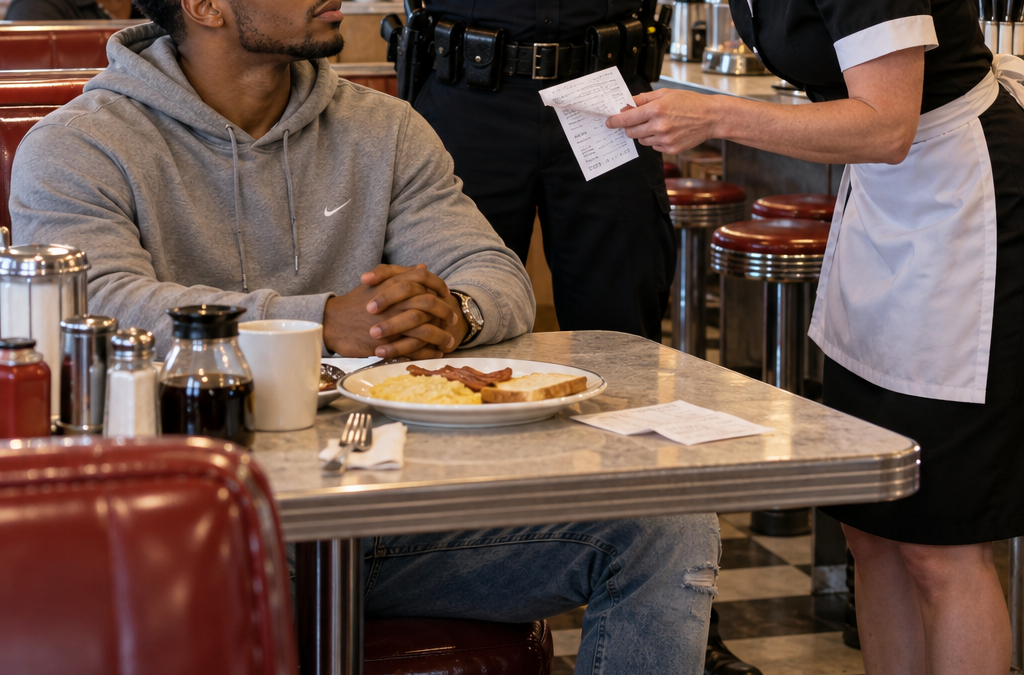
𝗣𝗔𝗥𝗧 𝟮
The Golden Griddle in Decatur sat near a working-class neighborhood east of Atlanta.
It was one of our busier Georgia locations.
Saturday breakfast revenue was consistently strong.
Customer complaints were slightly above average, but nothing in the reports suggested a crisis.
I parked at 9:15.
The morning rush was beginning to ease.
The lot remained half full.
I stayed in the Civic for about thirty seconds and looked through the front windows.
Checkered black-and-white tile.
Red vinyl booths.
Chrome trim.
A jukebox in the corner.
Motown playing softly.
I had chosen those details myself.
When I designed the original Golden Griddle, I wanted it to feel like my grandmother’s kitchen had been expanded into a diner.
Nothing fancy.
Nothing intimidating.
Warm food.
Warm light.
A place where a mechanic, a lawyer, a construction worker, a teacher, and a family with three noisy children could all sit in adjoining booths and feel equally entitled to be there.
I stepped from the Civic.
Warm syrup and coffee drifted from the kitchen exhaust.
The bell over the door chimed when I entered.
Inside, a Black family of four sat by the window.
Two white college students shared pancakes near the jukebox.
A Latino couple stood with a toddler near the register.
Behind the counter were two employees I recognized from personnel files.
Craig Wilson.
Late twenties.
Cashier and acting shift manager.
And Brenda Taylor.
Early thirties.
Front counter associate.
Craig leaned against the wall with one earbud in, scrolling on his phone.
His uniform shirt hung untucked.
He chewed gum with his mouth open.
Brenda leaned toward him.
She whispered something.
They laughed.
The Latino couple waited.
Ten seconds.
Twenty.
Thirty.
The husband finally cleared his throat.
Brenda looked toward him as though he had interrupted something important.
“What do you want?”
No welcome.
No smile.
No eye contact.
The man gave their order quietly.
His wife kept one hand on their toddler’s shoulder.
The whole interaction lasted less than a minute.
Then the door opened behind me.
A young white couple walked in.
Craig removed his earbud immediately.
His back straightened.
A broad smile appeared.
“Hey, welcome to Golden Griddle. What are y’all in the mood for?”
I stopped just inside the entrance.
Same employees.
Same counter.
Same minute.
Different customers.
Completely different restaurant.
Through the kitchen pass-through, I noticed Lorraine Moore.
Fifty-five.
Morning cook.
Six years with Golden Griddle.
I remembered her file because of her longevity.
She worked the grill without stopping, but when Craig greeted the white couple, Lorraine looked through the opening toward him.
Her mouth tightened.
Then she returned to the eggs.
I walked toward the counter.
Craig noticed me.
He didn’t remove the earbud this time.
His nose wrinkled slightly.
Then he looked at Brenda.
“Oh my God,” he said.
Not quietly.
“You smell that?”
Brenda looked at me.
Craig kept staring at his phone.
“Something walked in off the street.”
Brenda chuckled.
My body camera captured both voices clearly.
I stopped at the register.
For half a second, I considered whether the inspection had already told me enough.
It hadn’t.
People like Craig often behaved differently once challenged.
I wanted to know how far the behavior went.
Brenda folded her arms.
“Sir, this isn’t a charity.”
I said nothing.
“You got money, or are you just browsing?”
I looked at the menu above her.
“Southern breakfast platter.”
Neither of them moved.
“Scrambled eggs. Extra toast, please.”
Craig finally looked at me.
“Fourteen ninety-nine.”
Then his eyes traveled down my hoodie.
“You sure?”
I reached into my pocket and placed a twenty-dollar bill on the counter.
“Yes.”
Brenda smirked.
Craig picked up the bill.
“Got to check these days.”
He looked at Brenda.
“You never know with some people.”
I kept my expression neutral.
The biggest mistake an undercover observer can make is reacting too early.
One insult can be denied.
A pattern is harder.
Craig punched my order into the register.
I watched the screen.
Breakfast platter.
$14.99.
Tax.
Then another line appeared.
SPECIAL PREPARATION FEE—$3.50.
I waited until he told me the total.
“Eighteen forty-nine.”
“What’s the preparation fee?”
Craig’s fingers stopped.
Brenda looked toward me.
“What?”
“The additional three-fifty.”
Craig stared at the register.
Then at me.
“Standard fee.”
“For what?”
“Preparation.”
“I’ve eaten at other Golden Griddle locations.”
That part was obviously true.
“Never seen it.”
He leaned forward.
His voice dropped.
“Maybe other locations do things their way.”
One of the customers behind me stopped eating.
Craig continued.
“Here, that’s what it costs.”
“Does everybody pay it?”
His eyes narrowed.
“Everybody who needs to.”
That answer was more revealing than he realized.
I held his gaze.
“Do I need to?”
He flattened both palms on the counter.
“You want the food or not?”
I thought about Angela watching from the corporate office.
Legal listening.
The camera recording.
“Yes.”
“I want the food.”
Craig made my change.
He placed a one-dollar bill on the counter, then shoved the coins toward me carelessly.
Several rolled over the edge.
Two quarters and a penny hit the tile.
They spun between my shoes.
Craig looked down.
Then back up at me.
“Oops.”
Brenda covered her mouth.
Her shoulders shook with laughter.
I crouched.
Picked up the coins.
One by one.
Put them in my pocket.
Then walked to a booth beside the kitchen pass-through.
Under the table, I sent Angela a message.
Fake surcharge. $3.50. Not corporate.
Her response came almost immediately.
Confirmed. No approved surcharge. We have it.
I typed again.
Keep recording.
Legal watching live.
Good.
I put the phone away.
The diner continued around me.
Silverware against plates.
Coffee pouring.
Grill hissing.
A Marvin Gaye song drifted from the jukebox.
For a few minutes, if I ignored the counter, the restaurant sounded exactly the way I had imagined Golden Griddle should sound.
That made what I had seen worse.
Seven minutes passed.
The white couple who entered after me received their food.
Brenda carried both plates personally.
She placed them carefully on the table.
“Y’all enjoy.”
She smiled.
“Need anything, just holler.”
Their eggs steamed.
Toast was golden.
Butter melted through the grits.
My table remained empty.
Five more minutes passed.
Then Brenda appeared with my plate.
She held it in one hand.
The other rested on her hip.
She dropped the plate onto the table hard enough to rattle my fork.
No apology for the wait.
No explanation.
She walked away.
I looked down.
The eggs were dry.
Brown around the edges.
The toast consisted of heel pieces from the loaf.
Barely toasted.
My bowl of grits contained a thin layer across the bottom.
Two booths away, a white man was eating the same Southern breakfast platter.
His eggs were soft.
His toast thick and golden.
His grits filled the bowl.
I looked through the pass-through.
Lorraine had stopped moving.
Her spatula hung above the grill.
She stared at my plate.
Then at Craig.
I followed her eyes.
Craig was leaning against the wall watching me.
Smiling.
Brenda whispered something to him.
He laughed.
That was when I understood the plate had been altered after Lorraine prepared it.
I picked up my fork.
Cut into the eggs.
Cold in the center.
Chalky.
I chewed once.
Put the fork down.
Pushed the plate away.
I didn’t complain.
I wanted them comfortable.
Comfort makes careless people reveal themselves.
The bell chimed.
An elderly Black woman entered.
Small.
Probably in her seventies.
Floral dress.
Church hat.
Gold chain.
A purse looped over her forearm.
She walked slowly toward the register.
I noticed the familiarity in the way she moved.
She knew the restaurant.
Knew exactly where to stand.
“Excuse me, dear.”
Brenda was wiping the register screen.
No response.
“Could you tell me what the soup of the day is?”
Brenda continued wiping.
Five seconds.
Ten.
The woman waited.
Then tried again.
“Excuse me?”
Brenda finally looked up.
She released a long sigh.
“Ma’am, can you speak up? I can’t understand anything you’re saying.”
She had spoken clearly.
I heard every word from my booth.
“I was asking about the soup—”
Craig interrupted from behind Brenda.
“Maybe try the kids’ menu.”
He still wasn’t looking at her.
“Simpler choices.”
Brenda bit her lip.
A laugh escaped anyway.
The woman’s fingers tightened around her purse.
Her chin lowered.
There was no anger in her expression.
That would have been easier to watch.
What I saw was recognition.
As if something about that humiliation was familiar.
Practiced.
She turned around.
Walked slowly toward the door.
The bell chimed when she left.
Nobody stopped her.
I stared at the closed door.
Something tightened in my chest.
I texted Angela.
Tell me you saw that.
Every second.
Can we identify her?
Working on it.
Regular?
Possibly. She moved like she knows the location.
I looked at Craig.
Not yet.
Angela replied:
Your call.
I hated typing the next sentence.
I need to see everything.
Because by then I wanted to stand up.
Walk behind the counter.
Tell them exactly who I was.
Fire both of them before another customer crossed the threshold.
But I had thirty-eight restaurants.
If this behavior had reached the point where employees were comfortable doing it openly, I needed to know whether I was looking at two cruel people or a system protecting them.
So I stayed.
I finished half the coffee.
It was lukewarm.
About ten minutes later, I stood and headed toward the restroom.
The hallway walls displayed photographs from the company’s early years.
The original Golden Griddle.
My first employees.
A newspaper clipping announcing our third location.
I had personally approved that exact photo layout for every restaurant.
As I passed the kitchen, the door opened several inches.
“Sir.”
I stopped.
Lorraine stood behind it.
Apron dusted with flour.
Spatula in one hand.
She looked toward the dining room.
Then back at me.
“Don’t eat those grits.”
The warning was almost a whisper.
I felt cold move along my spine.
“What?”
“I saw what he did.”
Her eyes flicked toward Craig.
“He put something in there.”
I glanced toward my booth.
“What?”
“I couldn’t see.”
Her voice trembled.
“You turned away for a second. Craig took your bowl. His hands were over it. Then Brenda carried it out.”
“Why didn’t you stop him?”
The instant I asked, I regretted the sharpness in my voice.
Lorraine’s face changed.
“I tried.”
She swallowed.
“Not today. Before.”
I lowered my voice.
“Tell me.”
“I filed complaints.”
“How many?”
“Two.”
“With who?”
“Regional manager.”
My stomach sank before she said the name.
“Derek Wilson.”
Craig’s uncle.
Lorraine nodded.
“First one was six months ago. Second three months ago. I wrote everything.”
“Discrimination?”
“That.”
She looked through the crack again.
“Cash.”
“What cash?”
“Extra charges. He adds things to certain tickets. Then later they void it and keep the difference.”
Brenda.
Craig.
A coordinated theft.
“Anyone else report them?”
“I don’t know.”
Lorraine’s eyes filled but she refused to cry.
“I stopped asking.”
“Why?”
She gave me a look that made the answer obvious.
“Because after the second complaint Craig started telling everybody I was slow.”
Her grip tightened around the spatula.
“Said maybe they needed younger people in the kitchen. Derek cut one of my shifts for three weeks.”
Retaliation.
I felt anger rise so quickly that I had to slow my breathing.
“What’s your name?”
She looked confused.
“Lorraine.”
“I know.”
That surprised her.
I immediately realized my mistake.
I recovered.
“I saw your name tag.”
She looked down at it.
Then nodded.
I stepped closer.
“Lorraine, thank you.”
She blinked.
“For telling me.”
“You going to complain?”
“Yes.”
“To Derek?”
“No.”
For the first time, she looked directly at me.
“Somewhere higher.”
I kept my voice quiet.
“Much higher.”
Something in my tone made her study my face.
But she didn’t ask.
“I hear you,” I said. “I promise.”
Her lips pressed together.
Then she nodded once and stepped back into the kitchen.
I returned to my booth.
The grits remained untouched.
I moved the plate farther away.
Then I texted Angela.
Possible food tampering. Lorraine Moore witnessed Craig handling grits after kitchen pass. Contact health department. Pull every complaint for this location, minimum fourteen months. Include regional manager Derek Wilson.
Three dots appeared.
Then:
Already moving. Do not eat anything else. Legal recommends preserving plate.
Agreed.
Security?
Standing by.
Police?
Not yet unless immediate threat.
I placed the phone face down.
That moment changed the inspection.
Until then, I had been watching discrimination and possible theft.
Food tampering crossed a different line.
I stayed another forty-five minutes.
Not because I wanted to.
Because Lorraine had given me the missing piece.
This wasn’t spontaneous cruelty.
It had structure.
A Black father entered holding the hand of a boy who looked about six.
The boy stared at the jukebox.
Craig rang them up without greeting them.
I watched the screen from my booth.
The total was five dollars higher than the listed menu prices.
The father frowned.
“Excuse me. I think this is wrong.”
Craig glanced at him.
“Prices went up.”
“When?”
“Last week.”
They hadn’t.
I approved pricing.
Every location.
Every change.
The father looked at the board.
Then at his son.
He paid.
Craig pocketed part of the cash several minutes later and voided a line item.
My phone camera zoomed through the opening in my hoodie.
A Latina woman ordered sweet tea.
Brenda filled the cup halfway.
Lid.
Counter.
No smile.
Three minutes later, a white teenager ordered the same thing.
Brenda filled the cup to the top.
“There you go, sweetheart.”
I stopped calculating excuses.
There weren’t any left.
A young Black man entered next.
Twenty or twenty-one.
University sweatshirt.
Backpack.
He walked toward the menu.
Craig straightened immediately.
“Bag stays up front.”
The young man stopped.
“What?”
“Backpack.”
Craig pointed toward the entrance.
“Store policy.”
It wasn’t.
Golden Griddle had no bag-check policy anywhere.
The student looked around.
“You serious?”
“Do I look like I’m joking?”
The young man removed the backpack.
Placed it beside the umbrella stand.
He looked embarrassed.
Angry too.
But he complied.
Fifteen seconds later, a white man in his thirties entered carrying a leather messenger bag.
He walked directly past Craig.
Sat at a booth.
Nothing.
The student saw him.
I watched the realization appear on his face.
He turned.
“You didn’t make him leave his bag.”
Craig’s entire posture changed.
He came from behind the counter.
Closed the distance.
“You got a problem?”
“No. I’m asking—”
“I can call the cops.”
The student froze.
Craig stepped closer.
“They love dealing with guys like you.”
I felt my fingers tighten around my coffee mug.
The young man looked down.
Said nothing else.
When his order came, he took the bag from the entrance and left.
The bell rang behind him.
I stood.
Enough.
I walked to the counter.
Craig saw me coming.
His expression changed from amusement to irritation.
I stopped several feet away.
“Do you treat every customer this way?”
He stared at me.
“Or only the ones who look like me?”
Silence spread through the restaurant.
The jukebox was between songs.
For several seconds, all I heard was the grill.
Craig leaned forward.
“What did you say?”
“I asked a question.”
Brenda reached for the store phone.
“Should I call somebody?”
“I’d like to speak to the manager.”
Craig laughed.
“I’m manager on shift.”
Then he smiled.
“And my uncle is regional manager.”
There it was.
The confidence Lorraine had been afraid of.
He wasn’t simply violating policy.
He believed himself protected.
“So good luck,” he added.
I nodded.
“All right.”
I turned back toward my booth.
Craig called after me.
“If you don’t like it, door’s right there.”
I sat.
What happened next showed me just how practiced the system had become.
Craig picked up the telephone.
Dialed.
Then changed his voice.
Gone was the smugness.
Now he sounded concerned.
Responsible.
Professional.
“Hi, yeah. I have a customer here getting aggressive.”
My stomach tightened.
“He’s refusing to leave.”
I hadn’t refused anything.
“Making threats to staff.”
I hadn’t threatened anyone.
“Yeah, I’m worried about everybody’s safety.”
Brenda came from behind the register.
Her performance began immediately.
“Sir.”
Her voice was loud enough for every table.
“Please calm down.”
I looked at her.
I had said nothing.
“We asked you nicely to leave.”
No one had.
“We don’t want any trouble.”
Two customers pulled out phones.
An older white man wearing a trucker cap stared at Brenda, then at me.
A Black mother quietly pulled her children closer.
I understood exactly what Craig and Brenda were doing.
They were creating witnesses to a fictional event.
By the time police arrived, the officer would see a Black man accused of aggression by two employees who had already coordinated their story.
I texted Angela without moving visibly.
Police called. False report. Do not intervene yet unless officer escalates. Security move closer.
Her response came instantly.
SUV 3 min out. We see everything.
I folded my hands on the table.
Four minutes later, a Decatur patrol car pulled into the lot.
No emergency lights.
Officer Trent Adams entered alone.
Mid-forties.
Broad shoulders.
Observant.
His eyes moved through the room before he spoke.
That gave me some hope.
Craig reached him first.
“That’s him.”
He pointed at me.
“He’s been harassing us. Refuses to leave. Getting aggressive.”
Officer Adams looked at me.
I remained seated.
My hands stayed on the table.
“He made threats,” Brenda added.
I watched Adams glance around.
Several phones were recording.
He approached me.
“Sir, may I see identification?”
“Yes.”
Slowly, I removed my driver’s license.
Placed it on the table.
He read it.
HENRY DAVIS.
Nothing about the license identified my company.
Adams looked at my face.
Then back at Craig.
“Officer,” I said, “I asked a question about how customers are being treated here.”
Adams listened.
“I have not threatened anyone.”
Craig laughed behind him.
“I have not raised my voice.”
“I haven’t refused a lawful request.”
“You refused to leave!”
I looked toward Craig.
“You told me if I didn’t like the service, the door existed.”
“That’s the same thing.”
“No.”
Officer Adams lifted a hand.
“Everybody stop.”
He turned toward the dining room.
“Anyone here see what happened?”
Nobody answered immediately.
Then the older man in the trucker cap met his eyes.
He shook his head.
Slowly.
Clearly.
Not at me.
At Craig.
One of the customers recording said, “That man hasn’t done anything.”
Another voice came from near the windows.
“He just asked for the manager.”
Officer Adams turned back toward Craig.
“I’m going to speak with both parties separately.”
Craig’s confidence weakened.
Just slightly.
Then I saw movement through the front window.
A black SUV.
Angela had arrived.
The bell chimed.
She entered wearing a navy blazer and carrying a tablet and leather folder.
Two corporate security officers followed.
Craig stepped forward.
“Ma’am, we’ve got a situation. You need to wait outside.”
Angela didn’t acknowledge him.
She walked directly toward me.
Stopped beside the booth.
“Mr. Davis.”
The room changed.
Craig stopped moving.
Angela continued.
“We have the complete feed.”
Her voice was clear.
“Legal has reviewed everything. Corporate security has preserved the remote recordings. Health authorities have been notified. We’re ready.”
Craig stared at me.
Then at Angela.
“Mr. Davis?”
Angela turned.
“My name is Angela Brooks.”
She faced Craig and Brenda.
“I’m chief operations officer of Golden Griddle Incorporated.”
Brenda’s face went blank.
Craig looked toward the logo on the wall.
Then back at Angela.
I stood.
Reached into my hoodie.
Unzipped the pocket enough to expose the small body camera.
Craig stared at it.
I looked directly at him.
“My name is Henry Davis.”
His mouth opened.
“I founded Golden Griddle.”
No one moved.
“I own every one of its thirty-eight locations.”
Craig’s face lost color.
“Every menu.”
I looked toward Brenda.
“Every payroll.”
Then back at Craig.
“Including yours.”
The only sound in the diner was the hum of fluorescent lighting.
Craig’s lips moved.
“Wait.”
I said nothing.
“You—”
He swallowed.
“I didn’t know.”
That sentence finally broke something in me.
“You didn’t know what?”
My voice remained controlled.
“That the man you insulted owns the company?”
Craig stepped backward.
“That the man you overcharged knows every legitimate fee in the system?”
His eyes moved toward my table.
“That the man whose breakfast you tampered with signs your paycheck?”
Craig shook his head.
“That’s not what happened.”
Angela activated the tablet.
“It is.”
She turned the screen toward Officer Adams first.
Then toward Craig.
Split-screen footage played.
On one side, my body camera.
On the other, internal security cameras.
Craig insulting me when I entered.
The fake surcharge.
The coins pushed from the counter.
Then the security feed from behind the register.
Craig modifying transactions.
Cash disappearing.
Voids entered later.
Brenda assisting.
The elderly woman being mocked.
The Black student forced to surrender his backpack.
The white customer with the messenger bag walking through untouched.
Then the clip from the kitchen-side camera.
My grits sitting on the counter.
Craig approaching them.
His hands moving over the bowl.
Lorraine turning around just after.
Officer Adams’s expression hardened.
“What did he put in the food?”
Angela answered.
“We don’t know yet. The plate has been preserved.”
Adams pulled out his notebook.
“I’m going to need the footage.”
“Already copied.”
“And the food.”
“Also preserved.”
Craig interrupted.
“This is insane.”
His voice cracked.
“My uncle will explain everything.”
Angela looked at him.
“Derek Wilson?”
“Yes.”
“Call Derek.”
“He’ll tell you.”
“You should know something first.”
Craig waited.
“Derek was placed on administrative leave forty-five minutes ago.”
His expression collapsed.
“Our legal team is interviewing him about suppressed employee complaints and falsified performance evaluations.”
Angela closed the tablet cover.
“There is no one left to protect you.”
Craig reached for the counter.
His knees seemed to soften.
Officer Adams looked toward him.
“Mr. Wilson, don’t leave yet.”
That made Craig even paler.
I stood in the center of the restaurant and looked at the man who had laughed when my coins hit the floor.
I felt no satisfaction.
Mostly disappointment.
“You had a job.”
Craig stared downward.
“You had customers who trusted this restaurant enough to feed their children here.”
He said nothing.
“You had employees working beside you who deserved to feel safe.”
His jaw tightened.
“And this is what you did with that trust.”
Then Craig changed.
His shoulders fell.
His voice softened.
“Mr. Davis.”
He stepped toward me.
Security moved immediately.
I raised one hand.
Let him speak.
“I was having a bad morning.”
I almost couldn’t believe it.
“A bad morning?”
“I said stupid things.”
He looked around desperately.
“Jokes. I shouldn’t have. I understand that now.”
Angela opened her folder.
I continued looking at Craig.
“We have four months of immediately accessible video already flagged.”
His eyes flicked toward her.
“Four months of discriminatory service.”
I took one step closer.
“Four months of suspicious register voids.”
Another.
“Multiple complaints.”
His face tightened.
“Food tampering.”
“That wasn’t—”
“And you called police and knowingly reported that I threatened you.”
“I thought you were getting aggressive.”
“Where?”
He said nothing.
“When?”
Nothing.
“What words did I use?”
Silence.
“That’s not a bad morning.”
I let the sentence settle.
“That is what you do when you believe nobody with power is watching.”
Brenda began crying.
Not quiet tears.
Her whole body shook.
“I didn’t want any of this.”
She came around the register.
“Craig made me.”
Angela’s expression did not change.
“He told me what to do.”
Brenda clasped her hands.
“I needed the job.”
Angela removed three printed images from the folder.
She placed the first on the counter.
“You laughing after Dorothy Anderson was humiliated.”
The second.
“You voiding fraudulent surcharges while Craig removes cash.”
The third.
“You identifying customers before Craig applied the surcharge.”
Brenda stared at them.
Angela’s voice remained level.
“You were not standing nearby while somebody else did this.”
Another page.
“You were participating.”
Brenda covered her face.
I looked at both employees.
“Craig Wilson.”
He looked up.
“Brenda Taylor.”
She lowered her hands.
“You are terminated effective immediately.”
Craig inhaled sharply.
“For gross misconduct, discriminatory conduct, theft-related activity, dishonesty, food-safety violations, and violations of company policy.”
Brenda sobbed.
“Final compensation owed under law and company policy will be processed through corporate.”
I pointed toward the dining room.
“You will not return to this location or any other Golden Griddle property unless instructed in writing by counsel or law enforcement.”
Officer Adams stepped closer.
“And neither of you is leaving until I finish speaking with you.”
Craig looked toward the entrance.
Corporate security blocked it without touching him.
The balance of power in the room had reversed completely.
But the reversal wasn’t what mattered.
The truth was.
For months, Craig had acted as though this diner belonged to him because the people above him had chosen not to look.
Now everybody was looking.
Eventually, Officer Adams allowed corporate security to escort Craig and Brenda outside after collecting their information and making clear that further investigation would follow.
Craig walked slowly.
Head down.
No swagger.
Brenda followed clutching her purse.
The bell rang behind them.
For several seconds, nobody moved.
Then somebody began clapping.
I turned.
The older man in the trucker cap.
A second customer joined.
Then several more.
I lifted a hand.
“Please.”
The applause stopped.
“This isn’t something worth celebrating.”
People looked confused.
I looked toward the kitchen.
“It should never have gotten this far.”
Lorraine stood behind the pass-through.
Her eyes were wet.
I walked toward her.
She came through the kitchen door cautiously.
“Lorraine.”
“Yes, sir?”
“You don’t have to call me sir.”
She gave a nervous laugh.
“I think I do right now.”
I smiled slightly.
Then became serious.
“You filed two complaints.”
“Yes.”
“You followed the procedure we gave you.”
“Yes.”
“And we failed you.”
Her face tightened.
I didn’t soften the words.
Because they were true.
“Not just Derek.”
She looked at me.
“The company.”
I pointed around the restaurant.
“If our system allows one regional manager to bury a legitimate complaint because the accused employee is his nephew, then the system is broken.”
Lorraine wiped one eye quickly.
“You tried.”
“I tried.”
“And they punished you.”
Her chin trembled.
“Yes.”
“I’m sorry.”
That finally broke her composure.
Tears rolled down her face.
I let her take a moment.
Then I said, “I want you to become shift supervisor here.”
She froze.
“What?”
“Effective immediately, if you want it.”
Her spatula slipped from her fingers.
It hit the floor.
“You mean temporarily?”
“No.”
She stared at me.
“You’ve worked here six years.”
I glanced toward the grill.
“You know the standards better than the people who were supposedly managing you.”
“I’m a cook.”
“You’re an employee who saw wrongdoing and reported it when reporting it was dangerous.”
I looked directly at her.
“That tells me more about leadership than a title does.”
She covered her mouth.
The tears came harder.
“Your complaints are being reopened.”
I continued.
“Every retaliation against you will be reviewed. Your lost shifts will be examined. And from now on, if you report something, it goes to corporate compliance as well as local management.”
Lorraine nodded repeatedly.
“Thank you.”
“No.”
I shook my head.
“Thank you.”
Because that was the part I didn’t want anybody to forget.
My hidden camera had documented the misconduct.
But Lorraine had been telling the truth before I arrived.
She didn’t become credible because the CEO finally witnessed what she described.
She had been credible the entire time.
My company had simply failed to listen.
The investigation lasted two weeks.
I asked for everything.
Not summaries.
Not polished reports.
Raw data.
Fourteen months of register records.
Security footage.
Employee complaints.
Schedules.
Performance reviews.
Cash reconciliation.
Void logs.
Customer transactions.
What we found was worse than the morning I witnessed.
Craig’s surcharge scheme had operated for fourteen months.
He targeted customers he believed were less likely to complain.
Often Black.
Often Latino.
Often elderly.
Sometimes people who looked poor.
Sometimes customers with limited English.
The surcharge amount changed.
Two dollars.
Three-fifty.
Five.
Occasionally more.
After customers left, Brenda helped void fraudulent lines or manipulate transactions so the register reconciled.
Money disappeared.
The total theft eventually traced to Craig reached approximately fifty-eight thousand dollars.
Brenda was tied directly to about twenty-two thousand.
But the financial theft bothered me less than the other pattern.
Portion sizes manipulated by race.
Customers intentionally made to wait.
Certain people forced to surrender bags.
Others ignored.
Extra fees.
Mocking comments.
Threats to call police.
The conduct had become routine.
Which meant neither Craig nor Brenda believed consequences were coming.
Then we found the complaints.
Three formal written complaints had reached Derek Wilson.
Two belonged to Lorraine.
Another came from a former server.
Each described discriminatory conduct.
Each contained dates.
Names.
Specific examples.
None had been escalated.
Derek had placed them in a locked drawer.
We also found Craig’s performance evaluations.
Professional.
Reliable.
Excellent customer relations.
Promotion-ready.
I read one aloud in a meeting with Angela.
Then put it down.
“Who wrote this?”
“Derek.”
“It’s fiction.”
“Yes.”
When company attorneys interviewed Derek, he defended himself with one sentence that stayed with me.
“He’s family. I was trying to give him time to grow.”
I stared at the transcript.
Fourteen months.
Fifty-eight thousand dollars.
Customers humiliated.
An employee retaliated against.
Food tampered with.
Police called through a false accusation.
And Derek called it time to grow.
I had spent years hearing business leaders talk about loyalty.
Family.
Second chances.
Mentoring.
All good things.
Until they become vocabulary used to excuse harm.
The Decatur Police Department obtained our evidence.
Detectives reviewed the security footage.
Register records.
My body-camera feed.
Witness videos.
The preserved food.
Within seventy-two hours, the investigation moved beyond an employment matter.
Craig was arrested.
The charges included theft-related offenses, food tampering, and allegations connected to his knowingly false call to police.
Additional claims grew from the discriminatory service practices.
Brenda faced charges tied to fraud and theft assistance.
Derek later surrendered for allegations involving falsified business records and obstruction-related conduct.
I did not celebrate any of it.
People expected me to.
Reporters called asking how it felt to “take down” the employees.
I hated that phrase.
I hadn’t walked into Decatur looking to destroy anyone.
I wanted scrambled eggs.
I wanted to know whether my company’s values survived when nobody recognized the owner.
Craig, Brenda, and Derek made choices.
The evidence followed those choices.
That was all.
The story became public before our investigation was complete.
One of the customers had recorded the confrontation when Craig called police.
The video captured my reveal.
Angela arriving.
Craig’s face.
My body camera.
The statement that I owned Golden Griddle.
By Sunday evening, millions of people had watched it.
Monday morning, Atlanta television stations called.
Tuesday, national networks.
The clip people shared most was the moment I said:
“My name is Henry Davis. I founded Golden Griddle.”
I understood why people liked the reveal.
It was dramatic.
A cruel employee humiliates a man he assumes has no power, then discovers he owns the company.
Clean reversal.
Instant consequence.
But that framing bothered me.
Because it implied Craig’s mistake was mistreating the wrong person.
It wasn’t.
His mistake was mistreating people.
Period.
The Latino couple deserved the same service as the white couple who entered after them.
The Black father deserved the advertised price.
The Latina customer deserved a full cup of tea.
The student deserved to carry his backpack if the white customer could carry his.
Dorothy Anderson deserved to ask about soup without being mocked.
None of them needed to secretly own a ninety-million-dollar company before basic dignity applied.
Two days after the incident, I held a press conference at headquarters.
I did not enjoy press conferences.
This one was necessary.
Angela stood offstage.
Behind me was the Golden Griddle logo.
I looked at the reporters and began with the part that mattered.
“What happened in Decatur was not simply the failure of two frontline employees.”
Several journalists looked up from their notes.
“It was a failure of management.”
I continued.
“An employee reported misconduct through the process we created.”
A pause.
“Her complaint was buried.”
Another.
“She reported it again.”
I looked directly into the cameras.
“It was buried again.”
I refused to let Golden Griddle hide behind Craig and Brenda.
“If we create a reporting system that depends on the integrity of the same manager who may have a conflict of interest, then we have not created accountability.”
I announced immediate changes.
Every employee, from new cashier to regional manager, would complete revised anti-discrimination training.
Not a thirty-minute video employees could play in the background.
Instructor-led sessions.
Scenario review.
Documentation.
Testing.
Second, we created an independent complaint channel reporting directly to corporate compliance.
Local managers could no longer bury allegations by simply refusing to forward them.
Every submission received a tracking number visible to the employee.
Every complaint required closure documentation.
Retaliation review became automatic.
Third, I funded a five-hundred-thousand-dollar customer advocacy initiative from my own money for individuals facing discrimination in food-service environments across the Southeast.
Then I spoke about Dorothy.
“The elderly woman in the floral dress.”
The room became quiet.
“We identified her.”
Dorothy Anderson.
Golden Griddle customer for four years.
Loyalty account.
Regular visitor.
I had called her myself the night before.
The conversation lasted twenty-three minutes.
I apologized.
Not as CEO first.
As the man whose name was on the business that made her feel unwanted.
Dorothy listened politely.
Then said something I didn’t expect.
“Mr. Davis, I wasn’t mad.”
That hurt more than anger would have.
“I was tired.”
She told me she had grown up in Georgia.
She had lived long enough to know when a room didn’t want her.
“I just thought maybe your diner had become one of those rooms.”
I sat at my desk after the call ended and stared at nothing for a long time.
At the press conference, I announced Dorothy would receive lifetime meals at every Golden Griddle.
But even as I said it, I knew free food wasn’t the point.
The point was making sure she could return without bracing herself at the door.
Three months later, the criminal cases reached resolution.
Craig was convicted on the principal charges against him.
The food-tampering evidence was particularly damaging.
The preserved grits had been turned over for analysis, and prosecutors used the footage together with the physical evidence and financial records.
The judge described Craig’s conduct as a sustained pattern rather than an isolated lapse.
He received a state prison sentence and was ordered to pay restitution.
Brenda accepted a plea agreement.
Probation.
Community service.
A criminal record.
Derek was convicted on charges arising from his efforts to conceal misconduct and falsify internal records.
He also received incarceration.
Civil claims followed.
Affected customers were identified through footage, register data, and loyalty records.
Some joined formal discrimination complaints.
Our company paid settlements where our failures created harm.
I insisted on that.
Lawyers initially pushed back.
“Admission risk,” one said.
I looked at him.
“We’re not discussing whether the company failed.”
He stopped talking.
“It did.”
That was the part business owners often resist.
Responsibility feels expensive.
It is.
So is pretending you don’t have any.
Six months later, I returned to the Decatur Golden Griddle.
This time I wore a navy suit.
Polished shoes.
A watch.
No hidden camera.
I parked in front.
For several seconds, I stayed in the car and looked through the window.
Same black-and-white floor.
Same booths.
Same jukebox.
Same walls.
But the restaurant looked different because people looked different inside it.
Relaxed.
Lorraine stood behind the front counter.
Not hidden behind the grill.
Her supervisor badge was clipped beneath her name.
When the door opened, she looked up automatically.
“Good morning, welcome—”
Then she recognized me.
Her expression changed.
“Mr. Davis.”
I smiled.
“Henry.”
She came around the counter.
For a second, neither of us knew whether a handshake was appropriate.
Then Lorraine hugged me.
I hugged her back.
“You doing okay?” I asked.
“Better than okay.”
She stepped back.
“You want to see the numbers?”
I laughed.
“That sounds like a supervisor.”
“Best customer satisfaction score in the district.”
“I saw.”
“Lowest turnover.”
“Saw that too.”
“No health violations.”
“Lorraine.”
She smiled.
“I know you saw everything.”
I looked around.
New staff.
Black.
White.
Latino.
Young.
Older.
Not diverse because a corporate poster told them to be.
Just a workforce that looked like the community outside.
A family entered.
One of the servers immediately greeted them.
An elderly woman sat near the window.
Floral dress.
Small church hat.
Dorothy.
Lorraine followed my eyes.
“She comes every Saturday.”
“Same time?”
“About nine-fifteen.”
I walked toward her booth.
Dorothy looked up from a bowl of soup.
“Well.”
She smiled.
“Look who put on a suit.”
I laughed.
“Morning, Miss Dorothy.”
“You sitting?”
“If you’ll let me.”
“Depends.”
She pointed at the seat.
“You paying?”
I grinned.
“I thought you had the lifetime pass.”
“I do.”
She patted her purse.
“Doesn’t mean you get free food.”
I sat opposite her.
For the next twenty minutes, we talked.
Not about Craig.
Not about discrimination.
Not about lawsuits.
Dorothy told me about her church.
Her granddaughter.
The arthritis in her left knee.
Why Golden Griddle’s cornbread was better than our biscuits, which she considered overrated.
Eventually Lorraine brought me breakfast.
Southern platter.
Scrambled eggs.
Extra toast.
A full bowl of grits.
I stared at it.
Lorraine noticed.
“What?”
“Nothing.”
“You sure?”
I looked at the plate.
Six months earlier, the same order had taught me more about my company than years of reports.
“Yeah.”
I picked up my fork.
“I’m sure.”
The eggs were perfect.
When I finished eating, I walked outside alone.
The Golden Griddle sign hung above the entrance.
Twenty years earlier, I had painted the first version of that logo by hand because I couldn’t afford professional signage.
I thought about the fourteen-year-old boy I used to be.
Dishwasher.
Busboy.
Cook.
The kid who understood how it felt to become invisible the second somebody decided your clothes, your skin, or the amount of money in your wallet determined how much respect you deserved.
I had built Golden Griddle partly because of that boy.
Somewhere along the way, as the company grew from one restaurant to thirty-eight, I had begun trusting systems more than experience.
Customer satisfaction score.
Complaint percentage.
Regional reports.
Training completion.
Compliance audits.
Useful numbers.
But numbers can be clean while people are hurting underneath them.
Lorraine had followed procedure.
The procedure failed.
Dorothy had been a loyal customer.
Loyalty data never showed how humiliated she felt walking out.
The young college student had probably disappeared from our sales data as one lost transaction.
A spreadsheet would never explain that he left because an employee threatened to call police after inventing a rule for him that didn’t exist for the white man behind him.
I finally understood what my undercover visits were really testing.
Not whether employees recognized authority.
Whether they respected people who appeared to have none.
Because anyone can become polite when a CEO enters in a suit.
Anybody can smile when corporate walks through the door.
The truth lives in the minute before that.
The gray hoodie.
The cheap car.
The customer who speaks with an accent.
The elderly woman who needs more time to order.
The father counting money before paying.
The kid carrying a backpack.
The person an employee believes cannot complain loudly enough to matter.
That is where culture becomes real.
Lorraine joined me outside.
“You leaving?”
“In a minute.”
She stood beside me.
For a while, neither of us spoke.
Then she said, “You know what I thought that morning?”
“What?”
“When I warned you about the grits.”
She looked embarrassed.
“I thought you were probably homeless.”
I laughed.
“Seriously?”
“The hoodie.”
“That bad?”
“Pretty bad.”
We both laughed.
Then she became serious.
“But I still thought somebody needed to warn you.”
I looked at her.
There it was.
The entire lesson, reduced to one sentence.
Lorraine didn’t help me because she knew my title.
She didn’t know it.
She thought I might be a man with nowhere to sleep.
She warned me anyway.
That was character.
Craig’s behavior changed when he discovered who I was.
Lorraine’s didn’t need to.
I put my hands into my coat pockets.
“That’s why you’re standing behind that counter now.”
She looked toward the diner.
“I’m still getting used to it.”
“You’ll be fine.”
“How do you know?”
“Because the first test of leadership is what you do when protecting somebody costs you something.”
I looked at her.
“You passed that test before anybody gave you the title.”
She blinked quickly.
Then nodded.
I walked toward my car.
Not the Civic this time.
My Mercedes was parked at the edge of the lot.
Before opening the door, I looked back through the windows.
Dorothy was finishing her soup.
A server was helping a family with a high chair.
Lorraine stood beside the register speaking to one of the new employees.
Nothing dramatic was happening.
Nobody was recording.
Nobody knew I was still watching.
And that was precisely why the scene mattered.
Six months earlier, Craig and Brenda had believed that a man in a faded gray hoodie could be humiliated safely because he looked powerless.
They were wrong about me.
But that was never the important part.
The important part was that no customer should have to secretly own the building before being treated like a human being.
I opened the Mercedes door.
Then stopped.
Across the lot, a young employee was helping an elderly customer carry a takeout bag toward her car.
No manager beside him.
No camera.
No corporate executive giving instructions.
He held the door.
Waited for her to settle into the passenger seat.
Handed her the food carefully.
She smiled.
He smiled back.
Then he returned inside.
He never noticed me watching.
I got into the car.
For the first time since that Saturday in the gray hoodie, I felt certain the restaurant had become what I originally built it to be.
Not because the right people were afraid of consequences.
Because the right people were finally setting the standard.
I started the engine and looked once more at the Golden Griddle sign.
Twenty years earlier, I had thought success meant keeping the doors open.
Later, I thought it meant expansion.
Thirty-eight locations.
Hundreds of employees.
Millions in revenue.
By then I understood something simpler.
Success was whether Dorothy Anderson could walk through one of my doors without preparing herself to be treated as less than anyone else.
Whether the next college kid could carry his backpack to a booth without being singled out.
Whether Lorraine Moore could report wrongdoing without wondering if telling the truth would cost her livelihood.
Whether the man in the hoodie and the man in the suit received the same plate.
The same price.
The same welcome.
That was the business.
Everything else was numbers.
I pulled out of the parking lot.
In my rearview mirror, the diner grew smaller.
The red booths disappeared first.
Then the windows.
Finally only the sign remained.
Golden Griddle.
The same name that had started with a frying pan, five hundred borrowed dollars, and a promise I had almost allowed my own company to forget.
This time, I knew exactly what that promise required.
And I wasn’t going to forget it again.
𝗧𝗛𝗘 𝗘𝗡𝗗
Two Employees Saw My Gray Hoodie and Decided I Was the Kind of Customer They Could Cheat, Humiliate, and Call the Police On
The first insult I could ignore, the fake charge I could document, and even the cold food could become evidence—but when the cook whispered that someone had put something in my grits, the morning stopped being an inspection and became something much more dangerous.
Less than an hour later, two employees would tell a police officer I was threatening them while I sat silently in a booth with my hands folded on the table, never realizing that every word, every theft, and every act of cruelty had been recorded from the moment I walked through the door.
I woke at 5:30 that Saturday morning without an alarm.
For a few seconds, I stayed in bed listening to the silence of the house.
Buckhead had not fully awakened yet. No lawn equipment. No delivery trucks. No traffic building on Peachtree Road. Just the low hum of the air-conditioning and the occasional sound of a branch brushing one of the upstairs windows.
My wife had gone to visit her sister for the weekend, so the house felt unusually empty.
I got dressed without turning on the television.
Gray hoodie.
Faded jeans.
White sneakers.
No watch.
No ring.
Nothing that suggested wealth.
Nothing that suggested authority.
That was intentional.
On the hallway wall outside my bedroom were pieces of a life most people who worked for me had never seen.
A photograph of me at twenty-six standing beneath a crooked hand-painted sign that read GOLDEN GRIDDLE—GRAND OPENING, 2006.
Another showed me shaking hands with the governor at a ribbon-cutting.
Farther down was a framed magazine cover.
SELF-MADE: HOW A DISHWASHER BUILT A $90 MILLION DINER EMPIRE.
I passed all of them without slowing down.
Those photographs mattered to reporters.
Investors.
Bankers.
They mattered much less to me.
I remembered the parts that weren’t framed.
The burns on my forearms from reaching across restaurant grills when I was fourteen.
The owner of the diner where I washed dishes telling me I wasn’t allowed to eat leftover food unless I paid for it.
The first Golden Griddle location with six booths, a leaking roof, and a refrigerator compressor that sounded like it was dying every night.
The five-hundred-dollar loan I had borrowed from my aunt because no bank wanted to finance a twenty-six-year-old Black man with no collateral and an idea for a breakfast restaurant.
Thirty-eight locations later, people liked calling it an empire.
I still thought of it as a promise.
When I built Golden Griddle, I wanted people to walk through the door and feel welcomed before they spent a dollar.
Not because they wore the right clothes.
Not because they looked wealthy.
Not because a manager thought they were important.
Because they were customers.
Because they were people.
And twice a year, without warning anyone at the location I planned to visit, I tested that promise.
I called it the real menu.
Corporate reports told me labor cost.
Food cost.
Customer retention.
Average ticket size.
Waste percentage.
Inspection scores.
They could tell me almost anything about a restaurant except what it felt like to enter one when the staff believed nobody important was watching.
So I became nobody important.
I walked into my garage.
My black Mercedes SUV sat on one side.
Beside it was a 2014 Honda Civic with a dent in the rear bumper.
I took the Honda.
Before leaving, I clipped a small body camera inside the chest pocket of my hoodie.
Its lens was almost invisible.
Angela Brooks, Golden Griddle’s chief operations officer, was already awake at the corporate office.
She knew where I was going.
Nobody else at the location did.
I called her through the hands-free system as I pulled out.
“You seeing the feed?”
“Clear.”
“Audio?”
“Clear.”
“Legal?”
“Two people on standby.”
“You expect trouble?”
Angela asked that every time.
And every time, I gave her the same answer.
“I expect the restaurant to be exactly what the reports say it is.”
She laughed softly.
“That wasn’t my question.”
“No.”
I turned onto the main road.
“I don’t expect trouble.”
Forty minutes later, I realized how wrong I was.
The Golden Griddle in Decatur sat near a working-class neighborhood east of Atlanta.
It was one of our busier Georgia locations.
Saturday breakfast revenue was consistently strong.
Customer complaints were slightly above average, but nothing in the reports suggested a crisis.
I parked at 9:15.
The morning rush was beginning to ease.
The lot remained half full.
I stayed in the Civic for about thirty seconds and looked through the front windows.
Checkered black-and-white tile.
Red vinyl booths.
Chrome trim.
A jukebox in the corner.
Motown playing softly.
I had chosen those details myself.
When I designed the original Golden Griddle, I wanted it to feel like my grandmother’s kitchen had been expanded into a diner.
Nothing fancy.
Nothing intimidating.
Warm food.
Warm light.
A place where a mechanic, a lawyer, a construction worker, a teacher, and a family with three noisy children could all sit in adjoining booths and feel equally entitled to be there.
I stepped from the Civic.
Warm syrup and coffee drifted from the kitchen exhaust.
The bell over the door chimed when I entered.
Inside, a Black family of four sat by the window.
Two white college students shared pancakes near the jukebox.
A Latino couple stood with a toddler near the register.
Behind the counter were two employees I recognized from personnel files.
Craig Wilson.
Late twenties.
Cashier and acting shift manager.
And Brenda Taylor.
Early thirties.
Front counter associate.
Craig leaned against the wall with one earbud in, scrolling on his phone.
His uniform shirt hung untucked.
He chewed gum with his mouth open.
Brenda leaned toward him.
She whispered something.
They laughed.
The Latino couple waited.
Ten seconds.
Twenty.
Thirty.
The husband finally cleared his throat.
Brenda looked toward him as though he had interrupted something important.
“What do you want?”
No welcome.
No smile.
No eye contact.
The man gave their order quietly.
His wife kept one hand on their toddler’s shoulder.
The whole interaction lasted less than a minute.
Then the door opened behind me.
A young white couple walked in.
Craig removed his earbud immediately.
His back straightened.
A broad smile appeared.
“Hey, welcome to Golden Griddle. What are y’all in the mood for?”
I stopped just inside the entrance.
Same employees.
Same counter.
Same minute.
Different customers.
Completely different restaurant.
Through the kitchen pass-through, I noticed Lorraine Moore.
Fifty-five.
Morning cook.
Six years with Golden Griddle.
I remembered her file because of her longevity.
She worked the grill without stopping, but when Craig greeted the white couple, Lorraine looked through the opening toward him.
Her mouth tightened.
Then she returned to the eggs.
I walked toward the counter.
Craig noticed me.
He didn’t remove the earbud this time.
His nose wrinkled slightly.
Then he looked at Brenda.
“Oh my God,” he said.
Not quietly.
“You smell that?”
Brenda looked at me.
Craig kept staring at his phone.
“Something walked in off the street.”
Brenda chuckled.
My body camera captured both voices clearly.
I stopped at the register.
For half a second, I considered whether the inspection had already told me enough.
It hadn’t.
People like Craig often behaved differently once challenged.
I wanted to know how far the behavior went.
Brenda folded her arms.
“Sir, this isn’t a charity.”
I said nothing.
“You got money, or are you just browsing?”
I looked at the menu above her.
“Southern breakfast platter.”
Neither of them moved.
“Scrambled eggs. Extra toast, please.”
Craig finally looked at me.
“Fourteen ninety-nine.”
Then his eyes traveled down my hoodie.
“You sure?”
I reached into my pocket and placed a twenty-dollar bill on the counter.
“Yes.”
Brenda smirked.
Craig picked up the bill.
“Got to check these days.”
He looked at Brenda.
“You never know with some people.”
I kept my expression neutral.
The biggest mistake an undercover observer can make is reacting too early.
One insult can be denied.
A pattern is harder.
Craig punched my order into the register.
I watched the screen.
Breakfast platter.
$14.99.
Tax.
Then another line appeared.
SPECIAL PREPARATION FEE—$3.50.
I waited until he told me the total.
“Eighteen forty-nine.”
“What’s the preparation fee?”
Craig’s fingers stopped.
Brenda looked toward me.
“What?”
“The additional three-fifty.”
Craig stared at the register.
Then at me.
“Standard fee.”
“For what?”
“Preparation.”
“I’ve eaten at other Golden Griddle locations.”
That part was obviously true.
“Never seen it.”
He leaned forward.
His voice dropped.
“Maybe other locations do things their way.”
One of the customers behind me stopped eating.
Craig continued.
“Here, that’s what it costs.”
“Does everybody pay it?”
His eyes narrowed.
“Everybody who needs to.”
That answer was more revealing than he realized.
I held his gaze.
“Do I need to?”
He flattened both palms on the counter.
“You want the food or not?”
I thought about Angela watching from the corporate office.
Legal listening.
The camera recording.
“Yes.”
“I want the food.”
Craig made my change.
He placed a one-dollar bill on the counter, then shoved the coins toward me carelessly.
Several rolled over the edge.
Two quarters and a penny hit the tile.
They spun between my shoes.
Craig looked down.
Then back up at me.
“Oops.”
Brenda covered her mouth.
Her shoulders shook with laughter.
I crouched.
Picked up the coins.
One by one.
Put them in my pocket.
Then walked to a booth beside the kitchen pass-through.
Under the table, I sent Angela a message.
Fake surcharge. $3.50. Not corporate.
Her response came almost immediately.
Confirmed. No approved surcharge. We have it.
I typed again.
Keep recording.
Legal watching live.
Good.
I put the phone away.
The diner continued around me.
Silverware against plates.
Coffee pouring.
Grill hissing.
A Marvin Gaye song drifted from the jukebox.
For a few minutes, if I ignored the counter, the restaurant sounded exactly the way I had imagined Golden Griddle should sound.
That made what I had seen worse.
Seven minutes passed.
The white couple who entered after me received their food.
Brenda carried both plates personally.
She placed them carefully on the table.
“Y’all enjoy.”
She smiled.
“Need anything, just holler.”
Their eggs steamed.
Toast was golden.
Butter melted through the grits.
My table remained empty.
Five more minutes passed.
Then Brenda appeared with my plate.
She held it in one hand.
The other rested on her hip.
She dropped the plate onto the table hard enough to rattle my fork.
No apology for the wait.
No explanation.
She walked away.
I looked down.
The eggs were dry.
Brown around the edges.
The toast consisted of heel pieces from the loaf.
Barely toasted.
My bowl of grits contained a thin layer across the bottom.
Two booths away, a white man was eating the same Southern breakfast platter.
His eggs were soft.
His toast thick and golden.
His grits filled the bowl.
I looked through the pass-through.
Lorraine had stopped moving.
Her spatula hung above the grill.
She stared at my plate.
Then at Craig.
I followed her eyes.
Craig was leaning against the wall watching me.
Smiling.
Brenda whispered something to him.
He laughed.
That was when I understood the plate had been altered after Lorraine prepared it.
I picked up my fork.
Cut into the eggs.
Cold in the center.
Chalky.
I chewed once.
Put the fork down.
Pushed the plate away.
I didn’t complain.
I wanted them comfortable.
Comfort makes careless people reveal themselves.
The bell chimed.
An elderly Black woman entered.
Small.
Probably in her seventies.
Floral dress.
Church hat.
Gold chain.
A purse looped over her forearm.
She walked slowly toward the register.
I noticed the familiarity in the way she moved.
She knew the restaurant.
Knew exactly where to stand.
“Excuse me, dear.”
Brenda was wiping the register screen.
No response.
“Could you tell me what the soup of the day is?”
Brenda continued wiping.
Five seconds.
Ten.
The woman waited.
Then tried again.
“Excuse me?”
Brenda finally looked up.
She released a long sigh.
“Ma’am, can you speak up? I can’t understand anything you’re saying.”
She had spoken clearly.
I heard every word from my booth.
“I was asking about the soup—”
Craig interrupted from behind Brenda.
“Maybe try the kids’ menu.”
He still wasn’t looking at her.
“Simpler choices.”
Brenda bit her lip.
A laugh escaped anyway.
The woman’s fingers tightened around her purse.
Her chin lowered.
There was no anger in her expression.
That would have been easier to watch.
What I saw was recognition.
As if something about that humiliation was familiar.
Practiced.
She turned around.
Walked slowly toward the door.
The bell chimed when she left.
Nobody stopped her.
I stared at the closed door.
Something tightened in my chest.
I texted Angela.
Tell me you saw that.
Every second.
Can we identify her?
Working on it.
Regular?
Possibly. She moved like she knows the location.
I looked at Craig.
Not yet.
Angela replied:
Your call.
I hated typing the next sentence.
I need to see everything.
Because by then I wanted to stand up.
Walk behind the counter.
Tell them exactly who I was.
Fire both of them before another customer crossed the threshold.
But I had thirty-eight restaurants.
If this behavior had reached the point where employees were comfortable doing it openly, I needed to know whether I was looking at two cruel people or a system protecting them.
So I stayed.
I finished half the coffee.
It was lukewarm.
About ten minutes later, I stood and headed toward the restroom.
The hallway walls displayed photographs from the company’s early years.
The original Golden Griddle.
My first employees.
A newspaper clipping announcing our third location.
I had personally approved that exact photo layout for every restaurant.
As I passed the kitchen, the door opened several inches.
“Sir.”
I stopped.
Lorraine stood behind it.
Apron dusted with flour.
Spatula in one hand.
She looked toward the dining room.
Then back at me.
“Don’t eat those grits.”
The warning was almost a whisper.
I felt cold move along my spine.
“What?”
“I saw what he did.”
Her eyes flicked toward Craig.
“He put something in there.”
I glanced toward my booth.
“What?”
“I couldn’t see.”
Her voice trembled.
“You turned away for a second. Craig took your bowl. His hands were over it. Then Brenda carried it out.”
“Why didn’t you stop him?”
The instant I asked, I regretted the sharpness in my voice.
Lorraine’s face changed.
“I tried.”
She swallowed.
“Not today. Before.”
I lowered my voice.
“Tell me.”
“I filed complaints.”
“How many?”
“Two.”
“With who?”
“Regional manager.”
My stomach sank before she said the name.
“Derek Wilson.”
Craig’s uncle.
Lorraine nodded.
“First one was six months ago. Second three months ago. I wrote everything.”
“Discrimination?”
“That.”
She looked through the crack again.
“Cash.”
“What cash?”
“Extra charges. He adds things to certain tickets. Then later they void it and keep the difference.”
Brenda.
Craig.
A coordinated theft.
“Anyone else report them?”
“I don’t know.”
Lorraine’s eyes filled but she refused to cry.
“I stopped asking.”
“Why?”
She gave me a look that made the answer obvious.
“Because after the second complaint Craig started telling everybody I was slow.”
Her grip tightened around the spatula.
“Said maybe they needed younger people in the kitchen. Derek cut one of my shifts for three weeks.”
Retaliation.
I felt anger rise so quickly that I had to slow my breathing.
“What’s your name?”
She looked confused.
“Lorraine.”
“I know.”
That surprised her.
I immediately realized my mistake.
I recovered.
“I saw your name tag.”
She looked down at it.
Then nodded.
I stepped closer.
“Lorraine, thank you.”
She blinked.
“For telling me.”
“You going to complain?”
“Yes.”
“To Derek?”
“No.”
For the first time, she looked directly at me.
“Somewhere higher.”
I kept my voice quiet.
“Much higher.”
Something in my tone made her study my face.
But she didn’t ask.
“I hear you,” I said. “I promise.”
Her lips pressed together.
Then she nodded once and stepped back into the kitchen.
I returned to my booth.
The grits remained untouched.
I moved the plate farther away.
Then I texted Angela.
Possible food tampering. Lorraine Moore witnessed Craig handling grits after kitchen pass. Contact health department. Pull every complaint for this location, minimum fourteen months. Include regional manager Derek Wilson.
Three dots appeared.
Then:
Already moving. Do not eat anything else. Legal recommends preserving plate.
Agreed.
Security?
Standing by.
Police?
Not yet unless immediate threat.
I placed the phone face down.
That moment changed the inspection.
Until then, I had been watching discrimination and possible theft.
Food tampering crossed a different line.
I stayed another forty-five minutes.
Not because I wanted to.
Because Lorraine had given me the missing piece.
This wasn’t spontaneous cruelty.
It had structure.
A Black father entered holding the hand of a boy who looked about six.
The boy stared at the jukebox.
Craig rang them up without greeting them.
I watched the screen from my booth.
The total was five dollars higher than the listed menu prices.
The father frowned.
“Excuse me. I think this is wrong.”
Craig glanced at him.
“Prices went up.”
“When?”
“Last week.”
They hadn’t.
I approved pricing.
Every location.
Every change.
The father looked at the board.
Then at his son.
He paid.
Craig pocketed part of the cash several minutes later and voided a line item.
My phone camera zoomed through the opening in my hoodie.
A Latina woman ordered sweet tea.
Brenda filled the cup halfway.
Lid.
Counter.
No smile.
Three minutes later, a white teenager ordered the same thing.
Brenda filled the cup to the top.
“There you go, sweetheart.”
I stopped calculating excuses.
There weren’t any left.
A young Black man entered next.
Twenty or twenty-one.
University sweatshirt.
Backpack.
He walked toward the menu.
Craig straightened immediately.
“Bag stays up front.”
The young man stopped.
“What?”
“Backpack.”
Craig pointed toward the entrance.
“Store policy.”
It wasn’t.
Golden Griddle had no bag-check policy anywhere.
The student looked around.
“You serious?”
“Do I look like I’m joking?”
The young man removed the backpack.
Placed it beside the umbrella stand.
He looked embarrassed.
Angry too.
But he complied.
Fifteen seconds later, a white man in his thirties entered carrying a leather messenger bag.
He walked directly past Craig.
Sat at a booth.
Nothing.
The student saw him.
I watched the realization appear on his face.
He turned.
“You didn’t make him leave his bag.”
Craig’s entire posture changed.
He came from behind the counter.
Closed the distance.
“You got a problem?”
“No. I’m asking—”
“I can call the cops.”
The student froze.
Craig stepped closer.
“They love dealing with guys like you.”
I felt my fingers tighten around my coffee mug.
The young man looked down.
Said nothing else.
When his order came, he took the bag from the entrance and left.
The bell rang behind him.
I stood.
Enough.
I walked to the counter.
Craig saw me coming.
His expression changed from amusement to irritation.
I stopped several feet away.
“Do you treat every customer this way?”
He stared at me.
“Or only the ones who look like me?”
Silence spread through the restaurant.
The jukebox was between songs.
For several seconds, all I heard was the grill.
Craig leaned forward.
“What did you say?”
“I asked a question.”
Brenda reached for the store phone.
“Should I call somebody?”
“I’d like to speak to the manager.”
Craig laughed.
“I’m manager on shift.”
Then he smiled.
“And my uncle is regional manager.”
There it was.
The confidence Lorraine had been afraid of.
He wasn’t simply violating policy.
He believed himself protected.
“So good luck,” he added.
I nodded.
“All right.”
I turned back toward my booth.
Craig called after me.
“If you don’t like it, door’s right there.”
I sat.
What happened next showed me just how practiced the system had become.
Craig picked up the telephone.
Dialed.
Then changed his voice.
Gone was the smugness.
Now he sounded concerned.
Responsible.
Professional.
“Hi, yeah. I have a customer here getting aggressive.”
My stomach tightened.
“He’s refusing to leave.”
I hadn’t refused anything.
“Making threats to staff.”
I hadn’t threatened anyone.
“Yeah, I’m worried about everybody’s safety.”
Brenda came from behind the register.
Her performance began immediately.
“Sir.”
Her voice was loud enough for every table.
“Please calm down.”
I looked at her.
I had said nothing.
“We asked you nicely to leave.”
No one had.
“We don’t want any trouble.”
Two customers pulled out phones.
An older white man wearing a trucker cap stared at Brenda, then at me.
A Black mother quietly pulled her children closer.
I understood exactly what Craig and Brenda were doing.
They were creating witnesses to a fictional event.
By the time police arrived, the officer would see a Black man accused of aggression by two employees who had already coordinated their story.
I texted Angela without moving visibly.
Police called. False report. Do not intervene yet unless officer escalates. Security move closer.
Her response came instantly.
SUV 3 min out. We see everything.
I folded my hands on the table.
Four minutes later, a Decatur patrol car pulled into the lot.
No emergency lights.
Officer Trent Adams entered alone.
Mid-forties.
Broad shoulders.
Observant.
His eyes moved through the room before he spoke.
That gave me some hope.
Craig reached him first.
“That’s him.”
He pointed at me.
“He’s been harassing us. Refuses to leave. Getting aggressive.”
Officer Adams looked at me.
I remained seated.
My hands stayed on the table.
“He made threats,” Brenda added.
I watched Adams glance around.
Several phones were recording.
He approached me.
“Sir, may I see identification?”
“Yes.”
Slowly, I removed my driver’s license.
Placed it on the table.
He read it.
HENRY DAVIS.
Nothing about the license identified my company.
Adams looked at my face.
Then back at Craig.
“Officer,” I said, “I asked a question about how customers are being treated here.”
Adams listened.
“I have not threatened anyone.”
Craig laughed behind him.
“I have not raised my voice.”
“I haven’t refused a lawful request.”
“You refused to leave!”
I looked toward Craig.
“You told me if I didn’t like the service, the door existed.”
“That’s the same thing.”
“No.”
Officer Adams lifted a hand.
“Everybody stop.”
He turned toward the dining room.
“Anyone here see what happened?”
Nobody answered immediately.
Then the older man in the trucker cap met his eyes.
He shook his head.
Slowly.
Clearly.
Not at me.
At Craig.
One of the customers recording said, “That man hasn’t done anything.”
Another voice came from near the windows.
“He just asked for the manager.”
Officer Adams turned back toward Craig.
“I’m going to speak with both parties separately.”
Craig’s confidence weakened.
Just slightly.
Then I saw movement through the front window.
A black SUV.
Angela had arrived.
The bell chimed.
She entered wearing a navy blazer and carrying a tablet and leather folder.
Two corporate security officers followed.
Craig stepped forward.
“Ma’am, we’ve got a situation. You need to wait outside.”
Angela didn’t acknowledge him.
She walked directly toward me.
Stopped beside the booth.
“Mr. Davis.”
The room changed.
Craig stopped moving.
Angela continued.
“We have the complete feed.”
Her voice was clear.
“Legal has reviewed everything. Corporate security has preserved the remote recordings. Health authorities have been notified. We’re ready.”
Craig stared at me.
Then at Angela.
“Mr. Davis?”
Angela turned.
“My name is Angela Brooks.”
She faced Craig and Brenda.
“I’m chief operations officer of Golden Griddle Incorporated.”
Brenda’s face went blank.
Craig looked toward the logo on the wall.
Then back at Angela.
I stood.
Reached into my hoodie.
Unzipped the pocket enough to expose the small body camera.
Craig stared at it.
I looked directly at him.
“My name is Henry Davis.”
His mouth opened.
“I founded Golden Griddle.”
No one moved.
“I own every one of its thirty-eight locations.”
Craig’s face lost color.
“Every menu.”
I looked toward Brenda.
“Every payroll.”
Then back at Craig.
“Including yours.”
The only sound in the diner was the hum of fluorescent lighting.
Craig’s lips moved.
“Wait.”
I said nothing.
“You—”
He swallowed.
“I didn’t know.”
That sentence finally broke something in me.
“You didn’t know what?”
My voice remained controlled.
“That the man you insulted owns the company?”
Craig stepped backward.
“That the man you overcharged knows every legitimate fee in the system?”
His eyes moved toward my table.
“That the man whose breakfast you tampered with signs your paycheck?”
Craig shook his head.
“That’s not what happened.”
Angela activated the tablet.
“It is.”
She turned the screen toward Officer Adams first.
Then toward Craig.
Split-screen footage played.
On one side, my body camera.
On the other, internal security cameras.
Craig insulting me when I entered.
The fake surcharge.
The coins pushed from the counter.
Then the security feed from behind the register.
Craig modifying transactions.
Cash disappearing.
Voids entered later.
Brenda assisting.
The elderly woman being mocked.
The Black student forced to surrender his backpack.
The white customer with the messenger bag walking through untouched.
Then the clip from the kitchen-side camera.
My grits sitting on the counter.
Craig approaching them.
His hands moving over the bowl.
Lorraine turning around just after.
Officer Adams’s expression hardened.
“What did he put in the food?”
Angela answered.
“We don’t know yet. The plate has been preserved.”
Adams pulled out his notebook.
“I’m going to need the footage.”
“Already copied.”
“And the food.”
“Also preserved.”
Craig interrupted.
“This is insane.”
His voice cracked.
“My uncle will explain everything.”
Angela looked at him.
“Derek Wilson?”
“Yes.”
“Call Derek.”
“He’ll tell you.”
“You should know something first.”
Craig waited.
“Derek was placed on administrative leave forty-five minutes ago.”
His expression collapsed.
“Our legal team is interviewing him about suppressed employee complaints and falsified performance evaluations.”
Angela closed the tablet cover.
“There is no one left to protect you.”
Craig reached for the counter.
His knees seemed to soften.
Officer Adams looked toward him.
“Mr. Wilson, don’t leave yet.”
That made Craig even paler.
I stood in the center of the restaurant and looked at the man who had laughed when my coins hit the floor.
I felt no satisfaction.
Mostly disappointment.
“You had a job.”
Craig stared downward.
“You had customers who trusted this restaurant enough to feed their children here.”
He said nothing.
“You had employees working beside you who deserved to feel safe.”
His jaw tightened.
“And this is what you did with that trust.”
Then Craig changed.
His shoulders fell.
His voice softened.
“Mr. Davis.”
He stepped toward me.
Security moved immediately.
I raised one hand.
Let him speak.
“I was having a bad morning.”
I almost couldn’t believe it.
“A bad morning?”
“I said stupid things.”
He looked around desperately.
“Jokes. I shouldn’t have. I understand that now.”
Angela opened her folder.
I continued looking at Craig.
“We have four months of immediately accessible video already flagged.”
His eyes flicked toward her.
“Four months of discriminatory service.”
I took one step closer.
“Four months of suspicious register voids.”
Another.
“Multiple complaints.”
His face tightened.
“Food tampering.”
“That wasn’t—”
“And you called police and knowingly reported that I threatened you.”
“I thought you were getting aggressive.”
“Where?”
He said nothing.
“When?”
Nothing.
“What words did I use?”
Silence.
“That’s not a bad morning.”
I let the sentence settle.
“That is what you do when you believe nobody with power is watching.”
Brenda began crying.
Not quiet tears.
Her whole body shook.
“I didn’t want any of this.”
She came around the register.
“Craig made me.”
Angela’s expression did not change.
“He told me what to do.”
Brenda clasped her hands.
“I needed the job.”
Angela removed three printed images from the folder.
She placed the first on the counter.
“You laughing after Dorothy Anderson was humiliated.”
The second.
“You voiding fraudulent surcharges while Craig removes cash.”
The third.
“You identifying customers before Craig applied the surcharge.”
Brenda stared at them.
Angela’s voice remained level.
“You were not standing nearby while somebody else did this.”
Another page.
“You were participating.”
Brenda covered her face.
I looked at both employees.
“Craig Wilson.”
He looked up.
“Brenda Taylor.”
She lowered her hands.
“You are terminated effective immediately.”
Craig inhaled sharply.
“For gross misconduct, discriminatory conduct, theft-related activity, dishonesty, food-safety violations, and violations of company policy.”
Brenda sobbed.
“Final compensation owed under law and company policy will be processed through corporate.”
I pointed toward the dining room.
“You will not return to this location or any other Golden Griddle property unless instructed in writing by counsel or law enforcement.”
Officer Adams stepped closer.
“And neither of you is leaving until I finish speaking with you.”
Craig looked toward the entrance.
Corporate security blocked it without touching him.
The balance of power in the room had reversed completely.
But the reversal wasn’t what mattered.
The truth was.
For months, Craig had acted as though this diner belonged to him because the people above him had chosen not to look.
Now everybody was looking.
Eventually, Officer Adams allowed corporate security to escort Craig and Brenda outside after collecting their information and making clear that further investigation would follow.
Craig walked slowly.
Head down.
No swagger.
Brenda followed clutching her purse.
The bell rang behind them.
For several seconds, nobody moved.
Then somebody began clapping.
I turned.
The older man in the trucker cap.
A second customer joined.
Then several more.
I lifted a hand.
“Please.”
The applause stopped.
“This isn’t something worth celebrating.”
People looked confused.
I looked toward the kitchen.
“It should never have gotten this far.”
Lorraine stood behind the pass-through.
Her eyes were wet.
I walked toward her.
She came through the kitchen door cautiously.
“Lorraine.”
“Yes, sir?”
“You don’t have to call me sir.”
She gave a nervous laugh.
“I think I do right now.”
I smiled slightly.
Then became serious.
“You filed two complaints.”
“Yes.”
“You followed the procedure we gave you.”
“Yes.”
“And we failed you.”
Her face tightened.
I didn’t soften the words.
Because they were true.
“Not just Derek.”
She looked at me.
“The company.”
I pointed around the restaurant.
“If our system allows one regional manager to bury a legitimate complaint because the accused employee is his nephew, then the system is broken.”
Lorraine wiped one eye quickly.
“You tried.”
“I tried.”
“And they punished you.”
Her chin trembled.
“Yes.”
“I’m sorry.”
That finally broke her composure.
Tears rolled down her face.
I let her take a moment.
Then I said, “I want you to become shift supervisor here.”
She froze.
“What?”
“Effective immediately, if you want it.”
Her spatula slipped from her fingers.
It hit the floor.
“You mean temporarily?”
“No.”
She stared at me.
“You’ve worked here six years.”
I glanced toward the grill.
“You know the standards better than the people who were supposedly managing you.”
“I’m a cook.”
“You’re an employee who saw wrongdoing and reported it when reporting it was dangerous.”
I looked directly at her.
“That tells me more about leadership than a title does.”
She covered her mouth.
The tears came harder.
“Your complaints are being reopened.”
I continued.
“Every retaliation against you will be reviewed. Your lost shifts will be examined. And from now on, if you report something, it goes to corporate compliance as well as local management.”
Lorraine nodded repeatedly.
“Thank you.”
“No.”
I shook my head.
“Thank you.”
Because that was the part I didn’t want anybody to forget.
My hidden camera had documented the misconduct.
But Lorraine had been telling the truth before I arrived.
She didn’t become credible because the CEO finally witnessed what she described.
She had been credible the entire time.
My company had simply failed to listen.
The investigation lasted two weeks.
I asked for everything.
Not summaries.
Not polished reports.
Raw data.
Fourteen months of register records.
Security footage.
Employee complaints.
Schedules.
Performance reviews.
Cash reconciliation.
Void logs.
Customer transactions.
What we found was worse than the morning I witnessed.
Craig’s surcharge scheme had operated for fourteen months.
He targeted customers he believed were less likely to complain.
Often Black.
Often Latino.
Often elderly.
Sometimes people who looked poor.
Sometimes customers with limited English.
The surcharge amount changed.
Two dollars.
Three-fifty.
Five.
Occasionally more.
After customers left, Brenda helped void fraudulent lines or manipulate transactions so the register reconciled.
Money disappeared.
The total theft eventually traced to Craig reached approximately fifty-eight thousand dollars.
Brenda was tied directly to about twenty-two thousand.
But the financial theft bothered me less than the other pattern.
Portion sizes manipulated by race.
Customers intentionally made to wait.
Certain people forced to surrender bags.
Others ignored.
Extra fees.
Mocking comments.
Threats to call police.
The conduct had become routine.
Which meant neither Craig nor Brenda believed consequences were coming.
Then we found the complaints.
Three formal written complaints had reached Derek Wilson.
Two belonged to Lorraine.
Another came from a former server.
Each described discriminatory conduct.
Each contained dates.
Names.
Specific examples.
None had been escalated.
Derek had placed them in a locked drawer.
We also found Craig’s performance evaluations.
Professional.
Reliable.
Excellent customer relations.
Promotion-ready.
I read one aloud in a meeting with Angela.
Then put it down.
“Who wrote this?”
“Derek.”
“It’s fiction.”
“Yes.”
When company attorneys interviewed Derek, he defended himself with one sentence that stayed with me.
“He’s family. I was trying to give him time to grow.”
I stared at the transcript.
Fourteen months.
Fifty-eight thousand dollars.
Customers humiliated.
An employee retaliated against.
Food tampered with.
Police called through a false accusation.
And Derek called it time to grow.
I had spent years hearing business leaders talk about loyalty.
Family.
Second chances.
Mentoring.
All good things.
Until they become vocabulary used to excuse harm.
The Decatur Police Department obtained our evidence.
Detectives reviewed the security footage.
Register records.
My body-camera feed.
Witness videos.
The preserved food.
Within seventy-two hours, the investigation moved beyond an employment matter.
Craig was arrested.
The charges included theft-related offenses, food tampering, and allegations connected to his knowingly false call to police.
Additional claims grew from the discriminatory service practices.
Brenda faced charges tied to fraud and theft assistance.
Derek later surrendered for allegations involving falsified business records and obstruction-related conduct.
I did not celebrate any of it.
People expected me to.
Reporters called asking how it felt to “take down” the employees.
I hated that phrase.
I hadn’t walked into Decatur looking to destroy anyone.
I wanted scrambled eggs.
I wanted to know whether my company’s values survived when nobody recognized the owner.
Craig, Brenda, and Derek made choices.
The evidence followed those choices.
That was all.
The story became public before our investigation was complete.
One of the customers had recorded the confrontation when Craig called police.
The video captured my reveal.
Angela arriving.
Craig’s face.
My body camera.
The statement that I owned Golden Griddle.
By Sunday evening, millions of people had watched it.
Monday morning, Atlanta television stations called.
Tuesday, national networks.
The clip people shared most was the moment I said:
“My name is Henry Davis. I founded Golden Griddle.”
I understood why people liked the reveal.
It was dramatic.
A cruel employee humiliates a man he assumes has no power, then discovers he owns the company.
Clean reversal.
Instant consequence.
But that framing bothered me.
Because it implied Craig’s mistake was mistreating the wrong person.
It wasn’t.
His mistake was mistreating people.
Period.
The Latino couple deserved the same service as the white couple who entered after them.
The Black father deserved the advertised price.
The Latina customer deserved a full cup of tea.
The student deserved to carry his backpack if the white customer could carry his.
Dorothy Anderson deserved to ask about soup without being mocked.
None of them needed to secretly own a ninety-million-dollar company before basic dignity applied.
Two days after the incident, I held a press conference at headquarters.
I did not enjoy press conferences.
This one was necessary.
Angela stood offstage.
Behind me was the Golden Griddle logo.
I looked at the reporters and began with the part that mattered.
“What happened in Decatur was not simply the failure of two frontline employees.”
Several journalists looked up from their notes.
“It was a failure of management.”
I continued.
“An employee reported misconduct through the process we created.”
A pause.
“Her complaint was buried.”
Another.
“She reported it again.”
I looked directly into the cameras.
“It was buried again.”
I refused to let Golden Griddle hide behind Craig and Brenda.
“If we create a reporting system that depends on the integrity of the same manager who may have a conflict of interest, then we have not created accountability.”
I announced immediate changes.
Every employee, from new cashier to regional manager, would complete revised anti-discrimination training.
Not a thirty-minute video employees could play in the background.
Instructor-led sessions.
Scenario review.
Documentation.
Testing.
Second, we created an independent complaint channel reporting directly to corporate compliance.
Local managers could no longer bury allegations by simply refusing to forward them.
Every submission received a tracking number visible to the employee.
Every complaint required closure documentation.
Retaliation review became automatic.
Third, I funded a five-hundred-thousand-dollar customer advocacy initiative from my own money for individuals facing discrimination in food-service environments across the Southeast.
Then I spoke about Dorothy.
“The elderly woman in the floral dress.”
The room became quiet.
“We identified her.”
Dorothy Anderson.
Golden Griddle customer for four years.
Loyalty account.
Regular visitor.
I had called her myself the night before.
The conversation lasted twenty-three minutes.
I apologized.
Not as CEO first.
As the man whose name was on the business that made her feel unwanted.
Dorothy listened politely.
Then said something I didn’t expect.
“Mr. Davis, I wasn’t mad.”
That hurt more than anger would have.
“I was tired.”
She told me she had grown up in Georgia.
She had lived long enough to know when a room didn’t want her.
“I just thought maybe your diner had become one of those rooms.”
I sat at my desk after the call ended and stared at nothing for a long time.
At the press conference, I announced Dorothy would receive lifetime meals at every Golden Griddle.
But even as I said it, I knew free food wasn’t the point.
The point was making sure she could return without bracing herself at the door.
Three months later, the criminal cases reached resolution.
Craig was convicted on the principal charges against him.
The food-tampering evidence was particularly damaging.
The preserved grits had been turned over for analysis, and prosecutors used the footage together with the physical evidence and financial records.
The judge described Craig’s conduct as a sustained pattern rather than an isolated lapse.
He received a state prison sentence and was ordered to pay restitution.
Brenda accepted a plea agreement.
Probation.
Community service.
A criminal record.
Derek was convicted on charges arising from his efforts to conceal misconduct and falsify internal records.
He also received incarceration.
Civil claims followed.
Affected customers were identified through footage, register data, and loyalty records.
Some joined formal discrimination complaints.
Our company paid settlements where our failures created harm.
I insisted on that.
Lawyers initially pushed back.
“Admission risk,” one said.
I looked at him.
“We’re not discussing whether the company failed.”
He stopped talking.
“It did.”
That was the part business owners often resist.
Responsibility feels expensive.
It is.
So is pretending you don’t have any.
Six months later, I returned to the Decatur Golden Griddle.
This time I wore a navy suit.
Polished shoes.
A watch.
No hidden camera.
I parked in front.
For several seconds, I stayed in the car and looked through the window.
Same black-and-white floor.
Same booths.
Same jukebox.
Same walls.
But the restaurant looked different because people looked different inside it.
Relaxed.
Lorraine stood behind the front counter.
Not hidden behind the grill.
Her supervisor badge was clipped beneath her name.
When the door opened, she looked up automatically.
“Good morning, welcome—”
Then she recognized me.
Her expression changed.
“Mr. Davis.”
I smiled.
“Henry.”
She came around the counter.
For a second, neither of us knew whether a handshake was appropriate.
Then Lorraine hugged me.
I hugged her back.
“You doing okay?” I asked.
“Better than okay.”
She stepped back.
“You want to see the numbers?”
I laughed.
“That sounds like a supervisor.”
“Best customer satisfaction score in the district.”
“I saw.”
“Lowest turnover.”
“Saw that too.”
“No health violations.”
“Lorraine.”
She smiled.
“I know you saw everything.”
I looked around.
New staff.
Black.
White.
Latino.
Young.
Older.
Not diverse because a corporate poster told them to be.
Just a workforce that looked like the community outside.
A family entered.
One of the servers immediately greeted them.
An elderly woman sat near the window.
Floral dress.
Small church hat.
Dorothy.
Lorraine followed my eyes.
“She comes every Saturday.”
“Same time?”
“About nine-fifteen.”
I walked toward her booth.
Dorothy looked up from a bowl of soup.
“Well.”
She smiled.
“Look who put on a suit.”
I laughed.
“Morning, Miss Dorothy.”
“You sitting?”
“If you’ll let me.”
“Depends.”
She pointed at the seat.
“You paying?”
I grinned.
“I thought you had the lifetime pass.”
“I do.”
She patted her purse.
“Doesn’t mean you get free food.”
I sat opposite her.
For the next twenty minutes, we talked.
Not about Craig.
Not about discrimination.
Not about lawsuits.
Dorothy told me about her church.
Her granddaughter.
The arthritis in her left knee.
Why Golden Griddle’s cornbread was better than our biscuits, which she considered overrated.
Eventually Lorraine brought me breakfast.
Southern platter.
Scrambled eggs.
Extra toast.
A full bowl of grits.
I stared at it.
Lorraine noticed.
“What?”
“Nothing.”
“You sure?”
I looked at the plate.
Six months earlier, the same order had taught me more about my company than years of reports.
“Yeah.”
I picked up my fork.
“I’m sure.”
The eggs were perfect.
When I finished eating, I walked outside alone.
The Golden Griddle sign hung above the entrance.
Twenty years earlier, I had painted the first version of that logo by hand because I couldn’t afford professional signage.
I thought about the fourteen-year-old boy I used to be.
Dishwasher.
Busboy.
Cook.
The kid who understood how it felt to become invisible the second somebody decided your clothes, your skin, or the amount of money in your wallet determined how much respect you deserved.
I had built Golden Griddle partly because of that boy.
Somewhere along the way, as the company grew from one restaurant to thirty-eight, I had begun trusting systems more than experience.
Customer satisfaction score.
Complaint percentage.
Regional reports.
Training completion.
Compliance audits.
Useful numbers.
But numbers can be clean while people are hurting underneath them.
Lorraine had followed procedure.
The procedure failed.
Dorothy had been a loyal customer.
Loyalty data never showed how humiliated she felt walking out.
The young college student had probably disappeared from our sales data as one lost transaction.
A spreadsheet would never explain that he left because an employee threatened to call police after inventing a rule for him that didn’t exist for the white man behind him.
I finally understood what my undercover visits were really testing.
Not whether employees recognized authority.
Whether they respected people who appeared to have none.
Because anyone can become polite when a CEO enters in a suit.
Anybody can smile when corporate walks through the door.
The truth lives in the minute before that.
The gray hoodie.
The cheap car.
The customer who speaks with an accent.
The elderly woman who needs more time to order.
The father counting money before paying.
The kid carrying a backpack.
The person an employee believes cannot complain loudly enough to matter.
That is where culture becomes real.
Lorraine joined me outside.
“You leaving?”
“In a minute.”
She stood beside me.
For a while, neither of us spoke.
Then she said, “You know what I thought that morning?”
“What?”
“When I warned you about the grits.”
She looked embarrassed.
“I thought you were probably homeless.”
I laughed.
“Seriously?”
“The hoodie.”
“That bad?”
“Pretty bad.”
We both laughed.
Then she became serious.
“But I still thought somebody needed to warn you.”
I looked at her.
There it was.
The entire lesson, reduced to one sentence.
Lorraine didn’t help me because she knew my title.
She didn’t know it.
She thought I might be a man with nowhere to sleep.
She warned me anyway.
That was character.
Craig’s behavior changed when he discovered who I was.
Lorraine’s didn’t need to.
I put my hands into my coat pockets.
“That’s why you’re standing behind that counter now.”
She looked toward the diner.
“I’m still getting used to it.”
“You’ll be fine.”
“How do you know?”
“Because the first test of leadership is what you do when protecting somebody costs you something.”
I looked at her.
“You passed that test before anybody gave you the title.”
She blinked quickly.
Then nodded.
I walked toward my car.
Not the Civic this time.
My Mercedes was parked at the edge of the lot.
Before opening the door, I looked back through the windows.
Dorothy was finishing her soup.
A server was helping a family with a high chair.
Lorraine stood beside the register speaking to one of the new employees.
Nothing dramatic was happening.
Nobody was recording.
Nobody knew I was still watching.
And that was precisely why the scene mattered.
Six months earlier, Craig and Brenda had believed that a man in a faded gray hoodie could be humiliated safely because he looked powerless.
They were wrong about me.
But that was never the important part.
The important part was that no customer should have to secretly own the building before being treated like a human being.
I opened the Mercedes door.
Then stopped.
Across the lot, a young employee was helping an elderly customer carry a takeout bag toward her car.
No manager beside him.
No camera.
No corporate executive giving instructions.
He held the door.
Waited for her to settle into the passenger seat.
Handed her the food carefully.
She smiled.
He smiled back.
Then he returned inside.
He never noticed me watching.
I got into the car.
For the first time since that Saturday in the gray hoodie, I felt certain the restaurant had become what I originally built it to be.
Not because the right people were afraid of consequences.
Because the right people were finally setting the standard.
I started the engine and looked once more at the Golden Griddle sign.
Twenty years earlier, I had thought success meant keeping the doors open.
Later, I thought it meant expansion.
Thirty-eight locations.
Hundreds of employees.
Millions in revenue.
By then I understood something simpler.
Success was whether Dorothy Anderson could walk through one of my doors without preparing herself to be treated as less than anyone else.
Whether the next college kid could carry his backpack to a booth without being singled out.
Whether Lorraine Moore could report wrongdoing without wondering if telling the truth would cost her livelihood.
Whether the man in the hoodie and the man in the suit received the same plate.
The same price.
The same welcome.
That was the business.
Everything else was numbers.
I pulled out of the parking lot.
In my rearview mirror, the diner grew smaller.
The red booths disappeared first.
Then the windows.
Finally only the sign remained.
Golden Griddle.
The same name that had started with a frying pan, five hundred borrowed dollars, and a promise I had almost allowed my own company to forget.
This time, I knew exactly what that promise required.
And I wasn’t going to forget it again.








