𝗙𝗨𝗟𝗟 𝗦𝗧𝗢𝗥𝗬 Thirty Men Laughed When I Walked Into Granite Shield’s Tryout—By the Third Day, They Weren’t Trying to Test Me Anymore
𝗣𝗔𝗥𝗧 𝟮
There were old mats on the floor.
A heavy bag hanging from a ceiling beam.
He handed me a pair of worn boxing gloves.
“We start tomorrow.”
That was his speech.
For the next fifteen years, he trained me.
Krav Maga.
Brazilian jiu-jitsu.
Grappling.
Throws.
Escapes.
Balance.
Leverage.
How to stop fighting someone’s strength and start using their momentum.
He never entered me in competitions.
Never posted videos.
Never cared whether anyone knew.
He trained me for one reason.
So nobody could ever put their hands on me again and make me believe I was helpless.
Two years before the Granite Shield tryout, lung cancer took him.
Near the end, he was too weak to stand.
I sat beside his bed holding his hand.
His fingers barely closed around mine.
He looked at me and said five words.
“You’re stronger than you think.”
I tattooed them along my ribs after he died.
His boxing gloves hung in my garage.
Most nights, after Zoe went to sleep and before I left for the hospital, I hit the heavy bag for twenty minutes.
Quietly.
Same gloves.
Same movements.
Same voice in my head.
That was the woman Travis Lawson dismissed at the door.
He went to the equipment rack and held up two wristbands.
Blue for applicants.
Pink for visitors.
He dangled the pink one in front of me.
“Visitor badge. You can watch from the bench.”
“I’m registered for the tryout.”
He came closer until I could smell coffee on his breath.
“You really want to embarrass yourself in front of all these men?”
His voice dropped.
“Go home. Cook dinner for your kid.”
Something hot moved through my chest.
I took the pink wristband.
Then I walked onto the mat.
Travis smiled.
“Brody.”
Brody Kemp stood.
“Come show our guest how orientation works.”
The men shifted closer.
Brody approached slowly.
“This’ll be quick.”
He put one hand against my chest.
And shoved.
Hard.
I hit the mat on my left side.
My bad ankle twisted beneath me.
Pain shot through my leg so sharply my vision flashed white.
For half a second, I couldn’t breathe.
Nobody offered a hand.
One man looked away.
The rest watched.
Travis had his phone out.
Recording.
I pressed both palms against the mat.
Got my right foot underneath me.
Then the left.
My ankle trembled.
I stood.
The pain made my eyes water, but I refused to wipe them.
A referee stood near the edge of the floor.
Older man.
Quiet.
He hadn’t laughed.
I looked directly at him.
“Is full contact allowed in round two?”
He stared at me.
Then nodded.
Travis stopped smiling for half a second.
The next three days made his intentions impossible to misunderstand.
Every applicant received a thirty-pound training vest.
Mine weighed fifty.
The shoulder strap was torn, exposing a rough edge that cut into my collarbone.
Travis dropped it at my feet.
“Only one left.”
Three standard vests were hanging ten feet behind him.
I looked at them.
Then at him.
He smiled.
“Problem?”
I lifted the fifty-pound vest.
“No.”
I put it on.
He paired me with the largest recruits.
Every drill.
Every rotation.
Other applicants got three-minute rest periods.
I got ninety seconds.
Other recruits worked obstacle courses in pairs.
I ran alone while Travis sat in a folding chair with a stopwatch.
He didn’t hide what he was doing.
Neither did the men around him.
“How long until she drops?”
“Lunch.”
“Five bucks says before lunch.”
“She doesn’t belong here.”
Somebody answered, “She doesn’t belong anywhere near here.”
I kept moving.
That was all I could do.
Every time my left ankle screamed, I shifted more weight to the right.
Every time my lungs burned, I counted breaths the way Dad had taught me.
Four in.
Four out.
Don’t fight the pain.
Measure it.
Use it.
At the end of the first day, I took the bus home.
Zoe was at the table doing homework.
She looked at my shoulder where the vest had rubbed through the skin.
“What happened?”
“Training.”
She smiled.
“You’re really doing it?”
“I’m really doing it.”
She ran over and hugged me.
I almost cried right there.
Instead, I asked what she wanted for dinner.
“Fancy restaurant.”
So we had ramen.
One candle.
Two napkin flowers.
The second day was the dummy carry.
Applicants had to carry a weighted rescue dummy across the gym.
Most of the men were assigned 150 pounds.
Travis pointed at mine.
Two hundred.
I stared at the number printed on the side.
He shrugged.
“Random assignment.”
I knew better.
So did he.
So did everyone watching.
The dummy weighed seventy-five pounds more than I did.
I got it onto my shoulder.
Took four steps.
My left knee folded.
I hit the floor.
Laughter.
Travis pulled out his phone.
I tried again.
Six steps.
Fell.
My lungs felt like they were tearing open.
Travis held the camera closer.
“Come on, superhero.”
Someone laughed.
The third attempt, I got halfway.
My knee struck the floor hard enough to tear the fabric of my pants.
Blood appeared beneath the hole.
I stayed down for several seconds.
Travis kept filming.
He thought I was done.
I reached into my bag.
Pulled out athletic tape.
Wrapped my knee.
Stood.
Then I lifted the dummy again.
I carried it to the line.
Nobody clapped.
Travis lowered his phone.
The disappointment on his face was worse than the laughter.
That evening, his video appeared online.
He had added circus music.
The caption mocked me.
Within two days, half a million people had watched me fall.
Thousands commented.
Some laughed at my size.
Some attacked the diversity program.
Some attacked my race.
Some told me to go back where I came from, although Richmond was the only home I had ever known.
I read the comments sitting beneath a flickering streetlamp at eleven at night, waiting for the bus to take me to the hospital.
My knee throbbed.
My cracked phone screen made the words look jagged.
I kept scrolling even though each comment felt like touching a bruise.
Eventually I locked the phone.
The bus was fourteen minutes late.
I sat alone and watched traffic move through the dark.
The third day was worse.
During a drill, I left my duffel bag on the bench.
When I came back, it was gone.
I searched the locker room.
The hallway.
Under the benches.
Nothing.
Then one of the recruits glanced toward the back door.
He didn’t speak.
He didn’t need to.
I walked outside.
Rain had started again.
Behind the building sat a metal dumpster.
My bag was inside.
I climbed far enough over the edge to reach it.
When I pulled it out, filthy water ran down my arms.
The zipper was open.
Inside was Zoe’s newest drawing.
Me in the red cape.
The paper was soaked.
The marker had bled until my face was a blur of purple, red, and black.
Beneath it, wrapped in a towel, were my father’s boxing gloves.
Rainwater had soaked through the towel.
The leather was dark.
The stitching near one thumb had started coming apart.
I stood behind Granite Shield with those gloves pressed against my chest.
The rain came harder.
I closed my eyes.
“You’re stronger than you think.”
I whispered it because I needed to hear his voice and mine was all I had left.
For several minutes, I let myself stand there.
No fighting.
No pretending.
No smiling.
When I went back inside, Travis glanced at the wet bag.
Then at me.
He said nothing.
Neither did I.
That evening my landlord called.
“Twelve days became ten,” he said. “And I’m done extending.”
“I’m trying to fix this.”
“I don’t care what your situation is.”
The call ended.
I went home.
Zoe came running toward me holding a drawing.
“Mommy, look!”
I forced a smile.
“What is it?”
“You.”
She held it up proudly.
“I drew muscles this time.”
I laughed.
A real laugh.
It surprised me.
I knelt and hugged her so tightly the drawing crinkled between us.
“That’s my favorite one yet.”
That night, after ramen and our paper flowers, Zoe fell asleep talking about wanting a dog someday.
I sat alone at the kitchen table.
The eviction notice was in front of me.
Her ruined drawing was drying near the sink.
I could hear her breathing in the next room.
Then I cried.
Quietly.
I pressed both hands against my mouth because I didn’t want her waking up and seeing me break.
Later, I learned what Travis had been saying while I was doing everything I could just to survive.
The evidence came out in court.
Texts.
Witness statements.
Conversations people finally admitted hearing.
At a bar with two Granite Shield employees, Travis had said the part out loud that he kept disguising as professional judgment.
“If a five-two Black single mom passes my tryout, what does that say about every man on my roster?”
One colleague reminded him I had completed the dummy carry.
Travis answered, “She won’t finish what’s coming next.”
The following morning, he changed the final evaluation.
Originally, it was supposed to be a scored skills assessment.
He turned it into open sparring.
Full contact.
Last person standing.
No judges.
No points.
Just the mat.
Everyone knew what it meant.
He had stopped trying to make me quit.
Now he wanted someone to hurt me badly enough that quitting became the only possible choice.
I went home that evening and tucked Zoe into bed.
Then I folded one of her paper flowers and left it on her pillow.
In the garage, I sat on the concrete floor with my father’s gloves in my lap.
My hands were shaking.
I knew I could fight.
That wasn’t the problem.
The problem was that Granite Shield controlled the room, the rules, the pairings, the evidence, and whether I was hired afterward.
Winning one fight wouldn’t matter if they could simply call it misconduct.
Dad had always taught me that strength without strategy was just another way to lose.
So I called Earl Davis.
He answered after two rings.
“Earl?”
Silence.
Then his voice.
“Simone?”
My throat tightened.
“I need help.”
Another pause.
“How long?”
“Ten days.”
“Six tomorrow morning.”
That was all he said.
Earl had known my father for decades.
He ran a small boxing gym on the south side of Richmond.
No mirrors.
No expensive machines.
Just old rubber mats, iron weights, heavy bags, and forty years of sweat embedded in the walls.
I arrived at six exactly.
Earl looked at me.
At the bruises.
At the dark circles under my eyes.
At the way I protected my left leg.
Then he disappeared into the back room and returned with a bowl of hot oatmeal.
“Eat.”
I did.
I hadn’t realized how hungry I was until the first spoonful hit my stomach.
Afterward, we went through Granite Shield’s recruitment handbook line by line.
A civil rights attorney named Norah Collins trained at Earl’s gym several evenings each week.
When she arrived, she joined us.
Page sixteen.
Section nine.
Norah stopped reading.
“Here.”
She turned the handbook toward me.
Any recruit could formally challenge the highest-ranked active employee in a sanctioned match.
If the challenge followed the written procedure, the company had to recognize it.
I looked at Earl.
Earl looked at Norah.
Norah nodded.
“You file this, they accept.”
“And if I win?”
“They can’t pretend you failed the combat evaluation.”
For nine days, Earl rebuilt my approach around my bad leg.
No unnecessary movement.
No long exchange.
No battle of strength.
Everything anchored on my right side.
Every sequence ended quickly.
“Four seconds,” Earl told me.
“That’s the window.”
On the final night, I filled out the formal challenge.
My hand was steady.
Earl watched me sign.
“Your daddy would be proud.”
I touched the gloves inside my bag.
I couldn’t answer.
The morning of the final evaluation, I woke at four-thirty.
Zoe was asleep.
One arm hanging from the bed.
Mouth slightly open.
I stood in her doorway longer than I should have.
There are moments when being a parent means walking away from the person you most want to protect because staying beside them won’t save them.
I tore a piece of paper from her notebook.
Mommy’s going to work. I love you bigger than the sky.
I left it on her pillow.
The bus was late.
I ran the last half mile.
When I entered Granite Shield, everyone was already there.
Conversation stopped.
Brody sat on the front bench cracking his knuckles.
Someone behind him said, “The cockroach’s back.”
I walked to the officials’ table.
Placed the form down.
“Formal challenge. Section nine.”
The referee read it.
“Highest-ranked active employee?”
“Yes.”
I pointed.
“Brody Kemp.”
The room changed.
Travis grabbed the paper.
Read it.
Then started laughing.
“You hear this?”
He held the challenge above his head.
“Little Miss Cockroach wants my best guy.”
Men leaned forward.
Phones appeared.
Travis signed the approval immediately.
He believed he had finally been given permission to destroy me.
Brody stepped onto the mat.
He looked enormous up close.
He rolled his neck.
“Nothing personal, sweetheart.”
He smiled.
“But you should’ve stayed home.”
Travis stepped close to me.
His voice softened.
“Last chance to walk away. Nobody’s going to judge you.”
I looked directly into his eyes.
“Everybody already has.”
For once, he had no answer.
The referee raised his hand.
Silence filled the gym.
I could hear the overhead lights.
The referee dropped his hand.
Brody moved.
Fast.
Faster than most people expected from a man his size.
His right hand reached for my collar.
His left arm opened for the clinch.
He expected me to retreat.
I didn’t.
I stepped left.
Just outside his right arm.
My right hand caught his wrist.
Not with force.
With timing.
I redirected his momentum.
His balance shifted forward.
I moved behind him.
Arm drag.
Rear position.
My hip drove against the back of his thigh.
My right leg swept his lead foot.
Fifteen years of training became one movement.
Brody left the floor.
For a fraction of a second, a 230-pound man was airborne.
Then he hit the mat.
The sound cracked through the gym.
A water bottle fell from a bench.
Rolled across the floor.
Brody lay flat on his back.
Eyes open.
Air gone.
I stood over him.
Then my left ankle buckled.
Pain exploded upward.
I shifted onto my right leg before I fell.
My father’s gloves were on my hands.
Old leather.
Loose stitching.
I looked down at Brody.
Then toward the referee.
Nobody spoke.
One second.
Two.
Three.
Four.
Someone in the back started clapping.
Another recruit stood.
Then another.
The room erupted.
Men shouted.
Someone slapped both palms against a bench.
“Four seconds!”
Another voice repeated it.
“Four seconds!”
Travis didn’t move.
His clipboard hung from one hand.
One recruit who had recorded everything looked down at his phone.
Then at the man beside him.
“Bro, this is going everywhere.”
He was right.
The video spread before I even reached home.
Within an hour it was on social media.
By midnight, millions had watched it.
People replayed the throw in slow motion.
Martial artists broke down my footwork.
Commentators argued over technique.
The same internet that had laughed at me carrying the dummy suddenly wanted to know where I had trained.
I didn’t answer.
I had no interview to give.
I took the bus home.
Made ramen.
Folded a napkin flower.
Helped Zoe with homework.
Then I went to the hospital and cleaned floors.
I believed the fight was over.
It had barely started.
Two days later, a registered letter arrived.
Fourteen pages.
Granite Shield’s lawyers accused me of using unauthorized combat techniques and excessive force.
Brody claimed cervical strain.
Emotional distress.
Reputational damage.
Near the bottom was the sentence that made the room around me disappear.
Granite Shield Protection Agency intends to pursue criminal assault charges.
I read it twice.
Then placed it in the same drawer as my eviction notice.
Two different documents.
Two different threats.
Same drawer.
Five days before I would lose my home.
The media attack came next.
A local reporter named Carla Jennings aired a segment questioning whether I was an underdog or a violent opportunist.
The video shown on television had been cut.
Brody’s initial lunge was missing.
Viewers saw me move behind him and throw him.
Without the beginning, self-defense looked like an attack.
The internet split.
Hero.
Threat.
Mother.
Criminal.
Survivor.
Aggressor.
Thousands of people who had never met me decided who I was within seconds.
Then my hospital supervisor called at six in the morning.
“Simone, given the media attention and the pending legal matter, we’re placing you on unpaid administrative leave.”
I sat on the edge of my bed.
“For how long?”
“Pending review.”
We both knew what that meant.
My most reliable paycheck disappeared.
Five days before eviction.
Then Dwight came back.
Six years after I carried our daughter out of that house.
Eighteen months after the restraining order expired.
He saw the video.
His attorney filed for emergency custody.
The petition said I displayed violent and unstable behavior.
It said Zoe’s safety was at risk.
I read those words standing in my kitchen.
The man who shoved me down a staircase was calling me violent.
The man who made me flinch whenever a door slammed was asking a court to protect my daughter from me.
I wanted to scream.
Instead, I folded the papers.
Travis was attacking my future.
Dwight was attacking my past.
The hospital had taken my income.
My landlord was taking my home.
Everything was closing at once.
And Zoe knew almost nothing.
I shut off television reports.
Deleted social apps.
Kept smiling at dinner.
One night she looked up from her ramen.
“Mommy?”
“Yeah?”
“When do you start your new job?”
My chest tightened so hard I could barely breathe.
I smiled.
“Soon, baby.”
She nodded happily.
“Real soon?”
“Real soon.”
That lie hurt more than anything Travis had said to me.
After Zoe fell asleep, I called Norah.
“I can’t pay you.”
“I know.”
“I mean it. I have nothing.”
“I know, Simone.”
“No savings.”
“I’m not asking for money.”
She represented me pro bono.
The next morning she filed a counterclaim alleging discrimination, hostile recruitment practices, and intentional infliction of emotional distress.
Then she subpoenaed Granite Shield’s internal security footage.
Three days.
Every camera.
Every angle.
“The footage proves it,” she told me. “The heavy vest. The dummy. The harassment. Your bag. Everything.”
For the first time in weeks, I allowed myself hope.
Two days later, we sat together in her office when the court-produced files arrived.
Norah connected the drive.
Black screen.
She tried another file.
Black.
Another.
Nothing.
Every camera recording from all three days was corrupted.
Unreadable.
I stared at the laptop.
“They erased it.”
Norah said nothing.
Her silence confirmed what both of us understood.
No footage.
No job.
No savings.
Three days before eviction.
A custody case.
An assault threat.
And now the evidence that could prove what happened had disappeared.
I had thought the worst moment was being thrown onto the mat on my bad ankle.
I was wrong.
The worst moment was sitting in that office realizing someone could hurt you in front of witnesses and still try to erase the record afterward.
The morning of the hearing, a yellow envelope waited beneath my apartment door.
Final eviction notice.
Effective the next day.
I put it on the kitchen table beside the Granite Shield letter and Dwight’s custody petition.
Three documents.
Three ways to lose my life.
Zoe was at school.
I sat alone for several minutes.
Then I stood.
Put on the only blazer I owned.
Navy blue.
Thrift store.
Four years old.
I took the bus to court.
The hearing room held about forty people.
Reporters filled the back.
Granite Shield employees sat together in matching shirts.
Craig Belton, the company owner, sat in the third row.
Travis testified first.
Charcoal suit.
Fresh haircut.
Calm voice.
He looked nothing like the man who had called me a cockroach.
“Ms. Anderson entered the tryout under false pretenses,” he told the panel. “She concealed extensive combat training and used unsanctioned techniques that endangered one of our employees.”
The judges took notes.
“She manipulated a diversity initiative to gain access to our facility.”
I watched him lie.
For eleven minutes, he turned me into someone I barely recognized.
Then Norah stood.
“Mr. Lawson, which specific technique used by Ms. Anderson violated Granite Shield’s written rules?”
Travis paused.
“She used excessive force.”
“That wasn’t my question.”
Norah walked closer.
“Which technique?”
“I’d need to review the handbook.”
“I have it.”
She placed a copy before him.
“Section nine, paragraph four. Recognized grappling and throwing techniques are expressly permitted during sanctioned challenge matches.”
Silence.
“Ms. Anderson used a standard hip throw.”
Travis shifted.
Norah continued.
“Your own rules allowed it.”
Then she turned to the missing footage.
“Three full days of internal security recordings became corrupted after a court subpoena?”
“Technical malfunction.”
“All cameras?”
“Yes.”
“All three days?”
“As far as I understand.”
Norah nodded.
Then opened her laptop.
“Exhibit B.”
The recruit’s phone recording played.
Unedited.
Full sequence.
Brody lunged first.
I moved second.
The throw followed.
Four seconds.
Reporters leaned forward.
Then Norah introduced the evidence that Granite Shield hadn’t expected her to obtain.
Travis’s text messages.
A court order had given her access to communications relevant to the recruitment process.
She read them aloud.
“Diversity checkbox showed up. Wet, limping, 125 pounds. Won’t last the morning.”
Travis’s face changed.
Next message.
“Gave her the 200-pound dummy. She fell three times. Got it on video. This is gold.”
Another.
“Changed final round to open sparring. Full contact. She’ll quit or she’ll get carried out. Either way, problem solved.”
Each message made the room quieter.
Craig Belton stopped looking at me.
He looked at Travis.
Then Earl Davis testified.
Earl was seventy-one by then.
Former Marine.
Gym owner.
Voice steady.
He explained that eighteen years earlier, he had trained another Black security applicant who accused Granite Shield of rigging recruitment exercises to force him out.
The applicant complained.
The company submitted surveillance footage.
Every file was corrupted.
Same explanation.
Technical malfunction.
I looked toward Craig Belton.
His expression had gone rigid.
Earl continued.
The old case had settled quietly.
Sealed.
Forgotten by almost everyone.
Not by him.
Norah stood again.
“This is not an isolated technical failure. It is a pattern.”
Granite Shield’s attorney objected.
The head judge shut him down.
Then Norah turned to Dwight.
She submitted the police reports.
Hospital records.
The domestic violence complaint.
The restraining order.
Proof of what had happened to my ankle.
Proof that the man calling me dangerous had been the person I needed protection from.
The judge read the papers.
Then looked toward Dwight’s attorney.
“The emergency custody petition is denied.”
I closed my eyes.
For one second, everything inside me went quiet.
Zoe was safe.
That mattered more than Granite Shield.
More than the job.
More than what the internet thought.
Then Craig Belton stood from the gallery.
“Travis Lawson is terminated from Granite Shield effective immediately.”
Travis turned.
For the first time since I had met him, he looked small.
The head judge looked at me.
“Ms. Anderson, would you like to make a statement?”
I stood.
My knees felt weak.
I looked at the panel.
“I didn’t come here to prove I could fight.”
My voice held.
“I came because my daughter asks me every night when I’m starting my new job, and I’m tired of having to answer her with a lie.”
Nobody moved.
I took another breath.
“There are women who spend their whole lives hearing they’re too small, too dark, too poor, too damaged, too weak, or too broken to stand in certain rooms.”
I looked toward Travis.
Then back at the judges.
“I know what that does to a person because I believed some of it for years.”
My hand touched my side where my father’s words were tattooed beneath my shirt.
“But surviving something doesn’t mean the person who hurt you gets to decide who you become afterward.”
My throat tightened.
“I stood up because my daughter was watching me, even when she didn’t know she was watching.”
The room was silent.
“And someday she’s going to walk into a room where someone decides what she’s worth before she says a word. I need her to know their decision doesn’t have to become hers.”
I sat down.
The panel deliberated for less than an hour.
When the judges returned, the head judge read the ruling.
My actions during the Granite Shield evaluation had been lawful and consistent with the sanctioned rules.
Granite Shield’s claims against me were dismissed.
A formal investigation would be opened into evidence tampering, discriminatory recruitment practices, and false testimony.
I didn’t cheer.
I didn’t cry.
I closed my eyes.
And breathed.
For the first time in weeks, the breath went all the way down.
The consequences came quickly.
Travis was investigated and later charged over the destruction of subpoenaed evidence, a false report, and discriminatory conduct tied to the recruitment process.
His booking photograph appeared on the same stations that had questioned whether I was dangerous.
Dwight’s emergency custody attempt was finished.
Norah filed for stronger permanent protection based on his history and renewed interference.
The court granted it.
He was no longer allowed to come near Zoe or me.
Two days later, the hospital called.
My supervisor sounded different this time.
“Simone, the board has completed its review. You’re reinstated immediately with full back pay. We’re also issuing a formal apology.”
I listened.
Then said, “Thank you.”
He exhaled.
“When can you return?”
“I’m not.”
There was silence.
“Excuse me?”
“I’m not coming back.”
I wasn’t angry.
I simply understood that I had spent too much of my life staying in places that only respected me after someone forced them to.
Craig Belton requested a meeting.
I brought Norah.
His office was large.
Glass walls.
Heavy desk.
Quiet carpet.
He placed a contract in front of me.
Senior trainer.
Granite Shield Protection Agency.
Full authority to redesign recruitment procedures, physical assessments, evaluation standards, and anti-discrimination policies.
Salary: $6,800 a month.
I stared at the number.
More money than I had ever earned.
Then Craig pushed a second document across the desk.
Six months of rent.
Paid directly to my landlord.
The eviction filing would be withdrawn immediately.
“This doesn’t undo what happened,” Craig said.
“No.”
“But it’s a start.”
I read the contract.
Then looked at him.
“I’ll redesign the program.”
His shoulders relaxed.
“But I’m not doing it for you.”
He waited.
“I’m doing it so the next person who walks through that door doesn’t have to survive your employees before she gets the chance to prove she can do the job.”
He nodded.
I signed.
Same name.
Same hand.
Simone Anderson.
Richmond’s city council responded the following week.
Granite Shield had operated under a city diversity requirement, and what happened during my recruitment exposed how meaningless such policies could become without oversight.
The council passed new requirements for security contractors.
Recruitment evaluations had to be recorded.
Unedited copies had to be preserved outside the company.
Independent reviewers could access them.
Anti-hazing procedures became enforceable.
My case was cited in the legislation.
People congratulated me.
Reporters called.
I ignored most of them.
Because the moment that mattered came when I opened my apartment door after work.
Zoe ran toward me barefoot.
Her hair was half braided.
“Mommy!”
I dropped my bag.
She stopped in front of me.
Her eyes were huge.
“Did you get the job?”
I knelt.
For days I had been lying to her because I couldn’t bear to frighten her.
For weeks I had been carrying the possibility that I might lose our home.
For years I had been trying to become the woman she already believed I was.
I opened my arms.
“Yeah, baby.”
She crashed into me.
I held her.
“Mommy got the job.”
Zoe squeezed my neck.
Then suddenly pulled away.
“Wait.”
She ran down the hallway.
Came back carrying a drawing.
It was me.
Standing tall.
Granite Shield jacket.
Braids.
Big smile.
But beneath the collar, she had drawn something red.
A cape.
I laughed.
Then I cried.
Not quietly this time.
I cried on both knees in the hallway with my daughter in my arms and a piece of paper between us.
Everything I had almost lost was right there.
That weekend, Earl opened the gym for a small celebration.
Norah came.
Neighbors came.
Several recruits from Granite Shield came too, including men who admitted they should have spoken when Travis started targeting me.
Someone brought cake.
Zoe sat in a corner drawing everyone.
She called the collection her Wall of Heroes.
Six months later, I stood in Earl’s gym looking at twelve women.
Some were single mothers.
Some were survivors.
Some had never been hit by anyone but had spent years believing they would be helpless if it happened.
Others flinched when a training partner lifted a hand too quickly.
I understood every one of them.
The program was called Stand Your Ground, Stand Together.
Free every Saturday.
No fees.
No judgment.
No experience required.
One woman spent her first class standing against the back wall with her arms wrapped around herself.
She never threw a punch.
She returned the next Saturday.
And the next.
By the fourth week, she struck the heavy bag hard enough to make the chain shake.
Then she stepped back and started crying.
I walked over.
“You okay?”
She nodded.
“I forgot.”
“Forgot what?”
She looked at her hands.
“That I could do something.”
I understood.
That was why the program mattered.
Not because every woman needed to learn how to throw someone who outweighed her.
Because too many women had been taught that helplessness was part of who they were.
Within months, volunteer instructors carried the program to Baltimore, Atlanta, Charlotte, Detroit, Philadelphia, Houston, and Chicago.
Church basements.
School gyms.
Community centers.
Anywhere we could put mats on a floor.
Some instructors were survivors themselves.
Some were mothers.
Some were grandmothers.
Women brought daughters.
Daughters brought mothers.
In Detroit, a sixty-three-year-old woman filmed herself completing her first clean hip throw on a training dummy.
Zoe remained the unofficial artist of the entire thing.
Every Saturday she sat near the corner of Earl’s gym with markers spread around her.
She drew the women who trained.
Different ages.
Different sizes.
Different faces.
Wrapped hands.
Raised fists.
Nervous smiles that became confident ones.
She pinned every portrait to the wall.
At the center was the original.
Mommy in a red cape.
Eventually there were more than a hundred pictures.
I never became comfortable with being called a hero.
I knew what heroes looked like to Zoe.
They flew.
They never got scared.
They never sat alone at kitchen tables crying after their children fell asleep.
They didn’t read eviction notices with empty bank accounts.
They didn’t wonder whether one bad month could destroy everything.
I had done all of those things.
I had been terrified.
There were nights I almost quit Granite Shield.
There were mornings when getting out of bed felt harder than anything I did on that mat.
There were moments when I believed Travis might win simply because he had more money, more power, more people, and better control over the story.
But my father had never taught me that strength meant feeling no fear.
He taught me that strength was what you did after fear arrived.
Years earlier, Dwight had convinced me my survival depended on keeping him calm.
Travis had tried to convince me my future depended on accepting his judgment.
Both men misunderstood the same thing.
They believed intimidation could define the size of my world.
It couldn’t.
Months after everything ended, a reporter finally asked me a question I was willing to answer.
“What would you say to Travis Lawson today?”
I thought about it.
Not for dramatic effect.
I genuinely had to search for the answer.
Then I realized there wasn’t much to say.
“I don’t think about him.”
The reporter looked surprised.
“Not at all?”
“Not much.”
“Why?”
I looked through the glass doors of Earl’s gym.
A woman inside was learning how to escape a wrist grab.
She failed the first attempt.
Then the second.
On the third, she broke free and smiled.
I pointed toward her.
“I think about the next woman who walks through a door where everyone has already decided she doesn’t belong.”
The reporter followed my eyes.
“That’s who I work for now.”
That night, Zoe and I went home.
Dinner was better than ramen.
We could afford better now.
But she still insisted on folding napkin flowers.
Some traditions apparently survive everything.
After dinner, she pulled out her markers.
“What are you drawing?”
“You.”
“Again?”
She rolled her eyes.
“Obviously.”
I laughed.
“What am I doing this time?”
She covered the page with one hand.
“You can’t look yet.”
I pretended not to.
When she finished, she turned the paper around.
It was me standing in front of a doorway.
Behind me were dozens of women.
Some tall.
Some short.
Some young.
Some old.
Every one of them wore a cape.
I stared at the picture.
Zoe watched my face.
“Do you like it?”
I swallowed.
“I love it.”
She pointed toward the woman in front.
“That’s you.”
“I figured.”
“And those are everybody you helped.”
I looked more closely.
She had drawn the doorway wide open.
For years I had measured survival by what I managed not to lose.
My daughter.
My home.
My independence.
My ability to stand.
That drawing made me understand something I hadn’t before.
Survival wasn’t the end of the story.
Sometimes surviving gave you enough strength to hold the door open for the person coming behind you.
I thought about the morning my father handed me those old boxing gloves.
I thought about walking out of Dwight’s house at three in the morning with Zoe in my arms.
I thought about the cafeteria trays.
The hospital floors.
The delivery bags.
The eviction notice.
The fifty-pound vest.
The two-hundred-pound dummy.
My daughter’s ruined drawing lying wet inside a dumpster.
The hearing.
The lies.
The missing footage.
Brody hitting the mat.
Four seconds.
People always remembered those four seconds.
They treated them like the moment everything changed.
But they weren’t.
My life hadn’t changed because I threw a 230-pound man.
Those four seconds were only visible proof of something that had taken years to build.
The real fight happened in all the moments nobody recorded.
Standing after Dwight pushed me down those stairs.
Leaving him.
Showing up in my father’s garage the next morning.
Training while my ankle hurt.
Working when I was exhausted.
Smiling at Zoe when I was terrified.
Getting onto buses when I wanted to collapse.
Walking back into Granite Shield after they humiliated me.
Picking my father’s gloves out of a dumpster.
Calling Earl when pride told me to handle everything alone.
Going to court when the evidence had disappeared.
Standing up when the safest thing would have been to stay quiet.
That was strength.
Not one perfect throw.
Not applause.
Not millions of views.
Not a job title.
It was choosing, over and over again, not to let someone else’s cruelty become the final authority on who I was.
Zoe leaned against my shoulder.
“You’re crying.”
“I know.”
“Happy crying?”
I smiled.
“Yeah.”
She studied me.
Then nodded seriously.
“Okay.”
She went back to coloring.
I looked at the woman in the red cape.
For the first time, I didn’t feel embarrassed by the way my daughter saw me.
I didn’t feel like I was disappointing some impossible version of myself.
Maybe she had never believed I was fearless.
Maybe she had simply watched me keep getting up.
I reached beneath my shirt and touched the five words tattooed against my ribs.
You’re stronger than you think.
For years, I had treated those words like something my father had left behind for me.
Now I understood them differently.
They weren’t just about me.
They were meant to be passed forward.
And every Saturday, when another woman walked through Earl’s door with shaking hands and uncertain eyes, I saw the same question I had once carried into Granite Shield.
Do I belong here?
I never answered it for them.
I handed them gloves.
Showed them where to stand.
And gave them the same thing my father once gave me.
A place to discover the answer themselves.
𝗧𝗛𝗘 𝗘𝗡𝗗
Thirty Men Laughed When I Walked Into Granite Shield’s Tryout—By the Third Day, They Weren’t Trying to Test Me Anymore
The first man who tried to throw me out of Granite Shield’s gym weighed almost twice what I did, and he smiled when he told me women like me didn’t belong on his floor. By the time they changed the rules specifically to break me, I understood that I wasn’t competing for a job anymore—I was fighting to keep everything I had left.
My name is Simone Anderson.
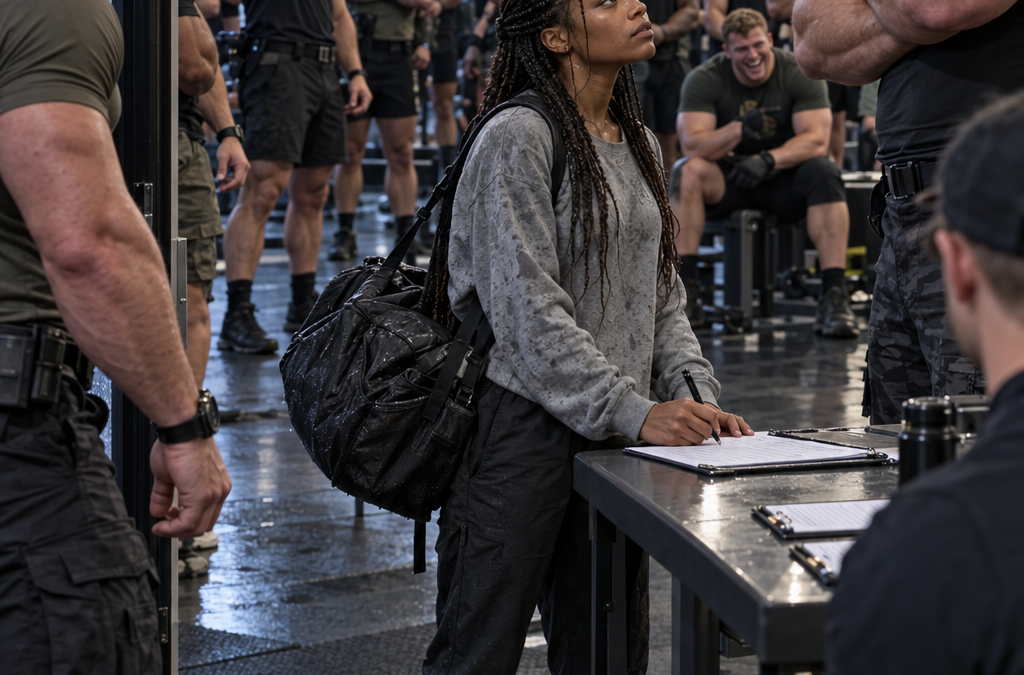
I was thirty-four years old when I walked into that gym in Richmond, Virginia, wearing soaked sneakers, an old sweatshirt, and enough desperation to make quitting impossible.
At the time, I weighed 125 pounds.
I stood five feet two inches tall.
I had a permanent weakness in my left ankle.
I was three months behind on rent.
My car had been repossessed.
I was working three jobs.
And I had twelve days before my landlord intended to put my ten-year-old daughter and me out of our apartment.
None of the men staring at me knew any of that.
They only saw a small Black woman dripping rainwater onto their polished training floor.
Travis Lawson saw me first.
He ran operations for Granite Shield Protection Agency, one of the most respected private security companies in the city. Granite Shield guarded politicians, executives, celebrities, and corporate clients who paid more for a single weekend of protection than I earned in months.
Travis looked exactly like the kind of man Granite Shield liked to put on brochures.
Broad shoulders.
Close-cropped hair.
Former college linebacker.
Confident enough to take up more space than his body actually needed.
He moved in front of the doorway as soon as I entered.
“What the hell is this?”
The room quieted.
Behind him were more than two dozen men waiting for the open recruitment trial. Most were over six feet tall. Thick necks. Heavy arms. Military haircuts. Compression shirts stretched across chests built in weight rooms.
I tightened my grip around my duffel bag.
“I’m here for the tryout.”
Someone laughed.
Then someone else.
Travis looked me up and down slowly, starting at my wet sneakers and ending at the braids dripping onto my shoulders.
“This tryout is for sharks.”
He leaned closer.
“Not cockroaches.”
More laughter.
I felt something cold settle inside my stomach.
Not surprise.
I had been called worse.
I had heard worse while delivering food.
I had heard worse from customers who looked at my face and decided I had somehow contaminated their order by touching the bag.
I had heard worse from a husband who once told me nobody else would ever want a woman like me.
Words stopped shocking me a long time before Granite Shield.
What mattered was what people did after the words.
I looked past Travis toward the registration table.
“I still need to sign in.”
That irritated him.
I could see it immediately.
He wanted me embarrassed.
Angry.
Defensive.
He wanted a performance he could use as proof that I didn’t belong.
Instead, I stepped around him.
A man named Brody Kemp rose from one of the benches.
Brody was Granite Shield’s highest-ranked active field employee. Six foot four. About 230 pounds. Built like the doorway had grown legs.
He stared down at me.
“Run before I crush you.”
I put my bag beside the registration table, picked up a pen, and signed my name.
Simone Anderson.
My hand didn’t shake.
“I’ll wait my turn.”
Brody smiled.
“Good. I’m restless anyway.”
I knew what men like him expected when they looked at me.
They expected weakness.
And to be fair, I looked tired because I was tired.
Not the kind that a full night of sleep could fix.
The kind that settles into your bones.
Every morning, I worked in the cafeteria at Zoe’s school.
That was my favorite job because at least I got to see my daughter during the day.
I scooped mashed potatoes.
Wiped tables.
Dragged garbage bags.
Smiled at children who complained about peas.
Zoe sometimes passed through my lunch line and tried not to grin too hard because she thought her friends would tease her if they knew she liked seeing her mother at school.
I always slipped her an extra piece of fruit anyway.
After the cafeteria shift, I delivered food through an app.
Bad tips.
Wrong addresses.
Customers who acted like five minutes of traffic was a personal attack.
One man once took his order from me, looked inside the bag, then threw it back against my chest.
“I didn’t order from someone like you.”
I remember watching the paper bag hit the pavement.
Grease spread across the bottom.
I picked it up.
Walked back to my car.
Completed the next delivery.
There wasn’t time to fall apart.
At night, I cleaned a hospital.
Eight hours under fluorescent lights.
Bathrooms.
Hallways.
Patient rooms.
Sometimes rooms where someone had died only hours earlier.
The hospital smelled like bleach, plastic, disinfectant, and grief.
Then I went home, slept for a few hours, and started again.
Three jobs.
Still behind on rent.
Thirty days after the first eviction warning, Zoe and I would have nowhere to go.
Zoe didn’t know.
I had made sure of that.
She was ten years old and still believed problems could be fixed with colored pencils.
Every night she folded paper napkins into crooked flowers and put them beside our bowls of instant ramen.
“Our fancy restaurant,” she called it.
Sometimes she lit the one candle we owned.
She would sit across from me, twirl noodles around her fork, and grin.
“Mommy, this is the best dinner ever.”
I would smile back.
She drew constantly.
Her favorite subject was me.
In every picture, I wore a red cape.
Mom flying above buildings.
Mom lifting cars.
Mom stopping bad guys.
She saw a superhero.
I saw a woman trying to keep the electricity on.
The Granite Shield job paid $5,800 a month.
Nearly three times what I was bringing home after exhausting myself across three different jobs.
Enough for rent.
Enough for groceries.
Enough to replace the car.
Enough for Zoe to keep making napkin flowers at a table that belonged to us.
That was why I stood there while thirty men laughed.
Not pride.
Not some desire to prove I could beat men.
I needed the job.
And underneath the exhaustion, underneath the hospital uniform and cafeteria apron and delivery bags, there was another version of me those men couldn’t see.
My father had built her.
His name was Raymond Anderson.
Retired Marine.
Combat instructor.
Quiet man.
Hard hands.
He never wasted words.
When I was younger, I thought his silence meant he didn’t know how to say what he felt.
Later, I realized it meant he believed actions were more reliable.
He was the one person who stood beside me after I married Dwight.
My mother stopped speaking to me after the wedding.
My father didn’t.
Even when he hated what Dwight was doing to me, he waited for the day I was ready to leave.
For four years, Dwight hit me.
The limp in my left leg came from him.
One night he shoved me down a staircase.
I remember the wooden steps hitting my ribs.
Then my shoulder.
Then my ankle twisting underneath me.
The doctor said it would heal.
It never healed correctly.
When Zoe was four, I finally left.
Three in the morning.
Plastic bag of clothes.
My daughter half asleep against my shoulder.
No car.
No money.
No plan.
I walked until my feet blistered.
My father opened his door before I knocked.
He looked at my face.
Looked at Zoe.
Looked at the bag.
He didn’t ask what happened.
He already knew.
The following morning, he took me into his garage.
There were old mats on the floor.
A heavy bag hanging from a ceiling beam.
He handed me a pair of worn boxing gloves.
“We start tomorrow.”
That was his speech.
For the next fifteen years, he trained me.
Krav Maga.
Brazilian jiu-jitsu.
Grappling.
Throws.
Escapes.
Balance.
Leverage.
How to stop fighting someone’s strength and start using their momentum.
He never entered me in competitions.
Never posted videos.
Never cared whether anyone knew.
He trained me for one reason.
So nobody could ever put their hands on me again and make me believe I was helpless.
Two years before the Granite Shield tryout, lung cancer took him.
Near the end, he was too weak to stand.
I sat beside his bed holding his hand.
His fingers barely closed around mine.
He looked at me and said five words.
“You’re stronger than you think.”
I tattooed them along my ribs after he died.
His boxing gloves hung in my garage.
Most nights, after Zoe went to sleep and before I left for the hospital, I hit the heavy bag for twenty minutes.
Quietly.
Same gloves.
Same movements.
Same voice in my head.
That was the woman Travis Lawson dismissed at the door.
He went to the equipment rack and held up two wristbands.
Blue for applicants.
Pink for visitors.
He dangled the pink one in front of me.
“Visitor badge. You can watch from the bench.”
“I’m registered for the tryout.”
He came closer until I could smell coffee on his breath.
“You really want to embarrass yourself in front of all these men?”
His voice dropped.
“Go home. Cook dinner for your kid.”
Something hot moved through my chest.
I took the pink wristband.
Then I walked onto the mat.
Travis smiled.
“Brody.”
Brody Kemp stood.
“Come show our guest how orientation works.”
The men shifted closer.
Brody approached slowly.
“This’ll be quick.”
He put one hand against my chest.
And shoved.
Hard.
I hit the mat on my left side.
My bad ankle twisted beneath me.
Pain shot through my leg so sharply my vision flashed white.
For half a second, I couldn’t breathe.
Nobody offered a hand.
One man looked away.
The rest watched.
Travis had his phone out.
Recording.
I pressed both palms against the mat.
Got my right foot underneath me.
Then the left.
My ankle trembled.
I stood.
The pain made my eyes water, but I refused to wipe them.
A referee stood near the edge of the floor.
Older man.
Quiet.
He hadn’t laughed.
I looked directly at him.
“Is full contact allowed in round two?”
He stared at me.
Then nodded.
Travis stopped smiling for half a second.
The next three days made his intentions impossible to misunderstand.
Every applicant received a thirty-pound training vest.
Mine weighed fifty.
The shoulder strap was torn, exposing a rough edge that cut into my collarbone.
Travis dropped it at my feet.
“Only one left.”
Three standard vests were hanging ten feet behind him.
I looked at them.
Then at him.
He smiled.
“Problem?”
I lifted the fifty-pound vest.
“No.”
I put it on.
He paired me with the largest recruits.
Every drill.
Every rotation.
Other applicants got three-minute rest periods.
I got ninety seconds.
Other recruits worked obstacle courses in pairs.
I ran alone while Travis sat in a folding chair with a stopwatch.
He didn’t hide what he was doing.
Neither did the men around him.
“How long until she drops?”
“Lunch.”
“Five bucks says before lunch.”
“She doesn’t belong here.”
Somebody answered, “She doesn’t belong anywhere near here.”
I kept moving.
That was all I could do.
Every time my left ankle screamed, I shifted more weight to the right.
Every time my lungs burned, I counted breaths the way Dad had taught me.
Four in.
Four out.
Don’t fight the pain.
Measure it.
Use it.
At the end of the first day, I took the bus home.
Zoe was at the table doing homework.
She looked at my shoulder where the vest had rubbed through the skin.
“What happened?”
“Training.”
She smiled.
“You’re really doing it?”
“I’m really doing it.”
She ran over and hugged me.
I almost cried right there.
Instead, I asked what she wanted for dinner.
“Fancy restaurant.”
So we had ramen.
One candle.
Two napkin flowers.
The second day was the dummy carry.
Applicants had to carry a weighted rescue dummy across the gym.
Most of the men were assigned 150 pounds.
Travis pointed at mine.
Two hundred.
I stared at the number printed on the side.
He shrugged.
“Random assignment.”
I knew better.
So did he.
So did everyone watching.
The dummy weighed seventy-five pounds more than I did.
I got it onto my shoulder.
Took four steps.
My left knee folded.
I hit the floor.
Laughter.
Travis pulled out his phone.
I tried again.
Six steps.
Fell.
My lungs felt like they were tearing open.
Travis held the camera closer.
“Come on, superhero.”
Someone laughed.
The third attempt, I got halfway.
My knee struck the floor hard enough to tear the fabric of my pants.
Blood appeared beneath the hole.
I stayed down for several seconds.
Travis kept filming.
He thought I was done.
I reached into my bag.
Pulled out athletic tape.
Wrapped my knee.
Stood.
Then I lifted the dummy again.
I carried it to the line.
Nobody clapped.
Travis lowered his phone.
The disappointment on his face was worse than the laughter.
That evening, his video appeared online.
He had added circus music.
The caption mocked me.
Within two days, half a million people had watched me fall.
Thousands commented.
Some laughed at my size.
Some attacked the diversity program.
Some attacked my race.
Some told me to go back where I came from, although Richmond was the only home I had ever known.
I read the comments sitting beneath a flickering streetlamp at eleven at night, waiting for the bus to take me to the hospital.
My knee throbbed.
My cracked phone screen made the words look jagged.
I kept scrolling even though each comment felt like touching a bruise.
Eventually I locked the phone.
The bus was fourteen minutes late.
I sat alone and watched traffic move through the dark.
The third day was worse.
During a drill, I left my duffel bag on the bench.
When I came back, it was gone.
I searched the locker room.
The hallway.
Under the benches.
Nothing.
Then one of the recruits glanced toward the back door.
He didn’t speak.
He didn’t need to.
I walked outside.
Rain had started again.
Behind the building sat a metal dumpster.
My bag was inside.
I climbed far enough over the edge to reach it.
When I pulled it out, filthy water ran down my arms.
The zipper was open.
Inside was Zoe’s newest drawing.
Me in the red cape.
The paper was soaked.
The marker had bled until my face was a blur of purple, red, and black.
Beneath it, wrapped in a towel, were my father’s boxing gloves.
Rainwater had soaked through the towel.
The leather was dark.
The stitching near one thumb had started coming apart.
I stood behind Granite Shield with those gloves pressed against my chest.
The rain came harder.
I closed my eyes.
“You’re stronger than you think.”
I whispered it because I needed to hear his voice and mine was all I had left.
For several minutes, I let myself stand there.
No fighting.
No pretending.
No smiling.
When I went back inside, Travis glanced at the wet bag.
Then at me.
He said nothing.
Neither did I.
That evening my landlord called.
“Twelve days became ten,” he said. “And I’m done extending.”
“I’m trying to fix this.”
“I don’t care what your situation is.”
The call ended.
I went home.
Zoe came running toward me holding a drawing.
“Mommy, look!”
I forced a smile.
“What is it?”
“You.”
She held it up proudly.
“I drew muscles this time.”
I laughed.
A real laugh.
It surprised me.
I knelt and hugged her so tightly the drawing crinkled between us.
“That’s my favorite one yet.”
That night, after ramen and our paper flowers, Zoe fell asleep talking about wanting a dog someday.
I sat alone at the kitchen table.
The eviction notice was in front of me.
Her ruined drawing was drying near the sink.
I could hear her breathing in the next room.
Then I cried.
Quietly.
I pressed both hands against my mouth because I didn’t want her waking up and seeing me break.
Later, I learned what Travis had been saying while I was doing everything I could just to survive.
The evidence came out in court.
Texts.
Witness statements.
Conversations people finally admitted hearing.
At a bar with two Granite Shield employees, Travis had said the part out loud that he kept disguising as professional judgment.
“If a five-two Black single mom passes my tryout, what does that say about every man on my roster?”
One colleague reminded him I had completed the dummy carry.
Travis answered, “She won’t finish what’s coming next.”
The following morning, he changed the final evaluation.
Originally, it was supposed to be a scored skills assessment.
He turned it into open sparring.
Full contact.
Last person standing.
No judges.
No points.
Just the mat.
Everyone knew what it meant.
He had stopped trying to make me quit.
Now he wanted someone to hurt me badly enough that quitting became the only possible choice.
I went home that evening and tucked Zoe into bed.
Then I folded one of her paper flowers and left it on her pillow.
In the garage, I sat on the concrete floor with my father’s gloves in my lap.
My hands were shaking.
I knew I could fight.
That wasn’t the problem.
The problem was that Granite Shield controlled the room, the rules, the pairings, the evidence, and whether I was hired afterward.
Winning one fight wouldn’t matter if they could simply call it misconduct.
Dad had always taught me that strength without strategy was just another way to lose.
So I called Earl Davis.
He answered after two rings.
“Earl?”
Silence.
Then his voice.
“Simone?”
My throat tightened.
“I need help.”
Another pause.
“How long?”
“Ten days.”
“Six tomorrow morning.”
That was all he said.
Earl had known my father for decades.
He ran a small boxing gym on the south side of Richmond.
No mirrors.
No expensive machines.
Just old rubber mats, iron weights, heavy bags, and forty years of sweat embedded in the walls.
I arrived at six exactly.
Earl looked at me.
At the bruises.
At the dark circles under my eyes.
At the way I protected my left leg.
Then he disappeared into the back room and returned with a bowl of hot oatmeal.
“Eat.”
I did.
I hadn’t realized how hungry I was until the first spoonful hit my stomach.
Afterward, we went through Granite Shield’s recruitment handbook line by line.
A civil rights attorney named Norah Collins trained at Earl’s gym several evenings each week.
When she arrived, she joined us.
Page sixteen.
Section nine.
Norah stopped reading.
“Here.”
She turned the handbook toward me.
Any recruit could formally challenge the highest-ranked active employee in a sanctioned match.
If the challenge followed the written procedure, the company had to recognize it.
I looked at Earl.
Earl looked at Norah.
Norah nodded.
“You file this, they accept.”
“And if I win?”
“They can’t pretend you failed the combat evaluation.”
For nine days, Earl rebuilt my approach around my bad leg.
No unnecessary movement.
No long exchange.
No battle of strength.
Everything anchored on my right side.
Every sequence ended quickly.
“Four seconds,” Earl told me.
“That’s the window.”
On the final night, I filled out the formal challenge.
My hand was steady.
Earl watched me sign.
“Your daddy would be proud.”
I touched the gloves inside my bag.
I couldn’t answer.
The morning of the final evaluation, I woke at four-thirty.
Zoe was asleep.
One arm hanging from the bed.
Mouth slightly open.
I stood in her doorway longer than I should have.
There are moments when being a parent means walking away from the person you most want to protect because staying beside them won’t save them.
I tore a piece of paper from her notebook.
Mommy’s going to work. I love you bigger than the sky.
I left it on her pillow.
The bus was late.
I ran the last half mile.
When I entered Granite Shield, everyone was already there.
Conversation stopped.
Brody sat on the front bench cracking his knuckles.
Someone behind him said, “The cockroach’s back.”
I walked to the officials’ table.
Placed the form down.
“Formal challenge. Section nine.”
The referee read it.
“Highest-ranked active employee?”
“Yes.”
I pointed.
“Brody Kemp.”
The room changed.
Travis grabbed the paper.
Read it.
Then started laughing.
“You hear this?”
He held the challenge above his head.
“Little Miss Cockroach wants my best guy.”
Men leaned forward.
Phones appeared.
Travis signed the approval immediately.
He believed he had finally been given permission to destroy me.
Brody stepped onto the mat.
He looked enormous up close.
He rolled his neck.
“Nothing personal, sweetheart.”
He smiled.
“But you should’ve stayed home.”
Travis stepped close to me.
His voice softened.
“Last chance to walk away. Nobody’s going to judge you.”
I looked directly into his eyes.
“Everybody already has.”
For once, he had no answer.
The referee raised his hand.
Silence filled the gym.
I could hear the overhead lights.
The referee dropped his hand.
Brody moved.
Fast.
Faster than most people expected from a man his size.
His right hand reached for my collar.
His left arm opened for the clinch.
He expected me to retreat.
I didn’t.
I stepped left.
Just outside his right arm.
My right hand caught his wrist.
Not with force.
With timing.
I redirected his momentum.
His balance shifted forward.
I moved behind him.
Arm drag.
Rear position.
My hip drove against the back of his thigh.
My right leg swept his lead foot.
Fifteen years of training became one movement.
Brody left the floor.
For a fraction of a second, a 230-pound man was airborne.
Then he hit the mat.
The sound cracked through the gym.
A water bottle fell from a bench.
Rolled across the floor.
Brody lay flat on his back.
Eyes open.
Air gone.
I stood over him.
Then my left ankle buckled.
Pain exploded upward.
I shifted onto my right leg before I fell.
My father’s gloves were on my hands.
Old leather.
Loose stitching.
I looked down at Brody.
Then toward the referee.
Nobody spoke.
One second.
Two.
Three.
Four.
Someone in the back started clapping.
Another recruit stood.
Then another.
The room erupted.
Men shouted.
Someone slapped both palms against a bench.
“Four seconds!”
Another voice repeated it.
“Four seconds!”
Travis didn’t move.
His clipboard hung from one hand.
One recruit who had recorded everything looked down at his phone.
Then at the man beside him.
“Bro, this is going everywhere.”
He was right.
The video spread before I even reached home.
Within an hour it was on social media.
By midnight, millions had watched it.
People replayed the throw in slow motion.
Martial artists broke down my footwork.
Commentators argued over technique.
The same internet that had laughed at me carrying the dummy suddenly wanted to know where I had trained.
I didn’t answer.
I had no interview to give.
I took the bus home.
Made ramen.
Folded a napkin flower.
Helped Zoe with homework.
Then I went to the hospital and cleaned floors.
I believed the fight was over.
It had barely started.
Two days later, a registered letter arrived.
Fourteen pages.
Granite Shield’s lawyers accused me of using unauthorized combat techniques and excessive force.
Brody claimed cervical strain.
Emotional distress.
Reputational damage.
Near the bottom was the sentence that made the room around me disappear.
Granite Shield Protection Agency intends to pursue criminal assault charges.
I read it twice.
Then placed it in the same drawer as my eviction notice.
Two different documents.
Two different threats.
Same drawer.
Five days before I would lose my home.
The media attack came next.
A local reporter named Carla Jennings aired a segment questioning whether I was an underdog or a violent opportunist.
The video shown on television had been cut.
Brody’s initial lunge was missing.
Viewers saw me move behind him and throw him.
Without the beginning, self-defense looked like an attack.
The internet split.
Hero.
Threat.
Mother.
Criminal.
Survivor.
Aggressor.
Thousands of people who had never met me decided who I was within seconds.
Then my hospital supervisor called at six in the morning.
“Simone, given the media attention and the pending legal matter, we’re placing you on unpaid administrative leave.”
I sat on the edge of my bed.
“For how long?”
“Pending review.”
We both knew what that meant.
My most reliable paycheck disappeared.
Five days before eviction.
Then Dwight came back.
Six years after I carried our daughter out of that house.
Eighteen months after the restraining order expired.
He saw the video.
His attorney filed for emergency custody.
The petition said I displayed violent and unstable behavior.
It said Zoe’s safety was at risk.
I read those words standing in my kitchen.
The man who shoved me down a staircase was calling me violent.
The man who made me flinch whenever a door slammed was asking a court to protect my daughter from me.
I wanted to scream.
Instead, I folded the papers.
Travis was attacking my future.
Dwight was attacking my past.
The hospital had taken my income.
My landlord was taking my home.
Everything was closing at once.
And Zoe knew almost nothing.
I shut off television reports.
Deleted social apps.
Kept smiling at dinner.
One night she looked up from her ramen.
“Mommy?”
“Yeah?”
“When do you start your new job?”
My chest tightened so hard I could barely breathe.
I smiled.
“Soon, baby.”
She nodded happily.
“Real soon?”
“Real soon.”
That lie hurt more than anything Travis had said to me.
After Zoe fell asleep, I called Norah.
“I can’t pay you.”
“I know.”
“I mean it. I have nothing.”
“I know, Simone.”
“No savings.”
“I’m not asking for money.”
She represented me pro bono.
The next morning she filed a counterclaim alleging discrimination, hostile recruitment practices, and intentional infliction of emotional distress.
Then she subpoenaed Granite Shield’s internal security footage.
Three days.
Every camera.
Every angle.
“The footage proves it,” she told me. “The heavy vest. The dummy. The harassment. Your bag. Everything.”
For the first time in weeks, I allowed myself hope.
Two days later, we sat together in her office when the court-produced files arrived.
Norah connected the drive.
Black screen.
She tried another file.
Black.
Another.
Nothing.
Every camera recording from all three days was corrupted.
Unreadable.
I stared at the laptop.
“They erased it.”
Norah said nothing.
Her silence confirmed what both of us understood.
No footage.
No job.
No savings.
Three days before eviction.
A custody case.
An assault threat.
And now the evidence that could prove what happened had disappeared.
I had thought the worst moment was being thrown onto the mat on my bad ankle.
I was wrong.
The worst moment was sitting in that office realizing someone could hurt you in front of witnesses and still try to erase the record afterward.
The morning of the hearing, a yellow envelope waited beneath my apartment door.
Final eviction notice.
Effective the next day.
I put it on the kitchen table beside the Granite Shield letter and Dwight’s custody petition.
Three documents.
Three ways to lose my life.
Zoe was at school.
I sat alone for several minutes.
Then I stood.
Put on the only blazer I owned.
Navy blue.
Thrift store.
Four years old.
I took the bus to court.
The hearing room held about forty people.
Reporters filled the back.
Granite Shield employees sat together in matching shirts.
Craig Belton, the company owner, sat in the third row.
Travis testified first.
Charcoal suit.
Fresh haircut.
Calm voice.
He looked nothing like the man who had called me a cockroach.
“Ms. Anderson entered the tryout under false pretenses,” he told the panel. “She concealed extensive combat training and used unsanctioned techniques that endangered one of our employees.”
The judges took notes.
“She manipulated a diversity initiative to gain access to our facility.”
I watched him lie.
For eleven minutes, he turned me into someone I barely recognized.
Then Norah stood.
“Mr. Lawson, which specific technique used by Ms. Anderson violated Granite Shield’s written rules?”
Travis paused.
“She used excessive force.”
“That wasn’t my question.”
Norah walked closer.
“Which technique?”
“I’d need to review the handbook.”
“I have it.”
She placed a copy before him.
“Section nine, paragraph four. Recognized grappling and throwing techniques are expressly permitted during sanctioned challenge matches.”
Silence.
“Ms. Anderson used a standard hip throw.”
Travis shifted.
Norah continued.
“Your own rules allowed it.”
Then she turned to the missing footage.
“Three full days of internal security recordings became corrupted after a court subpoena?”
“Technical malfunction.”
“All cameras?”
“Yes.”
“All three days?”
“As far as I understand.”
Norah nodded.
Then opened her laptop.
“Exhibit B.”
The recruit’s phone recording played.
Unedited.
Full sequence.
Brody lunged first.
I moved second.
The throw followed.
Four seconds.
Reporters leaned forward.
Then Norah introduced the evidence that Granite Shield hadn’t expected her to obtain.
Travis’s text messages.
A court order had given her access to communications relevant to the recruitment process.
She read them aloud.
“Diversity checkbox showed up. Wet, limping, 125 pounds. Won’t last the morning.”
Travis’s face changed.
Next message.
“Gave her the 200-pound dummy. She fell three times. Got it on video. This is gold.”
Another.
“Changed final round to open sparring. Full contact. She’ll quit or she’ll get carried out. Either way, problem solved.”
Each message made the room quieter.
Craig Belton stopped looking at me.
He looked at Travis.
Then Earl Davis testified.
Earl was seventy-one by then.
Former Marine.
Gym owner.
Voice steady.
He explained that eighteen years earlier, he had trained another Black security applicant who accused Granite Shield of rigging recruitment exercises to force him out.
The applicant complained.
The company submitted surveillance footage.
Every file was corrupted.
Same explanation.
Technical malfunction.
I looked toward Craig Belton.
His expression had gone rigid.
Earl continued.
The old case had settled quietly.
Sealed.
Forgotten by almost everyone.
Not by him.
Norah stood again.
“This is not an isolated technical failure. It is a pattern.”
Granite Shield’s attorney objected.
The head judge shut him down.
Then Norah turned to Dwight.
She submitted the police reports.
Hospital records.
The domestic violence complaint.
The restraining order.
Proof of what had happened to my ankle.
Proof that the man calling me dangerous had been the person I needed protection from.
The judge read the papers.
Then looked toward Dwight’s attorney.
“The emergency custody petition is denied.”
I closed my eyes.
For one second, everything inside me went quiet.
Zoe was safe.
That mattered more than Granite Shield.
More than the job.
More than what the internet thought.
Then Craig Belton stood from the gallery.
“Travis Lawson is terminated from Granite Shield effective immediately.”
Travis turned.
For the first time since I had met him, he looked small.
The head judge looked at me.
“Ms. Anderson, would you like to make a statement?”
I stood.
My knees felt weak.
I looked at the panel.
“I didn’t come here to prove I could fight.”
My voice held.
“I came because my daughter asks me every night when I’m starting my new job, and I’m tired of having to answer her with a lie.”
Nobody moved.
I took another breath.
“There are women who spend their whole lives hearing they’re too small, too dark, too poor, too damaged, too weak, or too broken to stand in certain rooms.”
I looked toward Travis.
Then back at the judges.
“I know what that does to a person because I believed some of it for years.”
My hand touched my side where my father’s words were tattooed beneath my shirt.
“But surviving something doesn’t mean the person who hurt you gets to decide who you become afterward.”
My throat tightened.
“I stood up because my daughter was watching me, even when she didn’t know she was watching.”
The room was silent.
“And someday she’s going to walk into a room where someone decides what she’s worth before she says a word. I need her to know their decision doesn’t have to become hers.”
I sat down.
The panel deliberated for less than an hour.
When the judges returned, the head judge read the ruling.
My actions during the Granite Shield evaluation had been lawful and consistent with the sanctioned rules.
Granite Shield’s claims against me were dismissed.
A formal investigation would be opened into evidence tampering, discriminatory recruitment practices, and false testimony.
I didn’t cheer.
I didn’t cry.
I closed my eyes.
And breathed.
For the first time in weeks, the breath went all the way down.
The consequences came quickly.
Travis was investigated and later charged over the destruction of subpoenaed evidence, a false report, and discriminatory conduct tied to the recruitment process.
His booking photograph appeared on the same stations that had questioned whether I was dangerous.
Dwight’s emergency custody attempt was finished.
Norah filed for stronger permanent protection based on his history and renewed interference.
The court granted it.
He was no longer allowed to come near Zoe or me.
Two days later, the hospital called.
My supervisor sounded different this time.
“Simone, the board has completed its review. You’re reinstated immediately with full back pay. We’re also issuing a formal apology.”
I listened.
Then said, “Thank you.”
He exhaled.
“When can you return?”
“I’m not.”
There was silence.
“Excuse me?”
“I’m not coming back.”
I wasn’t angry.
I simply understood that I had spent too much of my life staying in places that only respected me after someone forced them to.
Craig Belton requested a meeting.
I brought Norah.
His office was large.
Glass walls.
Heavy desk.
Quiet carpet.
He placed a contract in front of me.
Senior trainer.
Granite Shield Protection Agency.
Full authority to redesign recruitment procedures, physical assessments, evaluation standards, and anti-discrimination policies.
Salary: $6,800 a month.
I stared at the number.
More money than I had ever earned.
Then Craig pushed a second document across the desk.
Six months of rent.
Paid directly to my landlord.
The eviction filing would be withdrawn immediately.
“This doesn’t undo what happened,” Craig said.
“No.”
“But it’s a start.”
I read the contract.
Then looked at him.
“I’ll redesign the program.”
His shoulders relaxed.
“But I’m not doing it for you.”
He waited.
“I’m doing it so the next person who walks through that door doesn’t have to survive your employees before she gets the chance to prove she can do the job.”
He nodded.
I signed.
Same name.
Same hand.
Simone Anderson.
Richmond’s city council responded the following week.
Granite Shield had operated under a city diversity requirement, and what happened during my recruitment exposed how meaningless such policies could become without oversight.
The council passed new requirements for security contractors.
Recruitment evaluations had to be recorded.
Unedited copies had to be preserved outside the company.
Independent reviewers could access them.
Anti-hazing procedures became enforceable.
My case was cited in the legislation.
People congratulated me.
Reporters called.
I ignored most of them.
Because the moment that mattered came when I opened my apartment door after work.
Zoe ran toward me barefoot.
Her hair was half braided.
“Mommy!”
I dropped my bag.
She stopped in front of me.
Her eyes were huge.
“Did you get the job?”
I knelt.
For days I had been lying to her because I couldn’t bear to frighten her.
For weeks I had been carrying the possibility that I might lose our home.
For years I had been trying to become the woman she already believed I was.
I opened my arms.
“Yeah, baby.”
She crashed into me.
I held her.
“Mommy got the job.”
Zoe squeezed my neck.
Then suddenly pulled away.
“Wait.”
She ran down the hallway.
Came back carrying a drawing.
It was me.
Standing tall.
Granite Shield jacket.
Braids.
Big smile.
But beneath the collar, she had drawn something red.
A cape.
I laughed.
Then I cried.
Not quietly this time.
I cried on both knees in the hallway with my daughter in my arms and a piece of paper between us.
Everything I had almost lost was right there.
That weekend, Earl opened the gym for a small celebration.
Norah came.
Neighbors came.
Several recruits from Granite Shield came too, including men who admitted they should have spoken when Travis started targeting me.
Someone brought cake.
Zoe sat in a corner drawing everyone.
She called the collection her Wall of Heroes.
Six months later, I stood in Earl’s gym looking at twelve women.
Some were single mothers.
Some were survivors.
Some had never been hit by anyone but had spent years believing they would be helpless if it happened.
Others flinched when a training partner lifted a hand too quickly.
I understood every one of them.
The program was called Stand Your Ground, Stand Together.
Free every Saturday.
No fees.
No judgment.
No experience required.
One woman spent her first class standing against the back wall with her arms wrapped around herself.
She never threw a punch.
She returned the next Saturday.
And the next.
By the fourth week, she struck the heavy bag hard enough to make the chain shake.
Then she stepped back and started crying.
I walked over.
“You okay?”
She nodded.
“I forgot.”
“Forgot what?”
She looked at her hands.
“That I could do something.”
I understood.
That was why the program mattered.
Not because every woman needed to learn how to throw someone who outweighed her.
Because too many women had been taught that helplessness was part of who they were.
Within months, volunteer instructors carried the program to Baltimore, Atlanta, Charlotte, Detroit, Philadelphia, Houston, and Chicago.
Church basements.
School gyms.
Community centers.
Anywhere we could put mats on a floor.
Some instructors were survivors themselves.
Some were mothers.
Some were grandmothers.
Women brought daughters.
Daughters brought mothers.
In Detroit, a sixty-three-year-old woman filmed herself completing her first clean hip throw on a training dummy.
Zoe remained the unofficial artist of the entire thing.
Every Saturday she sat near the corner of Earl’s gym with markers spread around her.
She drew the women who trained.
Different ages.
Different sizes.
Different faces.
Wrapped hands.
Raised fists.
Nervous smiles that became confident ones.
She pinned every portrait to the wall.
At the center was the original.
Mommy in a red cape.
Eventually there were more than a hundred pictures.
I never became comfortable with being called a hero.
I knew what heroes looked like to Zoe.
They flew.
They never got scared.
They never sat alone at kitchen tables crying after their children fell asleep.
They didn’t read eviction notices with empty bank accounts.
They didn’t wonder whether one bad month could destroy everything.
I had done all of those things.
I had been terrified.
There were nights I almost quit Granite Shield.
There were mornings when getting out of bed felt harder than anything I did on that mat.
There were moments when I believed Travis might win simply because he had more money, more power, more people, and better control over the story.
But my father had never taught me that strength meant feeling no fear.
He taught me that strength was what you did after fear arrived.
Years earlier, Dwight had convinced me my survival depended on keeping him calm.
Travis had tried to convince me my future depended on accepting his judgment.
Both men misunderstood the same thing.
They believed intimidation could define the size of my world.
It couldn’t.
Months after everything ended, a reporter finally asked me a question I was willing to answer.
“What would you say to Travis Lawson today?”
I thought about it.
Not for dramatic effect.
I genuinely had to search for the answer.
Then I realized there wasn’t much to say.
“I don’t think about him.”
The reporter looked surprised.
“Not at all?”
“Not much.”
“Why?”
I looked through the glass doors of Earl’s gym.
A woman inside was learning how to escape a wrist grab.
She failed the first attempt.
Then the second.
On the third, she broke free and smiled.
I pointed toward her.
“I think about the next woman who walks through a door where everyone has already decided she doesn’t belong.”
The reporter followed my eyes.
“That’s who I work for now.”
That night, Zoe and I went home.
Dinner was better than ramen.
We could afford better now.
But she still insisted on folding napkin flowers.
Some traditions apparently survive everything.
After dinner, she pulled out her markers.
“What are you drawing?”
“You.”
“Again?”
She rolled her eyes.
“Obviously.”
I laughed.
“What am I doing this time?”
She covered the page with one hand.
“You can’t look yet.”
I pretended not to.
When she finished, she turned the paper around.
It was me standing in front of a doorway.
Behind me were dozens of women.
Some tall.
Some short.
Some young.
Some old.
Every one of them wore a cape.
I stared at the picture.
Zoe watched my face.
“Do you like it?”
I swallowed.
“I love it.”
She pointed toward the woman in front.
“That’s you.”
“I figured.”
“And those are everybody you helped.”
I looked more closely.
She had drawn the doorway wide open.
For years I had measured survival by what I managed not to lose.
My daughter.
My home.
My independence.
My ability to stand.
That drawing made me understand something I hadn’t before.
Survival wasn’t the end of the story.
Sometimes surviving gave you enough strength to hold the door open for the person coming behind you.
I thought about the morning my father handed me those old boxing gloves.
I thought about walking out of Dwight’s house at three in the morning with Zoe in my arms.
I thought about the cafeteria trays.
The hospital floors.
The delivery bags.
The eviction notice.
The fifty-pound vest.
The two-hundred-pound dummy.
My daughter’s ruined drawing lying wet inside a dumpster.
The hearing.
The lies.
The missing footage.
Brody hitting the mat.
Four seconds.
People always remembered those four seconds.
They treated them like the moment everything changed.
But they weren’t.
My life hadn’t changed because I threw a 230-pound man.
Those four seconds were only visible proof of something that had taken years to build.
The real fight happened in all the moments nobody recorded.
Standing after Dwight pushed me down those stairs.
Leaving him.
Showing up in my father’s garage the next morning.
Training while my ankle hurt.
Working when I was exhausted.
Smiling at Zoe when I was terrified.
Getting onto buses when I wanted to collapse.
Walking back into Granite Shield after they humiliated me.
Picking my father’s gloves out of a dumpster.
Calling Earl when pride told me to handle everything alone.
Going to court when the evidence had disappeared.
Standing up when the safest thing would have been to stay quiet.
That was strength.
Not one perfect throw.
Not applause.
Not millions of views.
Not a job title.
It was choosing, over and over again, not to let someone else’s cruelty become the final authority on who I was.
Zoe leaned against my shoulder.
“You’re crying.”
“I know.”
“Happy crying?”
I smiled.
“Yeah.”
She studied me.
Then nodded seriously.
“Okay.”
She went back to coloring.
I looked at the woman in the red cape.
For the first time, I didn’t feel embarrassed by the way my daughter saw me.
I didn’t feel like I was disappointing some impossible version of myself.
Maybe she had never believed I was fearless.
Maybe she had simply watched me keep getting up.
I reached beneath my shirt and touched the five words tattooed against my ribs.
You’re stronger than you think.
For years, I had treated those words like something my father had left behind for me.
Now I understood them differently.
They weren’t just about me.
They were meant to be passed forward.
And every Saturday, when another woman walked through Earl’s door with shaking hands and uncertain eyes, I saw the same question I had once carried into Granite Shield.
Do I belong here?
I never answered it for them.
I handed them gloves.
Showed them where to stand.
And gave them the same thing my father once gave me.
A place to discover the answer themselves.








