𝗙𝗨𝗟𝗟 𝗦𝗧𝗢𝗥𝗬 They Told the Maid to Pour Coffee and Stay Silent—Then I Read the Clause That Could Take Their Entire Company
𝗣𝗔𝗥𝗧 𝟮
He didn’t know I saw him crying.
I backed away before he noticed me.
Warren was hard.
He wasn’t cruel.
His greatest weakness was trust.
Especially in Victor Grant.
Victor served as lead counsel for Cole Industries.
Yale Law.
Class of 1994.
Seven-figure annual retainer.
Tailored suits.
Beautiful fountain pens.
The kind of man who entered a room already irritated that someone less important might speak before him.
Victor treated household employees like fixtures.
Once, I watched him reduce a nineteen-year-old caterer to tears because she brought sparkling water instead of still.
Ten minutes later, he asked someone else whether they had seen “the little waitress.”
He had already forgotten her name.
Derek Ashford was worse.
CEO of Ashford Capital Partners.
International investments.
European property holdings.
Family money dressed up as genius.
Derek arrived at the estate three days before the merger signing.
Charcoal suits.
Platinum cufflinks.
A voice carefully shaped somewhere between London and New York.
He spoke softly because soft-spoken powerful men know everyone will lean closer.
The merger had taken eighteen months to negotiate.
Cole Industries would combine with Ashford Capital’s European holdings.
Projected value of the new entity:
$4.6 billion.
Cole’s board loved it.
Investment bankers loved it.
Victor loved it.
Everyone spoke about synergies, market penetration and cross-border growth.
Champagne had already been ordered for the signing.
Nobody asked what I thought.
Why would they?
I was the woman carrying the tray.
But for three years, I had been cleaning Warren’s private study.
And law had never left me.
I dusted shelves where legal binders sat.
Vacuumed around tables where draft agreements had been left open.
Emptied wastebaskets containing abandoned markups.
I never stole documents.
Never photographed anything.
Never opened locked drawers.
I didn’t need to.
People with power become careless around people they believe are invisible.
They leave pages faceup.
They conduct conference calls while you polish furniture.
They discuss millions while you replace coffee.
At night, after the house went quiet, I wrote down what I remembered.
Not confidential numbers.
Legal structures.
Terms.
Concepts.
Questions.
I still owned my old casebooks.
I kept them beside my bed in the staff quarters.
I read from midnight until my eyes stopped focusing.
My spiral notebook filled with citations.
Reversion clauses.
Indemnities.
Choice-of-law provisions.
Arbitration.
Asset transfers.
I told myself I was staying sharp for the day I returned to school.
I didn’t know whether that day would ever come.
Still, I read.
That habit saved Warren Cole’s company.
The morning of the merger signing, I ironed my uniform twice.
White blouse.
Black skirt.
Black shoes.
Apron.
I knew I would be in the boardroom.
Not seated.
Not speaking.
Serving.
The meeting was held at Cole Tower in Manhattan.
Fifty-second floor.
Floor-to-ceiling glass.
A conference table long enough to land a small aircraft on.
I arrived at 7:15.
Fresh orchids stood along the credenza.
Leather portfolios waited at every chair.
Espresso cups arranged beside saucers.
At the head of the table sat a navy binder.
Two hundred fourteen pages.
The final merger agreement.
I looked at it while placing sugar bowls.
The binder was open.
Page fourteen.
I had seen earlier drafts.
Never the final version.
I should have looked away.
Instead, my eyes caught a phrase.
Reversionary interest.
My hands stopped.
I leaned slightly.
Read.
Clause 9.
Section B.
Paragraph 3.
The language was dense enough to encourage fatigue.
That’s a trick lawyers know.
Hide something dangerous beside something boring.
Indemnity.
Definitions.
Performance standards.
Boilerplate.
Then the mechanism.
If Cole Industries failed to meet a specified revenue benchmark within eighteen months following closing, voting ownership transferred to Ashford Capital.
I looked for the benchmark.
Then found it.
340 percent revenue growth.
I read the number again.
Three hundred forty percent.
Eighteen months.
My stomach dropped.
Commercial real estate does not grow 340 percent in eighteen months.
Not a mature multistate portfolio.
Not legitimately.
It wasn’t aggressive.
It wasn’t optimistic.
It was impossible.
That meant failure had been designed into the agreement.
The clause wasn’t protection.
It was acquisition by delayed trigger.
Cole would sign.
Everyone would celebrate.
Eighteen months later, the benchmark would fail.
Ashford would take voting control.
Warren might remain chairman.
Maybe keep his office.
Maybe keep his salary.
But control would be gone.
I read it three times.
Then footsteps sounded outside.
I moved back to the coffee service.
The board entered in groups.
Cole executives first.
CFO Douglas Hale.
Four vice presidents.
Board members.
Assistants.
Then bankers from Ridgefield Morton.
Blue suits.
Platinum watches.
Men who looked as if they billed money simply for breathing near a transaction.
Victor Grant entered and took the chair beside Warren’s.
Finally Derek Ashford arrived.
Three lawyers followed him.
He shook Warren’s hand.
“Today’s the day.”
Warren smiled.
“Long time coming.”
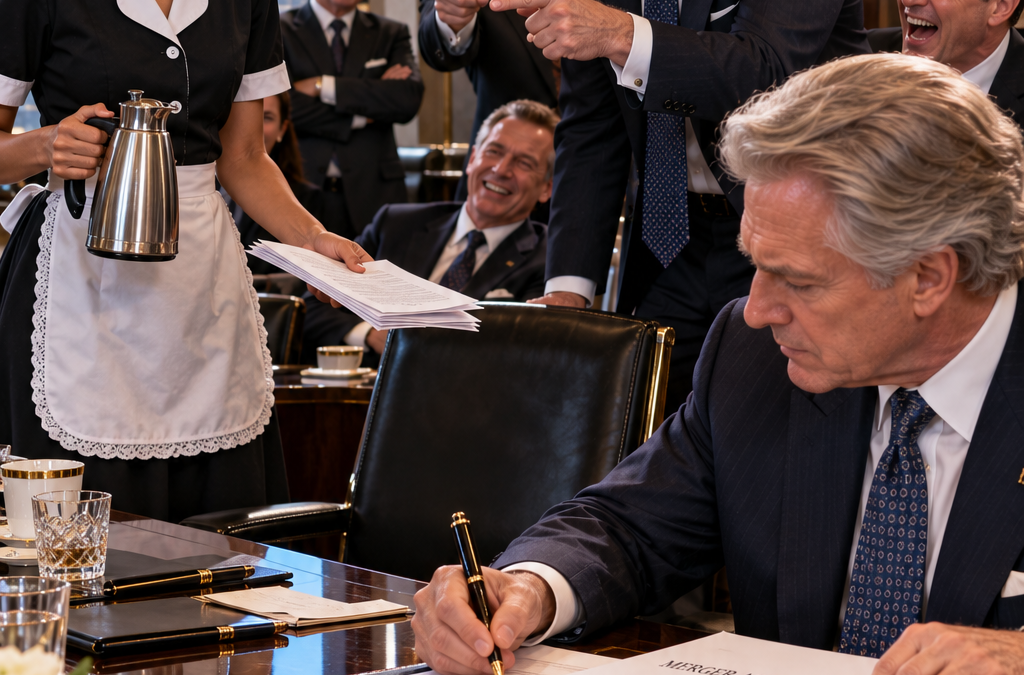
I stood near the wall holding a polished carafe.
Derek sat.
Victor opened his portfolio.
Warren began reviewing the final closing documents.
I kept hearing one number.
My pulse climbed.
I needed to tell Warren.
I waited for a break.
None came.
Finally, I stepped toward the table.
Victor looked up instantly.
“What are you doing?”
“Mr. Grant, I need to speak to Mr. Cole.”
“About what?”
“The agreement.”
His face hardened.
“You need to stand over there.”
“There’s something in—”
“Stand against the wall and do your job.”
The room barely reacted.
That was what hurt.
Not the insult.
The normality.
A lawyer humiliating a housekeeper wasn’t important enough to interrupt the meeting.
I stepped back.
Derek looked toward me.
Then at the empty cup in front of him.
“Sweetheart.”
I hated that word immediately.
“If you’re going to eavesdrop, at least make yourself useful.”
A few men laughed.
He tapped the cup.
I walked over.
Poured.
My hand did not shake.
“There.”
Derek never looked at my face.
“See?”
More laughter.
“That’s what you’re qualified for.”
Victor smirked.
“Pouring things. Cleaning things. Knowing where you belong.”
I returned to the wall.
Fourteen men.
Not one objected.
Warren was reviewing the execution page.
His father’s Montblanc rested in his hand.
I had seen that pen before.
He used it for major deals.
Sentimental.
Important.
He uncapped it.
Click.
The sound reached me across twelve feet.
I thought of my mother.
Hospital machines.
Dialysis.
The withdrawal form.
My professor.
All those nights reading by phone light.
I thought about what would happen if Warren signed.
Two thousand employees.
Property.
Pensions.
Families.
I couldn’t stay silent.
I put the coffee carafe down.
“He’s lying in that contract.”
Every head turned.
My own words shocked me.
Victor shot to his feet.
“Security.”
Derek stopped smiling.
“Get her out.”
Two guards entered.
I felt a hand close around my arm.
“Mr. Cole.”
Victor pointed at me.
“Remove her now.”
“Clause 9.”
The guard began pulling me toward the door.
“Mr. Cole, please.”
Warren looked up.
“Page fourteen.”
Victor raised his voice.
“She’s lost her mind.”
“Section B, paragraph three.”
The guard tightened his grip.
“The reversionary interest provision.”
Derek leaned back.
“Warren, are we seriously stopping a four-billion-dollar transaction because your cleaning woman found a phrase she doesn’t understand?”
A few men laughed.
Weakly.
I kept looking at Warren.
“If you sign, you lose voting control in eighteen months.”
The room changed.
Not completely.
Just enough.
“The revenue benchmark is 340 percent.”
The guard pulled again.
“It’s impossible.”
Warren stopped moving.
His pen remained above the signature line.
“It’s supposed to fail.”
Derek’s fingers froze around his own pen.
“It’s a trap.”
Warren looked at the security guard.
“Stop.”
The guard stopped.
Victor leaned forward.
“Warren—”
“Let her go.”
“She’s domestic staff.”
“I know who she is.”
The hand released my arm.
I straightened my blouse.
Warren placed the Montblanc on the table.
“What did you say?”
My throat was dry.
“Clause 9. Section B. Paragraph three.”
“Page?”
“Fourteen.”
He flipped backward.
Fifteen.
Fourteen.
His finger moved down the page.
I watched his face.
Nothing.
Then confusion.
Then disbelief.
Then anger.
He read the paragraph twice.
“Victor.”
Victor shifted.
“Yes?”
“Did you review this?”
“Of course.”
“Three hundred forty percent.”
Victor pulled the binder closer.
“It is a performance provision.”
“I can read.”
“Reversionary protections are common.”
“Is three hundred forty percent common?”
“The projections were prepared by Ashford’s actuarial group.”
Warren’s voice became quieter.
“That wasn’t my question.”
Victor stopped.
Warren looked at me.
“Explain.”
Every person in the room stared.
Three minutes earlier, none of them believed I deserved to approach the table.
Now they were waiting for the maid to interpret their merger.
I took a breath.
“Typical annual revenue growth for established commercial real-estate portfolios is nowhere near that number.”
Derek rolled his eyes.
I continued.
“A strong expansion year might produce low double digits.”
The bankers were listening now.
“Three hundred forty percent in eighteen months is not a performance target.”
I pointed toward the contract.
“It’s a trigger designed to be missed.”
Warren looked down.
“What happens when it’s missed?”
“Ashford receives voting control.”
The CFO opened his copy.
I continued.
“You retain title and compensation.”
Derek said sharply:
“This is ridiculous.”
“But governance transfers.”
I ignored him.
“Board control follows.”
One banker began flipping through his binder.
“Your company still exists.”
I looked at Warren.
“But you no longer control it.”
Board member Richard Patterson removed his glasses.
“How the hell did legal miss this?”
No one answered.
Derek leaned forward.
“Because legal didn’t miss anything.”
His voice regained some polish.
“This is standard merger language.”
“No,” I said.
His eyes snapped toward me.
“Excuse me?”
“A standard reversion provision is generally tied to material default, insolvency, failure of representations or another genuine breach.”
I looked back at Warren.
“Not a deliberately impossible revenue benchmark.”
Victor laughed once.
“Now she’s giving contract lectures.”
I turned to him.
“Would you like to explain why the trigger is 340 percent?”
He stared.
I waited.
Nothing.
CFO Douglas Hale spoke.
“She has a point.”
The room shifted again.
Derek looked at him.
Douglas continued.
“I challenged the synergy projections four months ago.”
Warren turned.
“You what?”
“I sent legal a memo.”
His eyes moved toward Victor.
“The assumptions looked unrealistic.”
Victor’s face changed.
“I was told Ashford’s actuarial people had independently verified them.”
Warren looked at Victor.
“You received that memo?”
“I receive hundreds of—”
“Did you receive it?”
Victor swallowed.
“Yes.”
“And?”
“My team reviewed it.”
“Your team concluded this was reasonable?”
“Within the overall model—”
“Three hundred forty percent?”
Victor had no answer.
Warren looked at me again.
“What else?”
That question changed everything.
I reached into my apron.
Victor stared as though I might produce a weapon.
I pulled out my spiral notebook.
Worn cover.
Bent corners.
Years of notes.
“There are two other provisions.”
Derek pushed his chair back.
“This is absurd.”
“Sit down,” Warren said.
Derek stopped.
“Warren—”
“I said sit.”
Derek sat.
Warren pointed toward the empty chair beside him.
Victor’s chair.
“Miss Sullivan.”
It was the first time anyone in that room used my name.
“Come here.”
Victor stood.
Nobody asked him to.
He moved toward the wall.
I approached the table.
Warren pulled out the chair.
“Sit.”
I did.
A maid’s apron touched leather worth more than a semester of law school.
No one laughed now.
Warren looked at my notebook.
“Where did you learn this?”
I hesitated.
“Howard.”
“Howard what?”
“Howard University School of Law.”
Victor made a disbelieving sound.
I looked at him.
“I was a third-year student.”
“Was?”
“My mother became ill.”
“What kind of ill?” Warren asked.
“Renal failure.”
I kept my eyes on the notebook.
“I withdrew.”
The room was silent.
Derek said:
“Convenient story.”
I looked up.
“You asked where I learned contract law.”
My voice stayed flat.
“I answered.”
Warren picked up his phone.
“Helen.”
His assistant answered.
“Get the dean of Howard Law.”
Victor shook his head.
“This has become theater.”
Warren ignored him.
Forty-five seconds later, the conference speaker activated.
“This is Dean Amelia Crawford.”
“Dean Crawford, Warren Cole. I apologize for the interruption.”
“I know who you are, Mr. Cole.”
“I have a woman here named Brianna Sullivan.”
Silence.
Then the dean’s voice changed.
“Brianna?”
“Yes.”
“Brianna Sullivan?”
I stared at the table.
“Yes.”
“My God. Is she all right?”
Something tightened in my chest.
Warren looked at me.
“She says she attended Howard Law.”
“She did more than attend.”
The room remained silent.
“She was one of the best students we had in twenty years.”
I closed my eyes.
“Top tier academically. Professor Whitmore gave her his strongest recommendation. She was expected to make law review before withdrawing.”
Victor’s face lost color.
Dean Crawford continued.
“We offered hardship deferral assistance.”
I remembered.
“She declined because her mother needed treatment and she did not want to take funds she wasn’t sure she could repay.”
My eyes burned.
Warren ended the call politely.
No one spoke.
Patterson whispered:
“Good God.”
Warren looked at me.
“Clause 14.”
I opened the notebook.
“Page thirty-one.”
Everyone turned.
“Hidden arbitration provision.”
Warren flipped there.
“The agreement requires all post-closing disputes to be arbitrated exclusively in the Cayman Islands.”
Derek interrupted.
“Cross-border arbitration is common.”
“It can be.”
I nodded.
“But the tribunal here is selected by the acquiring party.”
One of Ashford’s lawyers on video leaned toward the microphone.
“The panel is administered pursuant to recognized international rules.”
“Selected from a list controlled by Ashford?”
He paused.
“The panel process—”
“Yes or no?”
Derek stared at me.
The lawyer finally said:
“Yes.”
I continued.
“Cole Industries is incorporated in Delaware.”
Warren nodded.
“So why remove all access to Delaware courts?”
No answer.
“Why force a domestic company into a private offshore forum for disputes arising from domestic securities rights?”
Ashford’s lead attorney said:
“International assets are involved.”
“But the rights being waived belong to a U.S. corporation.”
I opened my notebook.
“Marshall v. Atlantic Holdings, Second Circuit, 2019.”
The attorney’s expression tightened.
“Mandatory offshore arbitration cannot be used to waive statutory rights otherwise enforceable under U.S. securities law.”
Victor stared at me.
I continued.
“If Clause 9 activates and Mr. Cole challenges it, Clause 14 sends him into a forum Ashford effectively controls.”
Patterson sat back.
“So they take the company and choose the referee.”
“That’s one way to describe it.”
Derek’s jaw tightened.
“That’s a childish interpretation.”
“No.”
I looked at him.
“It’s an accurate one.”
Warren turned to Victor.
“You approved this too?”
Victor stared at the page.
Silence.
Warren did not repeat the question.
He looked at me.
“Clause 22.”
I turned several pages.
“Page sixty-eight. Appendix F.”
Douglas Hale found it almost simultaneously.
He read.
Then removed his glasses.
“Oh, Jesus.”
“What?” Warren asked.
Douglas looked up.
“She’s right again.”
I pointed toward the language.
“Independent intellectual-property transfer.”
Warren began reading.
“All patents, proprietary construction methodologies, zoning systems, databases and associated intellectual assets transfer to Ashford Capital twenty-four months after closing.”
Patterson leaned toward the document.
“Conditional on the revenue trigger?”
“No.”
Douglas answered before I could.
“Not conditional.”
I nodded.
“Even if Cole somehow hit the impossible performance benchmark, the IP transfers anyway.”
Warren looked at Derek.
Derek said nothing.
“Thirty years of systems.”
I continued.
“Client databases.”
“Zoning analytics.”
“Construction methods.”
“Patent portfolios.”
“They move to Ashford.”
A banker quietly closed his folder.
I noticed.
Then the second banker did the same.
They were distancing themselves from the deal.
I closed my notebook.
“Clause 9 takes voting control.”
No one moved.
“Clause 14 restricts legal recourse.”
Silence.
“Clause 22 takes intellectual property.”
I looked at Warren.
“Three mechanisms.”
Then at Derek.
“Three different ways to strip the company.”
Derek stood.
“I will not sit here and be lectured by a damn maid.”
His fist struck the table.
Cups rattled.
One tipped.
Coffee spread across a legal pad.
I did not move.
“This agreement was reviewed by international counsel.”
He pointed at me.
“And now we’re treating a housekeeper with an unfinished law degree like she’s the Supreme Court.”
I stayed seated.
“You aren’t being lectured by a maid, Mr. Ashford.”
His mouth tightened.
“You’re being exposed by someone who reads.”
Nobody laughed.
Warren reached for his phone.
“Helen.”
“Yes?”
“Call Arthur Briggs at the SEC.”
Derek froze.
“And get Peter Weiss at Morrison & Sterling here with a forensic-contract team.”
“Immediately?”
“Now.”
Warren ended the call.
Then looked across the table.
“You came into my house.”
Derek’s face hardened.
“You sat at my table.”
Warren’s voice remained almost conversational.
“You drank my coffee.”
I watched Derek’s jaw tighten.
“And you tried to take control of a company two thousand people depend on.”
Derek straightened his jacket.
“You’re making a catastrophic mistake.”
“Am I?”
“You kill this deal and I will bury Cole Industries in litigation.”
Warren leaned forward.
“Say that again.”
Derek stopped.
“My board secretary is recording minutes.”
Silence.
“My CFO is sitting here.”
Longer silence.
“And the SEC is about to receive this contract.”
Warren’s eyes did not leave him.
“Threaten me again.”
Derek sat.
His attorneys on the video screen began speaking at once.
Warren hit disconnect.
The screen went black.
He looked at security.
“Mr. Ashford and his team remain on-site until outside counsel inventories every deal document brought into this building.”
Then at Victor.
“Your credentials are revoked.”
Victor stared.
“Warren.”
“Collect your personal belongings.”
“You’re firing me?”
Warren looked at him for a long time.
“You approved a contract that could have transferred control of my company.”
“I relied on—”
“You ignored my CFO.”
“My team—”
“You told security to remove the person who caught what you missed.”
Victor’s face reddened.
“I have represented you twenty-two years.”
“Then you should have read page fourteen.”
Victor stood.
Security moved beside him.
For one second, he looked at me.
I remembered him telling me to stand against the wall.
Telling me to know my place.
His mouth opened.
Nothing came out.
He left.
The room emptied slowly.
The bankers first.
Then board members.
Then Ashford’s people under supervision.
Derek passed me on his way to the door.
He didn’t look at me.
The associate who had laughed earlier did.
Only once.
Then immediately looked down.
Warren remained.
So did Douglas Hale.
I was still sitting at the table.
My uniform suddenly felt very heavy.
My body had begun shaking now that there was nothing left to fight.
Warren noticed.
He walked to the sideboard.
Poured a glass of water.
Placed it in front of me.
I almost laughed at the reversal.
“Thank you.”
He sat across from me.
“You saved my company.”
“I read the contract.”
“Forty-three attorneys read the contract.”
I looked down.
“They were probably reading their sections.”
“You read the deal.”
That distinction mattered.
Then he asked:
“How long have you been reading documents in my house?”
I stiffened.
“I never took anything.”
“I didn’t ask that.”
“I read what was left open.”
“How long?”
“Three years.”
He leaned back.
“Why?”
I looked at my notebook.
“Because I miss school.”
His expression changed.
I hated pity.
He seemed to understand.
He did not offer it.
Instead he asked:
“How much do you owe for your mother’s care?”
“That’s private.”
“Fair.”
Silence.
Then:
“Do you want to finish law school?”
I looked at him.
The question hurt more than the insults.
“Yes.”
“Then finish.”
“I can’t.”
“Why?”
“My mother.”
“Financially?”
“Yes.”
He nodded once.
“Then that problem can be solved.”
“No.”
His eyebrows lifted.
“I don’t want charity.”
“Neither do I.”
I frowned.
“You just prevented somebody from stealing billions from me.”
He leaned forward.
“I owe you.”
“You don’t owe me billions.”
“Good. Because I’m not giving you billions.”
For the first time all day, I laughed.
Barely.
But I laughed.
Warren smiled.
“Finish law school.”
I looked at the notebook.
“What about my job?”
“You won’t be cleaning my house anymore.”
My stomach dropped.
He saw it.
“Because starting Monday, you work with the forensic team.”
I stared.
“As what?”
“Research consultant.”
“I don’t have a degree.”
“You have three years of law school and apparently more contract awareness than people I paid seven figures.”
Douglas coughed to hide a laugh.
I looked at him.
He raised both hands.
“She’s right.”
That afternoon six attorneys from Morrison & Sterling arrived.
Three paralegals.
Forensic accountants.
The final agreement was dismantled line by line.
Clause 9.
Confirmed.
Clause 14.
Confirmed.
Clause 22.
Confirmed.
Then they found smaller irregularities.
Definitions engineered to interact with other schedules.
Notice provisions designed to shorten response times.
Cross-default language.
None as destructive as the three I found.
Enough to show intent.
By two o’clock, Peter Weiss closed the binder.
“This isn’t sloppy drafting.”
Warren looked at him.
“No.”
Peter shook his head.
“This is architecture.”
“For what?”
“Control transfer.”
The SEC received copies that afternoon.
I returned to the estate that night.
For the first time in three years, I entered through the front door.
The house looked exactly the same.
That bothered me.
Something enormous had happened.
Yet the marble didn’t know.
The chandeliers didn’t know.
My room downstairs still held the same narrow bed.
Same law books.
Same uniform hanging from a hook.
I sat on the mattress.
Called my mother.
“How are you feeling?”
“Don’t change the subject.”
I smiled.
“What subject?”
“A man named Warren Cole called me.”
I closed my eyes.
“Mama.”
“He said you’re going back to school.”
“We’re discussing it.”
“No.”
Her voice became stronger.
“You are going back.”
“We need to talk about treatment.”
“We have talked about treatment for three years.”
“I can’t leave you.”
“Brianna.”
I went quiet.
“I worked three jobs so you could use that mind.”
“I know.”
“Then use it.”
My eyes filled.
“You think I got sick so you could spend the rest of your life apologizing?”
“No.”
“Then stop.”
I covered my mouth.
Mama continued.
“Baby, come home to yourself.”
That night, I opened my notebook.
On the first blank page, I wrote one sentence.
Finish.
Six months later, I stood inside Howard Law’s auditorium wearing a cap and gown.
Returning was not easy.
I had credits to complete.
Exams.
Administrative requirements.
An accelerated schedule made possible by coursework I had already finished and a scholarship funded through the Cole Foundation.
I insisted the scholarship documents state that no employment obligation came with it.
Warren agreed.
My mother sat in the third row.
She was thinner.
But alive.
Specialists had stabilized her condition.
Warren’s foundation paid the treatment bills.
I fought him over that too.
He finally said:
“If you need a legal theory, call it restitution for three years of underemployment.”
I told him that was nonsense.
He said:
“Fine. Sue me.”
I didn’t.
When Dean Crawford handed me the diploma, her eyes filled.
“Welcome back.”
“Thank you.”
Professor Whitmore waited near the stairs afterward.
Retired.
Seventy-one.
Cane he treated like an insult.
He looked at me.
“I told them.”
“Told who?”
“Everyone.”
I laughed.
“What?”
“That you were too stubborn to disappear.”
He tapped his cane once.
“Apparently I was correct.”
My mother joined us.
Professor Whitmore took her hand.
“Mrs. Sullivan.”
“Yes?”
“Your daughter was irritatingly gifted.”
Mama smiled.
“I know.”
For the first time in years, laughter did not feel borrowed.
While I finished school, federal investigators built their case.
The three clauses in the Cole merger were not unique.
Similar structures appeared in four Ashford acquisitions.
Impossible performance triggers.
Offshore dispute mechanisms.
Buried IP transfers.
Two companies had already lost control of assets.
Executives had believed they simply failed to understand sophisticated merger terms.
They hadn’t failed.
They had been targeted.
Derek Ashford was eventually charged with securities fraud, wire fraud and conspiracy.
His assets were frozen.
Passport surrendered.
His associate cooperated.
Then investigators turned toward Victor Grant.
That betrayal hurt Warren more than Ashford ever could.
Victor had accepted roughly half a million dollars in undisclosed payments routed through a consulting company tied to his wife’s maiden name.
He had not merely missed the clauses.
He had been paid not to see them.
The state bar disbarred him.
When Warren told me, he sat behind his desk for a long time.
“Twenty-two years.”
I said nothing.
“He was at my wife’s funeral.”
I knew.
“He held my grandson.”
Warren stared out the window.
“I thought I knew him.”
“Trust isn’t stupidity.”
He looked at me.
“It feels like it.”
“Only afterward.”
That was all I could give him.
Cole Industries rebuilt its legal department.
Peter Weiss became general counsel.
Douglas Hale stayed CFO.
Outside review became mandatory on major transactions.
No single attorney could control a deal from initial negotiation through final approval.
And after graduation, Peter offered me a position.
Associate General Counsel for Contract Integrity.
The title sounded invented because it was.
I asked him what it meant.
“It means you’re paid to be suspicious.”
“That seems healthy.”
“For a lawyer?”
He smiled.
“Extremely.”
My office was on the thirty-ninth floor.
Glass walls.
City view.
Bookshelves.
A desk I initially thought was too large.
The first morning I arrived, I placed two things on it.
A photograph of my mother.
And the spiral notebook.
Warren visited around nine.
He looked at the notebook.
“You’re keeping that?”
“Always.”
“Why?”
“Because nobody respected it when it was in my apron.”
He nodded.
“And now?”
“Now I need to remember that doesn’t make the words any smarter.”
He smiled.
“You know, reporters want me to say something inspirational about you.”
“That sounds dangerous.”
“I gave them one line.”
“What line?”
He hesitated.
“The smartest person in my company wasn’t in the corner office.”
I groaned.
“Warren.”
“She was cleaning it.”
I covered my face.
“You did not.”
“I absolutely did.”
The quote spread everywhere.
I hated it at first.
Not because it was insulting.
Because it risked turning my life into a fairy tale.
Hidden genius maid saves billionaire.
That wasn’t what happened.
I wasn’t secretly waiting to be discovered.
I wasn’t cleaning floors as some noble test.
I was poor.
My mother was sick.
I needed work.
I had unfinished education and no guarantee I would ever return.
There was nothing romantic about it.
And the men in that boardroom were not fools.
That mattered too.
Many were intelligent.
Educated.
Experienced.
Some had degrees from institutions people treat almost like brands.
They missed the danger because expertise can create its own blindness.
They had seen so many merger documents that certain language stopped looking dangerous.
Standard clauses became scenery.
They trusted processes.
Trusted counsel.
Trusted reputation.
I never had that luxury.
When you have sixty dollars, you read everything.
When hospital bills can destroy you, you read everything.
When a landlord sends a notice, you read every line.
When an employer gives you a form, you read before signing.
Poverty teaches caution brutally.
I carried that caution into the contract.
Clause 9 looked wrong because I had not become comfortable enough to skim it.
Clause 14 looked wrong because Professor Whitmore had taught me to ask who benefits from procedure.
Clause 22 looked wrong because I had spent years watching people hide important things where they assumed nobody would bother looking.
That wasn’t magic.
It was attention.
A year after the merger collapsed, I returned to the Cole estate for dinner.
Not to work.
Dinner.
I almost went through the service entrance out of habit.
Then stopped.
Walked around to the front.
Warren opened the door himself.
“You’re late.”
“Two minutes.”
“Lawyers.”
“Billionaires.”
He laughed.
My mother sat inside.
Healthy enough to argue with Warren over whether his cook used too much salt.
Douglas Hale came.
Peter Weiss.
A few members of the board.
No uniforms.
No trays.
At some point, I walked past the dining room where Victor Grant had once told a caterer she was replaceable.
I remembered the girl crying.
I wondered where she was now.
That stayed with me.
Not everyone gets the reveal.
Not everyone turns out to have attended law school.
Not every housekeeper catches a billion-dollar trap.
And that should not be necessary.
Victor was wrong to humiliate me before he knew my education.
Derek was wrong to speak to me that way before I explained Clause 9.
My intelligence did not retroactively make their contempt unacceptable.
It had always been unacceptable.
I asked Warren about that once.
We were reviewing a vendor dispute in my office.
“Would you have stopped Victor if I hadn’t been right?”
He put down the document.
“What?”
“In the boardroom.”
I held his eyes.
“If Clause 9 had been harmless, would you still have cared how he spoke to me?”
Warren went quiet.
Long enough that I knew the answer mattered.
Finally:
“Probably not enough.”
I appreciated that.
Not because it was flattering.
Because it was honest.
He continued.
“I noticed Victor was arrogant.”
“Everybody noticed.”
“I interpreted it as temperament.”
“Because you weren’t the target.”
“Yes.”
He leaned back.
“I’ve thought about that.”
“Good.”
“I deserved that.”
“That wasn’t punishment.”
“I know.”
He looked toward the glass wall.
“I spent years thinking being personally polite to staff meant I ran a respectful organization.”
I waited.
“It doesn’t.”
“No.”
He nodded.
“You can be decent yourself and still permit cruelty around you.”
That lesson changed Cole Industries almost as much as the failed merger did.
Warren created clearer conduct standards for executives and outside counsel.
Staff could report mistreatment without going through household or corporate chains controlled by the people involved.
Domestic employees received the same harassment protections as corporate employees.
Someone asked if that was because I had saved the company.
I told them I hoped not.
Respect should not require rescue first.
Years later, the moment I remember most is not Warren stopping the security guard.
Not Derek losing his composure.
Not Victor being removed.
Not even graduation.
I remember the click of Warren’s pen.
That tiny sound.
Twelve feet away.
I knew he was seconds from signing.
I remember my hand on the coffee carafe.
I remember the wall against my back.
I remember every reason to stay quiet.
I needed the job.
My mother needed treatment.
Victor could have fired me.
Security could have removed me.
I had no degree.
No title.
No seat.
Fourteen men had already shown me exactly how much weight they gave my voice.
Speaking made no sense from the perspective of self-preservation.
I spoke anyway.
Not because I knew I would win.
I didn’t.
For several seconds, I fully expected to be escorted from the building and unemployed before the elevator reached the lobby.
I spoke because I knew what silence would cost somebody else.
That is different from courage as people like to describe it.
Courage gets romanticized after the outcome is known.
Before the outcome, it feels a lot like making a terrible decision while terrified.
I still keep the uniform.
It hangs in a garment bag at the back of my closet.
My mother asked why.
“You planning to go back to cleaning?”
“No.”
“Then throw it away.”
“I can’t.”
She shook her head.
“You keep too many things.”
Maybe.
But the uniform matters.
On difficult days, I look at it.
Not because I am ashamed of the woman who wore it.
Because I am proud of her.
She worked twelve-hour days.
Sent money to her mother.
Read law by phone light.
Stayed awake when exhaustion told her to quit.
Was treated like furniture and still kept her mind alive.
Associate General Counsel Brianna Sullivan exists because Housekeeper Brianna Sullivan refused to disappear.
Neither woman is worth more than the other.
One simply has a chair at the table now.
That chair taught me something.
Tables are dangerous.
Not the furniture.
The idea.
People spend enormous energy deciding who deserves a seat.
Degrees.
Titles.
Money.
Family names.
Clothes.
Accent.
Race.
Then once somebody is outside the table, people become comfortable assuming the person has nothing useful to say.
That almost cost Warren Cole everything.
The most dangerous person in that boardroom was not the maid.
It was the assumption that the maid could not possibly understand what she was reading.
Derek relied on it.
Victor relied on it.
The bankers tolerated it.
Even Warren participated in it until the moment my words became financially relevant.
That is why I never tell this story as one about hidden brilliance.
It is about attention.
Mine to the contract.
And everyone else’s failure to pay attention to me.
Six months after I started at Cole Industries, a new paralegal entered my office.
Young woman.
Twenty-three.
Nervous.
She carried a binder against her chest.
“Ms. Sullivan?”
“Brianna.”
She hesitated.
“I found something.”
That sentence made me put down my pen immediately.
“What?”
She opened the binder.
She had flagged a warranty provision in a vendor agreement.
Nothing criminal.
Nothing worth billions.
But the language conflicted with an insurance requirement three schedules later.
If executed, it could have created unnecessary liability.
She explained it.
Carefully.
When she finished, she looked frightened.
“I’m probably wrong.”
“Why?”
“The partner already reviewed it.”
“So?”
She stared.
I smiled.
“Show me the pages.”
We spent twenty minutes checking.
She was right.
We corrected the agreement.
The company saved maybe two hundred thousand dollars in potential exposure.
Small compared with the Ashford deal.
Huge to a young employee wondering whether her eyes could be trusted.
Before she left, I said:
“Never begin with I’m probably wrong.”
She smiled awkwardly.
“What should I say?”
“Here’s what I found.”
She nodded.
Then stopped at the door.
“Is that the notebook?”
She pointed to my shelf.
“The one from the story?”
“Yes.”
“Can I see it?”
I handed it over.
She turned the worn cover.
“You wrote all this while you were housekeeping?”
“Mostly.”
She looked at me.
“I don’t think I could have done that.”
“You don’t know what you can do until life removes the easier options.”
She handed it back.
Years later, I thought about that sentence.
I wasn’t sure I liked it.
Hardship teaches.
But that doesn’t mean hardship is good.
I would have preferred finishing law school on schedule.
I would have preferred my mother never becoming sick.
I would have preferred never scrubbing someone else’s floors at three in the morning.
Strength is often praised by people who did not have to pay its price.
So I don’t romanticize what happened.
I survived it.
I learned from it.
Then I used what I learned.
That is enough.
Derek Ashford eventually stood trial.
The evidence from multiple acquisitions was overwhelming.
The government reconstructed payment flows.
Internal emails.
Draft histories.
Private communications discussing trigger provisions and post-closing asset control.
Victor’s undisclosed payments became another piece.
The scheme was not hypothetical.
It was deliberate.
Warren attended one day of trial.
I didn’t.
A reporter asked why.
“I already know what was in the contract.”
That was all I said.
The verdict arrived months later.
Convictions.
Ashford Capital collapsed under investigations and lawsuits.
Victimized companies brought claims.
Former executives came forward.
The empire Derek believed he could expand by quietly taking others apart began taking itself apart in public.
I felt no joy.
Consequences are sometimes necessary without being pleasurable.
Victor disappeared from corporate law.
Last I heard, he was consulting privately in some limited capacity permitted under whatever restrictions remained.
I never spoke to him again.
Once, an envelope arrived at my office.
No return address.
Inside was a handwritten note.
Brianna,
I owe you an apology.
I was wrong about you.
I read that sentence several times.
Then stopped.
Wrong about me.
That phrasing bothered me.
It suggested his mistake was believing I lacked intelligence.
That wasn’t the deepest wrong.
He should not have needed to discover I was intelligent before treating me with dignity.
I put the letter away.
I never answered.
Maybe he understood more later.
Maybe not.
Not everything requires closure.
My mother lived long enough to see me argue my first major contract dispute as counsel.
She sat in the back of a conference room wearing a blue scarf.
Not because she understood every legal point.
Because she wanted to watch.
Afterward, she said:
“You talk too much.”
I laughed.
“I’m a lawyer.”
“That’s not an excuse.”
She hugged me.
Then whispered:
“Your hands still look better than mine.”
I nearly cried.
Instead, I held them.
Those hands had paid for everything before Warren Cole ever knew my name.
When people later called me self-made, I corrected them.
“No one is.”
My mother made sacrifices.
Professors taught me.
A dean remembered me.
Warren eventually listened.
Douglas confirmed what he knew.
Outside counsel did its job.
Investigators followed evidence.
Opportunity came from many directions.
But there was one part that belonged entirely to me.
The moment before I spoke.
Nobody could make that decision for me.
I could stay against the wall.
Keep the job.
Protect my immediate life.
Watch Warren sign.
Or I could say the sentence everyone in the room wanted me too insignificant to say.
He’s lying in that contract.
I said it.
Everything that followed began there.
Today, when I enter a boardroom, nobody asks me to pour coffee.
Usually someone has already placed a cup at my seat.
My name appears on the agenda.
My legal opinion is requested before signatures happen.
People wait when I speak.
That change still feels strange sometimes.
But before every major closing, I do something nobody knows about.
I read the agreement once standing up.
Not at the table.
Standing by the wall.
I put myself back there mentally.
No title.
No office.
No expectation anyone will listen.
Then I ask the question that saved Warren Cole’s company.
What would I notice if I couldn’t afford to be careless?
It has never failed me.
The world once decided my uniform told the whole story.
It didn’t.
But the uniform was part of my story.
So was Howard.
So was my mother’s illness.
So were the floors I cleaned.
So was the spiral notebook.
So was Clause 9.
I don’t need to erase any of it.
The woman against that boardroom wall and the lawyer sitting at its table are the same woman.
The difference is not intelligence.
She always had that.
The difference is that now the room knows enough to listen before she has to save it.
𝗧𝗛𝗘 𝗘𝗡𝗗
They Told the Maid to Pour Coffee and Stay Silent—Then I Read the Clause That Could Take Their Entire Company
Fourteen men sat around a table preparing to sign a multibillion-dollar merger while I stood against the wall in a maid’s uniform holding a silver coffee pot.
They laughed when I tried to speak, but the moment Warren Cole’s pen touched the signature page, I knew staying silent would help someone steal everything he had spent thirty years building.
Three years earlier, I arrived at the Cole estate carrying almost everything I owned inside a black garbage bag.
I had sixty dollars in my wallet.
That was it.
No apartment.
No savings.
No career.
No idea when I would return to the life I had abandoned.
The hiring manager looked me over in a small office beside the kitchen.
“Can you clean twelve thousand square feet by yourself?”
“Yes, ma’am.”
“Can you cook basic meals?”
“Yes.”
“Laundry?”
“Yes.”
“Overnight availability?”
“Yes.”
She checked three boxes.
“When can you start?”
“Today.”
That was my interview.
Nobody asked where I had been two years earlier.
Nobody asked why a twenty-five-year-old woman who spoke like she had spent years in classrooms was applying to scrub marble floors in Greenwich.
Nobody wanted references from the professors whose names were still saved in my phone.
They wanted clean crystal.
Polished silver.
Bathrooms that smelled like lemon instead of bleach.
They wanted somebody invisible.
I could do invisible.
I had learned.
Two years before I entered that estate, I had been a third-year student at Howard University School of Law.
Top five in my class.
Contracts was my best subject.
Professor Edward Whitmore was seventy even then, terrifying, impatient and incapable of pretending a mediocre answer was interesting.
He taught with the assumption that every word in a contract had been placed there by somebody trying to accomplish something.
Sometimes honestly.
Sometimes not.
“Never read language alone,” he used to say.
“Read motive.”
During one lecture, he held one of my exams in the air.
Two hundred students watched.
“This,” he said, “is what excellence looks like.”
I remember wanting to disappear beneath my desk.
I also remember calling my mother afterward.
“Mama, Professor Whitmore embarrassed me in front of everybody.”
“What did you do?”
“Got the highest grade.”
She laughed until she coughed.
Grace Sullivan had been laughing through exhaustion my entire life.
She worked hospital laundry overnight.
Grocery store weekends.
Office cleaning Tuesdays and Thursdays.
Nineteen years of that.
She made sure I had textbooks even when she wore the same winter coat six years in a row.
She made sure tuition deposits were paid before utility bills were.
When I complained about studying, she would point at her hands.
The chemicals had cracked the skin around her nails permanently.
“Use your head so your hands don’t have to look like mine.”
Then one February morning, she collapsed.
Not dramatically.
No movie scene.
She stood up from the kitchen table and simply folded.
Her kidneys had been failing for months.
She had ignored the signs.
Back pain.
Swelling.
Nausea.
Fatigue.
She had called all of it being tired.
The diagnosis changed everything.
Stage-three renal failure.
Specialists.
Dialysis.
Medication.
Hospital visits.
Insurance paid some.
Some wasn’t enough.
Bills appeared faster than we could open them.
I tried staying in school at first.
Morning classes.
Work in the afternoon.
Hospital at night.
Studying in waiting rooms.
I lasted six weeks.
Then I sat in the registrar’s office on a Tuesday in March with a withdrawal form in front of me.
The pen felt impossibly heavy.
“You can take a hardship deferral,” the administrator told me.
“I can’t pay the balance.”
“There may be emergency funding.”
“My mother needs the money more.”
“Brianna, you’re almost finished.”
I knew.
That was what made it hurt.
I signed.
For the next year I worked anything I could get.
Night janitor.
Grocery stocker.
Dog walking.
Temporary office cleaning.
I slept in pieces.
Two hours here.
Three there.
Then the Cole household listing appeared.
LIVE-IN HOUSEKEEPER.
ROOM AND BOARD INCLUDED.
I applied immediately.
Free housing meant almost every paycheck could go toward my mother’s medical costs.
That was how I ended up at Warren Cole’s estate.
Eleven acres.
Stone house.
Long driveway.
Windows taller than the bedroom I grew up in.
Warren Cole had built his fortune in commercial real estate.
Mixed-use development.
Office towers.
Residential conversions.
Shopping districts.
By the time I arrived, Cole Industries owned properties across nine states.
The company was valued in the billions.
Warren himself was sixty-two.
Silver hair.
Square jaw.
A voice that could turn a room quiet without becoming loud.
He had grown up in Queens.
Drove a cab as a teenager.
Made his first real-estate deal at twenty-three using borrowed money and confidence he later admitted he did not actually possess.
He was demanding.
Impatient.
Capable of firing someone before breakfast and forgetting their name by lunch.
But over three years, I learned things about Warren most executives probably didn’t.
He left Christmas cards and hundred-dollar bills for every member of the grounds crew.
He knew the kitchen staff’s children’s names.
He never yelled at domestic employees.
Once, at two in the morning, I found him sitting alone on the back porch reading letters from his late wife.
He didn’t know I saw him crying.
I backed away before he noticed me.
Warren was hard.
He wasn’t cruel.
His greatest weakness was trust.
Especially in Victor Grant.
Victor served as lead counsel for Cole Industries.
Yale Law.
Class of 1994.
Seven-figure annual retainer.
Tailored suits.
Beautiful fountain pens.
The kind of man who entered a room already irritated that someone less important might speak before him.
Victor treated household employees like fixtures.
Once, I watched him reduce a nineteen-year-old caterer to tears because she brought sparkling water instead of still.
Ten minutes later, he asked someone else whether they had seen “the little waitress.”
He had already forgotten her name.
Derek Ashford was worse.
CEO of Ashford Capital Partners.
International investments.
European property holdings.
Family money dressed up as genius.
Derek arrived at the estate three days before the merger signing.
Charcoal suits.
Platinum cufflinks.
A voice carefully shaped somewhere between London and New York.
He spoke softly because soft-spoken powerful men know everyone will lean closer.
The merger had taken eighteen months to negotiate.
Cole Industries would combine with Ashford Capital’s European holdings.
Projected value of the new entity:
$4.6 billion.
Cole’s board loved it.
Investment bankers loved it.
Victor loved it.
Everyone spoke about synergies, market penetration and cross-border growth.
Champagne had already been ordered for the signing.
Nobody asked what I thought.
Why would they?
I was the woman carrying the tray.
But for three years, I had been cleaning Warren’s private study.
And law had never left me.
I dusted shelves where legal binders sat.
Vacuumed around tables where draft agreements had been left open.
Emptied wastebaskets containing abandoned markups.
I never stole documents.
Never photographed anything.
Never opened locked drawers.
I didn’t need to.
People with power become careless around people they believe are invisible.
They leave pages faceup.
They conduct conference calls while you polish furniture.
They discuss millions while you replace coffee.
At night, after the house went quiet, I wrote down what I remembered.
Not confidential numbers.
Legal structures.
Terms.
Concepts.
Questions.
I still owned my old casebooks.
I kept them beside my bed in the staff quarters.
I read from midnight until my eyes stopped focusing.
My spiral notebook filled with citations.
Reversion clauses.
Indemnities.
Choice-of-law provisions.
Arbitration.
Asset transfers.
I told myself I was staying sharp for the day I returned to school.
I didn’t know whether that day would ever come.
Still, I read.
That habit saved Warren Cole’s company.
The morning of the merger signing, I ironed my uniform twice.
White blouse.
Black skirt.
Black shoes.
Apron.
I knew I would be in the boardroom.
Not seated.
Not speaking.
Serving.
The meeting was held at Cole Tower in Manhattan.
Fifty-second floor.
Floor-to-ceiling glass.
A conference table long enough to land a small aircraft on.
I arrived at 7:15.
Fresh orchids stood along the credenza.
Leather portfolios waited at every chair.
Espresso cups arranged beside saucers.
At the head of the table sat a navy binder.
Two hundred fourteen pages.
The final merger agreement.
I looked at it while placing sugar bowls.
The binder was open.
Page fourteen.
I had seen earlier drafts.
Never the final version.
I should have looked away.
Instead, my eyes caught a phrase.
Reversionary interest.
My hands stopped.
I leaned slightly.
Read.
Clause 9.
Section B.
Paragraph 3.
The language was dense enough to encourage fatigue.
That’s a trick lawyers know.
Hide something dangerous beside something boring.
Indemnity.
Definitions.
Performance standards.
Boilerplate.
Then the mechanism.
If Cole Industries failed to meet a specified revenue benchmark within eighteen months following closing, voting ownership transferred to Ashford Capital.
I looked for the benchmark.
Then found it.
340 percent revenue growth.
I read the number again.
Three hundred forty percent.
Eighteen months.
My stomach dropped.
Commercial real estate does not grow 340 percent in eighteen months.
Not a mature multistate portfolio.
Not legitimately.
It wasn’t aggressive.
It wasn’t optimistic.
It was impossible.
That meant failure had been designed into the agreement.
The clause wasn’t protection.
It was acquisition by delayed trigger.
Cole would sign.
Everyone would celebrate.
Eighteen months later, the benchmark would fail.
Ashford would take voting control.
Warren might remain chairman.
Maybe keep his office.
Maybe keep his salary.
But control would be gone.
I read it three times.
Then footsteps sounded outside.
I moved back to the coffee service.
The board entered in groups.
Cole executives first.
CFO Douglas Hale.
Four vice presidents.
Board members.
Assistants.
Then bankers from Ridgefield Morton.
Blue suits.
Platinum watches.
Men who looked as if they billed money simply for breathing near a transaction.
Victor Grant entered and took the chair beside Warren’s.
Finally Derek Ashford arrived.
Three lawyers followed him.
He shook Warren’s hand.
“Today’s the day.”
Warren smiled.
“Long time coming.”
I stood near the wall holding a polished carafe.
Derek sat.
Victor opened his portfolio.
Warren began reviewing the final closing documents.
I kept hearing one number.
My pulse climbed.
I needed to tell Warren.
I waited for a break.
None came.
Finally, I stepped toward the table.
Victor looked up instantly.
“What are you doing?”
“Mr. Grant, I need to speak to Mr. Cole.”
“About what?”
“The agreement.”
His face hardened.
“You need to stand over there.”
“There’s something in—”
“Stand against the wall and do your job.”
The room barely reacted.
That was what hurt.
Not the insult.
The normality.
A lawyer humiliating a housekeeper wasn’t important enough to interrupt the meeting.
I stepped back.
Derek looked toward me.
Then at the empty cup in front of him.
“Sweetheart.”
I hated that word immediately.
“If you’re going to eavesdrop, at least make yourself useful.”
A few men laughed.
He tapped the cup.
I walked over.
Poured.
My hand did not shake.
“There.”
Derek never looked at my face.
“See?”
More laughter.
“That’s what you’re qualified for.”
Victor smirked.
“Pouring things. Cleaning things. Knowing where you belong.”
I returned to the wall.
Fourteen men.
Not one objected.
Warren was reviewing the execution page.
His father’s Montblanc rested in his hand.
I had seen that pen before.
He used it for major deals.
Sentimental.
Important.
He uncapped it.
Click.
The sound reached me across twelve feet.
I thought of my mother.
Hospital machines.
Dialysis.
The withdrawal form.
My professor.
All those nights reading by phone light.
I thought about what would happen if Warren signed.
Two thousand employees.
Property.
Pensions.
Families.
I couldn’t stay silent.
I put the coffee carafe down.
“He’s lying in that contract.”
Every head turned.
My own words shocked me.
Victor shot to his feet.
“Security.”
Derek stopped smiling.
“Get her out.”
Two guards entered.
I felt a hand close around my arm.
“Mr. Cole.”
Victor pointed at me.
“Remove her now.”
“Clause 9.”
The guard began pulling me toward the door.
“Mr. Cole, please.”
Warren looked up.
“Page fourteen.”
Victor raised his voice.
“She’s lost her mind.”
“Section B, paragraph three.”
The guard tightened his grip.
“The reversionary interest provision.”
Derek leaned back.
“Warren, are we seriously stopping a four-billion-dollar transaction because your cleaning woman found a phrase she doesn’t understand?”
A few men laughed.
Weakly.
I kept looking at Warren.
“If you sign, you lose voting control in eighteen months.”
The room changed.
Not completely.
Just enough.
“The revenue benchmark is 340 percent.”
The guard pulled again.
“It’s impossible.”
Warren stopped moving.
His pen remained above the signature line.
“It’s supposed to fail.”
Derek’s fingers froze around his own pen.
“It’s a trap.”
Warren looked at the security guard.
“Stop.”
The guard stopped.
Victor leaned forward.
“Warren—”
“Let her go.”
“She’s domestic staff.”
“I know who she is.”
The hand released my arm.
I straightened my blouse.
Warren placed the Montblanc on the table.
“What did you say?”
My throat was dry.
“Clause 9. Section B. Paragraph three.”
“Page?”
“Fourteen.”
He flipped backward.
Fifteen.
Fourteen.
His finger moved down the page.
I watched his face.
Nothing.
Then confusion.
Then disbelief.
Then anger.
He read the paragraph twice.
“Victor.”
Victor shifted.
“Yes?”
“Did you review this?”
“Of course.”
“Three hundred forty percent.”
Victor pulled the binder closer.
“It is a performance provision.”
“I can read.”
“Reversionary protections are common.”
“Is three hundred forty percent common?”
“The projections were prepared by Ashford’s actuarial group.”
Warren’s voice became quieter.
“That wasn’t my question.”
Victor stopped.
Warren looked at me.
“Explain.”
Every person in the room stared.
Three minutes earlier, none of them believed I deserved to approach the table.
Now they were waiting for the maid to interpret their merger.
I took a breath.
“Typical annual revenue growth for established commercial real-estate portfolios is nowhere near that number.”
Derek rolled his eyes.
I continued.
“A strong expansion year might produce low double digits.”
The bankers were listening now.
“Three hundred forty percent in eighteen months is not a performance target.”
I pointed toward the contract.
“It’s a trigger designed to be missed.”
Warren looked down.
“What happens when it’s missed?”
“Ashford receives voting control.”
The CFO opened his copy.
I continued.
“You retain title and compensation.”
Derek said sharply:
“This is ridiculous.”
“But governance transfers.”
I ignored him.
“Board control follows.”
One banker began flipping through his binder.
“Your company still exists.”
I looked at Warren.
“But you no longer control it.”
Board member Richard Patterson removed his glasses.
“How the hell did legal miss this?”
No one answered.
Derek leaned forward.
“Because legal didn’t miss anything.”
His voice regained some polish.
“This is standard merger language.”
“No,” I said.
His eyes snapped toward me.
“Excuse me?”
“A standard reversion provision is generally tied to material default, insolvency, failure of representations or another genuine breach.”
I looked back at Warren.
“Not a deliberately impossible revenue benchmark.”
Victor laughed once.
“Now she’s giving contract lectures.”
I turned to him.
“Would you like to explain why the trigger is 340 percent?”
He stared.
I waited.
Nothing.
CFO Douglas Hale spoke.
“She has a point.”
The room shifted again.
Derek looked at him.
Douglas continued.
“I challenged the synergy projections four months ago.”
Warren turned.
“You what?”
“I sent legal a memo.”
His eyes moved toward Victor.
“The assumptions looked unrealistic.”
Victor’s face changed.
“I was told Ashford’s actuarial people had independently verified them.”
Warren looked at Victor.
“You received that memo?”
“I receive hundreds of—”
“Did you receive it?”
Victor swallowed.
“Yes.”
“And?”
“My team reviewed it.”
“Your team concluded this was reasonable?”
“Within the overall model—”
“Three hundred forty percent?”
Victor had no answer.
Warren looked at me again.
“What else?”
That question changed everything.
I reached into my apron.
Victor stared as though I might produce a weapon.
I pulled out my spiral notebook.
Worn cover.
Bent corners.
Years of notes.
“There are two other provisions.”
Derek pushed his chair back.
“This is absurd.”
“Sit down,” Warren said.
Derek stopped.
“Warren—”
“I said sit.”
Derek sat.
Warren pointed toward the empty chair beside him.
Victor’s chair.
“Miss Sullivan.”
It was the first time anyone in that room used my name.
“Come here.”
Victor stood.
Nobody asked him to.
He moved toward the wall.
I approached the table.
Warren pulled out the chair.
“Sit.”
I did.
A maid’s apron touched leather worth more than a semester of law school.
No one laughed now.
Warren looked at my notebook.
“Where did you learn this?”
I hesitated.
“Howard.”
“Howard what?”
“Howard University School of Law.”
Victor made a disbelieving sound.
I looked at him.
“I was a third-year student.”
“Was?”
“My mother became ill.”
“What kind of ill?” Warren asked.
“Renal failure.”
I kept my eyes on the notebook.
“I withdrew.”
The room was silent.
Derek said:
“Convenient story.”
I looked up.
“You asked where I learned contract law.”
My voice stayed flat.
“I answered.”
Warren picked up his phone.
“Helen.”
His assistant answered.
“Get the dean of Howard Law.”
Victor shook his head.
“This has become theater.”
Warren ignored him.
Forty-five seconds later, the conference speaker activated.
“This is Dean Amelia Crawford.”
“Dean Crawford, Warren Cole. I apologize for the interruption.”
“I know who you are, Mr. Cole.”
“I have a woman here named Brianna Sullivan.”
Silence.
Then the dean’s voice changed.
“Brianna?”
“Yes.”
“Brianna Sullivan?”
I stared at the table.
“Yes.”
“My God. Is she all right?”
Something tightened in my chest.
Warren looked at me.
“She says she attended Howard Law.”
“She did more than attend.”
The room remained silent.
“She was one of the best students we had in twenty years.”
I closed my eyes.
“Top tier academically. Professor Whitmore gave her his strongest recommendation. She was expected to make law review before withdrawing.”
Victor’s face lost color.
Dean Crawford continued.
“We offered hardship deferral assistance.”
I remembered.
“She declined because her mother needed treatment and she did not want to take funds she wasn’t sure she could repay.”
My eyes burned.
Warren ended the call politely.
No one spoke.
Patterson whispered:
“Good God.”
Warren looked at me.
“Clause 14.”
I opened the notebook.
“Page thirty-one.”
Everyone turned.
“Hidden arbitration provision.”
Warren flipped there.
“The agreement requires all post-closing disputes to be arbitrated exclusively in the Cayman Islands.”
Derek interrupted.
“Cross-border arbitration is common.”
“It can be.”
I nodded.
“But the tribunal here is selected by the acquiring party.”
One of Ashford’s lawyers on video leaned toward the microphone.
“The panel is administered pursuant to recognized international rules.”
“Selected from a list controlled by Ashford?”
He paused.
“The panel process—”
“Yes or no?”
Derek stared at me.
The lawyer finally said:
“Yes.”
I continued.
“Cole Industries is incorporated in Delaware.”
Warren nodded.
“So why remove all access to Delaware courts?”
No answer.
“Why force a domestic company into a private offshore forum for disputes arising from domestic securities rights?”
Ashford’s lead attorney said:
“International assets are involved.”
“But the rights being waived belong to a U.S. corporation.”
I opened my notebook.
“Marshall v. Atlantic Holdings, Second Circuit, 2019.”
The attorney’s expression tightened.
“Mandatory offshore arbitration cannot be used to waive statutory rights otherwise enforceable under U.S. securities law.”
Victor stared at me.
I continued.
“If Clause 9 activates and Mr. Cole challenges it, Clause 14 sends him into a forum Ashford effectively controls.”
Patterson sat back.
“So they take the company and choose the referee.”
“That’s one way to describe it.”
Derek’s jaw tightened.
“That’s a childish interpretation.”
“No.”
I looked at him.
“It’s an accurate one.”
Warren turned to Victor.
“You approved this too?”
Victor stared at the page.
Silence.
Warren did not repeat the question.
He looked at me.
“Clause 22.”
I turned several pages.
“Page sixty-eight. Appendix F.”
Douglas Hale found it almost simultaneously.
He read.
Then removed his glasses.
“Oh, Jesus.”
“What?” Warren asked.
Douglas looked up.
“She’s right again.”
I pointed toward the language.
“Independent intellectual-property transfer.”
Warren began reading.
“All patents, proprietary construction methodologies, zoning systems, databases and associated intellectual assets transfer to Ashford Capital twenty-four months after closing.”
Patterson leaned toward the document.
“Conditional on the revenue trigger?”
“No.”
Douglas answered before I could.
“Not conditional.”
I nodded.
“Even if Cole somehow hit the impossible performance benchmark, the IP transfers anyway.”
Warren looked at Derek.
Derek said nothing.
“Thirty years of systems.”
I continued.
“Client databases.”
“Zoning analytics.”
“Construction methods.”
“Patent portfolios.”
“They move to Ashford.”
A banker quietly closed his folder.
I noticed.
Then the second banker did the same.
They were distancing themselves from the deal.
I closed my notebook.
“Clause 9 takes voting control.”
No one moved.
“Clause 14 restricts legal recourse.”
Silence.
“Clause 22 takes intellectual property.”
I looked at Warren.
“Three mechanisms.”
Then at Derek.
“Three different ways to strip the company.”
Derek stood.
“I will not sit here and be lectured by a damn maid.”
His fist struck the table.
Cups rattled.
One tipped.
Coffee spread across a legal pad.
I did not move.
“This agreement was reviewed by international counsel.”
He pointed at me.
“And now we’re treating a housekeeper with an unfinished law degree like she’s the Supreme Court.”
I stayed seated.
“You aren’t being lectured by a maid, Mr. Ashford.”
His mouth tightened.
“You’re being exposed by someone who reads.”
Nobody laughed.
Warren reached for his phone.
“Helen.”
“Yes?”
“Call Arthur Briggs at the SEC.”
Derek froze.
“And get Peter Weiss at Morrison & Sterling here with a forensic-contract team.”
“Immediately?”
“Now.”
Warren ended the call.
Then looked across the table.
“You came into my house.”
Derek’s face hardened.
“You sat at my table.”
Warren’s voice remained almost conversational.
“You drank my coffee.”
I watched Derek’s jaw tighten.
“And you tried to take control of a company two thousand people depend on.”
Derek straightened his jacket.
“You’re making a catastrophic mistake.”
“Am I?”
“You kill this deal and I will bury Cole Industries in litigation.”
Warren leaned forward.
“Say that again.”
Derek stopped.
“My board secretary is recording minutes.”
Silence.
“My CFO is sitting here.”
Longer silence.
“And the SEC is about to receive this contract.”
Warren’s eyes did not leave him.
“Threaten me again.”
Derek sat.
His attorneys on the video screen began speaking at once.
Warren hit disconnect.
The screen went black.
He looked at security.
“Mr. Ashford and his team remain on-site until outside counsel inventories every deal document brought into this building.”
Then at Victor.
“Your credentials are revoked.”
Victor stared.
“Warren.”
“Collect your personal belongings.”
“You’re firing me?”
Warren looked at him for a long time.
“You approved a contract that could have transferred control of my company.”
“I relied on—”
“You ignored my CFO.”
“My team—”
“You told security to remove the person who caught what you missed.”
Victor’s face reddened.
“I have represented you twenty-two years.”
“Then you should have read page fourteen.”
Victor stood.
Security moved beside him.
For one second, he looked at me.
I remembered him telling me to stand against the wall.
Telling me to know my place.
His mouth opened.
Nothing came out.
He left.
The room emptied slowly.
The bankers first.
Then board members.
Then Ashford’s people under supervision.
Derek passed me on his way to the door.
He didn’t look at me.
The associate who had laughed earlier did.
Only once.
Then immediately looked down.
Warren remained.
So did Douglas Hale.
I was still sitting at the table.
My uniform suddenly felt very heavy.
My body had begun shaking now that there was nothing left to fight.
Warren noticed.
He walked to the sideboard.
Poured a glass of water.
Placed it in front of me.
I almost laughed at the reversal.
“Thank you.”
He sat across from me.
“You saved my company.”
“I read the contract.”
“Forty-three attorneys read the contract.”
I looked down.
“They were probably reading their sections.”
“You read the deal.”
That distinction mattered.
Then he asked:
“How long have you been reading documents in my house?”
I stiffened.
“I never took anything.”
“I didn’t ask that.”
“I read what was left open.”
“How long?”
“Three years.”
He leaned back.
“Why?”
I looked at my notebook.
“Because I miss school.”
His expression changed.
I hated pity.
He seemed to understand.
He did not offer it.
Instead he asked:
“How much do you owe for your mother’s care?”
“That’s private.”
“Fair.”
Silence.
Then:
“Do you want to finish law school?”
I looked at him.
The question hurt more than the insults.
“Yes.”
“Then finish.”
“I can’t.”
“Why?”
“My mother.”
“Financially?”
“Yes.”
He nodded once.
“Then that problem can be solved.”
“No.”
His eyebrows lifted.
“I don’t want charity.”
“Neither do I.”
I frowned.
“You just prevented somebody from stealing billions from me.”
He leaned forward.
“I owe you.”
“You don’t owe me billions.”
“Good. Because I’m not giving you billions.”
For the first time all day, I laughed.
Barely.
But I laughed.
Warren smiled.
“Finish law school.”
I looked at the notebook.
“What about my job?”
“You won’t be cleaning my house anymore.”
My stomach dropped.
He saw it.
“Because starting Monday, you work with the forensic team.”
I stared.
“As what?”
“Research consultant.”
“I don’t have a degree.”
“You have three years of law school and apparently more contract awareness than people I paid seven figures.”
Douglas coughed to hide a laugh.
I looked at him.
He raised both hands.
“She’s right.”
That afternoon six attorneys from Morrison & Sterling arrived.
Three paralegals.
Forensic accountants.
The final agreement was dismantled line by line.
Clause 9.
Confirmed.
Clause 14.
Confirmed.
Clause 22.
Confirmed.
Then they found smaller irregularities.
Definitions engineered to interact with other schedules.
Notice provisions designed to shorten response times.
Cross-default language.
None as destructive as the three I found.
Enough to show intent.
By two o’clock, Peter Weiss closed the binder.
“This isn’t sloppy drafting.”
Warren looked at him.
“No.”
Peter shook his head.
“This is architecture.”
“For what?”
“Control transfer.”
The SEC received copies that afternoon.
I returned to the estate that night.
For the first time in three years, I entered through the front door.
The house looked exactly the same.
That bothered me.
Something enormous had happened.
Yet the marble didn’t know.
The chandeliers didn’t know.
My room downstairs still held the same narrow bed.
Same law books.
Same uniform hanging from a hook.
I sat on the mattress.
Called my mother.
“How are you feeling?”
“Don’t change the subject.”
I smiled.
“What subject?”
“A man named Warren Cole called me.”
I closed my eyes.
“Mama.”
“He said you’re going back to school.”
“We’re discussing it.”
“No.”
Her voice became stronger.
“You are going back.”
“We need to talk about treatment.”
“We have talked about treatment for three years.”
“I can’t leave you.”
“Brianna.”
I went quiet.
“I worked three jobs so you could use that mind.”
“I know.”
“Then use it.”
My eyes filled.
“You think I got sick so you could spend the rest of your life apologizing?”
“No.”
“Then stop.”
I covered my mouth.
Mama continued.
“Baby, come home to yourself.”
That night, I opened my notebook.
On the first blank page, I wrote one sentence.
Finish.
Six months later, I stood inside Howard Law’s auditorium wearing a cap and gown.
Returning was not easy.
I had credits to complete.
Exams.
Administrative requirements.
An accelerated schedule made possible by coursework I had already finished and a scholarship funded through the Cole Foundation.
I insisted the scholarship documents state that no employment obligation came with it.
Warren agreed.
My mother sat in the third row.
She was thinner.
But alive.
Specialists had stabilized her condition.
Warren’s foundation paid the treatment bills.
I fought him over that too.
He finally said:
“If you need a legal theory, call it restitution for three years of underemployment.”
I told him that was nonsense.
He said:
“Fine. Sue me.”
I didn’t.
When Dean Crawford handed me the diploma, her eyes filled.
“Welcome back.”
“Thank you.”
Professor Whitmore waited near the stairs afterward.
Retired.
Seventy-one.
Cane he treated like an insult.
He looked at me.
“I told them.”
“Told who?”
“Everyone.”
I laughed.
“What?”
“That you were too stubborn to disappear.”
He tapped his cane once.
“Apparently I was correct.”
My mother joined us.
Professor Whitmore took her hand.
“Mrs. Sullivan.”
“Yes?”
“Your daughter was irritatingly gifted.”
Mama smiled.
“I know.”
For the first time in years, laughter did not feel borrowed.
While I finished school, federal investigators built their case.
The three clauses in the Cole merger were not unique.
Similar structures appeared in four Ashford acquisitions.
Impossible performance triggers.
Offshore dispute mechanisms.
Buried IP transfers.
Two companies had already lost control of assets.
Executives had believed they simply failed to understand sophisticated merger terms.
They hadn’t failed.
They had been targeted.
Derek Ashford was eventually charged with securities fraud, wire fraud and conspiracy.
His assets were frozen.
Passport surrendered.
His associate cooperated.
Then investigators turned toward Victor Grant.
That betrayal hurt Warren more than Ashford ever could.
Victor had accepted roughly half a million dollars in undisclosed payments routed through a consulting company tied to his wife’s maiden name.
He had not merely missed the clauses.
He had been paid not to see them.
The state bar disbarred him.
When Warren told me, he sat behind his desk for a long time.
“Twenty-two years.”
I said nothing.
“He was at my wife’s funeral.”
I knew.
“He held my grandson.”
Warren stared out the window.
“I thought I knew him.”
“Trust isn’t stupidity.”
He looked at me.
“It feels like it.”
“Only afterward.”
That was all I could give him.
Cole Industries rebuilt its legal department.
Peter Weiss became general counsel.
Douglas Hale stayed CFO.
Outside review became mandatory on major transactions.
No single attorney could control a deal from initial negotiation through final approval.
And after graduation, Peter offered me a position.
Associate General Counsel for Contract Integrity.
The title sounded invented because it was.
I asked him what it meant.
“It means you’re paid to be suspicious.”
“That seems healthy.”
“For a lawyer?”
He smiled.
“Extremely.”
My office was on the thirty-ninth floor.
Glass walls.
City view.
Bookshelves.
A desk I initially thought was too large.
The first morning I arrived, I placed two things on it.
A photograph of my mother.
And the spiral notebook.
Warren visited around nine.
He looked at the notebook.
“You’re keeping that?”
“Always.”
“Why?”
“Because nobody respected it when it was in my apron.”
He nodded.
“And now?”
“Now I need to remember that doesn’t make the words any smarter.”
He smiled.
“You know, reporters want me to say something inspirational about you.”
“That sounds dangerous.”
“I gave them one line.”
“What line?”
He hesitated.
“The smartest person in my company wasn’t in the corner office.”
I groaned.
“Warren.”
“She was cleaning it.”
I covered my face.
“You did not.”
“I absolutely did.”
The quote spread everywhere.
I hated it at first.
Not because it was insulting.
Because it risked turning my life into a fairy tale.
Hidden genius maid saves billionaire.
That wasn’t what happened.
I wasn’t secretly waiting to be discovered.
I wasn’t cleaning floors as some noble test.
I was poor.
My mother was sick.
I needed work.
I had unfinished education and no guarantee I would ever return.
There was nothing romantic about it.
And the men in that boardroom were not fools.
That mattered too.
Many were intelligent.
Educated.
Experienced.
Some had degrees from institutions people treat almost like brands.
They missed the danger because expertise can create its own blindness.
They had seen so many merger documents that certain language stopped looking dangerous.
Standard clauses became scenery.
They trusted processes.
Trusted counsel.
Trusted reputation.
I never had that luxury.
When you have sixty dollars, you read everything.
When hospital bills can destroy you, you read everything.
When a landlord sends a notice, you read every line.
When an employer gives you a form, you read before signing.
Poverty teaches caution brutally.
I carried that caution into the contract.
Clause 9 looked wrong because I had not become comfortable enough to skim it.
Clause 14 looked wrong because Professor Whitmore had taught me to ask who benefits from procedure.
Clause 22 looked wrong because I had spent years watching people hide important things where they assumed nobody would bother looking.
That wasn’t magic.
It was attention.
A year after the merger collapsed, I returned to the Cole estate for dinner.
Not to work.
Dinner.
I almost went through the service entrance out of habit.
Then stopped.
Walked around to the front.
Warren opened the door himself.
“You’re late.”
“Two minutes.”
“Lawyers.”
“Billionaires.”
He laughed.
My mother sat inside.
Healthy enough to argue with Warren over whether his cook used too much salt.
Douglas Hale came.
Peter Weiss.
A few members of the board.
No uniforms.
No trays.
At some point, I walked past the dining room where Victor Grant had once told a caterer she was replaceable.
I remembered the girl crying.
I wondered where she was now.
That stayed with me.
Not everyone gets the reveal.
Not everyone turns out to have attended law school.
Not every housekeeper catches a billion-dollar trap.
And that should not be necessary.
Victor was wrong to humiliate me before he knew my education.
Derek was wrong to speak to me that way before I explained Clause 9.
My intelligence did not retroactively make their contempt unacceptable.
It had always been unacceptable.
I asked Warren about that once.
We were reviewing a vendor dispute in my office.
“Would you have stopped Victor if I hadn’t been right?”
He put down the document.
“What?”
“In the boardroom.”
I held his eyes.
“If Clause 9 had been harmless, would you still have cared how he spoke to me?”
Warren went quiet.
Long enough that I knew the answer mattered.
Finally:
“Probably not enough.”
I appreciated that.
Not because it was flattering.
Because it was honest.
He continued.
“I noticed Victor was arrogant.”
“Everybody noticed.”
“I interpreted it as temperament.”
“Because you weren’t the target.”
“Yes.”
He leaned back.
“I’ve thought about that.”
“Good.”
“I deserved that.”
“That wasn’t punishment.”
“I know.”
He looked toward the glass wall.
“I spent years thinking being personally polite to staff meant I ran a respectful organization.”
I waited.
“It doesn’t.”
“No.”
He nodded.
“You can be decent yourself and still permit cruelty around you.”
That lesson changed Cole Industries almost as much as the failed merger did.
Warren created clearer conduct standards for executives and outside counsel.
Staff could report mistreatment without going through household or corporate chains controlled by the people involved.
Domestic employees received the same harassment protections as corporate employees.
Someone asked if that was because I had saved the company.
I told them I hoped not.
Respect should not require rescue first.
Years later, the moment I remember most is not Warren stopping the security guard.
Not Derek losing his composure.
Not Victor being removed.
Not even graduation.
I remember the click of Warren’s pen.
That tiny sound.
Twelve feet away.
I knew he was seconds from signing.
I remember my hand on the coffee carafe.
I remember the wall against my back.
I remember every reason to stay quiet.
I needed the job.
My mother needed treatment.
Victor could have fired me.
Security could have removed me.
I had no degree.
No title.
No seat.
Fourteen men had already shown me exactly how much weight they gave my voice.
Speaking made no sense from the perspective of self-preservation.
I spoke anyway.
Not because I knew I would win.
I didn’t.
For several seconds, I fully expected to be escorted from the building and unemployed before the elevator reached the lobby.
I spoke because I knew what silence would cost somebody else.
That is different from courage as people like to describe it.
Courage gets romanticized after the outcome is known.
Before the outcome, it feels a lot like making a terrible decision while terrified.
I still keep the uniform.
It hangs in a garment bag at the back of my closet.
My mother asked why.
“You planning to go back to cleaning?”
“No.”
“Then throw it away.”
“I can’t.”
She shook her head.
“You keep too many things.”
Maybe.
But the uniform matters.
On difficult days, I look at it.
Not because I am ashamed of the woman who wore it.
Because I am proud of her.
She worked twelve-hour days.
Sent money to her mother.
Read law by phone light.
Stayed awake when exhaustion told her to quit.
Was treated like furniture and still kept her mind alive.
Associate General Counsel Brianna Sullivan exists because Housekeeper Brianna Sullivan refused to disappear.
Neither woman is worth more than the other.
One simply has a chair at the table now.
That chair taught me something.
Tables are dangerous.
Not the furniture.
The idea.
People spend enormous energy deciding who deserves a seat.
Degrees.
Titles.
Money.
Family names.
Clothes.
Accent.
Race.
Then once somebody is outside the table, people become comfortable assuming the person has nothing useful to say.
That almost cost Warren Cole everything.
The most dangerous person in that boardroom was not the maid.
It was the assumption that the maid could not possibly understand what she was reading.
Derek relied on it.
Victor relied on it.
The bankers tolerated it.
Even Warren participated in it until the moment my words became financially relevant.
That is why I never tell this story as one about hidden brilliance.
It is about attention.
Mine to the contract.
And everyone else’s failure to pay attention to me.
Six months after I started at Cole Industries, a new paralegal entered my office.
Young woman.
Twenty-three.
Nervous.
She carried a binder against her chest.
“Ms. Sullivan?”
“Brianna.”
She hesitated.
“I found something.”
That sentence made me put down my pen immediately.
“What?”
She opened the binder.
She had flagged a warranty provision in a vendor agreement.
Nothing criminal.
Nothing worth billions.
But the language conflicted with an insurance requirement three schedules later.
If executed, it could have created unnecessary liability.
She explained it.
Carefully.
When she finished, she looked frightened.
“I’m probably wrong.”
“Why?”
“The partner already reviewed it.”
“So?”
She stared.
I smiled.
“Show me the pages.”
We spent twenty minutes checking.
She was right.
We corrected the agreement.
The company saved maybe two hundred thousand dollars in potential exposure.
Small compared with the Ashford deal.
Huge to a young employee wondering whether her eyes could be trusted.
Before she left, I said:
“Never begin with I’m probably wrong.”
She smiled awkwardly.
“What should I say?”
“Here’s what I found.”
She nodded.
Then stopped at the door.
“Is that the notebook?”
She pointed to my shelf.
“The one from the story?”
“Yes.”
“Can I see it?”
I handed it over.
She turned the worn cover.
“You wrote all this while you were housekeeping?”
“Mostly.”
She looked at me.
“I don’t think I could have done that.”
“You don’t know what you can do until life removes the easier options.”
She handed it back.
Years later, I thought about that sentence.
I wasn’t sure I liked it.
Hardship teaches.
But that doesn’t mean hardship is good.
I would have preferred finishing law school on schedule.
I would have preferred my mother never becoming sick.
I would have preferred never scrubbing someone else’s floors at three in the morning.
Strength is often praised by people who did not have to pay its price.
So I don’t romanticize what happened.
I survived it.
I learned from it.
Then I used what I learned.
That is enough.
Derek Ashford eventually stood trial.
The evidence from multiple acquisitions was overwhelming.
The government reconstructed payment flows.
Internal emails.
Draft histories.
Private communications discussing trigger provisions and post-closing asset control.
Victor’s undisclosed payments became another piece.
The scheme was not hypothetical.
It was deliberate.
Warren attended one day of trial.
I didn’t.
A reporter asked why.
“I already know what was in the contract.”
That was all I said.
The verdict arrived months later.
Convictions.
Ashford Capital collapsed under investigations and lawsuits.
Victimized companies brought claims.
Former executives came forward.
The empire Derek believed he could expand by quietly taking others apart began taking itself apart in public.
I felt no joy.
Consequences are sometimes necessary without being pleasurable.
Victor disappeared from corporate law.
Last I heard, he was consulting privately in some limited capacity permitted under whatever restrictions remained.
I never spoke to him again.
Once, an envelope arrived at my office.
No return address.
Inside was a handwritten note.
Brianna,
I owe you an apology.
I was wrong about you.
I read that sentence several times.
Then stopped.
Wrong about me.
That phrasing bothered me.
It suggested his mistake was believing I lacked intelligence.
That wasn’t the deepest wrong.
He should not have needed to discover I was intelligent before treating me with dignity.
I put the letter away.
I never answered.
Maybe he understood more later.
Maybe not.
Not everything requires closure.
My mother lived long enough to see me argue my first major contract dispute as counsel.
She sat in the back of a conference room wearing a blue scarf.
Not because she understood every legal point.
Because she wanted to watch.
Afterward, she said:
“You talk too much.”
I laughed.
“I’m a lawyer.”
“That’s not an excuse.”
She hugged me.
Then whispered:
“Your hands still look better than mine.”
I nearly cried.
Instead, I held them.
Those hands had paid for everything before Warren Cole ever knew my name.
When people later called me self-made, I corrected them.
“No one is.”
My mother made sacrifices.
Professors taught me.
A dean remembered me.
Warren eventually listened.
Douglas confirmed what he knew.
Outside counsel did its job.
Investigators followed evidence.
Opportunity came from many directions.
But there was one part that belonged entirely to me.
The moment before I spoke.
Nobody could make that decision for me.
I could stay against the wall.
Keep the job.
Protect my immediate life.
Watch Warren sign.
Or I could say the sentence everyone in the room wanted me too insignificant to say.
He’s lying in that contract.
I said it.
Everything that followed began there.
Today, when I enter a boardroom, nobody asks me to pour coffee.
Usually someone has already placed a cup at my seat.
My name appears on the agenda.
My legal opinion is requested before signatures happen.
People wait when I speak.
That change still feels strange sometimes.
But before every major closing, I do something nobody knows about.
I read the agreement once standing up.
Not at the table.
Standing by the wall.
I put myself back there mentally.
No title.
No office.
No expectation anyone will listen.
Then I ask the question that saved Warren Cole’s company.
What would I notice if I couldn’t afford to be careless?
It has never failed me.
The world once decided my uniform told the whole story.
It didn’t.
But the uniform was part of my story.
So was Howard.
So was my mother’s illness.
So were the floors I cleaned.
So was the spiral notebook.
So was Clause 9.
I don’t need to erase any of it.
The woman against that boardroom wall and the lawyer sitting at its table are the same woman.
The difference is not intelligence.
She always had that.
The difference is that now the room knows enough to listen before she has to save it.








