𝗙𝗨𝗟𝗟 𝗦𝗧𝗢𝗥𝗬 They Called Me the Parking Boy in Front of a Hundred Engineers Until I Asked for One Wrench and Twenty Minutes
𝗙𝗨𝗟𝗟 𝗦𝗧𝗢𝗥𝗬
They applauded.
I was walking past the bay carrying the keys to a Bentley when somebody turned the Ferrari’s ignition.
The starter engaged.
The engine turned.
Almost caught.
Then died.
But beneath the grind of the starter, I heard something.
Click.
Tiny.
Half buried beneath the mechanical noise.
I stopped walking.
Another engineer tried the ignition.
Again.
Click.
I moved closer to the glass partition.
The team was already checking fuel pressure.
Electrical output.
Ignition coils.
Nobody seemed to notice the sound.
I did.
I knew that sound.
Not exactly.
But close enough.
I stood there maybe ten seconds.
Then the front desk called my name.
“Solomon!”
I walked away.
For the rest of the day, that click stayed in my head.
That night, after Lily fell asleep, I sat at our tiny kitchen table and drew the Ferrari engine from memory.
I wrote numbers beside the cylinders.
Then I crossed them out.
Started again.
Something about cylinder three.
Timing.
Maybe chain tension.
I could almost hear Grandpa Elijah.
Don’t chase what the machine is doing.
Listen for what it’s trying to tell you.
The second day, the engineers replaced components.
The third day, they recalibrated the ignition.
The fourth, they started arguing.
By day five, Victor was screaming.
“Again!”
The engine turned.
Coughed.
Died.
I stood thirty feet away polishing fingerprints from the hood of a client’s Mercedes.
Click.
I closed my eyes.
Third cylinder.
I was almost certain.
But who was I supposed to tell?
Victor Harrington?
One of the hundred engineers?
I wore a polo shirt with VALET stitched across the chest.
They wore badges with universities and companies beneath their names.
So I kept quiet.
Day six.
Day seven.
Day eight.
The Ferrari remained dead.
On day nine, Victor caught me watching.
I was standing outside the glass partition while the team prepared another test.
He turned.
Saw me.
His expression changed immediately.
He walked toward the glass and knocked hard enough to make me jump.
“What the hell are you looking at?”
The engineers behind him turned.
“Nothing, sir.”
“Then move.”
I started to leave.
Victor knocked again.
“I don’t need your greasy face pressed against the glass.”
Two men behind him laughed.
I looked at Victor.
Then at the Ferrari.
Then walked away.
The next morning, there was a sign taped beside the side entrance.
PARKING STAFF STAY IN THE LOT.
DO NOT ENTER ENGINEERING BAY.
THIS MEANS YOU.
There was only one valet at Greystone.
Everyone knew.
Nobody removed it.
At lunch, I sat alone in the employee break room eating a sandwich Lily and I had made the night before.
Three engineers entered.
One saw me.
He stopped.
“Let’s eat somewhere else.”
Another laughed.
“Why?”
The first man looked directly at me.
“Parking lot smells like oil and food stamps.”
They laughed and walked out.
I stared at my sandwich.
For a few seconds, anger moved through me so fast I could feel heat in my neck.
Then I heard Elijah.
Never let another man’s ignorance decide your behavior.
I kept eating.
That was how I survived Greystone.
Silence.
Not weakness.
Control.
There is a difference.
Victor tested that control the next day.
I was returning keys to the front desk when he stepped into the hallway.
Four engineers followed him.
The arrangement looked deliberate.
“You’re still here,” Victor said.
“I work here.”
He smiled.
“I figured you’d quit.”
I stepped left.
He moved left.
I stepped right.
He blocked me again.
“Excuse me.”
“Tell me something, parking boy.”
The men behind him smiled.
“You got a father?”
I looked at him.
He continued.
“Or did he run off?”
The hallway became very quiet.
I could hear one engineer breathing through his nose.
Another shifted his weight.
Victor waited for me to react.
I didn’t.
“I need to get back to work.”
“Work?”
He laughed.
“Parking cars isn’t work.”
I said nothing.
“Picking up trash isn’t work. Mopping floors isn’t work.”
His finger moved toward the restoration bay.
“What I do in there is work.”
He leaned closer.
“What you do is what happens when a man has no education, no talent, and no future.”
My jaw tightened.
He noticed.
That encouraged him.
“You know why the valet stand is outside?”
I already knew I wasn’t going to like the answer.
“Same reason people put the dog bowl on the porch.”
The engineers behind him laughed.
“Some things don’t belong inside.”
Five seconds.
That was how long I stood there.
Five seconds deciding whether losing my job would make me feel better.
Then I stepped around him.
He let me pass.
Behind me, somebody laughed harder.
I didn’t look back.
At ten fifteen that night, I sat inside my old Buick after my shift.
My hands were shaking on the steering wheel.
Not because I was afraid.
Because I had spent twelve days holding back something I knew.
The Ferrari could be fixed.
I knew it.
Every failed ignition strengthened the diagnosis.
I knew where they were looking wrong.
I knew where they needed to look.
And the people who were humiliating me were failing because they had forgotten the first thing Elijah ever taught me.
Machines speak.
Most people just make too much noise to hear them.
I pulled out my phone.
Lily’s picture filled the screen.
Missing two front teeth.
Proudly holding one of her crayon engine drawings.
I smiled.
Then another notification appeared.
A video.
Someone at Greystone had posted it.
Derek Sloan.
One of Victor’s engineers.
He had filmed me standing outside the glass partition.
The caption read:
EVEN THE PARKING GUY THINKS HE CAN DO BETTER THAN US.
By midnight it had tens of thousands of likes.
The comments were worse.
Stick to parking cars.
Does he even know what Ferrari means?
Maybe he can wash it after the real engineers fix it.
Then one about food stamps.
Another about my skin.
Another comparing me to a monkey.
I turned the phone off.
When I got home, Lily was asleep.
I sat beside her bed.
Her drawings were taped above the pillow.
One photograph hung among them.
My grandfather.
Elijah Owens standing beside a red Ferrari.
Wrench in his hand.
I stared at it.
Then sat closer.
Something felt wrong.
I lifted the picture from the wall.
The car.
Long nose.
Rounded roofline.
Chrome trim.
Ferrari badge.
I had looked at the photo thousands of times.
But only then did I notice the proportions.
My heart started beating faster.
I switched on the bedside lamp.
Same model.
I was almost certain.
Maybe even the same car.
Memories came back.
Selma.
Summer heat.
Oil on concrete.
My grandfather laughing.
I was eight when he first put a wrench in my hand.
Elijah’s shop stood at the end of a dirt road outside Selma.
One room.
Corrugated roof.
Concrete floor stained by forty years of oil.
No website.
No receptionist.
No certificate framed on the wall.
Just Elijah.
People drove past dealerships to reach him.
Farmers.
Doctors.
Teachers.
Truck drivers.
Black.
White.
Rich.
Poor.
He treated them exactly the same.
One summer afternoon, when I was about ten, a man arrived in a luxury sedan wearing a suit.
Behind him came a farmer in a rusted truck.
The man in the suit tried to slip Grandpa extra money.
“You can take mine first.”
Elijah pushed the cash back.
“He was here first.”
The man frowned.
“You know who I am?”
Grandpa looked at the sedan.
“Engine doesn’t.”
That was Elijah.
Every summer, I sat on an overturned bucket beside him.
He taught me how to strip a transmission.
Read spark plugs.
Feel warped metal with my fingertips.
But his favorite lesson made no sense to me at first.
He would place my hand on an engine block.
“Close your eyes.”
“Why?”
“You listen better when your eyes stop talking.”
I would close them.
“Feel that?”
“Vibration.”
“What kind?”
I hated that question.
“What do you mean?”
“Fast? Slow? Smooth? Uneven?”
I would concentrate.
“Uneven.”
“Good.”
Then he smiled.
“Every engine has a heartbeat, boy. You don’t fix machines.”
“What do I do?”
“You heal them.”
At eight, I thought it was magic.
By twelve, I understood.
An engine leaves clues everywhere.
Sound.
Heat.
Vibration.
Resistance.
Rhythm.
Technology could measure those things.
Elijah could feel them.
By fourteen, I could too.
People started calling me Little Elijah.
Grandpa pretended it embarrassed him.
It didn’t.
Then one summer a red Ferrari arrived on a flatbed.
I was too young to understand what it was worth.
All I knew was that it looked like something from another planet.
The owner had been told the engine was nearly beyond saving.
Elijah spent weeks working on it.
I watched everything.
He found a timing fault nobody else had detected.
Adjusted the alignment by hand.
Worked the chain tension in tiny increments.
Listen.
Turn.
Listen.
Turn.
He never rushed.
When the engine finally started, the owner stood in the doorway crying.
He tried to give Grandpa three times the agreed price.
Elijah refused.
“Just take care of her.”
Before closing the engine, Grandpa wrote something on a small piece of paper.
Specifications.
Measurements.
Notes.
I watched him fold it.
Then place it beneath the valve cover.
“Why’d you do that?”
He smiled.
“So the next man who really listens knows I was here.”
I had forgotten that.
Until I looked at the photograph beside Lily’s bed.
Elijah died when I was sixteen.
Heart attack.
Alone in the shop.
I found him.
He was sitting in his old chair.
Hands resting on a timing belt.
Eyes closed.
For a second, I thought he was listening.
Then I touched his shoulder.
Cold.
The bank took the shop before the funeral flowers died.
Tools were auctioned.
The building disappeared six months later.
Forty years of knowledge scattered between strangers carrying cardboard boxes.
I saved one wrench.
Ten millimeter.
Old.
Handle worn smooth.
EO scratched into the steel.
Elijah Owens.
I still carried it.
Not because I needed it every day.
Because carrying it made me feel like some part of him had survived.
Two days after Derek’s video went online, Preston Whitfield gathered all hundred engineers in the restoration bay.
I was outside when I heard him.
“Gentlemen, you have forty-eight hours.”
His voice was calm.
That made it worse.
“I have given you twelve days and everything you requested. If this car isn’t running in two days, I’m shipping it overseas.”
Victor’s face tightened.
That afternoon, they made another attempt.
New fuel pump.
Rewired ignition.
Sensors recalibrated.
Victor turned the key.
The engine groaned.
Nearly caught.
Died.
Click.
Louder.
Desperate.
I was mopping the hallway.
I stopped.
That was enough.
I leaned the mop against the wall.
Everything inside me said the same thing.
If you walk away now, you will remember it for the rest of your life.
So I entered the bay.
A hundred conversations stopped.
I could feel water from the mop bucket on my shoes.
My polo was wrinkled.
My hands smelled like cleaning solution.
The Ferrari sat beneath the lights.
Victor noticed me first.
“What are you doing?”
I looked past him.
“I can fix the engine.”
Nobody moved.
Then Victor laughed.
One engineer joined him.
Then another.
Soon the whole bay echoed.
Victor started clapping slowly.
“Ladies and gentlemen.”
Clap.
“The parking lot has sent us a genius.”
More laughter.
Derek raised his phone immediately.
Of course he did.
Victor walked toward me.
“Say it again.”
“I can fix it.”
“Louder.”
I didn’t.
He leaned close.
“Come on. Tell Preston. Tell a hundred engineers what you think.”
I looked at the Ferrari.
“The problem isn’t your fuel system.”
Somebody laughed.
“It’s timing.”
The laughter weakened.
“Third cylinder is offset.”
Now the room quieted.
“About two degrees.”
Victor stared.
“Who told you that?”
“Nobody.”
“You’ve been Googling?”
“No.”
“How would you know?”
“I listened.”
He laughed again.
But less confidently.
“You listened.”
“Yes.”
He turned toward his team.
“You hear that? Twenty million dollars in equipment and all we needed was the valet’s ears.”
Nobody laughed as hard this time.
Victor faced me again.
“I think you want attention.”
“I don’t.”
“I think you saw that video.”
“I did.”
“I think you’re trying to play hero.”
“No.”
“And I think you don’t know the difference between a timing chain and a bicycle chain.”
He jabbed a finger into my chest.
I looked at it.
Then at him.
“You have five seconds to leave.”
I stayed.
Victor raised his hand.
“Five.”
I didn’t move.
“Four.”
Then a woman’s voice came from the back.
“Let him try.”
Everybody turned.
Margaret Callaway stood beside a folding chair.
Seventy-two.
Retired restoration specialist.
A legend in the classic-car world.
Preston had called her in that morning as a final adviser.
Victor’s expression changed.
“Margaret.”
“You heard me.”
“He’s the valet.”
“So?”
Victor almost smiled.
“So?”
Margaret walked forward.
“He just gave you a more specific diagnosis than any of your teams have produced in twelve days.”
Victor shook his head.
“That doesn’t make him a mechanic.”
“Elijah Owens parked tractors before he became the greatest engine mechanic I ever knew.”
My entire body went still.
Elijah.
I looked at Margaret.
She was looking at me now.
Really looking.
Victor kept talking, but I barely heard him.
Margaret’s eyes moved to the wrench shape beneath my back pocket.
Something passed over her face.
Recognition.
Preston had been standing near the office entrance.
He stepped forward.
“What do you need?”
I looked at him.
“Twenty minutes.”
Victor laughed.
Preston ignored him.
“Anything else?”
“One ten-millimeter wrench.”
That laughter came back.
“A wrench?” Victor said.
“That’s it.”
“No diagnostic system?”
“No.”
“Computer?”
“No.”
“Oscilloscope?”
“No.”
Preston nodded.
“Give him twenty minutes.”
The bay erupted.
Victor argued.
Engineers protested.
Derek’s phone remained raised.
The livestream number climbed.
Victor grabbed Preston’s arm.
“If he fails, I want him fired.”
Preston pulled free.
“And if he succeeds?”
Victor said nothing.
I walked toward the Ferrari.
A hundred engineers separated around me.
Someone stuck out a foot.
I stepped over it.
Another voice behind me said, “Fifty bucks says he can’t open the hood.”
Another answered, “Hundred says he breaks something.”
I kept walking.
That was when Victor stepped in front of me again.
He pointed toward the Ferrari.
“You stay away from that car.”
Preston said, “Move.”
Victor ignored him.
His finger swung toward my chest.
“Do not let this dirty Black man near a thirty-five-million-dollar automobile.”
The room changed.
Even some of his own people looked uncomfortable.
I said nothing.
Victor stepped closer.
“You hear me?”
“I hear you.”
“You’re broke.”
I stared at him.
“You’re dirty.”
His hand grabbed my collar.
“And you think you belong in this room?”
I looked down at his fist.
Then up.
“Let go.”
“Or what?”
“Nothing.”
That seemed to confuse him.
I continued quietly.
“I just want to fix the car.”
Preston’s voice sharpened.
“Victor.”
Victor released me.
I straightened my shirt.
Then I walked to the Ferrari.
I placed both hands on the hood.
Cold metal.
Fourteen years without a heartbeat.
I closed my eyes.
Somebody laughed.
“Clock’s running.”
I ignored them.
Tap.
Listen.
Move.
Tap.
Different.
Move.
Tap.
Flat.
I opened my eyes.
“Third cylinder.”
Victor scoffed.
I leaned closer to the hood.
“Micro-slack in the timing chain.”
A senior engineer frowned.
I continued.
“Engine’s been sitting fourteen years. Metal contraction, guide relaxation, chain tension changed unevenly.”
I tapped again.
“Enough to shift sequence.”
Victor crossed his arms.
“You diagnosed microscopic chain movement through the hood.”
“Yes.”
“That isn’t science.”
Margaret spoke.
“It used to be.”
Victor turned.
She continued.
“Resonance diagnosis.”
Several older engineers looked at one another.
“European restorers used variations of it before digital sensors became standard.”
Victor shook his head.
“You can’t fix it without tearing down the engine.”
“I can.”
“In twenty minutes?”
“Yes.”
“How?”
I reached into my pocket.
Elijah’s wrench caught the light.
Derek laughed into his phone.
“Look at that thing.”
I looked at the Ferrari.
Then at the wrench.
For a second, I was eight again.
Concrete floor.
Alabama heat.
My grandfather’s hands.
Listen.
I crouched.
The bolt I needed sat deep behind the assembly.
Most people would have used a light.
Mirror.
Camera.
I didn’t.
I reached in by feel.
Found the bolt.
Placed the wrench.
Quarter turn.
Listen.
Eighth turn.
Listen.
Behind me, Victor muttered something.
I didn’t hear it.
The room disappeared.
There was only the engine.
Turn.
Listen.
Turn.
Listen.
The tiny click changed.
I adjusted again.
My arm was buried nearly to the elbow.
Sweat moved down my temple.
My hand stayed steady.
After several minutes, I heard something I hadn’t heard before.
A low metallic resonance.
Almost a sigh.
Margaret stood.
I pulled my arm out.
“The chain is aligned.”
Victor released a breath.
“Then start it.”
“No.”
He smiled.
“I knew it.”
“It still won’t run.”
Laughter started.
I raised one hand.
“There’s something else.”
I looked at the valve cover.
A memory moved through me.
So the next man who really listens knows I was here.
My heart began pounding.
I loosened the bolts.
Lifted the cover.
And there it was.
Folded paper.
Yellow.
Oil stained.
My fingers stopped.
Nobody laughed.
I reached in and lifted it carefully.
Unfolded once.
Twice.
Handwriting.
My vision blurred before I reached the signature.
I knew the slant of the letters.
The narrow E.
The oversized O.
Elijah Owens.
I couldn’t breathe.
Margaret came closer.
“What is it?”
I handed her the paper.
She looked.
Her face changed.
“Oh, Lord.”
The room was completely silent.
Margaret touched the signature.
“Elijah.”
I wiped my eyes.
She looked at me.
“You’re his grandson.”
It wasn’t a question.
I nodded.
“How did you know him?” I asked.
Her mouth trembled.
“I apprenticed under him.”
My breath caught.
“Selma?”
“Summer of sixty-eight.”
She smiled through wet eyes.
“He taught me everything worth knowing.”
Victor stared between us.
Margaret turned toward the engineers.
“This note was written by Elijah Owens.”
Nobody moved.
“He was the finest mechanic I ever worked beside.”
Her voice strengthened.
“He had no engineering degree. No formal certification. No industry awards.”
She held up the note.
“And he understood engines in ways most people never will.”
She looked at me.
“This man carries his hands.”
I swallowed hard.
Preston stepped closer.
“My father took this car to Alabama.”
He sounded stunned.
“He told me once.”
I looked at him.
“He never remembered the mechanic’s name. He called him the only man that car ever trusted.”
I stared at the note.
The dates didn’t align perfectly with every memory I had carried as a child, but the history did.
The Ferrari had been in Elijah’s hands more than once across its life.
What mattered was that the handwritten sequence matched the engine in front of us.
Grandpa had left instructions.
Torque values.
Cold tolerance.
Adjustment sequence.
Exactly the kind of notes he used to scribble on coffee cans and cardboard scraps.
Preston looked at me.
“Can you finish it?”
I folded the paper carefully.
“Yes.”
The second problem was beneath the valve cover.
Collapsed gasket.
Secondary misalignment.
The note told me enough.
For the next few minutes, I worked the way Elijah had taught me.
Slowly.
No wasted motion.
No performance.
No need to impress anybody.
I could almost feel him standing behind me.
Not correcting.
Just watching.
When I finished, I replaced the cover.
Tightened the bolts.
Set the wrench on the engine.
Then stepped back.
“Try it.”
Preston held the key.
For fourteen years, he had turned that key and been disappointed.
I could see it in his face.
Hope can become frightening after enough failures.
He climbed into the driver’s seat.
Leather creaked.
He looked through the windshield at me.
I nodded.
He turned the key.
Starter.
Whine.
One second.
Two.
Then something caught.
The vibration reached my feet first.
A pulse through concrete.
Then the Ferrari roared.
Not coughed.
Not sputtered.
Roared.
The sound slammed against the walls.
A mug vibrated off Victor’s bench and shattered.
Diagnostic papers slid onto the floor.
Nobody moved to pick them up.
I stood still.
The engine settled into rhythm.
Alive.
Clean.
Deep.
Fourteen years of silence gone in seconds.
I closed my eyes.
And heard Grandpa.
Every engine has a heartbeat.
When I opened them, Margaret was crying.
Preston gripped the steering wheel with both hands.
A hundred engineers stood frozen.
Derek’s phone was still recording.
Victor had lost all color.
No smile.
No insults.
No words.
The man who had spent twelve days making sure everyone heard him could not speak.
I didn’t look at him for long.
I looked at the Ferrari.
That mattered.
Margaret walked forward and placed her palm on the hood.
She closed her eyes.
Felt the vibration.
Then came to me.
“Elijah would be proud.”
I tried to answer.
Nothing came.
She placed her hand on my shoulder.
“You sound just like his hands.”
That broke me.
I turned away.
Covered my mouth.
All those years.
The shop gone.
Tools scattered.
His name forgotten outside Selma.
And somehow his hands were still here.
In mine.
Preston shut off the engine.
Silence returned.
Different silence.
Respectful.
He climbed out.
Walked directly toward me.
Then took my hand in both of his.
“My father spent decades wondering what happened to the man who fixed this car.”
His voice cracked.
“He never found him.”
I looked at the note.
Preston continued.
“He died wishing he had thanked him properly.”
He tightened his grip.
“So I’m thanking you.”
I nodded.
“And him.”
I looked away for a second.
“Thank you.”
Preston released my hand.
Then he faced the room.
“I brought a hundred engineers here for one purpose.”
Nobody moved.
“To start that engine.”
He turned back to me.
“Solomon did it.”
Victor finally found his voice.
“Preston, this is—”
Preston held up a hand.
Victor stopped.
“I own thirty classic cars.”
Preston looked at me.
“Some haven’t run in decades.”
I thought I knew what was coming.
I didn’t.
“I want you to run restoration.”
I stared at him.
“Sir?”
“Head of classic restoration.”
Victor laughed once in disbelief.
Preston ignored him.
“Your own team. Your own authority. Your own shop if that’s what it takes.”
I looked around the bay.
At the men who had mocked me.
The sign.
The lunchroom.
The videos.
Then at my polo.
“I’m a valet.”
Preston shook his head.
“You were a valet thirty seconds ago.”
The words hit me harder than I expected.
Not because I was ashamed of parking cars.
I wasn’t.
Work is work.
Elijah taught me that too.
But for three years, Greystone had treated the uniform as if it described my limits.
I had started believing it might.
Margaret turned toward the room.
She raised Elijah’s note.
“I want everyone here to understand what almost happened.”
No one spoke.
“This industry ignored Elijah Owens because men with credentials assumed a Black mechanic in Alabama could not know what they did not.”
Her voice hardened.
“He died without the recognition he deserved.”
She pointed toward me.
“And today, you almost repeated it.”
Several engineers looked down.
“The only man who solved your problem was the man you kept outside the room.”
I watched them.
Some looked ashamed.
Some defensive.
Some simply stunned.
Nobody apologized.
Not then.
I didn’t need it.
Apologies matter.
But they do not rewrite what happened.
I pulled out my phone.
One missed FaceTime call.
Lily.
I called back.
Her face filled the screen instantly.
She was crying.
“Daddy!”
I crouched.
“What happened?”
“I saw you!”
“What?”
“On the phone! Mrs. Alvarez showed me! You fixed the red car!”
I laughed through tears.
“We fixed it.”
She frowned.
“We?”
I looked at Elijah’s wrench.
“Me and Grandpa Elijah.”
Lily wiped her face.
“Is he in heaven?”
“Yes.”
“Can he see engines from there?”
I laughed.
“I hope so.”
That video reached millions of people.
Not the video Derek had intended to make.
He wanted to film a valet embarrassing himself.
Instead, people watched Victor insult me.
Watched engineers laugh.
Watched somebody try to trip me.
Watched Derek push the camera closer every time he expected humiliation.
Then they watched the Ferrari start.
By morning, Victor Harrington’s name was everywhere.
Greystone fired him before noon.
Their statement talked about company values.
Zero tolerance.
Standards.
I read it once.
Then put my phone away.
The truth was obvious.
They had tolerated Victor until tolerance became expensive.
That mattered to me.
Companies like to pretend wrongdoing begins the moment the public sees it.
It doesn’t.
Victor had been humiliating me for days.
People heard him.
People laughed.
Nobody stopped him.
The cameras did not create the problem.
They only removed everybody’s ability to deny it.
Victor released an apology.
Not really an apology.
“I regret if my comments were perceived as offensive.”
I read that line twice.
If.
That little word carried more cowardice than the rest of the statement combined.
Companies canceled contracts.
A conference removed him from its schedule.
His professional profile disappeared.
Derek tried to defend himself.
Said the livestream had been misunderstood.
Said he was “documenting an unusual challenge.”
The original footage destroyed that excuse.
His own captions.
His laughter.
His comments.
Greystone fired him too.
Sponsors left.
He deleted his accounts.
For a while, reporters kept asking me what I thought.
One asked whether watching Victor lose his career felt satisfying.
I considered the question.
Then said the truth.
“I don’t think about Victor Harrington much.”
The reporter looked surprised.
“What do you think about?”
“My daughter.”
I paused.
“My grandfather.”
Then smiled.
“And engines.”
“What about everything that happened?”
I shrugged.
“The rest is noise.”
That answer spread almost as widely as the Ferrari video.
But I wasn’t trying to make a statement.
I meant it.
Anger can become another job.
I already had enough work.
Preston kept his promise.
So did I.
I accepted the restoration position.
Not immediately.
I made him put everything in writing.
Salary.
Authority.
Team structure.
Training budget.
And one condition.
“I choose who works under me.”
Preston nodded.
“Done.”
“No exceptions.”
“Done.”
I hired people who knew engines.
But that wasn’t enough.
I wanted people who knew how to respect work.
The first mechanic I hired was a young man fresh out of trade school who had spent years being told diesel repair was the only thing he was good for.
The second was a woman in her sixties who had been pushed out of two restoration shops by men who thought gray hair meant obsolete knowledge.
The third was a quiet twenty-year-old who struggled badly in interviews but could disassemble a carburetor faster than anyone I had ever met.
I did not build a team of impressive résumés.
I built a team of listeners.
Six months later, Preston gave me something I had not asked for.
He bought the old property in Selma.
Elijah’s property.
Or what was left of it.
The building had been gone for years.
The concrete foundation remained beneath weeds.
When Preston told me, I stared at him.
“Why?”
“You said your grandfather deserved a shop.”
“I said he deserved to be remembered.”
“So remember him properly.”
I drove Lily to Alabama.
She had never seen the place.
We stood beside the old foundation.
She held my hand.
“This was Grandpa Elijah’s?”
“Yes.”
“It’s small.”
I laughed.
“Everything seems small when you’re six.”
She looked at me.
“I’m six.”
“Exactly.”
We rebuilt the garage.
Not into a museum.
Elijah would have hated that.
A working shop.
Same road.
Same land.
Concrete floor.
Modern lifts.
Old hand tools mounted beside new ones.
Above the door, the sign read:
ELIJAH’S GARAGE
Underneath:
LISTEN TO WHAT THE ENGINE IS TELLING YOU.
Preston moved several cars from his collection there.
Mercedes.
Shelby.
Barracuda.
Machines that had not run in years.
We brought them back one by one.
People began traveling to Selma again.
Not because of a viral video.
Because the work was good.
That mattered more.
One afternoon, I was sitting on a stool rebuilding a carburetor when Lily climbed onto an overturned bucket beside me.
Exactly where I had sat beside Elijah.
She held the old ten-millimeter wrench.
Turned it over.
Ran one finger across the letters.
EO.
“Daddy?”
“Yeah?”
“Can engines really talk?”
I smiled.
“Yes.”
She leaned closer.
“What do they say?”
“Depends on the engine.”
“That’s not an answer.”
“It’s the only answer.”
She frowned.
I put down the carburetor.
“Machines tell you what hurts.”
“How?”
“Sound.”
I tapped the engine block.
“Vibration.”
Another tap.
“Heat.”
She listened seriously.
“But you have to be quiet enough.”
She nodded.
Then placed her palm on the metal.
Closed her eyes.
I watched her.
For several seconds, she said nothing.
Then her eyebrows lifted.
“I feel something.”
I smiled.
“What?”
“A little shaking.”
“Good.”
“Is that bad?”
“Not always.”
She opened her eyes.
“How do you know?”
“That’s what you learn.”
“Will you teach me?”
The question hit something deep inside me.
I looked at the shop.
At the lifts.
At Elijah’s photograph hanging on the wall.
At Margaret’s handwritten letter framed beside it.
At Preston’s Ferrari, restored and running, parked beneath a cover in the far bay.
Then back at Lily.
“Yes.”
“When?”
“Now.”
I moved the carburetor between us.
“First lesson.”
She sat straighter.
“Every engine has a heartbeat.”
Lily smiled.
“That sounds like Grandpa Elijah.”
“It should.”
I handed her the wrench.
For years, I had thought Elijah’s legacy ended when the bank took his shop.
I was wrong.
Buildings disappear.
Tools get sold.
Names get forgotten.
But knowledge can survive inside another person.
So can dignity.
So can patience.
So can the belief that work should be judged by the hands doing it, not the skin around those hands or the uniform on their back.
I still think about that day at Greystone sometimes.
Not the moment the Ferrari started.
The days before.
The sign.
The hallway.
The lunchroom.
Victor’s hand on my collar.
A hundred people laughing because they thought my job title told them everything they needed to know about me.
That is the part I remember.
Because when the engine started, everybody understood.
The harder lesson is what comes before proof.
Who do you respect before they prove themselves useful to you?
Who do you listen to before somebody important confirms they are worth hearing?
Who do you look past because their uniform is cheap?
Their hands are dirty?
Their accent is unfamiliar?
Their name isn’t printed beneath a degree?
I had the answer on day one.
Nobody asked.
That Ferrari spent twelve days surrounded by brilliant people who knew more theory than I ever would.
They had better equipment.
Better credentials.
Better access.
And they kept trying to force the machine to answer their questions.
Elijah had taught me something different.
Listen first.
That principle applied to more than engines.
A man can stand beside you for years carrying skills, grief, history, and brilliance you never notice because you decided what he was worth before he spoke.
Victor looked at my valet shirt and saw failure.
Derek looked at me and saw content.
The engineers saw someone beneath them.
Elijah would have seen hands.
That was always his measure.
Not status.
Not race.
Not money.
Do the hands care?
Do they listen?
Do they respect the work?
Years after Greystone, Lily asked me about Victor.
She was older then.
Old enough to understand the video.
“Do you hate him?”
We were closing the shop.
Sunset turned the dirt road orange.
I thought about it.
“No.”
“Why not?”
“Because hate keeps somebody in your life.”
She considered that.
“What if he hates you?”
“That’s his problem.”
She smiled.
Then looked at the wrench hanging near my bench.
“Grandpa Elijah would’ve yelled at him.”
I laughed.
“No.”
“He wouldn’t?”
“He would’ve made Victor stand quietly and listen to the engine.”
“That’s worse.”
I laughed harder.
Maybe she was right.
A man like Victor could survive anger.
Silence bothered him.
Especially silence followed by truth.
That was why I never shouted.
I didn’t need to.
The Ferrari spoke for me.
The old wrench spoke for Elijah.
And when that engine came alive beneath the lights, every insult in the room suddenly sounded small.
That is what I learned.
You do not always have to answer people who underestimate you.
Sometimes the best answer is to know exactly what you can do.
Wait until the moment matters.
Then put your hands on the work.
Listen.
And let the result make the noise.
𝗧𝗛𝗘 𝗘𝗡𝗗
They Called Me the Parking Boy in Front of a Hundred Engineers Until I Asked for One Wrench and Twenty Minutes
By the time Victor Harrington grabbed my collar and asked whether a man like me could even read an engine diagram, a hundred engineers were watching and at least half of them were laughing.
I could have walked away. Instead, I looked past him at the silent red Ferrari beneath the lights and repeated the only thing that mattered.
“I can fix it.”
My name is Solomon Owens.
For three years, almost everyone at Greystone Motors knew me as the valet.
Not Solomon.
Not Mr. Owens.
Not the man raising a six-year-old daughter alone.
Not the grandson of one of the most gifted mechanics Alabama had ever produced.
Just the valet.
I arrived every morning at six through the side entrance and left around ten at night after the last client had collected his car.
Greystone was one of Detroit’s most exclusive classic-car restoration facilities.
It was the kind of place where men arrived in vehicles worth more than apartment buildings and complained about scratches so small I needed sunlight to see them.
My job was simple.
Take the keys.
Open the door.
Park the car.
Bring it back when asked.
Smile.
Say, “Yes, sir.”
Do not make anyone uncomfortable.
I was good at it.
Being invisible is a skill.
I learned that long before Greystone.
I needed the paycheck.
My daughter, Lily, was six.
Her mother left when she was two.
There had been no dramatic fight.
No long goodbye.
One morning I came home from a night shift and found half the closet empty.
Her perfume still lingered in the bedroom.
A note would almost have been easier.
There wasn’t one.
For months, Lily would ask when Mommy was coming home.
At first, I told her I didn’t know.
Eventually, she stopped asking.
So I worked.
Three jobs for a while.
Then two.
When Greystone offered enough overtime, I dropped the third because five hours of sleep was starting to feel generous.
I didn’t need much.
Rent.
Groceries.
School supplies.
A new pair of shoes for Lily every September because children apparently grow their feet overnight just to punish single fathers.
That was my life.
And honestly, I didn’t resent it.
Lily made small things feel large.
She drew engines with crayons on grocery receipts.
Not cars.
Engines.
Little red cylinders.
Blue belts.
Yellow wires twisting everywhere.
Half the drawings made no mechanical sense.
I taped every one to the wall anyway.
“You like this one?” she would ask.
“It’s my favorite.”
“You said that about the last one.”
“I have many favorites.”
“That’s cheating.”
“You’ll understand when you’re a parent.”
She would roll her eyes like a teenager trapped inside a first grader.
Then she would draw another.
What nobody at Greystone knew was that engines had been part of my life long before I ever parked one.
I could rebuild a transmission.
Tune a carburetor by ear.
Read spark plugs the way some people read handwriting.
I could hear a bad bearing from across a garage.
I could diagnose problems by vibration through the steering column.
I knew what metal sounded like when it was tired.
I knew what an engine sounded like when it was lying.
And I knew all of that because of my grandfather.
Elijah Owens.
The world never wrote articles about him.
No plaques carried his name.
No engineering school quoted him.
He had no framed diploma.
But in Selma, Alabama, people knew.
When an engine died and nobody else could bring it back, you went to Elijah.
That part of my life felt far away by the time the Ferrari arrived at Greystone.
It came in on a flatbed on a Monday morning.
Cherry red.
1961 Ferrari 250 GT SWB.
Even men who worked around rare cars every day stopped what they were doing.
The owner was Preston Whitfield III.
His father had owned the Ferrari for decades.
The car had been dead for fourteen years.
Preston had spent those years trying to honor one instruction his father left him.
Bring her back to life.
He tried everything.
Specialists in Europe.
Restoration houses in California.
German engineers.
Italian experts.
A team from Japan that had rebuilt engines for museum collections.
Everyone failed.
Finally, Preston turned Greystone into something between a laboratory and a competition.
He brought in a hundred mechanical engineers.
Ten teams.
Diagnostic computers.
Oscilloscopes.
Sensors.
Imaging systems.
Equipment worth more money than I would earn in several lifetimes.
Victor Harrington was placed in charge.
Victor had built a career on being the smartest man in every room.
The trouble was that eventually he started believing it.
He was tall, silver at the temples, expensive watch, custom work boots that probably never touched mud.
He knew how to speak so that other people became quieter.
The first day, he gathered the engineers around the Ferrari.
“We solve this,” he told them, “and everyone in this industry knows who did it.”
They applauded.
I was walking past the bay carrying the keys to a Bentley when somebody turned the Ferrari’s ignition.
The starter engaged.
The engine turned.
Almost caught.
Then died.
But beneath the grind of the starter, I heard something.
Click.
Tiny.
Half buried beneath the mechanical noise.
I stopped walking.
Another engineer tried the ignition.
Again.
Click.
I moved closer to the glass partition.
The team was already checking fuel pressure.
Electrical output.
Ignition coils.
Nobody seemed to notice the sound.
I did.
I knew that sound.
Not exactly.
But close enough.
I stood there maybe ten seconds.
Then the front desk called my name.
“Solomon!”
I walked away.
For the rest of the day, that click stayed in my head.
That night, after Lily fell asleep, I sat at our tiny kitchen table and drew the Ferrari engine from memory.
I wrote numbers beside the cylinders.
Then I crossed them out.
Started again.
Something about cylinder three.
Timing.
Maybe chain tension.
I could almost hear Grandpa Elijah.
Don’t chase what the machine is doing.
Listen for what it’s trying to tell you.
The second day, the engineers replaced components.
The third day, they recalibrated the ignition.
The fourth, they started arguing.
By day five, Victor was screaming.
“Again!”
The engine turned.
Coughed.
Died.
I stood thirty feet away polishing fingerprints from the hood of a client’s Mercedes.
Click.
I closed my eyes.
Third cylinder.
I was almost certain.
But who was I supposed to tell?
Victor Harrington?
One of the hundred engineers?
I wore a polo shirt with VALET stitched across the chest.
They wore badges with universities and companies beneath their names.
So I kept quiet.
Day six.
Day seven.
Day eight.
The Ferrari remained dead.
On day nine, Victor caught me watching.
I was standing outside the glass partition while the team prepared another test.
He turned.
Saw me.
His expression changed immediately.
He walked toward the glass and knocked hard enough to make me jump.
“What the hell are you looking at?”
The engineers behind him turned.
“Nothing, sir.”
“Then move.”
I started to leave.
Victor knocked again.
“I don’t need your greasy face pressed against the glass.”
Two men behind him laughed.
I looked at Victor.
Then at the Ferrari.
Then walked away.
The next morning, there was a sign taped beside the side entrance.
PARKING STAFF STAY IN THE LOT.
DO NOT ENTER ENGINEERING BAY.
THIS MEANS YOU.
There was only one valet at Greystone.
Everyone knew.
Nobody removed it.
At lunch, I sat alone in the employee break room eating a sandwich Lily and I had made the night before.
Three engineers entered.
One saw me.
He stopped.
“Let’s eat somewhere else.”
Another laughed.
“Why?”
The first man looked directly at me.
“Parking lot smells like oil and food stamps.”
They laughed and walked out.
I stared at my sandwich.
For a few seconds, anger moved through me so fast I could feel heat in my neck.
Then I heard Elijah.
Never let another man’s ignorance decide your behavior.
I kept eating.
That was how I survived Greystone.
Silence.
Not weakness.
Control.
There is a difference.
Victor tested that control the next day.
I was returning keys to the front desk when he stepped into the hallway.
Four engineers followed him.
The arrangement looked deliberate.
“You’re still here,” Victor said.
“I work here.”
He smiled.
“I figured you’d quit.”
I stepped left.
He moved left.
I stepped right.
He blocked me again.
“Excuse me.”
“Tell me something, parking boy.”
The men behind him smiled.
“You got a father?”
I looked at him.
He continued.
“Or did he run off?”
The hallway became very quiet.
I could hear one engineer breathing through his nose.
Another shifted his weight.
Victor waited for me to react.
I didn’t.
“I need to get back to work.”
“Work?”
He laughed.
“Parking cars isn’t work.”
I said nothing.
“Picking up trash isn’t work. Mopping floors isn’t work.”
His finger moved toward the restoration bay.
“What I do in there is work.”
He leaned closer.
“What you do is what happens when a man has no education, no talent, and no future.”
My jaw tightened.
He noticed.
That encouraged him.
“You know why the valet stand is outside?”
I already knew I wasn’t going to like the answer.
“Same reason people put the dog bowl on the porch.”
The engineers behind him laughed.
“Some things don’t belong inside.”
Five seconds.
That was how long I stood there.
Five seconds deciding whether losing my job would make me feel better.
Then I stepped around him.
He let me pass.
Behind me, somebody laughed harder.
I didn’t look back.
At ten fifteen that night, I sat inside my old Buick after my shift.
My hands were shaking on the steering wheel.
Not because I was afraid.
Because I had spent twelve days holding back something I knew.
The Ferrari could be fixed.
I knew it.
Every failed ignition strengthened the diagnosis.
I knew where they were looking wrong.
I knew where they needed to look.
And the people who were humiliating me were failing because they had forgotten the first thing Elijah ever taught me.
Machines speak.
Most people just make too much noise to hear them.
I pulled out my phone.
Lily’s picture filled the screen.
Missing two front teeth.
Proudly holding one of her crayon engine drawings.
I smiled.
Then another notification appeared.
A video.
Someone at Greystone had posted it.
Derek Sloan.
One of Victor’s engineers.
He had filmed me standing outside the glass partition.
The caption read:
EVEN THE PARKING GUY THINKS HE CAN DO BETTER THAN US.
By midnight it had tens of thousands of likes.
The comments were worse.
Stick to parking cars.
Does he even know what Ferrari means?
Maybe he can wash it after the real engineers fix it.
Then one about food stamps.
Another about my skin.
Another comparing me to a monkey.
I turned the phone off.
When I got home, Lily was asleep.
I sat beside her bed.
Her drawings were taped above the pillow.
One photograph hung among them.
My grandfather.
Elijah Owens standing beside a red Ferrari.
Wrench in his hand.
I stared at it.
Then sat closer.
Something felt wrong.
I lifted the picture from the wall.
The car.
Long nose.
Rounded roofline.
Chrome trim.
Ferrari badge.
I had looked at the photo thousands of times.
But only then did I notice the proportions.
My heart started beating faster.
I switched on the bedside lamp.
Same model.
I was almost certain.
Maybe even the same car.
Memories came back.
Selma.
Summer heat.
Oil on concrete.
My grandfather laughing.
I was eight when he first put a wrench in my hand.
Elijah’s shop stood at the end of a dirt road outside Selma.
One room.
Corrugated roof.
Concrete floor stained by forty years of oil.
No website.
No receptionist.
No certificate framed on the wall.
Just Elijah.
People drove past dealerships to reach him.
Farmers.
Doctors.
Teachers.
Truck drivers.
Black.
White.
Rich.
Poor.
He treated them exactly the same.
One summer afternoon, when I was about ten, a man arrived in a luxury sedan wearing a suit.
Behind him came a farmer in a rusted truck.
The man in the suit tried to slip Grandpa extra money.
“You can take mine first.”
Elijah pushed the cash back.
“He was here first.”
The man frowned.
“You know who I am?”
Grandpa looked at the sedan.
“Engine doesn’t.”
That was Elijah.
Every summer, I sat on an overturned bucket beside him.
He taught me how to strip a transmission.
Read spark plugs.
Feel warped metal with my fingertips.
But his favorite lesson made no sense to me at first.
He would place my hand on an engine block.
“Close your eyes.”
“Why?”
“You listen better when your eyes stop talking.”
I would close them.
“Feel that?”
“Vibration.”
“What kind?”
I hated that question.
“What do you mean?”
“Fast? Slow? Smooth? Uneven?”
I would concentrate.
“Uneven.”
“Good.”
Then he smiled.
“Every engine has a heartbeat, boy. You don’t fix machines.”
“What do I do?”
“You heal them.”
At eight, I thought it was magic.
By twelve, I understood.
An engine leaves clues everywhere.
Sound.
Heat.
Vibration.
Resistance.
Rhythm.
Technology could measure those things.
Elijah could feel them.
By fourteen, I could too.
People started calling me Little Elijah.
Grandpa pretended it embarrassed him.
It didn’t.
Then one summer a red Ferrari arrived on a flatbed.
I was too young to understand what it was worth.
All I knew was that it looked like something from another planet.
The owner had been told the engine was nearly beyond saving.
Elijah spent weeks working on it.
I watched everything.
He found a timing fault nobody else had detected.
Adjusted the alignment by hand.
Worked the chain tension in tiny increments.
Listen.
Turn.
Listen.
Turn.
He never rushed.
When the engine finally started, the owner stood in the doorway crying.
He tried to give Grandpa three times the agreed price.
Elijah refused.
“Just take care of her.”
Before closing the engine, Grandpa wrote something on a small piece of paper.
Specifications.
Measurements.
Notes.
I watched him fold it.
Then place it beneath the valve cover.
“Why’d you do that?”
He smiled.
“So the next man who really listens knows I was here.”
I had forgotten that.
Until I looked at the photograph beside Lily’s bed.
Elijah died when I was sixteen.
Heart attack.
Alone in the shop.
I found him.
He was sitting in his old chair.
Hands resting on a timing belt.
Eyes closed.
For a second, I thought he was listening.
Then I touched his shoulder.
Cold.
The bank took the shop before the funeral flowers died.
Tools were auctioned.
The building disappeared six months later.
Forty years of knowledge scattered between strangers carrying cardboard boxes.
I saved one wrench.
Ten millimeter.
Old.
Handle worn smooth.
EO scratched into the steel.
Elijah Owens.
I still carried it.
Not because I needed it every day.
Because carrying it made me feel like some part of him had survived.
Two days after Derek’s video went online, Preston Whitfield gathered all hundred engineers in the restoration bay.
I was outside when I heard him.
“Gentlemen, you have forty-eight hours.”
His voice was calm.
That made it worse.
“I have given you twelve days and everything you requested. If this car isn’t running in two days, I’m shipping it overseas.”
Victor’s face tightened.
That afternoon, they made another attempt.
New fuel pump.
Rewired ignition.
Sensors recalibrated.
Victor turned the key.
The engine groaned.
Nearly caught.
Died.
Click.
Louder.
Desperate.
I was mopping the hallway.
I stopped.
That was enough.
I leaned the mop against the wall.
Everything inside me said the same thing.
If you walk away now, you will remember it for the rest of your life.
So I entered the bay.
A hundred conversations stopped.
I could feel water from the mop bucket on my shoes.
My polo was wrinkled.
My hands smelled like cleaning solution.
The Ferrari sat beneath the lights.
Victor noticed me first.
“What are you doing?”
I looked past him.
“I can fix the engine.”
Nobody moved.
Then Victor laughed.
One engineer joined him.
Then another.
Soon the whole bay echoed.
Victor started clapping slowly.
“Ladies and gentlemen.”
Clap.
“The parking lot has sent us a genius.”
More laughter.
Derek raised his phone immediately.
Of course he did.
Victor walked toward me.
“Say it again.”
“I can fix it.”
“Louder.”
I didn’t.
He leaned close.
“Come on. Tell Preston. Tell a hundred engineers what you think.”
I looked at the Ferrari.
“The problem isn’t your fuel system.”
Somebody laughed.
“It’s timing.”
The laughter weakened.
“Third cylinder is offset.”
Now the room quieted.
“About two degrees.”
Victor stared.
“Who told you that?”
“Nobody.”
“You’ve been Googling?”
“No.”
“How would you know?”
“I listened.”
He laughed again.
But less confidently.
“You listened.”
“Yes.”
He turned toward his team.
“You hear that? Twenty million dollars in equipment and all we needed was the valet’s ears.”
Nobody laughed as hard this time.
Victor faced me again.
“I think you want attention.”
“I don’t.”
“I think you saw that video.”
“I did.”
“I think you’re trying to play hero.”
“No.”
“And I think you don’t know the difference between a timing chain and a bicycle chain.”
He jabbed a finger into my chest.
I looked at it.
Then at him.
“You have five seconds to leave.”
I stayed.
Victor raised his hand.
“Five.”
I didn’t move.
“Four.”
Then a woman’s voice came from the back.
“Let him try.”
Everybody turned.
Margaret Callaway stood beside a folding chair.
Seventy-two.
Retired restoration specialist.
A legend in the classic-car world.
Preston had called her in that morning as a final adviser.
Victor’s expression changed.
“Margaret.”
“You heard me.”
“He’s the valet.”
“So?”
Victor almost smiled.
“So?”
Margaret walked forward.
“He just gave you a more specific diagnosis than any of your teams have produced in twelve days.”
Victor shook his head.
“That doesn’t make him a mechanic.”
“Elijah Owens parked tractors before he became the greatest engine mechanic I ever knew.”
My entire body went still.
Elijah.
I looked at Margaret.
She was looking at me now.
Really looking.
Victor kept talking, but I barely heard him.
Margaret’s eyes moved to the wrench shape beneath my back pocket.
Something passed over her face.
Recognition.
Preston had been standing near the office entrance.
He stepped forward.
“What do you need?”
I looked at him.
“Twenty minutes.”
Victor laughed.
Preston ignored him.
“Anything else?”
“One ten-millimeter wrench.”
That laughter came back.
“A wrench?” Victor said.
“That’s it.”
“No diagnostic system?”
“No.”
“Computer?”
“No.”
“Oscilloscope?”
“No.”
Preston nodded.
“Give him twenty minutes.”
The bay erupted.
Victor argued.
Engineers protested.
Derek’s phone remained raised.
The livestream number climbed.
Victor grabbed Preston’s arm.
“If he fails, I want him fired.”
Preston pulled free.
“And if he succeeds?”
Victor said nothing.
I walked toward the Ferrari.
A hundred engineers separated around me.
Someone stuck out a foot.
I stepped over it.
Another voice behind me said, “Fifty bucks says he can’t open the hood.”
Another answered, “Hundred says he breaks something.”
I kept walking.
That was when Victor stepped in front of me again.
He pointed toward the Ferrari.
“You stay away from that car.”
Preston said, “Move.”
Victor ignored him.
His finger swung toward my chest.
“Do not let this dirty Black man near a thirty-five-million-dollar automobile.”
The room changed.
Even some of his own people looked uncomfortable.
I said nothing.
Victor stepped closer.
“You hear me?”
“I hear you.”
“You’re broke.”
I stared at him.
“You’re dirty.”
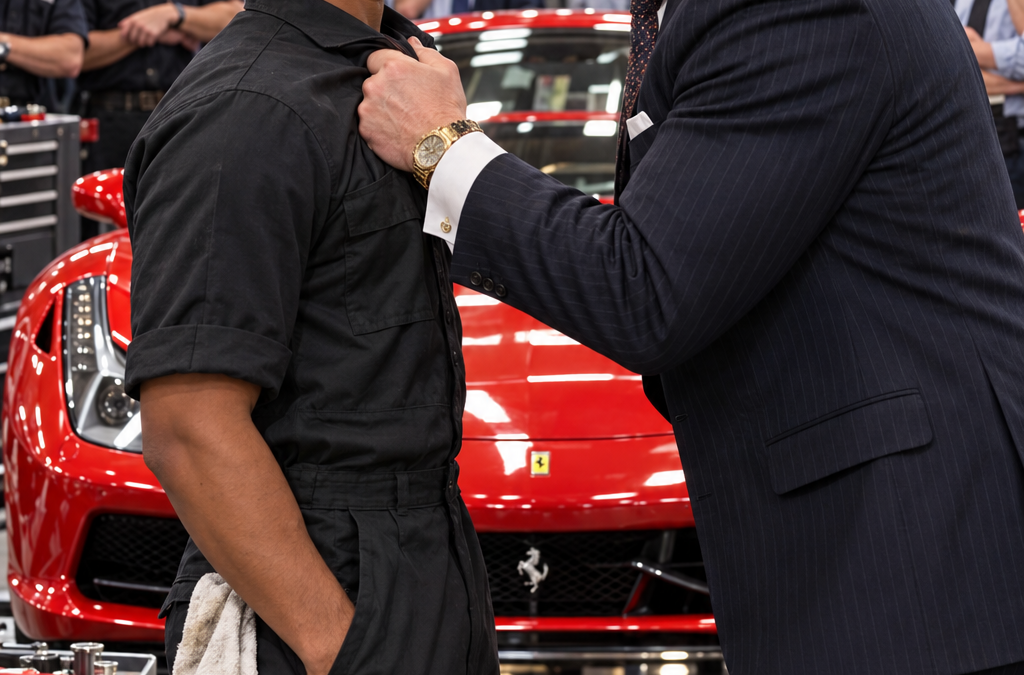
His hand grabbed my collar.
“And you think you belong in this room?”
I looked down at his fist.
Then up.
“Let go.”
“Or what?”
“Nothing.”
That seemed to confuse him.
I continued quietly.
“I just want to fix the car.”
Preston’s voice sharpened.
“Victor.”
Victor released me.
I straightened my shirt.
Then I walked to the Ferrari.
I placed both hands on the hood.
Cold metal.
Fourteen years without a heartbeat.
I closed my eyes.
Somebody laughed.
“Clock’s running.”
I ignored them.
Tap.
Listen.
Move.
Tap.
Different.
Move.
Tap.
Flat.
I opened my eyes.
“Third cylinder.”
Victor scoffed.
I leaned closer to the hood.
“Micro-slack in the timing chain.”
A senior engineer frowned.
I continued.
“Engine’s been sitting fourteen years. Metal contraction, guide relaxation, chain tension changed unevenly.”
I tapped again.
“Enough to shift sequence.”
Victor crossed his arms.
“You diagnosed microscopic chain movement through the hood.”
“Yes.”
“That isn’t science.”
Margaret spoke.
“It used to be.”
Victor turned.
She continued.
“Resonance diagnosis.”
Several older engineers looked at one another.
“European restorers used variations of it before digital sensors became standard.”
Victor shook his head.
“You can’t fix it without tearing down the engine.”
“I can.”
“In twenty minutes?”
“Yes.”
“How?”
I reached into my pocket.
Elijah’s wrench caught the light.
Derek laughed into his phone.
“Look at that thing.”
I looked at the Ferrari.
Then at the wrench.
For a second, I was eight again.
Concrete floor.
Alabama heat.
My grandfather’s hands.
Listen.
I crouched.
The bolt I needed sat deep behind the assembly.
Most people would have used a light.
Mirror.
Camera.
I didn’t.
I reached in by feel.
Found the bolt.
Placed the wrench.
Quarter turn.
Listen.
Eighth turn.
Listen.
Behind me, Victor muttered something.
I didn’t hear it.
The room disappeared.
There was only the engine.
Turn.
Listen.
Turn.
Listen.
The tiny click changed.
I adjusted again.
My arm was buried nearly to the elbow.
Sweat moved down my temple.
My hand stayed steady.
After several minutes, I heard something I hadn’t heard before.
A low metallic resonance.
Almost a sigh.
Margaret stood.
I pulled my arm out.
“The chain is aligned.”
Victor released a breath.
“Then start it.”
“No.”
He smiled.
“I knew it.”
“It still won’t run.”
Laughter started.
I raised one hand.
“There’s something else.”
I looked at the valve cover.
A memory moved through me.
So the next man who really listens knows I was here.
My heart began pounding.
I loosened the bolts.
Lifted the cover.
And there it was.
Folded paper.
Yellow.
Oil stained.
My fingers stopped.
Nobody laughed.
I reached in and lifted it carefully.
Unfolded once.
Twice.
Handwriting.
My vision blurred before I reached the signature.
I knew the slant of the letters.
The narrow E.
The oversized O.
Elijah Owens.
I couldn’t breathe.
Margaret came closer.
“What is it?”
I handed her the paper.
She looked.
Her face changed.
“Oh, Lord.”
The room was completely silent.
Margaret touched the signature.
“Elijah.”
I wiped my eyes.
She looked at me.
“You’re his grandson.”
It wasn’t a question.
I nodded.
“How did you know him?” I asked.
Her mouth trembled.
“I apprenticed under him.”
My breath caught.
“Selma?”
“Summer of sixty-eight.”
She smiled through wet eyes.
“He taught me everything worth knowing.”
Victor stared between us.
Margaret turned toward the engineers.
“This note was written by Elijah Owens.”
Nobody moved.
“He was the finest mechanic I ever worked beside.”
Her voice strengthened.
“He had no engineering degree. No formal certification. No industry awards.”
She held up the note.
“And he understood engines in ways most people never will.”
She looked at me.
“This man carries his hands.”
I swallowed hard.
Preston stepped closer.
“My father took this car to Alabama.”
He sounded stunned.
“He told me once.”
I looked at him.
“He never remembered the mechanic’s name. He called him the only man that car ever trusted.”
I stared at the note.
The dates didn’t align perfectly with every memory I had carried as a child, but the history did.
The Ferrari had been in Elijah’s hands more than once across its life.
What mattered was that the handwritten sequence matched the engine in front of us.
Grandpa had left instructions.
Torque values.
Cold tolerance.
Adjustment sequence.
Exactly the kind of notes he used to scribble on coffee cans and cardboard scraps.
Preston looked at me.
“Can you finish it?”
I folded the paper carefully.
“Yes.”
The second problem was beneath the valve cover.
Collapsed gasket.
Secondary misalignment.
The note told me enough.
For the next few minutes, I worked the way Elijah had taught me.
Slowly.
No wasted motion.
No performance.
No need to impress anybody.
I could almost feel him standing behind me.
Not correcting.
Just watching.
When I finished, I replaced the cover.
Tightened the bolts.
Set the wrench on the engine.
Then stepped back.
“Try it.”
Preston held the key.
For fourteen years, he had turned that key and been disappointed.
I could see it in his face.
Hope can become frightening after enough failures.
He climbed into the driver’s seat.
Leather creaked.
He looked through the windshield at me.
I nodded.
He turned the key.
Starter.
Whine.
One second.
Two.
Then something caught.
The vibration reached my feet first.
A pulse through concrete.
Then the Ferrari roared.
Not coughed.
Not sputtered.
Roared.
The sound slammed against the walls.
A mug vibrated off Victor’s bench and shattered.
Diagnostic papers slid onto the floor.
Nobody moved to pick them up.
I stood still.
The engine settled into rhythm.
Alive.
Clean.
Deep.
Fourteen years of silence gone in seconds.
I closed my eyes.
And heard Grandpa.
Every engine has a heartbeat.
When I opened them, Margaret was crying.
Preston gripped the steering wheel with both hands.
A hundred engineers stood frozen.
Derek’s phone was still recording.
Victor had lost all color.
No smile.
No insults.
No words.
The man who had spent twelve days making sure everyone heard him could not speak.
I didn’t look at him for long.
I looked at the Ferrari.
That mattered.
Margaret walked forward and placed her palm on the hood.
She closed her eyes.
Felt the vibration.
Then came to me.
“Elijah would be proud.”
I tried to answer.
Nothing came.
She placed her hand on my shoulder.
“You sound just like his hands.”
That broke me.
I turned away.
Covered my mouth.
All those years.
The shop gone.
Tools scattered.
His name forgotten outside Selma.
And somehow his hands were still here.
In mine.
Preston shut off the engine.
Silence returned.
Different silence.
Respectful.
He climbed out.
Walked directly toward me.
Then took my hand in both of his.
“My father spent decades wondering what happened to the man who fixed this car.”
His voice cracked.
“He never found him.”
I looked at the note.
Preston continued.
“He died wishing he had thanked him properly.”
He tightened his grip.
“So I’m thanking you.”
I nodded.
“And him.”
I looked away for a second.
“Thank you.”
Preston released my hand.
Then he faced the room.
“I brought a hundred engineers here for one purpose.”
Nobody moved.
“To start that engine.”
He turned back to me.
“Solomon did it.”
Victor finally found his voice.
“Preston, this is—”
Preston held up a hand.
Victor stopped.
“I own thirty classic cars.”
Preston looked at me.
“Some haven’t run in decades.”
I thought I knew what was coming.
I didn’t.
“I want you to run restoration.”
I stared at him.
“Sir?”
“Head of classic restoration.”
Victor laughed once in disbelief.
Preston ignored him.
“Your own team. Your own authority. Your own shop if that’s what it takes.”
I looked around the bay.
At the men who had mocked me.
The sign.
The lunchroom.
The videos.
Then at my polo.
“I’m a valet.”
Preston shook his head.
“You were a valet thirty seconds ago.”
The words hit me harder than I expected.
Not because I was ashamed of parking cars.
I wasn’t.
Work is work.
Elijah taught me that too.
But for three years, Greystone had treated the uniform as if it described my limits.
I had started believing it might.
Margaret turned toward the room.
She raised Elijah’s note.
“I want everyone here to understand what almost happened.”
No one spoke.
“This industry ignored Elijah Owens because men with credentials assumed a Black mechanic in Alabama could not know what they did not.”
Her voice hardened.
“He died without the recognition he deserved.”
She pointed toward me.
“And today, you almost repeated it.”
Several engineers looked down.
“The only man who solved your problem was the man you kept outside the room.”
I watched them.
Some looked ashamed.
Some defensive.
Some simply stunned.
Nobody apologized.
Not then.
I didn’t need it.
Apologies matter.
But they do not rewrite what happened.
I pulled out my phone.
One missed FaceTime call.
Lily.
I called back.
Her face filled the screen instantly.
She was crying.
“Daddy!”
I crouched.
“What happened?”
“I saw you!”
“What?”
“On the phone! Mrs. Alvarez showed me! You fixed the red car!”
I laughed through tears.
“We fixed it.”
She frowned.
“We?”
I looked at Elijah’s wrench.
“Me and Grandpa Elijah.”
Lily wiped her face.
“Is he in heaven?”
“Yes.”
“Can he see engines from there?”
I laughed.
“I hope so.”
That video reached millions of people.
Not the video Derek had intended to make.
He wanted to film a valet embarrassing himself.
Instead, people watched Victor insult me.
Watched engineers laugh.
Watched somebody try to trip me.
Watched Derek push the camera closer every time he expected humiliation.
Then they watched the Ferrari start.
By morning, Victor Harrington’s name was everywhere.
Greystone fired him before noon.
Their statement talked about company values.
Zero tolerance.
Standards.
I read it once.
Then put my phone away.
The truth was obvious.
They had tolerated Victor until tolerance became expensive.
That mattered to me.
Companies like to pretend wrongdoing begins the moment the public sees it.
It doesn’t.
Victor had been humiliating me for days.
People heard him.
People laughed.
Nobody stopped him.
The cameras did not create the problem.
They only removed everybody’s ability to deny it.
Victor released an apology.
Not really an apology.
“I regret if my comments were perceived as offensive.”
I read that line twice.
If.
That little word carried more cowardice than the rest of the statement combined.
Companies canceled contracts.
A conference removed him from its schedule.
His professional profile disappeared.
Derek tried to defend himself.
Said the livestream had been misunderstood.
Said he was “documenting an unusual challenge.”
The original footage destroyed that excuse.
His own captions.
His laughter.
His comments.
Greystone fired him too.
Sponsors left.
He deleted his accounts.
For a while, reporters kept asking me what I thought.
One asked whether watching Victor lose his career felt satisfying.
I considered the question.
Then said the truth.
“I don’t think about Victor Harrington much.”
The reporter looked surprised.
“What do you think about?”
“My daughter.”
I paused.
“My grandfather.”
Then smiled.
“And engines.”
“What about everything that happened?”
I shrugged.
“The rest is noise.”
That answer spread almost as widely as the Ferrari video.
But I wasn’t trying to make a statement.
I meant it.
Anger can become another job.
I already had enough work.
Preston kept his promise.
So did I.
I accepted the restoration position.
Not immediately.
I made him put everything in writing.
Salary.
Authority.
Team structure.
Training budget.
And one condition.
“I choose who works under me.”
Preston nodded.
“Done.”
“No exceptions.”
“Done.”
I hired people who knew engines.
But that wasn’t enough.
I wanted people who knew how to respect work.
The first mechanic I hired was a young man fresh out of trade school who had spent years being told diesel repair was the only thing he was good for.
The second was a woman in her sixties who had been pushed out of two restoration shops by men who thought gray hair meant obsolete knowledge.
The third was a quiet twenty-year-old who struggled badly in interviews but could disassemble a carburetor faster than anyone I had ever met.
I did not build a team of impressive résumés.
I built a team of listeners.
Six months later, Preston gave me something I had not asked for.
He bought the old property in Selma.
Elijah’s property.
Or what was left of it.
The building had been gone for years.
The concrete foundation remained beneath weeds.
When Preston told me, I stared at him.
“Why?”
“You said your grandfather deserved a shop.”
“I said he deserved to be remembered.”
“So remember him properly.”
I drove Lily to Alabama.
She had never seen the place.
We stood beside the old foundation.
She held my hand.
“This was Grandpa Elijah’s?”
“Yes.”
“It’s small.”
I laughed.
“Everything seems small when you’re six.”
She looked at me.
“I’m six.”
“Exactly.”
We rebuilt the garage.
Not into a museum.
Elijah would have hated that.
A working shop.
Same road.
Same land.
Concrete floor.
Modern lifts.
Old hand tools mounted beside new ones.
Above the door, the sign read:
ELIJAH’S GARAGE
Underneath:
LISTEN TO WHAT THE ENGINE IS TELLING YOU.
Preston moved several cars from his collection there.
Mercedes.
Shelby.
Barracuda.
Machines that had not run in years.
We brought them back one by one.
People began traveling to Selma again.
Not because of a viral video.
Because the work was good.
That mattered more.
One afternoon, I was sitting on a stool rebuilding a carburetor when Lily climbed onto an overturned bucket beside me.
Exactly where I had sat beside Elijah.
She held the old ten-millimeter wrench.
Turned it over.
Ran one finger across the letters.
EO.
“Daddy?”
“Yeah?”
“Can engines really talk?”
I smiled.
“Yes.”
She leaned closer.
“What do they say?”
“Depends on the engine.”
“That’s not an answer.”
“It’s the only answer.”
She frowned.
I put down the carburetor.
“Machines tell you what hurts.”
“How?”
“Sound.”
I tapped the engine block.
“Vibration.”
Another tap.
“Heat.”
She listened seriously.
“But you have to be quiet enough.”
She nodded.
Then placed her palm on the metal.
Closed her eyes.
I watched her.
For several seconds, she said nothing.
Then her eyebrows lifted.
“I feel something.”
I smiled.
“What?”
“A little shaking.”
“Good.”
“Is that bad?”
“Not always.”
She opened her eyes.
“How do you know?”
“That’s what you learn.”
“Will you teach me?”
The question hit something deep inside me.
I looked at the shop.
At the lifts.
At Elijah’s photograph hanging on the wall.
At Margaret’s handwritten letter framed beside it.
At Preston’s Ferrari, restored and running, parked beneath a cover in the far bay.
Then back at Lily.
“Yes.”
“When?”
“Now.”
I moved the carburetor between us.
“First lesson.”
She sat straighter.
“Every engine has a heartbeat.”
Lily smiled.
“That sounds like Grandpa Elijah.”
“It should.”
I handed her the wrench.
For years, I had thought Elijah’s legacy ended when the bank took his shop.
I was wrong.
Buildings disappear.
Tools get sold.
Names get forgotten.
But knowledge can survive inside another person.
So can dignity.
So can patience.
So can the belief that work should be judged by the hands doing it, not the skin around those hands or the uniform on their back.
I still think about that day at Greystone sometimes.
Not the moment the Ferrari started.
The days before.
The sign.
The hallway.
The lunchroom.
Victor’s hand on my collar.
A hundred people laughing because they thought my job title told them everything they needed to know about me.
That is the part I remember.
Because when the engine started, everybody understood.
The harder lesson is what comes before proof.
Who do you respect before they prove themselves useful to you?
Who do you listen to before somebody important confirms they are worth hearing?
Who do you look past because their uniform is cheap?
Their hands are dirty?
Their accent is unfamiliar?
Their name isn’t printed beneath a degree?
I had the answer on day one.
Nobody asked.
That Ferrari spent twelve days surrounded by brilliant people who knew more theory than I ever would.
They had better equipment.
Better credentials.
Better access.
And they kept trying to force the machine to answer their questions.
Elijah had taught me something different.
Listen first.
That principle applied to more than engines.
A man can stand beside you for years carrying skills, grief, history, and brilliance you never notice because you decided what he was worth before he spoke.
Victor looked at my valet shirt and saw failure.
Derek looked at me and saw content.
The engineers saw someone beneath them.
Elijah would have seen hands.
That was always his measure.
Not status.
Not race.
Not money.
Do the hands care?
Do they listen?
Do they respect the work?
Years after Greystone, Lily asked me about Victor.
She was older then.
Old enough to understand the video.
“Do you hate him?”
We were closing the shop.
Sunset turned the dirt road orange.
I thought about it.
“No.”
“Why not?”
“Because hate keeps somebody in your life.”
She considered that.
“What if he hates you?”
“That’s his problem.”
She smiled.
Then looked at the wrench hanging near my bench.
“Grandpa Elijah would’ve yelled at him.”
I laughed.
“No.”
“He wouldn’t?”
“He would’ve made Victor stand quietly and listen to the engine.”
“That’s worse.”
I laughed harder.
Maybe she was right.
A man like Victor could survive anger.
Silence bothered him.
Especially silence followed by truth.
That was why I never shouted.
I didn’t need to.
The Ferrari spoke for me.
The old wrench spoke for Elijah.
And when that engine came alive beneath the lights, every insult in the room suddenly sounded small.
That is what I learned.
You do not always have to answer people who underestimate you.
Sometimes the best answer is to know exactly what you can do.
Wait until the moment matters.
Then put your hands on the work.
Listen.
And let the result make the noise.








