𝗙𝗨𝗟𝗟 𝗦𝗧𝗢𝗥𝗬 The Woman Who Called My Shop a Garbage Dump Returned Before Sunset With a Look I Had Never Seen on Her Face
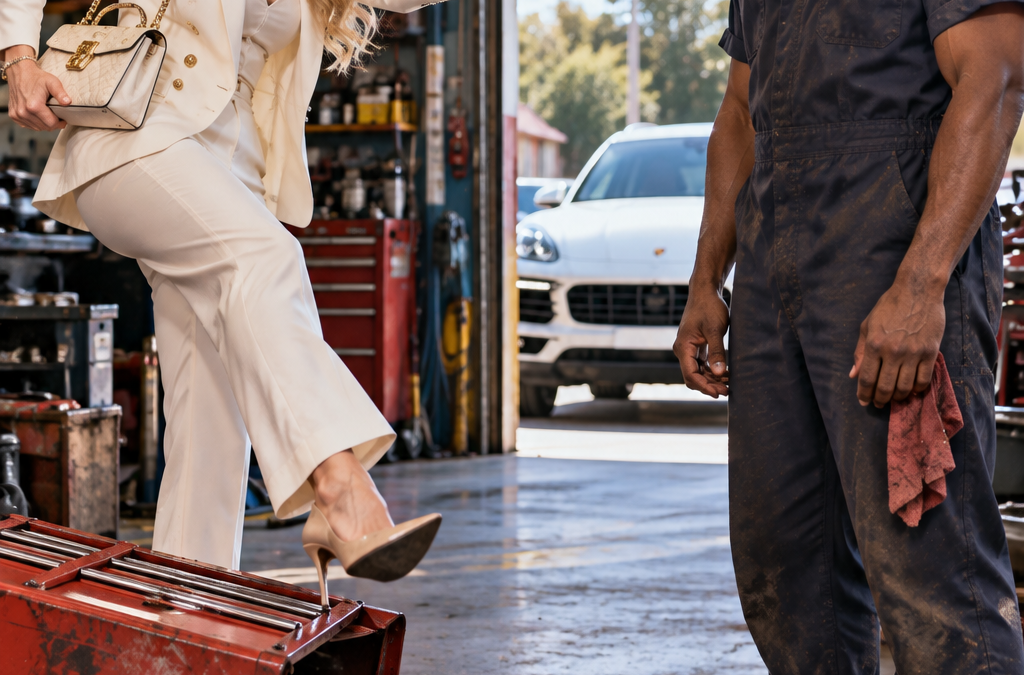
𝗙𝗨𝗟𝗟 𝗦𝗧𝗢𝗥𝗬
There are insults you hear with your ears.
And there are insults that wake up memories.
For one second, I wasn’t thirty-five.
I was fifteen again.
Standing inside my grandfather Earl’s garage while a farmer questioned whether a Black mechanic knew how to repair a tractor.
I could hear Grandpa’s voice.
The machine doesn’t know color.
That sentence had kept me out of more fights than any law ever could.
So I bent down.
Picked up the first wrench.
Then the second.
The woman stood there waiting.
For anger, maybe.
I gave her none.
When the last socket was back in its tray, I stood.
“Anything else?”
She stared at me.
Then turned.
Her Porsche started with an expensive growl.
She accelerated hard enough to throw dust across my parking lot.
I watched the vehicle disappear down Cedar Road.
Then I returned to work.
The grain elevator valve on my bench was due Thursday.
The farmer who owned it had three hundred acres of corn waiting on that machine.
His problem mattered.
Victoria Ashford didn’t.
At least that was what I believed at nine-thirty that Tuesday morning.
By sunset, I would know better.
Cedar Road sat on the industrial edge of Milfield, Ohio.
Milfield had once been a steel town.
You could still see the skeleton of what it used to be if you knew where to look.
Brick warehouses with broken windows.
Old rail spurs disappearing beneath weeds.
Factories that used to run three shifts operating one.
Bars built for crowds of workers now closing before midnight.
My grandfather used to tell me that when he was young, the night sky over Milfield glowed orange from the mills.
By the time I was born, most of that glow was gone.
People stayed because their families were there.
Because their houses were paid off.
Because moving costs money.
Because sometimes leaving a dying town feels more frightening than dying slowly with it.
Jensen Repair sat between a tire yard and an old hardware store that had been empty for nine years.
The shop had started as Grandpa Earl’s garage.
He built the first workbench himself.
He welded the frame from scrap steel.
The top was three-inch maple he salvaged from a demolished school.
When I was a kid, I thought that bench was indestructible.
By thirty-five, I knew nothing was indestructible.
But some things lasted because people cared for them.
That was the philosophy of the shop.
I repaired what other people abandoned.
Diesel engines.
Hydraulic systems.
Old compressors.
Farm equipment.
Industrial machinery manufactured by companies that no longer existed.
My favorite jobs were the ones dealers declared impossible.
“Parts discontinued.”
“Machine obsolete.”
“Replace entire system.”
Those phrases usually meant nobody had taken the time to understand what was actually broken.
A machine is rarely mysterious.
It tells you what hurts.
You just have to listen long enough.
Grandpa taught me that.
He taught me almost everything.
I was eight when he first put my hand on a running engine block.
“Close your eyes.”
I looked at him.
“Why?”
“You use those too much.”
He pointed at my eyes.
“Close them.”
I did.
The engine vibrated beneath my fingers.
“What do you hear?”
“A motor.”
He slapped the back of my head lightly.
“Boy, if that’s all you hear, I’ve wasted a whole summer.”
I listened again.
The idle wasn’t even.
There was a faint knock under the main rhythm.
“Something’s tapping.”
“Where?”
I moved my hand.
“Left side.”
He smiled.
“Valve seat.”
I opened my eyes.
“How do you know?”
“I listened before you were born.”
That was Grandpa.
No magic.
No ego.
Just time.
At twelve, I could diagnose an alternator from dashboard flicker.
At fourteen, I could rebuild a carburetor.
At sixteen, truck drivers were dropping vehicles at our garage and leaving the keys with me if Grandpa happened to be at the factory.
But the lesson I remembered most clearly had nothing to do with machines.
I was fifteen.
Winter.
A farmer brought in a tractor that had died during harvest.
He was white.
Grandpa was Black.
So was I.
The farmer acted as if those facts were part of the repair estimate.
He questioned every price.
Every tool.
Every diagnosis.
At one point he asked Grandpa whether he had “somebody certified” who could check his work.
Grandpa just kept turning the wrench.
I was furious.
We repaired the tractor.
Perfectly.
The farmer paid less than he should have after complaining about the price for twenty minutes.
He never thanked us.
When his truck disappeared, I picked up a wrench and threw it.
It hit the floor.
Grandpa walked over.
Picked it up.
Placed it on the pegboard.
Then sat beside me.
“The machine doesn’t know color.”
I stared at him.
He pointed toward the road where the farmer had left.
“That man might.”
His finger moved toward the tractor tracks.
“That tractor doesn’t.”
I said nothing.
“A crankshaft doesn’t care if your hands are Black or white. A valve doesn’t open easier because a man has money. Steel doesn’t respect titles.”
He tapped my chest.
“It respects understanding.”
I remember swallowing because I was still angry enough to cry.
Grandpa continued.
“You master the work, Samuel. Really master it. Then when people underestimate you, let the machine introduce you.”
I carried that sentence for the rest of my life.
That Tuesday morning, after Victoria Ashford left my shop, I let the grain elevator introduce me back to myself.
I worked until noon.
The valve assembly had scoring along the internal bore.
I machined a sleeve, replaced the seals and pressure-tested the unit.
At twelve-fifteen, Dorothy Webb walked into the shop.
Dorothy owned the little house behind mine.
She was sixty-seven and had known me since I was born.
Her eyes were wet.
I looked up.
“You okay?”
She held out her phone.
“Sam.”
“What?”
“They’re doing something terrible.”
I wiped my hands.
On the screen was a video.
Victoria.
My shop.
Me.
She had apparently filmed part of our encounter.
The caption read:
Small town. Smaller ambitions.
I watched five seconds.
Then handed the phone back.
Dorothy stared at me.
“You’re not angry?”
“I was there.”
“People are laughing at you.”
“People laugh.”
“They’re saying things.”
“People talk.”
“She called you—”
“I heard what she called me.”
Dorothy’s voice cracked.
“That woman has never met you.”
“That didn’t stop her.”
“She put your face online.”
I looked at the repaired valve on my bench.
“Is that grain elevator going to care about the internet?”
Dorothy blinked.
Then shook her head.
“No.”
“Then I have a deadline.”
She stood there for another second.
“You’re just like Earl.”
I smiled.
“That sounds like an insult when you say it like that.”
She almost laughed.
Then she left.
I didn’t own a smartphone.
That fact confused people.
I had a flip phone.
It made calls.
It survived being dropped on concrete.
That was enough.
I had no interest in watching strangers decide what I was worth.
But I noticed something else that afternoon.
The shop stayed quiet.
Too quiet.
People usually came through.
A farmer needing a belt.
A trucker asking about a differential.
Somebody stopping to borrow a torque wrench they would forget to return.
Not that day.
Nobody came.
Years later, that was the part I remembered more than Victoria.
Not the insults.
The silence.
People who had trusted me with equipment worth more than their houses saw the video.
Some probably hated it.
Some probably defended me from their couches.
But only Dorothy walked through my door.
There are moments when a community teaches you exactly what courage costs.
That day, apparently, it cost a walk across a parking lot.
At 2:47 p.m., everything changed.
I did not know the exact time until later.
At 2:47, the central hydraulic press system inside Milfield Manufacturing failed.
Milfield Manufacturing was the town’s last major employer.
Four hundred people.
Parents.
Grandparents.
Men and women I had gone to school with.
Families whose mortgages depended on that building making automotive components five days a week.
Victoria Ashford had purchased the company six weeks earlier.
She was thirty.
Wealthy.
Educated.
From somewhere on the East Coast.
She had arrived in Milfield with consultants, lawyers and a Porsche.
The plant produced precision components for Brower Automotive, a European manufacturer whose contract represented most of Milfield Manufacturing’s revenue.
The heart of the plant was an old hydraulic press line.
Installed in 1987.
I knew the system.
Not because I had worked there.
Because Grandpa had built it.
Officially, he hadn’t.
Officially, Earl Jensen had been maintenance staff.
That was one of the great lies of his life.
Grandpa spent thirty-one years at that plant.
He designed modifications.
Solved pressure problems.
Rebuilt hydraulic circuits.
Created custom components.
Men with engineering titles took his drawings into meetings.
Managers signed their names to his solutions.
He remained Earl from maintenance.
He never complained.
That used to make me angry.
It still did.
When I was twenty-two, after he died, I found his leather notebook.
Four hundred pages.
Hand-drawn schematics.
Pressure tables.
Material specifications.
Diagnostic notes.
Every machine he had touched.
Every modification.
Every mistake somebody else had made that he corrected.
One section was marked:
MILFIELD MANUFACTURING — HYDRAULIC PRESS LINE — 1987.
Inside were the drawings for the HV40 control valve.
Grandpa’s design.
Custom.
Never mass-produced.
Never cataloged.
He had fabricated the original by hand.
That notebook lived in a fireproof lockbox beneath my workbench.
At 4:11 that afternoon, my flip phone rang.
Unknown number.
I answered.
“Jensen Repair.”
A man’s voice.
“Samuel?”
“Yes.”
“This is Phil Garrett at Milfield Manufacturing.”
I knew Phil.
Not well.
He had brought me a pump assembly three years earlier.
Good engineer.
The kind who didn’t pretend to know what he didn’t.
“We’ve got a problem.”
“What kind?”
“HV40.”
I stopped moving.
“What happened?”
“Main housing cracked.”
“Pressure event?”
“Looks like it.”
“How bad?”
“Three sublines down.”
I leaned against the bench.
“Relief system?”
“Still intact.”
“Return contamination?”
“Elevated.”
Silence.
Then Phil said, “I gave your name to Victoria this morning.”
“I noticed.”
Another silence.
“I’m sorry.”
“You didn’t kick my toolbox.”
His exhale sounded almost like a laugh.
“Can you come?”
I looked at the clock.
“Did she ask you to call?”
Phil hesitated.
That answered me.
“No.”
“She wants someone who knows the system.”
“She knows where I work.”
“Sam.”
“I’m not being difficult.”
I wasn’t.
“If she needs me, she can ask.”
Phil said nothing.
We ended the call.
At 5:02, I was locking the shop.
The grain elevator valve was complete.
I had swept the floor.
Tools were back where they belonged.
The sun was low enough to cast long shadows across Cedar Road.
Then I heard the Porsche.
Same white vehicle.
Same woman.
Different posture.
She parked.
Got out.
Her white blazer was still immaculate.
But she no longer moved like she owned the pavement.
She stopped three feet from me.
“Mr. Jensen.”
I held the padlock.
“Ms. Ashford.”
“I need your help.”
Three words.
No apology.
I waited.
She looked uncomfortable with silence.
Good.
“What broke?”
Her face tightened.
“Everything.”
I looked at her for several seconds.
Then unlocked the door I had just locked.
“What system?”
“Main hydraulic press.”
“HV40?”
She blinked.
“Yes.”
“Pressure failure?”
“Yes.”
I entered the shop.
She followed.
Her eyes moved toward the toolbox she had kicked earlier.
I wondered if she remembered.
Of course she remembered.
People always remember cruelty when they need something from the person they hurt.
I slid the fireproof lockbox from beneath the bench.
“What is that?”
“Your factory.”
She frowned.
I lifted it.
“You driving?”
“Yes.”
“I’ll follow.”
“I can take you.”
“No.”
I walked toward my truck.
She stood there.
“Mr. Jensen.”
I turned.
For one second, I thought she might apologize.
She didn’t.
“We don’t have much time.”
“Then you should probably stop wasting it.”
I drove behind her to Milfield Manufacturing.
The lockbox sat on the passenger seat.
Grandpa’s notebook inside.
For the entire drive, I thought about him.
Earl Jensen died on a Thursday morning in March.
He was sixty-eight.
Heart attack.
Fast.
Unfair.
The night before, he had been in the garage arguing with me about thread pitch.
The next morning, he was gone.
For months afterward, I kept expecting to hear his boots behind me.
That was grief for me.
Not dramatic.
Mechanical.
A missing sound.
An absent tool.
A question with no one left to answer it.
When I inherited the shop, I kept his sign.
His workbench.
His pegboard.
His notebook.
I changed almost nothing.
Some people called that sentimental.
Maybe it was.
But I also knew something they didn’t.
The world had spent Earl’s whole life refusing to put his name where it belonged.
I wasn’t going to erase it too.
We arrived at the factory at 5:48.
I had never heard that building quiet.
Factories have personalities.
Milfield’s was noise.
Steel.
Hydraulics.
Conveyors.
Compressed air.
Four hundred people working around machines designed to pound metal into exact shapes all day.
That evening, the building sounded like a church after a funeral.
Workers stood in groups.
Production dead.
Oil gleamed across the concrete beneath the central press line.
Victoria walked ahead of me.
Fast.
She pointed.
“It’s over there.”
I stopped.
She kept walking for three steps before realizing I wasn’t following.
“What?”
I looked around.
Ceiling.
Crane rails.
Ventilation.
Hydraulic routes.
Floor drains.
Emergency shutoffs.
Anchor bolts.
Older machines often tell their history through modifications.
A new line here.
Different fitting there.
Paint disturbed around a junction.
I was already reading the system before touching it.
Phil came toward me.
He held out his hand.
I shook it.
“Main housing cracked.”
“Show me.”
We walked.
Workers stepped aside.
Some recognized me from the video.
I could see it in their faces.
A few looked embarrassed.
One older machinist named Ray Caldwell gave me a small nod.
Ray had brought his truck to my shop twice.
He had always treated me straight.
I returned the nod.
At the far end of the line stood a tall European man in a charcoal suit.
I later learned he was Hans Brower.
Chief technical officer for Brower Automotive.
His company’s contract was the reason everybody in the building looked afraid.
He watched me approach.
Then said something quietly to his assistant.
The assistant translated.
“He asks if you are the repair specialist.”
Victoria hesitated.
“Yes.”
Hans looked at my coveralls.
Toolbox.
Old lockbox.
Then at Victoria.
“One man?”
His English was precise.
“You are sending one man to repair what your engineering department could not?”
I heard it.
Didn’t care.
I had heard versions of that sentence my entire life.
One man.
One mechanic.
One Black guy.
One shop on Cedar Road.
People love numbers when they don’t understand skill.
Twenty confused people are still confused.
I reached the HV40.
The crack was obvious.
Diagonal.
Main housing.
Hydraulic fluid coated the surrounding platform.
I set down my toolbox.
Then the lockbox.
When I opened it, Phil leaned closer.
I removed Grandpa’s notebook.
Turned through the pages.
Stopped.
There it was.
HV40 — MILFIELD MANUFACTURING — CUSTOM BUILD 1987.
Grandpa’s handwriting.
His lines.
His measurements.
For a second, the factory disappeared.
I was eight again.
Watching his pencil move.
Phil stared.
“Is that…”
“My grandfather’s.”
He looked from the drawing to the machine.
“He designed this?”
“Built it too.”
I touched the page.
“This valve was never a catalog part.”
Hans had stepped closer.
He looked at the notebook.
“These are original engineering drawings?”
“Yes.”
“Who was your grandfather?”
“Earl Jensen.”
Hans frowned.
“I reviewed plant history. There is no Jensen listed among original engineers.”
I looked at him.
“He wasn’t listed as an engineer.”
“What was he listed as?”
“Maintenance.”
Hans looked at the drawing again.
Then at the machine.
Phil’s face changed.
He knew what that meant.
So did some of the older workers.
I closed the notebook.
Placed my hands on the valve housing.
Steel communicates.
Temperature.
Residual vibration.
Stress.
I moved along the lines.
Then looked at Phil.
“I need metric pipe wrenches.”
“Okay.”
“Machine shop access.”
“Done.”
“And ten feet around the line clear.”
Phil nodded.
Then I looked at Victoria.
“One more thing.”
“What?”
“I need you off the floor.”
Her eyes widened.
“Excuse me?”
“You don’t know this equipment.”
“That is my factory.”
“It is also a dangerous hydraulic system with stored pressure.”
Her face reddened.
“You don’t get to order me out of my own—”
“This morning you called machines you didn’t understand junk.”
The room went silent.
I kept my voice level.
“I need people around this system who respect what it can do.”
Her eyes flashed.
“You’re doing this because of this morning.”
“No.”
I pointed toward the cracked housing.
“I’m doing it because hydraulic fluid under pressure can pass through skin before a person knows they’ve been hit.”
Phil looked at her.
Hans looked at her.
So did the executives.
I continued.
“If you want me to repair it, safety is mine.”
For a second, I thought she would fire me from a job she hadn’t technically hired me for.
Then she turned.
Her heels echoed across the floor.
The stairwell door closed behind her.
I knelt.
And started listening.
I did not connect a computer.
I didn’t need one yet.
I placed my right hand on the main line.
Closed my eyes.
Phil went quiet.
My left hand moved across the feeder junctions.
Tap.
Listen.
Move.
Tap.
Listen.
The first section sounded normal.
Second.
Normal.
Then something changed.
Small.
Most people wouldn’t have heard it.
A slight turbulence pattern.
A resonance that should not have been there.
I moved backward.
Tapped again.
There.
I opened my eyes.
“This housing didn’t fail because it was old.”
Phil frowned.
“What?”
I pointed at the junction between the second and third stations.
“Open that.”
A technician brought tools.
We removed the cover.
I stared inside.
Then laughed once.
Not because it was funny.
Because I had spent four minutes listening to three years of somebody’s mistake.
“The check valve is backward.”
Phil leaned in.
“No.”
“Yes.”
He looked.
His face went pale.
“Jesus.”
Hans came closer.
“What does that mean?”
I pointed.
“This check valve controls fluid direction. Somebody installed it in reverse.”
“How long?”
Phil was already checking records on his tablet.
“2021.”
I nodded.
“Three years.”
Phil scrolled.
“External contractor.”
“That explains the housing.”
He looked at me.
“How?”
“The system has been pushing against restricted reverse flow every cycle. The HV40 has been compensating.”
“Every press cycle?”
“Yes.”
“How many?”
A technician answered.
“Several thousand per shift.”
I looked at the cracked housing.
“Then it has been fighting itself millions of times.”
Hans stepped closer.
“You knew from sound?”
“Yes.”
“How?”
I tapped the pipe.
“Correct flow is smooth through this section.”
I tapped again.
“Reverse check creates turbulence.”
“You can hear turbulence inside steel?”
“If you know the machine.”
He stared.
“How much difference?”
“Maybe two hertz in resonance.”
Hans looked at his assistant.
Said something in German.
The assistant wrote quickly.
Phil asked, “If we replace the housing?”
“It breaks again.”
“When?”
“Depends how hard you run production.”
I looked at him.
“But without correcting this, you’re not repairing anything. You’re resetting the clock.”
That was when the people around me stopped seeing the man from Victoria’s video.
I could feel it.
They started seeing the work.
That mattered more.
The cracked HV40 housing could not be repaired safely.
It had to be replaced.
The replacement did not exist.
I opened Grandpa’s notebook.
“Machine shop.”
Phil led me across the plant.
Lathe.
Mill.
Drill press.
Grinding station.
Good equipment.
Mostly used for light work.
I checked the material rack.
Found 4140 chromoly steel.
Eight-inch billet.
I rolled it across my palm.
“Good.”
Phil looked at the drawing.
“You can make it?”
“I can try.”
Hans frowned.
“Try?”
I looked at him.
“Anybody who promises perfection before cutting metal is either inexperienced or lying.”
Something almost like respect passed across his face.
I mounted the billet.
Checked alignment.
Set the tool.
Turned on the lathe.
The sound filled the shop.
Finally.
Noise I understood.
The first cut peeled steel away in a curling ribbon.
I adjusted speed by ear.
Measured.
Cut.
Measured again.
Grandpa had taught me that precision wasn’t about moving slowly.
It was about never moving carelessly.
Outer diameter.
6.375 inches.
Then the bore.
Incremental cuts.
Fifteen thousandths at a time.
Metal warmed.
Oil smoked faintly.
I could feel people watching.
Phil.
Hans.
Technicians.
Workers drifting close enough to see but not interfere.
I ignored all of them.
My world narrowed.
Steel.
Tool.
Measurement.
Grandpa’s numbers.
At one point I could almost hear his voice.
Don’t chase the dimension, boy. Let the tool arrive there.
I smiled without meaning to.
Phil noticed.
“What?”
“Nothing.”
The port angles came next.
Three ports.
One hundred twenty degrees apart.
Seven and a half degrees off radial.
No digital guide.
No CNC program.
Gauge blocks.
Protractor head.
Patience.
Hans stepped closer halfway through.
“You are doing this manually.”
“Yes.”
“Why not CNC?”
“Programming would take longer than cutting.”
“You trust your hands that much?”
“No.”
I checked the measurement.
“I trust the drawing.”
Ninety-four minutes after I started, I lifted the finished housing into the light.
Phil stepped forward.
He didn’t touch it.
Just stared.
Hans held out both hands.
“May I?”
I gave it to him.
He rotated the part slowly.
Checked the ports.
Bore.
Seal grooves.
“This would take my team hours to program.”
“Probably.”
“You did it in ninety minutes.”
“Ninety-four.”
He looked at me.
I wiped my hands.
“My grandfather would’ve done it in sixty.”
Phil laughed.
Even Hans smiled.
Then I opened Earl’s notebook again.
“We’re not done.”
Phil’s smile disappeared.
“What else?”
I returned to the line.
Compared the current layout against Grandpa’s original system drawing.
Years of maintenance had changed things.
Some changes were smart.
Some weren’t.
I pointed at a relief valve.
“What is that set to?”
A technician checked.
“Thirty-two hundred PSI.”
“Wrong.”
Phil frowned.
“That’s been the operating setting for years.”
“Grandpa specified twenty-eight hundred.”
“Why would somebody raise it?”
“To compensate for the flow restriction.”
I looked toward the reversed check valve.
“You lose efficiency, somebody increases pressure. Machine produces again. Problem seems solved.”
Hans nodded slowly.
“But pressure increases stress.”
“Exactly.”
I touched the line.
“At thirty-two hundred, your seals are living close to their burst limit.”
Phil rubbed his forehead.
“So we’ve been masking one problem by creating another.”
“Yes.”
Then I moved toward the reservoir return.
Pulled the filter specification.
“Twenty-five micron?”
A technician nodded.
I looked at Grandpa’s drawing.
“Should be ten.”
Phil stared.
“What difference?”
“Metal.”
I looked at him.
“Your fluid reports showing iron?”
His expression changed.
He pulled out the tablet.
“Forty-seven parts per million six months ago.”
“Next?”
“Fifty-two.”
“Next?”
He scrolled.
“Sixty-one.”
I nodded.
“Larger filter is letting particulate circulate.”
“And scoring cylinders.”
“Eventually seals too.”
Phil looked sick.
“How long?”
“Four years, maybe.”
Hans crossed his arms.
“You have found three systemic problems in less than two hours.”
“Four.”
Everyone looked at me.
I pointed to a line support near the second station.
“That bracket is too rigid.”
Phil frowned.
“That’s original.”
“No.”
I checked the notebook.
“Original had a floating mount.”
I pointed.
“Somebody replaced it.”
A technician checked the maintenance database.
“2019.”
“What’s wrong with rigid?”
“Thermal expansion.”
I ran my finger along the line.
“Hot fluid expands this run. Floating mount lets it move.”
I tapped the bracket.
“This traps expansion stress.”
Phil exhaled.
“So the whole system has been slowly getting strangled by repairs.”
“Repairs made without understanding the design.”
That sentence made everyone quiet.
Because that was the real problem.
The machine was old.
But age hadn’t betrayed it.
People had.
One small decision at a time.
Wrong filter.
Wrong pressure.
Wrong valve orientation.
Wrong bracket.
Each choice looked harmless alone.
Together, they nearly killed the factory.
I took chalk from a tray.
Knelt on the floor.
Started drawing.
Corrected flow direction.
Relief pressure.
Filter requirement.
Mounting points.
Fluid return path.
People gathered around.
The diagram grew until it covered six feet of concrete.
Questions started.
“Why this angle?”
“Reduces turbulence.”
“Why lower pressure?”
“System was designed around flow, not brute force.”
“Why ten micron?”
“Protects cylinder finish.”
“What happens if we run twenty-five?”
“You already saw what happens.”
Nobody laughed.
They took notes.
Photographs.
More questions.
I answered all of them.
I wasn’t interested in humiliating Phil’s team.
They hadn’t designed the mistakes.
And even if they had, knowledge is useless when used only as a weapon.
Grandpa taught me that too.
One young engineer asked, “How are we supposed to maintain a system this old after you leave?”
I looked at him.
“You stop treating old as primitive.”
He blinked.
I pointed to Earl’s drawing.
“This was designed around failure prevention. Understand why each piece is there before changing it.”
Phil nodded.
The engineer wrote that down.
Then a voice came from behind the group.
“I worked with Earl.”
Ray Caldwell.
The old machinist.
He stepped closer.
“Thirty years ago.”
I stood.
Ray looked at the notebook.
Then at me.
“He used to carry one just like that.”
“This is it.”
His eyes widened.
He touched the edge of the cover.
Not the pages.
Just the leather.
“He was the smartest man in this building.”
Nobody spoke.
Ray’s voice roughened.
“And nobody ever said it.”
His eyes met mine.
“I’m saying it now.”
I had spent thirteen years receiving compliments about my own work.
None hit me like that.
I looked down because I didn’t trust my face.
“Thank you.”
Ray nodded.
That was enough.
At 8:15 p.m., installation started.
First, the reversed check valve.
We opened the junction.
Removed it.
Rotated it.
Reseated it.
Seven minutes.
Three years of damage corrected in seven minutes.
That is the terrifying thing about industrial failure.
Sometimes millions of dollars depend on which direction somebody turns one component.
Then the relief valve.
Thirty-two hundred down to twenty-eight.
Then the filter.
Twenty-five micron element out.
Ten micron in.
The correct filter had been sitting on a shelf inside the factory.
For more than a year.
Nobody knew they needed it.
Then we replaced the rigid bracket with a floating mount.
Finally, the HV40.
The part I had machined.
Thirty-one pounds.
I lifted it into position.
Aligned the ports.
First bolt.
Finger tight.
Second.
Third.
Star pattern.
Torque wrench.
Eighty-five foot-pounds.
Each bolt checked twice.
When the final one seated, I rested both hands on the housing.
Phil stood beside me.
“You ready?”
I looked at the system.
Not yet.
I checked each connection again.
Seal orientation.
Line alignment.
Relief valve.
Filter.
Junction.
Then I placed my palm on the steel.
Closed my eyes.
For a second, I smelled Grandpa’s garage.
Cutting oil.
Coffee.
Winter air.
I could see his hands guiding mine.
The machine doesn’t know color.
I opened my eyes.
“Start it.”
Phil radioed the control room.
The main pump motor engaged.
Low hum.
Then rising pitch.
Fluid entered the system.
Pressure climbed.
Five hundred.
One thousand.
Fifteen hundred.
Two thousand.
Twenty-five hundred.
Every person around the line stared at the gauge.
Twenty-seven.
Twenty-eight.
The needle stopped.
Steady.
No pulse.
No vibration.
No leak.
I kept my hand on the housing.
Smooth.
“First press.”
Phil gave the command.
The hydraulic ram descended.
The platform shook.
Metal entered the die.
The press closed.
Opened.
A finished component dropped onto the conveyor.
Second press.
Third.
Three sublines synchronized.
I listened.
Not perfect.
Machines are never perfect.
But right.
The difference matters.
Phil grabbed the first produced component.
Carried it to inspection.
People waited.
Dimensional check.
Surface finish.
Material integrity.
All within specification.
Hans took the component.
Examined it beneath a light.
Turned it slowly.
Then looked toward me.
“It is better.”
I said nothing.
“Better than your previous operating benchmark.”
Phil checked system data.
He looked up.
“He’s right.”
Somebody behind us laughed from relief.
Then another worker clapped.
I turned.
Within seconds, the factory erupted.
Not like a stadium.
Like four hundred people realizing they might still have jobs tomorrow.
Men shouted.
Someone whistled.
A woman near the second station covered her mouth and cried.
Ray Caldwell clapped both hands above his head.
Phil grabbed my shoulder.
“Sam.”
I looked at him.
“You saved this place.”
I shook my head.
“Grandpa did most of the work thirty-seven years ago.”
“No.”
Phil’s grip tightened.
“You did.”
I looked at the machine.
“I finished maintenance that should’ve been done correctly.”
Hans approached.
He extended his hand.
I shook it.
“Mr. Jensen.”
“Samuel.”
“Samuel.”
He nodded toward the line.
“I have worked with engineers in twelve countries.”
I waited.
“I have never seen someone diagnose hydraulic turbulence by ear.”
“Then your engineers need quieter factories.”
He laughed.
Actually laughed.
Then his expression became serious.
“We will speak tomorrow.”
“About what?”
“Work.”
“I have work.”
“At my company.”
“I have a shop.”
“I know.”
There was something about the way he said it that told me the conversation was not finished.
Victoria was watching from the upper office windows.
I could see her silhouette.
She had not returned to the floor.
That was fine with me.
I packed my tools.
At 11:26 p.m., I left Milfield Manufacturing.
The factory was running.
The night air felt cold against my face.
I climbed into my truck.
Grandpa’s notebook sat beside me.
Before starting the engine, I opened it.
Turned to the HV40 page.
At the bottom, in handwriting I had somehow never noticed before, Grandpa had written:
If housing fails, inspect system before blaming component.
I laughed.
“Of course you did.”
Then I cried.
Not much.
Just enough.
I put my hand over my eyes.
For years, Grandpa had been dead.
That night he had been everywhere.
In the valve.
In the drawing.
In my hands.
In the machine that came back to life.
I drove home.
By the next morning, Milfield had changed its mind about me.
Or maybe the internet had.
A worker had recorded part of the repair.
The video showed me kneeling on the floor with chalk, explaining the corrected hydraulic layout while engineers stood around taking notes.
Someone paired it with Victoria’s morning video.
Same coveralls.
Same hands.
Same day.
In one clip, she called me garbage.
In the other, those hands were keeping four hundred people employed.
Dorothy arrived at my shop before eight.
She was smiling so hard I thought her face might hurt.
“You seen it?”
“No.”
“Half a million people.”
“Seen what?”
“You.”
“I see me every morning.”
She shoved her phone toward me.
I backed away.
“Dorothy.”
“You need to watch.”
“I don’t.”
“Samuel Jensen.”
“No.”
She put one hand on her hip.
“You are exactly like Earl.”
“I know.”
The phone kept ringing.
Customers.
Reporters.
People I hadn’t heard from in years.
Some neighbors finally came.
That part made me complicated inside.
People brought coffee.
Donuts.
Apologies.
One man said he had wanted to come yesterday but “didn’t know what to say.”
I told him he could have said hello.
He looked ashamed.
I didn’t enjoy that.
I just wanted him to understand.
At nine, Hans Brower arrived.
No entourage.
Just him.
He sat at Grandpa’s workbench.
I poured coffee.
He drank it black.
“You work here alone?”
“Mostly.”
“You understand hydraulic systems beyond automotive manufacturing.”
“Yes.”
“Pneumatics?”
“Yes.”
“Mechanical diagnostics?”
“Yes.”
“Industrial controls?”
“Enough to know when to call an electrician.”
He smiled.
Then slid a folder across the bench.
“Consulting agreement.”
I didn’t touch it.
“For what?”
“Brower Automotive global hydraulic systems.”
I looked at him.
“I don’t want to move.”
“You don’t have to.”
“I’m not closing this shop.”
“I am not asking you.”
“Travel?”
“Occasional.”
“How occasional?”
“Negotiable.”
I opened the folder.
The number stopped me.
I read it twice.
Then looked at him.
“That’s wrong.”
“No.”
“That is more money than I made in five years.”
“Yes.”
“For consulting.”
“For expertise.”
I closed the folder.
“You’ve known me less than twenty-four hours.”
“I saw enough.”
“That seems irresponsible.”
Hans leaned back.
“Samuel, do you know how many companies sell software claiming to predict machine failure?”
“No.”
“Many.”
He pointed toward my hands.
“Yesterday you heard a reversed valve through a steel line.”
I said nothing.
“You fabricated a discontinued custom component manually within two hundredths of a millimeter.”
“Grandpa’s drawing did the hard part.”
“And then you discovered three additional system errors that our contracted audit did not identify.”
“Four.”
Hans smiled.
“Exactly.”
I read the agreement again.
“What do you want from me?”
“The same thing Milfield needed.”
“What’s that?”
“For you to listen before the machine breaks.”
I accepted.
Not because I wanted money.
That would be a lie.
Money mattered.
Money meant I could fix the roof.
Replace the oldest lift.
Stop wondering whether one bad month would close Grandpa’s shop.
But I accepted for another reason too.
For years, knowledge like Earl’s had been treated as something informal.
Useful when people were desperate.
Invisible when they weren’t.
Hans was offering to put value on it while I was still alive.
I signed.
Victoria Ashford did not come to the shop.
Not that day.
Not the next.
Her problems had moved beyond me.
The video spread.
Customers contacted Milfield Manufacturing.
Community groups issued statements.
Civil rights organizations asked questions.
The company board met.
Brower Automotive sent a formal letter.
Hans never told me the exact wording.
Phil did.
Future business depended on ethical leadership.
Translation:
Victoria had become more expensive than she was worth.
The board removed her as CEO.
Six votes to one.
She retained ownership temporarily but lost control.
Phil Garrett became interim director.
When he told me, I was rebuilding a diesel injector pump.
I kept working.
“You don’t seem surprised.”
“I’m not.”
“You don’t seem happy either.”
“Should I be?”
Phil leaned against the bench.
“After what she did?”
I looked at him.
“Her losing a job doesn’t put my wrenches back on the floor.”
Phil thought about that.
“She wants to apologize.”
I stopped.
“To me?”
“Yes.”
“In person.”
I returned to the injector pump.
“Tell her something for me.”
“What?”
“The machine doesn’t know color.”
Phil waited.
“That’s it?”
“That’s enough.”
Victoria left Milfield several weeks later.
I never saw her again.
People expected me to feel victorious.
I didn’t.
There is something deeply unsatisfying about being proven human only after becoming useful.
That was the part nobody on television understood.
They wanted the story to be neat.
Rich woman humiliates mechanic.
Mechanic saves factory.
Rich woman loses power.
Mechanic wins.
But life isn’t a courtroom drama.
I had been the same man at nine in the morning that I was at nine that night.
My hands didn’t become more skilled because Hans Brower noticed them.
Grandpa’s knowledge didn’t become more valuable because engineers finally gathered around his drawings.
Victoria had been wrong before the machine broke.
That mattered.
You should not need a miracle to earn basic respect.
A week after the board meeting, Phil arrived at the shop carrying a long flat package.
“What’s this?”
“Open it.”
Inside was a letter.
Factory stationery.
Signatures covering the bottom half.
Three hundred eighty-seven names.
I read the first line.
Mr. Jensen,
Thank you for saving our jobs.
I stopped.
Phil looked away to give me privacy.
I continued.
The letter thanked me for coming despite what had happened.
For staying calm.
For repairing the line.
Then I reached the final paragraph.
It thanked Earl Jensen.
By name.
For designing and building the hydraulic system that had served Milfield Manufacturing for thirty-seven years.
I read that paragraph three times.
Then again.
Grandpa had worked in that building for thirty-one years.
They had used his mind.
His drawings.
His hands.
They had called him maintenance.
Now, seven years after his death, three hundred eighty-seven workers had written his name where the company never had.
I sat down.
Phil pretended to inspect an old carburetor on my shelf.
“Samuel?”
“Give me a minute.”
“Take ten.”
I laughed through my nose.
Then wiped my face.
We hung the letter beside Grandpa’s photograph.
Phil suggested glass.
I said no.
I wanted it exposed.
Shop air.
Oil.
Dust.
Metal.
The same things Grandpa had lived around.
Six months later, I used part of the Brower consulting money to rent the empty hardware store next door.
People asked why I didn’t build something new.
Because Grandpa didn’t.
He used what existed and made it useful.
I knocked through the wall between the buildings.
Installed workbenches.
Bought refurbished equipment.
Two lathes.
A mill.
Engine stands.
Electrical diagnostic stations.
Welding booths.
Then I put up a new sign.
JENSEN COMMUNITY WORKSHOP.
FREE SATURDAY TRAINING.
The first Saturday, seven kids came.
The next, twelve.
Then twenty.
Some were high school students.
Some were young adults.
A few were older people who had been laid off and wanted another skill.
I charged nothing.
You showed up.
You worked.
That was the price.
On the first morning, I stood in front of a group of teenagers.
One boy stared at the engine on the stand.
“What are we doing?”
I smiled.
“Listening.”
He looked confused.
I started the engine.
Then I told all of them to close their eyes.
A girl laughed.
“For real?”
“For real.”
“What are we listening for?”
“You tell me.”
They closed their eyes.
The engine idled.
For a while, nobody spoke.
Then the same girl raised her hand.
“There’s a clicking sound.”
“Where?”
“Right side.”
I smiled.
Grandpa felt close enough to touch.
“Good.”
Above the main workbench hung his photograph.
Beneath it, I painted five words across the concrete wall.
THE MACHINE DOESN’T KNOW COLOR.
People photographed that sentence.
Shared it.
Quoted it.
To me, it was never a slogan.
It was Grandpa sitting on a stool after a farmer insulted him.
It was a fifteen-year-old boy trying to understand why doing excellent work did not always make people treat you fairly.
It was an old Black man teaching his grandson how to survive without becoming bitter.
Years after the factory repair, people still asked me about Victoria.
They wanted to know whether I hated her.
I didn’t.
Hate is expensive.
Grandpa taught me that too, though he never used the word.
Hate requires maintenance.
You have to feed it.
Protect it.
Polish it.
Carry it around.
I had machines that deserved that energy more.
What Victoria did mattered.
What the neighbors didn’t do mattered too.
I never forgot that only Dorothy walked through my door when the world was laughing.
That experience changed how I ran the workshop.
Whenever a student was embarrassed by a mistake, I made sure somebody stood beside them.
Whenever somebody was underestimated, I made them explain the diagnosis themselves instead of letting a louder person take over.
And whenever one of the younger kids looked at the expensive machinery and said, “I don’t think I belong here,” I told them the same thing.
“The machine doesn’t care.”
One Saturday, a sixteen-year-old boy named Malik stayed after everybody else left.
He had been coming for three months.
Quiet kid.
Smart.
He was good with electrical systems.
He stood beneath Grandpa’s photograph.
“Mr. Jensen?”
“Samuel.”
“My mom says I should go to college.”
“That sounds terrible.”
He laughed.
“No. I mean…”
He looked at his hands.
“I’m good at this.”
“Yes.”
“But people act like working with your hands means you weren’t smart enough to do something else.”
I set down the wrench I was holding.
Grandpa had heard that his entire life.
So had I.
“What do you think?”
“I like fixing things.”
“Then fix things.”
“What if people think—”
I cut him off.
“People thought my grandfather was maintenance.”
Malik glanced at Earl’s picture.
“He designed that factory system?”
“Yes.”
“And nobody knew?”
“Some people knew.”
“But officially?”
“No.”
He stared at the photograph.
“That’s messed up.”
“Yes.”
I leaned against the bench.
“So understand something.”
He looked at me.
“Respect your skill enough to learn everything about it.”
I pointed toward the electrical training board.
“Not half.”
“Everything.”
“Yes.”
“Why?”
“Because ignorance makes you dependent on somebody else’s opinion.”
He listened.
“Knowledge gives you options.”
I tapped his chest.
“And once you know what you can do, nobody gets to define you before you enter the room.”
Malik nodded.
Then his eyes moved toward Grandpa’s quote.
“The machine doesn’t know color.”
“No.”
“People still do.”
“Yes.”
He looked at me.
“So what’s the point?”
That question stopped me.
Because he was right.
The phrase could sound too simple if you misunderstood it.
Grandpa never meant racism disappeared when you worked hard.
His entire life disproved that.
So I told Malik the truth.
“The point isn’t that skill fixes prejudice.”
He waited.
“It doesn’t.”
I looked at Earl.
“The point is that prejudice doesn’t change what is true about your skill.”
Malik stayed quiet.
“People can deny you credit.”
I thought about Grandpa’s company record.
“They can deny you titles.”
His maintenance classification.
“They can underpay you.”
The farmer.
“They can insult you.”
Victoria.
“They can look at your shop and decide you’re nothing.”
I touched the workbench.
“But they cannot make you less capable by refusing to recognize your capability.”
Malik nodded slowly.
“That’s different.”
“Very.”
I watched him leave that afternoon.
Then I stayed alone in the workshop.
Sunlight entered through the garage doors.
Dust floated through it.
Machines sat quiet.
I walked back into the original shop.
Grandpa’s tools were still arranged on the pegboard.
Mine had joined them over the years.
Some new.
Some older than I was.
I opened the fireproof lockbox.
Removed his notebook.
The leather was softer now.
Pages stained by decades of hands.
I turned to the HV40 section.
His notes.
His measurements.
That little sentence at the bottom.
If housing fails, inspect system before blaming component.
I had thought about those words many times.
Eventually, they stopped sounding like engineering advice.
People are systems too.
Communities are systems.
Companies.
Families.
Sometimes when something breaks, everybody blames the visible part.
The old machine.
The mechanic.
The worker.
The person without the title.
But the real cause may have been building pressure for years somewhere nobody bothered to examine.
A backwards valve.
A bad assumption.
A system forcing something to work against itself until eventually it cracks.
The HV40 survived millions of cycles under conditions it was never designed to endure.
Then one afternoon, everyone looked at the broken housing and assumed age had finally caught it.
They were wrong.
The machine had not failed because it was weak.
It had failed because it had been compensating for other people’s mistakes for too long.
I understood that machine.
Maybe that was why I heard it.
I thought about Grandpa.
Thirty-one years.
Solving problems.
Watching other men sign their names beneath his work.
Carrying that pressure home without letting it poison him.
Maybe Jensen Repair was his relief valve.
Maybe I was too.
He never got the title.
Never got the salary.
Never saw that letter with his name on it.
That still hurts.
Recognition after death is a poor substitute for fairness during life.
But I also know this.
Every Saturday, young people work beneath his photograph.
They use machines purchased with money earned because his notebook saved a factory.
They learn methods he taught me.
They hear his words.
His name is spoken.
Not as maintenance.
As Earl Jensen.
Designer.
Mechanic.
Teacher.
My grandfather.
And that means something.
One winter morning, nearly three years after Victoria first walked into my shop, Phil Garrett stopped by.
Milfield Manufacturing had changed.
New leadership.
Updated maintenance procedures.
The HV40 system was still running.
They had begun planning a phased modernization rather than waiting for catastrophic failure.
Smart.
Phil handed me a small box.
“What now?”
“Factory board approved something.”
I opened it.
Inside was a brass plaque.
EARL JENSEN HYDRAULIC SYSTEMS LAB.
I stared at it.
Phil smiled.
“We’re renaming the maintenance engineering lab.”
I ran my thumb across Grandpa’s name.
“He would hate this.”
Phil laughed.
“Why?”
“He thought plaques were stupid.”
“Then we’ll tell people you forced us.”
I looked at him.
“Who proposed it?”
“Ray.”
Of course.
I closed the box.
“Tell him thank you.”
“You should come to the ceremony.”
“No.”
“Sam.”
“No ceremonies.”
“Why?”
I looked around the shop.
“Bring your engineers here Saturday instead.”
“For what?”
“Training.”
Phil smiled.
“Deal.”
That Saturday, twelve Milfield engineers came to Cedar Road.
They stood beside high school students, laid-off workers and two farmers.
Nobody had titles on their shirts.
I put a hydraulic training unit in front of them.
“Today we’re going to break this.”
One engineer laughed.
“Intentionally?”
“Yes.”
“Why?”
“Because knowing how something works is easy when it works.”
I removed a check valve.
Turned it around.
Installed it backward.
Then looked at the group.
“Now tell me what the machine is saying.”
For the next four hours, the room filled with questions.
Hands.
Measurements.
Arguments.
Learning.
At noon, I stepped outside.
Cedar Road looked almost exactly as it had the morning Victoria arrived.
Cracked pavement.
Tire yard.
Old brick.
My sign.
No Porsche.
No cameras.
No reporters.
Just work.
Dorothy was watering flowers beside her house.
She shouted across the lot.
“Sam!”
“What?”
“You eating?”
“Eventually.”
“You always say that.”
“So?”
“So Earl said that too.”
I shook my head.
She disappeared inside.
Five minutes later she returned carrying a plate.
I sat on the step outside Jensen Repair.
Ate.
Listened to young voices arguing over hydraulic pressure inside the workshop.
I looked up at Grandpa’s old sign.
There are days when I still hear Victoria’s voice.
Garbage dump.
Nobody.
Trash heap.
But those words no longer sting the way they did.
Not because she eventually needed me.
Not because I repaired her factory.
Not because Hans Brower offered me a contract.
Not because the internet decided I was worth celebrating after deciding I was worth mocking.
Those things came later.
They are not the reason she was wrong.
She was wrong the moment she looked at a person she did not know and believed appearance gave her enough information to measure his worth.
That was her failure.
Not mine.
I understand that now in a way I didn’t when I was younger.
There will always be people who need you to prove more because of how you look.
There will always be rooms where your credentials are examined more closely.
People who hear confidence from someone else and arrogance from you.
People who call expertise luck because admitting you earned it would force them to reconsider themselves.
You cannot control that.
You can control what you build inside yourself before entering those rooms.
Grandpa built knowledge.
Then he gave it to me.
I built more.
Now I give it away every Saturday.
That is how I measure success.
Not Victoria losing her position.
Not a viral video.
Not the consulting checks.
Those things are temporary.
Skill passed from one generation to another is harder to erase.
A boy learns to listen to an engine.
A man learns to diagnose a hydraulic line.
A girl discovers she is better with a lathe than anyone expected.
An engineer learns to ask why before replacing a part.
A name left out of the record gets painted on a wall.
That lasts.
Sometimes, late in the evening, after the workshop empties, I start an engine and close my eyes.
I do it for no reason other than memory.
Tap.
Rhythm.
Vibration.
A faint irregularity.
I can almost hear Grandpa standing beside me.
“What do you hear?”
Everything, I want to tell him.
I hear everything.
I hear the factory running thirty-seven years after you designed it.
I hear four hundred people going home with jobs because your notebook existed.
I hear students next door learning your methods.
I hear engineers saying your name.
I hear machines built by hands the world underestimated.
And I hear that wrench hitting the floor on the morning Victoria Ashford walked into my shop.
For years, I thought dignity meant never letting people see that something hurt you.
I was wrong.
Dignity means knowing something can hurt without allowing it to decide what you become.
Victoria’s words hurt.
The neighbors’ silence hurt more.
My grandfather’s missing credit still hurts.
None of that made me smaller.
It made me more careful about who I allowed myself to become.
I never wanted to be the man who needed somebody else humiliated in order to feel respected.
So I didn’t celebrate Victoria’s fall.
I built a workshop instead.
I didn’t spend the Brower money proving I had escaped Cedar Road.
I invested it in Cedar Road.
I didn’t lock Grandpa’s knowledge away so people would have to depend on me.
I opened the notebook.
I taught.
That is the only answer I know to a world that sometimes refuses to see people clearly.
Make something useful.
Teach someone.
Preserve what matters.
Correct the record when you can.
And when someone kicks your tools across the floor because they have already decided what kind of man you are, you pick them up.
One at a time.
Not because they deserve your restraint.
Because the tools belong in your hands, not on the ground.
Then you go back to work.
Sooner or later, something will break.
And when it does, the machine won’t care what they called you.
It will only care whether you know how to listen.








