𝗙𝗨𝗟𝗟 𝗦𝗧𝗢𝗥𝗬 The Whole Town Laughed When I Paid $60 for a Rusted Crate No One Could Open, but the Weld Around Its Lid Made Me Refuse to Walk Away
𝗙𝗨𝗟𝗟 𝗦𝗧𝗢𝗥𝗬
Then he would point at a seam.
“But a craftsman leaves his mood behind.”
I didn’t understand at first.
Then he showed me.
A nervous man pauses.
A hurried man crowds the bead.
An angry man runs hot.
A tired man drifts.
A skilled man leaves rhythm.
This crate had rhythm.
But there was something else.
The weld had been done carefully by hands that were no longer completely steady.
Tiny corrections.
Subtle.
Almost invisible beneath the rust.
A craftsman compensating for weakness.
That got my attention.
The auctioneer moved toward the scrap lots.
“Steel crate. Sealed. Contents unknown. Sold as-is.”
Nobody bid.
Someone yelled, “Charge us to haul it!”
Laughter.
The auctioneer smiled.
“Five dollars?”
Nothing.
“Ten?”
Nothing.
I raised my hand.
“Sixty.”
The yard went quiet.
I don’t know why I said sixty.
Maybe because I wanted the bid strong enough that nobody would play games.
Maybe because the seam had already convinced me.
The auctioneer blinked.
“Sixty?”
“Yes.”
Then the laughter started.
Not one person.
A wave.
Burl Kessick laughed first.
Burl was forty-eight and built like a man who believed size and authority were the same thing.
Thick neck.
Heavy stomach.
Red polo shirt stretched across him.
Gold chain.
Gold watch.
Gold ring.
His father had built Kessick Scrapyard.
Burl had inherited it along with the habit of talking louder than anyone around him.
He pushed through the crowd.
“Sixty dollars?”
I kept one hand on the crate.
Burl planted his palm on the lid beside mine.
Cheap cologne.
Beer on his breath.
“Sixty dollars for this?”
I looked at him.
“That’s what I bid.”
He turned toward the crowd.
“You hear that?”
They had.
But Burl liked performing.
“Sixty dollars for a box nobody can even open.”
More laughter.
He leaned closer.
“I’ve seen dumb money in my life, boys. This might be the dumbest sixty bucks spent in this county.”
A man behind him made some joke.
I don’t remember the exact words.
I remember the meaning.
Black farmer.
Probably thought there was gold inside.
People laughed harder.
I didn’t.
Burl looked down at me.
“You know what’s in there?”
“I know what I’m buying.”
That irritated him.
“You hear that?”
He slapped the crate.
“He knows.”
Then, quieter, meant mostly for me:
“You know where you belong, old man?”
I met his eyes.
He smiled.
“It ain’t here.”
That sentence was older than Burl.
Older than me.
Men had been finding different ways to say it my whole life.
School.
Hardware stores.
Banks.
Restaurants.
Land offices.
Auction yards.
You don’t belong here.
Not in these clothes.
Not with those people.
Not bidding on that property.
Not asking for that loan.
Not standing where we can see you.
I had spent sixty-five years surviving people who confused my quiet with permission.
I kept my hand on the crate.
The auctioneer’s gavel came down.
“Sold. Sixty dollars.”
Burl laughed again.
But the crate was mine.
Roy Subtles came over later.
Roy owned the feed store across from the county road and had been my neighbor for more than twenty years.
He wasn’t cruel.
That almost made what he said worse.
“Leland.”
I looked up.
“That’s your medicine money.”
“I know.”
“You paid sixty dollars for something you can’t open.”
“It’ll open.”
His expression changed the way people look at a sick animal.
“I’m saying this because I’m your friend.”
“I know.”
“You could use that money.”
“I know.”
He waited.
I gave him nothing else.
Two young men helped wrestle the crate into my truck bed.
One whispered, “Old man lost his mind.”
I heard him.
He probably knew I heard him.
On the way out, Burl stepped toward the road.
I slowed.
He bent down to my window.
“Drive careful, scarecrow.”
He knocked twice on my truck roof with that gold ring.
“Don’t let your treasure fall out.”
I looked straight ahead.
He added:
“I don’t clean up after your kind.”
I released the brake.
My truck moved.
In the rearview mirror, Burl was still laughing.
I drove home at thirty-five miles an hour.
No hurry.
The crate sat low in the bed, heavier than it looked.
The road rolled past soybean fields turning brown under the October sky.
I kept thinking about that seam.
Not Burl.
The seam.
A thing either tells you something or it doesn’t.
Crowds don’t change that.
By Monday, people started visiting.
Men who had not set foot on my farm in years suddenly needed something.
A wrench.
Advice about a hinge.
Someone wanted to know whether I had an extra chain.
They all found reasons to stand inside my workshop and stare at the crate.
Nobody asked directly at first.
They waited for me to embarrass myself.
Roy finally did.
He stood in the doorway with his arms crossed.
“That thing still closed?”
“Yes.”
“You been working on it?”
“Looking.”
“At what?”
“The weld.”
He sighed.
“Leland, you gave sixty dollars to a steel box.”
“Yes.”
“A steel box nobody knows how to open.”
“I know how.”
That surprised him.
“Then why haven’t you?”
“Not ready.”
He rubbed his face.
“What’s gotten into you?”
I was filing a burr off a clamp.
I kept filing.
“It’ll open.”
Roy waited.
Nothing.
Eventually he left.
He didn’t close the door.
I stood up and closed it myself.
By Wednesday, Burl’s nickname had spread.
Scarecrow.
Someone told me people at the diner were using it.
Someone else told me Burl had reenacted the auction twice over breakfast.
Every retelling got better for him.
He claimed I had begged for the crate.
Claimed I thought Confederate money was inside.
Claimed I told him I heard gold moving when we loaded it.
None of that happened.
Truth has never stopped a man who knows he has an audience.
Then somebody repeated another joke.
“The crate’s about coffin size.”
That one stuck with me.
Not because it was clever.
Because people had laughed.
Men who knew me.
Men whose tractors I had helped pull from mud.
Men who had borrowed tools from my barn.
Men whose fathers had traded seed with mine.
No one stopped it.
That is how cruelty survives.
It rarely needs a crowd full of cruel people.
It needs one loud person and everyone else unwilling to ruin breakfast.
I kept working.
I needed a wire brush and cutting gas.
So I drove to the hardware store.
The owner looked at me from behind the register.
“What do you need?”
“Wire wheel. Medium cup brush. Cutting gas.”
He didn’t check the shelves.
“Out.”
Behind him, twelve wire brushes hung from hooks.
Gas cylinders stood along the back wall.
I looked at them.
Then at him.
He didn’t blink.
I could have argued.
Could have pointed.
Could have made him say the lie twice.
Instead I nodded.
“Have a good afternoon.”
I drove forty minutes to another county.
The man there asked what size brush.
That was all.
He took my money.
I drove home.
People like to tell stories about men like me as if endurance means nothing hurts.
That isn’t true.
Every closed door leaves something.
Every joke.
Every time someone looks at your clothes before your face.
Every time a clerk tells you something is unavailable while it sits behind his shoulder.
Every time you decide whether correcting someone will cost more than staying quiet.
The marks do not disappear because you refuse to show them.
That night, I sat beside the crate with coffee getting cold on my bench.
I didn’t touch a tool.
Just looked.
For the first time since the auction, doubt came.
Not about the crate exactly.
About myself.
That is how ridicule works if it lasts long enough.
It tries to move into your own voice.
What if they were right?
What if I had spent money I needed because I wanted to prove something?
What if I cut that lid open and found mice nests?
Broken tools?
Nothing?
I put my palm on the seam.
Cold steel.
Rough rust.
Beneath it, that steady line.
Whoever sealed this crate had taken time.
A dying weld, maybe.
But not careless.
Not meaningless.
And I understood something.
A man doesn’t weld a lid shut that carefully to protect scrap from rain.
He is protecting something from people.
That thought settled me.
For three evenings, I cleaned the weld.
One inch at a time.
Wire brush.
Scraper.
Light.
Reading glasses.
Rust fell in orange flakes.
The bead underneath became clearer.
No breaks.
No gaps.
One continuous seal.
On the second evening, I heard a truck outside.
Heavy idle.
Burl.
He walked into my workshop without knocking.
“Still playing with it?”
I kept brushing.
He came closer.
Tapped the lid with his ring.
Clink.
Clink.
“I’ll give you ten bucks.”
“No.”
“Think about it.”
“Already did.”
He laughed.
“You lose fifty instead of sixty.”
I looked at him.
“Not for sale.”
He stood.
His eyes traveled around my shop.
Old bench.
Tools I had collected over forty years.
Welding rig.
Farm parts.
Everything I owned enough to need.
“Figures.”
He smirked.
“That box is probably the most valuable thing in the whole place.”
That one landed.
He intended it to.
My house.
Farm.
Workshop.
My life.
Summed up by a man who had never built any of it.
I didn’t answer.
Burl walked out.
Left the door open.
I listened to his truck leave.
Then crossed the floor.
Closed the door.
Returned to the crate.
Kept brushing.
On the third evening, Otis Fenton’s voice came back to me.
A weld is handwriting.
I studied the bead under better light.
There.
I could see it now.
The man who had sealed this had once been very good.
No question.
But his hands had been failing.
The bead made microscopic corrections where the torch drifted.
He had braced himself.
Taken breaks.
Restarted without overlap.
Whoever he was, he knew what he was doing.
And he knew he might not get another chance.
That realization made the hair along my arms lift.
I decided to cut the crate Thursday night.
After supper, I went to the workshop.
Closed the door.
Turned on the overhead bulb.
Set water to my left.
Fire blanket to my right.
Otis had taught me that too.
“The one time you don’t prepare for fire is the one time fire remembers your name.”
I marked a line inside the weld.
I didn’t want to cut into the box any more than necessary.
Checked my hoses.
Regulators.
Torch tip.
Striker.
Everything twice.
Then I lowered my helmet.
Lit the flame.
Blue hiss.
The whole world narrowed.
Torch to steel.
First spark.
Then another.
Orange spray scattered across the floor.
I moved slowly.
Too much heat and I could damage whatever was inside.
Too little and the cut would wander.
The seam gave a quarter inch at a time.
I followed it.
Knees complaining.
Back stiff.
Hands steady.
Halfway around, sweat ran beneath my shirt despite the cool night.
Three-quarters around, I stopped.
Shut the torch.
Raised the helmet.
The shop became silent except for ticking metal.
That was when the doubt hit hardest.
I sat back.
What if nothing was there?
Burl’s laugh.
The diner.
The hardware store.
Roy.
Scarecrow.
Sixty dollars.
Medicine money.
I looked at my hands.
Old.
Calloused.
Dark against the steel.
Maybe I had spent my life believing patience could reveal truth because that belief made the world easier to tolerate.
Maybe sometimes rust was just rust.
Then I looked at the bead I had not cut yet.
Even.
Deliberate.
A craftsman’s last clean line.
No.
I knew metal.
That much nobody could laugh out of me.
I pulled the helmet down.
Relit the torch.
Finished.
The final inch separated with a small metallic sound.
Almost a sigh.
I shut the gas.
Waited.
The crate cooled.
I did not pry the lid immediately.
Heat can ruin paper.
Destroy cloth.
Start fire where you can’t see it.
So I sat.
Ten minutes.
Twenty.
Thirty.
When the steel was safe, I pulled off my gloves.
Worked a pry bar beneath one corner.
The lid lifted.
Old air escaped.
Oil cloth.
Cold iron.
Dry dust.
No rot.
No rain smell.
The inside had survived.
There were three things.
A bundle wrapped in oil cloth.
A brick-shaped package.
An envelope.
I lifted the oil cloth first.
Set it on my bench.
Unwrapped it.
Documents.
Dry.
Protected.
The first page was an old partnership agreement.
Persing Machine Shop.
Doyle Persing.
Grady Kessick.
My stomach tightened when I saw the name Kessick.
I read slowly.
Grady’s investment gave him half ownership.
Half.
Not full.
The second document was a witness statement.
Doyle Persing.
Otis Fenton.
I stopped breathing for a second.
Otis.
My Otis.
The blacksmith who taught me to read welds.
His signature was at the bottom.
I knew it.
I had seen it on shop receipts when I was a boy.
The statement said Doyle had signed only one partnership agreement.
The original.
It said any later document claiming Doyle had transferred full ownership to Grady Kessick was false.
Forgery.
It said Doyle’s half belonged to his daughter.
Ruth.
I sat down.
I knew the Persing story.
Everyone old enough did.
Doyle Persing had run the machine shop on Depot Road before I was born.
People said he could machine a shaft within a thousandth by feel.
He died in the eighties.
Not long after, Grady Kessick ended up with the entire property.
People called it business.
Some called it unfortunate.
Ruth disappeared from town.
Nobody talked much about why.
Small towns get very good at converting injustice into history.
I picked up the second object.
Money.
Cash wrapped in brown paper.
Old bills.
Fives.
Tens.
Twenties.
A lot of them.
I didn’t count it all that night.
I didn’t need to.
Enough for lawyers.
Enough to matter.
Then the envelope.
Pencil on the front.
TO THE MAN WITH PATIENCE.
I stared at those words for a long time.
Then opened it.
Doyle Persing’s handwriting.
Careful.
Tight.
I read.
He wrote that his hands had begun to fail.
That he could no longer trust them on fine measurements.
That Grady had arranged papers Doyle knew were dishonest.
That he did not trust banks connected to people Grady knew.
He did not trust the legal papers Grady controlled.
So he put the truth somewhere Grady would never bother to look.
Inside steel.
Doyle wrote that Grady could talk, bargain and manipulate, but never learned to weld.
He could value scrap by the pound and still fail to understand craftsmanship.
Doyle believed a patient man would one day see the seam and know the box had been sealed for a reason.
Then came the line that stopped me.
Find Ruth.
Put this in her hands.
Let an honest man undo what a dishonest one did.
I read it again.
Then the last sentence.
A man’s life is not the noise his partner makes over his grave. It is the one true thing he troubled to seal up tight, where only a patient hand would ever find it.
I removed my glasses.
Sat in the chair.
The bulb hummed overhead.
I could hear insects outside.
The workshop smelled of cut steel.
Otis’s signature lay on the bench beside me.
Suddenly the path felt too exact to be chance.
Otis had taught me how to read a weld.
Doyle had trusted a weld.
Decades later, those two lessons met in my hands.
I looked toward the open crate.
The outside was rust.
Inside was clean.
That felt like something too.
I stayed there until the sky began turning gray.
I could have kept everything.
That is important.
Nobody knew what I had found.
Burl certainly didn’t.
The money alone could have changed my life.
Medicine.
Tractor repairs.
Roof.
Taxes.
Maybe enough left to make the next ten years easier than the last ten.
I was sixty-five.
Nobody would have asked questions.
Could have sealed the papers in a drawer.
Spent the cash slowly.
Let the Kessick family keep whatever they had stolen.
I thought about it.
Not because I wanted to steal from Ruth.
Because temptation is not proof of bad character.
What matters is what you do after it speaks.
I touched Doyle’s letter.
Find Ruth.
Simple.
So Monday morning I wrapped the papers, cash and letter back inside the oil cloth.
Put them on the passenger seat.
Drove across the road to Roy’s feed store.
Roy looked up.
“Morning.”
“Morning.”
“What happened to the crate?”
“It opened.”
He froze.
“What was inside?”
I looked at him.
“Where does Ruth Persing live?”
He stared.
“Ruth?”
“Yes.”
“Why?”
“I need to give her something.”
He leaned over the counter.
“Leland.”
I waited.
“What was in that box?”
“Address, Roy.”
Something in my face must have told him this wasn’t diner talk.
He took out a pen.
Wrote an address on the back of a feed receipt.
“Two counties over. Route 9. Past the mill.”
He handed it to me.
“What are you mixed up in?”
“Nothing that belongs to me.”
I left.
The drive took an hour and a half.
The bundle sat beside me.
One hand stayed close to it.
I found Ruth’s house.
Small.
White paint peeling at the corners.
Porch sagging.
Empty flowerpots.
Quiet.
I parked.
Took off my hat.
Carried the bundle up three steps.
Knocked.
No answer.
Then footsteps.
The door opened three inches.
Chain still on.
A woman looked through.
She was older than I expected.
Tired eyes.
Careful face.
“What do you need?”
“Ms. Lannam?”
“Yes.”
“My name’s Leland Garris.”
She looked at my clothes.
My boots.
My skin.
Then back at my eyes.
She didn’t open the door.
I understood.
I had lived my life being judged through gaps in doors.
I wasn’t going to punish her for protecting herself behind one.
“I bought a steel crate at an estate auction.”
Her expression changed slightly.
“Your father’s name was Doyle Persing?”
The chain moved as she shifted.
“Yes.”
“The crate was welded shut.”
She stopped breathing.
“He welded it himself.”
Her hand gripped the door.
“How do you know?”
“Because I opened it.”
Silence.
“There were things inside.”
Her eyes moved to the oil cloth bundle.
“What things?”
“Things he meant you to have.”
The chain slid free.
The door opened.
Ruth Persing Lannam stood in front of me.
I saw Doyle in her, though I had never met him.
Same precision around the mouth.
Same measuring eyes.
I held out the bundle.
“This is yours.”
She took it.
Her hands trembled.
“Come in.”
“No, ma’am.”
“Please.”
I shook my head.
“You should read that privately.”
Her eyes filled before she had even opened anything.
“How much?”
“What?”
“What did you pay for the crate?”
“Sixty.”
She almost smiled through whatever was happening to her face.
“And you drove all the way here to give this to me?”
“Yes.”
“Why?”
I thought about Doyle’s letter.
Otis.
The weld.
Burl laughing.
“Because it’s yours.”
Nothing else needed saying.
She opened the bundle on a kitchen table visible through the screen.
I stayed on the porch.
First document.
Her hand covered her mouth.
Second.
She sat.
Then the letter.
I watched her lips move.
When she reached the end, she pressed the paper against her chest.
Her shoulders shook once.
She looked toward me.
I put my hat back on.
She hurried toward the door.
“Mr. Garris—”
I stepped down.
“Wait.”
I turned.
She stood behind the screen.
Tears finally moving.
“I don’t know what to say.”
“You don’t have to say anything.”
“My father…”
Her voice broke.
I nodded.
“He knew.”
That was all I could give her.
I walked back to my truck.
She stood watching.
The bundle was still against her chest.
I drove home with nothing on the passenger seat.
I felt lighter than I had on the way there.
The legal part started quickly.
Ruth hired an attorney.
The cash made that possible.
A week later, someone came to my farm asking where I had found the crate.
Then another person.
Then investigators.
I told the truth.
Auction.
Sixty dollars.
Workshop.
Weld.
Documents.
They photographed everything.
The cut line.
The original agreement.
Otis Fenton’s statement.
Doyle’s handwriting.
The later Kessick document did not survive comparison.
Ink wrong for the claimed date.
Signature inconsistent.
Pressure marks suggesting guidance.
Language that did not match the original partnership papers.
Forgery.
Grady Kessick was dead.
But Burl wasn’t.
And Burl had inherited more than property.
Records showed he had relied on that false document repeatedly.
Loans.
Sales.
Leases.
Scrap contracts.
He had profited from ownership his family did not legally possess.
The man who laughed at me for paying sixty dollars had been standing eight feet from the proof that could collapse his family’s fortune.
He saw rust.
That was all.
The case did not become one dramatic courtroom trial.
Real law is slower.
Motions.
Records.
Depositions.
Negotiations.
County filings.
But eventually the truth became more expensive than Burl could fight.
Property returned.
Land.
Shop.
Money.
Damages for years Ruth had been deprived of what belonged to her.
Burl had to mortgage his scrapyard.
Then came what hurt him most.
The public acknowledgment.
Signed.
Filed with the county.
His family had relied on a forged document to take Doyle Persing’s property.
Burl’s name.
Kessick.
Forgery.
Fraud.
Permanent record.
Money hurts men like Burl.
Humiliation hurts more.
Especially when they built their whole lives around humiliating other people.
The diner changed first.
Nobody announced anything.
Nobody said, “We no longer support Burl.”
Small towns rarely work that cleanly.
Men simply stopped laughing.
Then they stopped sitting with him.
Farmers began using other scrapyards.
Repair shops called different suppliers.
His corner table at the diner always seemed occupied.
People who once laughed too loudly at his jokes suddenly remembered appointments.
I watched none of this with pleasure.
Maybe that disappoints people.
Revenge stories are cleaner when the good man enjoys the bad man falling.
I didn’t.
Burl had been cruel to me.
He had spent years being cruel to others.
But watching a man lose everything does not put anything back into you.
The only part that mattered was Ruth.
One afternoon, three weeks after the county filing, I went to town for coffee.
I turned a courthouse corner.
Burl was coming toward me.
We stopped.
Three feet apart.
Same gold chain.
Same thick body.
But something about him had collapsed.
His face was red.
His eyes were tired.
He opened his mouth.
No words came.
For once, Burl Kessick had nothing.
I looked at him.
Not proudly.
Not angrily.
Just looked.
Then I nodded.
The same nod I gave anyone.
Walked past.
I could feel him watching me.
I never turned around.
Within a year, Burl sold the scrapyard.
At a loss.
Moved south.
People told me.
I said nothing.
The following spring, Ruth reopened Persing Machine Shop.
She invited me.
I nearly didn’t go.
She called twice.
The third time she said:
“If you make me drive to your farm and drag you here, I will.”
I believed her.
So I went.
The old shop on Depot Road had been cleaned.
Windows washed.
Lathe restored.
Belts replaced.
Oil on the ways.
Ruth stood behind the same machine her father had used.
She rested her hand on the carriage.
“My father taught me on this.”
“How old?”
“Seven.”
“That seems irresponsible.”
She laughed.
“He stood me on a crate so I could reach.”
I looked around.
“You remember?”
“Everything.”
She turned the machine on.
The motor hummed.
That sound filled the building.
Something old returning.
Ruth had tears in her eyes.
“So much of my life, I thought maybe I remembered it wrong.”
“What?”
“My father.”
She looked toward the lathe.
“The papers. Grady. What happened.”
“You knew.”
“I knew.”
She swallowed.
“But when everyone treats your truth like bitterness long enough, sometimes you start wondering.”
I understood that better than she knew.
She walked me toward the front corner.
Glass display case.
Inside sat the crate.
Rust outside.
Clean steel visible where I had cut.
Lid propped slightly open.
Beside it was a card.
DOYLE PERSING.
Nothing more.
I stared.
“You put this thing on display?”
“It deserves it.”
“It’s ugly.”
“So are you.”
I looked at her.
She smiled.
That was the first time I heard Ruth joke.
I liked her immediately after that.
She offered me money.
Of course she did.
I refused.
“Leland.”
“No.”
“You spent money.”
“Sixty dollars.”
“Gas.”
“I own a truck.”
“Cutting supplies.”
“I use them anyway.”
“You drove ninety minutes.”
“I’ve driven farther for worse reasons.”
She crossed her arms.
“You are impossible.”
“So I’m told.”
“I could pay off your farm.”
That made me laugh.
“Then I’d have to find something else to worry about.”
Her expression softened.
“Why won’t you take anything?”
I looked at the crate.
“Because that would change what happened.”
“How?”
“I bought a box.”
I shrugged.
“It belonged to your father. What was inside belonged to you.”
“That simple?”
“Yes.”
She studied me.
“No.”
“What?”
“It wasn’t simple.”
I thought about the auction.
The hardware store.
Burl.
Roy.
The nights of doubt.
Maybe she was right.
But simple and easy are not the same thing.
“Still yours.”
She stopped asking.
A few months later, Roy came by my farm.
I was sitting on the porch with morning coffee.
Same chair.
Same field.
He stopped at the edge of the yard.
Hands in his pockets.
“Morning.”
“Morning.”
He stood there.
Usually Roy always had something to say.
Not that day.
Finally:
“I was wrong.”
I looked at him.
“About?”
He almost smiled.
“You know damn well about what.”
I drank my coffee.
He looked toward the barn.
“I thought you’d lost your mind.”
“So did half the county.”
“I told you that was your medicine money.”
“It was.”
“You could’ve been wrong.”
“Yes.”
He frowned.
That answer bothered him.
“You knew what was inside?”
“No.”
He stared.
“Then what did you know?”
I set the cup down.
“The weld was wrong.”
“Wrong?”
“For scrap.”
He waited.
“Nobody seals an empty box like that.”
Roy looked toward the soybean field as if the answer might be there.
“So you risked sixty dollars because of a weld?”
“Because of what the weld told me.”
“That sounds like something Otis would’ve said.”
“It is.”
Roy nodded.
Then looked at me differently.
Not pity.
Not confusion.
Recognition maybe.
He tipped his cap.
I nodded back.
He walked on.
Nothing else needed saying.
Life returned to normal.
That is another part people leave out.
Extraordinary things happen.
Then fence posts still rot.
Tractors still leak.
Property tax still comes.
My soybeans still needed harvesting.
I still woke early.
Still drank coffee.
Still repaired things other people threw away.
But the town had changed around me.
Slightly.
People said hello more often.
Some too often.
That irritated me.
Respect that arrives after proof can feel suspicious.
Where were you before?
But I tried not to become hard.
One afternoon the hardware store owner stopped me outside the post office.
“Leland.”
I turned.
He looked uncomfortable.
“I heard about the crate.”
“Most people did.”
He shoved his hands into his pockets.
“About that day you came in…”
I waited.
He looked toward the street.
“I had the wire brushes.”
“I know.”
“And the gas.”
“I know.”
He swallowed.
“I shouldn’t have done that.”
“No.”
He looked at me.
“I’m sorry.”
I could have punished him.
Made him explain.
Forced him to say why.
Maybe he deserved that discomfort.
Instead I said:
“Stock what you tell people you stock.”
He almost laughed.
Then realized I wasn’t joking.
“Yes, sir.”
That “sir” was new.
I walked away.
I thought about Grandpa—my own grandfather, not Doyle—who once told me that a man can spend so long fighting disrespect he forgets what he wanted respect for in the first place.
I didn’t want people afraid of me.
I didn’t want Burl humiliated forever.
I wanted doors to open when people had money in their hand and honest business to do.
I wanted a bid to count the first time it was raised.
I wanted a child at an auction to look at an old Black farmer and not be taught to move away.
Small things.
Big things hide inside small ones.
Just like that crate.
I visited Ruth’s shop sometimes.
Not often.
She was busy.
That pleased me.
The sound of the lathe returned to Depot Road.
Farmers came for shafts.
Bushings.
Custom fittings.
People brought broken parts.
Ruth fixed them.
She was good.
Very good.
One afternoon, I watched her turn a small steel pin.
She stopped the lathe.
Measured with a micrometer.
I asked, “How close?”
She handed me the part.
“Check.”
I measured.
Dead on.
I raised an eyebrow.
“Not bad.”
She smiled.
“My father could do better.”
“So could Otis.”
“Then they can argue about it wherever they are.”
We both laughed.
The crate remained behind glass.
Customers asked about it.
Ruth told the story.
Not the version the newspapers liked.
Not “poor farmer discovers fortune.”
She hated that headline.
So did I.
There had been money inside, yes.
But money was not the treasure.
The truth was.
Money only gave truth enough fuel to reach a courtroom.
Sometimes I stood near the display and watched people examine the cut line.
Most saw the rust.
Some saw the torch marks.
A few bent closer to the original bead that remained beneath one corner.
Those were the people I liked.
The ones who looked twice.
Years later, I still thought about Doyle’s last weld.
I never met him.
But through that seam, I knew something about him.
His hands were failing.
His eyes probably were too.
He knew Grady was waiting.
Knew Ruth might lose everything.
Knew he did not have enough time to fight the whole battle himself.
So he built a message in the language he trusted most.
Steel.
He did not hide the crate where no one could find it.
That would have defeated the purpose.
He left it among things that would eventually be sold.
Then he made it look worthless to the kind of man he feared.
That was the genius.
Grady Kessick understood ownership.
Price.
Paper.
Control.
Burl understood weight.
Scrap value.
Profit.
Neither understood patience.
Doyle gambled that someday somebody would.
Not somebody brilliant.
Not somebody rich.
Not a lawyer.
Just somebody willing to crouch beside rusty steel and ask why.
That happened to be me.
There is a strange humility in realizing the biggest thing you ever did depended on lessons other men gave you.
Otis taught me to read welds.
Without him, I would have walked past.
The man in the next county sold me a wire brush without deciding I didn’t belong in his store.
Without that, maybe I would have delayed.
The young men at the auction helped load the crate even while laughing.
Without them, I might not have gotten it home.
Roy knew where Ruth lived.
Ruth had enough courage left to open her door.
Justice is rarely one man standing alone.
We just like stories that way.
The truth is usually a chain.
One person keeps something.
Another notices.
Another signs.
Another remembers.
Another speaks.
Another finally listens.
Even silence matters.
I learned that too.
At the auction, Burl laughed.
Other men laughed because he did.
Some didn’t laugh.
But they said nothing.
For years, I had told myself silence was neutral.
That day taught me it isn’t always.
Silence can be mercy.
Silence can be wisdom.
Silence can also be shelter for a cruel man.
The difference depends on who benefits from it.
I knew my own silence had protected me many times.
But I wondered afterward how often someone else had needed my voice and I chose comfort instead.
That question stayed.
So when I saw things later, I spoke more.
Not loudly.
Never needed to.
A young Black kid named Marcus started helping at Ruth’s shop during summer.
Sixteen.
Skinny.
Smart.
One afternoon, a customer came in and asked Ruth whether “the boy” was qualified to touch his machine.
Marcus heard.
I saw his shoulders change.
That old folding inward.
I knew it.
Before Ruth could answer, I looked at the man.
“He rebuilt your pump.”
The customer stared.
“What?”
“That pump you picked up last week.”
I pointed at Marcus.
“He did the final assembly.”
The man looked at him differently.
Not enough.
But differently.
“Didn’t know.”
“That’s why asking works better than assuming.”
Ruth looked at me after he left.
“You getting talkative in your old age?”
“Don’t spread it around.”
Marcus smiled.
That mattered.
A few months later, I found him studying the crate.
His finger hovered near the glass.
“How’d you know?”
“Know what?”
“That something was inside.”
“I didn’t.”
“You paid anyway.”
“Yes.”
“Why?”
I told him what Otis told me.
A weld is handwriting.
Marcus frowned.
“Metal can tell you who did it?”
“Sometimes.”
“How?”
“Practice.”
“That’s it?”
“That’s almost always it.”
He looked at the crate again.
“People said you got lucky.”
“I did.”
That surprised him.
“You think it was luck?”
“Of course.”
I pointed at the steel.
“I happened to attend that auction.”
“At the right time.”
“Yes.”
“I happened to know welds.”
“Yes.”
“I happened to have sixty dollars.”
“Yes.”
“So skill doesn’t matter?”
I shook my head.
“Luck puts something in front of you.”
I tapped the glass.
“Skill helps you see it.”
He nodded slowly.
“And courage?”
I thought about driving to Ruth’s house.
The easy choice would have been keeping quiet.
“Courage decides what you do after.”
Marcus remembered that.
Years later, after I was too old to do much heavy work, he came by my porch.
He owned a fabrication shop by then.
Had three employees.
He brought coffee.
Good coffee.
Too expensive.
We sat looking over the field.
He said, “I still use that thing you told me.”
“What thing?”
“Luck, skill, courage.”
I had forgotten.
He hadn’t.
That is how lessons travel.
You say something once.
Someone carries it farther than you ever could.
By then, Burl had been gone for years.
The Kessick scrapyard had another name.
New owners.
Most people stopped talking about the scandal.
That is the way time works.
It sands edges.
Eventually, children grow up who never knew why an old steel crate sat behind glass in Persing Machine Shop.
But Ruth kept telling them.
When she got older, she wrote the story down.
She asked me to read it.
I told her there were too many nice things about me.
She told me to mind my business.
One sentence I made her change.
She had written:
Leland Garris saved my family.
I crossed it out.
She got angry.
“It’s true.”
“No.”
“What would you call it?”
“I delivered a box.”
“You opened it.”
“Yes.”
“You found me.”
“Yes.”
“You returned everything.”
“It belonged to you.”
She stared.
“That is the part you don’t understand.”
“What?”
“Most people don’t.”
I looked at her.
“Don’t what?”
“Return things just because they belong to someone else.”
That made me quiet.
She put the sentence back.
I stopped arguing.
Eventually, the county historical society asked for the crate.
Ruth refused.
So did I.
They wanted it cleaned.
Preserved.
Catalogued.
Placed behind climate-controlled glass.
Ruth told them:
“It spent forty years rusting. It can survive my shop.”
I agreed.
Some things lose meaning when cleaned too well.
The rust mattered.
So did the bright cut line.
Outside neglected.
Inside protected.
The crate was proof that appearance and value had never been the same thing.
Maybe that was why the whole story stayed with me.
I had lived that lesson before I ever bought it.
People looked at me and saw cracked boots.
Old truck.
Thin Black farmer.
No college.
No money.
No influence.
Burl looked at the crate and saw rust.
Same mistake.
Different object.
He thought worth announced itself.
Gold chain.
New truck.
Loud voice.
Clean paint.
I had spent my life learning the opposite.
The strongest fence post on my farm looked terrible.
The oldest wrench in my shop fit better than the new set.
Otis’s leather apron was cracked almost white at the folds, but I kept it hanging beside my workshop door until the day my hands got too stiff to weld.
Worth is often quiet.
That is why loud men miss it.
One spring morning, years after the auction, I sat on my porch with coffee.
Warm day.
Soybeans not planted yet.
Field dark and ready.
Sun just coming up.
I thought about that first morning.
Before the crate.
Before Burl.
Before Ruth.
I had been the same man.
That bothered me at first.
Because everybody treated me differently afterward.
Men who ignored my bids started greeting me by name.
The hardware store owner called me Mr. Garris.
People listened when I spoke.
Nothing inside me had changed.
I did not become wiser because the crate contained documents.
I did not become more skilled because the county learned about the weld.
I did not become honest because I returned the money.
Those things had been there before.
The world simply needed a dramatic enough reason to notice.
I think about that whenever people say, “You proved them wrong.”
Maybe.
But the phrase gives them too much authority.
I never needed Burl to be wrong before I could be right about myself.
I knew what my hands knew.
I knew the work I had done.
I knew the life I had built.
The crate did not create my worth.
It exposed the poverty of their judgment.
There is a difference.
Roy came walking down the road that morning.
Older.
Slower.
He stopped.
“Coffee?”
I lifted the pot.
He came up.
Sat in the chair beside mine.
For a while we watched the field.
Then he said:
“You ever think about what would’ve happened if you hadn’t bid?”
“Yes.”
“What?”
“Someone else buys it as scrap.”
“And?”
“Cuts it open wrong.”
“Maybe burns the papers.”
“Maybe.”
“Or Burl gets it back.”
“Maybe.”
Roy shook his head.
“Hell of a thing.”
“Yes.”
“Sixty dollars.”
“Yes.”
He laughed.
“You always knew?”
“No.”
He looked at me.
“Still bothers me.”
“What?”
“That you didn’t know.”
“I knew enough.”
He shook his head again.
“You’re a strange man.”
“So you’ve said.”
We drank coffee.
Fog lifted.
Field appeared.
That was enough.
When people tell the story now, they like the courtroom part.
Burl losing the scrapyard.
Ruth getting her inheritance.
The forgery exposed.
They like the image of the loud man finally unable to speak when he met me outside the courthouse.
I understand.
Justice feels good when it makes noise.
But that is not the moment I remember most.
I remember kneeling at the auction.
Laughter behind me.
My thumb moving slowly across rust.
A steel seam beneath it.
Everybody else had already decided what the crate was worth.
The auctioneer.
Burl.
Roy.
The men along the fence.
They had measured the obvious things.
Rust.
Weight.
Difficulty.
Appearance.
I measured intention.
Someone had gone to enormous trouble to keep that lid closed.
That meant something.
People do the same thing to each other.
They measure obvious things.
Clothes.
Skin.
Money.
Age.
Accent.
Address.
Education.
They make fast judgments because fast judgments are easy.
Patience costs more.
You have to kneel.
Look closer.
Run your hand along the seam.
Ask what happened before you arrived.
Ask why something was built the way it was.
Ask what the rust is covering.
Doyle Persing trusted that somebody would eventually do that.
He was dying.
His hands shook.
The man who betrayed him had documents, money and influence.
Doyle had steel.
So he sealed the truth.
One last weld.
Not perfect.
But honest.
Decades later, the right pair of hands touched it.
Mine.
I don’t say that proudly.
Mostly I say it with gratitude.
Because I know how easily I could have walked past.
How easily any of us walk past things because somebody louder already told us what they are worth.
Sixty dollars.
That was all.
I have spent more on tractor tires.
More on medicine.
More repairing things that broke again.
But no money I ever spent carried farther.
It bought a rusted box.
Inside was a daughter’s inheritance.
A dead man’s testimony.
A blacksmith’s signature.
Enough cash to fight.
And one sentence that stayed with me longer than the money stayed with anyone.
A man’s life is not the noise his partner makes over his grave.
I understood Doyle.
People had made noise over my life too.
Scarecrow.
Fool.
Old man.
You don’t belong here.
Noise.
That was all.
The field still knew who worked it.
My tools knew who maintained them.
Otis’s lessons knew who remembered.
Ruth knew who brought the bundle to her porch.
And I knew myself before any of them changed their minds.
That is what I carried back to the porch each morning.
Not victory.
Certainty.
The quiet kind.
The kind that does not require witnesses.
Years later, when my hands finally began to shake enough that I stopped welding, I left Otis’s old apron hanging by the workshop door.
I left my best torch to Marcus.
My farm went to my niece.
And I wrote one note for whoever eventually cleaned out my workshop.
Nothing profound.
Just this:
Before you throw away something you don’t understand, ask why someone kept it.
Maybe they listen.
Maybe they don’t.
That part won’t be mine to control.
But I know this.
The world is full of men like Burl Kessick.
Men who weigh everything.
Price everything.
Laugh at everything they cannot immediately use.
They see rust and call it worthless.
They see quiet and call it weakness.
They see poverty and call it stupidity.
They see an old Black farmer crouching beside a sealed crate and decide the joke before he stands up.
Let them.
Noise has never changed steel.
A weld is either sound or it isn’t.
A document is either true or it isn’t.
A man is either honest when no one is watching or he isn’t.
That morning at the Ward Estate auction, the whole county thought I had paid sixty dollars for garbage.
Maybe that was what made the lesson so clean.
They saw exactly what they expected to see.
I did too.
Rust.
Age.
A box nobody wanted.
I just kept looking after they stopped.
And underneath all that rust, one careful line was still waiting for someone patient enough to read it.
𝗧𝗛𝗘 𝗘𝗡𝗗
The Whole Town Laughed When I Paid $60 for a Rusted Crate No One Could Open, but the Weld Around Its Lid Made Me Refuse to Walk Away
Burl Kessick called me a fool in front of half the county because I spent sixty dollars on a rusted steel crate that nobody at the auction had been able to open. I let them laugh, because while everyone else saw scrap metal, I had already run my thumb across the weld and felt something no one in that yard had bothered to read.
I was sixty-five years old that October.
Old enough to know the difference between silence and surrender.
People often confuse the two.
That morning, before the auction, I sat on the front porch of my farmhouse with a cup of black coffee between my hands and watched fog drift over forty acres of soybeans.
I did that every morning.
Same chair.
Same hour.
Same coffee so strong my late wife used to say it could strip paint.
There was nothing grand about my farm.
The porch leaned slightly toward the east.
One shutter had been crooked for six years because every time I meant to fix it, something more important broke first.
The barn roof was patched in three different shades of tin.
My pickup had rust around both wheel wells.
But the land was mine.
Every furrow.
Every fence post.
Every acre I had stayed awake worrying over during droughts, floods, bad prices and worse harvests.
Forty acres isn’t much to people who count land in sections.
It was everything to me.
I had worked it mostly alone.
People sometimes called that stubbornness.
Maybe it was.
But there is a kind of peace in knowing that when a gate hangs straight, your hands put it there.
When water runs, you repaired the pump.
When the crop comes in, nobody can pretend you didn’t earn it.
My hands knew soil.
They also knew metal.
I had never gone to trade school.
Never had money for that.
I learned the way poor men often learn.
By refusing to throw broken things away.
When the county repair shop told me my well pump was finished, I took it apart on the kitchen table.
Three nights later, it was running.
When the north gate split during an ice storm, I taught myself enough welding to rebuild the frame.
When the barn roof started sagging, I studied the trusses, borrowed a jack and put it right myself.
I had learned long ago that almost everything tells you what happened to it if you are patient enough to look.
Metal tells you.
Wood tells you.
Soil tells you.
People do too.
People are just better at lying about it.
I finished my coffee, washed the cup, put on my old felt hat and drove nine miles to the Ward Estate auction.
I had no plan to buy anything expensive.
I needed a vise if one went cheap.
Maybe a drill press.
A length of chain.
Things a farmer notices because replacing new with used keeps food in the refrigerator.
The auction was already crowded when I arrived.
Clean pickups lined the gravel.
Men stood around tailgates drinking coffee from foam cups.
Their wives moved between tables of furniture, dishes and household goods.
The Ward family had lived there more than eighty years.
Now the estate was being broken into lots.
That is what death looks like at an auction.
A man’s life separated into numbered stickers.
Lot 17.
Lot 41.
Lot 106.
I parked near the end.
When I walked toward the crowd, people made room.
Not much.
Just enough.
I had seen that movement my entire life.
Not fear exactly.
Not always hatred.
Sometimes something quieter.
Something people learn young and stop noticing in themselves.
A white man leaning against a fence watched me pass and spat into the gravel near my boots.
Not on them.
Near enough that the distinction didn’t matter.
I looked at the wet spot.
Then at him.
He stared back.
I kept walking.
At sixty-five, you get tired of giving every insult the dignity of a response.
The first item I bid on was a drill press.
The auctioneer looked past me.
I raised my hand again.
He stopped.
Squinted.
Then pointed.
“Got fifty from the gentleman in back.”
Gentleman.
He said it like charity.
Some people know how to make respect sound insulting.
I dropped out at eighty-five.
The drill press wasn’t worth ninety.
While everyone crowded around a flatbed trailer, I moved toward the back of the property.
That was where auctioneers put things they expected to sell by weight.
Broken lawn equipment.
Old fencing.
Scrap steel.
Bent shelving.
A cast-iron stove with one door missing.
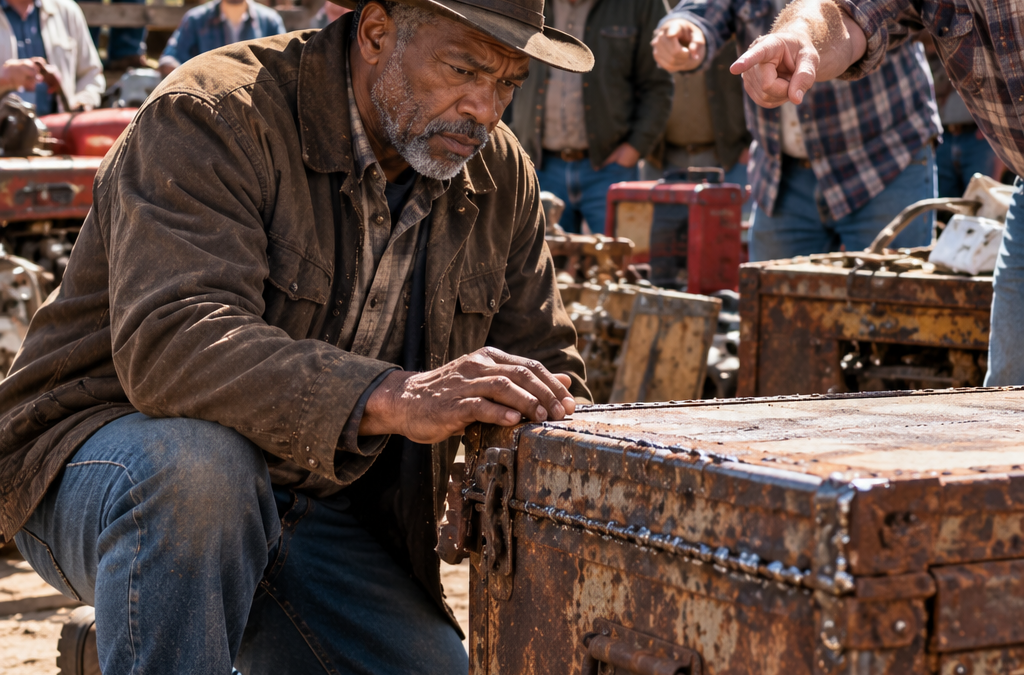
Then I saw the crate.
Heavy steel.
Maybe four feet long.
Two and a half wide.
Waist high.
Rust covered most of the outside.
No hinges.
No latch.
No lock.
That caught me.
I walked closer.
The lid had been welded directly to the body.
Not tack welded.
Not patched.
Sealed.
One continuous bead all the way around.
I crouched.
Took my reading glasses from my shirt pocket.
Put them on.
Then ran my thumb across the seam.
Rough rust on top.
But underneath?
Something deliberate.
The bead was consistent.
Whoever welded it had not been closing a damaged container.
They had wanted that lid to stay shut.
I moved another six inches.
Same rhythm.
Same spacing.
No hurried starts.
No ugly repairs.
I kept reading it.
Ten minutes maybe.
Could have been fifteen.
I forgot about the auction.
You can learn a lot from a weld.
I had learned that from Otis Fenton.
Otis was an old Black blacksmith who let me sweep his shop when I was fifteen.
He paid me fifty cents sometimes.
Usually he paid me by letting me watch.
He used to say a weld was handwriting in steel.
“Any fool can make sparks, boy.”
Then he would point at a seam.
“But a craftsman leaves his mood behind.”
I didn’t understand at first.
Then he showed me.
A nervous man pauses.
A hurried man crowds the bead.
An angry man runs hot.
A tired man drifts.
A skilled man leaves rhythm.
This crate had rhythm.
But there was something else.
The weld had been done carefully by hands that were no longer completely steady.
Tiny corrections.
Subtle.
Almost invisible beneath the rust.
A craftsman compensating for weakness.
That got my attention.
The auctioneer moved toward the scrap lots.
“Steel crate. Sealed. Contents unknown. Sold as-is.”
Nobody bid.
Someone yelled, “Charge us to haul it!”
Laughter.
The auctioneer smiled.
“Five dollars?”
Nothing.
“Ten?”
Nothing.
I raised my hand.
“Sixty.”
The yard went quiet.
I don’t know why I said sixty.
Maybe because I wanted the bid strong enough that nobody would play games.
Maybe because the seam had already convinced me.
The auctioneer blinked.
“Sixty?”
“Yes.”
Then the laughter started.
Not one person.
A wave.
Burl Kessick laughed first.
Burl was forty-eight and built like a man who believed size and authority were the same thing.
Thick neck.
Heavy stomach.
Red polo shirt stretched across him.
Gold chain.
Gold watch.
Gold ring.
His father had built Kessick Scrapyard.
Burl had inherited it along with the habit of talking louder than anyone around him.
He pushed through the crowd.
“Sixty dollars?”
I kept one hand on the crate.
Burl planted his palm on the lid beside mine.
Cheap cologne.
Beer on his breath.
“Sixty dollars for this?”
I looked at him.
“That’s what I bid.”
He turned toward the crowd.
“You hear that?”
They had.
But Burl liked performing.
“Sixty dollars for a box nobody can even open.”
More laughter.
He leaned closer.
“I’ve seen dumb money in my life, boys. This might be the dumbest sixty bucks spent in this county.”
A man behind him made some joke.
I don’t remember the exact words.
I remember the meaning.
Black farmer.
Probably thought there was gold inside.
People laughed harder.
I didn’t.
Burl looked down at me.
“You know what’s in there?”
“I know what I’m buying.”
That irritated him.
“You hear that?”
He slapped the crate.
“He knows.”
Then, quieter, meant mostly for me:
“You know where you belong, old man?”
I met his eyes.
He smiled.
“It ain’t here.”
That sentence was older than Burl.
Older than me.
Men had been finding different ways to say it my whole life.
School.
Hardware stores.
Banks.
Restaurants.
Land offices.
Auction yards.
You don’t belong here.
Not in these clothes.
Not with those people.
Not bidding on that property.
Not asking for that loan.
Not standing where we can see you.
I had spent sixty-five years surviving people who confused my quiet with permission.
I kept my hand on the crate.
The auctioneer’s gavel came down.
“Sold. Sixty dollars.”
Burl laughed again.
But the crate was mine.
Roy Subtles came over later.
Roy owned the feed store across from the county road and had been my neighbor for more than twenty years.
He wasn’t cruel.
That almost made what he said worse.
“Leland.”
I looked up.
“That’s your medicine money.”
“I know.”
“You paid sixty dollars for something you can’t open.”
“It’ll open.”
His expression changed the way people look at a sick animal.
“I’m saying this because I’m your friend.”
“I know.”
“You could use that money.”
“I know.”
He waited.
I gave him nothing else.
Two young men helped wrestle the crate into my truck bed.
One whispered, “Old man lost his mind.”
I heard him.
He probably knew I heard him.
On the way out, Burl stepped toward the road.
I slowed.
He bent down to my window.
“Drive careful, scarecrow.”
He knocked twice on my truck roof with that gold ring.
“Don’t let your treasure fall out.”
I looked straight ahead.
He added:
“I don’t clean up after your kind.”
I released the brake.
My truck moved.
In the rearview mirror, Burl was still laughing.
I drove home at thirty-five miles an hour.
No hurry.
The crate sat low in the bed, heavier than it looked.
The road rolled past soybean fields turning brown under the October sky.
I kept thinking about that seam.
Not Burl.
The seam.
A thing either tells you something or it doesn’t.
Crowds don’t change that.
By Monday, people started visiting.
Men who had not set foot on my farm in years suddenly needed something.
A wrench.
Advice about a hinge.
Someone wanted to know whether I had an extra chain.
They all found reasons to stand inside my workshop and stare at the crate.
Nobody asked directly at first.
They waited for me to embarrass myself.
Roy finally did.
He stood in the doorway with his arms crossed.
“That thing still closed?”
“Yes.”
“You been working on it?”
“Looking.”
“At what?”
“The weld.”
He sighed.
“Leland, you gave sixty dollars to a steel box.”
“Yes.”
“A steel box nobody knows how to open.”
“I know how.”
That surprised him.
“Then why haven’t you?”
“Not ready.”
He rubbed his face.
“What’s gotten into you?”
I was filing a burr off a clamp.
I kept filing.
“It’ll open.”
Roy waited.
Nothing.
Eventually he left.
He didn’t close the door.
I stood up and closed it myself.
By Wednesday, Burl’s nickname had spread.
Scarecrow.
Someone told me people at the diner were using it.
Someone else told me Burl had reenacted the auction twice over breakfast.
Every retelling got better for him.
He claimed I had begged for the crate.
Claimed I thought Confederate money was inside.
Claimed I told him I heard gold moving when we loaded it.
None of that happened.
Truth has never stopped a man who knows he has an audience.
Then somebody repeated another joke.
“The crate’s about coffin size.”
That one stuck with me.
Not because it was clever.
Because people had laughed.
Men who knew me.
Men whose tractors I had helped pull from mud.
Men who had borrowed tools from my barn.
Men whose fathers had traded seed with mine.
No one stopped it.
That is how cruelty survives.
It rarely needs a crowd full of cruel people.
It needs one loud person and everyone else unwilling to ruin breakfast.
I kept working.
I needed a wire brush and cutting gas.
So I drove to the hardware store.
The owner looked at me from behind the register.
“What do you need?”
“Wire wheel. Medium cup brush. Cutting gas.”
He didn’t check the shelves.
“Out.”
Behind him, twelve wire brushes hung from hooks.
Gas cylinders stood along the back wall.
I looked at them.
Then at him.
He didn’t blink.
I could have argued.
Could have pointed.
Could have made him say the lie twice.
Instead I nodded.
“Have a good afternoon.”
I drove forty minutes to another county.
The man there asked what size brush.
That was all.
He took my money.
I drove home.
People like to tell stories about men like me as if endurance means nothing hurts.
That isn’t true.
Every closed door leaves something.
Every joke.
Every time someone looks at your clothes before your face.
Every time a clerk tells you something is unavailable while it sits behind his shoulder.
Every time you decide whether correcting someone will cost more than staying quiet.
The marks do not disappear because you refuse to show them.
That night, I sat beside the crate with coffee getting cold on my bench.
I didn’t touch a tool.
Just looked.
For the first time since the auction, doubt came.
Not about the crate exactly.
About myself.
That is how ridicule works if it lasts long enough.
It tries to move into your own voice.
What if they were right?
What if I had spent money I needed because I wanted to prove something?
What if I cut that lid open and found mice nests?
Broken tools?
Nothing?
I put my palm on the seam.
Cold steel.
Rough rust.
Beneath it, that steady line.
Whoever sealed this crate had taken time.
A dying weld, maybe.
But not careless.
Not meaningless.
And I understood something.
A man doesn’t weld a lid shut that carefully to protect scrap from rain.
He is protecting something from people.
That thought settled me.
For three evenings, I cleaned the weld.
One inch at a time.
Wire brush.
Scraper.
Light.
Reading glasses.
Rust fell in orange flakes.
The bead underneath became clearer.
No breaks.
No gaps.
One continuous seal.
On the second evening, I heard a truck outside.
Heavy idle.
Burl.
He walked into my workshop without knocking.
“Still playing with it?”
I kept brushing.
He came closer.
Tapped the lid with his ring.
Clink.
Clink.
“I’ll give you ten bucks.”
“No.”
“Think about it.”
“Already did.”
He laughed.
“You lose fifty instead of sixty.”
I looked at him.
“Not for sale.”
He stood.
His eyes traveled around my shop.
Old bench.
Tools I had collected over forty years.
Welding rig.
Farm parts.
Everything I owned enough to need.
“Figures.”
He smirked.
“That box is probably the most valuable thing in the whole place.”
That one landed.
He intended it to.
My house.
Farm.
Workshop.
My life.
Summed up by a man who had never built any of it.
I didn’t answer.
Burl walked out.
Left the door open.
I listened to his truck leave.
Then crossed the floor.
Closed the door.
Returned to the crate.
Kept brushing.
On the third evening, Otis Fenton’s voice came back to me.
A weld is handwriting.
I studied the bead under better light.
There.
I could see it now.
The man who had sealed this had once been very good.
No question.
But his hands had been failing.
The bead made microscopic corrections where the torch drifted.
He had braced himself.
Taken breaks.
Restarted without overlap.
Whoever he was, he knew what he was doing.
And he knew he might not get another chance.
That realization made the hair along my arms lift.
I decided to cut the crate Thursday night.
After supper, I went to the workshop.
Closed the door.
Turned on the overhead bulb.
Set water to my left.
Fire blanket to my right.
Otis had taught me that too.
“The one time you don’t prepare for fire is the one time fire remembers your name.”
I marked a line inside the weld.
I didn’t want to cut into the box any more than necessary.
Checked my hoses.
Regulators.
Torch tip.
Striker.
Everything twice.
Then I lowered my helmet.
Lit the flame.
Blue hiss.
The whole world narrowed.
Torch to steel.
First spark.
Then another.
Orange spray scattered across the floor.
I moved slowly.
Too much heat and I could damage whatever was inside.
Too little and the cut would wander.
The seam gave a quarter inch at a time.
I followed it.
Knees complaining.
Back stiff.
Hands steady.
Halfway around, sweat ran beneath my shirt despite the cool night.
Three-quarters around, I stopped.
Shut the torch.
Raised the helmet.
The shop became silent except for ticking metal.
That was when the doubt hit hardest.
I sat back.
What if nothing was there?
Burl’s laugh.
The diner.
The hardware store.
Roy.
Scarecrow.
Sixty dollars.
Medicine money.
I looked at my hands.
Old.
Calloused.
Dark against the steel.
Maybe I had spent my life believing patience could reveal truth because that belief made the world easier to tolerate.
Maybe sometimes rust was just rust.
Then I looked at the bead I had not cut yet.
Even.
Deliberate.
A craftsman’s last clean line.
No.
I knew metal.
That much nobody could laugh out of me.
I pulled the helmet down.
Relit the torch.
Finished.
The final inch separated with a small metallic sound.
Almost a sigh.
I shut the gas.
Waited.
The crate cooled.
I did not pry the lid immediately.
Heat can ruin paper.
Destroy cloth.
Start fire where you can’t see it.
So I sat.
Ten minutes.
Twenty.
Thirty.
When the steel was safe, I pulled off my gloves.
Worked a pry bar beneath one corner.
The lid lifted.
Old air escaped.
Oil cloth.
Cold iron.
Dry dust.
No rot.
No rain smell.
The inside had survived.
There were three things.
A bundle wrapped in oil cloth.
A brick-shaped package.
An envelope.
I lifted the oil cloth first.
Set it on my bench.
Unwrapped it.
Documents.
Dry.
Protected.
The first page was an old partnership agreement.
Persing Machine Shop.
Doyle Persing.
Grady Kessick.
My stomach tightened when I saw the name Kessick.
I read slowly.
Grady’s investment gave him half ownership.
Half.
Not full.
The second document was a witness statement.
Doyle Persing.
Otis Fenton.
I stopped breathing for a second.
Otis.
My Otis.
The blacksmith who taught me to read welds.
His signature was at the bottom.
I knew it.
I had seen it on shop receipts when I was a boy.
The statement said Doyle had signed only one partnership agreement.
The original.
It said any later document claiming Doyle had transferred full ownership to Grady Kessick was false.
Forgery.
It said Doyle’s half belonged to his daughter.
Ruth.
I sat down.
I knew the Persing story.
Everyone old enough did.
Doyle Persing had run the machine shop on Depot Road before I was born.
People said he could machine a shaft within a thousandth by feel.
He died in the eighties.
Not long after, Grady Kessick ended up with the entire property.
People called it business.
Some called it unfortunate.
Ruth disappeared from town.
Nobody talked much about why.
Small towns get very good at converting injustice into history.
I picked up the second object.
Money.
Cash wrapped in brown paper.
Old bills.
Fives.
Tens.
Twenties.
A lot of them.
I didn’t count it all that night.
I didn’t need to.
Enough for lawyers.
Enough to matter.
Then the envelope.
Pencil on the front.
TO THE MAN WITH PATIENCE.
I stared at those words for a long time.
Then opened it.
Doyle Persing’s handwriting.
Careful.
Tight.
I read.
He wrote that his hands had begun to fail.
That he could no longer trust them on fine measurements.
That Grady had arranged papers Doyle knew were dishonest.
That he did not trust banks connected to people Grady knew.
He did not trust the legal papers Grady controlled.
So he put the truth somewhere Grady would never bother to look.
Inside steel.
Doyle wrote that Grady could talk, bargain and manipulate, but never learned to weld.
He could value scrap by the pound and still fail to understand craftsmanship.
Doyle believed a patient man would one day see the seam and know the box had been sealed for a reason.
Then came the line that stopped me.
Find Ruth.
Put this in her hands.
Let an honest man undo what a dishonest one did.
I read it again.
Then the last sentence.
A man’s life is not the noise his partner makes over his grave. It is the one true thing he troubled to seal up tight, where only a patient hand would ever find it.
I removed my glasses.
Sat in the chair.
The bulb hummed overhead.
I could hear insects outside.
The workshop smelled of cut steel.
Otis’s signature lay on the bench beside me.
Suddenly the path felt too exact to be chance.
Otis had taught me how to read a weld.
Doyle had trusted a weld.
Decades later, those two lessons met in my hands.
I looked toward the open crate.
The outside was rust.
Inside was clean.
That felt like something too.
I stayed there until the sky began turning gray.
I could have kept everything.
That is important.
Nobody knew what I had found.
Burl certainly didn’t.
The money alone could have changed my life.
Medicine.
Tractor repairs.
Roof.
Taxes.
Maybe enough left to make the next ten years easier than the last ten.
I was sixty-five.
Nobody would have asked questions.
Could have sealed the papers in a drawer.
Spent the cash slowly.
Let the Kessick family keep whatever they had stolen.
I thought about it.
Not because I wanted to steal from Ruth.
Because temptation is not proof of bad character.
What matters is what you do after it speaks.
I touched Doyle’s letter.
Find Ruth.
Simple.
So Monday morning I wrapped the papers, cash and letter back inside the oil cloth.
Put them on the passenger seat.
Drove across the road to Roy’s feed store.
Roy looked up.
“Morning.”
“Morning.”
“What happened to the crate?”
“It opened.”
He froze.
“What was inside?”
I looked at him.
“Where does Ruth Persing live?”
He stared.
“Ruth?”
“Yes.”
“Why?”
“I need to give her something.”
He leaned over the counter.
“Leland.”
I waited.
“What was in that box?”
“Address, Roy.”
Something in my face must have told him this wasn’t diner talk.
He took out a pen.
Wrote an address on the back of a feed receipt.
“Two counties over. Route 9. Past the mill.”
He handed it to me.
“What are you mixed up in?”
“Nothing that belongs to me.”
I left.
The drive took an hour and a half.
The bundle sat beside me.
One hand stayed close to it.
I found Ruth’s house.
Small.
White paint peeling at the corners.
Porch sagging.
Empty flowerpots.
Quiet.
I parked.
Took off my hat.
Carried the bundle up three steps.
Knocked.
No answer.
Then footsteps.
The door opened three inches.
Chain still on.
A woman looked through.
She was older than I expected.
Tired eyes.
Careful face.
“What do you need?”
“Ms. Lannam?”
“Yes.”
“My name’s Leland Garris.”
She looked at my clothes.
My boots.
My skin.
Then back at my eyes.
She didn’t open the door.
I understood.
I had lived my life being judged through gaps in doors.
I wasn’t going to punish her for protecting herself behind one.
“I bought a steel crate at an estate auction.”
Her expression changed slightly.
“Your father’s name was Doyle Persing?”
The chain moved as she shifted.
“Yes.”
“The crate was welded shut.”
She stopped breathing.
“He welded it himself.”
Her hand gripped the door.
“How do you know?”
“Because I opened it.”
Silence.
“There were things inside.”
Her eyes moved to the oil cloth bundle.
“What things?”
“Things he meant you to have.”
The chain slid free.
The door opened.
Ruth Persing Lannam stood in front of me.
I saw Doyle in her, though I had never met him.
Same precision around the mouth.
Same measuring eyes.
I held out the bundle.
“This is yours.”
She took it.
Her hands trembled.
“Come in.”
“No, ma’am.”
“Please.”
I shook my head.
“You should read that privately.”
Her eyes filled before she had even opened anything.
“How much?”
“What?”
“What did you pay for the crate?”
“Sixty.”
She almost smiled through whatever was happening to her face.
“And you drove all the way here to give this to me?”
“Yes.”
“Why?”
I thought about Doyle’s letter.
Otis.
The weld.
Burl laughing.
“Because it’s yours.”
Nothing else needed saying.
She opened the bundle on a kitchen table visible through the screen.
I stayed on the porch.
First document.
Her hand covered her mouth.
Second.
She sat.
Then the letter.
I watched her lips move.
When she reached the end, she pressed the paper against her chest.
Her shoulders shook once.
She looked toward me.
I put my hat back on.
She hurried toward the door.
“Mr. Garris—”
I stepped down.
“Wait.”
I turned.
She stood behind the screen.
Tears finally moving.
“I don’t know what to say.”
“You don’t have to say anything.”
“My father…”
Her voice broke.
I nodded.
“He knew.”
That was all I could give her.
I walked back to my truck.
She stood watching.
The bundle was still against her chest.
I drove home with nothing on the passenger seat.
I felt lighter than I had on the way there.
The legal part started quickly.
Ruth hired an attorney.
The cash made that possible.
A week later, someone came to my farm asking where I had found the crate.
Then another person.
Then investigators.
I told the truth.
Auction.
Sixty dollars.
Workshop.
Weld.
Documents.
They photographed everything.
The cut line.
The original agreement.
Otis Fenton’s statement.
Doyle’s handwriting.
The later Kessick document did not survive comparison.
Ink wrong for the claimed date.
Signature inconsistent.
Pressure marks suggesting guidance.
Language that did not match the original partnership papers.
Forgery.
Grady Kessick was dead.
But Burl wasn’t.
And Burl had inherited more than property.
Records showed he had relied on that false document repeatedly.
Loans.
Sales.
Leases.
Scrap contracts.
He had profited from ownership his family did not legally possess.
The man who laughed at me for paying sixty dollars had been standing eight feet from the proof that could collapse his family’s fortune.
He saw rust.
That was all.
The case did not become one dramatic courtroom trial.
Real law is slower.
Motions.
Records.
Depositions.
Negotiations.
County filings.
But eventually the truth became more expensive than Burl could fight.
Property returned.
Land.
Shop.
Money.
Damages for years Ruth had been deprived of what belonged to her.
Burl had to mortgage his scrapyard.
Then came what hurt him most.
The public acknowledgment.
Signed.
Filed with the county.
His family had relied on a forged document to take Doyle Persing’s property.
Burl’s name.
Kessick.
Forgery.
Fraud.
Permanent record.
Money hurts men like Burl.
Humiliation hurts more.
Especially when they built their whole lives around humiliating other people.
The diner changed first.
Nobody announced anything.
Nobody said, “We no longer support Burl.”
Small towns rarely work that cleanly.
Men simply stopped laughing.
Then they stopped sitting with him.
Farmers began using other scrapyards.
Repair shops called different suppliers.
His corner table at the diner always seemed occupied.
People who once laughed too loudly at his jokes suddenly remembered appointments.
I watched none of this with pleasure.
Maybe that disappoints people.
Revenge stories are cleaner when the good man enjoys the bad man falling.
I didn’t.
Burl had been cruel to me.
He had spent years being cruel to others.
But watching a man lose everything does not put anything back into you.
The only part that mattered was Ruth.
One afternoon, three weeks after the county filing, I went to town for coffee.
I turned a courthouse corner.
Burl was coming toward me.
We stopped.
Three feet apart.
Same gold chain.
Same thick body.
But something about him had collapsed.
His face was red.
His eyes were tired.
He opened his mouth.
No words came.
For once, Burl Kessick had nothing.
I looked at him.
Not proudly.
Not angrily.
Just looked.
Then I nodded.
The same nod I gave anyone.
Walked past.
I could feel him watching me.
I never turned around.
Within a year, Burl sold the scrapyard.
At a loss.
Moved south.
People told me.
I said nothing.
The following spring, Ruth reopened Persing Machine Shop.
She invited me.
I nearly didn’t go.
She called twice.
The third time she said:
“If you make me drive to your farm and drag you here, I will.”
I believed her.
So I went.
The old shop on Depot Road had been cleaned.
Windows washed.
Lathe restored.
Belts replaced.
Oil on the ways.
Ruth stood behind the same machine her father had used.
She rested her hand on the carriage.
“My father taught me on this.”
“How old?”
“Seven.”
“That seems irresponsible.”
She laughed.
“He stood me on a crate so I could reach.”
I looked around.
“You remember?”
“Everything.”
She turned the machine on.
The motor hummed.
That sound filled the building.
Something old returning.
Ruth had tears in her eyes.
“So much of my life, I thought maybe I remembered it wrong.”
“What?”
“My father.”
She looked toward the lathe.
“The papers. Grady. What happened.”
“You knew.”
“I knew.”
She swallowed.
“But when everyone treats your truth like bitterness long enough, sometimes you start wondering.”
I understood that better than she knew.
She walked me toward the front corner.
Glass display case.
Inside sat the crate.
Rust outside.
Clean steel visible where I had cut.
Lid propped slightly open.
Beside it was a card.
DOYLE PERSING.
Nothing more.
I stared.
“You put this thing on display?”
“It deserves it.”
“It’s ugly.”
“So are you.”
I looked at her.
She smiled.
That was the first time I heard Ruth joke.
I liked her immediately after that.
She offered me money.
Of course she did.
I refused.
“Leland.”
“No.”
“You spent money.”
“Sixty dollars.”
“Gas.”
“I own a truck.”
“Cutting supplies.”
“I use them anyway.”
“You drove ninety minutes.”
“I’ve driven farther for worse reasons.”
She crossed her arms.
“You are impossible.”
“So I’m told.”
“I could pay off your farm.”
That made me laugh.
“Then I’d have to find something else to worry about.”
Her expression softened.
“Why won’t you take anything?”
I looked at the crate.
“Because that would change what happened.”
“How?”
“I bought a box.”
I shrugged.
“It belonged to your father. What was inside belonged to you.”
“That simple?”
“Yes.”
She studied me.
“No.”
“What?”
“It wasn’t simple.”
I thought about the auction.
The hardware store.
Burl.
Roy.
The nights of doubt.
Maybe she was right.
But simple and easy are not the same thing.
“Still yours.”
She stopped asking.
A few months later, Roy came by my farm.
I was sitting on the porch with morning coffee.
Same chair.
Same field.
He stopped at the edge of the yard.
Hands in his pockets.
“Morning.”
“Morning.”
He stood there.
Usually Roy always had something to say.
Not that day.
Finally:
“I was wrong.”
I looked at him.
“About?”
He almost smiled.
“You know damn well about what.”
I drank my coffee.
He looked toward the barn.
“I thought you’d lost your mind.”
“So did half the county.”
“I told you that was your medicine money.”
“It was.”
“You could’ve been wrong.”
“Yes.”
He frowned.
That answer bothered him.
“You knew what was inside?”
“No.”
He stared.
“Then what did you know?”
I set the cup down.
“The weld was wrong.”
“Wrong?”
“For scrap.”
He waited.
“Nobody seals an empty box like that.”
Roy looked toward the soybean field as if the answer might be there.
“So you risked sixty dollars because of a weld?”
“Because of what the weld told me.”
“That sounds like something Otis would’ve said.”
“It is.”
Roy nodded.
Then looked at me differently.
Not pity.
Not confusion.
Recognition maybe.
He tipped his cap.
I nodded back.
He walked on.
Nothing else needed saying.
Life returned to normal.
That is another part people leave out.
Extraordinary things happen.
Then fence posts still rot.
Tractors still leak.
Property tax still comes.
My soybeans still needed harvesting.
I still woke early.
Still drank coffee.
Still repaired things other people threw away.
But the town had changed around me.
Slightly.
People said hello more often.
Some too often.
That irritated me.
Respect that arrives after proof can feel suspicious.
Where were you before?
But I tried not to become hard.
One afternoon the hardware store owner stopped me outside the post office.
“Leland.”
I turned.
He looked uncomfortable.
“I heard about the crate.”
“Most people did.”
He shoved his hands into his pockets.
“About that day you came in…”
I waited.
He looked toward the street.
“I had the wire brushes.”
“I know.”
“And the gas.”
“I know.”
He swallowed.
“I shouldn’t have done that.”
“No.”
He looked at me.
“I’m sorry.”
I could have punished him.
Made him explain.
Forced him to say why.
Maybe he deserved that discomfort.
Instead I said:
“Stock what you tell people you stock.”
He almost laughed.
Then realized I wasn’t joking.
“Yes, sir.”
That “sir” was new.
I walked away.
I thought about Grandpa—my own grandfather, not Doyle—who once told me that a man can spend so long fighting disrespect he forgets what he wanted respect for in the first place.
I didn’t want people afraid of me.
I didn’t want Burl humiliated forever.
I wanted doors to open when people had money in their hand and honest business to do.
I wanted a bid to count the first time it was raised.
I wanted a child at an auction to look at an old Black farmer and not be taught to move away.
Small things.
Big things hide inside small ones.
Just like that crate.
I visited Ruth’s shop sometimes.
Not often.
She was busy.
That pleased me.
The sound of the lathe returned to Depot Road.
Farmers came for shafts.
Bushings.
Custom fittings.
People brought broken parts.
Ruth fixed them.
She was good.
Very good.
One afternoon, I watched her turn a small steel pin.
She stopped the lathe.
Measured with a micrometer.
I asked, “How close?”
She handed me the part.
“Check.”
I measured.
Dead on.
I raised an eyebrow.
“Not bad.”
She smiled.
“My father could do better.”
“So could Otis.”
“Then they can argue about it wherever they are.”
We both laughed.
The crate remained behind glass.
Customers asked about it.
Ruth told the story.
Not the version the newspapers liked.
Not “poor farmer discovers fortune.”
She hated that headline.
So did I.
There had been money inside, yes.
But money was not the treasure.
The truth was.
Money only gave truth enough fuel to reach a courtroom.
Sometimes I stood near the display and watched people examine the cut line.
Most saw the rust.
Some saw the torch marks.
A few bent closer to the original bead that remained beneath one corner.
Those were the people I liked.
The ones who looked twice.
Years later, I still thought about Doyle’s last weld.
I never met him.
But through that seam, I knew something about him.
His hands were failing.
His eyes probably were too.
He knew Grady was waiting.
Knew Ruth might lose everything.
Knew he did not have enough time to fight the whole battle himself.
So he built a message in the language he trusted most.
Steel.
He did not hide the crate where no one could find it.
That would have defeated the purpose.
He left it among things that would eventually be sold.
Then he made it look worthless to the kind of man he feared.
That was the genius.
Grady Kessick understood ownership.
Price.
Paper.
Control.
Burl understood weight.
Scrap value.
Profit.
Neither understood patience.
Doyle gambled that someday somebody would.
Not somebody brilliant.
Not somebody rich.
Not a lawyer.
Just somebody willing to crouch beside rusty steel and ask why.
That happened to be me.
There is a strange humility in realizing the biggest thing you ever did depended on lessons other men gave you.
Otis taught me to read welds.
Without him, I would have walked past.
The man in the next county sold me a wire brush without deciding I didn’t belong in his store.
Without that, maybe I would have delayed.
The young men at the auction helped load the crate even while laughing.
Without them, I might not have gotten it home.
Roy knew where Ruth lived.
Ruth had enough courage left to open her door.
Justice is rarely one man standing alone.
We just like stories that way.
The truth is usually a chain.
One person keeps something.
Another notices.
Another signs.
Another remembers.
Another speaks.
Another finally listens.
Even silence matters.
I learned that too.
At the auction, Burl laughed.
Other men laughed because he did.
Some didn’t laugh.
But they said nothing.
For years, I had told myself silence was neutral.
That day taught me it isn’t always.
Silence can be mercy.
Silence can be wisdom.
Silence can also be shelter for a cruel man.
The difference depends on who benefits from it.
I knew my own silence had protected me many times.
But I wondered afterward how often someone else had needed my voice and I chose comfort instead.
That question stayed.
So when I saw things later, I spoke more.
Not loudly.
Never needed to.
A young Black kid named Marcus started helping at Ruth’s shop during summer.
Sixteen.
Skinny.
Smart.
One afternoon, a customer came in and asked Ruth whether “the boy” was qualified to touch his machine.
Marcus heard.
I saw his shoulders change.
That old folding inward.
I knew it.
Before Ruth could answer, I looked at the man.
“He rebuilt your pump.”
The customer stared.
“What?”
“That pump you picked up last week.”
I pointed at Marcus.
“He did the final assembly.”
The man looked at him differently.
Not enough.
But differently.
“Didn’t know.”
“That’s why asking works better than assuming.”
Ruth looked at me after he left.
“You getting talkative in your old age?”
“Don’t spread it around.”
Marcus smiled.
That mattered.
A few months later, I found him studying the crate.
His finger hovered near the glass.
“How’d you know?”
“Know what?”
“That something was inside.”
“I didn’t.”
“You paid anyway.”
“Yes.”
“Why?”
I told him what Otis told me.
A weld is handwriting.
Marcus frowned.
“Metal can tell you who did it?”
“Sometimes.”
“How?”
“Practice.”
“That’s it?”
“That’s almost always it.”
He looked at the crate again.
“People said you got lucky.”
“I did.”
That surprised him.
“You think it was luck?”
“Of course.”
I pointed at the steel.
“I happened to attend that auction.”
“At the right time.”
“Yes.”
“I happened to know welds.”
“Yes.”
“I happened to have sixty dollars.”
“Yes.”
“So skill doesn’t matter?”
I shook my head.
“Luck puts something in front of you.”
I tapped the glass.
“Skill helps you see it.”
He nodded slowly.
“And courage?”
I thought about driving to Ruth’s house.
The easy choice would have been keeping quiet.
“Courage decides what you do after.”
Marcus remembered that.
Years later, after I was too old to do much heavy work, he came by my porch.
He owned a fabrication shop by then.
Had three employees.
He brought coffee.
Good coffee.
Too expensive.
We sat looking over the field.
He said, “I still use that thing you told me.”
“What thing?”
“Luck, skill, courage.”
I had forgotten.
He hadn’t.
That is how lessons travel.
You say something once.
Someone carries it farther than you ever could.
By then, Burl had been gone for years.
The Kessick scrapyard had another name.
New owners.
Most people stopped talking about the scandal.
That is the way time works.
It sands edges.
Eventually, children grow up who never knew why an old steel crate sat behind glass in Persing Machine Shop.
But Ruth kept telling them.
When she got older, she wrote the story down.
She asked me to read it.
I told her there were too many nice things about me.
She told me to mind my business.
One sentence I made her change.
She had written:
Leland Garris saved my family.
I crossed it out.
She got angry.
“It’s true.”
“No.”
“What would you call it?”
“I delivered a box.”
“You opened it.”
“Yes.”
“You found me.”
“Yes.”
“You returned everything.”
“It belonged to you.”
She stared.
“That is the part you don’t understand.”
“What?”
“Most people don’t.”
I looked at her.
“Don’t what?”
“Return things just because they belong to someone else.”
That made me quiet.
She put the sentence back.
I stopped arguing.
Eventually, the county historical society asked for the crate.
Ruth refused.
So did I.
They wanted it cleaned.
Preserved.
Catalogued.
Placed behind climate-controlled glass.
Ruth told them:
“It spent forty years rusting. It can survive my shop.”
I agreed.
Some things lose meaning when cleaned too well.
The rust mattered.
So did the bright cut line.
Outside neglected.
Inside protected.
The crate was proof that appearance and value had never been the same thing.
Maybe that was why the whole story stayed with me.
I had lived that lesson before I ever bought it.
People looked at me and saw cracked boots.
Old truck.
Thin Black farmer.
No college.
No money.
No influence.
Burl looked at the crate and saw rust.
Same mistake.
Different object.
He thought worth announced itself.
Gold chain.
New truck.
Loud voice.
Clean paint.
I had spent my life learning the opposite.
The strongest fence post on my farm looked terrible.
The oldest wrench in my shop fit better than the new set.
Otis’s leather apron was cracked almost white at the folds, but I kept it hanging beside my workshop door until the day my hands got too stiff to weld.
Worth is often quiet.
That is why loud men miss it.
One spring morning, years after the auction, I sat on my porch with coffee.
Warm day.
Soybeans not planted yet.
Field dark and ready.
Sun just coming up.
I thought about that first morning.
Before the crate.
Before Burl.
Before Ruth.
I had been the same man.
That bothered me at first.
Because everybody treated me differently afterward.
Men who ignored my bids started greeting me by name.
The hardware store owner called me Mr. Garris.
People listened when I spoke.
Nothing inside me had changed.
I did not become wiser because the crate contained documents.
I did not become more skilled because the county learned about the weld.
I did not become honest because I returned the money.
Those things had been there before.
The world simply needed a dramatic enough reason to notice.
I think about that whenever people say, “You proved them wrong.”
Maybe.
But the phrase gives them too much authority.
I never needed Burl to be wrong before I could be right about myself.
I knew what my hands knew.
I knew the work I had done.
I knew the life I had built.
The crate did not create my worth.
It exposed the poverty of their judgment.
There is a difference.
Roy came walking down the road that morning.
Older.
Slower.
He stopped.
“Coffee?”
I lifted the pot.
He came up.
Sat in the chair beside mine.
For a while we watched the field.
Then he said:
“You ever think about what would’ve happened if you hadn’t bid?”
“Yes.”
“What?”
“Someone else buys it as scrap.”
“And?”
“Cuts it open wrong.”
“Maybe burns the papers.”
“Maybe.”
“Or Burl gets it back.”
“Maybe.”
Roy shook his head.
“Hell of a thing.”
“Yes.”
“Sixty dollars.”
“Yes.”
He laughed.
“You always knew?”
“No.”
He looked at me.
“Still bothers me.”
“What?”
“That you didn’t know.”
“I knew enough.”
He shook his head again.
“You’re a strange man.”
“So you’ve said.”
We drank coffee.
Fog lifted.
Field appeared.
That was enough.
When people tell the story now, they like the courtroom part.
Burl losing the scrapyard.
Ruth getting her inheritance.
The forgery exposed.
They like the image of the loud man finally unable to speak when he met me outside the courthouse.
I understand.
Justice feels good when it makes noise.
But that is not the moment I remember most.
I remember kneeling at the auction.
Laughter behind me.
My thumb moving slowly across rust.
A steel seam beneath it.
Everybody else had already decided what the crate was worth.
The auctioneer.
Burl.
Roy.
The men along the fence.
They had measured the obvious things.
Rust.
Weight.
Difficulty.
Appearance.
I measured intention.
Someone had gone to enormous trouble to keep that lid closed.
That meant something.
People do the same thing to each other.
They measure obvious things.
Clothes.
Skin.
Money.
Age.
Accent.
Address.
Education.
They make fast judgments because fast judgments are easy.
Patience costs more.
You have to kneel.
Look closer.
Run your hand along the seam.
Ask what happened before you arrived.
Ask why something was built the way it was.
Ask what the rust is covering.
Doyle Persing trusted that somebody would eventually do that.
He was dying.
His hands shook.
The man who betrayed him had documents, money and influence.
Doyle had steel.
So he sealed the truth.
One last weld.
Not perfect.
But honest.
Decades later, the right pair of hands touched it.
Mine.
I don’t say that proudly.
Mostly I say it with gratitude.
Because I know how easily I could have walked past.
How easily any of us walk past things because somebody louder already told us what they are worth.
Sixty dollars.
That was all.
I have spent more on tractor tires.
More on medicine.
More repairing things that broke again.
But no money I ever spent carried farther.
It bought a rusted box.
Inside was a daughter’s inheritance.
A dead man’s testimony.
A blacksmith’s signature.
Enough cash to fight.
And one sentence that stayed with me longer than the money stayed with anyone.
A man’s life is not the noise his partner makes over his grave.
I understood Doyle.
People had made noise over my life too.
Scarecrow.
Fool.
Old man.
You don’t belong here.
Noise.
That was all.
The field still knew who worked it.
My tools knew who maintained them.
Otis’s lessons knew who remembered.
Ruth knew who brought the bundle to her porch.
And I knew myself before any of them changed their minds.
That is what I carried back to the porch each morning.
Not victory.
Certainty.
The quiet kind.
The kind that does not require witnesses.
Years later, when my hands finally began to shake enough that I stopped welding, I left Otis’s old apron hanging by the workshop door.
I left my best torch to Marcus.
My farm went to my niece.
And I wrote one note for whoever eventually cleaned out my workshop.
Nothing profound.
Just this:
Before you throw away something you don’t understand, ask why someone kept it.
Maybe they listen.
Maybe they don’t.
That part won’t be mine to control.
But I know this.
The world is full of men like Burl Kessick.
Men who weigh everything.
Price everything.
Laugh at everything they cannot immediately use.
They see rust and call it worthless.
They see quiet and call it weakness.
They see poverty and call it stupidity.
They see an old Black farmer crouching beside a sealed crate and decide the joke before he stands up.
Let them.
Noise has never changed steel.
A weld is either sound or it isn’t.
A document is either true or it isn’t.
A man is either honest when no one is watching or he isn’t.
That morning at the Ward Estate auction, the whole county thought I had paid sixty dollars for garbage.
Maybe that was what made the lesson so clean.
They saw exactly what they expected to see.
I did too.
Rust.
Age.
A box nobody wanted.
I just kept looking after they stopped.
And underneath all that rust, one careful line was still waiting for someone patient enough to read it.








