𝗙𝗨𝗟𝗟 𝗦𝗧𝗢𝗥𝗬 The Soldier Sitting Alone in the Alabama Rain Wore the Same Uniform I Had Buried Three Years Earlier
𝗙𝗨𝗟𝗟 𝗦𝗧𝗢𝗥𝗬
I filed again.
And again.
Twelve times over three years.
Twelve submissions.
Twelve disappearances.
Every call ended the same way.
Someone transferred me.
Someone put me on hold.
Someone promised another department would return my call.
Nobody ever did.
Meanwhile, Carlton Briggs kept getting closer.
Carlton was fifty-eight and owned enough of Colton to make people nervous about irritating him.
The building Rosy’s Diner occupied belonged to him.
The grocery store on Fifth sat on his property.
He controlled commercial lots near the church.
He sat on the town administrative board and seemed to know every county official who mattered.
More importantly, through the financial arrangements tied to my property, he had enough leverage over the debt on my house to make my life miserable.
And he wanted my land.
Not because he cared about the house.
He wanted the parcel beneath it.
My property was the final piece he needed for a shopping development he had been planning for years.
Every other owner on the block had sold.
I had not.
At first, he was polite.
“Sell the place, Iris. You’ll be better off.”
“No.”
“You could start over somewhere.”
“I don’t want somewhere.”
He smiled the way powerful men smile when they think patience is the same thing as kindness.
Then he raised the offer.
I still refused.
Eventually the smile disappeared.
Deadlines shortened.
Fees appeared.
Interest increased.
Letters from attorneys began arriving.
I kept every one in a shoebox beneath my bed.
One afternoon Carlton came into Rosy’s and sat at the counter during my shift.
He ordered coffee he barely touched.
I stood across from him holding the pot.
He looked at me for a long moment.
“You know how this ends, Iris.”
I poured his coffee.
“No, I don’t.”
“You sell eventually.”
“Then you shouldn’t mind waiting.”
His jaw tightened.
“This house is killing you.”
“It’s mine.”
“It was Tommy’s.”
That made me stop.
Carlton saw it.
He leaned closer.
“Tommy’s gone.”
I set the coffee pot down carefully because my hand had started shaking.
“This house is all I have left of him.”
“No,” Carlton said. “That house is wood and nails. You’re ruining yourself over sentiment.”
I looked him straight in the eyes.
“Then it should be easy for you to understand why I won’t sell.”
He stared at me.
I stared back.
Finally, he stood.
“You’re making this harder than it needs to be.”
“No,” I said. “You are.”
After that, things changed.
People started hearing I was in financial trouble.
Customers who had tipped well for years suddenly left coins.
A man who sometimes gave me twenty dollars at Christmas stopped coming to the diner entirely.
Someone told the owner of the Sunday-night bar where I washed dishes that Carlton thought employing me was “a bad investment.”
The work disappeared the following week.
Maybe it was coincidence.
By then, I had stopped believing very much in coincidence.
What bothered me most was the benefits file.
The local processing went through the county clerk’s office.
A man named Phil Avery worked there.
Phil had lunch with Carlton every Tuesday.
I had seen them myself at the steakhouse on Route 9.
They were sitting near the window.
Carlton laughed.
Phil reached across the table and shook his hand.
I stood outside in the parking lot staring at them longer than I should have.
I had no proof.
Just a feeling.
But sometimes when you’ve spent long enough being slowly strangled, you learn to recognize the hands even when you cannot see them.
And now the clock had finally run out.
At eight the next morning, Carlton planned to arrive with paperwork and the sheriff.
I had eleven dollars in my pocket.
The rain kept falling.
I lowered my head and walked faster.
That was when I saw him.
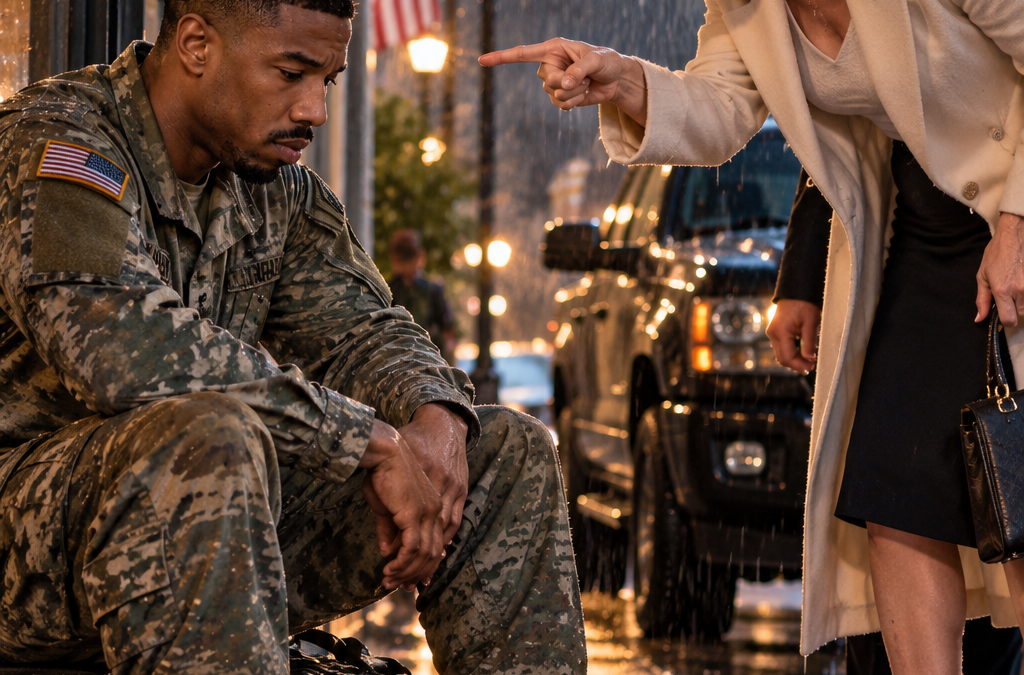
At first, he was just a shape beneath the awning of Grayson’s General Store.
The store had closed hours earlier.
Its lights were off.
The metal security gate was pulled over the entrance.
A man sat on the concrete step with his back against the door.
I might have walked past him if the streetlight had not flickered.
For one brief second, light fell across his shoulder.
Uniform.
My feet stopped.
I stared.
The rain blurred everything beyond a few yards.
He sat with his hands clasped between his knees.
Water dripped from his sleeves.
His head was bowed.
Then he looked up.
Black man.
Late twenties, maybe.
Tall.
Broad shoulders.
Eyes red from exhaustion and cold.
The uniform was soaked nearly black in places.
For one violent second, my mind betrayed me.
Tommy.
My chest seized.
Then reality returned.
Not Tommy.
Of course not Tommy.
But I knew that uniform.
I had ironed one like it.
Folded one.
Pressed my face against one while begging my husband not to leave yet.
Buried him in one.
The stranger watched me.
I could see the expectation in his eyes.
He expected me to keep walking.
Something about that hurt more than I understood.
I stepped beneath the edge of the awning.
“You all right?”
He gave a short nod that fooled neither of us.
“Yes, ma’am.”
“You don’t look all right.”
A tired smile appeared and disappeared.
“My car broke down.”
“Where?”
“Route Twelve.”
“That’s four miles from here.”
“Yes, ma’am.”
“You walked?”
He nodded.
“In this?”
Another nod.
I looked around.
No tow truck.
No friend coming.
No dry bag beside him.
Nothing.
“How long have you been sitting here?”
“Not long.”
He was lying politely.
His hands were shaking.
I looked toward Oak Street.
Then back at him.
“Come on.”
He stared at me.
“Ma’am?”
“Come on.”
I stepped back into the rain.
He did not move.
“You don’t have to do that.”
“I know.”
His expression changed.
“People around here might not like it.”
There was something in the way he said it that told me those words had a history.
I thought about Carlton.
I thought about the neighbors.
I thought about three years of people watching me struggle while finding reasons not to get involved.
Then I looked at the soldier.
“I stopped caring what people around here like a long time ago.”
He still hesitated.
So I held out my hand.
My fingers were pale from the cold.
Calluses crossed my palms.
Tommy’s wedding ring sat against my skin.
The soldier stared at my hand as if I had offered him something much larger.
Finally, he stood.
He was taller than I expected.
More than six feet.
But despite his size, he moved carefully, almost apologetically, as though he had learned to make himself smaller in places where people had already decided he was too much.
“I’m Nathan,” he said.
“Iris.”
We walked home together.
Neither of us spoke much.
Curtains shifted as we passed houses.
I saw them.
Mrs. Henson’s living room light was on.
Her curtains moved.
Across the street, Mr. Dawson stood behind his blinds.
A porch light clicked off as we approached one house.
Nathan noticed.
His shoulders tightened.
I kept walking.
When we reached my house, the front door stuck.
I shoved my shoulder against it.
Nathan stepped forward.
“Let me—”
The door opened suddenly with a groan.
“I’ve got it,” I said.
He looked at the crooked frame.
“Does it always do that?”
“Only when it rains.”
He glanced at the roof.
I laughed softly.
“And sometimes when it doesn’t.”
That earned the smallest smile from him.
We stepped inside.
He stopped on the mat.
Water fell from his uniform onto the floor.
“I’m sorry.”
“For what?”
“The floor.”
“It’s linoleum.”
“I’m getting it wet.”
“Nathan, the roof gets it wet for free.”
He looked at me, uncertain whether I was joking.
I smiled.
That finally made him smile too.
I brought him two towels from the bathroom.
They were thin and faded but clean.
Then I went to the hallway closet.
I stood there with my hand on the knob.
For several seconds, I couldn’t turn it.
I had not opened Tommy’s side in months.
Maybe longer.
His clothes were still folded inside.
People had told me I should donate them.
Move forward.
Make space.
As though grief were a closet that could be cleaned out.
I opened the door.
There they were.
Jeans.
T-shirts.
A gray Army sweatshirt.
REYNOLDS stitched across the chest.
My fingers rested on the letters.
A memory hit me so sharply that I almost closed the door.
Tommy standing in the kitchen wearing that sweatshirt.
Tommy complaining I had shrunk it.
Me telling him his shoulders had gotten bigger.
Him wrapping his arms around me from behind.
I swallowed.
Then I took the sweatshirt and a pair of jeans from the shelf.
“These should fit.”
Nathan looked at them.
Then at me.
His eyes stopped on the name.
“Your husband?”
I nodded.
He did not say he was sorry.
I appreciated that.
Sometimes sorrow becomes exhausting when strangers keep asking you to receive theirs.
I handed him the clothes.
“Bathroom’s down the hall.”
He changed while I went into the kitchen.
I opened the cupboard.
One cup of rice.
Three eggs.
A can of black beans.
Half a bottle of hot sauce.
That was everything.
My eleven dollars could have bought breakfast the next morning.
It could have bought something small to eat after Carlton took the house.
Instead, I left it in my pocket.
I measured the rice.
Cracked the eggs.
Opened the beans.
When Nathan came into the kitchen, he was wearing Tommy’s clothes.
I had to look away.
The sweatshirt fit differently.
Nathan was broader through the shoulders.
Taller.
His face was nothing like Tommy’s.
Still, seeing another soldier in those clothes opened something painful inside me.
I turned toward the stove.
“You like hot sauce?”
“Yes, ma’am.”
“Iris.”
“Yes, Iris.”
I cooked everything.
When I placed the plate in front of him, he looked at the food.
Then at me.
I sat opposite him with a glass of water.
“You’re not eating.”
“I ate at work.”
His eyes remained on my face.
He knew.
I knew he knew.
But he did not embarrass me by challenging the lie.
He picked up his fork.
“Thank you.”
He ate slowly at first.
Then faster.
I watched the rain crawl down the kitchen window.
For the first time that day, I felt useful in a way that did not involve carrying someone else’s dirty plates.
Then the phone rang.
I knew who it was before I answered.
“Hello?”
“Iris.”
Carlton.
My stomach tightened.
“What?”
“I hear you brought company home.”
I looked toward Nathan.
He had stopped eating.
“How is that your business?”
Carlton laughed once.
No humor.
“You really are determined to make every bad decision available to you.”
“Good night, Carlton.”
“You’re bringing them into the neighborhood now?”
I went very still.
“Them?”
Silence.
He realized what he had said.
Or maybe he didn’t care.
“You know exactly what I mean.”
My fingers tightened around the receiver.
Nathan stared at his plate.
I saw something close behind his eyes.
A door shutting.
I had seen that expression before in Tommy after phone calls he never explained.
“You listen to me,” I said. “A United States soldier was sitting in the rain. I brought him somewhere dry.”
“This isn’t a barracks.”
“No. It’s my house.”
“Until eight tomorrow morning.”
There it was.
The real reason for the call.
“I’ll be there with Boyd and the paperwork. You should have your things packed.”
My throat tightened.
I forced my voice to remain steady.
“Good night, Carlton.”
“You made the biggest mistake of your life tonight.”
I hung up.
For several seconds, neither Nathan nor I spoke.
Finally he set his fork down.
“I should go.”
“No.”
“Iris—”
“No.”
“I don’t want to make this worse for you.”
“You didn’t.”
“He called because I’m here.”
“He called because he likes reminding me he thinks he owns me.”
Nathan stood.
“I’ve caused enough trouble.”
I stood too.
“You haven’t caused anything.”
He looked at me.
I could feel my anger rising, not at him, but at the fact that he had been taught to apologize for other people’s cruelty.
“Carlton Briggs has been trying to take this house for three years. That call was coming whether you were here or not. The only difference is that tonight he found another reason to show me what kind of man he is.”
Nathan looked toward the window.
“People in this town already made it clear what they think.”
“I don’t care.”
“You might tomorrow.”
“I won’t.”
My voice shook, but I didn’t lower it.
“I am not putting a soldier back into the rain because Carlton Briggs doesn’t like the color of his skin. That is not who I am. It is not who my husband was. And it is not what this house is going to become while I still have a key to the door.”
Nathan stared at me.
Then slowly sat down.
I took his plate to the sink.
Outside, someone walked past the house.
I heard a man’s voice through the rain.
“White trash.”
The words were loud enough to be deliberate.
Nathan turned toward the window.
I kept washing the plate.
“Iris.”
“I heard him.”
“You’re not going to say anything?”
“To who?”
He had no answer.
I rinsed the plate and placed it on the rack.
“They’ve been talking about me for three years,” I said. “Tonight they just found a new subject.”
Afterward, I made up the bed.
Nathan refused twice.
I ignored him twice.
“You sleep there.”
“You’re giving me your bed after you already gave me your food.”
“I’m sleeping on the couch.”
“You shouldn’t have to.”
“I’ve slept there plenty.”
“Iris.”
“Nathan.”
He almost laughed.
That ended the argument.
I brought him a glass of water and set it on the nightstand.
Then I took the crocheted blanket from the back of the sofa and curled beneath it.
The fire in the small fireplace had burned low.
Nathan stood in the bedroom doorway.
Behind him, Tommy’s photograph hung on the wall.
For a moment the two uniforms seemed to exist in the same room.
Past and present.
Loss and something I didn’t have a name for yet.
“Good night,” Nathan said.
“Good night.”
He closed the door.
I did not sleep.
At some point the rain softened.
The house settled around me.
Pipes clicked.
The hallway floor creaked.
I stared at the ceiling thinking about eight o’clock.
What did you pack when you were losing a life?
Photographs first?
Tommy’s flag?
Documents?
Clothes?
The coffee mug he used every morning?
The stupid chipped bowl we bought on our honeymoon?
How could you decide which objects contained enough memory to deserve rescue?
I heard the bedroom door open.
Nathan came into the living room.
“Can’t sleep?” I asked.
“No.”
“Me neither.”
He sat on the floor near the fireplace, back against the wall.
For a while, we said nothing.
It should have been uncomfortable.
A stranger sitting in my dark living room.
Instead, the silence felt honest.
I got up and opened the little floral tin above the stove.
Two tea bags.
The last two.
I boiled water.
When I handed Nathan his cup, he wrapped both hands around it.
“Thank you.”
This time, I knew he wasn’t thanking me for tea.
I sat down again.
“You want to talk?”
Nathan looked into the fire.
After a long moment, he nodded.
“My father’s Army.”
“Career?”
“All his life.”
Something about the way he said it made me curious, but I didn’t ask his father’s rank.
Nathan continued.
“He’s the reason I enlisted. When I was eighteen, my mother cried when I told them. Dad didn’t. He said one thing.”
“What?”
“Earn it. Every bit of it. Don’t let anyone give you anything because of who I am.”
Nathan smiled faintly.
“So I did.”
He told me he had started at the bottom.
No special favors.
No shortcuts.
He never used his father’s name.
Every promotion mattered because he had earned it himself.
Then his expression changed.
“But there’s something a uniform can’t cover.”
I knew what he meant before he said it.
“My skin.”
His voice remained calm.
That made the words heavier.
“I can stand straighter than everyone else. Run faster. Shoot better. Score higher. Do everything right. And there’s always somebody who sees this first.”
He touched the back of his hand.
“Before they see the rank. Before the flag. Before anything.”
I listened.
“Sometimes it’s obvious. Usually it isn’t. Usually it’s small enough that if you complain, somebody tells you you’re imagining it.”
He stared at the fire.
“Wrong name. Worst assignment. Left out of a briefing. Somebody jokes that I must have gotten a promotion because the Army needed numbers. Somebody says I’m naturally athletic after I train twice as hard as they do.”
His jaw tightened.
“Small things.”
I understood those two words.
Small things were how people hurt you when they wanted plausible deniability.
Nathan took a drink.
“My transmission died outside town this afternoon. No cell signal where I stopped. So I walked.”
“Four miles.”
“About that.”
“In the rain.”
He nodded.
“I knocked on six doors.”
My hand tightened around my tea.
“Six?”
“Lights on. Cars outside. People home.”
“What happened?”
He looked at me.
“One woman opened the inner door, looked through the screen, saw me, and said, ‘Lord, no.’ Didn’t even let me ask.”
I stared at him.
“One guy opened the door and shut it again.”
Nathan looked down.
“Another man slowed his truck long enough to tell me I didn’t belong here.”
“What exactly did he say?”
Nathan shook his head.
“Not in your house.”
My anger rose.
He continued quietly.
“I wear this country’s uniform. I’ve been shot at for it. Twice I came close enough to dying that my father got calls he never told my mother about.”
He swallowed.
“But tonight I couldn’t get permission to stand on somebody’s porch long enough to get out of the rain.”
The fire cracked.
I heard Tommy’s voice in my memory.
A phone call two weeks before he died.
Eleven minutes.
That was all we got.
I looked at Nathan.
“Tommy said something once.”
Nathan waited.
“He said sometimes he wondered whether the country he was fighting for would fight for him if he ever needed it.”
Nathan’s eyes lifted.
I stared at my hands.
“He died saving two men.”
“I’m sorry.”
“He went back.”
My voice thinned.
“He got one out. Then he went back.”
I had told myself the story hundreds of times.
It never became easier.
“Afterward, I applied for his survivor benefits.”
I explained everything.
The twelve submissions.
The missing files.
The county clerk.
Phil Avery.
Carlton.
The land.
The mortgage.
The deadline.
When I told Nathan I had $1,600 toward the $4,800 due the next morning, he stared at me.
“And you fed me.”
“It was rice.”
“That wasn’t my question.”
I looked away.
“You gave me your last food.”
“You were hungry.”
“So are you.”
I said nothing.
He leaned forward.
“Why?”
The answer came easily.
“Because Tommy would have.”
Nathan waited.
“My husband ran through gunfire for men he barely knew. I could walk a stranger two blocks through the rain.”
“That’s not the same thing.”
“No.”
I looked at him.
“But it comes from the same place.”
He was quiet.
Then I said the part I had never said aloud.
“And because I know what it feels like to need someone to show up.”
The room became very still.
“I spent three years waiting for somebody to show up.”
My voice trembled.
“The military office. The county. Friends. Family. Anybody.”
I looked at Tommy’s photograph.
“Nobody did.”
Nathan said nothing.
He didn’t offer an empty promise.
He didn’t tell me things would work out.
He simply stayed there.
Sometimes that is the kindest thing a person can do.
My phone buzzed.
I looked at the message.
Carlton.
8:00. Sheriff will be present. Have your personal property ready for removal.
I turned the phone facedown.
Nathan watched me.
“Carlton?”
“Yes.”
“What does it say?”
“Nothing I didn’t know.”
I wrapped the blanket tighter around myself.
“I’ve been expecting this for three years.”
“You don’t seem scared.”
I almost laughed.
“I’m terrified.”
Nathan looked surprised.
“Being afraid and falling apart aren’t the same thing.”
The fire had become red embers.
“Besides,” I said, “I’ve survived worse mornings.”
He looked at Tommy’s picture.
Neither of us spoke again for a long time.
Eventually I fell asleep.
When I opened my eyes, the rain had stopped.
Pale light came through the curtains.
The blanket, which I remembered slipping off me sometime during the night, was tucked beneath my chin.
I sat up.
“Nathan?”
No answer.
I walked to the bedroom.
The bed was made so tightly it looked untouched.
Military corners.
Smooth blanket.
The bathroom was empty.
His uniform was gone from the radiator.
Tommy’s clothes were folded neatly on the bed.
I stood there for a second, surprised by the ache I felt.
Then I saw a piece of paper on the kitchen table.
The back of a grocery receipt.
I picked it up.
Iris,
Thank you. Not just for the food or the clothes. Thank you for seeing a soldier before you saw a skin color.
I won’t forget this night.
Nathan
A phone number was written below.
I read it twice.
Then I folded the receipt carefully and placed it beside Tommy’s photograph.
The microwave clock read 7:45.
Fifteen minutes.
I showered quickly.
Pulled on the cleanest white shirt I owned.
Combed my hair.
There was a small stain near one cuff.
I tried to scrub it out.
It didn’t matter.
At 7:57, I stood in front of the bathroom mirror.
I looked tired.
Older than thirty.
There were shadows beneath my eyes and a tightness around my mouth that hadn’t been there before Tommy died.
I put my hand against the sink.
“You’re not begging him,” I told my reflection.
My voice sounded strange in the small room.
“You hear me?”
I swallowed.
“You’re not begging anybody.”
At exactly eight, engines sounded outside.
Several.
I closed my eyes.
Of course Carlton had brought an audience.
I walked toward the front door.
Another engine stopped.
Then another.
I put my hand on the knob.
This was Tommy’s house.
Our house.
For another minute, anyway.
I opened the door.
Carlton Briggs stood at the bottom of my porch.
Gray suit.
Perfect tie.
Leather folder tucked beneath one arm.
Sheriff Boyd stood behind him.
Boyd was heavyset, middle-aged, and usually carried himself with the weary confidence of a man who understood that nobody in Colton wanted trouble with his office.
That morning, he looked uncomfortable.
I noticed why almost immediately.
Three black SUVs were parked along Oak Street.
Perfectly aligned.
Two uniformed military police officers stood beside the first vehicle.
A small American flag was mounted near its hood.
Carlton kept glancing toward them.
“What is this?” I asked.
“I was about to ask you the same thing,” he muttered.
“I have no idea.”
The rear door of the middle SUV opened.
A man stepped out.
Tall.
Silver hair.
Dress uniform.
My breath caught.
Even though I had spent years married to a soldier, I had never stood this close to a four-star general.
You didn’t need military knowledge to understand who he was.
The stars did that.
The ribbons across his chest caught the morning light.
He walked across my yard with the calm authority of someone who had spent decades entering rooms where people immediately stood straighter.
Carlton’s mouth opened.
Nothing came out.
Then the rear door of the third SUV opened.
Nathan stepped out.
He was wearing full dress uniform.
Clean.
Pressed.
Standing perfectly straight.
For several seconds, I could only stare at him.
Nathan met my eyes.
He did not smile.
But there was something steady in his expression.
Something that made me grip the porch railing.
The general stopped at the bottom of the steps.
“Mrs. Reynolds?”
“Yes.”
He removed his cap.
“My name is General Harold Brooks. United States Army.”
He glanced toward Nathan.
“Nathan is my son.”
I looked from him to Nathan.
Then back again.
Nathan’s father.
The career soldier.
The man Nathan had spoken about as though rank were the least important thing about him.
I tried to speak.
Nothing came.
General Brooks continued.
“My son told me what happened last night.”
I felt heat rise into my face.
“General, I only—”
“He told me everything.”
His voice softened.
“The broken car. The homes that turned him away. What was said to him. And what you did.”
I looked at Nathan.
He stood beside the SUV, watching quietly.
“You gave my son shelter when no one else would,” General Brooks said. “You gave him food you could not afford to spare. You gave him your late husband’s clothes.”
I swallowed.
“He was cold.”
“I know.”
His expression changed.
“And Nathan told me about Sergeant Tommy Reynolds.”
My throat closed.
General Brooks looked at the photograph visible through my open door.
“Your husband died in service to this country.”
“Yes.”
“And you have spent three years trying to receive the survivor benefits owed to you.”
Carlton stepped forward.
“General, with respect, this is a private financial matter between Mrs. Reynolds and—”
General Brooks turned his head.
That was all.
Carlton stopped speaking.
The general looked at him.
“Mr. Briggs?”
Carlton straightened.
“Yes.”
“My legal staff began reviewing Sergeant Reynolds’s file early this morning.”
My fingers went cold.
Carlton’s face changed almost imperceptibly.
General Brooks continued.
“The record was not lost.”
I stared at him.
“What?”
He turned back to me.
“Mrs. Reynolds, your submissions were received.”
The porch seemed to shift beneath my feet.
“All of them?”
“All twelve.”
I gripped the railing.
“No.”
“I’m afraid so.”
I shook my head.
“They told me there was no case.”
“There was.”
The general’s voice was controlled now.
Anger lived beneath it.
“Your filings entered the system correctly. They were logged, reviewed, and advanced through preliminary processing.”
“Then what happened?”
He looked at Carlton.
“At the local administrative level, they were repeatedly flagged, rerouted, and prevented from progressing.”
Carlton’s face drained.
I looked at him.
For three years, I had suspected.
But suspicion is not the same as hearing the truth spoken in daylight.
“Who?” I whispered.
General Brooks answered.
“The authorization records lead back to the Colton County Clerk’s Office.”
My heart began beating harder.
“To Phil Avery.”
Carlton moved.
“This is absurd.”
General Brooks faced him fully.
“We have also confirmed Mr. Avery’s professional and personal association with you.”
“That doesn’t prove anything.”
“No,” the general said. “It establishes what investigators will examine.”
Carlton looked toward Sheriff Boyd.
“Sheriff, are you going to let this man stand here and threaten me?”
Boyd did not answer.
General Brooks stepped closer.
“I am not threatening you.”
His voice was quiet.
“I am informing you that the relevant records have already been preserved and forwarded.”
Carlton’s mouth tightened.
“You have no jurisdiction over me.”
“That will be for federal investigators to discuss with your attorney.”
“Federal—”
Carlton stopped.
For the first time since I had known him, he looked frightened.
Not irritated.
Not offended.
Afraid.
I stared at him.
Three years of letters.
Three years of missed meals.
Three years of standing at the grocery counter removing items because I was short by two dollars.
Three years of listening to government employees tell me my husband’s file did not exist.
Three years of wondering whether I had filled out something incorrectly.
Whether I had failed Tommy.
Whether I had somehow been too stupid to understand the system he trusted to protect me.
All of it changed shape in that moment.
I had not failed.
Someone had done this.
Deliberately.
“You knew,” I said.
Carlton looked at me.
“Iris—”
“You knew.”
“I don’t know what they think they found, but—”
“You knew I was waiting for that money.”
“I knew you were having financial trouble.”
“You knew what those benefits would mean.”
He glanced toward the neighbors gathering on their porches.
I stepped down one stair.
“You watched me work sixteen-hour days.”
“I never told you to—”
“You watched me stop buying groceries.”
His face hardened.
“Don’t dramatize this.”
Something inside me broke loose.
Not grief.
Not fear.
Something cleaner.
Anger.
“I sent those papers twelve times.”
My voice shook across Oak Street.
“Twelve times.”
People were watching now.
Mrs. Henson stood two houses away.
Mr. Dawson had come onto his porch.
“You stood in my diner and told me Tommy was gone like that meant I should hand you the house he left me.”
Carlton looked around.
“This is not the place.”
“This is exactly the place.”
I stepped down another stair.
“You wanted this land.”
“I offered you a fair price.”
“And when I said no?”
“That has nothing to do with your benefits.”
General Brooks spoke.
“The evidence will determine that.”
Carlton turned sharply.
General Brooks did not move.
“The immediate issue,” he continued, “is that Mrs. Reynolds’s survivor-benefit case has been restored to active status. The full period of unpaid benefits is being recalculated.”
My knees nearly gave out.
I held the railing.
“Three years?”
“Yes.”
I put a hand over my mouth.
For a second, Tommy was everywhere.
On the porch.
In the doorway.
Laughing in the kitchen.
Promising to fix the roof.
Telling me the military would take care of me if anything happened.
He had believed that.
And finally, three years too late, someone was making good on the promise.
General Brooks continued.
“The arrears should be processed within the month.”
I looked at him through tears I had not noticed forming.
“Thank you.”
“That isn’t all.”
He glanced toward the folder in Carlton’s hand.
“I understand there is an immediate balance associated with the property.”
Carlton found his voice again.
“There absolutely is. Forty-eight hundred dollars due as of eight this morning.”
He opened the folder.
“Whatever administrative problem she has does not erase—”
General Brooks raised one hand.
Carlton stopped.
Then the general looked at me.
“I can arrange for that balance to be settled today.”
I wiped my face.
“No.”
Everyone became quiet.
Even Carlton stared.
General Brooks looked surprised.
“Mrs. Reynolds?”
“I said no.”
I stepped off the porch.
“I appreciate what you’ve done. More than you know. But I don’t take charity.”
His eyebrows rose slightly.
“It isn’t—”
“I’ve spent three years owing people.”
My voice trembled.
“Owing the bank. Owing Carlton. Owing the diner owner for letting me take extra shifts. Owing neighbors because they brought food after Tommy died. I don’t want to spend the rest of my life wondering what I owe someone else.”
Nathan lowered his eyes.
General Brooks studied me.
“I understand.”
“I can pay when the benefits come.”
“The property issue may not wait.”
“I know.”
He nodded slowly.
Then, unexpectedly, he smiled.
Not the formal expression he had worn since stepping out of the SUV.
A real smile.
Small.
Almost fatherly.
“Then perhaps I’m proposing the wrong arrangement.”
I frowned.
“What do you mean?”
“I run a veterans foundation.”
Nathan looked up.
General Brooks continued.
“We assist service members and military families across eleven states. Benefits disputes. Housing emergencies. Survivor support. Families who get lost between offices and departments.”
He looked toward Tommy’s photograph.
“We employ lawyers and social workers. What we often lack are people who understand what it feels like to be sitting on the other side of the desk.”
I stared at him.
“What are you saying?”
“I’m offering you a job.”
The words took several seconds to register.
“A job?”
“Family liaison.”
“I’m a waitress.”
“You survived three years of a system designed to exhaust you.”
“That doesn’t make me qualified.”
“No.”
He looked directly at me.
“It makes you experienced.”
Nathan smiled.
General Brooks continued.
“You know how it feels when the phone doesn’t get answered. You know what a widow sounds like when she says she’s fine because she’s too tired to explain that she isn’t. You know what paperwork looks like when it is the only thing standing between a family and losing their home.”
My eyes filled again.
“We can train you on the rest.”
I looked toward the house.
Tommy’s house.
My house.
The same door I had opened to Nathan less than twelve hours earlier.
“What about the $4,800?”
“I advance it against your future earnings.”
“No interest.”
“No interest.”
“I pay back every dollar.”
“Every dollar.”
“No special treatment because of Nathan.”
Nathan laughed softly from beside the SUV.
His father looked at him.
“I suspect my son would object to special treatment more than you would.”
I almost smiled.
Then I looked at General Brooks.
“All right.”
Carlton stepped forward.
“You cannot just stand here and decide none of this matters.”
I turned toward him.
He was gripping the folder hard enough to bend the leather.
“This is my town.”
The words came out before he could stop them.
General Brooks looked at him.
“No, Mr. Briggs.”
His voice was flat.
“It isn’t.”
The silence afterward was almost perfect.
The general replaced his cap.
“I recommend you retain competent counsel.”
Carlton stared.
“You’ll need it.”
Sheriff Boyd was already moving toward his cruiser.
Carlton looked at him.
“Boyd.”
The sheriff opened his door.
“Sheriff.”
Boyd paused.
Then he looked at Carlton.
“I think you should listen to him.”
He got inside.
The cruiser pulled away.
Carlton stood in the middle of Oak Street holding papers that had terrified me fifteen minutes earlier.
Now they looked like exactly what they were.
Paper.
Nothing more.
General Brooks turned toward me.
“We’ll have someone contact you today.”
I nodded.
Then I looked at Nathan.
He walked over.
For a moment, neither of us knew what to say.
“You left without goodbye,” I finally said.
He smiled.
“You were asleep.”
“You could have woken me.”
“You looked like you needed it.”
I looked toward the SUVs.
“So this was your idea?”
His smile faded.
“I called my father.”
“I noticed.”
“I didn’t know what else to do.”
“You didn’t have to do anything.”
Nathan looked at me for a long moment.
“Yes,” he said quietly. “I did.”
Those words stayed with me.
Because that had been my answer the night before.
Why help?
Because someone needed it.
Sometimes complicated things begin with simple decisions.
The investigation moved quickly after that.
Phil Avery cooperated within the first week.
Maybe he was afraid.
Maybe loyalty to Carlton disappeared the moment federal investigators started asking questions.
I never cared enough to find out.
Records showed what I had suspected.
My benefits applications had not vanished accidentally.
They had been deliberately obstructed.
Carlton wanted financial pressure on me until selling became the only option.
He had spent years betting that desperation would accomplish what his purchase offers could not.
He almost won.
Federal investigators took over.
Carlton lost his position on the administrative board.
Business partners began distancing themselves from him.
The shopping development never happened.
People who once laughed with him at restaurants suddenly remembered they had somewhere else to be.
I did not celebrate.
That surprised me.
For three years, I had imagined what it would feel like to see Carlton powerless.
I thought I would enjoy it.
Instead, I mostly felt tired.
Revenge did not restore the meals I skipped.
It did not give me back three years of fear.
It did not bring Tommy home.
Justice was quieter than revenge.
Justice was opening my mailbox without trembling.
Justice was seeing my mortgage statement and knowing nobody could manufacture a deadline just to frighten me.
Justice was the letter confirming Tommy’s benefits.
When the back pay finally arrived, I sat at the kitchen table staring at the number on the screen.
I checked it three times.
Then I closed the laptop.
I walked to Tommy’s photograph.
“We made it,” I whispered.
My voice broke on the last word.
That time, I let myself cry.
Not the controlled tears I had learned to wipe away before a diner customer noticed.
Not the silent tears that came in bed at two in the morning.
I cried until I could barely breathe.
I cried for the funeral.
For the twelve applications.
For the meals I pretended not to want.
For the nights I sat beside the leaking roof wondering how much longer I could hold everything together.
And somewhere inside all that grief was relief.
The following Monday, I started at the Brooks Veterans Foundation.
I hated my first week.
Not because the work was bad.
Because I felt like an impostor.
Everyone around me had degrees.
Case-management certifications.
Legal training.
Military administrative experience.
I had spent years carrying plates and wiping ketchup off booths.
On my third day, a woman named Teresa sat across from me.
Her husband had died eleven months earlier.
She had two children.
Her housing assistance had stalled.
She had called three offices that week.
Nobody had returned her messages.
“I know you’re probably going to tell me to fill out another form,” she said.
Her voice was flat.
Exhausted.
I looked at her.
“No.”
She blinked.
“No?”
“No.”
I pushed the tissue box closer.
“First, you’re going to tell me what happened.”
Her face crumpled.
That was when I understood why General Brooks had hired me.
I knew the language of people who were running out of strength.
I knew that “I’m okay” sometimes meant I had not eaten today.
I knew that “I can manage” sometimes meant I am terrified my children will see me break.
I knew that when a widow apologized for crying, the correct response was not to tell her everything would be fine.
It was to stay.
So I stayed.
I learned the forms.
Learned the systems.
Learned who to call and which office could actually fix a problem.
Within months, I was helping families avoid the same maze that had nearly destroyed me.
I paid General Brooks back every month.
The first payment was in an envelope.
He handed it back.
“What’s this?”
“The money.”
“I know what money looks like.”
“You said I could repay it.”
“I said there was no timeline.”
“I have a timeline.”
He looked at me.
“What is it?”
“As fast as possible.”
That made him laugh.
After that, accounting deducted it from my pay exactly the way I requested.
Nathan called the day after the confrontation.
“I’m just checking on you,” he said.
“That’s all?”
“That’s all.”
We talked for forty minutes.
Two days later, he called again.
“What are you checking this time?”
He paused.
“I’m still developing an excuse.”
I laughed.
“Take your time.”
He did not find one.
We talked for more than an hour.
Then again the next week.
By October, the calls had become visits.
Friday evenings, his car would pull up outside my house.
He would knock.
Always knock.
Even after I told him he didn’t have to.
“I remember what happened last time I came through this town,” he said once.
“You mean when I dragged you out of the rain?”
“You didn’t drag me.”
“You were being stubborn.”
“I was being cautious.”
“You were shivering.”
“Professionally.”
I laughed harder than I had in years.
We cooked together.
Real food.
Chicken.
Vegetables.
Cornbread.
Nathan was terrible at biscuits.
The first batch came out so hard he tapped one against the counter.
“I think this could stop a bullet.”
“Your father would be proud.”
“My father would classify it as a weapon.”
We sat on the porch afterward.
Some evenings we talked about nothing.
Other evenings we talked about everything.
He told me about his mother.
She had died of cancer nine years earlier.
I told him about the last voicemail Tommy left me.
Nathan never acted threatened by my memories.
That mattered.
He never asked me to put Tommy away so there would be room for him.
The first time he noticed Tommy’s sweatshirt still folded in the closet, he simply touched the stitching and said, “He must have been a good man.”
“He was.”
“I wish I’d known him.”
Something inside me loosened.
“I think he would have liked you.”
Nathan smiled.
“I hope so.”
We moved slowly.
Neither of us wanted rescue confused with love.
I had helped him one night.
His father had helped me the next morning.
That was not a foundation for a relationship by itself.
So we built another one.
Conversation.
Trust.
Bad biscuits.
Long walks.
Arguments about music.
Sunday mornings.
Silence that never felt threatening.
One Tuesday afternoon, Mrs. Henson knocked on my door.
I almost didn’t answer.
When I opened it, she stood with both hands folded in front of her.
She looked older somehow.
Smaller.
“Iris.”
“Mrs. Henson.”
She stared at the porch.
“I saw him.”
I knew immediately what she meant.
“Nathan?”
“That night.”
I waited.
“I saw you bring him home.”
“I know.”
Her face tightened.
“I was one of the houses.”
I said nothing.
“He knocked.”
The words came quietly.
“I looked through the curtain and didn’t answer.”
My stomach turned.
Nathan had never told me which six houses.
I was glad he hadn’t.
Mrs. Henson wiped at one eye.
“I told myself I was afraid because he was a stranger.”
I watched her.
“But that wasn’t all of it.”
“No,” I said.
She shook her head.
“I’m ashamed.”
The old version of me might have comforted her.
Told her not to be.
I had stopped doing that.
“You should be.”
She nodded.
“I know.”
We stood in silence.
Then she said, “I should have opened the door.”
“Yes.”
“I’m sorry.”
I looked at her for a long time.
Forgiveness did not require pretending something had not happened.
It did not require lying to make the guilty person more comfortable.
But it also did not require carrying their mistake forever.
I opened the door wider.
“Tea?”
She looked up.
“Yes.”
She came inside.
A year after the storm, Nathan and I married in the backyard.
Nothing elaborate.
Iris Reynolds marrying again had once seemed impossible to me.
For a long time, loving someone new felt like betraying the person I had lost.
Then I learned grief does not work that way.
Love is not a room with only one chair.
Tommy remained part of me.
Nathan understood that.
Maybe that was why I could finally let him become part of me too.
We used wildflowers instead of expensive arrangements.
Friends from the foundation brought folding chairs.
General Brooks arrived early and tried to help set them up until three people ordered a four-star general to sit down.
Nathan stood beneath the oak tree wearing a dark suit.
No uniform.
He said he wanted to marry me as Nathan.
Not as a soldier.
I wore a simple white dress.
Before walking outside, I stood alone in the bedroom.
Tommy’s photograph was on the dresser.
I picked it up.
For a long moment, I could not speak.
Then I smiled through tears.
“You were right,” I whispered.
I touched the frame.
“Somebody finally showed up.”
I carried the photograph outside.
We placed it on a small table near the ceremony.
One wildflower rested across the bottom of the frame.
General Brooks sat in the front row.
When I began walking down the garden path, he stood.
Everyone followed.
Nathan looked at me.
And I thought of the first time I saw him.
Wet uniform.
Shaking hands.
Sitting alone beneath the awning of a closed store while an entire town found reasons not to help.
I remembered how little I had that night.
Eleven dollars.
Almost no food.
A failing roof.
A mortgage deadline.
Grief I had learned to carry so quietly that people mistook it for strength.
I believed I had nothing to give.
I was wrong.
I had a door I could open.
A dry room.
A dead man’s sweatshirt.
A plate of rice, beans, and eggs.
Two tea bags.
A place beside a dying fire.
Sometimes that is enough.
Nathan took my hand.
His fingers closed around mine.
For a moment, I looked past him toward the house.
The porch still leaned slightly.
The front door still stuck when the humidity rose.
I had finally replaced the broken washing machine, but I never repaired every imperfection.
I didn’t want to.
That house had survived.
So had I.
There are nights that divide your life into before and after, though you rarely recognize them while they are happening.
That Thursday began with eleven dollars and the certainty that I was about to lose everything.
It ended with a stranger sleeping in my bed while I lay awake on the couch believing morning would take the last piece of Tommy I had left.
But the thing I remember most is not the convoy that arrived at eight.
Not Carlton’s face when the truth came out.
Not even the money that eventually appeared in my account.
I remember Nathan beneath that awning.
I remember his expression when I held out my hand.
He had already knocked on six doors.
Six people had taught him what to expect from the seventh.
I could have kept walking.
I had every excuse.
I was exhausted.
Poor.
Terrified.
Hungry.
Angry at the world.
No one would have blamed me for lowering my head and going home.
But Tommy had once run back into gunfire because somebody needed him.
So I stopped in the rain.
I opened my door.
And long before I understood that Nathan’s father wore four stars, long before anyone investigated Carlton Briggs, long before my benefits were restored or my house was safe, something had already changed.
For one night, two people whom the world had failed sat beside the same dying fire and reminded each other that cruelty was not the only thing people were capable of.
Years later, when rain strikes the windows hard enough to wake me, I still sometimes get out of bed.
I walk into the hallway.
Nathan sleeps through most storms.
I stand near the front door and listen.
The roof no longer leaks.
The mortgage is gone.
Tommy’s flag sits in a glass case in the living room.
His photograph still hangs where it always did.
Beside it is another photograph now.
Nathan and me in the backyard on our wedding day.
Two lives.
Two kinds of love.
Neither erased the other.
And whenever I look at that door, I remember the night I believed it was about to be taken from me.
Instead, it became the door that gave me my life back.








