𝗙𝗨𝗟𝗟 𝗦𝗧𝗢𝗥𝗬 The Sheriff’s Letter Said I Had to Leave a Garage I Had Never Built
𝗙𝗨𝗟𝗟 𝗦𝗧𝗢𝗥𝗬
Near the walking path.
In the passenger seat of a white SUV rolling slowly down the cul-de-sac.
Once, I looked out at 7:15 in the morning after coming home from a shift and saw her standing across the street, pretending to study Frank’s hedges while her phone was pointed directly at my driveway.
Frank warned me over the fence.
He was in his seventies, retired from the post office, with a dry sense of humor and a rose garden he treated like a second marriage.
“She’s not enforcing rules, honey,” he said one evening while clipping dead blooms. “She’s building a case file.”
I laughed because that was easier than admitting my stomach had tightened.
“A case file for what?”
Frank glanced toward the street.
“I’ve seen her do it before.”
“To who?”
He gave me a look that said he had learned not to answer too loudly.
“People who don’t understand fast enough that Diane likes ownership more than order.”
I didn’t know what that meant yet.
I would.
The fines began stacking.
Three hundred dollars.
Then eight hundred.
Each one arriving before the last was even due.
The language changed too.
At first the letters sounded corrective.
Then they became formal.
Then threatening.
“Failure to cure.”
“Pattern of noncompliance.”
“Potential further action.”
It was absurd, but absurdity does not make a threat harmless when the letterhead is official and the person signing it controls the board.
I started coming home from twelve-hour shifts afraid of my own porch.
That was the part I hated most.
I could handle hard.
Nursing teaches you hard.
I had held the hands of dying people while their families sobbed in hallways. I had worked through staff shortages, confused patients, angry visitors, alarms that wouldn’t stop, and nights when my feet hurt so badly I sat in my car after work because walking to the door felt like too much.
But I had always been able to come home.
Diane changed that.
Home became another chart I had to monitor.
Another patient whose vitals could crash without warning.
Then came the letter that changed everything.
It arrived on a Friday.
Not a fine.
Not a warning.
A Boundary Adjustment Notice.
According to the document, twelve feet of my backyard now fell within a “shared HOA improvement zone.”
I read that phrase over and over.
Shared HOA improvement zone.
It sounded like something invented by a committee trying to hide a theft behind more syllables.
The notice referenced an amended survey filed months before I bought the house. It claimed the rear portion of my property had been adjusted for community infrastructure development.
I called the county recorder’s office so fast I nearly dropped my phone.
A clerk named Maribel answered.
I gave her my parcel number, then read the document reference from the notice.
There was typing on her end.
A pause.
Then she said, “Yes, I see an amendment recorded.”
“My backyard is part of an HOA improvement zone?”
“That is what the amendment states.”
“I never signed anything like that.”
More typing.
“There is a signature attached.”
My mouth went dry.
“Whose?”
“Rebecca Morris.”
I gripped the counter.
“That’s me.”
“Yes, ma’am.”
“I didn’t sign it.”
Silence stretched for one beat too long.
Then Maribel’s voice changed.
“Would you like a certified copy?”
“Yes.”
My hands shook when I picked it up later that afternoon.
The photocopy showed a survey amendment shifting the legal boundary of my backyard twelve feet inward.
My signature sat at the bottom.
Except it was not my signature.
It was close enough to fool someone who wanted to be fooled.
The R was too sharp.
The M too wide.
The loop in the final s wrong.
I had signed thousands of medical charts, forms, discharge papers, medication logs, and insurance documents over the years. My signature was muscle memory. I knew every sloppy turn of it.
That one was fake.
Someone had forged my name onto a document reshaping the legal edges of my own property.
I sat in my car outside the county building with the certified copy on my lap and stared through the windshield until the parking lot blurred.
This was no longer about a fence.
No longer about a mailbox.
No longer about trash cans.
Diane Foster was trying to steal land.
And she had used my name to do it.
I did not confront her.
That may sound strange, but I had spent too many years as a nurse to run toward a crisis without taking vitals first.
Documentation saves lives.
It also saves houses.
So I did what I knew how to do.
I charted everything.
Obsessively.
Silently.
I photographed every notice.
Scanned every envelope.
Saved every email.
Downloaded the HOA portal messages before they could disappear.
I made a spreadsheet with columns for date received, alleged violation, amount, cited rule, due date, appeal status, and whether Diane had personally signed the letter.
I bought a new folder and labeled it PROPERTY RECORDS — DO NOT DISCARD.
Then I began recording my conversations with Diane on my phone, tucked innocently in the chest pocket of my scrubs whenever she approached me outside. I checked the recording laws first. I was careful. More careful than she had ever expected me to be.
Three weeks later, construction trucks rolled onto my grass at 7:00 a.m.
I was asleep when the first engine rumbled outside.
Night shift sleep is fragile. It does not arrive easily, and when it is broken, it breaks like glass.
I jolted awake thinking something had hit the house.
Then came the beep of a reversing truck.
I threw on a robe and ran downstairs.
When I opened the back door, a crew was unloading concrete pillars twelve feet past the old survey stakes near my rear fence line.
My grass was torn up in two strips where the truck tires had rolled across it.
Two men in reflective vests were unfolding blueprints on a portable table.
A third was marking the ground with orange paint.
And Diane Foster stood in the middle of my backyard holding a Starbucks cup like she owned the sunrise.
“What is this?” I demanded.
My voice cracked from sleep and shock.
Diane turned slowly.
Her sunglasses were on top of her head.
Her lipstick was perfect.
“Good morning, Rebecca.”
“What are these trucks doing on my property?”
“This is not your property.”
The sentence landed so calmly that for a moment I couldn’t respond.
She gestured toward the crew.
“This portion falls under the shared improvement zone.”
“No, it doesn’t.”
“The county records disagree.”
“The county records include a forged signature.”
Her smile hardened.
“Be careful with accusations.”
I pointed at the concrete forms.
“What are you building?”
“A community garage.”
“For what?”
“Maintenance equipment, storage, seasonal supplies.”
“On my backyard?”
“Adjacent to your backyard.”
“It’s inside my fence line.”
“Former fence line,” she said smoothly.
I stepped closer.
“Show me the board approval.”
“Approved.”
“Show me the vote.”
“The minutes are still being finalized.”
That phrase told me everything.
Minutes were still being finalized meant the meeting either had not happened, or Diane had not yet decided what the record needed to say.
“You can’t pour concrete here.”
She took a sip of coffee.
“Rebecca, you will thank me when property values rise.”
“I’m calling the police.”
“You are welcome to call anyone you like.”
Then she leaned slightly closer.
“But obstruction of an approved community improvement may create additional liability.”
Sweetheart, her voice said, though she did not use the word.
Her eyes did.
I went back inside, hands shaking with anger, and called the non-emergency police line.
An officer came out.
Diane showed him the recorded amendment.
He looked at my deed, looked at her paperwork, and gave me the sentence every property owner dreads.
“This looks civil.”
Civil.
A word that can make theft sound like a scheduling disagreement.
The officer advised us both to contact attorneys and left.
The crew stayed.
They did not pour that day because rain moved in, but they staked the site and left equipment behind like a threat.
That night, I pulled county GIS maps, old survey overlays, my title documents, and the original subdivision plat from 1987.
The truth was clear.
My deed’s boundary had never changed.
Not legitimately.
Not historically.
Not anywhere except Diane’s forged amendment.
The twelve feet she claimed ran right through the back section of my yard, exactly where her garage foundation was marked.
The forged amendment was not just fraud against me.
It was the legal excuse she needed to pour concrete on stolen land.
I hired a real estate attorney named Marcus Vale the next morning.
Marcus had an office downtown above a bakery that smelled like cinnamon and coffee. He was in his mid-forties, with graying hair, rolled-up sleeves, and the exhausted confidence of a man who had spent years watching people lie badly in expensive conference rooms.
I brought him everything.
The original deed.
The county map.
The forged amendment.
The HOA notices.
Photos of the trucks.
My recordings.
The fine spreadsheet.
He read silently for a long time.
When he reached the forged signature, he whistled low.
“This isn’t a boundary dispute, Rebecca.”
I sat forward.
“What is it?”
“This is criminal document fraud.”
The words should have frightened me.
Instead, they steadied me.
Because finally someone with authority was naming what I already knew.
Marcus filed an emergency injunction to stop construction and preserve the disputed property boundary.
He also sent demand letters to the HOA, Diane personally, and the construction company warning them that continuing work after notice of title fraud could expose them to liability.
For about forty-eight hours, everything paused.
Then Diane filed a lien against my house.
Nearly six thousand dollars in unpaid violation fees.
Fence height.
Mailbox color.
Trash timing.
Exterior obstruction.
Noncooperation.
Administrative enforcement charges.
Legal preparation fees.
It was all there, stacked like bricks.
The message was obvious.
If I fought her garage, she would threaten my house.
At the next HOA meeting, Diane stood before forty residents and called me a difficult homeowner obstructing community progress.
The clubhouse smelled like burnt coffee and floor polish.
Folding chairs filled most of the room.
People looked uncomfortable before the meeting even began.
That was Diane’s effect.
She made ordinary rooms feel like disciplinary hearings.
I sat in the third row with my phone recording from my scrub pocket.
Marcus sat beside me, quiet, legal pad balanced on one knee.
Diane stood at the front with her laminated bylaws and that clipboard.
Her voice was syrup sweet.
Her eyes were ice.
“Certain homeowners have chosen to place personal preference above the needs of this community,” she said.
I watched the back of her head.
I did not speak.
She clicked to a slide showing a rendering of the proposed garage.
Clean lines.
White siding.
Little shrubs in front.
No mention that it sat twelve feet inside my deeded property.
No mention that my signature on the amendment was forged.
No mention that construction trucks had rolled across my grass at sunrise.
“Progress requires cooperation,” she continued. “Unfortunately, some residents confuse accountability with persecution.”
A few people shifted in their seats.
I stayed silent.
Let her talk, Marcus had told me.
People like Diane dig best when handed a shovel.
Then an older man in the second row raised his hand.
Harold Bennett.
I knew him only vaguely.
He was widowed, soft-spoken, and walked every morning with a cane and a battered baseball cap. He lived near the cul-de-sac entrance in a brick ranch with a storage shed behind it.
Diane paused.
“Yes, Harold?”
His voice was quiet.
“Why did my storage shed vanish from the HOA minutes?”
The room changed.
Just slightly.
Diane blinked.
“I’m not sure what you mean.”
“You approved it eight years ago.”
“I don’t have those records in front of me.”
“I do.”
A murmur moved through the room.
Harold lifted a folder from his lap.
“I have the original approval. Signed by the board. But last year, when you fined me, you said there was no record of approval.”
Diane gave a small laugh.
“Volunteer boards sometimes have incomplete archives. People misremember. It happens.”
Harold did not sit down.
“I didn’t misremember.”
The room went quiet.
Then a woman near the back raised her hand.
“You said the same thing about my pergola.”
Another neighbor stood.
“And my driveway extension.”
Then another.
“My fine never matched the violation letter.”
A man in a blue jacket said, “What happened to the pool repair money?”
Diane’s mask flickered.
Only for a second.
A tightening near her mouth.
A quick glance toward the treasurer’s seat.
Then the smile returned.
“We are not going to turn this meeting into a complaint session based on old confusion.”
But the room had shifted.
For years, people had experienced Diane’s pressure alone.
That night, they began hearing each other.
After the meeting, Harold approached me in the parking lot.
Up close, he looked nervous but determined.
“I’m sorry about your yard,” he said.
“Thank you.”
He tapped his folder.
“I should have said something sooner.”
“You said something tonight.”
He nodded.
“She made me feel foolish for keeping papers.”
“Papers matter.”
His eyes met mine.
“I have eight years of them.”
That night, Marcus and I compiled everything.
My forged amendment.
My fines.
Harold’s missing shed approval.
Three other neighbors’ phantom violations.
Board minutes no one remembered attending.
Votes that did not appear in anyone’s notes.
Charges that did not match schedules.
Money nobody could trace in the ledger.
The pattern stretched back further than any of us had imagined.
Marcus requested the HOA’s full financial records through legal discovery.
We expected resistance.
Instead, the treasurer resigned the next morning.
No warning.
No explanation.
Just an email to the board stating she could no longer fulfill her duties.
By noon, she had contacted Marcus.
Her name was Elaine Porter.
She had been treasurer for two years, though Diane had kept the actual bank access and vendor relationships under what she called “presidential oversight.”
Elaine agreed to speak to Marcus off the record at first.
She was terrified.
I wasn’t in the room, but Marcus told me later that she cried before she said the word.
“Skimming.”
Diane had not just stolen land.
For years, she had been funneling violation fee payments into an account connected to her husband’s construction company.
The company appeared on HOA ledgers as a vendor for maintenance, storage, repair preparation, and infrastructure staging.
Its name was Foster Residential Services.
Registered owner: Diane’s husband, Craig Foster.
The same company listed on the blueprints for the so-called community garage.
The garage on my property was not community infrastructure.
It was inventory storage for Diane’s side business, built on land she had quietly claimed as her own through a forged survey amendment.
Once Elaine started talking, the whole thing unraveled fast.
Violation fees that should have gone into the HOA operating account were coded as special compliance funds.
Special compliance funds were paid out as vendor reimbursements.
Vendor reimbursements went to Craig’s company.
Craig’s company purchased materials.
Materials needed storage.
Storage needed land.
My backyard sat near the service lane and offered the perfect access point.
Diane had found the land first.
Then forged the paperwork.
Then created the violations to pressure me into silence.
Marcus looked almost grim when he laid it out for me.
“Forgery, fraud, embezzlement, misuse of association authority, retaliatory lien, fraudulent construction approval.”
I sat in his office with both hands wrapped around a paper cup of coffee I had not touched.
“All because of twelve feet?”
“No,” Marcus said. “Because she got away with smaller things for years.”
That sentence stayed with me.
People like Diane do not wake up one morning and forge a boundary amendment out of nowhere.
They practice.
A late fee here.
A missing minute there.
A vote no one remembers.
A homeowner too tired to fight.
A board member too intimidated to ask.
A treasurer kept just outside the real numbers.
Every small success teaches them the next theft is safe.
Until someone documents everything.
The court date arrived faster than I expected.
HOA fraud cases apparently move quickly when a county prosecutor smells easy, well-documented headlines.
The courtroom was smaller than I imagined.
No dramatic columns.
No television lighting.
Just wooden benches, fluorescent light, and the low hum of people waiting for their turn to have their lives translated into legal language.
Diane arrived in a blazer sharp enough to cut glass.
Navy blue.
White blouse.
Pearls.
Her sunglasses were not on her head for once, but she carried them in one hand like a talisman.
She still radiated the confidence of someone who had never once faced real consequences.
Craig sat behind her, jaw tight, avoiding everyone’s eyes.
Marcus laid it out plainly.
The forged signature.
The altered survey.
The original 1987 boundary.
The construction trucks.
The lien filed after our injunction request.
Six years of missing funds.
Elaine’s statement.
Harold’s records.
Sworn statements from two other residents.
The payments to Foster Residential Services.
The judge listened without interrupting.
Diane’s attorney tried to frame the matter as a misunderstanding over aging records and a legitimate community project that had been unfairly politicized by a difficult homeowner.
Difficult homeowner.
There it was again.
The phrase Diane had used like a brand.
The judge asked one question.
“Did Ms. Morris sign the boundary amendment?”
Diane’s attorney hesitated.
“The association relied on the recorded document.”
“That is not what I asked.”
The room became very still.
Marcus presented my signature exemplars.
Medical forms.
Closing documents.
Bank records.
The forged amendment.
The differences were obvious once placed side by side.
Then came Twist Three.
The judge looked over her glasses at Diane and said, “The county has advised this court that Ms. Foster is already the subject of an open fraud investigation involving her previous management of another homeowners association two towns over.”
For the first time all morning, Diane’s composure cracked.
Not tears.
Not anger.
Just a stunned, hollow stare.
As though she genuinely believed her clipboard had made her untouchable.
I watched her face and realized something that made my stomach turn.
She was not shocked that someone accused her.
She was shocked that someone had been believed.
The judge granted my injunction immediately.
Construction stopped.
The disputed garage site was frozen.
The lien on my house was voided that same afternoon.
Not reduced.
Not postponed.
Voided.
The court ordered the county record corrected pending the fraud investigation and restored my full, undisputed twelve feet of land.
My name was clean on every record again.
Diane was ordered to bear personal responsibility for the costs associated with the unauthorized construction if the investigation confirmed her misconduct.
Later, after the criminal filings and civil claims developed, that order became exactly what Marcus said it would become.
A demolition bill with her name on it.
Diane was removed from the board within the week.
The vote was unanimous.
Even the people who had defended her for years turned away when the forged amendment and financial records became impossible to explain.
Her HOA email account was deactivated before sunset.
I know because I sent one final message requesting confirmation that all enforcement actions against my property had been withdrawn.
It bounced back.
Account inactive.
I stared at that automatic reply longer than necessary.
For months, Diane’s emails had made my stomach tighten.
Now the address itself was dead.
The garage frame stood half-built in my backyard for a while, a skeleton of arrogance and stolen concrete.
The court would not allow immediate removal until the county finished photographing and documenting everything connected to the unauthorized project.
So I lived with it there.
Twelve feet into my grass.
Concrete footings.
Stacked materials.
Orange safety tape.
A monument to what Diane thought she could take.
Some evenings, I stood at the kitchen window and looked at it.
At first, it made me furious.
Then, strangely, it became useful.
Every time I felt tired of depositions, statements, meetings, and attorney calls, I looked at those concrete pillars and remembered what surrender would have meant.
Not peace.
Not compromise.
A stolen backyard.
A fake garage.
A forged signature sitting quietly in county records while Diane smiled at me over a Starbucks cup.
The criminal charges came later.
Felony fraud.
Forgery.
Embezzlement.
Filing false public records.
Misuse of association funds.
Craig’s company was pulled into the financial investigation.
Elaine cooperated fully.
Harold became one of the strongest witnesses because his records showed the pattern had existed for years.
Other residents joined civil claims.
Fines were reviewed.
Improper liens released.
Old approvals restored.
The board hired outside management and created rules requiring dual signatures, recorded votes, digital archives, and independent audits.
Maple Ridge Estates did not become perfect.
No neighborhood does.
But it stopped being Diane’s kingdom.
Six months after the sheriff’s letter landed on my porch, Harold and I sat in lawn chairs in my restored backyard, watching a demolition crew haul away the last of her stolen concrete dream.
The crew had already broken up the footings.
The garage frame was gone.
The grass was torn and muddy, but open.
Mine again.
Harold brought lemonade in a thermos.
I brought sandwiches.
Frank leaned over the fence for commentary like a man watching a sporting event.
When the final truck pulled away, Harold lifted his paper cup.
“To accurate minutes.”
I laughed and tapped my cup against his.
“To accurate boundaries.”
Frank called from the fence, “To minding your own damn business!”
That one felt most appropriate.
The yard looked rough afterward.
Bare patches.
Tire marks.
A long scar where the concrete had been cut out.
But I loved it.
I loved every ugly inch because it was mine.
Marcus came by later with the final order.
The forged amendment invalidated.
The lien voided.
The HOA ordered to correct all property records.
Diane personally liable for removal costs.
My twelve feet restored.
He handed me the folder.
“You won,” he said.
I looked out at the torn-up grass.
“It doesn’t look like winning.”
“It will.”
He was right.
I planted new grass seed that weekend.
Not because I wanted the yard to look perfect for the HOA.
Because I wanted to reclaim it with my own hands.
Sophia from across the street brought a bag of topsoil.
Frank brought a rake and complained the whole time about my technique.
Harold sat on the patio and supervised like a retired general.
We worked until sunset.
No clipboard.
No sunglasses.
No one measuring anything.
Weeks later, the first green came through.
Thin.
Uneven.
Stubborn.
I stood barefoot in the yard after a shift, looking at those small blades of grass, and felt something in my chest finally unclench.
I never asked to be a fighter.
I was a nurse.
I knew medication schedules, wound care, family grief, discharge instructions, and how to keep my voice steady when everything around me was falling apart.
I wanted a quiet house on a quiet cul-de-sac.
A backyard with rosemary.
A fence that kept the world at a manageable distance.
I did not want court dates.
Forgery.
Fraud.
Lien notices.
Sheriff’s letters with my name spelled wrong.
But wanting peace does not mean surrendering truth.
Diane believed she could rewrite reality because she controlled the paperwork.
She believed a forged signature could move my property line.
That missing minutes could erase old approvals.
That fines could silence questions.
That neighbors who were tired, elderly, busy, or afraid would eventually choose quiet over justice.
For a long time, she was right.
Then she picked a nurse who knew how to document.
A quiet neighbor who kept eight years of paperwork.
A treasurer who finally said one word out loud.
An attorney who understood that the story was never just about twelve feet of land.
Now my backyard begins exactly where it always did.
At the line written in my deed.
At the old survey stakes.
At the truth Diane tried to bury beneath concrete.
Sometimes people ask if I still live in Maple Ridge Estates.
I do.
My fence is still two inches over the approved height.
No one has mentioned it in six months.
And if anyone ever does, I have a folder ready.
𝗧𝗛𝗘 𝗘𝗡𝗗
The Sheriff’s Letter Said I Had to Leave a Garage I Had Never Built
The paper on my porch had my name spelled wrong, but the threat inside it was aimed directly at my house. Diane Foster had already taken twelve feet of my backyard on paper, and now she wanted me to surrender the truth too.
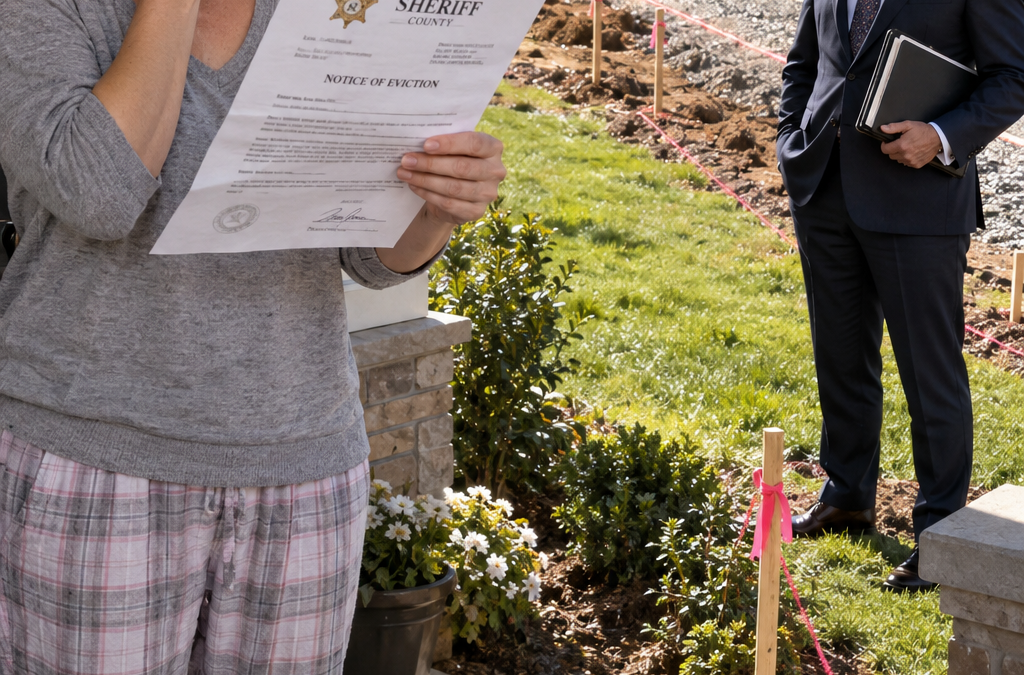
The sheriff’s letter landed on my porch on a Thursday morning with my name misspelled.
Rebekah Morris.
Not Rebecca Morris.
Not even close enough to feel accidental, somehow.
I stood there in my socks, holding the envelope in one hand and my coffee in the other, staring at a formal notice ordering me to vacate a structure I had never built.
A garage.
The letter said I had failed to vacate and surrender access to a garage located within a shared HOA improvement zone.
It said the structure had been approved by Maple Ridge Estates Homeowners Association.
It said continued obstruction could result in civil enforcement.
It said I had ten days to comply.
I read those words three times while the morning light spread across my porch and my coffee cooled untouched.
A garage.
On my land.
That I had never asked for.
Never approved.
Never built.
And according to the notice, I was the problem.
Six months earlier, I was just Rebecca, a night-shift nurse who loved her quiet cul-de-sac and believed the worst thing about my neighborhood was how early everyone mowed their lawn on Saturdays.
I had bought the little gray house on Maple Ridge Lane after seven years of working twelve-hour shifts, picking up overtime in flu season, and learning to sleep through daylight. It wasn’t fancy. Three bedrooms, a narrow kitchen, a backyard deep enough for tomatoes and two lawn chairs, and a fence that needed repainting every spring because Colorado weather had a personal grudge against cedar.
But it was mine.
That mattered.
After years of renting apartments where every wall seemed to belong to someone else, I wanted one place where I could walk barefoot through my own kitchen, plant rosemary by the back steps, and come home after a brutal shift without hearing footsteps overhead.
Maple Ridge Estates looked harmless when I moved in.
Quiet streets.
Trimmed lawns.
Children riding scooters in the evenings.
Mailboxes that all matched because, apparently, suburban unity began with identical posts.
The HOA packet at closing was thick, but the rules seemed ordinary enough.
Keep your yard maintained.
Don’t park junk cars on the lawn.
Ask before making major exterior changes.
No livestock.
No bright purple houses.
I could live with that.
Then I met Diane Foster.
Diane was the president of the Maple Ridge Estates HOA, though president never seemed like a large enough word for the role she believed she held. She ran the neighborhood like a personal kingdom. Clipboard in hand. Sunglasses perched on top of her head, even indoors. Hair cut into a sharp blond bob. Lipstick always too red for nine in the morning.
She had a way of appearing at the edge of people’s yards without seeming to walk there.
One moment the street would be empty.
The next, Diane would be standing near your mailbox with her laminated bylaw packet, smiling like she had caught you committing a crime.
She called it “checking compliance.”
Frank, my neighbor on the left, called it “hunting.”
The first time Diane came for me, I had been home from a double shift for less than four hours.
I was still in leggings and an oversized sweatshirt, standing in the kitchen trying to decide whether cereal counted as dinner, when the doorbell rang.
Diane stood on my porch with her clipboard tucked under one arm.
“Rebecca,” she said.
She had a way of saying names as though she were placing them into evidence.
“Diane.”
She smiled.
“I’m just checking compliance.”
Of course she was.
Her eyes moved past me toward the side yard.
“Your rear fence appears to exceed the approved height.”
“My fence?”
“Yes.”
“It was here when I bought the house.”
“That doesn’t make it compliant.”
“How high is it supposed to be?”
“Six feet.”
“It is six feet.”
“It is six feet two inches.”
I stared at her.
She held up a photograph clipped to her board.
There it was.
My fence.
A measuring tape.
Six feet two inches.
“You measured my fence?”
“I measure many things.”
That was the first sentence Diane ever said to me that truly scared me.
Not because of the words.
Because of the pride behind them.
She explained that the HOA was issuing a fifty-dollar fine. I could appeal, of course, but appeals had to be submitted in writing and reviewed by the board at its discretion.
“Or,” she said, smiling wider, “you can simply pay it and move on.”
I paid it.
I was tired.
I had three patients on my mind from the night before, a headache behind my eyes, and no desire to fight over two inches of cedar.
Who wants trouble over two inches of fence?
That was my first mistake.
Diane’s visits did not stop.
Next came the mailbox post.
Wrong shade of white.
I learned there were, according to Maple Ridge Estates, three approved whites.
Snowcap.
Ivory Gate.
Heritage Cloud.
Mine was apparently “hardware store white,” a phrase Diane used with the same disgust most people reserved for mold.
Then my trash cans.
Visible for eleven minutes past the permitted hour.
Eleven minutes.
The notice included a timestamped photograph, printed on HOA letterhead and slipped under my door in a clear sleeve with a smiley-face sticker on it.
That detail was pure Diane.
Threat wearing a sticker.
Then came a warning about my porch light being “insufficiently warm.”
Then another for a garden hose coiled too close to the driveway.
Then a complaint about “nonconforming seasonal planter material,” which meant the clay pot beside my front steps.
Every notice came with a photograph.
Every photograph came with a time.
Every time made it clear Diane had been watching my house more closely than anyone had a right to watch another person’s home.
I started seeing her everywhere.
At the mailbox.
Near the walking path.
In the passenger seat of a white SUV rolling slowly down the cul-de-sac.
Once, I looked out at 7:15 in the morning after coming home from a shift and saw her standing across the street, pretending to study Frank’s hedges while her phone was pointed directly at my driveway.
Frank warned me over the fence.
He was in his seventies, retired from the post office, with a dry sense of humor and a rose garden he treated like a second marriage.
“She’s not enforcing rules, honey,” he said one evening while clipping dead blooms. “She’s building a case file.”
I laughed because that was easier than admitting my stomach had tightened.
“A case file for what?”
Frank glanced toward the street.
“I’ve seen her do it before.”
“To who?”
He gave me a look that said he had learned not to answer too loudly.
“People who don’t understand fast enough that Diane likes ownership more than order.”
I didn’t know what that meant yet.
I would.
The fines began stacking.
Three hundred dollars.
Then eight hundred.
Each one arriving before the last was even due.
The language changed too.
At first the letters sounded corrective.
Then they became formal.
Then threatening.
“Failure to cure.”
“Pattern of noncompliance.”
“Potential further action.”
It was absurd, but absurdity does not make a threat harmless when the letterhead is official and the person signing it controls the board.
I started coming home from twelve-hour shifts afraid of my own porch.
That was the part I hated most.
I could handle hard.
Nursing teaches you hard.
I had held the hands of dying people while their families sobbed in hallways. I had worked through staff shortages, confused patients, angry visitors, alarms that wouldn’t stop, and nights when my feet hurt so badly I sat in my car after work because walking to the door felt like too much.
But I had always been able to come home.
Diane changed that.
Home became another chart I had to monitor.
Another patient whose vitals could crash without warning.
Then came the letter that changed everything.
It arrived on a Friday.
Not a fine.
Not a warning.
A Boundary Adjustment Notice.
According to the document, twelve feet of my backyard now fell within a “shared HOA improvement zone.”
I read that phrase over and over.
Shared HOA improvement zone.
It sounded like something invented by a committee trying to hide a theft behind more syllables.
The notice referenced an amended survey filed months before I bought the house. It claimed the rear portion of my property had been adjusted for community infrastructure development.
I called the county recorder’s office so fast I nearly dropped my phone.
A clerk named Maribel answered.
I gave her my parcel number, then read the document reference from the notice.
There was typing on her end.
A pause.
Then she said, “Yes, I see an amendment recorded.”
“My backyard is part of an HOA improvement zone?”
“That is what the amendment states.”
“I never signed anything like that.”
More typing.
“There is a signature attached.”
My mouth went dry.
“Whose?”
“Rebecca Morris.”
I gripped the counter.
“That’s me.”
“Yes, ma’am.”
“I didn’t sign it.”
Silence stretched for one beat too long.
Then Maribel’s voice changed.
“Would you like a certified copy?”
“Yes.”
My hands shook when I picked it up later that afternoon.
The photocopy showed a survey amendment shifting the legal boundary of my backyard twelve feet inward.
My signature sat at the bottom.
Except it was not my signature.
It was close enough to fool someone who wanted to be fooled.
The R was too sharp.
The M too wide.
The loop in the final s wrong.
I had signed thousands of medical charts, forms, discharge papers, medication logs, and insurance documents over the years. My signature was muscle memory. I knew every sloppy turn of it.
That one was fake.
Someone had forged my name onto a document reshaping the legal edges of my own property.
I sat in my car outside the county building with the certified copy on my lap and stared through the windshield until the parking lot blurred.
This was no longer about a fence.
No longer about a mailbox.
No longer about trash cans.
Diane Foster was trying to steal land.
And she had used my name to do it.
I did not confront her.
That may sound strange, but I had spent too many years as a nurse to run toward a crisis without taking vitals first.
Documentation saves lives.
It also saves houses.
So I did what I knew how to do.
I charted everything.
Obsessively.
Silently.
I photographed every notice.
Scanned every envelope.
Saved every email.
Downloaded the HOA portal messages before they could disappear.
I made a spreadsheet with columns for date received, alleged violation, amount, cited rule, due date, appeal status, and whether Diane had personally signed the letter.
I bought a new folder and labeled it PROPERTY RECORDS — DO NOT DISCARD.
Then I began recording my conversations with Diane on my phone, tucked innocently in the chest pocket of my scrubs whenever she approached me outside. I checked the recording laws first. I was careful. More careful than she had ever expected me to be.
Three weeks later, construction trucks rolled onto my grass at 7:00 a.m.
I was asleep when the first engine rumbled outside.
Night shift sleep is fragile. It does not arrive easily, and when it is broken, it breaks like glass.
I jolted awake thinking something had hit the house.
Then came the beep of a reversing truck.
I threw on a robe and ran downstairs.
When I opened the back door, a crew was unloading concrete pillars twelve feet past the old survey stakes near my rear fence line.
My grass was torn up in two strips where the truck tires had rolled across it.
Two men in reflective vests were unfolding blueprints on a portable table.
A third was marking the ground with orange paint.
And Diane Foster stood in the middle of my backyard holding a Starbucks cup like she owned the sunrise.
“What is this?” I demanded.
My voice cracked from sleep and shock.
Diane turned slowly.
Her sunglasses were on top of her head.
Her lipstick was perfect.
“Good morning, Rebecca.”
“What are these trucks doing on my property?”
“This is not your property.”
The sentence landed so calmly that for a moment I couldn’t respond.
She gestured toward the crew.
“This portion falls under the shared improvement zone.”
“No, it doesn’t.”
“The county records disagree.”
“The county records include a forged signature.”
Her smile hardened.
“Be careful with accusations.”
I pointed at the concrete forms.
“What are you building?”
“A community garage.”
“For what?”
“Maintenance equipment, storage, seasonal supplies.”
“On my backyard?”
“Adjacent to your backyard.”
“It’s inside my fence line.”
“Former fence line,” she said smoothly.
I stepped closer.
“Show me the board approval.”
“Approved.”
“Show me the vote.”
“The minutes are still being finalized.”
That phrase told me everything.
Minutes were still being finalized meant the meeting either had not happened, or Diane had not yet decided what the record needed to say.
“You can’t pour concrete here.”
She took a sip of coffee.
“Rebecca, you will thank me when property values rise.”
“I’m calling the police.”
“You are welcome to call anyone you like.”
Then she leaned slightly closer.
“But obstruction of an approved community improvement may create additional liability.”
Sweetheart, her voice said, though she did not use the word.
Her eyes did.
I went back inside, hands shaking with anger, and called the non-emergency police line.
An officer came out.
Diane showed him the recorded amendment.
He looked at my deed, looked at her paperwork, and gave me the sentence every property owner dreads.
“This looks civil.”
Civil.
A word that can make theft sound like a scheduling disagreement.
The officer advised us both to contact attorneys and left.
The crew stayed.
They did not pour that day because rain moved in, but they staked the site and left equipment behind like a threat.
That night, I pulled county GIS maps, old survey overlays, my title documents, and the original subdivision plat from 1987.
The truth was clear.
My deed’s boundary had never changed.
Not legitimately.
Not historically.
Not anywhere except Diane’s forged amendment.
The twelve feet she claimed ran right through the back section of my yard, exactly where her garage foundation was marked.
The forged amendment was not just fraud against me.
It was the legal excuse she needed to pour concrete on stolen land.
I hired a real estate attorney named Marcus Vale the next morning.
Marcus had an office downtown above a bakery that smelled like cinnamon and coffee. He was in his mid-forties, with graying hair, rolled-up sleeves, and the exhausted confidence of a man who had spent years watching people lie badly in expensive conference rooms.
I brought him everything.
The original deed.
The county map.
The forged amendment.
The HOA notices.
Photos of the trucks.
My recordings.
The fine spreadsheet.
He read silently for a long time.
When he reached the forged signature, he whistled low.
“This isn’t a boundary dispute, Rebecca.”
I sat forward.
“What is it?”
“This is criminal document fraud.”
The words should have frightened me.
Instead, they steadied me.
Because finally someone with authority was naming what I already knew.
Marcus filed an emergency injunction to stop construction and preserve the disputed property boundary.
He also sent demand letters to the HOA, Diane personally, and the construction company warning them that continuing work after notice of title fraud could expose them to liability.
For about forty-eight hours, everything paused.
Then Diane filed a lien against my house.
Nearly six thousand dollars in unpaid violation fees.
Fence height.
Mailbox color.
Trash timing.
Exterior obstruction.
Noncooperation.
Administrative enforcement charges.
Legal preparation fees.
It was all there, stacked like bricks.
The message was obvious.
If I fought her garage, she would threaten my house.
At the next HOA meeting, Diane stood before forty residents and called me a difficult homeowner obstructing community progress.
The clubhouse smelled like burnt coffee and floor polish.
Folding chairs filled most of the room.
People looked uncomfortable before the meeting even began.
That was Diane’s effect.
She made ordinary rooms feel like disciplinary hearings.
I sat in the third row with my phone recording from my scrub pocket.
Marcus sat beside me, quiet, legal pad balanced on one knee.
Diane stood at the front with her laminated bylaws and that clipboard.
Her voice was syrup sweet.
Her eyes were ice.
“Certain homeowners have chosen to place personal preference above the needs of this community,” she said.
I watched the back of her head.
I did not speak.
She clicked to a slide showing a rendering of the proposed garage.
Clean lines.
White siding.
Little shrubs in front.
No mention that it sat twelve feet inside my deeded property.
No mention that my signature on the amendment was forged.
No mention that construction trucks had rolled across my grass at sunrise.
“Progress requires cooperation,” she continued. “Unfortunately, some residents confuse accountability with persecution.”
A few people shifted in their seats.
I stayed silent.
Let her talk, Marcus had told me.
People like Diane dig best when handed a shovel.
Then an older man in the second row raised his hand.
Harold Bennett.
I knew him only vaguely.
He was widowed, soft-spoken, and walked every morning with a cane and a battered baseball cap. He lived near the cul-de-sac entrance in a brick ranch with a storage shed behind it.
Diane paused.
“Yes, Harold?”
His voice was quiet.
“Why did my storage shed vanish from the HOA minutes?”
The room changed.
Just slightly.
Diane blinked.
“I’m not sure what you mean.”
“You approved it eight years ago.”
“I don’t have those records in front of me.”
“I do.”
A murmur moved through the room.
Harold lifted a folder from his lap.
“I have the original approval. Signed by the board. But last year, when you fined me, you said there was no record of approval.”
Diane gave a small laugh.
“Volunteer boards sometimes have incomplete archives. People misremember. It happens.”
Harold did not sit down.
“I didn’t misremember.”
The room went quiet.
Then a woman near the back raised her hand.
“You said the same thing about my pergola.”
Another neighbor stood.
“And my driveway extension.”
Then another.
“My fine never matched the violation letter.”
A man in a blue jacket said, “What happened to the pool repair money?”
Diane’s mask flickered.
Only for a second.
A tightening near her mouth.
A quick glance toward the treasurer’s seat.
Then the smile returned.
“We are not going to turn this meeting into a complaint session based on old confusion.”
But the room had shifted.
For years, people had experienced Diane’s pressure alone.
That night, they began hearing each other.
After the meeting, Harold approached me in the parking lot.
Up close, he looked nervous but determined.
“I’m sorry about your yard,” he said.
“Thank you.”
He tapped his folder.
“I should have said something sooner.”
“You said something tonight.”
He nodded.
“She made me feel foolish for keeping papers.”
“Papers matter.”
His eyes met mine.
“I have eight years of them.”
That night, Marcus and I compiled everything.
My forged amendment.
My fines.
Harold’s missing shed approval.
Three other neighbors’ phantom violations.
Board minutes no one remembered attending.
Votes that did not appear in anyone’s notes.
Charges that did not match schedules.
Money nobody could trace in the ledger.
The pattern stretched back further than any of us had imagined.
Marcus requested the HOA’s full financial records through legal discovery.
We expected resistance.
Instead, the treasurer resigned the next morning.
No warning.
No explanation.
Just an email to the board stating she could no longer fulfill her duties.
By noon, she had contacted Marcus.
Her name was Elaine Porter.
She had been treasurer for two years, though Diane had kept the actual bank access and vendor relationships under what she called “presidential oversight.”
Elaine agreed to speak to Marcus off the record at first.
She was terrified.
I wasn’t in the room, but Marcus told me later that she cried before she said the word.
“Skimming.”
Diane had not just stolen land.
For years, she had been funneling violation fee payments into an account connected to her husband’s construction company.
The company appeared on HOA ledgers as a vendor for maintenance, storage, repair preparation, and infrastructure staging.
Its name was Foster Residential Services.
Registered owner: Diane’s husband, Craig Foster.
The same company listed on the blueprints for the so-called community garage.
The garage on my property was not community infrastructure.
It was inventory storage for Diane’s side business, built on land she had quietly claimed as her own through a forged survey amendment.
Once Elaine started talking, the whole thing unraveled fast.
Violation fees that should have gone into the HOA operating account were coded as special compliance funds.
Special compliance funds were paid out as vendor reimbursements.
Vendor reimbursements went to Craig’s company.
Craig’s company purchased materials.
Materials needed storage.
Storage needed land.
My backyard sat near the service lane and offered the perfect access point.
Diane had found the land first.
Then forged the paperwork.
Then created the violations to pressure me into silence.
Marcus looked almost grim when he laid it out for me.
“Forgery, fraud, embezzlement, misuse of association authority, retaliatory lien, fraudulent construction approval.”
I sat in his office with both hands wrapped around a paper cup of coffee I had not touched.
“All because of twelve feet?”
“No,” Marcus said. “Because she got away with smaller things for years.”
That sentence stayed with me.
People like Diane do not wake up one morning and forge a boundary amendment out of nowhere.
They practice.
A late fee here.
A missing minute there.
A vote no one remembers.
A homeowner too tired to fight.
A board member too intimidated to ask.
A treasurer kept just outside the real numbers.
Every small success teaches them the next theft is safe.
Until someone documents everything.
The court date arrived faster than I expected.
HOA fraud cases apparently move quickly when a county prosecutor smells easy, well-documented headlines.
The courtroom was smaller than I imagined.
No dramatic columns.
No television lighting.
Just wooden benches, fluorescent light, and the low hum of people waiting for their turn to have their lives translated into legal language.
Diane arrived in a blazer sharp enough to cut glass.
Navy blue.
White blouse.
Pearls.
Her sunglasses were not on her head for once, but she carried them in one hand like a talisman.
She still radiated the confidence of someone who had never once faced real consequences.
Craig sat behind her, jaw tight, avoiding everyone’s eyes.
Marcus laid it out plainly.
The forged signature.
The altered survey.
The original 1987 boundary.
The construction trucks.
The lien filed after our injunction request.
Six years of missing funds.
Elaine’s statement.
Harold’s records.
Sworn statements from two other residents.
The payments to Foster Residential Services.
The judge listened without interrupting.
Diane’s attorney tried to frame the matter as a misunderstanding over aging records and a legitimate community project that had been unfairly politicized by a difficult homeowner.
Difficult homeowner.
There it was again.
The phrase Diane had used like a brand.
The judge asked one question.
“Did Ms. Morris sign the boundary amendment?”
Diane’s attorney hesitated.
“The association relied on the recorded document.”
“That is not what I asked.”
The room became very still.
Marcus presented my signature exemplars.
Medical forms.
Closing documents.
Bank records.
The forged amendment.
The differences were obvious once placed side by side.
Then came Twist Three.
The judge looked over her glasses at Diane and said, “The county has advised this court that Ms. Foster is already the subject of an open fraud investigation involving her previous management of another homeowners association two towns over.”
For the first time all morning, Diane’s composure cracked.
Not tears.
Not anger.
Just a stunned, hollow stare.
As though she genuinely believed her clipboard had made her untouchable.
I watched her face and realized something that made my stomach turn.
She was not shocked that someone accused her.
She was shocked that someone had been believed.
The judge granted my injunction immediately.
Construction stopped.
The disputed garage site was frozen.
The lien on my house was voided that same afternoon.
Not reduced.
Not postponed.
Voided.
The court ordered the county record corrected pending the fraud investigation and restored my full, undisputed twelve feet of land.
My name was clean on every record again.
Diane was ordered to bear personal responsibility for the costs associated with the unauthorized construction if the investigation confirmed her misconduct.
Later, after the criminal filings and civil claims developed, that order became exactly what Marcus said it would become.
A demolition bill with her name on it.
Diane was removed from the board within the week.
The vote was unanimous.
Even the people who had defended her for years turned away when the forged amendment and financial records became impossible to explain.
Her HOA email account was deactivated before sunset.
I know because I sent one final message requesting confirmation that all enforcement actions against my property had been withdrawn.
It bounced back.
Account inactive.
I stared at that automatic reply longer than necessary.
For months, Diane’s emails had made my stomach tighten.
Now the address itself was dead.
The garage frame stood half-built in my backyard for a while, a skeleton of arrogance and stolen concrete.
The court would not allow immediate removal until the county finished photographing and documenting everything connected to the unauthorized project.
So I lived with it there.
Twelve feet into my grass.
Concrete footings.
Stacked materials.
Orange safety tape.
A monument to what Diane thought she could take.
Some evenings, I stood at the kitchen window and looked at it.
At first, it made me furious.
Then, strangely, it became useful.
Every time I felt tired of depositions, statements, meetings, and attorney calls, I looked at those concrete pillars and remembered what surrender would have meant.
Not peace.
Not compromise.
A stolen backyard.
A fake garage.
A forged signature sitting quietly in county records while Diane smiled at me over a Starbucks cup.
The criminal charges came later.
Felony fraud.
Forgery.
Embezzlement.
Filing false public records.
Misuse of association funds.
Craig’s company was pulled into the financial investigation.
Elaine cooperated fully.
Harold became one of the strongest witnesses because his records showed the pattern had existed for years.
Other residents joined civil claims.
Fines were reviewed.
Improper liens released.
Old approvals restored.
The board hired outside management and created rules requiring dual signatures, recorded votes, digital archives, and independent audits.
Maple Ridge Estates did not become perfect.
No neighborhood does.
But it stopped being Diane’s kingdom.
Six months after the sheriff’s letter landed on my porch, Harold and I sat in lawn chairs in my restored backyard, watching a demolition crew haul away the last of her stolen concrete dream.
The crew had already broken up the footings.
The garage frame was gone.
The grass was torn and muddy, but open.
Mine again.
Harold brought lemonade in a thermos.
I brought sandwiches.
Frank leaned over the fence for commentary like a man watching a sporting event.
When the final truck pulled away, Harold lifted his paper cup.
“To accurate minutes.”
I laughed and tapped my cup against his.
“To accurate boundaries.”
Frank called from the fence, “To minding your own damn business!”
That one felt most appropriate.
The yard looked rough afterward.
Bare patches.
Tire marks.
A long scar where the concrete had been cut out.
But I loved it.
I loved every ugly inch because it was mine.
Marcus came by later with the final order.
The forged amendment invalidated.
The lien voided.
The HOA ordered to correct all property records.
Diane personally liable for removal costs.
My twelve feet restored.
He handed me the folder.
“You won,” he said.
I looked out at the torn-up grass.
“It doesn’t look like winning.”
“It will.”
He was right.
I planted new grass seed that weekend.
Not because I wanted the yard to look perfect for the HOA.
Because I wanted to reclaim it with my own hands.
Sophia from across the street brought a bag of topsoil.
Frank brought a rake and complained the whole time about my technique.
Harold sat on the patio and supervised like a retired general.
We worked until sunset.
No clipboard.
No sunglasses.
No one measuring anything.
Weeks later, the first green came through.
Thin.
Uneven.
Stubborn.
I stood barefoot in the yard after a shift, looking at those small blades of grass, and felt something in my chest finally unclench.
I never asked to be a fighter.
I was a nurse.
I knew medication schedules, wound care, family grief, discharge instructions, and how to keep my voice steady when everything around me was falling apart.
I wanted a quiet house on a quiet cul-de-sac.
A backyard with rosemary.
A fence that kept the world at a manageable distance.
I did not want court dates.
Forgery.
Fraud.
Lien notices.
Sheriff’s letters with my name spelled wrong.
But wanting peace does not mean surrendering truth.
Diane believed she could rewrite reality because she controlled the paperwork.
She believed a forged signature could move my property line.
That missing minutes could erase old approvals.
That fines could silence questions.
That neighbors who were tired, elderly, busy, or afraid would eventually choose quiet over justice.
For a long time, she was right.
Then she picked a nurse who knew how to document.
A quiet neighbor who kept eight years of paperwork.
A treasurer who finally said one word out loud.
An attorney who understood that the story was never just about twelve feet of land.
Now my backyard begins exactly where it always did.
At the line written in my deed.
At the old survey stakes.
At the truth Diane tried to bury beneath concrete.
Sometimes people ask if I still live in Maple Ridge Estates.
I do.
My fence is still two inches over the approved height.
No one has mentioned it in six months.
And if anyone ever does, I have a folder ready.








