𝗙𝗨𝗟𝗟 𝗦𝗧𝗢𝗥𝗬 The Salon Owner Looked at the Veteran in My Chair and Told Me to Remember My Place
𝗙𝗨𝗟𝗟 𝗦𝗧𝗢𝗥𝗬
Still enough along the sides to shape.
I worked carefully.
Some barbers rush older men.
I never understood that.
If anything, age deserves slower hands.
I trimmed around his ears.
Evened the sides.
Blended gently.
His hands stopped trembling against the armrests.
For the first few minutes, we talked about ordinary things.
Weather.
Traffic near the VA clinic.
Football.
Then I asked:
“You getting cleaned up for something?”
“Veterans Day ceremony this weekend.”
“That right?”
“My son’s putting it together at City Hall.”
“He must be proud.”
Harold smiled faintly.
“I think so.”
“You think?”
“He’s busy.”
He looked at himself in the mirror.
“Doesn’t say much.”
“What does he do?”
“Works for the city.”
That was all.
I did not push.
Barbers learn when people want to talk and when they want the subject left alone.
“My father served,” I said.
I had not planned to say it.
The words just came.
Harold’s eyes lifted toward mine in the mirror.
“Army?”
“Yes, sir.”
“How long?”
“Twenty-two years.”
His expression changed.
“Same as me.”
I nodded.
“He passed two years ago.”
Harold turned slightly.
I guided his head back.
“Cancer.”
He reached up.
His hand closed around my wrist.
Not hard.
Just enough.
“Your daddy raised a good man.”
The clippers stopped in my hand.
I stared toward the ceiling.
For a second, I was back beside my father’s hospital bed.
His face thin.
His voice weaker than I had ever heard it.
Don’t make me ugly before I go.
I swallowed.
“Thank you.”
Harold released my wrist.
I started cutting again.
Denise glanced toward us.
Two clients had stopped scrolling on their phones.
For one moment, the salon felt different.
Not luxury.
Not business.
Not hierarchy.
Just two men talking about fathers, service and loss.
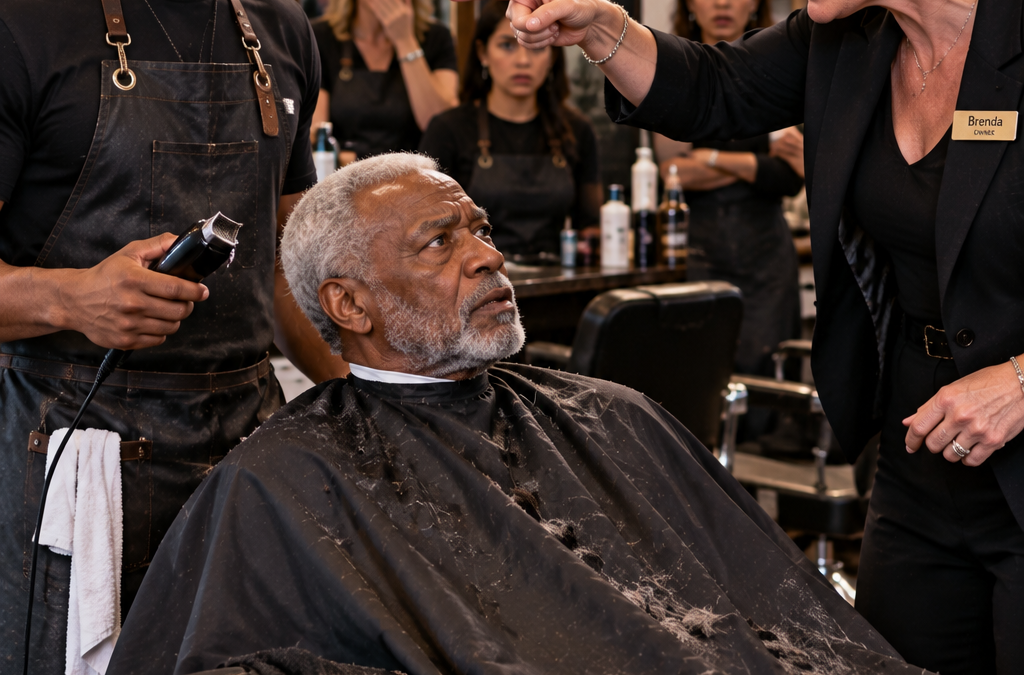
Then Brenda’s office door opened.
Her heels hit the tile.
Click.
Click.
Click.
She was looking at her phone.
Then she looked up.
Saw Harold.
Stopped.
I watched her eyes.
The cane.
Cap.
Old shoes.
Dark skin.
She assessed him the same way people inspect a stain.
Two seconds.
Maybe less.
Then the smile appeared.
A dangerous smile.
“Fletcher.”
She approached my station.
I kept the clippers moving.
“Yes?”
“Who do we have here?”
“This is Harold.”
Harold gave her a polite nod.
“Ma’am.”
“He’s a veteran.”
I smiled at him through the mirror.
“I’m getting him ready for a Veterans Day event.”
Brenda looked toward reception.
“I don’t see him on the schedule.”
“He’s a walk-in.”
“And payment?”
“On me.”
Her face tightened.
“On you.”
“Yes.”
“I’m giving him the cut.”
“That is not what I asked.”
I turned off the clippers.
“Brenda, it’s one haircut.”
“We don’t do free services.”
“It’s Veterans Day week.”
“I don’t care if it’s Christmas.”
Her voice was low enough that only those near us could hear.
“This is a business.”
“Then call it a promotion.”
“I didn’t authorize a promotion.”
Harold shifted in the chair.
“I can pay, ma’am.”
Brenda barely glanced at him.
“This conversation doesn’t concern you.”
My jaw tightened.
“He’s the customer.”
“He is not a customer until he pays.”
I stared at her.
“Brenda.”
She stepped closer.
“I decide who sits in these chairs.”
Then she added:
“Not you.”
The meaning landed between us.
Not barber and owner.
Something older.
Something uglier.
I looked at Harold.
His eyes had lowered.
I turned the clippers back on.
Brenda stared at me.
“You heard me.”
“Yes.”
“And?”
“I’m finishing his haircut.”
Her mouth opened.
Closed.
For once, she did not have an immediate response.
Then she walked back to her office.
The door shut hard.
Harold looked at me in the mirror.
“You don’t have to get yourself in trouble.”
“I’m already halfway done.”
“I can leave.”
“No, sir.”
“Son.”
“My father would haunt me.”
That got a small laugh.
“Sit still.”
I continued.
Five minutes later, Brenda came back.
This time she did not bother with a quiet voice.
“Fletcher.”
Every conversation stopped.
I lowered the clippers.
“Put those down.”
The jazz seemed suddenly too loud.
Then someone at reception turned it off.
Brenda stood in the center of the salon.
She wanted everyone listening.
“You deliberately ignored me.”
“I told you I was finishing.”
“You gave away my service.”
“My labor.”
“My salon.”
“My chair.”
She stepped closer.
“You do not decide what belongs to you in here.”
My hands went still.
She looked toward Harold.
Then back at me.
“You brought someone in off the street.”
“He walked in.”
“Unscheduled.”
“Yes.”
“Nonpaying.”
“Because I waived my fee.”
“You don’t own the fee.”
I took a breath.
“Three years.”
“What?”
“I’ve worked here three years.”
“So?”
“Never missed a day.”
“Do you want a medal?”
“I bring in more repeat clients than anybody except maybe Denise.”
Denise looked down.
“I’ve never given away a service before.”
Brenda laughed.
“You want to play hero?”
“No.”
“Yes, you do.”
She pointed toward Harold.
“You want to be generous with my money.”
“He served this country twenty-two years.”
“And you can barely pay your own bills.”
A few faces shifted.
She knew.
Of course she knew.
I had once asked for two extra days to pay my chair fee after Karen had an unexpected medical expense.
Brenda had remembered.
Not with compassion.
With ammunition.
“You’re barely keeping your lights on at home,” she continued, “and now you want to play big man in my shop.”
I felt heat behind my eyes.
“That’s not relevant.”
“It’s completely relevant.”
She looked me over.
“Because you still don’t understand where you stand.”
My stomach tightened.
She said it again.
Slower.
“You don’t know your place.”
Nobody moved.
Nobody needed her to explain what she meant.
Harold started pushing himself up.
His cane scraped against the floor.
“Ma’am.”
His voice trembled.
“I’ll pay.”
Brenda did not turn.
“Please.”
He reached for his wallet.
“I didn’t mean to cause any problem.”
She finally looked at him.
“Sir, nobody is talking to you.”
The words hit me harder than anything she had said to me.
Harold stopped.
This man had served twenty-two years.
Two combat tours, I later learned.
He had buried friends.
Raised a son.
Buried his wife.
He had walked into a salon asking for nothing more than a haircut.
And Brenda dismissed him like a piece of furniture making noise.
His chin trembled.
That ended the decision for me.
I unclipped my apron.
Folded it.
Set it on the counter.
Brenda stared.
“What are you doing?”
“You said I’m fired.”
“I haven’t said it yet.”
“Then say it.”
Her eyes narrowed.
“You’re fired.”
The room remained silent.
“Effective immediately.”
I nodded.
Harold looked horrified.
“No.”
I turned toward him.
“Sir—”
“This is because of me.”
“No.”
“I’ll pay.”
“No.”
He looked at Brenda.
“I’ll pay double.”
Brenda crossed her arms.
“Both of you need to leave.”
I picked up my tool bag.
Three years of work.
Packed into canvas and leather.
The station suddenly looked anonymous.
Like I had never been there.
I unfastened Harold’s cape.
His haircut was only half finished.
The left side clean.
Right side still uneven.
I crouched beside him.
His eyes were wet.
“I’m sorry.”
“No.”
He swallowed.
“You lost your job.”
“This was my choice.”
“Because of me.”
“Because of her.”
He looked toward Brenda.
Then back at me.
“I’d make it again tomorrow.”
I helped him stand.
Placed his cane in his hand.
Then we walked out.
I did not slam the door.
Did not curse Brenda.
Did not give her the satisfaction of seeing me lose control.
I stepped onto Main Street carrying my bag.
And then I realized I had nowhere to go.
That part rarely appears in stories about principle.
People like the moment a man stands up for himself.
They do not show rent due in eleven days.
Past-due electric bill.
Forty-two dollars in checking.
A wife already working double shifts.
I stood outside the salon thinking:
What the hell did I just do?
Then I looked at Harold.
Half a haircut.
The answer became simple.
I put my bag on a wooden bench outside the salon.
Three feet from the window.
Unzipped it.
Pulled out clippers.
Cape.
Comb.
Harold stared.
“What are you doing?”
“Sit.”
“Fletcher.”
“I’m not finished.”
“You’ve done enough.”
“No, sir.”
I pointed toward the bench.
“You have a ceremony.”
His eyes filled again.
“Sit down.”
He did.
I wrapped the cape around him.
People walked past.
I started cutting.
Sunlight instead of salon lighting.
Traffic instead of jazz.
No mirror.
I used the reflection from the salon glass when I needed one.
Inside, Brenda stood with her arms crossed.
Watching.
I saw her.
Ignored her.
My job was Harold.
I cleaned the right side.
Matched the fade.
Trimmed around his ears.
Edged carefully.
A woman carrying groceries stopped.
Then a man with a dog.
Then two people holding coffee.
One phone came out.
Then another.
I barely noticed.
Harold sat straight.
The shame was leaving his face.
That alone made everything worth it.
When I finished, I brushed loose hair from his neck.
“Done.”
He reached toward his head.
“Good?”
“You look dangerous.”
He smiled.
Then he took my hand.
His grip was surprisingly strong.
“My son would have done the same.”
I did not understand.
I assumed he meant his son would have helped a veteran.
Maybe stood up to Brenda.
I nodded.
A woman nearby began clapping.
Someone joined her.
Then another.
Small applause.
Nothing dramatic.
But through the glass, Brenda heard it.
I saw her face redden.
I packed my tools.
Harold hugged me.
Then we parted.
I went home unemployed.
That evening, somebody named Clare posted ninety seconds of sidewalk video online.
I did not know.
I barely used TikTok.
I was on my couch running numbers.
Rent.
Electricity.
Groceries.
Karen’s phone began buzzing before she had even taken off her hospital badge.
“What happened today?”
I looked at her.
“How do you know?”
She held up the screen.
“Apparently everybody knows.”
She sat beside me.
Played the video.
There I was.
Kneeling beside Harold.
Clippers moving.
Salon behind us.
Brenda visible through the window.
At the end, Harold held my hand.
The caption explained I had been fired for giving a veteran a free haircut and finished it outside.
The view count was climbing by the second.
I watched once.
Then put the phone face down.
Karen stared.
“That’s it?”
“What do you want me to say?”
“You’re going viral.”
“I’m unemployed.”
She became quiet.
“I’m sorry.”
“So am I.”
I leaned back.
“What if nobody hires me?”
“Somebody will.”
“What if Brenda starts calling people?”
Karen knew her.
She knew why I was worried.
I had complained about Brenda privately for years.
Karen always asked:
“Why stay?”
And I always answered:
“Because leaving with no plan is expensive.”
Now I had done exactly that.
By midnight, the video had hundreds of thousands of views.
By morning, millions.
People called me a hero.
Others called me irresponsible.
Some said the salon owner had every right to enforce policy.
That was fine.
People can disagree about free haircuts.
What happened next was not fine.
Brenda decided losing my job was not enough.
She wanted my name too.
Her first public statement said I had been terminated for repeated policy violations.
That was false.
I had no prior discipline.
Then she started calling other salons.
I learned because one owner I had known casually texted:
Brother, what happened at Thornton’s? She says you were stealing services.
Stealing.
The word made me sick.
I called three salons.
No callback.
Another.
Nothing.
Another manager told me politely:
“We’re not hiring right now.”
Their website showed two openings.
Brenda posted again.
Said I was insubordinate.
Said I should not be turned into a hero.
Threatened legal action against people spreading “defamatory” information.
I made the mistake of reading comments.
At two in the morning.
One person wrote:
If he gives away someone else’s services, he deserves to be fired.
Another:
We don’t know the whole story.
Another:
Typical entitlement.
Another:
The veteran thing is emotional manipulation.
Then:
Why does everything have to be about race?
I kept scrolling.
Karen found me at six.
“You sleep?”
“No.”
She took the phone from me.
“She’s telling everybody I’m a thief.”
“I know.”
“Other salons are going to believe her.”
“Some already do.”
I looked at my tool bag near the door.
For the first time in years, I did not want to touch it.
Three days passed.
I stayed home.
That scared Karen more than anything.
I was a man who got up.
Always.
Funeral morning after my father died, I still made coffee.
When bills came, I made lists.
When cars broke, I learned enough to fix them.
Action was how I survived fear.
Now I lay on the couch.
No calls.
No interviews.
No plan.
I started wondering whether I had confused pride with principle.
Maybe I should have stopped.
Maybe Harold would have understood.
Maybe I should have charged him.
Maybe one haircut was not worth our financial stability.
Then I would remember Brenda saying:
Nobody is talking to you.
And I knew I would have done it again.
Across town, someone else finally saw the video.
Mayor Terrence Wilson.
I had voted for him.
Never met him.
I knew his face from local news and city events.
What I did not know was that Harold Wilson was his father.
Terrence recognized the veteran’s cap before he recognized the face.
He called Harold.
Harold told him everything.
Not dramatically.
That was not his way.
“I went in for a haircut.”
“Barber offered it free.”
“Owner got angry.”
“He lost his job.”
“He finished outside.”
Then Harold said:
“The boy lost his job because of me.”
Terrence corrected him.
“No, Dad.”
Harold apparently argued.
Terrence asked only two practical questions.
“What is the salon?”
“Thornton’s Style and Grace.”
“The barber?”
“Fletcher. Don’t remember the last name.”
Terrence found me within hours.
My phone rang around eight that night.
Unknown number.
I almost ignored it.
“Hello?”
“Mr. Vaughn?”
“Yes.”
“My name is Terrence Wilson.”
My mind searched.
“Mayor Wilson?”
“Yes.”
I sat up.
Karen looked toward me.
“The man you cut hair for outside Thornton’s.”
I said nothing.
“He’s my father.”
I stood.
“Harold?”
“Yes.”
“Sir, I didn’t know—”
“I know.”
His voice changed.
“That is precisely why I’m calling.”
I listened.
“My father served twenty-two years.”
“I know some of that.”
“Two combat tours.”
I closed my eyes.
“He went to that salon because it was near his VA appointment.”
Pause.
“He wanted to look good for the Veterans Day ceremony.”
I remembered him saying his son organized it.
Terrence continued.
“My ceremony.”
I sat again.
“Mr. Mayor—”
“My father did not tell me what happened.”
His voice tightened.
“I learned from a video of him sitting on a public bench while a stranger finished his haircut outside a business that had made him feel unwelcome.”
I could hear anger beneath every controlled word.
“He would never have told me.”
“I believe that.”
“He doesn’t complain.”
“No.”
“He absorbs.”
That word stayed with me.
Absorbs.
Terrence said:
“And I heard what she called you afterward.”
I looked toward Karen.
“The theft accusation.”
“Yes.”
“I don’t know what to do.”
It was the first time I admitted that aloud.
Terrence paused.
Then said:
“First, stop believing you’re alone.”
My throat tightened.
“You treated my father with dignity without knowing who he was.”
“I treated him the way I would’ve wanted somebody to treat my father.”
“I know.”
Terrence’s voice softened.
“That’s why this matters.”
Then it hardened again.
“What happened to you is not going to disappear into social media.”
After we hung up, he made calls.
The Asheford Office of Civil Rights.
Georgia NAACP.
An investigative reporter named Angela Brooks.
Within two days, Angela interviewed me.
She came to our apartment with one camera operator.
No dramatic setup.
She sat across from me at the kitchen table.
“Why did you give Harold the haircut?”
“My father.”
“What about him?”
“He was a veteran.”
I looked toward the photograph in the living room.
“He died two years ago.”
I explained how Harold reminded me of him.
“How much was the haircut worth?”
“Forty-five dollars.”
“And you lost your job over forty-five dollars.”
“I lost my job because Brenda decided the haircut reminded her I could make one decision without asking permission.”
Angela studied me.
“Do you believe race was part of it?”
“Yes.”
“Why?”
“Three years.”
I told her what I could remember.
Not being called by name.
Black clients routed to me.
Comments about clientele.
“Did she use racial slurs?”
“Not usually.”
“Usually?”
I thought about the day.
“What she called Harold and me that morning wasn’t subtle.”
Harold agreed to an interview.
He wore his veteran’s cap.
Placed it on the table beside him.
Angela asked:
“How did the salon owner make you feel?”
Harold took a long time before answering.
“Like I had entered through a door meant for somebody else.”
That sentence aired.
So did mine.
So did two former employees who contacted Angela and said Brenda sometimes instructed staff to claim there were no appointments available when Black customers called.
The first news segment aired at six.
Headline:
SALON OWNER FIRES BARBER AFTER FREE VETERAN HAIRCUT, THEN ATTACKS HIM ONLINE.
Then Angela revealed Harold’s identity.
The mayor’s father.
National attention followed.
Brenda went on camera.
“This was a business decision.”
Nothing to do with race.
Policy violation.
Professional standards.
I watched from home.
For a moment, I wondered whether people would believe her.
Then Denise Crawford called Angela.
Denise had been in the salon that day.
Had watched.
Had stayed silent.
And for the previous year, she had saved staff messages.
Messages from Brenda.
Words I had never seen.
The help is getting too comfortable.
I only keep him because the consultant said I need a Black face.
If one more of his people walks in here, I swear.
When Angela displayed those messages on television, I felt physically sick.
Not surprised.
That was the disturbing part.
Nothing in them surprised me.
For three years, I had sensed the truth through tone, glances, scheduling decisions, little humiliations.
Now there it was.
Written.
Date stamped.
Undeniable.
Denise appeared on camera.
Her hands shook.
“I should have spoken that day.”
Angela asked:
“Why didn’t you?”
Denise looked down.
“I was afraid.”
“Of what?”
“Losing my job.”
Her voice cracked.
“I’m a single mother.”
She took a breath.
“I have a six-year-old daughter.”
I understood.
More than the internet did.
People called her cowardly.
I did not.
I knew the price of unemployment.
Fear had kept me at Thornton’s for three years too.
Denise said:
“But then Brenda lied.”
She looked toward the camera.
“She tried to destroy Fletcher for doing something decent.”
Then:
“I couldn’t afford to keep being quiet.”
Those words changed our relationship forever.
Brenda’s first apology came fast.
“If my actions were perceived as discriminatory…”
I stopped the video.
Karen laughed bitterly.
“If.”
Her second apology was worse.
No makeup.
Dim lighting.
Tears.
“I’m not racist.”
Then:
“I have Black friends.”
I groaned.
Karen covered her face.
Then Brenda said:
“I gave Fletcher a chance when nobody else would.”
I turned the television off.
That sentence hurt.
More than the firing.
More than “know your place.”
Because it revealed how she had always understood our relationship.
Not employer and skilled professional.
Benefactor and recipient.
She believed hiring me had been charity.
My clients.
My three years of labor.
My reliability.
My talent.
All of it erased beneath:
I gave him a chance.
Within days, Thornton’s bookings collapsed.
Regular clients canceled.
Employees resigned.
Product partners left.
The online reviews became a disaster.
Some of that made me uncomfortable.
Thousands of people who had never visited the salon left one-star ratings.
That did not feel like justice.
It felt like a mob.
But the business consequences from actual customers and partners were real.
People had seen who Brenda was.
They made choices.
The salon emptied.
Then came the legal case.
I did not want to sue at first.
I wanted a job.
Normal life.
Distance.
But Brenda had not simply fired me.
She had called competing salons and accused me of theft.
That endangered my career.
And Denise’s messages suggested the problem was larger than one argument.
My attorney explained the claims.
Wrongful termination.
Racial discrimination.
Hostile work environment.
Defamation.
Retaliatory blacklisting.
The case moved faster because of the public evidence.
Video.
Posts.
Messages.
Witnesses.
Months later, I walked into court wearing a dark suit Karen had chosen.
My father’s photograph was in my phone.
Before entering, I looked at it.
“Try not to let me say anything stupid.”
Karen squeezed my hand.
“He’d be proud.”
“I hope.”
“He would.”
The courtroom was packed.
Reporters.
Community members.
Veterans.
Salon workers.
People I had never met.
I hated being watched.
I had never wanted to become a symbol.
Symbols are simpler than people.
I was still worried about bills.
Still angry.
Still embarrassed sometimes.
Still wondering whether standing up to Brenda had been courage or just the moment my tolerance finally broke.
I took the stand.
My attorney began with my employment history.
“Three years?”
“Yes.”
“Attendance?”
“Never missed a scheduled workday.”
“Prior discipline?”
“None.”
“Customer complaints?”
“None that I knew of.”
Then he asked about Harold.
I looked toward the gallery.
Harold sat beside Terrence.
Veterans cap in his lap.
“I saw him walk in.”
“What did you notice?”
“The cane.”
I smiled slightly.
“Then the cap.”
“Why did that matter?”
“My father was a veteran.”
The room became quiet.
“Staff Sergeant Leonard Vaughn.”
“How long did he serve?”
“Twenty-two years.”
“Is he living?”
“No.”
My voice changed.
I hated that it did.
“He died two years before this happened.”
“And when Mr. Wilson walked into the salon?”
“I saw my father.”
I swallowed.
“Not literally.”
A few people smiled.
“He had the same posture.”
“The same kind of eyes.”
I explained the haircut.
The free service.
Brenda approaching.
Her words.
“Know your place.”
Then Harold trying to pay.
“And what did Ms. Thornton say?”
I hesitated.
“She said nobody was talking to him.”
“How did that affect you?”
I thought.
“That was the moment the job stopped mattering more than the man.”
The defense attorney cross-examined me.
“Mr. Vaughn, was there a salon policy against unauthorized free services?”
“Yes.”
“You knew that?”
“Yes.”
“And violated it?”
“Yes.”
“So you knowingly broke policy.”
“Yes.”
He paused.
Maybe he expected me to resist.
“You considered yourself above salon rules?”
“No.”
“But you broke one.”
“Yes.”
“Why?”
I looked toward Harold.
“Because sometimes a rule and the right thing are standing on opposite sides of the room.”
The attorney frowned.
“That sounds convenient.”
“Maybe.”
I looked back at him.
“But I made the choice.”
“You expected no consequences?”
“No.”
“You admit you were insubordinate?”
“I admit I refused to stop a haircut after she told me to.”
“Because you thought you knew better.”
“Because a seventy-two-year-old veteran was sitting in my chair being humiliated.”
He tried another direction.
“You could have simply charged him.”
“I could have.”
“You chose not to.”
“Yes.”
“No further questions.”
Then Harold entered the courtroom in full military dress uniform.
I had seen him in the veteran’s cap.
I had never seen the uniform.
For a second, I forgot to breathe.
Medals.
Service ribbons.
Combat badges.
Bronze Star.
Shoes polished.
Cane in his right hand.
Back straight.
He walked slowly.
But every step carried something.
Nobody instructed the courtroom to stand.
People just did.
I stood too.
Harold looked embarrassed by the attention.
That was Harold.
He took the witness chair.
His testimony began with service.
Twenty-two years.
Two combat tours.
Men lost.
Men carried.
Families notified.
Then home.
Marriage.
Son.
Widower.
He did not make himself heroic.
He described facts.
When asked why he entered Thornton’s, he almost smiled.
“I needed a haircut.”
A little laughter released the tension.
“For the Veterans Day ceremony?”
“Yes.”
“My son organized it.”
“What happened when you entered?”
“This young man saw me.”
He pointed toward me.
“Pulled out his chair.”
“What did he say?”
“Your money’s no good here today.”
Harold looked at me.
“Thank you for your service.”
His eyes filled.
“He made me feel welcome.”
Then Brenda.
Her expression.
Her refusal to acknowledge him.
The dismissal.
Nobody is talking to you.
Harold stopped.
His jaw tightened.
“What did that make you feel?”
He looked toward the jury.
“I have been shot at.”
Silence.
“I have carried wounded men.”
He gripped the cane.
“I have written letters to families when their sons did not come home.”
His voice remained steady.
“I buried my wife.”
Then it cracked.
One small break.
“But I had never felt as small as I felt sitting in that chair.”
A juror wiped his eyes.
Harold continued.
“For ten minutes, Fletcher treated me like I mattered.”
He looked toward Brenda.
“Then she looked at me like I was dirt somebody tracked onto her floor.”
No theatrics.
That made it worse.
The defense did not meaningfully challenge him.
Then Denise testified.
She admitted her silence.
“I was afraid.”
Her six-year-old daughter.
Rent.
Job security.
Then the messages appeared on a courtroom screen.
Brenda’s own words.
Denise read them aloud.
The help is getting too comfortable.
I only keep him because the consultant said I need a Black face.
If one more of his people walks in here, I swear.
I watched Brenda.
She never raised her eyes.
For years, I had wondered whether I was imagining things.
That is one of the quiet injuries of discrimination.
Not always the insult itself.
The uncertainty.
Was that about race?
Am I being too sensitive?
Would she have said that to someone else?
Why am I always assigned those clients?
Why does she never say my name?
Why do I feel unwelcome in a place where I work every day?
Those messages ended the uncertainty.
I had not imagined it.
The jury deliberated about four hours.
When we returned, Karen held my hand.
Harold sat behind me.
Terrence beside him.
Denise across the aisle.
The foreperson stood.
The jury found in our favor on every major claim.
Wrongful termination.
Racial discrimination.
Hostile work environment.
Defamation.
Compensatory damages:
Eight hundred fifty thousand dollars.
Punitive damages:
One and a half million.
Total:
Two point three five million dollars.
Numbers are strange in moments like that.
Everyone around me reacted.
Karen cried.
Someone behind us gasped.
My lawyer touched my shoulder.
I felt almost nothing initially.
Money could not unhear Brenda.
Could not give Harold back the dignity taken from him in that chair.
Could not erase the nights I stared at my phone wondering whether I would ever work again.
But the verdict said something I needed to hear.
It happened.
It mattered.
You were not imagining it.
The state licensing process also ended Brenda’s cosmetology career.
Her license was revoked.
The court condemned the discrimination plainly.
No euphemisms.
No “miscommunication.”
No “different perspectives.”
The judge said policy did not become legitimate merely because discrimination had been dressed inside it.
That sentence stayed with me.
Brenda left through a back exit.
I walked through the front.
Sunlight hit the courthouse steps.
For one second, I remembered the day outside Thornton’s.
Same sunlight.
Different building.
Same tool-callused hands.
Then I saw Harold.
Still in uniform.
He stood with the cane beside him.
Did not say anything.
He opened his arms.
I went to him.
We hugged.
Not politely.
Not the one-arm hug men give when they are afraid tenderness might embarrass them.
I held him.
He held me.
And suddenly my father was everywhere.
Hospital room.
Morning photograph.
Clippers in my hand.
Don’t make me ugly before I go.
I started crying.
Harold whispered:
“I got you, son.”
That nearly destroyed me.
Cameras captured the embrace.
The photograph appeared everywhere afterward.
People called it justice.
For me, it was grief.
Healing.
Something in between.
The settlement gave Karen and me security we had never had.
But the first thing I wanted was a shop.
Not luxury.
Not downtown.
Mine.
I found a space in Asheford’s historically Black neighborhood.
Corner location.
Warm brick.
Wood floors badly in need of refinishing.
Plumbing that made the contractor curse.
Perfect.
The first day I signed the lease, I stood alone inside.
No chairs yet.
No mirrors.
No jazz.
No Brenda.
Just an empty room and a key in my hand.
I thought about all the years I had imagined owning a place.
In my imagination, ownership meant freedom.
That day, it felt more like responsibility.
If my name went above the door, then whatever happened beneath that name belonged to me.
How people were greeted.
How employees were treated.
Who felt welcome.
Who did not.
I refused to recreate the same kingdom with myself on Brenda’s throne.
We put up a simple wooden sign.
Vaughn’s.
Nothing fancy.
Underneath:
YOUR SERVICE IS YOUR PAYMENT.
Every veteran received the first haircut free.
No paperwork.
No proof beyond their word.
If somebody lied for a forty-five-dollar haircut, that was between them and themselves.
I could live with the risk.
Behind chair number one, I hung two photographs.
My father.
Staff Sergeant Leonard Vaughn.
Full dress uniform.
Beside him:
Harold and me on the courthouse steps.
Arms around each other.
Denise became my first hire.
She showed up opening morning carrying an apron and looking nervous.
“You sure?”
I asked.
“No.”
I laughed.
“Good start.”
“I mean, after everything…”
She looked toward the floor.
“I should have said something that day.”
“Yes.”
She raised her eyes.
“You’re still mad?”
“Sometimes.”
Honesty mattered.
She nodded.
“I deserve that.”
“No.”
I picked up a small box.
“You deserve a chance to do better.”
Inside were new scissors.
Her initials engraved in the handle.
She stared.
“Fletcher…”
“You quit your job.”
“You testified.”
“You told the truth when lying would have been easier.”
Her eyes filled.
I handed her the scissors.
“Don’t make me regret hiring you.”
She laughed and cried at the same time.
Then hugged me.
Opening day was chaos.
People lined the sidewalk.
Some came because of the story.
Some because they needed a haircut.
I preferred the second group.
Harold arrived ten minutes before his appointment.
Of course.
Veterans.
He sat in chair one.
“Regular cut?”
“Same as always.”
“Your son coming?”
“He’s working.”
“He runs the city.”
“That boy’s always working.”
I laughed.
Harold became a regular.
Every other Saturday.
Same chair.
Same time.
Sometimes we talked.
Football.
Politics.
Karen’s hospital stories.
His wife.
My father.
Sometimes neither of us said anything.
I learned that silence changes when it is chosen.
Silence in Brenda’s salon had felt like abandonment.
Silence between Harold and me felt like peace.
Terrence Wilson remained involved too.
Not as mayor trying to turn everything into publicity.
As Harold’s son.
But the incident changed him politically.
He introduced a city ordinance requiring licensed businesses to complete anti-discrimination training and submit to periodic compliance review.
People started calling it the Harold Wilson Fair Business Act.
Harold hated the name.
“I did not ask anybody to name anything after me.”
Terrence told him:
“You didn’t ask to get thrown out of a salon either.”
The ordinance passed unanimously.
At the signing ceremony, Harold stood at a podium wearing his veteran’s cap.
Terrence rested one hand on his shoulder.
Harold looked at the room.
“I didn’t want a movement.”
People laughed softly.
“I wanted a haircut.”
More laughter.
Then he became serious.
“But that day I learned something.”
He looked toward me.
“Good people are still here.”
His hand tightened on the podium.
“They just have to decide when being good requires them to stand up.”
The room rose.
I stayed seated for half a second because my legs had gone weak.
Then I stood too.
Brenda sold the salon property.
At a loss, according to local reports.
She left Asheford.
I never saw her again.
People occasionally asked whether I wanted an apology.
No.
Not anymore.
An apology has value when someone offers it because truth changed them.
I had no interest in forcing words from Brenda so other people could feel the story had been completed neatly.
Life does not require everyone to redeem themselves.
Some people simply leave.
The old Thornton’s location eventually became a community arts center for underserved teenagers.
The first exhibition featured portraits of local veterans.
I almost did not attend.
Harold insisted.
One portrait showed him in uniform.
The teenager who painted it had captured his eyes perfectly.
Steady.
Tired.
Proud.
The portrait hung almost exactly where Brenda’s gold salon name had once dominated the wall.
I stood there for a long time.
Harold walked beside me.
“Not bad.”
“You look better in person.”
“Liar.”
“I’m a barber. I lie professionally.”
He laughed.
Then looked at the portrait.
“You know what I remember most?”
“What?”
“The bench.”
I thought he meant humiliation.
Then he said:
“Sun on my face.”
I waited.
“You finishing the haircut.”
His eyes remained on the portrait.
“I thought I had ruined your life.”
“You didn’t.”
“I believed it.”
“I know.”
“Then you kept cutting.”
He looked at me.
“That told me something.”
“What?”
“That Brenda could control the chair.”
He paused.
“But she couldn’t control the man holding the clippers.”
I had never thought about it that way.
Years passed.
Vaughn’s became more successful than I expected.
We added two chairs.
Then four.
Karen cut back her overtime.
I still opened most mornings.
Still cleaned my own station.
Still packed my tools carefully.
Customers sometimes recognized me from the old video.
Less often as time passed.
Good.
I wanted people remembering the shop for what happened there, not what had happened to me somewhere else.
One morning, a young barber named Marcus asked:
“Why do you still keep that old tool bag?”
The canvas was frayed.
Handle repaired twice.
“Still works.”
“You can buy anything now.”
“That sounds like something my wife says.”
He laughed.
Then he pointed toward my father’s photograph.
“That him?”
“Yes.”
“He the reason for the veteran policy?”
“Partly.”
“What’s the other part?”
I looked toward Harold’s photograph.
“Somebody needed a haircut.”
Marcus waited, thinking there had to be more.
There wasn’t.
That is the thing I understand differently now.
People call what I did kindness.
I appreciate that.
But in the moment, it did not feel extraordinary.
A veteran walked into a barber shop.
I had an empty chair.
Forty-five minutes.
Clippers.
He needed something I could provide.
That should have been simple.
Brenda made it complicated because her idea of who deserved service was tied to power.
Money.
Appearance.
Race.
Status.
She saw Harold’s worn shoes before she saw his veteran’s cap.
She saw his skin before she heard his name.
She saw me as labor before she saw me as a man.
The tragedy was not simply that she believed those things.
It was that for years, people around her adapted to them.
Including me.
That part took me a long time to admit.
I stayed silent too.
Not on Harold’s day.
Before.
Three years.
I heard comments.
Swallowed them.
Watched.
Calculated.
Rent against dignity.
Job security against confrontation.
I do not blame the man I was.
But I understand him better.
Fear is expensive.
So is courage.
Sometimes you do not know which one costs more until the bill arrives.
The day Harold entered my chair, silence finally became more expensive.
I could not pay for it anymore.
Neither could Denise eventually.
That mattered.
People online liked asking:
Why didn’t the other customers speak?
Easy question when you’re watching later.
Harder when you are inside the room.
Would I have spoken if the target had been somebody I did not know?
I hope so.
I cannot promise.
That uncertainty keeps me humble.
So at Vaughn’s, I tell my staff something simple.
“If something feels wrong, stop.”
No customer, manager or owner is above that.
Including me.
Especially me.
If I become the kind of boss people are afraid to correct, then putting my name on the door means nothing.
One Veterans Day, several years after the case, Harold arrived early.
He was slower.
Cane heavier in his hand.
Age had caught up with him in small ways.
But the cap remained.
Pins polished.
He sat in chair one.
I wrapped the cape around him.
“Same?”
“You ask that every time.”
“Professional protocol.”
“Same.”
I started cutting.
After a few minutes he said:
“Terrence wants me to move in with him.”
“You should.”
“Traitor.”
“You’re seventy-seven.”
“I know my age.”
“You fell last month.”
“Floor was slippery.”
“You fell in your bedroom.”
“Could still be slippery.”
I laughed.
Then he became quiet.
“Fletcher.”
“Yeah?”
“You ever regret it?”
“The haircut?”
“The job.”
I stopped.
Looked at him through the mirror.
“Sometimes I regretted the fear afterward.”
He nodded.
“But the decision?”
“No.”
“Not once?”
“Not once.”
I resumed cutting.
“What about you?”
“Regret walking in?”
“Yes.”
“No.”
He smiled faintly.
“Worst haircut appointment I ever had.”
“Rude.”
“Changed my life.”
“Mine too.”
He looked toward my father’s photograph.
“I wish I’d met him.”
My hand slowed.
“He would’ve liked you.”
“How do you know?”
“You’re both stubborn.”
Harold smiled.
Then said:
“I meant what I told you that first day.”
“What?”
“Your father raised a good man.”
I had heard the sentence before.
Years earlier.
Still, it found the same place.
I put the clippers down.
For a moment I could not speak.
Harold watched me through the mirror.
“You all right?”
“Yeah.”
“You look like you’re about to cry.”
“Old men talk too much.”
He laughed.
I finished.
Cleaned the neckline.
Removed the cape.
Held up the mirror.
Harold examined the cut.
“Not bad.”
“Not bad?”
“You missed something.”
“Where?”
He pointed at his ear.
I leaned in.
He laughed.
“Got you.”
“Get out of my shop.”
He stood.
We hugged.
When he reached the door, he turned.
“See you in two weeks.”
“Yes, sir.”
The bell chimed behind him.
For a while, I stood beside the empty chair.
Then I looked at the two photographs.
Leonard Vaughn.
Harold Wilson.
Two soldiers.
Two fathers.
One by blood.
One by circumstance.
I thought about the morning all of this began.
Brenda saying:
Know your place.
For years, that sentence made me angry.
Eventually it became almost funny.
Because she had been right about one thing.
I did need to know my place.
I just had the wrong definition.
My place was not beneath her.
Not inside whatever boundary she had assigned me.
My place was beside the person sitting in my chair.
My place was behind my own decisions.
My place was in a shop where people entered without first proving that they deserved respect.
My place was beside Karen.
Beside Denise when she finally found the courage to speak.
Beside Harold on those courthouse steps.
Beside my father’s memory.
And sometimes my place was on a wooden bench outside a salon, clippers humming in the afternoon sun, finishing a promise I had made to a stranger.
The haircut lasted less than an hour.
The consequences lasted years.
But when people ask whether forty-five dollars of service was worth everything that followed, I always think the question is wrong.
Harold did not need a forty-five-dollar haircut.
He needed to sit somewhere and not be treated like a problem.
I did not need to become a hero.
I needed to be able to look at my father’s photograph the next morning without wondering why I had watched another veteran be humiliated just to protect a paycheck.
Denise did not need the internet to forgive her.
She needed to decide what kind of person she wanted to be the next time silence became a choice.
And Brenda did not lose everything because I gave away a haircut.
She lost it because one haircut exposed what had already been inside that salon for years.
That is what I carry with me.
Not the verdict.
Not the damages.
Not the viral video.
Not the headlines.
I remember Harold sitting in my chair before any of that existed.
His hands trembling.
His old veteran’s cap.
His worn shoes.
The way he relaxed when I told him his money was no good that day.
For ten minutes, before Brenda opened her office door, he felt welcome.
That should not have been extraordinary.
Years later, every time the bell above Vaughn’s door rings, I still look up.
Young.
Old.
Rich.
Broke.
White.
Black.
Veteran.
College kid.
Construction worker.
Businessman.
Doesn’t matter.
I ask the same question.
“What can I do for you?”
Sometimes that is all dignity sounds like.
No speech.
No slogan.
No gold letters on the wall.
Just a chair being pulled out for someone who walked through the door.
And enough character to let them sit.








