𝗙𝗨𝗟𝗟 𝗦𝗧𝗢𝗥𝗬 The Rolls-Royce Manager Looked at My Muddy Clothes and Ordered Security to Throw Me Out—He Had No Idea Why I Had Walked Into His Showroom
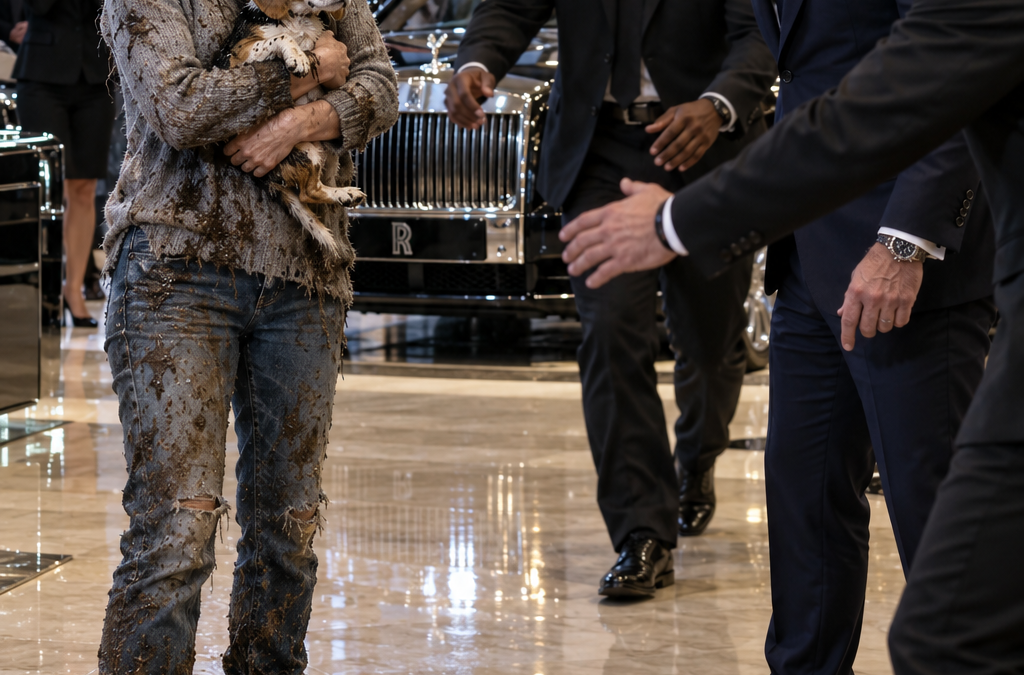
𝗙𝗨𝗟𝗟 𝗦𝗧𝗢𝗥𝗬
I wasn’t attending a board meeting.
I wanted to look at a car.
The showroom doors opened with a quiet pneumatic hiss.
Cool air moved across my face.
Polished marble stretched beneath enormous chandeliers.
Soft classical music played through hidden speakers.
Everything smelled like leather, orchids, and money.
Two customers stood beside a black Cullinan.
The man wore a Loro Piana polo.
The woman wore cream Chanel.
A young blonde sales associate was speaking with them.
Her name tag said EMMA.
I nodded as I passed.
She smiled.
“Good morning.”
“Morning.”
Then I saw the Phantom.
I forgot about everything else.
I walked directly toward it.
The east-facing windows threw a clean strip of sunlight across the dashboard.
Exactly where I wanted it.
I placed two fingers against the windshield.
The saddle-brown leather looked warmer in natural light than it had under studio lamps.
Good.
The stitching remained visible without becoming theatrical.
Even better.
I smiled.
A door opened behind me.
I heard shoes crossing marble.
Measured steps.
Expensive shoes.
“Ma’am.”
I turned.
The man approaching me was in his late thirties.
Charcoal Tom Ford suit.
Perfect tie.
Luxury watch.
Hair cut recently enough that I could still see the barber’s precision around his ears.
His name tag read GARRETT HOLLOWAY.
He stopped about six feet away.
His eyes went first to my boots.
Then my jeans.
Then the mud on my sweater.
Then my face.
Something closed behind his expression.
“Ma’am, I’m going to need you to step away from the vehicle.”
I looked at him.
“Good morning.”
He didn’t return it.
“I’d like to see this one.”
His smile appeared.
Not warmth.
Technique.
“Of course.”
“May I sit inside?”
That smile changed.
Just slightly.
“Sit inside?”
“Yes.”
“I’m afraid that’s not how this works.”
I glanced at the Phantom.
“How what works?”
“This vehicle is configured for delivery.”
“It is?”
“Two hundred thirty-four thousand dollars.”
I knew the number was wrong.
Not wildly.
Enough to tell me he hadn’t checked the exact configuration.
“We don’t open these cars for window shopping.”
“I’m not window shopping.”
Behind him, the conversation near the Cullinan stopped.
Garrett noticed.
He seemed to enjoy having an audience.
“Of course you’re not.”
The sarcasm was gentle enough to deny later.
Sharp enough to understand now.
I studied him.
“I’d like to see the interior.”
He glanced toward my boots.
“Ma’am, people come in on Saturdays all the time.”
“I’m sure.”
“They take pictures. They touch the cars. They want to pretend.”
“Pretend what?”
His smile widened.
“That they’re shopping.”
Emma had stopped talking to the couple.
The man beside the Cullinan looked uncomfortable.
His wife looked irritated, though I couldn’t yet tell with whom.
Garrett gestured toward the floor.
“You’re tracking actual mud across marble that costs hundreds of dollars per square foot to maintain.”
I looked down.
Three faint footprints.
Nothing dramatic.
“I’ll pay for the cleaning.”
He laughed.
A tiny sound through his nose.
“That’s generous.”
“I’d still like to see the Phantom.”
His eyes moved toward the entrance.
“Why don’t we step outside? I’ll have someone bring you a bottle of water.”
I stared at him.
“There’s a lovely cafe two blocks down.”
He paused.
“Probably more your speed.”
There it was.
That phrase.
More your speed.
A sentence people use when they want you to understand exactly what they think without having to defend the ugliness underneath it.
I could have ended everything right there.
I could have reached into my pocket.
Shown him my identification.
Made one phone call.
Watched every ounce of blood leave his face.
Instead, I looked at the Phantom.
“I want to see the saddle-brown stitching.”
He blinked.
“Excuse me?”
“The dashboard.”
I pointed.
“I want to see how the saddle-brown stitching sits in natural light from the east window.”
For the first time, uncertainty flickered across his face.
Only for a second.
He didn’t know why a muddy woman knew that exact interior specification.
He recovered by getting louder.
“Folks, apologies for the interruption.”
He looked toward the couple.
“Sometimes we get enthusiasts wandering in from the boulevard.”
The man gave an awkward half smile.
His wife didn’t.
Garrett gestured toward me.
“We do our best to redirect them.”
I felt something very cold settle inside me.
Not anger yet.
Clarity.
Emma stepped away from the Cullinan.
“Mr. Holloway?”
He turned.
“I can help her.”
Emma couldn’t have been more than twenty-six.
Her fingers were shaking.
“She was asking about the configuration menu. I can show her—”
“Emma.”
His tone stopped her.
“Yes?”
“Back to reception.”
“But—”
“Now.”
Her face went pink.
She lowered her eyes.
Walked away.
I watched her go.
Then looked at Garrett.
“Was that necessary?”
“Managing my staff is not your concern.”
Behind him, another sales associate had taken his phone from his blazer pocket.
I learned later his name was Brent Carile.
He held the phone casually near his hip.
Camera pointed toward us.
Garrett took out his own phone.
Tapped a contact.
“Security to the showroom floor.”
He put it away.
Then smiled at me again.
“I’m asking nicely one final time.”
“You’ve barely asked at all.”
His jaw tightened.
“I have been extremely patient.”
“Have you?”
“Most managers would have called security ten minutes ago.”
“I’ve been here less than ten minutes.”
He ignored that.
“Some of us still have manners.”
I looked at him.
Then at Emma standing behind the reception desk, visibly upset.
Then at the couple beside the Cullinan.
“I don’t think I’m disturbing your customers.”
I met his eyes.
“I think you are.”
The silence was immediate.
Garrett’s smile disappeared.
The side door opened.
A young security officer entered.
Twenty-two.
Twenty-three at most.
Crew cut.
Black uniform.
Polished boots.
His name tag said TYLER REEVES.
He walked halfway across the floor.
Then slowed.
He took in the situation.
Me.
Garrett.
The customers.
Emma.
The phones.
I watched his face.
He didn’t like what he saw.
“Tyler,” Garrett said, “escort this woman off the property.”
Tyler looked at me.
Then at Garrett.
“Has she been asked to leave?”
Garrett stared at him.
“What do you think I’ve been doing?”
“Has she refused?”
“She is refusing now.”
Tyler hesitated.
That hesitation told me more than Garrett understood.
Training.
Policy.
He was thinking through rules.
“Ma’am,” Tyler said.
His voice was careful.
“Mr. Holloway has asked you to leave. Would you mind stepping toward the entrance with me?”
“I would.”
He swallowed.
“I understand.”
“What’s your last name?”
He looked confused.
“Reeves.”
“Tyler Reeves?”
“Yes, ma’am.”
I held his eyes.
“Don’t put your hands on me.”
He became very still.
“He’s not worth your career.”
Garrett’s expression changed.
So did Tyler’s.
There was a rule.
I knew there was.
Our customer-escalation procedures had been rewritten eighteen months earlier after an incident in Dallas.
Non-threatening guests were not to be physically removed without documented escalation and higher authorization.
Tyler knew it.
So did I.
Garrett apparently did not.
Or didn’t care.
Several people were filming openly now.
An older woman who had just entered stood near the door with her phone raised.
A courier had stopped beside her.
Brent’s camera remained running.
Garrett saw them.
His humiliation was becoming public.
Instead of making him cautious, it made him reckless.
“This is a private business,” he said.
His voice rose.
“We reserve the right to refuse service.”
“Then refuse service.”
“I have.”
“No. You’ve insulted me.”
“Leave.”
“I want to see the car.”
“I’m going to call Beverly Hills Police and have you removed for trespassing.”
I looked at my boots.
The mud had dried into brown ridges across the leather.
I remembered the puppy shaking against my chest.
I remembered cold runoff soaking through my clothes.
I remembered the veterinary technician assuming I was someone who would abandon him because I looked poor.
Then I looked at Garrett.
“Call them.”
His eyes narrowed.
“Excuse me?”
“Call Beverly Hills Police.”
I walked to the cream Italian leather chair beside the Phantom display.
Sat down.
Crossed my ankles.
Folded my hands.
“I’ll wait.”
Garrett stared.
The room became so quiet I could hear the piano through the speakers.
“Get up.”
I didn’t.
“Get up.”
Nothing.
He looked at Tyler.
“Get her up.”
Tyler stayed where he was.
The couple beside the Cullinan began walking toward the entrance.
The man stopped before leaving.
“Holloway.”
Garrett looked at him.
“This is bad form.”
“Spencer—”
“Truly.”
The man and his wife left.
Three potential customers had already disappeared since I entered.
Garrett watched them go.
Then turned back to me.
I could almost see the calculations behind his eyes.
He had lost control of the room.
He needed to regain it.
He chose the worst possible method.
He pulled out his phone.
Opened Instagram.
Tapped the official Rolls-Royce Beverly Hills account.
Then went live.
At first, I thought I had misunderstood.
Then he pointed the camera toward me.
“Hi, everyone. Garrett here.”
My stomach tightened.
“Sorry about this, but I want to show you what we deal with sometimes.”
The viewer count began climbing.
He turned the phone so I was fully in frame.
“A woman in a sweater that smells like a wet basement has come into the showroom.”
Someone behind him inhaled sharply.
“She’s sitting in one of our display chairs and refusing to leave.”
He walked around me.
“Security has asked her to go.”
Tyler’s face hardened.
“Police are on the way.”
Garrett smiled at his own camera.
“I just want everyone to see this for themselves.”
I looked straight ahead.
Not because I wasn’t humiliated.
I was.
My skin felt hot.
My heart was beating faster than I wanted.
But there is a moment in certain confrontations when you understand the other person is no longer attacking you.
They are documenting themselves.
Garrett moved closer.
“Look at her.”
Viewer count rising.
“Hands folded like she’s sitting in church.”
Comments were appearing faster.
He kept going.
“As though this is normal.”
He aimed the phone toward my muddy boots.
“As though the floor she’s tracking mud across doesn’t cost more than her rent.”
That one hurt.
Not because it was true.
Because I knew how many people watching would assume it was.
He didn’t stop.
“And apparently she has money.”
He laughed.
“She wants to buy the Phantom.”
More viewers.
Hundreds.
Then more.
“The Phantom.”
He swung the camera toward the car.
“Two hundred thirty-four thousand dollars.”
Then back to me.
“What, food stamps come in early this month?”
The room froze.
I heard Emma whisper something from the desk.
Garrett either didn’t hear or didn’t care.
Tyler did.
His jaw tightened.
The count passed a thousand.
Then fourteen hundred.
Garrett turned.
“Tyler.”
Tyler looked at him.
“Grab her arm.”
“No, sir.”
“What?”
“I’m not putting my hands on her.”
Garrett laughed.
“Do you want your job?”
Tyler took one half step toward me.
His hand lifted.
Our eyes met.
I did not move.
His hand stopped.
“Mr. Holloway,” he said, “she hasn’t threatened anyone.”
“She’s trespassing.”
“I’ll wait for BHPD.”
“Grab her.”
“No.”
Tyler straightened.
“That isn’t what I’m trained to do.”
Garrett’s expression twisted.
“Oh.”
He looked between us.
“Oh, I see.”
Nobody spoke.
“You two know each other now?”
“No,” Tyler said.
“Cute.”
Garrett tilted his phone toward both of us.
“You people always have a story.”
The phrase landed harder than anything he’d said before.
You people.
Slow.
Deliberate.
Caught live.
Thousands were watching now.
Behind the reception desk, Emma lowered her phone out of sight.
I saw her thumb moving.
She was calling someone.
Good.
Garrett didn’t notice.
A few seconds later, the showroom doors opened.
A Beverly Hills police officer entered.
Tall.
Mid-thirties.
Badge: DONOVAN.
Another officer remained near the cruiser outside.
Donovan surveyed the room before speaking.
Garrett with his phone.
Me in the chair.
Tyler.
Staff.
Customers recording.
“Good morning.”
His tone was neutral.
“We got a call about a trespass.”
Garrett spun toward him.
Relief flooded his face.
“Officer, thank God.”
Donovan looked at him.
“This woman refuses to leave. I’ve asked her repeatedly.”
“I understand.”
“She’s disturbing customers.”
Donovan glanced at Garrett’s phone.
“Are you recording?”
“Official store account.”
“I’d recommend ending that.”
“It’s documentation.”
“All the same.”
Garrett hesitated.
Then ended the stream.
I saw the number just before the screen disappeared.
More than nine thousand viewers.
Donovan walked toward me.
Stopped several feet away.
Removed his hat.
“Good morning, ma’am.”
“Good morning.”
“I’m Officer Donovan.”
“Audrey.”
“Would you mind showing me identification?”
I reached into my sweater.
Pulled out my billfold.
Handed him my driver’s license.
He looked.
Then stopped.
It was subtle.
A breath held half a second too long.
His eyes returned to the card.
Then to me.
Then to the Phantom.
Then back to me.
He flipped the license.
Checked again.
Then handed it back carefully.
“Thank you, Ms. Bennett.”
Garrett noticed the change.
“What?”
Donovan turned toward him.
“Mr. Holloway, could I speak with you outside?”
Garrett smiled.
“Absolutely. After you cite her.”
“Outside.”
“Officer—”
“Now.”
No shouting.
No threat.
Just three letters of authority Garrett suddenly understood.
They stepped through the glass doors.
Everyone watched.
I stayed seated.
Emma stared at me from behind the desk.
Her phone vibrated.
She looked at the screen.
Her eyes widened.
Outside, Donovan spoke.
Garrett’s hands lifted.
Dropped.
Lifted again.
He looked through the glass at me.
Donovan said something else.
Garrett’s face went pale.
Ninety seconds later, he came back inside.
“Fine.”
Nobody responded.
“Fine. She can stay.”
He pointed toward me.
“But you’re not buying anything.”
I almost smiled.
“We don’t sell to time wasters.”
Officer Donovan followed him in.
He said nothing.
He just looked at me.
Waiting.
I stood.
Walked toward reception.
The mud from my sweater left a small mark on the leather chair.
I stopped in front of Emma.
“Sweetheart?”
“Yes?”
“May I borrow a pen?”
She reached beneath the counter.
Her hand shook when she offered me a black Montblanc.
“Thank you.”
I took a leather checkbook from my coat pocket.
Garrett drifted closer.
I could feel him watching.
I opened the checkbook.
The first check had already been partially completed in pencil from a transaction I’d planned earlier in the week.
I filled in the dealership.
Amount.
Two hundred thirty-four thousand seven hundred fifty dollars.
Garrett laughed.
The sound was weaker now.
“Oh, good.”
I continued writing.
“The prop checkbook.”
I signed.
AUDREY M. BENNETT.
Then tore the check free.
I slid it across the counter toward Emma.
She took it.
Looked at the bank.
Routing number.
Amount.
Then the signature.
Her face emptied.
“Oh my God.”
Garrett lunged forward.
“Let me see that.”
He took the check from her.
“Let’s see this fake.”
His eyes reached the signature.
Then the printed name beneath it.
Audrey M. Bennett.
Chairwoman of the Board.
Rolls-Royce Motorcars North America.
The check began shaking.
His lips parted.
He looked at me.
Then the check.
Then me again.
“This…”
I said nothing.
“This isn’t—”
“It’s not a forgery.”
For the first time all morning, I let the corporate voice enter mine.
Not loud.
Never loud.
Volume is what people use when they have lost control of language.
I reached into my sweater.
Removed my executive credential.
Black card.
Silver hologram.
Photograph.
Rolls-Royce emblem.
I placed it on the marble counter.
AUDREY M. BENNETT.
CHAIRWOMAN.
Garrett stared.
The entire showroom had gone silent.
He looked as though his body understood before his mind did.
“No.”
I took out my phone.
Tapped Edward Lawson.
He answered on the second ring.
“Audrey?”
“It’s me.”
“Emma called. I’m watching the recording.”
“I’m at Beverly Hills.”
“I know.”
“I need you here.”
“I’m coming.”
“Bring HR.”
“Already arranged.”
“Legal.”
“Yes.”
“The helicopter from Burbank.”
There was a pause.
“Twenty minutes.”
“Thank you.”
I ended the call.
Garrett finally found his voice.
“Wait.”
I put the phone away.
“Ms. Bennett, wait.”
I looked at him.
“There has clearly been a misunderstanding.”
“No.”
“I didn’t know—”
“No.”
His mouth closed.
“There has been no misunderstanding, Mr. Holloway.”
“I had no way to know who you were.”
That sentence.
Again.
As though identity were the problem.
As though the only thing wrong with his behavior was that he had selected an important victim.
I stepped toward him.
“You are still not understanding what happened.”
“I was protecting the showroom.”
“Sit down.”
“What?”
“Sit.”
He stared at me.
“The chair.”
I pointed toward the same cream leather chair.
He sat.
The mud mark from my sweater was still on the armrest.
His hand brushed it.
He jerked away as if burned.
Across the showroom, Brent was searching my name.
His face changed.
He showed his phone to another associate.
Then another.
Forbes.
Reuters.
Board announcements.
My biography.
Former Goldman Sachs.
Harvard MBA.
The first Black woman to chair the North American board of a major British luxury automotive subsidiary.
Information moved through the room like electricity.
Emma leaned toward another employee.
I heard her whisper.
“She approved this interior Thursday.”
Garrett heard it too.
His face folded.
“Ms. Bennett.”
I looked at him.
“Please.”
“Please what?”
“This is a misunderstanding.”
“No.”
“I was trying to protect clientele.”
“From me?”
“From disruptions.”
“What disruption?”
He couldn’t answer.
“Use your words.”
His throat moved.
“You were trying to do what?”
“I thought—”
“What?”
He looked at the floor.
“That I wasn’t a customer?”
Silence.
“That I couldn’t afford the car?”
Nothing.
“That my clothes told you my bank balance?”
Nothing.
“That mud made me dangerous?”
He looked up.
“No.”
“Then say what you thought.”
He couldn’t.
The low beating sound of rotors began outside.
Heads turned.
Through the glass, a black Bell 429 descended toward the helipad behind the property.
Garrett closed his eyes.
Only for a second.
The helicopter landed.
Three people emerged.
Edward Lawson first.
Sixty-three.
Silver hair.
Navy suit.
A man who had spent forty years learning how to enter a crisis without carrying the crisis in his body.
Vivian Brooks behind him.
HR director.
Charcoal blazer.
Portfolio already in hand.
Bradley Whitaker.
General counsel.
Glasses.
Phone at his ear.
They entered together.
Edward saw me.
Crossed the showroom quickly.
“Audrey.”
His hand touched my elbow.
“I am so sorry.”
“I’m fine.”
“What happened?”
I nodded toward Garrett.
“Most of it is available online.”
Edward’s expression tightened.
“He livestreamed?”
“Nine thousand four hundred viewers before Officer Donovan advised him to stop.”
Vivian actually closed her eyes.
Bradley said one word.
“Excellent.”
Edward looked at him.
“From an evidence perspective.”
“Understood.”
I continued.
“Four customer phones. Internal security. Officer Donovan’s body camera.”
Donovan gave a slight nod from the entrance.
Edward turned toward Garrett.
He stared at him for three seconds.
Garrett started rising.
Then one knee slipped against the cushion.
He dropped awkwardly.
Almost kneeling.
“Please.”
His voice came out thin.
“I have a family.”
Edward said nothing.
“Two kids.”
Still nothing.
“Mr. Lawson, please.”
I watched him.
Twenty minutes earlier, he had joked about my rent.
Food stamps.
My smell.
Now he wanted the room to understand the financial consequences of cruelty.
His family.
His mortgage.
His life.
I didn’t enjoy it.
That surprised me.
I’d expected satisfaction.
Instead, I felt tired.
The doors opened behind us.
Spencer and Charlotte Hartley had returned.
They had apparently remained outside after seeing the helicopter arrive.
Spencer looked at me.
“Audrey?”
So he knew me now too.
Of course he did.
The internet worked quickly when status was involved.
“We didn’t know.”
Charlotte touched his arm.
Spencer continued.
“We should have said something.”
I looked at them.
“We should have,” he repeated.
“I know.”
Charlotte’s eyes filled.
“I’m sorry.”
I believed her.
That didn’t undo anything.
But I believed her.
I glanced toward the black Cullinan.
“The one you were looking at?”
Spencer looked confused.
“Yes.”
“I’ll have it delivered tomorrow.”
His eyes widened.
“No.”
“With my compliments.”
“Audrey, absolutely not.”
“It’s done.”
Charlotte covered her mouth.
I left them standing near the entrance and walked back inside.
Vivian opened her portfolio.
Three documents came out.
She aligned them neatly on the counter.
Edward stepped toward the center of the showroom.
Every employee had gathered.
Emma.
Brent.
Reception staff.
Service technicians.
Tyler.
Officer Donovan remained near the entrance.
“Effective immediately,” Edward said, “Garrett Holloway is terminated for cause.”
Nobody gasped.
Nobody looked surprised.
The announcement felt less like a decision than the naming of something everyone already knew.
Vivian slid the first page toward Garrett.
“Termination notice.”
He stood slowly.
“Sign and date.”
He looked at her.
“Second document is return of company property. Phone, laptop, identification badge, vehicle key, garage opener.”
Bradley stepped forward.
“I’ll inventory them with you.”
Garrett stared between them.
“You can’t fire me on the spot.”
Vivian’s expression didn’t change.
“There is a process.”
“Section twelve of your employment agreement permits immediate termination for cause.”
“I have rights.”
“Yes.”
She turned the page slightly.
“You also have obligations.”
He looked toward Edward.
Edward said nothing.
Vivian continued.
“Your agreement specifically identifies harassment based upon a protected class as terminable conduct.”
She looked toward his phone.
“You livestreamed that conduct from an official company account to approximately nine thousand four hundred viewers.”
Garrett swallowed.
“There is no internal review capable of making that video disappear.”
Bradley adjusted his glasses.
“Litigation-hold notice will be delivered electronically before end of business.”
Garrett looked at him.
“Litigation?”
“Yes.”
“You’re suing me?”
“I recommend retaining independent employment counsel before Monday.”
Garrett’s face went white.
Vivian held out the pen.
“Sign.”
His hand shook.
The first letter of his name came out crooked.
He tried again.
When he finished, I walked toward Tyler.
He straightened.
“Ms. Bennett.”
“Tyler.”
“Ma’am.”
“You almost touched me.”
His face fell.
“I know.”
“But you stopped.”
“Yes.”
“Why?”
He considered the question.
“Because the policy said not to.”
I waited.
“And because it was wrong.”
“Better answer.”
He nodded.
“I should have said no sooner.”
“Probably.”
He looked down.
I continued.
“You stayed between policy and pressure when the person pressuring you controlled your paycheck.”
His eyes lifted.
“That isn’t easy.”
“No, ma’am.”
“You stay.”
His expression changed.
“What?”
“You’re not being disciplined.”
“Thank you.”
“In fact, we’re establishing an internal ombudsman track across North America.”
He stared.
“Customer bias incidents. Escalation review. Independent reporting authority.”
I watched him process it.
“I want you on the founding team.”
“Me?”
“Salary doubles.”
His mouth opened.
“Do you want it?”
He swallowed.
“Yes.”
“Then say it.”
“I’m in.”
“Good.”
I turned toward reception.
Emma immediately stood straighter.
“Emma.”
“Ms. Bennett.”
“You tried to intervene.”
“I didn’t do enough.”
“No.”
Her face dropped.
“But then you called Edward.”
“Yes.”
“You recognized that your manager was wrong even when refusing him could cost you your job.”
“I was scared.”
“So was Tyler.”
I looked toward Garrett.
“So was I.”
Emma blinked.
“You?”
“Of course.”
I pointed toward my chest.
“Titles don’t remove nerves.”
She nodded.
“From this morning forward, you’re acting general manager.”
Her mouth opened.
“What?”
“Twenty-six?”
“Yes.”
“How long have you been here?”
“Four months.”
“Good.”
“Good?”
“You haven’t had enough time to learn all the bad habits yet.”
Several employees laughed nervously.
Emma didn’t.
She looked terrified.
“I’ve never managed anyone.”
“You managed yourself correctly when your manager couldn’t.”
“Ms. Bennett—”
“Ninety-day evaluation.”
“I don’t know if—”
“We’ll assign a coach.”
She stared at me.
“Do you want the opportunity?”
Her shoulders lifted.
Then settled.
“Yes.”
“Say it.”
“I’m in.”
“Good.”
Behind us, Garrett put down the pen.
Tyler walked toward him.
There was pain in Tyler’s expression.
They knew each other.
“Mr. Holloway.”
Garrett looked at him.
“Tyler.”
“Back office first.”
“Come on.”
Nothing.
“We had drinks together.”
Tyler’s jaw tightened.
“Murphy’s. Two months ago.”
“I remember.”
“Then don’t do this.”
Tyler opened the side door.
“I’m not doing this.”
Garrett looked at him.
“You did.”
For once, Garrett had nothing to say.
He disappeared into the back office.
Twenty minutes later, he left through the front doors carrying a box.
No Tom Ford confidence.
No phone held high.
No audience he controlled.
Just a man walking past the same marble floor where he’d tried to convince everyone I did not belong.
After he left, I pulled Edward aside.
“Network memo Monday.”
He nodded.
“All showrooms.”
“Yes.”
“Use the video.”
He looked at me.
“Audrey.”
“Use my name.”
“The press will destroy him.”
“The press should discuss the behavior.”
“They’ll discuss everything.”
“I know.”
“This becomes national.”
“It already is.”
Edward exhaled.
“Don’t soften the memo.”
“I won’t.”
“If anyone turns this into an isolated bad-apple story, rewrite it.”
His brow tightened.
“You think it’s systemic?”
“I think a system that depends entirely on good people having good days isn’t a system.”
He nodded slowly.
“Understood.”
I walked to Officer Donovan.
“Thank you.”
“For what?”
“For being professional.”
He gave a small smile.
“That’s supposed to be normal.”
“It should be.”
He put his hat on.
“I’ll send a commendation to your captain.”
“Not necessary.”
“I know.”
He smiled again.
Then left.
Eventually, the showroom began moving again.
Phones stopped filming.
Customers drifted away.
People spoke in quiet voices.
I returned to the Phantom.
For the first time that morning, nobody tried to stop me.
I opened the driver’s door.
Saddle-brown leather.
Perfect stitching.
Natural light from the east window.
Exactly as I’d imagined.
I sat behind the wheel.
Closed my eyes.
Just one breath.
Then another.
My hands were shaking.
I hadn’t noticed until then.
I gripped the steering wheel.
Let myself feel it.
The humiliation.
The anger.
The exhausting knowledge that if I had been anybody else, Garrett might have won.
That was the part I couldn’t shake.
Not what he had done to Audrey Bennett, chairwoman.
What he believed he was entitled to do to a woman without that title.
Emma approached.
“Ms. Bennett?”
I opened my eyes.
“Send this one to the house this afternoon.”
“The Phantom?”
“Yes.”
She smiled.
“I’ll have it detailed.”
“Twice.”
Her eyes dropped toward my muddy clothes.
Then she laughed.
I did too.
“I’m driving the Land Rover home.”
By Saturday night, Garrett’s livestream had escaped every attempt to contain it.
People had screen-recorded it.
Twenty-three preserved copies appeared before the official account could be scrubbed.
By Sunday afternoon, tens of millions of people had watched some version.
By Monday morning, the number had climbed again.
Hashtags appeared in country after country.
My name became something strangers argued about.
So did Garrett’s.
The Los Angeles Times published the headline early Monday morning:
Black Chairwoman of Rolls-Royce North America Refused Service at Her Own Showroom.
By seven o’clock Eastern, I was sitting on a cream couch beneath television lights while a national morning anchor leaned toward me.
I wore a navy blazer.
Nothing expensive-looking.
No jewelry beyond small earrings.
The anchor was silver-haired and careful.
“Ms. Bennett, there is one question people keep asking.”
“I’m sure there are several.”
A few people off camera laughed.
“You had identification.”
“Yes.”
“You had your phone.”
“Yes.”
“You are chairwoman of the board.”
“Yes.”
“You could have stopped Mr. Holloway within seconds.”
I knew the question was coming.
“Why didn’t you simply identify yourself?”
I waited.
Not for drama.
Because I wanted to answer precisely.
“The woman who walked through those doors in a muddy sweater deserved exactly the same respect as the woman with the title.”
The anchor stopped moving.
I continued.
“If she doesn’t get that respect, then the title shouldn’t be what saves her.”
The studio was silent.
That sentence spread faster than the original confrontation.
Millions watched it.
Then millions more.
Reaction videos appeared.
Columns.
Television panels.
By the end of the week, politicians were quoting it.
Some remembered to credit me.
Some didn’t.
I found that almost funny.
The investigations moved quickly.
On the third day, Garrett’s California automotive sales license was revoked.
The minimum ban before reinstatement was set at five years.
On day four, the Equal Employment Opportunity Commission formally accepted the matter for investigation.
Our foundation’s legal team filed a parallel civil action on behalf of people who might have experienced similar discriminatory refusals at affiliated dealerships during the previous twenty-four months.
By the fifth day, the Beverly Hills dealership entity settled the underlying discrimination claim for $2.5 million.
Garrett was individually liable under a separate agreement for $850,000, structured against future income.
By the sixth day, his wife filed for divorce.
Two days later, their Calabasas home went on the market.
By the second weekend, reporters located him at a long-term-stay hotel near Phoenix.
A tabloid photographer caught him at a casino bar.
The picture spread almost as quickly as the first video.
I didn’t share it.
I didn’t comment.
His humiliation wasn’t the point.
Changing what had allowed him to behave that way was.
Ten days after the showroom incident, Rolls-Royce North America announced the Bennett Bias Training Initiative.
Mandatory across the network.
Tyler Reeves became part of its leadership.
An external advisory committee was formed.
Within weeks, other luxury automotive groups began adopting similar systems.
Then watch retailers.
Airlines.
Other companies that had suddenly realized discrimination in premium spaces wasn’t simply a public-relations problem.
Inside Beverly Hills, the changes were less dramatic.
More important.
Emma completed her ninety-day evaluation early.
Edward flew in personally with her permanent appointment letter.
At twenty-six years old, she became the youngest general manager in our North American network.
Tyler spent his first month helping write ombudsman protocols.
By the second, he was teaching them.
By the third, documentary crews were filming his training sessions.
He still carried the same customer-escalation binder he’d had the morning we met.
He had annotated the relevant pages in three different colors.
Charlotte Hartley posted a statement.
No photograph.
No polished publicist language.
The opening sentence said:
I stood there and said nothing. I am ashamed.
She left it online.
Spencer transferred half a million dollars to the Bennett Foundation.
The memo attached to the wire read:
BAD FORM IS NOT ENOUGH.
I smiled when I saw it.
At least he had learned something.
Three weeks after the incident, I returned to the Beverly Hills showroom.
This time, Mud was with me.
That was what I had named the puppy.
Not sophisticated.
Not elegant.
Accurate.
He had recovered completely.
His ears still seemed too large for his head.
He wore a small collar with a tag that said MUD.
I parked the Land Rover between another Bentley and another Aston Martin.
Same customer lot.
Different morning.
I carried Mud toward the entrance.
Emma met me at the door.
“Ms. Bennett.”
“Emma.”
She looked at the puppy.
“Is this him?”
“He wanted to inspect his car.”
She laughed.
“I’ve heard he has high standards.”
“Extremely.”
The Phantom sat on the showroom plinth.
My Phantom now.
Morning sunlight came through the east-facing glass and touched the saddle-brown stitching.
I opened the driver’s door.
Set Mud on the seat.
He sniffed the leather.
Gear selector.
Steering wheel.
Then turned around three times and collapsed across the seat.
Chin on his paws.
Emma watched.
“He looks comfortable.”
I scratched behind his ear.
“He earned it.”
“How?”
I looked at her.
“He didn’t judge me.”
Six months later, I was back where everything had actually begun.
My garden.
Late afternoon.
The bougainvillea had survived.
Mud lay across my feet while I sat on a stone bench reading a report through my glasses.
The Bennett Initiative had completed its first 180 days.
More than fourteen thousand frontline employees had completed training across four countries.
Twenty-three internal bias incidents had been identified and resolved before litigation became necessary.
Managers had been reassigned.
Several were terminated.
One employee had been promoted into the corporate ombudsman structure.
Garrett had largely disappeared.
A reporter tried locating him for a six-month follow-up.
The last rumor placed him somewhere in northern Idaho.
Beard.
Old Toyota Camry.
No public statements.
I didn’t ask anyone to confirm it.
There are points where accountability ends and obsession begins.
I had no interest in crossing that line.
Tyler gave the keynote at the annual automotive retail conference.
Standing ovation.
Hundreds of industry executives signed commitments to adopt similar reporting programs.
Later that year, he testified before a House subcommittee.
He carried that old protocol binder to the podium.
Emma increased quarterly sales at Beverly Hills by twenty-eight percent.
Other networks tried recruiting her.
She refused them.
Spencer and Charlotte established a scholarship at UCLA for first-generation Black women entering business school.
Two million dollars.
They named it after my grandmother.
I hadn’t told them to.
Spencer researched her name himself.
When I learned that, I sat at my desk for a very long time.
My grandmother had never owned a luxury car.
Neither had my mother.
My grandfather had been a sharecropper in Mississippi.
My mother became a school nurse in Oakland.
They had spent their lives in worlds where people constantly tried to decide their worth before hearing them speak.
Now their names were attached to opportunities for women who would enter rooms neither of them had been permitted to imagine.
That mattered more to me than any Phantom ever could.
In November, I stood backstage at the North American International Auto Show in Detroit.
Mud was tucked beneath my arm.
The ballroom was too cold, so someone had wrapped him in a little blanket.
He looked absurd.
Comfortable.
Completely unconcerned with prestige.
Exactly as a dog should.
A stage manager touched my elbow.
“You’re up.”
I stepped onto the stage.
Eight hundred people stood.
CEOs.
Board chairs.
Journalists.
Industry leaders.
The applause lasted more than a minute.
I was wearing the same gray sweater.
Washed, obviously.
No mud.
But the same sweater.
That choice wasn’t accidental.
Mud shifted beneath my arm.
I reached the podium.
Accepted the Diversity Champion of the Year award.
Set it aside.
Adjusted the microphone.
The applause faded.
I looked into the room.
“My grandfather was a sharecropper in Mississippi.”
The room became still.
“My mother was a school nurse in Oakland.”
I looked down at Mud sleeping against my arm.
“Neither of them owned a Rolls-Royce.”
A few people smiled.
“But both taught me the same thing.”
I thought about Garrett looking at my boots.
The veterinary technician.
Tyler deciding whether to obey.
Emma finding enough courage to make a phone call.
Spencer and Charlotte choosing silence, then living with it.
I thought about a frightened puppy trapped against a storm drain before dawn.
And about how strange it was that saving him had put mud on my clothes at exactly the right moment to reveal something much dirtier inside another human being.
“Dignity isn’t something you wear.”
Nobody moved.
“It’s something you walk in with.”
I paused.
“And something you walk out with, no matter who tries to take it from you while you’re passing through.”
For a moment, I thought about saying more.
I didn’t.
“Thank you.”
I stepped away from the podium.
Mud slept through the entire thing.
Months later, people still asked me what I would have done differently.
Would I identify myself sooner?
Would I leave before police arrived?
Would I stop Garrett before the livestream?
The answer remained no.
Not because I enjoyed what happened.
I didn’t.
There were nights afterward when I woke up hearing his voice.
Food stamps come in early?
You people.
Floor costs more than your rent.
Words survive inside the body longer than people realize.
But I had spent most of my professional life sitting in rooms where executives discussed customer dignity in abstract language.
Metrics.
Compliance.
Brand standards.
Inclusive culture.
Then I walked into one of our most prestigious showrooms covered in mud, and suddenly none of those words mattered.
Only behavior mattered.
Garrett Holloway had looked at me and believed he had enough information.
Dirty sweater.
Old vehicle.
Black woman.
Mud.
No designer handbag displayed.
No assistant behind me.
No obvious status.
He completed the rest of my story himself.
Poor.
Homeless.
Thief.
Time waster.
Problem.
He never asked whether I could afford the Phantom.
He decided I couldn’t.
He never asked why I was muddy.
He decided filth defined me.
He never asked who I was.
He believed appearance had already answered.
That was his failure.
The title wasn’t the twist.
People kept getting that wrong.
They called the story ironic because Garrett mistreated the chairwoman of his own company.
But the real story would have been exactly as ugly if my name had been Audrey Smith and I worked the night shift at a grocery store.
If I had twelve dollars in my account.
If I had entered only because I wanted to look at something beautiful that I could never afford.
If I had been homeless.
If I had actually smelled like rain and a basement and slept beneath a bridge.
None of those things would have made me deserve what he did.
That was the lesson Garrett never understood until it was too late.
Dignity cannot depend on discovering that the person you’re insulting outranks you.
One afternoon, nearly a year later, I drove the old Land Rover back to the veterinary clinic.
Yes, I still had it.
The Phantom was beautiful.
The Rover carried garden soil without complaint.
Mud rode beside me.
The receptionist was different.
The technician who had treated him that first morning happened to walk through the lobby.
She stopped.
Looked at Mud.
Then at me.
Recognition came slowly.
“Oh.”
I smiled.
“Hello.”
“You’re…”
“Audrey.”
Her face changed.
“Right.”
She knew now.
Everyone knew now.
She looked embarrassed.
“How is he?”
I put one hand on Mud’s head.
“Judgmental about food. Otherwise perfect.”
She laughed nervously.
Then her eyes dropped.
“I remember that morning.”
“So do I.”
“I wasn’t very nice.”
“No.”
She swallowed.
“I’m sorry.”
I believed her too.
The year had taught me that accepting an apology and pretending nothing happened were different things.
“Thank you.”
She crouched to pet Mud.
He licked her hand immediately.
Dogs are better at forgiveness than humans.
Probably because they don’t mistake forgiveness for permission.
On the drive home, Mud slept with his head against the passenger door.
Traffic crawled.
Sunset Boulevard glowed orange.
We passed the Beverly Hills showroom.
I slowed.
Through the glass, I could see Emma speaking with a couple beside a Cullinan.
A man entered behind them.
Jeans.
Work boots.
Paint on his shirt.
Nobody stopped him.
A young associate approached with a smile.
I couldn’t hear what was said.
I didn’t need to.
The man pointed toward a Phantom.
The associate opened the driver’s door.
Just like that.
No inspection.
No calculation.
No question about whether his clothes matched the price.
The door simply opened.
I sat at the traffic light watching through the glass.
Then it turned green.
A horn sounded behind me.
I laughed.
“All right, all right.”
Mud raised his head.
I drove on.
That ordinary moment stayed with me longer than the applause in Detroit.
Longer than the national interview.
Longer than the headlines.
Because that had been the goal.
Not revenge.
Not seeing Garrett lose his job.
Not forcing people to learn my title.
The goal was a door opening for somebody whose name nobody knew.
I returned home before dark.
The garden smelled damp from the sprinklers.
Mud jumped from the Rover and ran toward the back gate, barking at something invisible.
I followed more slowly.
At the edge of the flower bed, I stopped beside the bougainvillea.
The same plant I had been trying to save the morning everything began.
It had grown.
New branches climbed the wall.
Purple flowers caught the last sunlight.
I knelt.
Touched the soil.
No mud this time.
Just cool earth.
Mud trotted back and pushed his nose beneath my hand.
I scratched his head.
“You started a lot of trouble, you know that?”
His tail moved.
“Completely unrepentant.”
He sneezed.
I laughed.
Then I looked toward the house.
At the windows.
The quiet rooms.
The life that existed before people online knew my name.
And I understood something I had not been able to articulate beneath the television lights.
Garrett had tried to define me before I spoke.
Then the world, in reacting to him, had almost made the opposite mistake.
Suddenly I was the chairwoman.
The billionaire executive.
The woman who bought the Phantom.
The woman whose helicopter brought HR and legal.
Another set of labels.
More flattering.
Still labels.
But before all of that, I had simply been a woman crawling through mud because a puppy was drowning.
That was the person I cared about preserving.
Not the title.
Not the car.
Not the headlines.
The woman who heard something suffering and went toward it.
I stood.
Mud followed me toward the house.
The old Land Rover remained in the driveway with dirt around its tires.
Inside the garage, the Phantom waited beneath soft lights.
Two cars.
Two different worlds.
Neither one told the truth about the person driving them.
That was the point.
The next morning, I put on the gray sweater again.
I carried coffee into the garden.
Mud chased a bird he had absolutely no chance of catching.
The radio played softly beside me.
I knelt beside the flowers.
And when my hands disappeared into the soil, I smiled.
Because there was mud beneath my fingernails again.
This time, nobody was there to decide what it meant.
𝗧𝗛𝗘 𝗘𝗡𝗗
The Rolls-Royce Manager Looked at My Muddy Clothes and Ordered Security to Throw Me Out—He Had No Idea Why I Had Walked Into His Showroom
Garrett Holloway looked at the mud on my boots, the wet hair stuck against my face, and decided in less than ten seconds that I was too poor, too filthy, and too insignificant to touch anything inside his showroom. By the time he started broadcasting my humiliation to thousands of strangers, I had stopped wondering whether he would realize his mistake and started wondering how far he was willing to destroy himself before someone finally made him stop.
Six hours earlier, I had been kneeling in the mud behind my house with a pencil holding my hair together.
There was nothing glamorous about me that morning.
My gray sweater had a coffee stain near the left cuff and fresh dirt across the front. My jeans were old enough that one knee had gone pale from years of washing. My boots had already disappeared halfway into wet soil around the flower bed.
I preferred mornings like that.
No boardrooms.
No assistants.
No cameras.
No people carefully choosing their words because of the title printed beneath my name.
Just me, my garden, and an old radio sitting on the gravel path beside me.
The storm had hammered Southern California overnight.
The radio announcer said Los Angeles had taken two inches of rain in three hours. Roads were flooded. Mud had washed onto stretches of Mulholland Drive. Two animal shelters in the valley had lost power.
I was only half listening.
A bougainvillea along the back wall had been struggling for almost a month, and I was determined to save it.
Then I heard something.
Small.
Sharp.
Wrong.
I stopped digging.
At first I thought it was a bird.
Then it came again.
A thin, strained cry from somewhere beyond the rear gate.
I stood.
The sound came from the embankment that dropped toward the canyon behind the property.
There was a storm drain along that ridge.
My stomach tightened.
I left the shovel where it was and unlatched the gate.
The ground on the other side was worse than I expected.
Water had turned the slope into slick brown clay.
Within five steps, mud covered my boots.
Within ten, my jeans were soaked to the knees.
The cry came again.
“I’m coming,” I called.
I don’t know why.
Whatever was down there couldn’t understand me.
Maybe I was talking to myself.
I followed the sound to the drain.
Then I saw him.
A beagle puppy.
Four months old, maybe less.
He was jammed sideways against the metal grate, half submerged in runoff, his body trembling so violently I could see it from several feet away.
His eyes were huge.
I dropped to my knees.
“Oh, sweetheart.”
He whimpered.
Water rushed around his body.
One front leg was pinned beneath him.
I flattened myself against the slope and reached down.
Mud soaked through the front of my sweater.
The puppy snapped once—not aggressively, just terrified.
“It’s okay.”
I stretched farther.
“I know. I know.”
My fingers slipped under his belly.
He screamed when I moved him.
I nearly let go.
Then I saw the water rising behind the grate.
There wasn’t time.
“I’m sorry, baby.”
I pulled.
For one terrible second, nothing happened.
Then his body came free with a wet pop.
He yelped.
I rolled backward against the slope with him against my chest.
He was shaking.
So was I.
“You’re all right.”
I wrapped both arms around him.
“You’re going to live.”
His heart hammered beneath my palm.
I climbed back toward the house with one hand digging into the slope and the other holding him against me.
By the time I reached the gate, there wasn’t a clean piece of clothing left on my body.
I didn’t care.
I wrapped him in my sweater, carried him to my Land Rover, and drove straight toward the twenty-four-hour veterinary clinic on Sunset.
The Rover was twelve years old.
Black.
Dented on the rear quarter panel from a parking-lot accident two winters earlier.
People had been telling me to replace it for years.
I liked it.
It started every morning.
It didn’t care what shoes I wore.
That put it ahead of some people I knew.
At the clinic, a veterinary technician took the puppy from me.
“Found him in a storm drain?”
“Wedged against the grate.”
“How long?”
“I don’t know.”
She checked his gums.
“He’s cold.”
“I figured.”
“We need to run X-rays and bloodwork.”
“Do whatever he needs.”
The technician finally looked at me.
Not really at me.
At the mud.
My wet hair.
The sweater wrapped around the puppy.
“There’s an eight-hundred-dollar deposit.”
“Fine.”
“You want to pay cash or card?”
“Card.”
I paid.
She slid an intake form toward me.
I signed Bennett at the bottom.
She glanced at the signature.
Then at me.
“Do you want us to call a shelter when he stabilizes?”
I frowned.
“Why?”
She shrugged.
“Some people bring animals in and don’t come back.”
“I’ll be back at noon.”
“Suit yourself.”
I looked through the glass door leading toward treatment.
The puppy had disappeared into the back.
“Don’t send him anywhere.”
“Okay.”
“I mean it.”
She gave me the tired look of someone who had worked too many overnight shifts.
“I heard you.”
I walked back outside.
The morning air smelled washed clean.
I should have gone home.
I should have showered.
Changed.
Taken the London call from my office.
Instead, I looked at the dashboard clock.
7:50.
The call wasn’t until nine.
Then I saw the showroom.
Rolls-Royce Beverly Hills.
Glass facade.
White stone.
The kind of building designed to make people feel they needed permission before touching the front door.
On the raised showroom platform sat the new Phantom Series II.
I slowed.
Then smiled.
I knew that car.
Not that model.
That exact configuration.
Thursday afternoon, I had personally approved the final interior specification.
Saddle-brown leather.
Hand stitching.
A revised dashboard grain.
The board memo had gone out at 4:15.
I had seen renderings.
Samples.
Production photographs.
But I had never sat inside the finished car.
I checked the time again.
Plenty.
I turned into the customer lot.
My old Land Rover rolled between a silver Bentley Continental and a matte-black Aston Martin.
A streak of dried mud fell from one tire.
I looked at myself in the rearview mirror.
Mud on one cheek.
Hair held together with a pencil.
Wet jeans.
I almost laughed.
Then I opened the door.
I did not change.
I did not clean my face.
Why would I?
I wasn’t attending a board meeting.
I wanted to look at a car.
The showroom doors opened with a quiet pneumatic hiss.
Cool air moved across my face.
Polished marble stretched beneath enormous chandeliers.
Soft classical music played through hidden speakers.
Everything smelled like leather, orchids, and money.
Two customers stood beside a black Cullinan.
The man wore a Loro Piana polo.
The woman wore cream Chanel.
A young blonde sales associate was speaking with them.
Her name tag said EMMA.
I nodded as I passed.
She smiled.
“Good morning.”
“Morning.”
Then I saw the Phantom.
I forgot about everything else.
I walked directly toward it.
The east-facing windows threw a clean strip of sunlight across the dashboard.
Exactly where I wanted it.
I placed two fingers against the windshield.
The saddle-brown leather looked warmer in natural light than it had under studio lamps.
Good.
The stitching remained visible without becoming theatrical.
Even better.
I smiled.
A door opened behind me.
I heard shoes crossing marble.
Measured steps.
Expensive shoes.
“Ma’am.”
I turned.
The man approaching me was in his late thirties.
Charcoal Tom Ford suit.
Perfect tie.
Luxury watch.
Hair cut recently enough that I could still see the barber’s precision around his ears.
His name tag read GARRETT HOLLOWAY.
He stopped about six feet away.
His eyes went first to my boots.
Then my jeans.
Then the mud on my sweater.
Then my face.
Something closed behind his expression.
“Ma’am, I’m going to need you to step away from the vehicle.”
I looked at him.
“Good morning.”
He didn’t return it.
“I’d like to see this one.”
His smile appeared.
Not warmth.
Technique.
“Of course.”
“May I sit inside?”
That smile changed.
Just slightly.
“Sit inside?”
“Yes.”
“I’m afraid that’s not how this works.”
I glanced at the Phantom.
“How what works?”
“This vehicle is configured for delivery.”
“It is?”
“Two hundred thirty-four thousand dollars.”
I knew the number was wrong.
Not wildly.
Enough to tell me he hadn’t checked the exact configuration.
“We don’t open these cars for window shopping.”
“I’m not window shopping.”
Behind him, the conversation near the Cullinan stopped.
Garrett noticed.
He seemed to enjoy having an audience.
“Of course you’re not.”
The sarcasm was gentle enough to deny later.
Sharp enough to understand now.
I studied him.
“I’d like to see the interior.”
He glanced toward my boots.
“Ma’am, people come in on Saturdays all the time.”
“I’m sure.”
“They take pictures. They touch the cars. They want to pretend.”
“Pretend what?”
His smile widened.
“That they’re shopping.”
Emma had stopped talking to the couple.
The man beside the Cullinan looked uncomfortable.
His wife looked irritated, though I couldn’t yet tell with whom.
Garrett gestured toward the floor.
“You’re tracking actual mud across marble that costs hundreds of dollars per square foot to maintain.”
I looked down.
Three faint footprints.
Nothing dramatic.
“I’ll pay for the cleaning.”
He laughed.
A tiny sound through his nose.
“That’s generous.”
“I’d still like to see the Phantom.”
His eyes moved toward the entrance.
“Why don’t we step outside? I’ll have someone bring you a bottle of water.”
I stared at him.
“There’s a lovely cafe two blocks down.”
He paused.
“Probably more your speed.”
There it was.
That phrase.
More your speed.
A sentence people use when they want you to understand exactly what they think without having to defend the ugliness underneath it.
I could have ended everything right there.
I could have reached into my pocket.
Shown him my identification.
Made one phone call.
Watched every ounce of blood leave his face.
Instead, I looked at the Phantom.
“I want to see the saddle-brown stitching.”
He blinked.
“Excuse me?”
“The dashboard.”
I pointed.
“I want to see how the saddle-brown stitching sits in natural light from the east window.”
For the first time, uncertainty flickered across his face.
Only for a second.
He didn’t know why a muddy woman knew that exact interior specification.
He recovered by getting louder.
“Folks, apologies for the interruption.”
He looked toward the couple.
“Sometimes we get enthusiasts wandering in from the boulevard.”
The man gave an awkward half smile.
His wife didn’t.
Garrett gestured toward me.
“We do our best to redirect them.”
I felt something very cold settle inside me.
Not anger yet.
Clarity.
Emma stepped away from the Cullinan.
“Mr. Holloway?”
He turned.
“I can help her.”
Emma couldn’t have been more than twenty-six.
Her fingers were shaking.
“She was asking about the configuration menu. I can show her—”
“Emma.”
His tone stopped her.
“Yes?”
“Back to reception.”
“But—”
“Now.”
Her face went pink.
She lowered her eyes.
Walked away.
I watched her go.
Then looked at Garrett.
“Was that necessary?”
“Managing my staff is not your concern.”
Behind him, another sales associate had taken his phone from his blazer pocket.
I learned later his name was Brent Carile.
He held the phone casually near his hip.
Camera pointed toward us.
Garrett took out his own phone.
Tapped a contact.
“Security to the showroom floor.”
He put it away.
Then smiled at me again.
“I’m asking nicely one final time.”
“You’ve barely asked at all.”
His jaw tightened.
“I have been extremely patient.”
“Have you?”
“Most managers would have called security ten minutes ago.”
“I’ve been here less than ten minutes.”
He ignored that.
“Some of us still have manners.”
I looked at him.
Then at Emma standing behind the reception desk, visibly upset.
Then at the couple beside the Cullinan.
“I don’t think I’m disturbing your customers.”
I met his eyes.
“I think you are.”
The silence was immediate.
Garrett’s smile disappeared.
The side door opened.
A young security officer entered.
Twenty-two.
Twenty-three at most.
Crew cut.
Black uniform.
Polished boots.
His name tag said TYLER REEVES.
He walked halfway across the floor.
Then slowed.
He took in the situation.
Me.
Garrett.
The customers.
Emma.
The phones.
I watched his face.
He didn’t like what he saw.
“Tyler,” Garrett said, “escort this woman off the property.”
Tyler looked at me.
Then at Garrett.
“Has she been asked to leave?”
Garrett stared at him.
“What do you think I’ve been doing?”
“Has she refused?”
“She is refusing now.”
Tyler hesitated.
That hesitation told me more than Garrett understood.
Training.
Policy.
He was thinking through rules.
“Ma’am,” Tyler said.
His voice was careful.
“Mr. Holloway has asked you to leave. Would you mind stepping toward the entrance with me?”
“I would.”
He swallowed.
“I understand.”
“What’s your last name?”
He looked confused.
“Reeves.”
“Tyler Reeves?”
“Yes, ma’am.”
I held his eyes.
“Don’t put your hands on me.”
He became very still.
“He’s not worth your career.”
Garrett’s expression changed.
So did Tyler’s.
There was a rule.
I knew there was.
Our customer-escalation procedures had been rewritten eighteen months earlier after an incident in Dallas.
Non-threatening guests were not to be physically removed without documented escalation and higher authorization.
Tyler knew it.
So did I.
Garrett apparently did not.
Or didn’t care.
Several people were filming openly now.
An older woman who had just entered stood near the door with her phone raised.
A courier had stopped beside her.
Brent’s camera remained running.
Garrett saw them.
His humiliation was becoming public.
Instead of making him cautious, it made him reckless.
“This is a private business,” he said.
His voice rose.
“We reserve the right to refuse service.”
“Then refuse service.”
“I have.”
“No. You’ve insulted me.”
“Leave.”
“I want to see the car.”
“I’m going to call Beverly Hills Police and have you removed for trespassing.”
I looked at my boots.
The mud had dried into brown ridges across the leather.
I remembered the puppy shaking against my chest.
I remembered cold runoff soaking through my clothes.
I remembered the veterinary technician assuming I was someone who would abandon him because I looked poor.
Then I looked at Garrett.
“Call them.”
His eyes narrowed.
“Excuse me?”
“Call Beverly Hills Police.”
I walked to the cream Italian leather chair beside the Phantom display.
Sat down.
Crossed my ankles.
Folded my hands.
“I’ll wait.”
Garrett stared.
The room became so quiet I could hear the piano through the speakers.
“Get up.”
I didn’t.
“Get up.”
Nothing.
He looked at Tyler.
“Get her up.”
Tyler stayed where he was.
The couple beside the Cullinan began walking toward the entrance.
The man stopped before leaving.
“Holloway.”
Garrett looked at him.
“This is bad form.”
“Spencer—”
“Truly.”
The man and his wife left.
Three potential customers had already disappeared since I entered.
Garrett watched them go.
Then turned back to me.
I could almost see the calculations behind his eyes.
He had lost control of the room.
He needed to regain it.
He chose the worst possible method.
He pulled out his phone.
Opened Instagram.
Tapped the official Rolls-Royce Beverly Hills account.
Then went live.
At first, I thought I had misunderstood.
Then he pointed the camera toward me.
“Hi, everyone. Garrett here.”
My stomach tightened.
“Sorry about this, but I want to show you what we deal with sometimes.”
The viewer count began climbing.
He turned the phone so I was fully in frame.
“A woman in a sweater that smells like a wet basement has come into the showroom.”
Someone behind him inhaled sharply.
“She’s sitting in one of our display chairs and refusing to leave.”
He walked around me.
“Security has asked her to go.”
Tyler’s face hardened.
“Police are on the way.”
Garrett smiled at his own camera.
“I just want everyone to see this for themselves.”
I looked straight ahead.
Not because I wasn’t humiliated.
I was.
My skin felt hot.
My heart was beating faster than I wanted.
But there is a moment in certain confrontations when you understand the other person is no longer attacking you.
They are documenting themselves.
Garrett moved closer.
“Look at her.”
Viewer count rising.
“Hands folded like she’s sitting in church.”
Comments were appearing faster.
He kept going.
“As though this is normal.”
He aimed the phone toward my muddy boots.
“As though the floor she’s tracking mud across doesn’t cost more than her rent.”
That one hurt.
Not because it was true.
Because I knew how many people watching would assume it was.
He didn’t stop.
“And apparently she has money.”
He laughed.
“She wants to buy the Phantom.”
More viewers.
Hundreds.
Then more.
“The Phantom.”
He swung the camera toward the car.
“Two hundred thirty-four thousand dollars.”
Then back to me.
“What, food stamps come in early this month?”
The room froze.
I heard Emma whisper something from the desk.
Garrett either didn’t hear or didn’t care.
Tyler did.
His jaw tightened.
The count passed a thousand.
Then fourteen hundred.
Garrett turned.
“Tyler.”
Tyler looked at him.
“Grab her arm.”
“No, sir.”
“What?”
“I’m not putting my hands on her.”
Garrett laughed.
“Do you want your job?”
Tyler took one half step toward me.
His hand lifted.
Our eyes met.
I did not move.
His hand stopped.
“Mr. Holloway,” he said, “she hasn’t threatened anyone.”
“She’s trespassing.”
“I’ll wait for BHPD.”
“Grab her.”
“No.”
Tyler straightened.
“That isn’t what I’m trained to do.”
Garrett’s expression twisted.
“Oh.”
He looked between us.
“Oh, I see.”
Nobody spoke.
“You two know each other now?”
“No,” Tyler said.
“Cute.”
Garrett tilted his phone toward both of us.
“You people always have a story.”
The phrase landed harder than anything he’d said before.
You people.
Slow.
Deliberate.
Caught live.
Thousands were watching now.
Behind the reception desk, Emma lowered her phone out of sight.
I saw her thumb moving.
She was calling someone.
Good.
Garrett didn’t notice.
A few seconds later, the showroom doors opened.
A Beverly Hills police officer entered.
Tall.
Mid-thirties.
Badge: DONOVAN.
Another officer remained near the cruiser outside.
Donovan surveyed the room before speaking.
Garrett with his phone.
Me in the chair.
Tyler.
Staff.
Customers recording.
“Good morning.”
His tone was neutral.
“We got a call about a trespass.”
Garrett spun toward him.
Relief flooded his face.
“Officer, thank God.”
Donovan looked at him.
“This woman refuses to leave. I’ve asked her repeatedly.”
“I understand.”
“She’s disturbing customers.”
Donovan glanced at Garrett’s phone.
“Are you recording?”
“Official store account.”
“I’d recommend ending that.”
“It’s documentation.”
“All the same.”
Garrett hesitated.
Then ended the stream.
I saw the number just before the screen disappeared.
More than nine thousand viewers.
Donovan walked toward me.
Stopped several feet away.
Removed his hat.
“Good morning, ma’am.”
“Good morning.”
“I’m Officer Donovan.”
“Audrey.”
“Would you mind showing me identification?”
I reached into my sweater.
Pulled out my billfold.
Handed him my driver’s license.
He looked.
Then stopped.
It was subtle.
A breath held half a second too long.
His eyes returned to the card.
Then to me.
Then to the Phantom.
Then back to me.
He flipped the license.
Checked again.
Then handed it back carefully.
“Thank you, Ms. Bennett.”
Garrett noticed the change.
“What?”
Donovan turned toward him.
“Mr. Holloway, could I speak with you outside?”
Garrett smiled.
“Absolutely. After you cite her.”
“Outside.”
“Officer—”
“Now.”
No shouting.
No threat.
Just three letters of authority Garrett suddenly understood.
They stepped through the glass doors.
Everyone watched.
I stayed seated.
Emma stared at me from behind the desk.
Her phone vibrated.
She looked at the screen.
Her eyes widened.
Outside, Donovan spoke.
Garrett’s hands lifted.
Dropped.
Lifted again.
He looked through the glass at me.
Donovan said something else.
Garrett’s face went pale.
Ninety seconds later, he came back inside.
“Fine.”
Nobody responded.
“Fine. She can stay.”
He pointed toward me.
“But you’re not buying anything.”
I almost smiled.
“We don’t sell to time wasters.”
Officer Donovan followed him in.
He said nothing.
He just looked at me.
Waiting.
I stood.
Walked toward reception.
The mud from my sweater left a small mark on the leather chair.
I stopped in front of Emma.
“Sweetheart?”
“Yes?”
“May I borrow a pen?”
She reached beneath the counter.
Her hand shook when she offered me a black Montblanc.
“Thank you.”
I took a leather checkbook from my coat pocket.
Garrett drifted closer.
I could feel him watching.
I opened the checkbook.
The first check had already been partially completed in pencil from a transaction I’d planned earlier in the week.
I filled in the dealership.
Amount.
Two hundred thirty-four thousand seven hundred fifty dollars.
Garrett laughed.
The sound was weaker now.
“Oh, good.”
I continued writing.
“The prop checkbook.”
I signed.
AUDREY M. BENNETT.
Then tore the check free.
I slid it across the counter toward Emma.
She took it.
Looked at the bank.
Routing number.
Amount.
Then the signature.
Her face emptied.
“Oh my God.”
Garrett lunged forward.
“Let me see that.”
He took the check from her.
“Let’s see this fake.”
His eyes reached the signature.
Then the printed name beneath it.
Audrey M. Bennett.
Chairwoman of the Board.
Rolls-Royce Motorcars North America.
The check began shaking.
His lips parted.
He looked at me.
Then the check.
Then me again.
“This…”
I said nothing.
“This isn’t—”
“It’s not a forgery.”
For the first time all morning, I let the corporate voice enter mine.
Not loud.
Never loud.
Volume is what people use when they have lost control of language.
I reached into my sweater.
Removed my executive credential.
Black card.
Silver hologram.
Photograph.
Rolls-Royce emblem.
I placed it on the marble counter.
AUDREY M. BENNETT.
CHAIRWOMAN.
Garrett stared.
The entire showroom had gone silent.
He looked as though his body understood before his mind did.
“No.”
I took out my phone.
Tapped Edward Lawson.
He answered on the second ring.
“Audrey?”
“It’s me.”
“Emma called. I’m watching the recording.”
“I’m at Beverly Hills.”
“I know.”
“I need you here.”
“I’m coming.”
“Bring HR.”
“Already arranged.”
“Legal.”
“Yes.”
“The helicopter from Burbank.”
There was a pause.
“Twenty minutes.”
“Thank you.”
I ended the call.
Garrett finally found his voice.
“Wait.”
I put the phone away.
“Ms. Bennett, wait.”
I looked at him.
“There has clearly been a misunderstanding.”
“No.”
“I didn’t know—”
“No.”
His mouth closed.
“There has been no misunderstanding, Mr. Holloway.”
“I had no way to know who you were.”
That sentence.
Again.
As though identity were the problem.
As though the only thing wrong with his behavior was that he had selected an important victim.
I stepped toward him.
“You are still not understanding what happened.”
“I was protecting the showroom.”
“Sit down.”
“What?”
“Sit.”
He stared at me.
“The chair.”
I pointed toward the same cream leather chair.
He sat.
The mud mark from my sweater was still on the armrest.
His hand brushed it.
He jerked away as if burned.
Across the showroom, Brent was searching my name.
His face changed.
He showed his phone to another associate.
Then another.
Forbes.
Reuters.
Board announcements.
My biography.
Former Goldman Sachs.
Harvard MBA.
The first Black woman to chair the North American board of a major British luxury automotive subsidiary.
Information moved through the room like electricity.
Emma leaned toward another employee.
I heard her whisper.
“She approved this interior Thursday.”
Garrett heard it too.
His face folded.
“Ms. Bennett.”
I looked at him.
“Please.”
“Please what?”
“This is a misunderstanding.”
“No.”
“I was trying to protect clientele.”
“From me?”
“From disruptions.”
“What disruption?”
He couldn’t answer.
“Use your words.”
His throat moved.
“You were trying to do what?”
“I thought—”
“What?”
He looked at the floor.
“That I wasn’t a customer?”
Silence.
“That I couldn’t afford the car?”
Nothing.
“That my clothes told you my bank balance?”
Nothing.
“That mud made me dangerous?”
He looked up.
“No.”
“Then say what you thought.”
He couldn’t.
The low beating sound of rotors began outside.
Heads turned.
Through the glass, a black Bell 429 descended toward the helipad behind the property.
Garrett closed his eyes.
Only for a second.
The helicopter landed.
Three people emerged.
Edward Lawson first.
Sixty-three.
Silver hair.
Navy suit.
A man who had spent forty years learning how to enter a crisis without carrying the crisis in his body.
Vivian Brooks behind him.
HR director.
Charcoal blazer.
Portfolio already in hand.
Bradley Whitaker.
General counsel.
Glasses.
Phone at his ear.
They entered together.
Edward saw me.
Crossed the showroom quickly.
“Audrey.”
His hand touched my elbow.
“I am so sorry.”
“I’m fine.”
“What happened?”
I nodded toward Garrett.
“Most of it is available online.”
Edward’s expression tightened.
“He livestreamed?”
“Nine thousand four hundred viewers before Officer Donovan advised him to stop.”
Vivian actually closed her eyes.
Bradley said one word.
“Excellent.”
Edward looked at him.
“From an evidence perspective.”
“Understood.”
I continued.
“Four customer phones. Internal security. Officer Donovan’s body camera.”
Donovan gave a slight nod from the entrance.
Edward turned toward Garrett.
He stared at him for three seconds.
Garrett started rising.
Then one knee slipped against the cushion.
He dropped awkwardly.
Almost kneeling.
“Please.”
His voice came out thin.
“I have a family.”
Edward said nothing.
“Two kids.”
Still nothing.
“Mr. Lawson, please.”
I watched him.
Twenty minutes earlier, he had joked about my rent.
Food stamps.
My smell.
Now he wanted the room to understand the financial consequences of cruelty.
His family.
His mortgage.
His life.
I didn’t enjoy it.
That surprised me.
I’d expected satisfaction.
Instead, I felt tired.
The doors opened behind us.
Spencer and Charlotte Hartley had returned.
They had apparently remained outside after seeing the helicopter arrive.
Spencer looked at me.
“Audrey?”
So he knew me now too.
Of course he did.
The internet worked quickly when status was involved.
“We didn’t know.”
Charlotte touched his arm.
Spencer continued.
“We should have said something.”
I looked at them.
“We should have,” he repeated.
“I know.”
Charlotte’s eyes filled.
“I’m sorry.”
I believed her.
That didn’t undo anything.
But I believed her.
I glanced toward the black Cullinan.
“The one you were looking at?”
Spencer looked confused.
“Yes.”
“I’ll have it delivered tomorrow.”
His eyes widened.
“No.”
“With my compliments.”
“Audrey, absolutely not.”
“It’s done.”
Charlotte covered her mouth.
I left them standing near the entrance and walked back inside.
Vivian opened her portfolio.
Three documents came out.
She aligned them neatly on the counter.
Edward stepped toward the center of the showroom.
Every employee had gathered.
Emma.
Brent.
Reception staff.
Service technicians.
Tyler.
Officer Donovan remained near the entrance.
“Effective immediately,” Edward said, “Garrett Holloway is terminated for cause.”
Nobody gasped.
Nobody looked surprised.
The announcement felt less like a decision than the naming of something everyone already knew.
Vivian slid the first page toward Garrett.
“Termination notice.”
He stood slowly.
“Sign and date.”
He looked at her.
“Second document is return of company property. Phone, laptop, identification badge, vehicle key, garage opener.”
Bradley stepped forward.
“I’ll inventory them with you.”
Garrett stared between them.
“You can’t fire me on the spot.”
Vivian’s expression didn’t change.
“There is a process.”
“Section twelve of your employment agreement permits immediate termination for cause.”
“I have rights.”
“Yes.”
She turned the page slightly.
“You also have obligations.”
He looked toward Edward.
Edward said nothing.
Vivian continued.
“Your agreement specifically identifies harassment based upon a protected class as terminable conduct.”
She looked toward his phone.
“You livestreamed that conduct from an official company account to approximately nine thousand four hundred viewers.”
Garrett swallowed.
“There is no internal review capable of making that video disappear.”
Bradley adjusted his glasses.
“Litigation-hold notice will be delivered electronically before end of business.”
Garrett looked at him.
“Litigation?”
“Yes.”
“You’re suing me?”
“I recommend retaining independent employment counsel before Monday.”
Garrett’s face went white.
Vivian held out the pen.
“Sign.”
His hand shook.
The first letter of his name came out crooked.
He tried again.
When he finished, I walked toward Tyler.
He straightened.
“Ms. Bennett.”
“Tyler.”
“Ma’am.”
“You almost touched me.”
His face fell.
“I know.”
“But you stopped.”
“Yes.”
“Why?”
He considered the question.
“Because the policy said not to.”
I waited.
“And because it was wrong.”
“Better answer.”
He nodded.
“I should have said no sooner.”
“Probably.”
He looked down.
I continued.
“You stayed between policy and pressure when the person pressuring you controlled your paycheck.”
His eyes lifted.
“That isn’t easy.”
“No, ma’am.”
“You stay.”
His expression changed.
“What?”
“You’re not being disciplined.”
“Thank you.”
“In fact, we’re establishing an internal ombudsman track across North America.”
He stared.
“Customer bias incidents. Escalation review. Independent reporting authority.”
I watched him process it.
“I want you on the founding team.”
“Me?”
“Salary doubles.”
His mouth opened.
“Do you want it?”
He swallowed.
“Yes.”
“Then say it.”
“I’m in.”
“Good.”
I turned toward reception.
Emma immediately stood straighter.
“Emma.”
“Ms. Bennett.”
“You tried to intervene.”
“I didn’t do enough.”
“No.”
Her face dropped.
“But then you called Edward.”
“Yes.”
“You recognized that your manager was wrong even when refusing him could cost you your job.”
“I was scared.”
“So was Tyler.”
I looked toward Garrett.
“So was I.”
Emma blinked.
“You?”
“Of course.”
I pointed toward my chest.
“Titles don’t remove nerves.”
She nodded.
“From this morning forward, you’re acting general manager.”
Her mouth opened.
“What?”
“Twenty-six?”
“Yes.”
“How long have you been here?”
“Four months.”
“Good.”
“Good?”
“You haven’t had enough time to learn all the bad habits yet.”
Several employees laughed nervously.
Emma didn’t.
She looked terrified.
“I’ve never managed anyone.”
“You managed yourself correctly when your manager couldn’t.”
“Ms. Bennett—”
“Ninety-day evaluation.”
“I don’t know if—”
“We’ll assign a coach.”
She stared at me.
“Do you want the opportunity?”
Her shoulders lifted.
Then settled.
“Yes.”
“Say it.”
“I’m in.”
“Good.”
Behind us, Garrett put down the pen.
Tyler walked toward him.
There was pain in Tyler’s expression.
They knew each other.
“Mr. Holloway.”
Garrett looked at him.
“Tyler.”
“Back office first.”
“Come on.”
Nothing.
“We had drinks together.”
Tyler’s jaw tightened.
“Murphy’s. Two months ago.”
“I remember.”
“Then don’t do this.”
Tyler opened the side door.
“I’m not doing this.”
Garrett looked at him.
“You did.”
For once, Garrett had nothing to say.
He disappeared into the back office.
Twenty minutes later, he left through the front doors carrying a box.
No Tom Ford confidence.
No phone held high.
No audience he controlled.
Just a man walking past the same marble floor where he’d tried to convince everyone I did not belong.
After he left, I pulled Edward aside.
“Network memo Monday.”
He nodded.
“All showrooms.”
“Yes.”
“Use the video.”
He looked at me.
“Audrey.”
“Use my name.”
“The press will destroy him.”
“The press should discuss the behavior.”
“They’ll discuss everything.”
“I know.”
“This becomes national.”
“It already is.”
Edward exhaled.
“Don’t soften the memo.”
“I won’t.”
“If anyone turns this into an isolated bad-apple story, rewrite it.”
His brow tightened.
“You think it’s systemic?”
“I think a system that depends entirely on good people having good days isn’t a system.”
He nodded slowly.
“Understood.”
I walked to Officer Donovan.
“Thank you.”
“For what?”
“For being professional.”
He gave a small smile.
“That’s supposed to be normal.”
“It should be.”
He put his hat on.
“I’ll send a commendation to your captain.”
“Not necessary.”
“I know.”
He smiled again.
Then left.
Eventually, the showroom began moving again.
Phones stopped filming.
Customers drifted away.
People spoke in quiet voices.
I returned to the Phantom.
For the first time that morning, nobody tried to stop me.
I opened the driver’s door.
Saddle-brown leather.
Perfect stitching.
Natural light from the east window.
Exactly as I’d imagined.
I sat behind the wheel.
Closed my eyes.
Just one breath.
Then another.
My hands were shaking.
I hadn’t noticed until then.
I gripped the steering wheel.
Let myself feel it.
The humiliation.
The anger.
The exhausting knowledge that if I had been anybody else, Garrett might have won.
That was the part I couldn’t shake.
Not what he had done to Audrey Bennett, chairwoman.
What he believed he was entitled to do to a woman without that title.
Emma approached.
“Ms. Bennett?”
I opened my eyes.
“Send this one to the house this afternoon.”
“The Phantom?”
“Yes.”
She smiled.
“I’ll have it detailed.”
“Twice.”
Her eyes dropped toward my muddy clothes.
Then she laughed.
I did too.
“I’m driving the Land Rover home.”
By Saturday night, Garrett’s livestream had escaped every attempt to contain it.
People had screen-recorded it.
Twenty-three preserved copies appeared before the official account could be scrubbed.
By Sunday afternoon, tens of millions of people had watched some version.
By Monday morning, the number had climbed again.
Hashtags appeared in country after country.
My name became something strangers argued about.
So did Garrett’s.
The Los Angeles Times published the headline early Monday morning:
Black Chairwoman of Rolls-Royce North America Refused Service at Her Own Showroom.
By seven o’clock Eastern, I was sitting on a cream couch beneath television lights while a national morning anchor leaned toward me.
I wore a navy blazer.
Nothing expensive-looking.
No jewelry beyond small earrings.
The anchor was silver-haired and careful.
“Ms. Bennett, there is one question people keep asking.”
“I’m sure there are several.”
A few people off camera laughed.
“You had identification.”
“Yes.”
“You had your phone.”
“Yes.”
“You are chairwoman of the board.”
“Yes.”
“You could have stopped Mr. Holloway within seconds.”
I knew the question was coming.
“Why didn’t you simply identify yourself?”
I waited.
Not for drama.
Because I wanted to answer precisely.
“The woman who walked through those doors in a muddy sweater deserved exactly the same respect as the woman with the title.”
The anchor stopped moving.
I continued.
“If she doesn’t get that respect, then the title shouldn’t be what saves her.”
The studio was silent.
That sentence spread faster than the original confrontation.
Millions watched it.
Then millions more.
Reaction videos appeared.
Columns.
Television panels.
By the end of the week, politicians were quoting it.
Some remembered to credit me.
Some didn’t.
I found that almost funny.
The investigations moved quickly.
On the third day, Garrett’s California automotive sales license was revoked.
The minimum ban before reinstatement was set at five years.
On day four, the Equal Employment Opportunity Commission formally accepted the matter for investigation.
Our foundation’s legal team filed a parallel civil action on behalf of people who might have experienced similar discriminatory refusals at affiliated dealerships during the previous twenty-four months.
By the fifth day, the Beverly Hills dealership entity settled the underlying discrimination claim for $2.5 million.
Garrett was individually liable under a separate agreement for $850,000, structured against future income.
By the sixth day, his wife filed for divorce.
Two days later, their Calabasas home went on the market.
By the second weekend, reporters located him at a long-term-stay hotel near Phoenix.
A tabloid photographer caught him at a casino bar.
The picture spread almost as quickly as the first video.
I didn’t share it.
I didn’t comment.
His humiliation wasn’t the point.
Changing what had allowed him to behave that way was.
Ten days after the showroom incident, Rolls-Royce North America announced the Bennett Bias Training Initiative.
Mandatory across the network.
Tyler Reeves became part of its leadership.
An external advisory committee was formed.
Within weeks, other luxury automotive groups began adopting similar systems.
Then watch retailers.
Airlines.
Other companies that had suddenly realized discrimination in premium spaces wasn’t simply a public-relations problem.
Inside Beverly Hills, the changes were less dramatic.
More important.
Emma completed her ninety-day evaluation early.
Edward flew in personally with her permanent appointment letter.
At twenty-six years old, she became the youngest general manager in our North American network.
Tyler spent his first month helping write ombudsman protocols.
By the second, he was teaching them.
By the third, documentary crews were filming his training sessions.
He still carried the same customer-escalation binder he’d had the morning we met.
He had annotated the relevant pages in three different colors.
Charlotte Hartley posted a statement.
No photograph.
No polished publicist language.
The opening sentence said:
I stood there and said nothing. I am ashamed.
She left it online.
Spencer transferred half a million dollars to the Bennett Foundation.
The memo attached to the wire read:
BAD FORM IS NOT ENOUGH.
I smiled when I saw it.
At least he had learned something.
Three weeks after the incident, I returned to the Beverly Hills showroom.
This time, Mud was with me.
That was what I had named the puppy.
Not sophisticated.
Not elegant.
Accurate.
He had recovered completely.
His ears still seemed too large for his head.
He wore a small collar with a tag that said MUD.
I parked the Land Rover between another Bentley and another Aston Martin.
Same customer lot.
Different morning.
I carried Mud toward the entrance.
Emma met me at the door.
“Ms. Bennett.”
“Emma.”
She looked at the puppy.
“Is this him?”
“He wanted to inspect his car.”
She laughed.
“I’ve heard he has high standards.”
“Extremely.”
The Phantom sat on the showroom plinth.
My Phantom now.
Morning sunlight came through the east-facing glass and touched the saddle-brown stitching.
I opened the driver’s door.
Set Mud on the seat.
He sniffed the leather.
Gear selector.
Steering wheel.
Then turned around three times and collapsed across the seat.
Chin on his paws.
Emma watched.
“He looks comfortable.”
I scratched behind his ear.
“He earned it.”
“How?”
I looked at her.
“He didn’t judge me.”
Six months later, I was back where everything had actually begun.
My garden.
Late afternoon.
The bougainvillea had survived.
Mud lay across my feet while I sat on a stone bench reading a report through my glasses.
The Bennett Initiative had completed its first 180 days.
More than fourteen thousand frontline employees had completed training across four countries.
Twenty-three internal bias incidents had been identified and resolved before litigation became necessary.
Managers had been reassigned.
Several were terminated.
One employee had been promoted into the corporate ombudsman structure.
Garrett had largely disappeared.
A reporter tried locating him for a six-month follow-up.
The last rumor placed him somewhere in northern Idaho.
Beard.
Old Toyota Camry.
No public statements.
I didn’t ask anyone to confirm it.
There are points where accountability ends and obsession begins.
I had no interest in crossing that line.
Tyler gave the keynote at the annual automotive retail conference.
Standing ovation.
Hundreds of industry executives signed commitments to adopt similar reporting programs.
Later that year, he testified before a House subcommittee.
He carried that old protocol binder to the podium.
Emma increased quarterly sales at Beverly Hills by twenty-eight percent.
Other networks tried recruiting her.
She refused them.
Spencer and Charlotte established a scholarship at UCLA for first-generation Black women entering business school.
Two million dollars.
They named it after my grandmother.
I hadn’t told them to.
Spencer researched her name himself.
When I learned that, I sat at my desk for a very long time.
My grandmother had never owned a luxury car.
Neither had my mother.
My grandfather had been a sharecropper in Mississippi.
My mother became a school nurse in Oakland.
They had spent their lives in worlds where people constantly tried to decide their worth before hearing them speak.
Now their names were attached to opportunities for women who would enter rooms neither of them had been permitted to imagine.
That mattered more to me than any Phantom ever could.
In November, I stood backstage at the North American International Auto Show in Detroit.
Mud was tucked beneath my arm.
The ballroom was too cold, so someone had wrapped him in a little blanket.
He looked absurd.
Comfortable.
Completely unconcerned with prestige.
Exactly as a dog should.
A stage manager touched my elbow.
“You’re up.”
I stepped onto the stage.
Eight hundred people stood.
CEOs.
Board chairs.
Journalists.
Industry leaders.
The applause lasted more than a minute.
I was wearing the same gray sweater.
Washed, obviously.
No mud.
But the same sweater.
That choice wasn’t accidental.
Mud shifted beneath my arm.
I reached the podium.
Accepted the Diversity Champion of the Year award.
Set it aside.
Adjusted the microphone.
The applause faded.
I looked into the room.
“My grandfather was a sharecropper in Mississippi.”
The room became still.
“My mother was a school nurse in Oakland.”
I looked down at Mud sleeping against my arm.
“Neither of them owned a Rolls-Royce.”
A few people smiled.
“But both taught me the same thing.”
I thought about Garrett looking at my boots.
The veterinary technician.
Tyler deciding whether to obey.
Emma finding enough courage to make a phone call.
Spencer and Charlotte choosing silence, then living with it.
I thought about a frightened puppy trapped against a storm drain before dawn.
And about how strange it was that saving him had put mud on my clothes at exactly the right moment to reveal something much dirtier inside another human being.
“Dignity isn’t something you wear.”
Nobody moved.
“It’s something you walk in with.”
I paused.
“And something you walk out with, no matter who tries to take it from you while you’re passing through.”
For a moment, I thought about saying more.
I didn’t.
“Thank you.”
I stepped away from the podium.
Mud slept through the entire thing.
Months later, people still asked me what I would have done differently.
Would I identify myself sooner?
Would I leave before police arrived?
Would I stop Garrett before the livestream?
The answer remained no.
Not because I enjoyed what happened.
I didn’t.
There were nights afterward when I woke up hearing his voice.
Food stamps come in early?
You people.
Floor costs more than your rent.
Words survive inside the body longer than people realize.
But I had spent most of my professional life sitting in rooms where executives discussed customer dignity in abstract language.
Metrics.
Compliance.
Brand standards.
Inclusive culture.
Then I walked into one of our most prestigious showrooms covered in mud, and suddenly none of those words mattered.
Only behavior mattered.
Garrett Holloway had looked at me and believed he had enough information.
Dirty sweater.
Old vehicle.
Black woman.
Mud.
No designer handbag displayed.
No assistant behind me.
No obvious status.
He completed the rest of my story himself.
Poor.
Homeless.
Thief.
Time waster.
Problem.
He never asked whether I could afford the Phantom.
He decided I couldn’t.
He never asked why I was muddy.
He decided filth defined me.
He never asked who I was.
He believed appearance had already answered.
That was his failure.
The title wasn’t the twist.
People kept getting that wrong.
They called the story ironic because Garrett mistreated the chairwoman of his own company.
But the real story would have been exactly as ugly if my name had been Audrey Smith and I worked the night shift at a grocery store.
If I had twelve dollars in my account.
If I had entered only because I wanted to look at something beautiful that I could never afford.
If I had been homeless.
If I had actually smelled like rain and a basement and slept beneath a bridge.
None of those things would have made me deserve what he did.
That was the lesson Garrett never understood until it was too late.
Dignity cannot depend on discovering that the person you’re insulting outranks you.
One afternoon, nearly a year later, I drove the old Land Rover back to the veterinary clinic.
Yes, I still had it.
The Phantom was beautiful.
The Rover carried garden soil without complaint.
Mud rode beside me.
The receptionist was different.
The technician who had treated him that first morning happened to walk through the lobby.
She stopped.
Looked at Mud.
Then at me.
Recognition came slowly.
“Oh.”
I smiled.
“Hello.”
“You’re…”
“Audrey.”
Her face changed.
“Right.”
She knew now.
Everyone knew now.
She looked embarrassed.
“How is he?”
I put one hand on Mud’s head.
“Judgmental about food. Otherwise perfect.”
She laughed nervously.
Then her eyes dropped.
“I remember that morning.”
“So do I.”
“I wasn’t very nice.”
“No.”
She swallowed.
“I’m sorry.”
I believed her too.
The year had taught me that accepting an apology and pretending nothing happened were different things.
“Thank you.”
She crouched to pet Mud.
He licked her hand immediately.
Dogs are better at forgiveness than humans.
Probably because they don’t mistake forgiveness for permission.
On the drive home, Mud slept with his head against the passenger door.
Traffic crawled.
Sunset Boulevard glowed orange.
We passed the Beverly Hills showroom.
I slowed.
Through the glass, I could see Emma speaking with a couple beside a Cullinan.
A man entered behind them.
Jeans.
Work boots.
Paint on his shirt.
Nobody stopped him.
A young associate approached with a smile.
I couldn’t hear what was said.
I didn’t need to.
The man pointed toward a Phantom.
The associate opened the driver’s door.
Just like that.
No inspection.
No calculation.
No question about whether his clothes matched the price.
The door simply opened.
I sat at the traffic light watching through the glass.
Then it turned green.
A horn sounded behind me.
I laughed.
“All right, all right.”
Mud raised his head.
I drove on.
That ordinary moment stayed with me longer than the applause in Detroit.
Longer than the national interview.
Longer than the headlines.
Because that had been the goal.
Not revenge.
Not seeing Garrett lose his job.
Not forcing people to learn my title.
The goal was a door opening for somebody whose name nobody knew.
I returned home before dark.
The garden smelled damp from the sprinklers.
Mud jumped from the Rover and ran toward the back gate, barking at something invisible.
I followed more slowly.
At the edge of the flower bed, I stopped beside the bougainvillea.
The same plant I had been trying to save the morning everything began.
It had grown.
New branches climbed the wall.
Purple flowers caught the last sunlight.
I knelt.
Touched the soil.
No mud this time.
Just cool earth.
Mud trotted back and pushed his nose beneath my hand.
I scratched his head.
“You started a lot of trouble, you know that?”
His tail moved.
“Completely unrepentant.”
He sneezed.
I laughed.
Then I looked toward the house.
At the windows.
The quiet rooms.
The life that existed before people online knew my name.
And I understood something I had not been able to articulate beneath the television lights.
Garrett had tried to define me before I spoke.
Then the world, in reacting to him, had almost made the opposite mistake.
Suddenly I was the chairwoman.
The billionaire executive.
The woman who bought the Phantom.
The woman whose helicopter brought HR and legal.
Another set of labels.
More flattering.
Still labels.
But before all of that, I had simply been a woman crawling through mud because a puppy was drowning.
That was the person I cared about preserving.
Not the title.
Not the car.
Not the headlines.
The woman who heard something suffering and went toward it.
I stood.
Mud followed me toward the house.
The old Land Rover remained in the driveway with dirt around its tires.
Inside the garage, the Phantom waited beneath soft lights.
Two cars.
Two different worlds.
Neither one told the truth about the person driving them.
That was the point.
The next morning, I put on the gray sweater again.
I carried coffee into the garden.
Mud chased a bird he had absolutely no chance of catching.
The radio played softly beside me.
I knelt beside the flowers.
And when my hands disappeared into the soil, I smiled.
Because there was mud beneath my fingernails again.
This time, nobody was there to decide what it meant.








