𝗙𝗨𝗟𝗟 𝗦𝗧𝗢𝗥𝗬 The Rich Woman Dumped Water on an Elderly Black Guest and Told My Boss to Fire Me for Defending Her—She Had No Idea Who Was About to Walk Through the Door
𝗣𝗔𝗥𝗧 𝟮
They filled the table with voices before they filled it with food.
Wine first.
Then more wine.
Special requests.
No onions.
Sauce on side.
Water with no ice.
Extra lemon.
Different bread.
Nothing difficult individually.
But everything delivered as though the person asking needed you to understand that your job was not service.
It was obedience.
At 12:30, the door opened again.
An older Black woman walked in alone.
Mid-seventies maybe.
Faded floral dress.
Clean.
Pressed.
Old.
Light cardigan with a tear along one cuff.
Flat shoes with worn soles.
A leather handbag clutched with both hands.
She waited near the hostess stand.
No snapping.
No clearing her throat.
No impatient glance at a watch.
She simply waited until someone acknowledged her.
“Table for one, please.”
Her voice was soft.
Warm.
The hostess seated her near the corner.
Unfortunately, that placed her close to the Caldwell table.
I was assigned both.
I went to the older woman first.
Not because the rotation told me to.
Because something in her face reminded me of my grandmother.
“Good afternoon, ma’am.”
She looked up.
Dark brown eyes.
Tired.
Kind.
“Can I bring you something to drink?”
“Water, please.”
“Still or sparkling?”
She looked embarrassed.
“Regular water is fine.”
“Regular water is undefeated.”
That made her smile.
I opened the menu slightly toward her.
“Our soup today is butternut squash.”
“Is it good?”
“It’s my favorite.”
She closed the menu.
“Then I’ll trust you.”
That sentence stayed with me.
I’ll trust you.
I had spent fourteen months being treated as someone who carried plates.
She spoke to me like a person.
Her name was Ruth Pierce.
I wouldn’t learn the last name until later.
At first, she was simply Ruth.
I brought her water.
Soup.
Bread.
Then went to the Caldwell table.
I was setting down a bottle of Sauvignon Blanc when Victoria’s eyes moved toward the corner.
She stopped mid-sentence.
Her glass hovered near her mouth.
Then:
“Oh my God.”
One friend looked up.
“What?”
Victoria stared at Ruth.
“You’ve got to be kidding me.”
Her friend Megan followed her gaze.
She saw the dress.
Cardigan.
Shoes.
Handbag.
Then covered her mouth and laughed.
“No way.”
Victoria placed her glass down.
Not quietly.
“How did she even get in?”
I felt my shoulders tighten.
Nobody at their table lowered their voice.
That was important.
Some people say cruel things because they forget someone can hear.
Victoria wanted Ruth to hear.
“This is a hundred-dollar-a-plate restaurant.”
She leaned toward Megan.
“Not a soup kitchen.”
A woman in red laughed.
“The hostess should be fired.”
Another said, “My cleaning lady dresses better.”
Someone else added, “I can smell the thrift store from here.”
The table erupted.
Bradley didn’t laugh.
He looked at his plate.
I remember that clearly because for a few minutes I gave him credit for that.
Later I realized silence isn’t innocence when you are sitting beside cruelty and benefiting from not opposing it.
Two nearby tables heard.
A couple looked uncomfortable.
A man near the window picked up his phone and stared harder at it.
Nobody said anything.
Ruth heard.
Her spoon stopped.
She placed it down carefully.
Her left hand moved to the tear at her cuff.
She pressed the fabric flat.
Again.
Again.
Like if she covered the threadbare part, maybe the comments would lose their target.
Then she lowered her eyes.
I watched her shoulders curve inward.
She became physically smaller.
That’s what humiliation does.
It convinces the body to apologize for occupying space.
I knew that posture.
I’ve worn it.
On buses.
In department stores where security followed me aisle to aisle.
In school offices where people assumed I was the babysitter instead of Kayla’s mother because I looked younger than they expected.
In restaurants like that one.
Places where you enter already aware that somebody may ask you to prove you belong.
I delivered bread to another table.
My hands shook beneath the tray.
I wanted to go straight to Victoria.
Wanted to tell her she was cruel.
Ugly in the only way money can’t repair.
But rent was due Friday.
The electricity bill was late.
Kayla had outgrown her school shoes.
I had thirty-two dollars until payday after transportation and groceries.
Principles sound clean when people describe them after the danger has passed.
In the moment, courage has numbers attached.
Rent.
Food.
Childcare.
Medicine.
I went back to the Caldwell table.
Victoria didn’t even look at me.
“Waitress.”
“Yes, ma’am?”
“What is your policy on dress?”
“We ask guests to dress appropriately.”
She pointed with her wine glass.
“And that is appropriate?”
I looked toward Ruth.
“She’s wearing a dress.”
Megan laughed.
Victoria smiled.
“Sweetheart.”
I hated the word immediately.
“Look at her.”
I stayed quiet.
“She got dressed out of a dumpster.”
A man at the table chuckled.
“My eight-year-old owns better clothes.”
I said, “She’s a paying guest.”
Victoria tilted her head.
“Oh, she ordered something?”
“Yes.”
“The menu?”
“Yes.”
She laughed.
“She probably thought the prices were phone numbers.”
More laughter.
I could feel my pulse near my throat.
Victoria continued.
“This is fine dining.”
She lowered her voice slightly.
“Not a homeless shelter with tablecloths.”
Then Megan leaned forward.
“I don’t want her in our photos.”
The woman in red nodded.
“Move her behind something.”
Victoria looked at me.
“Anywhere we don’t have to see her.”
I gripped the tray.
My nails pressed into my palm.
My brain began counting consequences.
Do not react.
Kayla.
Rent.
Class tuition.
Electricity.
Don’t react.
“I’ll speak with my manager.”
I turned away.
It was the only sentence I could say safely.
At the service station, I poured myself water.
Drank it in one swallow.
My reflection stared back from the stainless steel.
Tired face.
Dark circles.
Jaw tight.
I looked toward Greg.
He was at the host stand.
He had heard everything.
I knew he had.
He was pretending to review reservations.
I went to him.
“Greg.”
“Hmm?”
“The Caldwell table is harassing the woman in the corner.”
He barely looked up.
“What happened?”
“You heard.”
“I heard conversation.”
“They’re making comments about her clothes.”
He exhaled.
“Olivia.”
“Greg.”
“Just don’t engage.”
“She’s crying.”
He looked at Ruth.
Then toward Caldwell’s table.
“She’s not crying.”
“She is trying not to.”
He pulled at his tie.
“We have a full room.”
“What does that have to do with anything?”
“I don’t need a scene.”
“There already is one.”
“Then don’t make it bigger.”
Keep it smooth.
Different words.
Same answer.
I walked away before I said something that would cost me the job.
Then I looked at Ruth.
Her soup had been pushed aside.
Hands folded.
Eyes down.
Nobody had checked on her.
Nobody.
That broke something in me.
I went to the kitchen.
Chef had peach cobbler cooling.
I cut a slice.
Placed it on a dessert plate.
Cinnamon.
A little powdered sugar.
Carried it to Ruth.
“Ma’am.”
She looked up.
“I didn’t order dessert.”
“I know.”
I set it down.
“Restaurant courtesy.”
“Oh, honey, I can’t—”
“You can.”
She stared at it.
“My grandmother loved peach cobbler.”
That was true.
“She used to say fruit made it breakfast food.”
Ruth laughed softly.
“Smart woman.”
“The smartest.”
Her shoulders loosened.
Only a little.
I leaned closer.
“You belong here.”
Her eyes immediately filled.
Not dramatically.
One shimmer.
“Thank you.”
I smiled.
“Take your time.”
It was a piece of cobbler.
Maybe three dollars food cost.
In that room, it felt like taking a side.
Victoria saw it.
Her fork hit the plate.
“Are you serious?”
I turned.
She was staring at me.
“I told you she makes us uncomfortable.”
I walked over.
“The dessert is complimentary.”
“I don’t care.”
“Okay.”
She blinked.
“You ignored what I told you.”
“I can’t remove another guest because you don’t like her clothes.”
“Do you know who I am?”
There it was.
I did not.
Not then.
I knew she wanted me to.
Her husband handled commercial real estate.
She knew people.
She had the owner’s number.
According to her, one phone call could end my career in Charlotte hospitality.
Her voice grew quieter.
More dangerous.
“One word from me and you don’t work in this city again.”
My palms started sweating.
I thought about Kayla’s shoes.
Then Victoria said:
“Get rid of her.”
I stared.
“Excuse me?”
“You heard me.”
Three seconds.
Maybe fewer.
It felt longer.
I knew there are moments when your life splits.
Not dramatically.
No music.
No sign.
Just one answer that sends you down a different road.
I said, “No.”
Victoria blinked.
“What?”
“No.”
I heard my own voice and knew the job might already be gone.
“She isn’t bothering anyone.”
Victoria laughed in disbelief.
“The waitress told me no.”
Megan shook her head.
“Unbelievable.”
Before anyone needed to call him, Greg approached.
He had been watching.
Of course.
“Everything okay, Mrs. Caldwell?”
“No.”
Victoria pointed at me.
“Your waitress refuses to handle a situation.”
Greg looked at me.
I watched him calculate.
Caldwell table.
Two thousand dollars.
Ruth’s soup.
Nine dollars.
He didn’t need a calculator.
“Olivia.”
He pulled me aside.
“What are you doing?”
“My job.”
“Your job is keeping guests happy.”
“She is a guest.”
He lowered his voice.
“The Caldwell table spends more here in one lunch than that woman will spend all year.”
I stared.
“So?”
“Don’t be naive.”
“Her money buys food, Greg. Not authority over who else can eat.”
He pulled at his tie.
“Let another server take the corner.”
“Why?”
“Keep things smooth.”
“They’re humiliating her.”
“I didn’t see anything.”
I looked toward the host stand.
“You were watching.”
“I didn’t see anything.”
He said it again.
Slower.
A choice disguised as ignorance.
I went back to Ruth.
Refilled her water.
Straightened her napkin.
She looked at me.
“Baby.”
“Yes, ma’am?”
“You don’t have to fight for me.”
“I’m not fighting.”
“You’re risking something.”
I didn’t answer.
She smiled sadly.
“I’ve been looked at that way my whole life.”
That made me crouch beside her.
“I’m used to it.”
I shook my head.
“No, ma’am.”
Her eyes lifted.
“Nobody should get used to being treated like that.”
Her lip trembled.
I held out my hand.
She took it.
Strong grip.
“You’re a good girl.”
I laughed softly.
“My daughter might challenge that.”
“Your mother raised you right.”
“So did yours.”
Something changed in her expression.
A private memory.
“Yes.”
She squeezed my hand.
“She did.”
I stood.
Went back to work.
I thought the worst was over.
It wasn’t.
Victoria stood from her table a few minutes later.
Said she was going to the restroom.
I noticed because she didn’t turn toward the restroom.
She walked toward Ruth.
Slow.
Measured.
Heels clicking.
Ruth didn’t see her.
She was looking at the cobbler.
Victoria reached the table.
Paused.
Then caught the edge of the tablecloth with her fingers.
A tiny movement.
Easy to deny.
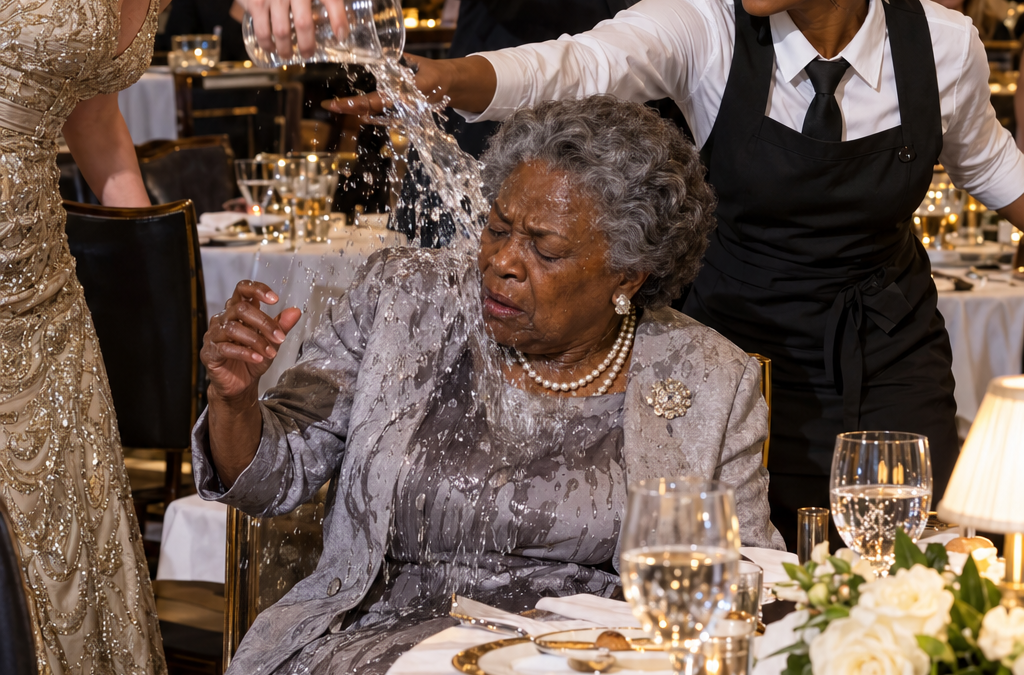
The water glass tipped.
Fell.
Ice and water rushed across the table.
Onto Ruth’s lap.
Her dress.
The floral fabric darkened instantly.
Ruth gasped.
“Oh!”
She pushed back.
Reading glasses slid down her nose.
Victoria widened her eyes.
“Oh dear.”
The performance was immediate.
“I’m so sorry.”
Then she looked at the dress.
“Although I suppose water can’t make it much worse.”
Megan laughed from across the room.
Someone else snorted.
Ruth stood there dripping.
Napkin in both hands.
Blotting.
Blotting.
Blotting.
Like she could erase humiliation with linen.
I had a tray in my hands.
I set it down so hard plates rattled.
Then crossed the room.
“Ma’am.”
I grabbed clean napkins.
“Here.”
Ruth whispered, “I’m fine.”
She wasn’t.
Her hands shook.
I looked at Victoria.
“That wasn’t an accident.”
Her eyebrows rose.
“Excuse me?”
“You walked over here.”
“I bumped a table.”
“No.”
Victoria’s face hardened.
“Maybe if the tables weren’t packed so close.”
I said, “You pulled the cloth.”
Her friends went silent.
Victoria leaned forward.
“Maybe certain people shouldn’t sit where they don’t belong.”
I felt something in me settle.
Not explode.
Settle.
Like a final piece locking into place.
“She belongs here.”
Victoria smiled.
“Does she?”
“Yes.”
“This is not a charity cafeteria.”
“She ordered food.”
“She’s an eyesore.”
She said it with no shame.
Then looked at me.
“And apparently so is the waitress defending her.”
The dining room went quiet.
Phones appeared.
Greg arrived.
“What happened?”
Victoria answered immediately.
“Your waitress is harassing me.”
I almost laughed.
“I accidentally spilled water.”
“You deliberately—”
Greg raised his hand.
“Enough.”
At me.
Not her.
Of course.
“Mrs. Caldwell, I apologize.”
Then to me:
“Walk away.”
“Greg.”
“Now.”
“Look at her dress.”
“I said walk away.”
“She poured water on her.”
“One more word and you’re done for the day.”
Victoria crossed her arms.
“No.”
Greg looked at her.
“What?”
“I want the old woman removed.”
Ruth looked up.
Victoria continued.
“Either she goes or my entire table leaves.”
Then:
“And we take our tab with us.”
Two thousand dollars.
I watched Greg’s face.
One second.
Two.
He turned toward Ruth.
That was when I knew.
“Ma’am.”
Ruth looked at him.
“I think you might be more comfortable somewhere else.”
Her face did not change.
“Somewhere else.”
“There’s another restaurant nearby.”
“My soup is here.”
“I understand.”
“The woman who poured water on me stays.”
Greg swallowed.
“We’re just trying to prevent further conflict.”
Ruth’s voice remained calm.
“The conflict is that she insulted me.”
No answer.
“Then poured water on me.”
Silence.
“And you’re asking me to leave.”
Greg pulled his tie.
“I think it’s best.”
That did it.
I stepped between them.
“No.”
Greg closed his eyes briefly.
“Olivia.”
“She is not leaving.”
“Stop.”
“She’s a paying customer.”
Victoria muttered, “Here we go.”
“She did nothing.”
“Olivia.”
“The person who should leave is the woman who spent thirty minutes humiliating her.”
Victoria stood.
“Victim.”
Her voice carried.
“You people love playing victim.”
The words seemed to explode without sound.
A woman at another table covered her mouth.
Bradley finally looked up.
Megan froze.
Victoria kept going because people like her often mistake silence for permission.
“Everything becomes race.”
She rolled her eyes.
“Always.”
I looked at her.
“Nobody mentioned race until you did.”
That was when Greg made his choice.
“You’re fired.”
I turned.
“What?”
“Go get your things.”
My ears rang.
“Greg.”
“You’re done.”
Rent.
Shoes.
Electricity.
Tuition.
Bus pass.
Every number came back at once.
I could feel tears starting.
I refused them.
Not there.
Victoria smiled.
That almost made it worse.
For five seconds, I stood completely still.
Then Ruth stood.
Her dress was still wet.
Her cardigan torn.
Her eyes red.
But her back had straightened.
She took both my hands.
“Thank you.”
I couldn’t answer.
“You stood up for me when nobody else did.”
My eyes filled.
“You shouldn’t lose your job because of me.”
“This isn’t because of you.”
“Listen.”
Her grip tightened.
“You don’t know what you just did.”
I shook my head.
“I’m pretty sure I got fired.”
Something almost like amusement passed through her face.
“You’ll know.”
I frowned.
“I promise.”
I untied my apron.
Folded it.
Set it on an empty table.
Then walked out.
I did not look at Victoria.
I knew if I did, I would cry or scream.
Neither would give me my paycheck back.
Outside, Charlotte heat hit me.
The sidewalk seemed too bright.
I took two steps.
Stopped.
My breathing changed.
That was when reality arrived.
Not inside.
Outside.
Kayla.
I had to tell Kayla.
Mama doesn’t have work Monday.
Rent due in six days.
I pressed both hands to my face.
Counted.
One.
Two.
Three.
I told myself I could pick up shifts somewhere.
Apply tonight.
Restaurant jobs turn over constantly.
I could sell something.
Ask Miss Darlene to wait on childcare money.
Call the power company.
Make arrangements.
Survival is mostly arranging one problem behind another so they can’t all hit you at once.
Then a black Cadillac Escalade pulled to the curb.
Polished.
Tinted.
Rear door opened.
A tall Black man stepped out.
Mid-forties.
Charcoal suit.
Silver cufflinks.
Italian shoes.
Phone in one hand.
He passed me without looking.
Not rude.
Focused.
He entered La Fontaine.
I didn’t know his name yet.
Inside, Ruth looked up.
Her face transformed.
“Donovan.”
He crossed the room.
“Mama.”
That one word told everybody the relationship.
He looked at her dress.
The wet fabric.
Her eyes.
Hands.
“What happened?”
His voice was quiet.
Ruth tried to minimize.
He stopped her.
“Your watch sent me an alert.”
He crouched.
“Your heart rate went through the roof.”
“I’m all right.”
“Tell me what happened.”
So she did.
Every word.
The comments.
Dress.
Soup kitchen.
Cobbler.
Water.
Greg.
Me.
Getting fired.
Donovan never interrupted.
I had come back inside by then.
Not fully.
I stood near the doorway because Ruth had motioned to me through the glass.
The entire room listened.
When she finished, Donovan stood.
Greg recognized him first.
I watched the color leave his face.
At the time, I didn’t understand why.
Then somebody whispered:
“That’s Donovan Pierce.”
I knew the name.
Everybody in Charlotte hospitality knew the name.
Pierce Atlantic Holdings.
Commercial real estate.
Hotels.
Office towers.
Retail properties.
Hundreds of millions in assets.
One of the biggest Black-owned real estate firms in the Southeast.
And La Fontaine’s building?
His.
The lease was up for renewal in ninety days.
Donovan turned toward the room.
“The woman you humiliated is my mother.”
Nobody moved.
“Ruth Pierce.”
He looked at Victoria.
“She raised three children after my father died.”
Victoria’s wine glass remained halfway off the table.
“My mother worked three jobs for sixteen years.”
He glanced at the floral dress.
“The dress you laughed at was a gift from my father on their twenty-fifth anniversary.”
Ruth looked down.
Touched the fabric.
“He died eleven years ago.”
Donovan’s voice changed.
Barely.
“She wears it because it reminds her of him.”
Victoria had nothing.
No comeback.
No joke.
Donovan continued.
“My mother could buy every dress in this building’s neighborhood.”
He shook his head.
“That wouldn’t make what you did more wrong.”
That sentence caught me.
He understood immediately.
It wasn’t wrong because Ruth had money.
It was wrong because Ruth was a person.
Bradley Caldwell had gone pale too.
Then I understood another layer.
His firm did business with Pierce Atlantic.
Several properties.
Millions.
He knew exactly what was happening to his future.
Donovan turned toward me.
“Are you Olivia?”
I swallowed.
“Yes.”
“My mother says you defended her.”
“I just—”
“You defended her.”
Ruth smiled at me.
I nodded.
“Yes.”
He stepped closer.
“Thank you.”
I felt embarrassed.
“I got fired.”
“So I heard.”
Greg rushed forward.
“Mr. Pierce.”
Donovan turned.
“I had no idea.”
There it was.
The most useless sentence rich people say when consequences arrive.
“If I’d known Mrs. Pierce was—”
Donovan stopped him.
“If you’d known she was my mother?”
Greg froze.
“Is that what you’re about to say?”
“I mean, I would have handled—”
“You had enough information.”
Greg’s mouth closed.
“You knew she was elderly.”
Silence.
“You knew she was a paying guest.”
Silence.
“You watched another customer harass her.”
Silence.
“You saw her dress soaked.”
Greg tugged at his tie.
“And you fired the only person who defended her.”
Donovan’s voice stayed low.
“Don’t tell me you lacked information.”
Greg looked at the floor.
“You lacked courage.”
I felt that.
Because Greg had never been cruel the way Victoria was.
He had always believed that mattered.
It didn’t.
Donovan made one phone call.
Put it on speaker.
“Thomas.”
The owner of La Fontaine answered.
Warm immediately.
“Donovan.”
“I’m in your restaurant.”
Pause.
“La Fontaine.”
Another pause.
“Your general manager watched a guest be harassed, then asked the victim to leave.”
Greg closed his eyes.
“When a waitress objected, he fired her.”
Silence.
Donovan continued.
“The guest is my mother.”
The silence grew heavier.
“My building houses your restaurant.”
No threat in his tone.
Just fact.
“Your renewal is ninety days away.”
Greg looked sick.
“If Greg Holland is still employed when I drink coffee tomorrow, we will not renew.”
The owner answered immediately.
“He’s done.”
Greg’s head dropped.
“Effective immediately.”
Donovan held the phone slightly closer.
“He’s here.”
The owner’s voice hardened.
“Greg, you’re suspended. Leave the property. HR will contact you.”
Greg loosened his tie.
Walked toward the office.
Nobody stopped him.
Nobody watched.
Then Victoria stood.
She had reconstructed herself.
People like her do that quickly.
Smile.
Posture.
Voice.
“Mr. Pierce.”
She extended one hand.
“This has been a terrible misunderstanding.”
He looked at the hand.
Then at her.
“You called my mother homeless.”
Her smile weakened.
“I was concerned about standards.”
“You mocked her clothes.”
“I admit some comments were—”
“You poured water on her.”
“Accidentally.”
Donovan looked toward the phones.
“At least four recordings say otherwise.”
Her face tightened.
“You threatened Olivia’s job.”
“I don’t control restaurant staff.”
“You tried.”
Victoria lowered her hand.
Donovan said, “That’s not a misunderstanding.”
He paused.
“That’s who you are.”
The whole room heard.
Bradley looked down.
Donovan turned toward him.
“Bradley.”
He looked up.
“Your company manages four of my properties.”
Bradley’s jaw tightened.
“Yes.”
“We’ll review that Monday.”
He nodded.
Didn’t argue.
Maybe because there was nothing to argue.
Then Donovan looked at me.
“Olivia.”
“Yes?”
“Your job is restored.”
I stared.
He smiled faintly.
“If you want it.”
I looked toward the kitchen.
Toward the room.
Toward the place that had just fired me for saying an old woman deserved to finish soup.
Before I answered, Donovan continued.
“Although I’d like you to consider another position.”
“Where?”
“Pierce Atlantic.”
I thought I misunderstood.
“What would I do?”
“Client relations.”
I almost laughed.
“I’m a waitress.”
“You are studying hospitality management.”
I stared at Ruth.
She smiled.
“You told him?”
“I ask questions.”
Donovan continued.
“My company deals with people.”
He gestured toward the dining room.
“I need people who understand dignity under pressure.”
I couldn’t speak.
“Interview Monday.”
He added.
“Nothing promised.”
That helped.
A real opportunity.
Not charity.
“Yes.”
My voice came out too quickly.
“Yes, sir.”
Ruth squeezed my hand.
“I told you.”
I laughed through tears.
“You did.”
The videos went online before the Caldwell party left.
That changed everything fast.
Too fast.
By midnight, hundreds of thousands of people had seen Victoria mocking Ruth.
By Sunday, millions.
The footage of the water glass became the clip everyone replayed.
Then my confrontation.
Greg firing me.
Donovan walking in.
News stations called.
I refused interviews at first.
I had a child.
Classes.
A job interview.
I wasn’t interested in becoming content.
The internet found Victoria’s old posts.
Racial comments.
Classist comments.
A pattern.
Not one bad afternoon.
Pierce Atlantic terminated Bradley Caldwell’s property contracts Monday morning.
Other clients followed.
Bradley and Victoria separated within weeks.
I didn’t celebrate that.
Their marriage wasn’t my business.
But I understood why a man who had spent years saying nothing might eventually discover silence has a price too.
La Fontaine investigated Greg.
Two old employee complaints surfaced.
Black staff describing slurs from guests.
Assignments pushed to less visible sections during major events.
Greg had buried both.
He wasn’t simply weak in one moment.
He had built a management style around protecting revenue from discomfort.
He was terminated permanently.
The restaurant changed its policy.
Discriminatory behavior toward guests or staff became grounds for removing the offending customer, regardless of spending.
That mattered to me more than Greg losing his job.
Punishment stops one person.
Policy changes the next situation.
Victoria eventually faced Ruth in civil court.
Ruth refused a private settlement.
I asked her why.
We were sitting in a coffee shop.
She stirred tea.
“Money can close a case.”
She looked at me.
“It can’t always correct a record.”
She wanted what happened said publicly.
On record.
A judge ordered damages and community service.
Victoria spent two hundred hours at a West End shelter.
People asked me whether I thought that changed her.
I had no idea.
Probably nobody did.
Consequences don’t automatically produce character.
Sometimes people grow.
Sometimes they only learn to hide better.
I never claimed to know which happened with her.
My own life changed faster than I could process.
The interview at Pierce Atlantic happened Monday.
Donovan wasn’t sentimental.
I appreciated that.
He asked about customer recovery.
Difficult clients.
Vendor conflict.
Escalation.
My certification.
Then he said:
“What happened Saturday will not get you the job.”
I nodded.
“Good.”
He looked surprised.
“Good?”
“I don’t want pity employment.”
He leaned back.
“Neither do I.”
We talked another hour.
I got the position.
Client relations coordinator.
Three times my restaurant pay.
Health insurance.
Tuition reimbursement.
Regular hours.
The first morning I walked into the Pierce Atlantic office, I stood outside the elevator for almost a minute.
Fourteenth floor.
Glass offices.
My name printed on a temporary badge.
I thought about La Fontaine.
About carrying plates.
About Greg saying do the math.
Two thousand dollar table versus nine-dollar soup.
Turns out he had done the wrong math.
Not because Ruth was connected to wealth.
Because he calculated human worth as revenue.
That equation always eventually fails.
Kayla and I moved two months later.
Two-bedroom apartment.
Her own room.
Radiator that didn’t sound like it was communicating with ghosts.
Her school was ten minutes away.
The first night there, she stood in her bedroom.
Turned slowly.
“This is mine?”
“Mostly.”
She frowned.
“Mostly?”
“I’m still coming in here to clean.”
She laughed.
Then jumped on the bed.
I finished my hospitality certificate four months later.
When my certificate arrived, Ruth came to dinner.
She brought peach cobbler.
“Restaurant quality?”
I asked.
“Better.”
“Bold claim.”
“I’ve lived long enough to make bold claims.”
We became friends.
Not some dramatic mother-daughter replacement.
I had my mother.
She had children.
We simply liked each other.
Every other Saturday, we had lunch.
Eventually, we went back to La Fontaine.
Same corner table.
Ruth wore the floral dress.
On purpose.
The first time, I laughed so hard the hostess stared.
“You really wore it?”
Ruth smoothed the fabric.
“My husband paid good money for this.”
“How much?”
“None of your business.”
The new manager greeted us.
Black woman.
Forties.
Direct.
She had removed several tables to give the dining room more space.
One new framed photograph hung near the entrance.
Ruth and me.
Taken after the court case.
Underneath:
DIGNITY IS NOT A DRESS CODE.
I cried when I saw it.
Ruth rolled her eyes.
“You cry too much.”
“You almost cried over cobbler.”
“That was cinnamon.”
“Sure.”
My desk at Pierce Atlantic eventually stopped feeling borrowed.
I put three things on it.
Kayla’s school photo.
My hospitality certificate.
A handwritten note from Ruth.
THANK YOU FOR SEEING ME.
That note bothered me for months.
Not because I disliked it.
Because I kept thinking about what it implied.
So many people had seen her that day.
Hostess.
Busboy.
Greg.
Eight people at Victoria’s table.
Thirty people in the room.
Seeing someone is not the same as recognizing their humanity.
I hadn’t done anything extraordinary.
That’s what people kept telling me afterward.
You’re brave.
You’re a hero.
I didn’t like either word.
Heroes are allowed to belong to stories.
What I did should belong to ordinary life.
An old woman was being humiliated.
I said stop.
The tragedy was not that I was unusually courageous.
It was that the room had made basic decency unusual.
Kayla understood the story differently.
Her teacher assigned an essay:
THE BRAVEST PERSON I KNOW.
She wrote about me.
I didn’t know until parent conference night.
Her teacher handed me a copy.
I read the first line.
My mom lost her job because she helped somebody.
I immediately started crying.
Kayla groaned.
“Mama.”
“I know.”
“You always cry.”
“I gave birth to you. I’m allowed.”
I framed the essay.
It sits beside Ruth’s note.
One day Kayla asked:
“Were you scared?”
“Yes.”
“Then why did you do it?”
I thought.
Because children deserve truthful answers.
“I didn’t know what would happen.”
“Did you know you’d get fired?”
“I thought I might.”
“Then why?”
I looked at her.
“Because if I let somebody treat Ruth that way while I stood there, I would have to remember that too.”
She frowned.
“Remember what?”
“That I chose my job over somebody else’s dignity.”
“Isn’t a job important?”
“Very.”
“More important than dignity?”
I smiled.
“That’s the question.”
She thought about it a long time.
Then:
“Can we get ice cream?”
Six-year-old philosophy.
Ruth kept volunteering.
Food bank three mornings a week.
She sorted clothing.
Served meals.
Talked to people.
Never performed charity.
That’s another difference I learned from her.
Some people help others because they enjoy the distance between helper and helped.
Ruth erased the distance.
She sat.
Listened.
Remembered names.
The floral dress kept appearing.
Donovan tried twice to buy her a new wardrobe.
She refused.
“I don’t dress for strangers.”
He stopped asking.
I once asked Donovan about his childhood.
We were driving to a client meeting.
He smiled.
“Mom told you three jobs?”
“Yes.”
“She left out cleaning offices.”
I looked at him.
“Four?”
“At one point.”
He stared out the window.
“My father died when I was thirteen.”
I knew that.
“She cleaned buildings overnight and somehow still got home before we woke up.”
He shook his head.
“For years, I thought she slept somewhere else.”
His voice softened.
“Turns out she barely slept.”
That was Ruth.
The dress Victoria mocked contained a life she could not see.
A marriage.
Grief.
Work.
Memory.
You cannot know a person’s story by looking at fabric.
That’s the arrogance behind class judgment.
The belief that appearance is biography.
Victoria disappeared from public life over time.
Social accounts gone.
Country club membership ended.
Divorce finalized.
Smaller house.
No interviews.
One reporter asked me whether I forgave her.
I said that question belonged to Ruth.
Ruth was asked later.
Her answer was better.
“I don’t carry her.”
That was it.
The reporter asked what she meant.
Ruth smiled.
“If I’m carrying resentment, I’m carrying Victoria.”
She shook her head.
“My back is too old.”
I loved that woman.
A year after I left La Fontaine, I visited during a weekday lunch.
No event.
No Ruth.
Just me.
I wanted soup.
I sat in the same corner.
The restaurant looked familiar.
Different manager.
Some different staff.
Same sunlight through the front windows.
A woman entered alone.
Late sixties.
Cheap coat.
Hair wrapped in a scarf.
She hesitated at the hostess stand.
I watched.
The hostess smiled.
“Table for one?”
“Yes.”
“Of course.”
No pause.
No look down.
No scan.
She seated her near the window.
A server approached.
“Good afternoon.”
Normal.
Nothing dramatic.
Nobody applauded.
Nobody filmed.
Nobody discovered she secretly owned a corporation.
She ate lunch.
Paid.
Left.
I sat there with tears in my eyes.
That was what change was supposed to look like.
Boring.
Dignity so ordinary nobody noticed.
The new manager saw me.
“Everything okay?”
“Perfect.”
She looked confused.
Good.
That meant there was nothing to explain.
Some people still tell the story as though Donovan was the ending.
Rich CEO walks in.
Cruel socialite exposed.
Manager fired.
Waitress rewarded.
It’s satisfying.
I understand.
But I don’t think that’s the most important part.
Take Donovan out.
Take the Escalade out.
Take Pierce Atlantic out.
Take the lease renewal out.
What remains?
An elderly woman in a faded dress.
A rich woman laughing.
A manager choosing money.
Thirty people watching.
A waitress deciding whether to speak.
That’s the story.
Because in real life, Donovan doesn’t always come through the door.
Sometimes the person being humiliated has no wealthy son.
No lawyer.
No camera.
No connection.
Sometimes the waitress gets fired and stays fired.
That possibility cannot be what determines whether the waitress should speak.
People often say courage means not being afraid.
That’s nonsense.
I was terrified.
I had a child.
A late electric bill.
No savings worth mentioning.
I knew exactly what losing my job could mean.
Courage was not the absence of those calculations.
It was feeling every single one and still reaching the same answer.
No.
She is not leaving.
I don’t pretend everybody can risk employment in every moment.
Life is complicated.
People have children.
Immigration status.
Medical bills.
Abusive bosses.
There are dangers not visible to an audience.
I judge silence less quickly now than I did that day.
Because I know what my own silence almost cost me emotionally.
But I also know this:
A room changes the first time somebody refuses its rules.
Ruth was supposed to shrink.
Victoria was supposed to control the tone.
Greg was supposed to protect the money.
I was supposed to obey.
The guests were supposed to watch.
Then one person said no.
That did not solve everything.
It simply changed what became possible next.
I still work at Pierce Atlantic.
My role has grown.
Client experience.
Tenant relations.
Training.
Eventually Donovan put me in charge of a small team.
The first time he offered the promotion, I asked:
“Is this because of your mother?”
He looked offended.
“No.”
“Good.”
“It’s because you argue with senior executives without blinking.”
“Also good.”
I finished my bachelor’s degree part-time.
The day I graduated, Kayla sat beside Ruth.
Donovan sat on the other side.
When my name was called, Kayla screamed so loudly someone behind them complained.
Ruth turned and told the woman:
“She’s proud of her mother. You’ll live.”
I learned that afterward.
It sounded exactly like her.
After graduation, we went to dinner.
Not La Fontaine.
I wanted Mexican food.
Ruth wore the floral dress anyway.
Of course.
She lifted her glass.
“To Olivia.”
I groaned.
“No speeches.”
“Too late.”
She ignored me.
“To the girl who brought me cobbler when the room wanted me to disappear.”
I looked down.
“And to the woman she became because she refused to disappear herself.”
That one got me.
I cried.
Again.
Ruth said, “Lord.”
Kayla laughed.
Years later, I still remember the exact second Greg said:
Do the math.
Caldwell table, two thousand.
Corner soup, nine dollars.
He thought the equation was obvious.
It wasn’t.
He counted the value of the meals.
He never counted the value of the people.
That mistake cost him everything.
Not because a rich man arrived later.
Because the culture that produced his choice was finally forced into daylight.
I teach new client-relations hires now.
Sometimes I tell them this story.
But I never tell them who Ruth’s son is until the end.
I describe the room.
The clothes.
The comments.
The water.
The manager.
The firing.
Then I ask:
What do you do?
Some answers are impressive.
Some are careful.
Some are obviously what people believe they are supposed to say in training.
Then I tell them about Donovan.
Their faces change.
That’s the moment I watch.
Because if the situation only becomes outrageous after they learn Ruth’s son is wealthy, they’ve missed the point.
I tell them:
“She mattered before the Escalade.”
Then I move on.
Ruth still texts.
Often at inconvenient times.
Her messages contain almost no punctuation.
LUNCH SATURDAY WEAR SOMETHING NICE
I reply:
YOU FIRST.
Sometimes she wears the dress.
Sometimes not.
It isn’t sacred because it’s old.
It matters because she decided what it means.
That’s the difference.
Victoria had looked at it and seen poverty.
Ruth saw her husband.
Greg saw a low check average.
I saw my grandmother.
Donovan saw his mother.
Same dress.
Different eyes.
That’s how prejudice works.
People believe they are describing what they see.
Often they are only describing themselves.
I think about my daughter most.
Kayla is older now.
She doesn’t remember the apartment radiator much.
She vaguely remembers Miss Darlene.
She definitely remembers me coming home from La Fontaine that afternoon.
I had tried to act normal.
She saw through it immediately.
“Mama, what’s wrong?”
“I don’t work at the restaurant anymore.”
“Why?”
I sat beside her.
“Because I told my manager no.”
Her eyes widened.
“You told your boss no?”
“Yes.”
“You’re not supposed to do that.”
“Sometimes you are.”
“Are we poor now?”
The question crushed me.
I took her hands.
“We’re okay.”
I didn’t know whether that was true.
I said it anyway.
Then she asked:
“Was it the right thing?”
I thought of Ruth.
Soaked dress.
Shaking hands.
“Yes.”
Kayla nodded.
“Then okay.”
Children can make moral clarity feel embarrassingly simple.
She trusted me.
I needed to become worthy of that trust.
The job at Pierce Atlantic helped.
The salary helped.
The education helped.
But even if Donovan had never arrived, I hope I would eventually have looked back and still believed I had made the right choice.
I cannot prove that alternate life.
Nobody can.
I only know the life I got.
A woman walked into a restaurant wearing a faded floral dress.
Most of the room saw somebody who didn’t belong.
I saw my grandmother.
Then I saw a human being being hurt.
And for one afternoon, that was enough to make me risk what I had.
People later called that brave.
I still call it basic.
Maybe one day it will be.
𝗧𝗛𝗘 𝗘𝗡𝗗
The Rich Woman Dumped Water on an Elderly Black Guest and Told My Boss to Fire Me for Defending Her—She Had No Idea Who Was About to Walk Through the Door
I knew rent was due in six days when I looked my manager in the eye and told him I would not throw an elderly Black woman out of our restaurant just because a wealthy table didn’t like the dress she was wearing.
Ten minutes later I was unemployed on the sidewalk trying to figure out how to buy my daughter’s new shoes, while inside the woman who had humiliated that guest was still sipping wine—until a black Escalade stopped at the curb and a man stepped out looking for his mother.
At 5:45 that morning, none of that existed yet.
There was no confrontation.
No firing.
No black Escalade.
No room full of phones.
There was just me sitting on the edge of a squeaky bed in our one-bedroom apartment on Charlotte’s West End, trying to convince my six-year-old daughter that morning was a real thing and not a personal attack.
“Kayla.”
She disappeared deeper under the blanket.
“No.”
I smiled.
“We’re having a strong start.”
“It’s nighttime.”
“It’s five forty-five.”
“Exactly.”
I pulled the blanket down enough to see one eye.
“Come here. I need to do your hair.”
She groaned like a sixty-year-old woman being asked to work overtime.
“Mama.”
“Move.”
She crawled backward until she was sitting between my knees.
I divided her hair into sections and began braiding.
The apartment smelled like cocoa butter, coffee, and rice from the night before.
Our radiator made a clicking sound every few minutes even though it was October and still warm enough outside that nobody needed heat.
I had asked the landlord about it twice.
He had explained something involving old pipes, pressure, and “getting to it.”
Landlords love verbs without dates.
On the kitchen counter, my hospitality-management textbook was open to chapter nine.
I was halfway through a certification program.
Tuesday and Thursday night classes.
Study on the bus.
Assignments after Kayla went to sleep.
I wasn’t doing it because I dreamed of managing white-tablecloth restaurants.
Not exactly.
I wanted options.
Options are expensive when you’re poor.
Education was the only payment plan I understood.
Kayla leaned back against me.
“You pulling.”
“I’m not.”
“You are.”
“Your head moved.”
“It moved because you pulled.”
I stopped.
“Would you like to do your own hair?”
She immediately became still.
“No, ma’am.”
“That’s what I thought.”
She grinned.
That gap between her front teeth made every smile look brighter than it had any right to at six in the morning.
By 6:20, I had packed her lunch.
Peanut butter sandwich.
Apple slices.
Juice.
A sticky note.
YOU’RE MY FAVORITE HUMAN.
I wrote one every day.
She pretended they embarrassed her.
Miss Darlene next door had told me she saved all of them.
By 6:30, Kayla was across the hall.
By 7:15, I was on the bus uptown with a chewed pen in one hand and chapter nine open on my lap.
Guest recovery.
Conflict resolution.
Service standards.
I remember that because it became funny later.
Not funny ha-ha.
Funny the way life sometimes puts the answer on the page right before asking the question in the ugliest possible way.
La Fontaine sat at the corner of Trade and Tryon.
White stone.
Gold awning.
Dark walnut hostess stand.
Stemware so thin I was afraid of breaking it during my first month.
Entrées started around fifty-eight dollars.
Wine climbed into numbers that made me wonder whether grapes had unionized.
I’d worked there fourteen months.
One of two Black servers on staff.
I was good.
I knew that.
Not arrogant.
Accurate.
I remembered allergies.
I could carry four plates without stacking them against my arm.
I knew which regular wanted lemon before he asked.
I could read a table in thirty seconds.
First date.
Business lunch.
Anniversary.
Marriage almost over.
People tell you things with the way they sit before they ever open their mouths.
My manager, Greg Holland, used to tell me I was one of the strongest servers on the floor.
He never said it where promotion decisions were made.
Greg was forty-something.
White.
Thin lips.
Navy ties.
Always pulling at the knot like it offended him.
He wasn’t loud.
He didn’t insult staff.
Didn’t scream.
Didn’t throw things.
For months, I thought that meant he was decent.
Eventually I understood that there are people who cause harm directly, and people who make harm possible by refusing to inconvenience themselves.
Greg belonged to the second group.
His favorite sentence was:
“Keep it smooth.”
That meant don’t challenge a rude guest.
Don’t complicate something profitable.
Don’t create a problem management has to acknowledge.
I had heard him say it when a kitchen employee got called a slur.
When a server was grabbed by a drunk customer.
When one of our Black busboys complained a guest asked whether “people like him” were allowed near the wine cellar.
Greg’s response was always some variation of:
Let’s not make this bigger than it needs to be.
That Saturday, lunch was heavy.
At 12:15, the Caldwell party arrived.
Eight people.
Reservation in the center of the dining room.
Victoria Caldwell came first.
White Chanel blazer.
Oversized sunglasses.
Perfect blond hair.
Perfume that arrived about four seconds before she did.
She didn’t say hello to the hostess.
She pointed.
“That’s ours.”
Behind her came her husband, Bradley.
Tall.
Expensive suit.
Quiet in the way some husbands become after years of deciding silence is easier than disagreeing.
Then friends.
Five of them.
All white.
All dressed like they expected photographs.
They filled the table with voices before they filled it with food.
Wine first.
Then more wine.
Special requests.
No onions.
Sauce on side.
Water with no ice.
Extra lemon.
Different bread.
Nothing difficult individually.
But everything delivered as though the person asking needed you to understand that your job was not service.
It was obedience.
At 12:30, the door opened again.
An older Black woman walked in alone.
Mid-seventies maybe.
Faded floral dress.
Clean.
Pressed.
Old.
Light cardigan with a tear along one cuff.
Flat shoes with worn soles.
A leather handbag clutched with both hands.
She waited near the hostess stand.
No snapping.
No clearing her throat.
No impatient glance at a watch.
She simply waited until someone acknowledged her.
“Table for one, please.”
Her voice was soft.
Warm.
The hostess seated her near the corner.
Unfortunately, that placed her close to the Caldwell table.
I was assigned both.
I went to the older woman first.
Not because the rotation told me to.
Because something in her face reminded me of my grandmother.
“Good afternoon, ma’am.”
She looked up.
Dark brown eyes.
Tired.
Kind.
“Can I bring you something to drink?”
“Water, please.”
“Still or sparkling?”
She looked embarrassed.
“Regular water is fine.”
“Regular water is undefeated.”
That made her smile.
I opened the menu slightly toward her.
“Our soup today is butternut squash.”
“Is it good?”
“It’s my favorite.”
She closed the menu.
“Then I’ll trust you.”
That sentence stayed with me.
I’ll trust you.
I had spent fourteen months being treated as someone who carried plates.
She spoke to me like a person.
Her name was Ruth Pierce.
I wouldn’t learn the last name until later.
At first, she was simply Ruth.
I brought her water.
Soup.
Bread.
Then went to the Caldwell table.
I was setting down a bottle of Sauvignon Blanc when Victoria’s eyes moved toward the corner.
She stopped mid-sentence.
Her glass hovered near her mouth.
Then:
“Oh my God.”
One friend looked up.
“What?”
Victoria stared at Ruth.
“You’ve got to be kidding me.”
Her friend Megan followed her gaze.
She saw the dress.
Cardigan.
Shoes.
Handbag.
Then covered her mouth and laughed.
“No way.”
Victoria placed her glass down.
Not quietly.
“How did she even get in?”
I felt my shoulders tighten.
Nobody at their table lowered their voice.
That was important.
Some people say cruel things because they forget someone can hear.
Victoria wanted Ruth to hear.
“This is a hundred-dollar-a-plate restaurant.”
She leaned toward Megan.
“Not a soup kitchen.”
A woman in red laughed.
“The hostess should be fired.”
Another said, “My cleaning lady dresses better.”
Someone else added, “I can smell the thrift store from here.”
The table erupted.
Bradley didn’t laugh.
He looked at his plate.
I remember that clearly because for a few minutes I gave him credit for that.
Later I realized silence isn’t innocence when you are sitting beside cruelty and benefiting from not opposing it.
Two nearby tables heard.
A couple looked uncomfortable.
A man near the window picked up his phone and stared harder at it.
Nobody said anything.
Ruth heard.
Her spoon stopped.
She placed it down carefully.
Her left hand moved to the tear at her cuff.
She pressed the fabric flat.
Again.
Again.
Like if she covered the threadbare part, maybe the comments would lose their target.
Then she lowered her eyes.
I watched her shoulders curve inward.
She became physically smaller.
That’s what humiliation does.
It convinces the body to apologize for occupying space.
I knew that posture.
I’ve worn it.
On buses.
In department stores where security followed me aisle to aisle.
In school offices where people assumed I was the babysitter instead of Kayla’s mother because I looked younger than they expected.
In restaurants like that one.
Places where you enter already aware that somebody may ask you to prove you belong.
I delivered bread to another table.
My hands shook beneath the tray.
I wanted to go straight to Victoria.
Wanted to tell her she was cruel.
Ugly in the only way money can’t repair.
But rent was due Friday.
The electricity bill was late.
Kayla had outgrown her school shoes.
I had thirty-two dollars until payday after transportation and groceries.
Principles sound clean when people describe them after the danger has passed.
In the moment, courage has numbers attached.
Rent.
Food.
Childcare.
Medicine.
I went back to the Caldwell table.
Victoria didn’t even look at me.
“Waitress.”
“Yes, ma’am?”
“What is your policy on dress?”
“We ask guests to dress appropriately.”
She pointed with her wine glass.
“And that is appropriate?”
I looked toward Ruth.
“She’s wearing a dress.”
Megan laughed.
Victoria smiled.
“Sweetheart.”
I hated the word immediately.
“Look at her.”
I stayed quiet.
“She got dressed out of a dumpster.”
A man at the table chuckled.
“My eight-year-old owns better clothes.”
I said, “She’s a paying guest.”
Victoria tilted her head.
“Oh, she ordered something?”
“Yes.”
“The menu?”
“Yes.”
She laughed.
“She probably thought the prices were phone numbers.”
More laughter.
I could feel my pulse near my throat.
Victoria continued.
“This is fine dining.”
She lowered her voice slightly.
“Not a homeless shelter with tablecloths.”
Then Megan leaned forward.
“I don’t want her in our photos.”
The woman in red nodded.
“Move her behind something.”
Victoria looked at me.
“Anywhere we don’t have to see her.”
I gripped the tray.
My nails pressed into my palm.
My brain began counting consequences.
Do not react.
Kayla.
Rent.
Class tuition.
Electricity.
Don’t react.
“I’ll speak with my manager.”
I turned away.
It was the only sentence I could say safely.
At the service station, I poured myself water.
Drank it in one swallow.
My reflection stared back from the stainless steel.
Tired face.
Dark circles.
Jaw tight.
I looked toward Greg.
He was at the host stand.
He had heard everything.
I knew he had.
He was pretending to review reservations.
I went to him.
“Greg.”
“Hmm?”
“The Caldwell table is harassing the woman in the corner.”
He barely looked up.
“What happened?”
“You heard.”
“I heard conversation.”
“They’re making comments about her clothes.”
He exhaled.
“Olivia.”
“Greg.”
“Just don’t engage.”
“She’s crying.”
He looked at Ruth.
Then toward Caldwell’s table.
“She’s not crying.”
“She is trying not to.”
He pulled at his tie.
“We have a full room.”
“What does that have to do with anything?”
“I don’t need a scene.”
“There already is one.”
“Then don’t make it bigger.”
Keep it smooth.
Different words.
Same answer.
I walked away before I said something that would cost me the job.
Then I looked at Ruth.
Her soup had been pushed aside.
Hands folded.
Eyes down.
Nobody had checked on her.
Nobody.
That broke something in me.
I went to the kitchen.
Chef had peach cobbler cooling.
I cut a slice.
Placed it on a dessert plate.
Cinnamon.
A little powdered sugar.
Carried it to Ruth.
“Ma’am.”
She looked up.
“I didn’t order dessert.”
“I know.”
I set it down.
“Restaurant courtesy.”
“Oh, honey, I can’t—”
“You can.”
She stared at it.
“My grandmother loved peach cobbler.”
That was true.
“She used to say fruit made it breakfast food.”
Ruth laughed softly.
“Smart woman.”
“The smartest.”
Her shoulders loosened.
Only a little.
I leaned closer.
“You belong here.”
Her eyes immediately filled.
Not dramatically.
One shimmer.
“Thank you.”
I smiled.
“Take your time.”
It was a piece of cobbler.
Maybe three dollars food cost.
In that room, it felt like taking a side.
Victoria saw it.
Her fork hit the plate.
“Are you serious?”
I turned.
She was staring at me.
“I told you she makes us uncomfortable.”
I walked over.
“The dessert is complimentary.”
“I don’t care.”
“Okay.”
She blinked.
“You ignored what I told you.”
“I can’t remove another guest because you don’t like her clothes.”
“Do you know who I am?”
There it was.
I did not.
Not then.
I knew she wanted me to.
Her husband handled commercial real estate.
She knew people.
She had the owner’s number.
According to her, one phone call could end my career in Charlotte hospitality.
Her voice grew quieter.
More dangerous.
“One word from me and you don’t work in this city again.”
My palms started sweating.
I thought about Kayla’s shoes.
Then Victoria said:
“Get rid of her.”
I stared.
“Excuse me?”
“You heard me.”
Three seconds.
Maybe fewer.
It felt longer.
I knew there are moments when your life splits.
Not dramatically.
No music.
No sign.
Just one answer that sends you down a different road.
I said, “No.”
Victoria blinked.
“What?”
“No.”
I heard my own voice and knew the job might already be gone.
“She isn’t bothering anyone.”
Victoria laughed in disbelief.
“The waitress told me no.”
Megan shook her head.
“Unbelievable.”
Before anyone needed to call him, Greg approached.
He had been watching.
Of course.
“Everything okay, Mrs. Caldwell?”
“No.”
Victoria pointed at me.
“Your waitress refuses to handle a situation.”
Greg looked at me.
I watched him calculate.
Caldwell table.
Two thousand dollars.
Ruth’s soup.
Nine dollars.
He didn’t need a calculator.
“Olivia.”
He pulled me aside.
“What are you doing?”
“My job.”
“Your job is keeping guests happy.”
“She is a guest.”
He lowered his voice.
“The Caldwell table spends more here in one lunch than that woman will spend all year.”
I stared.
“So?”
“Don’t be naive.”
“Her money buys food, Greg. Not authority over who else can eat.”
He pulled at his tie.
“Let another server take the corner.”
“Why?”
“Keep things smooth.”
“They’re humiliating her.”
“I didn’t see anything.”
I looked toward the host stand.
“You were watching.”
“I didn’t see anything.”
He said it again.
Slower.
A choice disguised as ignorance.
I went back to Ruth.
Refilled her water.
Straightened her napkin.
She looked at me.
“Baby.”
“Yes, ma’am?”
“You don’t have to fight for me.”
“I’m not fighting.”
“You’re risking something.”
I didn’t answer.
She smiled sadly.
“I’ve been looked at that way my whole life.”
That made me crouch beside her.
“I’m used to it.”
I shook my head.
“No, ma’am.”
Her eyes lifted.
“Nobody should get used to being treated like that.”
Her lip trembled.
I held out my hand.
She took it.
Strong grip.
“You’re a good girl.”
I laughed softly.
“My daughter might challenge that.”
“Your mother raised you right.”
“So did yours.”
Something changed in her expression.
A private memory.
“Yes.”
She squeezed my hand.
“She did.”
I stood.
Went back to work.
I thought the worst was over.
It wasn’t.
Victoria stood from her table a few minutes later.
Said she was going to the restroom.
I noticed because she didn’t turn toward the restroom.
She walked toward Ruth.
Slow.
Measured.
Heels clicking.
Ruth didn’t see her.
She was looking at the cobbler.
Victoria reached the table.
Paused.
Then caught the edge of the tablecloth with her fingers.
A tiny movement.
Easy to deny.
The water glass tipped.
Fell.
Ice and water rushed across the table.
Onto Ruth’s lap.
Her dress.
The floral fabric darkened instantly.
Ruth gasped.
“Oh!”
She pushed back.
Reading glasses slid down her nose.
Victoria widened her eyes.
“Oh dear.”
The performance was immediate.
“I’m so sorry.”
Then she looked at the dress.
“Although I suppose water can’t make it much worse.”
Megan laughed from across the room.
Someone else snorted.
Ruth stood there dripping.
Napkin in both hands.
Blotting.
Blotting.
Blotting.
Like she could erase humiliation with linen.
I had a tray in my hands.
I set it down so hard plates rattled.
Then crossed the room.
“Ma’am.”
I grabbed clean napkins.
“Here.”
Ruth whispered, “I’m fine.”
She wasn’t.
Her hands shook.
I looked at Victoria.
“That wasn’t an accident.”
Her eyebrows rose.
“Excuse me?”
“You walked over here.”
“I bumped a table.”
“No.”
Victoria’s face hardened.
“Maybe if the tables weren’t packed so close.”
I said, “You pulled the cloth.”
Her friends went silent.
Victoria leaned forward.
“Maybe certain people shouldn’t sit where they don’t belong.”
I felt something in me settle.
Not explode.
Settle.
Like a final piece locking into place.
“She belongs here.”
Victoria smiled.
“Does she?”
“Yes.”
“This is not a charity cafeteria.”
“She ordered food.”
“She’s an eyesore.”
She said it with no shame.
Then looked at me.
“And apparently so is the waitress defending her.”
The dining room went quiet.
Phones appeared.
Greg arrived.
“What happened?”
Victoria answered immediately.
“Your waitress is harassing me.”
I almost laughed.
“I accidentally spilled water.”
“You deliberately—”
Greg raised his hand.
“Enough.”
At me.
Not her.
Of course.
“Mrs. Caldwell, I apologize.”
Then to me:
“Walk away.”
“Greg.”
“Now.”
“Look at her dress.”
“I said walk away.”
“She poured water on her.”
“One more word and you’re done for the day.”
Victoria crossed her arms.
“No.”
Greg looked at her.
“What?”
“I want the old woman removed.”
Ruth looked up.
Victoria continued.
“Either she goes or my entire table leaves.”
Then:
“And we take our tab with us.”
Two thousand dollars.
I watched Greg’s face.
One second.
Two.
He turned toward Ruth.
That was when I knew.
“Ma’am.”
Ruth looked at him.
“I think you might be more comfortable somewhere else.”
Her face did not change.
“Somewhere else.”
“There’s another restaurant nearby.”
“My soup is here.”
“I understand.”
“The woman who poured water on me stays.”
Greg swallowed.
“We’re just trying to prevent further conflict.”
Ruth’s voice remained calm.
“The conflict is that she insulted me.”
No answer.
“Then poured water on me.”
Silence.
“And you’re asking me to leave.”
Greg pulled his tie.
“I think it’s best.”
That did it.
I stepped between them.
“No.”
Greg closed his eyes briefly.
“Olivia.”
“She is not leaving.”
“Stop.”
“She’s a paying customer.”
Victoria muttered, “Here we go.”
“She did nothing.”
“Olivia.”
“The person who should leave is the woman who spent thirty minutes humiliating her.”
Victoria stood.
“Victim.”
Her voice carried.
“You people love playing victim.”
The words seemed to explode without sound.
A woman at another table covered her mouth.
Bradley finally looked up.
Megan froze.
Victoria kept going because people like her often mistake silence for permission.
“Everything becomes race.”
She rolled her eyes.
“Always.”
I looked at her.
“Nobody mentioned race until you did.”
That was when Greg made his choice.
“You’re fired.”
I turned.
“What?”
“Go get your things.”
My ears rang.
“Greg.”
“You’re done.”
Rent.
Shoes.
Electricity.
Tuition.
Bus pass.
Every number came back at once.
I could feel tears starting.
I refused them.
Not there.
Victoria smiled.
That almost made it worse.
For five seconds, I stood completely still.
Then Ruth stood.
Her dress was still wet.
Her cardigan torn.
Her eyes red.
But her back had straightened.
She took both my hands.
“Thank you.”
I couldn’t answer.
“You stood up for me when nobody else did.”
My eyes filled.
“You shouldn’t lose your job because of me.”
“This isn’t because of you.”
“Listen.”
Her grip tightened.
“You don’t know what you just did.”
I shook my head.
“I’m pretty sure I got fired.”
Something almost like amusement passed through her face.
“You’ll know.”
I frowned.
“I promise.”
I untied my apron.
Folded it.
Set it on an empty table.
Then walked out.
I did not look at Victoria.
I knew if I did, I would cry or scream.
Neither would give me my paycheck back.
Outside, Charlotte heat hit me.
The sidewalk seemed too bright.
I took two steps.
Stopped.
My breathing changed.
That was when reality arrived.
Not inside.
Outside.
Kayla.
I had to tell Kayla.
Mama doesn’t have work Monday.
Rent due in six days.
I pressed both hands to my face.
Counted.
One.
Two.
Three.
I told myself I could pick up shifts somewhere.
Apply tonight.
Restaurant jobs turn over constantly.
I could sell something.
Ask Miss Darlene to wait on childcare money.
Call the power company.
Make arrangements.
Survival is mostly arranging one problem behind another so they can’t all hit you at once.
Then a black Cadillac Escalade pulled to the curb.
Polished.
Tinted.
Rear door opened.
A tall Black man stepped out.
Mid-forties.
Charcoal suit.
Silver cufflinks.
Italian shoes.
Phone in one hand.
He passed me without looking.
Not rude.
Focused.
He entered La Fontaine.
I didn’t know his name yet.
Inside, Ruth looked up.
Her face transformed.
“Donovan.”
He crossed the room.
“Mama.”
That one word told everybody the relationship.
He looked at her dress.
The wet fabric.
Her eyes.
Hands.
“What happened?”
His voice was quiet.
Ruth tried to minimize.
He stopped her.
“Your watch sent me an alert.”
He crouched.
“Your heart rate went through the roof.”
“I’m all right.”
“Tell me what happened.”
So she did.
Every word.
The comments.
Dress.
Soup kitchen.
Cobbler.
Water.
Greg.
Me.
Getting fired.
Donovan never interrupted.
I had come back inside by then.
Not fully.
I stood near the doorway because Ruth had motioned to me through the glass.
The entire room listened.
When she finished, Donovan stood.
Greg recognized him first.
I watched the color leave his face.
At the time, I didn’t understand why.
Then somebody whispered:
“That’s Donovan Pierce.”
I knew the name.
Everybody in Charlotte hospitality knew the name.
Pierce Atlantic Holdings.
Commercial real estate.
Hotels.
Office towers.
Retail properties.
Hundreds of millions in assets.
One of the biggest Black-owned real estate firms in the Southeast.
And La Fontaine’s building?
His.
The lease was up for renewal in ninety days.
Donovan turned toward the room.
“The woman you humiliated is my mother.”
Nobody moved.
“Ruth Pierce.”
He looked at Victoria.
“She raised three children after my father died.”
Victoria’s wine glass remained halfway off the table.
“My mother worked three jobs for sixteen years.”
He glanced at the floral dress.
“The dress you laughed at was a gift from my father on their twenty-fifth anniversary.”
Ruth looked down.
Touched the fabric.
“He died eleven years ago.”
Donovan’s voice changed.
Barely.
“She wears it because it reminds her of him.”
Victoria had nothing.
No comeback.
No joke.
Donovan continued.
“My mother could buy every dress in this building’s neighborhood.”
He shook his head.
“That wouldn’t make what you did more wrong.”
That sentence caught me.
He understood immediately.
It wasn’t wrong because Ruth had money.
It was wrong because Ruth was a person.
Bradley Caldwell had gone pale too.
Then I understood another layer.
His firm did business with Pierce Atlantic.
Several properties.
Millions.
He knew exactly what was happening to his future.
Donovan turned toward me.
“Are you Olivia?”
I swallowed.
“Yes.”
“My mother says you defended her.”
“I just—”
“You defended her.”
Ruth smiled at me.
I nodded.
“Yes.”
He stepped closer.
“Thank you.”
I felt embarrassed.
“I got fired.”
“So I heard.”
Greg rushed forward.
“Mr. Pierce.”
Donovan turned.
“I had no idea.”
There it was.
The most useless sentence rich people say when consequences arrive.
“If I’d known Mrs. Pierce was—”
Donovan stopped him.
“If you’d known she was my mother?”
Greg froze.
“Is that what you’re about to say?”
“I mean, I would have handled—”
“You had enough information.”
Greg’s mouth closed.
“You knew she was elderly.”
Silence.
“You knew she was a paying guest.”
Silence.
“You watched another customer harass her.”
Silence.
“You saw her dress soaked.”
Greg tugged at his tie.
“And you fired the only person who defended her.”
Donovan’s voice stayed low.
“Don’t tell me you lacked information.”
Greg looked at the floor.
“You lacked courage.”
I felt that.
Because Greg had never been cruel the way Victoria was.
He had always believed that mattered.
It didn’t.
Donovan made one phone call.
Put it on speaker.
“Thomas.”
The owner of La Fontaine answered.
Warm immediately.
“Donovan.”
“I’m in your restaurant.”
Pause.
“La Fontaine.”
Another pause.
“Your general manager watched a guest be harassed, then asked the victim to leave.”
Greg closed his eyes.
“When a waitress objected, he fired her.”
Silence.
Donovan continued.
“The guest is my mother.”
The silence grew heavier.
“My building houses your restaurant.”
No threat in his tone.
Just fact.
“Your renewal is ninety days away.”
Greg looked sick.
“If Greg Holland is still employed when I drink coffee tomorrow, we will not renew.”
The owner answered immediately.
“He’s done.”
Greg’s head dropped.
“Effective immediately.”
Donovan held the phone slightly closer.
“He’s here.”
The owner’s voice hardened.
“Greg, you’re suspended. Leave the property. HR will contact you.”
Greg loosened his tie.
Walked toward the office.
Nobody stopped him.
Nobody watched.
Then Victoria stood.
She had reconstructed herself.
People like her do that quickly.
Smile.
Posture.
Voice.
“Mr. Pierce.”
She extended one hand.
“This has been a terrible misunderstanding.”
He looked at the hand.
Then at her.
“You called my mother homeless.”
Her smile weakened.
“I was concerned about standards.”
“You mocked her clothes.”
“I admit some comments were—”
“You poured water on her.”
“Accidentally.”
Donovan looked toward the phones.
“At least four recordings say otherwise.”
Her face tightened.
“You threatened Olivia’s job.”
“I don’t control restaurant staff.”
“You tried.”
Victoria lowered her hand.
Donovan said, “That’s not a misunderstanding.”
He paused.
“That’s who you are.”
The whole room heard.
Bradley looked down.
Donovan turned toward him.
“Bradley.”
He looked up.
“Your company manages four of my properties.”
Bradley’s jaw tightened.
“Yes.”
“We’ll review that Monday.”
He nodded.
Didn’t argue.
Maybe because there was nothing to argue.
Then Donovan looked at me.
“Olivia.”
“Yes?”
“Your job is restored.”
I stared.
He smiled faintly.
“If you want it.”
I looked toward the kitchen.
Toward the room.
Toward the place that had just fired me for saying an old woman deserved to finish soup.
Before I answered, Donovan continued.
“Although I’d like you to consider another position.”
“Where?”
“Pierce Atlantic.”
I thought I misunderstood.
“What would I do?”
“Client relations.”
I almost laughed.
“I’m a waitress.”
“You are studying hospitality management.”
I stared at Ruth.
She smiled.
“You told him?”
“I ask questions.”
Donovan continued.
“My company deals with people.”
He gestured toward the dining room.
“I need people who understand dignity under pressure.”
I couldn’t speak.
“Interview Monday.”
He added.
“Nothing promised.”
That helped.
A real opportunity.
Not charity.
“Yes.”
My voice came out too quickly.
“Yes, sir.”
Ruth squeezed my hand.
“I told you.”
I laughed through tears.
“You did.”
The videos went online before the Caldwell party left.
That changed everything fast.
Too fast.
By midnight, hundreds of thousands of people had seen Victoria mocking Ruth.
By Sunday, millions.
The footage of the water glass became the clip everyone replayed.
Then my confrontation.
Greg firing me.
Donovan walking in.
News stations called.
I refused interviews at first.
I had a child.
Classes.
A job interview.
I wasn’t interested in becoming content.
The internet found Victoria’s old posts.
Racial comments.
Classist comments.
A pattern.
Not one bad afternoon.
Pierce Atlantic terminated Bradley Caldwell’s property contracts Monday morning.
Other clients followed.
Bradley and Victoria separated within weeks.
I didn’t celebrate that.
Their marriage wasn’t my business.
But I understood why a man who had spent years saying nothing might eventually discover silence has a price too.
La Fontaine investigated Greg.
Two old employee complaints surfaced.
Black staff describing slurs from guests.
Assignments pushed to less visible sections during major events.
Greg had buried both.
He wasn’t simply weak in one moment.
He had built a management style around protecting revenue from discomfort.
He was terminated permanently.
The restaurant changed its policy.
Discriminatory behavior toward guests or staff became grounds for removing the offending customer, regardless of spending.
That mattered to me more than Greg losing his job.
Punishment stops one person.
Policy changes the next situation.
Victoria eventually faced Ruth in civil court.
Ruth refused a private settlement.
I asked her why.
We were sitting in a coffee shop.
She stirred tea.
“Money can close a case.”
She looked at me.
“It can’t always correct a record.”
She wanted what happened said publicly.
On record.
A judge ordered damages and community service.
Victoria spent two hundred hours at a West End shelter.
People asked me whether I thought that changed her.
I had no idea.
Probably nobody did.
Consequences don’t automatically produce character.
Sometimes people grow.
Sometimes they only learn to hide better.
I never claimed to know which happened with her.
My own life changed faster than I could process.
The interview at Pierce Atlantic happened Monday.
Donovan wasn’t sentimental.
I appreciated that.
He asked about customer recovery.
Difficult clients.
Vendor conflict.
Escalation.
My certification.
Then he said:
“What happened Saturday will not get you the job.”
I nodded.
“Good.”
He looked surprised.
“Good?”
“I don’t want pity employment.”
He leaned back.
“Neither do I.”
We talked another hour.
I got the position.
Client relations coordinator.
Three times my restaurant pay.
Health insurance.
Tuition reimbursement.
Regular hours.
The first morning I walked into the Pierce Atlantic office, I stood outside the elevator for almost a minute.
Fourteenth floor.
Glass offices.
My name printed on a temporary badge.
I thought about La Fontaine.
About carrying plates.
About Greg saying do the math.
Two thousand dollar table versus nine-dollar soup.
Turns out he had done the wrong math.
Not because Ruth was connected to wealth.
Because he calculated human worth as revenue.
That equation always eventually fails.
Kayla and I moved two months later.
Two-bedroom apartment.
Her own room.
Radiator that didn’t sound like it was communicating with ghosts.
Her school was ten minutes away.
The first night there, she stood in her bedroom.
Turned slowly.
“This is mine?”
“Mostly.”
She frowned.
“Mostly?”
“I’m still coming in here to clean.”
She laughed.
Then jumped on the bed.
I finished my hospitality certificate four months later.
When my certificate arrived, Ruth came to dinner.
She brought peach cobbler.
“Restaurant quality?”
I asked.
“Better.”
“Bold claim.”
“I’ve lived long enough to make bold claims.”
We became friends.
Not some dramatic mother-daughter replacement.
I had my mother.
She had children.
We simply liked each other.
Every other Saturday, we had lunch.
Eventually, we went back to La Fontaine.
Same corner table.
Ruth wore the floral dress.
On purpose.
The first time, I laughed so hard the hostess stared.
“You really wore it?”
Ruth smoothed the fabric.
“My husband paid good money for this.”
“How much?”
“None of your business.”
The new manager greeted us.
Black woman.
Forties.
Direct.
She had removed several tables to give the dining room more space.
One new framed photograph hung near the entrance.
Ruth and me.
Taken after the court case.
Underneath:
DIGNITY IS NOT A DRESS CODE.
I cried when I saw it.
Ruth rolled her eyes.
“You cry too much.”
“You almost cried over cobbler.”
“That was cinnamon.”
“Sure.”
My desk at Pierce Atlantic eventually stopped feeling borrowed.
I put three things on it.
Kayla’s school photo.
My hospitality certificate.
A handwritten note from Ruth.
THANK YOU FOR SEEING ME.
That note bothered me for months.
Not because I disliked it.
Because I kept thinking about what it implied.
So many people had seen her that day.
Hostess.
Busboy.
Greg.
Eight people at Victoria’s table.
Thirty people in the room.
Seeing someone is not the same as recognizing their humanity.
I hadn’t done anything extraordinary.
That’s what people kept telling me afterward.
You’re brave.
You’re a hero.
I didn’t like either word.
Heroes are allowed to belong to stories.
What I did should belong to ordinary life.
An old woman was being humiliated.
I said stop.
The tragedy was not that I was unusually courageous.
It was that the room had made basic decency unusual.
Kayla understood the story differently.
Her teacher assigned an essay:
THE BRAVEST PERSON I KNOW.
She wrote about me.
I didn’t know until parent conference night.
Her teacher handed me a copy.
I read the first line.
My mom lost her job because she helped somebody.
I immediately started crying.
Kayla groaned.
“Mama.”
“I know.”
“You always cry.”
“I gave birth to you. I’m allowed.”
I framed the essay.
It sits beside Ruth’s note.
One day Kayla asked:
“Were you scared?”
“Yes.”
“Then why did you do it?”
I thought.
Because children deserve truthful answers.
“I didn’t know what would happen.”
“Did you know you’d get fired?”
“I thought I might.”
“Then why?”
I looked at her.
“Because if I let somebody treat Ruth that way while I stood there, I would have to remember that too.”
She frowned.
“Remember what?”
“That I chose my job over somebody else’s dignity.”
“Isn’t a job important?”
“Very.”
“More important than dignity?”
I smiled.
“That’s the question.”
She thought about it a long time.
Then:
“Can we get ice cream?”
Six-year-old philosophy.
Ruth kept volunteering.
Food bank three mornings a week.
She sorted clothing.
Served meals.
Talked to people.
Never performed charity.
That’s another difference I learned from her.
Some people help others because they enjoy the distance between helper and helped.
Ruth erased the distance.
She sat.
Listened.
Remembered names.
The floral dress kept appearing.
Donovan tried twice to buy her a new wardrobe.
She refused.
“I don’t dress for strangers.”
He stopped asking.
I once asked Donovan about his childhood.
We were driving to a client meeting.
He smiled.
“Mom told you three jobs?”
“Yes.”
“She left out cleaning offices.”
I looked at him.
“Four?”
“At one point.”
He stared out the window.
“My father died when I was thirteen.”
I knew that.
“She cleaned buildings overnight and somehow still got home before we woke up.”
He shook his head.
“For years, I thought she slept somewhere else.”
His voice softened.
“Turns out she barely slept.”
That was Ruth.
The dress Victoria mocked contained a life she could not see.
A marriage.
Grief.
Work.
Memory.
You cannot know a person’s story by looking at fabric.
That’s the arrogance behind class judgment.
The belief that appearance is biography.
Victoria disappeared from public life over time.
Social accounts gone.
Country club membership ended.
Divorce finalized.
Smaller house.
No interviews.
One reporter asked me whether I forgave her.
I said that question belonged to Ruth.
Ruth was asked later.
Her answer was better.
“I don’t carry her.”
That was it.
The reporter asked what she meant.
Ruth smiled.
“If I’m carrying resentment, I’m carrying Victoria.”
She shook her head.
“My back is too old.”
I loved that woman.
A year after I left La Fontaine, I visited during a weekday lunch.
No event.
No Ruth.
Just me.
I wanted soup.
I sat in the same corner.
The restaurant looked familiar.
Different manager.
Some different staff.
Same sunlight through the front windows.
A woman entered alone.
Late sixties.
Cheap coat.
Hair wrapped in a scarf.
She hesitated at the hostess stand.
I watched.
The hostess smiled.
“Table for one?”
“Yes.”
“Of course.”
No pause.
No look down.
No scan.
She seated her near the window.
A server approached.
“Good afternoon.”
Normal.
Nothing dramatic.
Nobody applauded.
Nobody filmed.
Nobody discovered she secretly owned a corporation.
She ate lunch.
Paid.
Left.
I sat there with tears in my eyes.
That was what change was supposed to look like.
Boring.
Dignity so ordinary nobody noticed.
The new manager saw me.
“Everything okay?”
“Perfect.”
She looked confused.
Good.
That meant there was nothing to explain.
Some people still tell the story as though Donovan was the ending.
Rich CEO walks in.
Cruel socialite exposed.
Manager fired.
Waitress rewarded.
It’s satisfying.
I understand.
But I don’t think that’s the most important part.
Take Donovan out.
Take the Escalade out.
Take Pierce Atlantic out.
Take the lease renewal out.
What remains?
An elderly woman in a faded dress.
A rich woman laughing.
A manager choosing money.
Thirty people watching.
A waitress deciding whether to speak.
That’s the story.
Because in real life, Donovan doesn’t always come through the door.
Sometimes the person being humiliated has no wealthy son.
No lawyer.
No camera.
No connection.
Sometimes the waitress gets fired and stays fired.
That possibility cannot be what determines whether the waitress should speak.
People often say courage means not being afraid.
That’s nonsense.
I was terrified.
I had a child.
A late electric bill.
No savings worth mentioning.
I knew exactly what losing my job could mean.
Courage was not the absence of those calculations.
It was feeling every single one and still reaching the same answer.
No.
She is not leaving.
I don’t pretend everybody can risk employment in every moment.
Life is complicated.
People have children.
Immigration status.
Medical bills.
Abusive bosses.
There are dangers not visible to an audience.
I judge silence less quickly now than I did that day.
Because I know what my own silence almost cost me emotionally.
But I also know this:
A room changes the first time somebody refuses its rules.
Ruth was supposed to shrink.
Victoria was supposed to control the tone.
Greg was supposed to protect the money.
I was supposed to obey.
The guests were supposed to watch.
Then one person said no.
That did not solve everything.
It simply changed what became possible next.
I still work at Pierce Atlantic.
My role has grown.
Client experience.
Tenant relations.
Training.
Eventually Donovan put me in charge of a small team.
The first time he offered the promotion, I asked:
“Is this because of your mother?”
He looked offended.
“No.”
“Good.”
“It’s because you argue with senior executives without blinking.”
“Also good.”
I finished my bachelor’s degree part-time.
The day I graduated, Kayla sat beside Ruth.
Donovan sat on the other side.
When my name was called, Kayla screamed so loudly someone behind them complained.
Ruth turned and told the woman:
“She’s proud of her mother. You’ll live.”
I learned that afterward.
It sounded exactly like her.
After graduation, we went to dinner.
Not La Fontaine.
I wanted Mexican food.
Ruth wore the floral dress anyway.
Of course.
She lifted her glass.
“To Olivia.”
I groaned.
“No speeches.”
“Too late.”
She ignored me.
“To the girl who brought me cobbler when the room wanted me to disappear.”
I looked down.
“And to the woman she became because she refused to disappear herself.”
That one got me.
I cried.
Again.
Ruth said, “Lord.”
Kayla laughed.
Years later, I still remember the exact second Greg said:
Do the math.
Caldwell table, two thousand.
Corner soup, nine dollars.
He thought the equation was obvious.
It wasn’t.
He counted the value of the meals.
He never counted the value of the people.
That mistake cost him everything.
Not because a rich man arrived later.
Because the culture that produced his choice was finally forced into daylight.
I teach new client-relations hires now.
Sometimes I tell them this story.
But I never tell them who Ruth’s son is until the end.
I describe the room.
The clothes.
The comments.
The water.
The manager.
The firing.
Then I ask:
What do you do?
Some answers are impressive.
Some are careful.
Some are obviously what people believe they are supposed to say in training.
Then I tell them about Donovan.
Their faces change.
That’s the moment I watch.
Because if the situation only becomes outrageous after they learn Ruth’s son is wealthy, they’ve missed the point.
I tell them:
“She mattered before the Escalade.”
Then I move on.
Ruth still texts.
Often at inconvenient times.
Her messages contain almost no punctuation.
LUNCH SATURDAY WEAR SOMETHING NICE
I reply:
YOU FIRST.
Sometimes she wears the dress.
Sometimes not.
It isn’t sacred because it’s old.
It matters because she decided what it means.
That’s the difference.
Victoria had looked at it and seen poverty.
Ruth saw her husband.
Greg saw a low check average.
I saw my grandmother.
Donovan saw his mother.
Same dress.
Different eyes.
That’s how prejudice works.
People believe they are describing what they see.
Often they are only describing themselves.
I think about my daughter most.
Kayla is older now.
She doesn’t remember the apartment radiator much.
She vaguely remembers Miss Darlene.
She definitely remembers me coming home from La Fontaine that afternoon.
I had tried to act normal.
She saw through it immediately.
“Mama, what’s wrong?”
“I don’t work at the restaurant anymore.”
“Why?”
I sat beside her.
“Because I told my manager no.”
Her eyes widened.
“You told your boss no?”
“Yes.”
“You’re not supposed to do that.”
“Sometimes you are.”
“Are we poor now?”
The question crushed me.
I took her hands.
“We’re okay.”
I didn’t know whether that was true.
I said it anyway.
Then she asked:
“Was it the right thing?”
I thought of Ruth.
Soaked dress.
Shaking hands.
“Yes.”
Kayla nodded.
“Then okay.”
Children can make moral clarity feel embarrassingly simple.
She trusted me.
I needed to become worthy of that trust.
The job at Pierce Atlantic helped.
The salary helped.
The education helped.
But even if Donovan had never arrived, I hope I would eventually have looked back and still believed I had made the right choice.
I cannot prove that alternate life.
Nobody can.
I only know the life I got.
A woman walked into a restaurant wearing a faded floral dress.
Most of the room saw somebody who didn’t belong.
I saw my grandmother.
Then I saw a human being being hurt.
And for one afternoon, that was enough to make me risk what I had.
People later called that brave.
I still call it basic.
Maybe one day it will be.








