𝗙𝗨𝗟𝗟 𝗦𝗧𝗢𝗥𝗬 The Restaurant Manager Threw My Daughter’s Birthday Cake on the Floor and Ordered Me to Kneel—Then He Called 911 When I Refused to Leave
𝗙𝗨𝗟𝗟 𝗦𝗧𝗢𝗥𝗬
I glanced toward the bag again.
“My name is printed on it.”
“I need a confirmation.”
“The bag says Owen Foster.”
He stared.
“That’s me.”
No response.
“I’m just trying to pick up the cake and go home.”
Craig’s expression didn’t soften.
“We’ve had issues with people coming in from the street and taking orders that aren’t theirs.”
There it was.
Not quite an accusation.
Not yet.
Just suspicion wrapped in procedure.
I tilted my head.
“I told you my name.”
“I heard you.”
“And it matches the bag.”
“I still need verification.”
I had learned over the years that there are moments when anger gives the other person exactly what he is waiting for.
So I kept my voice even.
“What kind of verification?”
“Identification.”
I almost laughed.
“ID?”
“Yes.”
“To pick up cake?”
“Policy.”
I knew immediately that he was lying.
There was no policy requiring identification for ordinary restaurant pickup orders.
I knew because it was my company.
But I didn’t tell him.
Not yet.
I reached into my wallet.
Took out my driver’s license.
Handed it to him.
Craig held it beneath the light.
Looked at the picture.
Then at me.
Then the picture.
He tilted the license as though I had manufactured it that afternoon.
Finally he handed it back.
I reached toward the bag.
He moved slightly, blocking me.
“There’s another issue.”
“What?”
“Dress code.”
I looked down at myself.
Navy polo.
Khakis.
White sneakers.
“I’m not eating here.”
“The Asheford Grill has a business-casual standard.”
“I’m collecting a takeout order.”
“Standards apply to the property.”
I looked beyond him.
At table two, a white man wore a faded college T-shirt and baseball cap.
At table seven, a woman in flip-flops laughed over a bottle of rosé.
At the bar, a young man in a hoodie stared at his phone with a cocktail beside him.
Nobody seemed distressed by their clothing.
I looked back at Craig.
“The man at table two has a beer logo on his shirt.”
His jaw moved slightly.
“The woman over there is wearing flip-flops.”
“Sir—”
“But my polo doesn’t meet the standard?”
“I’m telling you our policy.”
“Your policy?”
My voice became quieter.
Craig noticed.
“You’ve already asked for identification that your actual company policy does not require.”
His expression sharpened.
“And now you’re enforcing a dress rule against somebody picking up food while customers sitting twenty feet away are dressed more casually than I am.”
His right eye twitched.
Tiny movement.
But I saw it.
Not shame.
Annoyance.
I had stopped behaving like the person he expected me to be.
He wanted compliance.
Not questions.
“I’m going to ask you to wait outside.”
I stared at him.
“What?”
“We’ll bring the order curbside.”
“To the curb.”
“Yes.”
I felt heat rise behind my eyes.
I knew that heat.
I had felt it when bank employees suddenly became suspicious after discovering who owned an account.
I had felt it when security guards followed me through buildings where I was expected at meetings.
I had felt it in boardrooms where men assumed I was staff until somebody introduced me.
You learn to control that heat.
Especially as a Black man.
Because your anger will often be judged more harshly than the behavior that caused it.
I swallowed it.
“I’m not waiting outside.”
Craig leaned slightly forward.
“My order is two feet away. My name is on it. You checked my license. I’m going to take the bag and leave.”
I reached toward the counter.
Craig moved first.
He grabbed the bag.
Held it between us.
“I need to verify that this is actually yours.”
I stared at him.
“You already verified my identity.”
“We’ve had issues.”
“My name is on the bag.”
“I heard you.”
“My driver’s license says Owen Foster.”
“I saw it.”
“So what exactly are you verifying now?”
His lips curled.
Not quite a smile.
Something meaner.
He was enjoying the power.
That was what finally became clear.
This wasn’t confusion.
He wasn’t protecting an order.
He wasn’t enforcing policy.
He wanted me to understand that he controlled whether I received something I had already paid for.
He wanted me to ask.
Maybe apologize.
Maybe step outside.
Maybe lower my eyes.
Instead, I held out my hand.
“Give me my order.”
Craig opened his fingers.
The bag dropped.
Deliberately.
No slip.
No accident.
He spread his fingers and released it.
The paper bag hit the tile.
The container inside cracked.
Carrot cake rolled sideways.
Cream-cheese frosting burst across the floor.
Little orange frosting decorations scattered over the tile.
For several seconds, I didn’t understand what I was looking at.
My daughter’s cake.
On the floor.
The dessert she had called to remind me about.
The dessert I had promised.
Broken at my feet inside a restaurant I owned.
“Oops,” Craig said.
The dining room seemed to disappear around me.
“Guess you’ll need to reorder.”
I looked up.
He pointed toward the floor.
“Or you can get on your knees and clean it up.”
Silence.
“Your choice.”
That sentence did something to the room.
The jazz was still playing.
A saxophone.
Soft.
Elegant.
It sounded grotesque now.
People had stopped eating.
A woman at one table held her fork halfway to her mouth.
The man across from her lowered his napkin.
At the bar, someone set down his glass slowly enough that I heard ice move against crystal.
I looked around.
People were watching.
Most looked stunned.
One woman near the middle of the dining room reached into her purse.
She had white hair and pearl earrings.
I later learned her name was Brenda Lawson.
She took out her phone.
Raised it.
Started recording.
Near the kitchen stood one of our servers.
Tamara Collins.
Black woman.
Tray balanced on one hand.
Her eyes were wide.
She looked at Craig.
Then at me.
I would learn later that she had spent eight months dealing with him.
Comments about her expression.
Her hair.
Her attitude.
Where Black guests should sit.
Which employees belonged on which shifts.
But in that moment, I knew none of that.
All I knew was that she looked like somebody watching a familiar kind of cruelty become worse than she expected.
I looked down again.
Orange frosting carrots on the tile.
Lily always saved those for last.
I crouched.
Not because Craig told me to.
I picked up the cracked container with both hands.
Frosting smeared across my fingers.
I placed it carefully on the counter.
Then I wiped my hand against my khakis.
I looked Craig Henderson directly in the eyes.
“You’re going to regret this.”
My voice barely rose above the music.
But the room heard me.
Craig smiled.
“Is that a threat?”
“No.”
“You want me to call the police?”
I said nothing.
“Because I will.”
He stepped closer.
“And trust me, they won’t be as polite as I’ve been.”
Polite.
I stared at him.
A man had accused me of theft without evidence.
Invented an ID requirement.
Invented a dress-code issue.
Dropped food I had paid for onto the floor.
Told me to kneel.
And in his mind, he had been polite.
That was the most revealing thing he had said yet.
He took out his phone.
Called building security.
He made the call three feet away from me.
“Craig Henderson, general manager at the Asheford Grill on Peachtree.”
He looked directly at me as he spoke.
“I need security here immediately.”
Pause.
“I have a hostile individual inside the restaurant.”
Hostile.
I hadn’t raised my voice.
“Black male. Mid-forties. Navy polo. White sneakers.”
He was building me piece by piece for people who could not see me.
“Refusing to leave.”
I opened my hands slightly.
Kept them visible.
“He made a verbal threat against me personally.”
Threat.
“You’re going to regret this.”
That was all I had said.
But I knew the mathematics of the moment.
Every Black man knows some version of it.
Where are my hands?
How loud am I speaking?
How close am I standing?
Who is recording?
If I move toward my pocket, what does somebody think I’m reaching for?
If I insist on my rights, when does insistence become aggression in someone else’s report?
If security arrives already believing I’m dangerous, how quickly can a misunderstanding become something my daughter spends the rest of her life grieving?
My hands stayed visible.
Craig ended the call.
“Security’s coming.”
I remained where I was.
“Last chance.”
He pointed at the entrance.
“Walk out on your own, or they’ll walk you out.”
“I haven’t done anything wrong.”
“You threatened me.”
“I told you that you would regret what you did.”
“That’s a threat.”
“It’s a fact.”
Craig stepped closer.
His face changed.
He no longer needed the language of policy.
“You people always have something to say.”
My stomach tightened.
“Always got an attitude.”
The dining room became even quieter.
“Always think rules don’t apply to you.”
I said nothing.
“You walk in here dressed like that, acting like you own the place.”
For one strange second, I almost laughed.
Not because it was funny.
Because of the absurdity.
Acting like I owned the place.
I did.
But that wasn’t why his words mattered.
I looked beyond him.
Tamara was still standing near the kitchen entrance.
The tray was no longer steady.
Her eyes glistened.
She gave me the smallest nod.
Not encouragement exactly.
Recognition.
I see you.
I understood.
I swallowed my anger.
Craig mistook silence for surrender.
Then he dialed 911.
I watched his thumb press the numbers.
“Atlanta Police?”
He turned slightly so I could still hear every word.
“I need officers at the Asheford Grill on Peachtree Street.”
His voice became more formal.
More urgent.
“I have a Black male on the premises, mid-forties, approximately six-one, navy shirt, white shoes.”
My entire body became still.
“He is refusing to leave the property.”
True only because he had no legitimate reason to order me out.
“He has become increasingly aggressive and confrontational.”
False.
“He made a direct verbal threat to my personal safety.”
False.
“I consider him dangerous.”
Dangerous.
There it was.
I looked at my hands.
Empty.
I had spoken fewer words than Craig.
Had not touched him.
Had not threatened violence.
Had not moved toward him.
And now officers were being sent toward me believing a dangerous Black man had threatened a restaurant manager.
Craig knew what those words meant.
That was what frightened me.
He wasn’t losing control.
He was using control.
Deliberately.
He knew “aggressive” changed the expectation of whoever responded.
He knew “dangerous” changed posture.
He knew “direct threat” justified urgency.
He was weaponizing assumptions that existed before either of us walked into that restaurant.
For the first time that evening, I thought seriously about Lily waiting at home.
I imagined her checking the window.
Asking why I was late.
I imagined a police officer entering with incomplete information.
A hand moving too quickly.
A command misunderstood.
I imagined never getting to explain the cake.
Fear is strange.
Sometimes it feels like panic.
That night it felt like extreme clarity.
I knew exactly what I needed to do.
I pulled out my phone.
Craig reacted immediately.
His eyes snapped toward my hand.
For the first time, alarm entered his face.
I scrolled.
Found Nate Ellison.
Called.
He answered.
“Owen?”
“Nate.”
“What’s wrong?”
“Get to Asheford Grill.”
Silence.
“Now.”
“What happened?”
“I’ll explain when you arrive.”
“On my way.”
Eleven seconds.
Maybe less.
I ended the call.
Put the phone back in my pocket.
Craig stared.
“Who was that?”
I didn’t answer.
“Your lawyer?”
Silence.
“Doesn’t matter.”
But his voice had changed.
Just slightly.
“Police are already coming.”
I looked toward the door.
“You’re done here.”
I waited.
The next few minutes were among the longest I have ever experienced.
Craig paced.
Four steps.
Turn.
Four steps.
Turn.
He adjusted his tie.
Checked his phone.
Straightened menus.
Picked up a pen.
Put it down.
I stood still.
Somebody from the kitchen came out and saw the cake on the floor.
A young busboy.
He stopped.
Looked at me.
Looked at Craig.
Craig snapped his fingers.
“Clean it.”
The young man grabbed a mop.
Within half a minute, Lily’s cake disappeared into dirty water.
The physical evidence was gone from the floor.
The memory was not.
An older Black couple quietly asked for their check.
I watched the husband help his wife into her coat.
Her hands were trembling.
They left through the side.
Neither looked at me.
I understood why.
Sometimes witnessing something familiar brings back things you spent years trying not to remember.
Tamara set down her tray.
Her hands were shaking too badly to keep carrying it.
Brenda’s phone remained raised.
Recording.
Nobody asked her to stop.
The front door finally flew open.
Craig straightened instantly.
His shoulders came back.
Chin up.
He believed help had arrived.
Police.
Security.
Somebody with authority who would validate everything he had done.
Instead, Nate Ellison entered.
Charcoal suit.
Silver hair.
Steel-rimmed glasses.
Nate was CEO of Pinnacle Hospitality Group.
He ran the company operationally.
He answered to the board.
And ultimately, to me.
Nate scanned the restaurant.
Counter.
Cracked container.
Faint frosting residue.
Customers staring.
Tamara near the kitchen.
Brenda’s phone.
Then me.
His face lost color.
Craig did not notice.
He walked toward Nate confidently.
“Sir, good evening.”
Nate kept looking at me.
“I’m Craig Henderson, general manager.”
Now Nate looked at Craig.
“We have a situation.”
Craig gestured toward me.
“This individual was asked to leave the premises and has refused to comply. I’ve already contacted the police. Everything is under—”
“Stop talking.”
Two words.
Craig stopped.
Nate’s voice was low.
Controlled.
More dangerous than shouting.
Craig blinked.
“Sir?”
Nate pointed toward me.
“Do you know who that man is?”
Craig looked at me.
Confusion.
Then back at Nate.
“He’s a customer who—”
“That man is Owen Foster.”
Craig frowned.
My name still didn’t help him.
Nate stepped closer.
“He is not a random customer.”
Craig’s expression changed.
“He is not somebody who wandered in off the street.”
Another step.
“He owns this restaurant.”
Craig’s mouth opened.
Nothing.
“He owns this building.”
The room inhaled.
“And he owns Pinnacle Hospitality Group.”
Craig stared at me.
Nate’s voice dropped.
“The company that pays your salary.”
Silence.
“The company that provides your benefits.”
Craig’s face went pale.
“The company whose policies you are supposed to enforce.”
Nate looked at the broken cake container.
“You threw his food on the floor.”
Then at Craig.
“And told him to get on his knees.”
Craig’s face seemed to collapse.
“I—”
He looked at me.
“Mr. Foster…”
His hands began to shake.
“I had no idea.”
That sentence.
Out of everything he could have said, that was what he chose.
I had no idea.
I stepped forward.
“You didn’t realize?”
“Sir, if I had known—”
“You didn’t need to know.”
He stopped.
“You didn’t need to know my title.”
Silence.
“You didn’t need to know my net worth.”
His eyes dropped.
“You didn’t need to know my name was on the deed.”
I thought about the elderly Black couple who had quietly left.
Tamara.
The young busboy.
Every customer Craig might have treated badly without accidentally choosing the owner.
“You needed to treat me like a human being.”
He looked at me.
“And you couldn’t do that.”
No one spoke.
Craig’s eyes searched the room.
Nate.
Me.
Customers.
Brenda filming.
Tamara crying silently near the kitchen.
There was nowhere for him to find agreement.
Nate held out his hand.
“Keys.”
Craig swallowed.
“Sir, please.”
“Company phone.”
“Can we discuss this in the office?”
“Keys.”
Nate’s hand did not move.
“Phone.”
Craig reached into his pocket.
His fingers were shaking hard enough that the keys jingled.
He placed them on the host stand.
Then the company phone.
“Go to the back office,” Nate said.
Craig looked toward me.
“Collect personal belongings only.”
Nate checked his watch.
“Five minutes.”
“Mr. Ellison—”
“You’re finished.”
Craig walked toward the office.
The posture from earlier was gone.
He no longer moved like the building belonged to him.
His shoulders had collapsed.
His head stayed down.
Tamara watched him pass.
He did not look at her.
A few minutes later he returned carrying a cardboard box.
Coffee mug.
Jacket.
Framed photograph.
A few personal objects.
His entire kingdom reduced to what he could carry in two arms.
Near the exit, he stopped.
Looked at me.
“Mr. Foster.”
I waited.
“Please.”
His voice cracked.
“I have a family.”
I said nothing.
“A mortgage.”
His eyes were wet.
“Two kids in school.”
He held the box tighter.
“Can we talk?”
“We already did.”
His face tightened.
“I didn’t know who you were.”
Again.
The same excuse.
I looked at him for a long moment.
“You had an opportunity to talk when I told you my name was on the bag.”
He stared at the floor.
“You had another when I gave you my driver’s license.”
Silence.
“Another when I told you I would be gone in two minutes.”
I could still see the frosting hit the tile.
“My daughter was waiting for that cake.”
He swallowed.
“You threw it on the floor.”
“I’m sorry.”
“You told me to get on my knees.”
His chin dropped.
“That wasn’t confusion, Craig.”
He looked up.
“That wasn’t a bad judgment call.”
I kept my voice low.
“You made a choice.”
Nobody moved.
“And choices have weight.”
He left.
No applause.
No dramatic celebration.
Just a door closing.
The restaurant seemed to breathe again.
Voices returned slowly.
A whisper near the window.
Someone at the bar muttering, “Jesus.”
A woman pressing one hand against her chest.
Tamara walked toward me.
Her eyes were red.
“Owen—Mr. Foster…”
“Owen is fine.”
She stopped.
For several seconds she couldn’t speak.
Then:
“He does this all the time.”
My anger, which I thought had reached its limit, found another level.
“What?”
“The comments.”
She wiped her cheek.
“The schedules.”
Nate stepped closer.
“What schedules?”
“He gives us the worst sections.”
“Who is us?”
She hesitated.
“Black staff. Latino staff.”
Her voice broke.
“He told me I was too aggressive for fine dining.”
I looked at her.
She shook her head quickly.
“I should have said something. I just—”
“No.”
She stopped.
“You do not apologize to me.”
“I needed the job.”
“I know.”
“I thought if I complained, he’d—”
“You still have your job.”
Her eyes met mine.
“That I promise.”
Ten minutes later, Atlanta police walked through the doors.
Two officers.
Their hands were close to their belts.
Eyes moving quickly.
They had been told they were responding to a dangerous Black man making threats.
What they found was me sitting at the bar with a glass of water.
Nate beside me.
Fifty witnesses around us.
Brenda stood first.
“I recorded everything.”
One officer looked at her phone.
“The entire thing?”
“From before he threw the food down.”
She pointed toward me.
“The manager used racial language. Threw that gentleman’s order onto the floor. Told him to kneel. Then called you and lied.”
The officer looked at me.
Brenda continued.
“And that gentleman owns the restaurant.”
Several customers spoke at once.
The officers began taking statements.
Tamara gave hers.
Three diners confirmed Craig’s language.
Nate explained Pinnacle’s structure and Craig’s position.
One officer finally approached me.
“Mr. Foster?”
“Yes.”
“Are you all right?”
I looked toward the counter.
The cracked cake container was still there.
“No.”
He nodded as if he understood that there were different meanings to the question.
“Would you like to pursue the false report?”
“Yes.”
That answer came without hesitation.
“I would.”
The following Monday, Diane Caldwell, our vice president of Human Resources, arrived at Asheford Grill at eight in the morning with two investigators.
The review lasted four days.
I instructed them to examine everything.
Not simply Friday night.
Craig’s entire eight months.
Schedules.
Complaints.
Write-ups.
Table assignments.
Emails.
Performance reviews.
Employee statements.
Customer complaints.
If Friday had been an aberration, I wanted to know.
If it hadn’t, I wanted every detail.
It hadn’t.
The pattern was ugly.
Black and Latino guests had routinely been seated near the kitchen or restrooms.
Not because of random table rotation.
Deliberately.
Employees of color received weaker shifts.
Worse sections.
Lower-earning tables.
A Black sous-chef had been disciplined for “attitude” after questioning why one of his dishes was removed from the specials menu.
Investigators found Craig’s explanation in an email.
Too ethnic for our clientele.
I read that sentence more than once.
Too ethnic.
I thought about the company I believed I had built.
There is an unpleasant truth every owner eventually has to confront.
You can create values at the top.
Print them.
Train them.
Frame them.
Put them on websites.
But if a manager can violate those values for eight months while frightened employees remain silent, then the system around that manager has failed too.
Craig was responsible for Craig.
But I was responsible for asking how somebody like Craig had been allowed to operate inside my company for so long.
Tamara submitted three pages.
Single-spaced.
Fourteen incidents.
She told me later that her hands shook when she handed the statement across the table.
By the time she finished reading it, they didn’t.
Other employees came forward.
A line cook described Craig telling him to go back to washing dishes where he belonged.
A hostess said Craig ordered Black customers seated somewhere “less visible.”
Patterns became evidence.
Evidence became findings.
On Friday, Craig Henderson received formal termination for cause.
Gross misconduct.
Systemic racial discrimination.
No severance.
No benefits continuation beyond what the law required.
No company recommendation.
But by then, his employment record was becoming the smallest part of his problem.
Brenda Lawson’s granddaughter posted the video.
Two million views in forty-eight hours.
Five million by Wednesday.
Ten million by Friday.
Twenty-five million before the month ended.
National networks aired it.
Atlanta stations led with it.
People watched Craig take my order.
Watched the bag fall.
Watched him point toward the floor.
Watched Nate enter.
Watched Craig’s confidence evaporate once he discovered who I was.
The phrase “that’s the owner” followed the clip everywhere.
What bothered me about the reaction was how much attention people gave the reversal.
They loved the reveal.
The racist manager targets the wrong Black man.
The victim turns out to be wealthy.
Powerful.
Owner of the restaurant.
Justice arrives instantly.
It makes a satisfying video.
But that wasn’t what stayed with me.
The important part happened before Nate opened the door.
Craig believed I had no power.
That was the test.
He believed I was just a Black man in a navy polo.
And apparently, in his world, that made humiliation acceptable.
I appeared on a national morning program the following week.
Same navy polo.
I wore it deliberately.
The host asked me what went through my mind when Craig discovered I owned the restaurant.
“Nothing satisfying.”
She looked surprised.
“You didn’t feel vindicated?”
“I felt angry.”
“Why?”
“Because people keep describing this as a case of somebody mistreating the wrong person.”
I looked directly toward the camera.
“He didn’t throw my food onto the floor because of who I am.”
The studio became quiet.
“He threw it because of what I look like.”
I paused.
“That should terrify us more than the fact that I happened to own the restaurant.”
Because most people Craig judged that way would not have Nate Ellison to call.
Most would not own the security cameras.
Most would not have an HR department investigating by Monday.
Most would not have corporate counsel.
Most would not have fifty witnesses and a stranger recording from the dining room.
Some would simply leave.
Humiliated.
Angry.
Maybe wondering what they had done wrong.
I couldn’t change what happened to me.
But I could make sure the consequences did not end when Craig walked out carrying a cardboard box.
My attorney, Patricia Greer, filed the necessary civil-rights claims and a personal civil action.
Racial discrimination.
Intentional infliction of emotional distress.
False police reporting.
The false report mattered deeply to me.
Craig had not merely insulted me.
He deliberately fed law enforcement a fictional version of events in which I was aggressive, dangerous, and threatening.
Words that could have changed the way officers approached me.
Words that could have changed whether I returned home to Lily.
The district attorney eventually addressed that directly.
Weaponizing law enforcement because of race was not a misunderstanding.
Not an unfortunate workplace disagreement.
Not just rude behavior.
Craig pleaded no contest.
The sentence included 240 hours of community service.
Some of it at the National Center for Civil and Human Rights.
Some at a community kitchen.
Mandatory anti-bias training at his own expense.
Two years of probation.
A $15,000 fine.
The civil action resulted in a $250,000 judgment against him.
Craig did not have that kind of money.
He sold his car.
Emptied savings.
Borrowed from his brother.
Still couldn’t cover the full amount.
I took every dollar I received from him and put it somewhere else.
We established the Open Door Fellowship.
A fund supporting Black and brown entrepreneurs trying to enter the restaurant business.
People starting food companies.
Opening small restaurants.
Trying to lease their first kitchens.
Trying to get the financing and mentorship that too often determines whether a good idea survives.
I wanted the money tied directly to what had happened.
Not because humiliating Craig was the goal.
Because money carries meaning depending on where it goes.
The harm he caused would help people from the communities he had treated as inferior build businesses of their own.
Then Craig discovered that legal punishment was not the only consequence that followed him.
He tried to return to hospitality.
Again.
And again.
And again.
Applications throughout Georgia.
Then across the Southeast.
Then farther north.
Eventually, more than two hundred applications.
Restaurant groups.
Hotels.
Management companies.
Different cities.
Different states.
He received almost nothing.
He tried using his middle name.
Removed Asheford Grill from portions of his résumé.
Moved to Texas.
It didn’t matter.
Background checks found the termination.
The criminal matter.
And even before a background check finished, sometimes people recognized his face.
The video had become part of the internet.
One hiring manager in Dallas recognized him less than two minutes into a video interview.
She ended the conversation with two words.
“Good luck.”
Then the screen went black.
The hospitality industry began discussing his case as an example of workplace discrimination and management failure.
And somewhere inside all of that noise, I kept returning to a much quieter moment.
A little orange frosting carrot lying on a restaurant floor.
That was the image I remembered.
Not Craig carrying his box.
Not the viral numbers.
Not reporters.
Not court.
Not the money.
The cake.
Because before the video, before the CEO walked in, before anybody knew what I owned, I was a father trying to get home to his daughter.
Craig never saw that person.
He saw skin.
Clothes.
Shoes.
He constructed everything else from prejudice.
Thief.
Loiterer.
Poor.
Unwanted.
Aggressive.
Dangerous.
Those labels escalated because each one gave him permission to use the next.
First, I might be stealing an order.
Then I didn’t meet a dress standard.
Then I belonged outside.
Then I was hostile.
Then I was threatening.
Then I was dangerous enough for police.
At no stage did my behavior justify the next accusation.
It didn’t need to.
He had already decided who I was.
The most uncomfortable part of the entire experience was knowing that ownership protected me only after the harm had already happened.
It did not stop him from seeing me the way he saw me.
Money had not bought immunity from that.
Thirty-two properties had not bought it.
A company had not bought it.
A title had not bought it.
I could own the floor beneath a man’s shoes and still be treated as though I had no right to stand on it.
That realization stayed with me.
So did something Tamara said later.
“I needed the job.”
Four words.
I heard them differently after the investigation.
Craig’s power had never actually been as large as he imagined.
He was one general manager.
But to the people whose schedules he controlled, whose evaluations he wrote, whose sections he assigned, whose income depended on Friday and Saturday nights, his power was enormous.
Enough to keep fourteen incidents inside one employee’s notebook.
Enough to make workers absorb comments that should have been reported immediately.
Enough to turn survival into silence.
That was a failure I could not blame entirely on Craig.
If good employees are terrified to report a bad manager, then your reporting system is decorative.
If policies exist but nobody trusts them, then they do not exist in practice.
If discrimination becomes visible only because the owner personally experiences it, leadership has already been asleep too long.
That lesson cost me more emotionally than any judgment could recover.
When I looked back on that Friday, people always wanted to know why I stayed calm.
They treated restraint as some extraordinary quality.
It wasn’t.
I stayed calm because I understood the stakes.
Craig could lose his temper and still be the general manager dealing with a difficult customer.
If I lost mine, he had already shown me exactly what I would become in his story.
Aggressive.
Threatening.
Dangerous.
So I stood still.
I kept my hands visible.
I measured every word.
That is not the same thing as not being angry.
I was furious.
I was afraid.
And when he called 911, I was thinking about whether my daughter would see me walk through our front door that night.
People often describe dignity as if it means remaining untouched by humiliation.
That isn’t how it works.
Dignity sometimes means refusing to let humiliation decide what you do next.
Craig told me to kneel.
I didn’t.
He told me to leave.
I didn’t.
He called security.
I stood.
He called police.
I stood.
Not because I knew there would be a dramatic ending.
Not because I knew Brenda was recording.
Not because I knew Nate would arrive before officers.
I stood because I had done nothing wrong.
And I was tired of a lie becoming true simply because the person telling it sounded confident.
Craig Henderson eventually learned something I wish he had understood before I ever walked through the door.
The danger of treating people as though they don’t matter is not that one of them might secretly be rich.
It is not that the stranger in the polo might own the restaurant.
It is not that cameras might be running.
It is not that your cruelty might go viral.
Those things can create consequences.
But they are not the reason the behavior is wrong.
Craig’s mistake was never that he failed to recognize Owen Foster, owner of Pinnacle Hospitality Group.
His failure happened much earlier.
He looked at Owen Foster, father of Lily, customer holding a valid order, human being standing peacefully in front of him—
and decided that was not enough.
𝗧𝗛𝗘 𝗘𝗡𝗗
The Restaurant Manager Threw My Daughter’s Birthday Cake on the Floor and Ordered Me to Kneel—Then He Called 911 When I Refused to Leave
I walked into the Asheford Grill to pick up a carrot cake for my daughter’s birthday, and less than twenty minutes later the general manager had thrown it at my feet and told the police I was a dangerous Black man refusing to leave. What he didn’t understand was that I knew every tile beneath his shoes, every item on his menu, and every rule he was pretending to enforce—and I had no intention of moving.
My name is Owen Foster.
That Friday evening, I wasn’t thinking about business.
I wasn’t thinking about quarterly numbers, staffing reports, restaurant margins, or the thirty-two properties my company operated across the Southeast.
I was thinking about carrot cake.
Specifically, I was thinking about not disappointing my daughter.
Lily had called me twenty minutes earlier.
“Daddy?”
“Yeah, baby?”
“You didn’t forget, right?”
I smiled even though she couldn’t see me.
“Forget what?”
Silence.
The dangerous kind.
I could almost picture her face on the other end of the call.
“Daddy.”
I laughed.
“I’m kidding.”
“My carrot cake.”
“I know.”
“With the orange things.”
“The little frosting carrots?”
“Yes.”
“You pick those off first.”
“No, I save them for last.”
“You absolutely pick them off first.”
“You don’t know me at all.”
That was Lily.
Her birthday party was waiting at home, and I was already later than I wanted to be.
So when I pulled my ten-year-old Honda Accord into the lot beside the Asheford Grill on Peachtree Street in downtown Atlanta, all I wanted was to grab the order, get back into my car, and make it home before my daughter decided her father had committed the unforgivable crime of arriving late with dessert.
The restaurant glowed behind floor-to-ceiling windows.
Warm Edison bulbs.
White tablecloths.
Dark wood.
Soft jazz.
People dressed for a Friday night they wanted other people to notice.
The valet lane looked like a luxury dealership.
Mercedes.
BMW.
A Porsche near the corner.
Then my Honda.
Small dent in the rear bumper.
No tinted windows.
Nothing impressive about it.
I parked it myself.
I was wearing a navy polo shirt, khaki pants, and clean white sneakers.
No suit.
No expensive watch.
No driver.
No assistant.
No reason for anyone looking at me to imagine I had anything to do with the restaurant beyond ordering dessert.
That was fine with me.
I held the door for an elderly couple leaving.
The woman smiled.
“Thank you.”
“My pleasure.”
Then I walked inside.
Near the entrance was a brass plaque most people never read.
PINNACLE HOSPITALITY PROPERTY.
Four words.
Small enough to ignore.
Significant enough that somebody in that building should have known what they meant.
Pinnacle Hospitality Group was mine.
I had built the company from the ground up.
Thirty-two properties.
Restaurants.
Hotels.
Rooftop bars.
Catering operations.
I had personally approved the Asheford Grill project.
I had signed the lease.
Approved the menu concept.
Reviewed the construction budget.
Chosen the flooring after rejecting two cheaper alternatives.
I knew where the tile had come from.
I knew which menu items underperformed.
I knew how much the wine inventory cost.
I knew the restaurant’s target labor percentage.
I knew the employee handbook because I had helped write the original standards that later became the template for the entire company.
But I didn’t walk into my businesses expecting people to recognize me.
Frankly, I preferred when they didn’t.
You learn different things when people don’t know the owner is standing in front of them.
I approached the to-go counter.
My order was already there.
Brown paper bag.
Printed receipt.
OWEN FOSTER.
Easy.
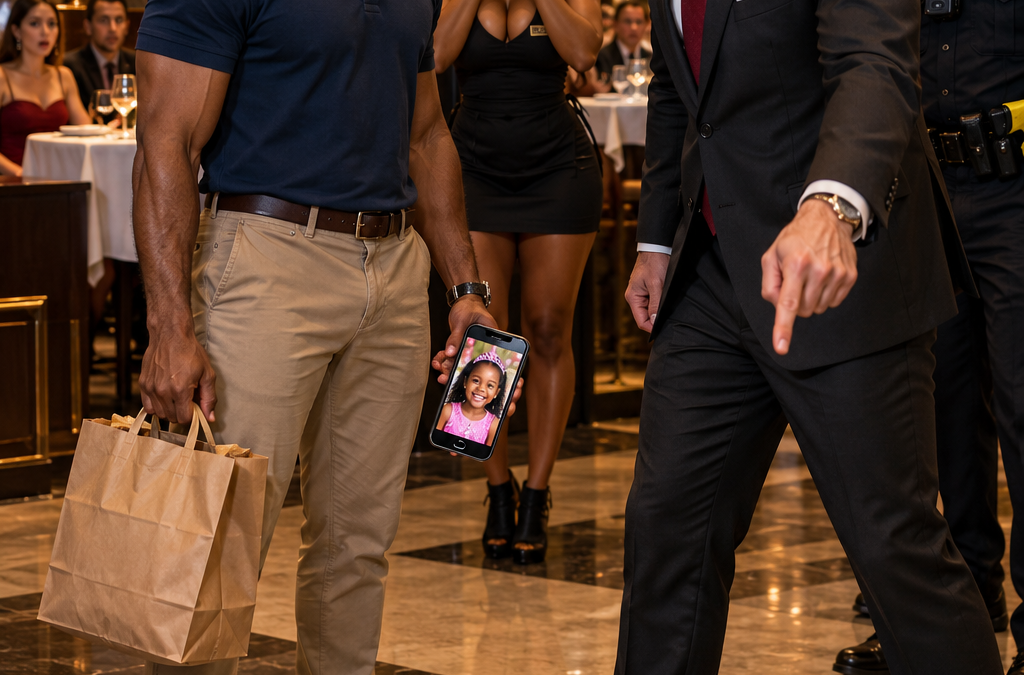
I took out my phone.
Lily had sent me a picture.
Pink birthday dress.
Crooked tiara.
Big smile.
I was grinning at the screen when I heard a voice.
“Can I help you?”
I looked up.
The man standing in front of me was Craig Henderson.
I knew the name.
I did not know the face.
He had been hired as general manager eight months earlier through a corporate staffing process while I was traveling overseas.
Nate Ellison, Pinnacle’s CEO, handled most day-to-day operating leadership.
Craig and I had never met.
Apparently, Craig had never considered learning what the owner of the company looked like either.
He wore the posture of a man who thought the room changed when he entered it.
Chest forward.
Chin raised.
Tie perfect.
Hair perfect.
Eyes less interested in understanding than controlling.
“Yeah,” I said. “I’m picking up a to-go order.”
He folded his arms.
“Name?”
“Foster.”
I pointed toward the bag.
“Should be that one.”
He didn’t turn around.
Didn’t check the label.
Didn’t touch the register.
Instead, he looked at me.
Shoes first.
Then khakis.
Polo.
Face.
Slowly.
I had experienced that inspection before.
Different cities.
Different buildings.
Different men.
Same eyes.
“This counter is for customers who placed orders through the app or by telephone.”
“I called mine in about an hour ago.”
“Confirmation number?”
I glanced toward the bag again.
“My name is printed on it.”
“I need a confirmation.”
“The bag says Owen Foster.”
He stared.
“That’s me.”
No response.
“I’m just trying to pick up the cake and go home.”
Craig’s expression didn’t soften.
“We’ve had issues with people coming in from the street and taking orders that aren’t theirs.”
There it was.
Not quite an accusation.
Not yet.
Just suspicion wrapped in procedure.
I tilted my head.
“I told you my name.”
“I heard you.”
“And it matches the bag.”
“I still need verification.”
I had learned over the years that there are moments when anger gives the other person exactly what he is waiting for.
So I kept my voice even.
“What kind of verification?”
“Identification.”
I almost laughed.
“ID?”
“Yes.”
“To pick up cake?”
“Policy.”
I knew immediately that he was lying.
There was no policy requiring identification for ordinary restaurant pickup orders.
I knew because it was my company.
But I didn’t tell him.
Not yet.
I reached into my wallet.
Took out my driver’s license.
Handed it to him.
Craig held it beneath the light.
Looked at the picture.
Then at me.
Then the picture.
He tilted the license as though I had manufactured it that afternoon.
Finally he handed it back.
I reached toward the bag.
He moved slightly, blocking me.
“There’s another issue.”
“What?”
“Dress code.”
I looked down at myself.
Navy polo.
Khakis.
White sneakers.
“I’m not eating here.”
“The Asheford Grill has a business-casual standard.”
“I’m collecting a takeout order.”
“Standards apply to the property.”
I looked beyond him.
At table two, a white man wore a faded college T-shirt and baseball cap.
At table seven, a woman in flip-flops laughed over a bottle of rosé.
At the bar, a young man in a hoodie stared at his phone with a cocktail beside him.
Nobody seemed distressed by their clothing.
I looked back at Craig.
“The man at table two has a beer logo on his shirt.”
His jaw moved slightly.
“The woman over there is wearing flip-flops.”
“Sir—”
“But my polo doesn’t meet the standard?”
“I’m telling you our policy.”
“Your policy?”
My voice became quieter.
Craig noticed.
“You’ve already asked for identification that your actual company policy does not require.”
His expression sharpened.
“And now you’re enforcing a dress rule against somebody picking up food while customers sitting twenty feet away are dressed more casually than I am.”
His right eye twitched.
Tiny movement.
But I saw it.
Not shame.
Annoyance.
I had stopped behaving like the person he expected me to be.
He wanted compliance.
Not questions.
“I’m going to ask you to wait outside.”
I stared at him.
“What?”
“We’ll bring the order curbside.”
“To the curb.”
“Yes.”
I felt heat rise behind my eyes.
I knew that heat.
I had felt it when bank employees suddenly became suspicious after discovering who owned an account.
I had felt it when security guards followed me through buildings where I was expected at meetings.
I had felt it in boardrooms where men assumed I was staff until somebody introduced me.
You learn to control that heat.
Especially as a Black man.
Because your anger will often be judged more harshly than the behavior that caused it.
I swallowed it.
“I’m not waiting outside.”
Craig leaned slightly forward.
“My order is two feet away. My name is on it. You checked my license. I’m going to take the bag and leave.”
I reached toward the counter.
Craig moved first.
He grabbed the bag.
Held it between us.
“I need to verify that this is actually yours.”
I stared at him.
“You already verified my identity.”
“We’ve had issues.”
“My name is on the bag.”
“I heard you.”
“My driver’s license says Owen Foster.”
“I saw it.”
“So what exactly are you verifying now?”
His lips curled.
Not quite a smile.
Something meaner.
He was enjoying the power.
That was what finally became clear.
This wasn’t confusion.
He wasn’t protecting an order.
He wasn’t enforcing policy.
He wanted me to understand that he controlled whether I received something I had already paid for.
He wanted me to ask.
Maybe apologize.
Maybe step outside.
Maybe lower my eyes.
Instead, I held out my hand.
“Give me my order.”
Craig opened his fingers.
The bag dropped.
Deliberately.
No slip.
No accident.
He spread his fingers and released it.
The paper bag hit the tile.
The container inside cracked.
Carrot cake rolled sideways.
Cream-cheese frosting burst across the floor.
Little orange frosting decorations scattered over the tile.
For several seconds, I didn’t understand what I was looking at.
My daughter’s cake.
On the floor.
The dessert she had called to remind me about.
The dessert I had promised.
Broken at my feet inside a restaurant I owned.
“Oops,” Craig said.
The dining room seemed to disappear around me.
“Guess you’ll need to reorder.”
I looked up.
He pointed toward the floor.
“Or you can get on your knees and clean it up.”
Silence.
“Your choice.”
That sentence did something to the room.
The jazz was still playing.
A saxophone.
Soft.
Elegant.
It sounded grotesque now.
People had stopped eating.
A woman at one table held her fork halfway to her mouth.
The man across from her lowered his napkin.
At the bar, someone set down his glass slowly enough that I heard ice move against crystal.
I looked around.
People were watching.
Most looked stunned.
One woman near the middle of the dining room reached into her purse.
She had white hair and pearl earrings.
I later learned her name was Brenda Lawson.
She took out her phone.
Raised it.
Started recording.
Near the kitchen stood one of our servers.
Tamara Collins.
Black woman.
Tray balanced on one hand.
Her eyes were wide.
She looked at Craig.
Then at me.
I would learn later that she had spent eight months dealing with him.
Comments about her expression.
Her hair.
Her attitude.
Where Black guests should sit.
Which employees belonged on which shifts.
But in that moment, I knew none of that.
All I knew was that she looked like somebody watching a familiar kind of cruelty become worse than she expected.
I looked down again.
Orange frosting carrots on the tile.
Lily always saved those for last.
I crouched.
Not because Craig told me to.
I picked up the cracked container with both hands.
Frosting smeared across my fingers.
I placed it carefully on the counter.
Then I wiped my hand against my khakis.
I looked Craig Henderson directly in the eyes.
“You’re going to regret this.”
My voice barely rose above the music.
But the room heard me.
Craig smiled.
“Is that a threat?”
“No.”
“You want me to call the police?”
I said nothing.
“Because I will.”
He stepped closer.
“And trust me, they won’t be as polite as I’ve been.”
Polite.
I stared at him.
A man had accused me of theft without evidence.
Invented an ID requirement.
Invented a dress-code issue.
Dropped food I had paid for onto the floor.
Told me to kneel.
And in his mind, he had been polite.
That was the most revealing thing he had said yet.
He took out his phone.
Called building security.
He made the call three feet away from me.
“Craig Henderson, general manager at the Asheford Grill on Peachtree.”
He looked directly at me as he spoke.
“I need security here immediately.”
Pause.
“I have a hostile individual inside the restaurant.”
Hostile.
I hadn’t raised my voice.
“Black male. Mid-forties. Navy polo. White sneakers.”
He was building me piece by piece for people who could not see me.
“Refusing to leave.”
I opened my hands slightly.
Kept them visible.
“He made a verbal threat against me personally.”
Threat.
“You’re going to regret this.”
That was all I had said.
But I knew the mathematics of the moment.
Every Black man knows some version of it.
Where are my hands?
How loud am I speaking?
How close am I standing?
Who is recording?
If I move toward my pocket, what does somebody think I’m reaching for?
If I insist on my rights, when does insistence become aggression in someone else’s report?
If security arrives already believing I’m dangerous, how quickly can a misunderstanding become something my daughter spends the rest of her life grieving?
My hands stayed visible.
Craig ended the call.
“Security’s coming.”
I remained where I was.
“Last chance.”
He pointed at the entrance.
“Walk out on your own, or they’ll walk you out.”
“I haven’t done anything wrong.”
“You threatened me.”
“I told you that you would regret what you did.”
“That’s a threat.”
“It’s a fact.”
Craig stepped closer.
His face changed.
He no longer needed the language of policy.
“You people always have something to say.”
My stomach tightened.
“Always got an attitude.”
The dining room became even quieter.
“Always think rules don’t apply to you.”
I said nothing.
“You walk in here dressed like that, acting like you own the place.”
For one strange second, I almost laughed.
Not because it was funny.
Because of the absurdity.
Acting like I owned the place.
I did.
But that wasn’t why his words mattered.
I looked beyond him.
Tamara was still standing near the kitchen entrance.
The tray was no longer steady.
Her eyes glistened.
She gave me the smallest nod.
Not encouragement exactly.
Recognition.
I see you.
I understood.
I swallowed my anger.
Craig mistook silence for surrender.
Then he dialed 911.
I watched his thumb press the numbers.
“Atlanta Police?”
He turned slightly so I could still hear every word.
“I need officers at the Asheford Grill on Peachtree Street.”
His voice became more formal.
More urgent.
“I have a Black male on the premises, mid-forties, approximately six-one, navy shirt, white shoes.”
My entire body became still.
“He is refusing to leave the property.”
True only because he had no legitimate reason to order me out.
“He has become increasingly aggressive and confrontational.”
False.
“He made a direct verbal threat to my personal safety.”
False.
“I consider him dangerous.”
Dangerous.
There it was.
I looked at my hands.
Empty.
I had spoken fewer words than Craig.
Had not touched him.
Had not threatened violence.
Had not moved toward him.
And now officers were being sent toward me believing a dangerous Black man had threatened a restaurant manager.
Craig knew what those words meant.
That was what frightened me.
He wasn’t losing control.
He was using control.
Deliberately.
He knew “aggressive” changed the expectation of whoever responded.
He knew “dangerous” changed posture.
He knew “direct threat” justified urgency.
He was weaponizing assumptions that existed before either of us walked into that restaurant.
For the first time that evening, I thought seriously about Lily waiting at home.
I imagined her checking the window.
Asking why I was late.
I imagined a police officer entering with incomplete information.
A hand moving too quickly.
A command misunderstood.
I imagined never getting to explain the cake.
Fear is strange.
Sometimes it feels like panic.
That night it felt like extreme clarity.
I knew exactly what I needed to do.
I pulled out my phone.
Craig reacted immediately.
His eyes snapped toward my hand.
For the first time, alarm entered his face.
I scrolled.
Found Nate Ellison.
Called.
He answered.
“Owen?”
“Nate.”
“What’s wrong?”
“Get to Asheford Grill.”
Silence.
“Now.”
“What happened?”
“I’ll explain when you arrive.”
“On my way.”
Eleven seconds.
Maybe less.
I ended the call.
Put the phone back in my pocket.
Craig stared.
“Who was that?”
I didn’t answer.
“Your lawyer?”
Silence.
“Doesn’t matter.”
But his voice had changed.
Just slightly.
“Police are already coming.”
I looked toward the door.
“You’re done here.”
I waited.
The next few minutes were among the longest I have ever experienced.
Craig paced.
Four steps.
Turn.
Four steps.
Turn.
He adjusted his tie.
Checked his phone.
Straightened menus.
Picked up a pen.
Put it down.
I stood still.
Somebody from the kitchen came out and saw the cake on the floor.
A young busboy.
He stopped.
Looked at me.
Looked at Craig.
Craig snapped his fingers.
“Clean it.”
The young man grabbed a mop.
Within half a minute, Lily’s cake disappeared into dirty water.
The physical evidence was gone from the floor.
The memory was not.
An older Black couple quietly asked for their check.
I watched the husband help his wife into her coat.
Her hands were trembling.
They left through the side.
Neither looked at me.
I understood why.
Sometimes witnessing something familiar brings back things you spent years trying not to remember.
Tamara set down her tray.
Her hands were shaking too badly to keep carrying it.
Brenda’s phone remained raised.
Recording.
Nobody asked her to stop.
The front door finally flew open.
Craig straightened instantly.
His shoulders came back.
Chin up.
He believed help had arrived.
Police.
Security.
Somebody with authority who would validate everything he had done.
Instead, Nate Ellison entered.
Charcoal suit.
Silver hair.
Steel-rimmed glasses.
Nate was CEO of Pinnacle Hospitality Group.
He ran the company operationally.
He answered to the board.
And ultimately, to me.
Nate scanned the restaurant.
Counter.
Cracked container.
Faint frosting residue.
Customers staring.
Tamara near the kitchen.
Brenda’s phone.
Then me.
His face lost color.
Craig did not notice.
He walked toward Nate confidently.
“Sir, good evening.”
Nate kept looking at me.
“I’m Craig Henderson, general manager.”
Now Nate looked at Craig.
“We have a situation.”
Craig gestured toward me.
“This individual was asked to leave the premises and has refused to comply. I’ve already contacted the police. Everything is under—”
“Stop talking.”
Two words.
Craig stopped.
Nate’s voice was low.
Controlled.
More dangerous than shouting.
Craig blinked.
“Sir?”
Nate pointed toward me.
“Do you know who that man is?”
Craig looked at me.
Confusion.
Then back at Nate.
“He’s a customer who—”
“That man is Owen Foster.”
Craig frowned.
My name still didn’t help him.
Nate stepped closer.
“He is not a random customer.”
Craig’s expression changed.
“He is not somebody who wandered in off the street.”
Another step.
“He owns this restaurant.”
Craig’s mouth opened.
Nothing.
“He owns this building.”
The room inhaled.
“And he owns Pinnacle Hospitality Group.”
Craig stared at me.
Nate’s voice dropped.
“The company that pays your salary.”
Silence.
“The company that provides your benefits.”
Craig’s face went pale.
“The company whose policies you are supposed to enforce.”
Nate looked at the broken cake container.
“You threw his food on the floor.”
Then at Craig.
“And told him to get on his knees.”
Craig’s face seemed to collapse.
“I—”
He looked at me.
“Mr. Foster…”
His hands began to shake.
“I had no idea.”
That sentence.
Out of everything he could have said, that was what he chose.
I had no idea.
I stepped forward.
“You didn’t realize?”
“Sir, if I had known—”
“You didn’t need to know.”
He stopped.
“You didn’t need to know my title.”
Silence.
“You didn’t need to know my net worth.”
His eyes dropped.
“You didn’t need to know my name was on the deed.”
I thought about the elderly Black couple who had quietly left.
Tamara.
The young busboy.
Every customer Craig might have treated badly without accidentally choosing the owner.
“You needed to treat me like a human being.”
He looked at me.
“And you couldn’t do that.”
No one spoke.
Craig’s eyes searched the room.
Nate.
Me.
Customers.
Brenda filming.
Tamara crying silently near the kitchen.
There was nowhere for him to find agreement.
Nate held out his hand.
“Keys.”
Craig swallowed.
“Sir, please.”
“Company phone.”
“Can we discuss this in the office?”
“Keys.”
Nate’s hand did not move.
“Phone.”
Craig reached into his pocket.
His fingers were shaking hard enough that the keys jingled.
He placed them on the host stand.
Then the company phone.
“Go to the back office,” Nate said.
Craig looked toward me.
“Collect personal belongings only.”
Nate checked his watch.
“Five minutes.”
“Mr. Ellison—”
“You’re finished.”
Craig walked toward the office.
The posture from earlier was gone.
He no longer moved like the building belonged to him.
His shoulders had collapsed.
His head stayed down.
Tamara watched him pass.
He did not look at her.
A few minutes later he returned carrying a cardboard box.
Coffee mug.
Jacket.
Framed photograph.
A few personal objects.
His entire kingdom reduced to what he could carry in two arms.
Near the exit, he stopped.
Looked at me.
“Mr. Foster.”
I waited.
“Please.”
His voice cracked.
“I have a family.”
I said nothing.
“A mortgage.”
His eyes were wet.
“Two kids in school.”
He held the box tighter.
“Can we talk?”
“We already did.”
His face tightened.
“I didn’t know who you were.”
Again.
The same excuse.
I looked at him for a long moment.
“You had an opportunity to talk when I told you my name was on the bag.”
He stared at the floor.
“You had another when I gave you my driver’s license.”
Silence.
“Another when I told you I would be gone in two minutes.”
I could still see the frosting hit the tile.
“My daughter was waiting for that cake.”
He swallowed.
“You threw it on the floor.”
“I’m sorry.”
“You told me to get on my knees.”
His chin dropped.
“That wasn’t confusion, Craig.”
He looked up.
“That wasn’t a bad judgment call.”
I kept my voice low.
“You made a choice.”
Nobody moved.
“And choices have weight.”
He left.
No applause.
No dramatic celebration.
Just a door closing.
The restaurant seemed to breathe again.
Voices returned slowly.
A whisper near the window.
Someone at the bar muttering, “Jesus.”
A woman pressing one hand against her chest.
Tamara walked toward me.
Her eyes were red.
“Owen—Mr. Foster…”
“Owen is fine.”
She stopped.
For several seconds she couldn’t speak.
Then:
“He does this all the time.”
My anger, which I thought had reached its limit, found another level.
“What?”
“The comments.”
She wiped her cheek.
“The schedules.”
Nate stepped closer.
“What schedules?”
“He gives us the worst sections.”
“Who is us?”
She hesitated.
“Black staff. Latino staff.”
Her voice broke.
“He told me I was too aggressive for fine dining.”
I looked at her.
She shook her head quickly.
“I should have said something. I just—”
“No.”
She stopped.
“You do not apologize to me.”
“I needed the job.”
“I know.”
“I thought if I complained, he’d—”
“You still have your job.”
Her eyes met mine.
“That I promise.”
Ten minutes later, Atlanta police walked through the doors.
Two officers.
Their hands were close to their belts.
Eyes moving quickly.
They had been told they were responding to a dangerous Black man making threats.
What they found was me sitting at the bar with a glass of water.
Nate beside me.
Fifty witnesses around us.
Brenda stood first.
“I recorded everything.”
One officer looked at her phone.
“The entire thing?”
“From before he threw the food down.”
She pointed toward me.
“The manager used racial language. Threw that gentleman’s order onto the floor. Told him to kneel. Then called you and lied.”
The officer looked at me.
Brenda continued.
“And that gentleman owns the restaurant.”
Several customers spoke at once.
The officers began taking statements.
Tamara gave hers.
Three diners confirmed Craig’s language.
Nate explained Pinnacle’s structure and Craig’s position.
One officer finally approached me.
“Mr. Foster?”
“Yes.”
“Are you all right?”
I looked toward the counter.
The cracked cake container was still there.
“No.”
He nodded as if he understood that there were different meanings to the question.
“Would you like to pursue the false report?”
“Yes.”
That answer came without hesitation.
“I would.”
The following Monday, Diane Caldwell, our vice president of Human Resources, arrived at Asheford Grill at eight in the morning with two investigators.
The review lasted four days.
I instructed them to examine everything.
Not simply Friday night.
Craig’s entire eight months.
Schedules.
Complaints.
Write-ups.
Table assignments.
Emails.
Performance reviews.
Employee statements.
Customer complaints.
If Friday had been an aberration, I wanted to know.
If it hadn’t, I wanted every detail.
It hadn’t.
The pattern was ugly.
Black and Latino guests had routinely been seated near the kitchen or restrooms.
Not because of random table rotation.
Deliberately.
Employees of color received weaker shifts.
Worse sections.
Lower-earning tables.
A Black sous-chef had been disciplined for “attitude” after questioning why one of his dishes was removed from the specials menu.
Investigators found Craig’s explanation in an email.
Too ethnic for our clientele.
I read that sentence more than once.
Too ethnic.
I thought about the company I believed I had built.
There is an unpleasant truth every owner eventually has to confront.
You can create values at the top.
Print them.
Train them.
Frame them.
Put them on websites.
But if a manager can violate those values for eight months while frightened employees remain silent, then the system around that manager has failed too.
Craig was responsible for Craig.
But I was responsible for asking how somebody like Craig had been allowed to operate inside my company for so long.
Tamara submitted three pages.
Single-spaced.
Fourteen incidents.
She told me later that her hands shook when she handed the statement across the table.
By the time she finished reading it, they didn’t.
Other employees came forward.
A line cook described Craig telling him to go back to washing dishes where he belonged.
A hostess said Craig ordered Black customers seated somewhere “less visible.”
Patterns became evidence.
Evidence became findings.
On Friday, Craig Henderson received formal termination for cause.
Gross misconduct.
Systemic racial discrimination.
No severance.
No benefits continuation beyond what the law required.
No company recommendation.
But by then, his employment record was becoming the smallest part of his problem.
Brenda Lawson’s granddaughter posted the video.
Two million views in forty-eight hours.
Five million by Wednesday.
Ten million by Friday.
Twenty-five million before the month ended.
National networks aired it.
Atlanta stations led with it.
People watched Craig take my order.
Watched the bag fall.
Watched him point toward the floor.
Watched Nate enter.
Watched Craig’s confidence evaporate once he discovered who I was.
The phrase “that’s the owner” followed the clip everywhere.
What bothered me about the reaction was how much attention people gave the reversal.
They loved the reveal.
The racist manager targets the wrong Black man.
The victim turns out to be wealthy.
Powerful.
Owner of the restaurant.
Justice arrives instantly.
It makes a satisfying video.
But that wasn’t what stayed with me.
The important part happened before Nate opened the door.
Craig believed I had no power.
That was the test.
He believed I was just a Black man in a navy polo.
And apparently, in his world, that made humiliation acceptable.
I appeared on a national morning program the following week.
Same navy polo.
I wore it deliberately.
The host asked me what went through my mind when Craig discovered I owned the restaurant.
“Nothing satisfying.”
She looked surprised.
“You didn’t feel vindicated?”
“I felt angry.”
“Why?”
“Because people keep describing this as a case of somebody mistreating the wrong person.”
I looked directly toward the camera.
“He didn’t throw my food onto the floor because of who I am.”
The studio became quiet.
“He threw it because of what I look like.”
I paused.
“That should terrify us more than the fact that I happened to own the restaurant.”
Because most people Craig judged that way would not have Nate Ellison to call.
Most would not own the security cameras.
Most would not have an HR department investigating by Monday.
Most would not have corporate counsel.
Most would not have fifty witnesses and a stranger recording from the dining room.
Some would simply leave.
Humiliated.
Angry.
Maybe wondering what they had done wrong.
I couldn’t change what happened to me.
But I could make sure the consequences did not end when Craig walked out carrying a cardboard box.
My attorney, Patricia Greer, filed the necessary civil-rights claims and a personal civil action.
Racial discrimination.
Intentional infliction of emotional distress.
False police reporting.
The false report mattered deeply to me.
Craig had not merely insulted me.
He deliberately fed law enforcement a fictional version of events in which I was aggressive, dangerous, and threatening.
Words that could have changed the way officers approached me.
Words that could have changed whether I returned home to Lily.
The district attorney eventually addressed that directly.
Weaponizing law enforcement because of race was not a misunderstanding.
Not an unfortunate workplace disagreement.
Not just rude behavior.
Craig pleaded no contest.
The sentence included 240 hours of community service.
Some of it at the National Center for Civil and Human Rights.
Some at a community kitchen.
Mandatory anti-bias training at his own expense.
Two years of probation.
A $15,000 fine.
The civil action resulted in a $250,000 judgment against him.
Craig did not have that kind of money.
He sold his car.
Emptied savings.
Borrowed from his brother.
Still couldn’t cover the full amount.
I took every dollar I received from him and put it somewhere else.
We established the Open Door Fellowship.
A fund supporting Black and brown entrepreneurs trying to enter the restaurant business.
People starting food companies.
Opening small restaurants.
Trying to lease their first kitchens.
Trying to get the financing and mentorship that too often determines whether a good idea survives.
I wanted the money tied directly to what had happened.
Not because humiliating Craig was the goal.
Because money carries meaning depending on where it goes.
The harm he caused would help people from the communities he had treated as inferior build businesses of their own.
Then Craig discovered that legal punishment was not the only consequence that followed him.
He tried to return to hospitality.
Again.
And again.
And again.
Applications throughout Georgia.
Then across the Southeast.
Then farther north.
Eventually, more than two hundred applications.
Restaurant groups.
Hotels.
Management companies.
Different cities.
Different states.
He received almost nothing.
He tried using his middle name.
Removed Asheford Grill from portions of his résumé.
Moved to Texas.
It didn’t matter.
Background checks found the termination.
The criminal matter.
And even before a background check finished, sometimes people recognized his face.
The video had become part of the internet.
One hiring manager in Dallas recognized him less than two minutes into a video interview.
She ended the conversation with two words.
“Good luck.”
Then the screen went black.
The hospitality industry began discussing his case as an example of workplace discrimination and management failure.
And somewhere inside all of that noise, I kept returning to a much quieter moment.
A little orange frosting carrot lying on a restaurant floor.
That was the image I remembered.
Not Craig carrying his box.
Not the viral numbers.
Not reporters.
Not court.
Not the money.
The cake.
Because before the video, before the CEO walked in, before anybody knew what I owned, I was a father trying to get home to his daughter.
Craig never saw that person.
He saw skin.
Clothes.
Shoes.
He constructed everything else from prejudice.
Thief.
Loiterer.
Poor.
Unwanted.
Aggressive.
Dangerous.
Those labels escalated because each one gave him permission to use the next.
First, I might be stealing an order.
Then I didn’t meet a dress standard.
Then I belonged outside.
Then I was hostile.
Then I was threatening.
Then I was dangerous enough for police.
At no stage did my behavior justify the next accusation.
It didn’t need to.
He had already decided who I was.
The most uncomfortable part of the entire experience was knowing that ownership protected me only after the harm had already happened.
It did not stop him from seeing me the way he saw me.
Money had not bought immunity from that.
Thirty-two properties had not bought it.
A company had not bought it.
A title had not bought it.
I could own the floor beneath a man’s shoes and still be treated as though I had no right to stand on it.
That realization stayed with me.
So did something Tamara said later.
“I needed the job.”
Four words.
I heard them differently after the investigation.
Craig’s power had never actually been as large as he imagined.
He was one general manager.
But to the people whose schedules he controlled, whose evaluations he wrote, whose sections he assigned, whose income depended on Friday and Saturday nights, his power was enormous.
Enough to keep fourteen incidents inside one employee’s notebook.
Enough to make workers absorb comments that should have been reported immediately.
Enough to turn survival into silence.
That was a failure I could not blame entirely on Craig.
If good employees are terrified to report a bad manager, then your reporting system is decorative.
If policies exist but nobody trusts them, then they do not exist in practice.
If discrimination becomes visible only because the owner personally experiences it, leadership has already been asleep too long.
That lesson cost me more emotionally than any judgment could recover.
When I looked back on that Friday, people always wanted to know why I stayed calm.
They treated restraint as some extraordinary quality.
It wasn’t.
I stayed calm because I understood the stakes.
Craig could lose his temper and still be the general manager dealing with a difficult customer.
If I lost mine, he had already shown me exactly what I would become in his story.
Aggressive.
Threatening.
Dangerous.
So I stood still.
I kept my hands visible.
I measured every word.
That is not the same thing as not being angry.
I was furious.
I was afraid.
And when he called 911, I was thinking about whether my daughter would see me walk through our front door that night.
People often describe dignity as if it means remaining untouched by humiliation.
That isn’t how it works.
Dignity sometimes means refusing to let humiliation decide what you do next.
Craig told me to kneel.
I didn’t.
He told me to leave.
I didn’t.
He called security.
I stood.
He called police.
I stood.
Not because I knew there would be a dramatic ending.
Not because I knew Brenda was recording.
Not because I knew Nate would arrive before officers.
I stood because I had done nothing wrong.
And I was tired of a lie becoming true simply because the person telling it sounded confident.
Craig Henderson eventually learned something I wish he had understood before I ever walked through the door.
The danger of treating people as though they don’t matter is not that one of them might secretly be rich.
It is not that the stranger in the polo might own the restaurant.
It is not that cameras might be running.
It is not that your cruelty might go viral.
Those things can create consequences.
But they are not the reason the behavior is wrong.
Craig’s mistake was never that he failed to recognize Owen Foster, owner of Pinnacle Hospitality Group.
His failure happened much earlier.
He looked at Owen Foster, father of Lily, customer holding a valid order, human being standing peacefully in front of him—
and decided that was not enough.








