𝗙𝗨𝗟𝗟 𝗦𝗧𝗢𝗥𝗬 The Restaurant Manager Said Women Like Us Would Never Belong in His Dining Room, and I Let Him Finish Every Word Before Reaching for My Phone
𝗙𝗨𝗟𝗟 𝗦𝗧𝗢𝗥𝗬
I wasn’t paid.
I didn’t care.
I wanted to know why one dish made money and another didn’t.
Why the restaurant was full on Friday but empty on Tuesday.
Why the owner complained about labor costs but threw out hundreds of dollars of spoiled ingredients every week.
Andrea thought I was strange.
“You study menus for fun.”
“You argue for fun.”
“I argue for justice.”
“You argued with a vending machine yesterday.”
“It stole my money.”
“Justice.”
“Exactly.”
She had fire.
I had patience.
She would push a door.
I would study the hinges first.
Together, we usually got through.
We both attended City College.
I studied finance.
Andrea studied business management.
We had offers after graduation.
Respectable firms.
Good salaries.
Office towers.
Health insurance.
Retirement plans.
People told us we were foolish when we turned them down.
Maybe we were.
At twenty-two, we pooled everything we had.
Savings.
Part-time wages.
Birthday money.
Even the emergency jar our mother kept above the refrigerator.
Twelve thousand dollars.
That was the beginning.
The first place was a tiny café in Brooklyn.
Eleven tables.
Secondhand espresso machine.
Floorboards that squeaked.
A refrigerator that made a grinding noise every forty minutes.
We painted the walls ourselves.
Andrea handled vendors.
I handled numbers.
Mom came in before opening day and stood in the middle of the room with both hands over her mouth.
“What?” Andrea asked.
Mom shook her head.
“Nothing.”
“You’re crying.”
“I am not.”
“You are definitely crying.”
Louise touched one of the tables.
Then she looked at us.
“You built something.”
Andrea smiled.
“Small.”
Mom shook her head.
“No.”
She pointed to the door.
“The door opens. People come in. They sit. You feed them.”
Her eyes moved around the room.
“That is never small.”
Two years later, there was a line outside every Saturday morning.
By twenty-six, we had four locations.
By twenty-eight, we created Pinnacle Hospitality Group.
We began acquiring struggling restaurants.
Not glamorous places at first.
A steakhouse in Philadelphia with terrible service and good bones.
A seafood restaurant in Baltimore whose kitchen staff deserved better management.
A hotel restaurant in Atlanta nobody visited except trapped business travelers.
Our approach was simple.
Don’t gut everything.
Don’t fire everybody.
Find out what is broken.
Fix that.
Keep the people worth keeping.
Pay attention to culture.
Because a restaurant can serve technically perfect food and still make people feel terrible.
Andrea understood that instinctively.
I understood what terrible culture did to revenue.
We met in the middle.
Pinnacle grew.
Then it kept growing.
By our mid-thirties, the company controlled restaurants in twelve states.
Some had Michelin stars.
Some were neighborhood institutions.
Some were still recovering.
We created a scholarship fund for low-income culinary students.
We invested in suppliers owned by people who had historically struggled to get access to major hospitality contracts.
Financial magazines became interested.
Food publications became more interested.
Andrea hated interviews.
So did I.
We rarely allowed photographs.
That became useful later.
Most of the people who knew Pinnacle knew the company.
They didn’t know our faces.
My mother lived long enough to see us succeed.
Not all of it.
Enough.
We bought her a house with a garden.
The first morning she woke there, she called me at six.
“There’s a bird outside my window.”
“Mom, birds existed in Harlem.”
“Not like this one.”
“What kind is it?”
“I don’t know. Rich people bird.”
I laughed so hard I had to sit down.
Louise died four years later.
Cancer.
She wore the same thin gold necklace nearly every day of her adult life.
After she died, Andrea and I each kept one of the two necklaces she’d worn most often.
Mine sat against my skin whenever I negotiated.
Whenever I walked into a boardroom.
Whenever I signed something important.
Three weeks before the night everything changed, I wore it while closing the largest acquisition Pinnacle had ever made.
The Elise Collection.
Twelve luxury restaurants in New York, Chicago, Los Angeles, and Miami.
Three hundred forty million dollars.
The centerpiece was Elise Grand on Manhattan’s Upper East Side.
Forty years old.
White tablecloths.
French service.
Crystal.
Central Park views.
Two-month wait for prime weekend reservations.
A cellar containing bottles older than some nations’ current governments.
The acquisition closed quietly.
The previous owners had legal reasons for keeping the transfer confidential until our transition plan was complete.
Managers were informed that a sale had occurred.
Most staff members were not told who the buyer was.
Andrea and I preferred it that way.
Three weeks after closing, I was reviewing staffing reports when I noticed Elise Grand had an unusual complaint pattern.
Nothing explicit.
That was what interested me.
Words like “unwelcoming.”
“Selective seating.”
“Hostile reception.”
“Felt judged.”
A few online reviews mentioned being told the restaurant was full while visible tables remained open.
One former customer used a phrase I couldn’t stop thinking about.
“They made us feel like we had entered by mistake.”
I called Andrea.
“I want to visit Elise.”
“When?”
“Saturday.”
She was quiet for half a second.
“As owners?”
“No.”
That got her attention.
“What are you thinking?”
“I want to walk in.”
“Without warning?”
“Yes.”
“Reservation?”
“No.”
I could hear her smile through the phone.
“Now this sounds interesting.”
“I want to know what we bought.”
Saturday evening, we dressed simply.
Black dresses.
Low heels.
Small clutch bags.
No assistants.
No driver.
No visible jewelry except our mother’s necklaces.
We took a cab uptown.
As we approached Elise Grand, the city seemed to become more polished with every block.
The limestone facade glowed beneath exterior lights.
A doorman opened the entrance for a couple in evening clothes before returning to the sidewalk.
Through tall windows, I could see the dining room.
White linen.
Crystal chandeliers.
Silver flatware.
Men in tailored suits.
Women in diamonds.
Almost every visible guest was white.
Andrea noticed too.
She leaned closer.
“You seeing what I’m seeing?”
“Yes.”
“You still want to do this?”
“More than before.”
We entered.
The first thing I noticed was the scent.
Beeswax.
Wine.
Butter.
Fresh flowers.
Expensive places always work carefully on what you smell before you even sit down.
The second thing I noticed was Gerald Thornton.
He stood behind the host podium.
Mid-fifties.
Salt-and-pepper hair slicked neatly back.
Dark suit.
Monogrammed cufflinks.
He had the posture of a man who believed the room reflected his status.
When the white couple ahead of us entered, he smiled.
“Mr. and Mrs. Ellison. Wonderful to see you.”
He came around the podium.
Shook hands.
Asked about their daughter.
Personally escorted them toward the dining room.
Then he returned.
He saw us.
And the smile vanished.
Not faded.
Vanished.
It was so immediate that even Andrea, who had spent her entire life assuming the worst of people faster than I did, glanced sideways at me.
Thornton did not say good evening.
He didn’t say welcome.
He stared.
“Can I help you?”
Four words.
Flat.
Impatient.
I smiled politely.
“We’d like a table for two, please.”
His eyes moved over us.
Shoes.
Dresses.
Clutch bags.
Necklaces.
Then he glanced down at the reservation book.
He didn’t open it.
“We’re fully booked.”
Andrea looked into the dining room.
Five empty tables were visible.
“Those are empty.”
Thornton didn’t turn.
“Reserved.”
“We can wait,” I said.
“No.”
He answered so quickly it almost overlapped my sentence.
“Nothing will become available.”
Andrea’s jaw shifted.
I knew that movement.
It meant she was about ten seconds from making someone regret waking up that morning.
Before she could speak, the front door opened behind us.
A white couple entered.
Maybe mid-fifties.
The man wore a navy blazer with brass buttons.
The woman had diamonds in her ears and a fur wrap over one shoulder.
She smiled brightly.
“Gerald, darling.”
Thornton transformed.
“Mrs. Hargrove.”
She laughed.
“We’ve been terrible. We didn’t book. Any chance you can save us?”
Thornton didn’t look at the reservation book.
“Of course.”
He snapped his fingers toward a waiter.
“Corner booth. And bring the Chardonnay they like.”
Mrs. Hargrove touched his arm.
“You’re a treasure.”
He personally walked them past us.
To one of the empty tables.
The one he had just implied was reserved.
He pulled out her chair.
Unfolded her napkin.
Laughed at something her husband said.
Then returned to us.
His smile disappeared again.
Andrea stared at him.
“They didn’t have a reservation.”
“Regular guests.”
“We’d like to become regular guests,” I said.
That irritated him more than anything Andrea could have said.
Perhaps because my voice remained calm.
He adjusted his tie.
“You need to understand how this establishment operates.”
“I’m trying.”
He leaned slightly toward me.
“We maintain a particular atmosphere.”
There it was.
A word designed to carry another word without saying it.
Atmosphere.
I looked at him.
“What atmosphere?”
His eyes narrowed.
“Our clientele expects a certain experience.”
“And we’re interfering with that by standing here?”
He exhaled through his nose.
“You two are not part of the atmosphere we cultivate.”
Andrea stepped forward.
“What exactly does that mean?”
“Andrea.”
“No.”
She looked at him.
“I want to hear him say it.”
Thornton’s gaze shifted toward her.
“I don’t owe you an explanation.”
“You owe customers an explanation when you’re denying service while seating people without reservations.”
“You’re not customers.”
The words came quickly.
Then he realized what he’d said.
I saw it.
A tiny hesitation.
He could have corrected himself.
He didn’t.
Andrea crossed her arms.
“Interesting.”
Thornton gripped the podium.
“You’re standing in the entrance disrupting service.”
“We’ve been here maybe four minutes,” I said.
“Long enough.”
A young waitress behind the bar was watching us.
Red hair.
Tight bun.
Her name tag said PAMELA.
She kept polishing the same wine glass.
Her eyes moved from Thornton to me.
Then back.
Thornton looked over my shoulder toward the dining room.
A couple at the nearest table had stopped talking.
A man farther away watched openly.
Others pretended not to.
I had spent enough years around wealth to know that silence can be very expensive.
People assume rich rooms are polite rooms.
They aren’t.
They are simply rooms where cruelty is often expressed quietly.
Thornton lowered his voice.
“Let me save you some embarrassment.”
Andrea almost laughed.
“You’re concerned about our embarrassment?”
“A glass of wine here can cost more than some people earn in a week.”
He glanced at our clothes.
His meaning was obvious.
I said, “We can pay.”
He smiled.
Not kindly.
“People often say that.”
Andrea’s voice sharpened.
“What is wrong with you?”
He leaned back.
“Nothing.”
“Then seat us.”
“No.”
“Why?”
His eyes hardened.
“Because I decide who belongs in this room.”
There it was.
Clean.
Simple.
Not reservations.
Not capacity.
Not policy.
Belonging.
I felt my mother’s necklace against my collarbone.
For one instant, I was nine years old again.
Watching Louise come home after midnight.
Taking off shoes that had rubbed her heels raw.
Standing all day in a restaurant where customers sometimes called her “girl.”
A woman who cooked expensive meals she could not afford to order.
A woman who entered through a back door so other people could enjoy the front.
Andrea’s hand brushed mine.
She knew where my mind had gone.
We didn’t need to speak.
Pamela suddenly set down the glass.
She walked toward us.
“Mr. Thornton.”
He ignored her.
“Mr. Thornton, table fourteen just cleared. I can reset it.”
He turned.
“Go back to the bar.”
She stopped.
“It’ll take five minutes.”
“I said go back.”
“There is a table.”
His voice dropped.
“Pamela.”
She swallowed.
“You have work to do.”
I looked at her.
Her hands were trembling.
She needed this job.
I could see it.
People imagine courage as something loud.
Most of the time, courage is a person making one small motion while every practical instinct tells them not to.
Pamela had made hers.
I gave her a slight nod.
Not permission.
Gratitude.
Don’t sacrifice yourself yet.
She returned to the bar.
Thornton watched her go with visible irritation.
Then another voice entered the conversation.
“Gerald.”
A man seated two tables away raised his wine glass.
Silver hair.
Rolex.
Tailored dinner jacket.
I recognized him before he introduced himself because I’d seen his photograph in financial papers.
Bryce Callahan.
Chairman of Callahan Urban Development.
Major Manhattan property owner.
Board memberships.
Donor circles.
A man accustomed to being heard.
He dabbed his mouth with his napkin.
“You’re doing the right thing.”
The room became quieter.
Callahan looked at my sister and me.
“This restaurant has standards.”
Andrea slowly turned toward him.
He continued.
“Some places remain special because management protects them.”
Thornton’s shoulders lifted.
Validation.
That was what he had needed.
Not proof.
Permission.
A woman at Callahan’s table nodded.
Another diner looked away.
A third actually smiled.
I watched the room.
Not Thornton.
The room.
Because this was no longer only about one manager.
A culture reveals itself under pressure.
People will write beautiful values on a website.
They will put diversity statements in annual reports.
They will sponsor panels.
What matters is what happens in the room when mistreatment becomes socially inconvenient to challenge.
Thornton turned back toward us.
“You heard Mr. Callahan.”
Andrea laughed once.
“Oh, I heard him.”
“I’m asking you to leave.”
“What if we don’t?”
His expression changed.
Then he pressed a button beneath the podium.
A security guard appeared from a side hallway.
Tall.
Broad.
Shaved head.
Black suit.
His name badge read CRAIG NELSON.
Thornton gestured toward us.
“These ladies have been asked to leave repeatedly.”
Craig looked at me.
Then Andrea.
Then Thornton.
“Ma’am,” he said to me, “I’m going to need you to step outside.”
His voice wasn’t cruel.
That didn’t make the situation acceptable.
I looked at him.
“Did you see us threaten anyone?”
“No.”
“Did we touch anyone?”
“No.”
“Raise our voices?”
He hesitated.
“No.”
“Then why are you removing us?”
He glanced at Thornton.
“Management requested it.”
Of course.
Authority often survives because responsibility can be passed sideways.
Thornton follows standards.
Craig follows management.
Guests follow etiquette.
Everyone follows something.
No one chooses.
Andrea looked at me.
I could see fire in her eyes.
I said, “We’ll step toward the door.”
She frowned.
“Adriana.”
“Trust me.”
Craig walked behind us.
He didn’t touch either of us.
Three steps from the exit, I stopped.
“I’d like to speak with the owner.”
Thornton laughed.
Actually laughed.
“The owner?”
“Yes.”
He folded his arms.
“You think the owner is going to come down here because two walk-ins are unhappy?”
“I’d still like to speak with them.”
His smile changed into something uglier.
“The owner does not meet with people who wander in off the street making demands.”
Andrea turned fully around.
“People like us, you mean?”
Thornton looked at her.
Then at me.
“Don’t make me say things everyone here already understands.”
I felt Andrea tense.
“What does everyone understand?” she asked.
Thornton stepped closer.
“I’ve worked in this business fifteen years.”
He pointed toward the dining room.
“I know who belongs in rooms like this.”
Then his eyes moved over us again.
“And who doesn’t.”
My heart started beating harder.
Not because I was afraid.
Because I was angry now.
Truly angry.
But anger had never controlled me well.
My mother taught me that.
Once, when Andrea and I were fourteen, a store employee followed us aisle by aisle through a pharmacy.
Andrea finally spun around.
“Do you think we’re stealing?”
My mother stopped her.
Then Louise turned to the employee.
“Sir, I want you to remember my daughters’ faces.”
The man looked confused.
“Why?”
“Because one day you may need something from someone who looks exactly like them.”
She took our hands and left.
I hadn’t understood then how much strength it took not to give someone your rage when they had earned it.
I understood standing in Elise Grand.
Thornton gestured toward our dresses.
“I can read a guest in three seconds.”
I said quietly, “That may be your problem.”
“What?”
“You decide in three seconds.”
His jaw tightened.
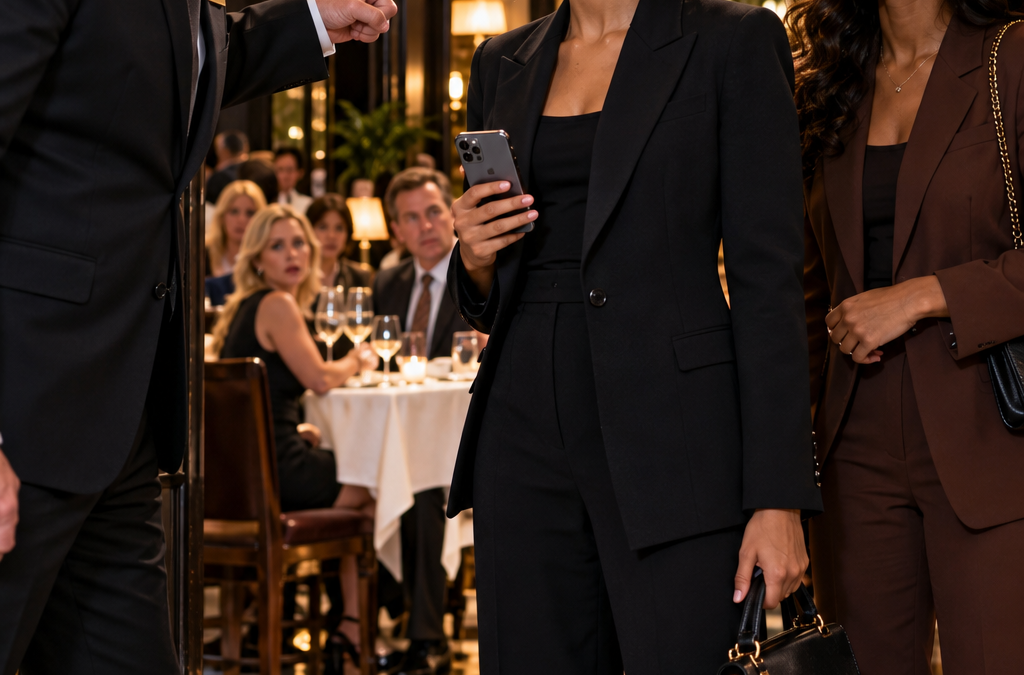
Behind him, I noticed a woman near the window holding her phone low beside her plate.
Recording.
Another phone was angled toward the podium two tables away.
Good.
Thornton didn’t notice.
Bryce Callahan stood.
He buttoned his blazer.
“I have been dining here for more than twenty years.”
His voice carried beautifully.
Men like him learn projection.
“In all that time, Elise Grand has maintained a certain caliber.”
He looked directly at us.
“Let’s not lower that standard tonight.”
Someone murmured agreement.
A woman tapped one fingernail against her glass.
Another guest whispered, loudly enough for us to hear, “Why don’t they just leave?”
Andrea’s eyes glistened.
That hurt me more than anything Thornton had said.
My sister had fought for me our entire life.
She had argued with teachers.
Landlords.
Bank officers.
Investors.
Vendors twice her age who assumed the quiet twin made decisions and the loud twin only complained.
I had seen her furious.
I had rarely seen her wounded.
I reached for her hand.
Squeezed three times.
A signal from childhood.
I’m here.
Hold on.
Thornton saw the room supporting him.
That made him bolder.
“You see?”
His voice softened.
Almost paternal.
“It’s not only me.”
He gestured to the dining room.
“Everyone understands.”
He leaned toward us.
“This isn’t your world.”
The front door opened.
Two NYPD officers entered.
Thornton had called them while Callahan was speaking.
I hadn’t even noticed.
One officer was in his forties.
Stocky.
Sergeant Reynolds, according to his badge.
The second was younger.
Officer Cooper.
Thornton moved toward them.
“Officers, thank you.”
His voice immediately became professional.
“We have two individuals refusing to leave after disrupting our guests.”
Reynolds looked at us.
“Ma’am?”
I spoke before Thornton could add anything.
“We entered and asked for a table.”
Reynolds listened.
“We were told the restaurant was full. A white couple entered after us without a reservation and was seated immediately. When we questioned the difference, the manager told us we weren’t part of the atmosphere, that we didn’t belong here, and that our presence disturbed his guests.”
Reynolds looked at Thornton.
“Are they threatening anyone?”
“No, but—”
“Damaging property?”
“No.”
“Shouting?”
Thornton hesitated.
“No.”
“Blocking the door?”
“No.”
Reynolds glanced toward the entrance.
“Then I’m not arresting anyone.”
Thornton flushed.
“They have been asked to leave private property.”
“And they’re standing three feet from the exit talking to you.”
Reynolds kept his voice neutral.
“You can refuse service. That’s different from asking us to put two peaceful people in handcuffs because you’re having an argument.”
The room shifted.
Thornton hated that.
He had expected the uniforms to restore his authority.
Instead, they placed limits around it.
“Fine.”
He turned toward us.
His face was red.
“Fine.”
Then he lost whatever discipline remained.
“But let me be absolutely clear.”
His voice rose.
“You will not eat here tonight.”
Andrea stared at him.
“You will not eat here tomorrow.”
Phones were recording openly now.
“And as long as I manage this restaurant, I will never serve your kind here.”
Silence.
Real silence.
Even Callahan looked at him.
Maybe Thornton finally understood he had crossed from coded language into something nobody could reinterpret later.
If he did, pride kept him moving.
“Never.”
I looked at him.
At the podium.
At the chandelier.
At the people.
At my sister.
Then I reached into my clutch.
Thornton gave a little smirk.
Maybe he thought I was calling a cab.
I unlocked my phone.
Called one number.
Nathan Brooks answered on the second ring.
Our chief financial officer.
He had spent the past year coordinating the Elise acquisition.
“Adriana?”
“I’m at the Grand.”
A pause.
Nathan knew my voice.
“What happened?”
“Shut it down tonight.”
Another pause.
Not confusion.
Calculation.
“All operations?”
“Immediately.”
“Understood.”
“You have five minutes.”
I ended the call.
Thornton looked amused.
Andrea looked at me.
Her eyes had changed.
The hurt was still there.
Now something steadier sat behind it.
Recognition.
She knew exactly what I had done.
Thornton muttered to Craig, “Probably calling a ride.”
Craig didn’t answer.
We waited.
One minute.
Two.
No one knew why we were still standing there.
Reynolds remained nearby.
Cooper wrote notes.
Guests whispered.
At three minutes, Thornton began looking toward the door, perhaps wondering whether he should physically force the issue himself.
Then the music stopped.
Miles Davis cut off mid-note.
The abrupt silence turned every head in the room.
A bartender tapped his point-of-sale screen.
Nothing.
A waiter tried another terminal.
“System’s frozen.”
From the kitchen, someone shouted, “Printer’s down.”
Thornton frowned.
Then his phone vibrated.
He looked at the screen.
Answered.
“Gerald Thornton, general manager.”
His posture changed as he listened.
“What?”
His eyes moved toward me.
“No, I haven’t received any—”
More listening.
“New ownership?”
His face emptied.
“What new ownership?”
The voice on the other end continued.
Thornton looked around the room as though an exit might appear inside the wallpaper.
“Tonight?”
He swallowed.
“Yes.”
The call ended.
For the first time all evening, Gerald Thornton had nothing to say.
I stepped toward the podium.
Slowly.
I opened my clutch.
Removed my business card.
Placed it on the marble surface.
He looked down.
ADRIANA SHAW
CO-FOUNDER & CEO
PINNACLE HOSPITALITY GROUP
Below that was the company logo.
His eyes stopped moving.
He read it again.
Then a third time.
Andrea walked beside me.
She placed her own card next to mine.
ANDREA SHAW
CO-FOUNDER & COO
Thornton’s mouth opened.
The room seemed to contract around us.
Mrs. Hargrove looked at her husband.
The woman who had tapped her glass stopped moving completely.
Officer Reynolds reopened his notebook.
Bryce Callahan’s face changed.
I watched recognition arrive.
Then fear.
Thornton looked at me.
“You…”
His voice failed.
I waited.
“You own…”
“This restaurant?”
He nodded.
“Yes.”
He looked at the cards.
Then me.
“I didn’t know.”
Those were the first words he chose.
Not I’m sorry.
Not I was wrong.
I didn’t know.
That mattered.
I leaned slightly toward him.
“That’s exactly the problem.”
His forehead creased.
“You didn’t need to know who I was.”
The dining room was silent.
“You didn’t need to know my net worth.”
He swallowed.
“You didn’t need to know my title.”
I pointed toward the door.
“You needed to know I was a person who walked into your restaurant and asked for a table.”
Andrea stepped beside me.
Thornton looked at her.
“If I had known—”
She almost smiled.
“If you’d known what?”
He stopped.
“That we were rich?”
His eyes dropped.
“That we owned the company?”
Nothing.
“Would you have pulled out my chair?”
He looked miserable.
“Would you have offered me Chardonnay?”
Still nothing.
“Would my breathing suddenly have stopped making your guests uncomfortable?”
A woman near the windows looked down at her plate.
Thornton whispered, “This has been misunderstood.”
“No,” I said.
“It has finally been understood.”
He tried again.
“I was protecting the reputation of the restaurant.”
“From us?”
He couldn’t answer.
“Two Black women asking for dinner?”
His face tightened.
“You said we weren’t part of the atmosphere.”
“I…”
“You told us we didn’t belong in this world.”
I let that sit.
“Who authorized you to decide that?”
“No one.”
“Who authorized a racial admissions policy?”
“It isn’t—”
“Twenty people just heard what you said.”
I glanced toward the phones.
“Several recorded it.”
Thornton looked around.
For the first time, he saw the cameras.
Panic moved across his face.
I turned toward the security guard.
“Mr. Nelson.”
Craig straightened.
“Yes, ma’am.”
“Did you believe we represented a security threat?”
He hesitated.
“No.”
“Then why did you escort us?”
“Mr. Thornton instructed me to.”
“And if he instructed you to remove any Black guest from this dining room?”
Craig looked down.
“I follow management directives.”
“Not anymore.”
His eyes lifted.
I faced Thornton.
“Place your keys and badge on the podium.”
His face changed.
“Ms. Shaw—”
“Now.”
He reached toward his lapel.
His hand shook.
He unclipped his badge.
Placed it beside our cards.
Then he removed his keys.
The metal hit marble.
A small sound.
It seemed louder than it should have.
“You are suspended effective immediately pending investigation.”
His lips moved.
No words.
I looked at Craig.
“Your badge and keys as well.”
Craig complied.
He did not argue.
That told me more than an argument would have.
I turned toward the officers.
“Sergeant Reynolds.”
“Yes, ma’am?”
“I would like to file a formal complaint regarding tonight’s incident and receive a copy of the report.”
He nodded.
“Absolutely.”
Then I faced the dining room.
Sixty or more people were staring.
Some looked ashamed.
Some annoyed.
Some fascinated.
Some afraid they might appear in somebody’s video.
Callahan was seated again.
His wine remained untouched.
“My name is Adriana Shaw.”
My voice carried without effort now.
“This is my sister, Andrea Shaw.”
She stood beside me.
“Three weeks ago, Pinnacle Hospitality Group acquired the Elise Collection.”
A murmur moved through the room.
“That includes this restaurant.”
I paused.
“Tonight’s service is over.”
A man near the windows raised his hand slightly.
“What about the checks?”
“All meals are complimentary.”
The murmuring grew.
I continued.
“What happened here tonight was not a misunderstanding.”
I looked toward Thornton.
“It was a decision.”
Then toward the room.
“And it was not only his decision.”
Nobody moved.
“He decided what we were worth before we said anything beyond asking for a table.”
I looked at Bryce Callahan.
“Others chose to support him.”
His jaw tightened.
“Others chose silence.”
Several people looked down.
“I am not asking anyone in this room to perform remorse because you now know who we are.”
My mother’s necklace felt warm beneath my fingertips.
“I am asking you to remember what you believed about us five minutes before you knew.”
That landed differently.
No title could rescue them from that question.
No money.
No surprise ending.
They had believed what they believed when we were simply two Black women at a door.
I looked toward the bar.
Pamela was crying.
Quietly.
She wiped her face when she saw me looking.
“Pamela.”
She stiffened.
“Yes?”
“You tried to seat us.”
Her eyes moved toward Thornton.
Then back.
“I just saw an open table.”
“Exactly.”
I nodded.
“I’d like to speak with you tomorrow.”
She stared.
“Yes, ma’am.”
Andrea took my hand.
Three squeezes.
I’m here.
We walked out.
No security escort.
No police escort.
No one blocking the door.
Outside, the Manhattan air felt colder than it had when we entered.
For several seconds, neither of us spoke.
Traffic moved along the avenue.
A horn sounded somewhere downtown.
Andrea finally exhaled.
Her breath shook.
“You okay?” I asked.
“No.”
I appreciated the answer.
I wrapped an arm around her.
She wiped her face.
“I wanted to destroy him.”
“I know.”
“I wanted to tell him the second he opened his mouth.”
“I know.”
“Why didn’t we?”
“Because then we’d only know how he treated owners.”
She looked at me.
“We needed to know how he treated people he believed had no power.”
Andrea stared back through the windows.
Staff were beginning to turn off the dining-room lights.
One section at a time.
She touched Mom’s necklace.
“Mama would have thrown a plate at him.”
I laughed.
“No.”
“She absolutely would.”
“Mom would have made a speech.”
“Then thrown a plate.”
“Possibly.”
Andrea started laughing.
So did I.
Not because the night was funny.
Because sometimes laughter is what your body chooses when the alternative is breaking.
Before we reached the corner, my phone began vibrating.
Nathan.
Legal.
Communications.
Operations.
The night was only beginning.
By midnight, the videos were online.
By morning, they were everywhere.
Three separate diners had recorded almost the entire confrontation.
There was no ambiguity.
Thornton telling us we weren’t part of the atmosphere.
Callahan talking about standards.
Thornton telling the police he would never serve “our kind.”
Then my business card landing on the podium.
Millions of people saw it.
The internet focused on the reveal.
Two women thrown out of their own restaurant.
It made a perfect clip.
But Andrea and I cared less about the reveal than what came before it.
At nine the next morning, we released a statement.
Short.
No theatrics.
We confirmed that two Pinnacle executives had experienced discriminatory treatment at Elise Grand.
We confirmed the suspensions.
We announced an independent investigation.
Then we went to work.
I did not want a public-relations exercise.
I didn’t want a manager fired so the company could pretend the problem had begun and ended with one man.
That would have been easy.
Easy solutions are dangerous in cases like that.
They allow institutions to treat culture as an individual defect.
So I asked for three years of complaints.
Reservation records.
Seating charts.
Shift reports.
Security logs.
Employee interviews.
Guest emails.
Internal messages.
We hired outside investigators.
What they found was worse than one Saturday night.
Twenty-three documented incidents.
Black and Latino walk-ins told the dining room was full when tables were available.
Non-white guests disproportionately seated near kitchens, restrooms, and service corridors.
Preferred window tables informally reserved for “known clientele.”
Employees instructed to preserve what Thornton called “the character of the room.”
There was no official written racial policy.
People rarely write ugly truths that plainly.
Culture doesn’t need paper.
It only needs repetition.
New employees watched.
They learned.
A hostess told investigators that Thornton once stopped her from seating a Black couple near the front window.
“What did he say?” I asked.
She looked at the table.
“He said, ‘You know better.'”
That phrase stayed with me.
You know better.
Two words can build a whole system.
Craig Nelson had participated in nine removal incidents.
Sometimes guests had become angry.
Sometimes they hadn’t.
In every case, he followed Thornton’s instructions without questioning the reason.
His suspension became termination.
Thornton’s did too.
The investigation also uncovered something I had expected and hated expecting.
Employees had complained.
Not formally.
Quietly.
To supervisors.
To one another.
To HR contacts.
Nothing had become a complete case.
Every warning arrived as a fragment.
Someone said Thornton had preferences.
Someone said certain guests got special treatment.
Someone mentioned he could be “old-fashioned.”
Someone said not to challenge him because important regulars liked him.
That was how fifteen years happened.
Not because no one knew.
Because nobody with sufficient authority assembled what everyone else knew separately.
That was my failure too.
I owned the company now.
We had bought financial statements, leases, equipment, inventory, brand value, labor obligations, and culture.
I couldn’t take credit for the assets and pretend the damage belonged only to previous owners.
Andrea understood that.
“We change the system,” she said.
“All twelve properties.”
“All of them.”
We did.
Reservation and walk-in policies were standardized.
Managers could no longer invent seating rules.
Complaint hotlines bypassed local leadership.
Every reported discrimination complaint went directly to corporate compliance.
We installed cameras in public front-of-house areas.
Not hidden surveillance.
Visible accountability.
Then we commissioned an independent audit of the entire Elise Collection.
Hiring.
Promotion.
Pay.
Scheduling.
Guest treatment.
Supplier relationships.
Ninety pages.
Ugly in places.
Useful because it was ugly.
Three additional managers lost their positions.
Others were retrained.
Some employees were promoted after years of being overlooked.
We rebuilt HR reporting procedures.
Then I made a decision our attorneys initially hated.
“Publish the findings.”
Our general counsel stared at me.
“The summary?”
“The findings.”
“Adriana.”
“No spin.”
“We could expose ourselves to litigation.”
“We already exposed people to discrimination.”
He went quiet.
I continued.
“We don’t get credibility by hiding the evidence that we’re imperfect.”
We published the audit summary and corrective actions.
Some people called it corporate self-destruction.
Others called it accountability.
I didn’t care what they called it.
I cared whether the next person walking through one of our doors had the same experience I had.
Then there was Pamela Garrett.
She came to our temporary corporate office the morning after the incident.
She looked exhausted.
Twenty-eight years old.
Three years at Elise.
Student loans.
A mother in Connecticut whose medication costs regularly exceeded what Pamela could comfortably afford.
She sat across from Andrea and me gripping a paper cup of coffee with both hands.
“I should have done more,” she said.
“No,” I said.
Her eyes lifted.
“I went back to the bar.”
“After you openly contradicted your general manager.”
“I still went back.”
“You were afraid of losing your job.”
She looked ashamed.
“Yes.”
“That’s not an irrelevant detail.”
She stared into the coffee.
“I watched him do things before.”
“Tell me.”
She did.
Guests turned away.
Comments in staff meetings.
Warnings about who should be placed where.
She had hated it.
She had also needed a paycheck.
“My mother has rheumatoid arthritis,” she said.
“Her prescription coverage is terrible.”
Her voice trembled.
“I kept telling myself I couldn’t become unemployed because I disagreed with my boss.”
Andrea leaned back.
“When did that stop working?”
Pamela looked at her.
“Saturday.”
“Why?”
She thought.
Then she said, “Because I saw your faces.”
I waited.
“You weren’t yelling.”
Her eyes filled.
“You were just asking to sit down.”
She wiped one cheek.
“And suddenly I realized I’d gotten used to something I knew was wrong.”
That answer mattered more to me than confidence would have.
People who never recognize their own compromises are dangerous leaders.
People who do can become good ones.
“What do you want to do with your career?” I asked.
She seemed surprised.
“Eventually?”
“Eventually.”
“Manage.”
“Why eventually?”
She almost laughed.
“Because people don’t make waitresses general managers.”
Andrea smiled.
“People make people general managers.”
Two weeks later, Pamela became interim GM of Elise Grand.
Then permanent GM.
Youngest in the restaurant’s history.
She removed Thornton’s brass plate from the podium.
In its place, she put a small framed sentence.
Everyone who walks through this door is a guest.
When I saw it, I didn’t tell her that my mother would have loved it.
Some things are too personal to turn into corporate language.
Bryce Callahan faced his own consequences.
His comments were visible in every major recording.
The internet identified him within hours.
Two nonprofit boards asked for his resignation.
One was a literacy foundation.
The other worked on housing equity.
That irony was impossible to miss.
His company issued a statement distancing itself from his views.
Several business relationships came under review.
Callahan disappeared from public view.
He never called me.
Never apologized.
I preferred that to an apology written by a crisis consultant.
I wasn’t interested in humiliating him professionally for sport.
But I also didn’t believe status should protect people from consequences simply because they were accustomed to rooms where everybody knew their name.
Six months later, Andrea and I returned to Elise Grand.
Same Saturday-hour glow.
Same limestone facade.
Same two black dresses.
That was Andrea’s idea.
“Too dramatic?” I asked when she suggested it.
“Obviously.”
“So we’re doing it?”
“Obviously.”
We wore Mom’s necklaces.
A black car dropped us at the curb.
The front door opened before we reached it.
Pamela stood there.
Navy blazer.
Hair down now.
Name badge polished.
“Good evening, Ms. Shaw.”
She smiled at me.
Then at Andrea.
“Your table is ready.”
“What table?” Andrea asked.
Pamela smiled wider.
“The corner booth.”
The one Thornton had given the Hargroves.
I looked at my sister.
She looked at me.
Neither of us said anything.
Pamela led us inside.
The chandeliers hadn’t changed.
Neither had the marble.
The wine cellar remained.
The linen was still white.
Luxury doesn’t become moral by becoming less luxurious.
That had never been the goal.
The goal was for excellence not to require exclusion.
As we crossed the room, I noticed the people.
A Black family near the windows.
Mother.
Father.
Two children.
One daughter coloring on a children’s menu.
A Latino couple sharing wine.
An older Asian woman sitting alone at the bar with a book.
A white couple celebrating something at table twelve.
A Haitian American waiter laughing with two elderly guests near the center.
Nobody looked arranged.
That mattered.
Diversity staged for photographs is just another kind of performance.
This looked like Manhattan.
Andrea stopped walking.
Her hand touched my arm.
“Adriana.”
“I see it.”
She looked around.
Her eyes shone.
“Mama.”
I touched the necklace at my throat.
“I know.”
We sat.
Pamela handed us menus.
The kitchen had evolved too.
Classic French dishes remained.
So did the old tasting menu.
But the culinary team had added rotating influences from the backgrounds of staff members.
Not gimmicks.
Real dishes.
Real stories.
Food allowed to belong without asking permission.
Andrea opened the wine list.
“Look at this.”
“What?”
“South African Chenin Blanc next to Burgundy.”
“You going to cry over wine?”
“I might.”
“Mom didn’t even drink wine.”
“Mom drank whatever was free.”
“Correct.”
We laughed.
For dinner, we talked mostly about Louise.
Not Thornton.
Not the viral video.
Not corporate policy.
Mom.
The way she hummed off-key while cooking.
The way she bought our school uniforms one size large so we’d grow into them.
The way she always took restaurant leftovers home and transformed them into something completely different.
Andrea smiled.
“Remember when she turned leftover roast chicken into soup?”
“Three nights.”
“Four.”
“Three.”
“Four. Thursday through Sunday.”
“It wasn’t the same soup Sunday.”
“Adding noodles doesn’t make a new soup.”
“It absolutely does.”
A server passing nearby laughed.
“She’s right.”
Andrea pointed at him.
“Thank you.”
I shook my head.
“Now guests are entering family disputes.”
“Everyone who walks through the door is a guest, remember?”
Dinner lasted almost three hours.
When dessert arrived, I looked through the tall windows.
People were walking past outside.
Some glanced in.
For decades, Elise Grand had sold an image.
Exclusivity.
Elegance.
Rarity.
There was nothing inherently wrong with those things.
A seat could still be expensive.
A reservation could still be difficult.
Standards could still be high.
What had to disappear was the idea that “standards” could become a polite synonym for deciding certain people were naturally more deserving than others.
Andrea was looking at the Black family near the window.
The little girl had finished coloring.
She held up the page for her father.
He praised it like she’d painted the Sistine Chapel.
Andrea smiled.
“That could’ve been us.”
I knew what she meant.
Two girls from Harlem.
A tired mother.
A restaurant.
A door.
“Mom couldn’t have afforded this place.”
“No.”
“Even now.”
I looked at her.
“She would’ve complained about the portions.”
Andrea laughed.
“Absolutely.”
“Then asked for bread to take home.”
“Definitely.”
I touched the tablecloth.
Our mother had spent much of her life working in rooms where other people were served.
She had taught us to build something bigger than the kitchen where she stood twelve hours a day.
For years, I thought we had fulfilled that promise through scale.
More locations.
More employees.
More revenue.
More acquisitions.
But sitting there, I understood that bigger did not mean more expensive or more powerful.
It meant more room.
More chairs.
More people treated as though their dignity did not depend on whether the manager recognized their last name.
After dinner, Pamela joined us near the entrance.
“Everything okay?” she asked.
Andrea looked around.
“Better than okay.”
Pamela exhaled.
“You know, the first week I stood behind this podium, I was terrified.”
“Of what?” I asked.
“That I’d mess everything up.”
“You did.”
Her face dropped.
I smiled.
“Everybody does.”
She laughed weakly.
“Please don’t do that to me.”
“Sorry.”
“No, you’re not.”
“True.”
I looked at the podium.
There was no brass nameplate now.
Only the framed sentence.
Everyone who walks through this door is a guest.
“How many complaints?” I asked.
“Since reopening?”
“Yes.”
“Service complaints? Plenty.”
“Discrimination.”
Her expression changed.
“Two formal complaints. Both investigated. One substantiated partially. We retrained the employee and adjusted procedure.”
“Good.”
She looked surprised.
“Good?”
“Zero complaints would worry me.”
“Why?”
“Because no organization becomes perfect in six months.”
I pointed to the frame.
“The promise isn’t that nobody will ever fail.”
I looked at her.
“The promise is that when they do, we don’t pretend we didn’t see it.”
She nodded.
Outside, a cold breeze moved along the avenue.
Andrea and I stepped onto the sidewalk.
Behind us, the restaurant glowed through tall windows.
Same building.
Same chandeliers.
Same polished marble.
But the door felt different.
Maybe that sounds sentimental.
Doors are wood and glass.
They don’t know who passes through them.
People do.
That was the lesson I carried from that night.
Not that I had secretly been powerful.
That was never the point.
If anything, the fact that I owned the restaurant made the entire situation more disturbing.
Because Thornton didn’t become wrong when he discovered my title.
He had been wrong when he thought I had none.
He was wrong before the phone call.
Before the business cards.
Before the police.
Before the videos.
Before the investigation.
He was wrong when two women walked through an open door and he decided, in three seconds, that our faces told him everything he needed to know about our place in his world.
For months afterward, people would ask what I felt when I placed my business card on the podium.
Triumph?
Satisfaction?
Revenge?
The truth was less dramatic.
I felt tired.
Because I knew there were thousands of people who had experienced some version of that moment and never had a business card capable of changing the room.
They had simply been turned away.
Denied the apartment.
Ignored at the counter.
Followed through the store.
Passed over in the interview.
Seated near the kitchen.
Asked whether they could afford what they had requested.
And then expected to carry the humiliation home quietly.
I happened to possess power that night.
The obligation wasn’t to enjoy it.
The obligation was to use it.
Andrea and I began walking toward the car.
Halfway there, she touched my arm.
“You know what I keep thinking about?”
“What?”
“That first café.”
I smiled.
“Eleven tables.”
“That horrible espresso machine.”
“It had character.”
“It sounded like it was eating metal.”
“It was affordable.”
She laughed.
Then became serious.
“Mom standing in the middle of the room.”
I remembered.
The tears she denied.
The hand resting on the table.
The sentence.
The door opens. People come in. They sit. You feed them.
Andrea looked back toward Elise Grand.
“That’s all she ever wanted us to understand, isn’t it?”
I followed her gaze.
People were entering.
A couple.
Two women laughing.
A man carrying flowers.
Pamela greeted each of them.
No hesitation.
No three-second judgment.
“I think so.”
Andrea slipped her arm through mine.
We walked on.
I still wear my mother’s necklace when I visit our restaurants.
Not because I believe it brings luck.
Because it reminds me what the business is.
Numbers matter.
Margins matter.
Service scores matter.
Reservations matter.
Michelin stars matter.
But before any of those things, there is a person at a door.
And somebody on the other side deciding how that person will be received.
I spent my career studying restaurants as businesses.
That night at Elise Grand reminded me that hospitality is more basic than business.
It is an answer to a question.
Do I have to prove who I am before you treat me as though I belong here?
For years, Gerald Thornton had answered yes.
That answer was gone now.
Six months after he told my sister and me that his world would never have room for people like us, I stood outside the same restaurant and watched a little Black girl press her hands against the window from inside while laughing at something her father had said.
She wasn’t looking around to see whether anyone approved of her being there.
She didn’t know the history of the room.
She didn’t know my name.
She didn’t know Thornton’s.
She didn’t know there had once been an invisible line at that door.
She was simply having dinner with her family.
That was the point.
Not revenge.
Not a viral video.
Not watching a cruel man lose authority.
The point was that someday the people walking through that door would never need to know how hard somebody had once worked to close it.
I watched the girl run back toward her table.
Then the door opened again.
Pamela stood inside, greeting another pair of guests.
“Good evening,” she said.
Two ordinary words.
No suspicion.
No calculation.
No demand that they prove their worth first.
Just welcome.
And for the first time since buying Elise Grand, I felt that we truly owned something worth keeping.
𝗧𝗛𝗘 𝗘𝗡𝗗
The Restaurant Manager Said Women Like Us Would Never Belong in His Dining Room, and I Let Him Finish Every Word Before Reaching for My Phone
The manager looked my sister and me up and down as though we had tracked dirt across his marble floor, then told us our presence was making his real guests uncomfortable.
I stood there beneath a chandelier hanging over a restaurant my company had quietly bought three weeks earlier and let him keep talking, because sometimes the clearest way to learn what kind of business you own is to walk through its front door and see whether anyone thinks you belong there.
My mother used to tell my sister and me that a dining table could reveal everything about a person.
Not the food on it.
Not the price of the wine.
Not the china.
She meant the chairs.
Who was invited to sit in them.
Who was expected to serve.
Who was asked to wait.
And who was quietly made to understand that the table had never been meant for them.
I didn’t understand that when I was a child.
By the time I was thirty-four, I understood it too well.
My twin sister, Andrea, and I were born in a one-bedroom apartment in Harlem.
Our mother, Louise Shaw, cooked for a living.
Six days a week, she stood in the kitchen of a soul-food restaurant on 125th Street and made collard greens, fried catfish, cornbread, macaroni and cheese, smothered chicken, and anything else the owner could sell for a few dollars more than it cost to put on a plate.
When she came home, her hands smelled like onions, bleach, hot oil, and cocoa butter.
Her fingers were cracked from heat.
Her ankles were swollen.
Sometimes she sat at the kitchen table for ten full minutes before she had enough strength to take off her shoes.
But every night, no matter how tired she was, she came into the bedroom Andrea and I shared, kissed us both on the forehead, and said the same thing.
“You’re going to build something bigger than that kitchen.”
When I was eight, I thought she meant a bigger restaurant.
When I was twelve, I thought she meant a bigger apartment.
When I was twenty, I finally understood.
She meant a bigger life.
Our father, James, drove delivery trucks for a grocery company.
He died when Andrea and I were nine.
A highway accident.
One minute he was coming home.
The next morning, a man in a suit was sitting in our kitchen explaining insurance exclusions while my mother stared at a cup of coffee she never touched.
There was no large life-insurance payment.
No secret savings.
No safety net.
There was rent.
Electricity.
School uniforms.
Groceries.
Two little girls.
And Louise.
So she worked.
She kept the restaurant job.
Then she cleaned offices in Midtown at night.
For a while she also took Sunday catering work.
I remember waking up at midnight and seeing her ironing our school shirts while sitting down because her legs hurt too much to stand.
I once asked her why she never bought herself anything.
She smiled.
“I bought two daughters.”
“We’re expensive.”
“Terrible investment.”
Then she kissed my forehead.
Andrea and I were different from the beginning.
I watched.
She fought.
I noticed the way our mother counted bills before buying groceries.
Andrea noticed when a teacher assumed we were less capable than the girls sitting beside us.
I liked numbers because numbers didn’t care where you came from.
Twelve dollars was twelve dollars.
Twenty percent was twenty percent.
Profit was profit.
Loss was loss.
By fourteen, I was helping the owner of my mother’s restaurant organize invoices after school.
I wasn’t paid.
I didn’t care.
I wanted to know why one dish made money and another didn’t.
Why the restaurant was full on Friday but empty on Tuesday.
Why the owner complained about labor costs but threw out hundreds of dollars of spoiled ingredients every week.
Andrea thought I was strange.
“You study menus for fun.”
“You argue for fun.”
“I argue for justice.”
“You argued with a vending machine yesterday.”
“It stole my money.”
“Justice.”
“Exactly.”
She had fire.
I had patience.
She would push a door.
I would study the hinges first.
Together, we usually got through.
We both attended City College.
I studied finance.
Andrea studied business management.
We had offers after graduation.
Respectable firms.
Good salaries.
Office towers.
Health insurance.
Retirement plans.
People told us we were foolish when we turned them down.
Maybe we were.
At twenty-two, we pooled everything we had.
Savings.
Part-time wages.
Birthday money.
Even the emergency jar our mother kept above the refrigerator.
Twelve thousand dollars.
That was the beginning.
The first place was a tiny café in Brooklyn.
Eleven tables.
Secondhand espresso machine.
Floorboards that squeaked.
A refrigerator that made a grinding noise every forty minutes.
We painted the walls ourselves.
Andrea handled vendors.
I handled numbers.
Mom came in before opening day and stood in the middle of the room with both hands over her mouth.
“What?” Andrea asked.
Mom shook her head.
“Nothing.”
“You’re crying.”
“I am not.”
“You are definitely crying.”
Louise touched one of the tables.
Then she looked at us.
“You built something.”
Andrea smiled.
“Small.”
Mom shook her head.
“No.”
She pointed to the door.
“The door opens. People come in. They sit. You feed them.”
Her eyes moved around the room.
“That is never small.”
Two years later, there was a line outside every Saturday morning.
By twenty-six, we had four locations.
By twenty-eight, we created Pinnacle Hospitality Group.
We began acquiring struggling restaurants.
Not glamorous places at first.
A steakhouse in Philadelphia with terrible service and good bones.
A seafood restaurant in Baltimore whose kitchen staff deserved better management.
A hotel restaurant in Atlanta nobody visited except trapped business travelers.
Our approach was simple.
Don’t gut everything.
Don’t fire everybody.
Find out what is broken.
Fix that.
Keep the people worth keeping.
Pay attention to culture.
Because a restaurant can serve technically perfect food and still make people feel terrible.
Andrea understood that instinctively.
I understood what terrible culture did to revenue.
We met in the middle.
Pinnacle grew.
Then it kept growing.
By our mid-thirties, the company controlled restaurants in twelve states.
Some had Michelin stars.
Some were neighborhood institutions.
Some were still recovering.
We created a scholarship fund for low-income culinary students.
We invested in suppliers owned by people who had historically struggled to get access to major hospitality contracts.
Financial magazines became interested.
Food publications became more interested.
Andrea hated interviews.
So did I.
We rarely allowed photographs.
That became useful later.
Most of the people who knew Pinnacle knew the company.
They didn’t know our faces.
My mother lived long enough to see us succeed.
Not all of it.
Enough.
We bought her a house with a garden.
The first morning she woke there, she called me at six.
“There’s a bird outside my window.”
“Mom, birds existed in Harlem.”
“Not like this one.”
“What kind is it?”
“I don’t know. Rich people bird.”
I laughed so hard I had to sit down.
Louise died four years later.
Cancer.
She wore the same thin gold necklace nearly every day of her adult life.
After she died, Andrea and I each kept one of the two necklaces she’d worn most often.
Mine sat against my skin whenever I negotiated.
Whenever I walked into a boardroom.
Whenever I signed something important.
Three weeks before the night everything changed, I wore it while closing the largest acquisition Pinnacle had ever made.
The Elise Collection.
Twelve luxury restaurants in New York, Chicago, Los Angeles, and Miami.
Three hundred forty million dollars.
The centerpiece was Elise Grand on Manhattan’s Upper East Side.
Forty years old.
White tablecloths.
French service.
Crystal.
Central Park views.
Two-month wait for prime weekend reservations.
A cellar containing bottles older than some nations’ current governments.
The acquisition closed quietly.
The previous owners had legal reasons for keeping the transfer confidential until our transition plan was complete.
Managers were informed that a sale had occurred.
Most staff members were not told who the buyer was.
Andrea and I preferred it that way.
Three weeks after closing, I was reviewing staffing reports when I noticed Elise Grand had an unusual complaint pattern.
Nothing explicit.
That was what interested me.
Words like “unwelcoming.”
“Selective seating.”
“Hostile reception.”
“Felt judged.”
A few online reviews mentioned being told the restaurant was full while visible tables remained open.
One former customer used a phrase I couldn’t stop thinking about.
“They made us feel like we had entered by mistake.”
I called Andrea.
“I want to visit Elise.”
“When?”
“Saturday.”
She was quiet for half a second.
“As owners?”
“No.”
That got her attention.
“What are you thinking?”
“I want to walk in.”
“Without warning?”
“Yes.”
“Reservation?”
“No.”
I could hear her smile through the phone.
“Now this sounds interesting.”
“I want to know what we bought.”
Saturday evening, we dressed simply.
Black dresses.
Low heels.
Small clutch bags.
No assistants.
No driver.
No visible jewelry except our mother’s necklaces.
We took a cab uptown.
As we approached Elise Grand, the city seemed to become more polished with every block.
The limestone facade glowed beneath exterior lights.
A doorman opened the entrance for a couple in evening clothes before returning to the sidewalk.
Through tall windows, I could see the dining room.
White linen.
Crystal chandeliers.
Silver flatware.
Men in tailored suits.
Women in diamonds.
Almost every visible guest was white.
Andrea noticed too.
She leaned closer.
“You seeing what I’m seeing?”
“Yes.”
“You still want to do this?”
“More than before.”
We entered.
The first thing I noticed was the scent.
Beeswax.
Wine.
Butter.
Fresh flowers.
Expensive places always work carefully on what you smell before you even sit down.
The second thing I noticed was Gerald Thornton.
He stood behind the host podium.
Mid-fifties.
Salt-and-pepper hair slicked neatly back.
Dark suit.
Monogrammed cufflinks.
He had the posture of a man who believed the room reflected his status.
When the white couple ahead of us entered, he smiled.
“Mr. and Mrs. Ellison. Wonderful to see you.”
He came around the podium.
Shook hands.
Asked about their daughter.
Personally escorted them toward the dining room.
Then he returned.
He saw us.
And the smile vanished.
Not faded.
Vanished.
It was so immediate that even Andrea, who had spent her entire life assuming the worst of people faster than I did, glanced sideways at me.
Thornton did not say good evening.
He didn’t say welcome.
He stared.
“Can I help you?”
Four words.
Flat.
Impatient.
I smiled politely.
“We’d like a table for two, please.”
His eyes moved over us.
Shoes.
Dresses.
Clutch bags.
Necklaces.
Then he glanced down at the reservation book.
He didn’t open it.
“We’re fully booked.”
Andrea looked into the dining room.
Five empty tables were visible.
“Those are empty.”
Thornton didn’t turn.
“Reserved.”
“We can wait,” I said.
“No.”
He answered so quickly it almost overlapped my sentence.
“Nothing will become available.”
Andrea’s jaw shifted.
I knew that movement.
It meant she was about ten seconds from making someone regret waking up that morning.
Before she could speak, the front door opened behind us.
A white couple entered.
Maybe mid-fifties.
The man wore a navy blazer with brass buttons.
The woman had diamonds in her ears and a fur wrap over one shoulder.
She smiled brightly.
“Gerald, darling.”
Thornton transformed.
“Mrs. Hargrove.”
She laughed.
“We’ve been terrible. We didn’t book. Any chance you can save us?”
Thornton didn’t look at the reservation book.
“Of course.”
He snapped his fingers toward a waiter.
“Corner booth. And bring the Chardonnay they like.”
Mrs. Hargrove touched his arm.
“You’re a treasure.”
He personally walked them past us.
To one of the empty tables.
The one he had just implied was reserved.
He pulled out her chair.
Unfolded her napkin.
Laughed at something her husband said.
Then returned to us.
His smile disappeared again.
Andrea stared at him.
“They didn’t have a reservation.”
“Regular guests.”
“We’d like to become regular guests,” I said.
That irritated him more than anything Andrea could have said.
Perhaps because my voice remained calm.
He adjusted his tie.
“You need to understand how this establishment operates.”
“I’m trying.”
He leaned slightly toward me.
“We maintain a particular atmosphere.”
There it was.
A word designed to carry another word without saying it.
Atmosphere.
I looked at him.
“What atmosphere?”
His eyes narrowed.
“Our clientele expects a certain experience.”
“And we’re interfering with that by standing here?”
He exhaled through his nose.
“You two are not part of the atmosphere we cultivate.”
Andrea stepped forward.
“What exactly does that mean?”
“Andrea.”
“No.”
She looked at him.
“I want to hear him say it.”
Thornton’s gaze shifted toward her.
“I don’t owe you an explanation.”
“You owe customers an explanation when you’re denying service while seating people without reservations.”
“You’re not customers.”
The words came quickly.
Then he realized what he’d said.
I saw it.
A tiny hesitation.
He could have corrected himself.
He didn’t.
Andrea crossed her arms.
“Interesting.”
Thornton gripped the podium.
“You’re standing in the entrance disrupting service.”
“We’ve been here maybe four minutes,” I said.
“Long enough.”
A young waitress behind the bar was watching us.
Red hair.
Tight bun.
Her name tag said PAMELA.
She kept polishing the same wine glass.
Her eyes moved from Thornton to me.
Then back.
Thornton looked over my shoulder toward the dining room.
A couple at the nearest table had stopped talking.
A man farther away watched openly.
Others pretended not to.
I had spent enough years around wealth to know that silence can be very expensive.
People assume rich rooms are polite rooms.
They aren’t.
They are simply rooms where cruelty is often expressed quietly.
Thornton lowered his voice.
“Let me save you some embarrassment.”
Andrea almost laughed.
“You’re concerned about our embarrassment?”
“A glass of wine here can cost more than some people earn in a week.”
He glanced at our clothes.
His meaning was obvious.
I said, “We can pay.”
He smiled.
Not kindly.
“People often say that.”
Andrea’s voice sharpened.
“What is wrong with you?”
He leaned back.
“Nothing.”
“Then seat us.”
“No.”
“Why?”
His eyes hardened.
“Because I decide who belongs in this room.”
There it was.
Clean.
Simple.
Not reservations.
Not capacity.
Not policy.
Belonging.
I felt my mother’s necklace against my collarbone.
For one instant, I was nine years old again.
Watching Louise come home after midnight.
Taking off shoes that had rubbed her heels raw.
Standing all day in a restaurant where customers sometimes called her “girl.”
A woman who cooked expensive meals she could not afford to order.
A woman who entered through a back door so other people could enjoy the front.
Andrea’s hand brushed mine.
She knew where my mind had gone.
We didn’t need to speak.
Pamela suddenly set down the glass.
She walked toward us.
“Mr. Thornton.”
He ignored her.
“Mr. Thornton, table fourteen just cleared. I can reset it.”
He turned.
“Go back to the bar.”
She stopped.
“It’ll take five minutes.”
“I said go back.”
“There is a table.”
His voice dropped.
“Pamela.”
She swallowed.
“You have work to do.”
I looked at her.
Her hands were trembling.
She needed this job.
I could see it.
People imagine courage as something loud.
Most of the time, courage is a person making one small motion while every practical instinct tells them not to.
Pamela had made hers.
I gave her a slight nod.
Not permission.
Gratitude.
Don’t sacrifice yourself yet.
She returned to the bar.
Thornton watched her go with visible irritation.
Then another voice entered the conversation.
“Gerald.”
A man seated two tables away raised his wine glass.
Silver hair.
Rolex.
Tailored dinner jacket.
I recognized him before he introduced himself because I’d seen his photograph in financial papers.
Bryce Callahan.
Chairman of Callahan Urban Development.
Major Manhattan property owner.
Board memberships.
Donor circles.
A man accustomed to being heard.
He dabbed his mouth with his napkin.
“You’re doing the right thing.”
The room became quieter.
Callahan looked at my sister and me.
“This restaurant has standards.”
Andrea slowly turned toward him.
He continued.
“Some places remain special because management protects them.”
Thornton’s shoulders lifted.
Validation.
That was what he had needed.
Not proof.
Permission.
A woman at Callahan’s table nodded.
Another diner looked away.
A third actually smiled.
I watched the room.
Not Thornton.
The room.
Because this was no longer only about one manager.
A culture reveals itself under pressure.
People will write beautiful values on a website.
They will put diversity statements in annual reports.
They will sponsor panels.
What matters is what happens in the room when mistreatment becomes socially inconvenient to challenge.
Thornton turned back toward us.
“You heard Mr. Callahan.”
Andrea laughed once.
“Oh, I heard him.”
“I’m asking you to leave.”
“What if we don’t?”
His expression changed.
Then he pressed a button beneath the podium.
A security guard appeared from a side hallway.
Tall.
Broad.
Shaved head.
Black suit.
His name badge read CRAIG NELSON.
Thornton gestured toward us.
“These ladies have been asked to leave repeatedly.”
Craig looked at me.
Then Andrea.
Then Thornton.
“Ma’am,” he said to me, “I’m going to need you to step outside.”
His voice wasn’t cruel.
That didn’t make the situation acceptable.
I looked at him.
“Did you see us threaten anyone?”
“No.”
“Did we touch anyone?”
“No.”
“Raise our voices?”
He hesitated.
“No.”
“Then why are you removing us?”
He glanced at Thornton.
“Management requested it.”
Of course.
Authority often survives because responsibility can be passed sideways.
Thornton follows standards.
Craig follows management.
Guests follow etiquette.
Everyone follows something.
No one chooses.
Andrea looked at me.
I could see fire in her eyes.
I said, “We’ll step toward the door.”
She frowned.
“Adriana.”
“Trust me.”
Craig walked behind us.
He didn’t touch either of us.
Three steps from the exit, I stopped.
“I’d like to speak with the owner.”
Thornton laughed.
Actually laughed.
“The owner?”
“Yes.”
He folded his arms.
“You think the owner is going to come down here because two walk-ins are unhappy?”
“I’d still like to speak with them.”
His smile changed into something uglier.
“The owner does not meet with people who wander in off the street making demands.”
Andrea turned fully around.
“People like us, you mean?”
Thornton looked at her.
Then at me.
“Don’t make me say things everyone here already understands.”
I felt Andrea tense.
“What does everyone understand?” she asked.
Thornton stepped closer.
“I’ve worked in this business fifteen years.”
He pointed toward the dining room.
“I know who belongs in rooms like this.”
Then his eyes moved over us again.
“And who doesn’t.”
My heart started beating harder.
Not because I was afraid.
Because I was angry now.
Truly angry.
But anger had never controlled me well.
My mother taught me that.
Once, when Andrea and I were fourteen, a store employee followed us aisle by aisle through a pharmacy.
Andrea finally spun around.
“Do you think we’re stealing?”
My mother stopped her.
Then Louise turned to the employee.
“Sir, I want you to remember my daughters’ faces.”
The man looked confused.
“Why?”
“Because one day you may need something from someone who looks exactly like them.”
She took our hands and left.
I hadn’t understood then how much strength it took not to give someone your rage when they had earned it.
I understood standing in Elise Grand.
Thornton gestured toward our dresses.
“I can read a guest in three seconds.”
I said quietly, “That may be your problem.”
“What?”
“You decide in three seconds.”
His jaw tightened.
Behind him, I noticed a woman near the window holding her phone low beside her plate.
Recording.
Another phone was angled toward the podium two tables away.
Good.
Thornton didn’t notice.
Bryce Callahan stood.
He buttoned his blazer.
“I have been dining here for more than twenty years.”
His voice carried beautifully.
Men like him learn projection.
“In all that time, Elise Grand has maintained a certain caliber.”
He looked directly at us.
“Let’s not lower that standard tonight.”
Someone murmured agreement.
A woman tapped one fingernail against her glass.
Another guest whispered, loudly enough for us to hear, “Why don’t they just leave?”
Andrea’s eyes glistened.
That hurt me more than anything Thornton had said.
My sister had fought for me our entire life.
She had argued with teachers.
Landlords.
Bank officers.
Investors.
Vendors twice her age who assumed the quiet twin made decisions and the loud twin only complained.
I had seen her furious.
I had rarely seen her wounded.
I reached for her hand.
Squeezed three times.
A signal from childhood.
I’m here.
Hold on.
Thornton saw the room supporting him.
That made him bolder.
“You see?”
His voice softened.
Almost paternal.
“It’s not only me.”
He gestured to the dining room.
“Everyone understands.”
He leaned toward us.
“This isn’t your world.”
The front door opened.
Two NYPD officers entered.
Thornton had called them while Callahan was speaking.
I hadn’t even noticed.
One officer was in his forties.
Stocky.
Sergeant Reynolds, according to his badge.
The second was younger.
Officer Cooper.
Thornton moved toward them.
“Officers, thank you.”
His voice immediately became professional.
“We have two individuals refusing to leave after disrupting our guests.”
Reynolds looked at us.
“Ma’am?”
I spoke before Thornton could add anything.
“We entered and asked for a table.”
Reynolds listened.
“We were told the restaurant was full. A white couple entered after us without a reservation and was seated immediately. When we questioned the difference, the manager told us we weren’t part of the atmosphere, that we didn’t belong here, and that our presence disturbed his guests.”
Reynolds looked at Thornton.
“Are they threatening anyone?”
“No, but—”
“Damaging property?”
“No.”
“Shouting?”
Thornton hesitated.
“No.”
“Blocking the door?”
“No.”
Reynolds glanced toward the entrance.
“Then I’m not arresting anyone.”
Thornton flushed.
“They have been asked to leave private property.”
“And they’re standing three feet from the exit talking to you.”
Reynolds kept his voice neutral.
“You can refuse service. That’s different from asking us to put two peaceful people in handcuffs because you’re having an argument.”
The room shifted.
Thornton hated that.
He had expected the uniforms to restore his authority.
Instead, they placed limits around it.
“Fine.”
He turned toward us.
His face was red.
“Fine.”
Then he lost whatever discipline remained.
“But let me be absolutely clear.”
His voice rose.
“You will not eat here tonight.”
Andrea stared at him.
“You will not eat here tomorrow.”
Phones were recording openly now.
“And as long as I manage this restaurant, I will never serve your kind here.”
Silence.
Real silence.
Even Callahan looked at him.
Maybe Thornton finally understood he had crossed from coded language into something nobody could reinterpret later.
If he did, pride kept him moving.
“Never.”
I looked at him.
At the podium.
At the chandelier.
At the people.
At my sister.
Then I reached into my clutch.
Thornton gave a little smirk.
Maybe he thought I was calling a cab.
I unlocked my phone.
Called one number.
Nathan Brooks answered on the second ring.
Our chief financial officer.
He had spent the past year coordinating the Elise acquisition.
“Adriana?”
“I’m at the Grand.”
A pause.
Nathan knew my voice.
“What happened?”
“Shut it down tonight.”
Another pause.
Not confusion.
Calculation.
“All operations?”
“Immediately.”
“Understood.”
“You have five minutes.”
I ended the call.
Thornton looked amused.
Andrea looked at me.
Her eyes had changed.
The hurt was still there.
Now something steadier sat behind it.
Recognition.
She knew exactly what I had done.
Thornton muttered to Craig, “Probably calling a ride.”
Craig didn’t answer.
We waited.
One minute.
Two.
No one knew why we were still standing there.
Reynolds remained nearby.
Cooper wrote notes.
Guests whispered.
At three minutes, Thornton began looking toward the door, perhaps wondering whether he should physically force the issue himself.
Then the music stopped.
Miles Davis cut off mid-note.
The abrupt silence turned every head in the room.
A bartender tapped his point-of-sale screen.
Nothing.
A waiter tried another terminal.
“System’s frozen.”
From the kitchen, someone shouted, “Printer’s down.”
Thornton frowned.
Then his phone vibrated.
He looked at the screen.
Answered.
“Gerald Thornton, general manager.”
His posture changed as he listened.
“What?”
His eyes moved toward me.
“No, I haven’t received any—”
More listening.
“New ownership?”
His face emptied.
“What new ownership?”
The voice on the other end continued.
Thornton looked around the room as though an exit might appear inside the wallpaper.
“Tonight?”
He swallowed.
“Yes.”
The call ended.
For the first time all evening, Gerald Thornton had nothing to say.
I stepped toward the podium.
Slowly.
I opened my clutch.
Removed my business card.
Placed it on the marble surface.
He looked down.
ADRIANA SHAW
CO-FOUNDER & CEO
PINNACLE HOSPITALITY GROUP
Below that was the company logo.
His eyes stopped moving.
He read it again.
Then a third time.
Andrea walked beside me.
She placed her own card next to mine.
ANDREA SHAW
CO-FOUNDER & COO
Thornton’s mouth opened.
The room seemed to contract around us.
Mrs. Hargrove looked at her husband.
The woman who had tapped her glass stopped moving completely.
Officer Reynolds reopened his notebook.
Bryce Callahan’s face changed.
I watched recognition arrive.
Then fear.
Thornton looked at me.
“You…”
His voice failed.
I waited.
“You own…”
“This restaurant?”
He nodded.
“Yes.”
He looked at the cards.
Then me.
“I didn’t know.”
Those were the first words he chose.
Not I’m sorry.
Not I was wrong.
I didn’t know.
That mattered.
I leaned slightly toward him.
“That’s exactly the problem.”
His forehead creased.
“You didn’t need to know who I was.”
The dining room was silent.
“You didn’t need to know my net worth.”
He swallowed.
“You didn’t need to know my title.”
I pointed toward the door.
“You needed to know I was a person who walked into your restaurant and asked for a table.”
Andrea stepped beside me.
Thornton looked at her.
“If I had known—”
She almost smiled.
“If you’d known what?”
He stopped.
“That we were rich?”
His eyes dropped.
“That we owned the company?”
Nothing.
“Would you have pulled out my chair?”
He looked miserable.
“Would you have offered me Chardonnay?”
Still nothing.
“Would my breathing suddenly have stopped making your guests uncomfortable?”
A woman near the windows looked down at her plate.
Thornton whispered, “This has been misunderstood.”
“No,” I said.
“It has finally been understood.”
He tried again.
“I was protecting the reputation of the restaurant.”
“From us?”
He couldn’t answer.
“Two Black women asking for dinner?”
His face tightened.
“You said we weren’t part of the atmosphere.”
“I…”
“You told us we didn’t belong in this world.”
I let that sit.
“Who authorized you to decide that?”
“No one.”
“Who authorized a racial admissions policy?”
“It isn’t—”
“Twenty people just heard what you said.”
I glanced toward the phones.
“Several recorded it.”
Thornton looked around.
For the first time, he saw the cameras.
Panic moved across his face.
I turned toward the security guard.
“Mr. Nelson.”
Craig straightened.
“Yes, ma’am.”
“Did you believe we represented a security threat?”
He hesitated.
“No.”
“Then why did you escort us?”
“Mr. Thornton instructed me to.”
“And if he instructed you to remove any Black guest from this dining room?”
Craig looked down.
“I follow management directives.”
“Not anymore.”
His eyes lifted.
I faced Thornton.
“Place your keys and badge on the podium.”
His face changed.
“Ms. Shaw—”
“Now.”
He reached toward his lapel.
His hand shook.
He unclipped his badge.
Placed it beside our cards.
Then he removed his keys.
The metal hit marble.
A small sound.
It seemed louder than it should have.
“You are suspended effective immediately pending investigation.”
His lips moved.
No words.
I looked at Craig.
“Your badge and keys as well.”
Craig complied.
He did not argue.
That told me more than an argument would have.
I turned toward the officers.
“Sergeant Reynolds.”
“Yes, ma’am?”
“I would like to file a formal complaint regarding tonight’s incident and receive a copy of the report.”
He nodded.
“Absolutely.”
Then I faced the dining room.
Sixty or more people were staring.
Some looked ashamed.
Some annoyed.
Some fascinated.
Some afraid they might appear in somebody’s video.
Callahan was seated again.
His wine remained untouched.
“My name is Adriana Shaw.”
My voice carried without effort now.
“This is my sister, Andrea Shaw.”
She stood beside me.
“Three weeks ago, Pinnacle Hospitality Group acquired the Elise Collection.”
A murmur moved through the room.
“That includes this restaurant.”
I paused.
“Tonight’s service is over.”
A man near the windows raised his hand slightly.
“What about the checks?”
“All meals are complimentary.”
The murmuring grew.
I continued.
“What happened here tonight was not a misunderstanding.”
I looked toward Thornton.
“It was a decision.”
Then toward the room.
“And it was not only his decision.”
Nobody moved.
“He decided what we were worth before we said anything beyond asking for a table.”
I looked at Bryce Callahan.
“Others chose to support him.”
His jaw tightened.
“Others chose silence.”
Several people looked down.
“I am not asking anyone in this room to perform remorse because you now know who we are.”
My mother’s necklace felt warm beneath my fingertips.
“I am asking you to remember what you believed about us five minutes before you knew.”
That landed differently.
No title could rescue them from that question.
No money.
No surprise ending.
They had believed what they believed when we were simply two Black women at a door.
I looked toward the bar.
Pamela was crying.
Quietly.
She wiped her face when she saw me looking.
“Pamela.”
She stiffened.
“Yes?”
“You tried to seat us.”
Her eyes moved toward Thornton.
Then back.
“I just saw an open table.”
“Exactly.”
I nodded.
“I’d like to speak with you tomorrow.”
She stared.
“Yes, ma’am.”
Andrea took my hand.
Three squeezes.
I’m here.
We walked out.
No security escort.
No police escort.
No one blocking the door.
Outside, the Manhattan air felt colder than it had when we entered.
For several seconds, neither of us spoke.
Traffic moved along the avenue.
A horn sounded somewhere downtown.
Andrea finally exhaled.
Her breath shook.
“You okay?” I asked.
“No.”
I appreciated the answer.
I wrapped an arm around her.
She wiped her face.
“I wanted to destroy him.”
“I know.”
“I wanted to tell him the second he opened his mouth.”
“I know.”
“Why didn’t we?”
“Because then we’d only know how he treated owners.”
She looked at me.
“We needed to know how he treated people he believed had no power.”
Andrea stared back through the windows.
Staff were beginning to turn off the dining-room lights.
One section at a time.
She touched Mom’s necklace.
“Mama would have thrown a plate at him.”
I laughed.
“No.”
“She absolutely would.”
“Mom would have made a speech.”
“Then thrown a plate.”
“Possibly.”
Andrea started laughing.
So did I.
Not because the night was funny.
Because sometimes laughter is what your body chooses when the alternative is breaking.
Before we reached the corner, my phone began vibrating.
Nathan.
Legal.
Communications.
Operations.
The night was only beginning.
By midnight, the videos were online.
By morning, they were everywhere.
Three separate diners had recorded almost the entire confrontation.
There was no ambiguity.
Thornton telling us we weren’t part of the atmosphere.
Callahan talking about standards.
Thornton telling the police he would never serve “our kind.”
Then my business card landing on the podium.
Millions of people saw it.
The internet focused on the reveal.
Two women thrown out of their own restaurant.
It made a perfect clip.
But Andrea and I cared less about the reveal than what came before it.
At nine the next morning, we released a statement.
Short.
No theatrics.
We confirmed that two Pinnacle executives had experienced discriminatory treatment at Elise Grand.
We confirmed the suspensions.
We announced an independent investigation.
Then we went to work.
I did not want a public-relations exercise.
I didn’t want a manager fired so the company could pretend the problem had begun and ended with one man.
That would have been easy.
Easy solutions are dangerous in cases like that.
They allow institutions to treat culture as an individual defect.
So I asked for three years of complaints.
Reservation records.
Seating charts.
Shift reports.
Security logs.
Employee interviews.
Guest emails.
Internal messages.
We hired outside investigators.
What they found was worse than one Saturday night.
Twenty-three documented incidents.
Black and Latino walk-ins told the dining room was full when tables were available.
Non-white guests disproportionately seated near kitchens, restrooms, and service corridors.
Preferred window tables informally reserved for “known clientele.”
Employees instructed to preserve what Thornton called “the character of the room.”
There was no official written racial policy.
People rarely write ugly truths that plainly.
Culture doesn’t need paper.
It only needs repetition.
New employees watched.
They learned.
A hostess told investigators that Thornton once stopped her from seating a Black couple near the front window.
“What did he say?” I asked.
She looked at the table.
“He said, ‘You know better.'”
That phrase stayed with me.
You know better.
Two words can build a whole system.
Craig Nelson had participated in nine removal incidents.
Sometimes guests had become angry.
Sometimes they hadn’t.
In every case, he followed Thornton’s instructions without questioning the reason.
His suspension became termination.
Thornton’s did too.
The investigation also uncovered something I had expected and hated expecting.
Employees had complained.
Not formally.
Quietly.
To supervisors.
To one another.
To HR contacts.
Nothing had become a complete case.
Every warning arrived as a fragment.
Someone said Thornton had preferences.
Someone said certain guests got special treatment.
Someone mentioned he could be “old-fashioned.”
Someone said not to challenge him because important regulars liked him.
That was how fifteen years happened.
Not because no one knew.
Because nobody with sufficient authority assembled what everyone else knew separately.
That was my failure too.
I owned the company now.
We had bought financial statements, leases, equipment, inventory, brand value, labor obligations, and culture.
I couldn’t take credit for the assets and pretend the damage belonged only to previous owners.
Andrea understood that.
“We change the system,” she said.
“All twelve properties.”
“All of them.”
We did.
Reservation and walk-in policies were standardized.
Managers could no longer invent seating rules.
Complaint hotlines bypassed local leadership.
Every reported discrimination complaint went directly to corporate compliance.
We installed cameras in public front-of-house areas.
Not hidden surveillance.
Visible accountability.
Then we commissioned an independent audit of the entire Elise Collection.
Hiring.
Promotion.
Pay.
Scheduling.
Guest treatment.
Supplier relationships.
Ninety pages.
Ugly in places.
Useful because it was ugly.
Three additional managers lost their positions.
Others were retrained.
Some employees were promoted after years of being overlooked.
We rebuilt HR reporting procedures.
Then I made a decision our attorneys initially hated.
“Publish the findings.”
Our general counsel stared at me.
“The summary?”
“The findings.”
“Adriana.”
“No spin.”
“We could expose ourselves to litigation.”
“We already exposed people to discrimination.”
He went quiet.
I continued.
“We don’t get credibility by hiding the evidence that we’re imperfect.”
We published the audit summary and corrective actions.
Some people called it corporate self-destruction.
Others called it accountability.
I didn’t care what they called it.
I cared whether the next person walking through one of our doors had the same experience I had.
Then there was Pamela Garrett.
She came to our temporary corporate office the morning after the incident.
She looked exhausted.
Twenty-eight years old.
Three years at Elise.
Student loans.
A mother in Connecticut whose medication costs regularly exceeded what Pamela could comfortably afford.
She sat across from Andrea and me gripping a paper cup of coffee with both hands.
“I should have done more,” she said.
“No,” I said.
Her eyes lifted.
“I went back to the bar.”
“After you openly contradicted your general manager.”
“I still went back.”
“You were afraid of losing your job.”
She looked ashamed.
“Yes.”
“That’s not an irrelevant detail.”
She stared into the coffee.
“I watched him do things before.”
“Tell me.”
She did.
Guests turned away.
Comments in staff meetings.
Warnings about who should be placed where.
She had hated it.
She had also needed a paycheck.
“My mother has rheumatoid arthritis,” she said.
“Her prescription coverage is terrible.”
Her voice trembled.
“I kept telling myself I couldn’t become unemployed because I disagreed with my boss.”
Andrea leaned back.
“When did that stop working?”
Pamela looked at her.
“Saturday.”
“Why?”
She thought.
Then she said, “Because I saw your faces.”
I waited.
“You weren’t yelling.”
Her eyes filled.
“You were just asking to sit down.”
She wiped one cheek.
“And suddenly I realized I’d gotten used to something I knew was wrong.”
That answer mattered more to me than confidence would have.
People who never recognize their own compromises are dangerous leaders.
People who do can become good ones.
“What do you want to do with your career?” I asked.
She seemed surprised.
“Eventually?”
“Eventually.”
“Manage.”
“Why eventually?”
She almost laughed.
“Because people don’t make waitresses general managers.”
Andrea smiled.
“People make people general managers.”
Two weeks later, Pamela became interim GM of Elise Grand.
Then permanent GM.
Youngest in the restaurant’s history.
She removed Thornton’s brass plate from the podium.
In its place, she put a small framed sentence.
Everyone who walks through this door is a guest.
When I saw it, I didn’t tell her that my mother would have loved it.
Some things are too personal to turn into corporate language.
Bryce Callahan faced his own consequences.
His comments were visible in every major recording.
The internet identified him within hours.
Two nonprofit boards asked for his resignation.
One was a literacy foundation.
The other worked on housing equity.
That irony was impossible to miss.
His company issued a statement distancing itself from his views.
Several business relationships came under review.
Callahan disappeared from public view.
He never called me.
Never apologized.
I preferred that to an apology written by a crisis consultant.
I wasn’t interested in humiliating him professionally for sport.
But I also didn’t believe status should protect people from consequences simply because they were accustomed to rooms where everybody knew their name.
Six months later, Andrea and I returned to Elise Grand.
Same Saturday-hour glow.
Same limestone facade.
Same two black dresses.
That was Andrea’s idea.
“Too dramatic?” I asked when she suggested it.
“Obviously.”
“So we’re doing it?”
“Obviously.”
We wore Mom’s necklaces.
A black car dropped us at the curb.
The front door opened before we reached it.
Pamela stood there.
Navy blazer.
Hair down now.
Name badge polished.
“Good evening, Ms. Shaw.”
She smiled at me.
Then at Andrea.
“Your table is ready.”
“What table?” Andrea asked.
Pamela smiled wider.
“The corner booth.”
The one Thornton had given the Hargroves.
I looked at my sister.
She looked at me.
Neither of us said anything.
Pamela led us inside.
The chandeliers hadn’t changed.
Neither had the marble.
The wine cellar remained.
The linen was still white.
Luxury doesn’t become moral by becoming less luxurious.
That had never been the goal.
The goal was for excellence not to require exclusion.
As we crossed the room, I noticed the people.
A Black family near the windows.
Mother.
Father.
Two children.
One daughter coloring on a children’s menu.
A Latino couple sharing wine.
An older Asian woman sitting alone at the bar with a book.
A white couple celebrating something at table twelve.
A Haitian American waiter laughing with two elderly guests near the center.
Nobody looked arranged.
That mattered.
Diversity staged for photographs is just another kind of performance.
This looked like Manhattan.
Andrea stopped walking.
Her hand touched my arm.
“Adriana.”
“I see it.”
She looked around.
Her eyes shone.
“Mama.”
I touched the necklace at my throat.
“I know.”
We sat.
Pamela handed us menus.
The kitchen had evolved too.
Classic French dishes remained.
So did the old tasting menu.
But the culinary team had added rotating influences from the backgrounds of staff members.
Not gimmicks.
Real dishes.
Real stories.
Food allowed to belong without asking permission.
Andrea opened the wine list.
“Look at this.”
“What?”
“South African Chenin Blanc next to Burgundy.”
“You going to cry over wine?”
“I might.”
“Mom didn’t even drink wine.”
“Mom drank whatever was free.”
“Correct.”
We laughed.
For dinner, we talked mostly about Louise.
Not Thornton.
Not the viral video.
Not corporate policy.
Mom.
The way she hummed off-key while cooking.
The way she bought our school uniforms one size large so we’d grow into them.
The way she always took restaurant leftovers home and transformed them into something completely different.
Andrea smiled.
“Remember when she turned leftover roast chicken into soup?”
“Three nights.”
“Four.”
“Three.”
“Four. Thursday through Sunday.”
“It wasn’t the same soup Sunday.”
“Adding noodles doesn’t make a new soup.”
“It absolutely does.”
A server passing nearby laughed.
“She’s right.”
Andrea pointed at him.
“Thank you.”
I shook my head.
“Now guests are entering family disputes.”
“Everyone who walks through the door is a guest, remember?”
Dinner lasted almost three hours.
When dessert arrived, I looked through the tall windows.
People were walking past outside.
Some glanced in.
For decades, Elise Grand had sold an image.
Exclusivity.
Elegance.
Rarity.
There was nothing inherently wrong with those things.
A seat could still be expensive.
A reservation could still be difficult.
Standards could still be high.
What had to disappear was the idea that “standards” could become a polite synonym for deciding certain people were naturally more deserving than others.
Andrea was looking at the Black family near the window.
The little girl had finished coloring.
She held up the page for her father.
He praised it like she’d painted the Sistine Chapel.
Andrea smiled.
“That could’ve been us.”
I knew what she meant.
Two girls from Harlem.
A tired mother.
A restaurant.
A door.
“Mom couldn’t have afforded this place.”
“No.”
“Even now.”
I looked at her.
“She would’ve complained about the portions.”
Andrea laughed.
“Absolutely.”
“Then asked for bread to take home.”
“Definitely.”
I touched the tablecloth.
Our mother had spent much of her life working in rooms where other people were served.
She had taught us to build something bigger than the kitchen where she stood twelve hours a day.
For years, I thought we had fulfilled that promise through scale.
More locations.
More employees.
More revenue.
More acquisitions.
But sitting there, I understood that bigger did not mean more expensive or more powerful.
It meant more room.
More chairs.
More people treated as though their dignity did not depend on whether the manager recognized their last name.
After dinner, Pamela joined us near the entrance.
“Everything okay?” she asked.
Andrea looked around.
“Better than okay.”
Pamela exhaled.
“You know, the first week I stood behind this podium, I was terrified.”
“Of what?” I asked.
“That I’d mess everything up.”
“You did.”
Her face dropped.
I smiled.
“Everybody does.”
She laughed weakly.
“Please don’t do that to me.”
“Sorry.”
“No, you’re not.”
“True.”
I looked at the podium.
There was no brass nameplate now.
Only the framed sentence.
Everyone who walks through this door is a guest.
“How many complaints?” I asked.
“Since reopening?”
“Yes.”
“Service complaints? Plenty.”
“Discrimination.”
Her expression changed.
“Two formal complaints. Both investigated. One substantiated partially. We retrained the employee and adjusted procedure.”
“Good.”
She looked surprised.
“Good?”
“Zero complaints would worry me.”
“Why?”
“Because no organization becomes perfect in six months.”
I pointed to the frame.
“The promise isn’t that nobody will ever fail.”
I looked at her.
“The promise is that when they do, we don’t pretend we didn’t see it.”
She nodded.
Outside, a cold breeze moved along the avenue.
Andrea and I stepped onto the sidewalk.
Behind us, the restaurant glowed through tall windows.
Same building.
Same chandeliers.
Same polished marble.
But the door felt different.
Maybe that sounds sentimental.
Doors are wood and glass.
They don’t know who passes through them.
People do.
That was the lesson I carried from that night.
Not that I had secretly been powerful.
That was never the point.
If anything, the fact that I owned the restaurant made the entire situation more disturbing.
Because Thornton didn’t become wrong when he discovered my title.
He had been wrong when he thought I had none.
He was wrong before the phone call.
Before the business cards.
Before the police.
Before the videos.
Before the investigation.
He was wrong when two women walked through an open door and he decided, in three seconds, that our faces told him everything he needed to know about our place in his world.
For months afterward, people would ask what I felt when I placed my business card on the podium.
Triumph?
Satisfaction?
Revenge?
The truth was less dramatic.
I felt tired.
Because I knew there were thousands of people who had experienced some version of that moment and never had a business card capable of changing the room.
They had simply been turned away.
Denied the apartment.
Ignored at the counter.
Followed through the store.
Passed over in the interview.
Seated near the kitchen.
Asked whether they could afford what they had requested.
And then expected to carry the humiliation home quietly.
I happened to possess power that night.
The obligation wasn’t to enjoy it.
The obligation was to use it.
Andrea and I began walking toward the car.
Halfway there, she touched my arm.
“You know what I keep thinking about?”
“What?”
“That first café.”
I smiled.
“Eleven tables.”
“That horrible espresso machine.”
“It had character.”
“It sounded like it was eating metal.”
“It was affordable.”
She laughed.
Then became serious.
“Mom standing in the middle of the room.”
I remembered.
The tears she denied.
The hand resting on the table.
The sentence.
The door opens. People come in. They sit. You feed them.
Andrea looked back toward Elise Grand.
“That’s all she ever wanted us to understand, isn’t it?”
I followed her gaze.
People were entering.
A couple.
Two women laughing.
A man carrying flowers.
Pamela greeted each of them.
No hesitation.
No three-second judgment.
“I think so.”
Andrea slipped her arm through mine.
We walked on.
I still wear my mother’s necklace when I visit our restaurants.
Not because I believe it brings luck.
Because it reminds me what the business is.
Numbers matter.
Margins matter.
Service scores matter.
Reservations matter.
Michelin stars matter.
But before any of those things, there is a person at a door.
And somebody on the other side deciding how that person will be received.
I spent my career studying restaurants as businesses.
That night at Elise Grand reminded me that hospitality is more basic than business.
It is an answer to a question.
Do I have to prove who I am before you treat me as though I belong here?
For years, Gerald Thornton had answered yes.
That answer was gone now.
Six months after he told my sister and me that his world would never have room for people like us, I stood outside the same restaurant and watched a little Black girl press her hands against the window from inside while laughing at something her father had said.
She wasn’t looking around to see whether anyone approved of her being there.
She didn’t know the history of the room.
She didn’t know my name.
She didn’t know Thornton’s.
She didn’t know there had once been an invisible line at that door.
She was simply having dinner with her family.
That was the point.
Not revenge.
Not a viral video.
Not watching a cruel man lose authority.
The point was that someday the people walking through that door would never need to know how hard somebody had once worked to close it.
I watched the girl run back toward her table.
Then the door opened again.
Pamela stood inside, greeting another pair of guests.
“Good evening,” she said.
Two ordinary words.
No suspicion.
No calculation.
No demand that they prove their worth first.
Just welcome.
And for the first time since buying Elise Grand, I felt that we truly owned something worth keeping.








