𝗙𝗨𝗟𝗟 𝗦𝗧𝗢𝗥𝗬 The Railroad Executive Tried to Throw Me Out of the Cab While 206 Passengers Were Racing Toward a Deadly Curve
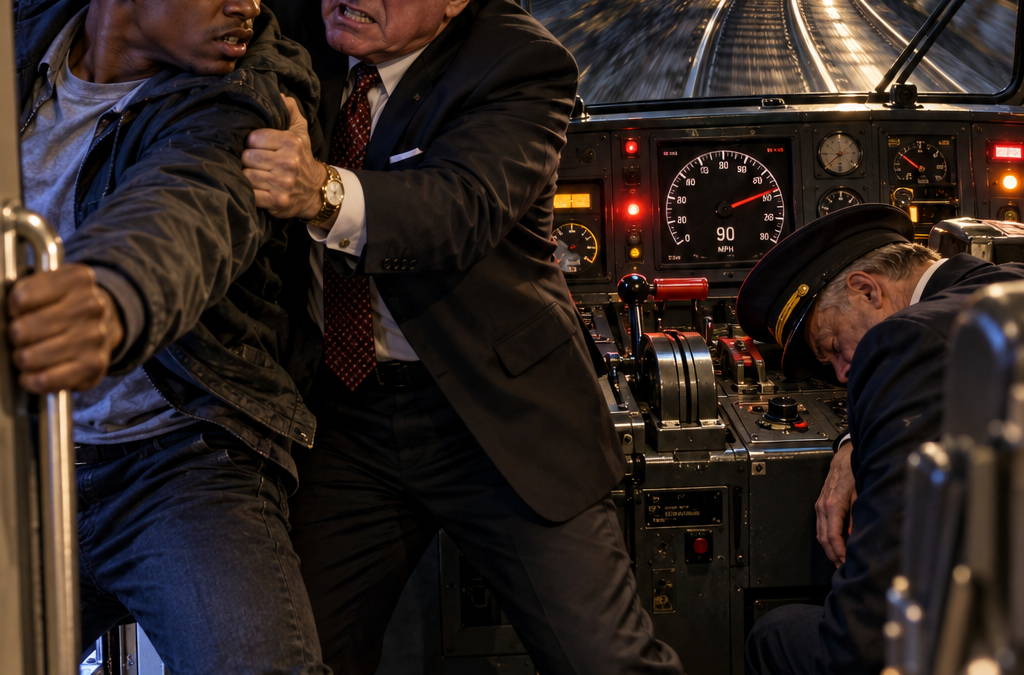
𝗙𝗨𝗟𝗟 𝗦𝗧𝗢𝗥𝗬
Three rows ahead, separated from economy by a glass partition and a strip of carpet that apparently made people important, Clayton Moore Jr. sat in premium class.
I didn’t know who he was yet.
If I had, I might have understood the way a few Ridgeway employees stiffened when he walked past.
He was director of operations.
His father, Clayton Moore Sr., had been a major executive at Ridgeway during my grandfather’s career.
A name my grandmother rarely said without her jaw tightening.
I would later learn Clayton Jr. was on the phone while I studied the notebook.
Talking loudly.
Talking about legacy protocols.
Talking about cleaning old names out of company manuals.
Talking about wanting the Preston era gone.
He didn’t know a Preston was sitting three rows behind him.
But someone else did.
Garrett Wells was fifty-five and had worked for Ridgeway for thirty-one years.
He was checking tickets when he walked past my seat.
He glanced down.
Then stopped.
I looked up.
“Problem?”
His eyes stayed on the notebook.
“Where did you get that?”
I put one hand over the cover instinctively.
“It belonged to my grandfather.”
Garrett’s face changed.
“What was his name?”
“Harold Preston.”
For a second, he looked like I’d hit him.
Then he swallowed.
“Right.”
I waited.
He said nothing else.
Just punched my ticket and moved on.
I watched him walk away.
His shoulders looked suddenly older.
At 4:52 p.m., the train was running through the Ashlin Valley corridor.
I remember the time because I checked my phone right before everything changed.
We were moving fast.
Eighty-eight miles an hour, though I didn’t know the exact speed yet.
I felt it through the floor.
Harold had taught me to feel speed long before I understood equations.
When I was eight, he started taking me to the abandoned Ridgefield maintenance yard in summer.
He still had a key after Ridgeway fired him.
Nobody had ever asked for it back.
Unit 4412 sat there, decommissioned and gathering dust.
He would lift me into the driver’s chair and put my hands on the controls.
“Don’t look at the gauge yet,” he’d say.
“Feel it.”
“What?”
“The machine.”
“It’s shaking.”
“Everything shakes.”
He would tap my wrist.
“Tell me how.”
At first I thought he was messing with me.
Then eventually I understood.
Different frequencies meant different loads.
Different pressure.
Different wheel behavior.
Different stress.
Machines spoke.
Not with words.
Through vibration.
Harold taught me to listen.
That afternoon on the Ridgeway Express, the vibration changed.
Just slightly.
My eyes lifted from the notebook.
The train accelerated.
Then the overhead lights flickered.
Once.
Twice.
A high-pitched alarm exploded through the car.
People looked up.
The red emergency strip along the ceiling began flashing.
A woman across the aisle pulled out her earbuds.
“What’s that?”
Nobody answered.
The train surged.
A suitcase fell from an overhead rack.
Someone yelled.
The brakes should have engaged.
They didn’t.
The sound beneath the floor sharpened.
My stomach dropped.
We were still accelerating.
Garrett Wells came running through the aisle.
Not walking fast.
Running.
People started standing.
“Please remain seated!”
That made everybody stand faster.
A man grabbed Garrett’s sleeve.
“What’s happening?”
“Sit down.”
“Why are we speeding up?”
“Sir, let go.”
The panic spread quicker than any fire could have.
Phones came out.
People shouted over each other.
A little boy started crying.
A woman near the window whispered a prayer.
I looked toward the front.
Then at my grandfather’s notebook.
I don’t remember deciding to stand.
I just did.
Garrett disappeared through the forward door.
I followed.
By the time I reached Car Three, the situation had collapsed.
Passengers filled the aisle.
The driver’s cabin door was open.
I saw a body on the floor.
Bill Thornton.
I didn’t know his name then.
Later I learned he had twenty years behind the controls.
A minor stroke had dropped him across the console.
Garrett was inside the doorway staring at the control panel.
He looked terrified.
Not incompetent.
Terrified.
There’s a difference.
He knew enough to understand what he didn’t know.
That can be worse than knowing nothing.
“Radio?” somebody shouted.
“No signal.”
“Emergency line?”
“Dead.”
“What about the brakes?”
Garrett didn’t answer.
Someone else yelled, “Do something!”
“I’m trying!”
“Try harder!”
The train rocked.
People screamed.
Garrett turned.
He saw me.
Then his eyes dropped to the notebook in my hand.
Everything about his face changed.
“Miles.”
It was the first time he’d used my name.
I moved toward him.
“What’s the speed?”
“Ninety.”
“Next major curve?”
His mouth tightened.
“Coleman Bridge.”
“How long?”
“Eleven minutes when the engineer went down.”
“How long now?”
“Maybe four.”
The crowd heard that.
The noise exploded.
Four minutes.
I looked through the cabin.
Newer system than the one Harold had taught me.
Digital displays.
Touch controls.
Different layout.
But I recognized the architecture.
I stepped forward.
“Let me in.”
Before Garrett could move, another man appeared between us.
Tall.
Expensive suit.
Silver cuff links.
Face already angry.
Clayton Moore Jr.
“What the hell do you think you’re doing?”
“I can stop the train.”
He looked me up and down.
I was eighteen.
Black.
Economy-class ticket.
Backpack.
Old notebook.
To Clayton, apparently that was enough evidence to decide everything about me.
“You?”
“Yes.”
He laughed once.
Not because something was funny.
Because he wanted everybody around us to hear what contempt sounded like.
“Get away from that door.”
“Sir, we don’t have time.”
“You don’t have clearance.”
“The driver is unconscious.”
“And you’re what? Some kind of engineer?”
“I know the system.”
Clayton stepped closer.
“You know the system.”
“Yes.”
He looked toward the passengers.
Then back at me.
“Look at you.”
I felt the moment change.
His voice lowered.
“You stink.”
The aisle went quiet around us.
“You’re filthy. You look like you crawled out from underneath the train.”
My stomach twisted.
“Sir—”
“What does a kid like you know besides picking up trash?”
Someone gasped.
Garrett stepped forward.
“Clayton.”
“Stay out of this.”
I looked past him at the speed display.
Ninety miles per hour.
Four minutes.
Maybe less.
“Someone is going to die.”
Clayton shoved me.
Hard.
My shoulder hit the wall.
“Get out of that doorway.”
The train lurched.
A suitcase came flying from a rack and smashed open against the aisle.
Clothes scattered across the floor.
People screamed again.
I didn’t move.
I opened the notebook.
Page thirty-eight.
I looked at the numbers.
Then at Clayton.
“Ninety miles an hour.”
His expression changed slightly.
“Four minutes to Coleman Bridge.”
He said nothing.
“Two hundred and six people on this train.”
I stepped toward him.
“You just wasted thirty seconds of their lives.”
For the first time, Clayton Moore Jr. went pale.
Garrett’s voice broke through the silence.
“Let him through.”
Clayton turned.
“What?”
“Let him through.”
“You cannot seriously be suggesting—”
“He’s Harold Preston’s grandson.”
Clayton stopped.
There it was.
Recognition.
Fear.
Something old passing through his eyes.
Garrett pointed toward the cabin.
“Let him through now.”
I didn’t wait.
I stepped around Clayton.
Entered the cab.
Closed the door.
The screams became muffled behind steel.
Suddenly it was just me.
An unconscious engineer.
A wall of warning lights.
And my grandfather’s notebook.
The speedometer showed ninety-one.
My hands began to shake.
I set the notebook on the console.
Page thirty-eight.
Six steps.
I heard Harold.
Not a ghost.
Memory.
Left hand here.
Right hand here.
What do you feel?
I placed my left hand on the throttle.
My right hand over the braking controls.
I closed my eyes for half a second.
Vibration.
Deep.
Fast.
Uneven.
Listen to the machine, Miles.
Don’t fight it.
Step one.
Main throttle to neutral.
I pulled the throttle back.
The engine stopped adding power.
Ninety-one.
Ninety.
Still too fast.
Step two.
Dynamic braking.
Graduated release.
The lever had been moved on the newer panel.
Different location.
Same principle.
I pulled it down slowly.
One increment.
Then two.
Then three.
The entire train shuddered.
Not violently.
A deep metallic groan traveled through the floor.
Eighty-eight.
Eighty-five.
My breathing slowed.
Step three.
Bleed auxiliary air pressure.
Twelve psi.
Not fifteen.
The official Ridgeway procedure said fifteen.
Harold’s handwriting said twelve.
I stared at the valve.
If he was wrong, I could lock the braking system unevenly.
At our speed, that could put cars sideways.
I heard Clayton’s voice in my head.
Untrained civilian.
Trash.
Kid.
I heard my academy rejection.
Does not meet our current standards.
Then Harold.
When that day comes, don’t ask permission.
Do what’s right.
I turned the valve to twelve.
Compressed air hissed through the cab.
Eighty.
Seventy-five.
“Come on.”
Step four.
Distribute braking force rear to front.
This was the part almost nobody outside old Ridgeway engineering records understood.
Harold discovered that sequencing braking load backward through the train dramatically reduced jackknifing risk.
He hadn’t found it in a textbook.
He found it because he had spent thousands of hours paying attention.
Car by car.
I selected the rear braking unit.
Then the next.
Then the next.
My fingers moved across the controls.
The train pulled against itself.
Seventy.
Sixty-five.
Coleman Bridge was getting closer.
I could see terrain changing through the windshield.
The track began its long approach.
Step five.
Reduce to forty before the curve.
Hold.
Sixty.
Fifty-five.
My shirt stuck to my back.
Fifty.
The steel beneath me screamed.
Forty-five.
The curve appeared.
I eased pressure.
Forty-two.
Forty.
The train entered Coleman.
I stopped breathing.
For one endless second, the cars leaned.
Wheels sang against the rails.
A high metallic note.
Then settled.
We stayed on the track.
I almost collapsed.
Not yet.
Step six.
Full stop.
Parking brake.
I pulled the final lever.
The train began releasing twenty years of momentum one mile at a time.
Thirty.
Twenty.
Ten.
Five.
Zero.
The Ridgeway Express stopped.
Silence hit harder than the alarm had.
I stood there with both hands still on the controls.
Then they started shaking.
Violently.
I had apparently been saving all the fear until there was room for it.
I looked at the notebook.
Page thirty-eight.
Every step had worked.
Exactly.
Outside the cab, I heard one person shout.
Then another.
Then crying.
Then something I never expected.
Applause.
It started near the front.
Spread backward.
A wave passing through steel.
People clapping because they understood at the same moment that they were alive.
Garrett opened the door.
He stared at the speedometer.
Zero.
Then at me.
Then the notebook.
“That sequence.”
His voice was barely there.
“My grandfather’s.”
Garrett nodded.
“I’ve watched drivers use it for twenty years.”
His eyes filled.
“None of them knew whose it was.”
A woman pushed past him.
She wrapped both arms around me.
I barely had time to react.
“Thank you.”
She was sobbing.
“I have two kids waiting at home.”
She squeezed harder.
“Thank you.”
An elderly man took my hand in both of his.
“God bless you, son.”
Passengers crowded the corridor.
Touching my shoulder.
Crying.
Laughing.
Some still shaking.
For a few minutes, none of us cared who had been sitting in economy or premium.
We were people who had almost died together.
That should have been the end.
It wasn’t.
Clayton stood at the far end of the corridor.
He didn’t approach me.
He had a phone pressed to his ear.
His face had gone from white to red.
His voice was low.
Urgent.
He wasn’t celebrating.
He was already managing the problem.
And I was the problem.
A passenger named Sophie Adams had recorded almost everything.
Clayton shoving me.
His words.
Garrett arguing with him.
Me entering the cabin.
The panic before the train stopped.
She posted the video before rescue crews arrived.
Watch what just happened.
Four words.
Eighteen minutes later, paramedics reached us.
By then the video already had hundreds of thousands of views.
Bill Thornton was carried out alive.
Doctors later confirmed a minor stroke.
Treatable.
Recoverable.
Police took statements.
News vans arrived.
And when reporters needed somebody to put in front of the cameras, they chose the man wearing the most expensive suit.
Clayton straightened his tie.
“Ridgeway Rail’s safety systems performed exactly as designed today.”
I was twenty feet away.
“Our protocols ensured safe deceleration and protected every passenger on board.”
He didn’t say my name.
Didn’t say Harold’s.
Didn’t mention trying to keep me out of the cab.
He stood there taking credit for a system his family had stolen.
And for the first time that day, I was angrier than I was afraid.
Three days later, Ridgeway sent me a letter.
Fifty thousand dollars.
All I had to do was sign a nondisclosure agreement.
I could never discuss what happened.
Never publicly claim credit for stopping the train.
Never connect Harold Preston’s name to Ridgeway’s braking protocol.
Fifty thousand dollars to disappear.
I read the offer twice.
Then I called Thomas Bradley.
Bradley was a civil rights attorney who had spent thirty years handling discrimination cases in transportation.
He had already seen Sophie’s video.
When I arrived at his office, he had it paused on a screen.
The image showed Clayton’s hand against my shoulder.
My body halfway into the wall.
Bradley pointed toward the chair.
“Sit.”
I put three things on his desk.
My academy rejection.
The settlement offer.
Harold’s notebook.
He examined the documents in silence.
Then opened the notebook.
His expression changed page by page.
“What do you want?”
I answered immediately.
“I want Harold Preston publicly recognized as the creator of that braking protocol.”
Bradley started writing.
“I want his name restored to company records.”
He wrote.
“I want a scholarship in his name for Black engineering students.”
More writing.
“I want Clayton Moore Jr. to apologize to my grandmother in person and on camera.”
Bradley looked up.
“That one is personal.”
“All of this is personal.”
He nodded.
“Anything else?”
“I want independent review before any Ridgeway employee can be terminated in a racial discrimination case.”
Bradley set down his pen.
“Five conditions.”
“Nonnegotiable.”
“You understand they’ll fight all five?”
“Yes.”
“They have more lawyers than some towns have people.”
“I know.”
“They’ll come after your credibility.”
“I know.”
“Your qualifications.”
“I know.”
“They may come after the train incident itself.”
I looked at Harold’s notebook.
“My grandfather had no lawyer. No social media. No video. No leverage.”
I put my palm over the cover.
“And they erased him.”
I met Bradley’s eyes.
“I’m not signing anything.”
He smiled.
“Good.”
That evening, Bradley called Clayton’s office.
When he listed the five conditions, Clayton laughed.
Bradley told me later that the laughter ended when he mentioned Harold.
“By next week,” Bradley had told him, “the whole country may know what your family did.”
That night, Grandma was sitting at the kitchen table when I got home.
Sophie’s video played silently on the television.
I put Harold’s notebook between us.
She touched the spine.
“He would’ve been proud.”
“I used his procedure.”
“I watched.”
“Every step.”
“I know.”
I sat.
“Grandma.”
Something in my voice made her look up.
“The man who blocked me is Clayton Moore Jr.”
Her hand stopped.
“More.”
Not a question.
A command.
“Director of operations.”
Her jaw tightened.
“His father—”
“I know who his father was.”
The temperature in the room seemed to change.
Grandma leaned back.
“Clayton Moore Senior sat across a desk from your grandfather and told him his work belonged to Ridgeway.”
I stayed silent.
“He told Harold his name didn’t matter. That he should be grateful Ridgeway allowed him to work there.”
I had never heard her speak about it this directly.
“He came home that night and sat where you’re sitting.”
She pointed at my chair.
“Didn’t eat. Didn’t talk.”
“What did he do?”
“Opened that notebook.”
She touched it.
“Started writing.”
“All night?”
“All night.”
She opened the notebook to the back.
Between the last sheet and the leather cover was a folded letter.
Yellow.
Creased.
Old.
“I never showed you this.”
I unfolded it.
It was addressed to Ridgeway’s board of directors.
Harold had written:
I am not asking for my job back.
I need you to know that I existed.
He described the emergency braking protocol.
How he had designed it.
Tested it.
Risked his career to defend it.
Then the final paragraph.
You took my work.
You removed my name.
You told me to be grateful.
I do not need your money.
I do not need your title.
I need you to remember I was here.
I built something that mattered.
My name was Harold James Preston.
And I mattered too.
My hands started shaking.
“He never sent it?”
Grandma shook her head.
“He said they’d throw it away.”
I folded it carefully.
“They won’t this time.”
The next afternoon, Garrett Wells knocked on our door.
No uniform.
No Ridgeway badge.
Just a tired man in a wrinkled shirt.
Grandma opened the door.
“Mrs. Preston?”
“Yes.”
“I’m Garrett Wells.”
He swallowed.
“I worked with Harold.”
Grandma studied him.
Then let him inside.
We sat in the living room.
I stayed near the window.
Garrett sat on the edge of the sofa like a defendant waiting for a sentence.
“I was there when they fired him.”
My arms folded automatically.
Grandma’s hands stayed still in her lap.
Garrett continued.
“Clayton Moore Senior told Harold the protocol was company property. Said he had no personal claim.”
He looked down.
“Said if Harold pushed for credit, they’d find a reason to terminate him.”
I asked, “What did you do?”
His face tightened.
“Nothing.”
Silence.
“I did nothing.”
He rubbed his palms together.
“I told myself I had a family. A mortgage. Three years in the company. Told myself it wasn’t my fight.”
“And then?”
“Two weeks later they manufactured the incident report.”
I stared at him.
“What report?”
“Safety violation.”
He looked at Grandma.
“It was false.”
Her eyes closed briefly.
“Everybody knew.”
Garrett’s voice cracked.
“They said Harold violated inspection procedure. Used it to terminate him.”
“And you stayed quiet.”
“Yes.”
“Twenty-two years.”
“Yes.”
I wanted to hate him.
Maybe part of me did.
Then he said, “Harold looked at me on his way out.”
His eyes filled.
“He didn’t say anything.”
Garrett wiped them angrily.
“But his face said, You could stop this.”
He took a breath.
“And I looked away.”
Grandma spoke for the first time.
“It isn’t too late to use your voice, Mr. Wells.”
Garrett nodded.
“I will testify.”
He looked at me.
“Publicly. Under oath. Whatever your lawyer needs.”
That same week, reporter Norah Caldwell started uncovering what Ridgeway had spent two decades hiding.
She found internal board minutes from 2004.
Motion to adopt emergency braking protocol as designed by H. Preston, Senior Engineer.
Then one line.
Remove individual attribution per senior directive.
There it was.
Written evidence.
Not misunderstanding.
Not administrative error.
Deliberate erasure.
She found three other Black engineers forced out between 2002 and 2006.
Same pattern.
Work taken.
Credit reassigned.
Complaint raised.
Violation manufactured.
Employee removed.
Then Norah called me.
“I need the notebook.”
I tightened my grip around the phone.
“For what?”
“If we place Harold’s original diagrams next to Ridgeway’s official protocol, line by line, we can show authorship.”
I looked at the notebook.
Grandma’s most guarded possession.
My grandfather’s life’s work.
“I’ll bring it tomorrow.”
That weekend I went to the old Ridgefield maintenance yard.
The place where Harold had trained me.
The gate was chained.
The chain had rusted so badly one hard pull broke it.
I walked inside.
Weeds had swallowed the concrete.
Windows were broken.
Rain had stained the walls.
Birds nested where engineers once worked.
Ridgeway had let the entire place decay.
Just like Harold’s memory.
In the main workshop, I found a plaque beneath cracked glass.
Senior engineers.
Twelve names.
Except there was a strange space between the eleventh and twelfth.
Someone had painted white primer over part of the wood.
I stared at it.
Then rubbed my thumb across the paint.
It flaked away.
One letter appeared.
Then another.
Harold J. Preston.
Senior Engineer.
My breath caught.
I touched the glass.
“I see you, Grandpa.”
I photographed it.
Sent it to Norah.
They painted over his name, but it’s still there.
Then Ridgeway attacked.
Monday morning, they issued a statement describing me as an unauthorized individual who had breached the driver’s cabin during an emergency.
No mention of saving anyone.
No Miles Preston.
No Harold.
By Tuesday, they threatened criminal charges.
Unauthorized operation of federal railway equipment.
Potential fines.
Potential prosecution.
Clayton went on television.
He sat beneath the Ridgeway logo with an American flag behind him.
Calm.
Polished.
“We cannot establish a precedent in which untrained civilians take control of federally regulated transportation equipment.”
Untrained.
That word hit harder than I expected.
The academy rejection sat on my desk at home.
Flagged before I even knew anyone had flagged me.
Clayton stared into the camera.
“Safety means following procedure.”
I nearly threw the remote.
Following procedure?
The driver had been unconscious.
The radio had failed.
Garrett couldn’t operate the controls.
Procedure was going to take 206 people into Coleman Bridge at ninety miles per hour.
Then Clayton said:
“We’re not the villains here. We built the systems that keep people safe.”
Built.
My grandfather’s notebook sat beside me.
I turned off the television.
Wednesday brought another legal letter.
This one threatened civil damages for reputational harm and operational disruption.
Ridgeway wanted to sue me for damaging their reputation by saving their train.
Grandma read the letter.
Twice.
Folded it.
Set it beside the toaster.
Then went outside and pulled weeds for an hour.
She always processed rage with her hands.
Reporters camped outside our house.
Three vans.
Satellite dishes.
Cameras.
Some neighbors brought food.
Others said I should have stayed in my seat.
A tabloid photographer aimed through our kitchen window.
Grandma closed the curtains.
She had lived in that house for forty years.
It was the first time I remembered those curtains being closed in daylight.
That night I lay on my bed staring at the ceiling.
The notebook sat beside my rejection letter.
The legal threat lay beside both.
Three documents.
Three ways of saying I didn’t belong.
Maybe I should’ve stayed in my seat.
I didn’t realize I had spoken aloud until Grandma appeared in the doorway.
“And let two hundred people die?”
I said nothing.
She walked in and sat on the edge of the bed.
“Your grandfather didn’t raise you to sit down.”
She stood.
“Neither did I.”
At the door she paused.
“I’m making Harold’s pot roast.”
I almost laughed.
“What?”
“Carrots the way he liked them.”
“Grandma—”
“Wash your hands.”
Then she left.
That dinner saved me more than any speech could have.
Meat.
Carrots.
A kitchen table.
A woman who loved me enough to remind me that the world outside our walls did not get to define who I was inside them.
Thursday morning, Norah Caldwell’s article went live.
The headline read:
THE NAME THEY ERASED: HOW RIDGEWAY RAIL STOLE A BLACK ENGINEER’S LEGACY AND TRIED TO BURY IT TWICE.
Twelve thousand words.
Documents.
Testimony.
Photographs.
Harold’s diagrams beside Ridgeway’s official manuals.
Identical.
Garrett’s sworn statement.
The 2004 board minutes.
The painted-over plaque.
Other Black engineers pushed out using the same method.
Then came the line that changed everything.
An internal email from three months earlier.
Sender: Clayton Moore Jr.
Recipient: Ridgeway Rail Academy admissions.
Subject: Miles Preston.
Preston family.
Flag and deny.
Do not process.
Do not respond with specifics.
I stared at the screen.
Grandma stood behind me.
“They knew who I was.”
“Yes.”
“They rejected me before they reviewed anything.”
“Yes.”
I read it again.
Flag and deny.
The father erased Harold.
The son tried to stop me before I ever entered Ridgeway.
Not coincidence.
Not bias nobody could prove.
Policy.
Intent.
Norah had also traced Harold’s protocol through fourteen documented safety incidents since 1997.
Fourteen times his system prevented disaster.
Fourteen times Ridgeway benefited.
Fourteen times his name remained absent.
The country exploded.
Justice for Harold Preston trended within an hour.
Engineers posted about stolen credit.
Teachers shared the article.
Union organizers.
Historians.
Former employees.
People who had never heard of us the day before.
Ridgeway stock dropped four percent before market close.
Two board members publicly distanced themselves from Clayton.
Friday morning, he was called into an emergency board meeting.
Later, details leaked.
The chairman placed Norah’s article in front of him.
“Explain.”
Clayton blamed activists.
Media.
Context.
Misinterpretation.
Then they put his email on the table.
Flag and deny.
His address.
His signature.
His words.
He had nothing left.
The board unanimously suspended him.
Security collected his badge.
Escorted him to the parking lot.
A photographer captured him carrying a cardboard box through the rain.
The image ran beside an old photograph of Harold in his Ridgeway uniform.
Grandma looked at both for a long time.
Then folded the newspaper.
“One of those men built something.”
She tapped Harold’s photograph.
“The other inherited something.”
By Friday night, Ridgeway’s tone had changed.
No threats.
No criminal language.
They announced a public press conference for Monday.
Bradley called me.
“They’re scared.”
“What does that mean?”
“It means they’ll try to apologize without admitting anything.”
“Corporate language.”
“Exactly.”
“What do we do?”
“We show up.”
I looked at Harold’s notebook.
“We put all five conditions on the table?”
“In front of the country.”
That night, I opened the notebook to Harold’s unsent letter.
I read the final line.
I need you to remember I was here.
Underneath it, on the first available space, I wrote:
They will say your name tomorrow, Grandpa.
I promise.
Monday morning, every seat in Ridgeway’s three-hundred-person conference hall was full.
Camera crews lined the walls.
Reporters packed the aisles.
The new Ridgeway logo hung behind a polished podium.
Grandma sat in the second row wearing the navy-blue dress she had worn to Harold’s funeral.
She hadn’t entered a Ridgeway building in twenty-two years.
The last time, security had watched while she collected Harold’s belongings in a cardboard box.
Now cameras turned toward her as she walked in.
I sat beside her.
Notebook in my hands.
Bradley on my other side.
Garrett three rows behind us in a suit that didn’t quite fit.
At 9:15, Patricia Hol from corporate communications approached the podium.
“Good morning. Ridgeway Rail Corporation has called this press conference to address concerns regarding historical practices—”
Historical practices.
I almost smiled.
Corporate language can make a knife wound sound like weather.
She spoke about accountability.
Review.
Moving forward.
Lessons.
Procedural shortcomings.
She never said Harold.
Never said Clayton.
Never said discrimination.
Never said theft.
Bradley stood.
“With respect, Ms. Hol, my client has a statement.”
Every camera turned.
The Ridgeway lawyers whispered.
One finally nodded.
They couldn’t stop us.
Not anymore.
Patricia stepped aside.
I stood.
Buttoned my jacket.
Picked up the notebook.
The walk to the podium felt strangely familiar.
Same feeling as walking toward the driver’s cab.
Fear behind me.
Something I had to do ahead of me.
I placed the notebook on the podium.
Opened it.
Looked at the cameras.
“Twenty-two years ago, a man named Harold Preston sat at a desk in this company and designed the emergency braking system Ridgeway still uses today.”
Silence.
“That system saved 206 lives two weeks ago.”
I looked toward the executives.
“And until this week, nobody here wanted to say his name.”
A few cameras clicked.
“My grandfather didn’t ask for money.”
I held up his letter.
“He didn’t ask for revenge.”
I looked down at his handwriting.
“He asked to be remembered for what he built.”
My throat tightened.
I kept going.
“You took his work.”
“You removed his name.”
“You fired him after he asked for credit.”
“And when he died, you assumed the story died with him.”
I placed my hand on the notebook.
“But you forgot something.”
My voice steadied.
“He taught me.”
I could see Grandma from the corner of my eye.
“Every summer. Every afternoon. Every page.”
I looked at the executive row.
“You can erase a name from a manual.”
Pause.
“You can paint over a plaque.”
Another pause.
“You can flag and deny a scholarship application.”
Several faces changed.
“But you cannot stop a grandfather from teaching his grandson.”
I heard a camera shutter.
“And you cannot stop that grandson from standing in the same company that erased him and saying what should have been said twenty-two years ago.”
I drew one breath.
“His name was Harold James Preston.”
Grandma closed her eyes.
“He was a senior engineer at Ridgeway Rail.”
Tears slipped down her face.
“He designed the Preston Protocol.”
My voice cracked.
I didn’t stop.
“And his work saved every person on that train.”
For three seconds, nobody moved.
Then someone in the back began clapping.
Another person joined.
Then the room stood.
Reporters.
Staff.
Guests.
People I had never met.
The applause rolled toward us.
I looked at Grandma.
She didn’t stand.
She sat with her hands folded and tears falling silently.
She had waited twenty-two years to hear Harold’s name spoken inside a Ridgeway building.
I had promised her.
Promised him.
Now the whole country had heard it.
Before the applause ended, Garrett Wells stood.
Nobody had invited him to speak.
“My name is Garrett Wells.”
The room quieted.
“I have worked for Ridgeway Rail for thirty-one years.”
He looked at me.
“And I was in the room when they fired Harold Preston.”
Every camera swung toward him.
“Everything Miles just told you is true.”
Garrett’s voice shook.
He steadied it.
“Clayton Moore Senior told Harold his work belonged to the company.”
“He threatened him.”
“They falsified the incident used to terminate him.”
Garrett swallowed.
“I knew.”
A murmur passed through the room.
“I watched Harold leave.”
He looked straight at me.
“His eyes told me I could stop it.”
Garrett’s voice broke.
“And I looked away.”
Nobody breathed.
“For twenty-two years, I looked away.”
He lifted his chin.
“I’m not looking away anymore.”
Then another man stood.
Darnell Cooper.
Retired engineer.
Then Raymond Foster.
Former safety inspector.
Both Black.
Both former Ridgeway employees.
“It happened to me too,” Darnell said.
Raymond nodded.
“Same pattern.”
The room erupted.
Reporters shouted.
Lawyers leaned toward each other.
Ridgeway executives stared straight ahead.
Everything the company had tried to frame as one historical mistake was now collapsing into a pattern.
Patricia Hol returned to the podium.
She looked at her prepared pages.
Then at us.
Then she did something I did not expect.
She set the script aside.
“On behalf of Ridgeway Rail Corporation, I want to say what should have been said first.”
The room quieted.
“We failed Harold Preston.”
Grandma’s hand closed around mine.
“We failed his family.”
Patricia looked toward us.
“And we failed the principles this company claimed to represent.”
She paused.
“Harold James Preston designed the emergency braking protocol Ridgeway Rail has used for more than two decades.”
There it was.
His name.
From them.
“His contribution saved lives, including the 206 passengers aboard the Ridgeway Express.”
My eyes burned.
“His name should never have been removed.”
Patricia took a breath.
“It will be restored.”
Grandma squeezed my hand once.
Firm.
Small.
The same way she had placed the notebook into my hands that morning.
Six weeks later, sunlight filled the lobby of Ridgeway Rail headquarters.
Nothing about the marble or steel had changed.
What changed was the wall.
A bronze plaque hung beside the main entrance.
Harold James Preston.
Senior Engineer.
Ridgeway Rail Corporation.
1978–2004.
Creator of the Preston Emergency Braking Protocol.
His work has saved thousands of lives.
His legacy will not be erased again.
There were only about thirty people at the ceremony.
I had asked Ridgeway to keep it small.
Harold had been a quiet man.
A circus would have felt wrong.
Grandma stood beside me.
Bradley.
Garrett.
Norah.
Darnell Cooper.
Raymond Foster.
Former employees.
A few current executives.
Ridgeway’s new interim CEO, Katherine Shaw, spoke briefly.
“Harold Preston gave this company one of its most important safety innovations.”
She didn’t hide behind polished language.
“We repaid him by erasing his name.”
She looked at the plaque.
“That ends today.”
She announced that the procedure would officially be called the Preston Protocol in all Ridgeway documentation.
Then she stepped aside.
Grandma walked toward the plaque.
She wore the same navy dress.
The funeral dress.
The press conference dress.
She had told me that morning this would be the final time she wore it for grief.
Her finger touched Harold’s engraved name.
“There you are.”
Barely a whisper.
Everybody heard it.
“Right where you belong.”
I couldn’t speak.
I held the notebook against my chest and let her have the moment.
No applause.
No cameras pushing close.
Just silence.
Witness.
Twenty-two years of grief standing in front of bronze.
Afterward, Katherine handed me an envelope.
Inside was a four-year full scholarship to Fullerton Institute of Technology.
Tuition.
Housing.
Materials.
Everything.
The letter read:
Miles James Preston.
I had legally added the middle name three weeks earlier.
Katherine handed me another document.
The charter for the Harold Preston Engineering Fellowship.
Annual.
Permanent.
Independently administered.
For Black students pursuing transportation engineering.
Ridgeway funded it.
An outside board controlled it.
No company executive could quietly kill the program after the cameras went away.
I read through the founding advisory members.
One name stopped me.
Garrett Wells.
I looked across the lobby.
He stood near a window staring at Harold’s plaque.
He noticed me.
We nodded to each other.
Twenty-two years earlier, Garrett had failed to stand beside my grandfather.
Now he would spend the rest of his career helping protect the legacy he had once been too afraid to defend.
Clayton Moore Jr. never apologized to me personally.
The board removed him permanently after the independent investigation confirmed the admissions interference and other discriminatory actions.
But the apology I had asked for wasn’t really about me.
Ridgeway representatives met Grandma publicly.
They apologized to her on camera.
Not for “historic shortcomings.”
Not for “unfortunate circumstances.”
For what they had done to Harold.
For taking his work.
For lying about him.
For firing him.
For leaving his widow to carry the truth alone for twenty-two years.
Grandma listened without interrupting.
When they finished, she said only:
“Make sure you don’t need another family to force you to remember the next person.”
That was Edna.
She could fit an entire lawsuit inside one sentence.
A month later, I sat alone inside an engineering lab at Fullerton.
Classes had not officially started yet, but the department head gave me early access.
Fluorescent lights hummed above the workbench.
Blueprint paper covered the surface.
I had already started sketching a next-generation braking architecture.
Something adaptive.
Faster pressure redistribution.
Real-time load sensing.
Harold would have argued with half my assumptions.
That thought made me smile.
His notebook lay beside the drawings.
Same cracked leather.
Same yellow pages.
Same ink.
I opened to the final page.
His unsent letter.
I need you to remember that I was here.
Below it:
They will say your name tomorrow, Grandpa.
I promise.
I thought about where his name existed now.
On Ridgeway’s wall.
In every updated safety manual.
In the Preston Protocol.
In the fellowship.
In headlines.
Engineering classrooms.
Training documents.
And in the mouths of people who had once worked very hard not to say it.
I turned the page.
Blank.
For forty years, Harold had filled that notebook.
Diagrams.
Corrections.
Failures.
Solutions.
Warnings.
Ideas.
Everything he understood about steel, pressure, movement, and responsibility.
Now there was one empty page left.
I picked up a pen.
For a moment, my hand hovered above the paper.
Then I began writing.
Page One.
My handwriting surprised me.
Small.
Precise.
Slanted slightly left.
Just like his.
I drew the first pressure line.
Then the first valve.
Then the outline of a braking system Harold had never lived long enough to imagine.
The notebook hadn’t ended with him.
That was what Ridgeway never understood.
They believed erasing a man’s name erased what he gave to the world.
They believed rejecting me would keep a Preston outside their doors.
They believed money could buy silence.
Threats could manufacture fear.
A corporate statement could rewrite a train full of witnesses.
They were wrong every time.
My grandfather had taught me long before I understood why.
One day, somebody is going to need what you know.
When that day comes, don’t ask permission.
Do what’s right.
On that train, with 206 lives rushing toward Coleman Bridge, I had finally understood what he meant.
It wasn’t about being fearless.
I had been terrified.
It wasn’t about proving I was smarter than anybody.
I didn’t care who received credit while that speedometer was dropping.
It wasn’t even about revenge.
Revenge wouldn’t have stopped the train.
Wouldn’t have restored Harold’s name.
Wouldn’t have helped another Black engineering student walk through a door Ridgeway once tried to close.
It was about refusing to let someone else’s judgment become the limit of what I was willing to do.
I looked down at the rejection letter lying beneath my new Fullerton paperwork.
For months, it had felt like a verdict.
Now it looked like what it had always been.
Paper.
I folded it once.
Placed it inside the back cover of Harold’s notebook.
Not because I wanted to remember the rejection.
Because I wanted to remember how close I had come to believing it.
Then I returned to the blank page.
The lab was quiet.
No applause.
No reporters.
No cameras.
Just me, my grandfather’s notebook, and a design beginning to take shape beneath my hand.
For the first time in my life, I wasn’t trying to get Ridgeway Rail to decide whether I belonged.
I already knew.
And somewhere between the first line I drew and the second, I could almost hear Harold’s voice again.
Don’t fight the machine, Miles.
Listen.
So I did.
𝗧𝗛𝗘 𝗘𝗡𝗗
The Railroad Executive Tried to Throw Me Out of the Cab While 206 Passengers Were Racing Toward a Deadly Curve
Clayton Moore Jr. shoved me away from the locomotive door and told me a Black kid like me belonged in the trash, not in the cab of a runaway train. Behind him, 206 people were screaming, the engineer was unconscious, and we had less than four minutes before ninety miles an hour met a curve designed for forty-five.
Six hours earlier, my biggest problem had been a rejection letter.
I sat at my grandmother’s kitchen table staring at the words until they almost stopped looking like English.
After careful review, we regret to inform you that your application does not meet our current standards.
That was all Ridgeway Rail Academy had given me.
One paragraph.
No explanation.
No interview.
No request for additional information.
Just a polite corporate sentence telling me that whatever I had done up to that point was not enough.
The kitchen smelled like black coffee, old wood, and the faint sweetness of something Grandma had baked the night before. Morning light hadn’t fully reached the windows yet. The only sound was the refrigerator humming and the small scrape of my thumb moving back and forth across the paper.
I had graduated at the top of my mechanical engineering program.
For my senior project, I had designed and built a working scale model of a locomotive braking system. The judges stood when the demonstration ended.
My engineering instructor had written that I was the most naturally gifted mechanical mind he had taught in twenty-three years.
None of it seemed to matter.
“Does not meet our current standards,” I said.
My grandmother, Edna Preston, stood at the kitchen counter in her faded blue apron.
Seventy-eight years old.
Five feet four on a generous day.
Hands that had buried a husband, raised a grandson, worked two jobs when money was thin, and somehow never trembled in front of anybody who wanted to make her feel small.
She poured coffee into two mugs.
She slid one toward me.
“You’ve read that sentence enough times.”
“I keep thinking maybe another sentence will appear.”
“It won’t.”
I gave a humorless laugh.
“Good to know.”
Grandma didn’t answer.
She had a way of letting silence sit between us without rushing to fill it.
My grandfather Harold used to say she could outwait the truth.
Eventually, whatever you were trying not to admit would get tired and come sit down beside you.
I folded the letter.
“I don’t understand.”
“You understand more than you think.”
“I had the grades.”
“I know.”
“The recommendations.”
“I know.”
“The project.”
“I was there when they called your name.”
“Then what exactly are their standards?”
That finally made her look at me.
She didn’t answer.
Instead, she turned toward the cabinet above the stove.
It was the one cabinet in the house I had never been allowed to touch.
When I was nine, I once reached for the handle and Grandma slapped the back of my hand so quickly I thought a wasp had stung me.
“Not yours,” she had said.
I had never asked again.
Now she opened it.
My breathing changed before I even saw what she was reaching for.
A brown leather notebook.
Cracked spine.
Rounded corners.
Old Ridgeway Rail logo stamped into the cover, faded almost to nothing.
My grandfather’s notebook.
I stood.
“Grandma.”
She brought it to the table.
“Take this with you today.”
I didn’t touch it.
“I can’t.”
“You can.”
“No.”
“And you will.”
She placed it in front of me.
I knew that notebook almost as well as I knew my grandfather’s face.
He had carried it everywhere.
Maintenance yard.
Dinner table.
Back porch.
Hospital.
Even when his hands had started shaking near the end, he would open it and trace diagrams with one finger.
After he died, Grandma locked it away.
I had not held it once.
Until that morning.
I rested my palms on either side of it.
“He wanted you to have it when you were ready,” she said.
“Why now?”
“Because they just told you what they think you’re worth.”
Her voice stayed calm.
“I thought you should spend some time remembering where you came from before you start believing them.”
I opened the cover.
Harold Preston’s handwriting filled the first page.
Small.
Precise.
Slanted slightly left.
Pressure calculations.
Valve diagrams.
Rail geometry.
Handwritten corrections to official manuals.
Pressure valve must release at 12 psi, not 15. Company specification incorrect. Verified 1998.
I turned another page.
Then another.
A full locomotive cabin layout.
Every switch marked.
Every gauge labeled.
Arrows showing relationships between systems.
Nothing decorative.
Nothing wasted.
The notebook wasn’t theory.
It was forty years of a man listening to machines until he understood what they would do before they did it.
Then I reached page thirty-eight.
A red circle had been drawn around the number.
Two lines beneath the heading.
Emergency Braking Protocol.
Six steps.
I knew them.
Every engineer who studied Ridgeway knew them.
The protocol had been implemented company-wide after two near derailments in the nineties.
The official safety manuals called it a Ridgeway Engineering Division innovation.
They never said who had created it.
My grandfather had.
I had known that my whole life.
But seeing the original steps in his handwriting made the theft feel different.
Physical.
Real.
Personal.
“He wrote this.”
Grandma nodded.
“They still use it.”
“I know.”
“No.”
She pulled out the chair across from me and sat.
“They use him.”
I looked up.
“There’s a difference.”
I closed the notebook.
My chest felt tight.
“You ever ask why they never put his name on it?”
“Plenty.”
“What did he say?”
“Your grandfather wasn’t a man who enjoyed talking about what people had done to him.”
“That’s not an answer.”
“It’s the only one he gave me for years.”
She reached over and placed two fingers on the cover.
“Then near the end, he said something different.”
“What?”
“One day somebody is going to need what I know. If I’m not there, Miles will be.”
I looked away.
My throat tightened.
Grandma stood.
“You miss that train, I’m not driving you.”
That was Edna Preston’s way of ending a conversation before it became too emotional.
I slid the rejection letter into my backpack.
Then I picked up the notebook.
It felt heavier than it looked.
“I’ll bring it back safe.”
Grandma touched my cheek.
Just once.
“You bring yourself back safe.”
She glanced at the notebook.
“That thing has survived worse.”
I almost missed the 4:15 Ridgeway Express.
Platform Nine was already flashing final boarding when I came running through the station with my backpack bouncing against one shoulder.
Two hundred and six passengers were headed north.
I was in economy.
Seat 14C.
I dropped into the seat, breathing hard, placed the notebook on my tray table, and opened it to page thirty-eight.
The Preston method.
My grandfather had developed it after two incidents revealed dangerous flaws in Ridgeway’s original emergency deceleration sequence.
He tested it.
Refined it.
Presented it to management.
Within six months, it had become the standard procedure across the company.
His name vanished from the paperwork.
His method didn’t.
Three rows ahead, separated from economy by a glass partition and a strip of carpet that apparently made people important, Clayton Moore Jr. sat in premium class.
I didn’t know who he was yet.
If I had, I might have understood the way a few Ridgeway employees stiffened when he walked past.
He was director of operations.
His father, Clayton Moore Sr., had been a major executive at Ridgeway during my grandfather’s career.
A name my grandmother rarely said without her jaw tightening.
I would later learn Clayton Jr. was on the phone while I studied the notebook.
Talking loudly.
Talking about legacy protocols.
Talking about cleaning old names out of company manuals.
Talking about wanting the Preston era gone.
He didn’t know a Preston was sitting three rows behind him.
But someone else did.
Garrett Wells was fifty-five and had worked for Ridgeway for thirty-one years.
He was checking tickets when he walked past my seat.
He glanced down.
Then stopped.
I looked up.
“Problem?”
His eyes stayed on the notebook.
“Where did you get that?”
I put one hand over the cover instinctively.
“It belonged to my grandfather.”
Garrett’s face changed.
“What was his name?”
“Harold Preston.”
For a second, he looked like I’d hit him.
Then he swallowed.
“Right.”
I waited.
He said nothing else.
Just punched my ticket and moved on.
I watched him walk away.
His shoulders looked suddenly older.
At 4:52 p.m., the train was running through the Ashlin Valley corridor.
I remember the time because I checked my phone right before everything changed.
We were moving fast.
Eighty-eight miles an hour, though I didn’t know the exact speed yet.
I felt it through the floor.
Harold had taught me to feel speed long before I understood equations.
When I was eight, he started taking me to the abandoned Ridgefield maintenance yard in summer.
He still had a key after Ridgeway fired him.
Nobody had ever asked for it back.
Unit 4412 sat there, decommissioned and gathering dust.
He would lift me into the driver’s chair and put my hands on the controls.
“Don’t look at the gauge yet,” he’d say.
“Feel it.”
“What?”
“The machine.”
“It’s shaking.”
“Everything shakes.”
He would tap my wrist.
“Tell me how.”
At first I thought he was messing with me.
Then eventually I understood.
Different frequencies meant different loads.
Different pressure.
Different wheel behavior.
Different stress.
Machines spoke.
Not with words.
Through vibration.
Harold taught me to listen.
That afternoon on the Ridgeway Express, the vibration changed.
Just slightly.
My eyes lifted from the notebook.
The train accelerated.
Then the overhead lights flickered.
Once.
Twice.
A high-pitched alarm exploded through the car.
People looked up.
The red emergency strip along the ceiling began flashing.
A woman across the aisle pulled out her earbuds.
“What’s that?”
Nobody answered.
The train surged.
A suitcase fell from an overhead rack.
Someone yelled.
The brakes should have engaged.
They didn’t.
The sound beneath the floor sharpened.
My stomach dropped.
We were still accelerating.
Garrett Wells came running through the aisle.
Not walking fast.
Running.
People started standing.
“Please remain seated!”
That made everybody stand faster.
A man grabbed Garrett’s sleeve.
“What’s happening?”
“Sit down.”
“Why are we speeding up?”
“Sir, let go.”
The panic spread quicker than any fire could have.
Phones came out.
People shouted over each other.
A little boy started crying.
A woman near the window whispered a prayer.
I looked toward the front.
Then at my grandfather’s notebook.
I don’t remember deciding to stand.
I just did.
Garrett disappeared through the forward door.
I followed.
By the time I reached Car Three, the situation had collapsed.
Passengers filled the aisle.
The driver’s cabin door was open.
I saw a body on the floor.
Bill Thornton.
I didn’t know his name then.
Later I learned he had twenty years behind the controls.
A minor stroke had dropped him across the console.
Garrett was inside the doorway staring at the control panel.
He looked terrified.
Not incompetent.
Terrified.
There’s a difference.
He knew enough to understand what he didn’t know.
That can be worse than knowing nothing.
“Radio?” somebody shouted.
“No signal.”
“Emergency line?”
“Dead.”
“What about the brakes?”
Garrett didn’t answer.
Someone else yelled, “Do something!”
“I’m trying!”
“Try harder!”
The train rocked.
People screamed.
Garrett turned.
He saw me.
Then his eyes dropped to the notebook in my hand.
Everything about his face changed.
“Miles.”
It was the first time he’d used my name.
I moved toward him.
“What’s the speed?”
“Ninety.”
“Next major curve?”
His mouth tightened.
“Coleman Bridge.”
“How long?”
“Eleven minutes when the engineer went down.”
“How long now?”
“Maybe four.”
The crowd heard that.
The noise exploded.
Four minutes.
I looked through the cabin.
Newer system than the one Harold had taught me.
Digital displays.
Touch controls.
Different layout.
But I recognized the architecture.
I stepped forward.
“Let me in.”
Before Garrett could move, another man appeared between us.
Tall.
Expensive suit.
Silver cuff links.
Face already angry.
Clayton Moore Jr.
“What the hell do you think you’re doing?”
“I can stop the train.”
He looked me up and down.
I was eighteen.
Black.
Economy-class ticket.
Backpack.
Old notebook.
To Clayton, apparently that was enough evidence to decide everything about me.
“You?”
“Yes.”
He laughed once.
Not because something was funny.
Because he wanted everybody around us to hear what contempt sounded like.
“Get away from that door.”
“Sir, we don’t have time.”
“You don’t have clearance.”
“The driver is unconscious.”
“And you’re what? Some kind of engineer?”
“I know the system.”
Clayton stepped closer.
“You know the system.”
“Yes.”
He looked toward the passengers.
Then back at me.
“Look at you.”
I felt the moment change.
His voice lowered.
“You stink.”
The aisle went quiet around us.
“You’re filthy. You look like you crawled out from underneath the train.”
My stomach twisted.
“Sir—”
“What does a kid like you know besides picking up trash?”
Someone gasped.
Garrett stepped forward.
“Clayton.”
“Stay out of this.”
I looked past him at the speed display.
Ninety miles per hour.
Four minutes.
Maybe less.
“Someone is going to die.”
Clayton shoved me.
Hard.
My shoulder hit the wall.
“Get out of that doorway.”
The train lurched.
A suitcase came flying from a rack and smashed open against the aisle.
Clothes scattered across the floor.
People screamed again.
I didn’t move.
I opened the notebook.
Page thirty-eight.
I looked at the numbers.
Then at Clayton.
“Ninety miles an hour.”
His expression changed slightly.
“Four minutes to Coleman Bridge.”
He said nothing.
“Two hundred and six people on this train.”
I stepped toward him.
“You just wasted thirty seconds of their lives.”
For the first time, Clayton Moore Jr. went pale.
Garrett’s voice broke through the silence.
“Let him through.”
Clayton turned.
“What?”
“Let him through.”
“You cannot seriously be suggesting—”
“He’s Harold Preston’s grandson.”
Clayton stopped.
There it was.
Recognition.
Fear.
Something old passing through his eyes.
Garrett pointed toward the cabin.
“Let him through now.”
I didn’t wait.
I stepped around Clayton.
Entered the cab.
Closed the door.
The screams became muffled behind steel.
Suddenly it was just me.
An unconscious engineer.
A wall of warning lights.
And my grandfather’s notebook.
The speedometer showed ninety-one.
My hands began to shake.
I set the notebook on the console.
Page thirty-eight.
Six steps.
I heard Harold.
Not a ghost.
Memory.
Left hand here.
Right hand here.
What do you feel?
I placed my left hand on the throttle.
My right hand over the braking controls.
I closed my eyes for half a second.
Vibration.
Deep.
Fast.
Uneven.
Listen to the machine, Miles.
Don’t fight it.
Step one.
Main throttle to neutral.
I pulled the throttle back.
The engine stopped adding power.
Ninety-one.
Ninety.
Still too fast.
Step two.
Dynamic braking.
Graduated release.
The lever had been moved on the newer panel.
Different location.
Same principle.
I pulled it down slowly.
One increment.
Then two.
Then three.
The entire train shuddered.
Not violently.
A deep metallic groan traveled through the floor.
Eighty-eight.
Eighty-five.
My breathing slowed.
Step three.
Bleed auxiliary air pressure.
Twelve psi.
Not fifteen.
The official Ridgeway procedure said fifteen.
Harold’s handwriting said twelve.
I stared at the valve.
If he was wrong, I could lock the braking system unevenly.
At our speed, that could put cars sideways.
I heard Clayton’s voice in my head.
Untrained civilian.
Trash.
Kid.
I heard my academy rejection.
Does not meet our current standards.
Then Harold.
When that day comes, don’t ask permission.
Do what’s right.
I turned the valve to twelve.
Compressed air hissed through the cab.
Eighty.
Seventy-five.
“Come on.”
Step four.
Distribute braking force rear to front.
This was the part almost nobody outside old Ridgeway engineering records understood.
Harold discovered that sequencing braking load backward through the train dramatically reduced jackknifing risk.
He hadn’t found it in a textbook.
He found it because he had spent thousands of hours paying attention.
Car by car.
I selected the rear braking unit.
Then the next.
Then the next.
My fingers moved across the controls.
The train pulled against itself.
Seventy.
Sixty-five.
Coleman Bridge was getting closer.
I could see terrain changing through the windshield.
The track began its long approach.
Step five.
Reduce to forty before the curve.
Hold.
Sixty.
Fifty-five.
My shirt stuck to my back.
Fifty.
The steel beneath me screamed.
Forty-five.
The curve appeared.
I eased pressure.
Forty-two.
Forty.
The train entered Coleman.
I stopped breathing.
For one endless second, the cars leaned.
Wheels sang against the rails.
A high metallic note.
Then settled.
We stayed on the track.
I almost collapsed.
Not yet.
Step six.
Full stop.
Parking brake.
I pulled the final lever.
The train began releasing twenty years of momentum one mile at a time.
Thirty.
Twenty.
Ten.
Five.
Zero.
The Ridgeway Express stopped.
Silence hit harder than the alarm had.
I stood there with both hands still on the controls.
Then they started shaking.
Violently.
I had apparently been saving all the fear until there was room for it.
I looked at the notebook.
Page thirty-eight.
Every step had worked.
Exactly.
Outside the cab, I heard one person shout.
Then another.
Then crying.
Then something I never expected.
Applause.
It started near the front.
Spread backward.
A wave passing through steel.
People clapping because they understood at the same moment that they were alive.
Garrett opened the door.
He stared at the speedometer.
Zero.
Then at me.
Then the notebook.
“That sequence.”
His voice was barely there.
“My grandfather’s.”
Garrett nodded.
“I’ve watched drivers use it for twenty years.”
His eyes filled.
“None of them knew whose it was.”
A woman pushed past him.
She wrapped both arms around me.
I barely had time to react.
“Thank you.”
She was sobbing.
“I have two kids waiting at home.”
She squeezed harder.
“Thank you.”
An elderly man took my hand in both of his.
“God bless you, son.”
Passengers crowded the corridor.
Touching my shoulder.
Crying.
Laughing.
Some still shaking.
For a few minutes, none of us cared who had been sitting in economy or premium.
We were people who had almost died together.
That should have been the end.
It wasn’t.
Clayton stood at the far end of the corridor.
He didn’t approach me.
He had a phone pressed to his ear.
His face had gone from white to red.
His voice was low.
Urgent.
He wasn’t celebrating.
He was already managing the problem.
And I was the problem.
A passenger named Sophie Adams had recorded almost everything.
Clayton shoving me.
His words.
Garrett arguing with him.
Me entering the cabin.
The panic before the train stopped.
She posted the video before rescue crews arrived.
Watch what just happened.
Four words.
Eighteen minutes later, paramedics reached us.
By then the video already had hundreds of thousands of views.
Bill Thornton was carried out alive.
Doctors later confirmed a minor stroke.
Treatable.
Recoverable.
Police took statements.
News vans arrived.
And when reporters needed somebody to put in front of the cameras, they chose the man wearing the most expensive suit.
Clayton straightened his tie.
“Ridgeway Rail’s safety systems performed exactly as designed today.”
I was twenty feet away.
“Our protocols ensured safe deceleration and protected every passenger on board.”
He didn’t say my name.
Didn’t say Harold’s.
Didn’t mention trying to keep me out of the cab.
He stood there taking credit for a system his family had stolen.
And for the first time that day, I was angrier than I was afraid.
Three days later, Ridgeway sent me a letter.
Fifty thousand dollars.
All I had to do was sign a nondisclosure agreement.
I could never discuss what happened.
Never publicly claim credit for stopping the train.
Never connect Harold Preston’s name to Ridgeway’s braking protocol.
Fifty thousand dollars to disappear.
I read the offer twice.
Then I called Thomas Bradley.
Bradley was a civil rights attorney who had spent thirty years handling discrimination cases in transportation.
He had already seen Sophie’s video.
When I arrived at his office, he had it paused on a screen.
The image showed Clayton’s hand against my shoulder.
My body halfway into the wall.
Bradley pointed toward the chair.
“Sit.”
I put three things on his desk.
My academy rejection.
The settlement offer.
Harold’s notebook.
He examined the documents in silence.
Then opened the notebook.
His expression changed page by page.
“What do you want?”
I answered immediately.
“I want Harold Preston publicly recognized as the creator of that braking protocol.”
Bradley started writing.
“I want his name restored to company records.”
He wrote.
“I want a scholarship in his name for Black engineering students.”
More writing.
“I want Clayton Moore Jr. to apologize to my grandmother in person and on camera.”
Bradley looked up.
“That one is personal.”
“All of this is personal.”
He nodded.
“Anything else?”
“I want independent review before any Ridgeway employee can be terminated in a racial discrimination case.”
Bradley set down his pen.
“Five conditions.”
“Nonnegotiable.”
“You understand they’ll fight all five?”
“Yes.”
“They have more lawyers than some towns have people.”
“I know.”
“They’ll come after your credibility.”
“I know.”
“Your qualifications.”
“I know.”
“They may come after the train incident itself.”
I looked at Harold’s notebook.
“My grandfather had no lawyer. No social media. No video. No leverage.”
I put my palm over the cover.
“And they erased him.”
I met Bradley’s eyes.
“I’m not signing anything.”
He smiled.
“Good.”
That evening, Bradley called Clayton’s office.
When he listed the five conditions, Clayton laughed.
Bradley told me later that the laughter ended when he mentioned Harold.
“By next week,” Bradley had told him, “the whole country may know what your family did.”
That night, Grandma was sitting at the kitchen table when I got home.
Sophie’s video played silently on the television.
I put Harold’s notebook between us.
She touched the spine.
“He would’ve been proud.”
“I used his procedure.”
“I watched.”
“Every step.”
“I know.”
I sat.
“Grandma.”
Something in my voice made her look up.
“The man who blocked me is Clayton Moore Jr.”
Her hand stopped.
“More.”
Not a question.
A command.
“Director of operations.”
Her jaw tightened.
“His father—”
“I know who his father was.”
The temperature in the room seemed to change.
Grandma leaned back.
“Clayton Moore Senior sat across a desk from your grandfather and told him his work belonged to Ridgeway.”
I stayed silent.
“He told Harold his name didn’t matter. That he should be grateful Ridgeway allowed him to work there.”
I had never heard her speak about it this directly.
“He came home that night and sat where you’re sitting.”
She pointed at my chair.
“Didn’t eat. Didn’t talk.”
“What did he do?”
“Opened that notebook.”
She touched it.
“Started writing.”
“All night?”
“All night.”
She opened the notebook to the back.
Between the last sheet and the leather cover was a folded letter.
Yellow.
Creased.
Old.
“I never showed you this.”
I unfolded it.
It was addressed to Ridgeway’s board of directors.
Harold had written:
I am not asking for my job back.
I need you to know that I existed.
He described the emergency braking protocol.
How he had designed it.
Tested it.
Risked his career to defend it.
Then the final paragraph.
You took my work.
You removed my name.
You told me to be grateful.
I do not need your money.
I do not need your title.
I need you to remember I was here.
I built something that mattered.
My name was Harold James Preston.
And I mattered too.
My hands started shaking.
“He never sent it?”
Grandma shook her head.
“He said they’d throw it away.”
I folded it carefully.
“They won’t this time.”
The next afternoon, Garrett Wells knocked on our door.
No uniform.
No Ridgeway badge.
Just a tired man in a wrinkled shirt.
Grandma opened the door.
“Mrs. Preston?”
“Yes.”
“I’m Garrett Wells.”
He swallowed.
“I worked with Harold.”
Grandma studied him.
Then let him inside.
We sat in the living room.
I stayed near the window.
Garrett sat on the edge of the sofa like a defendant waiting for a sentence.
“I was there when they fired him.”
My arms folded automatically.
Grandma’s hands stayed still in her lap.
Garrett continued.
“Clayton Moore Senior told Harold the protocol was company property. Said he had no personal claim.”
He looked down.
“Said if Harold pushed for credit, they’d find a reason to terminate him.”
I asked, “What did you do?”
His face tightened.
“Nothing.”
Silence.
“I did nothing.”
He rubbed his palms together.
“I told myself I had a family. A mortgage. Three years in the company. Told myself it wasn’t my fight.”
“And then?”
“Two weeks later they manufactured the incident report.”
I stared at him.
“What report?”
“Safety violation.”
He looked at Grandma.
“It was false.”
Her eyes closed briefly.
“Everybody knew.”
Garrett’s voice cracked.
“They said Harold violated inspection procedure. Used it to terminate him.”
“And you stayed quiet.”
“Yes.”
“Twenty-two years.”
“Yes.”
I wanted to hate him.
Maybe part of me did.
Then he said, “Harold looked at me on his way out.”
His eyes filled.
“He didn’t say anything.”
Garrett wiped them angrily.
“But his face said, You could stop this.”
He took a breath.
“And I looked away.”
Grandma spoke for the first time.
“It isn’t too late to use your voice, Mr. Wells.”
Garrett nodded.
“I will testify.”
He looked at me.
“Publicly. Under oath. Whatever your lawyer needs.”
That same week, reporter Norah Caldwell started uncovering what Ridgeway had spent two decades hiding.
She found internal board minutes from 2004.
Motion to adopt emergency braking protocol as designed by H. Preston, Senior Engineer.
Then one line.
Remove individual attribution per senior directive.
There it was.
Written evidence.
Not misunderstanding.
Not administrative error.
Deliberate erasure.
She found three other Black engineers forced out between 2002 and 2006.
Same pattern.
Work taken.
Credit reassigned.
Complaint raised.
Violation manufactured.
Employee removed.
Then Norah called me.
“I need the notebook.”
I tightened my grip around the phone.
“For what?”
“If we place Harold’s original diagrams next to Ridgeway’s official protocol, line by line, we can show authorship.”
I looked at the notebook.
Grandma’s most guarded possession.
My grandfather’s life’s work.
“I’ll bring it tomorrow.”
That weekend I went to the old Ridgefield maintenance yard.
The place where Harold had trained me.
The gate was chained.
The chain had rusted so badly one hard pull broke it.
I walked inside.
Weeds had swallowed the concrete.
Windows were broken.
Rain had stained the walls.
Birds nested where engineers once worked.
Ridgeway had let the entire place decay.
Just like Harold’s memory.
In the main workshop, I found a plaque beneath cracked glass.
Senior engineers.
Twelve names.
Except there was a strange space between the eleventh and twelfth.
Someone had painted white primer over part of the wood.
I stared at it.
Then rubbed my thumb across the paint.
It flaked away.
One letter appeared.
Then another.
Harold J. Preston.
Senior Engineer.
My breath caught.
I touched the glass.
“I see you, Grandpa.”
I photographed it.
Sent it to Norah.
They painted over his name, but it’s still there.
Then Ridgeway attacked.
Monday morning, they issued a statement describing me as an unauthorized individual who had breached the driver’s cabin during an emergency.
No mention of saving anyone.
No Miles Preston.
No Harold.
By Tuesday, they threatened criminal charges.
Unauthorized operation of federal railway equipment.
Potential fines.
Potential prosecution.
Clayton went on television.
He sat beneath the Ridgeway logo with an American flag behind him.
Calm.
Polished.
“We cannot establish a precedent in which untrained civilians take control of federally regulated transportation equipment.”
Untrained.
That word hit harder than I expected.
The academy rejection sat on my desk at home.
Flagged before I even knew anyone had flagged me.
Clayton stared into the camera.
“Safety means following procedure.”
I nearly threw the remote.
Following procedure?
The driver had been unconscious.
The radio had failed.
Garrett couldn’t operate the controls.
Procedure was going to take 206 people into Coleman Bridge at ninety miles per hour.
Then Clayton said:
“We’re not the villains here. We built the systems that keep people safe.”
Built.
My grandfather’s notebook sat beside me.
I turned off the television.
Wednesday brought another legal letter.
This one threatened civil damages for reputational harm and operational disruption.
Ridgeway wanted to sue me for damaging their reputation by saving their train.
Grandma read the letter.
Twice.
Folded it.
Set it beside the toaster.
Then went outside and pulled weeds for an hour.
She always processed rage with her hands.
Reporters camped outside our house.
Three vans.
Satellite dishes.
Cameras.
Some neighbors brought food.
Others said I should have stayed in my seat.
A tabloid photographer aimed through our kitchen window.
Grandma closed the curtains.
She had lived in that house for forty years.
It was the first time I remembered those curtains being closed in daylight.
That night I lay on my bed staring at the ceiling.
The notebook sat beside my rejection letter.
The legal threat lay beside both.
Three documents.
Three ways of saying I didn’t belong.
Maybe I should’ve stayed in my seat.
I didn’t realize I had spoken aloud until Grandma appeared in the doorway.
“And let two hundred people die?”
I said nothing.
She walked in and sat on the edge of the bed.
“Your grandfather didn’t raise you to sit down.”
She stood.
“Neither did I.”
At the door she paused.
“I’m making Harold’s pot roast.”
I almost laughed.
“What?”
“Carrots the way he liked them.”
“Grandma—”
“Wash your hands.”
Then she left.
That dinner saved me more than any speech could have.
Meat.
Carrots.
A kitchen table.
A woman who loved me enough to remind me that the world outside our walls did not get to define who I was inside them.
Thursday morning, Norah Caldwell’s article went live.
The headline read:
THE NAME THEY ERASED: HOW RIDGEWAY RAIL STOLE A BLACK ENGINEER’S LEGACY AND TRIED TO BURY IT TWICE.
Twelve thousand words.
Documents.
Testimony.
Photographs.
Harold’s diagrams beside Ridgeway’s official manuals.
Identical.
Garrett’s sworn statement.
The 2004 board minutes.
The painted-over plaque.
Other Black engineers pushed out using the same method.
Then came the line that changed everything.
An internal email from three months earlier.
Sender: Clayton Moore Jr.
Recipient: Ridgeway Rail Academy admissions.
Subject: Miles Preston.
Preston family.
Flag and deny.
Do not process.
Do not respond with specifics.
I stared at the screen.
Grandma stood behind me.
“They knew who I was.”
“Yes.”
“They rejected me before they reviewed anything.”
“Yes.”
I read it again.
Flag and deny.
The father erased Harold.
The son tried to stop me before I ever entered Ridgeway.
Not coincidence.
Not bias nobody could prove.
Policy.
Intent.
Norah had also traced Harold’s protocol through fourteen documented safety incidents since 1997.
Fourteen times his system prevented disaster.
Fourteen times Ridgeway benefited.
Fourteen times his name remained absent.
The country exploded.
Justice for Harold Preston trended within an hour.
Engineers posted about stolen credit.
Teachers shared the article.
Union organizers.
Historians.
Former employees.
People who had never heard of us the day before.
Ridgeway stock dropped four percent before market close.
Two board members publicly distanced themselves from Clayton.
Friday morning, he was called into an emergency board meeting.
Later, details leaked.
The chairman placed Norah’s article in front of him.
“Explain.”
Clayton blamed activists.
Media.
Context.
Misinterpretation.
Then they put his email on the table.
Flag and deny.
His address.
His signature.
His words.
He had nothing left.
The board unanimously suspended him.
Security collected his badge.
Escorted him to the parking lot.
A photographer captured him carrying a cardboard box through the rain.
The image ran beside an old photograph of Harold in his Ridgeway uniform.
Grandma looked at both for a long time.
Then folded the newspaper.
“One of those men built something.”
She tapped Harold’s photograph.
“The other inherited something.”
By Friday night, Ridgeway’s tone had changed.
No threats.
No criminal language.
They announced a public press conference for Monday.
Bradley called me.
“They’re scared.”
“What does that mean?”
“It means they’ll try to apologize without admitting anything.”
“Corporate language.”
“Exactly.”
“What do we do?”
“We show up.”
I looked at Harold’s notebook.
“We put all five conditions on the table?”
“In front of the country.”
That night, I opened the notebook to Harold’s unsent letter.
I read the final line.
I need you to remember I was here.
Underneath it, on the first available space, I wrote:
They will say your name tomorrow, Grandpa.
I promise.
Monday morning, every seat in Ridgeway’s three-hundred-person conference hall was full.
Camera crews lined the walls.
Reporters packed the aisles.
The new Ridgeway logo hung behind a polished podium.
Grandma sat in the second row wearing the navy-blue dress she had worn to Harold’s funeral.
She hadn’t entered a Ridgeway building in twenty-two years.
The last time, security had watched while she collected Harold’s belongings in a cardboard box.
Now cameras turned toward her as she walked in.
I sat beside her.
Notebook in my hands.
Bradley on my other side.
Garrett three rows behind us in a suit that didn’t quite fit.
At 9:15, Patricia Hol from corporate communications approached the podium.
“Good morning. Ridgeway Rail Corporation has called this press conference to address concerns regarding historical practices—”
Historical practices.
I almost smiled.
Corporate language can make a knife wound sound like weather.
She spoke about accountability.
Review.
Moving forward.
Lessons.
Procedural shortcomings.
She never said Harold.
Never said Clayton.
Never said discrimination.
Never said theft.
Bradley stood.
“With respect, Ms. Hol, my client has a statement.”
Every camera turned.
The Ridgeway lawyers whispered.
One finally nodded.
They couldn’t stop us.
Not anymore.
Patricia stepped aside.
I stood.
Buttoned my jacket.
Picked up the notebook.
The walk to the podium felt strangely familiar.
Same feeling as walking toward the driver’s cab.
Fear behind me.
Something I had to do ahead of me.
I placed the notebook on the podium.
Opened it.
Looked at the cameras.
“Twenty-two years ago, a man named Harold Preston sat at a desk in this company and designed the emergency braking system Ridgeway still uses today.”
Silence.
“That system saved 206 lives two weeks ago.”
I looked toward the executives.
“And until this week, nobody here wanted to say his name.”
A few cameras clicked.
“My grandfather didn’t ask for money.”
I held up his letter.
“He didn’t ask for revenge.”
I looked down at his handwriting.
“He asked to be remembered for what he built.”
My throat tightened.
I kept going.
“You took his work.”
“You removed his name.”
“You fired him after he asked for credit.”
“And when he died, you assumed the story died with him.”
I placed my hand on the notebook.
“But you forgot something.”
My voice steadied.
“He taught me.”
I could see Grandma from the corner of my eye.
“Every summer. Every afternoon. Every page.”
I looked at the executive row.
“You can erase a name from a manual.”
Pause.
“You can paint over a plaque.”
Another pause.
“You can flag and deny a scholarship application.”
Several faces changed.
“But you cannot stop a grandfather from teaching his grandson.”
I heard a camera shutter.
“And you cannot stop that grandson from standing in the same company that erased him and saying what should have been said twenty-two years ago.”
I drew one breath.
“His name was Harold James Preston.”
Grandma closed her eyes.
“He was a senior engineer at Ridgeway Rail.”
Tears slipped down her face.
“He designed the Preston Protocol.”
My voice cracked.
I didn’t stop.
“And his work saved every person on that train.”
For three seconds, nobody moved.
Then someone in the back began clapping.
Another person joined.
Then the room stood.
Reporters.
Staff.
Guests.
People I had never met.
The applause rolled toward us.
I looked at Grandma.
She didn’t stand.
She sat with her hands folded and tears falling silently.
She had waited twenty-two years to hear Harold’s name spoken inside a Ridgeway building.
I had promised her.
Promised him.
Now the whole country had heard it.
Before the applause ended, Garrett Wells stood.
Nobody had invited him to speak.
“My name is Garrett Wells.”
The room quieted.
“I have worked for Ridgeway Rail for thirty-one years.”
He looked at me.
“And I was in the room when they fired Harold Preston.”
Every camera swung toward him.
“Everything Miles just told you is true.”
Garrett’s voice shook.
He steadied it.
“Clayton Moore Senior told Harold his work belonged to the company.”
“He threatened him.”
“They falsified the incident used to terminate him.”
Garrett swallowed.
“I knew.”
A murmur passed through the room.
“I watched Harold leave.”
He looked straight at me.
“His eyes told me I could stop it.”
Garrett’s voice broke.
“And I looked away.”
Nobody breathed.
“For twenty-two years, I looked away.”
He lifted his chin.
“I’m not looking away anymore.”
Then another man stood.
Darnell Cooper.
Retired engineer.
Then Raymond Foster.
Former safety inspector.
Both Black.
Both former Ridgeway employees.
“It happened to me too,” Darnell said.
Raymond nodded.
“Same pattern.”
The room erupted.
Reporters shouted.
Lawyers leaned toward each other.
Ridgeway executives stared straight ahead.
Everything the company had tried to frame as one historical mistake was now collapsing into a pattern.
Patricia Hol returned to the podium.
She looked at her prepared pages.
Then at us.
Then she did something I did not expect.
She set the script aside.
“On behalf of Ridgeway Rail Corporation, I want to say what should have been said first.”
The room quieted.
“We failed Harold Preston.”
Grandma’s hand closed around mine.
“We failed his family.”
Patricia looked toward us.
“And we failed the principles this company claimed to represent.”
She paused.
“Harold James Preston designed the emergency braking protocol Ridgeway Rail has used for more than two decades.”
There it was.
His name.
From them.
“His contribution saved lives, including the 206 passengers aboard the Ridgeway Express.”
My eyes burned.
“His name should never have been removed.”
Patricia took a breath.
“It will be restored.”
Grandma squeezed my hand once.
Firm.
Small.
The same way she had placed the notebook into my hands that morning.
Six weeks later, sunlight filled the lobby of Ridgeway Rail headquarters.
Nothing about the marble or steel had changed.
What changed was the wall.
A bronze plaque hung beside the main entrance.
Harold James Preston.
Senior Engineer.
Ridgeway Rail Corporation.
1978–2004.
Creator of the Preston Emergency Braking Protocol.
His work has saved thousands of lives.
His legacy will not be erased again.
There were only about thirty people at the ceremony.
I had asked Ridgeway to keep it small.
Harold had been a quiet man.
A circus would have felt wrong.
Grandma stood beside me.
Bradley.
Garrett.
Norah.
Darnell Cooper.
Raymond Foster.
Former employees.
A few current executives.
Ridgeway’s new interim CEO, Katherine Shaw, spoke briefly.
“Harold Preston gave this company one of its most important safety innovations.”
She didn’t hide behind polished language.
“We repaid him by erasing his name.”
She looked at the plaque.
“That ends today.”
She announced that the procedure would officially be called the Preston Protocol in all Ridgeway documentation.
Then she stepped aside.
Grandma walked toward the plaque.
She wore the same navy dress.
The funeral dress.
The press conference dress.
She had told me that morning this would be the final time she wore it for grief.
Her finger touched Harold’s engraved name.
“There you are.”
Barely a whisper.
Everybody heard it.
“Right where you belong.”
I couldn’t speak.
I held the notebook against my chest and let her have the moment.
No applause.
No cameras pushing close.
Just silence.
Witness.
Twenty-two years of grief standing in front of bronze.
Afterward, Katherine handed me an envelope.
Inside was a four-year full scholarship to Fullerton Institute of Technology.
Tuition.
Housing.
Materials.
Everything.
The letter read:
Miles James Preston.
I had legally added the middle name three weeks earlier.
Katherine handed me another document.
The charter for the Harold Preston Engineering Fellowship.
Annual.
Permanent.
Independently administered.
For Black students pursuing transportation engineering.
Ridgeway funded it.
An outside board controlled it.
No company executive could quietly kill the program after the cameras went away.
I read through the founding advisory members.
One name stopped me.
Garrett Wells.
I looked across the lobby.
He stood near a window staring at Harold’s plaque.
He noticed me.
We nodded to each other.
Twenty-two years earlier, Garrett had failed to stand beside my grandfather.
Now he would spend the rest of his career helping protect the legacy he had once been too afraid to defend.
Clayton Moore Jr. never apologized to me personally.
The board removed him permanently after the independent investigation confirmed the admissions interference and other discriminatory actions.
But the apology I had asked for wasn’t really about me.
Ridgeway representatives met Grandma publicly.
They apologized to her on camera.
Not for “historic shortcomings.”
Not for “unfortunate circumstances.”
For what they had done to Harold.
For taking his work.
For lying about him.
For firing him.
For leaving his widow to carry the truth alone for twenty-two years.
Grandma listened without interrupting.
When they finished, she said only:
“Make sure you don’t need another family to force you to remember the next person.”
That was Edna.
She could fit an entire lawsuit inside one sentence.
A month later, I sat alone inside an engineering lab at Fullerton.
Classes had not officially started yet, but the department head gave me early access.
Fluorescent lights hummed above the workbench.
Blueprint paper covered the surface.
I had already started sketching a next-generation braking architecture.
Something adaptive.
Faster pressure redistribution.
Real-time load sensing.
Harold would have argued with half my assumptions.
That thought made me smile.
His notebook lay beside the drawings.
Same cracked leather.
Same yellow pages.
Same ink.
I opened to the final page.
His unsent letter.
I need you to remember that I was here.
Below it:
They will say your name tomorrow, Grandpa.
I promise.
I thought about where his name existed now.
On Ridgeway’s wall.
In every updated safety manual.
In the Preston Protocol.
In the fellowship.
In headlines.
Engineering classrooms.
Training documents.
And in the mouths of people who had once worked very hard not to say it.
I turned the page.
Blank.
For forty years, Harold had filled that notebook.
Diagrams.
Corrections.
Failures.
Solutions.
Warnings.
Ideas.
Everything he understood about steel, pressure, movement, and responsibility.
Now there was one empty page left.
I picked up a pen.
For a moment, my hand hovered above the paper.
Then I began writing.
Page One.
My handwriting surprised me.
Small.
Precise.
Slanted slightly left.
Just like his.
I drew the first pressure line.
Then the first valve.
Then the outline of a braking system Harold had never lived long enough to imagine.
The notebook hadn’t ended with him.
That was what Ridgeway never understood.
They believed erasing a man’s name erased what he gave to the world.
They believed rejecting me would keep a Preston outside their doors.
They believed money could buy silence.
Threats could manufacture fear.
A corporate statement could rewrite a train full of witnesses.
They were wrong every time.
My grandfather had taught me long before I understood why.
One day, somebody is going to need what you know.
When that day comes, don’t ask permission.
Do what’s right.
On that train, with 206 lives rushing toward Coleman Bridge, I had finally understood what he meant.
It wasn’t about being fearless.
I had been terrified.
It wasn’t about proving I was smarter than anybody.
I didn’t care who received credit while that speedometer was dropping.
It wasn’t even about revenge.
Revenge wouldn’t have stopped the train.
Wouldn’t have restored Harold’s name.
Wouldn’t have helped another Black engineering student walk through a door Ridgeway once tried to close.
It was about refusing to let someone else’s judgment become the limit of what I was willing to do.
I looked down at the rejection letter lying beneath my new Fullerton paperwork.
For months, it had felt like a verdict.
Now it looked like what it had always been.
Paper.
I folded it once.
Placed it inside the back cover of Harold’s notebook.
Not because I wanted to remember the rejection.
Because I wanted to remember how close I had come to believing it.
Then I returned to the blank page.
The lab was quiet.
No applause.
No reporters.
No cameras.
Just me, my grandfather’s notebook, and a design beginning to take shape beneath my hand.
For the first time in my life, I wasn’t trying to get Ridgeway Rail to decide whether I belonged.
I already knew.
And somewhere between the first line I drew and the second, I could almost hear Harold’s voice again.
Don’t fight the machine, Miles.
Listen.
So I did.








