𝗙𝗨𝗟𝗟 𝗦𝗧𝗢𝗥𝗬 The Professor Looked at My Janitor’s Uniform and Decided I Had No Business Touching Her Blackboard
𝗙𝗨𝗟𝗟 𝗦𝗧𝗢𝗥𝗬
I had never gone beyond high school.
College had not been financially possible.
My father died when I was seventeen.
My mother worked two jobs.
By graduation, earning money mattered more than collecting credits.
But numbers had always made sense to me.
Not easy exactly.
Natural.
I looked at Clara’s equation.
Saw the structure.
Made two substitutions.
Solved it.
Then slid the napkin back.
She stared at it.
“How long have you been pretending you can’t do math?”
“I didn’t know I was pretending.”
She smiled.
“You see numbers the way musicians hear notes.”
I carried that sentence for the rest of our marriage.
Clara started bringing problems home.
At first they were puzzles.
Then calculus.
Linear algebra.
Abstract algebra.
Topology.
She taught me language for things I had already been doing instinctively.
I learned from used textbooks.
Library books.
Online lectures.
Stacks of photocopied journal articles she smuggled home from school databases.
We spent evenings at the kitchen table arguing about proofs while dinner went cold.
When our daughter Lily was born, Clara sometimes solved equations with one hand while rocking her with the other.
Those were the happiest years of my life.
Then Clara became sick.
Ovarian cancer.
She was forty-one.
By the time the doctors understood how aggressive it was, we had less time than we thought.
She died five years before Victoria Ashford walked into my life.
Lily was three.
I was forty-two.
People talk about grief as if it is sadness.
Sadness is part of it.
But grief is also disruption.
The coffee cup someone no longer uses.
Half a closet.
A second toothbrush gone.
A child asking why Mommy cannot come to the school concert.
A grocery store aisle where you suddenly remember the brand of cereal your wife bought.
And silence.
God, the silence.
For months after Clara died, mathematics became the only place where I could still hear her.
She left behind a leather notebook.
Brown.
Worn corners.
Pages thick with equations.
Crossed-out ideas.
Arrows.
Questions.
Occasional jokes to herself.
There was one unfinished problem on the final pages.
I did not know its formal name then.
Later I learned it was a variant of the Caldwell–Morrison conjecture.
It had defeated mathematicians for decades.
Clara had found it in an old text and copied it because, as she wrote in the margin:
This one bothers me.
That was Clara.
A difficult problem did not intimidate her.
It irritated her until she understood it.
She had made real progress.
Then stopped.
Not because she surrendered.
Because cancer interrupted her.
So I kept going.
At Whitmore, after the final students left, I would finish my cleaning and stand in front of whatever mathematics remained on the board.
Sometimes it was undergraduate calculus.
Sometimes graduate algebra.
Sometimes a professor had left half a proof.
I worked through all of it.
At first, I used scrap paper.
Eventually, I began writing directly on the board.
I would work until two or three in the morning.
Then erase everything.
Clean the room.
Return the markers and chalk.
Push my cart onward.
Nobody knew.
For years, that arrangement suited me.
I did not want attention.
I wanted mathematics.
There is freedom in doing something only because you love it.
No publication pressure.
No tenure review.
No grant competition.
No one measuring whether my idea was fashionable.
If a proof took six months, it took six months.
If I failed, nobody knew.
If I succeeded, nobody applauded.
Clara would have understood.
Then Victoria Ashford arrived.
I knew who she was before I ever met her.
Everyone did.
Thirty-two years old.
Doctorate at twenty-five.
Three major journal publications before thirty.
Transferred from Princeton.
Youngest mathematics department chair in Whitmore history.
Brilliant.
Nobody questioned that.
I certainly didn’t.
I read her papers.
Some were excellent.
One in particular on boundary transformations stayed with me for weeks.
Victoria had the kind of mind that moved fast and expected the world to move with it.
But brilliance can become dangerous when a person starts confusing intelligence with rank.
She came from a world I had only ever cleaned after.
Greenwich.
Private schools.
Summer programs.
Prestigious universities.
Her father was a federal judge.
Her mother was a corporate attorney.
She entered Whitmore already knowing she belonged.
I had spent most of my life knowing I could be removed from almost any room if someone important decided I looked wrong inside it.
Victoria posted the challenge during her first semester.
Fifty-thousand-dollar research grant.
An open problem in algebraic topology.
The Caldwell–Morrison variant.
She wrote it across the main department board.
Then announced that she expected serious submissions from doctoral candidates.
That night, I stood in front of it for nearly an hour without touching the chalk.
I knew the structure.
Not because I had seen that exact formulation.
Because Clara’s notebook had been orbiting the same problem.
I felt something inside me move.
For three weeks, Whitmore’s graduate students attacked it.
I watched their work appear and disappear.
I saw where they got trapped.
Most used the standard framework.
Reasonable.
Elegant.
Wrong direction, I thought.
But I was not certain.
One night, at 2:14 in the morning, I finally wrote five lines on the board.
Not a solution.
An approach.
I meant to erase them.
Then Lily called.
She had woken from a nightmare.
My neighbor, Mrs. Gomez, was staying with her during my shift, but Lily wanted to hear my voice.
I talked to her for fifteen minutes.
By the time I hung up, I had fallen behind schedule.
I cleaned the lecture hall.
Emptied the trash.
Mopped.
Then rolled my cart out.
I forgot the board.
Five lines.
That was all.
Five lines changed everything.
Victoria found them the next morning.
She checked security footage.
There I was.
Gray uniform.
Mop leaning against the wall.
Writing mathematics.
She could have spoken to me privately.
Could have asked what I was doing.
Could have asked where I learned it.
She did not.
Instead, she printed a still image.
Showed it to colleagues.
Apparently called me a janitor who thought he was John Nash.
Most laughed.
Professor Harold Webb did not.
I knew Harold by sight.
Sixty-five.
White hair.
Quiet manner.
Twenty-something years at Whitmore.
He often stayed later than other faculty.
Sometimes when I entered his office, he was still reading.
Unlike many professors, he always moved his own coffee mug before I cleaned around it.
Small thing.
I noticed.
The next morning, I arrived for what I had been told was a facilities issue.
Ten o’clock.
Unusual time for me.
I had barely slept after my night shift.
I carried my mop because a supervisor had said there might be a spill in the main lecture hall.
When I opened the side door, two hundred people turned toward me.
Every seat was full.
Students sat on the steps.
Teaching assistants lined the back wall.
Phones came up.
Victoria stood at the front.
My five lines remained on the board.
The room began whispering.
I stopped.
Something in my stomach sank.
Victoria smiled.
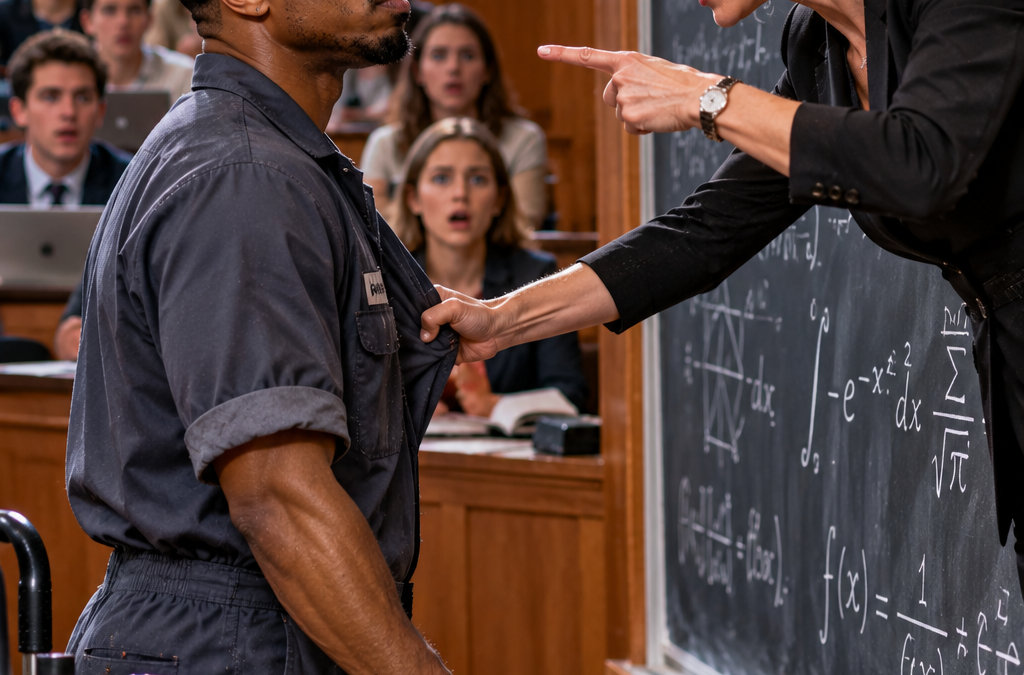
“Everyone, this is Preston Brooks.”
I looked around.
“Preston cleans this building.”
A few students laughed.
She continued.
“He mops your floors. Empties your trash.”
Another pause.
“And apparently, he also does our mathematics.”
More laughter.
My hand tightened around the mop.
I looked at the board.
My handwriting.
Displayed like evidence from a crime scene.
Victoria stepped toward me.
“Did you write that?”
I could have lied.
I did not.
“Yes.”
She tilted her head.
“With what qualifications?”
I said nothing.
“A GED?”
More laughter.
“Night school?”
Someone near the front covered her mouth.
“Or just a mop and a dream?”
The room laughed harder.
I remember thinking about Lily.
Not Clara.
Lily.
Because humiliation changes when you have a child.
You imagine someone doing the same thing to them.
I wondered how I would tell Lily I had stood there and let two hundred people laugh at her father.
Victoria turned toward the students.
“This is what happens when proximity gets confused with competence.”
My face burned.
She gestured toward the board.
“Being near genius does not make someone a genius.”
Something inside me hardened.
Not anger exactly.
Anger is hot.
This felt cold.
Then Victoria wrote another equation beneath my work.
Dense.
Complicated.
Designed to intimidate.
I recognized pieces of her published framework immediately.
She turned.
“I’ll tell you what, Mr. Brooks.”
Her voice became playful.
Cruelty often becomes playful when the person delivering it is certain nobody can hurt them back.
“Since you’re so interested in advanced mathematics…”
She looked me up and down.
Gray uniform.
Wet work shoes.
Cracked hands.
“Solve this.”
Somebody laughed.
Victoria smiled.
“Solve it and I’ll marry you.”
The room exploded.
People bent over laughing.
Someone clapped.
Phones rose higher.
I looked at her.
Then at the equation.
For fifteen years, I had erased myself from those boards.
That morning, I decided not to.
I leaned my mop against the wall.
Walked toward the board.
Victoria’s smile flickered.
I picked up a piece of chalk.
And began.
The first lines were straightforward.
I used her framework because I wanted everyone in the room to understand exactly where the problem lived.
A few graduate students followed.
Victoria crossed her arms.
Then I reached the substitution.
Stopped.
Circled it.
Victoria frowned.
“What are you doing?”
I pointed.
“This doesn’t hold.”
The room quieted.
“Excuse me?”
“The substitution in step three.”
I tapped the term.
“You assumed continuity across this boundary.”
Her face changed.
“The function isn’t continuous there.”
“That is a standard transformation.”
“Yes.”
I drew a line through it.
“But only under symmetric boundary conditions.”
A student in the first row leaned forward.
Victoria said, “The boundary conditions are valid.”
“No, ma’am.”
I rewrote the previous step.
“You changed the domain here.”
I pointed.
“But you retained the original boundary assumption.”
I heard pages turning behind me.
I continued.
“That creates a removable discontinuity across this interval.”
Victoria stared at the board.
“Everything after that depends on continuity.”
I wrote three more lines.
“So everything after it fails.”
Silence.
Not one laugh remained.
A student spoke.
“He’s right.”
I later learned his name was Thomas Reed.
Graduate student.
He looked down at his notebook.
Then back up.
“He’s right.”
Another student checked.
Then another.
Whispers spread.
Victoria walked toward the board.
Her heels sounded sharp against the floor.
She stood beside me.
Perfume.
Pressed dress.
Perfect hair.
Me in a uniform that smelled faintly of disinfectant.
For eleven seconds she studied the correction.
Then she turned toward the class.
“I inserted that error intentionally.”
The lie came too quickly.
“It was a test.”
Nobody answered.
She continued.
“To see whether anyone would catch it.”
Thomas closed his notebook.
His face said enough.
Victoria looked at me.
“You were lucky.”
I put down the chalk.
“One error doesn’t make you a mathematician.”
“No, ma’am.”
I picked up my mop.
“It doesn’t.”
I turned toward the door.
Then Harold Webb spoke from the back.
“Professor Ashford.”
Everyone turned.
He stood slowly.
“For the record, I reviewed the framework you just used last spring.”
Victoria’s face tightened.
“I flagged the same discontinuity.”
A wave of whispers.
“I assumed you would correct it in revision.”
He paused.
“You did not.”
Victoria turned white.
I looked at Harold.
He looked back at me.
Not like a janitor who had embarrassed a professor.
Not like a charity story.
Like one mathematician looking at another.
I walked out.
My legs shook only after the door closed.
The hallway was empty.
I leaned against the wall.
My chest hurt.
Not from fear.
From years.
Fifteen years of swallowing the assumption that if I wore a gray uniform, maybe people were entitled to believe there was nothing beyond it.
I was not ashamed of being a janitor.
Never had been.
Work is work.
I had raised Lily with that paycheck.
Paid for Clara’s medicine with it.
Kept food in our kitchen.
There is dignity in cleaning a room.
What hurt was the idea that cleaning a room somehow proved I was incapable of understanding what happened inside it.
That afternoon, I picked Lily up from school.
She ran toward me carrying a construction-paper project.
“Daddy!”
I lifted her.
She was eight and had Clara’s eyes.
“What happened to your shirt?”
I looked down.
A faint chalk streak crossed my chest.
“Long story.”
“Were you doing math at work again?”
I stared at her.
“How do you know I do math at work?”
She rolled her eyes.
“I know everything.”
“Terrifying.”
She laughed.
For that moment, the lecture hall disappeared.
Then Whitmore made sure it came back.
The next day, I found a letter inside my employee locker.
University letterhead.
Formal.
Polite.
Fourteen days.
I was “invited” to present a complete solution to Victoria’s open problem before a faculty committee.
If verified, I would receive the same $50,000 research grant available to other eligible participants.
If I declined or failed to demonstrate legitimate academic work, my employment could be reviewed for unauthorized use of university facilities.
I read the letter twice.
Unauthorized use.
I had spent fifteen years cleaning those rooms.
I had apparently earned the right to clean the chalk from the boards.
Not put chalk onto them.
That evening, the letter sat on my kitchen table between Lily and me.
Macaroni and cheese cooled on the stove.
She pointed with her fork.
“What’s that?”
“Math problem.”
“Hard?”
“Yes.”
“How hard?”
I looked at her.
“Harder than anything I’ve done.”
She thought about that.
“Harder than Mom’s problems?”
I smiled.
“Maybe.”
Lily returned to her long division.
A minute later, she said, “Mom said hard problems just mean you need more paper.”
I looked toward Clara’s leather notebook on the shelf.
That was when I knew I would do it.
Not for Victoria.
Not for the grant.
Not even for my job.
The problem in Victoria’s challenge was Clara’s unfinished problem.
Close enough that the same structure appeared.
The final page of Clara’s notebook had been waiting five years.
I took it down.
Opened it.
Her handwriting stopped mid-thought.
I ran my thumb across the page.
Then started working.
Day one disappeared into equations.
I worked my overnight shift.
Came home at five thirty.
Kissed Lily while she slept.
Made coffee.
Sat at the table.
Clara had approached the problem differently from the published literature.
Combinatorics first.
Topology second.
At first glance, almost naïve.
But Clara had never cared whether an approach was respectable.
Only whether it worked.
By day three, I had forty pages.
Printer paper recovered from Whitmore recycling bins.
Written on both sides.
Margins packed.
Lily fell asleep on the couch while I worked.
I carried her to bed.
Then returned.
The first three stages opened.
The fourth did not.
Step four was the graveyard.
Topology and number theory had to be connected in a way nobody had managed cleanly.
I tried standard transformations.
Failed.
Modified spectral methods.
Failed.
Brute-force computation.
Failed.
Six hours produced twenty useless pages.
I crushed them into the trash.
At dawn, I sat staring at Clara’s notebook.
“Where did you see it?” I whispered.
No answer came.
On day five, Harold Webb found me during my break.
I was sitting on an overturned bucket inside the supply closet, writing on cardboard because I had run out of paper.
He stood in the doorway.
“You’re working on it.”
I looked up.
“You probably shouldn’t be here.”
“Why?”
“They’ll say you’re helping.”
“I’m not.”
He stepped inside.
“I’m here to tell you I failed.”
I waited.
“Twenty-two years ago, I worked on the Caldwell–Morrison conjecture.”
I stopped writing.
“Fourteen months.”
He smiled without humor.
“I published one partial result. Eleven citations. Not exactly immortality.”
“Where did you stop?”
“Step four.”
Of course.
“The bridge?”
“Topology to number theory.”
I nodded.
“Tried everything I knew.”
He looked at my cardboard.
“But you’re not trying what I knew.”
I said nothing.
“You think differently.”
“That’s a polite way to say untrained.”
“No.”
His answer came sharply.
“That is what people like Victoria mean when they say it.”
He crouched slightly.
“I mean you didn’t spend ten years being taught which doors are supposed to be locked.”
That sentence stayed with me.
He pulled a photocopied article from his jacket.
Minor paper in combinatorial topology.
“I’m not giving you a solution.”
“I wouldn’t take one.”
“I know.”
He placed the article beside a bottle of bleach.
“This result might show you where a door is.”
Then he left.
I read that article seven times.
On the eighth, I saw it.
A small lemma about boundary conditions in discrete spaces.
Almost irrelevant to the original paper.
But it aligned with something Clara had written years earlier.
Not the solution.
A hinge.
Day eight.
Three in the morning.
My kitchen table disappeared beneath paper.
Lily’s drawings covered the refrigerator.
One showed three stick figures holding hands.
One small.
Two large.
The figure representing Clara had wings.
I worked four hours.
The connection came close.
Then vanished.
I could feel it.
That may sound strange to people who do not love mathematics.
But sometimes you know an answer exists before you can articulate it.
The structure starts humming beneath the symbols.
You can almost hear where things want to connect.
At seven fifteen, Lily walked into the kitchen wearing pajamas.
“Daddy?”
“Yes?”
“Did you sleep?”
“Technically.”
“That means no.”
She picked up one sheet.
Turned it sideways.
“This looks like a butterfly.”
She pointed at an integral sign.
I laughed.
Really laughed.
The first time in days.
“What?”
“Your mom called them butterflies.”
“She did?”
“All the time.”
Lily put the page down.
“You’re going to finish Mom’s problem, right?”
“I’m trying.”
“She’d want you to.”
I looked at her.
Clara’s eyes.
Clara’s certainty.
“Yes.”
Day ten.
I later learned Victoria had pulled my employment records.
High school diploma.
No college degree.
No academic certifications.
Night janitor since age twenty-seven.
Emergency contact: Clara Brooks, deceased.
Dependent: Lily Brooks, age eight.
Maybe for a second she saw something human there.
If she did, it did not last.
She began building an academic-fraud case.
By day eleven, my body started failing.
Four hours of sleep across three days.
My vision blurred.
At work, I dropped a bucket in the second-floor hallway.
Water spread around my shoes.
I stood there unable to move for thirty seconds.
A security guard asked if I needed medical attention.
I said no.
I mopped it up.
That morning, I fell asleep at the kitchen table.
When I woke, a blanket covered my shoulders.
Beside my hand lay a note in purple crayon.
YOU CAN DO IT, DADDY.
LOVE, LILY.
I kept that note.
Day twelve.
The supply closet became my unofficial office.
Equations taped to walls.
Shelves.
Locker.
Inside of the door.
I was close.
Step four had changed from a wall into a door with light beneath it.
I needed one more idea.
Something inside Clara’s notebook.
A margin note.
A discarded calculation.
Something she had seen but not had time to develop.
Day thirteen, the university took everything.
Two campus security officers came to my closet.
“Mr. Brooks?”
“Yes?”
“You need to step outside.”
“Why?”
“We’ve been instructed to secure this area.”
They photographed every page.
Every equation.
Every scrap.
Yellow tape went across the door.
I stood in the hallway watching twelve days of work become evidence.
I asked, “Can I have my notes?”
“No.”
“They belong to me.”
“They’re part of an academic misconduct review.”
“On whose authority?”
One officer looked uncomfortable.
“Department administration.”
Victoria.
I found out the accusation an hour later.
Professor Webb had provided restricted research.
My notation resembled his published work.
The 1998 article was found inside my locker.
Victoria described that as proof of academic fraud.
Harold was suspended.
When he found me sitting outside the building, he lowered himself onto the bench beside me.
For a while, neither of us spoke.
“I’m sorry,” I said.
“For what?”
“You got suspended because of me.”
“No.”
He stared at the mathematics building.
“I got suspended because a frightened person has authority.”
I looked at him.
“She’s scared.”
“Of what?”
“You.”
I laughed once.
“She isn’t scared of me.”
“Yes, she is.”
He turned.
“She chose that problem because she believed nobody could solve it.”
He paused.
“And now the man she publicly declared unqualified is getting close.”
I looked down.
“They took my pages.”
“Do you remember them?”
“Most.”
“Then they took paper.”
He stood.
“You still have Clara’s notebook?”
I nodded.
“Then they didn’t take what matters.”
He walked away.
That evening, local news reported that a university janitor had been accused of academic fraud.
My employee photograph appeared on screen.
Gray uniform.
Neutral expression.
A quotation from an unnamed faculty source said I had “no business being near that board.”
By noon the following day, my phone would not stop ringing.
I turned it off.
At three fifteen, Lily came home from school.
She dropped her backpack.
Her eyes were red.
“Daddy.”
I stood.
“What happened?”
“Tyler said you’re a cheater.”
Everything inside me froze.
“He showed everyone an article.”
I crouched in front of her.
“What did he say?”
“That you stole somebody’s homework.”
She wiped her face.
“He said janitors don’t know math.”
I swallowed.
“I told him you do.”
“Good.”
“I told him Mom taught you.”
Her mouth trembled.
“And he said Mom was probably dumb too.”
For ten seconds, I could not speak.
Clara had died five years earlier.
Cancer had taken almost everything physical from her.
Her hair.
Her strength.
Her appetite.
Her voice near the end.
But hearing my daughter tell me that another child had insulted the dead mother she barely remembered almost broke something in me.
I pulled Lily against my chest.
She cried.
I held her.
“Your mother was the smartest person I ever knew.”
“Then why do people say things?”
“Because they don’t know her.”
I kissed her hair.
“And they don’t know us.”
That evening, I made scrambled eggs and toast.
Clara’s bad-day meal.
Lily went to bed early.
I returned to the notebook.
The deadline was the next morning.
I had nothing.
Then I read the final margin note again.
I had read it a hundred times.
Almost there.
Try flipping the boundary.
Mirror image.
I stared.
Mirror image.
I had always assumed she meant the geometric boundary.
She did not.
She meant the proof.
Every major attempt went from topology toward number theory.
Left to right.
Because that was the natural scholarly direction.
Because that was how the problem had always been taught.
What if Clara meant reverse it?
Start with number theory.
Build backward toward topology.
Right to left.
I picked up my pencil.
A simple identity.
Undergraduate level.
I extended it.
Generalized it.
Mapped the resulting structure onto the topological framework.
Not forcing one discipline into another.
Letting the relationship emerge.
My breathing changed.
Line four.
Line five.
Line six.
The bridge appeared.
Eleven lines.
That was all.
Thirty years of failed step four.
Eleven lines.
I stared at them.
Read them again.
Checked every assumption.
Again.
Again.
At 2:47 in the morning, I put down my pencil.
It held.
My hands started shaking.
I opened Clara’s notebook.
Placed my palm over her handwriting.
“I found it.”
My voice broke.
“I found your butterfly.”
Lily’s purple note remained beside me.
YOU CAN DO IT, DADDY.
I cried quietly at the kitchen table.
Not because of Victoria.
Not because of the grant.
Because for five years, Clara’s unfinished thought had felt like a conversation interrupted forever.
That night, for one moment, I felt as though she had finished the sentence.
At eight fifty-eight the next morning, I entered Whitmore’s main lecture hall.
Every seat was full.
Students from other departments crowded the upper rows.
Local news cameras stood at the back.
Faculty committee in front.
Dean Richard Hail.
Professor Eleanor Shaw.
Vice chair Nathan Cole.
Other faculty.
Victoria sat in the center.
Perfect navy dress.
Hair pinned.
A pen turning continuously between her fingers.
Harold Webb sat in the last row.
Technically suspended.
Apparently nobody had convinced him he was forbidden from sitting quietly in a public lecture.
I wore my gray uniform.
The university had offered me a jacket.
I refused.
Not because I wanted to make a statement.
Because I did not want anyone believing the uniform had been the embarrassing part of this story.
I walked toward the board.
Same board.
Same room.
Same place where laughter had surrounded me fourteen days earlier.
I picked up the chalk.
My hand was steady.
The first three stages took thirty minutes.
Combinatorial construction.
Generalization.
Topological mapping.
Professor Shaw leaned forward.
Thomas Reed wrote quickly.
Nobody interrupted.
Then I reached step four.
I stopped.
For three seconds, I heard Clara.
Not literally.
Memory.
Her voice from years earlier.
Hard problems just mean more paper.
I reached into my breast pocket.
Pulled out the folded page containing her margin note.
Looked once.
Mirror image.
Then put it away.
I wrote the number-theory identity.
Expanded it.
Generalized.
Then reversed the standard bridge.
Number theory toward topology.
Right to left.
Line one.
Two.
Three.
The room became impossibly quiet.
Four.
Five.
Six.
I heard somebody whisper.
Seven.
Eight.
Nine.
Professor Shaw’s chair creaked as she leaned closer.
Ten.
Eleven.
I wrote the final equality.
Then stopped.
Forty-two minutes.
I placed the chalk onto the tray.
The tiny sound seemed enormous.
I turned around.
Two hundred people stared at me.
Nobody clapped.
For one terrifying second, I thought I had missed something.
Then Professor Shaw spoke.
“It holds.”
Her voice was almost a whisper.
She stood.
Walked closer to the board.
Read the final steps again.
“It holds.”
She turned toward the committee.
“Every step.”
Dean Hail removed his glasses.
“Mr. Brooks.”
“Yes, sir?”
“Where did you study?”
“Nowhere.”
A murmur moved through the room.
“My wife taught me.”
I looked toward the folded paper in my pocket.
“She started the proof.”
Thomas Reed stood first.
He clapped once.
Then again.
Another student joined him.
Then ten.
Then fifty.
The entire room rose.
The sound hit me physically.
Applause.
Feet against the floor.
People shouting.
Phones in the air.
I stayed beside the board.
Chalk dust on my fingers.
I looked at my hands.
Cracked skin.
Cleaning chemicals in the lines.
Hands that had held Clara during chemotherapy.
Hands that braided Lily’s hair badly before school because her mother was gone.
Hands that had scrubbed bathrooms at three in the morning.
Hands that had erased thousands of other people’s equations.
Nobody had changed those hands.
They were the same hands.
Only the room had finally learned what else they could do.
I looked at Harold.
He stood in the back row.
Did not clap wildly.
Just nodded.
That meant more.
Then I saw Victoria.
She had not moved.
Her pen lay on the floor.
She stared at the proof.
Her eyes were wet.
For once, she was not looking at my uniform.
She was not looking at my shoes.
Or my hands.
She was looking at the mathematics.
Then at me.
A professor two seats away leaned toward her.
“So when’s the wedding?”
A few students laughed.
I didn’t.
Neither did Victoria.
The joke suddenly felt ugly in a way it had not to the room two weeks earlier.
Maybe that was progress.
Humiliation does not become justice merely because the direction changes.
Victoria lowered her eyes.
The video spread before I left campus.
Millions watched.
But what went viral was not the forty-two-minute proof.
It was the original humiliation.
Victoria grabbing my faded sleeve.
Telling me I had no business at the board.
Then:
“Solve this and I’ll marry you.”
Cut to me finishing the conjecture.
Standing ovation.
Victoria crying.
People turned it into entertainment.
Memes.
Wedding jokes.
Headlines.
I avoided all of them.
Lily did not.
She came home furious.
“They keep saying you should marry her.”
“I know.”
“Are you?”
“No.”
She looked relieved.
“Good.”
I laughed.
“Why good?”
“She was mean.”
“That is a compelling legal argument.”
Lily frowned.
“What’s legal?”
“Never mind.”
Two days later, Victoria came to my apartment.
I opened the door.
For a moment, neither of us spoke.
She looked different without the lecture hall behind her.
Smaller.
Not physically.
Human.
Lily stood behind me holding a purple crayon.
Victoria said, “I owe you an apology.”
“Yes.”
She blinked.
I think she expected me to rescue her from the discomfort.
I did not.
“I said those things because I wanted to humiliate you.”
“Yes.”
“I saw your uniform.”
She swallowed.
“And decided that told me what you were capable of.”
I said nothing.
“I wanted to make an example of you.”
Her hands trembled.
“I was wrong.”
“Yes.”
She took that too.
“I accused you of academic fraud because I couldn’t accept what was happening.”
“Harold lost his position temporarily.”
“I know.”
“My daughter was called a liar’s child.”
Victoria closed her eyes.
“I know.”
“No, Professor Ashford.”
I kept my voice quiet.
“You know the information.”
She looked at me.
“You do not know what it feels like to hear your eight-year-old defend her dead mother because a university professor needed to protect her pride.”
Her face broke.
A tear moved down one cheek.
I felt no satisfaction.
That surprised me.
For fourteen days, I had imagined what it would feel like if Victoria finally understood.
There was no victory in watching someone become ashamed.
Only sadness at how unnecessary everything had been.
She wiped her cheek.
“I’m sorry.”
I believed she meant it.
That did not erase anything.
But it mattered.
Lily tugged my shirt.
“Daddy?”
“Yes?”
“Who’s she?”
I looked at Victoria.
Then at my daughter.
“Someone who’s learning.”
Victoria’s eyes filled again.
I stepped aside.
“You want coffee?”
She looked surprised.
“Yes.”
That was not forgiveness.
Not yet.
It was a door.
Three weeks later, another letter arrived.
MIT.
I almost threw it into the pile of university mail.
Then I saw my name.
The mathematics department had reviewed the proof.
They offered me a full doctoral fellowship.
Tuition.
Stipend.
Housing support.
Research placement.
They did not ask me to come as a novelty.
Not a visiting curiosity.
Not “the janitor mathematician.”
A student.
A researcher.
A colleague.
I sat at the kitchen table holding the letter.
Lily ate cereal across from me.
“Daddy?”
“Yes?”
“What’s wrong?”
“Nothing.”
“You look weird.”
“A school wants me to study mathematics.”
“What school?”
“MIT.”
She chewed.
“Is that good?”
I laughed.
“Yes.”
“Far?”
“A little.”
She stopped chewing.
“Can I come?”
I reached across the table.
“You’re coming anywhere I go.”
“Then okay.”
Just like that.
Decision made.
Victoria resigned as department chair the same week.
She was not fired.
She resigned.
I heard she submitted one page to Dean Hail.
No excuses.
No defense.
She kept teaching, but not as chair.
She later told me she had hung one photograph above her home desk.
The security still of me at the Whitmore board at 2:14 in the morning.
Gray uniform.
Mop against the wall.
Chalk in my hand.
She said she kept it as a warning to herself.
I understood.
Whitmore held a ceremony before I left.
Main auditorium.
Packed.
Students.
Faculty.
News cameras.
The university president presented the $50,000 research award.
Harold Webb’s suspension had already been reversed.
He sat in the front row.
Where he belonged.
Lily sat beside him.
Victoria sat on Lily’s other side.
That arrangement would have seemed impossible a month earlier.
I stood behind the podium.
Still wearing my janitor uniform.
Someone from administration had offered me a suit.
Again.
Again I said no.
I looked at the audience.
For fifteen years, I had cleaned rooms filled with people like them.
I did not resent that anymore.
Maybe I never truly had.
I gripped the podium.
“My name is Preston Brooks.”
My voice sounded strange through the microphone.
“For fifteen years, I’ve cleaned this building.”
I paused.
“There is nothing shameful about that.”
The room became still.
“I want to say that first because a lot of people have described what happened here as a story about a janitor who turned out to be something more.”
I shook my head.
“I don’t like that description.”
Harold watched me.
“So I’ll correct it the same way I corrected the board.”
A few people smiled.
“I did not stop being a janitor when I solved that problem.”
I looked down at my hands.
“And I did not become valuable when professors discovered I could do mathematics.”
Silence.
“I was valuable the night before.”
Lily smiled.
“So was every person who cleaned this building with me.”
I looked toward Victoria.
“So is every person whose job makes other people stop wondering what might exist inside their head.”
Victoria lowered her eyes.
“My wife taught mathematics.”
My voice changed.
“Her name was Clara Brooks.”
I took the leather notebook from beneath the podium.
“She began the proof.”
I held it up.
“She never got to finish.”
I looked toward Lily.
“She died five years ago.”
The room was silent.
“Most of what you saw on that board came from years of conversations with her.”
I swallowed.
“So the proof belongs to her as much as it belongs to me.”
Lily wiped her face.
I continued.
“Professor Ashford made a mistake when she looked at me.”
Victoria looked up.
“She thought my uniform told her what I knew.”
I paused.
“But I made a mistake too.”
People shifted.
“I spent fifteen years believing the safest thing was to hide.”
Harold’s face softened.
“I solved equations at night and erased them before morning because I had already decided people like me were not welcome in those conversations.”
I looked at the students.
“Maybe I had reasons.”
I glanced at Victoria.
“But hiding also meant nobody had a chance to be better than I expected them to be.”
The words surprised even me.
I had not written a speech.
“Some people proved my fears right.”
I looked toward Harold.
“Others didn’t.”
He nodded.
“The lesson I want my daughter to learn is not that she must solve an impossible problem before someone takes her seriously.”
My voice strengthened.
“She shouldn’t have to.”
Lily looked straight at me.
“The lesson is that another person’s inability to recognize your mind does not reduce it.”
Applause began.
I raised one hand.
Not yet.
“And if you’re the person doing the judging…”
I looked across the faculty.
“…understand something.”
The room quieted again.
“Prejudice doesn’t only wound the person you misjudge.”
I glanced at the board behind the stage.
“It makes you blind.”
Victoria’s eyes closed briefly.
“You stop seeing talent.”
“You stop seeing ideas.”
“You stop seeing human beings.”
“And sometimes the person you refuse to see is standing three feet away holding the answer you’ve been looking for.”
Nobody moved.
I closed Clara’s notebook.
“I spent fifteen years erasing boards.”
I smiled.
“I think I’m ready to stop erasing.”
Then I stepped away.
The applause rose slowly.
Not wild.
Not theatrical.
Heavy.
Harold stood.
Then Lily.
Then Victoria.
Soon the entire auditorium was standing.
I walked down the steps.
Lily ran to me.
I lifted her.
“You did good, Daddy.”
“That’s high praise.”
“You talked too long.”
“There’s my critic.”
Harold joined us.
He held out his hand.
I ignored it and hugged him.
He laughed.
“Careful. I have a reputation.”
Then Victoria approached.
She stopped several feet away.
For the first time since I had met her, she seemed unsure whether she was entitled to come closer.
Lily solved that.
She held out her hand.
Victoria looked at it.
Then took it.
Lily looked at me.
“Are we going to eat?”
I laughed.
“Yes.”
“Pizza?”
“Yes.”
“Can she come?”
I looked at Victoria.
Victoria looked at me.
“If she wants.”
Victoria swallowed.
“I’d like that.”
We walked from the auditorium together.
Not holding hands like some viral fairy tale.
Not beginning a romance because of a cruel joke.
That would have made what happened too simple.
Victoria and I were not in love.
We were two people standing on opposite sides of a mistake that had changed both of us.
Over time, we became something more complicated.
Friends.
Eventually colleagues.
People capable of telling each other uncomfortable truths.
She never asked me to forget what she did.
I never used it to keep her permanently beneath me.
That mattered.
Because I had no interest in becoming the person who once looked at me and decided a single thing told the whole story.
Months later, Lily and I moved to Massachusetts.
The first day I walked into MIT as a doctoral student, I almost turned around.
Everyone seemed younger.
Better dressed.
More prepared.
People spoke casually about universities I had never visited and professors whose books I had taught myself from after midnight.
For a few seconds, I became the janitor outside the lecture hall again.
Then I felt something in my backpack.
Clara’s notebook.
I kept walking.
My first seminar professor handed out a problem.
I solved it.
Then another.
I struggled with that one for three days.
That felt strangely good.
Because for the first time, I could fail openly.
I did not have to hide every unfinished idea.
I did not have to erase the board.
Harold called once a week.
Victoria emailed occasionally.
Lily adapted faster than I did.
Within a month, she had corrected one of my professors about a arithmetic mistake on a café receipt.
Clara would have been proud.
Years later, people still occasionally recognized me.
“Are you the janitor who solved that theorem?”
I learned to answer carefully.
“I’m Preston Brooks.”
Sometimes they understood the correction.
Sometimes they didn’t.
The $50,000 grant helped.
The fellowship changed our finances.
But the most valuable thing Whitmore gave me was not money.
It was the moment I stopped allowing other people’s assumptions to decide how much of myself I showed the world.
I kept my old uniform.
It hangs in my closet even now.
Gray.
Faded.
Collar frayed.
One sleeve still bears a white chalk mark that never fully washed out.
Lily once asked why I kept it.
“Because it reminds me.”
“Of Professor Ashford?”
“No.”
“Of Mom?”
“Partly.”
“Then what?”
I held the fabric between my fingers.
“That a uniform can tell people what work you do.”
I looked at her.
“It cannot tell them who you are.”
She thought about that.
Then nodded as though the issue were obvious.
Children sometimes understand in ten seconds what adults spend lifetimes refusing to learn.
Clara’s notebook sits beside mine now.
I never replaced it.
The final problem is no longer unfinished.
After the proof was formally verified, I copied the completed argument beneath her last line.
At the bottom, I wrote two sentences.
You were right about the mirror.
Lily still calls the integrals butterflies.
I like to imagine Clara would laugh.
Sometimes late at night, I remember that first lecture hall.
Two hundred students.
Victoria’s hand gripping my sleeve.
The laughter.
Her voice.
Solve this and I’ll marry you.
For a long time, I thought the important moment came when I picked up the chalk.
I was wrong.
The important moment came just before.
The second when I could have taken my mop and walked out.
Nobody would have blamed me.
I had already been humiliated.
I owed that room nothing.
But walking away would have meant allowing Victoria’s judgment to become the final statement about me.
So I stayed.
Not because I needed to prove I was better than her.
Because I finally understood I had spent too many years helping other people remain comfortable with knowing only the smallest version of me.
I put down the mop.
Picked up the chalk.
And let the board stay written.
That was the real beginning.
The equation was only proof.
𝗧𝗛𝗘 𝗘𝗡𝗗
𝗧𝗛𝗘 𝗘𝗡𝗗
The Professor Looked at My Janitor’s Uniform and Decided I Had No Business Touching Her Blackboard
For fifteen years, I erased equations from Whitmore University’s blackboards before sunrise so nobody would know the man pushing the mop cart could understand them. The morning Professor Victoria Ashford grabbed my sleeve in front of two hundred students, I realized she had mistaken my silence for proof that there was nothing inside me worth hearing.
My name is Preston Brooks, and for fifteen years I cleaned a mathematics department where almost nobody knew I loved mathematics.
That sounds strange when I say it now.
At the time, it felt normal.
Whitmore University sat on forty acres of old Connecticut land covered in carefully trimmed lawns, stone buildings and ivy that seemed to have been trained to grow in exactly the right places.
The mathematics building was one of the oldest structures on campus.
Three floors.
Marble hallways.
Heavy oak doors.
Lecture rooms with blackboards so wide they covered almost entire walls.
During the day, some of the smartest people in the country filled those rooms.
Professors argued about proofs.
Graduate students covered boards with symbols.
Visiting scholars gave lectures using words most people outside mathematics would never hear in their lives.
At night, all those people went home.
Then I arrived.
Nine o’clock.
Gray uniform.
Work shoes.
Mop cart with a squeaky left wheel.
Bucket.
Gloves.
Keys.
That was the version of me Whitmore knew.
“Evening, Preston.”
“Morning, Preston.”
“Can you get that coffee stain?”
“Trash is full in 304.”
“Bathroom on the second floor needs attention.”
Most people were not cruel.
That is important.
They simply did not think about me.
Sometimes being invisible does not require hatred.
Sometimes all it requires is convenience.
I appeared after their work was done and disappeared before they came back.
To them, I was part of the building.
Like the lights.
The elevators.
The heat.
Useful when needed.
Otherwise unnoticed.
I did not resent them for that.
Not at first.
I had a daughter to raise.
Bills to pay.
A wife to remember.
And mathematics.
Mathematics belonged to me whether anybody at Whitmore understood that or not.
My wife, Clara, had taught me my first real equation on our second date.
We were sitting in a diner outside Hartford.
Coffee between us.
She had been talking about her students.
Clara taught high school mathematics and believed with almost religious conviction that there was no such thing as a child who was “bad at math.”
Only children who had been frightened badly enough to stop trying.
She tore a napkin in half.
Wrote an equation.
Slid it toward me.
“Solve it.”
I laughed.
“What is this?”
“A test.”
“For what?”
“To see if I should agree to a third date.”
“You already agreed.”
“I can withdraw.”
I picked up the pen.
She watched me.
I had never gone beyond high school.
College had not been financially possible.
My father died when I was seventeen.
My mother worked two jobs.
By graduation, earning money mattered more than collecting credits.
But numbers had always made sense to me.
Not easy exactly.
Natural.
I looked at Clara’s equation.
Saw the structure.
Made two substitutions.
Solved it.
Then slid the napkin back.
She stared at it.
“How long have you been pretending you can’t do math?”
“I didn’t know I was pretending.”
She smiled.
“You see numbers the way musicians hear notes.”
I carried that sentence for the rest of our marriage.
Clara started bringing problems home.
At first they were puzzles.
Then calculus.
Linear algebra.
Abstract algebra.
Topology.
She taught me language for things I had already been doing instinctively.
I learned from used textbooks.
Library books.
Online lectures.
Stacks of photocopied journal articles she smuggled home from school databases.
We spent evenings at the kitchen table arguing about proofs while dinner went cold.
When our daughter Lily was born, Clara sometimes solved equations with one hand while rocking her with the other.
Those were the happiest years of my life.
Then Clara became sick.
Ovarian cancer.
She was forty-one.
By the time the doctors understood how aggressive it was, we had less time than we thought.
She died five years before Victoria Ashford walked into my life.
Lily was three.
I was forty-two.
People talk about grief as if it is sadness.
Sadness is part of it.
But grief is also disruption.
The coffee cup someone no longer uses.
Half a closet.
A second toothbrush gone.
A child asking why Mommy cannot come to the school concert.
A grocery store aisle where you suddenly remember the brand of cereal your wife bought.
And silence.
God, the silence.
For months after Clara died, mathematics became the only place where I could still hear her.
She left behind a leather notebook.
Brown.
Worn corners.
Pages thick with equations.
Crossed-out ideas.
Arrows.
Questions.
Occasional jokes to herself.
There was one unfinished problem on the final pages.
I did not know its formal name then.
Later I learned it was a variant of the Caldwell–Morrison conjecture.
It had defeated mathematicians for decades.
Clara had found it in an old text and copied it because, as she wrote in the margin:
This one bothers me.
That was Clara.
A difficult problem did not intimidate her.
It irritated her until she understood it.
She had made real progress.
Then stopped.
Not because she surrendered.
Because cancer interrupted her.
So I kept going.
At Whitmore, after the final students left, I would finish my cleaning and stand in front of whatever mathematics remained on the board.
Sometimes it was undergraduate calculus.
Sometimes graduate algebra.
Sometimes a professor had left half a proof.
I worked through all of it.
At first, I used scrap paper.
Eventually, I began writing directly on the board.
I would work until two or three in the morning.
Then erase everything.
Clean the room.
Return the markers and chalk.
Push my cart onward.
Nobody knew.
For years, that arrangement suited me.
I did not want attention.
I wanted mathematics.
There is freedom in doing something only because you love it.
No publication pressure.
No tenure review.
No grant competition.
No one measuring whether my idea was fashionable.
If a proof took six months, it took six months.
If I failed, nobody knew.
If I succeeded, nobody applauded.
Clara would have understood.
Then Victoria Ashford arrived.
I knew who she was before I ever met her.
Everyone did.
Thirty-two years old.
Doctorate at twenty-five.
Three major journal publications before thirty.
Transferred from Princeton.
Youngest mathematics department chair in Whitmore history.
Brilliant.
Nobody questioned that.
I certainly didn’t.
I read her papers.
Some were excellent.
One in particular on boundary transformations stayed with me for weeks.
Victoria had the kind of mind that moved fast and expected the world to move with it.
But brilliance can become dangerous when a person starts confusing intelligence with rank.
She came from a world I had only ever cleaned after.
Greenwich.
Private schools.
Summer programs.
Prestigious universities.
Her father was a federal judge.
Her mother was a corporate attorney.
She entered Whitmore already knowing she belonged.
I had spent most of my life knowing I could be removed from almost any room if someone important decided I looked wrong inside it.
Victoria posted the challenge during her first semester.
Fifty-thousand-dollar research grant.
An open problem in algebraic topology.
The Caldwell–Morrison variant.
She wrote it across the main department board.
Then announced that she expected serious submissions from doctoral candidates.
That night, I stood in front of it for nearly an hour without touching the chalk.
I knew the structure.
Not because I had seen that exact formulation.
Because Clara’s notebook had been orbiting the same problem.
I felt something inside me move.
For three weeks, Whitmore’s graduate students attacked it.
I watched their work appear and disappear.
I saw where they got trapped.
Most used the standard framework.
Reasonable.
Elegant.
Wrong direction, I thought.
But I was not certain.
One night, at 2:14 in the morning, I finally wrote five lines on the board.
Not a solution.
An approach.
I meant to erase them.
Then Lily called.
She had woken from a nightmare.
My neighbor, Mrs. Gomez, was staying with her during my shift, but Lily wanted to hear my voice.
I talked to her for fifteen minutes.
By the time I hung up, I had fallen behind schedule.
I cleaned the lecture hall.
Emptied the trash.
Mopped.
Then rolled my cart out.
I forgot the board.
Five lines.
That was all.
Five lines changed everything.
Victoria found them the next morning.
She checked security footage.
There I was.
Gray uniform.
Mop leaning against the wall.
Writing mathematics.
She could have spoken to me privately.
Could have asked what I was doing.
Could have asked where I learned it.
She did not.
Instead, she printed a still image.
Showed it to colleagues.
Apparently called me a janitor who thought he was John Nash.
Most laughed.
Professor Harold Webb did not.
I knew Harold by sight.
Sixty-five.
White hair.
Quiet manner.
Twenty-something years at Whitmore.
He often stayed later than other faculty.
Sometimes when I entered his office, he was still reading.
Unlike many professors, he always moved his own coffee mug before I cleaned around it.
Small thing.
I noticed.
The next morning, I arrived for what I had been told was a facilities issue.
Ten o’clock.
Unusual time for me.
I had barely slept after my night shift.
I carried my mop because a supervisor had said there might be a spill in the main lecture hall.
When I opened the side door, two hundred people turned toward me.
Every seat was full.
Students sat on the steps.
Teaching assistants lined the back wall.
Phones came up.
Victoria stood at the front.
My five lines remained on the board.
The room began whispering.
I stopped.
Something in my stomach sank.
Victoria smiled.
“Everyone, this is Preston Brooks.”
I looked around.
“Preston cleans this building.”
A few students laughed.
She continued.
“He mops your floors. Empties your trash.”
Another pause.
“And apparently, he also does our mathematics.”
More laughter.
My hand tightened around the mop.
I looked at the board.
My handwriting.
Displayed like evidence from a crime scene.
Victoria stepped toward me.
“Did you write that?”
I could have lied.
I did not.
“Yes.”
She tilted her head.
“With what qualifications?”
I said nothing.
“A GED?”
More laughter.
“Night school?”
Someone near the front covered her mouth.
“Or just a mop and a dream?”
The room laughed harder.
I remember thinking about Lily.
Not Clara.
Lily.
Because humiliation changes when you have a child.
You imagine someone doing the same thing to them.
I wondered how I would tell Lily I had stood there and let two hundred people laugh at her father.
Victoria turned toward the students.
“This is what happens when proximity gets confused with competence.”
My face burned.
She gestured toward the board.
“Being near genius does not make someone a genius.”
Something inside me hardened.
Not anger exactly.
Anger is hot.
This felt cold.
Then Victoria wrote another equation beneath my work.
Dense.
Complicated.
Designed to intimidate.
I recognized pieces of her published framework immediately.
She turned.
“I’ll tell you what, Mr. Brooks.”
Her voice became playful.
Cruelty often becomes playful when the person delivering it is certain nobody can hurt them back.
“Since you’re so interested in advanced mathematics…”
She looked me up and down.
Gray uniform.
Wet work shoes.
Cracked hands.
“Solve this.”
Somebody laughed.
Victoria smiled.
“Solve it and I’ll marry you.”
The room exploded.
People bent over laughing.
Someone clapped.
Phones rose higher.
I looked at her.
Then at the equation.
For fifteen years, I had erased myself from those boards.
That morning, I decided not to.
I leaned my mop against the wall.
Walked toward the board.
Victoria’s smile flickered.
I picked up a piece of chalk.
And began.
The first lines were straightforward.
I used her framework because I wanted everyone in the room to understand exactly where the problem lived.
A few graduate students followed.
Victoria crossed her arms.
Then I reached the substitution.
Stopped.
Circled it.
Victoria frowned.
“What are you doing?”
I pointed.
“This doesn’t hold.”
The room quieted.
“Excuse me?”
“The substitution in step three.”
I tapped the term.
“You assumed continuity across this boundary.”
Her face changed.
“The function isn’t continuous there.”
“That is a standard transformation.”
“Yes.”
I drew a line through it.
“But only under symmetric boundary conditions.”
A student in the first row leaned forward.
Victoria said, “The boundary conditions are valid.”
“No, ma’am.”
I rewrote the previous step.
“You changed the domain here.”
I pointed.
“But you retained the original boundary assumption.”
I heard pages turning behind me.
I continued.
“That creates a removable discontinuity across this interval.”
Victoria stared at the board.
“Everything after that depends on continuity.”
I wrote three more lines.
“So everything after it fails.”
Silence.
Not one laugh remained.
A student spoke.
“He’s right.”
I later learned his name was Thomas Reed.
Graduate student.
He looked down at his notebook.
Then back up.
“He’s right.”
Another student checked.
Then another.
Whispers spread.
Victoria walked toward the board.
Her heels sounded sharp against the floor.
She stood beside me.
Perfume.
Pressed dress.
Perfect hair.
Me in a uniform that smelled faintly of disinfectant.
For eleven seconds she studied the correction.
Then she turned toward the class.
“I inserted that error intentionally.”
The lie came too quickly.
“It was a test.”
Nobody answered.
She continued.
“To see whether anyone would catch it.”
Thomas closed his notebook.
His face said enough.
Victoria looked at me.
“You were lucky.”
I put down the chalk.
“One error doesn’t make you a mathematician.”
“No, ma’am.”
I picked up my mop.
“It doesn’t.”
I turned toward the door.
Then Harold Webb spoke from the back.
“Professor Ashford.”
Everyone turned.
He stood slowly.
“For the record, I reviewed the framework you just used last spring.”
Victoria’s face tightened.
“I flagged the same discontinuity.”
A wave of whispers.
“I assumed you would correct it in revision.”
He paused.
“You did not.”
Victoria turned white.
I looked at Harold.
He looked back at me.
Not like a janitor who had embarrassed a professor.
Not like a charity story.
Like one mathematician looking at another.
I walked out.
My legs shook only after the door closed.
The hallway was empty.
I leaned against the wall.
My chest hurt.
Not from fear.
From years.
Fifteen years of swallowing the assumption that if I wore a gray uniform, maybe people were entitled to believe there was nothing beyond it.
I was not ashamed of being a janitor.
Never had been.
Work is work.
I had raised Lily with that paycheck.
Paid for Clara’s medicine with it.
Kept food in our kitchen.
There is dignity in cleaning a room.
What hurt was the idea that cleaning a room somehow proved I was incapable of understanding what happened inside it.
That afternoon, I picked Lily up from school.
She ran toward me carrying a construction-paper project.
“Daddy!”
I lifted her.
She was eight and had Clara’s eyes.
“What happened to your shirt?”
I looked down.
A faint chalk streak crossed my chest.
“Long story.”
“Were you doing math at work again?”
I stared at her.
“How do you know I do math at work?”
She rolled her eyes.
“I know everything.”
“Terrifying.”
She laughed.
For that moment, the lecture hall disappeared.
Then Whitmore made sure it came back.
The next day, I found a letter inside my employee locker.
University letterhead.
Formal.
Polite.
Fourteen days.
I was “invited” to present a complete solution to Victoria’s open problem before a faculty committee.
If verified, I would receive the same $50,000 research grant available to other eligible participants.
If I declined or failed to demonstrate legitimate academic work, my employment could be reviewed for unauthorized use of university facilities.
I read the letter twice.
Unauthorized use.
I had spent fifteen years cleaning those rooms.
I had apparently earned the right to clean the chalk from the boards.
Not put chalk onto them.
That evening, the letter sat on my kitchen table between Lily and me.
Macaroni and cheese cooled on the stove.
She pointed with her fork.
“What’s that?”
“Math problem.”
“Hard?”
“Yes.”
“How hard?”
I looked at her.
“Harder than anything I’ve done.”
She thought about that.
“Harder than Mom’s problems?”
I smiled.
“Maybe.”
Lily returned to her long division.
A minute later, she said, “Mom said hard problems just mean you need more paper.”
I looked toward Clara’s leather notebook on the shelf.
That was when I knew I would do it.
Not for Victoria.
Not for the grant.
Not even for my job.
The problem in Victoria’s challenge was Clara’s unfinished problem.
Close enough that the same structure appeared.
The final page of Clara’s notebook had been waiting five years.
I took it down.
Opened it.
Her handwriting stopped mid-thought.
I ran my thumb across the page.
Then started working.
Day one disappeared into equations.
I worked my overnight shift.
Came home at five thirty.
Kissed Lily while she slept.
Made coffee.
Sat at the table.
Clara had approached the problem differently from the published literature.
Combinatorics first.
Topology second.
At first glance, almost naïve.
But Clara had never cared whether an approach was respectable.
Only whether it worked.
By day three, I had forty pages.
Printer paper recovered from Whitmore recycling bins.
Written on both sides.
Margins packed.
Lily fell asleep on the couch while I worked.
I carried her to bed.
Then returned.
The first three stages opened.
The fourth did not.
Step four was the graveyard.
Topology and number theory had to be connected in a way nobody had managed cleanly.
I tried standard transformations.
Failed.
Modified spectral methods.
Failed.
Brute-force computation.
Failed.
Six hours produced twenty useless pages.
I crushed them into the trash.
At dawn, I sat staring at Clara’s notebook.
“Where did you see it?” I whispered.
No answer came.
On day five, Harold Webb found me during my break.
I was sitting on an overturned bucket inside the supply closet, writing on cardboard because I had run out of paper.
He stood in the doorway.
“You’re working on it.”
I looked up.
“You probably shouldn’t be here.”
“Why?”
“They’ll say you’re helping.”
“I’m not.”
He stepped inside.
“I’m here to tell you I failed.”
I waited.
“Twenty-two years ago, I worked on the Caldwell–Morrison conjecture.”
I stopped writing.
“Fourteen months.”
He smiled without humor.
“I published one partial result. Eleven citations. Not exactly immortality.”
“Where did you stop?”
“Step four.”
Of course.
“The bridge?”
“Topology to number theory.”
I nodded.
“Tried everything I knew.”
He looked at my cardboard.
“But you’re not trying what I knew.”
I said nothing.
“You think differently.”
“That’s a polite way to say untrained.”
“No.”
His answer came sharply.
“That is what people like Victoria mean when they say it.”
He crouched slightly.
“I mean you didn’t spend ten years being taught which doors are supposed to be locked.”
That sentence stayed with me.
He pulled a photocopied article from his jacket.
Minor paper in combinatorial topology.
“I’m not giving you a solution.”
“I wouldn’t take one.”
“I know.”
He placed the article beside a bottle of bleach.
“This result might show you where a door is.”
Then he left.
I read that article seven times.
On the eighth, I saw it.
A small lemma about boundary conditions in discrete spaces.
Almost irrelevant to the original paper.
But it aligned with something Clara had written years earlier.
Not the solution.
A hinge.
Day eight.
Three in the morning.
My kitchen table disappeared beneath paper.
Lily’s drawings covered the refrigerator.
One showed three stick figures holding hands.
One small.
Two large.
The figure representing Clara had wings.
I worked four hours.
The connection came close.
Then vanished.
I could feel it.
That may sound strange to people who do not love mathematics.
But sometimes you know an answer exists before you can articulate it.
The structure starts humming beneath the symbols.
You can almost hear where things want to connect.
At seven fifteen, Lily walked into the kitchen wearing pajamas.
“Daddy?”
“Yes?”
“Did you sleep?”
“Technically.”
“That means no.”
She picked up one sheet.
Turned it sideways.
“This looks like a butterfly.”
She pointed at an integral sign.
I laughed.
Really laughed.
The first time in days.
“What?”
“Your mom called them butterflies.”
“She did?”
“All the time.”
Lily put the page down.
“You’re going to finish Mom’s problem, right?”
“I’m trying.”
“She’d want you to.”
I looked at her.
Clara’s eyes.
Clara’s certainty.
“Yes.”
Day ten.
I later learned Victoria had pulled my employment records.
High school diploma.
No college degree.
No academic certifications.
Night janitor since age twenty-seven.
Emergency contact: Clara Brooks, deceased.
Dependent: Lily Brooks, age eight.
Maybe for a second she saw something human there.
If she did, it did not last.
She began building an academic-fraud case.
By day eleven, my body started failing.
Four hours of sleep across three days.
My vision blurred.
At work, I dropped a bucket in the second-floor hallway.
Water spread around my shoes.
I stood there unable to move for thirty seconds.
A security guard asked if I needed medical attention.
I said no.
I mopped it up.
That morning, I fell asleep at the kitchen table.
When I woke, a blanket covered my shoulders.
Beside my hand lay a note in purple crayon.
YOU CAN DO IT, DADDY.
LOVE, LILY.
I kept that note.
Day twelve.
The supply closet became my unofficial office.
Equations taped to walls.
Shelves.
Locker.
Inside of the door.
I was close.
Step four had changed from a wall into a door with light beneath it.
I needed one more idea.
Something inside Clara’s notebook.
A margin note.
A discarded calculation.
Something she had seen but not had time to develop.
Day thirteen, the university took everything.
Two campus security officers came to my closet.
“Mr. Brooks?”
“Yes?”
“You need to step outside.”
“Why?”
“We’ve been instructed to secure this area.”
They photographed every page.
Every equation.
Every scrap.
Yellow tape went across the door.
I stood in the hallway watching twelve days of work become evidence.
I asked, “Can I have my notes?”
“No.”
“They belong to me.”
“They’re part of an academic misconduct review.”
“On whose authority?”
One officer looked uncomfortable.
“Department administration.”
Victoria.
I found out the accusation an hour later.
Professor Webb had provided restricted research.
My notation resembled his published work.
The 1998 article was found inside my locker.
Victoria described that as proof of academic fraud.
Harold was suspended.
When he found me sitting outside the building, he lowered himself onto the bench beside me.
For a while, neither of us spoke.
“I’m sorry,” I said.
“For what?”
“You got suspended because of me.”
“No.”
He stared at the mathematics building.
“I got suspended because a frightened person has authority.”
I looked at him.
“She’s scared.”
“Of what?”
“You.”
I laughed once.
“She isn’t scared of me.”
“Yes, she is.”
He turned.
“She chose that problem because she believed nobody could solve it.”
He paused.
“And now the man she publicly declared unqualified is getting close.”
I looked down.
“They took my pages.”
“Do you remember them?”
“Most.”
“Then they took paper.”
He stood.
“You still have Clara’s notebook?”
I nodded.
“Then they didn’t take what matters.”
He walked away.
That evening, local news reported that a university janitor had been accused of academic fraud.
My employee photograph appeared on screen.
Gray uniform.
Neutral expression.
A quotation from an unnamed faculty source said I had “no business being near that board.”
By noon the following day, my phone would not stop ringing.
I turned it off.
At three fifteen, Lily came home from school.
She dropped her backpack.
Her eyes were red.
“Daddy.”
I stood.
“What happened?”
“Tyler said you’re a cheater.”
Everything inside me froze.
“He showed everyone an article.”
I crouched in front of her.
“What did he say?”
“That you stole somebody’s homework.”
She wiped her face.
“He said janitors don’t know math.”
I swallowed.
“I told him you do.”
“Good.”
“I told him Mom taught you.”
Her mouth trembled.
“And he said Mom was probably dumb too.”
For ten seconds, I could not speak.
Clara had died five years earlier.
Cancer had taken almost everything physical from her.
Her hair.
Her strength.
Her appetite.
Her voice near the end.
But hearing my daughter tell me that another child had insulted the dead mother she barely remembered almost broke something in me.
I pulled Lily against my chest.
She cried.
I held her.
“Your mother was the smartest person I ever knew.”
“Then why do people say things?”
“Because they don’t know her.”
I kissed her hair.
“And they don’t know us.”
That evening, I made scrambled eggs and toast.
Clara’s bad-day meal.
Lily went to bed early.
I returned to the notebook.
The deadline was the next morning.
I had nothing.
Then I read the final margin note again.
I had read it a hundred times.
Almost there.
Try flipping the boundary.
Mirror image.
I stared.
Mirror image.
I had always assumed she meant the geometric boundary.
She did not.
She meant the proof.
Every major attempt went from topology toward number theory.
Left to right.
Because that was the natural scholarly direction.
Because that was how the problem had always been taught.
What if Clara meant reverse it?
Start with number theory.
Build backward toward topology.
Right to left.
I picked up my pencil.
A simple identity.
Undergraduate level.
I extended it.
Generalized it.
Mapped the resulting structure onto the topological framework.
Not forcing one discipline into another.
Letting the relationship emerge.
My breathing changed.
Line four.
Line five.
Line six.
The bridge appeared.
Eleven lines.
That was all.
Thirty years of failed step four.
Eleven lines.
I stared at them.
Read them again.
Checked every assumption.
Again.
Again.
At 2:47 in the morning, I put down my pencil.
It held.
My hands started shaking.
I opened Clara’s notebook.
Placed my palm over her handwriting.
“I found it.”
My voice broke.
“I found your butterfly.”
Lily’s purple note remained beside me.
YOU CAN DO IT, DADDY.
I cried quietly at the kitchen table.
Not because of Victoria.
Not because of the grant.
Because for five years, Clara’s unfinished thought had felt like a conversation interrupted forever.
That night, for one moment, I felt as though she had finished the sentence.
At eight fifty-eight the next morning, I entered Whitmore’s main lecture hall.
Every seat was full.
Students from other departments crowded the upper rows.
Local news cameras stood at the back.
Faculty committee in front.
Dean Richard Hail.
Professor Eleanor Shaw.
Vice chair Nathan Cole.
Other faculty.
Victoria sat in the center.
Perfect navy dress.
Hair pinned.
A pen turning continuously between her fingers.
Harold Webb sat in the last row.
Technically suspended.
Apparently nobody had convinced him he was forbidden from sitting quietly in a public lecture.
I wore my gray uniform.
The university had offered me a jacket.
I refused.
Not because I wanted to make a statement.
Because I did not want anyone believing the uniform had been the embarrassing part of this story.
I walked toward the board.
Same board.
Same room.
Same place where laughter had surrounded me fourteen days earlier.
I picked up the chalk.
My hand was steady.
The first three stages took thirty minutes.
Combinatorial construction.
Generalization.
Topological mapping.
Professor Shaw leaned forward.
Thomas Reed wrote quickly.
Nobody interrupted.
Then I reached step four.
I stopped.
For three seconds, I heard Clara.
Not literally.
Memory.
Her voice from years earlier.
Hard problems just mean more paper.
I reached into my breast pocket.
Pulled out the folded page containing her margin note.
Looked once.
Mirror image.
Then put it away.
I wrote the number-theory identity.
Expanded it.
Generalized.
Then reversed the standard bridge.
Number theory toward topology.
Right to left.
Line one.
Two.
Three.
The room became impossibly quiet.
Four.
Five.
Six.
I heard somebody whisper.
Seven.
Eight.
Nine.
Professor Shaw’s chair creaked as she leaned closer.
Ten.
Eleven.
I wrote the final equality.
Then stopped.
Forty-two minutes.
I placed the chalk onto the tray.
The tiny sound seemed enormous.
I turned around.
Two hundred people stared at me.
Nobody clapped.
For one terrifying second, I thought I had missed something.
Then Professor Shaw spoke.
“It holds.”
Her voice was almost a whisper.
She stood.
Walked closer to the board.
Read the final steps again.
“It holds.”
She turned toward the committee.
“Every step.”
Dean Hail removed his glasses.
“Mr. Brooks.”
“Yes, sir?”
“Where did you study?”
“Nowhere.”
A murmur moved through the room.
“My wife taught me.”
I looked toward the folded paper in my pocket.
“She started the proof.”
Thomas Reed stood first.
He clapped once.
Then again.
Another student joined him.
Then ten.
Then fifty.
The entire room rose.
The sound hit me physically.
Applause.
Feet against the floor.
People shouting.
Phones in the air.
I stayed beside the board.
Chalk dust on my fingers.
I looked at my hands.
Cracked skin.
Cleaning chemicals in the lines.
Hands that had held Clara during chemotherapy.
Hands that braided Lily’s hair badly before school because her mother was gone.
Hands that had scrubbed bathrooms at three in the morning.
Hands that had erased thousands of other people’s equations.
Nobody had changed those hands.
They were the same hands.
Only the room had finally learned what else they could do.
I looked at Harold.
He stood in the back row.
Did not clap wildly.
Just nodded.
That meant more.
Then I saw Victoria.
She had not moved.
Her pen lay on the floor.
She stared at the proof.
Her eyes were wet.
For once, she was not looking at my uniform.
She was not looking at my shoes.
Or my hands.
She was looking at the mathematics.
Then at me.
A professor two seats away leaned toward her.
“So when’s the wedding?”
A few students laughed.
I didn’t.
Neither did Victoria.
The joke suddenly felt ugly in a way it had not to the room two weeks earlier.
Maybe that was progress.
Humiliation does not become justice merely because the direction changes.
Victoria lowered her eyes.
The video spread before I left campus.
Millions watched.
But what went viral was not the forty-two-minute proof.
It was the original humiliation.
Victoria grabbing my faded sleeve.
Telling me I had no business at the board.
Then:
“Solve this and I’ll marry you.”
Cut to me finishing the conjecture.
Standing ovation.
Victoria crying.
People turned it into entertainment.
Memes.
Wedding jokes.
Headlines.
I avoided all of them.
Lily did not.
She came home furious.
“They keep saying you should marry her.”
“I know.”
“Are you?”
“No.”
She looked relieved.
“Good.”
I laughed.
“Why good?”
“She was mean.”
“That is a compelling legal argument.”
Lily frowned.
“What’s legal?”
“Never mind.”
Two days later, Victoria came to my apartment.
I opened the door.
For a moment, neither of us spoke.
She looked different without the lecture hall behind her.
Smaller.
Not physically.
Human.
Lily stood behind me holding a purple crayon.
Victoria said, “I owe you an apology.”
“Yes.”
She blinked.
I think she expected me to rescue her from the discomfort.
I did not.
“I said those things because I wanted to humiliate you.”
“Yes.”
“I saw your uniform.”
She swallowed.
“And decided that told me what you were capable of.”
I said nothing.
“I wanted to make an example of you.”
Her hands trembled.
“I was wrong.”
“Yes.”
She took that too.
“I accused you of academic fraud because I couldn’t accept what was happening.”
“Harold lost his position temporarily.”
“I know.”
“My daughter was called a liar’s child.”
Victoria closed her eyes.
“I know.”
“No, Professor Ashford.”
I kept my voice quiet.
“You know the information.”
She looked at me.
“You do not know what it feels like to hear your eight-year-old defend her dead mother because a university professor needed to protect her pride.”
Her face broke.
A tear moved down one cheek.
I felt no satisfaction.
That surprised me.
For fourteen days, I had imagined what it would feel like if Victoria finally understood.
There was no victory in watching someone become ashamed.
Only sadness at how unnecessary everything had been.
She wiped her cheek.
“I’m sorry.”
I believed she meant it.
That did not erase anything.
But it mattered.
Lily tugged my shirt.
“Daddy?”
“Yes?”
“Who’s she?”
I looked at Victoria.
Then at my daughter.
“Someone who’s learning.”
Victoria’s eyes filled again.
I stepped aside.
“You want coffee?”
She looked surprised.
“Yes.”
That was not forgiveness.
Not yet.
It was a door.
Three weeks later, another letter arrived.
MIT.
I almost threw it into the pile of university mail.
Then I saw my name.
The mathematics department had reviewed the proof.
They offered me a full doctoral fellowship.
Tuition.
Stipend.
Housing support.
Research placement.
They did not ask me to come as a novelty.
Not a visiting curiosity.
Not “the janitor mathematician.”
A student.
A researcher.
A colleague.
I sat at the kitchen table holding the letter.
Lily ate cereal across from me.
“Daddy?”
“Yes?”
“What’s wrong?”
“Nothing.”
“You look weird.”
“A school wants me to study mathematics.”
“What school?”
“MIT.”
She chewed.
“Is that good?”
I laughed.
“Yes.”
“Far?”
“A little.”
She stopped chewing.
“Can I come?”
I reached across the table.
“You’re coming anywhere I go.”
“Then okay.”
Just like that.
Decision made.
Victoria resigned as department chair the same week.
She was not fired.
She resigned.
I heard she submitted one page to Dean Hail.
No excuses.
No defense.
She kept teaching, but not as chair.
She later told me she had hung one photograph above her home desk.
The security still of me at the Whitmore board at 2:14 in the morning.
Gray uniform.
Mop against the wall.
Chalk in my hand.
She said she kept it as a warning to herself.
I understood.
Whitmore held a ceremony before I left.
Main auditorium.
Packed.
Students.
Faculty.
News cameras.
The university president presented the $50,000 research award.
Harold Webb’s suspension had already been reversed.
He sat in the front row.
Where he belonged.
Lily sat beside him.
Victoria sat on Lily’s other side.
That arrangement would have seemed impossible a month earlier.
I stood behind the podium.
Still wearing my janitor uniform.
Someone from administration had offered me a suit.
Again.
Again I said no.
I looked at the audience.
For fifteen years, I had cleaned rooms filled with people like them.
I did not resent that anymore.
Maybe I never truly had.
I gripped the podium.
“My name is Preston Brooks.”
My voice sounded strange through the microphone.
“For fifteen years, I’ve cleaned this building.”
I paused.
“There is nothing shameful about that.”
The room became still.
“I want to say that first because a lot of people have described what happened here as a story about a janitor who turned out to be something more.”
I shook my head.
“I don’t like that description.”
Harold watched me.
“So I’ll correct it the same way I corrected the board.”
A few people smiled.
“I did not stop being a janitor when I solved that problem.”
I looked down at my hands.
“And I did not become valuable when professors discovered I could do mathematics.”
Silence.
“I was valuable the night before.”
Lily smiled.
“So was every person who cleaned this building with me.”
I looked toward Victoria.
“So is every person whose job makes other people stop wondering what might exist inside their head.”
Victoria lowered her eyes.
“My wife taught mathematics.”
My voice changed.
“Her name was Clara Brooks.”
I took the leather notebook from beneath the podium.
“She began the proof.”
I held it up.
“She never got to finish.”
I looked toward Lily.
“She died five years ago.”
The room was silent.
“Most of what you saw on that board came from years of conversations with her.”
I swallowed.
“So the proof belongs to her as much as it belongs to me.”
Lily wiped her face.
I continued.
“Professor Ashford made a mistake when she looked at me.”
Victoria looked up.
“She thought my uniform told her what I knew.”
I paused.
“But I made a mistake too.”
People shifted.
“I spent fifteen years believing the safest thing was to hide.”
Harold’s face softened.
“I solved equations at night and erased them before morning because I had already decided people like me were not welcome in those conversations.”
I looked at the students.
“Maybe I had reasons.”
I glanced at Victoria.
“But hiding also meant nobody had a chance to be better than I expected them to be.”
The words surprised even me.
I had not written a speech.
“Some people proved my fears right.”
I looked toward Harold.
“Others didn’t.”
He nodded.
“The lesson I want my daughter to learn is not that she must solve an impossible problem before someone takes her seriously.”
My voice strengthened.
“She shouldn’t have to.”
Lily looked straight at me.
“The lesson is that another person’s inability to recognize your mind does not reduce it.”
Applause began.
I raised one hand.
Not yet.
“And if you’re the person doing the judging…”
I looked across the faculty.
“…understand something.”
The room quieted again.
“Prejudice doesn’t only wound the person you misjudge.”
I glanced at the board behind the stage.
“It makes you blind.”
Victoria’s eyes closed briefly.
“You stop seeing talent.”
“You stop seeing ideas.”
“You stop seeing human beings.”
“And sometimes the person you refuse to see is standing three feet away holding the answer you’ve been looking for.”
Nobody moved.
I closed Clara’s notebook.
“I spent fifteen years erasing boards.”
I smiled.
“I think I’m ready to stop erasing.”
Then I stepped away.
The applause rose slowly.
Not wild.
Not theatrical.
Heavy.
Harold stood.
Then Lily.
Then Victoria.
Soon the entire auditorium was standing.
I walked down the steps.
Lily ran to me.
I lifted her.
“You did good, Daddy.”
“That’s high praise.”
“You talked too long.”
“There’s my critic.”
Harold joined us.
He held out his hand.
I ignored it and hugged him.
He laughed.
“Careful. I have a reputation.”
Then Victoria approached.
She stopped several feet away.
For the first time since I had met her, she seemed unsure whether she was entitled to come closer.
Lily solved that.
She held out her hand.
Victoria looked at it.
Then took it.
Lily looked at me.
“Are we going to eat?”
I laughed.
“Yes.”
“Pizza?”
“Yes.”
“Can she come?”
I looked at Victoria.
Victoria looked at me.
“If she wants.”
Victoria swallowed.
“I’d like that.”
We walked from the auditorium together.
Not holding hands like some viral fairy tale.
Not beginning a romance because of a cruel joke.
That would have made what happened too simple.
Victoria and I were not in love.
We were two people standing on opposite sides of a mistake that had changed both of us.
Over time, we became something more complicated.
Friends.
Eventually colleagues.
People capable of telling each other uncomfortable truths.
She never asked me to forget what she did.
I never used it to keep her permanently beneath me.
That mattered.
Because I had no interest in becoming the person who once looked at me and decided a single thing told the whole story.
Months later, Lily and I moved to Massachusetts.
The first day I walked into MIT as a doctoral student, I almost turned around.
Everyone seemed younger.
Better dressed.
More prepared.
People spoke casually about universities I had never visited and professors whose books I had taught myself from after midnight.
For a few seconds, I became the janitor outside the lecture hall again.
Then I felt something in my backpack.
Clara’s notebook.
I kept walking.
My first seminar professor handed out a problem.
I solved it.
Then another.
I struggled with that one for three days.
That felt strangely good.
Because for the first time, I could fail openly.
I did not have to hide every unfinished idea.
I did not have to erase the board.
Harold called once a week.
Victoria emailed occasionally.
Lily adapted faster than I did.
Within a month, she had corrected one of my professors about a arithmetic mistake on a café receipt.
Clara would have been proud.
Years later, people still occasionally recognized me.
“Are you the janitor who solved that theorem?”
I learned to answer carefully.
“I’m Preston Brooks.”
Sometimes they understood the correction.
Sometimes they didn’t.
The $50,000 grant helped.
The fellowship changed our finances.
But the most valuable thing Whitmore gave me was not money.
It was the moment I stopped allowing other people’s assumptions to decide how much of myself I showed the world.
I kept my old uniform.
It hangs in my closet even now.
Gray.
Faded.
Collar frayed.
One sleeve still bears a white chalk mark that never fully washed out.
Lily once asked why I kept it.
“Because it reminds me.”
“Of Professor Ashford?”
“No.”
“Of Mom?”
“Partly.”
“Then what?”
I held the fabric between my fingers.
“That a uniform can tell people what work you do.”
I looked at her.
“It cannot tell them who you are.”
She thought about that.
Then nodded as though the issue were obvious.
Children sometimes understand in ten seconds what adults spend lifetimes refusing to learn.
Clara’s notebook sits beside mine now.
I never replaced it.
The final problem is no longer unfinished.
After the proof was formally verified, I copied the completed argument beneath her last line.
At the bottom, I wrote two sentences.
You were right about the mirror.
Lily still calls the integrals butterflies.
I like to imagine Clara would laugh.
Sometimes late at night, I remember that first lecture hall.
Two hundred students.
Victoria’s hand gripping my sleeve.
The laughter.
Her voice.
Solve this and I’ll marry you.
For a long time, I thought the important moment came when I picked up the chalk.
I was wrong.
The important moment came just before.
The second when I could have taken my mop and walked out.
Nobody would have blamed me.
I had already been humiliated.
I owed that room nothing.
But walking away would have meant allowing Victoria’s judgment to become the final statement about me.
So I stayed.
Not because I needed to prove I was better than her.
Because I finally understood I had spent too many years helping other people remain comfortable with knowing only the smallest version of me.
I put down the mop.
Picked up the chalk.
And let the board stay written.
That was the real beginning.
The equation was only proof.








