𝗙𝗨𝗟𝗟 𝗦𝗧𝗢𝗥𝗬 The Professor Called Me Street Trash While I Stood in Front of a Thousand-Year-Old Contract No One in the Building Could Read
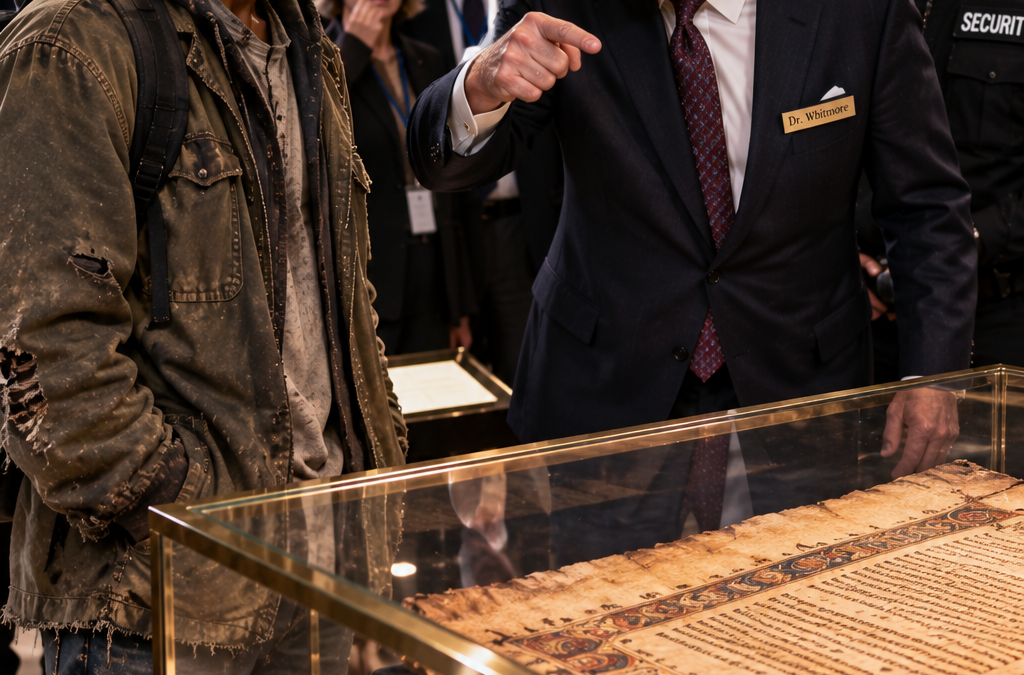
𝗣𝗔𝗥𝗧 𝟮
The way clauses leaned into each other.
The way a scribe compressed a common word.
The way an unfamiliar suffix disrupted a sentence.
I began writing on the pavement.
First line.
Old English.
Second.
Third.
Then beneath them, modern English.
My hand moved quickly.
Rain blew under the awning and darkened the sidewalk a few feet away.
I kept writing.
By midnight, my knee had swollen.
By two in the morning, my fingers were numb.
By four, I had translated thirty-seven lines.
At some point I stopped counting.
When the sky began turning gray, yellow chalk covered nearly six feet of concrete.
Forty-three lines.
Original text on the left.
Translation on the right.
I sat against the museum wall.
Looked at the work.
Then closed my eyes.
I meant to rest for five minutes.
I woke to a woman saying:
“Hey.”
My eyes opened instantly.
That reflex comes from sleeping places where people regularly tell you to move.
A woman crouched several feet away.
Brown coat.
Dark hair.
Museum ID around her neck.
She was staring at the sidewalk.
Then at me.
“You wrote this?”
I nodded.
She looked back down.
“Line twelve.”
“What about it?”
“The transfer verb.”
I sat up.
“It’s not absolute.”
She looked at me quickly.
“Why?”
“Because the ending changes the legal force.”
“You’re sure?”
“Yes.”
She moved farther along the chalk.
Line nineteen.
Then twenty-two.
Then twenty-seven.
Her breathing changed.
“Where did you study?”
“Nowhere.”
She frowned.
“Where?”
“Books.”
“What university?”
“I never went.”
“High school?”
“Not really.”
She looked at me.
“How old are you?”
“Eighteen.”
The woman stood slowly.
“My name is Eleanor Hayes.”
I wiped my hands on my jeans.
“Aaron Cole.”
“I know.”
That surprised me.
“The security report from last night.”
Of course.
She looked at the chalk again.
“Come inside.”
I almost laughed.
“I don’t think your people want me inside.”
“My people?”
“The museum.”
She looked toward the staff entrance.
“Come with me.”
Something in her voice made me stand.
My knee hurt.
I tried not to limp.
Eleanor noticed.
She didn’t mention it.
She led me through a side door.
Past conservation rooms.
Down a corridor that smelled like climate-controlled air and old paper.
No one stopped us.
We entered a small research room.
She closed the door.
On the table lay a high-resolution printout.
Another page of the contract.
I stared.
“You haven’t seen this one?”
“No.”
She pushed it toward me.
“Read it.”
I looked at her.
“This a test?”
“Yes.”
“Okay.”
I sat.
At first, the page seemed harder than the one in the display.
More legal language.
Compressed abbreviations.
Witness names.
Boundary descriptions.
I leaned closer.
My lips moved.
Old English first.
Meaning followed.
“This is a penalty clause.”
Eleanor sat opposite me.
“If the eastern wall isn’t maintained within three planting seasons, the land may revert to the church.”
“Which church?”
I traced the line.
“St. Cuthbert at Durham.”
Her eyes widened slightly.
I continued.
“Witnesses include a reeve.”
Pause.
“Two thanes.”
Then a title I had seen once.
Maybe twice.
I leaned closer.
“And a Weald Gerefa.”
Eleanor stopped moving.
“What?”
“Forest magistrate.”
“I know what it means.”
She stared at the page.
“That office disappears from records before the twelfth century.”
“Yes.”
“How did you recognize it?”
“I saw the title in a scanned charter four years ago.”
“Where?”
“Library computer.”
She sat back.
“How long have you studied Old English?”
“Five years.”
“Latin?”
“Seven.”
“Norse?”
“Three.”
Her face changed.
“Who taught you?”
“My mother.”
That answer wasn’t technically true.
My mother didn’t know Old English.
She barely knew Latin.
But everything began with her.
So it was true enough.
The door opened.
Whitmore entered carrying coffee.
Two assistants behind him.
He stopped.
His eyes moved from Eleanor to me.
Then to the page.
“What is this?”
Eleanor stood.
“Aaron translated forty-three lines overnight.”
Whitmore’s face remained blank.
“On the sidewalk.”
Silence.
“He also just identified a Weald Gerefa in page two.”
One assistant looked at me.
The other looked at Whitmore.
Whitmore set his coffee down.
“You brought him into a conservation research room?”
“Yes.”
“You have lost your mind.”
“He’s right.”
“That isn’t the point.”
“It should be.”
Whitmore turned toward me.
“You again.”
I said nothing.
He looked at Eleanor.
“This institution is not a charity.”
“He is not asking for charity.”
“He sleeps outside.”
“I asked him to translate.”
“He has no credentials.”
“He has the answer.”
Whitmore’s eyes returned to me.
“You are consulting a homeless teenager now?”
I watched his face.
No curiosity.
That was what struck me.
Not one question about the translation.
Not one.
He didn’t ask how I recognized the title.
Didn’t ask whether my grammar held.
Didn’t ask what else I saw.
He had already chosen the only fact about me that mattered.
Homeless.
Whitmore turned away.
“This is ridiculous.”
He left.
Two assistants followed.
The third stayed.
A woman named Dr. Sandra Wells.
She looked at the page in front of me.
Then at me.
“You really translated that?”
“Yes.”
“How long?”
“Maybe fifteen minutes.”
She reached into her coat.
Pulled out a notebook.
Sat down.
“Show me.”
That was the first time a scholar asked.
Not who I was.
Not where I slept.
Show me.
So I did.
My mother’s name was Denise Cole.
She worked nights at Whitfield University.
Janitorial staff.
Nine years.
Most students never noticed her.
Professors saw the floor after she cleaned it, not the woman holding the mop.
She emptied trash bins in lecture halls.
Vacuumed offices.
Scrubbed bathrooms.
And sometimes brought home books.
Not stolen books.
Discarded ones.
University libraries throw away more knowledge than most poor neighborhoods ever see.
Old editions.
Water-damaged copies.
Cracked spines.
Outdated dictionaries.
Books that had been replaced by newer printings.
Mom would find them in carts marked DISCARD.
She asked permission.
Then brought them home in grocery bags.
The first one she gave me was a Latin grammar.
Water stain across the cover shaped like half a moon.
I was eleven.
I opened it and understood almost nothing.
Declensions.
Cases.
Conjugations.
She sat on the bed beside me.
“Read it anyway.”
“What’s the point if I don’t understand?”
“Understanding comes later.”
She tapped the book.
“Words don’t care who reads them, baby.”
I looked at her.
“They answer anyone who asks right.”
That sounded like something she had invented.
Maybe she had.
I read.
The next night too.
Then another.
Three months later, Latin began making sense.
Not all of it.
Enough.
A year later, I could read simple passages.
Nobody taught me.
The book did.
Mom kept bringing more.
History.
Greek.
Old English.
A damaged collection of medieval inscriptions.
She didn’t understand why I liked dead languages.
Neither did I.
Maybe because dead people couldn’t look at my clothes.
A thousand-year-old sentence didn’t care whether rent was late.
Latin never asked what neighborhood I lived in.
Old English didn’t notice Mom wore a janitor uniform.
A word either meant something or it didn’t.
That honesty comforted me.
When I was fourteen, Mom got sick.
Pancreatic cancer.
April diagnosis.
August funeral.
Four months.
That was all.
She was forty-one.
People say illness gives you time to say goodbye.
Sometimes it gives you time to watch someone disappear.
There was no insurance.
No savings.
No father around.
No relative willing to take in a teenager they barely knew.
A church helped me buy an old van for three hundred dollars.
I moved into it.
That sounds dramatic when people tell the story afterward.
It didn’t feel dramatic.
It felt cold.
Practical.
The van leaked.
The heater worked when the engine did.
I parked where I could without getting ticketed.
I kept Mom’s books inside a milk crate.
Fourteen eventually.
Every one I considered necessary.
The Latin grammar stayed on top.
When I felt alone, I read.
When I was hungry, I read.
When people moved me from a parking lot, I found another streetlight and read.
I learned Old Norse from a library discard.
Ogham from a handbook I found in a dumpster behind the university.
Gothic from scanned manuscripts.
Anglo-Saxon legal language from free databases.
Nobody gave me a syllabus.
So I read everything.
That turned out to matter.
Experts specialize.
I couldn’t afford specialization.
Every book I found became part of the same education.
Two days after Eleanor brought me into the museum, I was called back.
Official test.
Museum director approved.
One chance.
That was what they told me.
I arrived at two.
Whitmore’s entire team was there.
Six respected scholars.
People whose names I had seen beneath journal articles.
I recognized two.
They did not recognize me.
Whitmore stood near the table.
“We are going to evaluate whether your apparent abilities constitute actual competence.”
Apparent abilities.
I sat.
He slid a photocopy toward me.
“Translate.”
No greeting.
No explanation.
I looked at the page.
Third section of the contract.
Boundary clause.
I began.
At first it was straightforward.
Then something scratched at my brain.
Wrong note.
I stopped.
Read again.
Three words bothered me.
Not because I couldn’t translate them.
Because they translated too easily.
They didn’t belong.
I wrote the passage.
Then circled the first word.
The second.
Third.
Seven minutes.
I put down the pencil.
“The translation is on the right.”
Whitmore reached forward.
I kept one finger on the page.
“But these three words were changed.”
Nobody moved.
Whitmore’s eyes narrowed.
“This one says loan.”
I tapped it.
“It should be grant.”
Next.
“This says seasonal.”
Tap.
“It should be perpetual.”
Third.
“And this witness name is wrong by one letter.”
I looked at him.
“That changes the title from bishop to thane.”
Silence.
Sandra Wells stopped breathing for a second.
Eleanor looked at Whitmore.
His face had drained.
I knew immediately.
He had changed them.
I asked:
“Did you make this copy?”
Whitmore’s jaw tightened.
“That is irrelevant.”
“No.”
Sandra spoke.
“It isn’t.”
Whitmore turned on her.
“This is an evaluation.”
Sandra looked at me.
“How did you know?”
“The grammar.”
“That’s all?”
“The wrong terms fit modern assumptions.”
I pointed at the sentence.
“But not the period.”
I searched for the right explanation.
“It’s like hearing one note wrong in a song.”
Sandra nodded slowly.
Whitmore stood.
His chair scraped.
“Lucky.”
I looked at him.
“What?”
“Lucky guess.”
I almost smiled.
Three lucky guesses?
Instead I stayed quiet.
“Even parrots imitate sounds.”
He walked out.
Two assistants followed.
Sandra remained.
She opened her notebook.
Then copied my translation.
Line by line.
That night, I slept badly.
The next morning, the museum banned me.
Board decision.
Five to three.
No further access.
No contact with the artifact.
No research privileges.
Eleanor found me outside.
“I’m sorry.”
I looked at her.
“You voted?”
“I’m not on the board.”
“Director?”
“He didn’t stop it.”
I nodded.
That fit.
“Whitmore argued liability.”
I laughed.
“What does that mean?”
“It means he found a respectable word for being afraid of you.”
I looked at the museum doors.
“Okay.”
“Aaron.”
“It’s okay.”
“No.”
She shook her head.
“It isn’t.”
But the decision stood.
By evening, local news picked it up.
MUSEUM LETS HOMELESS TEEN HANDLE PRICELESS ARTIFACT.
That was the headline.
Nobody mentioned I had never touched the original.
The anchor smiled while reading it.
Online comments came faster.
Fake.
Diversity stunt.
Street kid.
Clown show.
I saw the segment because a man at a bus shelter was watching on his phone.
He laughed.
I sat six feet away.
He didn’t recognize me.
That was almost funny.
Later, three guys from the neighborhood did.
“Professor!”
One blocked the sidewalk.
“You teaching Latin?”
The others laughed.
“You live in a van, man.”
He leaned closer.
“You ain’t no scholar.”
I walked around him.
Back inside the van, I turned off the small battery light.
Darkness.
The milk crate sat behind the passenger seat.
Mom’s Latin grammar on top.
I picked it up.
For the first time since she died, I didn’t open it.
I was tired.
Not sleepy.
Tired in the part of you that believes tomorrow deserves effort.
Maybe Whitmore was right about one thing.
Credentials mattered.
Doors mattered.
Institutions mattered.
What good was knowing something if the people controlling the room could simply lock you outside?
I thought about stopping.
That scared me.
Reading had been the only thing that survived everything else.
Mom.
Home.
School.
Money.
If I stopped reading, what was left?
I put the book down.
Closed my eyes.
Tried to remember Mom’s voice.
I couldn’t.
Not clearly.
That terrified me more than Whitmore ever had.
At six the next morning, someone knocked on the van.
I woke.
Eleanor stood outside.
Cold breath visible.
She placed a brown envelope on the hood.
Then walked away.
No speech.
I got out.
Opened it.
High-resolution printout.
Page four.
Untouched by the team.
At the top, Eleanor had written three words.
FINISH WHAT MATTERS.
I stood beside the van for a long time.
Then I reached for my chalk.
The first layer took forty minutes.
Old English.
Clear enough.
Legal obligations.
Land usage.
Boundary terms.
Nothing revolutionary.
I finished.
Then kept staring.
Something was wrong.
The left border.
A vine pattern.
Decorative according to the catalog.
Leaves.
Thorns.
Tiny marks.
I turned the page sideways.
My breathing changed.
Not thorns.
Runes.
Younger Futhark.
Old Norse.
So small the scribe had disguised them inside ornamentation.
I sat on the van hood.
Started copying.
One mark.
Two.
Word.
Another.
An hour later, I had a second text.
Different clauses.
Grazing rights.
Seasonal access.
Land usage terms for Norse settlers.
My hands began shaking.
Not from cold.
I looked at the bottom edge.
There was a narrow stain scholars had apparently dismissed as water damage.
Something about it bothered me.
I held the page toward sunlight.
Notches.
Faint.
Grouped.
I counted.
Ogham.
I laughed out loud.
Alone in a parking lot.
Not because it was funny.
Because the contract suddenly became alive.
Three layers.
Three audiences.
Anglo-Saxon legal prose for English landholders.
Norse clauses for Scandinavian settlers.
Ogham blessing representing church authority.
A single parchment speaking three languages at once.
Not translation.
Negotiation.
I began drawing arrows.
Cross-references.
Terms repeating in different forms.
Boundary descriptions matching.
Obligations distributed.
Each group addressed in language it trusted.
I forgot hunger.
Forgot cold.
Forgot Whitmore.
By sunset, I had the structure.
The experts weren’t stupid.
That mattered to me.
They were looking where scholarship had trained them to look.
The main text.
The recognized layer.
The familiar framework.
I had spent my whole education reading discarded books.
Margins.
Footnotes.
Things people labeled obsolete.
Maybe that trained me differently.
I had learned never to assume the important thing was in the center.
I folded the printout.
Walked to the museum.
Front doors locked.
I went around.
Eleanor was inside.
I knocked on glass.
She opened the door.
“What happened?”
“It’s not two languages.”
She frowned.
“Three.”
I handed her the envelope.
“They’re not translating the same thing.”
She opened it.
Read.
Her eyes moved faster.
Then slower.
She sat.
“What are these?”
“Norse.”
“And this?”
“Ogham.”
She looked at me.
“That was cataloged as staining.”
“It’s not.”
She read another page.
“Do you know what this means?”
“I read what was there.”
“No.”
Her voice softened.
“Aaron.”
She looked almost afraid.
“You just changed the document.”
“I didn’t change it.”
“You changed what it is.”
That night she called Professor Margaret Sullivan at Oxford.
I didn’t know.
Two days later, Sullivan arrived.
Seventy-one.
Forty years studying medieval charters.
She did not smile at me.
I liked her immediately.
The original contract sat beneath protective glass.
My notes beside it.
Sullivan pointed.
“Translate.”
No introduction.
No question about where I lived.
Translate.
I leaned forward.
“Reversion clause.”
“Verb?”
“Conditional subjunctive.”
“Implication?”
“Penalty activates only if abandonment is intentional.”
Sullivan stopped me.
“Why?”
“Because neglect and relinquishment aren’t equivalent here.”
She removed her glasses.
Looked at me.
Then opened her briefcase.
Pulled out another document.
Different manuscript.
Older.
“Line seven.”
I read.
Frowned.
Something was off.
Sullivan noticed.
“What?”
“This published translation is wrong.”
The room went still.
“What?”
“The verb.”
I pointed.
“It doesn’t mean possess.”
“What does it mean?”
“Protect.”
She leaned closer.
“The noun?”
“Boundary marker.”
I looked at the translation beneath it.
“They’ve treated this like ownership.”
Pause.
“It’s custodial.”
Sullivan stared at me.
For a long time.
Then sat back.
“I supervised this translation.”
I felt heat crawl up my neck.
“Oh.”
“1983.”
I waited.
“It has appeared in major textbooks for four decades.”
I didn’t know whether I was supposed to apologize.
So I said nothing.
Sullivan stood.
Walked to the door.
Whitmore was outside with two board members.
She opened it.
“This young man has an instinct for historical language I have not encountered in forty years.”
Whitmore stiffened.
“Instinct is not scholarship.”
Sullivan looked at him.
“No.”
Then smiled very slightly.
“But scholarship without instinct is bookkeeping.”
Nobody spoke.
“And your books do not balance.”
She closed the door.
The public presentation was scheduled for the next morning.
Two hundred forty seats.
Journalists.
Scholars.
Cameras.
Board members.
I wanted to disappear.
The night before, I sat alone in the museum wing.
The contract glowed beneath amber light.
For the first time since this began, I was scared of being right.
On the sidewalk, failure belonged to me.
Tomorrow, failure would belong to everybody watching.
Eleanor arrived carrying sandwiches.
She handed me one.
I ate because she stared until I did.
After a while, she said:
“My name wasn’t always Eleanor Hayes.”
I looked at her.
“Elena Haiescu.”
“Romanian?”
“Yes.”
“I thought so.”
She smiled.
“My accent?”
“Something in the vowels.”
She laughed.
Then grew serious.
“I came here at twenty-two.”
She looked toward the dark gallery.
“My first supervisor said tourists couldn’t understand me.”
“That bad?”
“No.”
Her mouth tightened.
“He could.”
I understood.
“I changed my name.”
She touched her throat.
“Changed my vowels.”
“Why?”
“To stay.”
We were quiet.
“I hated myself for it for years.”
“Do you still?”
“Sometimes.”
She looked at me.
“But I also know surviving a closed door and approving of the door are not the same thing.”
I thought about Whitmore.
The board.
The van.
Mom.
“My mother used to say words don’t care who reads them.”
Eleanor listened.
“She said they answer anyone who asks right.”
“That sounds wise.”
“She cleaned university classrooms.”
I swallowed.
“She brought me books professors threw away.”
The words became harder.
“She died before she could see any of this.”
Eleanor said nothing.
That helped.
“If words don’t care who reads them…”
My voice broke.
“…what happens when the people guarding the words do?”
Eleanor waited.
Then:
“You ask louder.”
“I’m not loud.”
“I know.”
She tapped my notes.
“Use the work.”
That was when I cried.
I hated crying in front of people.
Still do.
But something gave.
“I miss her.”
Eleanor didn’t touch me.
Didn’t tell me it was okay.
She let the grief have the room.
“I read these languages and sometimes…”
I wiped my face.
“…I can hear her.”
“Her voice?”
“Not exactly.”
I looked at my hands.
“Just the feeling that someone thought I was worth teaching.”
Eleanor reached into her coat.
Placed something beside me.
Museum identification badge.
My photograph.
My name.
AARON COLE.
RESEARCH STAFF.
I stared.
“You earned it.”
I picked it up.
Plastic.
Nothing magical.
Still, I ran my thumb across my name.
For someone who had been removed from buildings most of his life, a badge saying I belonged inside one felt heavier than it should have.
The next morning, the Grand Hall was full before nine.
I sat in the back.
Clean dark shirt.
Jeans.
My sneakers were still old.
Staff badge clipped near my chest.
Whitmore went first.
Charcoal suit.
Burgundy tie.
Perfect posture.
He looked like scholarship.
I looked like I had slept in a vehicle.
Because I had.
He began with methodology.
Software.
Corpus analysis.
Letter-frequency modeling.
Computational comparisons.
His team had done real work.
I respected that.
Seventeen minutes passed.
Then twenty.
Still methodology.
Charts.
Matrices.
Confidence.
Museum director Richard Bennett finally stepped up.
“Before Dr. Whitmore proceeds to the translation findings, the museum would like to invite an independent analysis.”
The audience shifted.
“Mr. Aaron Cole.”
Murmurs.
People turned.
I stood.
My legs felt weak.
I walked toward the stage.
Two hundred forty faces.
I avoided the podium.
Went straight to the contract.
The original.
Ten feet away behind glass.
Eleanor brought a wireless microphone.
I clipped it on.
My hands were steady.
I looked at the room.
Then at the parchment.
“The document in front of me is not written in two languages.”
Silence.
“It is written in three.”
Heads lifted.
“The primary layer is Anglo-Saxon legal prose.”
I pointed toward the body text.
“That is the layer Dr. Whitmore’s team has concentrated on.”
I looked toward him.
“Their partial translation is largely accurate.”
A few people seemed surprised I said that.
I had no interest in stealing what was theirs.
Then I pointed at the border.
“This vine pattern is not decoration.”
A scholar in the front row leaned closer.
“The marks inside it are Younger Futhark runes.”
I enlarged the scan.
Old Norse characters appeared.
A murmur moved through the room.
“They contain separate land-use provisions for Scandinavian settlers occupying territory east of the boundary.”
I shifted to the bottom.
“And this area here has been cataloged as staining.”
Zoom.
“Those marks are Ogham.”
Someone whispered.
I continued.
“They form an ecclesiastical benediction invoking Saint Columba and church authority over the transfer.”
The room was completely quiet now.
“Three languages.”
I held up one finger.
“English landholders.”
Second.
“Norse settlers.”
Third.
“Church authority.”
I let my hand fall.
“This is not simply a land contract.”
Pause.
“It is a trilingual treaty.”
No one moved.
“Three communities using one physical document while being addressed through separate linguistic and legal traditions.”
I looked at the parchment.
“They did not trust one language to hold everybody.”
Then I translated.
All of it.
Page one.
Boundary language.
Witnesses.
Obligations.
Page two.
Penalty clauses.
Conditional reversion.
Legal terms.
Then the Norse layer.
My pronunciation changed.
I could hear it.
The rhythm became harder.
Older.
I explained grazing rights.
Seasonal road access.
Water usage.
Each clause mirroring or correcting the Anglo-Saxon terms.
Pens appeared everywhere.
People wrote.
Cameras stayed fixed.
Then Ogham.
The blessing.
Notches almost invisible against the parchment.
A religious authority binding the secular promises.
I explained how the three systems depended on one another.
No single layer told the entire truth.
That was why the experts had stalled.
They were solving one conversation while two others had been hidden around it.
Forty-one minutes.
That was how long I spoke.
When I finished, the hall went silent.
Not polite silence.
Four full seconds.
I counted because fear makes time strange.
Then Professor Sullivan stood.
She clapped once.
Again.
Someone joined.
Then another.
The whole hall rose.
I didn’t know what to do.
So I stood beside the glass.
My hands at my sides.
People were clapping for me.
For Mom.
For the van.
For every night under a streetlight.
At least that was what it felt like.
I looked toward Whitmore.
He remained seated.
His unfinished methodology slide glowed behind him.
Slide fourteen.
He stared at the screen.
I felt no joy watching him.
That surprised me.
I had imagined vindication as something warm.
It wasn’t.
It felt quiet.
Almost sad.
Because nothing I had said that morning changed who I had been three days earlier when he called me trash.
Only his ability to see me had changed.
Director Bennett walked to the microphone.
The applause faded.
“When the museum acquired the Millennium Contract, we believed full analysis would require years.”
He looked toward the board.
“We assembled scholars we believed represented the finest available expertise.”
Pause.
“We were wrong about one thing.”
He turned toward me.
“What finest means.”
My chest tightened.
“Mr. Aaron Cole will be credited as lead translator of the Millennium Contract.”
The hall erupted again.
“His name will appear on exhibition materials, publications, and academic references.”
I nodded.
Couldn’t speak.
Then Sullivan stood and walked toward me.
She carried a cream-colored sheet.
Oxford crest.
I recognized it before she said anything.
My stomach dropped.
“This is a formal offer.”
I stared.
“Full scholarship.”
She continued.
“Tuition.”
“Housing.”
“Living stipend.”
“Research funding.”
I heard every word.
None felt real.
“Historical linguistics and medieval legal texts.”
She held out the paper.
I didn’t take it immediately.
Nobody had ever handed me a future before.
Everything in my life had usually been something I found after someone else discarded it.
A book.
A blanket.
A van.
A library computer left unlocked.
Now an institution older than my country was asking me to come inside.
My fingers shook when I took the letter.
“I don’t know what to say.”
Sullivan smiled.
“Then read it later.”
Somebody laughed.
She added:
“You seem good at that.”
Warm laughter moved through the room.
Then silence again.
Whitmore had stood.
He walked toward me.
Every camera followed.
My body tightened.
Old reflex.
He stopped.
Extended his hand.
“I was wrong.”
I stared at it.
His voice was rough.
“I was wrong about you.”
He swallowed.
“About credentials.”
Pause.
“About who gets to sit at the table.”
The room held still.
“I humiliated you publicly.”
His eyes met mine.
“So I owe you a public apology.”
I thought about the service door.
Wet concrete.
My knee.
Cockroach.
Street trash.
There are moments when forgiveness is too complicated to perform on command.
I did not forgive him in that instant.
But I respected what he was doing.
He was standing where everyone could see him admit failure.
That costs something.
I shook his hand.
“Thank you.”
He nodded.
That was enough.
The story went everywhere.
Street kid decodes document six PhDs couldn’t.
I hated that headline.
The scholars had decoded important parts.
I built on work they had done.
But newspapers like conflict more than accuracy.
Photos of me standing beside the contract spread.
Then someone found the original chalk translation Eleanor had photographed.
Yellow words on gray sidewalk.
That image mattered more to people.
Maybe because it looked impossible.
A boy with no home writing medieval law outside a museum.
Messages came.
Teachers.
Janitors.
Students.
People sleeping in cars.
Immigrants.
Former prisoners.
Mothers working two jobs.
People telling me the same thing in different forms.
They had knowledge no one respected because it came without the correct packaging.
Three days later, the museum announced a permanent exhibition.
My translation.
My notes.
Photographs of the chalk.
They called the area the Cole Wing.
Language Without Borders.
The first time I saw my name on the wall, I stood alone.
Touched the letters.
AARON COLE.
Mom had written that name inside my school jackets.
On cheap birthday cards.
On the front of notebooks so I wouldn’t lose them.
Now it was mounted in oak above a museum gallery.
I closed my eyes.
Whispered the blessing from the Ogham layer.
I said it for her.
A week later, Sandra Wells asked Eleanor for a private meeting.
I wasn’t there.
Eleanor told me later.
Sandra admitted she had copied my first translation after the test.
Then sent it secretly to Professor Sullivan.
She had done it before anyone approved.
Before the board changed its mind.
Before Whitmore could bury the work.
Sullivan came because Sandra had taken a risk.
That mattered to me.
For weeks, I thought Eleanor was the only person who had chosen to see me.
She wasn’t.
Sandra had stayed quiet in the room.
But outside it, she acted.
Courage doesn’t always announce itself.
Sometimes it sends an email at midnight.
Sometimes it leaves an envelope on a van.
Sometimes it votes against the majority even when it loses.
There had been more good people in the story than I knew.
That realization changed me.
September came.
Oxford.
I owned one suitcase.
Eleanor drove me to the airport.
I donated the van to a youth shelter.
I kept the books.
All fourteen.
Milk crate included.
Airport security hated the milk crate.
I didn’t care.
Mom’s Latin grammar remained on top.
At the terminal, Eleanor handed me a box.
Inside was a framed photograph.
The sidewalk.
My forty-three lines.
Yellow chalk.
Gray concrete.
Taken before rain erased them.
“I almost didn’t photograph it.”
I touched the glass.
“Why did you?”
“I was afraid it would disappear.”
I looked at her.
“Most things do.”
“Yes.”
She smiled.
“That’s why archives exist.”
I held the frame.
“Thank you.”
“For what?”
“Everything.”
She shook her head.
“You’re welcome.”
“No.”
I looked at her.
“You believed me.”
Eleanor’s expression changed.
“I didn’t.”
I frowned.
She continued.
“I saw the translation.”
“That’s the same thing.”
“No.”
Her voice was gentle.
“Belief is what people say when they don’t have evidence yet.”
She tapped the frame.
“You gave me evidence.”
I smiled.
“That sounds very curator.”
“It is.”
I looked down.
She added:
“I saw you.”
That stayed with me.
I carried the milk crate toward security.
Before boarding, I turned.
Eleanor was still there.
I almost waved.
Instead I nodded.
She nodded back.
The night before leaving, I had returned to the museum sidewalk.
Same place where security pushed me out.
The chalk translation was gone.
Rain.
Shoes.
Street sweepers.
Concrete clean again.
I knelt.
Pulled out the same yellow chalk.
Only a small piece remained.
I wrote one line.
Old English.
The stones remember.
So will I.
Then I left.
Eleanor found it the next morning.
Instead of washing it away, the museum conservation team photographed it.
Eventually they sealed the spot beneath transparent resin.
A piece of chalk preserved outside a building that once threw me into the rain.
I found that funny.
Two months after I arrived at Oxford, the museum announced a scholarship.
Young people from underserved backgrounds.
No requirement for traditional schooling if they could demonstrate extraordinary aptitude.
Historical studies.
Languages.
Linguistics.
The Denise Cole Memorial Scholarship.
I was sitting in a library when Eleanor sent me the photograph.
Mom’s name on a brass plaque.
DENISE COLE.
I stared until the screen dimmed.
Turned it back on.
Stared again.
I never told anybody what I did next.
I went into a bathroom stall.
Locked the door.
Sat on the closed toilet.
Cried until my chest hurt.
My mother spent nine years cleaning rooms where professors barely knew her name.
Now students would receive money under it.
That felt larger than Oxford.
Larger than the contract.
Larger than everything.
University did not magically fix my life.
That part gets lost in stories.
Oxford was hard.
The first seminar nearly broke me.
Everybody seemed to know rules I had never been taught.
How to cite.
How to structure academic papers.
Which arguments were considered obvious.
What books everyone had supposedly read before arriving.
Students discussed schools, mentors, summer programs.
I had a van.
At first, I felt like Whitmore might still be right.
Maybe I had talent but not scholarship.
Professor Sullivan noticed.
Of course she did.
She called me into her office.
“You are behind.”
I looked down.
“Yes.”
“That is not an insult.”
I looked up.
“You are behind in academic conventions.”
She tapped my first essay.
“This is structurally terrible.”
I almost laughed.
“But your argument is excellent.”
She leaned back.
“So we fix structure.”
That was all.
No shame.
No suggestion that difficulty meant fraud.
We worked.
Citation systems.
Research methods.
Academic writing.
Textual criticism.
Things other students had learned gradually, I learned aggressively.
My first term exhausted me more than homelessness had in some ways.
On the street, survival rules were obvious.
Stay warm.
Find food.
Avoid police trouble.
Protect books from rain.
At university, everybody seemed to know invisible rules.
I learned those too.
But I refused to lose the thing that got me there.
I kept reading margins.
Kept asking what everyone else had dismissed as decoration.
Three months into my first year, a professor presented a fragment of a Norse legal manuscript.
Students debated a damaged line.
I stared at the edge.
“What?”
The professor stopped.
I pointed.
“Nothing.”
“Then why are you looking there?”
I smiled.
“Habit.”
There were faint marks in the binding.
Reused parchment.
An older text beneath the visible one.
The room laughed warmly.
Not cruelly.
By then, they knew me.
Professor Sullivan put down her pen.
“Of course.”
That became a joke in the department.
If Aaron is staring at the margin, check the margin.
I liked that.
Years later, people continued asking about Whitmore.
Did I hate him?
No.
Was he racist?
Yes.
Was that the only reason he rejected me?
No.
That answer confused people.
Prejudice was there.
Obvious.
His language proved it.
But so was something else.
Institutional fear.
If I could do what I did without credentials, what did that say about the system that had made credentials the gate?
Whitmore had spent decades becoming an authority.
I walked in from the street and threatened not his knowledge, but the structure that told him knowledge should arrive wearing a particular uniform.
That doesn’t excuse him.
Understanding someone is not the same as excusing them.
His apology mattered because he eventually understood that too.
Years afterward, he wrote me.
One letter.
Short.
He had begun mentoring students from nontraditional backgrounds.
He said he had changed his graduate admissions committee’s evaluation standards.
At the bottom, he wrote:
I used to believe expertise was proven by the path taken to acquire it. You taught me the path and the knowledge are not the same thing.
I kept the letter.
Not because I needed proof he changed.
Because people changing should be remembered too.
Eleanor and I wrote often.
She eventually retired.
At her retirement ceremony, the museum asked me to speak.
I flew back.
Same building.
Same service entrance still existed around the side.
I walked there first.
The resin panel remained in the sidewalk.
The stones remember.
So will I.
I stood over it.
A young museum employee recognized me.
“Mr. Cole?”
“Yes.”
“You wrote that?”
“A long time ago.”
She stared at the yellow line.
“Does it mean exactly what the plaque says?”
“No.”
She looked surprised.
“What does it mean?”
I smiled.
“Translations are complicated.”
Then went inside.
Eleanor was sitting in the front row.
Older.
Silver in her hair.
Still sharp.
I stood at the podium.
People expected me to talk about the contract.
I didn’t.
I talked about an envelope.
A brown envelope placed on the hood of a van at six in the morning.
A sheet of paper inside.
Three words.
Finish what matters.
That was Eleanor’s gift.
Not access.
Not rescue.
Permission was temporary.
What she gave me was evidence that one person inside the building believed the work mattered enough to risk something.
After the ceremony, she complained.
“You made me sound noble.”
“You were.”
“No.”
“You went behind the board.”
“That was irresponsible.”
“Exactly.”
She laughed.
We stood together near the Millennium Contract.
Visitors moved around us.
A school group stopped in front of the exhibit.
The teacher pointed toward the border.
“Does anyone see the runes?”
A boy raised his hand.
I watched.
That was the real victory.
Not my name.
Not Oxford.
Not the headlines.
A child now knew to look at the border.
Knowledge had expanded the field of vision.
That is what scholarship is supposed to do.
Not prove how much we already know.
Show us where we were not looking.
I learned that from discarded books.
From Mom.
From sleeping in a van.
From being outside institutions long enough to see their walls.
People like neat stories.
Homeless boy proves experts wrong.
Professor apologizes.
Oxford scholarship.
Happy ending.
But the truth is more useful than the neat version.
Six scholars were not idiots.
I was not magic.
I had read material they had not.
I had no formal specialization, so my education crossed boundaries academic departments kept separate.
I studied Old English beside Norse beside Ogham because no adviser told me I was supposed to choose.
What looked like disadvantage in one setting became an advantage in another.
That matters.
People often think excellence means knowing more than everyone else.
Sometimes it means seeing connections experts have been trained to separate.
And sometimes institutions fail because they confuse evidence of learning with the only possible route to learning.
Degrees matter.
Training matters.
Standards matter.
But they are tools for identifying knowledge.
They are not the source of knowledge itself.
Mom understood that without ever entering a faculty meeting.
Words don’t care who reads them.
They answer anyone who asks right.
I spent years trying to understand what she meant.
Now I do.
Words are indifferent.
People aren’t.
A manuscript doesn’t know whether your clothes are clean.
A verb doesn’t ask where you sleep.
A rune doesn’t check your university email address.
But institutions are made of people.
And people guard doors.
Sometimes the work has to become undeniable before the door opens.
That is unfair.
It is also real.
My life became dedicated to making fewer people wait outside as long as I did.
After Oxford, I taught.
Then researched.
Then created programs for independent scholars.
We built pathways for people with unconventional education.
Refugees.
Formerly incarcerated students.
Self-taught translators.
People from places where formal schooling had been interrupted.
Not charity.
I hated that word in this context.
Evaluation.
Real evaluation.
Give people difficult material.
Let them show what they know.
Some fail.
That’s fine.
Failure is honest.
But at least the test measures ability rather than appearance.
Years after the Millennium Contract presentation, a nineteen-year-old woman sent me an email.
She lived in a motel with her mother.
Had taught herself Akkadian from PDFs and free lectures.
Nobody believed her.
She asked:
“How do I know if I’m actually good or just obsessed?”
I wrote back:
Find something difficult that has an answer. Try it. Then let someone qualified criticize the work.
She replied:
“What if they won’t look at it?”
I stared at that sentence.
Then called Eleanor.
She was retired by then.
“What?”
“I need advice.”
“Dangerous.”
I read the email.
Silence.
Then Eleanor said:
“Send her an envelope.”
I laughed.
We did.
The girl later earned a scholarship.
Not because of me.
Because she was good.
That difference always mattered.
People wanted me to become a symbol.
I resisted.
Symbols become simplified.
I was still a person.
Still got translations wrong.
Still misunderstood texts.
Still made bad arguments.
Still forgot appointments.
Still hated formal dinners.
Still kept Mom’s grammar on my desk even after the binding nearly fell apart.
The half-moon stain remained.
I never repaired it.
Some damage becomes part of provenance.
That was something museum conservators taught me.
You don’t erase every mark.
You stabilize.
Protect.
Preserve history honestly.
I began thinking about people the same way.
For years I was ashamed of the van.
Then ashamed of being ashamed.
Eventually, I stopped trying to clean that part of the story.
I slept in a van.
I was hungry sometimes.
I smelled like oil.
I was thrown out of a museum.
Those things happened.
They do not make the translation more impressive.
They make the exclusion more visible.
There is a difference.
I would rather no child have to freeze under a streetlight to prove talent.
Suffering is not a credential.
Poverty does not create genius.
Usually it destroys opportunities before anyone ever sees them.
I survived it.
That does not make it good.
Mom should have had health insurance.
I should have had a home.
I should have finished school.
The fact that something beautiful grew through broken concrete does not justify breaking the concrete.
That became another lesson I carried into classrooms.
When students told me hardship made them stronger, I believed them.
Then I told them they deserved support anyway.
Strength should not be the price of admission.
Every few years, I returned to the National Heritage Museum.
The Millennium Contract aged almost invisibly beneath controlled light.
My translation sat nearby.
So did photographs of the chalk.
Visitors read the story.
Most moved on.
That was fine.
Museums are full of lives people spend ninety seconds with.
One afternoon, I found Dr. Whitmore standing alone near the display.
Older.
Thinner.
Walking with a cane.
He did not see me at first.
I stood beside him.
“Still think it’s a grant?”
He looked over.
Then laughed.
“You’re never going to let that go.”
“You changed the word.”
“For diagnostic purposes.”
“You cheated.”
“I designed a test.”
“You cheated academically.”
He smiled.
Then looked at the parchment.
“I was terrible to you.”
“Yes.”
No need to make him comfortable.
He nodded.
“I’ve thought about that day many times.”
“So have I.”
“Do you wish I’d acted differently?”
The question surprised me.
“Yes.”
He seemed surprised too.
“I thought you might say it made you stronger.”
“No.”
I looked through the glass.
“I was already strong enough.”
That landed.
He looked down.
“I’m sorry.”
“I know.”
We stood together.
Two men connected by one document and one ugly beginning.
After a while he said:
“You saw the border.”
“Yes.”
“I had looked at it hundreds of times.”
“I know.”
“What did you have that I didn’t?”
I thought.
At eighteen, I might have answered talent.
At forty, I knew better.
“I didn’t know what I was supposed to ignore.”
He stared at me.
Then nodded.
“That may be the best criticism of expertise I have ever heard.”
“It’s also the best defense.”
“How?”
“Experts know what usually matters.”
I pointed toward the border.
“They’re right most of the time.”
“But not that time.”
“No.”
He smiled.
“Fair.”
When he left, I stayed.
A family approached the case.
A little girl pressed her face too close to the glass until her father pulled her back.
She pointed.
“What does that say?”
He looked at the exhibit label.
“I don’t know.”
She asked:
“Can anybody read it?”
He smiled.
“Some people can.”
She stared at the parchment.
Maybe that was enough.
Curiosity first.
Everything else later.
The last time I held Mom’s Latin grammar before donating my personal archive, the cover nearly detached.
I sat at my desk.
Turned pages slowly.
Eleven-year-old pencil marks filled the margins.
Wrong translations.
Questions.
Little arrows.
I found one note in my own handwriting.
WHY DOES THIS MATTER?
I laughed.
I had written it beside a declension chart.
Mom had answered underneath.
Her handwriting:
YOU DON’T KNOW YET.
I had forgotten that.
I sat there with tears in my eyes.
She had understood learning better than most academics I later met.
Not everything you learn pays immediately.
Some knowledge waits.
A Latin case ending learned at eleven.
A Norse rune found in a discarded book.
An Ogham notch copied from a dumpster handbook.
Years later, those fragments assembled themselves in front of a thousand-year-old parchment.
That is education.
Not just curriculum.
Accumulation.
Attention.
Memory.
Faith that something useless today may become necessary tomorrow.
Mom never saw the Millennium Contract.
Never heard applause.
Never saw Oxford.
Never saw her name on a scholarship.
But she put the first book in my hands.
Everything else came afterward.
People called me self-taught for years.
I eventually stopped accepting the phrase.
I was not self-taught.
Books taught me.
Authors taught me.
Libraries taught me.
Dead scribes taught me.
Eleanor taught me.
Sullivan taught me.
Whitmore taught me too, though not always what he intended.
And Denise Cole taught me first.
No one learns alone.
Some teachers simply never meet their student.
When I think back to the night it began, I don’t remember Whitmore’s insult most strongly.
I remember the sidewalk.
Cold.
Wet air.
Yellow chalk.
My knee throbbing.
The museum glowing above me.
I remember writing line after line.
Nobody applauding.
Nobody watching.
That was the purest work I ever did.
Before the headlines.
Before recognition.
Before scholarships.
Just me trying to make the words honest.
That is still how I know whether work matters.
Would I do it if no one knew?
Would I translate the line if it disappeared in rain tomorrow?
Would I keep reading if my name never went on the wall?
The answer needs to be yes.
Otherwise, recognition becomes the work.
And recognition is unstable.
It arrives late.
Leaves early.
Chooses badly.
The words are steadier.
Sometimes young scholars ask me what they should do when someone powerful dismisses them.
They expect something heroic.
Fight.
Prove them wrong.
Never give up.
I tell them something less satisfying.
First, make sure your work is right.
Not emotionally right.
Not morally deserved.
Technically right.
Then make it clear enough that someone else can test it.
Then find one person willing to look.
Eleanor was that person for me.
Sandra too.
Sullivan later.
You rarely need everyone.
You need one open door.
Then another.
The tragedy is that many brilliant people never get even one.
That is why those of us inside have an obligation to open them.
Not lower standards.
Open evaluation.
Those are not the same thing.
The museum almost rejected me because it believed admitting someone like me would lower standards.
In reality, testing my work raised them.
That became the principle of every program I later built.
Do not ask where knowledge came from before asking whether it is true.
Verify first.
Judge the work.
Then talk about the path.
Sometimes the path matters.
Sometimes it explains extraordinary perspective.
But it should not be used to dismiss evidence before evidence is examined.
That is what Whitmore did.
He saw the van before the translation.
The smell before the grammar.
The skin before the sentence.
He decided source determined value.
The Millennium Contract itself should have warned him against that.
It had survived a thousand years because three peoples found a way to put separate voices onto the same page.
English.
Norse.
Celtic church tradition.
Different systems.
One agreement.
The document’s deepest lesson wasn’t linguistic.
It was structural.
No single language held the whole truth.
I think about that often.
No single institution does either.
No degree.
No neighborhood.
No class.
No nation.
Knowledge appears wherever people pay attention.
Sometimes under cathedral foundations.
Sometimes in Oxford libraries.
Sometimes in a van two blocks from a museum.
And sometimes in a janitor’s grocery bag.
The last object from Mom’s life I kept privately was that grammar book.
Everything else eventually went to archives.
The van was gone.
Clothes gone.
Chalk used down to nothing.
But the grammar stayed on my shelf.
Whenever a student visited my office and seemed intimidated, they usually noticed it.
Ugly book.
Water stain.
Broken spine.
They would ask:
“Why keep that?”
I would hand it over.
“Open the front.”
Inside, in Mom’s handwriting:
Aaron—
Read everything.
Words answer anyone who asks right.
Love, Mom.
Most students became quiet.
I always gave them a minute.
Then I said:
“That is the most important academic credential I own.”
Some laughed.
I didn’t.
Because every title that came later rested on that sentence.
Professor.
Translator.
Fellow.
Author.
Researcher.
All of them.
The oldest contract in the museum may have been written in 1016.
But the contract that governed my life was written almost a thousand years later in blue ink inside a discarded book.
My mother made a promise without knowing she was making one.
That knowledge did not belong only to people already invited inside.
That curiosity had dignity.
That discarded things could still contain worlds.
She lived long enough to give me that.
I lived long enough to prove her right.
Years after that first presentation, I stood once more outside the museum before sunrise.
No crowd.
No cameras.
The resin panel in the sidewalk had scratched slightly from weather.
Yellow letters still visible beneath it.
The stones remember.
So will I.
I crouched.
Ran my fingertips over the clear surface.
Then looked up at the building.
The security door where I had been thrown out was still there.
The research hall too.
Somewhere inside, the Millennium Contract rested under glass.
But I no longer felt angry at the building.
Buildings don’t decide who belongs.
People do.
And people can learn.
That was the most hopeful discovery of all.
Whitmore learned.
Sandra acted.
Eleanor opened a door.
Sullivan crossed an ocean.
The board changed.
The museum created scholarships.
Students who once would have been dismissed began applying.
None of that erased what happened.
It transformed what happened into responsibility.
That was better than revenge.
I stood.
My knees complained now.
I was no longer eighteen.
For a second, I imagined that boy beside me.
Torn sneakers.
Oil smell.
Yellow chalk.
Afraid to stop reading because reading was the only place his mother still existed.
I wanted to tell him something.
Not that everything would work out.
That is too easy.
Too false.
Many things would remain difficult.
People would still underestimate him.
Institutions would still fail.
Grief would remain grief.
But I would tell him this:
Do not confuse being unseen with having nothing worth seeing.
Those are entirely different conditions.
The first belongs to the observer.
The second belongs to you.
Know the difference.
I looked one last time at the preserved line.
Then walked toward the museum doors.
A young security guard was unlocking them.
He saw me.
“Morning, Professor Cole.”
“Morning.”
He held the door.
I stopped before entering.
“Thank you.”
He smiled.
“Of course.”
Such a small thing.
A door held open.
Years earlier, another door had slammed behind me.
I stepped inside.
The hall smelled like polished stone and old paper.
The same building.
The same words.
A different world.
And somewhere in the quiet, I could almost hear my mother again.
Not clearly.
Never clearly.
But enough.
Read everything, baby.
So I did.








