𝗙𝗨𝗟𝗟 𝗦𝗧𝗢𝗥𝗬 The Private Banker Laughed at My Grandmother’s Rusty Lunchbox and Ordered Security to Throw Me Out—Then a Junior Teller Opened the Papers Inside
𝗣𝗔𝗥𝗧 𝟮
The certificates looked official.
Fine print.
Embossed seals.
Signatures.
PIEDMONT TEXTILES printed across the top.
I knew almost nothing about stock certificates.
One of them said two hundred shares.
Issued August 1968.
The letter was folded twice.
My name was written on the front.
Larry.
Nobody called me Larry except Grandma.
I opened it.
Her handwriting shook slightly.
Larry,
I don’t know if these papers are worth anything.
I bought them in 1968 with three months of my wages.
People at the mill said I was crazy.
I wanted to leave you something more than this old box.
Take them to a bank and ask.
Love,
Grandma.
I read it twice.
Three months of wages.
In 1968.
For a Black woman working a textile production line.
That fact landed harder than anything else.
Grandma had never been reckless with money.
She counted grocery coupons.
Turned off lamps when she left rooms.
Washed aluminum foil to reuse it.
She once drove three miles back to a supermarket because the cashier had accidentally given her fifty cents too much change.
Three months of wages was not impulse money.
If she spent that much on stock, she believed something.
I just didn’t know what.
The next morning, I took the lunchbox to my regular bank.
Normal commercial branch.
Nothing fancy.
The teller examined the certificates.
Turned them over.
Typed the company name.
Then shook her head.
“We don’t handle these directly.”
“Are they fake?”
“I don’t think so.”
“Worth anything?”
“I really can’t tell you.”
She typed again.
“You need an institution with securities research or estate transfer services.”
“Where?”
She wrote an address.
“Sterling Crest Private Bank.”
I had never heard of it.
“Downtown?”
“Yes.”
“They can tell me?”
“They should.”
That was enough.
Thursday morning, I put on the cleanest jacket I owned.
Not because I knew Sterling Crest was fancy.
Because Grandma had asked me to go to a bank.
You dress respectfully when handling somebody’s final request.
I put the certificates and letter back inside the lunchbox.
Closed it.
Drove downtown.
Parking outside Sterling Crest was full.
European cars.
Things with badges I recognized but models I didn’t.
I found a public garage three blocks away.
Walked.
The moment I entered the building, I knew I looked wrong for the room.
Not wrong as a person.
Wrong according to the room.
There is a difference.
Sterling Crest smelled like leather and cedar.
White marble floor.
Dark wood.
Brown leather chairs.
Crystal vases.
Fresh orchids.
Even the silence felt expensive.
Nobody was arguing over overdraft fees.
Nobody was filling out deposit slips.
Nobody was asking whether their direct deposit had cleared.
A man sat drinking espresso while a woman in a suit showed him documents.
A couple in cashmere spoke quietly with an adviser.
I stepped inside wearing cement-stained work boots.
The marble caught every gray print.
People looked.
I noticed.
Black men learn early to notice when a room notices us.
You develop a kind of peripheral awareness.
Who watches.
Who moves away.
Who holds a bag tighter.
Who assumes you are lost.
I walked toward reception.
A young woman with blonde hair sat behind the desk.
Her name tag said Cheryl.
“Good morning.”
She smiled automatically.
“Good morning.”
“I need some help checking old stock certificates.”
The smile stayed.
For half a second.
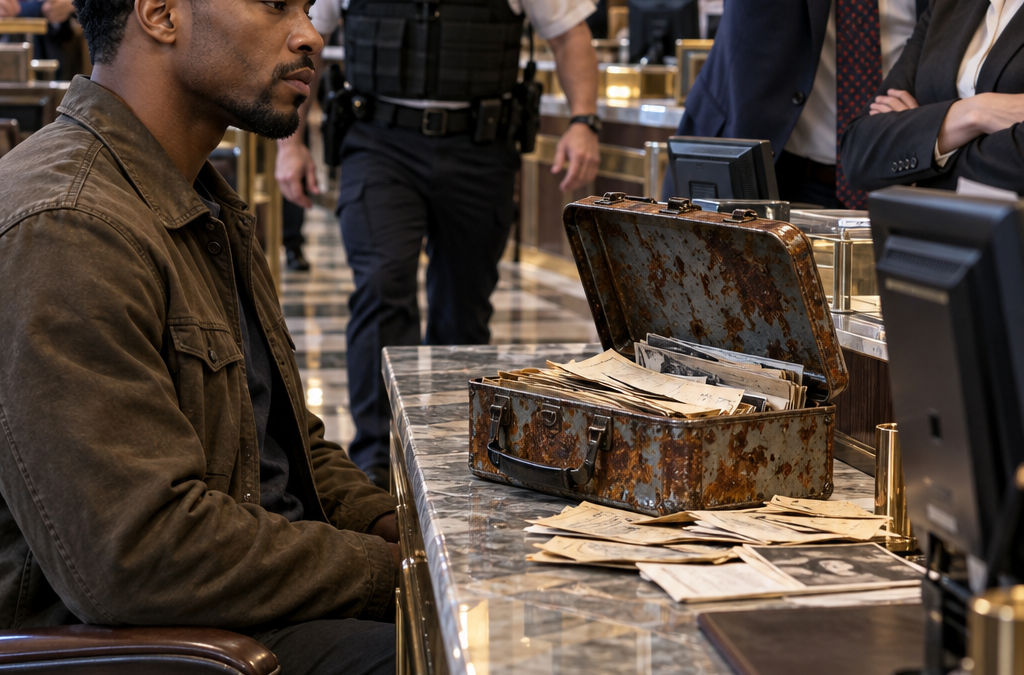
Then I placed the lunchbox on the counter.
Metal scraped marble.
The sound carried.
Cheryl’s expression froze.
Her eyes moved down.
Rust.
Then my boots.
Then my jacket.
Then my face.
“I was told your bank handles older securities.”
“Are you an existing client?”
“No, ma’am.”
Her shoulders changed.
Just slightly.
“We generally serve clients by appointment.”
“I understand.”
“I can give you a number.”
“I was told somebody here could check these.”
Before she answered, another man appeared.
He had been sitting at a desk twenty feet away.
Tailored suit.
Dark hair slicked neatly back.
Gold cuff links with initials.
Expensive pen in his breast pocket.
He walked over like someone had summoned him to remove a problem.
“I’ve got it, Cheryl.”
She leaned back.
The man looked at me.
“Can I help you?”
The words were polite.
The tone wasn’t.
“Yes, sir.”
I rested one hand on the lunchbox.
“My grandmother passed away.”
Nothing changed in his face.
“She left me some old stock certificates.”
“Stock certificates?”
“Yes.”
“In there?”
He pointed.
“Yes.”
He leaned closer.
Cologne reached me before his next sentence.
“Let me explain something to you.”
I waited.
“This is Sterling Crest Private Bank.”
“Yes, sir.”
“Our client portfolios begin at five million dollars.”
I nodded.
“We serve executives. Physicians. Developers. Families with substantial assets.”
“Okay.”
“We are not a general retail bank.”
“I understand.”
He looked at the lunchbox.
“Then I’m not sure what you expect us to do with that.”
“I just need somebody to look at the certificates.”
“Where were you referred from?”
“First National on Fifth.”
He almost smiled.
“The branch near the check-cashing store?”
“Yes.”
A man nearby looked over.
The banker straightened one cuff.
“Do you have an account here?”
“No.”
“Referral from a current client?”
“No.”
“Documentation of liquid assets meeting our minimum?”
“I don’t know what that means.”
There.
I saw the verdict settle into his face.
He reached under the counter.
Pulled out a brochure.
Slid it toward me.
“Basic retail services.”
I looked at it.
“Different building.”
He pointed at an address.
“Probably more appropriate.”
I looked at him.
“Sir, I don’t need checking.”
“I understand.”
“It would take somebody two minutes to type the company name.”
He gave a little laugh.
Not enough to call laughter yet.
“Two minutes of my time is worth more than whatever is rattling around inside that rusted tin can.”
The lobby became quieter.
I felt my jaw tighten.
I said:
“They belonged to my grandmother.”
“That doesn’t make them valuable.”
“I didn’t say it did.”
“You’re in the wrong place.”
“I was sent here.”
“And I’m redirecting you.”
He leaned forward again.
“You don’t belong here.”
That was the first time he said it.
Not the last.
I picked up Grandma’s lunchbox.
For one moment, I nearly left.
I had jobs waiting.
A wiring inspection that afternoon.
Bills.
Life.
Maybe this wasn’t worth it.
Then I remembered the letter.
Take them to a bank and ask.
Grandma had worked thirty years.
Bought those papers with three months of wages.
She had asked one thing from me.
Not sell them.
Not make money.
Ask.
So I walked to the waiting area.
Sat.
Put the lunchbox on my lap.
“I’ll wait.”
The banker stared.
“For what?”
“Somebody else with two minutes.”
His face tightened.
He turned to Cheryl.
“Ten minutes.”
Then, loud enough that I heard:
“If he’s still here, call security.”
That was when I learned his name.
A colleague approached him.
“Everything okay, Preston?”
Preston Moore.
He laughed.
“I swear, every week it gets worse.”
I looked straight ahead.
“Last month somebody wanted us to break a hundred-dollar bill.”
His coworker chuckled.
“Today we’ve got a dead grandmother’s garbage can.”
The other man laughed quietly.
Not much.
Enough.
Preston continued.
“What’s next? Shoebox full of pennies?”
My right thumb pressed against the rusted lid.
Hard.
I counted breaths.
One.
Two.
Three.
Anger does strange things to the body.
My face felt warm.
My hands cold.
I thought about Grandma.
When I was thirteen, somebody at school called me a racial slur.
I came home furious.
She listened.
Then said:
“Did it change your name?”
“No.”
“Change your grades?”
“No.”
“Change what you know?”
“No.”
“Then don’t hand him more power than his mouth deserves.”
I hated that answer at thirteen.
At thirty-eight, I understood it better.
So I sat.
Ten minutes became twenty.
Clients came and went.
Nobody asked why I was there.
One woman passed near me and pulled her handbag closer.
That hurt more than Preston’s jokes.
Because it was automatic.
She didn’t know me.
Had never heard me speak.
Yet something about me required precaution.
I looked down at Grandma’s lunchbox.
Rust.
Dent.
Bent handle.
She had carried it into Piedmont Textiles every morning when segregation was still something adults around Charlotte remembered personally.
What rooms had she entered where people looked at her the way these people looked at me?
How many counters?
Banks?
Stores?
Offices?
Maybe that was why she kept the certificates at home.
I didn’t know yet.
Then another woman entered the lobby.
Mid-fifties.
Navy blazer.
Gold buttons.
Reading glasses hanging on a chain.
Employees straightened slightly when she walked past.
Branch manager.
I learned later her name was Katherine Ellsworth.
Preston intercepted her.
They spoke quietly.
Not quietly enough.
“We have a situation.”
She glanced at me.
“Walk-in.”
Another glance.
“Won’t leave.”
Preston nodded toward my boots.
“The Caldwell meeting is in eighteen minutes. This doesn’t look good.”
Katherine looked directly at me.
Three seconds maybe.
She didn’t come over.
Didn’t ask my name.
Didn’t ask what I needed.
She turned back to Preston.
“Handle it gently.”
That was all.
Handle it.
I looked at the lunchbox.
People talk about prejudice as if it always announces itself with hatred.
Sometimes it is much cleaner.
More professional.
A three-second glance.
A decision.
Handle it.
Near the teller windows sat a young woman I had noticed earlier.
Twenty-something.
Brown skin.
Hair pulled back.
Name tag:
DENISE CARVER.
She had been watching.
I didn’t know that.
Not until she stood.
She walked to the water cooler.
Filled a paper cup.
Then crossed the lobby.
She set it beside me.
“Here you go, sir.”
I looked up.
“Thank you.”
“Can I get you anything else while you wait?”
Nobody had asked me that since I entered.
I almost said:
Two minutes.
Instead:
“No, ma’am.”
She nodded.
Walked away.
Simple.
A cup of water.
Five words.
I remembered her name because everyone else in that building had spent the morning making sure I understood I was unwanted.
Then Preston returned.
Security came with him.
Tall man.
Buzz cut.
Heavy arms.
Glenn.
Preston stopped in front of my chair.
Didn’t sit.
“Last chance.”
I looked at him.
“You can walk out on your own, or Glenn can escort you.”
“I’m sitting.”
“You’re trespassing.”
“The front door was open.”
“You were told we cannot help you.”
“I was told you wouldn’t.”
His eyes narrowed.
“Same thing.”
“No.”
He leaned down.
Put both hands on the chair arms.
His face close to mine.
“Nobody in this building is going to touch your little box.”
I said nothing.
“Nobody is going to examine whatever sad pieces of paper your grandmother shoved inside.”
My thumb moved along the lid.
“You’re wasting your time.”
Pause.
“My time.”
He lowered his voice.
“And frankly, you’re making clients uncomfortable.”
I looked around.
People avoided my eyes.
Preston followed my gaze.
“Look at them.”
I looked back at him.
“No, really.”
He pointed.
“Look.”
His voice became louder.
“Their clothes.”
Point.
“Their watches.”
Point.
“The cars outside.”
Then he looked me up and down.
“Now look at yourself.”
There it was.
“Your boots.”
His lip curled.
“That jacket.”
Then the lunchbox.
“That thing.”
He straightened.
“You do not fit here.”
The room heard.
“You know it.”
I stared at him.
“Then why are you still embarrassing yourself?”
For a moment, I didn’t answer.
Then I told him the only answer that mattered.
“Because my grandmother asked me to.”
He blinked.
“What?”
“She asked me to find out what those papers were worth.”
He laughed.
A short, ugly laugh.
“Your grandmother.”
“Yes.”
“You honestly think she left you a fortune inside that?”
“I don’t know.”
“Then let me help you.”
I waited.
“I think your grandmother was confused.”
My fingers tightened.
“I think she collected worthless paper from some mill she probably cleaned.”
“She didn’t clean it.”
He stopped.
“She worked production.”
Thirty years.
Same line.
Same mill.
Preston shrugged.
“Same difference.”
Same difference.
Something inside me went very still.
Grandma used to come home with cotton fiber in her hair.
Hands aching.
Feet swollen.
She lost part of her hearing because of those machines.
Same difference.
I stood slowly.
Glenn stepped closer.
Preston snapped his fingers near my face.
“You want to know what those papers are worth?”
I looked at him.
“Nothing.”
Snap.
“Zero.”
He pointed toward the lunchbox.
“Whatever fantasy your grandmother had about those old papers making somebody rich?”
He shook his head.
“Nothing.”
I heard someone inhale across the lobby.
Preston wasn’t finished.
“She probably kept them in that sad little lunch pail because she had no safe, no broker, nobody who took her seriously.”
That sentence hit harder than he knew.
Because maybe part of it was true.
Maybe nobody had taken Grandma seriously.
Glenn put his hand on my shoulder.
Heavy.
“Sir.”
I looked down at it.
“I need you to come with me.”
I could have pulled away.
Could have shouted.
Could have demanded police.
Instead I lifted the lunchbox against my chest.
Stood.
Then said loudly enough that everybody could hear:
“I want this noted.”
Preston rolled his eyes.
“I walked into this building asking for information about certificates my grandmother left me.”
Nobody moved.
“I did not threaten anyone.”
Glenn’s hand stayed on my shoulder.
“I did not raise my voice.”
Preston looked bored.
“I sat in a chair.”
I looked toward Katherine.
“And I am being physically removed.”
“Nobody cares about your speech.”
Preston waved toward the door.
“Glenn, get him out.”
“Actually—”
A woman’s voice.
“I’d like to see what’s in the box.”
Everyone turned.
Denise Carver stood away from her teller window.
Headset off.
Hands at her sides.
Preston stared.
“Excuse me?”
“He wants someone to look up stock certificates.”
She looked at me.
“I can run a CUSIP search.”
Preston’s face changed.
“Denise.”
“It takes two minutes.”
“Go back to your station.”
“He’s been here almost forty minutes.”
“I said go back.”
She didn’t move.
“I have two minutes.”
The room became completely still.
Preston’s voice sharpened.
“You are a junior teller.”
“Yes.”
“You do not decide who receives private banking services.”
“I’m not opening an account.”
She remained calm.
“I’m looking up securities.”
“This is not your decision.”
She ignored him.
Looked at me.
“Sir, may I see the certificates?”
Glenn’s hand was still on my shoulder.
I turned my head toward him.
“Take your hand off me.”
Not loud.
He looked at Preston.
Preston said nothing.
Glenn removed it.
Katherine appeared again.
“What is going on?”
Preston answered immediately.
“Denise is undermining me in front of clients.”
“I’m offering a database search.”
Katherine looked toward the entrance.
An older couple had just arrived.
Apparently important.
Everyone knew them.
I could see Katherine calculating.
Not morality.
Appearance.
If security dragged me through the lobby now, those clients would see.
She exhaled.
“Fine.”
Preston turned.
“Katherine—”
“Fine.”
Her voice tightened.
“Denise, do your search.”
She looked at me.
“Then we are finished with this situation.”
Situation.
That was me.
Denise came over.
Held out her hand.
“May I?”
I opened the lunchbox.
Pulled out Grandma’s certificates.
My hands trembled.
Only a little.
Denise noticed.
She took them carefully.
Not like trash.
Not like something dirty.
Like documents.
“Thank you, Mr…”
“Davis.”
“Mr. Davis.”
She looked at the first certificate.
Then went back to her workstation.
I sat again.
Lunchbox on my lap.
Preston stood in the middle of the lobby.
Angry.
Humiliated that a junior teller had challenged him.
Denise typed.
Nobody spoke.
Keyboard clicks.
Air conditioning.
My breathing.
She searched Piedmont Textiles.
Result.
Her face remained neutral.
Clicked.
Then clicked again.
Something changed.
She leaned closer.
Scrolled.
Typed.
Then grabbed a pen.
Wrote numbers.
Stopped.
Calculated again.
Her face lost color.
I sat forward.
She checked the certificate.
Then the screen.
Then another certificate.
Then wrote again.
Her hand stopped.
She turned toward me.
“Mr. Davis?”
“Yes, ma’am?”
Her voice sounded different.
“Do you know what these represent?”
“Old stock.”
“Do you know what happened to Piedmont Textiles?”
“No.”
She turned the monitor slightly.
“Piedmont was acquired in 1981.”
I stood.
“The acquiring company later merged with Colton Briggs Industries.”
That name I knew.
Everybody did.
Large industrial company.
National.
I stared at her.
“Okay.”
“Your grandmother’s original shares appear to have carried through the acquisition and subsequent splits.”
I didn’t understand.
“How many did she buy?”
“Two hundred.”
“Yes.”
Denise looked at her notes.
“According to this history, those have multiplied to forty-one thousand six hundred shares.”
The lobby stopped breathing.
I looked at her.
“What?”
She swallowed.
“Forty-one thousand six hundred.”
I still didn’t understand what that meant.
Then she gave me the number.
“At yesterday’s closing price…”
Pause.
“…approximately forty-two point six million dollars.”
No.
That was my first thought.
Not excitement.
No.
Numbers that large belong to television.
Lottery signs.
Corporate lawsuits.
Not my grandmother’s lunchbox.
I sat.
Hard.
The chair caught me.
Denise said something.
I didn’t hear it.
I opened the lunchbox.
Found Grandma’s letter.
My eyes blurred before I finished the first line.
Larry.
I read it again.
I don’t know if these papers are worth anything.
Three months of wages.
People said she was crazy.
I wanted to leave you something more than this old box.
My throat closed.
“She didn’t know.”
Denise came closer.
“What?”
“She didn’t know.”
My voice cracked.
I pressed the letter against my chest.
“She worked there thirty years.”
Nobody in the bank moved.
“She died without knowing.”
I closed my eyes.
There was grief in that realization.
People expected me to celebrate later.
I didn’t.
Not at first.
Forty-two million dollars.
And Grandma spent the last years of her life clipping coupons.
Worrying about property tax.
Arguing with me over whether a new refrigerator was “necessary.”
She never knew.
I wished I could tell her.
That was the first thing money couldn’t buy.
When I opened my eyes, the entire room looked different.
Not physically.
People looked at me differently.
Cheryl covered her mouth.
The woman who had pulled her handbag away stared at me with tears.
Glenn had backed up.
Katherine looked sick.
And Preston Moore had gone completely pale.
His expensive pen lay on the floor.
He stepped toward me.
“Mr. Davis.”
I looked at him.
“I think we got off on the wrong foot.”
I almost laughed.
Five minutes.
That was all it took.
He smoothed his jacket.
“I would be more than happy to personally help coordinate—”
“Stop.”
He did.
I looked at him.
“Five minutes ago, you called my grandmother confused.”
His mouth opened.
“You called her life savings junk.”
“Mr. Davis—”
“You snapped your fingers in my face.”
Silence.
“Told me I didn’t belong.”
He looked around.
Now the room was watching him.
I continued.
“The only thing that changed is a number on a screen.”
He swallowed.
“I’m the same man.”
I looked at my boots.
“Same cement.”
My jacket.
“Same clothes.”
Lunchbox.
“Same box.”
Then his face.
“So if those papers were worth five dollars…”
I let the question sit.
“Would you be talking to me like this now?”
He couldn’t answer.
Nobody needed him to.
Katherine hurried over.
“Mr. Davis, on behalf of Sterling Crest, I deeply apologize.”
I looked at her.
“This is not representative of—”
“You watched.”
She stopped.
“You were standing there.”
“I did not understand the full—”
“You didn’t ask.”
Her eyes flicked toward the wealthy couple by the doors.
I saw it.
“So don’t tell me this is about misunderstanding.”
She looked down.
“You saw a Black man with work boots and a rusty box.”
I pointed toward Preston.
“And you told him to handle it.”
Katherine’s hands came together.
“I made an error.”
“Yes.”
Preston tried again.
“Our normal walk-in protocol—”
“You called me a stray.”
His face collapsed.
“Which protocol says that?”
No answer.
“Which protocol says my grandmother’s factory work was the same as cleaning floors?”
Silence.
“Which protocol says security puts a hand on me because I’m sitting in a chair?”
Nothing.
I looked at Katherine.
“I want two things.”
She straightened.
“Anything reasonable.”
“First.”
I looked at Preston.
“He’s gone.”
Preston stared.
“Lawrence—”
“You don’t know me well enough to call me Lawrence.”
His mouth closed.
I returned my eyes to Katherine.
“Not a review.”
“Mr. Davis—”
“Not tomorrow.”
I could hear how calm I sounded.
“Now.”
Katherine looked around the lobby.
At clients.
Employees.
Glenn.
Preston.
Then:
“Preston, you are suspended effective immediately.”
His face turned red.
“What?”
“Turn over your badge.”
“Katherine, you told me—”
“Badge.”
“I handled exactly what you told—”
“Preston.”
Her voice hardened.
“Now.”
He looked around.
Nobody helped him.
Funny how fast silence changes sides.
He removed the badge.
Held it.
For a second, I saw panic in his face.
Twelve years.
Reputation.
Title.
All suddenly unstable.
He handed it to Glenn.
The same security guard ordered to remove me.
Glenn gestured toward the exit.
“This way, sir.”
Preston stared at him.
Then at me.
I expected anger.
Maybe hatred.
Instead he looked lost.
He walked out.
Italian shoes clicking across marble.
That sound had announced him when he approached me earlier.
Now it marked his exit.
I did not enjoy it.
That surprised me.
I thought humiliation might feel satisfying when directed at someone who had humiliated me.
It didn’t.
It just looked ugly from the other side too.
When he disappeared, I turned to Katherine.
“Second thing.”
“Yes?”
“When I come back with an attorney to handle these certificates…”
She nodded quickly.
“…Denise Carver works with me.”
Katherine hesitated.
“Denise is a junior teller.”
“She gave me water.”
Katherine blinked.
“She offered two minutes.”
“Mr. Davis, an account of this size requires licensed senior—”
“Then train her.”
Denise stared at me.
Katherine started again.
“We have wealth-management advisers with decades of—”
“They were all in the building.”
Silence.
“She’s the only one who treated me like a person before she knew the number.”
I picked up the lunchbox.
“That’s the qualification I care about.”
Then I looked at Denise.
“Thank you.”
She swallowed.
“You’re welcome.”
I walked out.
My boots left gray marks across the marble.
I noticed them.
For the first time, I did not feel ashamed.
Outside, the morning looked ordinary.
Cars.
Traffic.
Sun.
People crossing streets.
I stood on the sidewalk holding forty-two million dollars inside a lunchbox that looked like garbage.
Then I laughed.
Not from happiness.
From disbelief.
I drove to a lawyer.
Not because I suddenly understood money.
Because I understood enough to know I didn’t.
My neighbor had once given me the business card of a civil rights attorney named Ruben Brooks.
I found it in my glove compartment.
Ruben’s office was nothing like Sterling Crest.
Second floor.
Old building.
Coffee machine that sounded broken.
He wore shirtsleeves.
No tie.
I placed the lunchbox on his desk.
He didn’t laugh.
Good start.
I told him everything.
From Grandma’s closet.
To the bank.
Preston.
Katherine.
Glenn.
Denise.
Forty-two million.
Ruben listened without interrupting.
When I finished, he leaned back.
“They picked the wrong man on the wrong day.”
“I don’t want revenge.”
“That’s good.”
“Why?”
“Revenge makes people sloppy.”
He folded his hands.
“What do you want?”
I thought about the lobby.
“I want them to admit what happened.”
“Possible.”
“I want Denise protected.”
He nodded.
“And I want somebody to make sure they don’t do this to the next person whose papers aren’t worth forty million.”
Ruben stared at me.
“That one’s harder.”
“I figured.”
Then he smiled slightly.
“Hard is billable.”
Within forty-eight hours, he filed complaints.
Federal.
State.
Discrimination.
Equal access.
He also sent Sterling Crest a preservation notice.
Camera footage.
Internal emails.
Visitor logs.
Employee records.
Everything.
The bank responded quickly.
Their lawyers knew.
What they did not know was Denise had recorded part of the confrontation.
Sixty-three seconds.
Preston snapping his fingers.
Nothing.
Zero.
Glenn’s hand on my shoulder.
Get him out.
Denise kept it private at first.
She watched the bank’s internal response.
They suspended Preston.
Issued a vague memo about customer-service expectations.
No race.
No discrimination.
No mention that their branch manager had watched.
Four days later, Denise posted the video.
Eight million views.
I hated becoming famous for being humiliated.
People think viral attention feels like support.
Sometimes it does.
Sometimes it feels like strangers replaying your worst forty-five minutes for entertainment.
My face everywhere.
Grandma’s lunchbox everywhere.
Hashtags.
RUSTY LUNCHBOX.
News crews.
Some people called me brave.
I had sat in a chair.
That was all.
Others said I should have left when asked.
Some questioned whether it was really racial.
That one fascinated me.
How much clearer did Preston need to be?
An investigative journalist named Norah Sullivan contacted Ruben.
She had already been researching discrimination in private banking.
My case gave her evidence with names.
Her team dug deeper.
The Charlotte branch had a pattern.
Non-white walk-ins turned away at much higher rates.
Two previous complaints against Preston.
Racial language.
Both closed internally.
Katherine signed off.
That hurt more than discovering Preston was prejudiced.
He was one man.
The branch had protected him.
System.
Not accident.
Within two weeks, Sterling Crest terminated Preston for cause.
Katherine lost the branch.
Transferred to back-office administration.
Two additional employees received formal discipline.
Glenn called Ruben.
He wanted to apologize.
I agreed to speak once.
We met in Ruben’s conference room.
Glenn looked different without the security uniform.
Smaller.
“I shouldn’t have touched you.”
I waited.
“I was told you were refusing to leave.”
“I was.”
He looked surprised.
I continued.
“I was also sitting quietly.”
“Yes.”
“You heard what he said.”
“Yes.”
“Before you touched me.”
“Yes.”
“Why did you?”
His eyes dropped.
“He was senior.”
“That’s not a reason.”
“No.”
He rubbed his hands.
“It felt like one then.”
I appreciated that answer because it was honest.
“I’m sorry.”
I nodded.
Didn’t tell him it was okay.
Because it wasn’t.
But apologies don’t require lies from the person receiving them.
The settlement took months.
Sterling Crest wanted confidentiality.
Ruben negotiated.
The dollar amount remained sealed.
But I made another demand.
Twelve million dollars committed to reform.
Bias training.
Revised walk-in protocols.
Independent complaint review.
And scholarships for underrepresented students entering banking and finance.
They asked what the scholarship should be called.
I answered immediately.
The Alma Davis Financial Access Initiative.
The bank accepted.
That mattered more than the settlement check.
Grandma had bought stock in 1968.
The same era when banks often treated Black families as risks before considering their finances.
She had trusted herself when institutions didn’t.
Her name belonged on something designed to widen a door.
Norah’s television segment aired months later.
Fourteen minutes.
She interviewed me in Grandma’s house.
The lunchbox sat on the table.
She asked:
“What do you want people to remember?”
I looked at the box.
Not Preston.
Not me.
“Her.”
Norah waited.
“My grandmother.”
I picked up the lunchbox.
“She worked a production line for thirty years.”
The metal felt familiar now.
“She bought two hundred shares with three months of wages.”
I looked into the camera.
“People told her she was foolish.”
Pause.
“She kept the certificates here because she didn’t have the kind of financial access people in that bank took for granted.”
I ran my thumb over the rust.
“She died without knowing what she had built.”
I swallowed.
“So I don’t want people remembering the banker.”
I looked at Grandma’s photograph behind the camera.
“I want them to remember the woman who believed before there was any number on a screen.”
That was the clip people replayed.
I understood why.
Money makes stories loud.
Belief makes them last.
I continued working as an electrician for six months.
People called me crazy.
Forty-two million dollars and I was still climbing ladders.
But I had signed the contract.
My foreman asked:
“Why are you here?”
“Because I said I’d finish.”
“You could buy the company.”
“I don’t want the company.”
“You could buy me.”
“Not interested.”
He laughed.
I finished the job.
Then I stopped working full-time.
I bought Grandma’s house back from the estate process.
Technically, it had already passed to me, but there were debts and paperwork.
I cleared everything.
Then renovated it.
With my own hands.
People asked why I didn’t tear it down.
Because Grandma didn’t leave me money so I could erase where she lived.
I rewired the house.
Sanded floors.
Fixed the porch.
Straightened the shutter.
Painted the exterior yellow again.
Same shade as before.
Then I bought the lot next door.
Built a training workshop.
Electrical.
Plumbing.
Carpentry.
HVAC basics.
And financial literacy.
That last one mattered.
A kid who knows how to wire a panel but doesn’t understand interest rates can still spend a lifetime building wealth for someone else.
I named it the Alma Davis Trade Center.
The lunchbox went in a glass case near the entrance.
Grandma’s letter underneath.
I don’t know if these papers are worth anything.
Visitors always stopped.
Some wanted to hear about forty-two million.
The students were more interested in something else.
“She spent three months’ pay?”
“Yes.”
“Why?”
“She believed the company would grow.”
“How did she know?”
“She didn’t.”
That confused them.
“So she got lucky?”
“Partly.”
“What’s the rest?”
“She waited.”
That became a lesson too.
Not investment advice.
Patience.
Ownership.
Long horizons.
Believing tomorrow deserved preparation even when today was hard.
Denise Carver stayed with Sterling for a while.
The bank promoted her.
Client relations.
More money.
More authority.
I requested her as my contact during every part of the transfer process.
Senior executives hated that.
They would enter meetings with teams of experts.
Then I’d ask:
“Where’s Denise?”
“She isn’t licensed for this section.”
“Then she can sit.”
So she sat.
Asked questions.
Learned.
Within six months, the independent firm I eventually hired to manage the portfolio offered her a position.
Three times her Sterling salary.
She took it.
When reporters asked why she had stood up that day, Denise said:
“Because everybody else decided he wasn’t worth two minutes.”
I called her after seeing the interview.
“That was good.”
“You watched?”
“Unfortunately.”
She laughed.
“Why unfortunately?”
“I hate seeing myself on television.”
“You look fine.”
“I look angry.”
“You were angry.”
“Fair.”
Then she became quiet.
“Lawrence?”
“Yes?”
“I almost didn’t say anything.”
I knew.
“Why did you?”
She thought.
“My mother.”
That surprised me.
“She’s Black.”
“I guessed.”
“She worked customer service when I was little.”
Denise paused.
“I watched people talk down to her all the time.”
She swallowed.
“And I remember what it did after she came home.”
We were quiet.
“I saw your face.”
She continued.
“When Preston started talking about your grandmother.”
“I thought about my mother.”
That was why the water mattered.
Not training.
Not corporate values.
Memory.
People protect dignity when they recognize what its loss costs.
Preston disappeared from private banking.
I didn’t follow closely.
Reporters did.
License review.
Job applications rejected.
Eventually some loan-processing position outside Charlotte.
People expected me to enjoy that.
I didn’t.
I did not need him homeless.
I needed him unable to repeat what he had done from a position of unchecked authority.
There is a difference between consequence and cruelty.
Katherine eventually released a statement.
She admitted her silence had contributed to the discrimination.
I read it once.
The sentence that mattered was:
I failed to intervene when intervention was clearly required.
Yes.
That was exactly it.
She had not shouted at me.
Had not used a slur.
Had not touched me.
She simply watched a subordinate dehumanize me and chose convenience.
For years, people had probably considered Katherine fair because she personally said nothing offensive.
But leadership is not only what you refuse to say.
It is what you permit.
That lesson shaped the Trade Center too.
Our instructors knew.
If somebody mocked another student because of race, class, accent, gender—anything—we didn’t wait until it became dramatic.
Stop it early.
Silence trains bullies.
I learned that in a marble lobby.
Two years after the bank incident, the Alma Davis Financial Access Initiative awarded forty-three scholarships.
Three recipients eventually worked in private banking.
One landed at Sterling Crest Charlotte.
I attended her first-day reception.
Different manager.
Different employees.
Same marble.
I wore the same work boots.
Not intentionally.
Mostly.
The branch manager saw me.
Walked over.
“Mr. Davis.”
“Lawrence.”
“Welcome.”
A young Black woman stood nearby.
Twenty-three maybe.
New analyst.
Nervous.
I asked:
“You like it?”
“So far.”
“Good.”
Then I saw the leather chair where I had sat holding Grandma’s lunchbox.
For one second, I was back there.
Preston over me.
Glenn’s hand.
Nobody speaking.
Denise carrying water.
The new manager followed my eyes.
“We replaced those chairs last year.”
I smiled.
“That one can stay.”
She looked confused.
“Why?”
“History.”
I sat in it.
Just for a minute.
Nobody stared.
Nobody called security.
I laughed quietly.
The young analyst asked:
“What?”
“Nothing.”
Money changed my life.
Of course it did.
Anyone pretending forty-two million doesn’t matter is lying.
I stopped checking my bank balance before buying groceries.
Medical bills no longer frightened me.
I helped relatives.
Invested carefully.
Created the center.
Supported scholarships.
But wealth also taught me something uncomfortable.
People treated me differently.
Stores.
Restaurants.
Banks.
Once they knew.
That bothered me.
At a dealership, a salesman ignored me until someone recognized my name.
Then suddenly:
Mr. Davis.
Coffee?
Private room?
Premium options?
Same clothes.
Same man.
Number changed.
I began seeing Preston everywhere.
Not literally.
The habit.
The calculation.
How much respect should I give this person based on what I think they can spend?
I hated it.
One afternoon, I visited a new financial institution anonymously.
No appointment.
Work clothes.
I asked a basic question about a trust.
A young adviser answered professionally.
Didn’t know my name.
Didn’t ask net worth before explaining.
Spent fifteen minutes.
At the end I said:
“Thank you.”
He smiled.
“Of course.”
I later moved a portion of my business there.
His manager asked why.
“Fifteen minutes.”
“What?”
“That’s why.”
They didn’t understand.
Denise did.
Grandma’s house became the place I went when everything felt too large.
I kept her recliner.
People told me to replace it.
No.
The cushion still had her shape.
One night, I sat there holding the lunchbox.
I had removed the certificates, obviously.
Professionals secured them.
But the box came home.
I opened the lid.
Empty.
For thirty years it had carried sandwiches.
Fruit.
Thermos bottles.
Then for decades it protected paper.
Now nothing.
Except meaning.
I thought about Grandma in 1968.
She would have been thirty-two.
Three months of wages.
What did people say?
Probably the same things people said about poor people trying to invest now.
You need that money.
Stocks are for rich people.
You don’t know what you’re doing.
Who told you to buy that?
Maybe she doubted herself.
Maybe she almost sold.
Maybe the certificates lived in the lunchbox because she didn’t trust banks.
The source documents suggested no bank account had been opened for her around the purchase.
I imagined her bringing them home.
Folding them.
Putting them beneath the lid.
Closing the clasp.
Then going to work the next morning.
Decades passed.
Companies merged.
Shares split.
Executives changed.
Buildings closed.
Grandma retired.
The lunchbox moved from factory locker to closet.
Value accumulated silently.
That part fascinated me.
The fortune existed before anybody in Sterling Crest acknowledged it.
When Preston laughed, the shares were already worth what they were worth.
His opinion did not reduce them by one cent.
When Denise showed kindness, the shares were not more valuable either.
The difference was not value.
Recognition.
That became the story for me.
People say:
Don’t judge a book by its cover.
Too simple.
The harder truth is this:
Your judgment does not determine what is inside.
You can refuse to look.
Laugh.
Dismiss.
Throw somebody out.
The value remains.
You are the one who loses access to it.
Sterling Crest nearly lost a forty-two-million-dollar relationship because the people at the door were too confident about what wealth looked like.
But I didn’t want the lesson reduced to:
Be polite because the poor-looking customer might secretly be rich.
That is almost as ugly as Preston’s thinking.
I deserved two minutes even if the certificates were worthless.
That is the part people missed.
If Grandma’s stock had been worth five dollars, Preston would still have been wrong.
If the lunchbox contained expired coupons, he would still have been wrong to humiliate me.
If I had entered only to ask directions, I still deserved basic respect.
Dignity cannot be a return-on-investment calculation.
That became something I said at the Trade Center often.
One student asked:
“So money didn’t matter?”
“Money mattered to the bank.”
“What about you?”
“It changed what I could do.”
“But not what you deserved.”
“Exactly.”
He nodded.
Then asked:
“Would you have sued if the shares were worthless?”
That stopped me.
I thought.
“I don’t know.”
Honest answer.
Maybe I would have been too busy.
Too embarrassed.
Maybe Ruben wouldn’t have had the same leverage.
Maybe journalists wouldn’t care.
That bothered me.
Because it meant the system might only have listened because a big number made discrimination expensive.
That was why the structural changes mattered.
We needed a system where the next person didn’t need forty-two million dollars behind the complaint.
Ruben understood that.
He helped build the independent oversight terms into the settlement.
Denise helped design training.
Not the useless kind where employees watch a video and click “agree.”
Scenario based.
Who gets greeted.
Who gets questioned.
Who gets assumed to be a client.
Who gets asked for extra documentation.
Who gets security called.
Data reviewed by race.
Patterns matter.
People resist that word.
Pattern.
They want every incident isolated.
Preston was having a bad day.
Katherine misunderstood.
Glenn followed orders.
Cheryl didn’t know what to do.
But when the same direction repeats, it isn’t weather.
It’s climate.
Norah’s reporting proved that.
Years later, she interviewed me again.
We sat inside the Trade Center.
Students were learning conduit bending in the next room.
She asked:
“Do you think Sterling Crest changed?”
“Some.”
“That sounds skeptical.”
“It should.”
“Why?”
“Institutions are good at changing language faster than behavior.”
She smiled.
“Quote?”
“If you want.”
“What would convince you?”
“Ten years of data.”
She laughed.
“You’re difficult.”
“I work electrical.”
“What does that mean?”
“Nothing. I just wanted to say it.”
We both laughed.
Then she asked:
“Do you forgive Preston?”
I hated that question.
Not because she asked badly.
Because society loves making victims narrate forgiveness.
“I don’t think about him much.”
“That isn’t an answer.”
“It’s the best one.”
She waited.
“I don’t need him miserable.”
“Okay.”
“I don’t need him redeemed either.”
“What do you need?”
“I needed him removed from a position where his prejudice could decide who got access.”
She nodded.
“That happened.”
“Yes.”
“So?”
“So I moved on.”
That was enough.
Grandma’s name became more famous than she ever was alive.
Scholarship.
Trade Center.
Articles.
Plaques.
I wondered whether she would have liked that.
Probably not.
She hated attention.
At the Trade Center dedication, I had to speak.
Community leaders came.
Bank executives too.
I considered refusing their attendance.
Ruben convinced me otherwise.
“If they’re writing checks, let them hear the lesson.”
Fair.
I stood beside the lunchbox display.
Students behind me.
“People keep calling this the forty-two-million-dollar lunchbox.”
I looked at the case.
“That’s not what it is.”
The room became quiet.
“It’s my grandmother’s work lunchbox.”
I pointed to her photograph.
“She carried meals in it before it carried stock certificates.”
Pause.
“She worked thirty years.”
I looked at the young people.
“The money matters because it lets us build this place.”
Then at the bank executives.
“But the number is not what made her worthy.”
Nobody shifted.
“And I want to make something clear.”
I let silence work.
“If those certificates had been worth nothing, the way I was treated at Sterling Crest would still have been wrong.”
One of the executives looked down.
“Do not leave here thinking the lesson is that you should be respectful because the person in work boots might secretly be wealthy.”
I shook my head.
“The lesson is that he shouldn’t have to be.”
That line made the local paper.
I was glad.
Because that was the part I wanted remembered.
Not hidden wealth.
Human worth.
Denise sat in the front row.
Afterward she approached.
“You practiced that.”
“No.”
“You definitely practiced.”
“Maybe.”
She smiled.
“Your grandmother would be proud.”
That one hurt.
I looked away.
“I hope.”
“She would.”
“How do you know?”
Denise glanced at the lunchbox.
“Because you didn’t turn her investment into a monument to yourself.”
I had never thought of that.
The Trade Center grew.
First year, forty students.
Then eighty.
We added certification preparation.
Apprenticeship placement.
Personal finance.
Credit.
Insurance.
Retirement accounts.
Basic investing.
I sat in on those classes sometimes.
The instructor once held up a stock certificate replica.
“Mr. Davis.”
Everyone looked at me.
“Tell the lunchbox story.”
Groans.
They had heard it.
I said:
“No.”
The instructor laughed.
“Why?”
“Because if these kids think the lesson is to put paper in a box for fifty years, we’ve failed.”
The students laughed.
Then we talked about diversification.
Grandma might have hated that.
Or maybe loved it.
I wish I could ask.
Some nights, grief still came.
Money doesn’t make grief smaller.
It just gives grief nicer rooms to visit you in.
I would sit in Grandma’s restored kitchen.
Same table.
New wiring.
Repaired cabinets.
And imagine telling her.
“Grandma.”
“What?”
“You remember those papers?”
“What papers?”
“The stock.”
“Oh.”
That was exactly how she would act.
“They’re worth forty-two million.”
She would stare.
Then probably say:
“That seems excessive.”
I would laugh.
Then she would ask whether I had paid the property tax.
I know that woman.
Maybe that was why I never became comfortable calling the money mine.
Legally, yes.
But emotionally?
It felt like stewardship.
She had carried it forward.
Now I had to.
Years after her death, I found another photograph.
It had slipped behind a drawer.
Grandma at Piedmont Textiles.
Same year she bought the stock.
She stood beside a vending machine.
Lunchbox in one hand.
On the back she had written:
Three months was worth the chance.
That sentence stopped me.
She knew.
Not what the stock would become.
The risk.
Three months was worth the chance.
I framed it beside the lunchbox.
Students ask about it.
I tell them:
“That is investing.”
Not stock picking.
Not gambling.
Choosing to give the future something the present would rather spend.
Time.
Money.
Education.
Discipline.
Grandma had planted something she would never harvest.
That humbles me.
The bank incident became less painful with time.
Not gone.
Less sharp.
I could walk into wealthy spaces without hearing Preston.
But sometimes a receptionist’s eyes still moved toward my boots.
Sometimes I saw that half-second calculation.
Then I remembered.
Not the money.
Denise’s water cup.
Kindness before information.
That became my standard.
How does someone treat you before they know what you can do for them?
That reveals more than any speech.
Preston became polite after he saw the number.
Denise was polite when she thought I might have worthless paper.
That distinction shaped every relationship I built afterward.
When companies approached me for investment, I sometimes arrived early and sat in the lobby anonymously.
Not a trick.
Observation.
How were janitors treated?
Delivery drivers?
Receptionists?
People who appeared confused?
Some firms failed before the meeting began.
One investment team had beautiful numbers.
I declined.
Their managing partner asked why.
“Your receptionist snapped at a delivery man.”
He stared.
“That has nothing to do with the fund.”
“It tells me how your people behave when they think someone has no power.”
He had no response.
I learned that at Sterling Crest.
The greatest tests of character often arrive disguised as people you believe cannot affect you.
Brittle organizations treat courtesy as strategy.
Healthy ones treat it as culture.
There is a difference.
Years later, the Trade Center hosted a group from Sterling Crest.
Financial literacy workshop.
I almost canceled when I heard the bank name.
Then I remembered why we existed.
A young banker taught students about compound growth.
Black man.
Maybe twenty-seven.
Afterward he approached the lunchbox case.
“Mr. Davis?”
“Yes?”
“I’m one of the Alma Initiative scholars.”
I stared at him.
“You are?”
“Second class.”
He smiled.
“I work at Sterling now.”
“What department?”
“Private client services.”
For a moment, the whole story folded back on itself.
Same bank.
New person.
“Why banking?”
He looked at Grandma’s photograph.
“Because my mother never had anybody explain money to her.”
Then:
“I wanted to be the person who explains.”
I smiled.
“That’s a good reason.”
He hesitated.
“I know what happened to you there.”
“I figured.”
“I’m sorry.”
“You didn’t do it.”
“No.”
He looked toward the lunchbox.
“But I work in the building where it happened.”
I understood.
“Then make the building different.”
He nodded.
That was enough.
One winter morning, I returned to Sterling Crest alone.
No meeting.
No cameras.
Denise no longer worked there.
Katherine gone.
Preston long gone.
I carried Grandma’s lunchbox.
Empty.
The new receptionist greeted me.
“Good morning. How can I help you?”
“I’m here to see the Alma Davis scholarship display.”
She smiled.
“Of course.”
No recognition.
No visible calculation.
She pointed.
“Second floor.”
Then:
“Would you like me to show you?”
“No, thank you.”
“Elevator is to your left.”
That was it.
I walked across the marble.
Different staff.
Same cold air.
On the second floor, a display listed scholarship recipients.
Grandma’s photograph at the top.
Lunchbox in her hand.
I stood there.
A bank employee walked past.
Didn’t know who I was.
“Good morning, sir.”
“Morning.”
I smiled after he left.
Not because everything was fixed.
Because ordinary respect is what I had wanted from the beginning.
Not special treatment.
Not an apology after discovering wealth.
Just:
Good morning, sir.
How can I help?
Two minutes.
That’s all.
When I think about Preston now, I don’t remember his expensive pen.
His shoes.
His cuff links.
I remember the second he looked at Grandma’s lunchbox and decided he understood what it contained.
That was his mistake.
Not failing to predict forty-two million dollars.
Nobody could have known.
His mistake was believing appearance justified certainty.
Rust means trash.
Work boots mean poor.
Black man means doesn’t belong.
Private bank means some people deserve less time than others.
He stacked assumptions until they became a worldview.
Then acted as if the worldview were fact.
Grandma did the opposite.
She looked at a factory job.
Saw ownership.
Looked at three months of wages.
Saw possibility.
Looked at an old lunchbox.
Saw somewhere safe enough to keep a future.
Maybe that was the real inheritance.
Not stock.
Vision.
The ability to look beyond what something appears to be today.
I try to teach that.
To students.
To myself.
A broken kid can become an electrician.
An electrician can become an investor.
A lunchbox can become an archive.
A junior teller can become a senior financial adviser.
A scholarship can put someone behind the same desk that once excluded people like them.
A house with chipped yellow paint can become a training center.
None of that happens because appearance changes first.
Possibility exists before proof.
That is what Grandma understood.
Near the end of her life, I once asked her whether she regretted anything.
We were on the porch.
Tomatoes in the garden.
She thought for a long time.
“Not buying more land.”
I laughed.
“Seriously?”
“Land doesn’t multiply.”
“Sometimes it does.”
“No.”
She pointed at me.
“You know what I mean.”
I didn’t know about the stock.
I wish I had asked better questions.
But maybe she didn’t tell me because she truly didn’t know whether it mattered.
Maybe to her, the certificates were just a chance she once took.
Something set aside.
Hope with no guarantee.
That idea means more to me than the final number.
Because people romanticize successful risks.
They forget Grandma spent decades not knowing whether she had made a foolish decision.
She carried uncertainty.
Didn’t sell.
Didn’t boast.
Didn’t build identity around it.
She just kept living.
That requires its own kind of strength.
The last time I held the original letter, I noticed one word I had always rushed past.
More.
I wanted to leave you something more than this old box.
At first I assumed she meant money.
Now I’m not sure.
Maybe she did.
Maybe not.
She left me patience.
Work ethic.
Skepticism of appearances.
The responsibility to finish what I start.
A belief that small decisions can outlive us.
And a story about dignity that turned out to be more valuable than whatever number appeared on the bank screen.
The lunchbox still sits behind glass at the Alma Davis Trade Center.
Rust intact.
Dents intact.
We never polished it.
I refused.
A museum conservator once offered.
“No.”
“It would preserve the metal.”
“Preserve the rust.”
He looked confused.
“The rust is part of it.”
He nodded eventually.
Because I wanted students to see exactly what Preston saw.
Nothing hidden.
No trick.
An ugly box.
Then read the plaque.
Then understand.
The object did not become beautiful when people discovered its value.
We simply learned to look at it differently.
Same with Grandma.
Same with me.
Same with people entering rooms every day where someone has already decided who belongs.
I still own work boots.
Still wear them.
Some have cement stains.
Sometimes I walk into expensive places wearing them deliberately.
Not to provoke anyone.
Because they are mine.
I built things in them.
Worked in them.
They do not become shameful because marble is white.
Once, after speaking at a finance conference, a young man approached.
Private banking analyst.
He said:
“I know this is weird, but your story changed how I greet people.”
That sounded small.
I liked it.
“How?”
“I stopped deciding whether someone was my client before asking why they walked in.”
“That’s the whole thing.”
He nodded.
“I used to think efficiency meant screening fast.”
“It can.”
“So how do you know the difference?”
“Between screening and prejudice?”
“Yes.”
I thought.
“Ask whether you would require the same proof from someone who looked like your idea of wealth.”
He wrote that down.
I laughed.
“Don’t write everything.”
“Sorry.”
“Keep that one.”
Maybe change happens like that.
Not one viral scandal.
Not one settlement.
A thousand small interruptions in habits people stopped noticing.
Ask.
Listen.
Look.
Two minutes.
That was all Denise offered.
Two minutes.
Those two minutes uncovered forty-two million dollars.
But even that framing still bothers me.
Because it sounds like kindness was rewarded financially.
Denise deserved credit even if nothing valuable emerged.
The moral value of what she did existed before the database result.
She saw a man being humiliated.
She stepped forward.
That was complete already.
Everything after was evidence of how badly everyone else had misjudged me.
Not proof that Denise’s kindness was correct.
Kindness does not need a profitable outcome to be correct.
I wish more people understood that.
Years after the case, I sat with Denise at a cafe.
She had become a senior partner at the firm managing part of my portfolio.
She dressed differently now.
Still herself.
She looked at my hands.
“You still working on the Trade Center wiring yourself?”
“Somebody has to check the apprentices.”
“You’re going to get electrocuted with forty million dollars.”
“What an embarrassing obituary.”
She laughed.
Then grew serious.
“Do you ever wish I hadn’t searched?”
I stared.
“What?”
“That day.”
“Why would I?”
“You lost anonymity.”
True.
“Your entire life changed.”
Also true.
I considered.
“No.”
Then:
“But sometimes I wish Grandma had known first.”
Denise looked down.
“I know.”
That was the only regret money could never address.
So I built things with her name.
Not because buildings replace people.
They don’t.
Because names disappear quickly unless somebody carries them.
Alma Davis.
Production-line worker.
Investor.
Grandmother.
Woman who took three months’ wages in 1968 and purchased two hundred shares because she believed the future might eventually recognize something the present didn’t.
Every scholarship certificate carried her name.
Every student entering the Trade Center passed her photograph.
Every banker participating in the access initiative learned her story.
The woman Sterling Crest never met became part of its training.
I think she would have found that hilarious.
Especially if she knew how much trouble her lunchbox caused.
Sometimes, late in the afternoon, after students leave, I stand in the Trade Center lobby.
The building goes quiet.
Sun hits the glass case.
Rust becomes almost orange.
I can see my reflection mixed with Grandma’s photograph.
That is when I remember the original morning.
Marble.
Cold water.
Security hand.
Preston’s voice.
You don’t belong.
Maybe the strangest thing is that I believed him for a second.
Not intellectually.
My body did.
That old feeling.
Wrong room.
Wrong clothes.
Wrong person.
People who experience exclusion know it.
You start checking yourself.
Should I leave?
Am I causing a problem?
Maybe I misunderstood.
Maybe I should be quieter.
Maybe I should have dressed differently.
That is how prejudice becomes efficient.
Eventually, the person being excluded helps remove himself.
I almost did.
Grandma’s letter stopped me.
Because she had given me an instruction.
Take them to a bank and ask.
So I stayed.
Not courageously.
Obediently.
Sometimes courage is just loyalty to somebody who believed you could finish a simple task.
I finished hers.
The last thing I want people to misunderstand is that the story ends with me becoming rich.
That is where the headlines end.
It is not where the meaning ends.
The richest moment in that bank happened before anyone knew the certificates’ value.
A young teller carried a paper cup across the lobby.
“Here you go, sir.”
That was wealth too.
Dignity.
Recognition.
A human being deciding another human being was worth crossing the room for.
Grandma spent her life building value nobody could see.
Denise spent two minutes recognizing a man everybody else had already dismissed.
And I spent years afterward trying to build rooms where fewer people had to arrive carrying forty-two million dollars before somebody asked their name.
That is what I inherited.
The money simply gave me the tools to make it visible.
The lunchbox remains rusted.
I want it that way.
Because rust tells the truth.
It says:
This object was carried.
Used.
Ignored.
Stored.
Judged.
It survived all of that.
So did Grandma.
So did I.
And whenever someone stands in front of the glass case and asks why I never cleaned it, I tell them the same thing.
“Because nothing was wrong with the box.”
Usually they understand after a second.
The problem was never the rust.
The problem was the people who thought rust told them everything they needed to know.
:::








