𝗙𝗨𝗟𝗟 𝗦𝗧𝗢𝗥𝗬 The Only Road to 200 Lake Homes Ran Through My 12 Acres, and the HOA President Was Far Too Nervous About One Old Deed
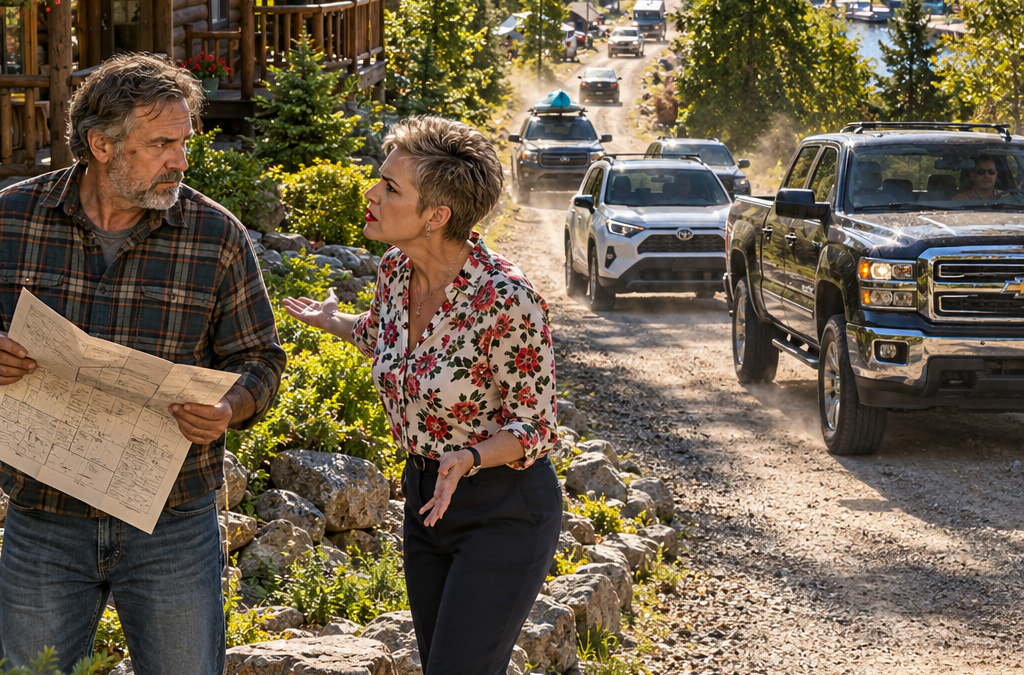
𝗙𝗨𝗟𝗟 𝗦𝗧𝗢𝗥𝗬
That was all I cared about.
I signed.
Moved in.
And spent my first night alone in the cabin with every window cracked because I wanted to hear the lake.
The next morning, I woke to tires on gravel.
At first I assumed delivery truck.
Then I remembered I hadn’t ordered anything.
I got out of bed.
Walked to the front window.
A dark pickup was moving slowly along the gravel road.
Not toward my cabin.
Past it.
Two adults in front.
Teenagers in the back.
Kayaks strapped overhead.
They didn’t look lost.
One of them waved.
I waved automatically.
Then watched the truck disappear through the trees.
I made coffee.
Ten minutes later, another vehicle passed.
SUV this time.
Then nothing for maybe an hour.
I told myself the realtor’s “rarely used” description had been flexible.
By noon, three more cars had gone through.
One towing a small fishing boat.
One carrying groceries.
One minivan with Lakeside Ridge parking stickers on the windshield.
That got my attention.
I walked to the road.
Pulled up the county parcel map on my phone.
Zoomed in.
Then farther.
The gravel road entered my property at the north line.
Crossed it.
Curved past the cabin.
Continued south.
Entirely through my parcel until it reached another tract closer to Lakeside Ridge.
I thought the map might be simplified.
So I opened my closing documents.
Same thing.
My parcel.
My road.
At least according to the deed map.
I stood there while another vehicle approached.
This one slowed when the driver saw me.
Older woman.
Window down.
“Morning.”
“Morning.”
She pointed ahead.
“Road okay?”
“As far as I know.”
“Good.”
Then she kept going.
I watched her disappear.
Road okay.
She had asked me as though I were a caretaker.
Not owner.
That afternoon, I drove the route myself.
The gravel road crossed my land and continued toward a narrow neck of property connecting into Lakeside Ridge.
Then I understood what the realtor hadn’t.
Or hadn’t explained.
The road wasn’t serving a few cabins.
It was the only land route into the rear lake section of the subdivision.
Two hundred families, according to a sign near the entrance.
Some homes had boat access.
That didn’t matter for groceries, school buses, ambulances, snowplows, propane trucks, or everyday life.
The gravel road through my property was their road.
Except legally, it appeared to be mine.
That evening, I was stacking firewood beside the porch when a vehicle stopped near the cabin.
Black Tahoe.
A heavyset man climbed out.
Late fifties.
Navy polo.
Tan pants.
Expensive watch.
He didn’t knock.
Didn’t introduce himself until he had already walked halfway up the drive.
“Nathan Cole?”
“Yes.”
“Victor Kaine.”
He said it like I should know.
Then added:
“President of Lakeside Ridge HOA.”
I set down the wood.
“All right.”
“You must be the new owner.”
“I am.”
He looked toward the road.
“Then let’s get something clear early.”
No handshake.
No welcome.
No introduction to the neighborhood.
Straight to the line he had come to deliver.
“That road isn’t yours to block.”
I looked at him.
“I haven’t blocked anything.”
“Good.”
He nodded as though I had agreed to a condition.
“Because you can’t.”
“According to my deed, it runs entirely through my property.”
Victor’s expression changed.
Just slightly.
“That road has served Lakeside Ridge for thirty years.”
“Okay.”
“You don’t buy a cabin and suddenly decide two hundred families can’t reach their homes.”
“I didn’t say that.”
“Then we don’t have a problem.”
I crossed my arms.
“Maybe we do.”
His face hardened.
“What does that mean?”
“It means if two hundred families have a legal right to cross my property, I’d like to see the document establishing it.”
Victor gave a short laugh.
“Thirty years of use establishes it.”
“Maybe.”
“No maybe.”
“Then there should be paperwork.”
He stared at me.
I continued.
“I’m not blocking anything today.”
“Good.”
“But I want the easement.”
“We have one.”
“Send it.”
His jaw tightened.
“You’re making this more complicated than it needs to be.”
“I asked for a document.”
“This community has used that road continuously since 1991.”
“Then the document should be easy to find.”
Victor looked toward the cabin.
Then the trees.
Then back at me.
“You bought the property knowing the road existed.”
“I bought the property knowing a gravel road existed.”
“Same thing.”
“No.”
I shook my head.
“Not legally.”
That word irritated him.
People who rely on assumed authority often dislike precision.
Victor stepped closer.
“I’m going to give you some advice.”
I waited.
“Don’t start your first week here by making enemies out of everyone around the lake.”
I looked toward the road.
“I’m not the one who came to somebody else’s house and threatened him.”
“I didn’t threaten you.”
“Good.”
I smiled slightly.
“Then send me the easement.”
He left without shaking my hand.
That was when I knew something was wrong.
Not necessarily criminal.
Not yet.
But wrong.
If the easement were obvious, Victor would have shown it to me.
If two hundred homes depended on it, every HOA president should have known exactly where the document was recorded.
Instead, he had given me history.
Pressure.
Community need.
Everything except paper.
The next morning, I drove to the county records office.
Small building.
Brick.
Fluorescent lights.
The kind of government office where the carpet looks older than some employees.
I went to the recorder counter.
A thin man in his early sixties sat behind it.
Glasses.
Gray hair.
Nameplate:
LONNIE BRIGGS
I gave him the parcel number.
Then the address.
His eyes changed.
Not dramatically.
But I noticed.
Years of engineering work had made me pay attention when someone looks at a number twice.
“You’re the new owner?”
“Yes.”
He turned toward his screen.
Typed.
Then stopped.
“Those files are being updated.”
“What does that mean?”
“Some older records are being rescanned.”
“I’d like the deed chain and all easements.”
“Come back next week.”
“Can I see the originals?”
“Not while they’re being updated.”
“Who requested the update?”
Lonnie looked at me.
“Routine records work.”
I nodded.
“Then I’ll request certified copies.”
His fingers stopped on the keyboard.
“That’ll take time.”
“That’s fine.”
“You said you wanted them today.”
“I’d prefer today.”
I leaned on the counter.
“But I’ll file the request.”
He stared at me.
Then printed the form.
There are situations where raising your voice makes people feel justified in resisting you.
So I didn’t.
I filled out every line.
Full deed chain.
Recorded easements.
Right-of-way documents.
Amendments.
Maps.
Supporting filings.
Certified copies.
I paid the fee.
Lonnie stamped the request.
“Three to five business days.”
“Thank you.”
He didn’t say you’re welcome.
Three days later, a thick envelope arrived.
I spread everything across the kitchen table.
The original deed creating my parcel dated to 1991.
I read it slowly.
Then again.
Property description.
Boundaries.
Improvements.
Restrictions.
Mineral language.
Access language.
No HOA easement.
No public right-of-way.
No recorded community access across the gravel road.
Nothing.
I checked the subsequent transfers.
Same.
Nothing.
Then I found another document.
Stapled behind a later record.
Dated two years earlier.
COMMUNITY ACCESS EASEMENT CONFIRMATION
It claimed a perpetual roadway easement had existed since the subdivision’s creation.
It described Lakeside Ridge as possessing access rights through what was now my property.
At first, I thought maybe I had simply missed some older reference.
Then I looked at the recording information.
The easement supposedly “confirmed” rights dating back decades.
Yet the document itself had only been filed two years ago.
No reference to the original grantor.
No notarized signature from the property owner.
No prior recorded instrument.
No compensation language.
No map approved by the owner.
At the bottom was a county certification.
Lonnie Briggs.
I sat back.
The same man who had told me the records were being updated.
I read the document again.
This time not as a homeowner.
As someone accustomed to examining a structure for the first sign of failure.
If an easement had always existed, why was the first document confirming it created two years ago?
If the prior owner granted it, where was his signature?
If it was a community right-of-way, why was there no legal description signed by the affected landowner?
And why had the county clerk who didn’t want me seeing the file personally signed the questionable record?
I called the attorney who handled my closing.
Her name was Meredith Shaw.
I emailed everything.
She called twenty minutes later.
“Nathan.”
“Yeah?”
“Do not block that road.”
“I wasn’t planning to.”
“Do not threaten to block it either.”
“Why?”
“Because whatever happened here, two hundred families rely on access. A judge will care about that immediately.”
“So Victor wins?”
“No.”
Her voice sharpened.
“Need and legal ownership are different questions.”
“Then what’s wrong with the document?”
“A lot.”
“Fraud?”
“Don’t use that word yet.”
“Everyone keeps telling me not to use the interesting words.”
“Because interesting words become expensive if you’re wrong.”
I smiled despite myself.
“What do we know?”
“We know the original deed doesn’t show an easement.”
“Correct.”
“We know this newer document claims to confirm one but doesn’t identify the original granting instrument.”
“Correct.”
“It lacks signatures I’d expect.”
“Yes.”
“And I don’t like the filing sequence.”
“So?”
“So we request a county audit.”
“Formal?”
“Very.”
I filed it the next morning.
Then I installed cameras.
Not because I expected anybody to attack me.
Because I wanted to understand what I owned.
Motion-activated.
Weatherproof.
One near the county-road entrance.
One near the cabin.
One farther south.
Within three days, I realized the phrase rarely used had been almost comically wrong.
Morning commute.
School traffic.
Contractors.
Delivery vans.
Pickup trucks.
Propane.
Landscaping crews.
Private vehicles.
Dozens every day.
At peak times, one vehicle every few minutes.
Some drivers slowed near the cabin.
Most didn’t.
One delivery truck threw gravel against the edge of my porch.
Another vehicle passed well above any reasonable speed.
I wasn’t angry that people needed access.
I was angry nobody had told me what I was actually buying.
I had spent nearly every dollar I owned on twelve acres with what amounted to a community highway through the middle.
That affects privacy.
Liability.
Maintenance.
Value.
Security.
Everything.
Victor knew.
The HOA knew.
Someone at the county knew.
Apparently everybody knew except the man signing the deed.
That bothered me more than the traffic.
The following Tuesday, a Lakeside Ridge resident stopped while I was checking one camera.
Older man.
Pickup.
He lowered the window.
“You Nathan?”
“Yes.”
“I’m Owen Parker.”
We shook hands.
“Victor says you’re trying to close the road.”
“I’m not.”
“That’s not what he’s telling people.”
“What is he telling them?”
Owen looked uncomfortable.
“That you bought the property knowing the community had permanent access and now you’re trying to leverage it for money.”
I stared at him.
“Did Victor show you the easement?”
“No.”
“Have you ever seen it?”
“No.”
“Then why do you believe him?”
Owen looked down the road.
“Because we’ve always used it.”
That was the heart of everything.
Habit.
Thirty years.
People woke up.
Drove to work.
Came home.
No one asked who owned the road because nothing forced them to.
Then I arrived.
A new owner becomes a question even when he doesn’t want to be one.
The next HOA meeting was scheduled for Thursday.
I didn’t receive an invitation.
I went anyway.
Lakeside Ridge’s clubhouse overlooked the lake.
Polished timber.
Stone fireplace.
Rows of folding chairs.
I sat in the third row.
A folder rested on my lap.
Certified deed.
1991 records.
Questionable easement.
County audit request.
Camera traffic counts.
Victor entered and saw me.
His expression tightened.
Then he smiled for the room.
“Mr. Cole.”
“Victor.”
“Didn’t realize you were attending.”
“It’s an open meeting.”
“Of course.”
He walked away.
The agenda reached road access twenty minutes later.
Victor stood.
“Given recent questions concerning our established community right-of-way, the board is proposing an emergency resolution confirming Lakeside Ridge’s historic access.”
People murmured.
He continued.
“This road has served residents for thirty years. Nothing has changed except ownership of one underlying parcel.”
That wording was deliberate.
Underlying parcel.
As though my property were merely dirt under their road.
Victor projected a map.
My land highlighted.
Road marked as Lakeside Ridge Community Access.
“We simply need our governance records to reflect what everyone already knows.”
A board member asked:
“Doesn’t the county already show the easement?”
Victor hesitated.
“Yes.”
That was when I raised my hand.
He ignored me.
The board member noticed.
“Mr. Cole has a question.”
Victor had no choice.
“Nathan.”
I stood.
“I’d like to ask about the access document filed two years ago.”
The room quieted.
Victor’s smile stayed.
“That’s simply a formal confirmation of long-established rights.”
I opened my folder.
“Then why does the original 1991 deed show no easement?”
Murmurs.
Victor said, “Not every historical use is reflected in the first deed.”
“Agreed.”
I held up the certified record.
“But I’ve reviewed the entire chain.”
More murmurs.
“No recorded road easement.”
Victor’s smile weakened.
“The community’s continuous use is well established.”
“Maybe.”
“Thirty years is more than maybe.”
“I’m asking about the document.”
I held up the newer one.
“This was filed two years ago.”
Victor’s voice hardened.
“Correct.”
“It says an easement always existed.”
“Correct.”
“But it doesn’t identify the instrument that originally created it.”
“Legal paperwork evolves.”
“No owner signature.”
“Because it was a confirmation.”
“No notarized grant.”
“Again—”
“No public hearing.”
Victor slammed one hand lightly against the table.
“This is a distraction.”
I looked toward the back.
Lonnie Briggs was there.
I hadn’t noticed him when I entered.
He stood near the door.
His face had gone pale.
When our eyes met, he looked away.
I continued.
“The certification at the bottom belongs to County Clerk Lonnie Briggs.”
Every head turned.
Lonnie shifted.
Then began moving toward the exit.
Victor raised his voice.
“The vote will proceed.”
I didn’t chase Lonnie.
Didn’t argue.
I closed the folder.
“I’ve already filed a formal audit request with the county.”
The room changed.
Not loudly.
But confidence moved.
People looked at Victor differently.
“Until that audit is complete,” I said, “I’m not blocking the road.”
A few residents visibly relaxed.
“I’m not threatening anyone’s home access.”
More movement.
“But I’m also not accepting a questionable filing as proof simply because Victor says everybody has always driven there.”
Victor stared at me.
“We will not be intimidated.”
“I’m not intimidating you.”
I sat down.
“I’m asking for the truth.”
The emergency resolution passed narrowly.
It didn’t matter.
The county audit had already started.
Two weeks later, Sheriff Dana Ruiz called me.
Not the county recorder.
The sheriff.
That told me immediately the issue had moved beyond a paperwork dispute.
“Mr. Cole?”
“Yes.”
“This is Sheriff Dana Ruiz.”
I stood at my kitchen counter.
“What happened?”
“I’d like you to come to the office.”
“Am I in trouble?”
“No.”
“Then tell me.”
She paused.
“The community easement document you asked us to review did not go through the lawful recording process.”
I closed my eyes.
“What does that mean?”
“It appears to have been inserted into the chain outside standard procedure.”
“Forged?”
“We’re still determining criminal classifications.”
“What about the date?”
“Backdated.”
My stomach tightened.
“Owner authorization?”
“None.”
“Notarization?”
“Not valid.”
“Public hearing?”
“No record.”
“And Lonnie?”
Another pause.
“Come in.”
I drove to the sheriff’s office.
Dana Ruiz was in her early fifties.
Direct.
No theatrical law-enforcement voice.
She laid copies across a conference table.
The questioned easement had been entered into the county system after hours.
No normal intake stamp.
No payment trail.
No owner notification.
No legal review.
No supporting deed.
The metadata didn’t match the date shown on the face of the document.
“How did this happen?” I asked.
“We asked Mr. Briggs.”
“And?”
“He cooperated.”
I could tell from her expression there was more.
“How much?”
She looked at me.
“What?”
“Nobody does this because Victor asked nicely.”
Dana didn’t smile.
“You’ve done investigations before?”
“Different kind.”
She folded her hands.
“Lonnie says Victor Kaine paid him.”
There it was.
I felt less satisfaction than I expected.
Mostly nausea.
“How much?”
“Enough to matter.”
“Why?”
“According to Briggs, Victor told him the easement was merely correcting an old omission.”
“That doesn’t explain money.”
“No.”
“He knew it was wrong.”
“We believe so.”
I leaned back.
“Two hundred families have been using that road.”
“Yes.”
“If the easement was fake, what happens to them?”
Dana studied me.
“That’s a civil question you’ll need to handle with your attorney.”
“That’s not what I asked.”
She understood.
“You aren’t required to decide today.”
But I was already thinking about school buses.
Ambulances.
People going to work.
Children.
Older residents.
Victor had put them in a position where their access depended on a crime.
That made me angrier than anything he had said to me personally.
The sheriff questioned Lonnie formally.
According to the eventual statement, he lasted less than ten minutes before explaining the arrangement.
Victor wanted permanent control over the road before the old property changed hands.
The previous owner had been elderly.
Rarely questioned traffic.
But Victor knew eventually somebody new might buy the parcel.
Somebody might check.
So he paid Lonnie to create a document making the community’s use look legally permanent.
No negotiations.
No compensation.
No notice.
No signature from the landowner.
Just paperwork slipped into the system so the next owner would assume the problem had been settled decades earlier.
Me.
I was the next owner.
Victor had expected me to see the easement and surrender.
If Lonnie had been less nervous that morning at the county office, I might have.
Deputies executed a warrant at Victor’s house the next morning.
Records.
Electronic devices.
Financial documents.
HOA communications.
Victor tried to argue.
Of course he did.
According to Owen Parker, who lived across the street, Victor stood in his driveway telling deputies they were misunderstanding a civil property matter while they carried boxes from his home.
But folders only work when the paper inside them is real.
By that evening, everyone around Lake Mercer knew.
My phone rang almost constantly.
Residents.
Reporters.
People apologizing.
People frightened.
Some angry at me even though I had not blocked anything.
One woman called crying.
“My husband is on dialysis.”
“I’m sorry.”
“If you close the road, we can’t get him to treatment.”
“I’m not closing it.”
“Victor says—”
“Victor is the reason we’re here.”
Silence.
Then:
“Please don’t punish us.”
That sentence stayed with me.
Punish us.
I never wanted leverage over two hundred families.
That was Victor’s mindset.
Control the road.
Control the community.
Control the new owner.
My mindset was much simpler.
Tell me what is legally mine.
Tell me what is legally theirs.
Then build an honest agreement between those facts.
An emergency HOA meeting was scheduled for Saturday.
This time I received an invitation.
Not as a hostile property owner.
As a speaker.
Victor was no longer presiding.
An interim board chaired the meeting.
The clubhouse was full.
People stood along the walls.
Some wouldn’t look at me.
Others did nothing but look.
I walked to the front.
No dramatic folder.
No PowerPoint.
Just me.
“I want to start with the part everybody is afraid of.”
The room went quiet.
“I’m not closing the road.”
A collective breath moved through the space.
One woman actually began crying.
“I never wanted two hundred families trapped behind my property.”
I looked around.
“I didn’t buy twelve acres to control your lives.”
Someone near the back said:
“Then what do you want?”
“Truth.”
I let that sit.
“And a legal agreement that respects both sides.”
I explained what I had found.
Original deed.
No easement.
Later filing.
County audit.
I did not describe Lonnie in insulting terms.
Didn’t call Victor names.
The facts didn’t need help.
Then I told them what bothered me most.
“You’ve used this road for thirty years.”
People nodded.
“That matters.”
Victor had been right about one thing.
History mattered.
Maybe not the way he claimed.
But it mattered.
“Your children go to school on that road. Your ambulances use it. Deliveries. Fire engines. Work.”
I paused.
“I understand what this road is to you.”
Then I looked toward the windows where the gravel line disappeared through trees toward my cabin.
“But it is also the road through the middle of my home.”
That landed differently.
People had thought about access.
Not about what daily traffic meant to me.
“I bought twelve acres expecting privacy.”
I smiled faintly.
“The realtor used the phrase rarely used.”
Several people laughed uncomfortably.
“I’ve counted more than eighty vehicle movements on some days.”
A man lowered his head.
“Some vehicles pass my porch at forty miles per hour.”
Someone muttered, “That’s ridiculous.”
“It is.”
“I’ve had delivery trucks throw gravel against the cabin.”
I looked toward the interim board.
“So if we’re going to share this road, then we share responsibility too.”
The board’s attorney stood.
“We’d like to propose a formal easement.”
Properly negotiated.
Properly surveyed.
Properly recorded.
Compensated.
Maintenance obligations defined.
Speed restrictions.
Emergency access.
Liability allocation.
No expansion of use without my consent.
Privacy protections around my cabin.
That sounded like what should have happened decades earlier.
The first offer included a lump-sum payment large enough that I had to read it twice.
I didn’t accept immediately.
Not because I wanted more money.
Because money was only one piece.
I called Meredith.
We worked through the terms.
Then I added my own.
HOA contributes annually to gravel maintenance.
Ten-mile-per-hour zone near the cabin.
No parking.
No stopping except emergencies.
No widening without written approval.
No new utility trench.
No commercial shortcut traffic unrelated to Lakeside Ridge.
Cameras could remain for security.
And the easement would be clear enough that no future Victor could reinterpret it.
The interim board agreed.
Residents voted.
Overwhelmingly yes.
For the first time since I bought the cabin, the road belonged to both realities at once.
The underlying land remained mine.
The community received a legitimate right of passage.
Not because Victor stole it.
Because I granted it.
Legally.
Knowingly.
For compensation.
With conditions.
That’s what consent looks like on paper.
The easement was recorded correctly.
I watched the clerk stamp it.
Lonnie wasn’t behind the counter anymore.
He had been removed from his position.
As part of the cleanup, county staff began reviewing other records he had touched.
Lonnie cooperated fully.
He helped identify and correct falsified or improper entries.
One file at a time.
I saw him once during that process.
He looked older.
“Nathan.”
I stopped.
He stared at the floor.
“I’m sorry.”
I believed him.
That didn’t erase it.
“I almost walked away that morning.”
“What?”
“When you told me to come back next week.”
His eyes lifted.
“If I’d left, I might have accepted the fake document.”
He nodded.
“I know.”
“Why’d you do it?”
He closed his eyes.
“Money.”
I waited.
“And because Victor made it sound harmless.”
“Harmless.”
“He said everybody already used the road. Said we were only fixing paperwork.”
“Did you believe him?”
“For about five minutes.”
That was more honest than I expected.
“What about after?”
“I was already in it.”
I looked at him.
“That’s usually when you stop.”
He nodded.
“I know.”
There wasn’t anything else to say.
Victor’s case moved separately.
Fraud.
Bribery involving a public official.
Additional allegations connected to how the HOA records had been used.
He was permanently barred from serving on an HOA board in the county.
That part seemed almost symbolic by then.
No sane community would have elected him again anyway.
Or I hoped not.
The Lakeside Ridge board changed completely.
Some members resigned because they had trusted Victor too easily.
Others stayed to rebuild.
Owen Parker joined.
So did a woman named Denise Hall, whose husband was the dialysis patient.
They invited me to become an HOA member.
I laughed.
“I’m not in your HOA.”
“Honorary?”
“No.”
“Advisory?”
“No.”
Owen smiled.
“Neighbor?”
“That I’ll take.”
That distinction became important to me.
I didn’t need a title inside their organization.
I needed a functional relationship.
The road changed too.
The HOA installed speed signs.
They paid for fresh gravel.
Drainage improvements were done where spring runoff had been cutting ruts near the south turn.
They placed convex mirrors at two blind curves.
No one did any of that before because everybody treated the road as something that simply existed.
Once the paperwork established responsibility, maintenance improved.
That’s one of the least dramatic benefits of clear ownership.
People know who is supposed to fix what.
I put up one sign at the northern edge.
Wooden.
Simple.
No legal warnings.
No cameras pictured.
No threats.
It read:
SHARED ROAD
PLEASE DRIVE SLOW
NEIGHBORS AHEAD
I built it myself.
Cedar posts.
Dark stain.
White letters.
Owen stopped when I was installing it.
“That’s it?”
“What?”
“After everything Victor did, that’s your sign?”
“What should it say?”
He thought.
“Private property. Trespassers prosecuted. HOA president beware.”
I laughed.
“Too many words.”
The first week, some drivers still passed too fast.
Then word spread.
People slowed.
They waved.
A few stopped near the edge of the property—not near my cabin—to thank me.
One woman brought muffins.
Another family left a note in my mailbox.
Thank you for not making us pay for what Victor did.
I kept that one.
Not because I thought I deserved praise.
Because it reminded me how close everybody had come to becoming enemies over something none of them had created.
The cameras stayed.
At first, residents were nervous about that.
I explained they recorded the road, not private homes.
They protected me.
They also protected them if an accident happened.
Nobody argued after that.
The realtor eventually called.
She had heard about the dispute.
“I owe you an apology.”
“Yes.”
She was quiet.
That wasn’t the answer she expected.
“I should’ve investigated the road more carefully.”
“Yes.”
“I’m sorry.”
“Thank you.”
She offered to refund part of her commission.
I declined.
I didn’t want another fight.
But I told her to stop using phrases like rarely used without verifying them.
A road serving two hundred families is not rarely used because no vehicle happens to pass during a fifteen-minute showing.
She agreed.
Whether she changed her practice, I don’t know.
I hope so.
The cabin eventually became what I had wanted.
Not silent.
Never silent.
But peaceful.
There’s a difference.
I hear tires.
Sometimes school buses.
Delivery vans.
Residents towing fishing boats.
I know who they are now.
Most slow near the cabin.
Most wave.
I wave back.
The private dock remains my favorite place.
At sunset, the lake turns almost copper under the trees.
Some evenings I sit there with coffee even though coffee at sunset is a terrible decision for sleep.
The road is far enough uphill that traffic becomes only a soft crunch in the distance.
I don’t resent it anymore.
Because it no longer feels like somebody else’s claim passing through my property.
It is an agreement I made.
That distinction changed everything.
People sometimes ask why I didn’t simply close the road the day I discovered there was no valid easement.
There were moments when I thought about it.
Not seriously enough to drag barriers into place.
But emotionally?
Absolutely.
Victor made me furious.
He had walked onto my property acting as though two hundred families gave him ownership by proxy.
Then I learned he’d bribed a public official to manufacture the paper he couldn’t get honestly.
There was a part of me that wanted to put a chain across the road just to force everyone to finally understand where it sat.
But that would have hurt the wrong people.
Victor lived there.
So did children.
Retirees.
Nurses.
Teachers.
The woman whose husband needed dialysis.
People going to work at five in the morning.
People waiting for prescriptions.
An easement dispute is paperwork until an ambulance needs through.
I had built bridges under much worse conditions.
The whole point of a bridge is access.
I couldn’t spend my life helping people cross obstacles and then create one simply because I was angry.
So I didn’t.
That doesn’t mean I surrendered.
I made them negotiate.
That’s different.
I refused Victor’s fake right.
Then offered the community a real one.
Some people saw that as generosity.
I didn’t.
It was fairness.
They had relied on the road in good faith.
I had bought land in good faith.
Both sides had been deceived.
A fair solution had to acknowledge both.
The legal settlement also covered part of what I had lost by buying under incomplete disclosure.
That helped.
I invested some of the money in the property.
Rebuilt the dock.
Added sound insulation on the road-facing side of the cabin.
Planted a thick line of evergreens to create privacy between the porch and gravel.
Within a few years, drivers could barely see the house.
That mattered more to me than the compensation itself.
Privacy restored.
Access preserved.
No one trapped.
No one cheated.
That was the outcome I wanted.
Dana Ruiz visited once after the case ended.
Not officially.
She was fishing nearby and stopped.
We sat on the dock.
She asked:
“Do you regret buying it?”
I thought about that.
“No.”
“Not even after Victor?”
“Especially after Victor might be overstating it.”
She smiled.
“Then why?”
“Because now I actually know what I own.”
Dana looked toward the road.
“And what everyone else owns.”
“Exactly.”
She nodded.
“Most people don’t figure that out until after trouble.”
“I had helpful motivation.”
We sat quietly.
Then she said:
“Victor thought nobody would ever check.”
“That’s what Lonnie said.”
“He was probably right for a while.”
“Thirty years.”
“No.”
She shook her head.
“The fake record was only two.”
I understood.
The community’s long use wasn’t the deception.
Victor’s attempt to convert reliance into secret legal control was.
That distinction mattered.
People had used the road for decades because prior owners allowed it or never challenged it.
Maybe a court would eventually have had to examine prescriptive rights, necessity, reliance, or other doctrines.
Meredith had warned me not to assume that lack of a recorded easement meant I could instantly shut everything down without litigation.
Property law is rarely as clean as homeowners want it to be.
But Victor didn’t trust the legal process.
He didn’t negotiate with the previous owner.
Didn’t petition a court.
Didn’t compensate anyone.
He paid a clerk to create an easier answer.
That was the crime.
Not wanting secure access.
Wanting access was reasonable.
How he obtained it wasn’t.
I think that lesson got lost in some retellings.
The story around the lake became:
Nathan discovered the HOA had no road rights and exposed Victor.
That’s true enough.
But incomplete.
Two hundred families really did need that road.
Victor could have solved the problem honestly.
Approach the owner.
Negotiate.
Survey.
Record.
Pay.
Maintain.
Done.
Instead, he decided ownership was an obstacle to be edited.
People like Victor confuse outcome with entitlement.
Because the community needed the road, he believed anything done to secure it became justified.
That logic is dangerous.
Need can explain pressure.
It doesn’t erase consent.
The same is true in engineering.
A bridge may be essential.
That doesn’t mean you can fabricate inspection results because closing it would inconvenience people.
Reality doesn’t become optional because the alternative is difficult.
Lonnie learned that.
Victor learned it harder.
The new Lakeside Ridge board seemed to understand.
Every year they send me a maintenance statement.
Gravel costs.
Snowplowing.
Drainage work.
Insurance.
Nothing secret.
Nothing complicated.
If work will affect my property beyond the road surface, they ask.
Usually I say yes.
Sometimes I don’t.
Nobody threatens me.
Nobody arrives in a navy polo announcing what I can’t do.
Owen became board president three years later.
The first thing he did was stop by the cabin.
He knocked.
That alone made me like him.
“Nathan.”
“Owen.”
“I’ve been elected president.”
“My condolences.”
He laughed.
“I wanted to tell you before you heard from someone else.”
“Appreciated.”
“And I brought this.”
He handed me a binder.
“What is it?”
“Road agreement. Current insurance certificate. Maintenance schedule. Survey. Everything.”
I stared at him.
“You know I already have copies.”
“I know.”
“Then why?”
He smiled.
“I figured our presidents should develop a tradition of actually bringing paperwork.”
I laughed harder than I expected.
“Come in.”
We had coffee.
That was how authority was supposed to feel.
Boring.
Transparent.
Documented.
No performance.
I still keep Victor’s fake easement.
Certified copy.
Not displayed.
Just filed.
It sits beside the legitimate easement we eventually executed.
Sometimes I take both out.
Same road.
Same land.
Two documents.
One created secretly.
One negotiated openly.
The physical road didn’t change.
The legal meaning did.
That’s something people underestimate about paper.
Good paperwork doesn’t merely record reality.
It records consent.
Who agreed.
Who didn’t.
What rights exist.
What limits exist.
Who maintains.
Who pays.
What happens next.
Victor treated documents as costumes.
Make something look official and people obey.
The real easement did the opposite.
It removed the need for obedience.
Everybody knew the terms.
That is the difference between control and agreement.
The community became friendlier over time.
At first, people waved because they were grateful I hadn’t blocked the road.
Later, they waved because they knew me.
There’s a difference there too.
Denise Hall started bringing me tomatoes every summer.
Her husband’s treatment went well.
One afternoon she stopped near the sign while I was repairing a drainage ditch.
“Do you know I hated you for about three days?”
I laughed.
“Before meeting me?”
“Yes.”
“Efficient.”
“Victor told us you were trying to hold the community hostage.”
“That phrase sounds like him.”
“I believed it.”
“Most people did.”
She looked toward the cabin.
“Then I realized you’d never blocked anything.”
“No.”
“You didn’t even put up a gate.”
“No.”
“So why did I believe him?”
I set the shovel down.
“Because losing access to your home is scary.”
She nodded.
“And because he gave the fear a person.”
That made her quiet.
I hadn’t planned the sentence.
It just came out.
Victor needed me to become the threat.
If residents believed the real problem was a fraudulent county record and their own president, his authority collapsed.
If they believed a selfish outsider was trying to close their only road, they would rally behind him.
So he gave fear my name.
That’s a common trick.
Simplify the problem until anger knows where to stand.
I didn’t need to fight that with anger of my own.
I needed records.
That was why the first HOA meeting mattered.
I did not accuse Victor of bribery.
I didn’t know that yet.
I simply held up 1991.
Then two years ago.
Asked why.
One honest question can do more damage to a bad story than ten minutes of shouting.
Victor’s mistake was thinking confidence could bridge the gap.
It couldn’t.
Neither could Lonnie.
The dates didn’t match the story.
The signatures didn’t match the process.
The filing didn’t match county procedure.
Once people started looking, the structure failed at every connection.
I know structures.
When one load path is fake, eventually the stress finds it.
The road itself is better now than when I bought the cabin.
Ironically.
Fresh gravel.
Proper crown.
Drainage ditches.
Culvert replaced near the lower bend.
Winter plowing paid proportionally by the HOA under the agreement.
I maintain the portion around my cabin because I prefer doing it myself.
One morning after a snowstorm, I was clearing the road when a Lakeside Ridge school bus came through.
The driver slowed.
Opened the window.
“Morning, Nathan.”
“Morning.”
“Thanks for clearing this.”
“No problem.”
Then the bus rolled past.
Children inside waved.
I waved back.
For a second, I thought about Victor.
He had claimed the community needed control of the road.
He was wrong.
They needed access.
Control and access are not the same thing.
A legal easement gave them everything they actually needed without taking everything from me.
That was the solution sitting there from the beginning.
But cooperation doesn’t make powerful people feel powerful.
Control does.
Victor had wanted the road to become proof that he could decide.
Who passed.
What rights existed.
What a new owner could question.
He wasn’t protecting the community from me.
He was protecting his authority from scrutiny.
That’s why the county file mattered so much.
The road dispute exposed him.
Then the bribery exposed what was underneath.
He had built his leadership around the assumption nobody would check.
The day I requested a certified copy, that assumption ended.
I sometimes wonder what would have happened if Lonnie had simply handed me the file without acting nervous.
Maybe I would have seen the newer easement.
Assumed my closing attorney missed something.
Maybe I’d accept it.
Maybe I wouldn’t compare the recording sequence carefully.
Victor probably expected exactly that.
Most property owners don’t read every page.
Most people see an official county document and believe it.
That’s reasonable.
Public records are supposed to deserve trust.
That is why corrupting them is so serious.
Lonnie didn’t merely lie to me.
He damaged the reliability of the system everyone depends on.
A county recorder’s office works because strangers can walk in and assume the records weren’t bought.
Once that trust breaks, every line becomes questionable.
His cooperation afterward mattered.
But it couldn’t fully undo what he had done.
The county implemented new controls.
Two-person verification for certain historical easement corrections.
Audit logs.
Supervisor review.
Owner notification where appropriate.
Those reforms didn’t make headlines around Lake Mercer.
I thought they were one of the best outcomes.
Because the next person might never know they were protected by them.
Good systems prevent stories.
That’s success.
The wooden sign at my property line has weathered now.
I repaint it every couple of years.
SHARED ROAD.
PLEASE DRIVE SLOW.
NEIGHBORS AHEAD.
I considered replacing the word shared with easement.
Too legal.
Shared says more.
It is my underlying land.
Their access right.
Our responsibility.
Shared does not mean confused.
It doesn’t mean everybody owns everything.
It means two rights can occupy the same strip of gravel without one erasing the other.
That’s what Victor couldn’t accept.
He thought if my ownership was real, their access became weaker.
So he tried to erase my ownership from the equation.
The honest solution proved the opposite.
Once my rights were acknowledged, I was willing to protect theirs.
Respect usually works better than deception.
Not always.
But often enough to try first.
One evening, years after the case ended, I sat on the dock watching sunset.
The water was flat.
Orange light across the lake.
Behind me, I could hear a car moving slowly along the gravel.
It passed.
Driver tapped the horn once.
Probably Owen.
I didn’t turn.
I thought about the first morning.
The truck.
The kayaks.
The confusion.
Standing in the road with my phone realizing strangers were crossing my land as if I didn’t exist.
I had felt cheated.
I was.
But I also felt something else I didn’t understand then.
Threatened by how much other people’s lives depended on something I had just bought.
Ownership usually feels like control.
That road taught me ownership can also mean responsibility.
I could have treated two hundred families as leverage.
Victor did.
I chose not to.
That decision gave me more peace than winning ever could have.
Because in the end, I didn’t want a private road empty of neighbors.
I wanted a home where nobody lied to me about what was mine.
Those are different dreams.
The first is isolation.
The second is dignity.
I got the second.
The cabin is still mine.
The dock is mine.
The twelve acres remain mine.
The road crosses my land.
And Lakeside Ridge has a permanent legal right to use it under the agreement we all signed openly.
Nobody has to hide.
Nobody has to bribe a clerk.
Nobody has to threaten anyone.
The school bus passes.
Ambulances can pass.
Families go home.
I drink coffee on the porch.
Most vehicles slow.
Some drivers wave.
I usually wave back.
And every now and then, someone new moves into Lakeside Ridge and asks why the road sign says SHARED ROAD instead of PRIVATE ROAD or HOA ACCESS.
Owen tells them the short version.
“There was a paperwork problem.”
I tell them something different.
“There was a truth problem.”
Because that’s what it really was.
The road had physically existed for decades.
The families were real.
Their reliance was real.
My ownership was real.
What wasn’t real was the document Victor created to avoid dealing honestly with all of those facts at once.
Once that fake piece of certainty disappeared, the real solution became obvious.
Talk.
Negotiate.
Write it correctly.
Pay what is fair.
Respect the property.
Keep the road open.
No drama required.
I came to Lake Mercer looking for quiet.
For a while, I found police interviews, county audits, HOA meetings, lawyers, traffic cameras, bribery charges, and two hundred frightened families.
Not exactly what the realtor promised.
But when I sit on my dock now and hear a vehicle crunching slowly across the gravel behind me, the sound doesn’t bother me.
It means someone is going home.
And I know exactly why they have the right to pass.
Because this time, the paper tells the truth.
𝗧𝗛𝗘 𝗘𝗡𝗗
The Only Road to 200 Lake Homes Ran Through My 12 Acres, and the HOA President Was Far Too Nervous About One Old Deed
The first morning after I moved into my lake cabin, I counted four vehicles driving across land my deed said belonged entirely to me, and every one of them acted as though the gravel road through my front yard had never been private.
By the time the HOA president showed up demanding that I never interfere with that road, I had already started wondering why a community of two hundred families depended on a legal right nobody seemed willing to show me.
My name is Nathan Cole, and when I bought those twelve acres, I thought I was buying silence.
Not isolation.
Not some survivalist fantasy where I never saw another human being.
Just silence.
After years of having my days dictated by schedules, alarms, radios, machinery, traffic, and other people’s emergencies, I wanted a place where I could wake up and hear something that didn’t require a response.
Wind through pine.
Water against a dock.
Maybe a woodpecker if he wasn’t too ambitious.
That was enough.
I had spent most of my adult life building things that belonged to other people.
Bridges.
Retaining systems.
Temporary crossings.
Infrastructure in places where mistakes had consequences far beyond money.
For part of my career, I worked overseas on military engineering contracts, including projects where we built or repaired bridges under conditions nobody would ever describe as normal.
You learn things doing that work.
How to read terrain.
How to stay calm when somebody else wants you to panic.
How to separate what people say from what the structure underneath them can actually support.
And maybe most importantly, how much damage one bad assumption can do when everyone treats it like a fact.
By the time I came home for good, I was tired of building access for everyone else.
I wanted one place that was mine.
The property showed up almost by accident.
Twelve wooded acres near Lake Mercer, about forty minutes outside the nearest decent-sized town.
There was a cabin set back among the trees.
Two bedrooms.
Stone fireplace.
Screened porch.
Private dock at the bottom of a long slope.
And a gravel road that entered from the county highway, crossed the center of the property, passed within maybe eighty feet of the cabin, then disappeared toward the lake.
The realtor called it a quiet dead-end road.
“Rarely used,” she said.
I remember that phrase.
Rarely used.
I asked where it went.
She looked at the listing map.
“Back toward some lake properties.”
“Public road?”
“I don’t believe so.”
“Shared access?”
“Possibly historical.”
That word should have made me stop.
Historical.
Instead, I looked toward the lake.
The afternoon light was moving through the trees.
The dock sat empty.
No houses visible from the porch.
No traffic.
No noise.
The place felt like exactly what I had spent years imagining.
I paid almost everything I had saved.
That part wasn’t smart in the traditional financial sense.
But I had no mortgage afterward.
No landlord.
No association dues.
No developer telling me what color the cabin could be.
I checked the parcel boundaries.
The land wasn’t inside Lakeside Ridge, the gated community around the eastern side of the lake.
I asked about the HOA specifically.
My realtor told me the property was independent.
County tax records showed the same.
The cabin parcel predated the subdivision.
I had no shared clubhouse rights.
No architectural restrictions.
No HOA membership.
That was all I cared about.
I signed.
Moved in.
And spent my first night alone in the cabin with every window cracked because I wanted to hear the lake.
The next morning, I woke to tires on gravel.
At first I assumed delivery truck.
Then I remembered I hadn’t ordered anything.
I got out of bed.
Walked to the front window.
A dark pickup was moving slowly along the gravel road.
Not toward my cabin.
Past it.
Two adults in front.
Teenagers in the back.
Kayaks strapped overhead.
They didn’t look lost.
One of them waved.
I waved automatically.
Then watched the truck disappear through the trees.
I made coffee.
Ten minutes later, another vehicle passed.
SUV this time.
Then nothing for maybe an hour.
I told myself the realtor’s “rarely used” description had been flexible.
By noon, three more cars had gone through.
One towing a small fishing boat.
One carrying groceries.
One minivan with Lakeside Ridge parking stickers on the windshield.
That got my attention.
I walked to the road.
Pulled up the county parcel map on my phone.
Zoomed in.
Then farther.
The gravel road entered my property at the north line.
Crossed it.
Curved past the cabin.
Continued south.
Entirely through my parcel until it reached another tract closer to Lakeside Ridge.
I thought the map might be simplified.
So I opened my closing documents.
Same thing.
My parcel.
My road.
At least according to the deed map.
I stood there while another vehicle approached.
This one slowed when the driver saw me.
Older woman.
Window down.
“Morning.”
“Morning.”
She pointed ahead.
“Road okay?”
“As far as I know.”
“Good.”
Then she kept going.
I watched her disappear.
Road okay.
She had asked me as though I were a caretaker.
Not owner.
That afternoon, I drove the route myself.
The gravel road crossed my land and continued toward a narrow neck of property connecting into Lakeside Ridge.
Then I understood what the realtor hadn’t.
Or hadn’t explained.
The road wasn’t serving a few cabins.
It was the only land route into the rear lake section of the subdivision.
Two hundred families, according to a sign near the entrance.
Some homes had boat access.
That didn’t matter for groceries, school buses, ambulances, snowplows, propane trucks, or everyday life.
The gravel road through my property was their road.
Except legally, it appeared to be mine.
That evening, I was stacking firewood beside the porch when a vehicle stopped near the cabin.
Black Tahoe.
A heavyset man climbed out.
Late fifties.
Navy polo.
Tan pants.
Expensive watch.
He didn’t knock.
Didn’t introduce himself until he had already walked halfway up the drive.
“Nathan Cole?”
“Yes.”
“Victor Kaine.”
He said it like I should know.
Then added:
“President of Lakeside Ridge HOA.”
I set down the wood.
“All right.”
“You must be the new owner.”
“I am.”
He looked toward the road.
“Then let’s get something clear early.”
No handshake.
No welcome.
No introduction to the neighborhood.
Straight to the line he had come to deliver.
“That road isn’t yours to block.”
I looked at him.
“I haven’t blocked anything.”
“Good.”
He nodded as though I had agreed to a condition.
“Because you can’t.”
“According to my deed, it runs entirely through my property.”
Victor’s expression changed.
Just slightly.
“That road has served Lakeside Ridge for thirty years.”
“Okay.”
“You don’t buy a cabin and suddenly decide two hundred families can’t reach their homes.”
“I didn’t say that.”
“Then we don’t have a problem.”
I crossed my arms.
“Maybe we do.”
His face hardened.
“What does that mean?”
“It means if two hundred families have a legal right to cross my property, I’d like to see the document establishing it.”
Victor gave a short laugh.
“Thirty years of use establishes it.”
“Maybe.”
“No maybe.”
“Then there should be paperwork.”
He stared at me.
I continued.
“I’m not blocking anything today.”
“Good.”
“But I want the easement.”
“We have one.”
“Send it.”
His jaw tightened.
“You’re making this more complicated than it needs to be.”
“I asked for a document.”
“This community has used that road continuously since 1991.”
“Then the document should be easy to find.”
Victor looked toward the cabin.
Then the trees.
Then back at me.
“You bought the property knowing the road existed.”
“I bought the property knowing a gravel road existed.”
“Same thing.”
“No.”
I shook my head.
“Not legally.”
That word irritated him.
People who rely on assumed authority often dislike precision.
Victor stepped closer.
“I’m going to give you some advice.”
I waited.
“Don’t start your first week here by making enemies out of everyone around the lake.”
I looked toward the road.
“I’m not the one who came to somebody else’s house and threatened him.”
“I didn’t threaten you.”
“Good.”
I smiled slightly.
“Then send me the easement.”
He left without shaking my hand.
That was when I knew something was wrong.
Not necessarily criminal.
Not yet.
But wrong.
If the easement were obvious, Victor would have shown it to me.
If two hundred homes depended on it, every HOA president should have known exactly where the document was recorded.
Instead, he had given me history.
Pressure.
Community need.
Everything except paper.
The next morning, I drove to the county records office.
Small building.
Brick.
Fluorescent lights.
The kind of government office where the carpet looks older than some employees.
I went to the recorder counter.
A thin man in his early sixties sat behind it.
Glasses.
Gray hair.
Nameplate:
LONNIE BRIGGS
I gave him the parcel number.
Then the address.
His eyes changed.
Not dramatically.
But I noticed.
Years of engineering work had made me pay attention when someone looks at a number twice.
“You’re the new owner?”
“Yes.”
He turned toward his screen.
Typed.
Then stopped.
“Those files are being updated.”
“What does that mean?”
“Some older records are being rescanned.”
“I’d like the deed chain and all easements.”
“Come back next week.”
“Can I see the originals?”
“Not while they’re being updated.”
“Who requested the update?”
Lonnie looked at me.
“Routine records work.”
I nodded.
“Then I’ll request certified copies.”
His fingers stopped on the keyboard.
“That’ll take time.”
“That’s fine.”
“You said you wanted them today.”
“I’d prefer today.”
I leaned on the counter.
“But I’ll file the request.”
He stared at me.
Then printed the form.
There are situations where raising your voice makes people feel justified in resisting you.
So I didn’t.
I filled out every line.
Full deed chain.
Recorded easements.
Right-of-way documents.
Amendments.
Maps.
Supporting filings.
Certified copies.
I paid the fee.
Lonnie stamped the request.
“Three to five business days.”
“Thank you.”
He didn’t say you’re welcome.
Three days later, a thick envelope arrived.
I spread everything across the kitchen table.
The original deed creating my parcel dated to 1991.
I read it slowly.
Then again.
Property description.
Boundaries.
Improvements.
Restrictions.
Mineral language.
Access language.
No HOA easement.
No public right-of-way.
No recorded community access across the gravel road.
Nothing.
I checked the subsequent transfers.
Same.
Nothing.
Then I found another document.
Stapled behind a later record.
Dated two years earlier.
COMMUNITY ACCESS EASEMENT CONFIRMATION
It claimed a perpetual roadway easement had existed since the subdivision’s creation.
It described Lakeside Ridge as possessing access rights through what was now my property.
At first, I thought maybe I had simply missed some older reference.
Then I looked at the recording information.
The easement supposedly “confirmed” rights dating back decades.
Yet the document itself had only been filed two years ago.
No reference to the original grantor.
No notarized signature from the property owner.
No prior recorded instrument.
No compensation language.
No map approved by the owner.
At the bottom was a county certification.
Lonnie Briggs.
I sat back.
The same man who had told me the records were being updated.
I read the document again.
This time not as a homeowner.
As someone accustomed to examining a structure for the first sign of failure.
If an easement had always existed, why was the first document confirming it created two years ago?
If the prior owner granted it, where was his signature?
If it was a community right-of-way, why was there no legal description signed by the affected landowner?
And why had the county clerk who didn’t want me seeing the file personally signed the questionable record?
I called the attorney who handled my closing.
Her name was Meredith Shaw.
I emailed everything.
She called twenty minutes later.
“Nathan.”
“Yeah?”
“Do not block that road.”
“I wasn’t planning to.”
“Do not threaten to block it either.”
“Why?”
“Because whatever happened here, two hundred families rely on access. A judge will care about that immediately.”
“So Victor wins?”
“No.”
Her voice sharpened.
“Need and legal ownership are different questions.”
“Then what’s wrong with the document?”
“A lot.”
“Fraud?”
“Don’t use that word yet.”
“Everyone keeps telling me not to use the interesting words.”
“Because interesting words become expensive if you’re wrong.”
I smiled despite myself.
“What do we know?”
“We know the original deed doesn’t show an easement.”
“Correct.”
“We know this newer document claims to confirm one but doesn’t identify the original granting instrument.”
“Correct.”
“It lacks signatures I’d expect.”
“Yes.”
“And I don’t like the filing sequence.”
“So?”
“So we request a county audit.”
“Formal?”
“Very.”
I filed it the next morning.
Then I installed cameras.
Not because I expected anybody to attack me.
Because I wanted to understand what I owned.
Motion-activated.
Weatherproof.
One near the county-road entrance.
One near the cabin.
One farther south.
Within three days, I realized the phrase rarely used had been almost comically wrong.
Morning commute.
School traffic.
Contractors.
Delivery vans.
Pickup trucks.
Propane.
Landscaping crews.
Private vehicles.
Dozens every day.
At peak times, one vehicle every few minutes.
Some drivers slowed near the cabin.
Most didn’t.
One delivery truck threw gravel against the edge of my porch.
Another vehicle passed well above any reasonable speed.
I wasn’t angry that people needed access.
I was angry nobody had told me what I was actually buying.
I had spent nearly every dollar I owned on twelve acres with what amounted to a community highway through the middle.
That affects privacy.
Liability.
Maintenance.
Value.
Security.
Everything.
Victor knew.
The HOA knew.
Someone at the county knew.
Apparently everybody knew except the man signing the deed.
That bothered me more than the traffic.
The following Tuesday, a Lakeside Ridge resident stopped while I was checking one camera.
Older man.
Pickup.
He lowered the window.
“You Nathan?”
“Yes.”
“I’m Owen Parker.”
We shook hands.
“Victor says you’re trying to close the road.”
“I’m not.”
“That’s not what he’s telling people.”
“What is he telling them?”
Owen looked uncomfortable.
“That you bought the property knowing the community had permanent access and now you’re trying to leverage it for money.”
I stared at him.
“Did Victor show you the easement?”
“No.”
“Have you ever seen it?”
“No.”
“Then why do you believe him?”
Owen looked down the road.
“Because we’ve always used it.”
That was the heart of everything.
Habit.
Thirty years.
People woke up.
Drove to work.
Came home.
No one asked who owned the road because nothing forced them to.
Then I arrived.
A new owner becomes a question even when he doesn’t want to be one.
The next HOA meeting was scheduled for Thursday.
I didn’t receive an invitation.
I went anyway.
Lakeside Ridge’s clubhouse overlooked the lake.
Polished timber.
Stone fireplace.
Rows of folding chairs.
I sat in the third row.
A folder rested on my lap.
Certified deed.
1991 records.
Questionable easement.
County audit request.
Camera traffic counts.
Victor entered and saw me.
His expression tightened.
Then he smiled for the room.
“Mr. Cole.”
“Victor.”
“Didn’t realize you were attending.”
“It’s an open meeting.”
“Of course.”
He walked away.
The agenda reached road access twenty minutes later.
Victor stood.
“Given recent questions concerning our established community right-of-way, the board is proposing an emergency resolution confirming Lakeside Ridge’s historic access.”
People murmured.
He continued.
“This road has served residents for thirty years. Nothing has changed except ownership of one underlying parcel.”
That wording was deliberate.
Underlying parcel.
As though my property were merely dirt under their road.
Victor projected a map.
My land highlighted.
Road marked as Lakeside Ridge Community Access.
“We simply need our governance records to reflect what everyone already knows.”
A board member asked:
“Doesn’t the county already show the easement?”
Victor hesitated.
“Yes.”
That was when I raised my hand.
He ignored me.
The board member noticed.
“Mr. Cole has a question.”
Victor had no choice.
“Nathan.”
I stood.
“I’d like to ask about the access document filed two years ago.”
The room quieted.
Victor’s smile stayed.
“That’s simply a formal confirmation of long-established rights.”
I opened my folder.
“Then why does the original 1991 deed show no easement?”
Murmurs.
Victor said, “Not every historical use is reflected in the first deed.”
“Agreed.”
I held up the certified record.
“But I’ve reviewed the entire chain.”
More murmurs.
“No recorded road easement.”
Victor’s smile weakened.
“The community’s continuous use is well established.”
“Maybe.”
“Thirty years is more than maybe.”
“I’m asking about the document.”
I held up the newer one.
“This was filed two years ago.”
Victor’s voice hardened.
“Correct.”
“It says an easement always existed.”
“Correct.”
“But it doesn’t identify the instrument that originally created it.”
“Legal paperwork evolves.”
“No owner signature.”
“Because it was a confirmation.”
“No notarized grant.”
“Again—”
“No public hearing.”
Victor slammed one hand lightly against the table.
“This is a distraction.”
I looked toward the back.
Lonnie Briggs was there.
I hadn’t noticed him when I entered.
He stood near the door.
His face had gone pale.
When our eyes met, he looked away.
I continued.
“The certification at the bottom belongs to County Clerk Lonnie Briggs.”
Every head turned.
Lonnie shifted.
Then began moving toward the exit.
Victor raised his voice.
“The vote will proceed.”
I didn’t chase Lonnie.
Didn’t argue.
I closed the folder.
“I’ve already filed a formal audit request with the county.”
The room changed.
Not loudly.
But confidence moved.
People looked at Victor differently.
“Until that audit is complete,” I said, “I’m not blocking the road.”
A few residents visibly relaxed.
“I’m not threatening anyone’s home access.”
More movement.
“But I’m also not accepting a questionable filing as proof simply because Victor says everybody has always driven there.”
Victor stared at me.
“We will not be intimidated.”
“I’m not intimidating you.”
I sat down.
“I’m asking for the truth.”
The emergency resolution passed narrowly.
It didn’t matter.
The county audit had already started.
Two weeks later, Sheriff Dana Ruiz called me.
Not the county recorder.
The sheriff.
That told me immediately the issue had moved beyond a paperwork dispute.
“Mr. Cole?”
“Yes.”
“This is Sheriff Dana Ruiz.”
I stood at my kitchen counter.
“What happened?”
“I’d like you to come to the office.”
“Am I in trouble?”
“No.”
“Then tell me.”
She paused.
“The community easement document you asked us to review did not go through the lawful recording process.”
I closed my eyes.
“What does that mean?”
“It appears to have been inserted into the chain outside standard procedure.”
“Forged?”
“We’re still determining criminal classifications.”
“What about the date?”
“Backdated.”
My stomach tightened.
“Owner authorization?”
“None.”
“Notarization?”
“Not valid.”
“Public hearing?”
“No record.”
“And Lonnie?”
Another pause.
“Come in.”
I drove to the sheriff’s office.
Dana Ruiz was in her early fifties.
Direct.
No theatrical law-enforcement voice.
She laid copies across a conference table.
The questioned easement had been entered into the county system after hours.
No normal intake stamp.
No payment trail.
No owner notification.
No legal review.
No supporting deed.
The metadata didn’t match the date shown on the face of the document.
“How did this happen?” I asked.
“We asked Mr. Briggs.”
“And?”
“He cooperated.”
I could tell from her expression there was more.
“How much?”
She looked at me.
“What?”
“Nobody does this because Victor asked nicely.”
Dana didn’t smile.
“You’ve done investigations before?”
“Different kind.”
She folded her hands.
“Lonnie says Victor Kaine paid him.”
There it was.
I felt less satisfaction than I expected.
Mostly nausea.
“How much?”
“Enough to matter.”
“Why?”
“According to Briggs, Victor told him the easement was merely correcting an old omission.”
“That doesn’t explain money.”
“No.”
“He knew it was wrong.”
“We believe so.”
I leaned back.
“Two hundred families have been using that road.”
“Yes.”
“If the easement was fake, what happens to them?”
Dana studied me.
“That’s a civil question you’ll need to handle with your attorney.”
“That’s not what I asked.”
She understood.
“You aren’t required to decide today.”
But I was already thinking about school buses.
Ambulances.
People going to work.
Children.
Older residents.
Victor had put them in a position where their access depended on a crime.
That made me angrier than anything he had said to me personally.
The sheriff questioned Lonnie formally.
According to the eventual statement, he lasted less than ten minutes before explaining the arrangement.
Victor wanted permanent control over the road before the old property changed hands.
The previous owner had been elderly.
Rarely questioned traffic.
But Victor knew eventually somebody new might buy the parcel.
Somebody might check.
So he paid Lonnie to create a document making the community’s use look legally permanent.
No negotiations.
No compensation.
No notice.
No signature from the landowner.
Just paperwork slipped into the system so the next owner would assume the problem had been settled decades earlier.
Me.
I was the next owner.
Victor had expected me to see the easement and surrender.
If Lonnie had been less nervous that morning at the county office, I might have.
Deputies executed a warrant at Victor’s house the next morning.
Records.
Electronic devices.
Financial documents.
HOA communications.
Victor tried to argue.
Of course he did.
According to Owen Parker, who lived across the street, Victor stood in his driveway telling deputies they were misunderstanding a civil property matter while they carried boxes from his home.
But folders only work when the paper inside them is real.
By that evening, everyone around Lake Mercer knew.
My phone rang almost constantly.
Residents.
Reporters.
People apologizing.
People frightened.
Some angry at me even though I had not blocked anything.
One woman called crying.
“My husband is on dialysis.”
“I’m sorry.”
“If you close the road, we can’t get him to treatment.”
“I’m not closing it.”
“Victor says—”
“Victor is the reason we’re here.”
Silence.
Then:
“Please don’t punish us.”
That sentence stayed with me.
Punish us.
I never wanted leverage over two hundred families.
That was Victor’s mindset.
Control the road.
Control the community.
Control the new owner.
My mindset was much simpler.
Tell me what is legally mine.
Tell me what is legally theirs.
Then build an honest agreement between those facts.
An emergency HOA meeting was scheduled for Saturday.
This time I received an invitation.
Not as a hostile property owner.
As a speaker.
Victor was no longer presiding.
An interim board chaired the meeting.
The clubhouse was full.
People stood along the walls.
Some wouldn’t look at me.
Others did nothing but look.
I walked to the front.
No dramatic folder.
No PowerPoint.
Just me.
“I want to start with the part everybody is afraid of.”
The room went quiet.
“I’m not closing the road.”
A collective breath moved through the space.
One woman actually began crying.
“I never wanted two hundred families trapped behind my property.”
I looked around.
“I didn’t buy twelve acres to control your lives.”
Someone near the back said:
“Then what do you want?”
“Truth.”
I let that sit.
“And a legal agreement that respects both sides.”
I explained what I had found.
Original deed.
No easement.
Later filing.
County audit.
I did not describe Lonnie in insulting terms.
Didn’t call Victor names.
The facts didn’t need help.
Then I told them what bothered me most.
“You’ve used this road for thirty years.”
People nodded.
“That matters.”
Victor had been right about one thing.
History mattered.
Maybe not the way he claimed.
But it mattered.
“Your children go to school on that road. Your ambulances use it. Deliveries. Fire engines. Work.”
I paused.
“I understand what this road is to you.”
Then I looked toward the windows where the gravel line disappeared through trees toward my cabin.
“But it is also the road through the middle of my home.”
That landed differently.
People had thought about access.
Not about what daily traffic meant to me.
“I bought twelve acres expecting privacy.”
I smiled faintly.
“The realtor used the phrase rarely used.”
Several people laughed uncomfortably.
“I’ve counted more than eighty vehicle movements on some days.”
A man lowered his head.
“Some vehicles pass my porch at forty miles per hour.”
Someone muttered, “That’s ridiculous.”
“It is.”
“I’ve had delivery trucks throw gravel against the cabin.”
I looked toward the interim board.
“So if we’re going to share this road, then we share responsibility too.”
The board’s attorney stood.
“We’d like to propose a formal easement.”
Properly negotiated.
Properly surveyed.
Properly recorded.
Compensated.
Maintenance obligations defined.
Speed restrictions.
Emergency access.
Liability allocation.
No expansion of use without my consent.
Privacy protections around my cabin.
That sounded like what should have happened decades earlier.
The first offer included a lump-sum payment large enough that I had to read it twice.
I didn’t accept immediately.
Not because I wanted more money.
Because money was only one piece.
I called Meredith.
We worked through the terms.
Then I added my own.
HOA contributes annually to gravel maintenance.
Ten-mile-per-hour zone near the cabin.
No parking.
No stopping except emergencies.
No widening without written approval.
No new utility trench.
No commercial shortcut traffic unrelated to Lakeside Ridge.
Cameras could remain for security.
And the easement would be clear enough that no future Victor could reinterpret it.
The interim board agreed.
Residents voted.
Overwhelmingly yes.
For the first time since I bought the cabin, the road belonged to both realities at once.
The underlying land remained mine.
The community received a legitimate right of passage.
Not because Victor stole it.
Because I granted it.
Legally.
Knowingly.
For compensation.
With conditions.
That’s what consent looks like on paper.
The easement was recorded correctly.
I watched the clerk stamp it.
Lonnie wasn’t behind the counter anymore.
He had been removed from his position.
As part of the cleanup, county staff began reviewing other records he had touched.
Lonnie cooperated fully.
He helped identify and correct falsified or improper entries.
One file at a time.
I saw him once during that process.
He looked older.
“Nathan.”
I stopped.
He stared at the floor.
“I’m sorry.”
I believed him.
That didn’t erase it.
“I almost walked away that morning.”
“What?”
“When you told me to come back next week.”
His eyes lifted.
“If I’d left, I might have accepted the fake document.”
He nodded.
“I know.”
“Why’d you do it?”
He closed his eyes.
“Money.”
I waited.
“And because Victor made it sound harmless.”
“Harmless.”
“He said everybody already used the road. Said we were only fixing paperwork.”
“Did you believe him?”
“For about five minutes.”
That was more honest than I expected.
“What about after?”
“I was already in it.”
I looked at him.
“That’s usually when you stop.”
He nodded.
“I know.”
There wasn’t anything else to say.
Victor’s case moved separately.
Fraud.
Bribery involving a public official.
Additional allegations connected to how the HOA records had been used.
He was permanently barred from serving on an HOA board in the county.
That part seemed almost symbolic by then.
No sane community would have elected him again anyway.
Or I hoped not.
The Lakeside Ridge board changed completely.
Some members resigned because they had trusted Victor too easily.
Others stayed to rebuild.
Owen Parker joined.
So did a woman named Denise Hall, whose husband was the dialysis patient.
They invited me to become an HOA member.
I laughed.
“I’m not in your HOA.”
“Honorary?”
“No.”
“Advisory?”
“No.”
Owen smiled.
“Neighbor?”
“That I’ll take.”
That distinction became important to me.
I didn’t need a title inside their organization.
I needed a functional relationship.
The road changed too.
The HOA installed speed signs.
They paid for fresh gravel.
Drainage improvements were done where spring runoff had been cutting ruts near the south turn.
They placed convex mirrors at two blind curves.
No one did any of that before because everybody treated the road as something that simply existed.
Once the paperwork established responsibility, maintenance improved.
That’s one of the least dramatic benefits of clear ownership.
People know who is supposed to fix what.
I put up one sign at the northern edge.
Wooden.
Simple.
No legal warnings.
No cameras pictured.
No threats.
It read:
SHARED ROAD
PLEASE DRIVE SLOW
NEIGHBORS AHEAD
I built it myself.
Cedar posts.
Dark stain.
White letters.
Owen stopped when I was installing it.
“That’s it?”
“What?”
“After everything Victor did, that’s your sign?”
“What should it say?”
He thought.
“Private property. Trespassers prosecuted. HOA president beware.”
I laughed.
“Too many words.”
The first week, some drivers still passed too fast.
Then word spread.
People slowed.
They waved.
A few stopped near the edge of the property—not near my cabin—to thank me.
One woman brought muffins.
Another family left a note in my mailbox.
Thank you for not making us pay for what Victor did.
I kept that one.
Not because I thought I deserved praise.
Because it reminded me how close everybody had come to becoming enemies over something none of them had created.
The cameras stayed.
At first, residents were nervous about that.
I explained they recorded the road, not private homes.
They protected me.
They also protected them if an accident happened.
Nobody argued after that.
The realtor eventually called.
She had heard about the dispute.
“I owe you an apology.”
“Yes.”
She was quiet.
That wasn’t the answer she expected.
“I should’ve investigated the road more carefully.”
“Yes.”
“I’m sorry.”
“Thank you.”
She offered to refund part of her commission.
I declined.
I didn’t want another fight.
But I told her to stop using phrases like rarely used without verifying them.
A road serving two hundred families is not rarely used because no vehicle happens to pass during a fifteen-minute showing.
She agreed.
Whether she changed her practice, I don’t know.
I hope so.
The cabin eventually became what I had wanted.
Not silent.
Never silent.
But peaceful.
There’s a difference.
I hear tires.
Sometimes school buses.
Delivery vans.
Residents towing fishing boats.
I know who they are now.
Most slow near the cabin.
Most wave.
I wave back.
The private dock remains my favorite place.
At sunset, the lake turns almost copper under the trees.
Some evenings I sit there with coffee even though coffee at sunset is a terrible decision for sleep.
The road is far enough uphill that traffic becomes only a soft crunch in the distance.
I don’t resent it anymore.
Because it no longer feels like somebody else’s claim passing through my property.
It is an agreement I made.
That distinction changed everything.
People sometimes ask why I didn’t simply close the road the day I discovered there was no valid easement.
There were moments when I thought about it.
Not seriously enough to drag barriers into place.
But emotionally?
Absolutely.
Victor made me furious.
He had walked onto my property acting as though two hundred families gave him ownership by proxy.
Then I learned he’d bribed a public official to manufacture the paper he couldn’t get honestly.
There was a part of me that wanted to put a chain across the road just to force everyone to finally understand where it sat.
But that would have hurt the wrong people.
Victor lived there.
So did children.
Retirees.
Nurses.
Teachers.
The woman whose husband needed dialysis.
People going to work at five in the morning.
People waiting for prescriptions.
An easement dispute is paperwork until an ambulance needs through.
I had built bridges under much worse conditions.
The whole point of a bridge is access.
I couldn’t spend my life helping people cross obstacles and then create one simply because I was angry.
So I didn’t.
That doesn’t mean I surrendered.
I made them negotiate.
That’s different.
I refused Victor’s fake right.
Then offered the community a real one.
Some people saw that as generosity.
I didn’t.
It was fairness.
They had relied on the road in good faith.
I had bought land in good faith.
Both sides had been deceived.
A fair solution had to acknowledge both.
The legal settlement also covered part of what I had lost by buying under incomplete disclosure.
That helped.
I invested some of the money in the property.
Rebuilt the dock.
Added sound insulation on the road-facing side of the cabin.
Planted a thick line of evergreens to create privacy between the porch and gravel.
Within a few years, drivers could barely see the house.
That mattered more to me than the compensation itself.
Privacy restored.
Access preserved.
No one trapped.
No one cheated.
That was the outcome I wanted.
Dana Ruiz visited once after the case ended.
Not officially.
She was fishing nearby and stopped.
We sat on the dock.
She asked:
“Do you regret buying it?”
I thought about that.
“No.”
“Not even after Victor?”
“Especially after Victor might be overstating it.”
She smiled.
“Then why?”
“Because now I actually know what I own.”
Dana looked toward the road.
“And what everyone else owns.”
“Exactly.”
She nodded.
“Most people don’t figure that out until after trouble.”
“I had helpful motivation.”
We sat quietly.
Then she said:
“Victor thought nobody would ever check.”
“That’s what Lonnie said.”
“He was probably right for a while.”
“Thirty years.”
“No.”
She shook her head.
“The fake record was only two.”
I understood.
The community’s long use wasn’t the deception.
Victor’s attempt to convert reliance into secret legal control was.
That distinction mattered.
People had used the road for decades because prior owners allowed it or never challenged it.
Maybe a court would eventually have had to examine prescriptive rights, necessity, reliance, or other doctrines.
Meredith had warned me not to assume that lack of a recorded easement meant I could instantly shut everything down without litigation.
Property law is rarely as clean as homeowners want it to be.
But Victor didn’t trust the legal process.
He didn’t negotiate with the previous owner.
Didn’t petition a court.
Didn’t compensate anyone.
He paid a clerk to create an easier answer.
That was the crime.
Not wanting secure access.
Wanting access was reasonable.
How he obtained it wasn’t.
I think that lesson got lost in some retellings.
The story around the lake became:
Nathan discovered the HOA had no road rights and exposed Victor.
That’s true enough.
But incomplete.
Two hundred families really did need that road.
Victor could have solved the problem honestly.
Approach the owner.
Negotiate.
Survey.
Record.
Pay.
Maintain.
Done.
Instead, he decided ownership was an obstacle to be edited.
People like Victor confuse outcome with entitlement.
Because the community needed the road, he believed anything done to secure it became justified.
That logic is dangerous.
Need can explain pressure.
It doesn’t erase consent.
The same is true in engineering.
A bridge may be essential.
That doesn’t mean you can fabricate inspection results because closing it would inconvenience people.
Reality doesn’t become optional because the alternative is difficult.
Lonnie learned that.
Victor learned it harder.
The new Lakeside Ridge board seemed to understand.
Every year they send me a maintenance statement.
Gravel costs.
Snowplowing.
Drainage work.
Insurance.
Nothing secret.
Nothing complicated.
If work will affect my property beyond the road surface, they ask.
Usually I say yes.
Sometimes I don’t.
Nobody threatens me.
Nobody arrives in a navy polo announcing what I can’t do.
Owen became board president three years later.
The first thing he did was stop by the cabin.
He knocked.
That alone made me like him.
“Nathan.”
“Owen.”
“I’ve been elected president.”
“My condolences.”
He laughed.
“I wanted to tell you before you heard from someone else.”
“Appreciated.”
“And I brought this.”
He handed me a binder.
“What is it?”
“Road agreement. Current insurance certificate. Maintenance schedule. Survey. Everything.”
I stared at him.
“You know I already have copies.”
“I know.”
“Then why?”
He smiled.
“I figured our presidents should develop a tradition of actually bringing paperwork.”
I laughed harder than I expected.
“Come in.”
We had coffee.
That was how authority was supposed to feel.
Boring.
Transparent.
Documented.
No performance.
I still keep Victor’s fake easement.
Certified copy.
Not displayed.
Just filed.
It sits beside the legitimate easement we eventually executed.
Sometimes I take both out.
Same road.
Same land.
Two documents.
One created secretly.
One negotiated openly.
The physical road didn’t change.
The legal meaning did.
That’s something people underestimate about paper.
Good paperwork doesn’t merely record reality.
It records consent.
Who agreed.
Who didn’t.
What rights exist.
What limits exist.
Who maintains.
Who pays.
What happens next.
Victor treated documents as costumes.
Make something look official and people obey.
The real easement did the opposite.
It removed the need for obedience.
Everybody knew the terms.
That is the difference between control and agreement.
The community became friendlier over time.
At first, people waved because they were grateful I hadn’t blocked the road.
Later, they waved because they knew me.
There’s a difference there too.
Denise Hall started bringing me tomatoes every summer.
Her husband’s treatment went well.
One afternoon she stopped near the sign while I was repairing a drainage ditch.
“Do you know I hated you for about three days?”
I laughed.
“Before meeting me?”
“Yes.”
“Efficient.”
“Victor told us you were trying to hold the community hostage.”
“That phrase sounds like him.”
“I believed it.”
“Most people did.”
She looked toward the cabin.
“Then I realized you’d never blocked anything.”
“No.”
“You didn’t even put up a gate.”
“No.”
“So why did I believe him?”
I set the shovel down.
“Because losing access to your home is scary.”
She nodded.
“And because he gave the fear a person.”
That made her quiet.
I hadn’t planned the sentence.
It just came out.
Victor needed me to become the threat.
If residents believed the real problem was a fraudulent county record and their own president, his authority collapsed.
If they believed a selfish outsider was trying to close their only road, they would rally behind him.
So he gave fear my name.
That’s a common trick.
Simplify the problem until anger knows where to stand.
I didn’t need to fight that with anger of my own.
I needed records.
That was why the first HOA meeting mattered.
I did not accuse Victor of bribery.
I didn’t know that yet.
I simply held up 1991.
Then two years ago.
Asked why.
One honest question can do more damage to a bad story than ten minutes of shouting.
Victor’s mistake was thinking confidence could bridge the gap.
It couldn’t.
Neither could Lonnie.
The dates didn’t match the story.
The signatures didn’t match the process.
The filing didn’t match county procedure.
Once people started looking, the structure failed at every connection.
I know structures.
When one load path is fake, eventually the stress finds it.
The road itself is better now than when I bought the cabin.
Ironically.
Fresh gravel.
Proper crown.
Drainage ditches.
Culvert replaced near the lower bend.
Winter plowing paid proportionally by the HOA under the agreement.
I maintain the portion around my cabin because I prefer doing it myself.
One morning after a snowstorm, I was clearing the road when a Lakeside Ridge school bus came through.
The driver slowed.
Opened the window.
“Morning, Nathan.”
“Morning.”
“Thanks for clearing this.”
“No problem.”
Then the bus rolled past.
Children inside waved.
I waved back.
For a second, I thought about Victor.
He had claimed the community needed control of the road.
He was wrong.
They needed access.
Control and access are not the same thing.
A legal easement gave them everything they actually needed without taking everything from me.
That was the solution sitting there from the beginning.
But cooperation doesn’t make powerful people feel powerful.
Control does.
Victor had wanted the road to become proof that he could decide.
Who passed.
What rights existed.
What a new owner could question.
He wasn’t protecting the community from me.
He was protecting his authority from scrutiny.
That’s why the county file mattered so much.
The road dispute exposed him.
Then the bribery exposed what was underneath.
He had built his leadership around the assumption nobody would check.
The day I requested a certified copy, that assumption ended.
I sometimes wonder what would have happened if Lonnie had simply handed me the file without acting nervous.
Maybe I would have seen the newer easement.
Assumed my closing attorney missed something.
Maybe I’d accept it.
Maybe I wouldn’t compare the recording sequence carefully.
Victor probably expected exactly that.
Most property owners don’t read every page.
Most people see an official county document and believe it.
That’s reasonable.
Public records are supposed to deserve trust.
That is why corrupting them is so serious.
Lonnie didn’t merely lie to me.
He damaged the reliability of the system everyone depends on.
A county recorder’s office works because strangers can walk in and assume the records weren’t bought.
Once that trust breaks, every line becomes questionable.
His cooperation afterward mattered.
But it couldn’t fully undo what he had done.
The county implemented new controls.
Two-person verification for certain historical easement corrections.
Audit logs.
Supervisor review.
Owner notification where appropriate.
Those reforms didn’t make headlines around Lake Mercer.
I thought they were one of the best outcomes.
Because the next person might never know they were protected by them.
Good systems prevent stories.
That’s success.
The wooden sign at my property line has weathered now.
I repaint it every couple of years.
SHARED ROAD.
PLEASE DRIVE SLOW.
NEIGHBORS AHEAD.
I considered replacing the word shared with easement.
Too legal.
Shared says more.
It is my underlying land.
Their access right.
Our responsibility.
Shared does not mean confused.
It doesn’t mean everybody owns everything.
It means two rights can occupy the same strip of gravel without one erasing the other.
That’s what Victor couldn’t accept.
He thought if my ownership was real, their access became weaker.
So he tried to erase my ownership from the equation.
The honest solution proved the opposite.
Once my rights were acknowledged, I was willing to protect theirs.
Respect usually works better than deception.
Not always.
But often enough to try first.
One evening, years after the case ended, I sat on the dock watching sunset.
The water was flat.
Orange light across the lake.
Behind me, I could hear a car moving slowly along the gravel.
It passed.
Driver tapped the horn once.
Probably Owen.
I didn’t turn.
I thought about the first morning.
The truck.
The kayaks.
The confusion.
Standing in the road with my phone realizing strangers were crossing my land as if I didn’t exist.
I had felt cheated.
I was.
But I also felt something else I didn’t understand then.
Threatened by how much other people’s lives depended on something I had just bought.
Ownership usually feels like control.
That road taught me ownership can also mean responsibility.
I could have treated two hundred families as leverage.
Victor did.
I chose not to.
That decision gave me more peace than winning ever could have.
Because in the end, I didn’t want a private road empty of neighbors.
I wanted a home where nobody lied to me about what was mine.
Those are different dreams.
The first is isolation.
The second is dignity.
I got the second.
The cabin is still mine.
The dock is mine.
The twelve acres remain mine.
The road crosses my land.
And Lakeside Ridge has a permanent legal right to use it under the agreement we all signed openly.
Nobody has to hide.
Nobody has to bribe a clerk.
Nobody has to threaten anyone.
The school bus passes.
Ambulances can pass.
Families go home.
I drink coffee on the porch.
Most vehicles slow.
Some drivers wave.
I usually wave back.
And every now and then, someone new moves into Lakeside Ridge and asks why the road sign says SHARED ROAD instead of PRIVATE ROAD or HOA ACCESS.
Owen tells them the short version.
“There was a paperwork problem.”
I tell them something different.
“There was a truth problem.”
Because that’s what it really was.
The road had physically existed for decades.
The families were real.
Their reliance was real.
My ownership was real.
What wasn’t real was the document Victor created to avoid dealing honestly with all of those facts at once.
Once that fake piece of certainty disappeared, the real solution became obvious.
Talk.
Negotiate.
Write it correctly.
Pay what is fair.
Respect the property.
Keep the road open.
No drama required.
I came to Lake Mercer looking for quiet.
For a while, I found police interviews, county audits, HOA meetings, lawyers, traffic cameras, bribery charges, and two hundred frightened families.
Not exactly what the realtor promised.
But when I sit on my dock now and hear a vehicle crunching slowly across the gravel behind me, the sound doesn’t bother me.
It means someone is going home.
And I know exactly why they have the right to pass.
Because this time, the paper tells the truth.








