𝗙𝗨𝗟𝗟 𝗦𝗧𝗢𝗥𝗬 The Officer Who Handcuffed Me Outside a Boutique Had No Idea Whose Badge Would Be Waiting for Him Monday Morning
𝗣𝗔𝗥𝗧 𝟮
She stared at it.
Then at me.
Then inserted it.
The transaction cleared.
No hesitation.
No fraud alert.
Four seconds.
APPROVED.
Karen removed the receipt.
She looked at the screen again as though the machine might reconsider.
It didn’t.
She placed the purse in a dust cover.
Then into the boutique’s shopping bag.
She handed me the receipt without a word.
“Thank you.”
Nothing.
I left.
I was halfway down the block when a patrol car swung across the lane and stopped in front of me.
Emergency lights came on.
Red.
Blue.
Reflections rolled across store windows.
I stopped.
The driver’s door opened.
Officer Derek Holloway stepped out.
I knew the name.
Not personally.
But during my preparation for Monday, I had skimmed the roster.
Twelve years.
Patrol.
Senior officer.
Several commendations.
I had not yet reached the complaint files.
That would matter later.
He was tall.
Over six feet.
Heavy through the chest and shoulders.
He left his sunglasses on top of his head.
“Stop right there.”
I looked behind me.
Then back at him.
“Are you speaking to me?”
“Do you see anybody else walking away from that store with merchandise they can’t afford?”
There are sentences that tell you immediately what kind of encounter you’re entering.
That was one.
I did not identify myself as incoming sheriff.
People later asked why.
Some assumed I wanted to test him.
I didn’t.
At that moment, I still believed training could correct the encounter before identity became relevant.
“I purchased everything I’m carrying.”
“Sure.”
“I have the receipt.”
“Let’s see it.”
I reached into my pocket.
Slowly.
Even off duty, habits stay with you.
No sudden movement during a police encounter.
I held the receipt out.
He took it.
The date was printed at the top.
Store name.
Item.
Amount.
Last four digits of the card.
Holloway looked at it for less than a second.
Then crumpled it.
He tossed it toward the curb.
“That doesn’t prove anything.”
I looked at the paper lying beside the gutter.
“It proves quite a bit.”
“Could be anyone’s receipt.”
“It corresponds to the item I purchased.”
“Could’ve found it.”
“Call the store.”
His face changed slightly.
Not because the suggestion was difficult.
Because I had made it.
“Excuse me?”
“Call the boutique.”
I pointed back toward Harlow & James.
“The employee who processed the purchase is inside.”
He stepped closer.
“I’ll decide what gets verified.”
“You stopped me based on an allegation. Verification seems relevant.”
His neck reddened.
That was when I understood something important.
My calm was making him angrier.
Some officers are trained to interpret fear as submission.
When they meet someone who isn’t frightened enough, they begin confusing composure with defiance.
Holloway touched his radio.
“Unit nineteen. Possible 459 outside Harlow & James on Elm. Black female, mid-thirties, suspected stolen merchandise. Requesting backup.”
I almost corrected his age estimate.
Then focused on the important part.
“You’re calling this a burglary?”
“I’m calling what I see.”
“What you see is a woman standing on a sidewalk holding merchandise she purchased.”
He moved until we were less than two feet apart.
“What I see is somebody who doesn’t belong on this block carrying something she didn’t earn.”
There it was.
Clearer.
A couple walking a dog stopped across the street.
The woman whispered something.
Her husband shook his head.
They remained where they were.
A teenager on a skateboard slowed.
He pulled out his phone.
I noticed the red recording indicator.
Later I learned his name.
Tyler Brooks.
Seventeen.
Junior at Ridgewood High.
At that moment, he was simply the only person who decided not to look away.
Holloway pointed toward my shopping bag.
“Put it down.”
“No.”
His eyes narrowed.
“Put the bag down.”
“It is my property.”
His thumb moved toward his holster.
He didn’t draw.
He unfastened the retention strap.
Click.
A tiny sound.
Everyone nearby heard it.
The couple stepped backward.
My attention fixed on his hand.
He wanted me to notice.
This wasn’t safety.
It was communication.
Last chance.
Obey me because I can make this dangerous.
I set the bag down slowly.
“There.”
Then I placed both hands at my sides.
“Now verify the purchase.”
Instead of doing that, he pulled latex gloves from his belt.
Snapped them on.
“Turn around.”
“For what?”
“Search.”
“You do not have probable cause to search me.”
“I have a store employee reporting stolen property.”
“You have not confirmed any theft occurred.”
“Turn around.”
I held his eyes.
“No.”
His voice dropped.
“I’m going to tell you once more.”
“And I’m telling you the law does not disappear because you dislike the way I’m answering.”
That was the last reasonable exchange we had.
He grabbed my shoulder.
Hard.
Spun me around.
My palms struck the hood of his cruiser.
The metal was hot from the sun.
“You don’t tell me how the law works.”
He pushed me forward.
The engine vibrated beneath my hands.
Then he searched me.
Not a limited frisk.
Not a lawful protective pat-down.
A humiliating search performed for an audience.
Pockets.
Waistband.
Sides.
Collar.
His hands stayed where no officer following policy would need them to stay.
My entire body wanted to turn around.
I didn’t.
From the sidewalk, somebody called:
“She didn’t do anything.”
Holloway shouted without looking back.
“Anyone interfering with an active investigation gets detained too.”
Silence.
That was all it took.
People know how quickly police power can redirect itself.
A second cruiser arrived.
Officer Travis Kemp stepped out.
I recognized his name too.
Five years.
Patrol.
Younger.
He looked at me against the hood.
Then at the shopping bag.
Then at the receipt near the gutter.
His face tightened.
“What do we have?”
“Shoplifter.”
Holloway continued searching.
“Twenty-eight-hundred-dollar bag.”
Kemp looked toward the boutique.
“Did you verify with the store?”
“They called me.”
“Did you verify the purchase?”
Holloway stopped.
He turned slowly.
“You questioning my stop?”
Kemp’s jaw tightened.
“No, sir.”
“Then control the crowd.”
Kemp hesitated.
Then obeyed.
That moment mattered later too.
He knew.
Not everything.
But enough.
And he chose silence.
Holloway picked up the Valentino.
He held it high.
“$2,800.”
He looked at my blouse.
Jeans.
Sandals.
Then laughed.
“Right.”
He turned the bag.
“And I drive a Lamborghini.”
A few people laughed nervously.
Nobody thought it was funny.
Nervous laughter is what people make when they want authority to know they are not opposing it.
I saw the boutique door open.
Karen stepped outside.
Holloway turned.
“Ma’am. Did this woman purchase this purse?”
That was her opportunity.
One sentence.
Yes.
I processed the transaction.
Everything ends.
Karen looked at me.
Then at the phones.
Then at Holloway.
“She was inside.”
“Did she buy it?”
Karen’s fingers tightened around her own elbow.
“She was acting suspicious.”
I stared at her.
“You ran my card.”
She avoided my eyes.
“I wasn’t sure the transaction was legitimate.”
“The card cleared.”
“I just thought somebody should check.”
“Did I pay?”
She looked at Holloway.
“Better safe than sorry.”
Four words.
Better safe than sorry.
I had heard variations my entire career.
Officer safety.
Suspicious behavior.
Couldn’t be too careful.
A phrase can become a hiding place when nobody asks what evidence lives behind it.
Holloway nodded.
“That’s enough.”
“No,” I said. “It isn’t.”
He turned.
“I’m placing you under investigative detention.”
“I want your badge number.”
“You’ll get it at the station.”
“I want your supervisor.”
He stepped close enough that I could see a coffee stain on his collar.
“You don’t make demands here.”
I remained still.
“That’s how this works for people like you.”
I felt something settle inside me.
Not shock.
Confirmation.
“People like me?”
“You heard me.”
The couple across the street finally walked away.
The barber disappeared back into his shop.
A woman pushing a stroller left.
One by one, people decided survival meant absence.
Only Tyler remained.
His phone stayed up.
Our eyes met.
Just for a second.
I didn’t nod.
Didn’t smile.
But I hoped he understood what I was thinking.
Keep recording.
Then I turned around.
Placed my hands behind my back.
Holloway applied the cuffs.
Far too tight.
The steel crushed into the bones of my wrists.
My fingers began tingling almost immediately.
“Too tight.”
“Should’ve thought about that before stealing.”
“I did not steal.”
He grabbed the chain between the cuffs.
Yanked.
My sandal caught the curb.
My knee struck concrete.
Pain shot through my leg.
I heard someone gasp.
Blood began running down my shin.
Holloway never paused.
He pulled again.
“Up.”
I got my feet underneath me.
Stood.
Straightened my back.
Tyler’s phone captured everything.
The fall.
The cuffs.
The blood.
The officer dragging me upright.
By then thousands were watching.
I didn’t know that.
Holloway walked me to the cruiser.
Pressed me against the rear door.
His hand went to the back of my head.
“Face the car.”
I obeyed.
Then he went back for my shopping bag.
He opened the Valentino.
Turned it upside down.
My belongings spilled onto the pavement.
Lipstick.
Compact mirror.
Tissues.
Hand lotion.
Wallet.
My mother’s photograph.
It was an old print I kept behind my driver’s license.
She died eight years earlier.
It was the only physical copy I carried.
Holloway pulled it out.
Looked at it.
Then flicked it toward the ground.
It landed face down.
Something in me moved then.
Not because of the bag.
Not the cuffs.
My mother.
“You have no right to do that.”
He opened my wallet.
Cards came out one by one.
Visa.
Insurance.
Library card.
He dropped each onto the sidewalk.
“Nothing here says you can afford a twenty-eight-hundred-dollar purse.”
“That is not a legal standard.”
He picked up the Valentino.
Dropped it.
Then stepped on it.
His boot pressed into the leather.
He twisted once.
The bag creased.
He looked at me.
Smiled.
“What are you going to do about it?”
I said nothing.
He raised his voice to the remaining crowd.
“Let this be a lesson.”
My stomach turned.
“This is what happens when people try to play above their level.”
He gestured toward me.
“You walk into a store you don’t belong in.”
I looked at Kemp.
He was fifteen feet away.
His face had changed.
He knew this was beyond procedure.
Beyond mistake.
He approached Holloway.
“Derek.”
“What?”
“The receipt.”
“What about it?”
“It’s right there.”
Kemp pointed.
“We should verify.”
Holloway turned.
“Verify what?”
“The transaction.”
“You’re still on this?”
“Two minutes. Call the store system. Run the card.”
Holloway stepped toward him.
“My scene.”
“I understand.”
“My call.”
Kemp looked at me.
Then back at Holloway.
“The clerk admitted the card processed.”
Holloway’s voice hardened.
“You want to file something about it?”
Kemp went silent.
“Go ahead.”
Another silence.
“See how far that gets you.”
Kemp stepped back.
I watched him.
Years earlier, during my first supervisory assignment, one of my mentors told me:
Bad officers rarely operate alone.
Sometimes they have partners.
Sometimes they have supervisors.
Sometimes all they need is a room full of decent people who decide today isn’t the day to risk their careers.
I was looking at that lesson in real time.
Holloway pulled out his field notebook.
“Name.”
“Olivia Spencer.”
“Address.”
I gave it.
“Employment?”
“Law enforcement.”
He stopped writing.
Then laughed.
“You?”
“Yes.”
“What, mall security?”
I didn’t answer.
“Crossing guard?”
Nothing.
“Airport bag checker?”
He turned toward the crowd.
“A bag checker got her own bag checked.”
Nobody laughed.
Not one person.
The silence embarrassed him.
He looked back at me.
“I am asking one more time,” I said.
“Call the store. Verify the transaction. Remove the restraints.”
“Or what?”
I met his eyes.
“Or you are going to face consequences you are not prepared for.”
He leaned closer.
“Is that a threat?”
“No.”
“What is it?”
“A promise.”
His face twisted.
He wrote something in the notebook.
“Here’s my promise. You go to the station. You sit in a cell. I write my report.”
He tapped the pen against the page.
“And by the time anybody asks questions, it’s your word against mine.”
He smiled.
“Guess whose word wins around here.”
I looked at him.
That sentence told me more about the Monroe County Sheriff’s Department than a month of transition briefings could have.
He opened the rear door.
“Get in.”
I stood still for a second.
Not resisting.
Thinking.
I could say it.
My appointment.
My name.
Monday.
I could end everything.
But the encounter had moved beyond me.
Fourteen complaints I had not yet read.
Kemp’s fear.
Karen’s confidence that her suspicion was enough.
Holloway openly telling a citizen he controlled the story because his badge would make people believe him.
I needed to know how deep this went.
So I ducked my head and sat in the cruiser.
The door closed.
Locks clicked.
Through the dirty rear window, I saw Tyler lower his phone briefly.
His hands were shaking.
Kemp pulled out his own phone.
Typed something.
Then put it away.
Later, I learned what he sent.
Sergeant Rita Caldwell, you need to see what Holloway is doing on Elm. It’s bad.
We drove away.
My belongings remained scattered on the sidewalk.
The receipt lay in water near the gutter.
Still readable.
Still proving I paid.
We hadn’t gone two blocks when dispatch called.
“Unit nineteen.”
Holloway lifted the radio.
“Go.”
“Confirm detainee’s name.”
He looked at me through the mirror.
“Olivia Spencer.”
A pause.
“Middle initial?”
I almost smiled.
Holloway checked my license.
“R.”
Another pause.
Longer.
Someone spoke in the background.
Then a different voice came over the radio.
Captain Warren Hughes.
“Holloway.”
“Captain.”
“Pull over.”
“I’m transporting a shoplifting suspect.”
“I said pull over.”
The arrogance disappeared from Holloway’s posture.
He slowed.
“What happened?”
“Do not proceed to the station.”
“Captain—”
“Pull to the curb and wait.”
He stopped in front of a closed dry cleaner.
His fingers tightened around the steering wheel.
“What’s going on?”
Then came the sentence.
The one that changed his face.
“Olivia R. Spencer is the incoming sheriff of Monroe County.”
Silence.
“Governor appointed her three weeks ago.”
Holloway stopped breathing.
“She assumes command Monday at 0800.”
The radio crackled.
“You have the next sheriff of this department handcuffed in your back seat.”
Nothing.
The world inside that cruiser became impossibly quiet.
Holloway stared forward.
I watched him in the mirror.
Color drained from his face.
His mouth opened slightly.
Closed.
He looked at me.
For the first time that afternoon, Derek Holloway saw a person instead of the story he had invented.
Not because I had changed.
Because suddenly I had power over him.
That disgusted me.
I leaned slightly forward.
“Officer Holloway.”
He looked away.
“Officer Holloway.”
His shoulders lowered.
“Look at me.”
Slowly, he turned.
“Uncuff me.”
He got out.
Opened the rear door.
His hands shook so badly the key missed twice.
The third time, metal clicked.
The cuffs opened.
I brought my hands forward.
Deep grooves circled both wrists.
Purple already beginning beneath the red.
I rubbed them slowly.
Not dramatically.
Documenting with my own eyes what would later be photographed.
Kemp pulled in behind us.
Thirty seconds later, another vehicle arrived hard.
Unmarked sedan.
Sergeant Rita Caldwell stepped out before the engine fully stopped.
Fifty-two.
Twenty-six years on the force.
Silver hair pulled tight.
She walked straight to the cruiser.
She saw me.
My wrists.
Blood on my knee.
Then Holloway.
“Holloway.”
He turned.
Her voice became quieter.
“Open the door.”
“It’s open.”
I stepped out.
Straightened my blouse.
Brushed dust from my jeans.
Caldwell looked at me.
“Ma’am, I’m Sergeant Rita Caldwell.”
She stopped.
Her eyes went to my wrists again.
“I am deeply sorry.”
“Sergeant.”
I nodded.
“Thank you for coming.”
Then I faced Holloway.
He looked physically smaller.
“Officer.”
“Ma’am.”
“On Monday morning, I will take command of this department.”
His eyes closed briefly.
“I will approve personnel decisions.”
Silence.
“I will review use-of-force policy.”
His jaw trembled.
“And I will decide whether people who demonstrate contempt for constitutional rights continue carrying badges in this county.”
He swallowed.
“I want your badge number.”
“419.”
“Body-camera footage preserved immediately.”
“Yes, ma’am.”
“Internal Affairs referral on my desk at eight Monday.”
“Yes.”
“Do not delete, alter or contact anyone regarding this incident.”
“Understood.”
Caldwell stepped toward him.
“Badge.”
He looked at her.
“Sergeant—”
“Badge and weapon.”
He began talking fast.
“I got a call. Karen said the bag was suspicious. She told me—”
“Badge.”
“I followed procedure.”
“You will have the opportunity to explain that.”
“Rita.”
Her eyes hardened.
“Do not use my first name.”
His hand went to the badge.
For the first time, he struggled with the clip.
He placed it on the hood.
Then his Glock.
Same holster he had unsnapped to frighten me.
Now empty.
“You are suspended without pay pending investigation.”
“Sergeant—”
“Do not contact Officer Kemp.”
Kemp stared at the ground.
“Do not contact Karen Whitfield.”
Holloway’s face tightened.
“Do not access department systems.”
Caldwell radioed for transport.
Then turned to Kemp.
“I need your body camera uploaded.”
“Yes.”
“Written statement.”
“Yes.”
“Everything.”
She held his eyes.
“What you saw.”
Pause.
“What you said.”
Longer pause.
“And what you didn’t do.”
Kemp nodded.
“Yes, Sergeant.”
Caldwell approached me.
“I want you evaluated at the hospital.”
“I will.”
“What do you need right now?”
I looked toward Elm Avenue.
“My belongings.”
She waited.
“My wallet.”
I looked at the bruises forming around my wrists.
“My cards.”
Then the thing I cared about.
“My mother’s photograph.”
My voice changed slightly.
Caldwell noticed.
“Holloway threw it into the street.”
Her jaw tightened.
“I want it recovered in an evidence bag.”
“It will be.”
“And Karen Whitfield.”
Caldwell nodded.
“Recorded statement tonight.”
“Agreed.”
A patrol officer returned to Elm Avenue.
He collected everything.
Including the receipt.
Still soaked.
Still readable.
Including my mother’s photograph.
Face down near the gutter.
He put it into clear evidence packaging.
When Caldwell brought it to me later, I held the plastic sleeve for almost a minute.
My mother was smiling through scratches on the old print.
I thought about the way Holloway had flicked her image away.
Then I put it safely in my purse.
Karen gave her statement that evening.
At first, she tried to minimize everything.
“I never said she stole.”
The detective had the call log.
“You reported suspected theft.”
“I said the situation seemed suspicious.”
“Why?”
Karen had no answer that sounded acceptable once spoken out loud.
“She was touching expensive items.”
“She’s a customer.”
“She was looking around.”
“Customers do that.”
“I just thought—”
“What?”
Silence.
Finally:
“She looked out of place.”
There it was.
The boutique owner saw Tyler’s video before the interview ended.
Karen was terminated before midnight.
I did not celebrate that either.
The problem was larger than one sales clerk.
Monday morning arrived on schedule.
At eight, I stood at a podium in the Monroe County courthouse.
Navy suit.
Gold sheriff’s badge above my heart.
Long sleeves covering the bruises.
Bandage beneath my trousers.
The room was full.
Commissioners.
Officers.
Reporters.
Residents.
Tyler stood in the back.
His Saturday livestream had spread everywhere.
Hundreds of thousands had watched Holloway arrest the woman who was about to become his sheriff.
By Monday, Tyler’s following had crossed a million.
The oath was simple.
I raised my right hand.
For a second, pain pulled through my wrist.
I kept it raised.
When the oath ended, the room applauded.
I waited.
Then I stepped toward the microphone.
I had written a speech Sunday night.
I didn’t use most of it.
“Accountability is not punishment.”
The room quieted.
“It is a promise.”
I looked toward the deputies lining the wall.
“A promise that people who carry authority will be held to at least the same legal standard as the people over whom that authority is exercised.”
Nobody moved.
“This badge is not a permission slip.”
I touched it.
“It is a restriction.”
A few officers shifted.
“It limits what we may do.”
“It tells us we serve.”
“It does not tell us we rule.”
I looked across the public gallery.
“Starting today, complaints will not disappear because they are inconvenient.”
I saw Caldwell.
Kemp.
Commissioners.
“Seniority will not convert misconduct into acceptable practice.”
Then I finished.
“And no citizen will be required to prove they are important before being treated as human.”
I stepped back.
That became the principle of my first year.
Internal Affairs opened Holloway’s case immediately.
Then I ordered something else.
“Pull his entire complaint history.”
Fourteen complaints.
I read every one.
Some were weak.
Some were contradictory.
Some lacked evidence.
But several should never have been closed.
Eleanor Hayes.
Sixty-one.
Retired postal worker.
Stopped in 2019 for a supposedly broken taillight.
Body-camera footage had never been properly reviewed.
The taillight worked.
Holloway kept her standing in the rain while he searched her vehicle.
Nothing found.
No citation.
Complaint filed.
Closed within three days.
Unsubstantiated.
A college student reported being pulled from a car because he was “moving suspiciously.”
No contraband.
No charge.
Complaint closed.
Another Black resident reported Holloway using racial language during a stop.
No sustained finding.
Again.
Again.
Again.
Statistics showed what individual files had hidden.
Over twelve years, Holloway stopped Black drivers at a rate wildly disproportionate to both population and department averages.
His use-of-force reports showed the same escalation sequence.
Command.
Confrontation.
Physical contact.
Cuffs.
Sometimes weapon display.
Very little de-escalation.
Very little verification.
Everything I had experienced on Elm Avenue was not an exception.
It was a method.
Former Sheriff Gerald Pratt was called before the county commission.
He said:
“I trusted my officers.”
One commissioner asked:
“Even after fourteen complaints?”
Pratt shifted.
“Holloway was effective.”
“Effective at what?”
Pratt had no answer.
Eventually, federal investigators arrived.
Title 18, Section 242.
Deprivation of rights under color of law.
They collected Tyler’s video.
Holloway’s body cam.
Kemp’s footage.
Dispatch traffic.
Karen’s call.
My receipt.
The purse.
Photographs of my injuries.
Then they subpoenaed Holloway’s phone.
That’s where any remaining ambiguity died.
Messages.
Slurs.
Jokes.
Statements about Black residents.
Comments about putting people “in their place.”
One message from the night before he stopped me read:
Let’s see which ones try acting like they belong tomorrow.
I sat alone in my office when investigators showed it to me.
For several seconds, I said nothing.
Then I asked:
“How many supervisors knew about prior complaints?”
Too many.
The grand jury indicted Holloway eleven days after the incident.
Civil-rights violation.
False reporting.
Evidence tampering tied to the receipt he knowingly discarded.
The trial lasted six days.
I testified.
The prosecutor asked why I did not identify myself as incoming sheriff.
I answered truthfully.
“Because I should not have needed to.”
Holloway’s attorney stood.
“You could have ended the encounter.”
“No.”
“You could have shown him who you were.”
“I showed him identification.”
“I mean your position.”
I looked at the jury.
“My position is irrelevant to whether Officer Holloway had authority to fabricate probable cause.”
The attorney changed direction.
“But revealing that you were a law-enforcement executive might have reduced confusion.”
“It might have changed how he treated me.”
“Exactly.”
I looked at him.
“That is the problem.”
He stopped.
I continued.
“If an officer respects constitutional limits only after discovering the person in handcuffs outranks him, that officer does not respect constitutional limits.”
No one moved.
“I was entitled to lawful treatment before Monday.”
The prosecutor later played Tyler’s video.
Normal speed.
Then slower.
Then audio isolated.
The jury heard Holloway call me a thieving roach.
They saw him crush the bag.
Saw my mother’s photograph hit the ground.
Saw my knee strike concrete.
Saw Kemp hesitate.
Saw Karen lie.
They also saw me remain calm.
People praised that afterward.
I never understood why.
Calm was not courage.
It was survival.
I knew what can happen when a Black person under police control is described as aggressive.
Every word becomes evidence.
Every movement becomes resistance.
I remained calm because fifteen years inside law enforcement had taught me how dangerous language becomes once an officer decides to narrate you as a threat.
The jury deliberated three hours and fourteen minutes.
Guilty.
All counts.
When the clerk read the verdict, Holloway lowered his head.
I watched him.
I expected satisfaction.
It didn’t come.
Eleanor Hayes sat behind me.
When the final guilty was read, she closed her eyes.
Exhaled.
Nodded once.
That mattered more.
At sentencing, the judge addressed Holloway directly.
“You were entrusted with authority to protect.”
Holloway stood in a dark suit.
No badge.
No gun.
Hands trembling.
“You transformed that authority into a weapon against the people you were sworn to serve.”
Twenty-four months in federal custody.
Three years supervised release.
Permanent bar from law-enforcement employment.
Some people called the sentence too light.
Others said losing his career was punishment enough.
I stayed out of that debate.
My work wasn’t finished.
Karen settled the civil case connected to her conduct.
Harlow & James publicly apologized.
The store changed ownership later.
Bias training became mandatory.
I didn’t care much about the press statement.
I cared whether the next person who walked through that door would be greeted before being evaluated.
Three other officers appeared in Holloway’s text messages.
Investigations followed.
Two resigned.
One was terminated.
The bigger work was inside my own department.
I created an independent Office of Accountability.
Civilian oversight.
Subpoena power.
Outside investigators.
Direct referral authority to the county prosecutor.
Every unresolved complaint from the previous decade was reviewed.
Thirty-seven cases reopened.
Twenty-two sustained findings.
Nine officers disciplined.
Three terminated.
One additional case referred federally.
The numbers made headlines.
The people behind them mattered more.
I signed Eleanor Hayes’s apology letter myself.
No press conference.
No cameras.
Just a plain envelope.
Weeks later, she visited my office.
She was smaller than I expected.
Gray hair.
Careful smile.
“You’re Sheriff Spencer?”
“Yes, ma’am.”
She handed me the letter.
“I brought this back.”
I frowned.
“Is something wrong?”
“No.”
She touched the page.
“I just wanted you to see what it means when somebody finally says the thing that should have been said five years ago.”
I looked at her.
“I’m sorry it took that long.”
“So am I.”
She folded the letter carefully.
“But somebody said it.”
She put it into her purse.
“That’s something.”
Kemp was more complicated.
I had watched him fail me.
He knew Holloway’s stop was wrong.
He saw the receipt.
Saw Karen hesitate.
He tried once.
Then retreated.
I didn’t fire him.
I also didn’t reward him for sending the text to Caldwell.
When we met in my office, I asked:
“Why didn’t you stop him?”
He stared at the floor.
“Because I was afraid.”
“Of what?”
“Holloway.”
“Specifically.”
“My evaluations.”
“Keep going.”
“Assignments.”
“Keep going.”
He swallowed.
“Career.”
There it was.
“I filed a concern years ago.”
“What happened?”
“My sergeant told me senior officers protect people who protect them.”
“And you believed him.”
“Yes.”
“You watched Holloway violate policy.”
“Yes.”
“You watched him tighten the cuffs.”
“Yes.”
“You saw the receipt.”
“Yes.”
“And you chose your career.”
Kemp looked up.
“Yes.”
I leaned back.
“Don’t call yourself a hero because you texted Caldwell.”
“I don’t.”
“Good.”
His eyes were wet.
“I was a coward.”
I said nothing.
He continued.
“I knew.”
“That matters.”
“I know.”
“You don’t erase cowardice by naming it.”
“No, ma’am.”
“You change what you do next.”
He did.
Over the next months, Kemp volunteered for the department’s early-intervention program.
Community meetings.
Civilian ride-alongs.
Officer mentoring.
Use-of-force review.
When a reporter asked why he had changed, he didn’t polish himself.
“I saw something wrong and chose my career.”
He paused.
“I don’t deserve credit because eventually I stopped choosing wrong.”
That answer told me he might become useful.
Eventually, he made sergeant.
Not because of Elm Avenue.
Because afterward he became the officer he should have been before it.
Tyler changed too.
The seventeen-year-old with the shaking phone became part of something much larger than he intended.
Media companies contacted him.
Schools.
News organizations.
He could have turned the video into a career built around one viral afternoon.
Instead, he agreed to become a civilian youth liaison for the department.
Part time.
Still in school.
He sat in policy meetings.
Asked irritating questions.
Exactly what I wanted.
On his first day, a reporter asked why he accepted.
Tyler said:
“Because everyone else put their phones down.”
He looked into the camera.
“I don’t want being the only person watching to feel normal.”
Six months after the incident, I drove through Ridgewood.
Routine patrol.
I didn’t usually ride alone anymore, but that morning I wanted quiet.
Magnolia trees.
Same storefronts.
Same American flags.
Elm Avenue approached.
I slowed.
Harlow & James was still there.
Different ownership.
New employees.
In the window was a small sign.
EVERYONE IS WELCOME.
I almost laughed.
Signs are easy.
Culture is harder.
I parked anyway.
Walked inside.
The bell chimed.
A young clerk looked up.
“Good morning.”
“Morning.”
“Can I help you find anything?”
“No.”
“Take your time.”
Then she went back to folding sweaters.
No staring.
No tracking my hands.
No assumption.
I browsed for ten minutes.
I didn’t buy anything.
Before leaving, I stood where the red Valentino had once been displayed.
I thought about the receipt.
The cuffs.
My mother’s photograph in the gutter.
Holloway telling me whose word would win.
Then I looked through the window at the sidewalk.
People passed.
Nobody knew exactly where my knee had hit the pavement.
That was fine.
Not every scar needs a monument.
Some need policy.
Data.
Oversight.
Training.
Consequences.
That’s what I chose.
People often asked why I didn’t identify myself earlier.
The question always carried an assumption.
That revealing power would have been the obvious solution.
Maybe.
For me.
Not for the next woman.
If I had said, “I’m your incoming sheriff,” Holloway probably would have stepped back.
Maybe apologized.
Maybe even saluted.
Then Monday would have arrived.
He would still have fourteen complaints in his file.
Eleanor Hayes would still have her memory of forty minutes in the rain.
Other citizens would still know his face for reasons their government had refused to hear.
Kemp would still believe silence was safer.
Karen would still believe a Black customer buying an expensive bag was inherently suspicious.
The problem would have remained.
Only I would have escaped it.
That wasn’t enough.
I never planned to become evidence in my own department.
I would have preferred another method.
But once it happened, I refused to turn the incident into a story about a powerful woman secretly outranking the man abusing her.
That was never the lesson.
The lesson was that Derek Holloway should not have needed to know my title.
My rights existed before he heard dispatch.
My dignity existed before the governor appointed me.
The receipt was valid before Captain Hughes said my name.
And the cuffs were wrong before Holloway learned whose signature would appear on personnel decisions Monday morning.
That distinction became the foundation of every reform I made.
One afternoon, months later, I spoke to a new academy class.
Thirty recruits sat in rows.
Fresh uniforms.
Straight backs.
The optimism of people who had not yet learned how heavy authority becomes.
I held up my badge.
“What’s this?”
One recruit answered:
“Authority.”
“Wrong.”
They looked confused.
Another said:
“Responsibility.”
“Closer.”
I put it on the table.
“This is public property.”
Silence.
“It is issued to you.”
I looked around.
“It can be taken from you.”
No one moved.
“The Constitution is not issued to you.”
I paused.
“It belongs to the person you stop.”
“The person you arrest.”
“The person who insults you.”
“The person you think is lying.”
“The person you know is guilty.”
“The person whose clothes you dislike.”
“The person whose neighborhood scares you.”
“The person who cannot afford an attorney.”
I leaned forward.
“And the person carrying a handbag you don’t think they can afford.”
A few recruits shifted.
They knew the story.
Everybody did.
I continued.
“If your respect for a citizen changes after you learn who they are, ask yourself what exactly you were respecting before.”
Nobody answered.
“Authority without restraint is not strength.”
I picked up the badge.
“It’s insecurity with government backing.”
That line circulated later.
People put it on posters.
I never intended that.
I was thinking about Holloway.
About the way he stood on Elm Avenue before the radio call.
Six-foot-two.
Armed.
Uniformed.
Surrounded by authority.
Still desperate for me to act frightened enough to reassure him.
Then after dispatch:
Smaller.
Shaking.
Needing the woman he had humiliated to tell him what would happen next.
The badge had not changed.
His understanding of my power had.
That was why I never forgot the smile I gave him when I was kneeling on the pavement.
Tyler’s video captured it.
People interpreted that smile a hundred ways.
Confidence.
Defiance.
Secret knowledge.
Revenge.
It wasn’t any of those.
At least not entirely.
I smiled because Holloway was so certain.
Certain I was poor.
Certain I was lying.
Certain Karen’s suspicion mattered more than my receipt.
Certain the crowd would obey him.
Certain Kemp would stay quiet.
Certain his report would become the truth.
Certain his badge made him untouchable.
And I knew something he didn’t.
Monday was coming.
Not just for him.
For the whole department.
That was what the smile meant.
You believe this moment belongs to you.
It doesn’t.
Truth has a clock of its own.
Sometimes it moves slowly.
Fourteen complaints slowly.
Five years of silence slowly.
A woman standing in the rain forty minutes slowly.
Sometimes it moves in one radio transmission.
Pull over immediately.
Sometimes it arrives Monday at eight in a navy suit with a gold badge.
But when it arrives, the most important question is not whether the powerful person gets revenge.
It’s whether the system becomes safer for someone without power.
That was the only outcome I cared about.
Six months after taking office, complaints were down sharply.
Not because I discouraged them.
We made complaints easier.
Online.
Anonymous options.
Independent review.
What fell was preventable misconduct.
Supervisors intervened earlier.
Officers de-escalated more.
Body-camera audits became random rather than complaint-driven.
Data identified patterns before somebody ended up bleeding on concrete.
That is what reform looks like most days.
Boring.
Spreadsheets.
Training hours.
Meetings.
Policy language.
Disciplinary matrices.
Not viral.
Not dramatic.
But far more important than watching one bad officer lose a badge.
On my office shelf, I keep two things.
My mother’s photograph.
Clean now.
Reframed.
And the original receipt from Harlow & James.
Water damaged.
Wrinkled.
Almost unreadable around the edges.
$2,800.
Paid in full.
Someone once asked why I kept it.
I said:
“Evidence.”
They assumed I meant evidence from the case.
I didn’t.
It reminds me how little proof matters to somebody committed to disbelief.
Holloway had the receipt in his hand.
He threw it away.
That is what prejudice does.
It doesn’t merely create false conclusions.
It rejects contradictory evidence because the conclusion came first.
My work as sheriff became making it harder for anybody with a badge to do that without consequence.
Not impossible.
Institutions are built from human beings.
Human beings fail.
I fail.
My officers fail.
But a healthy institution cannot require perfection.
It requires correction.
Fast.
Transparent.
Documented.
Independent when necessary.
That was what Monroe County had lacked.
The department had spent years teaching officers that mistakes could disappear if enough people inside the same building agreed not to look.
Holloway became reckless because nobody stopped him earlier.
Karen became confident because society had rewarded suspicion when it flowed in one direction.
Kemp became quiet because silence preserved careers.
The crowd became cautious because they had seen what happens when police turn attention toward witnesses.
Tyler was the exception.
Seventeen.
Hands shaking.
Three hundred followers when he lifted the phone.
He stayed.
People later praised him for recording.
The praise was deserved.
But I told him something privately.
“Next time, don’t risk your life for footage.”
He looked surprised.
“But—”
“Document when you safely can.”
I pointed toward him.
“But don’t turn yourself into another victim because people online want a better angle.”
He nodded.
“Yes, ma’am.”
Then he smiled.
“I wasn’t that close.”
“You were closer than your mother thinks you were.”
His face changed.
“How do you know?”
“She called me.”
His eyes widened.
I laughed.
That was the first time I laughed about anything connected to Elm Avenue.
Time helps.
Not by erasing.
By giving memories somewhere else to live.
My knee healed.
Wrists healed.
The bag went to my sister after all.
I had it professionally repaired first.
When she opened it, she stared.
“Olivia.”
“Happy birthday.”
“You lost your mind.”
“Probably.”
Then she saw the crease in the leather.
“What’s this?”
I looked at it.
The repair shop could have replaced the damaged panel.
I told them not to.
“Long story.”
She stared at me.
“That bag?”
“That bag.”
Her face softened.
“You sure you want to give it away?”
“Absolutely.”
“Why?”
I smiled.
“Because it’s still a handbag.”
She laughed.
That mattered.
I refused to let Holloway turn an object into a monument.
My mother’s photograph was different.
The receipt too.
But the purse belonged on my sister’s shoulder.
Used.
Scratched.
Filled with receipts and gum wrappers and whatever else sisters put into absurdly expensive bags after insisting they don’t need them.
Life moving forward.
That’s the part viral stories often miss.
People want a clean ending.
Bad officer punished.
Good woman wins.
System fixed.
Real endings are messier.
Holloway went to prison.
That did not restore the years his earlier victims spent being ignored.
Karen lost her job.
That did not erase every customer she had watched differently.
I became sheriff.
That did not make racism disappear.
Kemp improved.
That did not undo the moment he stepped back.
The department changed.
That did not mean it could never fail again.
So we kept working.
That’s the ending I trust.
Not triumph.
Practice.
Every morning, I walk into the sheriff’s office and pass the duty board.
Names.
Assignments.
Shifts.
People carrying firearms and legal authority because the public has temporarily trusted them to do so.
Sometimes I stop.
I think about Saturday.
Holloway’s words.
Guess whose word wins in this town?
Then I enter my office.
Above my desk is no giant portrait of myself.
No newspaper headline.
No screenshot of the livestream.
Just the oath of office.
And beneath it, in a small frame, the damaged receipt.
Because if I ever begin believing my word should automatically win simply because of the badge pinned to my chest, I will have become exactly the kind of sheriff Monroe County appointed me to replace.
𝗧𝗛𝗘 𝗘𝗡𝗗
The Officer Who Handcuffed Me Outside a Boutique Had No Idea Whose Badge Would Be Waiting for Him Monday Morning
The officer looked at the shopping bag in my hand, looked at my skin, and decided a woman like me could only have gotten a $2,800 purse by stealing it.
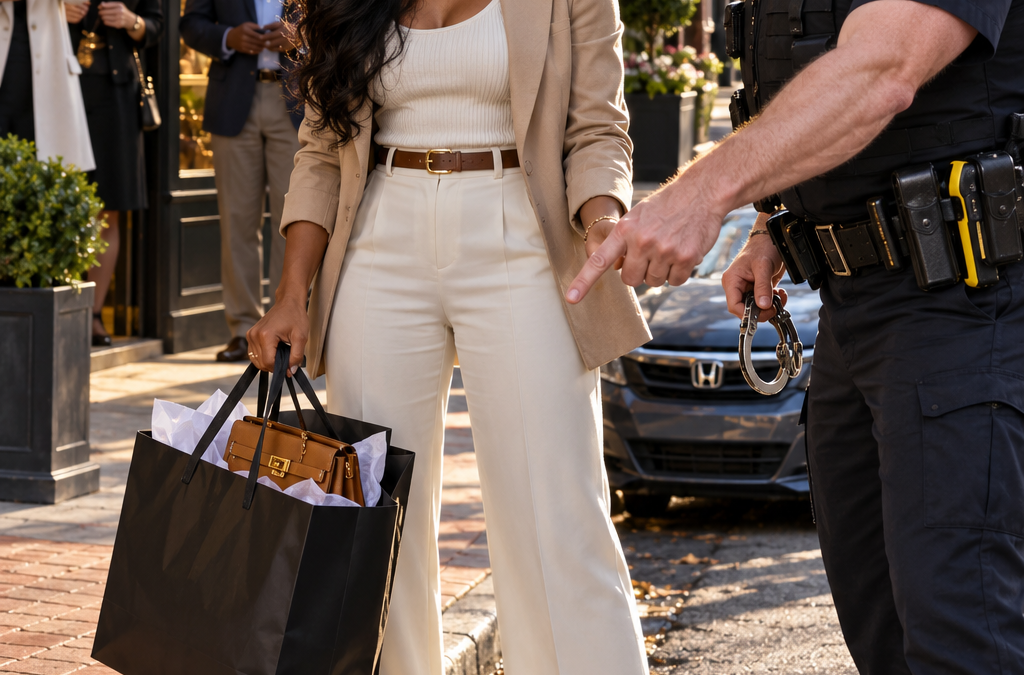
I could have ended the encounter with one sentence, but when he threw my receipt into the gutter and reached for his cuffs, I realized I was about to learn exactly what kind of department I had agreed to command.
My name is Olivia Spencer.
By the Saturday Derek Holloway stopped me on Elm Avenue, I had spent fifteen years wearing a badge.
I started patrol in Decatur, Georgia, when I was twenty-four.
Twelve-hour shifts.
Radios that cut out at the worst possible moment.
Body armor designed for a man’s shoulders.
Domestic calls where nobody told you the whole truth.
Traffic stops that became foot pursuits.
Foot pursuits that became hospital visits.
I learned quickly that police work is less about authority than restraint.
Anyone can escalate a situation.
The harder skill is knowing when not to.
In my late twenties, I transferred into narcotics.
During a raid, a bullet grazed my left shoulder.
It left a thin white scar I could still feel when the weather changed.
At thirty-two, I became the youngest Black woman in my county to make lieutenant.
At thirty-five, I was running Criminal Investigations.
Homicide.
Fraud.
Major narcotics.
Internal corruption cases no one volunteered to inherit.
Three weeks before that Saturday, my phone rang while I was drinking coffee at home.
I recognized the governor’s chief of staff first.
Then the governor himself came on the line.
“Monroe County needs a sheriff.”
I said nothing.
He continued.
“Someone who can’t be bought, bullied or embarrassed into looking the other way.”
“That’s a flattering description.”
“It wasn’t mine.”
I smiled.
“Whose was it?”
“Seven different people gave me your name.”
The sheriff’s office had been operating under temporary leadership after Gerald Pratt retired.
Pratt had spent years building the image of a stable department.
Low crime.
Good press.
Strong relationships with county commissioners.
But complaints kept surfacing.
Profiling.
Unnecessary force.
Internal reviews closed too quickly.
A culture where senior officers became almost untouchable.
The governor needed someone appointed until the next election.
He wanted me.
I asked for twenty-four hours.
I accepted the next morning.
The appointment made state news.
FIRST BLACK WOMAN NAMED SHERIFF IN MONROE COUNTY.
Photos.
Interviews.
Congratulations from people I hadn’t heard from in years.
The swearing-in was scheduled for Monday at eight.
My office was ready.
Badge engraved.
Nameplate installed.
Command staff notified.
But I had not officially taken control yet.
Saturday was supposed to be my final day without a schedule.
So I drove forty minutes to Ridgewood.
Population just under ten thousand.
Magnolia trees.
Brick storefronts.
American flags hanging from awnings.
The kind of town people described as quiet.
I needed a gift for my older sister’s birthday.
She had spent years carrying the same battered handbag she bought when her youngest entered elementary school.
I had decided to replace it with something ridiculous.
Not practical.
Not sensible.
Something she would never buy for herself.
I parked my Honda Civic on Elm Avenue.
No government vehicle.
No uniform.
No escort.
Linen blouse.
Jeans.
Flat sandals.
Sunglasses pushed onto my head.
I saw the boutique across the street.
Harlow & James.
White brick.
Gold lettering.
One mannequin in the window wearing a dress worth more than the monthly rent on my first apartment.
I stepped inside.
A brass bell chimed.
The store smelled like lavender and polished wood.
Silk blouses were arranged by color.
Handbags sat on glass shelves beneath warm lighting.
Prada.
Valentino.
Givenchy.
Places like that always made merchandise look less like something you bought and more like something you were expected to earn permission to touch.
Behind the register stood a woman in her forties.
Blonde highlights.
French-tipped nails.
Her name tag said KAREN.
She looked up.
Saw me.
Then looked me over.
The reaction was subtle.
Most prejudice is.
People imagine racism always announces itself through slurs.
Often it begins with silence.
No greeting.
No smile.
No, “Let me know if I can help.”
Just observation.
I browsed for twenty minutes.
Every time I moved, Karen moved her eyes.
I picked up one bag.
Put it down.
Checked another.
She never approached.
Eventually I stopped in front of a red Valentino bag.
Calfskin.
Gold clasp.
Simple enough that my sister wouldn’t accuse me of losing my mind.
I turned it over.
Checked the stitching.
Price tag.
$2,800.
Ridiculous.
Perfect.
“I’ll take this.”
Karen blinked.
“That one?”
“Yes.”
She took the bag from me.
At the register, she entered the amount slowly.
I gave her my card.
She stared at it.
Then at me.
Then inserted it.
The transaction cleared.
No hesitation.
No fraud alert.
Four seconds.
APPROVED.
Karen removed the receipt.
She looked at the screen again as though the machine might reconsider.
It didn’t.
She placed the purse in a dust cover.
Then into the boutique’s shopping bag.
She handed me the receipt without a word.
“Thank you.”
Nothing.
I left.
I was halfway down the block when a patrol car swung across the lane and stopped in front of me.
Emergency lights came on.
Red.
Blue.
Reflections rolled across store windows.
I stopped.
The driver’s door opened.
Officer Derek Holloway stepped out.
I knew the name.
Not personally.
But during my preparation for Monday, I had skimmed the roster.
Twelve years.
Patrol.
Senior officer.
Several commendations.
I had not yet reached the complaint files.
That would matter later.
He was tall.
Over six feet.
Heavy through the chest and shoulders.
He left his sunglasses on top of his head.
“Stop right there.”
I looked behind me.
Then back at him.
“Are you speaking to me?”
“Do you see anybody else walking away from that store with merchandise they can’t afford?”
There are sentences that tell you immediately what kind of encounter you’re entering.
That was one.
I did not identify myself as incoming sheriff.
People later asked why.
Some assumed I wanted to test him.
I didn’t.
At that moment, I still believed training could correct the encounter before identity became relevant.
“I purchased everything I’m carrying.”
“Sure.”
“I have the receipt.”
“Let’s see it.”
I reached into my pocket.
Slowly.
Even off duty, habits stay with you.
No sudden movement during a police encounter.
I held the receipt out.
He took it.
The date was printed at the top.
Store name.
Item.
Amount.
Last four digits of the card.
Holloway looked at it for less than a second.
Then crumpled it.
He tossed it toward the curb.
“That doesn’t prove anything.”
I looked at the paper lying beside the gutter.
“It proves quite a bit.”
“Could be anyone’s receipt.”
“It corresponds to the item I purchased.”
“Could’ve found it.”
“Call the store.”
His face changed slightly.
Not because the suggestion was difficult.
Because I had made it.
“Excuse me?”
“Call the boutique.”
I pointed back toward Harlow & James.
“The employee who processed the purchase is inside.”
He stepped closer.
“I’ll decide what gets verified.”
“You stopped me based on an allegation. Verification seems relevant.”
His neck reddened.
That was when I understood something important.
My calm was making him angrier.
Some officers are trained to interpret fear as submission.
When they meet someone who isn’t frightened enough, they begin confusing composure with defiance.
Holloway touched his radio.
“Unit nineteen. Possible 459 outside Harlow & James on Elm. Black female, mid-thirties, suspected stolen merchandise. Requesting backup.”
I almost corrected his age estimate.
Then focused on the important part.
“You’re calling this a burglary?”
“I’m calling what I see.”
“What you see is a woman standing on a sidewalk holding merchandise she purchased.”
He moved until we were less than two feet apart.
“What I see is somebody who doesn’t belong on this block carrying something she didn’t earn.”
There it was.
Clearer.
A couple walking a dog stopped across the street.
The woman whispered something.
Her husband shook his head.
They remained where they were.
A teenager on a skateboard slowed.
He pulled out his phone.
I noticed the red recording indicator.
Later I learned his name.
Tyler Brooks.
Seventeen.
Junior at Ridgewood High.
At that moment, he was simply the only person who decided not to look away.
Holloway pointed toward my shopping bag.
“Put it down.”
“No.”
His eyes narrowed.
“Put the bag down.”
“It is my property.”
His thumb moved toward his holster.
He didn’t draw.
He unfastened the retention strap.
Click.
A tiny sound.
Everyone nearby heard it.
The couple stepped backward.
My attention fixed on his hand.
He wanted me to notice.
This wasn’t safety.
It was communication.
Last chance.
Obey me because I can make this dangerous.
I set the bag down slowly.
“There.”
Then I placed both hands at my sides.
“Now verify the purchase.”
Instead of doing that, he pulled latex gloves from his belt.
Snapped them on.
“Turn around.”
“For what?”
“Search.”
“You do not have probable cause to search me.”
“I have a store employee reporting stolen property.”
“You have not confirmed any theft occurred.”
“Turn around.”
I held his eyes.
“No.”
His voice dropped.
“I’m going to tell you once more.”
“And I’m telling you the law does not disappear because you dislike the way I’m answering.”
That was the last reasonable exchange we had.
He grabbed my shoulder.
Hard.
Spun me around.
My palms struck the hood of his cruiser.
The metal was hot from the sun.
“You don’t tell me how the law works.”
He pushed me forward.
The engine vibrated beneath my hands.
Then he searched me.
Not a limited frisk.
Not a lawful protective pat-down.
A humiliating search performed for an audience.
Pockets.
Waistband.
Sides.
Collar.
His hands stayed where no officer following policy would need them to stay.
My entire body wanted to turn around.
I didn’t.
From the sidewalk, somebody called:
“She didn’t do anything.”
Holloway shouted without looking back.
“Anyone interfering with an active investigation gets detained too.”
Silence.
That was all it took.
People know how quickly police power can redirect itself.
A second cruiser arrived.
Officer Travis Kemp stepped out.
I recognized his name too.
Five years.
Patrol.
Younger.
He looked at me against the hood.
Then at the shopping bag.
Then at the receipt near the gutter.
His face tightened.
“What do we have?”
“Shoplifter.”
Holloway continued searching.
“Twenty-eight-hundred-dollar bag.”
Kemp looked toward the boutique.
“Did you verify with the store?”
“They called me.”
“Did you verify the purchase?”
Holloway stopped.
He turned slowly.
“You questioning my stop?”
Kemp’s jaw tightened.
“No, sir.”
“Then control the crowd.”
Kemp hesitated.
Then obeyed.
That moment mattered later too.
He knew.
Not everything.
But enough.
And he chose silence.
Holloway picked up the Valentino.
He held it high.
“$2,800.”
He looked at my blouse.
Jeans.
Sandals.
Then laughed.
“Right.”
He turned the bag.
“And I drive a Lamborghini.”
A few people laughed nervously.
Nobody thought it was funny.
Nervous laughter is what people make when they want authority to know they are not opposing it.
I saw the boutique door open.
Karen stepped outside.
Holloway turned.
“Ma’am. Did this woman purchase this purse?”
That was her opportunity.
One sentence.
Yes.
I processed the transaction.
Everything ends.
Karen looked at me.
Then at the phones.
Then at Holloway.
“She was inside.”
“Did she buy it?”
Karen’s fingers tightened around her own elbow.
“She was acting suspicious.”
I stared at her.
“You ran my card.”
She avoided my eyes.
“I wasn’t sure the transaction was legitimate.”
“The card cleared.”
“I just thought somebody should check.”
“Did I pay?”
She looked at Holloway.
“Better safe than sorry.”
Four words.
Better safe than sorry.
I had heard variations my entire career.
Officer safety.
Suspicious behavior.
Couldn’t be too careful.
A phrase can become a hiding place when nobody asks what evidence lives behind it.
Holloway nodded.
“That’s enough.”
“No,” I said. “It isn’t.”
He turned.
“I’m placing you under investigative detention.”
“I want your badge number.”
“You’ll get it at the station.”
“I want your supervisor.”
He stepped close enough that I could see a coffee stain on his collar.
“You don’t make demands here.”
I remained still.
“That’s how this works for people like you.”
I felt something settle inside me.
Not shock.
Confirmation.
“People like me?”
“You heard me.”
The couple across the street finally walked away.
The barber disappeared back into his shop.
A woman pushing a stroller left.
One by one, people decided survival meant absence.
Only Tyler remained.
His phone stayed up.
Our eyes met.
Just for a second.
I didn’t nod.
Didn’t smile.
But I hoped he understood what I was thinking.
Keep recording.
Then I turned around.
Placed my hands behind my back.
Holloway applied the cuffs.
Far too tight.
The steel crushed into the bones of my wrists.
My fingers began tingling almost immediately.
“Too tight.”
“Should’ve thought about that before stealing.”
“I did not steal.”
He grabbed the chain between the cuffs.
Yanked.
My sandal caught the curb.
My knee struck concrete.
Pain shot through my leg.
I heard someone gasp.
Blood began running down my shin.
Holloway never paused.
He pulled again.
“Up.”
I got my feet underneath me.
Stood.
Straightened my back.
Tyler’s phone captured everything.
The fall.
The cuffs.
The blood.
The officer dragging me upright.
By then thousands were watching.
I didn’t know that.
Holloway walked me to the cruiser.
Pressed me against the rear door.
His hand went to the back of my head.
“Face the car.”
I obeyed.
Then he went back for my shopping bag.
He opened the Valentino.
Turned it upside down.
My belongings spilled onto the pavement.
Lipstick.
Compact mirror.
Tissues.
Hand lotion.
Wallet.
My mother’s photograph.
It was an old print I kept behind my driver’s license.
She died eight years earlier.
It was the only physical copy I carried.
Holloway pulled it out.
Looked at it.
Then flicked it toward the ground.
It landed face down.
Something in me moved then.
Not because of the bag.
Not the cuffs.
My mother.
“You have no right to do that.”
He opened my wallet.
Cards came out one by one.
Visa.
Insurance.
Library card.
He dropped each onto the sidewalk.
“Nothing here says you can afford a twenty-eight-hundred-dollar purse.”
“That is not a legal standard.”
He picked up the Valentino.
Dropped it.
Then stepped on it.
His boot pressed into the leather.
He twisted once.
The bag creased.
He looked at me.
Smiled.
“What are you going to do about it?”
I said nothing.
He raised his voice to the remaining crowd.
“Let this be a lesson.”
My stomach turned.
“This is what happens when people try to play above their level.”
He gestured toward me.
“You walk into a store you don’t belong in.”
I looked at Kemp.
He was fifteen feet away.
His face had changed.
He knew this was beyond procedure.
Beyond mistake.
He approached Holloway.
“Derek.”
“What?”
“The receipt.”
“What about it?”
“It’s right there.”
Kemp pointed.
“We should verify.”
Holloway turned.
“Verify what?”
“The transaction.”
“You’re still on this?”
“Two minutes. Call the store system. Run the card.”
Holloway stepped toward him.
“My scene.”
“I understand.”
“My call.”
Kemp looked at me.
Then back at Holloway.
“The clerk admitted the card processed.”
Holloway’s voice hardened.
“You want to file something about it?”
Kemp went silent.
“Go ahead.”
Another silence.
“See how far that gets you.”
Kemp stepped back.
I watched him.
Years earlier, during my first supervisory assignment, one of my mentors told me:
Bad officers rarely operate alone.
Sometimes they have partners.
Sometimes they have supervisors.
Sometimes all they need is a room full of decent people who decide today isn’t the day to risk their careers.
I was looking at that lesson in real time.
Holloway pulled out his field notebook.
“Name.”
“Olivia Spencer.”
“Address.”
I gave it.
“Employment?”
“Law enforcement.”
He stopped writing.
Then laughed.
“You?”
“Yes.”
“What, mall security?”
I didn’t answer.
“Crossing guard?”
Nothing.
“Airport bag checker?”
He turned toward the crowd.
“A bag checker got her own bag checked.”
Nobody laughed.
Not one person.
The silence embarrassed him.
He looked back at me.
“I am asking one more time,” I said.
“Call the store. Verify the transaction. Remove the restraints.”
“Or what?”
I met his eyes.
“Or you are going to face consequences you are not prepared for.”
He leaned closer.
“Is that a threat?”
“No.”
“What is it?”
“A promise.”
His face twisted.
He wrote something in the notebook.
“Here’s my promise. You go to the station. You sit in a cell. I write my report.”
He tapped the pen against the page.
“And by the time anybody asks questions, it’s your word against mine.”
He smiled.
“Guess whose word wins around here.”
I looked at him.
That sentence told me more about the Monroe County Sheriff’s Department than a month of transition briefings could have.
He opened the rear door.
“Get in.”
I stood still for a second.
Not resisting.
Thinking.
I could say it.
My appointment.
My name.
Monday.
I could end everything.
But the encounter had moved beyond me.
Fourteen complaints I had not yet read.
Kemp’s fear.
Karen’s confidence that her suspicion was enough.
Holloway openly telling a citizen he controlled the story because his badge would make people believe him.
I needed to know how deep this went.
So I ducked my head and sat in the cruiser.
The door closed.
Locks clicked.
Through the dirty rear window, I saw Tyler lower his phone briefly.
His hands were shaking.
Kemp pulled out his own phone.
Typed something.
Then put it away.
Later, I learned what he sent.
Sergeant Rita Caldwell, you need to see what Holloway is doing on Elm. It’s bad.
We drove away.
My belongings remained scattered on the sidewalk.
The receipt lay in water near the gutter.
Still readable.
Still proving I paid.
We hadn’t gone two blocks when dispatch called.
“Unit nineteen.”
Holloway lifted the radio.
“Go.”
“Confirm detainee’s name.”
He looked at me through the mirror.
“Olivia Spencer.”
A pause.
“Middle initial?”
I almost smiled.
Holloway checked my license.
“R.”
Another pause.
Longer.
Someone spoke in the background.
Then a different voice came over the radio.
Captain Warren Hughes.
“Holloway.”
“Captain.”
“Pull over.”
“I’m transporting a shoplifting suspect.”
“I said pull over.”
The arrogance disappeared from Holloway’s posture.
He slowed.
“What happened?”
“Do not proceed to the station.”
“Captain—”
“Pull to the curb and wait.”
He stopped in front of a closed dry cleaner.
His fingers tightened around the steering wheel.
“What’s going on?”
Then came the sentence.
The one that changed his face.
“Olivia R. Spencer is the incoming sheriff of Monroe County.”
Silence.
“Governor appointed her three weeks ago.”
Holloway stopped breathing.
“She assumes command Monday at 0800.”
The radio crackled.
“You have the next sheriff of this department handcuffed in your back seat.”
Nothing.
The world inside that cruiser became impossibly quiet.
Holloway stared forward.
I watched him in the mirror.
Color drained from his face.
His mouth opened slightly.
Closed.
He looked at me.
For the first time that afternoon, Derek Holloway saw a person instead of the story he had invented.
Not because I had changed.
Because suddenly I had power over him.
That disgusted me.
I leaned slightly forward.
“Officer Holloway.”
He looked away.
“Officer Holloway.”
His shoulders lowered.
“Look at me.”
Slowly, he turned.
“Uncuff me.”
He got out.
Opened the rear door.
His hands shook so badly the key missed twice.
The third time, metal clicked.
The cuffs opened.
I brought my hands forward.
Deep grooves circled both wrists.
Purple already beginning beneath the red.
I rubbed them slowly.
Not dramatically.
Documenting with my own eyes what would later be photographed.
Kemp pulled in behind us.
Thirty seconds later, another vehicle arrived hard.
Unmarked sedan.
Sergeant Rita Caldwell stepped out before the engine fully stopped.
Fifty-two.
Twenty-six years on the force.
Silver hair pulled tight.
She walked straight to the cruiser.
She saw me.
My wrists.
Blood on my knee.
Then Holloway.
“Holloway.”
He turned.
Her voice became quieter.
“Open the door.”
“It’s open.”
I stepped out.
Straightened my blouse.
Brushed dust from my jeans.
Caldwell looked at me.
“Ma’am, I’m Sergeant Rita Caldwell.”
She stopped.
Her eyes went to my wrists again.
“I am deeply sorry.”
“Sergeant.”
I nodded.
“Thank you for coming.”
Then I faced Holloway.
He looked physically smaller.
“Officer.”
“Ma’am.”
“On Monday morning, I will take command of this department.”
His eyes closed briefly.
“I will approve personnel decisions.”
Silence.
“I will review use-of-force policy.”
His jaw trembled.
“And I will decide whether people who demonstrate contempt for constitutional rights continue carrying badges in this county.”
He swallowed.
“I want your badge number.”
“419.”
“Body-camera footage preserved immediately.”
“Yes, ma’am.”
“Internal Affairs referral on my desk at eight Monday.”
“Yes.”
“Do not delete, alter or contact anyone regarding this incident.”
“Understood.”
Caldwell stepped toward him.
“Badge.”
He looked at her.
“Sergeant—”
“Badge and weapon.”
He began talking fast.
“I got a call. Karen said the bag was suspicious. She told me—”
“Badge.”
“I followed procedure.”
“You will have the opportunity to explain that.”
“Rita.”
Her eyes hardened.
“Do not use my first name.”
His hand went to the badge.
For the first time, he struggled with the clip.
He placed it on the hood.
Then his Glock.
Same holster he had unsnapped to frighten me.
Now empty.
“You are suspended without pay pending investigation.”
“Sergeant—”
“Do not contact Officer Kemp.”
Kemp stared at the ground.
“Do not contact Karen Whitfield.”
Holloway’s face tightened.
“Do not access department systems.”
Caldwell radioed for transport.
Then turned to Kemp.
“I need your body camera uploaded.”
“Yes.”
“Written statement.”
“Yes.”
“Everything.”
She held his eyes.
“What you saw.”
Pause.
“What you said.”
Longer pause.
“And what you didn’t do.”
Kemp nodded.
“Yes, Sergeant.”
Caldwell approached me.
“I want you evaluated at the hospital.”
“I will.”
“What do you need right now?”
I looked toward Elm Avenue.
“My belongings.”
She waited.
“My wallet.”
I looked at the bruises forming around my wrists.
“My cards.”
Then the thing I cared about.
“My mother’s photograph.”
My voice changed slightly.
Caldwell noticed.
“Holloway threw it into the street.”
Her jaw tightened.
“I want it recovered in an evidence bag.”
“It will be.”
“And Karen Whitfield.”
Caldwell nodded.
“Recorded statement tonight.”
“Agreed.”
A patrol officer returned to Elm Avenue.
He collected everything.
Including the receipt.
Still soaked.
Still readable.
Including my mother’s photograph.
Face down near the gutter.
He put it into clear evidence packaging.
When Caldwell brought it to me later, I held the plastic sleeve for almost a minute.
My mother was smiling through scratches on the old print.
I thought about the way Holloway had flicked her image away.
Then I put it safely in my purse.
Karen gave her statement that evening.
At first, she tried to minimize everything.
“I never said she stole.”
The detective had the call log.
“You reported suspected theft.”
“I said the situation seemed suspicious.”
“Why?”
Karen had no answer that sounded acceptable once spoken out loud.
“She was touching expensive items.”
“She’s a customer.”
“She was looking around.”
“Customers do that.”
“I just thought—”
“What?”
Silence.
Finally:
“She looked out of place.”
There it was.
The boutique owner saw Tyler’s video before the interview ended.
Karen was terminated before midnight.
I did not celebrate that either.
The problem was larger than one sales clerk.
Monday morning arrived on schedule.
At eight, I stood at a podium in the Monroe County courthouse.
Navy suit.
Gold sheriff’s badge above my heart.
Long sleeves covering the bruises.
Bandage beneath my trousers.
The room was full.
Commissioners.
Officers.
Reporters.
Residents.
Tyler stood in the back.
His Saturday livestream had spread everywhere.
Hundreds of thousands had watched Holloway arrest the woman who was about to become his sheriff.
By Monday, Tyler’s following had crossed a million.
The oath was simple.
I raised my right hand.
For a second, pain pulled through my wrist.
I kept it raised.
When the oath ended, the room applauded.
I waited.
Then I stepped toward the microphone.
I had written a speech Sunday night.
I didn’t use most of it.
“Accountability is not punishment.”
The room quieted.
“It is a promise.”
I looked toward the deputies lining the wall.
“A promise that people who carry authority will be held to at least the same legal standard as the people over whom that authority is exercised.”
Nobody moved.
“This badge is not a permission slip.”
I touched it.
“It is a restriction.”
A few officers shifted.
“It limits what we may do.”
“It tells us we serve.”
“It does not tell us we rule.”
I looked across the public gallery.
“Starting today, complaints will not disappear because they are inconvenient.”
I saw Caldwell.
Kemp.
Commissioners.
“Seniority will not convert misconduct into acceptable practice.”
Then I finished.
“And no citizen will be required to prove they are important before being treated as human.”
I stepped back.
That became the principle of my first year.
Internal Affairs opened Holloway’s case immediately.
Then I ordered something else.
“Pull his entire complaint history.”
Fourteen complaints.
I read every one.
Some were weak.
Some were contradictory.
Some lacked evidence.
But several should never have been closed.
Eleanor Hayes.
Sixty-one.
Retired postal worker.
Stopped in 2019 for a supposedly broken taillight.
Body-camera footage had never been properly reviewed.
The taillight worked.
Holloway kept her standing in the rain while he searched her vehicle.
Nothing found.
No citation.
Complaint filed.
Closed within three days.
Unsubstantiated.
A college student reported being pulled from a car because he was “moving suspiciously.”
No contraband.
No charge.
Complaint closed.
Another Black resident reported Holloway using racial language during a stop.
No sustained finding.
Again.
Again.
Again.
Statistics showed what individual files had hidden.
Over twelve years, Holloway stopped Black drivers at a rate wildly disproportionate to both population and department averages.
His use-of-force reports showed the same escalation sequence.
Command.
Confrontation.
Physical contact.
Cuffs.
Sometimes weapon display.
Very little de-escalation.
Very little verification.
Everything I had experienced on Elm Avenue was not an exception.
It was a method.
Former Sheriff Gerald Pratt was called before the county commission.
He said:
“I trusted my officers.”
One commissioner asked:
“Even after fourteen complaints?”
Pratt shifted.
“Holloway was effective.”
“Effective at what?”
Pratt had no answer.
Eventually, federal investigators arrived.
Title 18, Section 242.
Deprivation of rights under color of law.
They collected Tyler’s video.
Holloway’s body cam.
Kemp’s footage.
Dispatch traffic.
Karen’s call.
My receipt.
The purse.
Photographs of my injuries.
Then they subpoenaed Holloway’s phone.
That’s where any remaining ambiguity died.
Messages.
Slurs.
Jokes.
Statements about Black residents.
Comments about putting people “in their place.”
One message from the night before he stopped me read:
Let’s see which ones try acting like they belong tomorrow.
I sat alone in my office when investigators showed it to me.
For several seconds, I said nothing.
Then I asked:
“How many supervisors knew about prior complaints?”
Too many.
The grand jury indicted Holloway eleven days after the incident.
Civil-rights violation.
False reporting.
Evidence tampering tied to the receipt he knowingly discarded.
The trial lasted six days.
I testified.
The prosecutor asked why I did not identify myself as incoming sheriff.
I answered truthfully.
“Because I should not have needed to.”
Holloway’s attorney stood.
“You could have ended the encounter.”
“No.”
“You could have shown him who you were.”
“I showed him identification.”
“I mean your position.”
I looked at the jury.
“My position is irrelevant to whether Officer Holloway had authority to fabricate probable cause.”
The attorney changed direction.
“But revealing that you were a law-enforcement executive might have reduced confusion.”
“It might have changed how he treated me.”
“Exactly.”
I looked at him.
“That is the problem.”
He stopped.
I continued.
“If an officer respects constitutional limits only after discovering the person in handcuffs outranks him, that officer does not respect constitutional limits.”
No one moved.
“I was entitled to lawful treatment before Monday.”
The prosecutor later played Tyler’s video.
Normal speed.
Then slower.
Then audio isolated.
The jury heard Holloway call me a thieving roach.
They saw him crush the bag.
Saw my mother’s photograph hit the ground.
Saw my knee strike concrete.
Saw Kemp hesitate.
Saw Karen lie.
They also saw me remain calm.
People praised that afterward.
I never understood why.
Calm was not courage.
It was survival.
I knew what can happen when a Black person under police control is described as aggressive.
Every word becomes evidence.
Every movement becomes resistance.
I remained calm because fifteen years inside law enforcement had taught me how dangerous language becomes once an officer decides to narrate you as a threat.
The jury deliberated three hours and fourteen minutes.
Guilty.
All counts.
When the clerk read the verdict, Holloway lowered his head.
I watched him.
I expected satisfaction.
It didn’t come.
Eleanor Hayes sat behind me.
When the final guilty was read, she closed her eyes.
Exhaled.
Nodded once.
That mattered more.
At sentencing, the judge addressed Holloway directly.
“You were entrusted with authority to protect.”
Holloway stood in a dark suit.
No badge.
No gun.
Hands trembling.
“You transformed that authority into a weapon against the people you were sworn to serve.”
Twenty-four months in federal custody.
Three years supervised release.
Permanent bar from law-enforcement employment.
Some people called the sentence too light.
Others said losing his career was punishment enough.
I stayed out of that debate.
My work wasn’t finished.
Karen settled the civil case connected to her conduct.
Harlow & James publicly apologized.
The store changed ownership later.
Bias training became mandatory.
I didn’t care much about the press statement.
I cared whether the next person who walked through that door would be greeted before being evaluated.
Three other officers appeared in Holloway’s text messages.
Investigations followed.
Two resigned.
One was terminated.
The bigger work was inside my own department.
I created an independent Office of Accountability.
Civilian oversight.
Subpoena power.
Outside investigators.
Direct referral authority to the county prosecutor.
Every unresolved complaint from the previous decade was reviewed.
Thirty-seven cases reopened.
Twenty-two sustained findings.
Nine officers disciplined.
Three terminated.
One additional case referred federally.
The numbers made headlines.
The people behind them mattered more.
I signed Eleanor Hayes’s apology letter myself.
No press conference.
No cameras.
Just a plain envelope.
Weeks later, she visited my office.
She was smaller than I expected.
Gray hair.
Careful smile.
“You’re Sheriff Spencer?”
“Yes, ma’am.”
She handed me the letter.
“I brought this back.”
I frowned.
“Is something wrong?”
“No.”
She touched the page.
“I just wanted you to see what it means when somebody finally says the thing that should have been said five years ago.”
I looked at her.
“I’m sorry it took that long.”
“So am I.”
She folded the letter carefully.
“But somebody said it.”
She put it into her purse.
“That’s something.”
Kemp was more complicated.
I had watched him fail me.
He knew Holloway’s stop was wrong.
He saw the receipt.
Saw Karen hesitate.
He tried once.
Then retreated.
I didn’t fire him.
I also didn’t reward him for sending the text to Caldwell.
When we met in my office, I asked:
“Why didn’t you stop him?”
He stared at the floor.
“Because I was afraid.”
“Of what?”
“Holloway.”
“Specifically.”
“My evaluations.”
“Keep going.”
“Assignments.”
“Keep going.”
He swallowed.
“Career.”
There it was.
“I filed a concern years ago.”
“What happened?”
“My sergeant told me senior officers protect people who protect them.”
“And you believed him.”
“Yes.”
“You watched Holloway violate policy.”
“Yes.”
“You watched him tighten the cuffs.”
“Yes.”
“You saw the receipt.”
“Yes.”
“And you chose your career.”
Kemp looked up.
“Yes.”
I leaned back.
“Don’t call yourself a hero because you texted Caldwell.”
“I don’t.”
“Good.”
His eyes were wet.
“I was a coward.”
I said nothing.
He continued.
“I knew.”
“That matters.”
“I know.”
“You don’t erase cowardice by naming it.”
“No, ma’am.”
“You change what you do next.”
He did.
Over the next months, Kemp volunteered for the department’s early-intervention program.
Community meetings.
Civilian ride-alongs.
Officer mentoring.
Use-of-force review.
When a reporter asked why he had changed, he didn’t polish himself.
“I saw something wrong and chose my career.”
He paused.
“I don’t deserve credit because eventually I stopped choosing wrong.”
That answer told me he might become useful.
Eventually, he made sergeant.
Not because of Elm Avenue.
Because afterward he became the officer he should have been before it.
Tyler changed too.
The seventeen-year-old with the shaking phone became part of something much larger than he intended.
Media companies contacted him.
Schools.
News organizations.
He could have turned the video into a career built around one viral afternoon.
Instead, he agreed to become a civilian youth liaison for the department.
Part time.
Still in school.
He sat in policy meetings.
Asked irritating questions.
Exactly what I wanted.
On his first day, a reporter asked why he accepted.
Tyler said:
“Because everyone else put their phones down.”
He looked into the camera.
“I don’t want being the only person watching to feel normal.”
Six months after the incident, I drove through Ridgewood.
Routine patrol.
I didn’t usually ride alone anymore, but that morning I wanted quiet.
Magnolia trees.
Same storefronts.
Same American flags.
Elm Avenue approached.
I slowed.
Harlow & James was still there.
Different ownership.
New employees.
In the window was a small sign.
EVERYONE IS WELCOME.
I almost laughed.
Signs are easy.
Culture is harder.
I parked anyway.
Walked inside.
The bell chimed.
A young clerk looked up.
“Good morning.”
“Morning.”
“Can I help you find anything?”
“No.”
“Take your time.”
Then she went back to folding sweaters.
No staring.
No tracking my hands.
No assumption.
I browsed for ten minutes.
I didn’t buy anything.
Before leaving, I stood where the red Valentino had once been displayed.
I thought about the receipt.
The cuffs.
My mother’s photograph in the gutter.
Holloway telling me whose word would win.
Then I looked through the window at the sidewalk.
People passed.
Nobody knew exactly where my knee had hit the pavement.
That was fine.
Not every scar needs a monument.
Some need policy.
Data.
Oversight.
Training.
Consequences.
That’s what I chose.
People often asked why I didn’t identify myself earlier.
The question always carried an assumption.
That revealing power would have been the obvious solution.
Maybe.
For me.
Not for the next woman.
If I had said, “I’m your incoming sheriff,” Holloway probably would have stepped back.
Maybe apologized.
Maybe even saluted.
Then Monday would have arrived.
He would still have fourteen complaints in his file.
Eleanor Hayes would still have her memory of forty minutes in the rain.
Other citizens would still know his face for reasons their government had refused to hear.
Kemp would still believe silence was safer.
Karen would still believe a Black customer buying an expensive bag was inherently suspicious.
The problem would have remained.
Only I would have escaped it.
That wasn’t enough.
I never planned to become evidence in my own department.
I would have preferred another method.
But once it happened, I refused to turn the incident into a story about a powerful woman secretly outranking the man abusing her.
That was never the lesson.
The lesson was that Derek Holloway should not have needed to know my title.
My rights existed before he heard dispatch.
My dignity existed before the governor appointed me.
The receipt was valid before Captain Hughes said my name.
And the cuffs were wrong before Holloway learned whose signature would appear on personnel decisions Monday morning.
That distinction became the foundation of every reform I made.
One afternoon, months later, I spoke to a new academy class.
Thirty recruits sat in rows.
Fresh uniforms.
Straight backs.
The optimism of people who had not yet learned how heavy authority becomes.
I held up my badge.
“What’s this?”
One recruit answered:
“Authority.”
“Wrong.”
They looked confused.
Another said:
“Responsibility.”
“Closer.”
I put it on the table.
“This is public property.”
Silence.
“It is issued to you.”
I looked around.
“It can be taken from you.”
No one moved.
“The Constitution is not issued to you.”
I paused.
“It belongs to the person you stop.”
“The person you arrest.”
“The person who insults you.”
“The person you think is lying.”
“The person you know is guilty.”
“The person whose clothes you dislike.”
“The person whose neighborhood scares you.”
“The person who cannot afford an attorney.”
I leaned forward.
“And the person carrying a handbag you don’t think they can afford.”
A few recruits shifted.
They knew the story.
Everybody did.
I continued.
“If your respect for a citizen changes after you learn who they are, ask yourself what exactly you were respecting before.”
Nobody answered.
“Authority without restraint is not strength.”
I picked up the badge.
“It’s insecurity with government backing.”
That line circulated later.
People put it on posters.
I never intended that.
I was thinking about Holloway.
About the way he stood on Elm Avenue before the radio call.
Six-foot-two.
Armed.
Uniformed.
Surrounded by authority.
Still desperate for me to act frightened enough to reassure him.
Then after dispatch:
Smaller.
Shaking.
Needing the woman he had humiliated to tell him what would happen next.
The badge had not changed.
His understanding of my power had.
That was why I never forgot the smile I gave him when I was kneeling on the pavement.
Tyler’s video captured it.
People interpreted that smile a hundred ways.
Confidence.
Defiance.
Secret knowledge.
Revenge.
It wasn’t any of those.
At least not entirely.
I smiled because Holloway was so certain.
Certain I was poor.
Certain I was lying.
Certain Karen’s suspicion mattered more than my receipt.
Certain the crowd would obey him.
Certain Kemp would stay quiet.
Certain his report would become the truth.
Certain his badge made him untouchable.
And I knew something he didn’t.
Monday was coming.
Not just for him.
For the whole department.
That was what the smile meant.
You believe this moment belongs to you.
It doesn’t.
Truth has a clock of its own.
Sometimes it moves slowly.
Fourteen complaints slowly.
Five years of silence slowly.
A woman standing in the rain forty minutes slowly.
Sometimes it moves in one radio transmission.
Pull over immediately.
Sometimes it arrives Monday at eight in a navy suit with a gold badge.
But when it arrives, the most important question is not whether the powerful person gets revenge.
It’s whether the system becomes safer for someone without power.
That was the only outcome I cared about.
Six months after taking office, complaints were down sharply.
Not because I discouraged them.
We made complaints easier.
Online.
Anonymous options.
Independent review.
What fell was preventable misconduct.
Supervisors intervened earlier.
Officers de-escalated more.
Body-camera audits became random rather than complaint-driven.
Data identified patterns before somebody ended up bleeding on concrete.
That is what reform looks like most days.
Boring.
Spreadsheets.
Training hours.
Meetings.
Policy language.
Disciplinary matrices.
Not viral.
Not dramatic.
But far more important than watching one bad officer lose a badge.
On my office shelf, I keep two things.
My mother’s photograph.
Clean now.
Reframed.
And the original receipt from Harlow & James.
Water damaged.
Wrinkled.
Almost unreadable around the edges.
$2,800.
Paid in full.
Someone once asked why I kept it.
I said:
“Evidence.”
They assumed I meant evidence from the case.
I didn’t.
It reminds me how little proof matters to somebody committed to disbelief.
Holloway had the receipt in his hand.
He threw it away.
That is what prejudice does.
It doesn’t merely create false conclusions.
It rejects contradictory evidence because the conclusion came first.
My work as sheriff became making it harder for anybody with a badge to do that without consequence.
Not impossible.
Institutions are built from human beings.
Human beings fail.
I fail.
My officers fail.
But a healthy institution cannot require perfection.
It requires correction.
Fast.
Transparent.
Documented.
Independent when necessary.
That was what Monroe County had lacked.
The department had spent years teaching officers that mistakes could disappear if enough people inside the same building agreed not to look.
Holloway became reckless because nobody stopped him earlier.
Karen became confident because society had rewarded suspicion when it flowed in one direction.
Kemp became quiet because silence preserved careers.
The crowd became cautious because they had seen what happens when police turn attention toward witnesses.
Tyler was the exception.
Seventeen.
Hands shaking.
Three hundred followers when he lifted the phone.
He stayed.
People later praised him for recording.
The praise was deserved.
But I told him something privately.
“Next time, don’t risk your life for footage.”
He looked surprised.
“But—”
“Document when you safely can.”
I pointed toward him.
“But don’t turn yourself into another victim because people online want a better angle.”
He nodded.
“Yes, ma’am.”
Then he smiled.
“I wasn’t that close.”
“You were closer than your mother thinks you were.”
His face changed.
“How do you know?”
“She called me.”
His eyes widened.
I laughed.
That was the first time I laughed about anything connected to Elm Avenue.
Time helps.
Not by erasing.
By giving memories somewhere else to live.
My knee healed.
Wrists healed.
The bag went to my sister after all.
I had it professionally repaired first.
When she opened it, she stared.
“Olivia.”
“Happy birthday.”
“You lost your mind.”
“Probably.”
Then she saw the crease in the leather.
“What’s this?”
I looked at it.
The repair shop could have replaced the damaged panel.
I told them not to.
“Long story.”
She stared at me.
“That bag?”
“That bag.”
Her face softened.
“You sure you want to give it away?”
“Absolutely.”
“Why?”
I smiled.
“Because it’s still a handbag.”
She laughed.
That mattered.
I refused to let Holloway turn an object into a monument.
My mother’s photograph was different.
The receipt too.
But the purse belonged on my sister’s shoulder.
Used.
Scratched.
Filled with receipts and gum wrappers and whatever else sisters put into absurdly expensive bags after insisting they don’t need them.
Life moving forward.
That’s the part viral stories often miss.
People want a clean ending.
Bad officer punished.
Good woman wins.
System fixed.
Real endings are messier.
Holloway went to prison.
That did not restore the years his earlier victims spent being ignored.
Karen lost her job.
That did not erase every customer she had watched differently.
I became sheriff.
That did not make racism disappear.
Kemp improved.
That did not undo the moment he stepped back.
The department changed.
That did not mean it could never fail again.
So we kept working.
That’s the ending I trust.
Not triumph.
Practice.
Every morning, I walk into the sheriff’s office and pass the duty board.
Names.
Assignments.
Shifts.
People carrying firearms and legal authority because the public has temporarily trusted them to do so.
Sometimes I stop.
I think about Saturday.
Holloway’s words.
Guess whose word wins in this town?
Then I enter my office.
Above my desk is no giant portrait of myself.
No newspaper headline.
No screenshot of the livestream.
Just the oath of office.
And beneath it, in a small frame, the damaged receipt.
Because if I ever begin believing my word should automatically win simply because of the badge pinned to my chest, I will have become exactly the kind of sheriff Monroe County appointed me to replace.








